José Daniel Ferrer, in Madrid, lashes out at European complicity with Havana
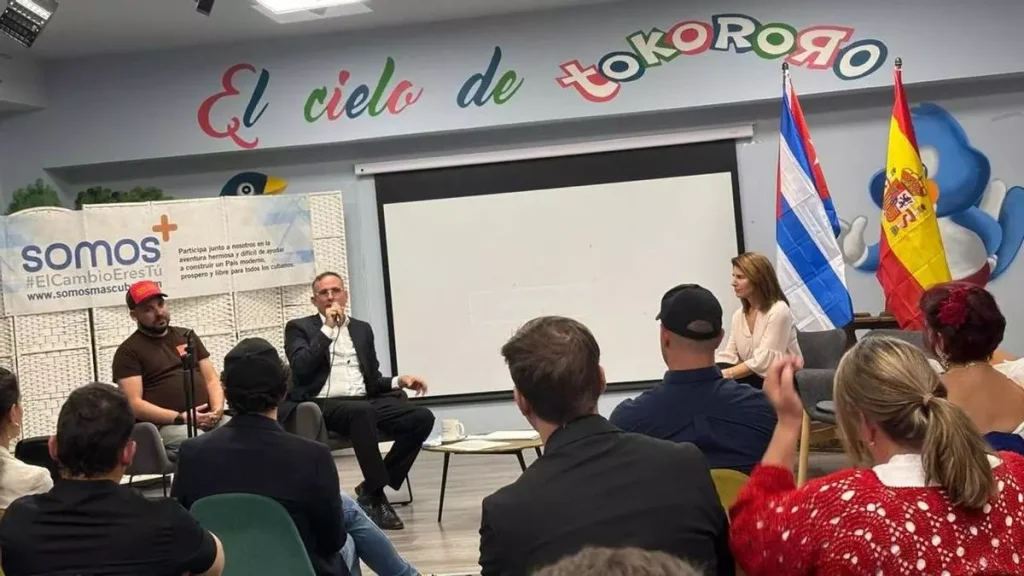
 14ymedio, Madrid, 17 May 2026 / “Spain must stop giving oxygen to the Cuban dictatorship.” The dry, direct sentence summed up the message José Daniel Ferrer delivered this Friday at a meeting lasting more than two hours with dozens of Cuban exiles in Madrid. The opposition leader did not come to ask for symbolic gestures or lukewarm declarations, but for a concrete political decision: to suspend the Political Dialogue and Cooperation Agreement between the European Union and Cuba, a framework which, he denounced, has done more to sustain the regime than to improve the lives of Cubans.
In Cuban prisons, Ferrer saw padlocks and handcuffs bearing the inscription “Made in Spain”. The image served to point directly at Spain as the European country most determined to keep relations with Havana open. “After China, Spain has become one of the biggest exporters to Cuba of products used in repression,” he said before an audience that included, among others, Iván Espinosa de los Monteros, former Vox spokesman in the Congress of Deputies, and Rocío Monasterio, a Spanish-Cuban politician and former spokeswoman for that party in the Parliament of the Autonomous Community of Madrid.
The opposition figure, released from prison and sent into exile after spending more than twelve years in the regime’s jails, insisted that the Spanish Government cannot present itself as a defender of human rights while backing a policy of understanding with a dictatorship. “Spain must stop supporting an anti-democratic regime that violates the rights of all its citizens,” he maintained.
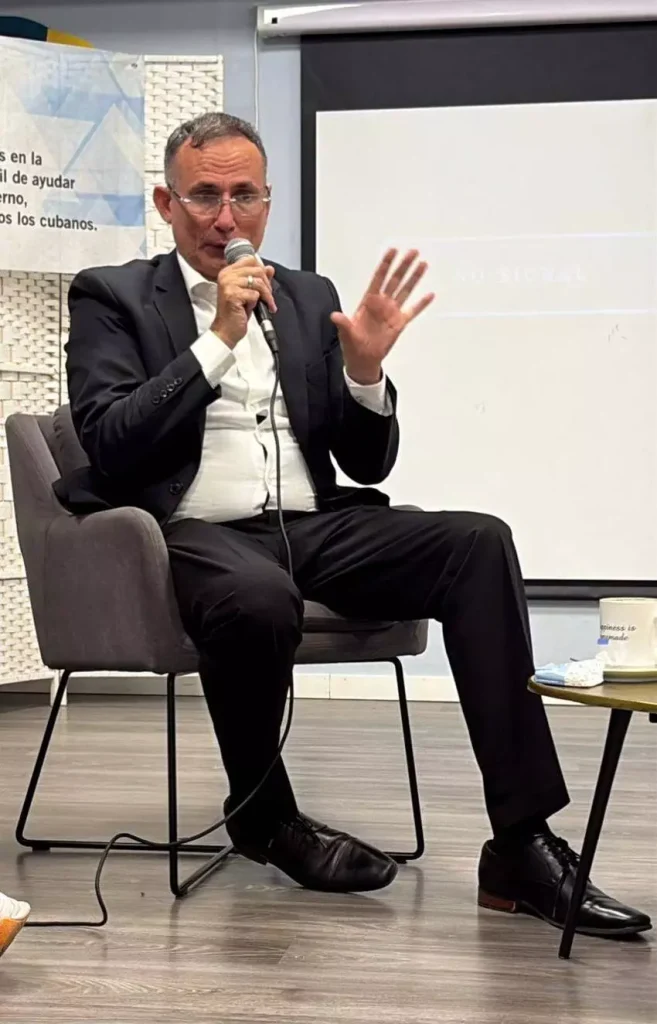
During his stay in this country, Ferrer is scheduled to meet politicians from the People’s Party and Vox. For now, he has no meetings arranged with figures from the Socialist Government, although he said he would be willing to speak with them. His aim, he said, would be to repeat to them the same thing he has taken to other European countries: that Cuba does not need more diplomatic oxygen, but international pressure. “It is a regime that only understands the language of pressure,” he said.
Ferrer also recalled the attitude which, according to him, some Spanish officials posted in Havana maintained for years. In the days of the thaw, they avoided meeting opposition figures, even when Barack Obama was able to do so during his visit to the Island. The explanation, he said, was that the President of the United States was allowed to do so because he was “the enemy”, whereas Spain was not. Ferrer would answer them with sharp Cuban humour: “Then being their enemy is always better; it is the only way to get them to respect you.”
“If he vomits it up, they pick it up off the floor and put it back in his mouth”
The most harrowing part of the meeting came when he spoke about prison. The leader of the Patriotic Union of Cuba (Unpacu) described humiliations, punishments and torture suffered by him and by other political prisoners. During a hunger strike, he recalled, they forced him to swallow rotten soup. A guard threatened him: “If he vomits it up, they pick it up off the floor and put it back in his mouth.”
Among the punishments, he mentioned the one the guards themselves know as “Shakira”: handcuffing the detainee by hands and feet for hours, forcing him to writhe in pain on the cold floor of a cell. Another method, he explained, consists of hanging the prisoner from the upper part of a grille, handcuffed, forcing him to remain for a long time barely supported on the tips of his toes.
Ferrer also spoke about the Catholic Church, an institution with which he has a relationship marked by gratitude and disappointment. He recalled moments when the church hierarchy acted as mediator to get inconvenient opposition figures out of Cuba, turning release from prison into banishment. But he distinguished that conduct from that of many priests, religious and laypeople who, inside the Island, he said, “have bravely defended the dignity of Cubans”, even from the pulpit, in the face of abuses by those in power.
“The advice of the regime’s thugs is not advice, it is threats,” he said, before recalling Samaniego’s fable ‘The Dog and the Crocodile’
The opposition leader devoted a central part of his remarks to political prisoners. He asked the exile community not to limit itself to providing economic support to families, but to accompany them emotionally and keep every case constantly visible. “The better known a prisoner of conscience is, the more careful they are about abusing him,” he said. For Ferrer, the most effective combination is for the prisoner to remain firm and for his family also to denounce what is happening.
He also warned against the silence imposed by fear. Many families, he explained, avoid denouncing beatings, threats or lack of medical care in the hope of protecting the inmate. But that strategy, he insisted, almost never works. “The advice of the regime’s thugs is not advice, it is threats,” he said, before recalling Samaniego’s fable ‘The Dog and the Crocodile’: one should not accept as guidance the voice of someone who wants to devour you.
Ferrer also devoted several minutes to the responsibility of the exile community. Leaving Cuba, he said, does not mean abandoning the struggle or becoming a spectator. To prove it, he showed on his phone a WhatsApp thread with an endless list of contacts with activists, relatives of political prisoners, independent journalists and opposition figures who are still inside the Island. “We have to talk every day with those who are over there,” he insisted.
When an activist knows that someone calls him, listens to him and publicises his case, he feels less alone in the face of the machinery of repression. Isolation, he recalled, is one of the regime’s most effective weapons.
“We have to talk every day with those who are over there”
He also referred to the emergence of new political parties and platforms in exile. He considered this positive, but issued a warning: the struggle against the dictatorship cannot be turned into an early election campaign. “The priority must be to end the dictatorship,” he said. Plurality will be indispensable in a democratic Cuba, but first, he stressed, “we have to win the freedoms that do not exist today”.
Ferrer called for coordination among organisations, activists, journalists, Churches, relatives of prisoners and emigrant communities. “The dictatorship is cohesive,” he recalled. Its apparatus, he said, acts together to repress, monitor, discredit, infiltrate and divide.
For that reason, he called on the exile community not to fall into rivalries manufactured in Havana. “Their main strategy has always been to set us against one another,” he warned. Differences of opinion, he added, must not become enmity or a public spectacle for the benefit of the regime.
His final appeal was less a speech than a warning. Cuba’s freedom, he came to say, will not come from international compassion or from agreements with the repressors. It will come when the tap of external legitimacy is turned off, when political prisoners are not left alone, and when the exile community understands that its strength lies not in competing for the future, but in pushing together against the present.
Translated by GH
______________________
COLLABORATE WITH OUR WORK: The 14ymedio team is committed to practicing serious journalism that reflects Cuba’s reality in all its depth. Thank you for joining us on this long journey. We invite you to continue supporting us by becoming a member of 14ymedio now. Together we can continue transforming journalism in Cuba.