Díaz-Canel is not afraid of ending up like Maduro, but he is terrified of ending up like Ceausescu
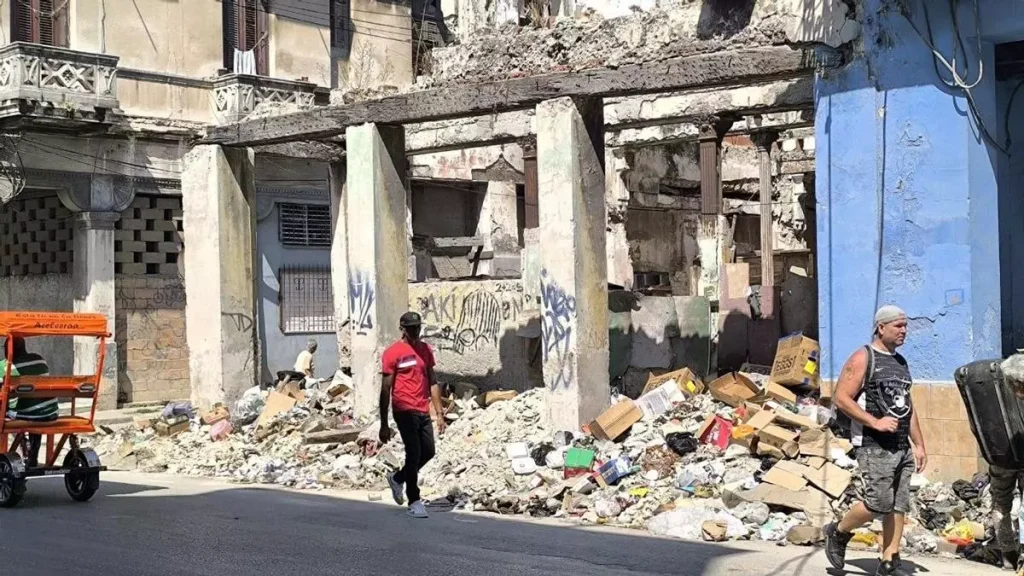
 14ymedio, Madrid, Yunior García Aguilera, May 16, 2026 – Havana looks like a bombed-out city, even though no enemy has yet signed the order to attack. Buildings split open like broken ribs. Balconies hang over the sidewalk with the stubbornness of the hanged. The city—one of the most beautiful in the region—now looks like a mouth full of cavities. Almost all the photos arriving from the capital seem taken by a war correspondent.
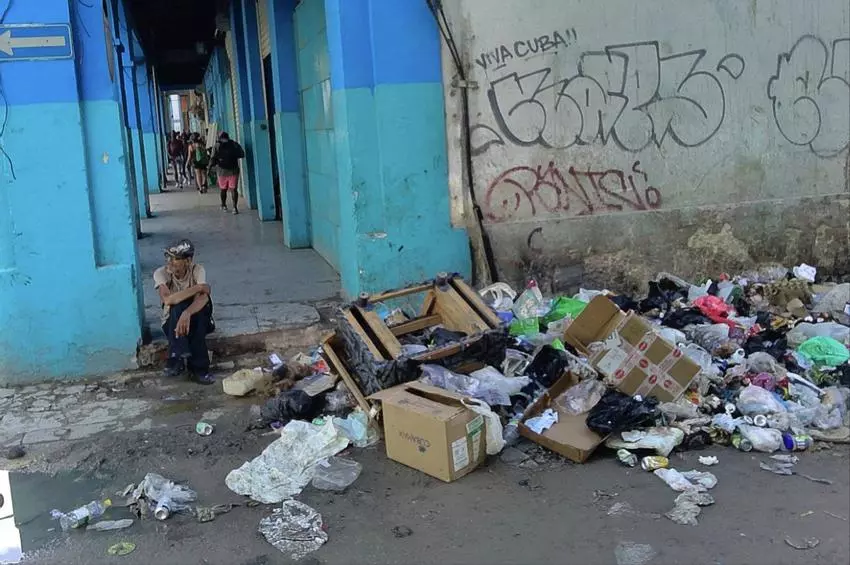
Smoke rises from several corners. Garbage accumulated for days burns in the streets. Plastic burns, rotten food burns, and patience burns. The air seems to come from a diseased factory. People cross those toxic clouds dodging sewage water, loose wires, holes, and rubble. Havana breathes with lungs full of ash.
But the bombs still have not fallen. The Island reached the postwar period before going through the war. The entire country has been devastated by a regime more persistent than white phosphorus.
In that landscape, the external threat appears almost like a gift for those in power. The Trump Administration mixes sanctions, diplomatic pressure, and increasingly harsh warnings. But everything indicates, for now, that Washington prefers to force a negotiation rather than open fire. The regime’s strategists seem to have understood this. That is why they play for time, raise the tone, overact resistance, and transfer—as always—the full weight of the crisis onto the shoulders of the people.
Díaz-Canel is not afraid of ending up like Maduro. The former Venezuelan dictator, at least until today, remains alive, protected, and turned into a judicial piece rather than a corpse. The gray-haired diva from Placetas fears another kind of ending. He fears ending up like Ochoa, like the de la Guardia brothers, or like Alejandro Gil: devoured by the same machinery he helped sustain. But what truly should keep him awake at night is ending up like Ceausescu, suddenly facing a crowd that no longer obeys or applauds.
That is why the external threat seems less nightmarish to him. It allows him to play the victim, gather international solidarity, and demand absolute loyalty within the borders. The external enemy is the narrative oxygen of every exhausted dictatorship. When there is no prosperity left to promise nor future left to administer, there is always the besieged square.
In political science there is a social phenomenon called rally round the flag: the closing of ranks around the flag. John Mueller studied it in 1970 while analyzing spikes in presidential popularity during international crises. William Baker and John Oneal later expanded the debate about its causes. When a community feels attacked from outside, even those who detest the government may lower the volume of their reproaches so as not to appear allied with the aggressor.
Iran offers a recent example. The Islamic Republic has repressed protests, imprisoned dissidents, and governed through terror. However, in the face of attacks or external threats, critical sectors may close ranks in the name of national sovereignty. The external threat does not erase internal discontent, but it can discipline it for a time. It does not convince everyone; it is enough if it paralyzes a few.
A real external threat would allow him to disguise mediocrity as martyrdom
Cuba is not Iran, but the mechanism is similar. Many critical voices inside and outside the Island perfectly recognize Castroism’s responsibility for the national ruin. But faced with the possibility of foreign intervention, some weigh every word, postpone demands, and moderate their tone. They fear appearing, through manipulation or clumsiness, in the invader’s photo. The regime knows that hesitation. It exploits it without scruples. It needs Washington to shout so it can demand silence in Havana.
For Díaz-Canel, a war against the United States could also function as retrospective absolution. His administration has been disastrous. His authority is borrowed. His popularity has never even approached discreetly decent figures. A real external threat would allow him to disguise mediocrity as martyrdom.
And part of the international press would seize the opportunity to tell the worn-out story of the besieged small country, the uncompromising leader, the modern Numancia. That is all the stage scenery Castroism needs to hide hunger, garbage, blackouts, prisons, and fear.
Raúl Castro’s grandson has been closer to the CIA than the most radical of the Cuban opposition
But reality insists on ruining their script. In Cuba, despite the blackmail of the besieged flag, protests are indeed taking place. They are not always massive nor organized. Sometimes they are merely a street standing its ground, a neighborhood shouting, pots and pans banging in the middle of blackouts, a garbage dump in flames, or a mother who cannot take it anymore. But they exist. And that is precisely what terrifies the regime.
Those in power would like to convince the world that every internal protest is an enemy operation. They would like every outraged Cuban to have to choose between patriotic hunger and the foreign missile. They would like to reduce the country to two miserable options: obey the Party or serve as a pretext for Washington. But after decades of accusing us of being “CIA agents,” now it turns out they are the ones sitting comfortably chatting with the ogre from the story. Raúl Castro’s grandson has been closer to the CIA than the most radical of the Cuban opposition.
The scenario the regime fears most is the insubordination of the hungry. Not the aircraft carrier facing the Malecón, but the entire neighborhood facing Party headquarters. Not the attack order signed in Washington, but the intimate, collective, and irreversible decision to lose fear in Cuba. If the social explosion repeats itself, Díaz-Canel will discover that his true ending was not written in English, but in Cuban.
Translated by Regina Anavy
______________________
COLLABORATE WITH OUR WORK: The 14ymedio team is committed to practicing serious journalism that reflects Cuba’s reality in all its depth. Thank you for joining us on this long journey. We invite you to continue supporting us by becoming a member of 14ymedio now. Together we can continue transforming journalism in Cuba.