Near the telecommunications tower, the seafront promenade has become a kind of public video-call room
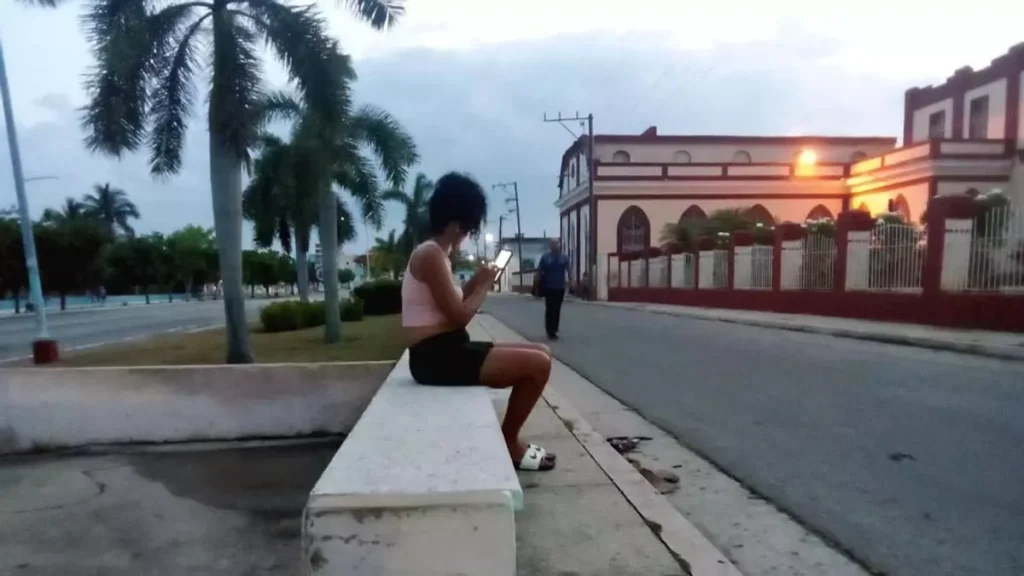
 14ymedio, Matanzas, Julio César Contreras, May 17, 2026 / At seven in the evening, when the sky over Matanzas Bay begins to turn grey and the cars thin out on the Vía Blanca, the Martí promenade fills with passers-by staring at their phone screens with the same intensity with which people once stared at the horizon. Some arrive alone, others as couples, others with small children running around near the granite benches while the adults try to catch an internet signal that appears and disappears like a mirage.
For months, this stretch of the Matanzas seafront promenade has become a kind of public video-call room, makeshift office and digital meeting point for those who, amid the blackouts and poor coverage, cannot get connected from home. The telecommunications tower in that part of the city is one of the few that still works, badly, when the connection goes down in the rest of the neighbourhoods.
When the browser on her phone starts going round and round in endless circles, Anays understands that, if she wants to speak to her sister, she will have to walk to the Martí promenade, about twelve blocks from where she lives, in the Versalles neighbourhood. “I have to do this every day at nightfall. If there’s no power, the coverage in my house drops almost completely. The problem is that at this time there is never any electricity,” complains the Matanzas resident, as she adjusts her mobile phone, looking for the exact angle where the video call will not freeze.
If there’s no power, the coverage in my house drops almost completely. The problem is that at this time there is never any electricity
The scene is repeated bench after bench. A woman in a pink dress anxiously checks the screen while a man beside her raises his head in resignation, as if expecting to find the signal floating among the clouds heavy with humidity. Farther on, beneath a flamboyant tree with spreading branches, a young man bent over his phone barely moves. His posture recalls the old fishermen of the shoreline, except that now no one is casting hooks into the sea, but trying to catch megabytes in the air.
As midnight approaches, dozens of people fight off mosquitoes around the antenna installed near the headquarters of the Municipal Committee of the Communist Party. “Even in this area the connection is sometimes terrible. Suddenly the call cuts off, the image freezes and, meanwhile, the minutes keep passing and the megabytes are being used up,” explains Anays, who still has not cooked the evening meal but gives priority to the family conversation, even if that means going down and back up the hill in the dark every day.
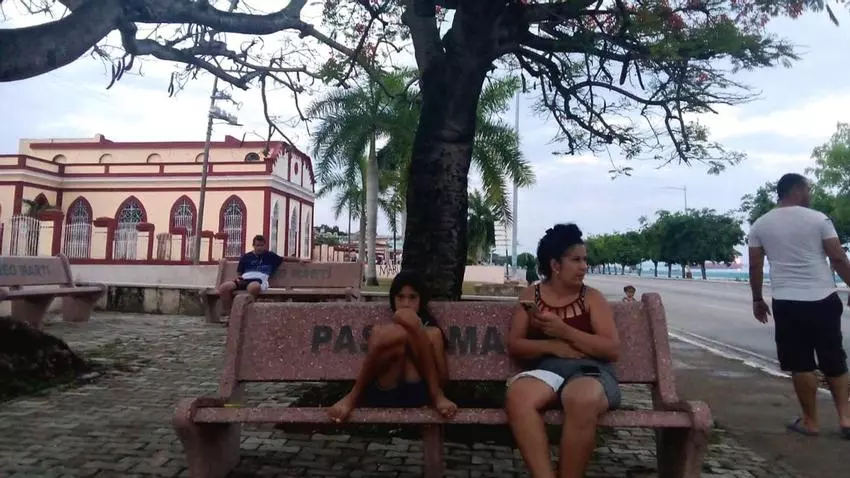
In Matanzas, speaking over the internet has become a mixture of patience, strategy and physical endurance. Some people leave home as soon as the power comes back in order to take advantage of the brief moment when the antennas work; others wait until the early hours because they say that “at that time you can browse a little better.” The younger ones know the exact spots where one extra bar of coverage comes in. “Here, close to the wall,” “under that palm tree,” “beside the bench,” are instructions heard as if they were coordinates.
“This country is getting worse all the time and now hepatitis is back,” says Tomás from another bench on the promenade while making a video call to his son, who has emigrated. “You sent me the top-up on Sunday and I only managed to receive it today, Monday. Now I’m going to try to save data as much as I can, because last month’s bonus was gone in less than a week.”
“This country is getting worse all the time and now hepatitis is back’
The man speaks loudly because there is a delay in the communication and he fears the call may drop at any moment. Near him, a dog sleeps on the cement while its owner stares fixedly at the phone connected to a pair of earphones. A few metres away, a young woman lights up her face with her mobile-phone screen in the growing gloom. The whole promenade seems to breathe to the rhythm of the intermittent connections.
“The truth is, I don’t know whether Etecsa has technical problems or is messing with us, but I get the impression that the amount of the top-up doesn’t match how long the mobile data is actually lasting,” Tomás insists. He then explains to his son that his wife could not come because it is her turn to look after the sick grandmother. “Don’t waste time calling me at home. Even if I climb onto the roof, I can’t hear you. Things are bad all over the city.”
The crisis makes no distinction between ages. “Your niece, to do a school assignment, spent more than an hour in Liberty Park downloading what she needed,” the man says, before again thanking him for the top-up sent from abroad. “If it weren’t for you, we’d be cut off.”
Getting connected on the Martí promenade is not a fashion, nor is it an excuse to look at the sea. Most people arrive exhausted after a day marked by blackouts, queues and heat. Yet, as night falls, the benches fill up again. The faces lit by the screens look like little modern bonfires in the middle of the darkness.
“I get the impression that the amount of the top-up doesn’t match how long the mobile data is actually lasting”
“My wife nearly fell the other day because of a pile of rubbish across the street after finishing the video call with our grandson,” says Eriberto, while making sure that his wife does not wander too far away with the phone in her hand. “The image freezes here too and you have to move around. But if we stay at home, we have no connection until after midnight.”
The old man looks around. There are already very few lights and the city begins to turn into one huge shadow. “Everything gets pitch black, and everywhere there’s a hole or a ditch full of rotten water,” he murmurs before getting up from the bench. Then he slowly puts away the phone, like someone protecting something too expensive and too fragile in a country where communicating with family has ended up looking more and more like a night-time expedition.
Translated by GH
______________________
COLLABORATE WITH OUR WORK: The 14ymedio team is committed to practicing serious journalism that reflects Cuba’s reality in all its depth. Thank you for joining us on this long journey. We invite you to continue supporting us by becoming a member of 14ymedio now. Together we can continue transforming journalism in Cuba.