- Rodríguez Dávila announces “adjustments in public services” while his ministry wastes fuel in its enormous Havana building, where generators run day and night.
- Starting in June, the frequency of trains to eastern Cuba will be reduced to one trip every two weeks; bus service between Havana and the provinces will be limited to three weekly departures.
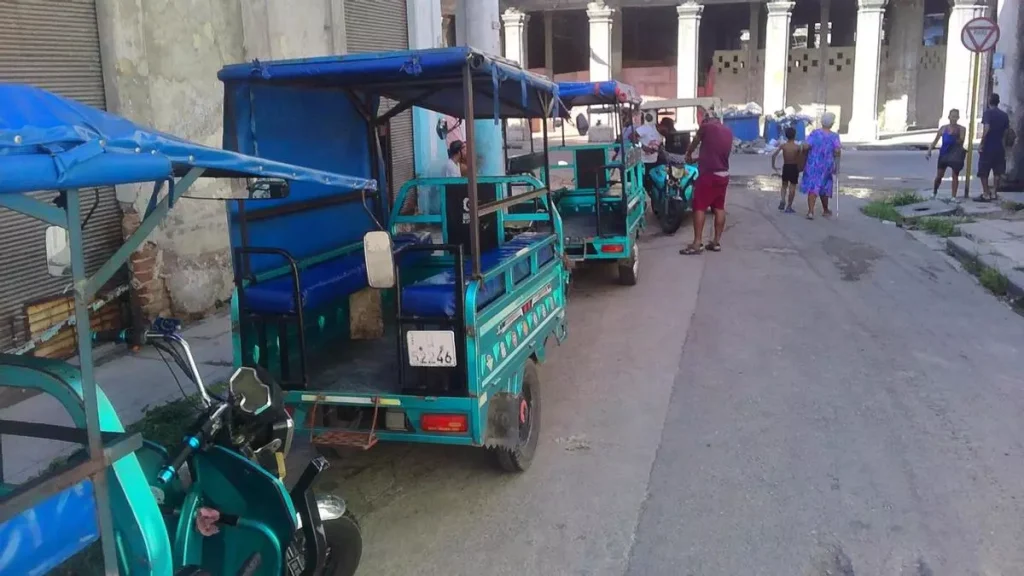
 14ymedio, Havana, May 16, 2026 – The Cuban Government once again asked for sacrifices from a population that already has almost no way to move around. Faced with an “acute fuel shortage,” the Ministry of Transportation announced a drastic reduction in national, railway, and maritime services, while placing electric tricycles, eco-cars, and other alternative means as part of the official response to a crisis that is increasingly paralyzing daily life on the Island.
Minister Eduardo Rodríguez Dávila reported this Friday on new “adjustments in public passenger services” and on the priority that will be given to the transportation of fuel, food, medicines, raw materials, and products intended for export. He also assured that Public Health and Education would receive differentiated treatment, although the package of measures confirms that traveling within Cuba will, from now on, become even more difficult.
The announcement contrasts with the usual image of the Ministry of Transportation itself, housed in an enormous Havana building where, according to residents and passersby in the Nuevo Vedado neighborhood, generators remain running day and night every time the power goes out, for as long as 20 consecutive hours. While Cubans are asked to resign themselves to fewer buses, fewer trains, and fewer maritime trips, the state headquarters maintains fuel consumption that many consider wasteful amid the energy emergency.
Routes to Santiago de Cuba, Guantánamo, Holguín, and Bayamo-Manzanillo will operate with one round trip approximately every two weeks.
National Bus routes will maintain their current schedule only until 11:59 p.m. on June 17, after the minister himself acknowledged in March that only a quarter of provincial buses and one train every eight days were operating. Beginning on the 18th, trips between Havana and provincial capitals will be reduced to three weekly frequencies. Manzanillo and Baracoa will have only one departure per week.
In the case of maritime transportation to the Isle of Youth, the ferry between Nueva Gerona and Batabanó will keep its two weekly trips — Tuesdays and Saturdays — until June 16. Starting on the 20th of that month, the service will be reduced to a single weekly frequency, departing Nueva Gerona on Saturdays at 7:00 a.m. and returning from Batabanó at 4:00 p.m.
Rail transportation is also not escaping the cutbacks. National trains will maintain their schedule during the remainder of May and the first half of June, but afterward the routes to Santiago de Cuba, Guantánamo, Holguín, and Bayamo-Manzanillo will operate with one round trip approximately every two weeks. The rest of the interprovincial and local rail services will remain suspended, except for cases such as the railcars of Boquerón and Caimanera, in Guantánamo.
“I know the population wants private drivers to charge 20 pesos and not 500 or 600, but it’s not possible.”
National air links to Santiago de Cuba, Holguín, and Nueva Gerona will remain “as long as operational conditions allow.” Viazul services will also continue, with sales in foreign currency through the Clásica card, an option inaccessible to much of the Cuban population that earns salaries in national currency.
The minister also acknowledged the impact of private transportation prices, whose fares have skyrocketed in recent years amid fuel shortages and a new gasoline sales scheme in dollars that also fails to guarantee supply for private citizens. “I know the population wants private drivers to charge 20 pesos and not 500 or 600, but it’s not possible,” he said, justifying that transport operators must pay for fuel, repairs, and their own compensation.
The crisis will also affect local transportation. Each province will have to decide which urban, suburban, intermunicipal, rural, railbus, and boat routes it considers essential, according to available fuel supplies.
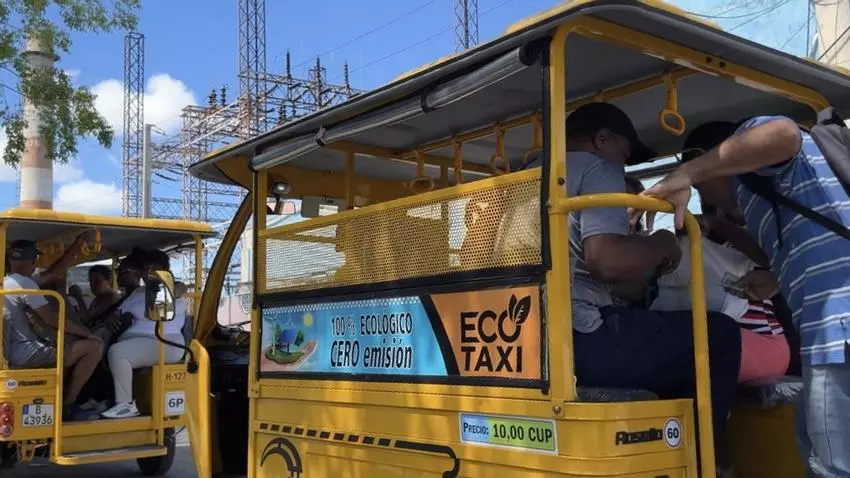
The government’s major bet, however, is once again electric mobility. Rodríguez Dávila announced the acceleration of the entry into service of 200 electric cars intended for medical services, currently at port, as well as the incorporation of a final batch of 150 electric tricycles, with priority given to municipalities.
The minister asked to “make the maximum use” of state and private electric tricycles on the routes with the greatest demand, speed up licenses for those providing services with electric vehicles, and put into operation solar charging stations for the country’s 19 electric tricycle and eco-car bases. According to the Government, these bases will operate independently from the national electric system (SEN), in a country where blackouts continue to define daily routine.
The emphasis on electric vehicles is not coming only from the Ministry of Transportation. Parallel to the announcement of the cutbacks, Miguel Díaz-Canel visited the company Vehículos Eléctricos del Caribe, known as Vedca, an international economic partnership between the Cuban state company Minerva and the Chinese company Tianjin Dongxing. There, the president described the factory as a “little jewel” and called for it to be “protected.”
The company, located in Boyeros, assembled more than 10,000 units last year and billed more than 12 million dollars in 2025, according to its executives. Vedca now aims to transform itself into a mixed enterprise, manufacture metal structures for tricycles in Cuba using laser cutting and robotic welding technology, and introduce electric pickup trucks.
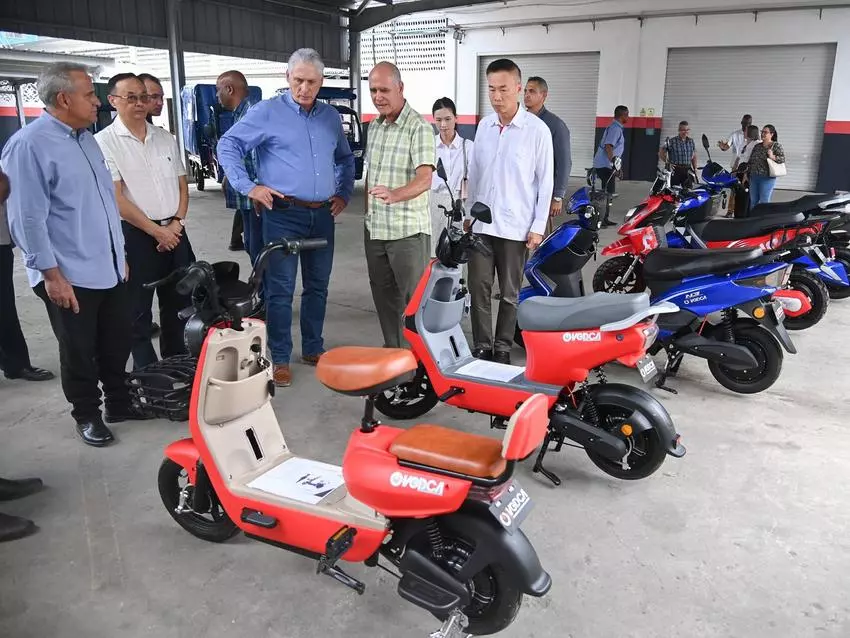
But the commercialization model itself shows the limits of that solution for most Cubans. Vedca sells its products through international payment gateways; that is, with money sent from abroad, and through foreign-currency retail chains. In the available offers, motorcycles exceed 1,200 dollars and tricycles range between 3,000 and 5,000 dollars, figures unimaginable for those who depend on a salary in pesos. The company plans to open mixed TRD-Vedca stores in Havana, Villa Clara, Santiago de Cuba, and Holguín.
The company has 96 workers, an average salary of 16,500 pesos, and plans to enter a system of bonuses paid in foreign currency. Its executives also stated that the partner-administrative building already operates with a photovoltaic system and that by August or September they hope to disconnect the entire facility from the SEN. They also announced that the next tricycles will arrive with built-in solar panels.
During the visit, Díaz-Canel presented the factory as an example of cooperation with China and as part of the country’s so-called “energy transition.” The ambassador in Havana, Hua Xin, promised that Beijing would maintain its support for Cuba in that process. The Cuban leader, for his part, said he would return before the end of the year and asked workers to let him know if “anything gets stuck.”
While the leaders continue traveling in long car caravans, they are reducing Cubans’ mobility even further. The electric tricycle may ease some local routes, but it does not replace a national transportation network or solve the growing isolation between provinces.
Translated by Regina Anavy
______________________
COLLABORATE WITH OUR WORK: The 14ymedio team is committed to practicing serious journalism that reflects Cuba’s reality in all its depth. Thank you for joining us on this long journey. We invite you to continue supporting us by becoming a member of 14ymedio now. Together we can continue transforming journalism in Cuba.