Who’s Fault Is It? / Alexis Piloto Cabrero, Cuban Law Association

Lawyer Alexis Piloto Cabrero

Juan Miguel Hernández Basulto, Camagüey, was expecting a package sent to his wife from Italy through Globestar agency operated in Havana by Cuban officials enjoying the total confidence of the State for this type of business. Hernandez Basulto was discontented when he received the package. The package was for his daughter’s quinceañera, and it was damaged and stolen before he received it. It hurts more when no one appears to be responsible. He told me that he wanted to make a formal claim for damages, but did not know what was the next step.

When communicating with the Globestar representative in Cuba, Mrs. Martha, she told him that she would take care of the problem. But instead she never gave him an answer to his problem. Will Juan Miguel then demanded from Saverio Cicaroni, the owner of the business in Rome, to explain where the gold articles, footwear, and other contents are, valued more than € 520.

Translated by E.C and A.I

12 March 2014

Escape to the Rhythm of Samba / Juan Juan Almeida

The medics Dorayda Igarza Ayala and Walter Jesús Cotarelo Carbonell join the list of the deserters of the Cuban mission in Brazil.

Their names were published by the Daily Official of the Union by reporting that they have been officially excluded from the program of collaboration, and their permission to practice medicine in South America has been suspended. The press release asserts the whereabouts of these Cubans are unknown; having won the esteem of the community in which they served they escaped their mission during carnival. Though this story of fleeing during carnival brings back memories of the spectacular poem Moncada “It was the morning of Santa Ana”, luckily for the doctors it wasn’t the same city nor the same people.

Translated by E.C and A.I

18 March 2014

Political Police Parade on Motorcycles through Havana

Caravana.minint_AIN

A caravan, composed mainly of young officials, takes a tour through historical places of State Security

CUBANET – A caravan of motorcyclists from Cuban State Security (political police) toured the capital’s streets this past Saturday, taking a route around the places “where that institution, celebrating 55 years of existence next March 26, took root,” according to the dispatch by the official Agency of National Information (AIN).

The group of officials — says the note from the AIN — left on motorcycles from the Freedom School City, the location of the mansion where initially the leadership of this Interior Ministry force was established.

A floral wreath at the Jose Marti monument marked the passage through Revolution Plaza where the main buildings of the MININT are located, which previously hosted that forces’ department.

The caravan also passed through the Villa Marista center of operations and ended in the Forest of the Martyrs of the OSE (Organs of State Security). The press note says that the objective of State Security is “to protect the Cuban people from enemy aggression and safeguard the Revolutions’ conquests,” and that objective will continue to be the principal duty of the new generations of that organization’s combatants.

The reality, however, is different.  One of the main functions of State Security is to combat internal dissidence. The Havana parade takes place while in Venezuela too the government’s motorcycles become embroiled in a fierce battle against opponents in the streets.

Cubanet, March 17, 2014

Translated by mlk.

A Conversation with the Consul General of the United States in Cuba / Ivan Garcia

Timothy P Roche, U.S. Consul General in Cuba

Timothy P Roche, U.S. Consul General in Cuba

The old United States embassy in Havana, today the headquarters of the United States Interest Section (USIS, also known as SINA for its Spanish acronym), is a seven-story building with a surfeit of glass windows located a stone’s throw from the Malecon. Built in 1953 and designed by the architect Wallace K. Harrison, it is similar in style to New York City highrises.http://desdelahabanaivan.wordpress.com/wp-admin/post.php?post=2592&action=edit

In spite of not having had diplomatic relations with Cuba since 1960, the United States has the second largest diplomatic headquarters on the island, surpassed only by the monumental edifice of the Russian delegation.

The U.S. Consul General in Cuba, Timothy P. Roche, has served since August 2012. This reporter’s primary reason for requesting an interview with him was to solicit his views on granting visas applications for family reunification and tourism.

Before arriving at the consul general’s rather sober office, one must go through the usual searches and electronic checkpoints typical of embassies almost anywhere in the world. In hostile countries, U.S. embassies are targets of attack by Islamic terrorists, but not in Cuba.

There are other risks. Without high fences, heavy doors with electronic locks, patrols by Cuban security agents and a squad of stern Marines, thousands of people eager to emigrate to the United States — pursuant to the current Cuban Adjustment Act — might be tempted to break into the building.

Lynn Roche, a public affairs officer and wife of the consul general graciously guided this reporter to Mr. Roche’s office, which was flanked by map of the island and the Stars and Stripes.

Since 1994, following the emigration agreements signed by Cuba and the United States during the Clinton administration, at least 20,000 Cubans each year have left the country permanently in a legal, orderly and safe manner to be reunited with their families.

The impact has been dramatic. In the last two decades, nearly 450,000 Cubans have left their homeland, including a high percentage of educated young people. “In fiscal 2013, we issued over 24,000 visas for permanent emigrants to the United States,” says Roche.

The length of time to process a visa varies. Oscar Rojas, for example, spent five years trying to get to Florida to reunite with his mother. Others, like Susana Mateo, were luckier. After just a year and a half she received a visa to settle with relatives in Hialeah.

The consul general acknowledges that granting a permanent visa request takes time. “There is a very high demand from applicants and we have a limited number of U.S. consular officials in Havana who can interview them. It is true that the interview process takes more time for some types of visas, but we are working to reduce the wait time.”

He adds, “It depends on the category but in some cases involving permanent relocation, such as for a bride or groom, the waiting period is four or five months. For spouses, minors and parents of U.S. citizens, there is no waiting period at all. Once your casework is complete in the United States, you receive the next available appointment. Before the Cuban Family Reunification Program it could take up to eleven years for an adult. Now it takes just over three. And in the case of tourist visas, we managed to substantially reduce the wait. It used to take almost 5 years. We are now granting permission within six months and we are working to further reduce this time.”

With regards to the new multiple entry visas, valid for five years, which they begin to offer as of 1 August 2013, the official clarifies, “This visa is not to stay and live in the United States for five years. Nor is it to work or study in the United States. And it’s given at the discretion of the consular official.”

Cubans older than 45 who have traveled to the United States up to four times and recently had their visas denied, qualify as “inconsistent with the policies of the United States Interest Section” when asking for a tourist visa.

With regards to this, the diplomat said, “Every case is different. It’s difficult to explain a case without knowing the specific characteristics of each one. Now, for us it’s better to offer a multiple-entry visa to cases made up of people who travel and return to Cuba, because it’s a better service for the client and more efficient for us.”

Mr. Roche didn’t have at hand the number of multiple-entry visas awarded from 1 August 2013 to date. In any event, on the issue of tourist visas — which are also good for cultural and academic exchanges — the number is huge: from 8,745 to more than 33,000 in 2013.

For Cubans who complete the procedures to travel to the United States, the high prices in hard currency charged by the Cuban government for routine procedures or simple medical check ups are a problem. This is the case with Roiniel Vega, who started the procedures to travel to Miami to visit his son seven months ago, and doesn’t understand why USIS doesn’t have printed forms with the procedures for asking for a non-immigrant visa.

“To the more than 500 convertible pesos (CUC) you have to pay to the government for a passport, medical check up, and other paperwork for those who want to travel to the United States, you have to add 20 CUC to pay for filling out the forms electronically in areas around the Interests Section. I wonder why USIS doesn’t have printed forms, to lower the costs of the paperwork,” says Roiniel.

The U.S. Counsul says that, “There are three steps to asking for a tourist visa. And the first step is filling in form DS-160 on our web page. We know that the majority of Cubans don’t have access to the Internet, but we’ve seen that many people arrange to get access to the web in various ways. We don’t have the capacity and resources to do it any other way.”

Iván García

8 February 2014

Tabarich: Nostalgia for Soviet Russia / Polina Martinez Shvietsova

A restaurant catering to a thousand Russians. Or is it for the geriatric and diplomatic sets? Is the Cold War still with us?

HAVANA, Cuba — A few months ago there was a rumor making the rounds of the Cuban capital. A new Russian restaurant was about to open in Havana. The place, to be called “Tabarich” (or Tovarich in its English transliteration), would be located in Miramar, an enclave favored by the geriatric jet set, diplomats and others with access to hard currency.

Tabarich’s predecessor — the casino and cabaret Montmatre, which also catered to the elite — had been built during the era of the Cuban republic. After the revolution it became another restaurant, the Moscú (or Moscow), as part of a 1960s revitalization project for the Rampa, according to the  movie director Enrique Colina.

In the 1970s and 1980s the Moscú had a certain splendor. Several generations of Cubans, including Carmita, a resident of Guanabacoa, recall its “wide variety of dishes.” Margot, a resident of Lawton, remembers its “carved wood ceilings and the graciousness of its staff.” For others like Desiderio Navarro the memories are not so fond. “Moscú and my wallet were light years apart,” he says.

1394132670_Montmartre-calle-P-Vedado-La-HabanaA public bath in the 1980s in what had been the Moscú restaurant, formerly the Montmartre cabaret.

A fire devastated the building in 1990, which coincided, perhaps conveniently, with the fall of the Soviet bloc. “It might have been a premeditated fire,” notes Arturo, an elderly gourmet.

The cabaret Montmartre, where French singers Edith Piaf and Maurice Chevalier once performed.

In the 1990s relations between Russia and Cuba cooled but after 2000 they took a new turn. In 2007 the National Coordinating Committee (NCC) was formed with the blessing of the Russian embassy in Havana and Cuban authorities. It was made up of  Russian women with some Cuban-Russian members. Their goal is to preserve Russian culture and the traditions of a community numbering about 1,077 Russian speakers.

The prospect of rehabilitating the old Moscú was considered and, while it was well-received — or at least seems to have been — nothing came of it.

Tabarich opened its doors in October 2013. “I was thinking about the Russian community living in Cuba and Cubans nostalgic for the Soviet era,” its manager, Pavel, tells me, adding, “It was designed with the turmoil of that historic period in mind.”

The restaurant is owned by two brothers: Anton, who lives in Russia and provides the funding, and Andrey, who remains on the island as its business manager. The Russian dishes offered are prepared by Cuban chefs who specialize in Russian food. If you would like a Russian dish such as pelmini dumplings with Smetana sauce and a glass of Cristal beer, the bill in hard-currency will put a big dent in your pocketbook!

Cubanet, March 6, 2014 | 

The Dirty Business Between Soldiers and Prisoners / Dania Virgen Garcia

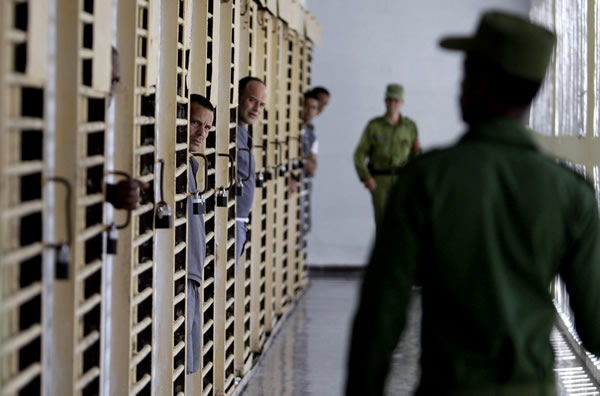
Prisons_Cuba_AFP. The image was taken in April 2013 when the foreign press was allowed to enter jails chosen by the state.

What about the wages of who officers who guard correctional facilities?  Do they traffic in narcotics and various benefits?

HAVANA, Cuba. – The ingestion of alcoholic beverages and psycho-pharmaceuticals is a very common vice in prisons, encampments and forced labor penitentiary settlements.  They provide, moreover, a business that is carried out day by day, in most cases, by prisoners with financial power.

Innumerable civilian workers and officials of the MININT (Ministry of the Interior) have been sanctioned in tribunals for the crimes of bribery and embezzlement.

Events like these often cause homicides.

There is a multitude of problems within the prisons and encampments: fights, bloodshed, theft, self-harm, escapes; these last are well paid-for to MININT’s civilian and military workers.

Life in the penitentiary settlements is incomparable to that of the jails.  They are workplaces or warehouses that belong to MININT. The quantity of prisoners that must inhabit them is reliably between 15 or 20, or those that bribe the re-educator of the prison or encampment.

Business is different in these places. The prisoners are privileged. Once they arrive they are free to do what they like. The supply of psycho-pharmaceuticals, alcohol, and the illicit businesses are not controlled. They may go outside the area when they want, ask permission to go to their homes and other benefits provided they bribe the guard and the officer.

The defenseless prisoners who report these outrages are exposed to reprisals, threats, severe beatings, shakedowns, punishments cells and prohibitions of their rights. They subject them to physical and psychological torture to make them shut up.

The inmates who do not allow themselves to break continue informing the independent press, which is their only means of defense.

When the punishments do not break them, they take away family visits and then transfer them to other prisons, some more than 200 kilometers from their families.

Another method that the guards use is to incite prisoners to physical attacks or accuse them of crimes not committed.

The heads of the Bureau of Prisons, Encampments and Forced Labor Settlements, within and outside of them, are not able to control this fully corrupt environment. Something is wrong when there is so much corruption.

Cubanet, March 18, 2014, Dania Virgen Garcia

Translated by mlk.

Retired but Not Gone Away / Mario Lleonart

On Friday, November 22, we made another stop on our U.S. itinerary that we will never forget. At the invitation of the Fellowship of Hispanic Churches, we participated in a tribute paid to retired pastors. Honor to whom honor is due, or as the Scripture says in Hebrews 13:7: ̈ Remember your leaders, who spoke the word of God to you; Consider the result of their conduct, and imitate their faith.”

This special occasion took place in Gethsemane Baptist Church in Miami at 5298 NW 7th St. The meeting was full of fond feelings. The pastor of the local church Felipe Rodriguez, moderator of the radio program “Building Lives,” which airs daily from 7 – 8 p.m, on 1450 AM, who was in an evangelistic campaign in our church in Taguayabon in 1993 while serving as pastor in Regla, blessed everyone with a few inspired words from Galatians 1:6 – 2:5 from which he set out seven truths he learned from the honorable elders: the one called by God preaches the true gospel (1:6-7); is radical (1.8-10); has a divine message ( 1:11-12); is set apart by God’s grace (1:15); is prepared by God (1:17-18); preaches with his testimony (1:24); and identifies the false brethren and does not submit to them even for a moment (2:4-5).

My wife Yoaxis  and I had the blessing of greeting such worthy elders. To share the table with Dr. Marcos Antonio Ramos, who prefers to be known as “Tony” the son of “Cheo”, showed us that even if they are retired they have by no means gone away. Some of them we knew from Cuba, as in the case of those who were our pastors in my early childhood: Isabel and Esteban Estrada, as well as Dora and Leoncio Veguilla, who for years occupied the highest offices of our Association in Cuba.

I was moved to find there the widow of former Taguayabon pastor Obed Guzman, the moderator for many years of the “Baptist Hour” program in Miami that we listened to from Cuba. It was also very moving for us to to be embraced by the widow of the great Jorge Comezañas. One of the most beautiful moments was the wedding sendoff of Rafael Melian (Felo) and Miriam Sánchez Parodi, who will move to Jacksonville in January.

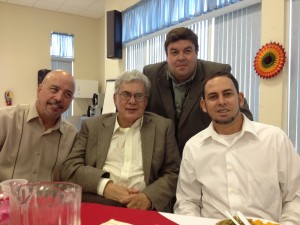
The author with one of those retired but not gone away, Dr. Marcos Antonio Ramos, along with the leaders Pablo Miret and Luis Estevez

As a continuation of Friday, on Sunday morning I attended the first service of Northside Baptist Church Pastor Adalberto Cuellar, also retired, who baptized my parents and many other relatives in Cuba because he was pastor at our church in Taguayabon in the hardest times, just as they got up the nerve to put a stamp on our door between November 1963 and December 1964. In our area, the work of this man of God, who remained unwavering in difficult times, still survives.

Leaders like Pablo Miret, Andrés Olivares, Luis Estevez, and Nathaniel Vicens struggled and performed a work of genuine servants “washing the feet” of so many heroes and reaching the goal. I embrace them for the gracious invitation and thank them for the master’s class that was given to me that day, fantastic for my ministry in the midst of an aging country, in the most-aged province, and with the fate of lacking an entire generation of senior pastors who, like most of those present that day, had to leave Cuba in a choice that I do not judge, as a result of one of the greatest persecutions that we believers have suffered in the entire continent.

Translated by Tomás A.

25 November 2013

18th Century Mansion – Forgotten but Not Gone / Camilo Ernesto Olivera Peidro

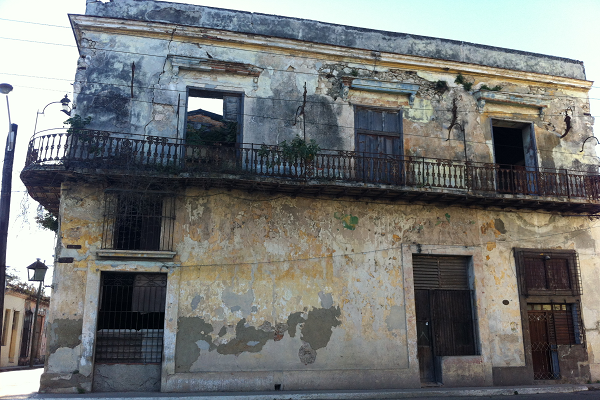
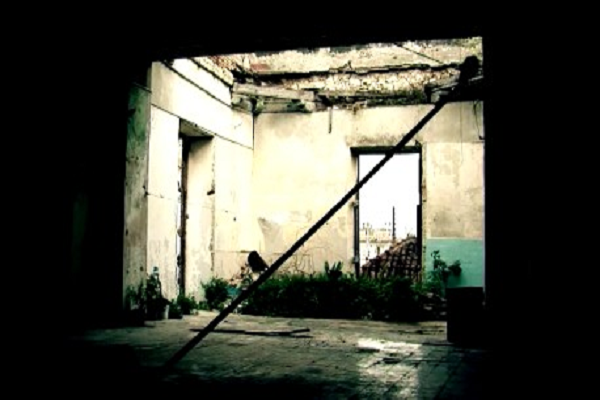
The Casa de las Cadenas, in Guanabacoa, could collapse on several families. It has withstood hurricanes, but now needs help.

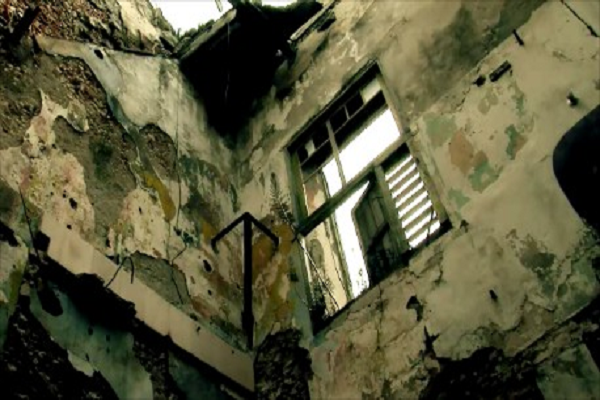
HAVANA, Cuba. – The walls have stood for nearly 270 years. But the degree of deterioration in the old house is worrying. Wood and tile ceilings on the second floor have been collapsing, not only because of the climate, but also from neglect. Roots from shrubbery and prickly pears crisscross those interior walls that are exposed to the outside. The exterior walls are cracked. Several families still live on the ground floor of the building.

The Casa de las Cadenas also gives its name to one of the oldest streets in Guanabacoa. Some time ago the local historian, Pedro Guerra, said that it is one of the most important historical buildings in the western part of the island. Built in the early eighteenth century, it was the first two-story house in town.

It is located in the heart of the designated Historic Center of Guanabacoa. It has been recognized by the government’s National Monuments Commission. According to oral tradition, documented by Elpidio de la Guardia, in his History of Guanabacoa:

Religious images were sheltered there by the Parish Mayor following a severe storm that destroyed the town in 1730. Masses were officiated there during that time. In return, the owner of the house was accredited by King Philip V of Spain to grant asylum to fugitives from justice. Only two other buildings throughout the Spanish Empire had this prerogative.

As happened with other structures in the oldest part of the capital during the last century, the Casa de las Cadenas was converted to a rooming house. In 2009, Nilda Maria Peralta, the last tenant on the second floor of the building, who was later evacuated, lamented about the apathy of the authorities regarding the plight of the place:

“There are nights I don’t sleep, worried because there could be another collapse and I’m alone up here. What is sadder is that nobody cares.”

Five years later, the deterioration continues:

“Most of us who live here have neither the expertise nor the financial resources to repair a historic building like this; that’s up to the government,” one of the tenants told this reporter.

A local man, with a mixture of irony and bitterness said:

“Hopefully resources will appear and they will ’grab’ them to restore it soon, because when this house says ’I’m going down,’ there will be deaths . . . What’s holding it up is the same miracle that kept it from being destroyed by that hurricane that came through during the Spanish times.”

Another man, who had been silent, said:

“But what can you expect from a government that doesn’t even maintain its city hall?”

He was referring to the nearby old mayor’s palace, which now belongs to the People’s Power. The property is showing obvious signs of deterioration.

The photos that accompany this text corroborate the sad state of the Casa de las Cadenas, that historic symbol of the once beautiful Guanabacoa, which is about to completely collapse under the weight of time and neglect.

Cubanet, March 5, 2014.

Translated by Tomás A.

Numismatic Change? / Reinaldo Escobar

The much discussed Cuban dual monetary system, which has distorted the economy for more than twenty years, seems to be facing its final days. Among the few reports that have been released, it appears it will be the CUP–the Cuban or national peso–that will survive, and the CUC–or Cuban Convertible Peso– that will cease to circulate.

In addition to the actual value of each of these currencies, they differ in that the differ in that if the CUP has a photo of a historical figure, the CUC has a sculpture of the same personage. Also on security issues, CUC far exceeds its alter ego.

The question we ask ourselves is whether there will be a change in the real value of money we earn as wages. How many hours will one have to work–once the money is unified–to buy a pound of spaghetti, a quart of oil or a beer?

We also wonder if we will continue to earn the same and if the prices of merchandise will remain the same. For example, if a refrigerator sells now for 500 CUC, will we have to pay 12,500 CUP for it. To ride the same distance that we pay 3 CUC for in a hard-currency taxi, now costs 10 CUP in an almendrone (the shared taxis for Cubans). How will the price be adjusted when we have a single currency?

The amount of cash that will have to be carried to the store will force the artisans to make larger purses, unless they print new denominations with values of 500 and 1,000 CUP. Rumors are already circulating about the faces we’ll see on the new bills. Juan Almeida and Vilma Espín are the favored candidates.

Although almost no one in Cuba has enough money, some will save the abolished chavitos as souvenirs, at least the coins, a good opportunity for the numismatists.

17 March 2014

No Rush… and No Results

In 1953, in his self defense statement [as he appeared at his trial for the Moncada Barracks attack] History will absolve me, Fidel Castro addressed some key issues pending in our country: land reform for instance. He announced on that opportunity, as a priority in his program, giving productive land to those in possession of five or less acres; a nationalistic and democratic project that had its first episode in October, 1958, when, in the middle of the guerrilla war a bill of law was issued from La Sierra Maestra. Once he took power, actual laws were passed–on May 1959 and October 1963–in which property titles were issued to 100 thousand farmers, but 70% of productive land remained in government hands.

The new monopoly of the land and the elimination of the institutions of the civil society related to the agricultural (farming) activity generated a progressive decrease of the agricultural efficiency, while about 40% of the productive land of the country became idle; a regression that was continued until Cuba lost the subsidies from the former Soviet Union. Since then, the government had spent millions of dollars to buy food supplies that otherwise could had been produced locally.

With such an obvious deficiency of the agricultural production, just five months after taking over the presidency of the State council and of the Cabinet, General Raúl Castro, conscious of the deplorable condition of economy, expressed emphatically: We have to focus on the land! We have to get it to produce! And he added, that sooner than later laws and regulations will be passed to (once again) lease idle lands to farmers on the condition they make them productive as soon as possible.

One week after his speech, the Official Gazette of Cuba published the Decree Law 259 on that regard. This measure, could not solve such a serious problem on its own, might have been valid if this law had been conceived as the first step in a long way to go, for which a strong political will is need to face the historical problem of private property in Cuba, worsened during the Revolutionary government which promoted large state farms (collectivism). continue reading

For its content, the Decree Law 259 of July, 2008 dictated from the totalitarian optics, evaded the root of the problem. This same law was just meant to lease small pieces of land of 30 – 100 acres infected with the marabu weed, and accompanied by multiple prohibitions such as: no building of houses, warehouses or infrastructure and no hiring of employees.The absurdity was that the Decree-Law, issued to attack an inefficiency whose primary cause if the inability of the State to make the land produce, is limited to offering parcels in usufruct (a kind of leasing arrangement), that it enjoying the fruits of the work of others, while the inefficient State reserves the right to keep the property. The results obtained in these conditions aren’t what was hoped for.

However, even though the above mentioned Decree-Law lacked the power to increase agricultural production, the law itself was an implicit recognition of the need for a change. Its main fault consisted of ignoring the possession of the property in hands of the producers and keeping the economic decisions subordinated to politics. Given its unsatisfactory results and the zigzagging process without the political will required, in December, 2012, Decree-Law 259 was repealed and replaced with the Decree-Law 300.

The new regulation made some advances such as: allowed the construction of housings, stores and other facilities; also allowed farmers to hire permanent or temp workers; and let farmers lease up to 5 acres, though limited to those that already had leased contracts and were associated to official entities: State farm, and State Cooperative Farms.

Decree-Law 300 brought the same fault of the previous one, the State kept the monopoly of land and private producers subordinated to the State. In its article 11 it states that the lessees can join as workers State Farms as legal entities, or as member of a cooperative farm, for which “the lessee yields the right of the land and other infrastructure to the entity to which he joins, such entity decides whether he continues working this land or not.”

In addition, the Decree-Law 300 preserved other limitations such as inputs and services not tied to the mentioned entities, with clear disadvantages for individuals regarding the term of the contract. Such limitation revealed once again there was not a strong political will to bring agricultural production to a profitable level and a desire to avoid creating domestic entrepreneurs.

The new failure is very well adjusted to the government reforms slogan of ” no rush but not pause “, in January, 2014 Law 311 was passed, which modifies Law 300, to extend the leases to up to 150 acres to the most productive sector of the peasantry, especially to people working for state farms, that were excluded in the previous legislation. However, the lease depends on there only being credit and services cooperatives in the municipality; and b) the State farms as legal entities, basic units of cooperative production and cooperatives of agricultural production in the municipality are located at a distance exceeding three (3) miles of the requested area.

This official data does not explain the fact that after leasing 3.7 million acres of idle lands (since Decree-Law 259 was adopted in 2008), there has been reported increase in production; although there is another 2.5 million acres of land idle of the  total 15.6 million acres of potentially productive land in the country. This negative result reminds us of that phrase of Jose Marti: “Cuba has an enormous potential to become a wealthy nation, but that is impossible if Cubans cannot be wealthy as well.”

Translated by: Rafael

From Diario de Cuba

2 March 2014

William Soler Pediatric Hospital Worries the Government / Ernesto Garcia Diaz

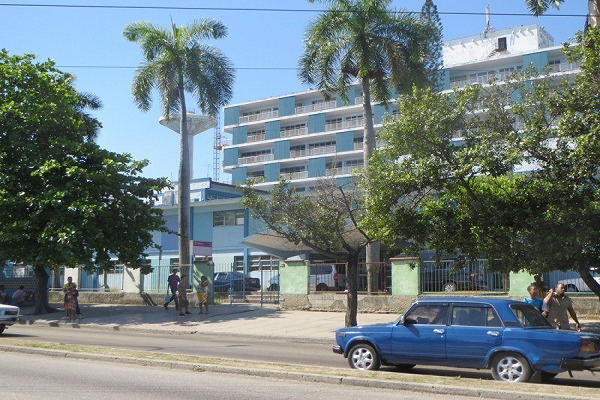
William Soler Hospital – Photo by Ernesto García

HAVANA, Cuba – On Saturday morning, the President of the National Assembly of People’s Power, Esteban Lazo, also a member of the Political Bureau of the Communist Party, visited  the William Soler Pediatric Teaching Hospital, located in the Havana municipality of Boyeros. The hospital’s guarded entry is closed for repairs. Emergency cases and patients requiring daily care are treated in the specialty clinics, adjacent to the hospital.

President Lazo came to the Children’s Hospital accompanied by Mercedes López Acea, the Party’s First Secretary in Havana, as well as a delegation of leaders from the health sector.

The center visited by Lazo is experiencing one of the worst infrastructure crises of the last twenty years, which is compromising care to children hospitalized there and impeding the provision of services to other provinces of the country.

The motorcade in which Esteban Lazo arrived – Photo by Ernesto García

The hospital’s situation is critical. Most of its inpatient and operating rooms are worn out from lack of maintenance, which, as shown by this visit, has begun to worry the government, because of unfavorable public opinion.

Esteban Lazo, who holds one of the top positions in the Cuban chain of command, left after spending an hour in the health facility, without providing any statements to those waiting outside.

Cubanet, March 17, 2014, Ernesto García Diaz

Translated by Tomás A.

That’s Life! / Fernando Damaso

Photo Rebeca

The Day of the Cuban Press was celebrated on 14 March, a day that commemorates the first edition of the newspaper Patria, directed by José Martí, in the year 1892. However, the celebration is exclusive — as is to be expected — the only participants are the government press, which has changed very little since its last congress. It continues to be complacent with the authorities who pay for it, as well as triumphalistic.

Some things–considered critiques–have been tried to improve its deteriorated image, they carefully balance a little salt and a little pepper in their articles and commentaries, to avoid calling the attention of the censors and other problems. Among these are the Letters to the Editor in the newspaper Granma, the same feature in Juventude Rebelde (Rebel Youth), and “Cuba Says” on the TV News. Nevertheless they can’t hide the government’s footprints.

The awards to the most outstanding journalists were for the most part given to the most-recognized defenders of the government line, in the written press as well as for radio, television and digital. Their writings and commentaries, commonly, seem to respond to journalism-by-direction rather than investigations, which seem to be missing.

For now, it seems that the problems and dissatisfactions of ordinary Cubans are only voiced by the independent journalists and the bloggers who, as is to be expected, were not considered in this celebration, along with some alternative publications, which is quite discriminatory.

Ironically, on this day of praise, the underground press that existed during the years of the Batista dictatorship appeared; a press which, like now, opposed the regime, exposed its lies and offered the truth, forming no part of the recognized press.  That’s life!

17 March 2014