“We Were Summoned To Unload the Rice, but the Men on the Ship Won’t Deliver It Until They See the Money”

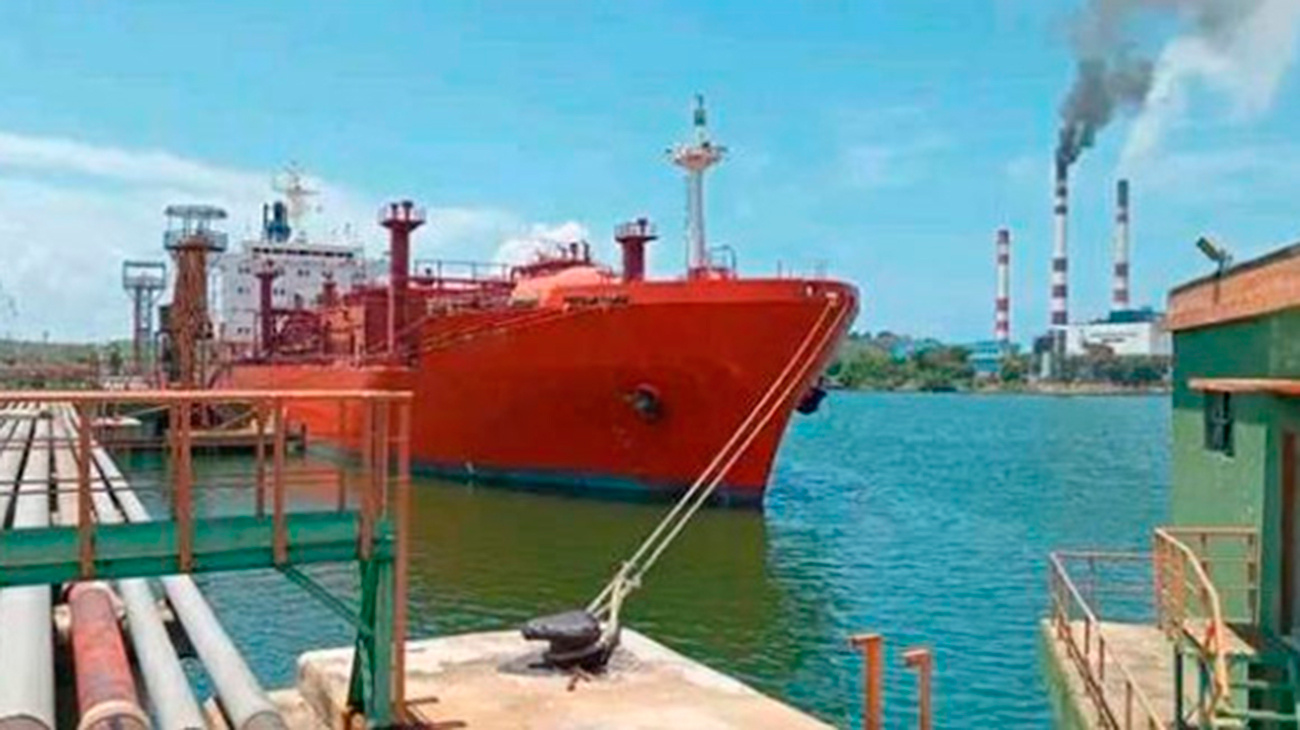
Coming from Canada, the ‘Santamaría’ arrived at the port of Cienfuegos on June 6 and is waiting at sea.


The grain arrives on the island imported from countries such as Brazil, the United States, Guyana, and Vietnam / 5 de Septiembre

14ymedio bigger14ymedio, Mercedes García, June 10, 2025 — The cargo ship Santamaría has not yet unloaded in the port of Cienfuegos because the Cuban authorities have not paid for the rice.

The grain, intended for the quota of the June basic family basket, has not reached the ration markets in Sancti Spíritus.

Ration store employees are forbidden to post “no rice” signs to prevent photos of the shortage ending up on Facebook

The stores and warehouses of the rationed market in Sancti Spíritus received the news this Monday like a jug of cold water poured over them. They will have to continue waiting for the rice that is in the hold of the Santamaría, the ship with the Panamanian flag that came from Canada and arrived in Cienfuegos on June 6. The lack of payment is keeping the cargo on board and consumers waiting without explanation.

“I was going to put up a sign saying there is no rice, but we are directed not to put up anything, because then people take a photo and post it on Facebook,” says the employee of a ration store (bodega) in the Kilo 12 neighborhood, where most of his colleagues have been delaying the issue for days. The bodega is, in fact, so empty that in the last few days, only “some sweets for children are left”. continue reading

The stevedores and other workers in the sector are becoming accustomed to this type of situation. “We were summoned to unload the rice, but the men on the ship won’t deliver it until they see the money,” an employee of the Ministry of Internal Trade tells 14ymedio.

“Before, this happened once in a while, but now every time we have to stop a distribution operation of some product, especially rice, because it has not been possible to pay for the cargo at the port,” he says. “The month is already moving forward, and if this takes a few more days, people here won’t have rice until the second half of June, if they are lucky, and if not, they are left without rice until July or August,” he regrets.

“You can see that the rice intended for the basic basket doesn’t arrive, but the product continues to come in,” says a woman

“You can see that the rice intended for the basic basket doesn’t arrive, but the product continues to come in,” says a woman. In the private stores of Sancti Spíritus, a pound of imported rice now ranges between 240 and 300 pesos, depending on the quality and whether it is sold in bulk or in one-kilo packages, far from the 155 pesos per pound that was imposed as a price cap on the whole country in March.

The grain, indispensable in the daily menu, which Cuba imports from Brazil, the US, Guyana and Vietnam, constitutes in many households an essential nutritional support, given the high prices of animal proteins, vegetables and produce.

The rice that ends up in private stores comes through state importers, which individuals are obliged to use. Even the stevedores, trucks and warehouses used for the goods channel the supply to the MSMEs. But while the products destined for the ration book do not reach the province, “the containers for the MSMEs do not stop.”

The cost to unload the Santamaría is not known, but the amount is part of the “more than 300 million dollars” that the Cuban government annually spends to import rice for subsidized sale, according to vice president Salvador Valdés Mesa in February. The figure may be even higher. According to the 2023 data, 343,305,000 dollars were invested that year, a record figure in the last five years (in 2019 it was 239,725,000 dollars), especially if one takes into account the decline in population.

“We need to increase national production so that this currency can be used to meet other needs,” said Valdés Mesa

“We need to increase national production so that this currency can be used to meet other needs,” said Valdés Mesa, amid the popular unrest that had caused the delay of several months, from the arrival of the rice quota corresponding to December 2024, that finally, in many provinces, Cubans only managed to consume in mid-February of this year.

The delay in unloading ships due to the Government’s inability to pay is becoming more frequent. In April of last year, up to eleven ships surrounded the island for several days loaded with food, as acknowledged by the first deputy minister of Foreign Trade and Investment, Oscar Pérez-Oliva Fraga, in the first podcast of Miguel Díaz-Canel. The situation has been admitted on many occasions by the authorities, who attribute it to the consequences of US economic sanctions that not only affect bulk carriers but, frequently, the electric power.

In September 2024, while the Cubans were suffering one of the largest waves of power outages that year, four tankers waited in Cuban ports for payment before being unloaded. Less than a month ago, there was a similar situation with liquefied gas, which according to the Minister of Energy and Mines, Vicente de la O Levy, has not been supplied in Cuba for 117 of the 150 days of the year.

Translated by Regina Anavy

_______________

COLLABORATE WITH OUR WORK: The 14ymedio team is committed to practicing serious journalism that reflects Cuba’s reality in all its depth. Thank you for joining us on this long journey. We invite you to continue supporting us by becoming a member of 14ymedio now. Together we can continue transforming journalism in Cuba.

Cuba Is Willing To Call for Exiled Players if They Do Not Speak Ill of the Government

“They don’t care about principles, what matters is winning,” a source close to the FCB tells ‘Swing Completo’

Baseball players who joined the national team of Cuba in the Premier Tournament 12 / JIT

14ymedio bigger14ymedio/Swing Completo, Havana, June 9, 2025 — Players who “do not have a political stance against the government” could be “eligible” for the Cuban national team to participate in the 2026 World Classic. According to a source close to the Cuban Baseball Federation, quoted by Swing Completo, “this is something to resolve” in order to have a competitive team.

The source revealed, at least to Swing Completo, that they lack the Government’s approval to make the official announcement. Article 1.6 of the regulations of the National Series states that “players who have not left delegations or contracts managed by the FCB, who are not sanctioned and who possess a Cuban passport or identity card, may be authorized to play, with the prior application of the athlete to the province with which he wants to play and with the approval of the CNB”.

FCB members are willing to renounce the principles that, in the past, were an impediment to calling for other players. “They don’t care about the principles; what matters is to win, or at least not make fools of themselves,” said the same source.

“However”, he stressed, “the players who have spoken ill of the government or take a political position against it would never be considered.” continue reading

One of the figures excluded and reviled by the Cuban authorities for defecting in 2009 in Rotterdam, Netherlands, is Aroldis Chapman, the “Cuban Missile.” The athlete does not forget that they called him “traitor, worm and sellout.” For this reason, he has rejected any possibility of defending Cuba in international events.

“I think all those people who are convening the players who are here and those going to the Classic are the first who should be respected and not everyone else,” he said last March.

The same position is taken by the exiled players who in 2023 formed the Cuban Professional Baseball Federation (Febcube). The group includes Yulieski Gurriel, Guillermo Heredia, Raisel Iglesias and José Abreu, among others.

Official journalist Pavel Otero said that the FCB has already contacted 10 players who play in the United States Major Leagues and several Minor Leagues. Yoan Moncada, Andy Ibáñez, Andy Pagés and Daysbel Hernández would be on that list, in addition to Yariel Rodríguez.

“We have already personally spoken to more than 10 active players in the 40-man Major League roster,” said Otero. “Almost all the headliners for most positions are already written down.”

Translated by Regina Anavy

____________

COLLABORATE WITH OUR WORK: The 14ymedio team is committed to practicing serious journalism that reflects Cuba’s reality in all its depth. Thank you for joining us on this long journey. We invite you to continue supporting us by becoming a member of 14ymedio now. Together we can continue transforming journalism in Cuba.
Trump’s Measures Oblige American Airlines To Cut Half Its Flights to Havana

The company will suspend all flights to Santiago de Cuba during the summer.

An American Airlines plane at Havana’s José Martí International Airport on October 30, 2022 / 14ymedio

14ymedio bigger14ymedio, Havana, 8 June 2025 — American Airlines, which manages most of the flights between the United States and Cuba, asked the Department of Transport (DOT) last Friday to decrease the number of its routes to the island this summer, including all connections with Santiago de Cuba. The reason, it explained, is the low demand for trips to the country in the summer period, stirred up by Washington’s policies towards Havana.

The company’s application was made two days after the Donald Trump administration proclaimed the restriction of most visas for Cubans who wish to enter that nation, in addition to citizens from six other countries.

“According to the Report on Excess of Stay [in the US], Cuba had an excessive stay rate with B1 and B2 visas of 7.69%, and with F, M and J visas of 18.75%,” specifies the proclamation. Consequently, the US suspends the entry of Cubans with visas B1 and B2 (business and tourism, respectively), F and M (academic and technical studies), and J (cultural exchanges). “Consular officials will reduce the validity of any other non-immigrant visa issued to Cuban nationals to the extent permitted by law,” it adds.

The company’s application was made two days after the Trump administration proclaimed the restriction of most visas for Cubans

As a result, American Airlines expected a significant drop in the number of flights this summer between Cuba and the US, which would put it in financial difficulties if the DOT does not agree to reduce the number of connections. continue reading

“In view of these current challenges and with a view to deploying its scarce aircraft more efficiently, American seeks a temporary suspension of a limited number of its services between the United States and Cuba for the remainder of the 2025 summer season,” the company said in its application, cited by the digital portal AirlineGeeks.com.

The routes from Miami to Havana and Santiago would be most affected by the cuts, and, at the request of the airline itself, the latter could disappear during the coming months. In the case of the capital, American Airlines hopes to modify the permission granted by the DOT last March to cut up to a maximum of three of its eight daily frequencies from Thursday to Monday, and up to four on Tuesday and Wednesday.

“The previous exemption already covered specific frequencies for American’s service to Camagüey, Holguín, Matanzas/Varadero and Santa Clara, which remain unchanged in the new application,” AirlineGeeks said.

“The previous exemption already covered specific frequencies for American services to Camagüey, Holguín, Matanzas/Varadero and Santa Clara, which remain unchanged in the new application”

According to the platform, the company argued that if granted permission – “limited to the rest of the summer season 2025” – the DOT would give it time to “better adapt its capacity and services to market conditions.” There is no indication, however, of when the Department could issue its verdict.

Cubans living abroad, although far below the number of Canadian tourists, are the second largest group of travelers arriving annually to the island. Many of them come from the United States, where the main community of Cubans abroad is located, so a decrease in flights could have a negative impact on the already depressed tourism rates on the island.

However, it will not be the first time that this sector has faced suspension of air routes due to low demand. In recent years, with the country’s loss of prestige as a tourist destination and the consequent drop in visitors, several airlines have suspended their routes. This is the case of the Swiss Edelweiss and the German Condor.

In the case of Condor, the Cuban government itself decided to take over the route so as not to lose more passengers. According to the Minister of Transport, Eduardo Rodríguez Dávila, the connection is the first one established by Cubana de Aviación between the two countries in 20 years.

Translated by Regina Anavy

____________

COLLABORATE WITH OUR WORK: The 14ymedio team is committed to practicing serious journalism that reflects Cuba’s reality in all its depth. Thank you for joining us on this long journey. We invite you to continue supporting us by becoming a member of 14ymedio now. Together we can continue transforming journalism in Cuba.

The Supermarket in ‘MLC’ on 3rd and 70th Succumbs to its Rival in Dollars

“It hasn’t been open for a month,” an employee of a small candy kiosk told ’14ymedio’.

The 3rd and 70th supermarket started selling in dollars in the 90s / 14ymedio

14ymedio bigger14ymedio, Juan Diego Rodríguez, Havana, 8 June 2025 — The showdown between the American dollar and the freely convertible currency (MLC) continues to be won by the dollar. The supermarket on 3rd and 70th, in Havana, has finally succumbed to the lack of supplies and the tough competition from its neighbor, the well-stocked store in fulas [dollars], inaugurated in January this year. This Sunday, customers who came to one of the most famous stores since the 90s in the neighborhood of Miramar found its doors closed and the interior dark.

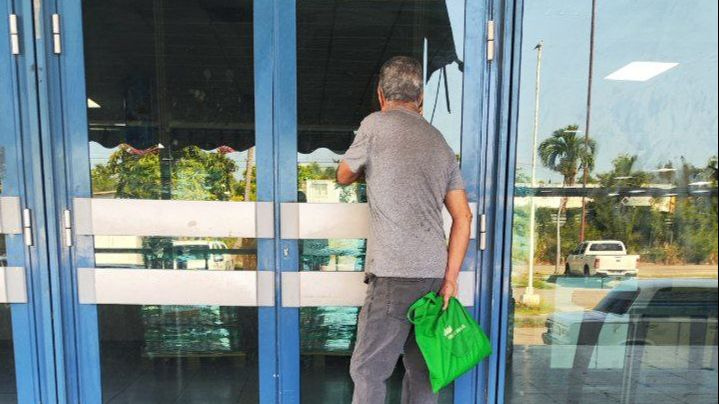
“It hasn’t opened for a month,” said an employee selling jam from a small kiosk outside, the only place that survived the debacle. With his face glued to the glass, a customer tried to decipher whether there was any merchandise left that foreshadowed a reopening. The damaged door, the dirty glass and the floor slabs full of holes do not augur, however, a rapid return from what became more than three decades ago a place frequented by diplomats, officials and foreigners.

This Sunday, customers who came to one of the most famous shops in the neighborhood of Miramar found its doors closed and the interior dark / 14ymedio

The store that was an emblem of dollarization from 1993 and then opened to the public has succumbed due to the weakness of the freely convertible currency. Its shelves and refrigerators, with scarce products, have not been able to compete with the new store, located on that same corner but across the street, on the ground floor of the hotel Gran Muthu Habana. continue reading

Its shelves and refrigerators, with few products, have not been able to compete with the new place / 14ymedio

Belonging to the Caribbean Stores of the Cimex corporation, one of the many branches of Cuba’s all-powerful Armed Forces Business Management Group, the luxurious establishment admits three forms of payment: cash dollars, foreign cards and the so-called Classic card that is recharged with dollars. While the opponent’s butcher shop languished, its refrigerated windows were exhibiting hams, cuts of beef, countless sausages and those chicken breasts that many Cuban families have not tasted for years.

A month ago the battle ended quietly. Collapsed on the canvas from lack of resources, unable to recover, the market in MLC ended up surrendering. On the other side of the street, propped up by greenbacks, its foreign-currency adversary has continued to earn, since then, tens of thousands of dollars every day.

Translated by Regina Anavy

____________

COLLABORATE WITH OUR WORK: The 14ymedio team is committed to practicing serious journalism that reflects Cuba’s reality in all its depth. Thank you for joining us on this long journey. We invite you to continue supporting us by becoming a member of 14ymedio now. Together we can continue transforming journalism in Cuba.

Baseball Players Moncada, Pagés, Ibáñez, Hernández and Rodríguez Want to Play with Cuba in the World Classic

There is talk of a list of 10 U.S. Major League players to whom the Island will send an invitation.

Yoan Mocada, in the center, during the game against China’s Taipei team / Jit

14ymedio bigger14ymedio/Swing Completo, Havana, 8 June 2025 — Yoan Moncada, Andy Ibáñez, Andy Pagés and Daysbel Hernández are the players who have expressed their interest in playing with Cuba in the 2026 World Classic. Yariel Rodriguez could join them. He is backed by several Inder managers, despite having broken a contract in Japan, for which the Cuban Baseball Federation (FCB) demanded 10 million dollars for “damages.”

A source from the Island confirmed to the specialized media Swing Completo that there is a list of at least 10 Cuban Major League players who will be sent an invitation.

Moncada was part of the national team selection that failed in the Premier 12 tournament. The athlete from Cienfuegos, who was injured for most of the year, on that occasion “asked to be included” in the roster of 60 players, according to the specialized media Pelota Cubana.

“My dad wants to see me play for Cuba, and that’s all I care about,” says Andy Pagés / El Extrabase

Moncada, who in 2015 was signed by the US Boston Red Sox for 31.5 million dollars, took advantage of the window to get a third-base contract with the Los Angeles Angels.

The Los Angeles Dodgers player, Andy Pagés, has expressed his desire to join the Cuban national team. The athlete would thus fulfill his father’s wish. “From the beginning, I said yes. Already there were people who did not accept it and others who did,” he told Pelota Cubana USA. “I don’t worry about that. There will always be people who say bad things and others who support me. As I said, my dad wants to see me play for Cuba, and that’s all I care about.” continue reading

However, in the participation of Pagés in the World Classic, warned Andy Lans, “the most logical thing would be to think that the outfielder sees the above-mentioned competition as a possibility to display his skills. He is not the only one.”

In the case of Daysbel Hernández, his talent as a pitcher has been revealed with the Atlanta Braves / Francys Romero

In the case of Daysbel Hernandez his talent as a pitcher has been revealed with the Atlanta Braves in the Minor Leagues; his aspiration is still to reach the top circuit. The FCB has expressed its interest in being part of the pre-selection, and the specialized media see him as an option for a relief pitcher.

Andy Ibáñez was already part of the Asere team version and would be ready to return if there is a call. Another option is Ernesto Martinez Jr., who is with the Milwaukee Brewers and considered a promising prospect.

Translated by Regina Anavy

____________

COLLABORATE WITH OUR WORK: The 14ymedio team is committed to practicing serious journalism that reflects Cuba’s reality in all its depth. Thank you for joining us on this long journey. We invite you to continue supporting us by becoming a member of 14ymedio now. Together we can continue transforming journalism in Cuba.

Cuban Government to Allow a U.S. Exporter to Open a Branch Office on the Island

A Chinese technology company and a Mexican food marketing company will also be able to do so, although none of the three will be able to directly market their products on the Island.

Maravana has a license from the U.S. Treasury Department to export vehicles to Cuba. / 14ymedio

14ymedio bigger14ymedio, Havana, June 1, 2025 — On Friday, Cuban authorities licensed three foreign companies to do business on the island. They will now be listed in the National Registry of Foreign Commercial Representatives, which will allow them to open branches on the island. The companies are the Mexican food marketing company Michoacana, the Chinese technology company Qingdao Hainergy, and — most notably — the American exporter Maravana Cargo, which already to ships second-hand vehicles from the United States.

With a 90-day deadline to formalize its registration, Maravana Cargo has permits to transport goods, “including sea and air parcels,” food “in all categories, automotive equipment in all categories, parts, pieces, and aggregates for the automotive sector.”

Always cautious when granting prerogatives to foreign companies and private businesses, especially those founded by Cuban-American entrepreneurs, the Ministry of Foreign Trade and Investment has made it clear just what Maravana Cargo can and cannot do on the island. It states that the company may neither “import 0r export directly for commercial purposes, nor distribute or transport merchandise within the the country’s borders.”

As explained at the time to 14ymedio, the company already had a counterpart on the Island: Maracuba, which is responsible, in addition to delivering packages in all provinces – it has a fleet of vans for this purpose continue reading

– for delivering the vehicles to customers when they arrive at a Cuban port.
Maracuba’s counterpart on the island is Maravana, a company which owns a fleet of vans that it uses to deliver packages nationwide. It is also delivers imported vehicles to buyers after they have cleared Cuban customs

Maracuba’s counterpart on the island is Maravana, a company which owns a fleet of vans that it uses to deliver packages nationwide

The export license issued by the Treasury department prohibits the company from selling vehicles to members of the Communist Party and state-owned businesses.

Unlike the narrow license granted to Maravana, which is limited to the automotive and food sectors, those of Qingdao and Michoacana are much broader. The Chinese company has the green light to export to Cuba “goods and services from sectors such as the electronics industry, including household appliances, electrical equipment, renewable energy, information technology and telecommunications, air conditioning, educational and audiovisual media, medical equipment, refrigeration and boilers, lighting and irrigation equipment, motor vehicles, their parts, and spares.”

An addendum to the list of products the Chinese company is authorized to sell include medical equipment and furniture, toys and recreational items, land vehicles (including tractors and other vehicles used in the railway sector) audiovisual production equipment, and other equipment related to the energy sector, including nuclear reactors.

The restrictions imposed on the company are the same as those stated in Maravana Cargo’s license, and are repeated in the case of Michoacana.

The Mexican company is authorized to “produce and market food products

The Mexican company is authorized to “produce and market food products, inputs such as fertilizers, herbicides and other chemicals for crops and livestock, including raw materials for their production, as well as equipment and machinery associated with renewable energy sources.”

The three companies offer services and products that the Cuban government is unable to provide to its citizens, from scarce and expensive food items to vehicles that only a few can afford.

It remains to be seen how these companies will get around restrictions Havana has imposed to control private and foreign businesses and to monopolize the circulation of foreign currency on the island. The inability to repatriate their funds in dollars, a restriction the government implemented last April for all foreign companies operating in Cuba, will be one of these companies’ biggest challenges.

____________

COLLABORATE WITH OUR WORK: The 14ymedio team is committed to practicing serious journalism that reflects Cuba’s reality in all its depth. Thank you for joining us on this long journey. We invite you to continue supporting us by becoming a member of 14ymedio now. Together we can continue transforming journalism in Cuba.

Fractures of Castroism

Citizens are becoming more aware of their rights and are demanding from the dictatorship the spaces that belong to them.

Several people close a street in Old Havana to protest after several days without drinking water in their homes, on 11 November 2023 / Felipe Borrego/EFE

14ymedio bigger14ymedio, Pedro Corzo, Miami, 8 June 2025 — Everything seems to indicate that the ironclad social control established in Cuba by brothers Fidel and Raúl Castro, inherited by the inept Miguel Diaz-Canel, is cracking, although it is fair to say that this is not exclusively a consequence of the opposition’s courage, but rather the chronic inefficiency of the system, which has accumulated endless failures and errors over 66 years.

In a telephone conversation from Santa Clara, Guillermo Fariñas, 2010 Sakharov Prize winner and leader of the United Anti-Totalitarian Forum (Fantu), described how, despite the repression, which has resulted in the constant growth of the prison population for political reasons, citizens are developing a more precise awareness of their rights and demanding from the dictatorship the spaces that are theirs.

According to Fariñas, based on these demands, his organization has established a number of issues that activists promote in the queues that people are inevitably forced to stand in to resolve any situation, particularly those related to food and medicine.

One of the themes is the Castro regime’s unfulfilled promise to restore the 1940 Constitution, which guaranteed an open society with full respect for the rights of citizens. He told us that this is a case that is virtually unknown to younger generations, who have been submerged in complete ignorance of the past. continue reading

The immense majority of those who fought ’Castro-Communism’ in the initial years of the revolution and even afterwards, came from the revolutionary ranks.

Another issue that is brought up in the queues and discussed as if it were casual conversations is the farce that Fidel Castro embodied during the first months of the insurrection, denying that he intended to establish a communist regime, pointing out to people that the dictatorship was established with lies and false promises, an atmosphere that has been perpetuated over time.

The opposition leader, who is categorically prohibited from traveling to the nation’s capital, says that another issue that the militants in the queues is inciting violence, arguing that the Castro-led insurrection resorted to terrorism throughout its administration and that, consequently, they are morally invalidated from questioning anyone who resorts to intimidation to attack the government, since terrorism does not become good just because it promotes socialism.

Another interesting aspect that individuals in the ranks speak of as if by chance, is that the vast majority of those who fought Castro-communism in the initial years of the revolution and even afterward, came from the revolutionary ranks because they had been defrauded by the farce orchestrated by the Castros to perpetuate themselves in government.

The so-called internationalist missions in Africa are widely discussed, explaining to people that they were not genuine acts of solidarity, but rather Castro’s way of compensating for the economic and military aid coming from the Soviet Union, using Cubans as “cannon fodder,” sending them to fight on that continent where thousands of soldiers died and others were abandoned to the most extreme poverty.

The insurrection led by the Castros resorted to terrorism throughout its administration.

Two of the Castro regime’s biggest falsehoods are the free provision of medicine and education. Fantu activists point out that, since 1962, all workers have been directly deprived of 11.1% of their net wages, based on Decree-Law 147/1962. This deprivation also covers Social Security, a condition that does not make it a gift of totalitarianism.

The privileges in food and goods received by members of the Armed Forces and the Ministry of the Interior are addressed in the queues, in addition to the reasons that prevent the existence of other political parties. They add that the current energy crisis could have been avoided if, during the period of Chavismo’s rise in Venezuela (2001-2016), the enormous financial loans granted by Hugo Chávez for the remodeling of Cuban thermoelectric plants had been used.

Guillermo Fariñas says that several Fantu activists are in prison for bringing up these issues in the queues, including Oscar Sánchez Madan, political coordinator of the Fantu National Council and resident in the municipality of Matanzas, Pedro Luis Fernández Peralta, Fantu coordinator in the municipality of Diez de Octubre (Havana province), and Amaury Díaz García, municipal coordinator of Fantu in the city of Sancti Spíritus.

____________

COLLABORATE WITH OUR WORK: The 14ymedio team is committed to practicing serious journalism that reflects Cuba’s reality in all its depth. Thank you for joining us on this long journey. We invite you to continue supporting us by becoming a member of 14ymedio now. Together we can continue transforming journalism in Cuba.

They Fled to the US To Avoid Jail for Participating in Cuba’s July 2021 Protests and Now Fear Being Deported Back to Cuba

The two sisters arrived as rafters in 2022 and are trying to obtain political asylum.

Yaneris Redondo León and Mariana de la Caridad Fernández León when they were still living on the island. / Facebook

14ymedio bigger14ymedio, Havana, 7 June 2025 — Sisters Mariana de la Caridad Fernández León and Yaneris Redondo León, exiled in the United States after being sentenced to prison for participating in the 11 July 2021, protests in Havana, could be deported to Cuba if their request for political asylum is rejected. “Today we are afraid that we will be denied that protection,” Fernández denounced on social media, asserting that “returning could be equivalent—without exaggerating—to being sent directly to our deaths.”

The young woman’s post provides few details about the legal process she faces in the United States after arriving in the country illegally with her sister as rafters and requesting political asylum. However, it suggests that her case is one of many that have surfaced with Donald Trump’s new policies, which in recent months have ended several of the avenues opened by the previous administration for migrants to request international protection.

“We ask the United States government to act with justice, humanity, and historical memory. We are politically persecuted. We ask for protection, not privileges,” Fernández emphasizes, asserting that both she and her sister meet “each and every one of the legal and humanitarian requirements to obtain refugee status.” She adds that it would be “deeply unfair to return us to a country where we were already imprisoned for thinking differently and making our political stance clear.”

Fernández and Redondo, who were then 18 and 30 years old, participated in the mass protests that took place in the Mantilla neighborhood.

Their request has been supported by organizations such as Justice 11J, which stated: “What appears to be a decision not to provide protection by the United States authorities contradicts the principle of non-refoulement, which prohibits the return of a person to a country where they are at risk of being tortured, persecuted, or subjected to inhuman or degrading treatment, even if their asylum application has been denied.” continue reading

Fernández and Redondo, then aged 18 and 30, participated in the mass protests that took place in the Mantilla neighborhood of the capital in July 2021. During the demonstration, they were pepper-sprayed, beaten, and arrested. “My sister and I were locked up for 15 days without a court order. During our detention, we suffered psychological abuse, death threats, and medical neglect,” she says.

Thanks to the “superhuman efforts” of their family, both were released from prison after posting bail of 1,000 pesos each. For more than a year, while awaiting trial, they had to report regularly to the police, who forced them to “sign documents under threat of returning to prison” if they engaged in any act of dissent.

In July 2022, they were finally brought to trial for contempt of court, assault, and public disorder, crimes that, according to Fernandez, were “fabricated” by State Security. Both were found guilty. Redondo was sentenced to seven years in prison and Fernández to five, which was later reduced to years of house arrest.

They were notified that they had 72 hours to voluntarily surrender to the authorities and process their return to prison.

They were notified that they had 72 hours to voluntarily surrender to authorities and process their return to prison. “Faced with the imminent repression and the well-founded fear of what awaited us, we made the most difficult decision of our lives: to flee our country. On November 13, 2022, after a journey of more than 16 hours by sea, we arrived at an uninhabitable island, exhausted and without a clear direction, but with our hope intact. We managed to survive that dangerous journey and finally reach US territory, where we requested political asylum,” she added.

After entering the United States, Fernández even had to be hospitalized “due to the extreme physical exhaustion during the flight.” Now, however, she fears that all her sacrifice will be in vain. “We ask the United States government, the immigration judges, society, and all Cuban exiles to listen to us. Our cause is not individual. It is the cause of a people who continue to demand freedom.”

____________

COLLABORATE WITH OUR WORK: The 14ymedio team is committed to practicing serious journalism that reflects Cuba’s reality in all its depth. Thank you for joining us on this long journey. We invite you to continue supporting us by becoming a member of 14ymedio now. Together we can continue transforming journalism in Cuba.

Cuba’s ‘Army of White Coats’ Joins the Protest Against Etecsa’s ‘Tarifazo’

A group of academics, artists and journalists publish a letter of “support and solidarity” with the students protesting huge price increases for internet and telephone service

Students of the Faculty of Medical Sciences of Havana / Facebook

14ymedio bigger14ymedio, Havana, 7 June 72025 — After a “process of deep reflection,” the students of the Faculty of Medical Sciences of Havana – the elite of the “army of white coats” that Fidel Castro considered unconditional defenders of the Revolution – have also joined the virtual protests against the rate increases, known as el tarifazo‘ [huge rate hike], announced by Etecsa, the country’s communications monopoly. The Federación Estudiantil Universitaria (FEU) of that institution reiterated, in a cautionary statement, its “firm position” against the decision of the telecommunications monopoly on prices.

The letter, spread on social networks, is a reaction to the meeting held between the FEU and the authorities of Etecsa last Thursday, in which representatives of the students proposed changes such as facilitating the creation of “new national technology companies or associated MSMEs,” to enable cash payment in both pesos and dollars, to reduce the dependence on digital platforms such as Transfermobile and to “promote agreements with countries such as China or Russia to obtain financing and improve the technological infrastructure.” However, the answers given by the authorities were, it says, “insufficient and evasive.”

Raising the tone, the medical students reproached Etecsa for ignoring “the structural needs of millions” and proposing minimal solutions that do not solve the main problem. “We do not accept that a part of the student population should be privileged while workers, scientists, teachers, the elderly and our own families are excluded.”

They also pointed to the FEU administrative authority in the University, from which they expected the “leadership,” “accompaniment” and “support” that “never arrived.” “The absence of our superiors at decisive moments was not only strategic, it was symbolic: an expression of the abandonment that we are no longer willing to tolerate,” says the document in which, a few paragraphs later, the FEU of the faculty breaks with the administration: “They don’t represent us!” continue reading

After ensuring that they will not admit “empty structures or disconnected hierarchies,” the students called on other university faculties of the Island to join in the student demands

After assuring that they will not admit “empty structures or disconnected hierarchies”, the students called on other university faculties of the Island to join in the student demands. “We are not alone. We join the wave of courageous announcements from sister faculties (…). There can be no development without connectivity. There can be no revolutionary morality without the right to criticism. There can be no justice if the majority is sacrificed in favor of a few.”

Similar notes of “rejection” and “disagreement” with the measures of Etecsa have been published by students from other careers, such as Tourism in Havana in recent days. There have also been videos of young people holding meetings with authorities in which they question the decisions of a system that “does not solve” problems and that, despite the daily crises, “takes away what allowed us to escape from reality.”

Etecsa’s policies, which they accuse of violating the contract that obliges the company to notify the population of any change in its services one month in advance, “is not a mistake, it is a pattern,” continues one of the students in these meetings. “How often are decisions taken that affect millions without consulting us? (…) We are taught to resist, but that is not synonymous with submission,” they say.

There is also a message circulating on social networks and WhatsApp groups of dubious origin calling for a “mobilization” of students to hold sit-ins in front of universities and marches on campuses. This text has been denounced as false by the activist Yamilka Lafita, who said that this type of communication ends up “tarnishing and delegitimizing the civic, critical and honest work being done by students from various faculties in the country.”

“This type of content, manufactured by interests outside the student body, only serves to divide, confuse and stop the conscious awakening of those who, from the classrooms, are demanding rights, dignity and real participation,” she highlighted on her Facebook page, which she manages under the name of Lara Crofs.

Other sections of the population have also expressed their discontent and supported the students’ demands. This is the case of a group of academics and intellectuals who have written a letter in “support and solidarity with the students of the Island, calling on the international community to defend the students and teachers from reprisals that they are suffering for making their claims public.”

Other sectors of the population have also expressed their discontent and supported the students’ claims

“For the first time in decades, the Cuban student community, honoring old republican traditions of participation in political and social affairs, has raised its voice in the face of this outrage, even calling for a national university strike,” says the text, adding: “It has become a target of the repressive machinery of the regime, which has already launched an information manipulation campaign, because it hopes that a similar persecution will be unleashed against them as was used against the protesters of July 2021.” At the bottom of the statement, dozens of activists, artists and intellectuals have left their signatures.

The citizen platform Archipelago has also put in writing its “admiration” for the university students, who have decided not only to protest but have called for a student strike. “Who said the young people were lost? You are the protagonists of a unique moment, and you are regaining the hopes of millions. You are making history,” it published, thanking the young people for showing that “Cuba is alive.”.

Despite the unprecedented mobilization that the country is experiencing against a decision taken by the regime, the authorities have made it clear that they will not back down, arguing that Etecsa needs currency to guarantee its services and that there is no other option.

Last Thursday, the law students at Holguín University went one step further and filed a lawsuit against the telecommunications monopoly that probably no court will admit. The students questioned the ’tarifazo’ on mobile and data services, describing it as “exclusive, classist and contrary to the law,” supporting their claim in the Constitution and the Penal Code.

Translated by Regina Anavy

____________

COLLABORATE WITH OUR WORK: The 14ymedio team is committed to practicing serious journalism that reflects Cuba’s reality in all its depth. Thank you for joining us on this long journey. We invite you to continue supporting us by becoming a member of 14ymedio now. Together we can continue transforming journalism in Cuba.

Two Teenagers Struck by Lightning in Cuba Died and a Girl Drowned in Artemis

The boys were identified by some neighbors on social networks as Luis Antonio and Maicol

Archive photo of Bauta, Artemisa / CC

14ymedio bigger14ymedio, Havana, June 8, 2025 — The municipality of Bauta, in the province of Artemisa, experienced a day of mourning after several fatal events resulted in the deaths of three minors. In the first case, a three-year-old girl drowned on the beach, and two teenagers, 13 and 16, were struck by lightning.

According to the official press, which barely revealed details about the incidents, the girl and her family lived in the municipality of Caimito but were allegedly on holiday in a house at Playa Baracoa.

In the case of the teenagers, the local newspaper, El Artemiseño, said they were struck by lightning around 5:30 pm on Saturday while playing football “outdoors” in the neighborhood of Pita, in the popular council Urban 2 of Bauta. The boys were identified by some neighbors on social networks as Luis Antonio and Maicol, without giving any last names. continue reading

They were struck by lightning near 5:30 pm on Saturday while playing “outdoor” soccer in the Pita neighborhood

While in other countries warnings are frequent to the population to take shelter when there are thunderstorms, the weather reports on the island rarely include calls to the population to protect themselves from lightning, which is usually fatal when it hits someone.

In July 2020, two people died and 12 others were injured in the municipality of Florida, Camagüey, due to an electric shock. The victims of the accident were traveling along a road in the territory when they were struck by lightning, and the survivors had to be admitted to local hospitals.

Cuba records an annual average of 54 deaths from lightning strikes, the leading cause of death due to meteorological phenomena on the island, with 1,742 deaths between 1987 and 2017, according to the latest available data from a study carried out by specialists of the Island’s Meteorological Institute (Insmet).

At that time, lightning deaths exceeded those caused by hurricanes, tornadoes and other natural phenomena, although the erosion of infrastructure and lack of resources to protect citizens may have influenced these figures in recent years.

Translation by Regina Anavy

____________

COLLABORATE WITH OUR WORK: The 14ymedio team is committed to practicing serious journalism that reflects Cuba’s reality in all its depth. Thank you for joining us on this long journey. We invite you to continue supporting us by becoming a member of 14ymedio now. Together we can continue transforming journalism in Cuba.

With Months of Delay in Cuba Due to Non-Payment of Imports, Distribution of Liquefied Gas Begins

Priority will be given to customers who have not been served “since January or earlier.”

Ship with liquefied gas at the dock of the Hermanos Díaz refinery, in Santiago de Cuba / Cubdebate

14ymedio bigger14ymedio, Havana, 27 May 2025 — After the funds were completed to pay for the ship that is at the international dock of the Hermanos Díaz refinery in Santiago de Cuba, the discharge of liquefied gas began on Tuesday, confirmed the Unión Cuba Petróleo (Cupet). The government’s insolvency has prevented supplies to 1.7 million households in recent months, leaving ships waiting weeks before they can deliver their goods.

Last Thursday the first deputy minister of the Ministry of Energy and Mines, Argelio Jesús Abad Vigoa, said that two or three days after the start of marketing liquefied gas in the eastern provinces, distribution will extend to the west of the country.

The director of the Territorial Division for Marketing of Fuel, Lisset González Sardinas, said that “the organizational conditions of distribution and marketing are created,” so “100 percent coverage in a period of 24 days is expected.”

As part of the logistics, it was indicated that the Ticket application will come into operation, “for which 80 daily shifts will be released, with customers occupying a separate line.” This became three lines, along with the composition of the support team that would lead the organization of the point of sale at each marketing point. continue reading

As part of the logistics, it was indicated that the Ticket application will come into operation, “for which 80 daily shifts will be released, with customers occupying an independent line”

According to the plan, “14,000 cylinders per day are expected to be extracted from the cylinder filling plant for transport to the centers in Santiago de Cuba and the rest of the territories.” Although the planned production includes the extraction of 4,000 cylinders in the morning and 3,500 in the afternoon, this will depend on whether there are no “setbacks in the industry.”

At least 164 cylinders will be taken every day to each marketing point and “will be sold to customers, who since January or before, have not received liquefied gas.” It has been specified that in the two following turns those people will be given preference who bought until the February 15, and the distribution will continue like this, with the following turns being sold to the rest of the customers successively.

“Each customer will buy only once, regardless of the cycle interval of their group. Until all of the customers are served, they will not be able to make a new purchase. This decision seeks to cover all the demand that exists today,” published the newspaper Sierra Maestra.

According to information disseminated by Granma, the liquefied gas will be supplied to “care centers, educational institutions and others of social importance”. Each province was left to implement a strategy and to do so quickly.

This Tuesday the priority of supply of liquefied gas will be the population that lives in tall buildings, such as those on the 18 floors of Garzón and Martí. On Wednesday, the supply includes the residents of the 18 floors of Micro 9, along with other tall buildings in the city, such as the 20 floors located in the municipality of Trocha, Versalles and Block J of the José Martí Urban Center.

Due to the lack of liquefied gas, Cubans have filled the cylinders with methane gas / Cupet

The distribution also includes sales outlets for commercial houses in the towns of El Cobre, Melgarejo and Boniato. After that, it will cover those located in the districts of Antonio Maceo and Abel Santamaría, which includes the village of El Caney. Santiago de Cuba will be supplied on alternate days. Beginning on the ninth day, distribution will occur in the settlements of El Brujo, Sevilla, El Espardillo and El Castillito.

The despair over the lack of liquefied gas in Sancti Spíritus, Villa Clara, Ciego de Ávila, Matanzas and Cienfuegos encouraged all kinds of risky practices such as filling cylinders with natural methane gas instead of liquefied gas. This means that the small cylinders are subjected to twice the pressure, with the danger of an explosion.

“It’s a risky time bomb in our kitchens, because liquefied gas is denser than natural gas, and natural gas spreads faster and is more volatile in the air,” warned a young man worked at the Methane Gas Plant.

The first deputy minister of the Ministry of Energy and Mines said that in the case of the central provinces from Villa Clara to Ciego de Ávila, “they will continue to be supplied with the products of the Cienfuegos Refinery.” The official acknowledged that the shortage is “one of the major current problems for cooking food, and it is one of the causes of the increase in demand for electricity.”

Eleven days after the triumphant announcement of the completion of maintenance at the Cienfuegos refinery, the official newspaper Vanguardia confirmed that the shutdown of the refinery was due to the slow arrival of the ship carrying the crude oil, because “it had a technical failure which prevented its arrival as planned.” Domestic gas production covers only 13 per cent of demand, and the rest depends on increasingly expensive imports, whose price has risen by almost 40 per cent in the last six months.

Denying the optimism of the official media, “it won’t be until the weekend when the plants start and liquefied gas production is restarted,” said Irenaldo Pérez Cardoso, deputy director of Cupet. The picture does not seem to change. In Matanzas, more than 100,000 households are without cylinders and the distribution works half-way. In Havana, Artemisa and Mayabeque, about 99,000 customers did not have access to the service between October and November 2024.

Translated by Regina Anavy

____________

COLLABORATE WITH OUR WORK: The 14ymedio team is committed to practicing serious journalism that reflects Cuba’s reality in all its depth. Thank you for joining us on this long journey. We invite you to continue supporting us by becoming a member of 14ymedio now. Together we can continue transforming journalism in Cuba.

The Owner of ‘Cuban Costco’ is on a Hunger and Thirst Strike in the Combinado Del Este Prison

“He’s been ‘planted’ hard [refused to cooperate with prison authorities] and in solitary confinement,” says a relative of Frank Cuspinera.

Frank Cuspinera, in a photo from two years ago / Instagram

14ymedio bigger14ymedio, Havana, June 6, 2025 — As announced, Frank Cuspinera, owner of Diplomarket, the “Cuban Costco”, imprisoned in the Combinado del Este, has been on a hunger and thirst strike since June 1. “He’s standing firm” tells 14ymedio a relative of the Cuban-American businessman who calls himself Luis for fear of reprisals.

Cuspinera has been taken to an isolation cell. “He cannot receive visitors or make calls,” says Luis. He reports that the authorities called the businessman’s wife, Camila Castro, who is out of jail but also being investigated for the same crimes Cuspinera is accused of – tax evasion, currency trafficking and money laundering – to tell her that they are concerned about her husband’s health.

Castro went to jail this Thursday, called by the authorities to perform “family dynamics,” says Luis. This is what they call it, “when the relatives of a ’plantado’ are brought in to convince him to stop the strike”. He goes on: “They wanted to bring in the family dynamic without even knowing Frank’s emotional profile, without even having found out the reasons why he’s carrying out the strike. Obviously they were only complying with an institutional protocol, so it will be recorded in some file that they did what they had to do and called the family.”

His wife went to the jail this Thursday, called by the authorities to perform “family dynamics”

For the family, there is no real worry or professional psychological work behind it, so neither Cuspinera’s mother nor his wife accepted the “dynamics.” All of them fear, says Luis, that the entrepreneur will end up in the hospital “faster than we think” if he continues not to ingest liquids – the human body survives only a few days without water. continue reading

Cuspinera announced his hunger strike in a handwritten letter signed on May 21 and sent from the Combinado del Este, almost a year after his arrest with no news of his whereabouts. In it, he made “an appeal to the international community, to international and human rights bodies,” as well as to the United States Department of State, “to intervene with the Cuban institutions for the constant violations of my rights and the denial of legal guarantees for my defense by the Cuban state institutions and their representatives.”

The businessman complained that he was manipulated by State Security and the Cuban judicial apparatus, “which are viciously activated against me” and which managed, with “multiple falsehoods”, to accuse him “without the right of defense”.

Several Diplomarket workers are being investigated and ’regulated’

All this was confirmed to 14ymedio by Luis, who gave details about the case, since the Diplomarket was closed and its owners arrested on June 20, 2024. After receiving the visit of officials from the National Tax Administration Office (ONAT) who “had a complaint for tax evasion, without having done a prior audit”, the Technical Directorate of Investigations (DTI) appeared in the supermarket. The entrepreneurs were arrested and their business licenses taken away “immediately” from both Cuspinera SURL, the firm under which the supermarket operated, and Kmila-mart, his wife’s company, leaving them “inoperable”.

A former collaborator of Cuspinera and Castro, who also requests anonymity, tells this newspaper that several Diplomarket workers now are “regulated“; that is, they are not allowed to leave the country. “There are several people who have tried to leave Cuba; no one informed them of anything, and when they got to the airport they were told that they couldn’t leave and lost their plane tickets,” says the source.

“When you go to see the instructor, Major Yiset Oliva Betancourt, she tells you that you cannot leave the country because all the workers in that company are under investigation.” The situation, the man denounces, goes against the Constitution, which in article 52 decrees freedom of movement.

One month before the operation against Diplomarket, the company’s accountant left the country without notice

A third source related to Cuspinera, whom we will call Olga, says that one month before the operation against Diplomarket, the founder of the company’s accounting department and the wife of the general manager of Kmila-mart, “left the country without meeting the review period for their work and without prior notice”. According to Olga, the managers of the company later discovered that “there were bad procedures in their work,”  and they undertook an “internal audit.”

At the time of arrest, Olga says, “there were already indications of capital misappropriation and defaults,” but the investigation could not be concluded due to the closing of commercial operations. “Some time after her husband left the country, it became known that they are both in the United States,” says the woman, who cannot confirm “how much could have been diverted.”

The couple’s behavior in any case, is “highly suspect,” and “the authorities have not taken this into account, making Frank solely responsible.”

Luis, who categorically denied that Cuspinera was associated in any way with the regime, ventured before 14ymedio a few days ago that what happened may have to do with the success achieved by the Cuban-American, and that, once arrested, the State Security “pulled” all the information about the operation of Diplomarket to implement the “model” in the current dollar stores, inaugurated on the last day of December with the Supermarket 3rd and 70th.

“Here everyone knows that all the MSMEs do currency trafficking, because when they enacted the laws for private companies it was done knowing that there would never be availability in the bank to obtain the currency legally. It is known that the largest percentage of everything sold in Cuba are imported products obtained with foreign exchange transactions, because nothing is produced here, so you have to import to produce later,” said the source. “They let you run knowing that they have the power to invoke this crime when they don’t want to let you run anymore, and they choose MSMEs that got out of their hands to eliminate them.”

Translated by Regina Anavy

____________

COLLABORATE WITH OUR WORK: The 14ymedio team is committed to practicing serious journalism that reflects Cuba’s reality in all its depth. Thank you for joining us on this long journey. We invite you to continue supporting us by becoming a member of 14ymedio now. Together we can continue transforming journalism in Cuba.

Law Students in Holguín, Cuba, File a Lawsuit Against Etecsa for the ‘Tarifazo’: Phone and Internet Rate Increases

 The new prices violate educational rights and deepen social inequalities.

View of the Holguín boulevard taken from the intersection of Martí and Libertad streets / Luis Ernesto/Visión desde Cuba

14ymedio bigger14ymedio, Holguin, June 7, 2025 — Law Students at the University of Holguín filed a formal lawsuit against the Cuban Telecommunications Company S.A. (Etecsa), in a gesture unprecedented in the recent history of the country. The students questioned the recent mobile and data services rate increases — commonly referred to as the ’tarifazo’ — supporting their claim in the Constitution, the Penal Code and various national regulations. The signatories consider this measure -defended and maintained yesterday afternoon by President Miguel Díaz-Canel – as “exclusivist, classist and contrary to law.”

The demand was made public by the students themselves through their social networks. One of them, René Javier, wrote on Facebook: “Every jurist, whether trained or in training, has a duty to fight against three giants: fear, injustice and ignorance.”

On the basis of articles 384 and 385 of the current Penal Code, the plaintiffs reject any “institution or public official who objects to the exercise of the right of free, direct and unsupervised consultation,” as well as “those who exercise coercion, detention, harassment, separation or institutional sanction against any student, teacher or worker.”

According to the students, the state-owned Etecsa violated its own contractual terms – specifically points 7 and 19 – by imposing price changes without prior notice, in breach of the clause requiring notification of any change at least 30 days in advance. The president of the company, Tania Velázquez, justified this decision by claiming that it sought to avoid “anxiety” in customers and “actions” by the population. continue reading

In the document – written in legal language and supported by constitutional arguments – the signatories warn that the new price increase not only violates educational and communication rights, but also deepens social inequalities. The limitation of service to only 6 GB and sectoral solutions represent “a social segmentation of Cuban society,” they said.

The students also challenged any attempt to delegitimize their thinking, falsely accusing them of acting under “manipulation, interference or external intervention.” The president himself, Diaz-Canel, in his podcast From the Presidency, denied that there was any conflict with the student body and stated that the news about protests and academic stoppage were a fabrication of “a totally despicable matrix.”

Although they do not have the backing of the ruling Federation of University Students (FEU), which parrots the interests of the Communist Party of Cuba, the students also condemn the partial dollarization of internet access through establishing re-charges from abroad. They consider that this system excludes those sectors of the population that do not receive remittances and reinforces the social gap between those who have access to foreign currency and those who depend exclusively on wages in Cuban pesos.

“This is not only an economic issue,” said René Javier, the young man from Holguín, but a flagrant violation of the right to information, fairness and personal development.”

The students also propose a meeting for dialogue with Etecsa between June 6 and 13, to find a consensual and peaceful solution to the crisis that is affecting a large part of the population. However, they make it clear that they reject any attempt at political instrumentalization or co-optation by official structures. Neither the FEU nor the management of the Faculty of Social Sciences of the University of Holguín showed their support, so the signatories reject any gesture of support after the publication of the document.

“We request a firm response from the defendant,” they conclude, “to declare our claim admissible with all its pronouncements in the required period.”

Translated by Regina Anavy

____________

COLLABORATE WITH OUR WORK: The 14ymedio team is committed to practicing serious journalism that reflects Cuba’s reality in all its depth. Thank you for joining us on this long journey. We invite you to continue supporting us by becoming a member of 14ymedio now. Together we can continue transforming journalism in Cuba.
The Cuban Regime Dismisses Citizen Protests Against Etecsa’s Rate Hike, ‘el Tarifazo’

Díaz-Canel justifies the increase in internet prices: “I see it as a tactical retreat.”

Díaz-Canel categorically denied any conflict with the students. / 14ymedio

14ymedio bigger14ymedio, Yunior García Aguilera, Madrid, 5 June 2025 — The podcast “Desde la presidencia,” [From the Presidency] broadcast this Thursday on the State TV’s Round Table program, confirmed what was already evident: the absolute disconnection of the Cuban regime’s bureaucracy from the debates and real demands of the citizenry. It took Miguel Díaz-Canel a week to address the crisis following the unpopular Etecsa rate increases for phone and internet service. And he did so by repeating the same justifications of the last few days and making it clear that, if there are changes, they will be minimal, because the essentials remain the same. “If we don’t apply them, we would be very close to technological collapse,” he said of the controversial rates.

Faced with widespread criticism that the thirteenfold increase and disguised dollarization of the state-run telecommunications monopoly’s rates had come at the worst possible time, the president’s response was a gem of political cynicism: “There’s never been a better time.” And as if that weren’t enough, he added: “I see it as a tactical retreat. We were moving forward and forward, we have to stop and step back a bit, accumulate what we need, so as not to deny the development we need in the immediate present and in the future.”

To support the new rates, the officials accompanying the president, the Vice Minister of Communications, Ernesto Rodríguez Hernández, and the president of Etecsa, Tania Velázquez, provided a wealth of technical data, including a graph showing revenues—on a downward slope—and data consumption, crossing in the opposite direction. Among the most striking data was the number of radio base stations, of which there are 5,600 on the island, half of which lack power backup.

Among the most striking data was that of the radio bases, of which there are 5,600 on the Island, half of them without power backup.

“Today, depending on its design, a base station connects between 900 and 3,000 people. So, when it goes down, we’re talking about 3,000 users immediately losing connection, losing communication,” Velázquez specified. Purchasing a new one costs $100,000, she said, “and that’s money we don’t have available. Neither to replace nor to expand coverage, continue reading

for example, in 4G, which only covers 50% of the country and 50% of the population.”

There’s also the shortage of battery banks, she added. About 2,800 are needed to replace damaged ones, but each one costs $1,500. Adding to the total, there are 25,000 landline telephones that have been without service for six months because there is no money to repair them, and new cell phones can’t be sold because of a shortage of SIM cards.

With this litany of shortcomings, what is inexplicable, not to say negligent, is the failure to plan investments in time to reverse the situation. But Díaz-Canel, as if the problem had just arrived, said that the rate increase is something that “we are obliged to take if we want—and it is what we want—to save, first and foremost, a basic service for the population, and one essential for advancing the country’s digital transformation.”

Knowing, however, that the population is up in arms against this colossal blow—which is occurring at the same time they are seeing more and more hotels being built that are never filled—he offered, in his own way, a meager apology. “It is necessary to recognize where we have failed in communicating or designing them,” he admitted regarding the new measures. And in a seemingly conciliatory manner, he said: “The leadership of the Revolution will never shy away from dialogue with the people, because our reason for being is precisely to serve the people.”

“The leadership of the Revolution will never shy away from dialogue with the people, because our reason for being is precisely to serve the people.”

In recent days, the internal fracture these measures have caused within the state apparatus itself has been laid bare. This isn’t just about ETECSA. The decisions were pushed by the head of government, Manuel Marrero Cruz, and blessed since late 2024 by the leadership of the Cuban Communist Party (PCC). But, faced with popular fury, both Díaz-Canel and Marrero preferred to throw the company’s executives into the crossfire, using them as a shield.

And yet, the rift opened. Last Saturday, from his Facebook wall, the very official Ernesto Limia Díaz—vice president of the Union of Writers and Artists of Cuba (UNEAC) and a trusted essayist of the regime—publicly attacked the prime minister. He began his message by aligning himself with Díaz-Canel, whom he called “our president” and showering him with praise for his actions during previous crises. But then he mentioned Marrero—without titles or affection—and demanded that he show his face. In an unexpected outburst, he wrote that it was he who should “undo wrongs,” blaming him directly for the rate increase.

His courage didn’t last long. After Roberto Morales Ojeda—known as the “guillotine of cadres” within the PCC—posted a call to “close ranks,” Limia reversed course. In his new post , with a melancholic tone and barricade-like vocabulary, he spoke of “shooting ourselves in the foot,” blamed “Marco Rubio and the Batista clique,” and asked, with selective memory: “Strikes for what?” The story, apparently, weighs more than 6 GB.

La Manigua Telegram Group, home to the most radical and violent sectors of the ruling party. / Screenshot

The Cuban student rebellion, however, has already crossed the Atlantic. Even the podcast La Base—a sanctuary of former Spanish leader Pablo Iglesias—devoted a special episode to the topic. The only interviewee from the island, paradoxically, was not a student, but Ernesto Teuma, a member of the Communist Party of Cuba (PCC). His testimony was equally damning: he acknowledged that the current bureaucracy, “in the absence of Fidel, has failed to build itself with a new generation of leaders.” The comrade’s statement left the presenters speechless, after almost an hour of prelude heavy on nostalgic sentimentality and external justifications.

In the podcast broadcast by Cuban Television, the president of Etecsa acknowledged that limiting consumption to 6 GB was a deliberate strategy to push customers to seek international top-ups. It is precisely this diaspora, denied the right to express their opinions and accused of spreading “scurrilous ideas,” that the state monopoly intends to exploit even further to keep its finances afloat.

For his part, Díaz-Canel categorically denied any conflict with the students. He said the photos, videos, and testimonies circulating on social media about the academic strike—without ever mentioning the word “strike”—are manipulations by “counterrevolutionary hate platforms.” But university channels themselves have published minutes, communications, and interventions that contradict the president. The strike is a fact, as is the call for the resignation of the leaders of the University Student Federation, accused of not representing anyone who doesn’t wear an official guayabera.

In the Telegram group La Manigua, the cradle of the most radical and violent sectors of the ruling party, user Yuri Aguiar Luna published a warning this Thursday that seems to reflect the preference of some sectors of the regime for repression rather than dialogue: “I’m reminding some of the kids at MatCom (Faculty of Mathematics and Computing) that yesterday, June 4, was the anniversary of Tiananmen.”

____________

COLLABORATE WITH OUR WORK: The 14ymedio team is committed to practicing serious journalism that reflects Cuba’s reality in all its depth. Thank you for joining us on this long journey. We invite you to continue supporting us by becoming a member of 14ymedio now. Together we can continue transforming journalism in Cuba.

The Council for the Democratic Transition in Cuba Announces its First Convention Inside the Island

“The country is in transition, even though the regime denies it. The challenge is to organize, channel, and sustain this transition in an ethical, peaceful, and democratic manner.”

The CTDC was founded weeks before the historic protests of 11J / 14ymedio

14ymedio bigger14ymedio, Havana, June 6, 2025 — In the midst of growing social unrest and the recent university protests in Cuba following the strike over Etecsa’s price increases, the Council for the Democratic Transition in Cuba (CTDC) announced this Friday the holding of its First Democratic Convention, under the motto “We are in transition.” The event, which will take place from tomorrow, Saturday, and will last for several weeks, seeks to map out a citizen’s path to the democratic future of the country.

With citizens’ rights and the rule of law as central tenets, the meeting aims to build concrete proposals from Cuban civil society, involving both citizens living on the island and Cubans in exile.

During the first 14 days, more than 900 Cubans will participate in 100 assemblies

The Convention will be divided into two phases: an initial phase of citizen discussion, face-to-face meetings in various locations throughout the country, and a subsequent phase of institutional deliberation. During the first 14 days, more than 900 Cubans will participate in 100 open citizens’ assemblies in different parts of the country. This stage aims to collect local diagnoses, identify priorities and build a Citizens’ Agenda, nourished by the aspirations, demands and proposals of the participants.

According to the CTDC, this phase continues a preliminary process of deliberation that has been developed in recent years in closed spaces, often discreetly, to avoid reprisals. continue reading

The second phase, which is institutional in nature and through online platforms, will bring together organizations affiliated with the Council and independent actors both within and outside the country. This segment will focus on the internal consolidation of the CTDC and the elaboration of a democratic vision with a State perspective, based on principles such as separation of powers, respect for human rights and priority attention to political prisoners.

Several CTDC members are currently in prison

Several of its members are currently in prison, including its president, José Daniel Ferrer, and vice-president, Félix Navarro. Both opponents were part of the group of prisoners released last January, under an agreement between the regime and the Vatican, and returned to prison eight days after the death of Pope Francis.

The event is held at a crucial moment, as the Council itself warns, marked by the hardening of authoritarianism, the growing discredit of the Cuban regime and the need to offer alternatives structured from civil society. The Convention aims to become a space for civic articulation and legitimacy in the face of the State’s lack of institutional representation.

“The country is in transition, even if the regime denies it,” says the statement. “The challenge is to order, channel and sustain this transition in an ethical, peaceful and democratic way”.

The Council was founded in Cuba on June 14, 2021 – a few weeks before the historic protests of 11J [11 July 2021] – and acquired international legal personality after its legal formalization before a public notary in Spain on January 14, 2022, where the articles of association and the founding document were certified. This process included their legalization before the Madrid Notarial College, the Ministry of Justice and the Ministry of Foreign Affairs of Spain, as well as before the Consulate General of Cuba in Madrid, fulfilling all the requirements for legitimacy required by Spanish law. Finally, the CTDC was annotated on April 5, 2022, in accordance with the Hague Convention, giving it international validity. The entire process was managed by attorney Ernesto Gutiérrez Tamargo, legal coordinator of the Council.

“The country is in transition, even if the regime denies it”, says the statement

At the time of its founding, 14 organizations converged in an unprecedented union. Today, the Council is composed of 28 independent organizations and actors, who are committed to collective work, democratic institutions and plurality as pillars of change.

On its fourth anniversary, the CTDC says that “We are in transition” is not just a slogan, but “an affirmation of the present and a call to imagine, build and sustain a free, plural and peaceful Cuba.”

Translated by Regina Anavy

____________

COLLABORATE WITH OUR WORK: The 14ymedio team is committed to practicing serious journalism that reflects Cuba’s reality in all its depth. Thank you for joining us on this long journey. We invite you to continue supporting us by becoming a member of 14ymedio now. Together we can continue transforming journalism in Cuba.