Priority will be given to customers who have not been served “since January or earlier.”
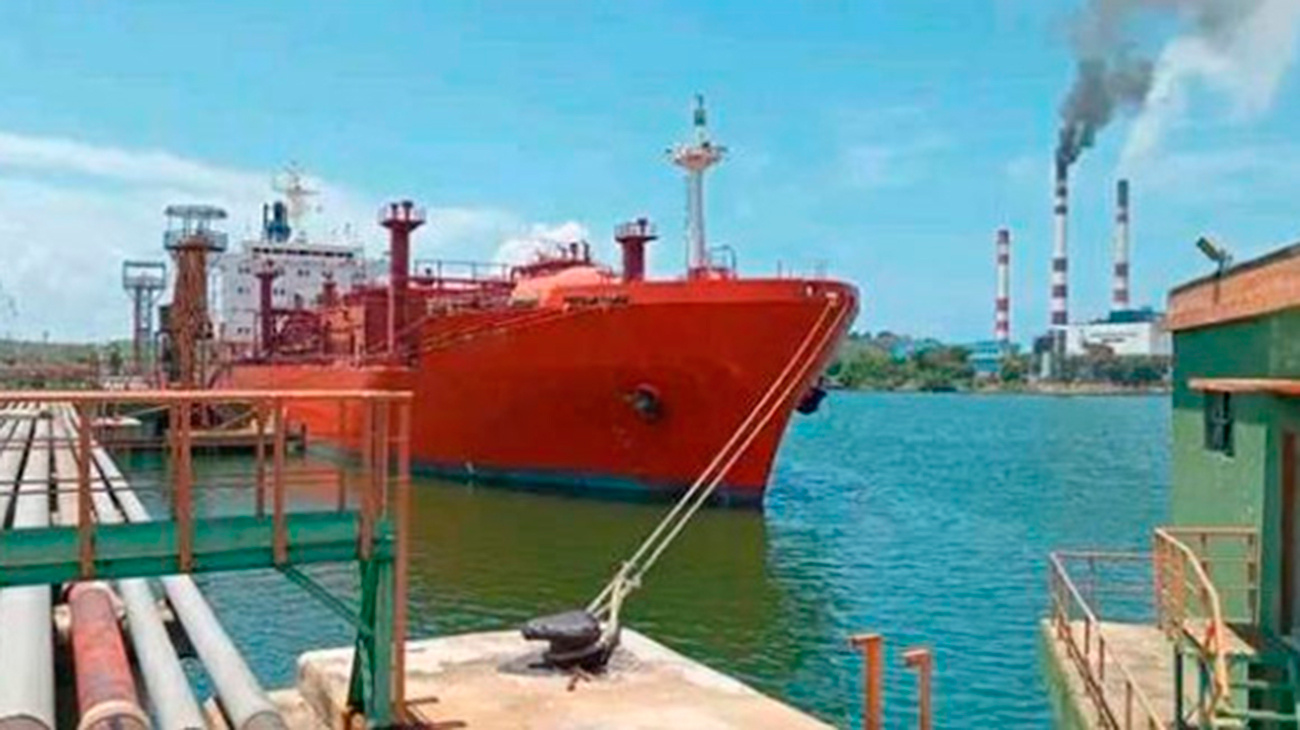
 14ymedio, Havana, 27 May 2025 — After the funds were completed to pay for the ship that is at the international dock of the Hermanos Díaz refinery in Santiago de Cuba, the discharge of liquefied gas began on Tuesday, confirmed the Unión Cuba Petróleo (Cupet). The government’s insolvency has prevented supplies to 1.7 million households in recent months, leaving ships waiting weeks before they can deliver their goods.
Last Thursday the first deputy minister of the Ministry of Energy and Mines, Argelio Jesús Abad Vigoa, said that two or three days after the start of marketing liquefied gas in the eastern provinces, distribution will extend to the west of the country.
The director of the Territorial Division for Marketing of Fuel, Lisset González Sardinas, said that “the organizational conditions of distribution and marketing are created,” so “100 percent coverage in a period of 24 days is expected.”
As part of the logistics, it was indicated that the Ticket application will come into operation, “for which 80 daily shifts will be released, with customers occupying a separate line.” This became three lines, along with the composition of the support team that would lead the organization of the point of sale at each marketing point.
As part of the logistics, it was indicated that the Ticket application will come into operation, “for which 80 daily shifts will be released, with customers occupying an independent line”
According to the plan, “14,000 cylinders per day are expected to be extracted from the cylinder filling plant for transport to the centers in Santiago de Cuba and the rest of the territories.” Although the planned production includes the extraction of 4,000 cylinders in the morning and 3,500 in the afternoon, this will depend on whether there are no “setbacks in the industry.”
At least 164 cylinders will be taken every day to each marketing point and “will be sold to customers, who since January or before, have not received liquefied gas.” It has been specified that in the two following turns those people will be given preference who bought until the February 15, and the distribution will continue like this, with the following turns being sold to the rest of the customers successively.
“Each customer will buy only once, regardless of the cycle interval of their group. Until all of the customers are served, they will not be able to make a new purchase. This decision seeks to cover all the demand that exists today,” published the newspaper Sierra Maestra.
According to information disseminated by Granma, the liquefied gas will be supplied to “care centers, educational institutions and others of social importance”. Each province was left to implement a strategy and to do so quickly.
This Tuesday the priority of supply of liquefied gas will be the population that lives in tall buildings, such as those on the 18 floors of Garzón and Martí. On Wednesday, the supply includes the residents of the 18 floors of Micro 9, along with other tall buildings in the city, such as the 20 floors located in the municipality of Trocha, Versalles and Block J of the José Martí Urban Center.

The distribution also includes sales outlets for commercial houses in the towns of El Cobre, Melgarejo and Boniato. After that, it will cover those located in the districts of Antonio Maceo and Abel Santamaría, which includes the village of El Caney. Santiago de Cuba will be supplied on alternate days. Beginning on the ninth day, distribution will occur in the settlements of El Brujo, Sevilla, El Espardillo and El Castillito.
The despair over the lack of liquefied gas in Sancti Spíritus, Villa Clara, Ciego de Ávila, Matanzas and Cienfuegos encouraged all kinds of risky practices such as filling cylinders with natural methane gas instead of liquefied gas. This means that the small cylinders are subjected to twice the pressure, with the danger of an explosion.
“It’s a risky time bomb in our kitchens, because liquefied gas is denser than natural gas, and natural gas spreads faster and is more volatile in the air,” warned a young man worked at the Methane Gas Plant.
The first deputy minister of the Ministry of Energy and Mines said that in the case of the central provinces from Villa Clara to Ciego de Ávila, “they will continue to be supplied with the products of the Cienfuegos Refinery.” The official acknowledged that the shortage is “one of the major current problems for cooking food, and it is one of the causes of the increase in demand for electricity.”
Eleven days after the triumphant announcement of the completion of maintenance at the Cienfuegos refinery, the official newspaper Vanguardia confirmed that the shutdown of the refinery was due to the slow arrival of the ship carrying the crude oil, because “it had a technical failure which prevented its arrival as planned.” Domestic gas production covers only 13 per cent of demand, and the rest depends on increasingly expensive imports, whose price has risen by almost 40 per cent in the last six months.
Denying the optimism of the official media, “it won’t be until the weekend when the plants start and liquefied gas production is restarted,” said Irenaldo Pérez Cardoso, deputy director of Cupet. The picture does not seem to change. In Matanzas, more than 100,000 households are without cylinders and the distribution works half-way. In Havana, Artemisa and Mayabeque, about 99,000 customers did not have access to the service between October and November 2024.
Translated by Regina Anavy
____________
COLLABORATE WITH OUR WORK: The 14ymedio team is committed to practicing serious journalism that reflects Cuba’s reality in all its depth. Thank you for joining us on this long journey. We invite you to continue supporting us by becoming a member of 14ymedio now. Together we can continue transforming journalism in Cuba.