The US Cancels Visas for 14 Athletes To Attend a Cuban Athletics Federation Event

The refusal “destroyed the aspirations of those who prepared for that competition,” Cubadebate reported.


A total of 12 Cuban athletes, a delegate and a journalist from the Cuban Athletics Federation were denied visas / Jit

14ymedio bigger14ymedio, Havana, 6 April 2025 — The Cuban Athletics Federation (FCA) reported that the United States denied visas to 14 out of 16 athletes on the Island. The FCA stated that this “unacceptable action” prevented Cuba from having a full delegation at the 2025 World Indoor Athletics Masters Championships, which took place in Gainesville (Florida) between March 23 -30. The lack of a visa “crushed the aspirations of those who prepared for this competition,” Cubadebate reported.

The official State newspaper Granma accused the US of “again disrespecting the world sports movement by not fulfilling the obligations of a venue and preventing all athletes from participating with equal rights.” Moreover, according to Margit Jungmann, president of the World Athletics Championships, “it is a celebration of the passion, dedication and camaraderie that define Master Athletics.”

Granma indicates that on January 27, the process for obtaining visas began at the US Embassy in Havana, but almost a month later, on February 25, the diplomatic headquarters “called for interviews and denied visas to four of the applicants.”

It further noted that on March 31, when the event had already concluded, they were notified that the other 10 visas had also been refused. continue reading

The two Cubans who did not have visa problems live in the United States. The official media even resorted to the poem “Ode to Sport” by Baron Pierre de Coubertin to insist that the United States once again ignored the sacred foundational concepts of the Olympic movement.

In the last week of March, the jazz group at Clark College in Washington was also denied a travel permit

Last February, the US government suspended “the application mechanism for a group of visa categories” used by Cuban state officials and their agencies to travel to the United States.

The decision directly affects “bilateral exchanges that were taking place in areas of mutual interest and benefit for the peoples of Cuba and the United States, such as culture, health, education, science and sports,” said the Deputy Minister of Foreign Affairs, Carlos Fernández de Cossío.

Among those affected at the time was the basketball team that was to participate in a qualifying match in Puerto Rico. The last week of March, the jazz group at Clark College in Washington was also denied a travel permit. A letter sent to Clark College by the Office of Foreign Assets Control (OFAC), indicated that the presence of the group in Havana is “incompatible” with the policies of the US government, and, therefore, the travel permit was denied.

In mid-March, The New York Times published a draft that included Cuba on a red list of citizens who would be banned from entering the US. The US special envoy for Latin America, Mauricio Claver-Carone, avoided commenting on the issue. “I neither affirm nor deny,” he said. “It is still being discussed; I have nothing to add.”

However, he defended the immigration policy of the Donald Trump administration: “We’re going to be more surgical, more effective.”

Translated by Regina Anavy

____________

COLLABORATE WITH OUR WORK: The 14ymedio team is committed to practicing serious journalism that reflects Cuba’s reality in all its depth. Thank you for joining us on this long journey. We invite you to continue supporting us by becoming a member of 14ymedio now. Together we can continue transforming journalism in Cuba.

March Rumors in Cuba: The Order To Block Subversive Words Has Been Given

It is said that the Cuban repressors detected in the US will be sent to special prisons in El Salvador.

Police officers escorting Venezuelans to prison as part of a transfer agreement between El Salvador and the Trump administration. / Press Secretariat of the Presidency of El Salvador

14ymedio bigger14ymedio, Havana, 7 April 2025 — Having lost the battle against poverty in real life, Miguel Díaz-Canel has decided to eradicate it in cyberspace. At least that’s what one of the most persistent rumors about Cuba during the month of March claims, alluding to a supposed executive order by the president to block terms like “hunger” “freedom ,” “poverty,” and “blackout” on instant messaging.

These words—and many others, including insults to the government and diatribes against the country’s situation—define the island’s vocabulary, and although there is no record of an order in place to remove them from the digital sphere, the regime has blocked them before, during times of particular political and social tension.

The most recent example: the protests of 11 July 2021, during which the State telecommunications entity Etecsa systematically vetoed any messages with problematic words or containing a possible call to march against the regime. At that time, “experiments” proliferated, demonstrating that if a text message containing the words “pa la calle” [to the streets] or “libertad” [freedom] was typed and sent from a mobile phone , the notification never reached the recipient’s screen.

Without a doubt, the Cuban panorama is once again one of notable tension, and not only because of what is happening within the borders, but also because of the news arriving from the other shore.

Without a doubt, the Cuban situation is once again marked by tension, not only because of what’s happening within its borders, but also because of the news coming from the other shore. What is happening in Washington, where Donald Trump generates countless headlines every day, is also fueling rumors about the island. continue reading

The mass deportations of migrants to El Salvador’s prisons—the vast majority of whom are criminals and gang members, but also include innocent people—has led to the hypothesis that Cuban repressors and counterintelligence agents in the United States will also be identified, detained, and sent to Nayib Bukele’s prisons.

That Havana and Washington are secretly in talks has also been part of the conspiracy theories since January 20, when Trump took office. According to some reports, there have been communications between the Oval Office and Raúl Castro and Nicolás Maduro, with unspecified threats if Trump intensifies economic sanctions against these regimes.

According to many online commenters, politicians from both countries hold constant meetings to negotiate the delicate balance between what the White House says it will do against the Cuban regime and what it actually plans to do.

Others are already speaking of a back-and-forth between the two governments. One rumor accuses Miguel Díaz-Canel of organizing a drug trafficking operation to the United States. Supposedly, several small planes that landed in that country had departed from Holguín the day before, and had the approval of the president—who was in that province at the time of takeoff—to transport narcotics and alter their records.

Supposedly, several small planes that landed in that country had departed from Holguín the day before, and had the approval of the president.

For many, Trump represents the beginning of the end of the Cuban regime, and some assume that before he leaves the White House, what many rumors have been predicting for years—despite his public “resurrections”—will happen: the death of Raúl Castro. Castro’s transfer to the Cimeq military hospital, “in extremely serious condition,” was one of the rumors circulating this month.

Constant rumors continue about the deteriorating situation on the island. In the face of police inaction—a phenomenon denounced by numerous internet users—reports of scenes where perpetrators take the law into their own hands are increasing. The capture of a bicycle and purse thief, allegedly accused of burglary in Havana, was one such complaint.

It was also reported that the warehouse manager at the Noris Urban Nursing Home in Holguín is stealing food intended for the elderly there, who are particularly affected by hunger and the lack of supplies. Another rumor alleges the loss of wages for Community Services workers in Santiago de Cuba. Another, in the same province, reports that management at Laboratorios Oriente has withheld workers’ wages following the theft of a gas cylinder there.

Some of these commentaries become news after being verified by the independent press. Others, however, remain rumors, but are powerful indicators of the state of tension and anxiety in which Cubans live.

____________

COLLABORATE WITH OUR WORK: The 14ymedio team is committed to practicing serious journalism that reflects Cuba’s reality in all its depth. Thank you for joining us on this long journey. We invite you to continue supporting us by becoming a member of 14ymedio now. Together we can continue transforming journalism in Cuba.

Cuba Is on the US Immigration Red List, According to The New York Times

It is unclear whether citizens of the 43 countries included who have valid visas or permanent residency will be affected.

Family members of the migrants waiting at the airport in Miami / 14ymedio

14ymedio bigger14ymedio, Havana, 15 March 2025 — The Trump administration wants to restrict entry into the United States to citizens of some 43 countries, including Cuba, on the “red list.” According to The New York Times ( NYT ), which obtained a draft of the measure, the lists were drawn up weeks ago by the State Department and were under review for 60 days, to be sent to the White House next week.

None of the officials who spoke anonymously with the newspaper were able to clarify whether citizens of these countries who have valid visas or permanent residency in the US—such as the hundreds of Cubans admitted through humanitarian parole— will be affected.

The draft could be subject to changes before reaching the Oval Office, but for now it includes a list of 11 countries whose citizens would be, according to the NYT, “strictly banned from entering the United States.” These include, in addition to Cuba, other old enemies of Washington: Venezuela, Iran, Libya, North Korea, Somalia, Sudan, Syria, and Yemen, as well as the Buddhist kingdom of Bhutan, which inexplicably appears on that list.

A second “orange list” includes 10 other states: Russia, Belarus, Eritrea, Haiti, Laos, Myanmar, Pakistan, Sierra Leone, South Sudan, and Turkmenistan. Entry for citizens of these countries may be restricted, though not prohibited. continue reading

For citizens of those nationalities, entry may be restricted, although not prohibited.

“In those cases, wealthy business travelers could be allowed entry, but not those traveling on immigrant or tourist visas. Citizens on that list would also be subject to mandatory in-person visa interviews,” the anonymous officials familiar with the matter said.

Finally, the “yellow list” includes the remaining 22 countries, whose governments will have 60 days to “correct perceived deficiencies, facing the threat of being moved to one of the other lists if they fail to comply.” The irregularities could include a lack of information provided by each country on travelers or inadequate security practices in immigration procedures, such as the issuance of passports.

This part of the list includes Angola, Antigua and Barbuda, Benin, Burkina Faso, Cambodia, Cameroon, Cape Verde, Chad, the Republic of the Congo, the Democratic Republic of the Congo, Dominica, Equatorial Guinea, Gambia, Liberia, Malawi, Mali, Mauritania, Saint Kitts and Nevis, Saint Lucia, Sao Tome and Principe, Vanuatu, and Zimbabwe.

Other “problematic” countries for Washington, such as Nicaragua, are not included in the interim report.

The lists were compiled by diplomatic and security officials and are being reviewed by embassies and regional offices of the State Department, as well as security specialists from other departments and intelligence agencies. “They are commenting on whether the descriptions of deficiencies in certain countries are accurate or whether there are political reasons—such as avoiding disrupting cooperation in priority areas—to reconsider the inclusion of some,” the NYT emphasizes.

Upon his arrival at the White House on January 20, Donald Trump signed the so-called “Protecting the American People Against Invasion”

According to the NYT, upon his arrival at the White House on January 20, Donald Trump signed the Protecting the American People Against Invasion Act. He also called for investigations into countries that provide “deficient” information about their citizens to the point that it could justify a total or partial ban on their entry into the country.

He then gave the State Department 60 days to comply with the executive order and deliver the report.

Many of the countries included in the draft had already been sanctioned with similar measures during Trump’s previous term. In January 2017, immediately after taking office, the Republican signed an executive order barring entry to the US to nationals of seven Muslim-majority states: Iraq, Syria, Iran, Libya, Somalia, Sudan, and Yemen. Subsequently, North Korea and Venezuela—in this case only for officials and their families, although it has now been added to the red list—entered the list, while Sudan and Iraq were also removed. The courts approved the measure.

Among those included in the new draft is Afghanistan, a case that is causing strong disputes within the Government, especially over war refugees, according to the NYT .

In the case of Cuba, the fact that its government admits few deportations could be the reason why the State Department included it on the red list. There are more than 42,000 Cubans awaiting expulsion, but the regime evaluates each return individually and, to date, has only admitted 104 migrants so far this year.

____________

COLLABORATE WITH OUR WORK: The 14ymedio team is committed to practicing serious journalism that reflects Cuba’s reality in all its depth. Thank you for joining us on this long journey. We invite you to continue supporting us by becoming a member of 14ymedio now. Together we can continue transforming journalism in Cuba.
Matanzas Residents With Family Abroad Dream of a Dollar Store

A few days ago, paying by card was once again a fantasy in Plaza Milanés and Ayllón de Matanzas / 14ymedio

14ymedio bigger14ymedio, Julio César Contreras, Matanzas, 7 April 2025 — The debate has changed focus. Just a year and a half ago, the discussion was why the government had raised an “eyesore in MLC” [Freely Convertible Currency] – as a well-known journalist of the official press called it- out of harmony with the historical environment and heritage of the center of Matanzas. Now, the question among residents with family abroad is when will it start charging in dollars to save them from ruin.

The business, belonging to the military corporation Cimex, was inaugurated in May 2023, and only four months later the official press listed it as part of the “vanguard in the implementation of electronic commerce within the currency trading network of the province.” The decline, however, arrived suddenly. “The last time I came, all operations were paralyzed because there was no electricity and not much to buy,” Melissa tells 14ymedio.

The young woman approached the establishment a few days ago willing to spend the recharge made by her mother from abroad on her card in freely convertible currency (MLC), but to get there she had to spend 500 pesos in transport. From the outside she could see a line of about a dozen people, which led her to believe that the offer of products was substantial.

“I thought they had something special to sell, but there’s a line because the connection for electronic payment was lost, and there’s no way to pay at the checkout counter. They say that the problem started about 20 minutes ago and is still not solved.” The butcher shop had nothing to sell, and the refrigerators looked thawed and empty. continue reading

The customers, after a short walk through the business, ended up in the Cubita Cafeteria, with offers in national currency. But there, too, a decline was evident. If until recently the menu board showed coffee, sandwiches and ice cream, this time it had on sale, for 35 pesos, only an espresso with a strong taste of roasted peas.

Melissa was lucky enough to have the right amount of money on her, because there was no connection at the coffee shop and it was impossible to pay with any debit card.

“It seemed that this was what was coming, that these markets were going to be in more places with more variety,” recalls Moisés, a retired neighbor of the Plaza. He saw the arrival of the MLC store as an opportunity to buy products “nearby and with better quality” and now has hope only in the dollarization of the business.

“I got credit right away on a card in MLC that my kids top up for me every month, but right now it doesn’t help much,” he says. “Although I live right here and am in a WhatsApp group where people are notified when something is available, the truth is that the offers have been declining, and meat is the product most affected.”

The position on dollarization, more than an economic issue, is political. While those who live on their wages or pensions in national currency, and a good number of those who still support the regime reject the emergence of the dollar into national life, the population that benefits from the remittances of their emigrant relatives is betting on the comfort of being able to pay with the same greenbacks they receive from Miami.

“It is true that if they do this it will be for just a few, but at least they will be making use of a part of these premises that is currently practically unused.” The desolation that is currently visible inside the complex contrasts with the assertions of the Cuban authorities that sales in MLC will be maintained.

“There are many ways to end something: you can stand in front of a microphone and announce that the stores in MLC will continue or you can kill them little by little,” reflects the retiree. In his opinion, the Plaza Milanés y Ayllón Shopping Center is doing the latter. ” There are deteriorated stores that are disgusting to see that could again provide service in dollars.”

Standing on one side or the other of that thin red line is quite an ideological statement. The most strict militants of the Communist Party see the markets in dollars as a necessary evil to collect foreign exchange, but that has a cost by increasing social differences and dependence on the United States. Others perceive the process of expanding the US currency as an opportunity to improve their lives that will also, says Moisés, “carry over to everyone, even if they do not receive remittances directly.”

Translated by Regina Anavy

____________

COLLABORATE WITH OUR WORK: The 14ymedio team is committed to practicing serious journalism that reflects Cuba’s reality in all its depth. Thank you for joining us on this long journey. We invite you to continue supporting us by becoming a member of 14ymedio now. Together we can continue transforming journalism in Cuba.

“When an Official of the Cuban Police Says ‘Enough’ the Regime Will Fall”

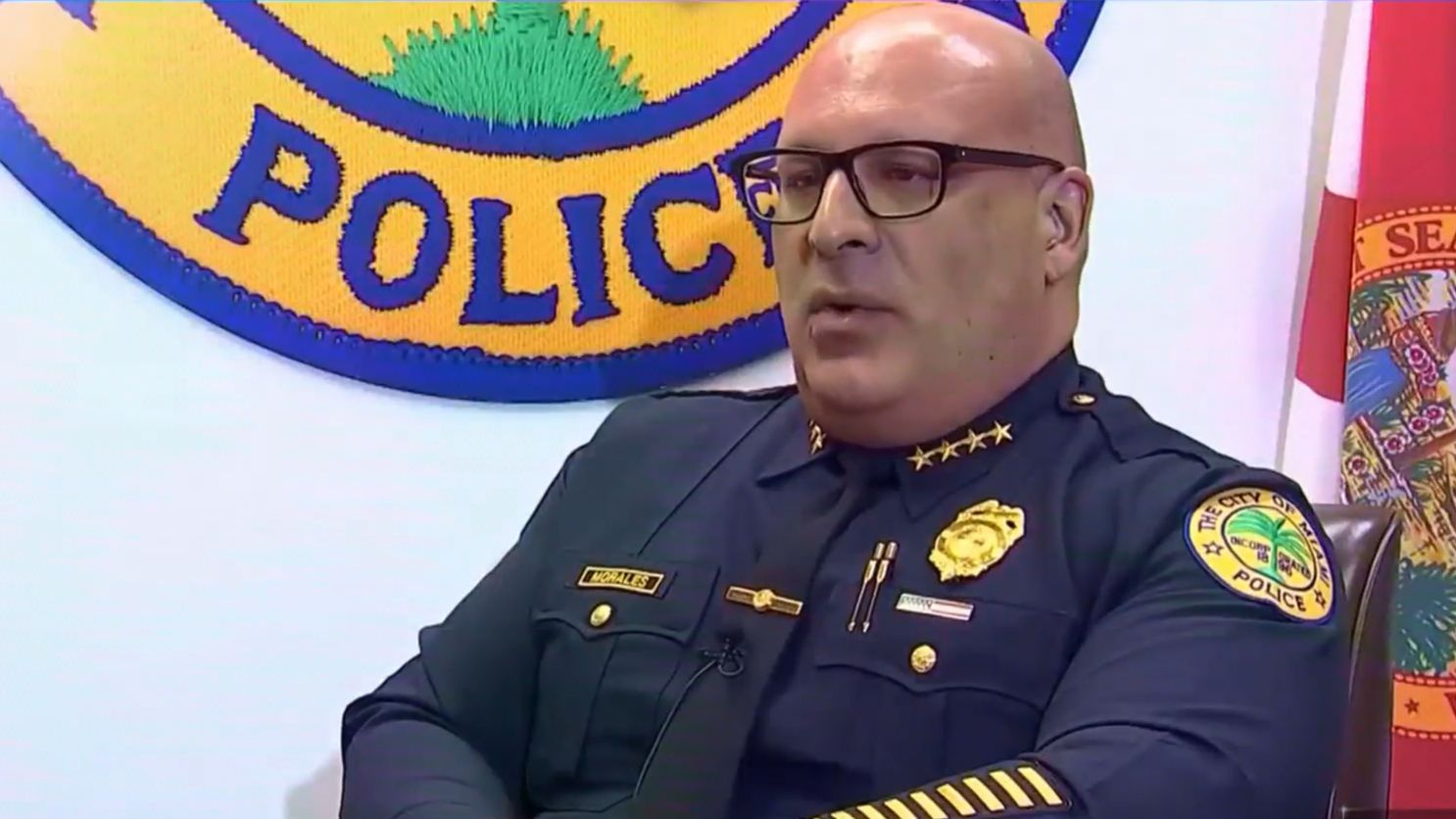
Miami Police Chief Manuel A. Morales acknowledges that “doing the right thing isn’t easy.”

Miami Police Chief Manuel A. Morales. / NBC Miami/Screen Capture

14ymedio bigger14ymedio, Havana, 6 April 2025 — Veteran Cuban-American police officer Manuel A. Morales, head of the Miami brigade, believes his colleagues on the island “can be the catalyst for change” if they understand “their true role,” which is “to serve the people.” In an interview with CubaNet, the officer reflects that although “doing the right thing isn’t easy,” since “it’s easier to go with the flow and do what everyone else is doing,” he asserts, “change begins with just one person.”

That change, continues Chief Morales, as he is known among his colleagues, “can spread from one officer to another until the moment comes when they say: ’Enough. We are not here to repress the people, we are here to protect them.’” When that happens, he asserts, “the regime will fall.”

The officer, with 31 years of service and known for having led the investigation into the death of the singer José Manuel Carbajal Zaldívar, ’El Taiger’, insists that many Cuban police officers “have only seen a model of repression, but if they begin to understand that their true role is to protect the people, change will be inevitable.” continue reading

“It all starts with one person saying ’this isn’t right,’ and like dominoes, others begin to follow suit.”

In this regard, he recalled Philip Zimbardo’s study, The Lucifer Effect, from the 1970s, which demonstrates “how an authoritarian environment can corrupt even psychologically healthy people.” He concludes: “It all starts with one person saying ’this isn’t right,’ and, like dominoes, others begin to follow.”

In the same way, he says, change must begin with the police and “then the army,” because “an oppressive system cannot be sustained without all members of society collaborating in the repression.”

Morales recalls that the Miami police provided support in other countries to achieve stability, for example in Haiti, where they sent Haitian-American officers to train their colleagues. “They were there for at least eight days and worked alongside the United Nations police. Something similar happened in Panama after Noriega’s fall: the Panamanian National Police was trained by us.” The same, he suggests, could happen in Cuba, where his officers, and even he himself, would be willing to retrain the police in the event of a democratic change.

Born in Puerto Rico to Cuban parents, with a bachelor’s degree in Organizational Leadership from the University of Saint Thomas and a master’s degree in Security Studies from the Center for National Defense and Security at the Naval Postgraduate School, he joined the Miami Police Department in 1994 as an officer and has had a distinguished career. He was promoted to commander in 2009 and has overseen daily operations and the deployment of the Gang Unit and the Crime Suppression Unit.

Regarding professional ethics, the veteran believes that “freedom must always come before security.” “If we sacrifice freedom for security, we lose both. The key is to guarantee freedom, and as a result, security develops naturally. Here, the legal process ensures that no one is arbitrarily convicted.”

____________

COLLABORATE WITH OUR WORK: The 14ymedio team is committed to practicing serious journalism that reflects Cuba’s reality in all its depth. Thank you for joining us on this long journey. We invite you to continue supporting us by becoming a member of 14ymedio now. Together we can continue transforming journalism in Cuba.

“It Hurts My Soul to See the Seniors of the 13th of March Old Age Home Filthy and Hungry”

The cheapest elderly care plan comes to $176 a month, 14 times the average Cuban salary and more than 30 times the average pension of a retiree.

13th of March Old Age Home in Guanabacoa, Havana. / 14ymedio

14ymedio bigger14ymedio, José Lassa, Havana, 4 April 2025 — “I’m going to give it to Eleguá,” says an elderly woman standing at the fence of the 13th of March old age home in Guanabacoa, stretching her hand between the bars and grabbing the money a passerby hands her. The charity doesn’t go unnoticed, and soon another hand, black and calloused, reaches out demanding a bill to save them from eating the “morronga” (morning snack) served downtown. Bordered by the reddish fence that marks the boundary between public and state property, the place looks more like a beggar’s shack than an old age home.

“Every time I go to the old age home, they call me and ask me to buy them coffee, and a cup costs 20 pesos, but that’s not the point,” says Aleida, who lives two blocks from the old age home. “They’re all dirty, they stink. It pains me to see the elderly like this, because we’ll all reach that age,” she confesses.

At age 50, a widow with no children, the Havana resident dedicates part of her time to helping “the old folks.” “Many of those who are there are here because they sold their house so their children could leave the country, hoping their lives would improve. The least I can do is bring them a thermos of coffee and some bread sometimes. I’d even like to bathe them because they break my heart.”

The woman suspects that more or less all of the island’s state-run old age homes are in a similar condition, but a few days ago she read in the press that 25% of Cubans are over 60 years old. The number confirmed her suspicion: there are too many elderly people and no one to care for them, which has led to a surge in cases of neglect and vulnerability among the elderly.

“When my grandmother fell ill four years ago, I went to the Ministry of Labor to request a caregiver. They told me they didn’t have anyone because, even though the demand for staff was high, they couldn’t afford to pay them,” Yisel says. continue reading

As she explained to 14ymedio, her job meant she couldn’t dedicate herself to caring for her grandmother, and the fact that the elderly woman had family members made it even more difficult to hire a caregiver. “Obviously, elderly people who lived alone were more likely to receive someone. If the family member couldn’t care for the elderly person, they had to justify their situation very clearly. When they finally assigned someone, families typically paid them a little more because their salary was a pittance.”

Elderly people beg for money and food through the fence of the old age home. / 14ymedio

Yisel followed all the necessary procedures, but she couldn’t get a caregiver assigned to her grandmother. For a while, she managed the situation as best she could, but after a year, she had to admit her relative to a psychiatric hospital, where a companion was required.

Once again, it was impossible for her to stay, so she contacted some registered nurses who no longer worked for Public Health and who were caring for the elderly in hospitals. “They were really good. They did everything for her, and they had the knowledge. Back then, when the dollar was at 50 pesos, they earned 2,000 pesos a day. I don’t want to think about how much that business costs now, with the dollar at 355 pesos.”

TaTamanía, a small business founded in 2023 and dedicated to care work, gives an idea of ​​how the business has changed—in terms of prices and organization. Elderly, sick, disabled. There’s no case that isn’t addressed by the “first private agency in Cuba dedicated to care.” The cost of these services, however, is what truly scares families.

“It pains me to see the elderly like this, because we’ll all reach that age,” laments a neighbor. / 14ymedio

Regardless of the plan chosen, the only payment method is to deposit dollars or euros into a foreign account. For people with mobility problems, the rate is $1.10 per hour; for people with reduced mobility, $1.35; and hospital care is charged at $1.50. The minimum required to request this service is 40 hours per week for one month. Calculating this, the cheapest plan comes to $176, about 62,480 pesos at the informal exchange rate, 14 times the average Cuban salary (4,468 pesos) and more than 30 times the average pension of a retiree (1,900 pesos).

The cheapest plan comes to $176, 14 times the average Cuban salary  and more than 30 times the average pension of a retiree.

At these prices, it’s clear that TaTamanía’s services aren’t benefiting elderly people like those at the 13 de Marzo old age home, but rather people with relatives abroad who can afford their “highly qualified” caregivers.

The town’s seniors gather around parks and bodegas. / 14ymedio

The private service offers five places for families who cannot afford the service, which it considers its social responsibility. However, agencies of its kind are far from capable of solving the problem of elderly care. “I have a friend who tells me he has no choice but to leave his mother alone, because in order to pay what they ask for her care, he has to go out on payday and give the entire amount to the caregiver,” Yisel says.

Guanabacoa’s parks are the place where many of the municipality’s elderly congregate at one time of he day or another. Sitting in wheelchairs, taking the last puff of a cigarette or waiting for the bread to arrive at the ration store, they are the sad image of an aging country. Even so, the park, the streets, or the old age home itself are, for many, an alternative to the empty homes from which their children and grandchildren have emigrated.

For many, the park, the streets, or the old age home itself are the alternative to an empty home. / 14ymedio

____________

COLLABORATE WITH OUR WORK: The 14ymedio team is committed to practicing serious journalism that reflects Cuba’s reality in all its depth. Thank you for joining us on this long journey. We invite you to continue supporting us by becoming a member of 14ymedio now. Together we can continue transforming journalism in Cuba.

Moses and the Newspaper

A National Humor Award that everyone applauds and no one discusses

Moisés Rodríguez, National Humor Prize 2025. / 14ymedio

14ymedio bigger14ymedio, Jorge Fernández Era, Havana, 6 April 2025 — For those of us who, in one way or another, participated in the young humor movement that emerged in Cuba in the 1980s, the Matanzas group La Seña del Humor represented that high point we always strived to reach, no matter if we actually got there or at least were close. Those older people we saw in the members of La Seña were our paradigm, proof that, among us, cultured figures could be popular without the need for banal mockery or the costumbrismo — the traditional heritage — that looked to the past and shunned the present.

Few forget that festival they organized in Matanzas, which, based on camping, helped steer our work with the vitality provided by confronting multiple forms of humor, almost all of them questioning a reality that seemed unquestionable. From that event at the Teatro Sauto, I remember seeing Pepe Pelayo and his group live, at their peak, and forever recording two unique moments: the monologue of the guy cutting his nails, delivered by Pelayo himself and Aramís Quintero, and the epic son performance of the aptly named cultured music performed by these cultured Matanzas natives.

He played a unique character: that of a musician who barely participated in the presentation, and who therefore spent his time reading a newspaper.

Moisés Rodríguez, one of the few remaining members of the legendary group in Cuba, played a unique character: a musician who barely participated in the performance, spending his time reading a newspaper. I mentioned this to the editor of La Seña a few days ago, and here is his reply:

“The act that closed our shows was Roberto Roberto and his group Bakán. That’s where Moisés el Roberto came from when he worked with his friend Lázaro Hernández, since they were both named Roberto. It was a typical orchestra with two guitars, bass, keyboard, violin, drums-timpani, conga drum, harpsichord and güiro, and minor percussion. We all worked together because Aramís interviewed Roberto Roberto (that was me), but Moisés was left out, as he was incapable of playing a musical instrument. So I had the continue reading

idea for him to sit to the side of the group playing a huge band bass drum. Since he only did this once or twice in each act—when a gag was over or there was a change of rhythm—Moisés had nothing to do. He himself had the idea of ​​opening a newspaper and starting to read. He would take out a banana and eat it, or start brushing his teeth with a toothbrush, or put on deodorant… The group played classic songs, for example, Fur Elise by Beethoven, and it changed to Cuban son, or Ravel’s Bolero, which changed to a typical bolero, or a Brahms-merengue… and so on.”

I had written to the director of La Seña upon learning that Moisés Rodríguez had been awarded the 2025 National Humor Award for compelling reasons given by the jury: “For the significance of his work as part of the iconic group La Seña del Humor de Matanzas, for many the genesis of an entire movement in the 1980s later called ’new type of humor,’ and considering that La Seña marks a before and after in group work on the Cuban humor scene, defined by many as tropical Les Luthiers for the quality and versatility of their work, being a national reference for an entire generation of stage comedians in the 1980s and early 1990s, based on his work as a soloist, his presence on radio and television as an art curator, writer, and pedagogue.”

“For many, he is also the literature professor who brought his wisdom mixed with humor to the classroom, with his unforgettable lectures, which were short humorous scenes.”

Ulises Rodríguez Febles, a playwright and researcher from Matanzas, spoke in the White Room of Matanzas about Moisés and what he represented and represents for the national comedy scene, about “his body and gesture work, the work of his voice: playing with the phrase to support the joke, and sharply bringing his stories to laughter, from the deepest part of their essence: irony, absurdity, Creole cheekiness, playfulness, unexpected twists, the relationship between the body—the hands, the fingers, the hair…—and the delivery of the text. A sure shot to the spectator, to unleash laughter.”

He also said: “For many, he is also the literature professor who brought his wisdom mixed with humor to the classroom, with his unforgettable classes, which were short humorous sketches. He is the art critic, the curator, and the painter of abstract works, with whom he seems to be another Moses without ceasing to be one; the heir to a Martí and Christian tradition that is in his family roots, of which he is proud and which continues to beat within him. When we pay tribute to Moisés Rodríguez Cabrera, we are paying tribute to La Seña del Humor de Matanzas, the group that transformed Cuban stage humor and offered it a contemporary perspective, the group that became a symbol of the city and offered Cuban humor a different aesthetic connotation, a fusion of Creole and universal legitimacy, which served and serves as a reference in the history of contemporary humor, embracing tradition and modernity, the Cuban humorous heritage, and the confluences of our identity in music, literature, the visual, and the stage. And in that synthesis of intellect and grace, there is Moses.”

Pelayo, from Chile, congratulated him with a video. “We have been friends, partners, accomplices, henchmen, allies, colleagues, teammates, brothers for almost sixty years. I am one of the people alive, outside of your immediate family, who knows and loves you the most, and also, like you, I dedicated my life to humor. Therefore, I dare to affirm, with great certainty, that you were born a comedian, grew up a comedian, developed as a comedian, and reached the pinnacle of acting. You are the man with the greatest comedic talent I have ever known, and I have known too much. This award was a debt that Cuba owed you, that Cuban culture owed you, and not to mention Matanzas. In addition to being an excellent comedian, you are one of the most noble, sincere, humble, and helpful people in the entire universe.”

To me, who did not want to miss that moment, and was able to embrace him like no one else, among so many colleagues from the eighties who accompanied him in the evening, it occurs to me to think that Moisés, in that anthological issue with the newspaper, was simply reading that one day a tribute would be paid to his modesty and to the wisdom of those who accompanied him in that Matanzas monument that was and is La Seña.

____________

COLLABORATE WITH OUR WORK: The 14ymedio team is committed to practicing serious journalism that reflects Cuba’s reality in all its depth. Thank you for joining us on this long journey. We invite you to continue supporting us by becoming a member of 14ymedio now. Together we can continue transforming journalism in Cuba.

Russians Aspire To ‘Increase Investment Projects’ While Cubans See Only ‘Obstacles’

Delegations from both countries in a session of the Russia-Cuba Intergovernmental Commission / Cubadebate

14ymedio bigger 14ymedio, Havana, April 6, 2025 — On one side of the long table, the Cuban delegation, chaired by Ricardo Cabrisas and several key ministers; on the other, the Russians, clinging to their headphones and consulting data on modern Mac computers. The photo published this Saturday by Cubadebate – in which Russian Deputy Prime Minister Dmitri Chernichenko smiles with satisfaction – is that of two countries in total synchrony.

“The exchange highlighted the intensity of our strategic links and the existing opportunities to continue consolidating bilateral relations in all areas,” Cuban President Miguel Díaz-Canel insisted in a publication on X.

The reality, however, is that once again the Kremlin offers and Havana takes, a dynamic that Chernichenko himself recently criticized, despite signing 13 agreements beneficial to the Cuban regime this Friday.

The information published about the Russia-Cuba Intergovernmental Commission, which met for the 22nd time this week, is diverse and incomplete, but it reveals important data about the bilateral agenda. The first thing is that Moscow, according to Chernichenko, gave Cuba a “state loan” of 60 million dollars in the form of 100,000 tons of Russian oil that continue reading

arrived in February, aboard the Akademik Gubkin.

That credit is part of a Kremlin plan that, according to the Russian side, aims to “minimize the consequences of the energy crisis”

That credit is part of a Kremlin plan that, according to the Russians, aims to “minimize the consequences of the energy crisis that Cuba has been experiencing since last year,” which, however, has not prevented four widespread blackouts in the last six months. There are three Russian companies, they said, evaluating the Cuban electricity debacle through “integral reviews.”

Last January, an investment by the Kremlin financed the start-up of the exploitation of several oil wells in Boca de Jaruco. The process – given the low quality of Cuban crude oil – is extremely cumbersome and unprofitable, but Chernichenko expressed his hope that these facilities, directed by the Russian oil company, Zarubezhneft, will allow Cuba “to obtain oil and reduce its dependence on the import of this fuel” (national crude oil cannot be refined on the Island and is used only for thermoelectric plants).

The high-ranking official also stated that about 160,000 Russian tourists had arrived in Cuba in 2024, “which coincides with the record of 2023.” The figure does not coincide with what was proclaimed by the Cuban authorities, who had raised the number of visitors from Russia to 185,800, a “record” that exceeded 184,000 in 2023.

The number provided by Chernichenko casts even more doubt on the credibility of Cuban statistics and removes reasons for optimism this year. The number has fallen by almost 50% in January and February: from 43,859 Russian visitors last year to 22,306 this year.

Moscow has focused on the transport sector, with several Russian companies having just participated in the sector’s international fair held this week in Havana. “Soon,” Chernichenko said, they will send 50 Moskvitch cars to the Island to operate as taxis in the capital.

The Russians also promised to “resume” the shipment of vehicles (last year they sent 180 spare vehicles and parts). Now, in addition, they will open an assembly complex between UAZ – the legendary Russian brand – and a Cuban company. There are other minor projections in the field of wheat milling, the impoverished sugar sector and the construction of at least one hotel only for Russians.

The high Russian official highlighted that he had stayed in the Northern Keys of Ciego de Ávila, to experience “Cuban nature” firsthand

The request that Chernichenko made to parliamentary leader Esteban Lazo in Moscow, a week ago, was repeated personally before Cabrisas. “We aspire to increase investment projects,” he stated. However, everything has remained in projections, promises and invitations to more meetings. The senior Russian official highlighted that he had stayed at the Northern Keys of Ciego de Ávila, to experience “Cuban nature” firsthand.

The only quote that Cubadebate picked up from Cabrisas, architect of the rapprochement with Moscow, says everything about Havana’s vagueness and lack of will: “The obstacles we face are clear.” Neither Prime Minister Manuel Marrero, who was later photographed with Chernichenko and Cabrisas, nor President Miguel Díaz-Canel, who met with the Kremlin envoy this Friday, had a voice or vote in the meeting.

There is another trip on the horizon: Díaz-Canel’s to Moscow next month, at the invitation of Vladimir Putin himself – as Chernichenko stressed – to attend the parade for the 80th anniversary of the victory of the Soviet Union against Nazi Germany. At that time, the president will pose again with other Putin satellites, such as the Belarusian Aleksandr Lukashenko, the longest-serving dictator in Europe.

“Respect, trust and transparency” is the mantra that, according to its organizers, governs the meetings between the Kremlin and Havana. The three values have been more than denied by reality: Cuba seems not to have much respect for its creditor, nor does Russia have confidence in its “favorite partner,” and neither of the two Governments is transparent about where their alliance is going.

Translated by Regina Anavy

____________

COLLABORATE WITH OUR WORK: The 14ymedio team is committed to practicing serious journalism that reflects Cuba’s reality in all its depth. Thank you for joining us on this long journey. We invite you to continue supporting us by becoming a member of 14ymedio now. Together we can continue transforming journalism in Cuba.

Seven Years in Prison for ‘Sabotage’ Given to an Employee Who Stole 30 Liters of Diesel in Ciego De Ávila

The worker attempted to cover up the theft by pouring water into the tank of a generator that eventually failed during a blackout.

The theft occurred in the Ciego 1 generator unit /Granma

14ymedio bigger14ymedio, Havana, 5 April 2025 — The Cuban press has become a fan of the thriller. This week, along with the catalog of exemplary trials for drug trafficking, it published a case of “sabotage” against the Ministry of the Interior, which it describes as “extremely serious.” The crime, for which an operator of a generator unit in Ciego de Ávila was sentenced to seven years in prison, was the theft of “30 liters of diesel” in 2024.

Following the custom of the state press, Invasor does not offer the exact date of the trial but reports that the theft occurred before April 29 last year, when, in an audit of the Ciego 1 generator unit, the authorities noticed the lack of fuel. “Perhaps overcome by nervousness,” he says, the worker poured water into the tank to cover up the theft.

The media does not explain why, despite having noticed the lack, the apparent replacement of fuel was not investigated. But it didn’t happen until a blackout – “which is part of everyday life” – forced the generator to enter the national electrical system around 10:00 pm on Monday. With water in the tank, “after about 20 minutes the Ciego 1 slowed down and stopped working,” it reports dramatically. continue reading

The number of problems that were triggered from the failure of the generator is what led a worker of “impeccable and outstanding social and labor behavior” to appear in criminal court against the Security of the State of Camagüey and not in a civil court.

With the blackout, the Ministry of the Interior communications center was disconnected, as was the territory’s surveillance cameras

With the blackout, the Ministry of Interior communications center was disconnected, as was the surveillance cameras of the territory, “the flow of information in the province and the nation,” and the telephone services of the police and firefighters. It also caused “an economic impact on the Telecommunications company (Etecsa) of 5.74 pesos for the value of the two filters that it was necessary to replace to restore the unit,” emphasizes Invasor.

The court asked for seven years in prison for the worker, with the right to request a cassation appeal to reduce the sentence, and the “blue jug” he used to pour water into the generator was confiscated.

The media reports the confession of the accused: “It was the time when the electricity went out every day, and I thought they were going to blame me for that. I got nervous, and the solution that I came up with was to pour in liters of water so that when they measured… My intention was never to harm anything; I am quite sorry and quite ashamed, because I am not a person who commits a crime, much less one who commits sabotage.”

The career of the employee, who had worked in Ciego 1 for 10 years, and the fact that he had no criminal record were mitigating

The career of the employee, who had worked in Ciego 1 for 10 years, and the fact that he had no criminal record were mitigating, Invasor clarifies. But “the seriousness and harmfulness of the acts committed” determined that he was charged, in addition to theft, with sabotage. “The crime of sabotage affects the public good and the internal security of the State,” the Prosecutor’s Office argued.

The energy crisis on the Island, impossible to detach from the shortage of fuel, has prompted the State to launch a hunt against those who steal the product. Last February, 14ymedio reported the arrest of the mayor of Manzanillo (Granma), along with other officials, for doing business under the table with oil destined for services and state companies.

However, the case of Osvaldo Antonio Incencio Piñeiro, contrary to that of the accused of Ciego 1, was carried out with the utmost discretion because he was a leader. “Everything was done behind closed doors in the offices of the municipal Communist Party and the government,” a source close to the investigation told this newspaper.

Translated by Regina Anavy

____________

COLLABORATE WITH OUR WORK: The 14ymedio team is committed to practicing serious journalism that reflects Cuba’s reality in all its depth. Thank you for joining us on this long journey. We invite you to continue supporting us by becoming a member of 14ymedio now. Together we can continue transforming journalism in Cuba.

A Former High-Ranking PCC Official, Who Arrived in the United States With Humanitarian Parole, Self-Deports to Cuba

Misael Enamorado Dager returned to the island with his family after arriving in the United States approximately a year ago through the humanitarian parole program.

Misael Enamorado Dager served as first secretary of the Communist Party in Santiago de Cuba between 2001 and 2009 / Facebook

14ymedio bigger14ymedio, Havana, 3 April 2025 — Misael Enamorado Dager, former first secretary of the Communist Party (PCC) in Santiago de Cuba, self-deported from the United States to Cuba at the end of last March, as confirmed on his digital site by journalist Mario J. Penton. The former official returned to the Island with his family after arriving in the United States a year ago through the Humanitarian Parole Program.

Enamorado, who was also part of the Central Committee of the PCC, was harshly criticized for his initial link with the Havana regime and his subsequent departure to the United States. “The former communist leader made the voluntary decision to return to Cuba after receiving multiple legal notifications and an increase in public scrutiny,” Pentón explains.

Pressures on Enamorado became more intense after Republican Congressman Carlos Giménez included his name on a list of 100 Cuban repressors who were to be deported to the Island. In a letter sent to DHS Secretary Kristi Noem, the Republican said these individuals represented “a threat to national security.”

These agents of the Cuban regime must be identified, investigated and deported immediately, stressed the congressman. Giménez was born in Cuba and become one of the most recognized faces against the Castro regime in southern Florida as mayor of Miami-Dade county between 2011 and 2020.

Enamorado, who was also part of the Central Committee of the PCC, was harshly criticized for his initial link with the Havana regime

In the time he spent in the United States, Enamorado could not obtain permanent residence (green card) despite having taken advantage of the Cuban Adjustment Law. His past as a collaborator of the Cuban regime was continue reading

an insurmountable obstacle to legalizing his situation in Houston, Texas, where he lived.

The former official held the position of secretary of the PCC in Santiago de Cuba from 1995 to 2009, and in 1997 he was promoted to the Political Bureau. In 2009 he moved to Havana and was part of the Secretariat of the Central Committee of the party organization, until he was dismissed in 2013 by order of Raúl Castro.

According to Pentón, the Enamorado family owns a luxurious residence that they rent to tourists in Cuba, “presumably a personal gift from the Castro family,” a detail that further fueled his rejection by Cuban exiles.

The voluntary return of Enamorado to the Island sets a precedent that could be followed by other former officials of the Cuban regime who are currently in the United States. Among them are members of Cuban State Security and prosecutors linked to trials against opponents.

The former official held the position of secretary of the PCC in Santiago de Cuba from 1995 to 2009, and in 1997 he was promoted to the Political Bureau

In August of last year, the former first secretary of the Communist Party in Cienfuegos, Manuel Menéndez Castellanos, arrived in Miami. After accumulating merits on the Island, where his political career and affiliation to the regime top a substantial list of positions and distinctions – including that of “coordinator of the Coordination and Support Team of Commander-in-Chief Fidel Castro” – the official decided to spend his retirement in the United States, where part of his family resides.

Many before him have tried to achieve the “American dream” and have done so with impunity, as happened with Yurquis Companioni, a counterintelligence agent in Sancti Spíritus. In other cases, they have clashed with the US justice system. This happened to Liván Fuentes Álvares, former president of the National Assembly on the Isle of Youth, who – after the procedure was approved and he was about to travel to the United States – was denied humanitarian parole.

More recently known was the case of Judge Melody González, who sentenced four young people from Villa Clara to prison – without evidence and by order of State Security, according to her own statements – for allegedly throwing Molotov cocktails at regime officials. González is now facing a legal process in the United States, where she arrived requesting political asylum last May, after being denied entry with the humanitarian parole she had obtained. The former judge, currently detained at the Broward Transitional Center, in Florida, will have to prove, after a first failed attempt, that she is eligible for international protection.

Translated by Regina Anavy

____________

COLLABORATE WITH OUR WORK: The 14ymedio team is committed to practicing serious journalism that reflects Cuba’s reality in all its depth. Thank you for joining us on this long journey. We invite you to continue supporting us by becoming a member of 14ymedio now. Together we can continue transforming journalism in Cuba.

Nicaragua, the Insatiable Dictatorship

President Daniel Ortega and his co-dictator Rosario Murillo are two insatiable autocrats, individuals who do not respect limits when it is necessary to satisfy their hunger for power.

Nicaraguan Vice President Rosario Murillo and President Daniel Ortega. / EFE

14ymedio bigger14ymedio, Pedro Corzo, Miami, 6 April 2025 — It must be repeated ad nauseam: both Daniel Ortega and his co-dictator Rosario Murillo are insatiable autocrats. Men who respect no boundaries when it’s time to satisfy their hunger for power.

It is well known that Castro-Chavism is sustained by bayonets, although at present they are sitting on AK-47s, supplied by Vladimir Putin, the close friend of all autocrats.

Co-dictator Daniel Ortega has legitimized a practice we are all familiar with, consisting of the subordination of the powers of the State—legislative, judicial, electoral, oversight and supervision, regional and municipal—to the Executive Branch, an aberration enshrined by the apocryphal National Assembly of Nicaragua, composed of lackeys of the supreme couple, and who, as always, voted unanimously in favor of the proposal.

With this dictatorial disposition, public powers disappear, democracy ceases to exist, and precarious citizen participation is completely extinguished by the decision of two despots and the complicity of their servants.

In reality, both Ortega and his co-ruler are faithful admirers of the worst scum in the world, including Josef Stalin, Adolf Hitler, Mao Zedong, and, of course, Fidel Castro, the man behind the cancers of Castro-Chavism, who was the direct diabolical architect of the Nicaraguan regime. continue reading

In reality, both Ortega and his co-ruler are faithful admirers of the worst scum in the world: Josef Stalin, Adolf Hitler, Mao Zedong, and, of course, Fidel Castro

The reform to Nicaragua’s perpetually violated Constitution establishes the well-known positions of co-presidents, a condition that already existed in the country. It also extends the term of office for positions that are supposed to be elected.

In my opinion, the Nicaraguan regime, while seeking to resemble the totalitarian dictatorship established in Cuba by the brothers Fidel and Raúl Castro as much as possible, seeks to lend legitimacy to all its actions and is also not immune to the habits of military dictatorships, such as its vocation to make its enemies disappear or to exile them. Although, in all honesty, the two greatest similarities between Cuba, Venezuela, and Nicaragua are their immense capacity for repression and their cruelty in imprisoning their adversaries, generating an environment of citizen defenselessness that paralyzes communities.

One such scheme was recently denounced by the human rights organization Nunca Más, made up of exiled people in Costa Rica. According to this organization, the dictatorship has imposed a policy of forced disappearance on its opponents, as has happened with at least a dozen of them who were arrested several months ago.

The Castros and Ortegas like legitimacy, pretending to be democrats who respect the will of the people. Hence this latest reform to the Constitution — which proclaimed that socialism in Cuba was irrevocable — just as Castroism did in Cuba after the success of the Varela Project, proposed in 2002 by the Christian Liberation Movement led by the martyr Oswaldo Paya Sardiñas.

However, the co-dictators aren’t sleeping well. It’s April, the seventh anniversary of the popular protests in which Ortega’s henchmen killed nearly 400 people.

For the benefit of Rubén Darío’s people, international bodies continue to denounce the crimes of the Ortega regime. Recently, at a hearing before the Inter-American Commission on Human Rights (IACHR), Lesly Guerrero, a representative of the Center for Justice and International Law, said that the reforms have allowed the executive branch, headed by two “co-presidents,” to consolidate total control over the legislative, judicial, and electoral branches. She added: “These modifications not only eliminate institutional checks and balances, but also establish a system of government where repression and authoritarianism are presented with a veneer of legality.”

Furthermore, the co-dictators’ arrogance is boundless, a fact demonstrated by the country’s withdrawal from the United Nations Human Rights Council, following the request by the Group of Human Rights Experts on Nicaragua to sue the Central American country before the International Court of Justice (ICJ) for depriving Nicaraguans of their nationality.

Everything seems to indicate that Nicaragua and Venezuela are seeking to establish regimes similar to Cuba’s. They want to impose a closed society in which any vestige of freedom and respect for human dignity disappears.

Nevertheless, the co-dictators aren’t sleeping well. It’s April, the seventh anniversary of the popular protests in which Ortega’s henchmen killed nearly 400 people (325 according to the OAS-CIDH).

The blood of all these martyrs is on the hands of Ortega and Murillo, and blood stains, as the writer Jose Antonio Albertini affirms in one of his novels.

____________

COLLABORATE WITH OUR WORK: The 14ymedio team is committed to practicing serious journalism that reflects Cuba’s reality in all its depth. Thank you for joining us on this long journey. We invite you to continue supporting us by becoming a member of 14ymedio now. Together we can continue transforming journalism in Cuba.

‘Let There Be Light!: And the Light… (Went Out)’

The Garden of Passions, a museum of odds and ends created by a Cuban barber turned diplomat and spy

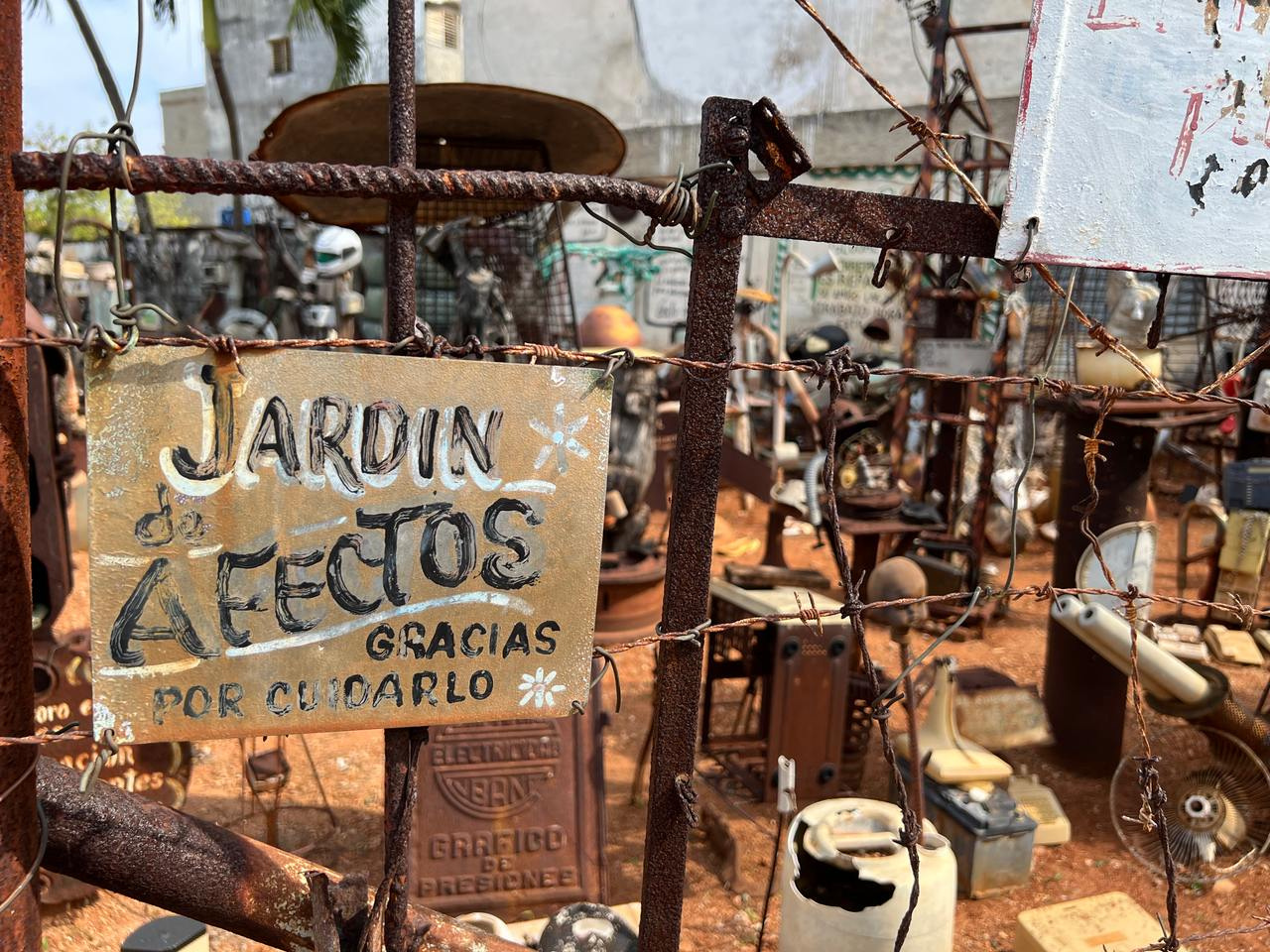
Wise sayings, reflections, commentary, fragments, doubts: all written upon a sheet of tin. / 14ymedio

14ymedio bigger14ymedio, José Lassa/Juan Izquierdo, Havana, 29 March 2025 – “An interesting and different kind of museum, created from throwaway objects transformed into beautiful sculptures that transmit messages full of moral lessons”. EcuRed’s [’Cuba’s Wikipedia’] perhaps rather simple definition, is, in a way, less eloquent than the unofficial names for the place it describes: The Museum of Junk, or Garden of the Passions. Also, we have: The Scrap Metal Gallery, or Gallo’s [’Cockerel’s’] Henhouse, along with many other variations on the name for the place created by Héctor Pascual Gallo, in the Alamar neighbourhood of Havana.

What’s significant is that EcuRed doesn’t even tell its readers who Gallo was – they have deleted the page which described the man who informed Fidel Castro – or at least so the legend goes – where Cuban exiles were going to land during the Bay of Pigs invasion. Born in eastern Havana in 1924, he was a barber, a diplomat, a spy and an artist, and he died in 2020.

After a whole lifetime – or several lifetimes, as he used to say – Gallo turned up in Alamar and began, aged over 80, a career in culture. One enormous and somewhat ghostly portrait of him is hung above the terrace inside the Garden. Another, signed by the Belgian artist Denis Meyer in 2019, is similarly fantasmagorical. Both represent Gallo as a sort of god of the place. And, in effect, it is his moral lessons – his passions – which populate the place.

A portrait signed by Belgian artist Denis Meyer in 2019 decorates the entrance. / 14ymedio

“I love white coffee more than anything else. Anything? Yes!”, says one of his commandments. “It’s good to know how to, and to be able to feed yourself”; “With time, beauty fades, but charm is accentuated”; “Putting something off doesn’t resolve it”; “Doing silly things doesn’t make you silly, unless it’s for more than 24 times a second (I was free for a minute)”. Wisdom, reflections, commentary, fragments, doubts: all written on bits of tin or wood and accompanied by arrows to keep you reading.

The most important thing about the Garden, however, is that it has the power to silence. In the land of rubbish tips, Gallo is the great organiser of rubbish, to which he attributes meaning, and history. The history of Cuba, no less. A mountain of cash registers, destroyed by rust, is the best symbol of the economic sinking of the country. A kind of Nganga cauldron, complete with forks and shells, recalls the incurable hunger of the Cuban people. One sign reads: “A verb most often used: resolve it. An expression most often heard: it’s not easy”.

A mountain of cash registers, destroyed by rust, is the best symbol of the economic sinking of the country. / 14ymedio

Picturesque and with an overall rusty brown hue, the Garden bursts its way into the daily life of Alamar. It’s impossible not to see it or hold an opinion about Gallo and his legend. No one knows exactly what to call the place, says Gertrudis, who lives close to the building with the giant portrait of the artist.

“They used to call it the Park of Junk. Perhaps it was after Gallo died that they named it Garden of the Passions. People know this street as Junk Street and everyone knows where it is”, she explains.

Ricardo, another person who grew up amongst Gallo’s trash, confirmed Gertrudis’s geographic reference: “Yes, they’d say ’Junk Street’. It’s part of his garden, where he turned all of his rubbish into a kind of love. Rubbish into Art. His granddaughter was at school with me actually. This part here is the old stock. Then it gets more organised as more objects were found. He was a journalist as well. A supercool old guy”.

’Brut Art’ by Cubans such as Gallo is currently on exhibition in a museum in Lausanne, Switzerland. / 14ymedio

For Gertrudis, a teacher who has lived in Alamar for years but has never actually been inside the Garden, the installation is connected with the so-called ’brut’ or ’deviant’ art movement. In fact, a number of works by Cubans who identify themselves as practitioners of this movement (one which might be defined as art created by people who aren’t, strictly speaking, artists), among them various works by Gallo, are being shown in Lausanne, Switzerland, this month.

“I find this kind of art quite interesting”, says Gertrudis. “I don’t know to what extent the people who create it have any artistic training, but yeah, it seems a pretty genuine movement to me. The materials they use are almost always re-used or recycled”.

On the question of what the Garden actually represents, its neighbours sum it up in one expression: “Daily objects which hold in themselves a sense of art”. / 14ymedio

On the question of what the Garden actually represents, Gertrudis sums it up in one expression: “Daily objects which hold in themselves a sense of art”. “Gallo transformed a space which, in itself, is quite boring. Alamar as a place is rather monotonous at times, and the idea of breaking with this physicality, with this architecturally ordered space – where, above all, there aren’t even any parks or other outstanding places either – is a great proposition, and its courage is rooted precisely in this”.

“Let there be light!: And the light… (went out)”, wrote Gallo on a signboard from 1993. More than 30 years have passed and the work appears just as fresh now as it did in the Special Period. At that time, forgotten by the regime which he had served, and apparently under Castro’s radar, Gallo made a place of creation out of poverty itself.

The goal is: to survive in this life, and in the next. “The difference between Goya and Gallo is just spelling”, says one of his aphorisms. “One is immortal, and the other is unmortal”.

Forgotten by the regime which he had served, and apparently under Castro’s radar, Gallo made a place of creation out of poverty itself. / 14ymedio

Translated by Ricardo Recluso

____________

COLLABORATE WITH OUR WORK: The 14ymedio team is committed to practicing serious journalism that reflects Cuba’s reality in all its depth. Thank you for joining us on this long journey. We invite you to continue supporting us by becoming a member of 14ymedio now. Together we can continue transforming journalism in Cuba.

The Garbage Has Destroyed Guanabacoa’s Great Treasure, Its Waters and Springs

In the midst of disaster and plague, a graffiti: “I am Fidel. Thank you for the country you left us.”

The scene of the garbage is so depressing that Yuliet prefers to keep the window closed, day and night. / 14ymedio

14ymedio bigger14ymedio, José Lassa / Juan Izquierdo, Havana, 6 April 2025 — What appeared first? The “I am Fidel” sign on a battered wall in Guanabacoa or the garbage dump located next to it? The hand that painted the slogan, popularized by the regime after the leader’s death in 2016, perhaps didn’t suspect that a rubbish pile and Castro could converge on that corner of the Havana municipality. Blurry, another message completes the irony: “Thank you for the country you left us.”

Guanabacoa is full of such signs, next to a pile of garbage or a sewage ditch. In some scenes, the vultures—with their wings spread out in a cross, like a child’s game—are exploring the waste or pecking at cans in the stream.

“Please dispose of waste in the water,” reads another sign near the Santa Rita Baths, once one of Havana’s most popular spas. One wonders whether such an absurd request had actually been erased by the damp on the wall. Thirty-nine-year-old Yuliet’s window overlooks one of the tributaries that lead to the place. The stench, at any time of day, is unbearable.

Graffiti — “I Am Fidel” — and trash in Guanabacoa, Havana. / 14ymedio

It’s enough to glance over it to see how the vultures and rats scratch among the puddles. The panorama is so depressing that Yuliet prefers to keep the window closed, day and night. “I keep it closed not only because of the smell, which in the end we get used to, but because the mosquitos are coming out of the toilet.”

Water, once clean and abundant, characterized Guanabacoa since time immemorial. Both the native people who gave the settlement its name and the settlers who arrived later decided that its baths and streams were the area’s greatest treasure. Before the Revolution, 11 of Cuba’s 27 water continue reading

bottling plants were located in Guanabacoa.

With its main resource contaminated beyond words, what was once its strength is now its weakness. Every stream, every well, every creek is an existing or potential source of disease. Garbage is taking over the land from Loma de la Cruz to Baños de Santa Rita, from the fields to the very center of the city.

A glance is enough to see how the vultures and rats dig through the puddles. / 14ymedio

“I love you, Yanisleidy,” reads the umpteenth graffiti next to a garbage dump. Fidel isn’t immune to the stench, but neither are declarations of love. The dump doesn’t believe in ideologies or feelings, and moves along with the increasingly turbid current that surrounds the hamlets and hills.

“People here don’t just go out and throw out the trash,” laments Juan, who arrived in the Mambí neighborhood from Las Tunas a decade ago. “They throw bags or whatever out the window, and it accumulates there until a good rain falls and washes away all the garbage.”

It’s a macabre sport that, with each “throw,” costs the city what little sanitation it has left. In defense of the residents, Juan claims the nearest trash container is six blocks away. “I used to use it,” he corrects himself: “It’s not there anymore. One day the Municipal Police came and took it away.”

In the residents’ minds there are two option: burn the trash or throw it in the stream, with the second considered ‘more hygienic.’ A cloudburst is the city’s only remaining ‘cleaning agent.’ When the rains come, the vultures hide under the trees, the rats drown or find a crack, and the trash floats away.

Guanabacoa is full of signs like this — ‘Please don’t throw the trash in the water’ — next to a pile of garbage or a sewage ditch. / 14ymedio

Caridad knows better than anyone that the downpour can wash away debris, but it’s deadly for those with low-lying yards. Less than a meter above the river level, the back of her house becomes a pool of rot when the current overflows. “It’s impossible to explain everything to my husband and I had to take out the patio,” she says.

“Some doctors came here to the neighborhood once, tested a couple of families, and left. No one else has come to check on our hygiene,” she says. Throughout the city, the feeling of helplessness is similar, fueled by the problems of drinking water shortages affecting all of Cuba.

The stench, at any time, is unbearable. / 14ymedio

A zinc sheet acts as a dike against the river. It doesn’t stop the dirty water or the diseases it brings, but at least it prevents the stink bombs from crossing the line into Caridad’s house.

When the rain subsides, she and her husband pile up the waste that has washed up on the patio. Loose or in bags, like the “paper boat” the children also play with, they throw all the rotten stuff back into the river. It’s a vicious cycle and also, the woman admits, a kind of revenge against the trash. Now it’ll be someone else’s problem.

____________

COLLABORATE WITH OUR WORK: The 14ymedio team is committed to practicing serious journalism that reflects Cuba’s reality in all its depth. Thank you for joining us on this long journey. We invite you to continue supporting us by becoming a member of 14ymedio now. Together we can continue transforming journalism in Cuba.

Forced Into Exile, Luz, Carolina, Yanelys, Anamelys and Katia Reinvent Themselves Outside of Cuba

Interrogations, threats, arbitrary arrests, internet shutdowns and police repression were the price they paid for their criticism.

Escobar was warned that she could not return frequently, only if it was “very urgently needed.” / Luz Escobar

14ymedio biggerEFE (via 14ymedio), Havana, 5 April 2025 — Carolina, Yanelys, Luz, Anamelys, and Katia are just five names on the list of Cuban women forced into exile in recent years for their dissent, from mere criticism to political activism to independent journalism.

“I didn’t leave Cuba of my own free will, they sent me out,” says art historian and activist Carolina Barrero, who tells EFE that “the repression intensified throughout 2021,” following the ’27N’ demonstration on November 27 of the previous year in front of the Ministry of Culture demanding freedom of expression and work.

“The surveillance was constant: I lived under constant suspicion, in a state of constant harassment. They charged me with criminal offenses for exercising fundamental rights,” recalls Barrero, who now heads the NGO Ciudadanía y Libertad.

“The surveillance was constant: I lived under constant suspicion, in a state of constant harassment.”

She insists she suffered “systematic persecution by State Security,” intelligence, and domestic counterintelligence. “I was detained multiple times, subjected to prolonged house arrest without a court order, and threatened with imprisonment if I continued my work of reporting and organizing peaceful demonstrations,” she says.

In February 2022, she says, she received the “ultimatum”: “Leave the country or face criminal prosecution, with the explicit threat of extending reprisals to third parties such as mothers of political prisoners, fellow activists…”

Another woman, curator Yanelys Núñez tells EFE that the “institutional violence” against her began in 2016, when she was expelled from her job for creating the work The Museum of Dissidence in Cuba with the artist and dissident Luis Manuel Otero Alcántara, currently in prison for insulting the symbols of the homeland, contempt, and public disorder.

The situation worsened two years later, due to the promotion of the dissident artist group the San Isidro Movement, explains Núñez from continue reading

Madrid, where she arrived in 2019. She recalls “threats to family and friends, arbitrary arrests, police and telephone surveillance, the ban on cultural events,” as well as “physical, verbal, and psychological harassment and violence.”

“The experience of being politically persecuted simply for defending your right to exist, for defending human rights, is terrible,” laments Núñez, who currently coordinates the independent Observatory of Gender Alas Tensas.

“The motive for the persecution I suffered is that Cuba has been under a dictatorship for more than 60 years, and all defenders are criminalized.”

“The motive for the persecution I suffered is that Cuba has been under a dictatorship for more than 60 years, and all defenders are criminalized,” says Núñez, adding: “I am not the first to have suffered this political violence in the country for wanting to participate in public and political life.”

Journalist Luz Escobar decided to work outside the official media. Because she worked at 14ymedio, “State Security put all the pressure they could on me to leave journalism in Cuba. But when they implicated my daughters in the repressive scheme, I decided to go into exile,” she told EFE.

“At first, they summoned me to the police, where they interrogated me to stop working. They insisted, but when I told them no, they changed their tactics and the tone of their threats: ’You’re doing things wrong, and if you continue, you’ll go to jail.’ All because reporting is a crime in Cuba,” she explains.

“After November 27th (27N), they saw me as an activist, and the repression multiplied: interrogations, threats, arbitrary arrests, internet shutdowns—all of this happened weekly,” she says. Escobar, whose father is also a freelance journalist, adds that even the day she was at the airport about to leave for Spain, she was warned that she couldn’t return frequently, only if it was “very urgent.”

“I spent weeks without being able to leave the house because security and the police were always downstairs trying to arrest me.”

Curator Anamelys Ramos, a member of the San Isidro Movement, did not leave Cuba due to pressure, although she admits she was “under brutal harassment.” “I spent weeks without being able to leave the house because security and the police were always downstairs trying to arrest me,” she told EFE.

After the Island-wide July 11 protests, the largest anti-government demonstrations in decades, she left for Mexico to study for a doctorate in Anthropology. In February 2022, when she tried to return, the “biggest outrage” occurred. “They wouldn’t even let me board the American Airlines plane because Cuba sent a notification to the airline that I wouldn’t be admitted into the country. By not letting me return, I was left in legal limbo and without a home or job,” she laments.

“I’ve always been in the spotlight of State Security,” communicator Katia Sánchez tells EFE. More than five years ago, she created La Penúltima Casa, the country’s first digital communication blog to help people use online platforms professionally.

She then created the El Pitch podcast, for entrepreneurs, in a country where the communications sector is restricted for the self-employed. As the project grew, so did the harassment from State Security, she laments. At first, it was “friendly,” with questions about her contacts and sources of funding, but it ended with “interrogations and threats that led to the closure of the project in Cuba.”

This communicator spent years “looking for loopholes to break through” to keep her project going, but “all of that ends up being bigger than starting a business.” Moving to the United States was the solution she found to keep her project afloat.

____________

COLLABORATE WITH OUR WORK: The 14ymedio team is committed to practicing serious journalism that reflects Cuba’s reality in all its depth. Thank you for joining us on this long journey. We invite you to continue supporting us by becoming a member of 14ymedio now. Together we can continue transforming journalism in Cuba.
ICE Detains in the US a ‘Marielito’ Who Fled Cuba 45 Years Ago

José Francisco García had been trying to obtain US citizenship for a decade.

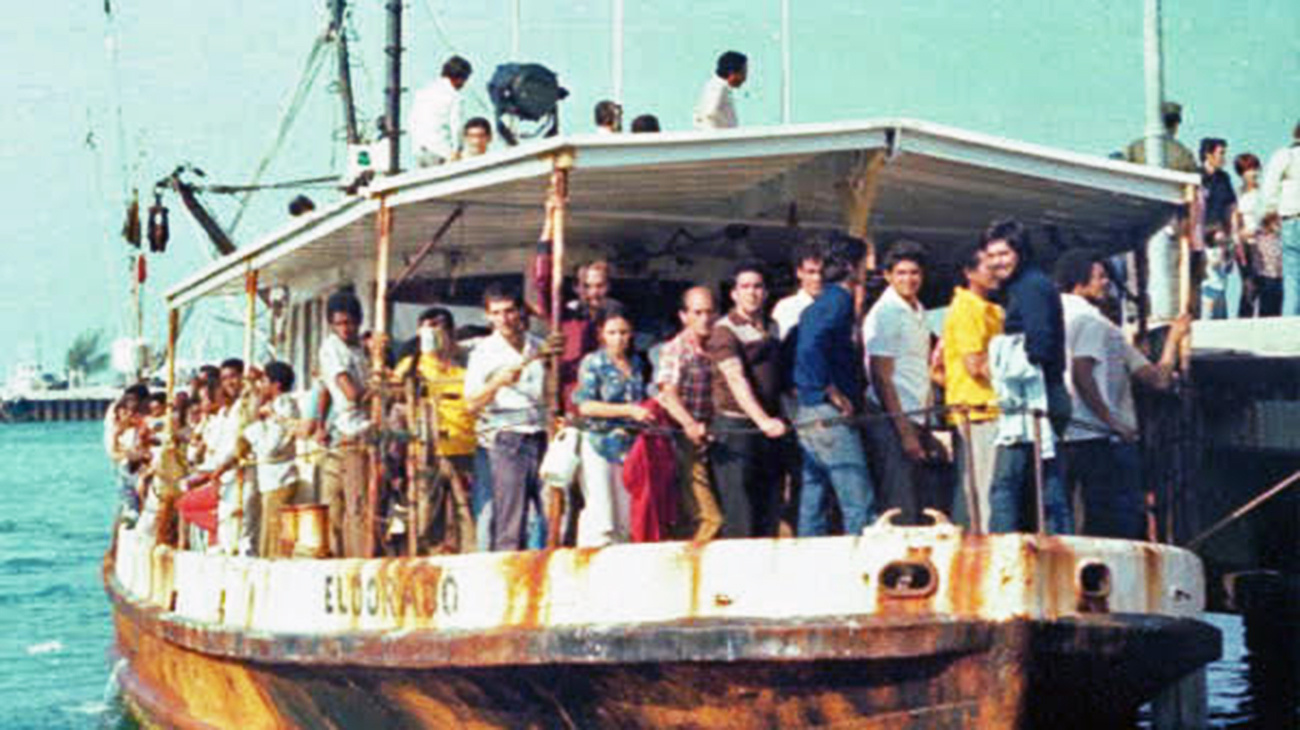
The shrimp boat El Dorado arriving in Key West loaded with marielitos, in April 1980. / Florida Memory

14ymedio bigger14ymedio, Havana, 4 April 2025 — José Francisco García Rodríguez, 73, who arrived in the United States during the Mariel boatlift—the seaborne stampede of more than 125,000 Cubans in 1980—has been detained since March 31 at an Immigration and Customs Enforcement (ICE) processing center in Pine Prairie, Louisiana. His family fears the deportation of a man who fled Fidel Castro nearly half a century ago.

García Rodríguez was detained while at a Circle K store. Two weeks earlier, according to his stepdaughter, Christian Cooper Riggs, the Cuban expressed concern about being arrested and sent to Cuba. However, she did not specify whether the migrant had a green card.

In a video posted on social media, Riggs criticized the fact that immigration in the US “is a problem that can be solved with a scalpel. Not a machete.” She emphasized that the arrest of an elderly man with a heart condition, who is also the primary caregiver for his wife, who suffers from dementia, is not a solution to anything.

“I understand we have an immigration problem. I really do,” the woman acknowledged, also admitting that the country “can’t accommodate all the people who cross its borders and that there are some really bad people who have to be confronted.”

Riggs said García Rodríguez arrived in the US like thousands of migrants, with only the clothes on his back and no English. “He fought, made mistakes, and paid for them.” For 43 years, he has been an exemplary father and has worked between 40 and 60 hours a week. “He pays taxes and contributes to Social Security, which he has never collected,” she argued. continue reading

He tried for a decade to obtain citizenship, but gave up three years ago when lawyers suggested it was better to keep a low profile.

He tried for a decade to obtain citizenship, but gave up three years ago when lawyers suggested it was better to keep a low profile.

ICE detention centers are operating at capacity. According to the agency’s most recent data, updated as of March 27, there were 47,304 people in custody in federal, state, and private facilities. The system’s capacity has been strained by the increase in raids and targeted operations.

President Donald Trump’s plan for mass deportations has been joined by a new approach that will require greater collaboration from the state prison system to locate and detain immigrants on parole, even for minor offenses.

In an interview with EFE, immigration attorneys in Utah denounced the poor practices of ICE in that state since last December, when parole officers began directly arresting immigrants as they showed up for their scheduled appointments, even for minor offenses.

“The practice is dishonest,” attorney Adam Crayk told the Salt Lake Tribune, alleging that officers “ask immigrants to report, and then ICE detains them.”

For their part, attorneys Chris Keen and Orlando Luna stated that this situation has undermined the confidence of both immigrants and their legal advocates in the U.S. judicial system.

https://www.facebook.com/23443429/videos/1763270351233043/?ref=embed_video&t=0

____________

COLLABORATE WITH OUR WORK: The 14ymedio team is committed to practicing serious journalism that reflects Cuba’s reality in all its depth. Thank you for joining us on this long journey. We invite you to continue supporting us by becoming a member of 14ymedio now. Together we can continue transforming journalism in Cuba.