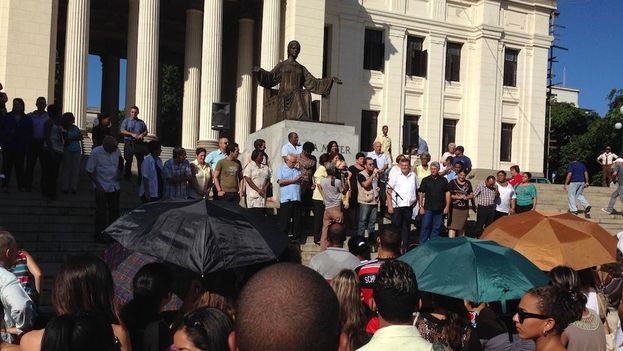
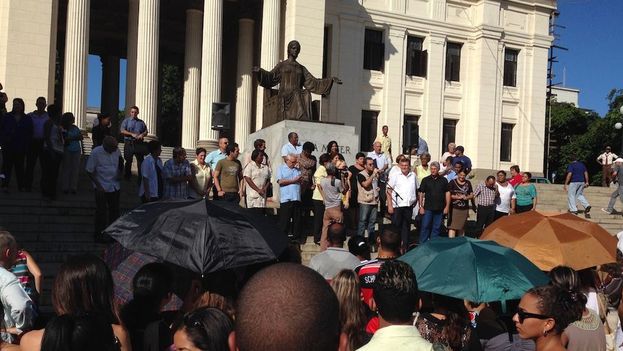
Castroniria / Orlando Luis Pardo Lazo

Castroneirics: Is there Cuban literature after the Revolution?

Orlando Luis Pardo Lazo

This story started long before the triumph of the Cuban Revolution, on January 1st1959. In the beginning it was not the Word, but the War. And in the war Fidelity is the utmost value, its betrayal usually paid with death, whether civil or political, from culture to corpses without much transition.

In March 1956, Alberto Bayo, who soon was to become a Cuban revolutionary commander, while training Castro’s little army in Mexico, wrote the first traceable record of Fideliterature, where Castro is compared with a “lighthouse than gleams airs of freedom”, and as one of our “great locos that pursue Glory to sow a beautiful fruit in History.”

Indeed, many charismatic leaders have been called “locos” by our national tradition, which despises common sense and praises maddened social actors, as much as it disregards conventionalism in order to foster improvisation.

Months later, Ernesto Ché Guevara himself depicted Fidel as a “blazing prophet of the dawn.” And then an avalanche of verses came pouring upon his epical guerrilla, from the Ecuadorian Elías Cedeño Jerves, who sees him as an eagle-in-chief flying over the mountains of Sierra Maestra (although those birds are inexistent on the Island), to Cuban Carilda Oliver Labra, who focuses her gratefulness to the “male groin” under Castro’s green-olive uniform (thus settling the basis for Latin American Machismo-Leninism). continue reading

Local Nicolas Guillen and Chilean Pablo Neruda, Pura del Prado (that was to become one of the most emblematic poets of Miami), Argentinean Julio Cortazar, and, of course, the rapport-reporter Herbert Matthews from the New York Times, who, as Anthony DePalma has revealed in a recent book, was “the man who invented Fidel” as a Western literary hero in a continent prone to Robin Hoods that could expiate the guilt of superiority of the United States.

The “farmer´s morning almond”, a “sun in every corner”, the “purest rose of the Caribbean” with his “warm forehead”, “thriving arms” and “sweet smile”, were among the miraculous metaphors of a time when kitsch was considered correct as long as the people could repeat it.

The Cuban troubadour Carlos Puebla sang contagiously that “fun is over, ‘cause commander is here to put a stop”, equating chaos and capitalism, while order and austerity were the new undeniable values. Puerto Rican singer Daniel Santos reached the climax with his guaracha: if Fidel is to be a communist, put my name on that list, for I do agree with him (just before fleeing from Cuba in the 1959 itself, as did many ephemeral enthusiastic whose artworks remained behind as incessant icons.

In the summer of 1961, with his Browning pistol resting like a peace-pipe on a table of the Cuban National Library, Fidel Castro himself had to frame the limits of our intellectual illusions: “Within the Revolution, everything; against the Revolution, nothing”.

While abolishing fundamental freedoms, Fidel declared himself to be enemy of any cult to his own personality. Soviet-like monuments were carefully avoided, so we have little to say about fidelistics in Cuban statuary. But the cultural politics imposed socialist realism as the best approach to beauty. Many artists were censored for life, erased from dictionaries and catalogs. Castro as a literary character showed up here and there, in pamphlet paragraphs where he could be heard in the Revolution Square applauded by workers, or raising his machete in a sugarcane field.

One exemption is the deconstructive documentary “Coffea Arábiga”, filmed in 1968 by Nicolas Guillen Landrian, nephew of the Nicolas Guillen that was President of the Union of Writers. There, the image of an over-acting Fidel during a speech in Havana University Hill is followed by a soundtrack of the then forbidden Beatles: The Fool on the Hill, with captions emphasizing that he “sees the sun going down and the world spinning around.”

The bufo theatre was abolished very early, to assure no impersonations of a funny Fidel on stage, whose solemnness was consecrated by Article 144 of Cuban Criminal Law, which punishes with up to 3 years in jail the crime of “aggravated contempt” to his public figure.

Skipping over the seventies of obscene ostracism for all artists considered conflictive, and also over the centralized eighties and the balkanization of the nineties, we can concentrate in the Cuban representations of Fidel in the so-called years zero or 2000’s.

For example, Bernardo Navarro Tomás, now residing in New York, appropriates pop and retro banner design to re-narrate Fidel’s biographical milestones, where terror seems just a commercial masquerade.

Street artist Danilo Maldonado Machado, El Sexto, in Havana, bets on bad-painting with explosive collages and nightmarish splashes, including slogans in the lips of a Castro that reminds us of a Minotaur in his labyrinth. These dialogue boxes are his citizen response to decades of monologue with the trademark of Fidel. Just as his own skin is used now as a dissident canvas tattooed with two recent martyrs of Cuban civil society: Laura Pollán and Oswaldo Payá.

Yanoski Mora became famous when he was arrested for selling to tourists a portrait of Fidel crowned with feathers like a Native American chief, a reproduction of a photo of Castro in 1959 with Oklahoma Creek Indians. He later refused to be interviewed or show his oil original. He had learned this esthetics lesson from the political police: the international left is allowed to depict Castro’s decadence (for example, Ecuadorian Oswaldo Guayasamín), but Cubans should not cope with His Holy Image, unless it is to portray the virtues of the retired leader.

A painter awarded the National Visual Arts Prize, Pedro Pablo Oliva, created oneiric landscapes where “Big Grandpa” leads smiling crowds that question themselves through text-boxes. Despite his international prestige, this exhibition of Oliva was doomed to take place only in his private studio in Pinar del Rio province, under the close surveillance of the authorities.

Anyway, during the 10th Biennial for Visual Arts 2009, the exhibit State of Exception included the installation of a carnival machine designed by Nancy Martínez: “A sequence of one,” which offered to winning players a series of plush dolls of Fidel Castro, from the young warrior to the convalescent old man.

The hinge between visual arts and writing came in the extreme style of Juan Abreu, exiled in Barcelona, who is updating in his website the evolution of a mural called “El super-ensartaje” (super-threading), where the historic alpha-males of Cuban Revolution are exposed in a homo-pornographic orgy. The complementary literary aggression is a trilogy, where the mummy of LoverCommander, toppled by a Coup de Etat, is exhibited in a cage, kept alive by drugs and condemned to listen for eternity the marathon of his own speeches, being fornicated by a character that travels from the future only to satisfy his Fidelist fantasy.

Not far from the Revolution Square, where he lives, Jorge Enrique Lage, as part of the fiction writers of Generation Year Zero, has turned Fidel into a Superhero with many Hollywood tics, in his short-story for the anthology “Cuba in Splinters” by O/R Books, New York 2014. Fidel, as a character by Argentinean Jorge Luis Borges, discovers the power of freezing time. He can now wander free of security and wonder what kind of country he has really created, in intense instants for reflection upon his long-lasting loneliness in power.

In the independent digital magazine The Revolution Evening Post, episode 4, in a list of 21 points to approach a 21st-century literature on the Island, the first provocation deals with the figure of Fidel, or rather with his abnormal absence in a context with a well-established genre of the Latin American Dictator Novel, from the times of “Facundo” in 1845, to “Mister President” and “The Great Burundún Burundá is Dead”, to “I, the Supreme” and “The Autumn of the Patriarch”, to “The Perón Novel” and “The Feast of the Goat” a decade ago. The Cuban exemption could be “Reasons of State” by Alejo Carpentier in 1974, where he prefers to caricature a collage of foreign dictators, to avoid suspicions from the active readers of Castro’s State Security.

At least three other writers of Generation Year Zero push the limits of Castro’s world as will and representation.

Jorge Alberto Aguiar Diaz in “Fefita and the Berlin Wall,” explores two desperate lovers that cloister themselves out of a country devoured by crisis. Fidel follows their acts as an unavoidable voice in every TV set of a city in ruins, inhabited ruins that in his novel “The Surveilled Party” Antonio Jose Ponte believes resemble the body of the premier, and moreover, that they were artificially imposed by him to resemble in turn the promised US invasion that never was.

In my novel in progress “Alaska”, on which I work as a Visiting Fellow of the International Writers Project, fiction is understood as filling in the gaps of crucial pacts where Fidel Castro and other political, entrepreneurial, exiled and religious elites become criminal complicit of contemporary historical deeds.

Ahmel Echevarría in his censored novel “Training Days”, later published in Prague, uses a Fidel-like homeless person as witness of a funeral procession at Revolution Square. This old and shrewd urban prowler has wanted all of his life to be a writer, and even dares to give a lot of advice to the narrator named after Ahmel, denoting a Lucifer-like lucidity: Fidel as a fatuous Faust. It was Gabriel Garcia Marquez who stated that his friend Fidel was an extraordinary writer, but without the chance ever to write, given his many official duties. Dreams are the remaining realm of former revolutionaries. Guillermo Rosales, a 1993 suicide that destroyed most of his novels, in “Boarding Home” boasts of being an “absolute exile”, only to succumb every night to the nightmares of Castroism. His self-referential protagonist cannot get rid of the oneiric omniscient omnipresence of Fidel. The author himself is a kind of schizoid Fidel. His mental disease has literally and literarily immortalized Fidel, to the point that the director of the Cuban Book Institute recognized in private that “as long as those dreams remain in the book, it can never be published while Fidel lives”.

In the late 80’s, Heberto Padilla and Reinaldo Arenas came upon the same image in their novels “Heroes Are Grazing in My Garden” and “The Color of Summer”, respectively: to contemplate their lost homeland from the air, flying in a helicopter with Fidel Castro, who keeps describing the reality below only to please himself.

Arenas’ trip is a sarcastic series of bloody events that barely hide Castro’s homosexuality: as in Juan Abreu’s Super-Threading. On the contrary, the flight of Padilla embodies the Oedipus complex that Cuban intellectuals suffer since 1961, when a despotic pistol incriminated them for being so complaining and so little committed to the social process.

A similar edipic syndrome drove Norberto Fuentes, a former militiaman and secret agent of the Cuban Ministry of the Interior, now exiled in USA, to write in advance “The Autobiography of Fidel Castro”, in an interpretation of the personality of a man “much more intelligent” than his auto-biographer and former ex collaborator, and to whom the author renders his bitter-sweet admiration, verging in an unconfessed homoerotism towards the patriarch.

In this trend we can classify most books of Fidel’s defectors, although they are not fiction in principle, but it’s obvious their efforts —generally failed— to restore a certain human condition to the myth: a hitman like Jorge Masetti in “Furor and delirium”, a foreign diplomat like Jorge Edwards in “Persona non grata”, Cuban scientists like Hilda Molina in “My Truth” (2010) and Armando Rodríguez in “The robots of Fidel Castro” (2011), and even his personal bodyguards like Juan Reinaldo Sánchez in “The hidden life of Fidel Castro” (2014).

And this remits to the women that loved Fidel and decades later decided to tell it, as in “Havana Dreams: A Story of a Cuban Family,” by the actress Naty Revuelta, who was his adulterous lover and mother of a girl named not Castro but Fernández who, when grown-up, fled disguised from Cuba only to predictably write “Castro’s Daughter”. Just as his exiled sister Juanita Castro released “Fidel and Raul, my brothers,” in a delayed 2009. The most passionate of the —let’s say— bed-sellers is “Dear Fidel” by German-American Marita Lorenz, who claims to have been drugged and forced to abort by Cuban State Security, and yet she returned as a CIA agent to poison Fidel, only for him to discover the plot and fetch her his Browning with this challenge: it’s loaded, shoot me, I won’t die, no one can kill me, I’m immortal (a startling spell that has lasted for over 55 years now).

Cuban novelist Zoé Valdés, sent to Paris in diplomatic mission, where she defected in the early 90s, deals in a prosaic way with Castro, making a cartoon out of his character and calling him Super-XL Size, according to the dimensions of his —you guess what— testicles. Furthermore, her compilation of political articles could not avoid a Castrocentric vision, even to criticize his communist dictatorship to its last foundations: so “The Fiction Fidel” was her choice for a title.

In fact, pornopolitics seems to be our artistic reaction to the sequestering of the Cuban body within the homogeneous masses in front of the uniformed unique leader. No places for pleasure are legal on the Island since 1959. And while many were being stigmatized and even expelled from their jobs for hiding a lascivious paper or a hot hard drive, Fidel could afford a 1-week 7-page interview with Playboy, and return reinforced in his convictions to persecute capitalist degradation in our people.

Wendy Guerra, in her novel “I Was Never A First Lady” appeals to the nostalgia of her demented mother to recover the merciful monstrosity of the Number One Man in the golden years of the Revolution, a system devoid of first ladies since the revolution itself was the eternally virgin bride. Then, she also explores the first days without Fidel, when an emergency surgery almost kills him in July 2006. Wendy Guerra seizes the sinister silence or the deadly deafness of those meaningful minutes that opened the post-Castrozoic Era in Havana, while Miami yelled with histrionic hysteria.

In many ways Fidel seemed shielded by women’s wombs. The poet Reina María Rodríguez, in her now disregarded unconfessed crush on Castro, made it clear: “There is only one way to care about him. We have grown up beside him as if he were a tall tree”. No wonder why the official propaganda compares him to a centenary Caguairán tree, as his health looks more and more deteriorated in each sporadic appearance —or apparition— in national TV.

About his magnicide on the Island (quite common in a number of foreign best-sellers and videogames) the dystopia in progress “Alter Cuba” by Raul Aguiar is so far the best effort to reshape a Planet Cuba where Castro vanishes from our history before leaving a noticeable trace. About filming a fictitious Fidel, only in 2008 the local movie “Kangamba” timidly showed his shoulders with their emblematic epaulet. And then in “Memories of Overdevelopment” by Miguel Coyula, we have him all over as pop reference and reincarnated in a stout walking stick called Fiddle, which is humble enough as to dialogue after half a century of monologue.

When Soviet communism collapsed, the Cuban troubadour Pedro Luis Ferrer released a series of songs full of good humor that provoked the anger of the censors. One of them reminds of the “Big Grandpa” paintings of Pedro Pablo Oliva, since it’s called precisely “Grandpa Paco”: “grandpa built our house with lots of sacrifice, but the least move now needs his approval, as grandpa still keeps his old weapons ready to make himself obeyed”. The apotheosis was the underground punk band from Havana, Porno Para Ricardo. Paying the price of going to jail more than once, their front man Gorky composed the paroxysmal provocation called “Commander”, where he offensively mocks Grandpa —again from politics to pornophilia— whose official newspaper by the way has been called Granma from the beginning.

Once the fear of fictionalizing Fidel is over, I’m afraid that it will be too late for a fiction to be fully meaningful about him. Besides, it’s more than likely that Cuban literature as such will find itself in difficulties to be appreciated beyond the straitjackets of socialism or its symbolic undermining. Both market avidity abroad and the lack of local readers will pose a formidable barrier to avoid any experimental estrangements and thus to remain stuck to the stereotypes of what Cuban writing and arts in general should look like.

As politics was too important to be left in the hands of politicians, literature was too important to be left in the hands of intellectuals. Fidel Castro managed to impose himself for too long as a non-fictionalizable figure. Being an incontinent narrator himself, competence was considered contempt. It might be time to turn the F chapter of Cuban literature and delicately recognize our defeat. Unless, of course, some authors are willing to grab that Browning back from the summer of 1961 in the National Library, and make a statement that escapes the reactionary rationale of within/against/outside the Revolution.

[Original in English]

13 November 2014
Cuban-Spaniards Demand Their Rights to Social Security / 14ymedio, Ferran Nunez

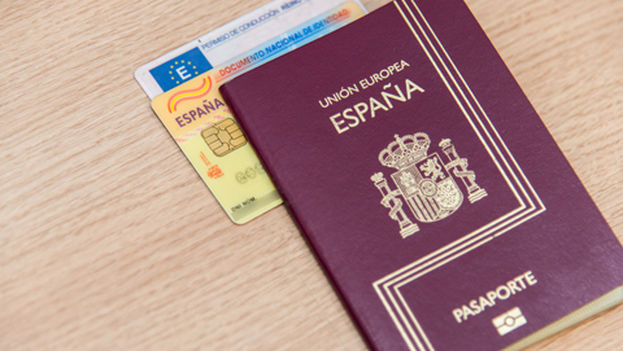
Spanish passport (CC)

14ymedio, Ferrán Nuñez, Paris, 7 November 2014 — It was the month of November 2007. A group of seven Latin American countries led by Spain decided to sign a historic agreement that never came to be, so far, a mere bureaucratic anecdote. In effect, the Multilateral Spanish American Convention on Social Security offered a legal solution to the Hispano-American workers who moved to a Spain then in the middle of a real estate boom. Similarly, it dealt with former refugees from Chile, Uruguay and other states who, after a life of work in Europe and once democracy was re-established in their countries of origin, wanted to return home with their acquired retirement rights.

Naturally, this movement of workers is part of the wider trend of globalization which, as we know, accelerated the displacement of workers from the poorest regions to richer ones, thus creating an ever greater interdependence among countries. Specifically, among Hispanic nations where there is “a common cultural, economic and social framework,” this agreement is intended to become an instrument to coordinate the disparate national laws so that migrating workers and their families, in the always possible case of return, “could enjoy the benefits generated by their work in their host countries.” In this way, the agreement has facilitated the return to their country of origin of many workers hit by the current financial crisis.

The Cuban Case

The Spanish Law of Historical Memory permitted the children and grandchildren of Spaniards to claim the nationality of their ancestors. The current global crisis that the island is experiencing has caused many descendants of those Spaniards, among whom are included the children of Fidel Castro himself, to welcome the benefits of this law in order to be able to emigrate. According to the latest official consulate data, half a million applications were made, of which 190 thousand have been accepted and 100 thousand are pending. In the end Cuba will have the greatest colony of Spaniards of all the Americas.

Thus, many fellow countrymen, looking for a better future, have managed to install themselves on the Spanish peninsula and in other countries. Spain, through its seventeen administrative authorities, is devoting considerable resources to organizing the return of these families. However, the arrival of new Spaniards to the peninsular territory may be traumatic since there exist no agreements between Madrid and Havana for recognizing the retirements, among other deficiencies, as pointed out by lawyer Pedro Luis Sanudo from his blog DobleR, where he advises waiting for “better times” to try the return adventure.

Based on these realities, an affected group above age 50, residents in Spain, headed by the returnee Cuban-Spaniard Alvaro Miralles, has gathered signatures (ten thousand) on the platform Change.org. The object of his demand is simple: Cuba’s inclusion in the Multilateral Spanish American Convention on Social Security. He intends to send this petition to the King and to the Foreign Relations Ministers of Spain and Cuba during the next Spanish American Summit which takes place in December in the Mexican state of Veracruz.

For Miralles it is not only a problem of basic justice and equity among all Hispano-American countries. The protection of Cubans abroad should be a priority, and he concludes his petition saying: “Cuba has just received great support in the heart of the United Nations for the lifting of the economic embargo of Cuba; we believe this is a good opportunity to also lift another embargo that exists between Spain and Cuba as regards social security.” The next visit of the Spanish Chancellor to Havana, announced for next November 24, could be the best occasion to complete this agreement.

——-

Ferrán Nuñez has published the book “Historia de Cuba y de España para tontos” (The History of Cuba and Spain for Idiots).

Translated by MLK

Extremism on the Table / Fernando Damaso

On the page 2 of the November 7th Granma, there is an article by the journalist Pedro de la Hoz, who is now also one of the vice presidents of the Cuban Writers and Artists Union (UNEAC), where, honoring his last name (in English ’hoz’ means ’sickle’), railing against the recent celebrations in Havana of a cheerleading event, the celebration of Halloween in some recreation centers with the participation of costumed young people, and even the wearing of clothing with the American flag.

The character, calling on crossover Stalinist-style ideology, shouts to the heavens speaking of banality, sexism and sentimental silliness, asserts his right to expound on his arguments and judge those who don’t think like he does.

All correct: everyone can think as he likes and defend his opinions, which is not a very common practice in Cuba, where the media only publishes those characters with ties to the regime, among which the man in question is an example.

It struck me that de la Hoz, so concerned about foreign influences, although he recognizes that we live in a global village, has never defended Cuban traditions related to Holy Week, Christmas Eve, Christmas, seeing out the old year and seeing in the new (without additional ideological elements) and, in the case of Havana, the celebration of Carnival, which has been totally lost and has nothing to do with the current booze and food binge, to name just a few.

I don’t think that celebrating Halloween, practicing cheerleading, wearing a shirt or short with the stars and stripes and even celebrating Thanksgiving threatens national identity. Working against our national identity is forgetting our customs and traditions, social indiscipline, lack of respect, rude language, and generalized marginality, street violence, corruption, double standards, opportunism and many other evils.

Hopefully the recent article doesn’t unleash some new witch hunt.

7 November 2014

Old dissidents in Cuba: Between homelessness and forgetting / Ivan Garcia

Gladys Linares Blanco, age 72

The elderly are the big losers in the timid economic reforms of Cuba’s General-President. Thousands who once applauded Fidel Castro’s long speeches in the Plaza of the Revolution, or fought in the civil wars in Africa, today survive however they can.

There they are. Selling newspapers, peanuts, or single cigarettes. Others have it worse. Senile dementia has overtaken them and they beg for alms or dig through the dumpsters.

But even harder is life for an old dissident. Do the names Vladimiro Roca Antunez, Martha Beatriz Roque Cabello and Felix Bonne Carcassés mean nothing today? In the 90s they were the most active opponents betting on democracy and political and economic freedoms. In the summer of 1997 they drafted a lucid document titled “The Nation Belongs to Everyone.”

For this coherent and inclusive legacy they received verbal and physical violence on the part of the regime and its secret police. And they went to jail. Seventeen years after the launch of “The Nation Belongs to Everyone,” already old and with a litany of ailments, they are barely surviving. continue reading

Vladimiro, son of the Communist leader Blas Roca, had to sell his house in Neuvo Vedado. With the money he bought a crappy apartment and with the rest he survives. He’s about to turn 72, has never received the pension that he has a right to because he flew MIGs and worked in State institute.

Fidel Castro was implacable with the first waves of dissent. In addition to jailing them, he expelled them from the dignified and well-paid jobs And refused them a check on retirement. Others were forced to live in exile.

Bonne, the only black person in the group, was a university professor and prominent intellectual. He is almost blind and between the memory loss and shortages, waits for God to take him in his house in the Rio Verde neighborhood.

Martha Beatriz, a distinguished economist, is trying to weather the storm at the front of a network of social communicators, for which she receives insults and violence from State Security.

If the autocratic state doesn’t care about historical dissidents, who should watch over them? The younger dissidents? The current opponents should find ways to help the elderly dissidents.

It is just and humane. And is not acting like the government with the hundreds of thousands of men and women who, in their youth, didn’t hesitate to offer their energies and even their lived to his Revolution, and when they get old they are abandoned to their fate, with few exceptions.

To repair the unjust reality in the ranks of the dissidents, independent journalists Jose A. Fornaris and Odelin Alfonso are trying to do something. “We are working on how to create a support fund destined to the older opponents so they will receive at least 50 convertible pesos a month. Also this fund would cover a stipend for colleagues who are incapacitated by accident or illness,” said Fornaris, head of an association of free Cuban journalists.

For his part, Alfonso thinks that a kind of pension fund, “Every journalist who publishes his works and is paid, will voluntarily donate a portion. It’s sad how older dissidents are living.”

Implementing the project would allow dozens of opponents in their seventies to squeak by with dignity. Tania Diaz Castro, poet and journalist, was in the front lines in the hard years of the 1980s, when few dared to dissent against Castroism.

Their names should not be forgotten. Ricardo Bofill, Reinaldo Bragado, Rolando Cartaya and Marta Frayde, among others, gave birth to a party in favor of human rights.

Díaz Castro, a member of that party, never imagined that many years later Cuba would remain a totalitarian country. She lives in Santa Fe, to the west of Havana, surrounded by books and dogs. She survives writing reports for digital sites and with the dollars her children are able to send her from abroad.

And she is not the worst off. A few blocks from her home lives Manuel Gutierrez, in the opposition since the 1980s and founder of a dissident party. Now over 70, he earns a living working the land and tending goats.

He lives in a miserable hut of tiles and rough cement. But he does not complain. “That’s what happened to me. Worse off than me are the less known dissidents. It was my choice, to stay in Cuba and fight for change,” he said, trying to hide the tremor in his hands, due to unaddressed Alzheimer’s.

The current dissidence cannot and must not forget the past. When the current dissidents were afraid and silently accepted the regime’s public verbal lynchings of those brave opponents, they were speaking for all Cubans.

Now, we dissidents and independent journalists who don’t yet have grey hair, should concern ourselves with those who came before and opened the way for us. If the present is less repressive on the island, it’s precisely because of the old dissidents.

Iván García

Photo: Gladys Linares Blanco, 72, a teacher by profession, is a prominent opponent who thanks to her conversion to an independent journalist, can more or less survive in Havana, where she lives. Another who survives thanks to his collaborations in digital media is the lawyer Rene Gomez Manzano, a former colleague of Felix Bonne Carcasses, Martha Beatriz Roque and Vladimiro Roca Antunez in the Working Group of the Internal Dissidence, the four writers of The Nation Belongs to Everyone. Unlike Gladys, René has been invited to events in the US and Spain, among other countries. The photo was taken from a Cuban Una cubana fuera de serie.

5 November 2014

Where Is the Anomaly? / Rebeca Monzo

After reading an article, “Not Very Anomalous Anomalies,” published in Granma on November 7 and written by journalist Pedro de la Hoz about Halloween, cheerleading and those little stars-and-stripes flags, I couldn’t wait to get to my laptop to respond and refresh Mr. de la Hoz’s memory.

First of all, it should be pointed out that for some years now a small group of young people — and others not so young, myself included —  have been celebrating, as best we can, not only these but many other dates that have become as intrinsic a part of our culture as Christmas, Christmas Eve and the Feast of the Epiphany — holidays which were  banned for fifty-six years.

Though we are part of a global village, each country manages to keep its own traditions alive without being too worried about adopting new ones from other continents. A good example of this is Japan. Attractive, pleasant and joyous customs are not imposed by decree; they are assimilated spontaneously.

This is not the case with the well-known yellow ribbons, which have been imposed on us in schools and workplaces by the Committees for the Defense of the Revolution, labor unions and the Communist Party, yet which have nothing to do with our cultural heritage. Not to mention that they come to us via that famous enemy country which our media rails against daily in spite of the fact that Cuban artists, intellectuals and athletes continually turn to it in hopes of improving their lives.

College students at CUJAE and even the University of Havana organized their own Halloween festivities. It was also celebrated by the musicians at the Tropical, at the 1830, at the Diablo Tun Tun and at the Hotel Capri’s Salon Rojo, which to my mind is perfectly fine since they were options one could freely choose.* Also, as far as I can tell, none of these locations would be considered sacred, so where is the anomaly?

Translator’s note: CUJAE is a Cuban university that offers a variety of engineering degrees. The Tropical and the Salon Rojo, or Red Room, are Havana nightclubs. 1830 is a Havana restaurant and salsa club. El Diablo Tun Tun is a piano bar and musical venue.

8 November 2014

The official press keeps the government satisfied / 14ymedio, Reinaldo Escobar

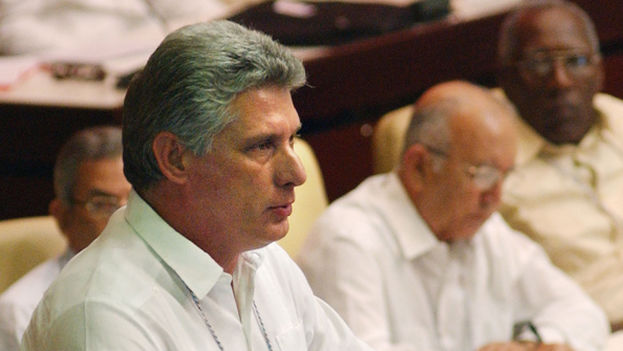
Miguel Dí­az-Canel Bermúdez

14ymedio, Reinaldo Escobar, Havana, 12 November 2014 – In a meeting with the president of the Cuban Journalists Union (UPEC), the first vice president, Miguel Díaz-Canel Bermúdez, said journalists had a responsibility to investigate more before offering an opinion, but also praised the work undertaken in recent weeks by the national press, giving as an example that published on Ebola, the comments about the editorial in The New York Times and other local topics.

This is the fifteenth meeting of its kind and it was held at the Council of State in the offices of the vice president, who has paid special attention to the work of journalists since the Ninth Congress of UPEC in July of last year. Diaz-Canel said he was pleased with the good level of those working in critical posts at the provincial newspapers.

After the meeting no detailed indication emerged relating to any notable excesses or gaps in the mass media, although it did seem to the vice president that “our media is fresher” and the Cuban press has begun to reflect topics that appear in the media of other countries. continue reading

At the meeting Antonio Molton, the president of UPEC, reported on the upcoming participation of the organization leading the meeting of the Federation of Latin America Journalists (FELAP), which will be held this week in Ecuador.

As is known, the media authorized in this country are closely controlled by the Communist Party, an organization that behaves like a true proprietor in naming the directors and outlining the editorial line of every newspaper, magazine, radio station and television station, be it national or provincial.

Lately there have been more critical articles and readers’ letters with notes of the inadequacies and mistakes of state entities, as well as critical demonstrations related to the quality of services or the prices of some products. What still had not been permitted – and Díaz-Canel did not speak of this – is questioning the legitimacy of the leaders or casting doubt on the viability of the socialist system in the country.

No independent journalist nor alternative blogger belongs to UPEC.

Memories of Media Death / Orlando Luis Pardo Lazo

Memories of Overdevelopment is a Cuban film that comes from the future. And that is a lot to say in a country like ours, condemned to survive in a perpetual and precarious present time that revolves around the same dates and hallmarks of that high-contrast story still called the Revolution.

Indeed, in the beginning it was not the Word, but the Sword. And Fidel Castro swore that the sword was good. And he turned it into Swordcialism or Death, a slogan that means more to us than one thousand and one laws. Or rather, than one thousand and 959 laws. Because memories in Cuba are symbolically bound to that date. 1959: life B.C or A.C., before Castro or after Castro.Within the Revolution and against the Revolution, but no space outside the Revolution is conceivable. That’s what totalitarianism is all about: the State as an imitation of God. And in social sets so claustrophobic, Creation must be then Reaction.

Edmundo Desnoes is a lucky writer. In Cuban literature, where he is well-known but has never been well read, he put into practice the perspective of the pariah, the lucid loser in the middle of proletarian’s paradise, the vision of the victims beyond all boasting victories, the endearing delirium of the displaced. All this in a country with an official narrative that punishes those displaced with death, from the civil to the corpse. And Edmundo Desnoes was lucky enough twice, in the beginning and in the end of his own biopics in the time of the revolution. continue reading

His two novels, Memories of Underdevelopment and Memories of Development, mutated into the screenplays of two definitive Cuban films. From the sixties to the two thousands or years zero, always touching the limits of two not-so-different violences: that is, the canonical question about what Cubanness had been or was going to be.

The telescope of the first inner-exiled Sergio, pointed to the capital of all Cubans, Havana —right in front of his face back then—, after so many decades of outer exile has become another optical artifact in the post-historical hands of the second Sergio: it’s a magnifying glass now focused in detail on his daily desires, deceptions, dreams, disappointments and —again— death.

From Northtalgia to Southnesthesia, from Sergio to Sergio 2.0, from the anachronistic analogic of the black-and-white to the rainbow of digital cut-and-paste, somewhere somehow between both movies we Cubans have left behind our old illusions of identity. Life is elsewhere. Love is nowhere. Loss is everywhere. Suddenly we are all Citizen Sergio now. Our notion of a nation is deservedly denaturalized. We try to remember an early word reminiscent of a world that turned out to be too late for us. Rosebudlution. Amnesia is even less painful than anesthesia. Yet we cannot forget a single event. Fidelity fossilizes our future. Only the Revolution remains the same. There is no exile, as there is no exit to our extreme exceptionality.

Both Memories… are less recapitulation than genesis: both generate their own type of audience. In more than one way these memories are imaginary despite being testimonial, since all collective narrative is an invention: ideology as the measure of human idiocy. In both films, the private monologue in voice-off is a replica of the monstrous monologue on top of a tribune turned into tribunal turned into scaffold turned into scarcity turned into a sinister silence. As the Cuban 21st cinematographic century is inaugurated, art approaches the autistic.

In this sense, our memories imitate mute movies. Yet, it’s not only about contesting the monolithic speech, but also an escape to it, through the ethics of multiplicity, of a displaced dialogue between the minimal citizen and the maximum leader. Thus, despite esthetic differences, both Memories… are unanimous in this paranoid presence in the first case and this schizoid absence in the second case: they both attempt to express our inexpressible condition as Cubanless Cubans, whether in the trenches of war on the Island or the tender wardrobes of exile.

Both films are renaissance masterpieces, out of the ruins of the Republic that was not and the Revolution that could have been. Beauty out of barbarism. Faith out of failure. We are so accustomed to Memories of Underdevelopment that we hardly feel its original estrangement, its narrative challenges, visual boldness and rhetorical risks. We are so unaccustomed to Memories of Overdevelopment that we only feel its estranged originality, its challenging narrative, bold visuality and risky rhetorics.

It sounds like a tongue-twister. And it is so: in totalitarian environments, after all speeches are sequestered, the labyrinth of a life in truth starts with freedom of language. I invite you tonight to experience our experimental existence as one continual character in the search of a discontinuous Cuba.

Original written in English

12 November 2014

Orphans of the Wall / 14ymedio, Bernard de la Grange

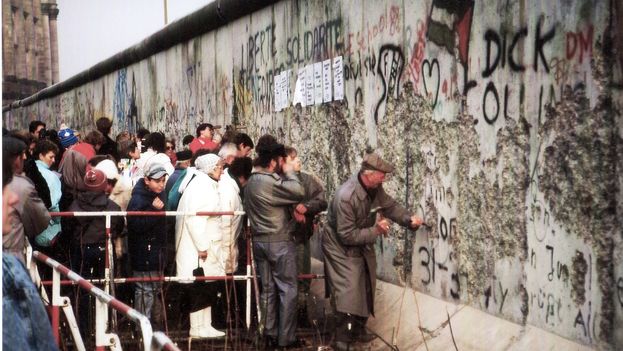
alemanes-emprenden-muro-BerlA-n-CC_CYMIMA20141108_0067_16
Germans tackle the Berlin Wall, 1989 (CC)

14ymedio, Bertrand de la Grange, Madrid/November 8, 2014 — Prensa Latina devoted only ten lines to news that stunned the world. Below a detached title – “The GDR Announces the Opening of its Borders” – the Cuban agency related on November 9, 1989, that the German Democratic Republic had just made an administrative “ruling” by which “citizens will be able to take private trips without the need to explain their reasons.” The word “wall” did not appear in the teletype. Such moderation reflected the prevailing confusion in Havana.

The transcendental event that western media celebrated was a catastrophe for the allies of the Soviet Union in the Americas. Cuba and Sandinista Nicaragua were in mourning. The guerillas still active in the region, above all the Salvadoran FMLN, the Guatemalan URNG, and to a lesser extent the Colombian FARC, saw their logistical and diplomatic space reduced with the weakening of the communist bloc.

Mikhail Gorbachev’s trip to Cuba, some months before, had made evident the gulf that separated the Soviet president from the then Maximum Leader who held tight to ideological orthodoxy as a detractor of the Perestroika economic reforms, which were seen by Havana as an imitation of capitalism. “We have seen sad things in other socialist countries, very sad things,” Fidel Castro would later say in reference to the changes that took place two years after the collapse of the USSR, with its devastating consequences for the Cuban economy, totally dependent on subsidies from Moscow. continue reading

The events of November 9 also alarmed the Sandinista leaders in Nicaragua. They did not expect it, in spite of – or perhaps because of – their close relationship with the Stasi, the intelligence apparatus of the GDR, which along with Cubans managed the security of the nine leaders of the revolution. A year before, the Stasi had played a key role in Operation Berta in order to change by force of arms the Nicaraguan currency in a desperate effort to stop an inflation of 36,000%, which the government managed to reduce to 2,000% in 1989.

When the news arrived from Berlin, Nicaragua was immersed in a very tense electoral campaign. At the request of the White House, Gorbachev had convinced the Sandinista government to advance the elections scheduled for the end of the year to February 25, 1990. This was about looking for a political exit to the war between the Sandinista forces, supported by Havana, and an essentially peasant rebellion, the Contras, sustained by Washington. Managua was then an important piece on the regional geo-political board, and the US feared that El Salvador would be the next chip to fall.

The Sandinista National Liberation Front (FSLN) hoped to achieve with those elections democratic legitimacy to convince the international community of the need to disarm the Contras under the supervision of the United Nations. Opposing, the National Opposition Union (UNO) a coalition of 14 parties from the whole political spectrum, seemed to have not the least chance of winning. Its candidate, Violeta Barrios, widow of Joaquin Chamorro, assassinated during the Somoza dictatorship, was a housewife without political experience. Instead, the FSLN counted on the overwhelming machinery of the State to impose its candidate, Daniel Ortega, who had spent a decade in power.

La Prensa, property of the Chamorro family, dedicated extensive coverage to the Berlin event, including an editorial entitled, “Fall of the Wall, a Miracle of History.” Antonio Lacayo, son-in-law and close adviser to the UNO candidate, saw the opportunity that was presented to them. “We knew immediately that that historic event would have very favorable repercussions for us in the campaign against the Sandinistas,” he says in a book, The Difficult Nicaraguan Transition, published in 2005. “We said that if the Germans were capable of throwing off forty years of dictatorship, we could throw off ours of ten years…”

He was not wrong. Contrary to the surveys, the international press and the diplomats, who predicted a comfortable victory for Daniel Ortega, Violeta de Chamorro won with almost 55% of the vote.

“The electoral defeat of the Sandinistas was our Berlin Wall, we were convinced we were going to win,” Joaquin Villalobos would later say. Villalobos was one of the leaders of the Salvadoran guerrilla group, the Farabundo Marti Front for National Liberation, which had its rearguard in Managua. Instead, the events of November 1989 in Germany did not affect them “morally,” and they decided to continue with their plans to launch an unprecedented military offensive against the capital, San Salvador, and the country’s principal cities.

The political times of Central America did not match up with those of Eastern Europe. The Salvadoran guerrillas saw their survival endangered in the face of pressures from the United States on Gorbachev to stop the deliveries of Soviet arms through Cuba and Nicaragua. The FMLN dreamed of winning power by means of weapons, although their more realistic commanders settled for achieving a greater control of terrain in preparation for a negotiation.

While the Cold War was dying out and the citizens of East Germany were celebrating their new freedom, the leaders of the FMLN hurried the final details of “Operation To the Top” in safe houses placed at their disposal by the Sandinista government. November 11, a little before eight at night, Radio Venceremos, the emissary of the Salvadoran guerrillas, received the message from Joaquin Villalobos: “We are on the march. From here to there, there is no retreat,” he said from Managua. The offensive was beginning.

The Soviets were furious at feeling tricked by their Sandinista allies who had committed to cutting off logistical help to the FMLN. The minister of Foreign Affairs, Eduard Shevardnadze, one of Gorbachev’s closest associates, had traveled to Nicaragua the month before to announce Moscow’s decision to collaborate with the peace plan for Central America, launched two years before with international support.

Close to 4,000 Salvadorans died in the two weeks of combat, between guerrilla fighters, soldiers and the civil population. Was anything achieved? According to writer David Escobar Galindo, ex-negotiator for the government, “The offensive of November 11, 1989, opened the possibility for peace by demonstrating that war could not be decided militarily.” Terror had reached an equilibrium. Both sides would sign the peace in 1992 and, a distant consequence of the fall of the Wall, the FMLN would come to power by the ballot box in 2009.

Editor’s note: This text has been previously published in the daily El Pais. We reproduce it with permission of the author.

Bertrand de la Grange was a correspondent for Le Monde in Central America when the Wall fell.

Translated by MLK

The Dominant Interests / 14ymedio, Reinaldo Escobar

Granma article against The New York Times, April 24, 2003: “The New York Times is neither serious nor liberal”

14ymedio, Reinaldo Escobar, Havana, 11 November 2014 — I was tempted to title this text “The Good New York Times and Bad New York Times”, but since Yoani Sanchez had done the same with USAID it seemed repetitive.

The truth is that lately, and in an unusual manner, the official organ of the Cuban Communist Party, the newspaper Granma, and its televised arm, The Roundtable show, haven’t stopped repeating the good reasons this newspaper has for criticizing the embargo, for demanding that Alan Gross be exchanged for Cuba’s Ministry of the Interior (MININT) prisoners held in the United States, or for criticizing U.S. policy with regards to the Cuban government. This is the good New York Times, a credible and influential American newspaper. continue reading

But some have the healthy habit of saving paper and among these pearls appears, published in the Granma itself, an article which speaks very differently in relation to the famous newspaper .

On April 24, 2003, the news was fresh of the imprisonment of 75 Cuban dissidents (originally there were 80 defendants) who were given sentences of 15, 20 and up to 28 years imprisonment. The New York Times addressed that process, later dubbed the Black Spring, and to the Cuban government this was unforgivable.

Granma’s response, under the byline of Arsenio Rodríguez, was overwhelming and conclusive. “…their editorial decisions are neither serious nor liberal, but obediently follow orders in defense of the interests of the dominant powers in this nation.” And concluding with this succinct affirmation: “… the true role of the New York Times was, is and will be to represent the essence of the empire.”

The question some of us in Cuba ask is if the newspaper has ceased to represent the imperial interests of the United States (if this was ever the case) or if now those interests are changing and something is moving under the table, behind the backs of the only protagonists in this drama: Cubans.

I do not know if Arsenio Rodriguez has retired, how old he is, or if he prefers to “pass” on the subject, but I would love to read his opinion now. I would give anything to have the evidence that the editorial decisions of Granma dutifully obey orders in defense of the dominant interests.

Defections by Cuban Doctors in Venezuela Double / 14ymedio

Cuban doctors before leaving on a “mission” (EFE)

14ymedio, Havana, 10 November 2014 — Some 700 Cuban health professionals defected from Venezuela between September 2013 and September 2014, according to data published Sunday in Caracas by the daily El Universal. The majority went to the United States and reported the deterioration of their work conditions.

This figure doubles the number from the same period a year earlier, when some 300 professionals left their missions, according to information from Solidarity Without Borders (SSF), an organization with headquarters in Miami that helps Cuban health professionals looking for a better future.

“The worsening of conditions in Venezuela is causing an increase in defections. The lack of safety, low pay, worker exploitation and control over private life continue to be the big reasons,” said Doctor Julio Cesar Alfonso, president of the organization, to El Universal. continue reading

Alfonso explains that the most significant increase was registered after the death of President Hugo Chavez. Among other reasons that impel doctors to escape, according to the organization’s president, are the devaluation of the bolivar, an average salary of 100 dollars at the official exchange rate and few prospects for professional development.

The phenomenon is not limited to Venezuela and, according to Solidarity Without Borders, some 1,100 Cuban professionals abandoned their missions abroad between September 2013 and 2014.

Translated by MLK

Cuban Doctors Are Enslaved Says ‘The Wall Street Journal’ / 14ymedio

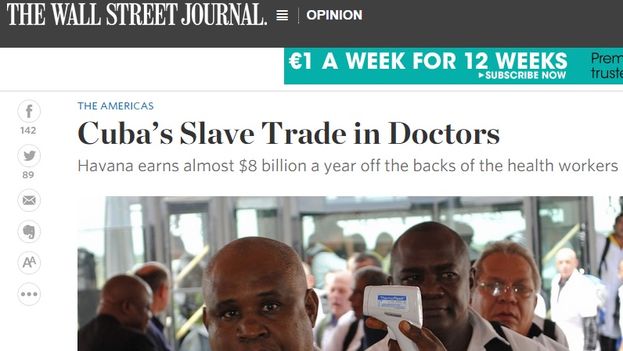
The Column ‘Cuba’s Slave Trade in Doctors’ in ‘The Wall Street Journal’

14ymedio, Havana, 10 November 2014 — In an article published Sunday, the Wall Street Journal lashes out against the “doctor diplomacy” carried out by the Island by sending health personnel abroad. The newspaper compares the system with the “slave trade” in spite of international praise.

Columnist Mary Anastasia O’Grady, however, asserts that the doctors who travel to poor countries “are not a gift from Cuba,” since the Island earns some 8 billion dollars annually at the expense of the workers through the payments it receives from the host country – as in the case of Venezuela – or other countries who send funds to the World Health Organization. O’Grady reminds readers that the medical personnel do not receive their remuneration directly and that this money goes to the coffers of the state which only dedicates a small part to the salaries. continue reading

“It is the perfect crime: By sending its subjects abroad to help poor people, the regime gains from the global community the image of a disinterested contributor even though it exploits the workers and enriches itself at their expense,” writes the columnist. “This is a great business which, if were not carried out by Marxists gangsters, surely would offend journalists. Instead, they swallow it.”

O’Grady insists that “human trafficking is nothing new for Havana, nor is it limited to the medical profession.” Refusing to participate in a mission can mean the loss of employment—as Cuban Doctor Antonio Guedes reported from Madrid to the German international television chain DW—or have consequences for children’s university admission.

In 2008, some workers reported to the United States Justice Department the hard work conditions and the salary of three cents per hour they received during a mission to Curacao where they went to work in exchange for Cuba’s debt to Curacao Drydock Company. The relatives of the claimants, according to the report by the United States newspaper The Christian Science Monitor, “lost jobs and access to education and suffered harassment by gangs.”

The columnist emphasizes that sending medical personnel abroad is causing a shortage of doctors in Cuba, in spite of the delicate epidemiological situation the Island is experiencing, affected by outbreaks of dengue fever and cholera.

Translated by MLK

Education on the Market / 14ymedio, Orlando Palma

Start of the school year at the University of Havana, one of the education centers that would offer export of education services

14ymedio, Orlando Palma, Havana/November 8, 2014 — Although missing from the opportunities portfolio, “the exportation of academic services” may be a considerable field for obtaining foreign currency given the presence of more than two thousand Cuban helpers in some 14 countries, according to what Doctor Aida Terrero Lafita, director of International Relations for the Ministry of Education, set forth in a press conference.

Although the amount that this would represent for the country was not made public, the official emphasized that among those programs most in demand abroad are a literacy teaching program known as Yes, I Can, and another called Teach Your Child, intended for early childhood, and those that focus on special education.

Dr. Terrero specified that on the African continent there is a growing trend of seeking Cuban collaboration in technical and professional education, especially as related to jobs in the fields of electricity, construction and agronomy. continue reading

The branch of the Ministry of Education charged with exporting academic services includes a team of 26 specialists occupied with carrying out the process for selecting the teachers who will offer services abroad.

There are many educators who aspire to carry out one of these missions, now lacking the epic and caring character of other times and marked today by the economic needs of the country and the hardships that these professionals experience. In spite of receiving a fraction of what the State raises in payment for their services, many of them consider the missions in other countries an opportunity to improve economically and acquire consumer goods.

Public Health personnel have been doing something similar and, according to unofficial figures, close to 50,000 people from that sector currently lend service abroad. They are mainly in Venezuela, Brazil, Nicaragua, and Bolivia, also in Argentina, Ecuador, Haiti, Guatemala, Panama and many other countries.

Translated by MLK

Between the Renovated and the Pathetic / 14ymedio, Eliecer Avila

News from Cuban television, with Rafael Serrano at the front

14ymedio, Eliecer Avila, Havana/November 5, 2014 — In recent months, an attempt to renovate the look of Television National News has been noted. They have changed the set, adding colors and trying to infuse dynamism and spontaneity into the reading.

It is clear that the directors of that news program have been inspired by the style of TeleSur, their only “competitor,” which combines the visual quality of the big television companies with its spokesman mission for the governments of Cuba and Venezuela. In order to carry out their political influence and consolidation of power, TeleSur has created a broad platform of opinion.

Faced with the effectiveness of TeleSur, the “cable” news programs and the packets, the directors of National News have no option but to put on a little makeup or they won’t even watch themselves. Nevertheless, we see how the newscasters fail to adapt to the new format: They feign dialogue, and it comes out wooden; they try to be spontaneous, but fear of making a mistake makes them rigid and stuttering; they want to give the impression of analysis but they wind up reading the raw, pre-conceived note.

They do not have a single journalist who really knows what he speaks of or can form intelligent questions or comments about events. Let’s see about today: They talked about the plenary session of Popular Power in Havana, where Esteban Lazo called for taking measures; about a national meeting of Protestant churches, where its president asserted that “in other places, no, but here we live in a society of dialogue;” and finally, about the president of the European Parliament who leaves his post when “the terrible social situation that exists in Europe” worsens following austerity policies.

With that news, lacking all objectivity, disconnected from reality and useless for any member of the public, they will never be credible even if they dress the newscasters in Halloween style or give Rafael Serrano an Afro.

Translated by MLK