Look But Don’t Touch / 14ymedio, Victor Ariel Gonzalez

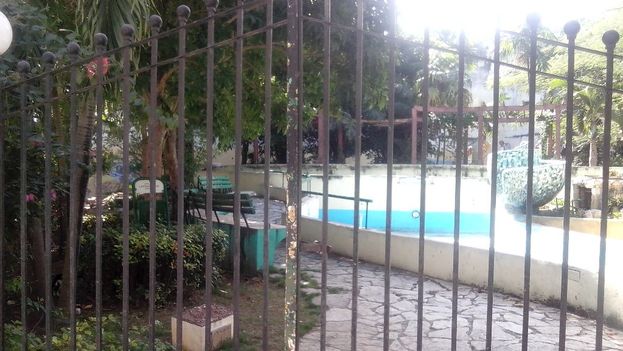
At Sol and Oficios, there is a closed park and a dry fountain. (14YMEDIO)
At Sol and Oficios, a closed park and a dry fountain. (14YMEDIO)
  • As ancient buildings are crumbling, the vacant lots are transformed into parks that are always closed

14ymedio, Victor Ariel Gonzales, Havana, 9 January 2015 — A group of tourists stops at the entrance of the “ecological park” on Mercaderes Street, a few steps from the Havana Cathedral. The guide speaks to them about this vacant lot turned into a public space which would be nothing out of the ordinary except for being the only one of its kind that is kept open. Aside from the brief circuit designed for foreign visitors, the parks of Old Havana are always closed.

So functions the fiefdom of Eusebio Leal, Havana’s City Historian. As old buildings crumble, the now-vacant parcels are transformed into gardens to which are added benches, trash cans, shade trees and maybe even a fountain. But, along with all that, they also put a magnificent gate closed with chain and padlock. No one can enter these urban oases.

At the corner of Teniente Rey and Habana there existed until a few years ago a children’s park full of attractions that were never used. The attractions “were burned” in the sun, says a neighbor of the place who remembers the image of children asking why “their park” was closed.

Today, the slides now dismantled, the site remains inaccessible but at least seeks another function in the community. Talking about this is Justo Torres who brought from his native Isabel de Sagua an interest in gardening and urban agriculture. He works at Nelva Oasis, a small gardening business very nearby that coordinated the park’s management with the Historian’s Office – a kind of local government.

Very enthusiastically, Torres confesses to being full of ideas for this place: giving it a “social use,” practicing agro-ecology and vermiculture, among others. “It is a unique experiment,” he says and one that also aims to be economically sustainable. He trusts that, in time, authorities will continue supporting the initiative.

Nevertheless, the rest of the parks have not had the same luck and have no use beyond the visual . . . behind bars. The monument erected in honor of Cuban doctor Carlos J. Finlay at Cuba and Amargura cannot be seen up close. There is also the Las Carolinas park, administered by the modern dance company Retazos, and open only for its interest in “some workshop for children and teens,” according to a custodian.

The list goes on. At Sol and Oficios, next to the Office of Cultural Heritage, an enormous green space surrounds a fountain as dry as a desert, that is their park. And at Acosta and Damas they built a pretty reminder of the Jewish community that lived there, just for the pedestrians to pass by because of having nowhere to rest without jumping the gate.

One of the best examples of this closure of public spaces is the fountain at Plaza Vieja in the heart of Havana within the city walls. The uninformed find the bars that surround the water to be strange. They do not know that this area has so many problems with the supply of the liquid which has had neighbors bringing buckets and tanks to it. A spectacle that reflects the real Cuba, which is not seen on postcards.

Across from the Central Train Station – another decadent icon of the city – a park offers anything except an invitation to relax. Old steam locomotives rust behind bars next to benches that will never be used again either.

This situation forms part of a vicious cycle that is completed with vandalism. The primary idea is that the parks remain closed so that the neighbors – who are not foreigners, but seemingly “uncivilized” Cubans – do no damage to them, while the lack of contact and “entrance prohibited” could be making it difficult to create respect for the urban environment or a sense of belonging.

So Nercy Perez, who works at the previously mentioned garden at Teniente Rey and Havana, would like the area schools to integrate themselves more in the projects she and her colleagues promote. “If children learn from an early age to take care of things, then later it will be easier.” The woman is of the opinion that “people do not have the culture” of caring for things. Indeed, she had to interrupt the conversation to scold a student who passed by and just grabbed one of her plants.

Other neighbors complain about the lack of public spaces. “The children have nowhere to play. They have to be in the street. The old people have nowhere to sit,” criticizes Joaquin from El Cristo neighborhood. The plaza that carries this latter name has been closed by metal barriers for a long time. Its interior does not look anything like a place where generations of Havanans scampered.

Also closed to the public, the Plaza del Cristo faces one of the many interminable repairs that can be seen in Old Havana, between crumbling buildings and dirty streets. What is obvious, unfortunately for those who long for a pretty city, is that not so many tourists pass through here.

“The only option for children is to go to the Inflatable Toys Park,” complains Norma, mother of two little ones. She concludes: “Of course, since that does provide money [from entrance fees], they don’t close it.”

Translated by MLK

Fidel Castro, the Starring Actor / Ivan Garcia

Fidel-Castro-janeiro-2014-FM-620x330
When Norge, a nightclub manager, heard from a friend who has internet at home about the international media frenzy regarding the alleged death of the bearded Fidel Castro, the news caused him mixed feelings.

“For the world, the great headline could be Fidel’s death. But for Cubans, the day after his death will add an unbearable burden of the personality cult and constant evocations in the press. Can you imagine?

“A minimum of one month of national mourning, long lines at the Jose Marti Memorial in the Plaza of the Revolution to sign the condolence book, and special programs all day on national TV and radio. continue reading

“Endless tirades in the Granma and Juventud Rebelde (Rebel Youth) newspapers, books, conferences about his life and work. Probably a museum opening, several effigies throughout the country and its cities, and important speeches everywhere.

“His intangible presence would once again be imposed on Cuban life, and we already have too little money, food, and lack a future,” said Norge, gesticulating with his hands.

Fidel Castro is a controversial figure. He is loved and hated with the same intensity. To his devotees, he is beyond good or evil. To his detractors, is to blame for the economic disaster in Cuba, the housing shortage and the fourth world infrastructure.

For 47 years he ruled the destiny of the Island with an iron fist. His revolution put more emphasis on politics than economics. He curtailed freedom of speech and press and eliminated habeas corpus.

He administered the country like his private ranch. He had unlimited powers. Without consulting the ministers, the bland national parliament, or his citizens, he opened the public coffers to build a center for biotechnology, bomb shelters or to buy in Africa a herd of buffaloes and experiment with their milk.

He led the nation at the blow of campaigns. One morning he would mobilize the country to sow coffee, bananas, and to build a hundred nursery schools.

In foreign policy his was a subversive strategy. Until he came to power, a Latin American leader never spent so much money and resources trying to export a social model.

Between 1960 and 1990, Castro sent troops or advisers to a dozen African countries. Also a tank brigade to Syria in the Yom Kippur War with Israel in 1973.

He had a huge reserve of cars, trucks or canned sardines. From a mansion in the Nuevo Vedado neighborhood, sitting in a black leather swivel chair, he directed from a distance the civil war in Angola. Like a neighborhood bodega owner, he was fully informed about the ranch consumed by the troops who took part in the battle of Cuito Canavale, south of Angola.

He was punctilious. His interlocutors, simple wax sculptures maintaining a parallel government at his orders, diverting the nation’s funds to achieve some of his whims.

Frequently walking through an underground passage that connected his office with the newsroom of the newspaper Granma, he wrote extensive reports, changed the layout, or edited the news.

In times of hurricanes, he moved to the Institute of Meteorology, in Casablanca, across the bay of Havana, and from there predicted the likely direction of a cyclone.

Or he moved aside the manager of the national baseball team to personally outline strategies to follow in a game of Cuba against the Baltimore Orioles.

For 47 years, Fidel Castro was undisputed star in the administration of Cuba. In all its facets. After his retirement due to illness in 2006, he dedicated himself to writing extravagant reflections which augured the end of the world and investigating the ‘exceptional’ properties of moringa..

The latest news of Fidel Castro was written in the newspaper Granma analyzing a New York Times editorial on Cuba. After three months of silence, in recent days rumors of his death have filled the international media.

Perhaps the dither started in Twitter when the former Kenyan minister and leader of that country’s opposition, Raila Odinga, on 4 January announced the death of this 41-year-old son, named Fidel Castro Odinga.

But the truth is that the old guerrilla has not publicly opined on the landmark agreement of 17 December between Havana and Washington. And he hasn’t even taken a photo with the three Cuban spies imprisoned in the United States, whose return to the island has been one of his political priorities since 1998.

While the world sounds the alarms, the sensation among many ordinary Cubans is that they prefer a low-news-profile Fidel Castro.

“Let him die when God wills. Quietly is better. He already talked a lot. He was too intrusive and the protagonist in our lives for nearly 50 years,” says Daniel, driver of urban buses in Havana.

The stressful daily work in Cuba offers little room for speculation about the health of the former commander-in-chief. Juliana, retired, expects the news any moment. “He’s probably not in good health. But they’ve killed him so many times in Miami, that when he does really die people are not going to believe it.”

In the past nine years, Castro I has passed to being a minor player in national politics. Many people appreciate it and wonder what would change in Cuba’s situation after his death.

If there’s something the regime knows how to sell, it is that Castroism will persevere after Fidel.

Iván García

Photo: Fidel Castro on January 8, 2014, when he attended the inauguration of Kcho’s art in the Romerillo neighborhood in the Playa municipality, Havana. Taken from Giornalettismo.

13 January 2015

The Sword of Raul Castro / Luis Felipe Rojas

Lady in White Aideé Gallardo, recently released from prison. Photo taken from the page about Cuban matters, Martinoticias.com

All said and done, more than half of a list of 53 political prisoners that nobody knows are already free, completely secret and that nobody we ask clarifies for us. Of the fifty who were out, I have the list of 36 prisoners who were surprised to be free again, without formal charges and under different conditions for their release: immediate release, probation, and extra-penal freedom (the latter is awarded regularly after inmates suffering from illness that prevents them from staying in the difficult prison conditions on the island).

continue reading

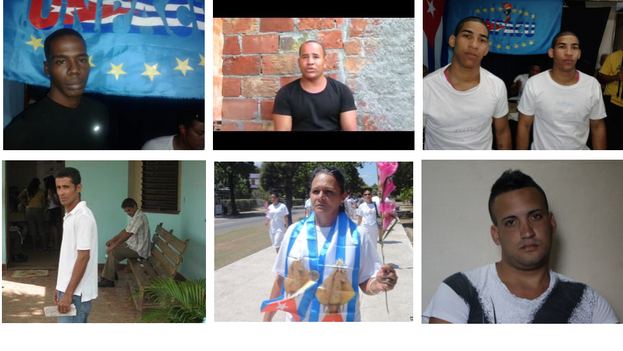
The partial list I have taken from the independent website 14Ymedio.com, directed by Yoani Sánchez:1.Alexander Otero Rodríguez 2. Alexeis Vargas Martín 3. Ángel Figueredo Castellón 4. Ángel Yunier Remón Arzuaga 5. Anoy Almeida Pérez 6. Aracelio Ribeaux Noa 7. Ariel Eugenio Arzuaga Peña 8. Bianko Vargas Martín 9. Daniel Enrique Quesada Chaveco 10. David Piloto Barceló 11. Diango Vargas Martín 12. Emilio Plana Robert 13. Enrique Figuerola Miranda 14. Ernesto Riverí Gascón 15. Haydeé Gallardo Salazar 16. Iván Fernández Depestre 17. Jorge Ramírez Calderón 18. José Lino Ascencio López 19. José M. Rodríguez Navarro 20. Julio César Vegas Santiesteban 21. Lázaro Romero Hurtado 22. Luis Enrique Labrador Díaz 23. Miguel Guerra Astie 24. Rolando Reyes Rabanal 25. Ruberlandis Maine Villalón 26. Yohanne Arce Sarmientos 27. Yordenis Mendoza Cobas 28. Wilberto Parada Milán 29. Mario Alberto Hernández Leiva 30. Leonardo Paumier Ramírez 31. Miguel Ángel Tamayo Frías 32. Ernesto Tamayo Guerra 33. Vladimir Ortiz Suárez 34. Roberto Hernández Barrio 35. Rubisney Villavicencio Figueredo 36. Carlos Manuel Figueredo Álvarez 37. Alexander Fernández Rico 38. Miguel Alberto Ulloa 39. Reiner Mulet.

It goes without saying, we are happy with these releases, they are people, young people mainly, who never should have been prisoners. What is striking is that the majority will remain as hostages, if there is no further pressure in the coming days. These dozens of outlaws in that violation of human rights, will follow the course of some ten political prisoners who were released between 2010 and 2011, when the Catholic Church served as a mediator for such releases.

The prisoners of the Black Spring of 2003 who decided to stay to live and fight in Cuba cannot leave the country until the years of their sentence end or until a doddering finger from the State Council eliminates this arbitrariness. José Daniel Ferrer García, Oscar Elías Biscet and Jorge Olivera Castillo, to mention just three, have been invited to travel as a defender of human rights, physician and writer, respectively, by political parties, national congresses, democratic governments and official institutions to visit the world and publicize the horror that they and an entire people live through. The Havana regime has refused, alluding to the false legal figure of the restriction of movement for ‘release on parole.’

We should be attentive, these people who are just out of prison have over themselves the ‘sword of Damocles’ of General Raul Castro. Not all have been promoted internationally, and reading their names one discovers that they are anonymous people who one day did not shut their mouth or stayed home, detained, taken out, to where the repressive forces of the Security of the State want to have them.

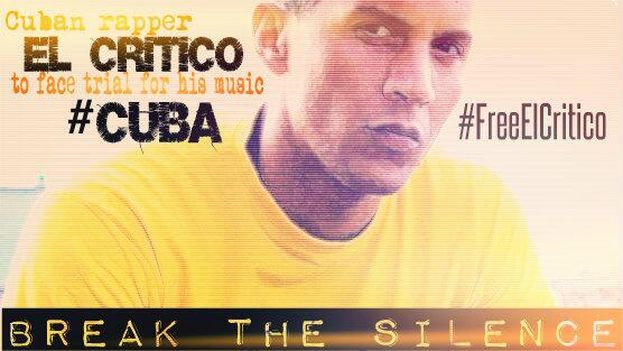
I was able to speak, hours after his having been freed, with the rebellious rapper Ángel Yunier Remón Arzuaga, known as El Crítico (The Critic). He thanked all those who have promoted the cause of Cuban political prisoners, and immediately he told me, that in addition to his cause of liberty, he was worried that, “My house is destroyed, brother. My young wife hasn’t been able to handle such a burden and the harassment by the police every day of this unjust lockup. Now I have to take on the two houses, this and the other,” he said, referring to the wattle and daub of the country where we were born.

Translated by: Hombre de Paz

The opponent Antonio Rodiles is not allowed to leave Cuba / Cubanet

RodilesCubanet, 13 January 2015 – The director of the opposition group Estado de SATS, Antonio G. Rodiles, reported Tuesday that the regime has refused to allow him to leave the country, as stated in his account on the social network Twitter.

cubanet square logoThe opponent was arrested the day of Tania Bruguera’s performance, with his wife, Ailer Gonzalez, whose passport was also withdrawn. Bruguera, currently in Havana, has also been denied permission to leave the country.

Cubanet spoke with Rodiles by telephone. He told how he had gone to the office of the Ministry of the Interior where passports are processed to renew his passport (the Cuban passport is valid for six years, but must be “renewed” every two to maintain its “validity”) and the official attending him, after searching for his name on the computer, simply informed him that his passport could not be renewed and, consequently, he could not travel abroad “for reasons of public interest.”

Days earlier, during the arrests that Rodiles and his wife, the artist Ailer González, were subjected to during the performance that Bruguera attempted in the Plaza of the Revolution, one agent of the Ministry of Interior had told Gonzalez to hand over both passports, which she did not do.

It is significant is that, so far, Rodiles and Ailer González, who had no direct involvement in organizing Bruguera‘s performance, are the only opponents against whom the government has taken this step.

I’m Happy / Angel Santiesteban

Havana, December 30, 2014

Dear Internet users, bloggers, colleagues, friends and Cubans scattered around the world:

Writing you is always an adventure. The constant surveillance is relentless, but perhaps this deepens the desire for communication with the outside and to do so means an unmistakable flavor. After the tensions decrease, and knowing it all came out well, I received the prize for mocking the dictatorship. As a writer, I would be capable of describing my own firing squad, and I would enjoy it, but — in addition to enjoying it — it’s a beautiful obligation that arises from the depths of the being.

I have allies — for now I can only name the closest — some wild cats who don’t allow anyone but me to approach them, to them I have dedicated great love. Slowly they came to accept me as I gained their confidence. They stay close to me, and surround me while I write, I hear their purring, admire the plan to the youngest and the tenderness of their mothers who wash them and love them. When someone barely approaches, the warn me, transmitting the possibility of danger, so I hide what I’m writing. continue reading

Photo by George Logan digitally retouched by Tony Swinney

Before, there were twelve, then it fell to nine. The guards are annoyed by the fidelity they show and the discourteous way they almost scare the guards, poking their uniforms. Maybe they’re waiting to go to the coast to look for the remains abandoned by the fishermen on the shore and executed there, because now I have only two — shut in the hole from where they emerge — staying inside the walls that rob me of my freedom. For now these cats are small, they can’t release them. Irony of life, but they must be thankful for their lives in prison.

I wanted to share with you this daily passage of my you so you can imagine how happy I am when I feed and caress them. I protect and defend them like my children, friends, compatriots and dreams of freedom, which — after almost two years of imprisonment — have grown in necessary intensity, in the oxygenation of existence.

In my own way, I’m happy because I’m in a place of the punished for thinking differently, for the height and slant of my handwriting* being incompatible with the totalitarian regime, to my honor.

Thanks to every one who has shouted for the freedom of Cuba, including me or not, because achieving the end of the Castro family dynasty I’m sorry is above me, and all those who dedicate their efforts have my respect and admiration and are my comrades in arms.

May you all have a prosperous 2015, and may our mutual aspirations for a democracy illuminate our archipelago.
firma-3

Ángel Santiesteban-Prats

December 2014. Jaimanitas Coastguard Prison Unit, Havana

*Translator’s note: A “handwriting expert” testified at Angel’s trial that the excessive height and slant of the letters in his handwriting, are proof that he was guilty.

“El Critico” will keep writing what comes from his heart / 14ymedio, Reinaldo Escobar

1421112963_CampaAa-liberaciAn-CrA-tico_CYMIMA20150112_0001_13

Given to putting rhymes to reality and signing to the rhythm of rap’s social protest, Angel Yunier Remon, “El Critico,” just got out of prison where he spent the last two years due to his activism. In March of 2013, Remon, who also coordinated the Patriotic Union of Cuba (UNPACU) in Bayamo, was arrested for painting “Down with the dictatorship!” on a wall in front of his house. He was sentenced to six years for assault.

During the time he has been in prison, El Critico has suffered from cholera, and carried out several hunger strikes. The campaign for his release gained intensity on social networks, generated solidarity among many other musicians in the world, and led to demand for his release by numerous international organizations.

Less than 72 hours after his release, 14ymedio held a telephone conversation with El Critico, already at home in Bayamo.

Question: Prison is hard for anyone. What did you experience in your time behind bars? continue reading

Answer: As you know, I’ve been out three days and now I’m trying to reintegrate myself into my family after spending one year, ten months and fifteen days in prison. I want you to know that I was subjected to physical and psychological torture there, meant to punish me for my ideals, which are in sync with those held today by the majority of the Cuban population. They are the same as the dreams of this people, which has suffered sophism for more than 56 years and spent decades asking for changes and justice.

Q: What is the situation of the other activists who are in the same prison?

A: I was in Las Mangas provincial prison, four miles from Bayamo. With me, among other activists, were Rubisney Villavicencio Figueredo and Alexander Otero Rodríguez, who are also home now.

Q: Can you tell us about the day you were released and give us some details about your current legal situation?

A: They never explained to me that I was being released. I’d spent a month in a punishment cell because of the disobedience I maintained. I was in my underwear, because they had taken everything. Then the guards came and returned the clothes they’d taken and ordered me to collect my things. Everything indicated I was being transferred, but they didn’t tell me anything. I left prison in a paddy wagon, accompanied by several guards and other State Security personnel. When we were outside they let me out, gave me a paper and left. On this paper there was a stamp and a signature saying that I was on parole.

Q: Your case prompted a lot of solidarity around the world. Do you want to say something to the people have demanded your release all this time?

A: I don’t know how to thank so much goodness and I want to at least offer a fraternal embrace. Undoubtedly, these are people who sided with the truth, whether from exile or from here. this shows that when voices are raised, as they should be, they can make themselves heard. This we must also do for a free Cuba, which is what so many of us want.

Q: What are you thinking of doing now? What are your plans?

A: I have a musical project I’ve fought hard for, so I am going to go out and see the youth of my city, where there is a lot of talent. This project is called “The children nobody wanted.*” So now I want to dedicate myself to making music and rescuing the talent of all these young people who want to be heard. For my part, I can assure you that El Critico will continue writing what comes from my heart.

Q: How were you received in your neighborhood?

A: Here, right now, there is tremendous confusion, but great joy. One by one almost all the neighbors have come by the house to offer their support and their joy that I’m out. These are people who were witnesses to the injustices committed in this neighborhood. Now they come to embrace me and it is as if they had all been released along with me.

Q: Were you able to write any new songs while you were in prison?

A: I have documented everything that happened. They are experiences acquired in a difficult situation and I want to reveal them in my songs, because they are things that should be known.

*Translator’s note: Taken from the title of a novel (and also a blog) by Angel Santiesteban, who remains in prison.

12 January 2015

According to Washington, Cuba Has Freed the 53 Prisoners It Agreed Upon With the US / 14ymedio

Some of the political prisoners released (Enrique Figuerola, Yordenys Mendoza Coba, Bianko y Diango Vargas Martín, Alexander Otero Rodríguez, Haydeé Gallardo Salázar, Miguel Alberto Ulloa)
  • The Island’s dissidence has insisted it has record of only 39 releases

14YMEDIO, Havana, 12 January 2015 — Cuba has released the 53 prisoners that it had promised to free in talks with the US according to an announcement Monday by the US ambassador to the UN, Samantha Power. According to these reports, the liberations of those prisoners who had been missing was completed this weekend, and the White House will send to Congress the complete list to then make it public.

Dissident groups such as the Cuban Commission for Human Rights and National Reconciliation (CCDHRN) and the Patriotic Union of Cuba (UNPACU) have insisted that they have until now only confirmed 39 releases since last Wednesday. “We will see what happens in the coming days,” Elizardo Sanchez, spokesman for the CCDHRN, has said.

Power has admitted that there were differences in Congress about the way to act, but has assured that there is a common will to advance the rights of the Cuban people. continue reading

The Havana agreement was reached in July, according to Reuters, which also says that it is a question of “days and weeks” for Obama to begin exercising his executive powers to reduce the restrictions on trade and travel. The first changes could be announced, say officials, January 21st or 22nd when Roberta Jacobson, Latin American Deputy Secretary for the State Department, will arrive in Havana to begin the negotiations between Cuba and the United States.

Power has stressed that there are changes underway in Cuba, as also confirmed by the re-opening of the Embassy and the “democratic program” that the US will promote in its talks. Also, she explains that the future of the Guantanamo naval base has not been a topic on the table.

Translated by: MLK

Without Cuba / Orlando Luis Pardo Lazo

mi amor

When did we disappear while a nation? When did Cuba stop being one? Or perhaps it never fully was one?

Nations are human inventions, impulses of our historical imagination. Cuba was the story that we told ourselves. A chronic story and, therefore, unbelievably believable.

We never had any democrats. The Republic’s great milestones are nothing more than frauds, ruses of worldwide communism in order to gain time and corrupt the remains of the social fabric in our country.

Bullets, bills, the opportunist who lives off of the fool, anything is worth more in Cuba than ballots. We are compulsive demagogues, even if we’ve had saints and sages and virtue. But we were lacking fascism, that experience which Cuba might have joined in on if it hadn’t been aborted by the leftist Revolution of 1933. Then it was necessary to wait until 1959 to be able to consummate our congenital totalitarian defect: a fascism from the right with a popular narrative. continue reading

Now Fidel Castro has died. His remains have been cremated before being presented in public. And his ashes will be dispersed from the Rio Bravo to Patagonia, assuring along the way that they are not vandalized out of revenge or as a malicious amulet. Writing without Fidel in the world and knowing this is, for me, a defining, prophetic experience, something millions of Cubans no longer planned to live to tell.

January 28th or February 24th or April 17th: the liberating announcement that we Cubans will never again hear the soap opera-like voice of Fidel Castro has the regime of his illegitimate brother, Raul, terrified. Like all assassins, Castroism is a state of cowardice in the midst of his insulting impunity. Families readjust. They know blood is the way out. And they are making sure it will not be theirs that flows. In this sense, they have promoted a modest pacifism of opposition that will keep them in power.

They will probably never announce that the Commander in Chief is a cadaver. This insolent silence will probably be stretched out to the end of time by Island authorities as the only source of governance. North American newspapers are also updating their obituary notes from 10 and 15 years ago. But it will be the least read text in the world, the least current. Because we Cubans are ahead of the world in the craft of leaving Fidel Castro’s imprint behind, just as in the heart of each of us a decrepit dictator has evolved, amounting to millions of miniature fidelcastros no less lethal than the original.

When did the nation disappear? When did Cuba stop being Cuba? Or perhaps it never completely stopped being Cuba?

We only know that, while we are Cubans, we have to distance ourselves from Cubans to the maximum. We are a universe in expansion, we repulse one another. The proximity to ourselves brings out the worst in the populace. The island can’t be reforested. The desert of the soul made a desert of the landscape. I come from there: I can swear to you that today none of you will survive even half a day of “Havanity” [Havana reality]. And tomorrow will be much worse.

Getting lost is beautiful. The amnesic memory is beautiful. What we loved and what loved us emigrated with us. Let’s be worthy of that love that will not be repeated. Let’s be different in the lives of other nations. And, in some of the early hours of the universal moon, let’s allow that love or sorrow to assassinate us completely, hopefully before the state assassin on duty does so.

Cuba will never be free. Maybe Cubans still can be.

Translated by: Kathy Fox

5 January 2015

“The canonization of historical figures continues” / 14ymedio, Luz Escobar

'Control of History' (1st part) by Saavedra. (Luz Escobar)
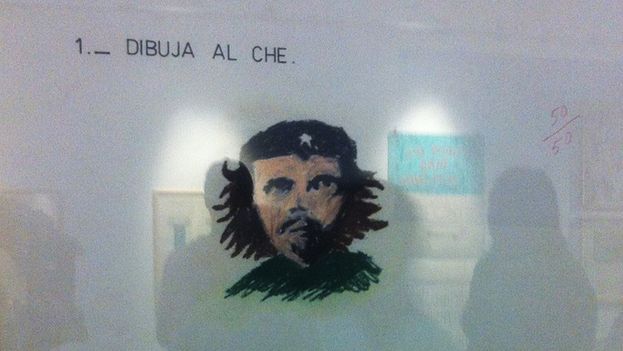
‘Control of History’ (1st part) by Saavedra. (Photo by Luz Escobar) Assignment: “Draw Che.” Grade received from teacher: 50 points out of 50.

14ymedio, Luz Escobar, Havana, 10 January 2015 – Outside the Galiano gallery in Central Havana yesterday, dozens of people gathered to enter the Añejo 27 [Aged 27] exposition. Some passersby were puzzled by the reasons for the tumult, perhaps thinking that eggs or pork had come to the ration stores. However, it’s “just art,” one disappointed girl told another who grimaced on hearing it.

The doors open and in the salon are hanging works from almost thirty years ago. “A liqueur from the past” with a strange taste of the present. The author of these drawings, collages and oils is Lázaro Saavedra, an artist with a stroke of the ironic and few words. Even so, 14ymedio managed to talk with him amid some images that characterize his work and his artistic generation.

Escobar: Graphic art and humor are in mourning this week because of the events at the weekly Charlie Hebdo. What did you think when you heard about this tragedy?

Saavedra: Rather than thinking, in the face of news like that what one feels is a very emotional reaction. continue reading

Escobar: Eight years have passed since the “little war of e-mails” in which you participated very actively. How has cultural policy changed at that time?

Saavedra: Everything has remained the same.

Escobar: In this exhibition, Añejo 27, there is an impressive effect in many of the themes and situations. Aren’t you frightened?

Saavedra: And what are the specific issues in which this effect is noticed?

Escobar: For example, this picture in front of us reminds me of the homework of my daughters who are now in elementary school.

Saavedra: You’re referring to the “Portrait of Che”? Yes, of course, it’s still current. That is, the entire canonization of historical figures continues.

Escobar: Tania Bruguera’s performance didn’t happen. Do you think it was too soon for a call like that?

Saavedra: I think so, it was too soon.

Escobar: What about Cuban art today, does it enjoy good health?

Saavedra: That’s a difficult question because if you think about health you have to counterbalance that with disease. In the answer to this question about disease, we have to be thinking about the cure for things to be better. Then we will have to detect what would be the points of sickness.

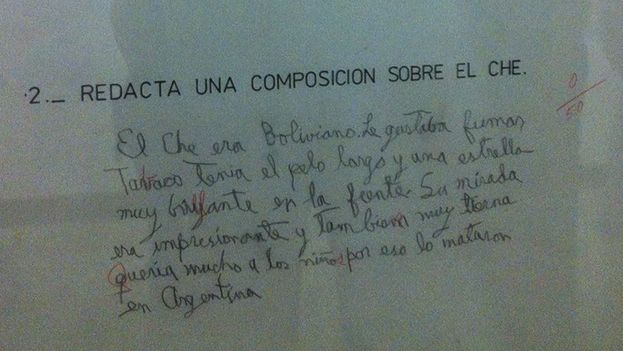
'Control of History' (part 2) by Saavedra. (Luz Escobar) Text of the composition on Che: “Che was Bolivian. He liked to smoke cigars. He had long hair and a very bright star on his forehead. His gaze was impressive and also very tender. He loved children very much and because of this they killed him in Argentina.” Teacher’s grade: 0 points out of 50.
‘Control of History’ (part 2) by Saavedra. (Luz Escobar)
Assignment: “Write a composition on Che.” Text of the composition: “Che was Bolivian. He liked to smoke cigars. He had long hair and a very bright star on his forehead. His gaze was impressive and also very tender. He loved children very much and because of this they killed him in Argentina.” Grade received from teacher: 0 points out of 50.

Escobar: The disconnect in artistic language, for example, with respect to what is happening in other countries in the world?

Saavedra: The disconnect in language has always been a constant in Cuban art. For example I did Volume One precisely because of this disconnect in Cuban art. In these times to do a work with new language could be considered a work of “ideological diversionism.” To some extent that is also what happened with Tania’s work, there is a disconnect in the appearance of the work with the traditional concepts of art.

Escobar: You’ve stood out as a teacher of new generations. What artistic surprises do young people have in store for us?

Saavedra: I don’t know now because I haven’t been teaching at ISA (Superior Institute of Art) for a few years, it’s been since about 2009 that I lost contact with the new generations.

Because of work problems I haven’t been able to give classes, in fact that is one of the doubts I have of myself. I would like to at least prove first hand, that is at the primary source, that this is what is being done at ISA. I refer to the place, because another thing is what comes out of ISA versus what is archived in ISA, which are two different things.

List of the Political Prisoners Released to date / 14ymedio

, Havana, 9 January 2015

2. Alexeis Vargas Martín

3. Ángel Figueredo Castellón

4. Ángel Yunier Remón Arzuaga

5. Anoy Almeida Pérez

6. Aracelio Ribeaux Noa

7. Ariel Eugenio Arzuaga Peña

8. Bianko Vargas Martín

9. Daniel Enrique Quesada Chaveco

10. David Piloto Barceló

11. Diango Vargas Martín

12. Emilio Plana Robert

13. Enrique Figuerola Miranda

14. Ernesto Riverí Gascón

15. Haydeé Gallardo Salázar

16. Iván Fernández Depestre

17. Jorge Ramírez Calderón

18. José Lino Ascencio López

19. Jose M. Rodriguez Navarro

20. Julio César Vegas Santiesteban

21. Lázaro Romero Hurtado

22. Luis Enrique Labrador Díaz

23. Miguel Guerra Astie

24. Rolando Reyes Rabanal

25. Ruberlandis Maine Villalón

26. Yohanne Arce Sarmientos

27. Yordenis Mendoza Cobas

28. Wilberto Parada Milán

29. Mario Alberto Hernández Leiva

30. Leonardo Paumier Ramirez

31. Miguel Angel Tamayo Frias

32. Ernesto Tamayo Guerra

33. Vladimir Ortiz Suárez

34. Roberto Hernández Barrio

35. Rubisney Villavicencio Figueredo

36. Carlos Manuel Figueredo Álvarez

37.  Alexander Fernández Rico

38. Miguel Alberto Ulloa

39. Reiner Mulet

Capitalism Straight Away, or the Chinese Method First? / Rafael Alcides

By Rafael Alcides — It’s December 17th. The majority (and right now there are about 30 of us in line at the pharmacy) is celebrating the agreements between Raul and Obama; if there had been firecrackers, they would have lit them. Anyway, implicating everyone with her finger, a woman with a child in tow and a voice choked by emotion was saying: “Saint Lazarus has made this happen!”

As I was saying, the majority, because among the old guys (there were eleven, counting me, and I’m not from that neighborhood; I’m just in line there because my pharmacy didn’t have my medicine), there are three in opposition: one who says that, without the mediation of dissidents, the agreement constitutes a betrayal by Obama, a betrayal that will be recorded in history with words of mourning.

The others shoot back with what about the Human Rights people* in this long-awaited moment, they’re thinking about their piece of the pie; and the man, a chubby guy who looks like a lawyer, noting the lack of a quorum and all the unfriendly faces, leaves without offering anyone his place in line. continue reading

Another one is a dentist, who later they will tell me is not one of those Human Rights people, but while his cohorts debate the future of Cuban socialism, he’ll continue saying that without an elimination of the Embargo on the horizon, the agreements between Raul and Obama have been nonsense and it’s obvious that Raul is not Fidel.

And the other old guy who opposes is wearing dark glasses, is very respected by the group, and totally rejects the agreements. That’s why, in order to debate things fully, and because these guys are old, we follow Jose Marti’s old men in “Los zapaticos de Rosa**” and distance ourselves; meanwhile, there in the entrance to the pharmacy the majority continues, with the Saint Lazarus devotee as their leader, believing capitalism is already here.

“No sir, as a former military man,” some cross-eyed guy assures the man with the dark glasses, “I can tell you that the Army general has not handed the keys of the city over to the enemy. You are right when you say Fidel himself has said one thing one day and the complete opposite the next, but that’s politics. It’s the political chess game. With each new power play the scene changes. It can’t be any other way.”

“For that very reason,” insists the man with the dark glasses, “I don’t believe Raul when he says that this has been done without sacrificing our principles, and tomorrow I’m turning in my Party I.D.; I don’t want to have it on me when they let the businessman off the plane who will take charge of cleaning up the garbage, and the one who will take on the issue of transportation, and the one who’s already budgeting for the construction of two hundred thousand houses in six months, for starters, and I won’t go on because the rest you can figure out on your own.”

“Stop posing as a national oracle,” admonishes the military guy, losing his temper. And in an even worse mood, the man with dark glasses replies:

“The oracle here is still Fidel, and with his flaws, Raul.  I abide by the law of physics. If you remove a brick from a dam, just one brick, you’re bringing about the end of the dam. Look at the Chinese, look at the Vietnamese. Tons of Chinese millionaires today. Tons, thousands. And leading the Party. The only thing missing now is what the bourgeoisie and the lackeys of imperialism call ‘democracy.’”

“In any case,” says the man dressed in bermudas and an Industriales baseball cap, “is that good or bad?  Because what I want are busses that transport me, trucks that pick up my garbage, and for my family to not have to live in barbacoas [jerry-built tenements], cramped quarters.”

“But not by those means, because that would be the end of socialism,” objects the military guy, agreeing with the man in dark glasses.

“But what’s more important: the means or the end result?”

That came from one of the old guys who hadn’t spoken yet, apparently someone of authority in the group and who addressed the crossed-eye guy and the soldier as “my brother.”  His summons surprised the one with the dark glasses:

“So then, for you principles don’t matter. Very strange considering your history. A guy like you.”

“I trust Raul,” says the historical one. “You were talking about the Chinese, but we aren’t Chinese here. And if it’s necessary to be Chinese, we’ll become Chinese. And if we have to do what the Chinese haven’t done yet, we’ll do that, too. Socialism hasn’t worked at all anywhere in the world, and Raul, who’s in touch with the world, has seen this. That’s why he’s done this, so get ready for what’s coming.”

Since the historical one seemed to know a lot about what was coming, the group got quiet, willing to listen. The quietest one was the man with dark glasses; but, suddenly, as if coming to his senses and more interested in his present than in the future, he unexpectedly asked:

“And what about me? You know me; the sixty-four awards, seals and medals I have at home say something, the son of mine who died in an internationalist war, and everything else you know. Outside of Cuba, I could live like a king. So tell me, can he who has suddenly made it all clear, at the end of his life, stand to see us back where we were when we started this thing?”

Except for the man with the dark glasses, everyone sided with the man in bermudas and baseball cap. Rectifying things is the work of wise men, he was saying. There was no agreement, however, on whether or not Raul would take the necessary steps to dismantle the system, whatever those were, without causing damage, doing it without seeming to, one step here, another there, taking his time.

“But, what about me?”

“Raul doesn’t have time to do things slowly,” said a fragile but energetic-for-his age doctor who had intervened twice before.

“And what about me?”

Nobody paid attention to the one in dark glasses, he kept repeating his “what about me’s” but the people ignored him. Their attention was on the argument between the doctor and the military guy.

“The Army general has all the time in the world,” the military guy insisted angrily. The one in bermudas and baseball cap backed him up:

“These people last a thousand years. Gallego Fernandez is 100 and look at him still standing stronger than a light post.”

“No sir, Gallego isn’t 100 yet,” specified the historical one.

The doctor explained himself, appealing to their common sense:

“I’m saying that Raul doesn’t have time to waste making changes one baby step at a time; not in the crushing conditions the country finds itself now; whatever he is going to do, he has to do it quickly, he’s opened the gates and that’s very delicate, he no longer has the outside enemy as the excuse that allowed him to keep the non-conformists here on the inside in their place, and they will become more courageous.  Without stopping to think about whether he hurts one or one million, he has to do it like Fidel did when, suddenly, at a burial he said that when I said digo [I say] it was really Diego, and in the process turned us into socialists. In fact, that was also on a 16th day of the month.  Just like that, the way you rip off a Band-Aid. That’s the kind of time he doesn’t have.”

The historical one didn’t understand the objection. He spoke for everyone:

“Everyone has their methods, and in the one I’m talking about, Raul would avoid responsibility and end up as the one who corrected Fidel’s mistakes. For starters, this is about Cuba, not the conceited fame of anyone. Do you remember the last interactions between the Godfather and his son, Mike Corleone? Imagine Diaz Canel acting like he’s talking and, behind him is Raul—who has resigned, alleging that he was really really sick but in reality he’s healthier than all of us—speaking for comrade Diaz Canel. We are, as my pal and neighbor used to say” — then he signals for the man with dark glasses — “in the very moment when the Chinese, after wasting thirty years making cement in the back yard with a cauldron and wood fire as if they were frying pork rinds, enter history. Talk to the Chinese about those lost years. In the same way, anyone here today who has felt deceived, will applaud later.”

It wasn’t a finished debate. There was still hardly any blood.  Someone was saying that maybe a Chinese method was coming that didn’t use Cuban capital, recalling the economic philosophy of the bonsai*** set forth by Murillo; for his part, the dentist continued to repeat like someone obsessed, that without an elimination of the embargo, Obama and Raul’s agreements were nonsense, even more so considering that not so long ago Raul had claimed that we could withstand the embargo 55 more years.

Then the doctor, perhaps fed up with that guy’s lamenting, raising his voice and confronting him, said that the plural in Raul’s “we could” was an exaggeration, that Raul hadn’t experienced one second of the embargo, that during 55 years Raul had woken up in air conditioning, that he had sat in an air-conditioned car, walked into an air-conditioned office, gone to bed with air conditioning and had only gotten sweat on his shirt when he went out to review a military unit, catching some sun on the way in order to synthesize his vitamins, or when he went hunting.

And that’s when it started. The military guy demanded the take back his words; audacious, the doctor refused; and while those two old men were being subdued by the group, I heard a woman who had been cleaning her upper dentures with a nail file say to an old man who had just arrived, as she put her teeth back in, energetic and ready to interject:

“With these changes that are coming, I would like them to do what the Chinese still haven’t done; if for no other reason than for the people here to be able to say what they think without things like this happening.”

This post by Rafael Alcides was hosted on Regina Coyula’s blog.

Translator’s notes:

*This phrase does not refer to any specific organization; the expression “human rights person/people” is widely used by Cubans to refer to anyone engaged in any way in working for democracy and human rights in Cuba.

**”The Little Pink Shoes” is a very famous poem in Cuba by José Martí. It tells the story of Pilar, a privileged little girl, who while playing on the beach sees a poor little sick girl with cold feet and no shoes. Pilar gives the girl her shoes, telling her, ‘Oh, take mine, I have more at home.

***Marino Murillo is Cuba’s Minister of Planning and Economy. The late Cuban economist Oscar Espinosa Chepe, a regime opponent, coined the term “bonsai businesses” to refer to the types of small private businesses now allowed by the regime: bonsai, of course, are very small, and are subject to constant “trimming” to make sure they are not allowed to grow to any significant size.

Translated by: Kathy Fox

10 January 2015
Message from Maritza Corrales / Polemica, The 2007 Debate

It isn’t possible to accept this kind of “indiscretion and naiveté,” to name it euphemistically, in times like the ones we are living in now. I know, as always, you will be profound, accurate, destructive and–as Marti was–with deaf ears. Count me as one more crusader.

The patient and very painful reconstruction of cultural ruins, but above all human ruins, that we found ourselves forced to live through and try to overcome, cannot have been in vain.

Backwards, brother, as one of our revolutionary slogans reads, not even to regain momentum. Accepting that would mean, as Mayito says, regressing and this, to which we have given the best of each one of us, is a Revolution based and conceived on two simple and profound words: dignity and justice; and we must continue fighting for them.

Maritza Corrales

Translated by: Kathy Fox

Drug Consumption Increases in Cuba / 14ymedio, ORLANDO PALMA

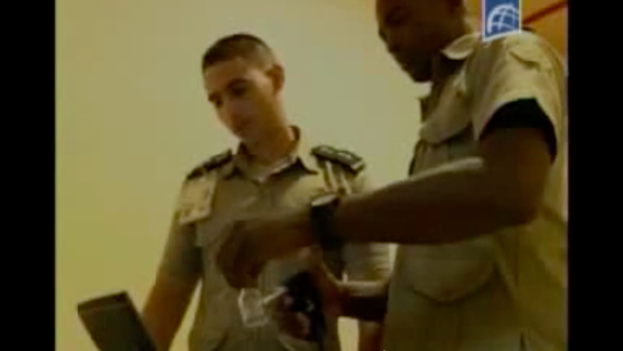
Screen capture from the TV report issued by Primetime News about customs work against drug trafficking

14ymedio, Orlando Palma, Havana, 8 January 2015 – The seizure in 2014 of close to 40 tons of drugs in Cuban ports and airports belies the old official line that for decades presented narco-trafficking as a foreign phenomenon, a characteristic of the “corrupt capitalist world.” The official press boasted that the Island was not used as bridge for the introduction of narcotics into other countries.

Nevertheless, as early as the nineties, some academic studies and journalistic reports began to speak in more realistic terms about national addiction and consumption of prohibited substances. continue reading

Last October Cuban television’s Primetime News published a report from Jose Marti International Airport in which the techniques used by customs to detect the entry of drugs were demonstrated and in which it reported the discovery of at least 40 cases of intent to traffic drugs through the border through mid-October.

The report came out days after the independent press echoed a study published by Customs of the Republic that showed the case of a passenger who transferred to the Island “a certain quantity of drug in an ingested form which was destined for the domestic consumption market.” That brief phrase focused attention on the existence of two problems within Cuba: domestic consumption and the use of “mules” for transport of the substances.

The Customs report, prepared by Moraima Rodriguez Nuviola, chief of the Department of Analysis for that agency, adds other figures. Between January and November 2014, the system for confronting drugs on the border discovered through air, sea and postal channels 38,843 kilograms of drugs, among them 36,587 of cocaine, 2,224 of marijuana and 32 of cannabinoids.
Customs now has 110 dog units trained to find not only explosives but also drugs.

Modern X-ray equipment for the Mariel port, together with other technical means of control have been installed or will be installed soon in all of the country’s international airports. Among them the internal body scan, which is used to find out if a person has ingested drugs and the external body scan to see if there is contraband attached to the body.

Official recognition of the existence of a domestic market for the consumption of drugs has been reflected on official television through signals such as the appearance of a message announcing a telephone help line for addicts and the introduction into scripts of cases brought against networks that distribute crack cocaine or any other substance. Counseling programs have begun to include advice for family members who live with addicts.

Increased tourism and the new economic capacity of some population sectors would be the main causes for the presumed increase in consumption of drugs. Meanwhile, the new official discourse suggests that, to the extent that the country now is looking like the rest of the world, these phenomena are inevitable.

After the announcement of the re-establishment of diplomatic relations between Washington and Havana, the fight to stop drug trafficking could become another area of cooperation between the two countries, since the Island, in contrast with the majority of its neighbors, is not an important point in the circulation of narcotics.

“I do not believe that the Cuban government wants to be a drug trafficking center,” Barry McCaffrey, a White House anti-drug official during the Clinton administration, has said in statements to The Washington Post. McCaffrey has said that there has already been “all kinds of communication between the US and the Island” in this area, although it was not “perfect cooperation.”

Translated by MLK