
Journalist Reinaldo Escobar Wins the 2018 Verbum Novel Prize

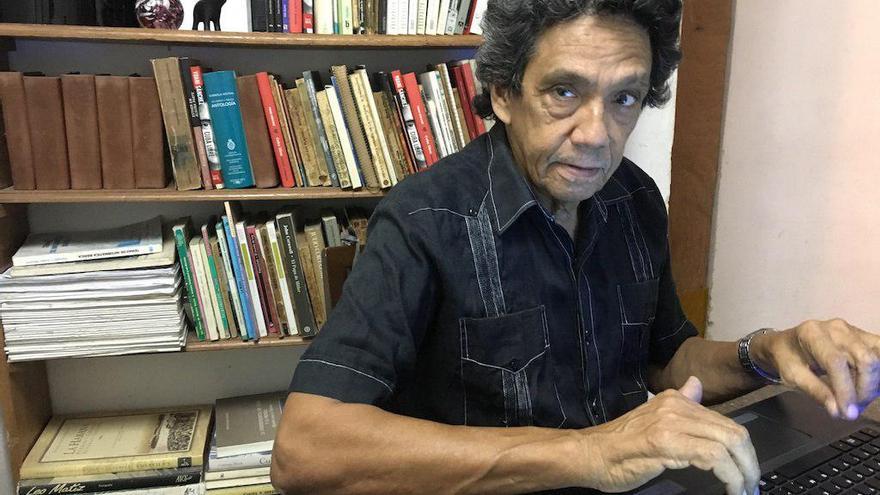
Reinaldo Escobar worked on the creation of ‘La Grieta’ for a quarter of a century. (14ymedio)

14ymedio bigger14ymedio, Havana, 27 August 2018 — Journalist Reinaldo Escobar’s work, La Grieta*, won the 2018 Iberianamerican Verbum Novel Prize. The results of the contest were announced this Monday and its organizers reported that 507 authors participated and there were five finalist.

Escobar, editor-in-chief of 14ymedio, was awarded the prize for “the narrative maturity with which he tackles the chronicle of disenchantment for an entire generation of Cubans,” and “the subtle irony that manages to raise a smile and the delicate game of mirrors that fuses reality and fiction.”

“I’ve been working for a quarter of a century on this novel, writing and rewriting its pages,” Escobar said, on hearing of the award. “It is a testimony that I hope will transcend me as an individual and represent thousands of Cubans who lived similar experiences.” continue reading

La Grieta tells the story of Antonio Martínez, a young man who entered the School of Journalism at the end of the ’60s with the illusion of entering the profession during a time of new airs of freedom. Two decades later he ends up expelled from the newspaper where he works and stigmatized as an enemy who will not be allowed to exercise his profession in any other media.

The novel’s first typed version, without copies, was completed in 1994 but was confiscated by State Security at the Havana airport when Escobar tried to take it out of the country. A quarter of a century later, the novel is seeing the light reconstructed by memory and enriched by the author’s experience.

The jury of the Verbum Prize has emphasized that it is “an entertaining and intense work, which a whole generation can identify which and in which younger readers will discover the chronicle of an epoch of fallacious epics.”

The steps through which the plot takes shape begin with the ins and outs of the ideological struggle between fundamentalists and liberals in the university environment, the sanction the lead character was subjected to in a process of political cleansing, his later involvement in a prestigious magazine that worked to sugarcoat the image of the country for external consumption, and the enthusiasm for glasnost and perestroika that leads him to try to push journalism along more open paths from a newspaper of national circulation, to a point of direct confrontation where he finally stumbles against the insurmountable wall of intolerance.

Parallel to the events of the protagonist’s professional life, where at each step he discovers the enormous distance between reality and official discourse, Martínez maintains his own romantic utopia that leads him to seek, over and over again, a personal chimera.

The author portrays a part of that generation that jumped from adolescence to adulthood in the midst of the maelstrom brought by the Revolution. The illusion, the doubt, the skepticism, the frustration, follow one another in a sequence where it is difficult to determine the exact point of rupture, that insurmountable crack (grieta) where the deepest convictions are recomposed.

The jury that selected the winner comprised Fernando Rodríguez Lafuente (Spain, president), Pedro Juan Gutiérrez (Cuba), Sara Mañero Rodicio (Spain), José Antonio Martínez Climent (Spain, winner of the 2017 Iberoamerican Verbum Novel Award) and Luis Rafael (Cuba-Spain).

Among the finalists, along with La Grieta, was La Dantesca vida de Philip Orsbridge, by Alfredo Nicolás Lorenzo (Cuba), La hora del silencio, by Cristina Feijóo (Argentina), Los paraguas y el sol, by Enrique Pérez Díaz (Cuba) and Fóllale, Manco, by Juan Sebastián Rojas (Colombia).

Translator’s note: “Grieta” is a word that can be translated as crack, fracture, rift, chasm, fissure, breach and many synonyms of these words. Not having read the book, this translator hesitates to pick one to represent the title in English.

See Also: Twenty Years of Freedom or the True Face of Fantomas

__________________________

The 14ymedio team is committed to serious journalism that reflects the reality of deep Cuba. Thank you for joining us on this long road. We invite you to continue supporting us, but this time by becoming a member of 14ymedio. Together we can continue to transform journalism in Cuba.
"They Warned Us That Cuba Can’t Turn Into Another Nicaragua," Say Detained Artists

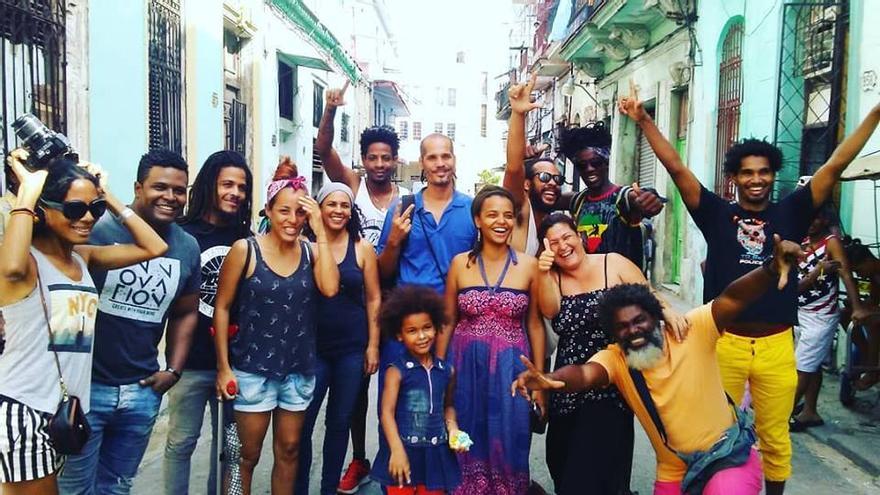
Caption: Detained along with Luis Manuel Otero Alcántara were the journalist Yania Suarez, Yanelys Núñez, Michel Matos, and Yasser Castellanos (Facebook)

14ymedio bigger14ymedio, Luz Escobar, Havana, 13 August 2018 — The artists of the campaign against Decree 349, who tried to organize a concert on Saturday at the house of Luis Manuel Otero Alcántara, were freed at the stroke of midnight on Sunday.

Otero Alcántara explained to 14ymedio that he and Yanelys Núñez were arrested in the early afternoon on Saturday when State Security and the police surrounded his home, which houses the Museum of Politically Uncomfortable Art (Mapi).

“They detained us on the corner of Damas and San Isidro, a few hours before the concert, when we went out to get a few things we needed, they took us in two patrol cars, one for her and the other for me,” the artist said from outside the Zapata and C Police Station after being freed at the stroke of midnight on Sunday. continue reading

“At the moment of the arrest they didn’t tell us anything, but when we were in the station State Security arrived for an interview and they warned us that Cuba can’t turn into another Nicaragua, they are very worried,” added Otero Alcántara. He also said that detained with him in the station were the journalist Yania Suarez, Yanelys Núñez, Michel Matos, and Yasser Castellanos.

According to testimony that the actress Iris Ruiz offered to this newspaper by telephone on Saturday afternoon, officials blocked entry to the house under the pretext that they didn’t have permission from the Ministry of Culture to have the party with the musicians. In face of the prohibition the creators drew a hopscotch court in the street to play and “pass the time relaxing,” explained Ruiz.

She also explained that agreeing to withdraw would mean “that the right to make alternative art is finished and that we give up in the face of this law that hasn’t yet come into full force.”

For Ruiz it was important to remain and apply pressure because if not “they next time they’ll come with the same thing and every time we do an activity, we’ll have to ask permission from the Ministry of Culture,” and it would also mean “the acceptance of this law that we are rejecting.” Again and again artists were threatened and the artist says that they were asked to withdraw or else the patrols could come to disperse them.

Finally the artists entered the house, but police agents arrived and threatened Luis Manuel Otero’s mother that they wouldn’t let her son go and that they would take away her house in the event she wasn’t evicted.

During the telephone call the voice of the poet Amaury Pacheco could be heard yelling, “No to Decree 349.” “All of us here in the middle of the street were detained, the first time they managed to put Amaury in a patrol car but they couldn’t take him because,” as the actress recounts, “the people pulled him back out” and the crowd celebrated with applause and cheers. “This is the fifth action but we’re not going to stop until the decree is knocked down,” proclaimed Iris Ruiz.

Since the beginning of the week several of the artists who had publicly demonstrated their support for the concert received summons from State Security to be interrogated. For others, like Gorki Águila, on the same day of the gathering a police operation surrounded his house to prevent him from leaving his home.

Yasser Castellanos, rapper and plastic artist, told 14ymedio that he was summoned to the Cuba y Chacón police station. “In general the point is to discredit the organizers of the event, calling them delinquents, and to warn us that they weren’t going to permit us to hold the concert.” Also summoned were Soandry del Río, Ras Sandino from the group Student without Seed, the urban artist Karnal, and the members of the group Social Conflict.

The gathering for the concert is part of the “No to Decree 349” campaign which aims to give visibility to the demands of a group of independent artists who emerged from a debate over the content and scope of the law. Among the artists who were expected to participate in the Concert Without 349’s Permission were Soandry del Río, La Alianza, Hip Hop de Barrio, Gorki Águila, David de Omni and Amaury Pacheco.

Decree 349 prohibits “the provision of artistic services” without the prior approval of the Ministry of Culture and requires that “commercial centers of plastic arts” have prior authorization and be registered in the “Creators’ Registry.”

The organizers of the campain against the decree claim that the law is meant to eliminate the work of independent artists who in recent decades have earned their space working at the margins of institutions.

Otero Alcántara believes that it is a response to the production of the recent #OOBienal and it affects other artists who have organized their own workshops and independent galleries, like Tania Brugera or the artists Italo Expósito and Luis Trápaga, both expelled from the Creators’ Registry at the end of the alternative event as retaliation for taking part in it. Both Expósito and Trápaga have alternative cultural spaces in their homes where they organize exhibits and concerts.

Decree 349 will come into full force in December and it provides for fines and confiscations of instruments, equipment, accesories, and other goods from the offenders.

David de Omni, one of the artists arrested outside Mapi, says that “the people in the street don’t like what happened here on Saturday” and that “very few people yelled ’Long live the revolution!’ and those slogans that they always order them to say.”

The artist saw in the crowd an older man “who yelled ’Long live Fidel’” but only two or three followed him “because the majority of the people in the street were calling the police abusers and asking them to let us go.” He says that when they carried him off in the patrol car he felt the noise of “many hands hitting the roof of the car and voices saying, ’Don’t take him.’”

“I was detained in the Dragones police station for a few hours but nothing will stop us fighting against Decree 349 and we’re going to keep up with these actions until they get rid of this law,” he warned.

____________________

The 14ymedio team is committed to serious journalism that reflects the reality of deep Cuba. Thank you for joining us on this long road. We invite you to continue supporting us, but this time by becoming a member of 14ymedio. Together we can continue to transform journalism in Cuba.
Beer Returns to the Children’s Area of Carlos III Plaza Because "It’s Necessary to Carry Out the Plan"

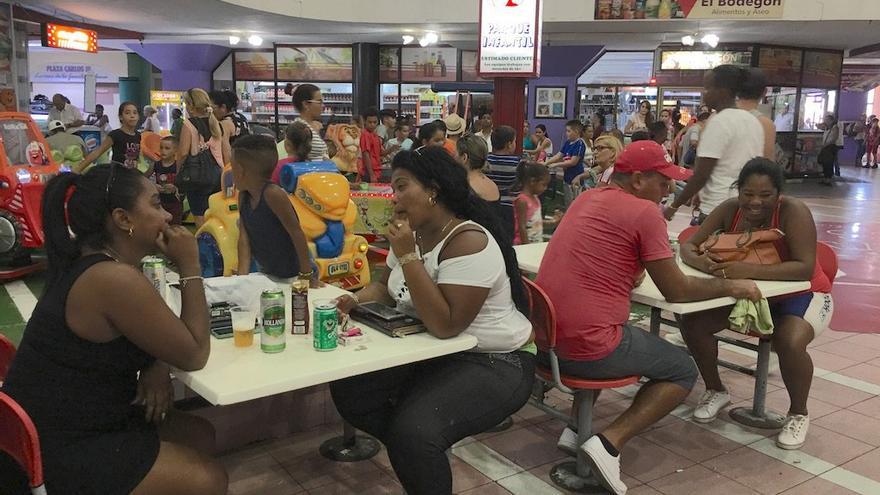
Caption: Families with children have no qualms about drinking alcohol while the little ones use the animal and spaceship-shaped rides (14ymedio)

14ymedio bigger14ymedio, Havana, 25 August 2018 — The prohibition of alcohol sales in the children’s area of Carlos III Plaza in Havana lasted less than three months. The administration of the largest mall in Cuba’s capital once again has allowed the consumption of beer in the cafeterias adjoining the children’s play area, as confirmed by 14ymedio.

In June the sale of alcoholic beverages on the building’s ground floor was suspended to prevent the proximity of children from customers drinking beer. The measure was adopted after the situation was denounced in various independendent media sources, even winding up on official television.

The management of Carlos III Plaza at that time set up a series of tables in the outside area of the mall where it was possible to consume beer and other alcoholic beverages. However, the improvised cafeteria was recently closed down and the sale of alcohol returned to the inside of the building. continue reading

The employee in the customer service office declined this Friday to make any statements on what happened, but a worker at the bag-check assured that “they’re orders from above.” The measure was revoked for “economic reasons, because this place has to carry out a plan and beer is one of the most-sold products.”

“Sales have fallen a lot and although it’s true that there had been a lot of peace and quiet, this is a mall, not a convent,” declares an employee who sells snacks, pizza, and beer in the area a few yards away from electric rides where small children play. “The numbers were in the red,” he confirms.

Several employees chalk the decision up to “the high demand for beer and other alcoholic beverages in the summer.” School vacations coincide with many parents who work in state centers also taking a break. “We were losing a lot of money,” confirms the snack seller.

Although some signs still say that the consumption of rum is prohibited, the salespeople justify themselves by saying that they are not committing any violation because “here beer is what sells, we haven’t sold a shot of Havana Club nor a box of Planchado rum.”

In July, when the prohibition was in effect, a man who worked at the place confirmed to this newspaper that every day they were suffering losses, that the bread was going bad and they sold almost no fried chicken, which were the favorite accompanying dishes for people coming to drink alcohol.

Here the complaints of parents who come to spend some leisure time with the electric rides are beginning to be heard again. “It was easy to imagine that this situation would repeat itself because here when it is a question of making money everything else is set aside, even childhood,” laments Claribel Ledezma, grandmother of a four-year-old girl.

“I live near this place and I remember when it first opened the only people who came to drink a few beers were rich people, but now you see many people have money to spend on alcoholic beverages,” the woman believes. “Some groups come in the morning and leave in the afternoon totally drunk. Children have to watch this kind of spectacle.”

Other families with children have no qualms consuming alcohol while the little ones use the animal and spaceship-shaped rides. “They have fun and so do we,” says Pablo, father of seven-year-old twins. “After all, they live in Cuba and they have to get used to the fact that things are this way.”

In 2005 a resolution published in the Official Gazette prohibited the sale of alcohol, including beer, to minors under the age of 16. The alarms went off after it was noticed that the drinking age hadn’t stopped dropping on the island.

On average drinking alcohol starts at 15 years old. The psychologist Justo Fabelo Rochy, coordinator of the You Decide project, which tries to create awareness of the problem among adolescents, warns that given this situation many adults who develop an alcohol addiction started drinking at these early ages.

__________________________________

The 14ymedio team is committed to serious journalism that reflects the reality of deep Cuba. Thank you for joining us on this long road. We invite you to continue supporting us, but this time by becoming a member of 14ymedio. Together we can continue to transform journalism in Cuba.
The US Resumes Consular Services for Its Citizens in Cuba

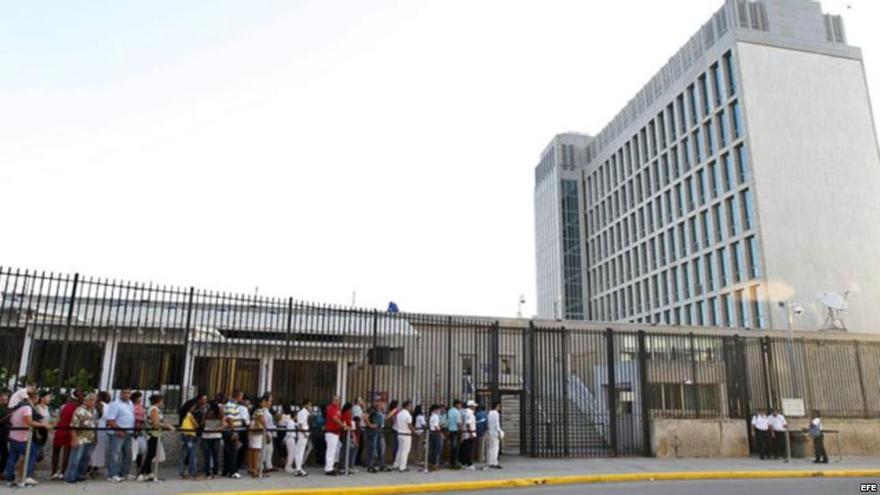
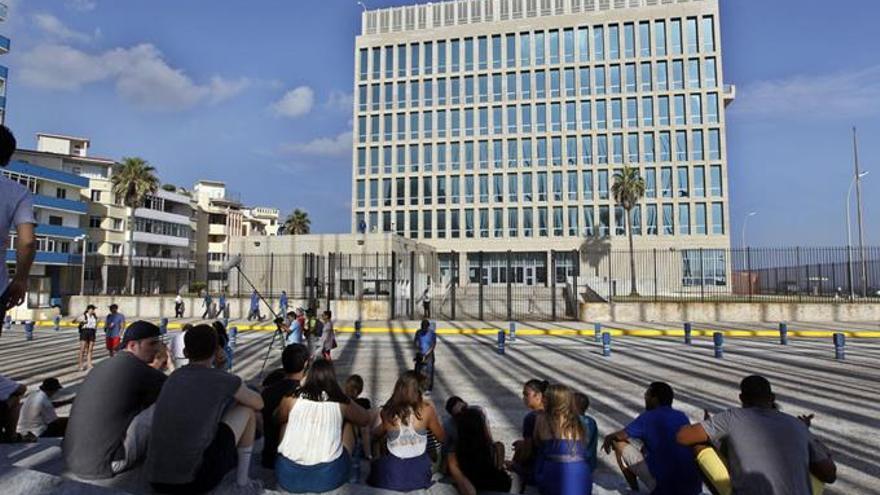
The US embassy staff in Havana continues working at minimum levels after the evacuation of its non-essential personnel. (EFE)

14ymedio bigger14ymedio, Havana | 24 August 2018 – The US embassy in Havana announced Friday that it has resumed consular services for American citizens. Renewal of passports, notary services, authentication, consular reports of birth abroad and emergency assistance are available as of today in Havana, without the need to travel to another country, as had been the case.

The diplomatic headquarters published this decision in a statement released on their social networks. Many Cubans took the opportunity to request the restoration of the family parole reunification program, which has been postponed for nearly a year.

Some people also demanded the return of consular services for family reunification currently taking place in Guyana. Residents on the Island who are interested in visiting the United States must obtain their visa in a third country. continue reading

In September of last year, the United States reduced by 60% the diplomatic personnel in the Island, after twenty-six of its officials were allegedly attacked with a “sonic weapon” which affected their hearing and caused other related problems. Relations between Washington and Havana deteriorated rapidly after the arrival of Donald Trump as president. The United States accuses the island of knowing who is behind the alleged attacks on its diplomats, while Cuban authorities say it is a pretext to derail the process of reestablishing relations undertaken under the previous administration.

Recently, the US Congress published a report questioning the embassy’s ability to keep abreast of Cuban affairs. “The ability of the United States to follow the situation in Cuba, defend human rights, carry out consular activities and comply with bilateral agreements is being undermined by a drastic reduction in the staff of the embassy in Havana,” reported Reuters, which had access to the document.

The document, issued by the Congressional Research Service, affirms that the decision to reduce the number of diplomats from 50 to a maximum of 18 on the Island due to the mysterious ailments that affected 26 US and 10 Canadian officials since 2016, has resulted in there being more work than those who remain on the island can complete.

According to Reuters, not a single refugee visa has been processed this year because the office responsible for doing so remains closed. Last year there were 117 people who benefited from receiving these visas in Havana.

The Cuban government has expressed its concern that the minimum 20,000 visas for Cuban migrants will not be reached this year, an agreement that both countries signed in 1994 to end the crisis of the rafters.

This Thursday, the United States lowered the level of alert for those who intend to travel to the island. The State Department placed Cuba in category 2, which recommends exercising caution due to the acoustic attacks against employees of the US embassy. At the end of September, the State Department had placed the island in category 3, recommending that the Americans “reconsider” a trip to the the greater of the Antilles.

Translated by Wilfredo Díaz Echevarria

______________________________

The 14ymedio team is committed to serious journalism that reflects the reality of deep Cuba. Thank you for joining us on this long road. We invite you to continue supporting us, but this time by becoming a member of 14ymedio. Together we can continue to transform journalism in Cuba.
Judge Denies Bail to Cuban Independent Journalist Serafin Moran Detained in Texas

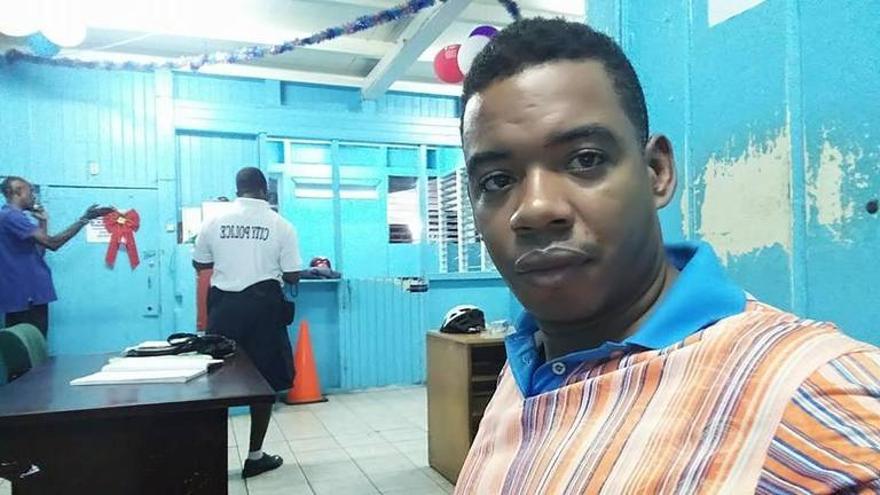
Cuban freelance journalist Serafín Morán Santiago, 40, has been accused in the island of spreading propaganda and being a paid agent of the United States government.  Now he is in an immigration detention center in Texas waiting for a response to his asylum application. (Courtesy of Serafín Morán Santiago)

14ymedio bigger14ymedio, Miami | 24 August 2018 — An immigration judge from the State of Texas denied bail to independent journalist Serafín Morán Santiago, who has been detained in that state since last April after requesting political asylum at the border with Mexico.

Morán must remain in custody until his case is decided at an asylum hearing in October, journalist María Fernanda Egas, of the Fundamedios organization, which monitors freedom of the press in the United States, said via telephone to 14ymedio.

Both Fundamedios and Reporters Without Borders launched an alert on Morán’s situation, who in their opinion must be “immediately released” and under no circumstances repatriated to Cuba. The reporter, according to both organizations, would face on the island “a real risk of death,” denounced María Fernanda Egas. continue reading

Serafín Morán Santiago turned himself in to the agents of the Border Patrol on April 13, after traveling a complicated route from Guyana, the first country he visited after leaving Cuba. This passage is made daily by dozens of Cubans in order to reach the southern border of the United States.

After the implementation of President Trump’s policy known as “zero tolerance” for undocumented immigration, asylum seekers can remain detained until an immigration judge determines whether or not their case is eligible to receive this status.

In the current fiscal year, which ends in September, 364 Cubans have been returned to the island, most of them after being detained in facilities of the Immigration and Customs Enforcement (ICE). Cuba pledged to the United States that it would accept all of its nationals with deportation orders starting with the new migratory agreement signed by both countries in 2017.

According to Morán’s complaints, agents of State Security (Cuban) “kidnapped” and “punched” him in June 2016. On September 2, 2017, he was again arrested and his work equipment confiscated. The journalist says he tried to seek refuge through the US embassy in Havana, but his case file was rejected twice.

In the event that Morán fails to prove that he is being persecuted by the Cuban government, he could be repatriated to the island. The journalist, 40, has collaborated as an independent reporter for media such as Univisión 23, Telemundo, Hispano Post, Primavera Digital, Cubanet and TV Martí.

Translated by Wilfredo Díaz Echevarria

___________________

The 14ymedio team is committed to serious journalism that reflects the reality of deep Cuba. Thank you for joining us on this long road. We invite you to continue supporting us, but this time by becoming a member of 14ymedio. Together we can continue to transform journalism in Cuba.
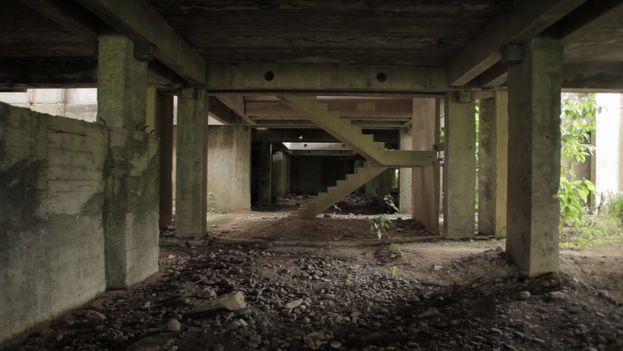
Bayamo Pediatric Hospital Remains Unfinished After 35 Years

“The construction of the Maternal and Child Hospital began in 1982 was a dream for the residents of Bayamo. Today it is only a memory of the Government’s uncompleted promises.” Video is not subtitled, but includes good images of the hospital. 

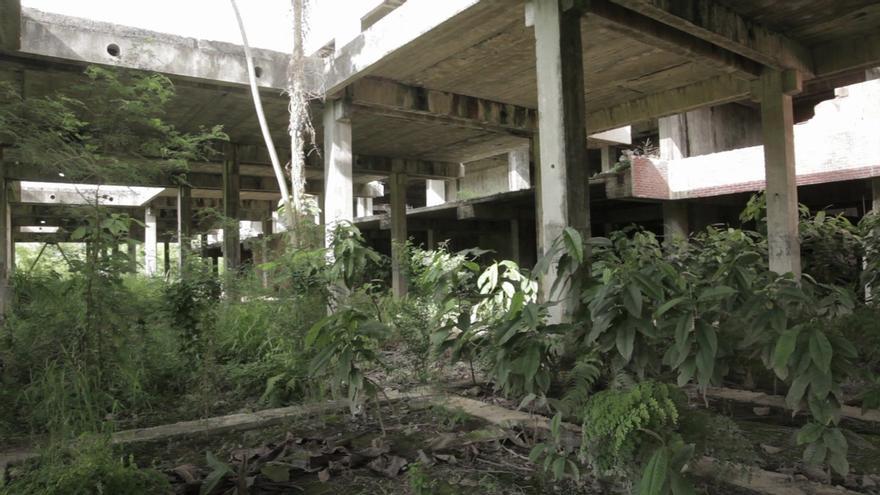
14ymedio bigger14ymedio, Bayamo, 24 August 2018 — From the road one can see the eight-story hulk that should have served to heal and care for the children of the area, but which was never finished. The construction of the Bayamo Pediatric Hospital, in Granma province, began 35 years ago and today serves only as a refuge for bats and mosquitos.

The construction of the Maternal and Child Hospital, as it is also known for the multiple specialties its structure was meant to shelter, was announced by Fidel Castro during a speech in 1982. The following year the Engineering Works Construction Company of began digging the earth.

Among the crowd, in that July 26th celebration where Castro played to the audience, was a young man of 28 who thought that his children would be born in that hospital center projected to be one of the “most modern in Latin America.” Now, on the verge or retirement, Reynier Rosas recalls, “I had gray hair, some teeth fell out and my daughter gave me two grandchildren, but from the hospital, nothing.” continue reading

“I did a ton of volunteer work on the construction of the Pediatric,” Rosas explains to 14ymedio. “At the beginning there was a lot of enthusiasm and the place was full of builders, trucks and designers,” he recalls. “But little by little it was left empty and even the authorities stopped talking about the hospital.”

In that decade of the eighties, when work began for theBayamo Pediatric Hospital, the Soviet subsidy boosted the Cuban economy and financed numerous projects. Those were the years when the work on the Juraguá nuclear power plant, which stopped after the debacle of the socialist camp, also began in Cienfuegos.

“In 1988, the first signs were beginning to be felt,” remembers Migdalia, 68, who worked as a cook for the construction brigades of the unfinished hospital. “When I started working there, nothing was missing, but little by little the food supply became unstable and the arrival of materials began to fail.”

The Pediatric was not only designed to be the most important children’s hospital in the province, but it would be the second tallest building in Bayamo, a city of small architecture. In spite of being unfinished, its imposing structure can be seen from several places in the local geography.

Given the current situation, a “very specific and rigorous study” must be done to evaluate “if it is possible” to finish structure, says civil engineer Eriberto Chávez. (14ymedio)

In that same year of 1988 Castro returned to Bayamo and inquired among the leaders of the Party about the delays of the work he had promised more than five years ago. “Some of those who met him on that occasion told him very clearly that there was a lot of backlog, structural problems and that without the resources it could not be finished,” Migdalia recalls. “But he said they had to make a sacrifice to open it.”

Then, Migdalia says, in 1991 there was a break in the works and there were only a few workers, more to prevent the materials being stolen than to continue building the hospital. In the mid-90s they tried to give the project a new impetus but “it was worse because the situation was very bad and only very little progress was made,” he recalls.

The hardships of the Special Period led to vandalism and on the darkest nights nearby residents took floor slabs, steel bars and other materials to use in their own homes. Some workers took advantage of the lack of control to resell some of those resources on the black market.

In 2003, the Construction Business Group of Granma province undertook the work to enable a polyclinic taking advantage of a part of the site. The work was valued at 30 million Cuban pesos and currently suffers a series of problems that stem from its vicinity with the abandoned colossus, such as the proliferation of rats and insects in its facilities.

“Now, more than ever, we need that hospital because many doctors’ offices and family clinics that used to be in Bayamo are no longer open,” laments Riza, the mother of two children of school age. “In addition, the pediatric hospital that is providing services fails to meet the demand,” he says.

According to official figures, the number of clinics or family doctor’s offices has decreased significantly in the country in recent years. These premises went from 14,007 in 2007 to 10,782 in 2016. The number of polyclinics was also reduced by 9.2% in that period, according to official data.

“This place is a curse, it is not worth rebuilding because it has been damaged a lot by the rains and the sun, but it costs too much to destroy it,” adds Raiza, who is married to a mason who was hired at the beginning of this century for one of many restarts in the hospital construction, without success.

The place that was intended to cure has become a source of ill health. Every time it rains, “lagoons are created on the ground floor,” a security employee who guards the site confirmed to this newspaper. The puddles end up becoming mosquito breeding sites, an alarming situation in a city that in recent months has experienced a rebound of cases of Zika and dengue fever.

In 2015, a restart of the construction work was announced, which would begin with the placement of steps and stairways to allow the designers to go up to level eight. (14ymedio)

Caption: In 2015, a restart of the construction work was announced, which would begin with the placement of steps and stairways to allow the designers to go up to level eight. (14ymedio)

Decades of abandonment have left their mark. The property “has serious damages,” says civil engineer Eriberto Chávez, a resident of the city. The specialist warns about the deterioration “in the joints of beams with columns and columns with slabs.” Given the current situation, a “very specific and rigorous study” must be done to evaluate “if it is possible” to use the structure.

In 2015, a restart of the construction work was announced, which would begin with the placement of steps and stairways to allow the designers to go up to level eight and the roof, but the plan, once again, did not come to fruition due to lack of resources.

Now the province has other emergencies and with the economic straits that the country is experiencing from the cuts in oil shipments from Venezuela, the forecasts are not promising with regards to the “modern ruins” of the hospital.

With the passage of time, the people of Bayamo have stopped making plans involving the hospital, although the complaints about its situation are still heard in some neighborhood meetings or in conversations between neighbors. “They scammed us, an eight-story scam that we have to see every day,” says Reynier Rosas harshly. “I try not to look over there because it reminds me how naive I was.”

___________________________

The 14ymedio team is committed to serious journalism that reflects the reality of deep Cuba. Thank you for joining us on this long road. We invite you to continue supporting us, but this time by becoming a member of 14ymedio. Together we can continue to transform journalism in Cuba.
United States Reduces the Alert Level for Travel to Cuba

The US embassy in Havana continues to staff at minimum levels after the evacuation of its non-essential personnel. (EFE)

14ymedio bigger14ymedio, Havana | 23 August 2018 – The United States on Thursday reduced the alert level for travel to Cuba, a surprise decision after relations between both countries were frozen after the mysterious “sonic attacks” suffered by 26 US diplomats in Havana, reports the Nuevo Herald.

Cuba is now found in category 2, which recommends exercising caution due to attacks directed against employees of the US embassy in Havana. At the end of September, the State Department had placed the island in category 3, recommending that Americans “reconsider” a trip to the Greater of the Antilles.

After the departure of 60% of the US diplomatic personnel deployed in Cuba and the reduction in the services of the embassy, relations between Washington and Havana deteriorated rapidly. The United States accuses the island of knowing who is behind the alleged attack on 26 of its diplomats, while Cuban authorities say it is a pretext to derail the process of reestablishing relations undertaken under the previous administration. continue reading

The Cuban economy has been affected in the past year by the fall in the number of tourists visiting the country, which dropped by 5.67% according to official figures. President Donald Trump in June of last year toughened the conditions for Americans visiting the neighboring country, so that their travel to Cuba fell by 23.6%.

The Havana Consulting Group, a company specializing in analyzing the Cuban economy, considers that the first half of 2018 has been “traumatic and devastating” for the Cuban tourist industry due to the combination of “countless accumulated unresolved problems,” among them the low influx of tourists from the USA.

According to Orna Blum, spokeswoman for the Bureau of Western Hemisphere Affairs of the US State Department, the change to level 2 was due to a new assessment of the risk of traveling to Cuba.

“The Department conducted a comprehensive risk assessment for US private citizen travelers in Cuba and decided that a Level 2 travel alert was appropriate,” the spokeswoman told the Nuevo Herald.

The United States reiterated that it does not yet know the weapon used to harm its officials or what country or group is behind the alleged attacks.

Translated by Wilfredo Díaz Echevarria

_______________________________

The 14ymedio team is committed to serious journalism that reflects the reality of deep Cuba. Thank you for joining us on this long road. We invite you to continue supporting us, but this time by becoming a member of 14ymedio. Together we can continue to transform journalism in Cuba.

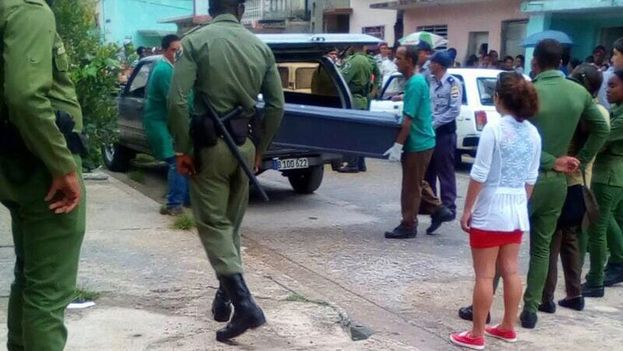
Victims of Machismo and Official Silence

The bodies of Tomasa Causse Fabat, a 64-year-old nurse and her daughter, Daylín Najarro Causse, 36, murdered by a former domestic partner of Najarro’s, are taken to Legal Medicine in Cienfuegos. (14ymedio)

14ymedio bigger14ymedio, Yoani Sanchez, Havana, 25 August 2018 — A few weeks ago, purely by chance, I attended an international event about the treatment of gender violence in the press. The official Cuban representative at the meeting, with a certain pride and a touch of superiority, emphasized that on the island there was no “crime blotter” and femicides are not a problem.

This week, two events reminded me of those words. One was the 58th anniversary of the founding of the Federation of Cuban Women (FMC), a pro-government organization that has done immense harm to the feminist cause on the Island by promoting a sugarcoated version of reality, silencing aggressions against women and monopolizing their social representation.

The other memory triggered was the publication of a note in the Cienfuegos newspaper, September 5th, about the sentences handed out to the three perpetrators of the kidnapping, rape and murder of a 19-year-old girl. In an unusual gesture, the local media followed the case starting last year, when the father of the victim insisted on speaking out and making the tragedy known, and did not rest until he achieved that. continue reading

Editorial distinction goes to September 5th’s news reporting which broke the official silence, although the coverage was sparse and several times lacked the minimum requirements for information reporting. For example, the description of the context of gender violence in which the murder of Leidy Maura Pacheco Mur took place was missing, and the journalist took great care not to mention words such as “femicide.” An omission caused, in part, by the lack of statistics on the real incidence of this scourge.

In that same Cienfuegos city, in May of this year, a mother and her daughter were stabbed to death by the latter’s ex-husband. Their deaths were reported only by the independent press and are not part of the presentations from the FMC when they go on tour around the world, nor have they reached the archives of UN Women, the United Nations entity dedicated to gender equality and the empowerment of women.

This lack of institutional information does not prevent each Cuban woman from having her own list of friends, neighbors or relatives who have died at the hands of an abusive husband, or who have been raped or suffered harassment. This personal record includes the sexual pressures of their bosses at work, groping on public transport and even the catcalls that he believes are compliments that she sees as aggressions.

To hide this situation and to silence with lies what needs to be made visible makes the problem worse because it prevents the establishment of a clear idea of ​​the risks. How many times have we heard advice such “don’t walk down that street in the dark,” “call when you get there,” “don’t you feel alone in that park”? If the Cuban reality presents so many dangers for us, why isn’t the national media alerting us to them?

While thousands of women in Latin America march under the slogan “Not one more,” the victims of sexist violence on the Island can not be remembered in the streets and their faces are filed away only in that long gallery of outrages and aggressions that we carry in our memories. Every day that passes without public recognition of the true dimension of what is happening emboldens aggressors and weakens women.

____________________

The 14ymedio team is committed to serious journalism that reflects the reality of deep Cuba. Thank you for joining us on this long road. We invite you to continue supporting us, but this time by becoming a member of 14ymedio. Together we can continue to transform journalism in Cuba.
Every Effort Against the Dictatorship Seems to Me Appropriate and Inevitable / Ángel Santiesteban

Ángel Santiesteban, 12 May 2018 — Every effort against the dictatorship seems appropriate and inevitable to me. I believe fervently that in all of them is the pushback on the wall of dictatorship; but the actual reality does not lie there, at this stage of the championship contest we can’t believe in siren songs.
In particular, I believe in all of the opponents, in the Ladies in White, in Rosa María Paya, whom I respect and admire, in Antonio Rodiles, in Guillermo Fariña, UNPACU, Antúnez and all the others, just to mention those that come to mind now. continue reading

What I don’t believe is in the regime, in that some opponent can count on the Castros and his minions compromising and accepting any exigency that does not include them.

It is simply about agreeing or not, with one or more projects. I think it is unnecessary that five years can pass by only for them to tell us, this is not the way, we better rectify it.

From now on, and we see it in the example of Venezuela where Cuba is the ideologist, they won’t permit anything. The demand it seems to me, must be direct: that the regime abandon power and allow the road to a democracy where the people are the ones who govern. Accept that they will not be actors in that transition, and that it can only be achieved, of course, with pressure from the concert of nations.

By then we will have saved several years, that our generation has already missed, to see if we can have the experience of freedom in our beloved islands that make up the Cuban archipelago.

Hopefully the opponents who are leaders of projects will sit down to talk and find a roadmap, between all of them, the best path, the most united, in time and in form, as to what the dictatorship needs in order to leave power. This is like religion, each one contains a little bit of truth, of reasons and needs, none alone has all the answers and all the knowledge.

And for that I think that the artists and intellectuals should have an active role. As you well know, no political movement has been achieved without a prior cultural movement of art and of developed thought. I lend my voice so that it can be achieved.

About the author

Ángel Santiesteban

(Havana, 1966). Graduated in Film Direction, resides in Havana, Cuba. Mention in the Juan Rulfo contest (1989), National Prize of the Writers Guild UNEAC (1995). The book: Sueño de un día de verano [Dream of a Summer Day], was published in 1998. In 1999 he won the César Galeano award. And in 2001, the Alejo Carpentier Prize organized by the Cuban Book Institute with the set of stories: Los hijos que nadie quiso [The Children Nobody Wanted]. In 2006, he won the Casa de las Américas prize in the story genre with the book: Dichosos los que lloran [Blessed are Those Who Mourn]. In 2013, he won the Franz Kafka International Novels of the Drawer Prize, organized in the Czech Republic with the novel El verano en que Dios dormía [The Summer God Slept]. He has published in Mexico, Spain, Puerto Rico, Switzerland, China, England, Dominican Republic, France, USA, Colombia, Portugal, Martinique, Italy, Canada, among other countries.

Translated by Wilfredo Díaz Echevarria

Advice To The Independent Press To Protect Itself From Cuban Security

Among other items, the manual gives advice on what to do in case of suffering physical aggression. (Capture)

14ymedio bigger14ymedio, Yoani Sanchez, Havana, 23 August 2018 — How to evaluate the risks? What to do in the face of physical aggression? How to better protect information? These are some of the questions answered by the Holistic Security Manual for Cuban Journalists, recently published by the Institute for War & Peace Reporting (IWPR). With a simple language, the document is an essential “toolbox” for reporters on the island.

For decades, the Cuban independent press has experienced innumerable abuses and has had to adapt to frequent difficult and dangerous situations. This long experience has served as the main source for the IWPR in writing the current manual, presented in PDF format, inspired by the day-to-day of all those reporters who have chosen to narrate their country outside the official media. continue reading

Along with the experiences collected among these protagonists of free information, the manual has also relied on the advice of experts and various international organizations committed to freedom of expression and the protection of journalists. Hence, the final result is a compendium of recommendations sharply focused on the Cuban reality, with its peculiarities and its particular legal context.

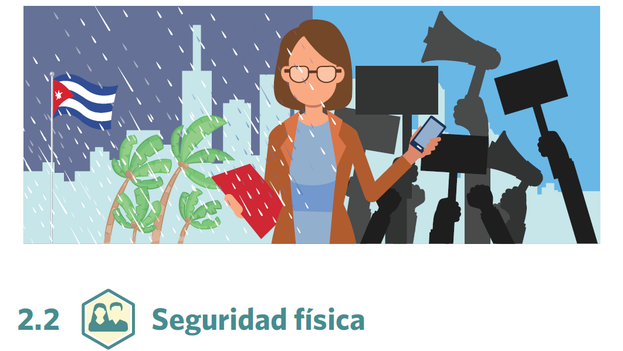
The pages of the manual integrate advice for physical, psychological, digital and legal security, and also suggestions on how to act in times of danger. “The objective of the manual is to strengthen the capabilities of prevention, self-protection and security while exercising any information activity on the island,” say its editors, to which must also be added that it is a manual marked by awareness of civic matters and journalistic ethics.

The pages of the manual integrate advice for physical, psychological, digital and legal security, and also suggestions on how to act in times of danger

Responding to repression with a greater promotion of transparency and more professional work are some of the practices promoted by the 112-page document. This is a real challenge to a government that prefers to have “a mute, deaf and blind country,” as the Inter-American Press Association (IAPA) denounced at its meeting in Colombia in July.

In a society living under hyper-vigilance, with State Security increasingly dedicated to computer espionage, it is worth reminding reporters that they should never “leave notes or information from sources” nor fail to use encryption applications, which encrypt the messages from the moment of sending, as explained in great detail in the manual.

The flexibility when it comes time to adjust the advice, according to the subject on which the journalist is working or the characteristics of each medium, is also inscribed among the virtues of this volume. Its capacity for amendment can be infinite given the new challenges faced by reporters every day, which is why the IWPR insists on keeping the content “alive, subject to changes as the context changes.”

Beyond the recommendations for the safeguarding of the journalist, the media and the information collected, the text also becomes a glossary of the most common vulnerabilities suffered by the press in Cuba. A list to be taken into account at times when pressure is being applied from various sectors to have a Press Law in the country.

The fact that the manual was published soon after the end of the Congress of the Cuban Journalists Union, also helps to check it against the statements made in that conclave by professionals linked to official media, in which they demanded more access to institutional sources and better salaries. These demands stand in contrast to those of the independent sector, which is not even legally recognized that suffers from frequent arbitrary detentions and confiscations of tools of the trade.

It would be worth the effort for the editors to review some technological tips, such as the recommended use of WhatsApp in the Cuban context

It would be worth the effort for the editors to review some technological tips, such as the recommended use of WhatsApp in the Cuban context. The tool, very popular in other nations, faces several obstacles on the Island that don’t recommend it for journalism. With forced and data-heavy updates, it performs far below what Telegram can offer national users.

On the one hand, using the desktop version of WhatsApp requires a connection to the internet via mobile phone, something very difficult to achieve for those in Cuba who use a single browsing account in the public Wi-Fi zones. Telegram Desktop, meanwhile, can be used independently of cellular, which, together with the possibility of editing the messages after sending them, makes it more recommended for the press.

It is no wonder that Telegram has come to be called the messaging service of “the dissidents and the persecuted.” An added bonus is that it does not belong to Facebook, like WhatsApp, which was purchased by the social network giant. Mark Zuckerberg’s company has been shown to have serious vulnerabilities in terms of management of its clients’ data, while Telegram shows a greater commitment to security, and for this reason it has been blocked in Russia, where it was created.

Although the manual is intended for the Cuban press beyond the control of the Communist Party, many of the advice included in its pages can also serve those who work in media authorized and financed by the authorities. Even this media must be required reading for foreign correspondents living in Cuba, who are not exempt from surveillance and punishment for their work.

The manual closes with the text of Law 88, also known as the Gag Law, under which 75 activists were tried in 2003, in what came to be called the Black Spring. At least a third of the accused activists exercised independent journalism. A shocking epilogue that recalls that, despite the advice and recommendations regarding security, an independent Cuban reporter is at the mercy of the repressive caprice of the regime.

_________________________

The 14ymedio team is committed to serious journalism that reflects the reality of deep Cuba. Thank you for joining us on this long road. We invite you to continue supporting us, but this time by becoming a member of 14ymedio. Together we can continue to transform journalism in Cuba.

ETECSA Performs Another Test of Mobile Internet but Limits it to 70 Megabytes per User

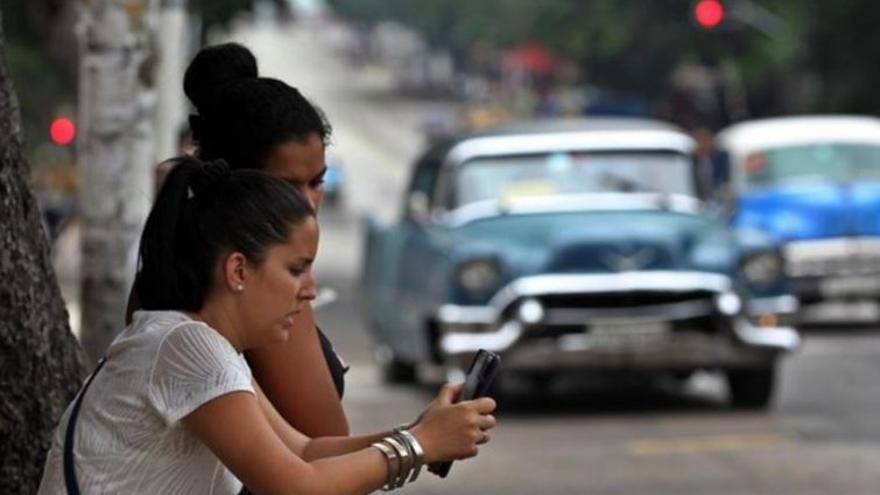
Two women connecting to the state WIFI network. (EFE)

14ymedio bigger14ymedio, Havana, 22 August 2018 – The Telecommunications Company of Cuba (ETECSA), this Wednesday, is carrying out another test of Internet browsing on mobile phones but, unlike the prior one that was unlimited, this time users can only consume one package of 70 non-renewable megabytes, according to the state monopoly.

From eight in the morning until midnight today, customers have “access to the Internet for prepaid cellular services,” a statement from ETECSA indicated. “During the period of time foreseen for the test, it may be partially or complete stopped depending on the behavior of the network and the adjustments of technical parameters that are being evaluated,” the text adds.

In the first test, this past week, customers complained about the excessive slowness of web browsing from mobile phones, the constant crashes and the lack of prior notification. continue reading

The company clarifies on this occasion that “those customers who use email from their cell phones should consider that their use of the email will count against any remaining limits in their active accounts.”

The connection this Wednesday has been marked by slowness, frequent loss of the data signal and congestion in the service, despite the fact that, like the prior test, a pre-announcement was not made in the national media. Users can barely check their email accounts, use chat services and social networks such as Telegram or Facebook but are unable to play videos online or download applications.

On August 14 ETECSA ran the first public test of internet access from mobile phones, which includes some 800,000 users. The prices for connecting at public wifi points (equivalent to one dollar per hour) and in homes (between 15 and 70 dollars for a 30-hour package) are still very expensive for Cubans, whose salaries average the equivalent of 30 dollars a month.

Results of an internet “Speed Test” during Etecsa’s test on Wednesday of internet-by-mobile connections. (14ymedio)

As information about the test spread and a larger number of people  began using the data package, the connection became slower and access to the MiCubacel portal became almost impossible. “In the middle of the morning I was able to download a small app from the Google Play store but after noon I couldn’t even open my Gmail account,” lamented Brandon, a 17-year-old who found out because a friend called him from Trinidad and Tobago to tell him that he had read about the test on the internet.

Some users in Sancti Spíritus told this newspaper that they had been able to make video calls through the IMO in the morning and others in Havana also confirmed the information although “with avery low quality image.”

The 70 megabyte package can be acquired by dialing *133 #, then following the menu and selecting the appropriate option number: Data (1), Daily Use (2) and Send (1) and also by accessing the MiCubacel portal (https://mi.cubacel.net) after registering as a user.

Translated by Wilfredo Díaz Echevarria

________________________

The 14ymedio team is committed to serious journalism that reflects the reality of deep Cuba. Thank you for joining us on this long road. We invite you to continue supporting us, but this time by becoming a member of 14ymedio. Together we can continue to transform journalism in Cuba.

The Sickle and Cup

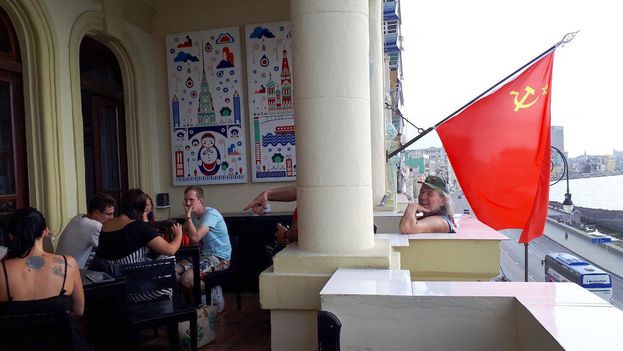
The old Hammer and Sickle flag waves over a bar Havana

14ymedio bigger14ymedio, Marcelo Hernández, Havana | August 14, 2018 — While the word “communism” leaves the Constitution by the back door, in Cuba, Soviet nostalgia feeds all types of businesses. Around Plaza de Armas in Havana, various old people offer old medals obtained in the Soviet Union and small replicas of busts of Lenin that once decorated the offices of civil servants.

On Avenida del Malecón a private restaurant has been converted into an obligatory pilgrimage site for those who want to remember the years when the Russian bear embraced the island so strongly.

The privately-owned restaurant Nazdarovie sets out to offer its clients the experience of a journey through time, its walls decorated with matrioshkas, smiling workers from the extinct Eastern Bloc, and optimistic-looking kolkhozniks (Soviet collective farmers).

A drinks menu at the “Sickle and Cup” — reflected in the logo — in Havana (14ymedio)

Founded by a Cuban who studied in the now-extinct country of the Soviets, the place combines, along with shots of vodka and a Russian menu, an iconography that at moments provokes laughter. Like the happy mix of the sickle with a glass of wine, which replaces the hammer in the emblem of the worldwide proletariat with something more hedonistic and fun.

On the spacious terrace, with the sea right in front, a red flag flutters to the satisfaction of utopians and to the amusement of passersby. Some come to take a photo with it, like a last bastion of the communist system that they once attempted to build in Cuba and that ended up defeated by the demands of the market, foreign currency, and the tourism of nostalgic ideologues.

______________________

The 14ymedio team is committed to serious journalism that reflects the reality of deep Cuba. Thank you for joining us on this long road. We invite you to continue supporting us, but this time by becoming a member of 14ymedio. Together we can continue to transform journalism in Cuba.

With Fewer Personnel in Havana, the US Loses its Capacity to Follow Cuban Affairs

The annual processing of 20,000 migrant visas for Cubans, by virtue of an agreement signed in 1994, will not be reached this year due to the lack of personnel, according to a report from Congress.

14ymedio bigger14ymedio, Havana, 23 August 2018 — María Medina, a student from Pinar del Río, had the luck to be a minor when she discovered that she had been robbed of her Green Card, as well as her Cuban passport, as she got ready to board a plane to return to Miami, where she lives.

Since she is only 16 her case is considered urgent by US consular authorities and she can apply for a new document without leaving the island, according to the TV channel Telemundo 51, which reported that her parents have already flown from Florida with the necessary papers to verify her identity.

The young woman’s luck is very different from that of thousands of Cubans who need to travel to third countries to obtain a visa after the diplomatic distancing between Washington and Havana as a result of the mysterious “sonic attacks” against American diplomats on the island that brought drastic cuts to American diplomatic personnel. continue reading

The difficulties in covering the demand for consular services faced by the few American officials remaining in Havana are reflected in a recent report published by the US Congress.

“The capacity of the United States to follow the situation in Cuba, defend human rights, carry out consular activities, and comply with the bilateral agreements is being undermined by a drastic reduction of personnel in the Embassy in Havana,” states Reuters, which cites the report.

The document, issued by the Congressional Research Service, affirms that the decision to reduce the number of diplomats on the island from 50 to a maximum of 18 due to the mysterious ailments that affected 26 American officials and 10 Canadian officials since 2016, means that the work that needs to be done exceeds the capacity of the officials who remain on the island.

“Because of the reduction of personnel, American officials maintain that employees often have to carry out two or three different tasks in terms of responsibilities,” reads the report, which maintains that the processing of humanitarian and diplomatic visas continues to be guaranteed on the island.

The complicated situation in the American consulate seemed to worsen this month when the US State Department announced that the limited personnel still on the island will remain in Cuba for only a year instead of two, as they were assured at first. “This makes the continuity of operations and familiarity with the work in Cuba difficult,” claims the report.

According to Reuters, citing the official report, not one refugee visa has been processed so far this year, now that the office charged with doing so is closed, while last year it processed a total of 177 visas of this kind, often granted to citizens who claim to be persecuted by their governments.

The annual processing of 20,000 Cuban migrant visas, by virtue of an agreement signed in 1994, will not be reached this year due to the lack of personnel, according to the report.

In part this is because the applicants must travel to Guyana to carry out the process, a situation that the Trump Administration affirms will not change until the issue of the mysterious attacks on the diplomats has been solved.

____________________________

The 14ymedio team is committed to serious journalism that reflects the reality of deep Cuba. Thank you for joining us on this long road. We invite you to continue supporting us, but this time by becoming a member of 14ymedio. Together we can continue to transform journalism in Cuba.

Pushing, Hitting, and Screaming to Get a ‘Malta’ at the Holguin’s Children’s Carnival

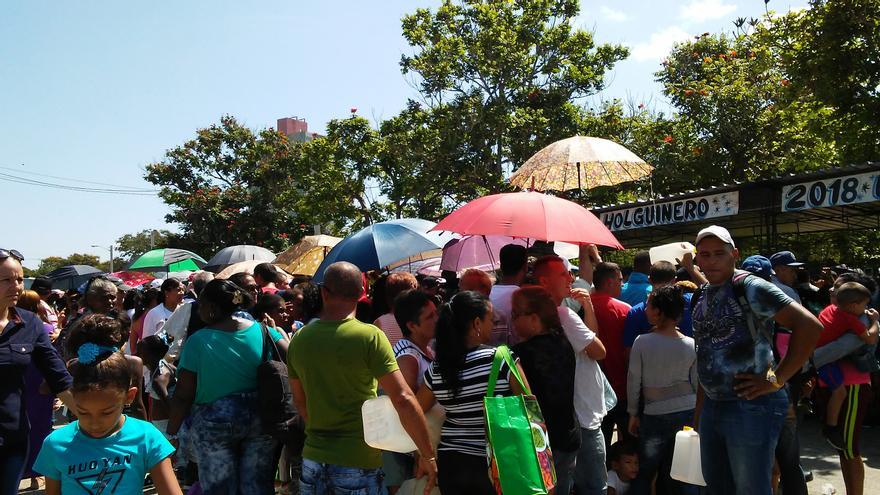
Dozens of people wait in line in Holguín to buy sweets subsidized by the State (14ymedio)

14ymedio bigger14ymedio, Leonardo del Valle, Holguín | August 13, 2018 — Marlon was restless for a week, asking his parents every night when Sunday would come. Only seven years old, this young holguinero’s hope was to bounce on the inflatables, eat all kinds of sweets, and drink malta, that alcohol-free beer so well loved in Cuba, which has turned into a privilege.

The Children’s Carnival, held this Sunday in the provincial capital of Holguín, was intended to allow children to buy sweets at subsidized prices and enjoy different attractions, but the few products offered and the poor management by the State spoiled the event.

“This year the children’s package includes a packet of sugar wafers, one of Pelly candies and another of lollipops, an africana (cookie covered in chocolate) and a dessert,” Yanet, Marlon’s mother, tells 14ymedio. The packet costs 20 pesos, a privilege considering the rise in price of sweets. continue reading

Also available for purchase at the Children’s Carnival were cookies, candies, ice cream, and malta, all at rationed prices.

“More than a festival, this is a real disappointment for the children and especially for one, to see them cry because despite having the money it’s impossible to buy one of the cheapest items for sale. Who is going to enter that bloodbath to buy a package?” sighs Yanet.

The lines to buy the packages of sweets had to be managed by the police because of the tumult. At the points of sale, survival of the fittest was the rule. Pushing, hitting, screaming, to buy some sweets. All of this under an unrelenting sun. “The price of these products in malls is much higher. There’s no way that we can buy them. This is the only chance for our children to enjoy them,” comments a mother.

Puppets, carnival troupes, and all kinds of State-planned activities were seen this Sunday in Holguín

Malta, for example, which is produced in Holguín, has a subsidized price of 3 pesos in national currency. In malls a can of malta sells for 0.65 CUC (about 14 pesos), but it’s almost never available because private stores buy them and resell them for 1 CUC.

“There have been people here since last night to buy malta. They are practically the owners of the lines and they are selling their places in line,” says Marelis Garcés, at the front of the line for malta. “A bottle that costs 3 pesos here can later sell for 30-35 pesos. Every year it’s the same,” the woman laments.

For Luis Ernesto, the number of points of sale was fewer this year. “The problem is that this is almost never available during the year, and when they put it on sale, fights break out,” he said.

At the Children’s Carnival there were also cookies, candies, ice cream, and malta available for sale, all with rationed prices.

Children were greeted with floats and children’s carnival troupes as spectacles and fun games administered by self-employed people. The public complained about the prices, which are high because they are not subsidized by the State.

Local press outlets echoed the poor quality of the costumes of the carnival troupes. According to a report from the weekly Ahora!, the fabric that the State gave for this activity was some they were unable to sell because it was so unattractive. Every year fewer people want to participate in the troupes because the pay is so low, reported the local press.

The Children’s Carnival is a prelude to the festivities that will begin this Tuesday. The authorities has already announced that they will sell beer on tap in Los Chinos, El Estadio, the suburb Pedro Díaz Coello and Plaza Camilo Cienfuegos.

This Sunday, a little after ten in the morning, practically nothing remained for sale from what the State was offering at the Children’s Carnival. On the way home to the suburb of Vista Alegre, Yanet bought Marlon an imported malta in a mall. A few meters away, a reseller offered a packet of cookies for 15 pesos, 5 more than the original price, the same ones that ran out a few hours earlier at the State-owned points of sale.

_________________

The 14ymedio team is committed to serious journalism that reflects the reality of deep Cuba. Thank you for joining us on this long road. We invite you to continue supporting us, but this time by becoming a member of 14ymedio. Together we can continue to transform journalism in Cuba.

Manipulation and Shamelessness in the Decline of a Dying Man / Somos+

If the republic doesn’t open its arms to everyone and move forward with everyone, the republic dies. José Martí

Somos+,Lcdo. Adalberto R Mesa Duarte, 22 August 2018 — I believe that if the Cuban people felt consciously free to express what they have kept in for sixty years, Raúl Castro and his “Always Unanimous National Assembly” would resign en masse from such a serious responsibility.

In a real democracy, “cooption” cannot be an option. So I ask: Why keep doing the same thing? … How is it possible that the Constitution of 1940, one of the most advanced legal documents of its time, and whose application could extend to even today, needed to be destroyed in 1976, only to subsequently and repeatedly modify it to the whims of the eternal censor, to the point that its original idea has disappeared?

The answer is very simple: to guarantee that an entire class remain in power! That in the style of the most classic dictators, to dazzle some, and to subdue, arrest, or murder others, only to subdue an entire people in the name of liberty. continue reading

The Constitution of 1940, and the democratic system of government that it established, was violated by “Commander Censor” and his Revolution long before his arrival in Havana in 1959. Any debate in this direction turns into a broad and justified questioning of each one of the rules that over time were introduced to the Constitution, and which objectively blinded and made impossible a popular response that could turn back the social unhappiness that hovered over the people and in the end caused the stagnation of the society that we live in.

Six decades have been more than enough for Cuban society to become resigned to sadness, fears, and the inability to carry out by themselves significant contributions to the development of the nation. For example, we can take as a reference socially blameworthy situations, in which the personal interests of the Dictator took precedence above those of the Cuban people, and in those in which it is obvious that the word “PEOPLE” is only used to manipulate and thereby justify absurd ambitions. A total analysis of the constitution’s rules would be interesting, but too extensive for this occasion.

From the Constitution of 1940, Article 10, I cite: “The citizen has the right. Subsection a) To live in his homeland without being an object of discrimination or any kind of extortion, no matter his race, class, ‘political opinions’, or religious beliefs.” End of citation.

In the Constitution of 1976, in Chapter VI Equality, Article 42, I cite: “Discrimination because of race, skin color, sex, national origin, religious beliefs, and any other reason prejudicial to human dignity is forbidden and sanctioned by the law.” End of citation.

So, for what reason does the “Censor in Chief” curiously leave out, in the Constitution of 1976, the reason of discrimination for “political opinions?”

I have here one of the answers: In daily practice, it is certain that in Cuba, any person that is discriminated against for reasons of race, skin color, sex, national origin, religious beliefs, or any other reason prejudicial to human dignity, is relatively protected by the State, only that the wronged person must have one condition: that the person discriminated against must be a revolutionary, or at least keep a low profile sufficiently in line with revolutionary doctrine! Or rather: keep your head down and don’t protest!

Everyone knows that in any other case, the actions of the district attorney, the courts, and the Ministry of the Interior turn out overwhelmingly differently, because to think and have different opinions in Cuba is an obvious sentence to live in disgrace, submission, and institutional neglect.

Perhaps it’s necessary to keep trusting this government only because it has given “free” education and health to the people? The people also have a right to the fundamental freedoms that were eliminated as of 1959!

I believe that before taking part and voting mechanically to legitimize by referendum the Project of the Constitution proposed by Raúl Castro and his dictatorship, Cuban society must be made aware of the answers to many of the questions that I raise here, otherwise we will continue with the “boot of oppression above our heads.”

In the Constitution of 1940, I repeat, were implemented many of the guarantees that today the Cuban people lack, so they were intentionally eliminated, in order to perpetuate totalitarianism as a fundamental element of direction and social submission, and so it is appropriate now to ask:

  • Why does the government of the Republic of Cuba, which boasts of the total support of the people, need to establish and shield the ruling role of the Communist Party at the head of Cuban society, without submitting it to a review, vote, and approval of the people? All told, and so it is well understood: the party is even above the Constitution itself!
  • Why was the Court of Constitutional Guarantees abolished? Everyone knows that the district attorney neither guarantees nor respond tos with total transparency the claims of human rights violations on the part of the Ministry of the Interior, including those that are endorsed in the Constitution of 1976 itself and the subsequent reforms.
  • What rights, for example, does the citizen have when his property or personal goods are confiscated by the police or the Department of State Security? In the legal framework of 1940, the judicial authority was the entity that determined what would proceed. Today it is carried out by a simple civil servant and on many occasions the act of confiscation isn’t even reflected on the record. And in this case: don’t even ask!
  • Why is the principle of the presumption of innocence not observed? In Cuba a citizen is detained… Even for being ugly! …It is enough that the State presumes that a person could commit a crime for him to be imprisoned. He is detained and then they investigate…
  • Why are the registries of detained and imprisoned people not public? There are many examples in which this vital information was denied to family members and/or interested parties, even after days have passed. And sometimes the aforementioned information isn’t even offered.
  • Why are prisoners and people detained for political motives locked up along with people imprisoned for common crimes? There are many well-documented reports of cases where they have received beatings from “some revolutionary prisoners or detainees”…
  • Why are Cubans restricted or prohibited from living in places or territories of the country, and including: why are they exiled inside of their own homeland? Example: In the capital*…
  • Why are Cuban citizens denied entry to their own country, or why are they prohibited from leaving without giving reasons to justify themselves?
  • Why are citizens with political opinions opposed to the regime objects of repression and censorship? Where is freedom of expression? Why are they even denied the right to work?
  • Why is it a crime to associate or gather peacefully without weapons, why is marching or gathering for all the aims of life, without any more restriction than is necessary to guarantee public order, a repressible act?
  • Why is any act which would limit or prohibit the citizen from participating in the political life of the nation not made punishable? Why is any form of coercion to force a citizen to affiliate, vote, or demonstrate against his will in any electoral operation not sanctioned?
  • Why is the free formation of associations and/or political parties of different ideological tendencies, with adaptation to the laws, not permitted?
  • Why is the President of the Republic not elected by means of universal suffrage of the people, by way of a direct and secret vote? And why isn’t he limited to serve for a term of four years with the possibility of a single reelection?
  • Why doesn’t the diaspora have the right to vote, while it already totals nearly three million Cubans? These people have even been stripped of the right to live in their own country.
  • Why is the man who considers himself the king of this country, and not the citizens of the land, the only one who proposes reforms to the Constitution?

In my modest opinion, the only legal and non-violent way to stop this farce is with the vote of all the people of Cuba, and if the government of Raúl Castro wishes to demonstrate a truly democratic opening, it must observe a tangible transparency, it must go without the accustomed manipulations of public opinion, and additionally it must permit the attendance of international observers, and as is logical, it must include the popular consultation, that is the votes, of all the Cuban exiles. In any other case, it will just be another excluding and biased Constitution.

The Constitution of 1940 was massacred by Fidel and Raúl Castro, and if the majority of its precepts that were eliminated are not restored, Cuban society will continue to be subjugated by resignation, fear, and oppression. Sixty years of this “Royal Monopoly – Revolution” is enough to demonstrate that.

Translator’s note: Cubans are not permitted to live in Havana without legally established residency.