Cuba Looks for Investors Ready to Take Risks

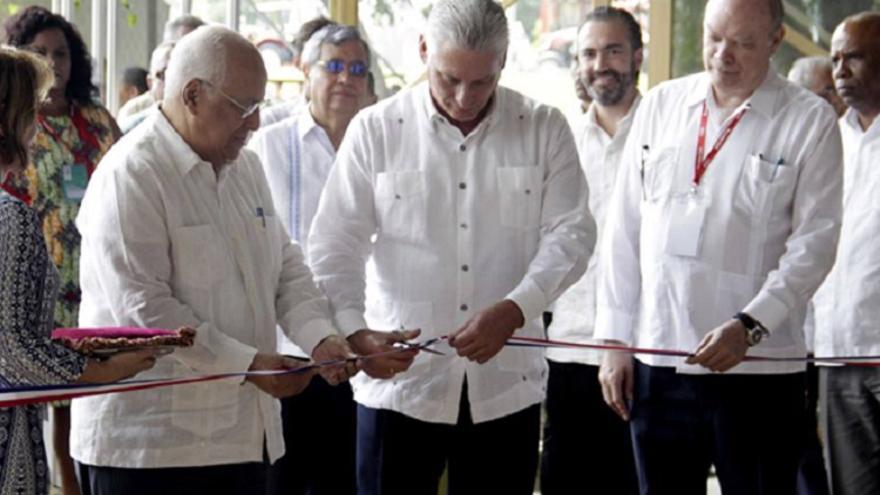
This Monday Díaz-Canel inaugurated the 36th edition of the International Fair of Havana (Fihav). (EFE)

14ymedio bigger14ymedio, Havana, October 30, 2018 — “Now it’s a high-risk investment but I hope that in five years everything changes for the better.” That’s the hope expressed by an Italian businessman who has invested in the Island, stumbling over the habitual difficulties of doing business in Cuba.

“Since I first became interested until I was finally able to start work here, two and a half years passed,” laments the investor who has opted for the sector of hygiene and skincare products. “This isn’t a market for people who come trying to do business quickly, and you have to use the official language very well,” he specifies.

With the 36th edition of the International Fair of Havana (Fihav), the authorities want to present the image of a country open to foreign capital in the middle of an especially complicated panorama for the Cuban economy, which faces once again the challenge of attracting a greater number of foreign investors to the Island to solve the liquidity crisis. continue reading

After the approval of a foreign investment law in 2014, businessmen have been very timid and, instead of the $2 billion annually that the Government was expecting, only $1.3 billion had come at the end of 2016.

In 2017 authorities announced that $2.3 billion in investment had come in during that exercise, but not even the arrival of that capital managed to lift up the economy suffering from the cuts in petroleum shipments from Venezuela and the inflated debts with numerous creditors.

The slowness in the approval of investments burdens the arrival of cash, to which is added a complex bureaucracy in which “there are many civil servants of the third or fourth level who don’t decide anything but waste a lot of time,” continues the Italian businessmen who prefered to remain anonymous.

The businessman insists that, right now, the Cuban side owes him “hundreds of thousands of dollars” in late payments, but that he has continued importing merchandise to the Island in the hopes of being able to recoup his money and remain in the country with his sights set on the future.

In an interview with the official press, the Minister of Foreign Business and Investment in Cuba, Rodrigo Malmierca Díaz, insisted on the protection of sovereignty in the policies of investment. “We, nevertheless, are not going to sell the country. We are going to develop this process in agreement with our laws, and with our policies,” he warned.

Malmierca urged that people not despair in face of the slow results of the ZEDM and clarified that “it is conceived for a long-term development” and is “a project for 50 years of development.” His declarations have increased skepticism among Cubans, tired of waiting for the economy to experience an upturn.

The signature work of ex-president Raúl Castro, the Special Zone of Development of Mariel (ZEDM), has also not offered the expected fruits. Until now the place anticipates investments from 15 countries and 37 approved business projects, much less than projected.

The increase in shortages of food, the rise in prices of agricultural products, and the new restrictions for the private sector complicate still further the internal scene of the Island.

Expocuba, created as a showcase in the 80s during the greatest closeness with the Soviet Union, now takes in 2,500 businessmen from more than 60 countries and also the presence of the mandatory Miguel Díaz-Canel, who made the inaugural speech and has developed an intense agenda of meetings with representatives from delegations, among them the Venezuelan Vice President Tareck El Aissami, and Yuri Borisov, Vice Prime Minister of the Russian Federation.

Spain is the most-represented country in Fihav with 112 businesses, 63 of them grouped in the official pavilion, 29 in the Basque country pavilion, and 20-something distributed among the rest of the exposition’s perimeter. The Spanish presence is also accompanied by the recently named ambassador, Juan Fernández Trigo, and in a few days the president of the Spanish government, Pedro Sánchez, will come to the Island.

The Cuban economist Elías Amor, settled in Spain, has a very critical opinion on Fihav. “If the Cuban economy wants to export more, it must forget about parties and fairs and dedicate itself to increase productivity,” he says in his blog Cubaeconomía.

For the specialist, the Island “needs to increase its exports of products if it wants to correct the grave deficit in its external accounts,” but since 2011 the number of sales abroad “has done nothing more than fall” in a nominal drop of 59%.

Amor recommends that to raise exports, Cuba must “produce better and know how to sell what is produced, they have to train the working population, introduce modern technologies, and do things well and not more cheaply.”

The mammoth state socialist business continues dominating the economic landscape of the Island, where the existence of two currencies also slows down many interested in investing. Failure to pay and judicial insecurity are some of the other motives that dissuade foreign businessmen from putting their money in the country.

For the economist Omar Everleny Pérez, more flexible legislation to favor the arrival of foreign capital is not enough, but rather Cuba needs “a new mentality in orientation of the economic policymakers and of the risks that need to be taken for Cuba to join the international circuits of business and investment.”

Recently the Havana Government made a small payment of the third installment of a renegotiated debt of 2.6 billion to 14 countries. The initial amount of 11.1 billion was restructured to be paid until 2033, of which $60 million has already been paid in 2017 and close to 70 in 2018 so far.

Fihav is also developing amidst the debates in neighborhoods and workplaces in which the project of constitutional reform is discussed. One of the most-questioned points in the text has been, exactly, that which doesn’t include nationals among the businessmen who can invest in the Island.

Numerous voices have been raised across the country to demand recognition of the right of Cubans living inside and out of the country to invest in industry, tourism, services, and other key sectors.

Translated by: Sheilagh Carey

_____________________

The 14ymedio team is committed to serious journalism that reflects the reality of deep Cuba. Thank you for joining us on this long road. We invite you to continue supporting us, but this time by becoming a member of 14ymedio. Together we can continue to transform journalism in Cuba.14ymedio bigger

Cuba’s Private Businesses Market Halloween Supplies

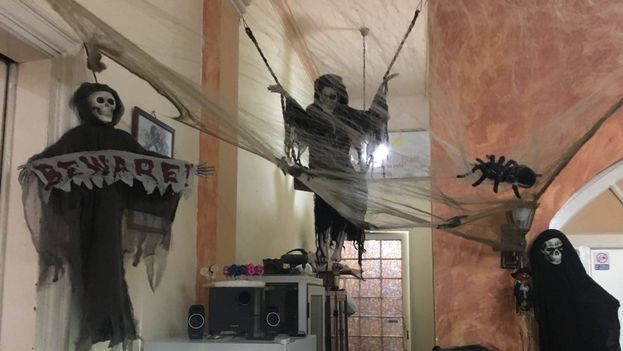
Private business in Cuba sell costumes and decorations for Halloween, includingr masks, fangs, witch hats and wigs. (14ymedio)

14ymedio bigger14ymedio, Havana, 31 October 2018 — For some days now private businesses in Cuba have displayed decorations related to the underworld. Skulls, spider webs, skeletons, ghosts and pumpkins with candles are incorporated into the usual décor in cafes, bars and restaurants.

Tonight Havana’s Avenue of the Presidents, the Malecón and La Rampa, will be filled with vampires, werewolves, witches and zombies parading to observe Halloween, a celebration that more each year sneaks into the list of dates favored by younger Cubans.

Costumes and decorations are almost always improvised and homemade, but others sent from relatives who live abroad and may appear in the Havana night, with scary masks being the most entertaining.

You can also buy costumes from the self-employed who, for this date, offer masks, fangs, witch hats and wigs.

While younger people roam the streets with disguises that sometimes produce chills while others induce laughter, the government appears to be scared of the innocence of these children when they see how this Anglo-Saxon celebration, so celebrated in the United States, triumphs on the Island.

______________________________

The 14ymedio team is committed to serious journalism that reflects the reality of deep Cuba. Thank you for joining us on this long road. We invite you to continue supporting us, but this time by becoming a member of 14ymedio. Together we can continue to transform journalism in Cuba.

LGBTIQ ‘Kiss-In’ Cancelled for Fear of Being Called a ‘Provocation’

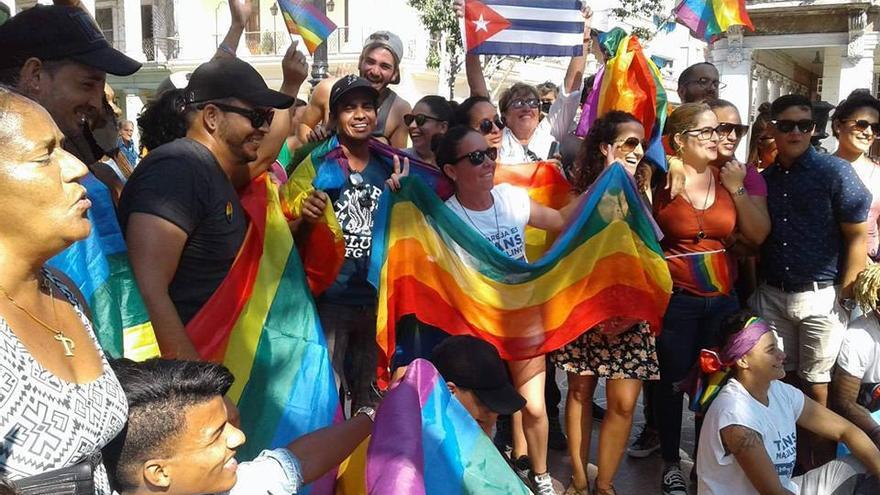
A group of activists gathered at the meeting point despite the cancellation of the event. (Proyecto Abriendo Brechas de Colores)

14ymedio bigger14ymedio, Luz Escobar, Havana, 29 October 2018 — The Proyecto Abriendo Brechas de Colores (Opening Color Gaps Project) was forced to cancel an event that had been promoted to mobilize the LGBTIQ community in favor of equal marriage for fear that it would be considered a provocation and harm “the very project” they are trying to promote.

The call to “Take Your Kisses Out of the Closet” was intended to be a “Kiss-in” on the last Saturdays of October, November and December between 3 and 5 pm at the corner of Prado and the Malecón. The event had already shifted its initial location, which was to be in front of the church at K and 25th, to avoid possible confrontations, but ultimately the organizers gave up on holding the event.

“Our enthusiasm prevented us from foreseeing some circumstances that have materialized along the way in favor and against an action like this,” the organization said in the statement announcing the cancellation. continue reading

“We have spent many years of work, a lot of joy and endless efforts for LGBTIQ people to get to where we are, and experience has shown us that there are battles that it is better to lose to achieve a much bigger future,” the text states.

“We want to kiss, hug, celebrate with pride our identities and share with the whole world how happy we are to see that Cuba advances on the path of justice,” stated the announcement of the planned event which, according to the organizers, was received with great success and shared more than a hundred times leading to about 600 confirmed participants. The event was to have been enlivened, they said, with activities such as a session of photographs of the most creative kisses, a touch of body painting, the handing out of educational materials and a flashmob.

“We did not foresee that an initiative motivated by the pride of seeing Cuba advance in the field of human rights, as well as the determination to combat the ideas that religious fundamentalism is spreading against that just and necessary change, could run up against so many closed doors, as it now has,” says the vague cancellation notice.

“When we changed the meeting point to Prado and the Malecón, we declared that we did not want them to use our action as an excuse to unleash the violence which the religious leaders of some denominations have called for in their preaching, since the beginning of the public consultation [over the text of a revised constitution],” the statement said.

Despite the announcement, around the initially agreed upon time a group of people carrying rainbow flags — mostly those with links to Cenesex, which was not the organizer of the event — danced to the song Música Vital, performed by Buena Fe, Yomil and el Dany and Omara Portuondo.

Jimmy Roque, one of the activists who came to Prado and the Malecón this Saturday despite the cancellation, said that what he saw “was fine, it was nice, they had choreography, they shouted ’Viva Cuba’,” but he regretted that “not a word” had been said.

“Let each one do what he can, it’s fine, but for those things you do not ask for permission, you do it and now, we’re going to do it again, to kiss on the Prado you do not have to ask for permission,” he said.

The Kiss-in was posed as a response to the statements of Alida León, president of the Evangelical League of Cuba, and the Reverend Moisés de Prada who intend to collect 500,000 signatures among their faithful against the inclusion in the new constitution of Article 68, which defines marriage as the union “between two persons.” The religious leaders insist that the concept of marriage “between a man and a woman” be maintained in the text, as it is in the current Constitution. Leon threatened to vote No if the suggested new wording of the article is maintained in the bill to reform the Constitution.

Since last June, posters have appeared in defense of the “original design of the family, as God created it” and against equal marriage on the facades of homes in various provinces of the country and public spaces.

The LGBTIQ community and defenders of the island’s sexual rights also disseminate in social networks their proposal to respond to these campaigns. Posters with more inclusive definitions of the concept of family and promotional videos with the message of “an original design of Cuban families” or “all rights for all families,” are some of the initiatives to promote inclusion.

 ________________________

The 14ymedio team is committed to serious journalism that reflects the reality of deep Cuba. Thank you for joining us on this long road. We invite you to continue supporting us, but this time by becoming a member of 14ymedio. Together we can continue to transform journalism in Cuba.

The Single Party, A Relic That (Almost) Nobody Dares To Denounce In The Constitutional Debate

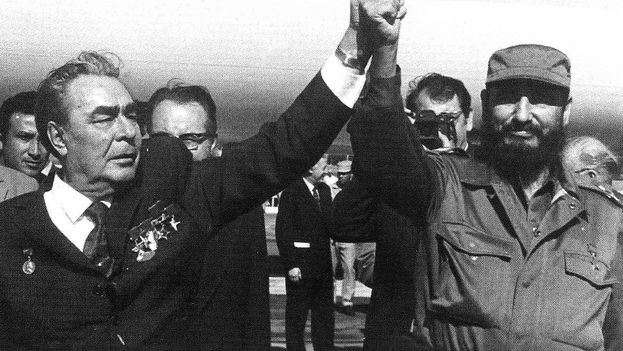
Just nine months after Brezhnev’s visit to Havana, the commission in charge of drafting the draft constitution was created.

14ymedio bigger14ymedio, Reinaldo Escobar, Havana, 25 October 2018 —  Hidden behind the guise of sovereignty and independence, the reality we see is often a model of elements or impositions that come from other latitudes. The reform of the Constitution that is currently being carried out in Cuba is not exempt from these contradictions, presenting as “ours” several points that have been copied from third parties.

One of the most emblematic cases of this mimicry is Article 5 of the current project to reform the Cuban Constitution where the Communist Party of Cuba (PCC) is described as “the leading force of society and of the State.” Although this has been one of the points most rejected by the political opposition, few have dared to question it in public debates.

This definition of the superpower of the PCC in society was introduced in the first version of the draft of the Constitution of 1976, which a commission in charge of its drafting delivered to Fidel Castro on February 24, 1975. That text was approved by the Party’s Politburo in April of that same year, in a context of an ever increasing approach to the Soviet Union. continue reading

The harmony with the Kremlin was reflected in the Constitution that was born, whose main body has survived to this day.

At that time, the text of the article underwent slight modifications from the preliminary draft to the final version. The most striking was the change of the definition of the PCC that went from reading the “organized Marxist-Leninist vanguard of the working class” to reading the “Martian [i.e. modeled on José Martí’s thought and writings] and Marxist-Leninist, organized vanguard of the Cuban nation,” to give it a more local touch that just barely managed to hide its deep foreign essence.

On February 15, 1976, a referendum was held in which more than five million voted, of which only 1% (54,070 people) dared to mark the ’No’ on the ballot. At that time Article 5 was seen by the vast majority of citizens entitled to vote as the formal definition of what everyone accepted as an accomplished fact, which was not worth trying to refute.

The failure of the 10 Million Ton sugar harvest, the collapse of the national economy and the visit of Leonid Brezhnev to the island in 1974 had cemented the Russian bear’s all-encompassing embrace around the Cuban model. That approach resulted in the sending of huge resources from the USSR to Cuba, but with the obligation on the part of the island’s nomenklatura to create structures and models of management and administration clearly compatible with the USSR.

The alignment with the Kremlin was reflected in the Constitution that was born, whose main body has survived to this day and is still present in several of the articles discussed in neighborhoods and workplaces.

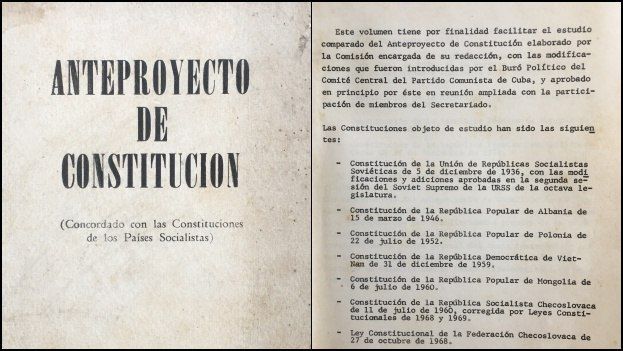
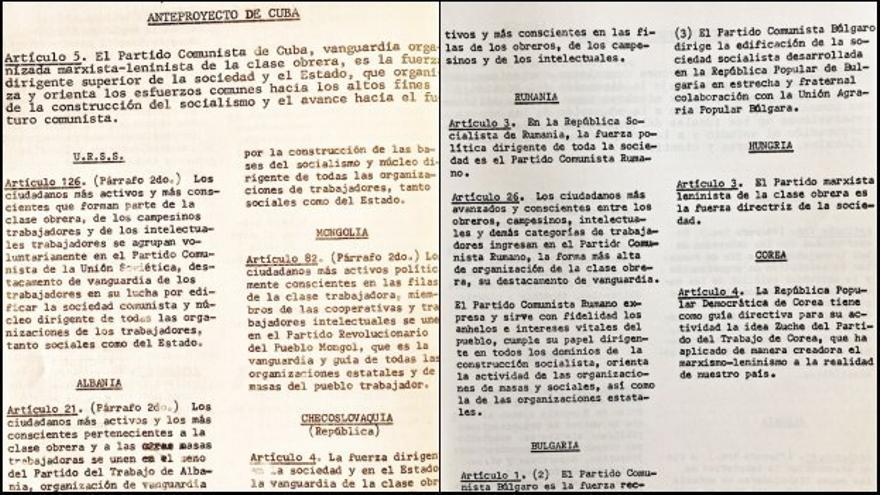
A brochure internally circulated to Party cadres, published in limited edition in April 1975, clearly showed the elements that allow a comparative study between the articles.

That “copy and paste” was not a secret to anyone and a brochure internally circulated to Party cadres, published in limited edition in April 1975, clearly showed the elements that allow a comparative study between the articles proposed in the Cuban draft and other constitutions of various countries of what was then called “the socialist camp.”

The comparative study passed out among Party militants explained the affinities between the nascent Cuban Constitution and its close cousins in the Soviet Union, Albania, Poland, Vietnam, Mongolia, Czechoslovakia, Romania, the German Democratic Republic, Bulgaria, Hungary and North Korea. At that time Cuba did not consider China a socialist country and it did not enjoy the favor of the Plaza of the Revolution, so it was not included in the volume.

The concordance of article 5 of the Cuban Constitution with the definitions that appear in the laws of these countries reflects the conceptual similarity in expressing, in more or less the same words, that the entity in command in the country is none other than the party of the communists.

The Cuban model thus adopted a tight corset which contrasted with the first 16 years after 1959, when the country lacked an adequate Constitution to govern it. The Party began to organize its first congress and only nine months after Brezhnev’s visit to Havana, the commission in charge of writing the draft constitution was created, presided over by Blas Roca, a man who enjoyed the confidence of Moscow.

With the presence of Roca at the head of the task, the similarities between the Cuban Constitution and its Eastern European twins were assured. Creole traditions in constitutional issues were reduced to nothingness and the previously highly weighted sovereignty was diminished to the condition of symbol.

Today, the only country on the list with which Cuba maintains a constitutional agreement is North Korea. The rest have left in the past the pretensions of the compulsory leadership of the Communist Party. The articles that shielded the system did not do much to stop the democratizing thrust that those nations experienced.  And when those nations’ constitutions wanted to stop reality they were, simply, repealed.

However, the proposal of Cuban constitutional reform, instead of looking for similarities with the democratic laws of Latin American countries based on the competitiveness of different political parties, continues to cling to the idea of imposing by law the prevalence of a single party. It is tied to precepts that have already demonstrated their failure.

Bad copies bring worse results and this case will not be the exception.

__________________________________

The 14ymedio team is committed to serious journalism that reflects the reality of deep Cuba. Thank you for joining us on this long road. We invite you to continue supporting us, but this time by becoming a member of 14ymedio. Together we can continue to transform journalism in Cuba.

An Article That Does Not Belong in a Constitution / Fernando Damaso

Fernando Dámaso — Article 3 of the draft Constitution states: “The defense of the socialist homeland is the greatest honor and supreme duty of every Cuban.”

The Homeland, with a capital letter, is one for all Cubans, both for insiders and outsiders, regardless of how they think. It has never been ascribed. Céspedes, Agramonte, Maceo, Gómez and Martí did not refer to it as a revolutionary or independence homeland.

In the times of the Republic there was no liberal, conservative, or authentic, orthodox, or capitalist country, or anything like that. Nor does there exist a socialist Homeland. The Homeland is above all ideologies and all economic, political and social systems. The applied adjective is a manipulation used by totalitarian regimes. Here we have enjoyed others: socialist democracy, human rights that we defend, patriotic civil society, et cetera. In this case, it is an imposition. continue reading

On another point, Article 3 raises the absurd and unnatural demand that the established system is “irrevocable,” a “straitjacket” directed against future generations, who do not have to respect or comply with what is decided here, but will decide on their own, according to the situation that they live in.

As if all this were not enough, it states that “Citizens have the right to fight by all means, including armed struggle, when no other recourse is possible, against anyone who attempts to overthrow the political, social and economic order established by this Constitution.”

It is ironic that those who overthrew the order established by the 1940 Constitution, having promised that they would enforce it and respect it, try, with a warlike spirit, to prevent that event from repeating itself when new Cubans decide to do so. It is good to remember that, as recent history shows, failed regimes fall by the weight of their errors and incompetence.

This article seems more to be part of a doctrinal document of the Communist Party than of a Constitution, both in its content and its form.

These impositions and arbitrary demands, unfortunately, not only appear in Article 3, but are disseminated throughout the entire constitutional project, product of the simplistic and dogmatic vision of society, under which it has been developed. A document with these characteristics is born sentenced to enjoy a short life.

Higher Salaries Equal Higher Production / Fernando Dámaso

Fernando Damaso, Havana, 26 October 2018 — According to some economists, the minimum wage in Cuba today, in order to keep up with the high cost of living, should exceed 1,200 CUP* per month (the equivalent of 50 CUC*, or roughly $50 US), well above its current level. This amount does not take into account one’s desires, repairs or improving one’s housing, for which it would be insufficient. We are talking about a subsistence minimum wage, where the citizen would have about 40 CUP per day (the equivalent of 1.55 CUC).

With regard to salaries, for years, government authorities have adopted the absurd principle that, in order to increase it, they must first increase production. This principle, internationally dismissed as wrong, is intended to remain irrevocable, when it is more than proven that an increase in wages is what leads to the increase of production, and the increase of in production, in turn, develops the market and increases consumption (with the wages earned by citizens), forcing a greater increase in production. continue reading

The link between wages-production-markets-consumption is the one that can help to cut the “Gordian knot” of our economy although, for now, it is clear that no one dares to do so, because political interests predominate over economic interests.

This economic anomaly, together with many other absurdities, imposed on Cuban society, has discouraged citizens’ initiative and the development of more efficient and modern forms of production. Meanwhile, the authorities, rather than solving the great problems they have created, concern themselves with prosecuting and punishing everything that demonstrates the economic inefficiency of socialism: the lack of productivity, the low quality of the goods produces, theft, corruption, embezzlement, losses and constant failures that characterizes it. It is the story of the “tree that is born crooked and its trunk never straightens.”

Meanwhile, our pro-government economists continue to invent formulas, ignoring the many successful experiences applied by different countries around the world.

*Translator’s note: Cuba has two official currencies, the Cuban Peso (CUP) and the Cuban Convertible Peso (CUC), with the latter being worth 25 times more than the former.  Most wages are paid in CUP but many products are only sold in CUC. The rationing system, it is generally agreed, only provides enough food — at extremely low prices but of limited types — for about 10 days per month.

Bolsonaro and the Shadow of Lula

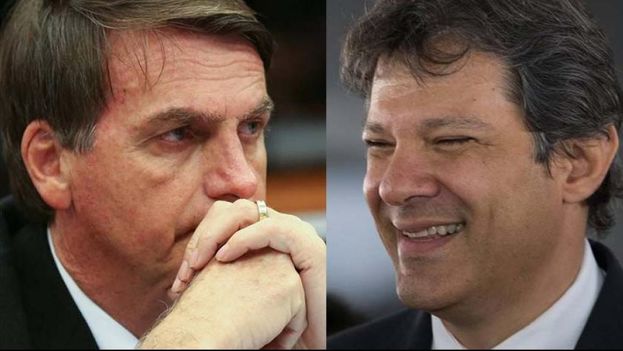
In the second round this Sunday, Haddad (right) could pay for the corruption linked to Lula, who has been his mentor, to the benefit of the extremist Bolsonaro (left).

14ymedio bigger14ymedio, Yoani Sanchez, Generation Y, Havana, 26 October 2018 — If everything goes as the polls predict, on October 28 the far right Jair Bolsonaro could win in the second round of the Brazilian presidential elections.

This possible victory would be underpinned not only by the weariness of a large part of the population in the face of corruption and the inefficiency of the political class, but also by the dead weight that his closeness with Luiz Inácio Lula da Silva has represented for the candidate Fernando Haddad.

While Bolsonaro fulminates against everyone, crusades against whomever and, like a chameleon, has toned down his speech to some degree in recent weeks, Fernando Haddad is linked to a fidelity with Lula which, right now, is his principal burden. From the presidential candidate of the Workers’ Party (PT), the shadow of the mistakes made by the former president, now in prison, and also by his successor Dilma Rousseff, colors everything. continue reading

Bolsonaro, with his nostalgia for the military dictatorship, has undertaken a slight turn towards the center to appease fears and win a greater number of voters among those areas of Brazilian society who resisted, until recently, to mark his name on their ballots. Their ranks grow every day, however, as people opposed to the PT are willing to punish at the polls the management of a group that began with promises to make a new kind of politics and ended up muddied in the miasma of corruption, patronage, influence peddling and ideological bullying.

Haddad, trapped by his proximity to his mentor, is unable to launch criticisms against the previous administrations of the PT, to promise a radical change with respect to his predecessors or to renege on the figure who has elevated him to these presidential elections. The pulling of strings that control Haddad from the Curitiba prison are too evident and the suspicion that once he rises to the Planalto Palace he could decree an amnesty that would free Lula dissuades many from supporting him.

In Brazil, not only is a new president being elected. If the citizens give the nod to Bolsonaro they would also inflict a devastating blow on the most authoritarian left which, two decades ago, began its ascent to the highest positions in numerous nations in Latin America. That era in which Lula posed in a family photo with Cristina Fernandez de Kirchner, Hugo Chavez, Evo Morales, Daniel Ortega, Raul Castro, Rafael Correa and many others, is about to receive the coup de grace at the ballot boxes of Brazil.

The problem is what will come next. When the punishment vote passes to spite the PT, it will be defeated. Can Bolsonaro moderate his behavior and govern for all Brazilians? Will he banish from his discourse the exclusions and dogmatism he has promoted to prevent society from becoming further polarized? Will he be able to give the country back its once thriving economy and lower unemployment? Will his mandate contribute to new Latin American alliances more focused on the welfare of the people than on the ideologies?

The answer to all those questions is a big question. Analysts have not ceased to sound the alarm about what can happen with a man so unpredictable and extremist in the presidency. Whatever happens, much of the responsibility falls on Lula’s shoulders.

This text was originally published by Deustche Welle’s Latin America page.

_________________________

The 14ymedio team is committed to serious journalism that reflects the reality of deep Cuba. Thank you for joining us on this long road. We invite you to continue supporting us, but this time by becoming a member of 14ymedio. Together we can continue to transform journalism in Cuba.

Migration Crisis: Authentic Caravan or Managed Maneuver?

Honduran immigrants charging the first security border gate by force and entering Mexican soil. Internet photo.

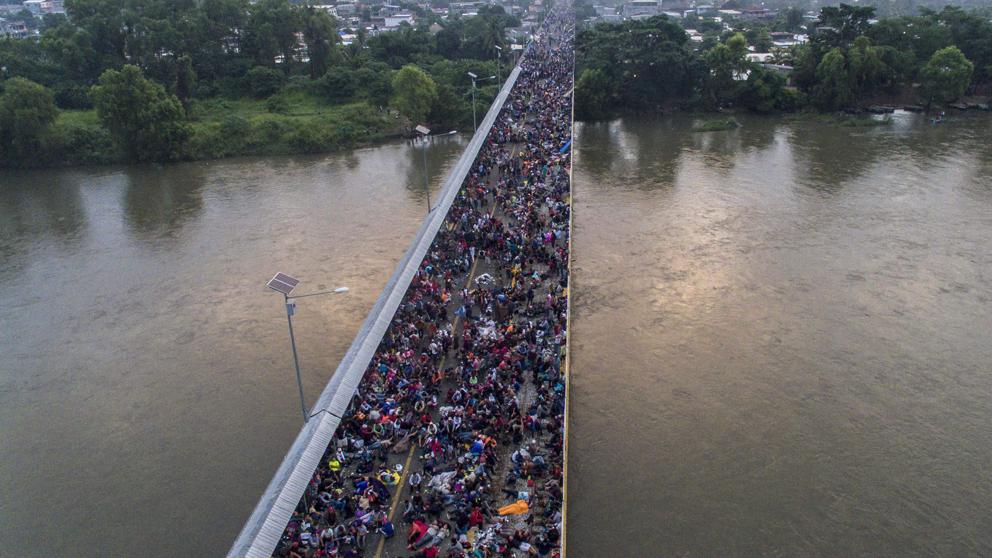
Cubanet, Miriam Celaya, Havana, 24 October 2018 — The new Central America migratory wave that has resulted these days in violent actions at the Mexican southern border, where the migrants forced the official fence and invaded that country’s territory by force, is monopolizing the media’s attention and threatens to become the new crisis point of the already complex relations between the US and its southern neighbors.

This Monday, October 22nd, the US President has considered the advance of the migratory caravan as a “national emergency” and has warned about the possible use of armed forces, if necessary, to prevent the passage of illegal immigrants into US soil.

Simultaneously, as a response to the passivity of the governments of the region, which have not stopped the migrant movement, the US president has also announced, through his Twitter account, a cut or substantial reduction of the aid that Washington allocates to Honduras, El Salvador and Guatemala. continue reading

Meanwhile, social networks are a hotbed of debate these days, most of them moved by prevailing emotions. No one seems indifferent to the images of men, women and young children crossing vast distances, dragged into the uncertain adventure of a journey full of risks and hardships that is a hard experience even for any young adult. The fear reflected in the innocent faces, helpless victims of both the misery of their lives in their countries of origin and the manipulations of unscrupulous politicians and their parents’ irresponsibility, is truly moving.

And in the absence of coherent explanations or sufficiently verified information in the meantime, there has been growing speculation about the origin of this new migratory avalanche – organized and apparently led by certain characters in regional politics – which, like a stubborn herd, continues its march towards a destination, though it knows the doors will be closed. It is really hard to believe that so many people have spontaneously succumbed to what, by all accounts and beyond the real deprivations that afflict millions of the poor in Latin America, is revealed as a political maneuver.

As often happens behind each human drama, passions are polarized among those who ask to allow the caravan march to continue and be offered entry to the US, for humanitarian reasons, and those who are vertically opposed to the avalanche. The former invoke the human right to emigrate and find better living conditions, and appeal to their own experience as argument (“we were also immigrants, the US is a country built by immigrants”, etc.); while the latter point out the dangers of uncontrolled immigration, the overload that immigrants pose, as recipients of benefits that, in the long run, will affect taxpayers, etc. And, of course, there is no shortage of cries from xenophobes and racists, ready to put their poisonous note on the matter.

Bridge at the international frontier between Guatemala and Mexico. Internet photo

The worst part of the case, however, is that regardless of the reasons that everyone believes they have, there isn’t the slightest possibility of escaping this crisis. That is, there is no politically correct way to solve such a problem. Because allowing the passage of this migration wave not only creates a succession of crises in the economies of the host countries – where even without receiving this large a number of immigrants, numerous social ill exist for their nationals, such as unemployment and poverty – but it creates political tensions in the relations between these countries and in the relations between of all of them with the US.

On the other hand, if the US accepted such a situation and allowed entry to this (other) caravan, it would be setting a terrible precedent, since it would open the possibility that similar successive invasions would continue to become an unstoppable torrent.

Not even an economy as powerful as the one in the US could withstand such pressure or escape unharmed. This, without mentioning that it would open the doors to racial violence in the interior of the country, in a spiral of hatred from which nobody – neither nationals nor immigrants – would come out as winners, but quite the contrary.

The European experience with migrants from Syria and other nations involved in violent conflicts, which have entangled the political and social environment in that small continent, is a pattern that shows the economic as well as political consequences that such an uncontrolled and constant migratory flow that has ended up turning the borders into areas of tension can produce in the receiving countries. At the same time, they have been causes of social confrontations, of tensions in the relations between countries, and between the governed and governments.

Until now, the crisis arising from the heat of this migratory avalanche towards Europe shows no signs of ending, but continues to stir hatred and rejection in open confrontations with the most permissive and tolerant positions.

And it is also not possible to deny the impact that the clash of cultures produces when it happens massively and on a large geographical scale. Because, while we are in an era where everyone talks about “globalization” – on the basis of human solidarity, tolerance, respect for differences, etc. – the truth is that there is no ideal recipe that minimizes the adverse effects of what already seems more a phenomenon of continuous and infinite stampedes than a natural and gradual process of migrations, where cultural insertion and mutual enrichment takes place between those who emigrate and the society that welcomes them.

Hondurans on their way toward the United States in the migrant caravan. Internet photo

Without wishing to tilt the scales in favor to one or the other side, we must understand that the human right to emigrate cannot ignore the right of receiving nations to establish the rules of the game, to choose what immigrants and how many of them will be accepted in their country and how many will not, according to their own interests and the administration of their own economy and social order. No one allows the expedited entry into their home, or dispenses its resources to anyone who demands them just because of the decisions someone else makes.

And this brings us to another important point of the case in point: the current migration from Central America to the USA, the violence at the outposts of this human torrent, added to the demands that the US government be responsible for solving a problem they created, are elements that suggest the work of third parties, cleverly hidden behind the scenes.

There are those who say that it is a dirty maneuver plotted and managed by the villains of the region: the failed regimes of the Castro-Chávez alliance (Nicaragua, Venezuela and Cuba) with the intention of diverting the attention from public opinion and the forums of international organizations of the deep crisis in those countries, reflected in the growing migrations of millions of people who are fleeing, frightened by the trail of misery of “XXI Century Socialism”.

The truth is that these continuous avalanches from south to north – and always with only one final destination: the USA – are not plainly and simply explained as a result of the congenital poverty of our nations or as the always romantic dream of conquering the American dream; but as the sum total of the failure of the Castro regime experiment, expanded to the continent, and the manipulations of a defeated ideology that refuses to go away.

Because what all this convulsive and difficult scenario overlaps is the intention to create a crisis of great magnitude between North and South and not the vindication of the rights of the “exploited and dispossessed” peoples, which regional radical leftist ideologues so often proclaim. These are, in short, the dangerous throes of a twisted system that tried to conquer the continent and that now agonizes, victim of its own inefficiency. Possibly, the best thing for everyone would be to help it die.

Translated by Norma Whiting

The ‘Chicken’ of ‘Rice with Chicken’ / Somos+

Somos+, Germain Gonzalez, 13 October, 2018 — There’s a certain surprise in digital media over the active participation of the Cuban population in the “debates” about the project of the constitution. The surprise is valid because in reality the “revolutionary” enthusiasm is minimal. The “electoral” processes as well as in the status reports from the delegates, the meetings of the organizations of the masses in the neighborhoods, workplaces and schools can be characterized by their formal structure. The population attends and completes this necessary process for the inspections carried out in their vicinity in order to get a job, scholarship, promotion, trip abroad, etc. The religious services of all creeds usually show greater attendance and happiness among the parishioners.

What’s certain is that Cubans, even with the extremely limited amount of information offered by the media, which is also scarce, biased, incomplete, and generally untruthful, feel anxious since something could improve or worsen. Like Pánfilo, the popular television character, who searched fruitlessly in the tabloid of project information for the quota of chicken or other rationed foods. continue reading

What’s certain is that the assemblies and their “debates,” just like the elections turn out “bread with nothing.” The uncomfortable explanations — of having something — stop right there, the media spreads only the favorable ones, and the chicken [i.e. not chicken but a substitute] of ’rice with chicken’ isn’t even mentioned: the “superior guiding power of society and the State” party, article five that takes away all validity from the rest of the monstrosity, if it had any.

Therefore the discussion of the rest of the article ends up an intellectual exercise. The referendum having taken place, and the final version of the thingamajig approved, in the first meeting of the political executive committee that presides over it throws out an idea, it’s approved — unanimously — the formal party processes are carried out (secretariat, full central committee), it’s presented to the National Assembly of Peoples Power (ordinary or extraordinary session according to the urgency), and this most docile parliament in universal history will approve the changes to the recently debuted constitution — unanimously — or simply as today they will do whatever is a good idea, taking notice of this.

Does anyone doubt it? Here goes an example:

On September 10, 1993, the political executive committee agrees on the creation of the Basic Units of Cooperative Production (UBPC) from the state-owned agricultural entities affected by gigantism, inefficiency, not economically and environmentally sustainable in the new situation created by the collapse of the Soviet Union and the European socialist camp the loss of the subsidies they gave to Cuba.

Ten days later Decree 143 is issued by the Council of State; in the next session of the assembly the Decree is approved, without questions and unanimously.

Regardless of being a terrible law, full of contradictions and incongruencies, it made available assets of billions of pesos, including 1.7 million hectares of agricultural land, hundreds of thousands of workers, and many millions of pesos of production, starting from the unappealable decision of an organ of power whose members have no practical nor theoretical experience in agricultural administration. Result: the cooperatives created are not profitible for the most part and agricultural production in clear retreat.

This example is not an isolated fact, the deterioration of the socioeconomic situation of the country is related to the system that gives ones man, or at most a small team, absolute powers for life, fulfilling the José Martí’s premonition:

Any wide and long-exercised power degenerates into caste. With caste comes interests, high positions, the fear of losing them, intrigues to hold on to them. The castes interweave, and they act tough to each other. (O.C. t9, p 340)

For example, the cooperative is master of production but had to sell it to the Company that the State designated at fixed prices, so for this reason, is it or is it not the master? The necessary supplies are received in the same manner, the rules for their functioning are so bureaucratic that there is almost no difference from a state entity, in short, all of the principles of cooperativism are violated.

Among the elders is the defenestration of the sugar industry; the “battle of ideas” with the creation of a super ministry, in the practical fount of corruption and waste of resources; martial decisions of great magnitude even for a power with interference in the internal affairs of other states or in conflicts between sovereign nations, etc.

In the brief historical existence of “real socialism” similar catastrophic actions abound: the forced collectivization of Stalin, the great “leap forward” of Mao are examples of absurd decisions that caused millions of death by hunger.

Translated by: Sheilagh Carey

Goodbye Friend

Antonio Tang and Florentino Aspillaga (right) in South Florida in 1993. (Antonio Tang)

14ymedio bigger14ymedio, Antonio Tang Baez, Montreal | October 23, 2018 – “Au revoir, mon ami,” I said to the most wanted deserter of the Cuban intelligence services on the banks of the Seine, in the center of Paris. I left him to his fate, while he walked calmly during a campaign of denunciation in the French capital against Cuban espionage maneuvers.

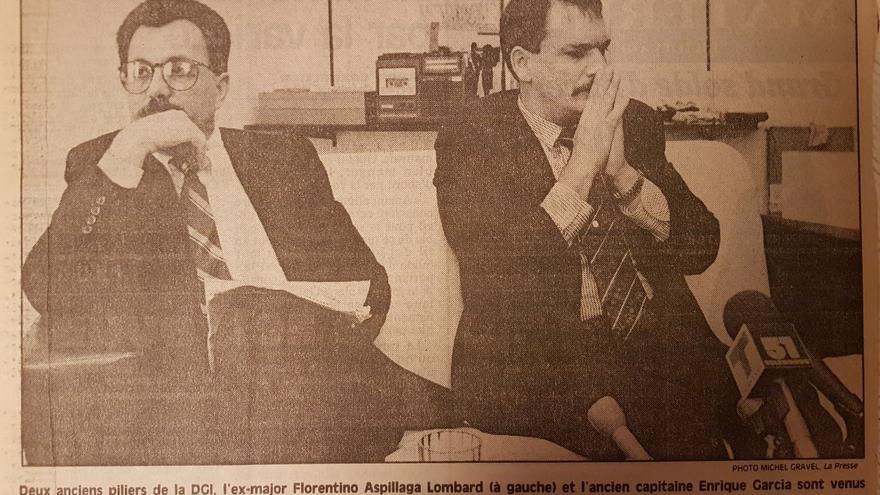
Those were the final chapters of the Cold War, the first years of the 90s. The world was in transition and the ex-Major of the Ministry of the Interior Florentino Aspillaga Lombard was on the cusp of his work in neutralizing the Cuban special services. For my part, in full youth, I did not consider at that time that it was a risk to leave the most wanted man in Havana alone in the middle of Paris. “After all,” I thought, “the job of a spy-catcher is not the same as that of a chaperone.”

I got the news of the death of someone who was a great friend, Florentino. His sudden death made me look back with nostalgia to the times when we dreamed of a free homeland and we thought it was possible in the short run. Destiny had in store for us a wait that still continues, but I still see it thru the lens of the past, in San Juan Puerto Rico. continue reading

At that time we had information that Puerto Rican separatist groups had discovered his presence on the island and were preparing to carry out another attack against the well-known Cuban deserter, who had already been wounded on a previous occasion in London by an agent from Havana.

Former officers of Cuban Intelligence, Florentino Aspillaga (left) with Enrique García, in Montreal in 1992. (La Presse)

Aspillaga and I were there denouncing the Cuban interference in the independence referendum that was going to take place on that island. Once again I had to participate in the operation because my friend always required my presence despite my youth and complete ignorance of the art of espionage.

In the middle of the “evacuation” from San Juan to Miami, the bodyguards pushed us into the vehicles and insisted: “Get in the car and take the flight we have booked for you. You and your friend are in danger.” I remember my strong protest, because I still had two nights at the Casino Hotel where I was staying, arguing that no one was looking for me, but my arguments fell on deaf ears and I finished my last two days of the operation in a boring Holiday Inn in Miami.

Florentino always forgave my rookie mistakes. He never allowed many photographs. The distrust and paranoia of the intelligence officer always accompanied him. However, he was never annoyed with me for taking pictures. He had a heart and a human sensibility that surpassed the vicissitudes of his profession. Memories are so many and so scattered when a friend from youth is lost. Together we fight for a better Cuba. Today his death surprises me and I can only say with pain: Goodbye, friend.

Translated by Wilfredo Díaz Echevarria

_____________________

The 14ymedio team is committed to serious journalism that reflects the reality of deep Cuba. Thank you for joining us on this long road. We invite you to continue supporting us, but this time by becoming a member of 14ymedio. Together we can continue to transform journalism in Cuba.

Cubana de Aviacion Resumes Flights to Guantanamo, Baracoa and Camaguey

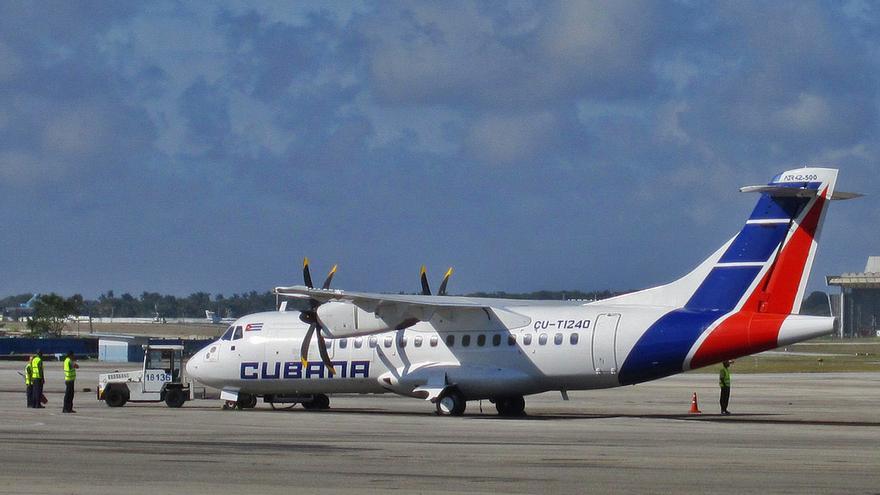
The resumption of the routes will be covered by model ATR 72-500 aircraft. (Flickr)

14ymedio bigger14ymedio, Havana, 24 October 2018 – Cubana de Aviación announced on Wednesday the restoration of three of its domestic routes starting on October 28. In a statement, the airline reported that air links will resume between Havana and the cities of Guantánamo, Baracoa and Camagüey.

Ticket sales are available in the sales offices as of this past Monday, as confirmed to this newspaper by the commercial office of Cubana de Aviación in Havana’s Vedado neighborhood.

The flights to Guantanamo, with a price of 228 CUP (Cuban pesos, roughly $9 US), will leave every Wednesday and Sunday, while those going to Baracoa, which will cost 270 pesos, will depart on Tuesdays and Thursdays. The frequency of the route to Camagüey, whose ticket price is 138 CUP, will be reduced to a single trip per week every Tuesday. continue reading

A worker from one of the commercial offices where the tickets for these routes are sold confirmed to 14ymedio that prices are still the same as those in effect prior to the cancellation of these routes.

The information desk of the company at the José Martí International Airport in Havana also informed this newspaper that the routes will be covered with model ATR 72-500 aircraft.

The airline has announced that it will gradually inform about the restoration of other national routes “in accordance with the normalization of conditions in each destination”.

The company refers in this manner to the suspension of all flights in the national territory that took place at the end of March of this year due to the lack of aircraft to cover the routes within the country.

At that time news of the cancellation of the flights took time to broadcast in the national media and the airline also did not report the situation quickly, which caused uncertainty among travelers who had a ticket to fly on Cubana de Aviación.

In the past, as a result of customer complaints about partial cancellations of departing flights, airline executives have had to face criticism, citing that “the technical problems of the aircrafts” are the main causes of delays and cancellations.

On May 18, a month and a half after the cancellation of all domestic flights, a Boeing 737 of the Mexican airline Global Air, and leased by Cubana de Aviación, crashed shortly after takeoff from Havana airport while heading to Holguin. In the accident, 112 of the 113 people traveling on board died, including passengers and crew.

Translated by Wilfredo Díaz Echevarria

______________________

The 14ymedio team is committed to serious journalism that reflects the reality of deep Cuba. Thank you for joining us on this long road. We invite you to continue supporting us, but this time by becoming a member of 14ymedio. Together we can continue to transform journalism in Cuba.

Real and Wonderful / Fernando Damaso

Fernando Damaso, 8 October 2018 — Next year, in the month of November, we will celebrate 500 years of the founding of Villa de San Cristóbal de La Habana. The authorities, after sixty years of abandonment and neglect, with the honorable exception of the Historian of the City, mainly in Old Havana and its surroundings, are mobilized to try to beautify it and make it a little presentable on such an important date.

The city’s large accumulated problems, such as 90% of its housing stock in only fair or poor condition, hundreds of unhealthy slums, where families are crowded, thousands of homeless sheltered for years in inadequate facilities and in miserable conditions, lack of public transportation, the shortage of drinking water, the collapsed drainage and sewage systems, the lack of public lighting and frequent power cuts, streets and sidewalks destroyed, dirt and filth due to the lack of garbage and solid waste collection, the destruction and non-replacement of trees along the streets and in avenues and parks, depressing and poorly supplied state shops, deafening noises, widespread social indiscipline and others, of course, can not be solved in thirteen months of work. continue reading

For this, time, workforce and material resources are lacking. In addition, we cannot do in a year what was left undone for six decades.

Therefore, it is foreseeable, accustomed as we are to these massive cyclical marathons, that everything will be concentrated on rescuing some of the other important facilities, mainly in Old Havana, Plaza and Playa, the privileged municipalities, renovating some parks and painting the facades (never the side or rear walls) of the buildings in the main streets and avenues, as “showcases.”

It has been announced that Chinatown will be rescued, where there are very few Chinese left, mainly with an eye to the tourists. Will Chinese be imported to inhabit it? Will they be authorized to run private businesses? A Chinatown without active Chinese would be a mockery.

The “deep city,” that formed by the remaining municipalities, except the avenue that joins the José Martí international airport to the city in the Boyeros Municipality, which will surely be used as a showcase, will receive only a few crumbs of the feast. This will be compensated with a lot of music, rum and beer in the days of the celebration, so that the sorrows are forgotten.

Once the marathon is over and the goals have been met by all the participating agencies and institutions, political events will be held with the most notable to reward the work done, flags and certificates will be handed out, and so on until the next anniversary.

We must pray that nature will not spoil the party with the visit of a hurricane in September or October, months in which they usually visit us every year, because then the 500th Anniversary would be sad.

Cuba’s Official Silence in the Khashoggi Case

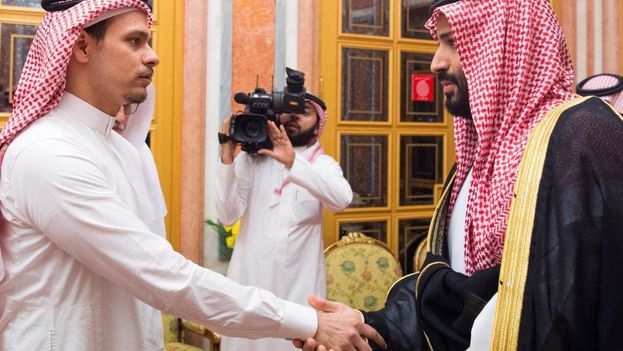
The Crown Prince of Saudi Arabia, Mohamed bin Salman (right), receives Salah bin Jamal Khashoggi (left), one of the sons of Saudi journalist Jamal Khashoggi, to personally convey his “condolences”. (EFE)

14ymedio bigger14ymedio, Yoani Sanchez, Havana, 24 October 2018 — A journalist enters a consulate and never comes out again. All indications point to the fact that within those walls he was reduced to a pile of body parts that were destroyed to erase all the evidence. The assassination of Saudi Jamal Khashoggi, presumably ordered by the absolutist monarch of his country, has provoked a wave of indignation that has not yet arrived in Cuba.

Khashoggi, a deep connoisseur of power networks in Saudi Arabia and a contributor to The Washington Post, is one of the latest victims of the excesses by authoritarian governments to silence the press. The profession has taken on a new life and the journalist’s death has revealed how economic conveniences cause the few who dare to criticize Riyadh to do so quite tepidly.

In recent days there have been protests in front of Saudi consulates in various parts of the world, declarations of support from countless media, and diplomatic demands expressed to King Salman bin Abdulaziz and Crown Prince Mohammed bin Salman. However, from Havana not a single complaint has come through the Ministry of Foreign Affairs, nor has there been a statement from the official Union of Cuban Journalists (UPEC). continue reading

In Europe, German Chancellor Angela Merkel has been emphatic in suspending arms sales to Saudi Arabia in response to the murder of the journalist, although analysts rationalize this firmness by the smaller volume of trade between Berlin and Riyadh. This Thursday, the European Parliament is also expected to hold a vote on a joint resolution of condemnation, the result of which is still unknown due to the fact that opinions on the issue remain divided within the bloc.

Washington, slower to respond, has announced that it will revoke the visas of those Saudi officials supposedly implicated in the reporter’s death and that it will also subsequently impose other punishments as the investigations progress.

In the midst of this clamor, the silence of the Plaza of the Revolution in Havana, and of UPEC, becomes more apparent. The reasons for such caution are as mundane and pragmatic as are those of others.

In 2016, Cuba signed an agreement with the Saudi Development Fund for 80 million dollars to export products from the Arab country and to finance infrastructure in the Island’s deteriorated hydraulic sector. Later Cuba received another credit of more of 26 million dollars for the Rehabilitation and Construction of Social Works Program of the Office of the Historian of Havana.

Everything seems to indicate that the Cuban authorities do not want to offend, with their demands, one of the few pockets willing to continue putting money in the island.

Castroism has always been motivated more by economic interests than by ideological affinities, hence its closeness to the caudillo Francisco Franco, its exchanges with Videla’s military dictatorship in Argentina and its willingness to receive Israeli businessmen with open arms, although its propaganda attacks that country with a constant stream of expletives.

At the moment there is no group of official journalists protesting in front of the Saudi Arabian embassy in Havana, because money has prevailed over ideals and because the murder of the journalist Jamal Khashoggi is a minor issue for a regime that, in exchange for investments, credits and donations, knows how to turn a blind eye.

For that reason, no guest will speak up for the silenced reporter on Cuban TV’s Roundtable program, no commentator on primetime news will point to the Saudi regime as responsible for his death, and in the Cuban foreign ministry no diplomat will be given the task of transmitting to the Arab monarchy a message of displeasure. For all of them, conveniences take priority over the death of a journalist who only wanted to do his job.

_____________________

The 14ymedio team is committed to serious journalism that reflects the reality of deep Cuba. Thank you for joining us on this long road. We invite you to continue supporting us, but this time by becoming a member of 14ymedio. Together we can continue to transform journalism in Cuba.

On a Fractured Identity

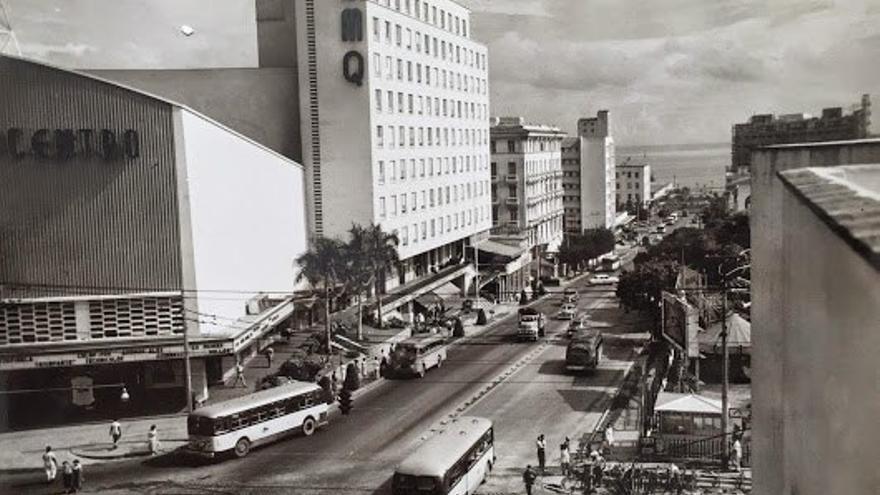
Havana’s La Rampa and Calle 23 during the Republican era. (CC)

14ymedio bigger14ymedio, Vicente Echerri, New York | October 20, 2018 — The destruction — and transformation — of the Cuban nation has become not only a commonplace, but a perennial lamentation among our own. Those of us who live in exile hardly have another subject, especially those who identify with the so-called “historic exile,” although many of us arrived twenty years later.

The Cuban identity that we cling to, that we are used to identifying with, isn’t, of course, the country that we left behind around the end of the 70s; not even, in other cases, ten or fifteen years before that date; but rather the republic that preceded Castroism and that Castroism froze in the memory and the longings of more than a generation, while forcing an entire society into a totalitarian permanence.

Paradoxically, that freezing that takes place, above all, in our minds, in our consciousness, contrasts with a radical transformation of the essential in Cuba — or that such as what we have — that doesn’t stop in the suppression of fundamental liberties, nor in the destruction of the entire economy, private and public, nor in the aggression against the environment; but rather, anxious to rewrite history and replace the past, in a society orphaned of its natural ruling classes, the State induces, through malice or through lack, the collective debasement of citizens’ customs, commonness as a norm of social commerce, larceny as natural compensation, and prostitution as a redeeming aspiration. Impotent and horrified, many of us have witnessed this shipwreck, whose consequences, like a hangover, also arrive to this shore to alter — if not to contaminate — our understanding of what it is to be Cuban. continue reading

Out of our love and stubbornness, there exists another Cuba from this side of the sea: a community deeply entrenched in the time of nostalgia, incapable of renouncing even the most insignificant of the memories that it hoards and that it considers inseparable from the national identity that we want to see restored to its inherent territory, as if this half century were nothing more than a bad dream.

We want, because I include myself among them, to be returned to the country that we lost — by whom? we don’t well know if Divine Providence or “the Americans” that, at times, can end up being confused — and to be allowed, in an act of love and discipline, to return to the Cubans from there (and some of those who went) the lost manners, the authentic patriotism, the morals that seem to have been drained in some sinkhole, the will to participate actively in the political life of one’s country, the decorum, in short, that is an essential ingredient of robust and prosperous societies.

But what’s certain is that the great majority of Cubans corrupt themselves, according to our criteria and, at the same time, we lack the political instruments that are indispensable for even trying to revert that process of corruption. Cuba has been transformed into something else without our being able to do anything, or nothing that can really have a genuine effect. Additionally, time (that of our freezing and that of the destruction of our country and its nation, one and the same) works against us.

On the eve of ten, of twenty years (that have to pass more rapidly than we would like), those who retain our vision of Cuba will be many fewer than today, while those that have incorporated the features of debasement will have grown by millions. In this race against time, the figures alone go against us. If another generation passes waiting for Cuba to return to the real time of history, there will remain almost nobody to tell about the illusion of our aspiration.

So, has Cuba been lost? Is Castroism — not the communist regime that has by now proven to be a universal fiasco, but rather its social and moral consequences — irreversible? Is it perhaps naive to try — and even to put some effort in it, as we have done, each one with the methods and talents at his disposal — to restore the nation (I mean to say, the body of institutions, traditions, customs, behavior, etc.) that we once had?

Giving space to pessimism, I dare to respond affirmatively to these questions. The totalitarian devastation leaves the Cuban people without foundations or models and, as a consequence, easy prey for domination. Those who don’t compromise, those who remember how things were, emigrate in the vast majority, and that emigration accelerates the poverty and alienation of those who stay.

Theirs is the harsh reality of the institutionalized misery, vassalage, and despicable skepticism that this generates. For us, a series of dreams of what was our country, of what it could have become, of what we still would like it to be. Rarely has the reality of two segments of the same nation been so distinct.

In its origins, Cuba was also a dream, a dream of a group of aristocrats and intellectuals close to them, whose comfort, in the majority of cases, also carried the stigma of slave labor. They had read, they had traveled, they aspired for the plantations they lived on to be a more efficient and educated — in the beginning, not even much more just and independent.

The colonial power closed all avenues to the rich and cultured creole who felt himself a pariah in his own land, and the Cuban nation rose as a distinct entity, separate from Spain, and that separation would end up paying for itself with a lot of blood.

The definition of Cuba is a European chimera, certainly a dream of distinguished white people who popularized that idea, who sell it, who propagate it, who preach it, who end up imposing it. The rest of the population are manual workers, peasants, Spanish shopkeepers — or their children — and slaves.

In the middle of the 19th century, the black population, if we only count the slaves, almost equaled the white and, together with the free black population, was greater than the white. Although the blending wasn’t as obvious as it is currently, it already existed at the borders of these communities. Cuba is rich, it’s true, but its wealth has been made on the sweat and blood and backs of hundreds of thousands of slaves.

Those who dream of Cuba aspire to the perfection of a European republic in the middle of a Caribbean plantation. I don’t blame them, I too have always dreamed of the same. The wars of independence, which served as a crucible for melting many prejudices and accelerating democracy, also served to consecrate the prominent institutions of the patrician ideal of the nation: a straitjacket — to use a metaphor — that they imposed on the black slaves and Spanish shopkeepers; an ideal with which one had to live, with institutions forged for a class that it was a duty to imitate.

Castroism dynamited that social contract, pillaged the wealth that the authority’s code of laws offered, demonized the past, satirized the paradigms, usurped public power, adulterated traditions. Citizens, lacking these references of identity, of these traditional parameters, turned into a herd. Those who didn’t consent were executed or imprisoned, or went into exile, or were consumed in the silence of their inner exile.

The new generations grow up lacking supports, authentic models, rigorous archetypes of improvement. They set themselves to dissimulation, ostentatious and caricature-like loyalty to a spurious regime to obtain privileges that, in the majority of cases, are ridiculous, as much as or more than the stones of glass beads with which the Spanish once bought the gold of the Indians. The degradation of the people is universal. The material and moral condition of Cubans subjected to Castroism can be summed up in one word: miserable.

It’s worth asking: are these scraped together men and women, whose manner of speaking we sometimes don’t recognize, an essential and prominent part of the Cuban people? Are they, these descendents of slaves and of shopkeepers who have been exploited and conned for half a century in the name of a crazed project, our compatriots? Are these millions of individuals debased by the totalitarian administration who, deprived of archetypes, sink into amorality and skepticism, our brothers?

I, who have always believed and still believe in the validity of the national ideal that our great men of the 19th century handed down to us, don’t hestitate in answering yes. However much we can’t recognize ourselves in their voices, in their gestures, in their conduct, in their lack of faith in the nation, they are our flesh and blood, part of that people to which we belong in agony like an extension of our being and without with we would feel much diminished.

They, the Cubans of the other shore — as much as many who come to this one in the midst of the continuous shipwreck — have been disfigured by the actions of history, but they are still intimate and dear to us, like a substantial part of an entity that covers us and surpasses us, that roots us and explains us.

The future of our beloved country doesn’t have to be exactly like we have dreamed in this long exile. Maybe the sacred ways whose absence we have deplored so much will never again be restored. Traditions are altered with new ingredients, in the same way that languages transform and customs evolve. The catastrophe that has happened in Cuba, responsible for so much death and imprisonment and exile and debasement, is not something that we can erase like a nightmare in order to start over.

We have in front of us the bitter pill of the reformulation of what it is to be Cuban, which, of course, is not a task exclusive to us, those from this shore, built in absolute repositories of an invariable tradition and ready to impose it from the podium of some fabulous tribunal, but rather of all sorts of voices and individuals, with a variety of contributions and visions, of principles and objectives, of ambitions and compromises.

The transformations that a people can suffer — sometimes for the worse — in the history of their development are not susceptible to being ignored: neither the jurist, nor the politician, nor the philosopher, nor the historian can permit himself that luxury. If only certain things hadn’t happened!

But, as we well know, history is not what could have been, but rather what was, and its consequences are palpable. If we compare what happened in Cuba’s recent history with more drastic historical events, we can even find some basis for optimism.

Let’s think, for example, about the Spanish conquest of America and what its impact meant on indigenous cultures, the most advanced, because those of the Caribbean ended up simply abolished.

What profound trauma should the Incan and Aztec priests, princes, and poets not have suffered in face of that shock that destroyed their temples and their codes, dominated their languages, suppressed their gods and their hierarchic strata, and even changed their names? I’m sure that there were many members of those cultures who lived and died dreaming of the return of the old worship and of the restitution of their ancestral customs, of a worldview that by then was never to return.

Likewise, in Elizabethan England, how many would not have waited from a long exile, or from a fearful underground, the return of what they supposed was the true faith, the return of the monasteries and abbeys, the celebration of legitimate worship subject to the Roman pope, the return of that world, in short, that the frustration and anger of Henry VIII had undone? But in England there would be no new monasteries until 300 years later, and the Roman mass would never again be celebrated in the old cathedrals of the kingdom. So radical and definitive can certain changes be.

The French Revolution — that has been so exalted and venerated by militant republicanism — wanted to remake everything and, in a spirit of change, changed not only the configuration of the State, but even the name of the months of the year and the length of the week and, of course, the national anthem and the flag and the political division of the country and a thousand other things. France would not again be the same, nor would the rest of Europe and thus the whole world, thanks to that monstrosity of the revolution that was Bonaparte and despite the fifteen years of Bourbon restoration that followed his overthrow.

How many, how many — we think — lived and died in the France of the 19th century and even that of the 20th, dreaming of the return of the Ancien Régime, hoping that the hateful rosette that represented the shirtless ones and the regicides would be lowered once and for all, and that once again the lilies that had distinguished the French kings since the high Middle Ages would cover the countryside.

Fortunately for us, and despite the drastic process of transformation and deterioration that has taken place in our country in the last fifty-something years, the visible symbols that identify us have not seemed to change: the official name of the State hasn’t changed, nor the flag, nor the shield, nor the anthem. This isn’t much, certainly, but it’s something, a sphere of common understanding from which to start.

Neither have those in charge in Cuba rejected the place and the words of the founding heroes, especially that of José Martí, even though they have manipulated his doctrine and have wanted to make him an accomplice to infamy. Martí’s discourse on Cuba and his political vision — deeply democratic — can still serve to extend a bridge — precarious, but a bridge nonetheless — between these two shores of our fractured national identity.

There’s no room, it’s true, for excessive optimism nor for the triumphalist visions that sometimes encourage us. Cuba will not be waiting for us, in some moment of an improbable future, like a docile material on which to imprint the vision of our society, more perfect and idealized, additionally, than what never was; to realize the old dream of waking up sleeping beauty and finding that everything revives around it. That is not possible. That never, in history, has been possible.

However, neither does that reality leave us without a task. There is still a job to do, I believe, in face of this devastation that afflicts us. We preserve our vision. We’ve had time to ponder the weaknesses, political and social, that brought us, as a people, to this point of disfigurement. We still have a trace of enthusiasm and dedication, we are still repositories of civic knowledge that our people from over there — because they are part of us and our pain — have maybe forgotten, forced by the difficulties of their lives; or almost certainly reinvented amidst their atrocious circumstances.

Between us we have to return to reformulate Cuba when this nightmare ends, and even before it ends, from the very moment in which we plan to cross this abyss, with the contributions of all and the voices of all. Martí said it wisely: “from the rights and opinions of all its children is a people made, and not from the rights and opinions of a single class of its children.” How difficult it is to renounce, in front of the terrible uprooting, the grip of our truth, of our solutions, of our arrogant sufficiency, to acquire the generosity and humility that a common undertaking imposes!

Editorial note: Making the most of the debate over the Constitution and the Cuban people, we reproduce this text with the authorization of the author, who read it on November 23, 2010, at the Association of Cuban Ex-Political Prisoners of New York-New Jersey.

 Translated by: Sheilagh Carey

_____________________________

The 14ymedio team is committed to serious journalism that reflects the reality of deep Cuba. Thank you for joining us on this long road. We invite you to continue supporting us, but this time by becoming a member of 14ymedio. Together we can continue to transform journalism in Cuba.

Ángel Santiesteban: "Europe has left us alone to confront the dictators" / Amir Valle, Ángel Santiesteban

Angel Santiesteban

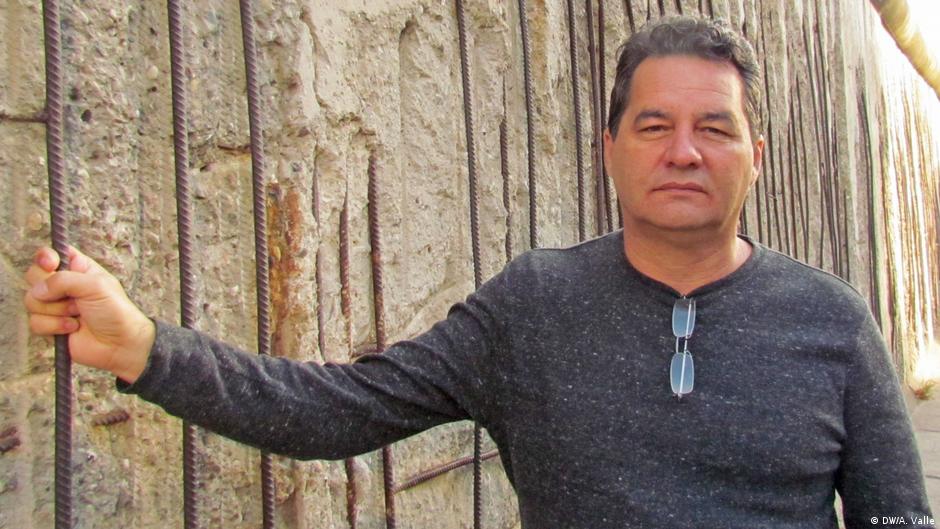
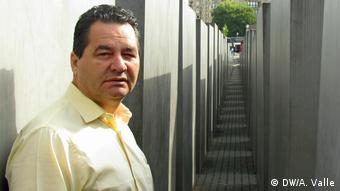
Deutsche Welle, Amir Valle with Angel Santiesteban, 18 September 2018 — Invited to the International Festival of Literature in Berlin, the Cuban writer Ángel Santiesteban speaks with Deutsche Welle (“DW”) and criticizes the passivity of the European Union and international public opinion in the face of the tragic situations in Cuba, Venezuela and Nicaragua.

Considered one of the most important Latin American writers at present, the Cuban writer Ángel Santiesteban was condemned to five years in prison for opening his blog in 2007, “The Children that Nobody Wanted” to give his opinion about the political and social disaster imposed by Castroism in Cuba. continue reading

Beginning from that moment, his life became a struggle against governmental censorship and for democracy on the island. In 2014, Reporters without Borders elected him among its 100 Information Heroes in the world. The Cuban Government prevented him from traveling outside the island for 10 years, but he finally was able to visit Berlin, in order to present the German edition of his book of short stories, Lobos en la noche (Wolves in the Night), published by the prestigious publisher, Fischer.

DW spoke with him, in his role as intellectual and dissident, about matters of relevance that mark his life and that of Cubans.

DW: “Europe has legitimatized the Cuban dictatorship” is a recurring phrase in your interviews. 

The Cuban writer Ángel Santiesteban, creator of the blog “The Children that Nobody Wanted.”

Ángel Santiesteban: Talking with a Regime that has shown for decades that it does not believe in dialogue legitimizes it. That’s undeniable. There have always been businessmen flirting with Castroism, but it’s understandable, since the only thing that matters to them is making a profit by being in Cuba. But to have a business based in a region that is struggling to establish what they call “the State of Wellbeing and Rights” is an enormous contradiction and, in many ways, shameless.

Since the European Union decided to sit down and talk with Cuba, the only thing we’ve seen is that it has had to cede time and time again to Havana’s demands, and that the dictatorship has repressed the opposition with more force, since it has seen that no one questions its violations. The same thing is happening in Venezuela, in Nicaragua. Europe has left us alone to confront the dictators. And that makes it responsible for our suffering and our dead.

As an opponent, in your blog, you were one of the most concerned with denouncing the responsibility of the Cuban Government for those social disasters that we see in Venezuela and Nicaragua. 

I believe that what’s called the “Free World” should once and for all condemn the Regime openly, and not just with timid sentences, for the moral support and advice in many areas that the Castros give to Maduro in Venezuela and to Ortega in Nicaragua.

Castroism has always been a parasitic government: first, the Russians and the socialist camp, then Venezuela. It’s a parasitism disguised as “the struggle for the rights of the poor in Latin America,” and now we know how many dead were the result of Fidel Castro’s promotion of the guerrillas in the region, not to mention that those guerrillas ended up being terrorists and narcotraffickers supported by the Cuban dicatorship.

Later, Fidel Castro and Chávez invented the poorly named Bolivarian Alternative for the Americas (ALBA), supposedly to defeat the neoliberalism and impose 21st-century socialism: another failure encouraged only by Castroism. And now, with their plan of extending socialism throughout Latin America, they behave like what they are: dictators, because they know that the “Free World” will criticize them only with politically correct words.

As a protagonist of Cuban culture, you have demonstrated against the most recent Cultural Law, Decree No. 349. Is it really dangerous?

From the time he came to power in 1959, Fidel Castro knew that he had to keep a lid on freedom of creation and expression. But with the exception of Law 88 directed at journalism, which we opponents call the “Gag Law”, all artistic censorship has been based on the application that the cultural commissars made from those famous words of Fidel: “Inside the Revolution, everything; outside the Revolution, nothing.”

But now the censorship is law: among many other obstacles, it limits the freedom of creative expression, then criminalizes and punishes those who try to show their work in public without the approval of governmental institutions. But the intellectuals are gagged by fear, and very few have raised their voices against it. Only the independent cultural opposition movement is protesting against this legalization of censorship.

Many people don’t understand that a large part of the Cuban opposition supports the North American president who is the most controversial of the last 100 years: Donald Trump.

Although there were some timid openings in economic matters, increasingly, as far as achievements in human rights go, we know what a failure Obama’s politics were for opening a supposed “new era” between Cuba and the United States. We can today question Trump’s other measures, but his pragmatism makes him understand that you can’t have a conversation with someone who doesn’t want to listen.

People who criticize our support of Trump should go to Cuba and suffer  all the repression that has fallen on us since Raúl Castro saw that his eternal enemy, the United States, was ready to sit down and negotiate, and placed human rights last in the list of demands of the Cuban dictatorship. Trump, whatever you say about him, has leapt into first place in resepct to demanding that Castroism should grant human rights to Cubans.

Author: Amir Valle (CP)

Reproduced on Angel Santiesteban’s Blog

Deutsche Welle is the international network of Germany and produces independent journalism in 30 languages. Follow us on Facebook, Twitter and YouTube.

THE END OF THE CASTRO ERA IN CUBA

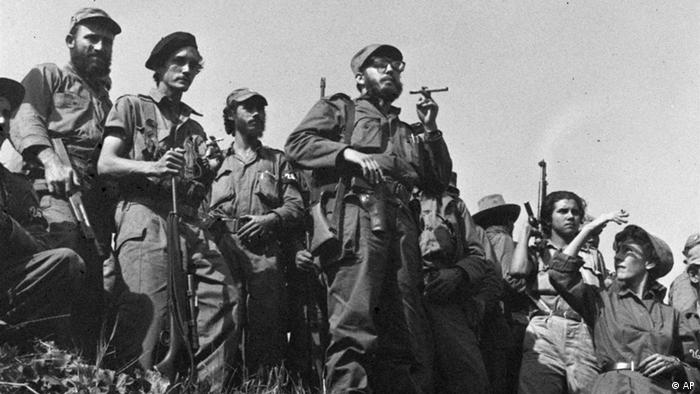
1959 – The Triumph of the Revolution

The rebels, led by Fidel Castro, come to power after expelling the dictator Fulgencio Batista in January. The United States recognizes the new government. Soon “revolutionary laws” (such as agrarian reform) affect U.S. businesses. In December, Republican President Dwight D. Eisenhower approves a CIA plan to overthrow Castro in one year and substitute “a junta friendly to the U.S.”

Recent coverage of Cuba from DW

NO TO DECREE #349: AGAINST THE “CRIMINALIZATION OF ART” IN CUBA

One of the first decrees signed by the new Cuban President, Miguel Díaz-Canel, penalizes independent art on the island and denounces artists and activists. Their protests have been repressed by the authorities. (August 29, 2018)

POSADA CARRILES: HERO AND VILLAIN IN DEATH

While Cuba and Venezuela announce “A terrorist has died without paying for his crimes,” intellectuals and Latin American political exiles hope to one day know the true face of this man. (May 24, 2018)

BOOK FAIR IN HAVANA: LIGHTS AND SHADOWS

Although thousands of Cubans attend the book fair, Cuban writers and intellectuals say that the International Book Fair is no longer as important for Cuban letters as it was in the ’90s. (February 10, 2018)

THE END OF THE CASTRO ERA IN CUBA

Almost no one in Cuba can remember life without the Castros. Since April 19, there hasn’t been a Castro at the front of the State. For almost 60 years, the brothers Fidel and Raúl have governed the country with an iron hand. (April 18, 2018).

Translated by Regina Anavy