The April 30 Rebellion in Venezuela: Another Hypothesis

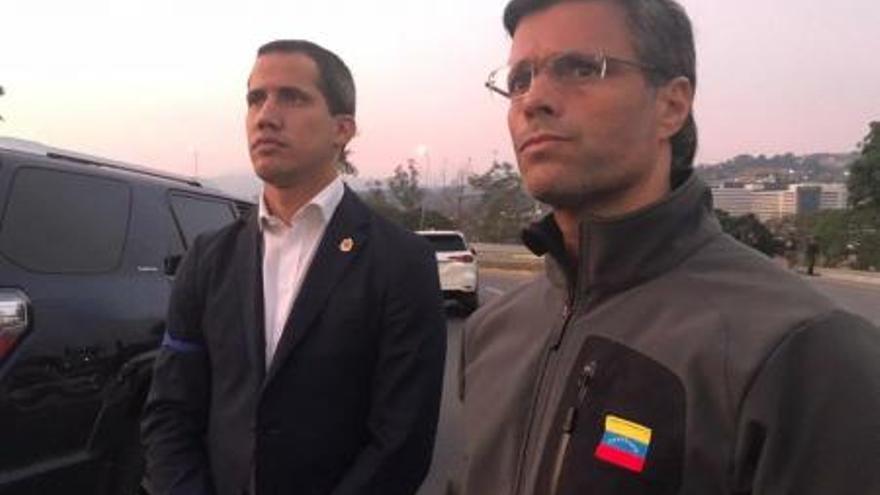
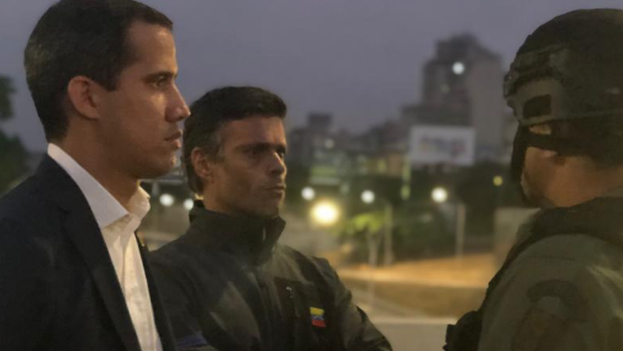
Juan Guaidó and Leopoldo Lopez accompanied by military deserters outside the Carlota military base on April 30. 

14ymedio bigger14ymedio, Jorge Hernández Fonseca, Lisbon, May 3, 2019 — As we now know, the rebellion in Venezuela on April 30 against the Maduro regime did not achieve its goal of overthrowing the dictatorship. Several likely hypotheses have emerged to explain what happened. In my opinion, however, the actual course of events to date does not support them. I think as Cubans we have a much clearer idea of what is likely to have happened.

We know that there were high level contacts between Juan Guaidó’s team and the United States on the one hand and between senior officials close to Maduro on the other, suggesting a conspiracy. Senior commanders would support Guaidó in overthrowing Maduro, apparently through military action. But according to this hypothesis, the designated date was delayed, frustrating action by the high command and leaving Guaidó on the sidelines.

Cubans know all too well that the main tactic of the island’s secret services is to infiltrate the ranks of its enemies. On the other hand, Cuban counterintelligence plays a dominant role in Venezuela. Therefore, it is not difficult to imagine that Cuban intelligence agents were aware of contacts between Guaidó’s team and senior government officials, which would have allowed them to put together a plan to thwart the scheme. If so, it appears Maduro’s high command followed it faithfully. continue reading

Personally, I find it highly unlikely that there were contacts between Maduro’s military and Guaidó’s men, or contacts with the outside world, since none were detected by the intelligence services. Rather than being aware of such contacts, I think it is much more likely that the intelligence services promoted the idea.

There is a senior official, the head of the Venezuela’s intelligence service, who for personal reasons has broken with Maduro. Though not one of the conspirators, logic suggests he will be replaced as the price for the “broken plates” of having allowed the release Leopoldo Lopez. Freeing Lopez has been one of the plan’s successes, and not an insignificant one.

Given the nature of this case, I understand that there is a lot of disinformation that has deliberately made public and that, therefore, no one has yet to come up with a plausible hypothesis. Nevertheless, I submit this as a contribution to the debate, confident that many Cubans will share my belief that, knowing how Cuba’s secret services operate, infiltration is behind these actions.

_________________

The 14ymedio team is committed to serious journalism that reflects the reality of deep Cuba. Thank you for joining us on this long road. We invite you to continue supporting us, but this time by becoming a member of 14ymedio. Together we can continue to transform journalism in Cuba.


One Year of Diaz-Canal: Continuity as the Norm

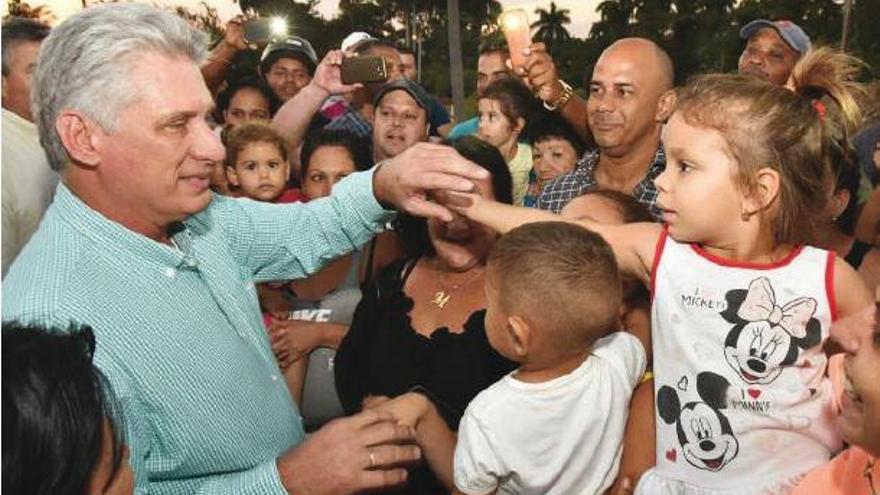
Regardless of how it is seen by the population, the official media has strived in a campaign that borders on the cult of personality where it is seen applauded by people, carrying children and sharing with workers. (Granma)

14ymedio bigger14ymedio, Havana, 19 April 2019 — When completion of his first year in the post of president of the Councils of State and Ministers, the performance of Miguel Diaz-Canel Bermúdez is mediocre, with more stepping on the brakes than progress in the field of reforms, with the shadow of Raúl Castro dulling his prominence.

For most Cubans, it has been twelve months in which the scarcity of basic products has increased, in which the official discourse has become more belligerent and in which the country has become increasingly isolated. Instead of the desired economic reforms, the 58-year-old engineer has tried to more strongly control the private sector and also the artistic expression.

The phrase Díaz-Canel repeats most frequently alludes to the continuity of his management with the principles left to him by the so-called historical generation. His constant allusion to “the teachings of Fidel” and “the accurate leadership of Raúl” show him as a ruler lacking in his own ideas who aims only to stand out for a more collegiate style of work. continue reading

The international situation has been extremely adverse, with an upsurge in pressure from the Donald Trump administration and the recent package of measures to reinforce the US embargo. The loss of allies in the region coupled with the weakening of some such as Venezuela and Nicaragua — suffering their own internal crises — have reinforced his diplomatic solitude.

The worst moment of Diaz-Canel’s mandate occurred when the caravan in which he traveled was booed by the population as it passed through the municipality of Regla, one of the areas most affected by last January’s tornado. The armored vehicles and the extensive security operation just managed to redouble their speed and leave the place. The short video that recorded the scene went viral in the social networks and unleashed a flood of memes that penetrated deeply in the collective imagination.

The most significant event of his mandate was this year’s discussion and approval of a new Constitution of the Republic, but this document, ratified in a referendum, is seen as a rigid corset left by Raúl Castro so that Díaz-Canel can not undertake major changes, or engage in a process of true democratization.

Arbitrary arrests of activists, police repression and reprisals against opponents and independent journalists have remained, with slight variations. Censorship against independent digital sites and travel restrictions against dissidents continue to be some of the most widely used strategies to control the freedoms of expression, association and the press.

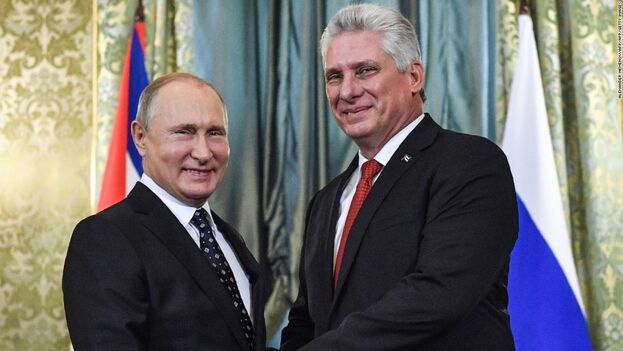
In the international arena, the current president visited the United States to speak at the headquarters of the United Nations, but most of his trips have been in the territory of Cuba’s allies and in very controlled spaces. Thus, he visited Vladimir Putin’s Russia, Nicolás Maduro’s Venezuela, the China of Xi Jinping and North Korea under the iron fist of Kim Jong-un.

Since he became president, he has promoted the presence of officials and ministers in social networks, especially on Twitter. His tweets are characterized by slogans, attacks against the United States and statements of loyalty to Fidel and Raúl Castro. One of the most used labels is, in fact, #SomosContinuidad (We Are Continuity).

he Cuban leader, Miguel Díaz-Canel, along with his Russian counterpart Vladimir Putin. (Kremlin)

Regardless of how it is seen by the Cuban people, the official media has put forth an effort in a campaign that borders on the cult of personality, where he is seen being applauded by people, carrying children and visting with workers. He has spent most of his time visiting provinces and meeting with executives of state companies. In reality the results are lean, but those trips try to send the message that Díaz-Canel “works” and that he is “tied to the people.”

Several tragic events, such as the crash of an airplane where 112 people lost their lives, the fall of a meteorite on the western part of the island, and the unexpected tornado that hit several municipalities in Havana, fueled popular superstition around Diaz-Canel, whom many consider a messenger of bad luck.

The jokes, the nicknames and the epithets are, in Cuba, a kind of “proof of life” for everyone who occupies a position in the official spheres. The first joke that circulated from the first day of his inauguration alluded to that his having taken “command” of the country but not having been given the batteries to be able to operate it.

Subsequently, and after several negative events, popular humor has rebaptized him “sack of salt,” (spilling salt is bad luck). Having not been elected by the vote of citizenship, opponents refer to him as “hand-picked” or “designated” instead of the respectful “president-elect.”

The most suspicious insist that after the approval of the new Constitution, Diaz-Canel will become the president of the Republic, a new position established as of April 10. When he is sworn in for a  first term in that position, this year that has passed will not count agains the decade that, according to the legislation, one person can remain at the helm of the country. If so, these will have been just twelve months of trial and testing.

__________________

The 14ymedio team is committed to serious journalism that reflects the reality of deep Cuba. Thank you for joining us on this long road. We invite you to continue supporting us, but this time by becoming a member of 14ymedio. Together we can continue to transform journalism in Cuba.

Residents of Boulevard D’25 Win the Battle Against Noise

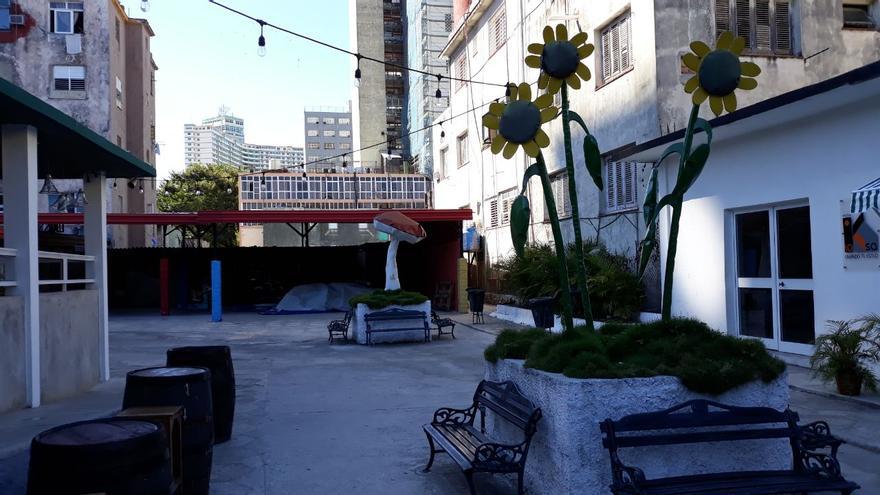
There is a notable decrease in the influx of people since the playground was closed. (14ymedio)

14ymedio bigger14ymedio, Luz Escobar, Havana, 24 April 2019 — Where once the hustle and bustle of children’s voices resounded at all hours of the day, silence now reigns. Most entertainment devices for the little ones have disappeared and those that are installed are covered with tarps or disconnected.

“The park was closed because the neighbors of the building next door were very upset by the noise,” one of the clerks in the arts-and-crafts shops told 14ymedio.

The place where there used to be an old state parking lot for vehicles, is now converted into an area to where the self-employed can rent spaces. Outskirts of each restaurant or cafe elegant young men show the menus where they announce “excellent dishes.” As for the playground, “That closed because it bothered a neighbor who convinced the whole building to protest,” says one of the waiters. continue reading

For the residents the question was not in dispute. Their health was affected due to “sound pollution,” and this was reflected in many of their demands to the Ministry of Public Health and the Provincial Government of the capital. The pressure they brought to bear, with complaint letters detailing the problems, caught the attention of the authorities, who agreed to close the playground.

According to the Facebook page Vecinos de La Rampa (Neighbors of La Rampa) there are several, not just one, residents whose complaints about the noise led them to close the park. One of them is Dr. Alina Arcos, who works in the Emergency Department of a hospital and lamented that she could hardly rest when she arrived home after more than nine hours of work.

“For three years, the residents of the community to which I belong have sent letters, complaints and denunciations to any organization, institution or official that might have any role in this, and except for a temporary solution, the rest have been useless. The businesses that operate there violate the commitments made by the Government and the Party with the community before its opening, multiple existing rules are openly breached and this puts our health at risk,” said Arcos in a post for the month of March.

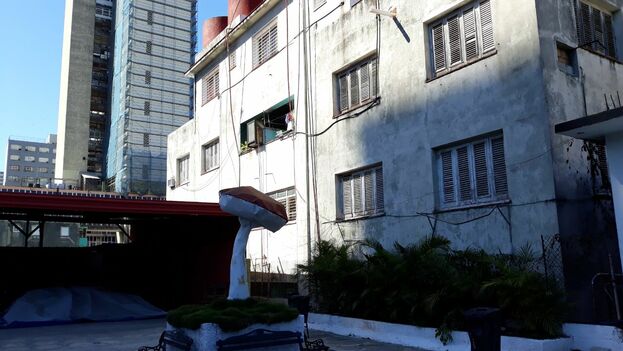
Facade of the building without posters. (14ymedio)

After several complaints in different instances made over more than three years and on social networks, the neighbors decided to show their discontent by hanging fabrics from their balconies, which they have now removed. “On this Boulevard, profits matters more than the welfare of the community, enough is enough!” Said one, and, “This Boulevard violates our right to live in peace,” said another.

“We all worked together and our efforts won. My parents, who lived tormented by the situation, now feel relieved,” a young man who lives in the building told 14ymedio an Thursday afternoon.

It is not the first time that the neighbors managed to close the park with their demands. The authorities had already ordered the closure of the park on a previous occasion, although the owners decided to ignore it and reopened it despite not having the required permits .

“We neighbors just discovered that the Boulevard does not have — hear this — has not and never has had a health license for the use that it has been put to,” denounced another of the neighbors in the neighborhood Facebook group.

On April 13, just before the school break, the park closed. “Days before there was a meeting here with more than 20 neighbors in which the president of the Municipality of Plaza de la Revolución participated,” says another neighbor who plays with her grandson in the inner courtyard of the building located on N Street between 23rd and 25th.

Before getting the facilities closed, Dr. Arcos pointed suspiciously at “corruption,” “abuse of power” and “influence peddling” as the causes that could explain the State’s delay in this case when it comes to protecting citizens.

This week one of the vice-presidents of the Plaza Municipal Assembly of the Power, Pedro Pablo Herrera, was dismissed from his position. Although the reasons are unknown, two sources claim that Herrera participated in at least one of the Assemblies that was held with the residents of Boulevard D’25 to try to solve the noise problem.

_________________

The 14ymedio team is committed to serious journalism that reflects the reality of deep Cuba. Thank you for joining us on this long road. We invite you to continue supporting us, but this time by becoming a member of 14ymedio. Together we can continue to transform journalism in Cuba.

It’s Forbidden to Say the Word "Crocodile" on Cuban Television

The actor Luis Silva, who incarnates the character of “Pánfilo,” denounces censorship in a program where bread in the form of a crocodile was shown. (Luis Silva/Facebook)

14ymedio bigger14ymedio, Havana, 2 May 2019 — The popular actor, Luis Silva, known for his comedic character, Pánfilo, reported this Wednesday that one of the episodes he had recorded in January for the program Vivir del Cuento (Living by One’s Wits) wasn’t put on the air because of a joke about bread in the form of a crocodile.

“Because of bread in the form of a crocodile, this episode wasn’t released on Monday. You can’t mention a crocodile, a hutia, or an ostrich. Worst of all, this episode had been recorded in January,” the actor wrote on social media.

The censorship is related to a declaration made by a  comandante of the Revolution, Guillermo García Frías, on the program Mesa Redonda (Round Table). The military nonagenarian, in charge of the National Enterprise for the Protection of Flora and Fauna, said that the meat of the hutia, a type of large rat found in the fields of Cuba, has more protein than “all the meats” and a “high quality” skin. continue reading

García also praised the ostrich and said it produced more meat than a cow. After his declarations, the words “crocodile”, “hutia” and “ostrich” trended on social media, where a multitude of memes and jokes about these animals circulated.

However, Luis Silva didn’t mean it as a joke and said the bread that appeared on Vivir del Cuento was a gift from the people of Triunvirato, a small town in Matanzas Province. “I decided to show it on the program as an expression of gratitude to the town. Draw your own conclusions. Friends of Triunvirato; I tried.” added the comic.

After publishing his first post, the actor qualified the situation and added that “the episode will be shown, surely. But with that scene cut.”

Comments weren’t long in coming. “What a shame that a comedian can’t mention it, and a high official of the country robs a comedian’s work and makes himself a national laughingstock,” said one user identified as Claudio Cabrera. For Idalia Quintana, “We Cubans are the only ones on planet earth who laugh at our misfortunes.”

Another “internaut” thought it ironic that the icon of Matanzas’ baseball team is a crocodile and suggested that they “change the name to a lizard.”

In comedy programs on Cuban television, jokes about the bureaucracy, the absurdities of the socialist state enterprise and intolerant ideologues are frequently included, but jokes against the Communist Party or the revolutionary leaders are still taboo.

Vivir del Cuento is one of the few programs that has survived on Cuban television with a critical script that focuses on everyday difficulties, the hardships experienced by retired people and the problems in buying food.

Translated by Regina Anavy

_________________

The 14ymedio team is committed to serious journalism that reflects the reality of deep Cuba. Thank you for joining us on this long road. We invite you to continue supporting us, but this time by becoming a member of 14ymedio. Together we can continue to transform journalism in Cuba.

The B Side of the Biennial

Luis Manuel Otero Alcántara was arrested on Thursday, the day the Biennial began. (14y middle)

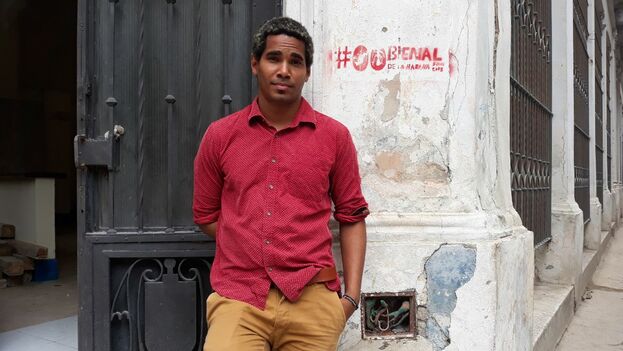
14ymedio bigger14ymedio, Luz Escobar, Havana, 12 April 2019 — On Thursday, April 11, while in the halls of the National Museum of Fine Arts the Mexican artist Gabriel Orozcowas preparing an exhibition, and on the terrace of the Spanish Embassy the duo Clandestina finished mounting its installations, the independent artist Luis Manuel Otero Alcántara was arrested in Damas Street when he carried out one of the actions he had planned for the XIII Biennial of Havana.

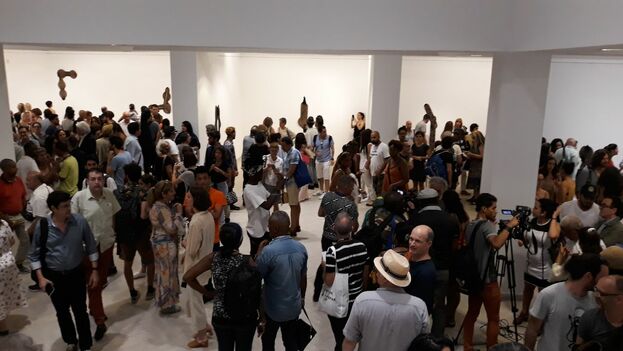
The most important artistic event in Cuba started with wide coverage in the official and foreign press. The media announced new features such as the multiplication of stages of the Havana-based event, which this year is also happening in Pinar del Río, Matanzas, Cienfuegos and Camagüey, and the motto of the Biennial — “The Construction of the Possible” — and the participation of more than 300 creators from 52 nations.

But none of them spoke of the flip side of the event. The arrest of Otero Alcántara came during a performance with which he was trying to pay tribute to Daniel Llorente, known as ’The Flag Man’ since he was arrested in 2017 while ’crashing’ the May Day parade waving an American flag. According to Eliezer Llorente, his son went missing more than two days ago. continue reading

The writer Abu Duyanah Tamayo, who witnessed the arrest, told this newspaper that when he arrived at the artist’s street, in the neighborhood of San Isidro, “they were putting him and two other boys in the patrol car.” According to his testimony, the boys were running toward their homes “because the police came screaming” but the officers entered the houses, took them out and took them away.

“They took the phone from Luis Manuel, and they tried to take ours from us when we arrived , but in the end we resisted and they didn’t.”

“The Biennial is a whole energy that gets into every corners and I am an artist and the Biennial is mine too,” Otero Alcántara had told 14ymedio before his arrest, when he had not yet specified a date or place for the action.

“I have three projects, and one of them is a tribute to the man of the flag, a race that will be called Daniel Llorente and in which every Cuban of and age can participate. It will be a 66 meter race, the distance Llorente ran in the Plaza of the Revolution on May 1st. Everyone who runs has to do it with an American flag and a Cuban flag, the first three will have their prize and their medal,” he explained.

The artist, who days before suffered another detention to warn him of the consequences if he went ahead with the performance, says he senses fear in the Government “This is a symbolic regime that has never been able to solve anything on a practical level, everything is hope, the illusion and the symbolism, “he said.

Installation of the clandestine duo in the Embassy of Spain. (14ymedio)

Otero Alcántara’s actions are part of the “Se USA” project. “The other work I’m going to do is a walkway outside my house, on the street, and with models that will be people from the neighborhood.” I will make a fashion show with 10 designs that I chose among the more than 80 that Chanel had when she did hers in the Prado, combining those Chanel designs with garments that Cubans wear a lot, in shorts, lycra, shirts, t-shirts, handkerchiefs, with the imagery of the American flag.”

As an artist, he is interested in talking about “that ultra-pathetic nationalism and patriotism” that power builds “to dominate, control and tell you that you are a traitor,” if you do not do things as they planned. “Why can’t Daniel Llorente go out with the flag if he wants. Why to you wantto make me an enemy, I feel like an enemy but I have to assume it because you impose it on me?” he protests.

This edition of the Biennial should have been celebrated in 2018, but its organizers postponed it because of the damage caused by the passage of Hurricane Irma. This decision gave rise to a group of independent artists, among whom, as a visible face, was Otero Alcántara, who took the initiative to organize the #00Bienal last year, an alternative call that was demonized and repressed by the Government and cultural authorities.

Hall of the Universal Art building of the Museum of Fine Arts with the pieces of the artist Gabriel Orozco. (14ymedio)

Since 1984 the Wifredo Lam Contemporary Art Center, together with the National Council of Plastic Arts and the Ministry of Culture, among other institutions, have been responsible for organizing the Havana Biennial.

The galleries of the Alicia Alonso Gran Teatro de La Habana, the Havana Collage, the Ensemble Workshop, the National Museum of Fine Arts and independent studios such as Del Castillo Art Studio or El Apartamento will remain open until May 12 as part of the exhibition.

In the last decade, with the birth of alternative spaces, activities that take place in independently managed galleries have also been added to the event and are included as part of the collateral actions. Provided they abstain from any criticisms of the Government, they will be allowed to exist.

________________

The 14ymedio team is committed to serious journalism that reflects the reality of deep Cuba. Thank you for joining us on this long road. We invite you to continue supporting us, but this time by becoming a member of 14ymedio. Together we can continue to transform journalism in Cuba.

Patriotic Clamor / Fernando Damaso

Various uses of the image of the flag from times past.

Fernando Dámaso, 29 April 2019 — The uproar continues between those who reject and those who accept the use of patriotic symbols, mainly the flag, in utilitarian objects. With this in mind I would like to clarify a few things and offer some personal thoughts.

“Patriotic puritans,” who mainly come from the intellectual community, want to sanctify the flag and turn it into an object of religious devotion.

“Patriotic populists” use it excessively, and often inappropriately, as a decorative object in shops, farmers markets, public offices, companies and vehicles. Also included in this group are political leaders, entrepreneurs and business executives who use it at any number of events and activities, no matter how insignificant, at which the flag’s size is in direct proportion to the magnitude of the failures they want to cover up. continue reading

“Jingoistic opportunists,” mainly musicians and athletes, use it to varying degrees in unoriginal and inartistic clothing designs.

I believe that, when the flag is used (in whole or in part) in everyday objects such as clothing, towels, bedsheets, curtains and upholstery, it should display some artistic quality and originality.

Examples of good design can be found in multiple utilitarian objects which feature various elements of the American and British flags. These are popular throughout the world, including in this country.

Rather than attacks or insults to a patriotic symbol, citizens view these examples, which they have known since infancy, with affection, not as inaccessible objects to be placed on an altar.

To celebrate the anniversary of the founding of the republic, Cubans have followed the yearly tradition of wearing the colors of the flag, and even the flag itself, on May 20 as a healthy sign of patriotic pride, with the blessing of all the country’s war veterans.

Instead of debating the flag’s use or non-use on everyday items, it would be better to educate citizens from an early age on its proper use while not allowing it to be used indiscriminately in bodegas, farmers markets, business settings or street demonstrations.

If a flag is made of cloth, it should not be left outside, exposed to sun, wind and rain to the point of disintegration. If it is applied to some other backing (paper, cardboard, poster board), it should not be left in streets, plazas and sidewalks to be mindlessly trampled on, like trash, by passers-by.

For those who do not remember or do not know, during the Republican era the flag could only remain outdoors from dawn, when it was hoisted, to dusk, when it was taken down, correctly folded into a triangular shape with the star on top, and kept in a designated place until the following morning, when the process was repeated.

When it became worn out, it was incinerated. The same held true for flags printed on paper products. All this was taught in school, and was common knowledge and required practice.

Furthermore, printing images, landscapes, text and signatures of any kind on flags was prohibited. In other words, its use was subject to regulations, which were respected and adhered to by officials and citizens alike. There were also established standards governing where it was to placed and when it was to be displayed alongside other flags.

Today, almost of this has been lost, along with many other things. Government officials and citizens alike are ignorant of these practices. I believe rescuing them is more important than wasting time squabbling over whether the flag should be used on everyday objects.

The Students and the Elephant

We might think that the little ones are not much affected by the incessant ideological programming, because childhood innocence is stronger than all that absurd talk. (14ymedio)

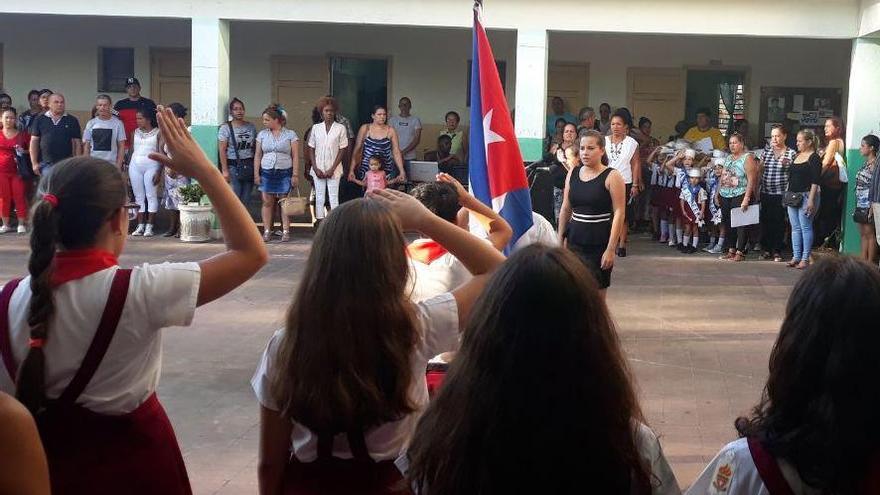
14ymedio bigger14ymedio, Ernesto Santana, Havana, May 2 2019 — There are many images of Cuba from the last 60 years that are shocking even for those who have grown up in it and should have already gotten used to it. But it is not easy to get used to those images that have something unnatural about them. One of the worst is that of primary school children who participate in acts of repudiation or in its light variant, the multitudinous political parades.

Or in a simulation of those types of marches in which the students, led by the principal and the teachers, leave the school for the street as a unit — carrying posters, disguised as workers and chanting slogans — they go around the block and they go back to school.

If one asks a ten-year-old what the Constitution is, or what the Helms-Burton Act is, what socialism or empire are, she almost most certainly has no idea or just repeats some explanatory phrase that has been instilled in her, and then continues to play without the slightest concern. continue reading

We might think that the little ones are not much affected by the incessant ideological programming, because childhood innocence is stronger than all that absurd talk. But when they grow up, the effects of long training can be seen: the double standard, learned helplessness, the Stockholm syndrome, all those Cuban ills of the last half century.

Although they don’t end up being the androids that the master plan intended them to be, at least many of them, automatons of absolute obedience, they do turn out to be fakers, who privately curse the government and then, to avoid standing out, march in the parade in the Plaza of the Revolution on May 1st.

As their teachers did in the past when they were children, the children follow their teachers without knowing the real significance of the empty words. But it doesn’t matter any more: they are words only food for being spoken, but not for being assumed. The children repeat, as their educators do, Fidel Castro’s concept of revolution as a series of confusing terms with no connection to reality.

Just words whose significance we find in no dictionary. Nobody knows what it means exactly to want to say, “change everything that should be changed,” “revolution is never lying,” or “I am Fidel.” And not even the teachers who are repeating it can rationally explain the school slogan, “Pioneers for communism, we will be like Che!”

Because you do not have to think about the meaning of any slogan. Just repeat it or carry it written on a poster. “I am Fidel” means, let’s face the contradiction, that Fidel Castro is God and therefore I can never be like him. But religious dogmas are not reasonable.

If there is a crisis of values, it does not matter. What can not be manifested is an ideological crisis. Thus, in the face of moral misery, the Government intends that the family share with the school the role of training and developing the students, even though what families and schools share most specifically is a serious lack of civility.

And yet, parents can not teach the child anything that contradicts the dogmas of the Castroite Church. In fact, instruction by the State is mandatory and parents can not educate their children at home. In Guantánamo province, a few days ago, two pastors were sentenced to prison for practicing homeschooling and acting against “the correct formation” of their children.

The Cuban educational system is not designed to train free and independent citizens, but to manufacture docile individuals. Teachers may be missing, classrooms may be very damaged and parents will have to help out the school in many aspects, but what can never fail is the revolutionary catechism and the cult of the immortal Commander in Chief.

Even when the student goes to university, and even when he graduates and practices teaching, he must continue to obey and avoid any independent attitude. The student Karla Pérez was a member of the opposition movement Somos+, and the and the teacher Dalila Rodríguez was not engaged in activism but she was the daughter of a defender religious rights, Leonardo Rodríguez Alonso and a friend of the pastor Mario Félix Lleonar.

Many years ago the writer Slawomir Mrozek published, in Communist Poland, the story “The Elephant,” about a teacher who, after explaining in detail what that animal was like, took his students to the zoo to see one face to face.

But the people in charge of the zoo — to save money and taking into account that the heavy animal moved very litte — decided to buy an inflatable one. When the students came to see a “real elephant,” suddenly the wind blew and carried the big animal across the sky as if it were a balloon. The trauma they experienced changed those children’s lives

The elementary students who performed that mockery of a march for May Day would not have been so disappointed. They already know very well that what they say and make them say in school has very little to do with reality.

_______________________

The 14ymedio team is committed to serious journalism that reflects the reality of deep Cuba. Thank you for joining us on this long road. We invite you to continue supporting us, but this time by becoming a member of 14ymedio. Together we can continue to transform journalism in Cuba.

Political Snobbery or Consensual Propaganda

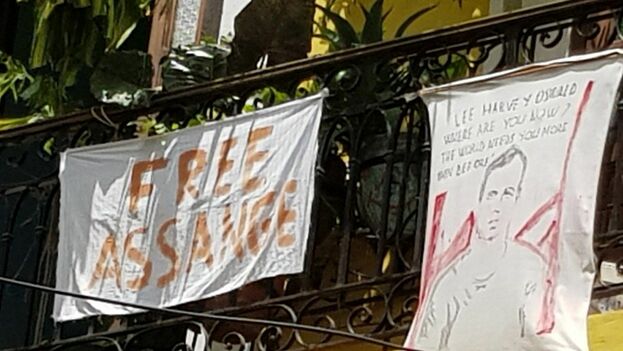
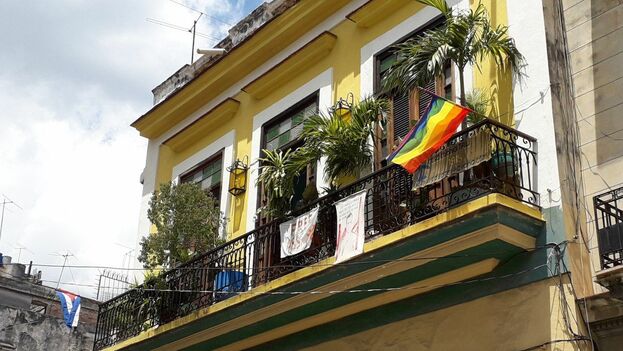
The truly surprising thing about this modest little hostel is the strange display hanging from its balcony. (14ymedio)

14ymedio bigger

14ymedio, Miriam Celaya, Havana, 19 April 2019 — As Cuba sinks into a new period of crisis, the absurdity of existing in parallel planes has been imposed as the norm in the daily lives of its inhabitants. Submerged in the desperate search for subsistence, a growing number of Cubans choose to ignore other signs of reality that reveal alarmingly the alienation that attacks us at a spiritual level from public spaces without the majority being aware of it.

This kind of social blindness prevents perceiving the flagrant rupture between the official discourse and the social practice, as well as the divorce between the real life of ordinary people and the performance of the earthly paradise offered to foreign tourists – that privileged Pleiad of occasional visitors that later leave, pleased to find so much charm in the midst of general decadence – in a Cuba of props that looks less and less like itself and its inhabitants.

In this idyllic representation made for the foreign guest, certain successful private hostels play an important role, which – contrary to the semi-deserted hotels of mixed state capital and foreign investors – usually keep their rooms full throughout the year. continue reading

In this idyllic representation made for the foreign guest, certain successful private hostels that usually keep their rooms full throughout the year play an important role

The historic center of Old Havana stands out among all the areas of tourist interest, not only for its architectural values, its old buildings, its old churches and stone palaces and its colonial squares, but also for the emergence of many small private investment spaces – lodging, restaurants, bars, coffee shops, sale of handicrafts, art galleries, among others – that began to proliferate everywhere in recent years in that compact and unique urban geography.

The interior of a hostel is a world apart that hides from prying eyes what is not within the reach of ordinary Cubans: comfort, quietude, the warm friendship of the owners, the abundance of a good breakfast, the cordiality of the employees.

Needless to say, every successful host is, or at least appears to be, “politically correct” according to the official canons: revolutionary, socialist, Fidel-fanatic and integrated into the system, which allows him to take certain rare liberties. This seems to be the case of the Colonial Casa Tali Hostel, located at 406 Lamparilla Street, a few steps from the Church of Santo Cristo del Buen Viaje and the square of the same name, in the inner area of Old Havana.

The house in question is not really a colonial building, but a typical construction of the first third of the twentieth century, although it exhibits colonial elements, with arches, columns, high ceilings, balcony with wrought iron railing on the façade, and French louvered window-doors, an architectural style quite common in any of the oldest areas of the city.

The Colonial Casa Tali Hostel is located at 406 Lamparilla Street, a few steps from the Church of Santo Cristo del Buen Viaje and the square of the same name. (14ymedio)

However, what is really surprising in this modest inn is the strange display hanging from its balcony: at one end the multicolored gay flag, at the other, the Cuban flag, and between each one of them, cloth banners written in English, one of they with a big sign that says: “Free Assange”, while the other one – which is even more enigmatic and inexplicable – sends the following message: “Lee Harvey Oswald where are you now? The world needs you more than before.”

For an American it would be unthinkable to place a petition to Lee Harvey Oswald on his facade

For any foreigner, both posters can be proof of the freedom of expression that Cubans enjoy. In fact, for an American it would be unthinkable to appeal to Lee Harvey Oswald on his facade.

But the citizens of Cuba know that, in this country, publicly and freely displaying a poster with political content, and written in Spanish constitutes in itself a very touchy problem for any artist or sign painter, and it is at least suspicious for a private entrepreneur to allow a similar audacity.

Furthermore, asking for freedom for the famous Australian hacker is to go one step ahead of what the official press monopoly has ventured to express; but to openly invoke the memory of Lee Harvey Oswald, presumed guilty of the 1963 assassination of John F. Kennedy, the then U.S. President, as subject of “the world needs more than before,” is not only an act of inadmissible insolence, but also a gross incitement to violence that contradicts, head-on, the overhyped will for peace speech of the Cuban Government.

Isn’t the owner of this business clearly suggesting that a new assassin is needed to shoot dead the U.S. president? What scruples do the Cuban authorities employ to condemn the alleged assassination attempts of their ally, the usurper Nicolás Maduro, and at the same time allow the display of this type of message? Are there good murders and bad murders?

Perhaps we will never know exactly if this is a case of naive political snobbery motivated by the excess enthusiasm of the owner of the hostel or a not very subtle propaganda the authorities have consented to. The truth is that most of the Havana inhabitants who move about under that balcony may not pay too much attention to the banners, or do not understand the message, written in English.

It is also more than likely that many of them don’t know who Lee Harvey Oswald was, or that they have only heard in passing in the official media the name of the arrogant hacker who has published so many secrets affecting the American Government.

This may be the case, so the hostel propaganda is tolerated or allowed precisely because both messages contain a deep anti-American sentiment

But that may be the case, and the hostel’s propaganda is tolerated or allowed precisely because both messages contain deep anti-American sentiments, the quintessence of the Castro regime.

It would be very different if another entrepreneur were encouraged to place on his balcony, even if written in Mandarin Chinese, a petition to free the artist Luis Manuel Otero Alcántara, arbitrarily kidnapped by the political police to prevent him from carrying out a performance within the framework of the Havana Bienial, where the American flag was used as motive.

We would also have to see what would happen to private hostel operators or any anonymous citizens if they placed posters in their balconies demanding freedom for Dr. Eduardo Cardet or for all the Cuban political prisoners. These banners would, without a doubt, unleash all the repression demons. And if someone questioned it, here’s the challenge: try to do it and you’ll see who and how establishes the limits to freedom of expression in Cuba.

Translated by Norma Whiting
__________________

The 14ymedio team is committed to serious journalism that reflects the reality of deep Cuba. Thank you for joining us on this long road. We invite you to continue supporting us, but this time by becoming a member of 14ymedio. Together we can continue to transform journalism in Cuba.

Housing as a Problem

During the ’70s and ’80s the ’microbrigades’ movement, used to build multi-family buildings, spread in Cuba. (14ymedio)

14ymedio bigger14ymedio, Reinaldo Escobar, Havana, 30 April 2019 — Two weeks ago Cuba’s Council of Ministers issued an agreement that makes the transfer of property more flexible for those who occupied “houses, rooms, habitations, accessory units and premises without legal status or without observing the formalities in their construction.”

It is assumed that this measure, long-awaited, benefits thousands of families throughout the country, not with a new home but with a new status for what they had already acquired.

This agreement does not open the door to the construction of new real estate but only regularizes the property of those who were leasing or “illegally” occupying their domicile. However, the new regulations will expand the official statistics of registered houses, which currently amount to 3,824,861 throughout the country, of which almost 40% are considered to be in just fair or poor condition. continue reading

With the enactment of this agreement in the Official Gazette, the size of the “housing problem” will hardly change, and it remains the oldest, most widespread social concern with the greatest impact on the Cuban population. In the last 60 years attempts at a solution have only had positive repercussions in the short term and in most cases they have been experiments where improvisation and voluntarism have prevented lasting results.

The first step taken by the Government in this sector occurred as early as February 17, 1959. That day, 24 hours after taking office as Prime Minister, Fidel Castro abolished the National Lottery and created in its place the National Institute of Savings and Housing (INAV), whose primary function would be to build houses with the money that would be obtained from the purchase of the new “Revolutionary Lottery” tickets.

Less than three weeks later Law 135 imposed a drastic reduction in the housing rents. At that time, the State did not have any presence in the real estate business since the first stone of the novel method, created by INAV, had not yet been laid. Thus, those affected were the private owners who, although they represented a minority compared to the number of beneficiaries, were all of those who, up until that time, had invested in the construction of houses and apartments.

On October 14, 1960, seeing the financial resources of the lottery did not advance the construction of housing at the desired rate, the Comandante en Jefe, obsessed with fulfilling his promise to resolve the matter as soon as possible and at whatever price, signed the Law of Urban Reform, towhich in its final disposition iwas granted “force and constitutional hierarchy.”

The new law eliminated the right of a private individual to profit from the rental of houses and transferred to the state all the properties that were dedicated to that business. After proclaiming in his first article that “every family has the right to decent housing,” it was specified that the State would enforce that right in three stages.

In the first stage, the price of the houses would be amortized with what the family paid for rent in five years. In the second, the “immediate future stage,” the State “with the resources coming from this Law” would build houses in a massive way and cede them in permanent lease arrangements through monthly payments that would not exceed 10% of the family income. In the third “future stage instruments,” the State would build houses with its own resources and “cede them in a permanent and gratuitous lease to each family.”

A rectification of these daydreams, which entered into force on July 1, 1985, extended the term of the payments to be made to 20 years and ruled that the price to be paid would be calculated, as of that date, based on the square meters of the building.

In the 25 years between the Urban Reform and its rectification, the most popular experiment that was put into practice was the plan of the microbrigades. Cubans under 30 only know of this concept through hearsay, because the once heroic microbrigades practically disappeared after 1990.

The movement was founded on February 17, 1971 in the Alamar district located east of the capital. It was based on the idea that workers would build their own homes. To this end, the State assigned land, supplied materials and placed a small number of specialists who trained those who would end up as bricklayers, electricians or plumbers.

At the conclusion of the work, the apartments were distributed among workers from the work center that had provided the microbrigadistas, with the determinations of who would get a home based on labor and social provided and a consideration of those who were really in need. Throughout the country one can find these projects where the buildings of five floors abound and from time to time more advanced models built using different technologies with 12, 14, 18 and 24 floors.

The reasons for the disappearance of this initiative have never been convincingly explained, but among the reasons may be how expensive it was for workplaces to continue paying the full salary of the micro-brigade workers who remained permanently mobilized in the construction, Monday through Saturday, ten hours a day for three to five years. On the other hand, the productivity of these improvised builders was low and the quality of the completed projects left much to be desired.

Another very important argument is that, until July 1985, those who received a house in this way and had participated in the micro  (as the microbrigade was commonly called) paid only a monthly payment equivalent to 10% of their salary. If someone earned, for example 200 pesos, he paid 20 each month, which multiplied by the 240 months in 20 years, resulted in the price of his apartment totalling 4,800 Cuban pesos. This amount was extremely far from what the apartment had cost the State, and thus the investment made was irrecoverable in economic terms.

In the meantime, new housing assignments were made taking possession of the apartments left behind by those who had decided to emigrate permanently. The immigration law that remained in effect until the end of 2012 provided for the confiscation of the properties of those who left the country.

The most important emigration waves were those in 1965 by the port of Camarioca, the one of 1980 through the Port of Mariel and the massive exodus of the rafters in 1994. As a result of these and other exits from the country, the problem was “resolved” for tens of thousands of families, almost all selected for “their proven political loyalty.”

After General Raul Castro became president of the country, two decisions were taken that had a strong impact: the authorization for the sale of houses (2011) and the new Migratory Law (2013), which abolished the concept of “definitive exit” by which the property of the emigrants was confiscated. Consequently, those who decided to leave were able to sell their houses to defray the expenses of their emigration.

When unleashing a wave of transactions for the sale of homes between individuals, the State realized that the prices that were declared legally, for the purposes of paying the required tax, were those that appeared written on the properties. But everyone knew that an apartment that registered a legal price of 4,800 Cuban pesos (approx. $200 US) was actually selling at 30,000 convertible pesos, or approximately 150 times more.

To avoid the effects of this veiled fraud, the Government decided to change, by decree, the prices of the homes that were to be sold and also assigned to each a “reference value” that multiplied the new figure by five, six or seven.

This reference value is used to calculate the sales tax. For example, that apartment which in 1985 was valued at 4,800 Cuban pesos today may have an official price of 39,000 pesos, but the reference value ends up being 234,000 pesos. Consequently, when the owner decides to sell it, he must contribute to the Treasury a tax of 4%, the equivalent of 9,360 pesos, almost double the idyllic price that the hard-working micro-brigadista paid off in 20 years, for the tax alone.

Now, the new measures will facilitate the acquisition of a property title for those who live in a state lease property and those who have not been able to legalize the possession of a house. However, the boldest thing that remains to be done to begin to give a definitive solution to the housing problem will not be to make paperwork more flexible, but to allow construction cooperatives to become companies with sufficient legal capacity to acquire materials, hire qualified personnel and open an authentic real estate market.

The State could continue to build for those who do not have the capacity to pay for the homes that go on the market. At least for those who receive poverty level wages. But at least it has already been recognized that a house can not be worth 4,800 pesos, as had been established by that hypocritical utopia.

____________________________

The 14ymedio team is committed to serious journalism that reflects the reality of deep Cuba. Thank you for joining us on this long road. We invite you to continue supporting us, but this time by becoming a member of 14ymedio. Together we can continue to transform journalism in Cuba.

Leopoldo Lopez and Juan Guaido Call From a Military Base for "The End of the Usurpation"

Juan Guaidó and Leopoldo López at La Carlota military base this morning

14ymedio bigger14ymedio, Caracas, 30 April 2019 — Venezuelan opposition leader Leopoldo López has been released by military deserters after receiving a presidential pardon, according to what his father told the Spanish radio station Cadena SER. Shortly afterwards, Juan Guaidó appeared with the leader of Venezuela’s Voluntad Popular ( Popular Will) Movement at La Carlota air base in Caracas to ask the military to rise up against Maduro in what he has called “Operación Libertad” (Operation Freedom).

“People of Venezuela our struggle is framed in the Constitution, in nonviolence,” said the interim president in a video that has been broadcast live on Twitter.

Guaidó has asked public employees and the military to join him. “I invite you to activate Operation Libertad in all the streets of Venezuela, as president in charge of Venezuela, I call all the soldiers, the entire military family to join us in the fight, not violent,” the politician adds.

According to the Spanish newspaper ABC , seven military detachments have been taken over by allies of Guaidó. continue reading

The Venezuelan government has already reacted by saying that it has the situation under control. Venezuela’s communication minister, Jorge Rodríguez, said that he is “confronting and deactivating” a plan for a coup.

“We inform the people of Venezuela that we are currently confronting and deactivating a small group of traitor military personnel who positioned themselves in the Altamira Area to promote a coup d’état against the Constitution and the peace of the Republic,” the minister said.

Within the framework of our constitution. For the final end of the usurpation. [See video here]

— Juan Guaidó (@jguaido) April 30, 2019

Leopold López, leader of the Voluntad Popular Movement, has been under house arrest since July 2017. Before that, López was in Ramo Verde prison since February 18, 2014 when he voluntarily turned himself in to the police after an arrest warrant was issued against him for the events that took place in a demonstration called six days earlier by, among others, him.

In September 2015, he was sentenced to almost 14 years in prison for the crimes of public incitement, conspiracy (association to commit a crime), property damage and arson for the events that occurred during the demonstration on February 12.

_________________

The 14ymedio team is committed to serious journalism that reflects the reality of deep Cuba. Thank you for joining us on this long road. We invite you to continue supporting us, but this time by becoming a member of 14ymedio. Together we can continue to transform journalism in Cuba.

May First Without an Official Speech, But With a Recording of Fidel Castro’s Voice

Raul Castro, dressed in military uniform, greeted the participants of the march from the rostrum but did not make any public address. (EFE)

14ymedio bigger14ymedio, Havana, 1 May 2019 — Unlike what happens in the rest of the world, the thousands of Cubans who marched this May Day did not ask for wage increases and better working conditions.

And, unlike in previous years, there was no speech from any of the authorities present; neither president Miguel Díaz-Canel nor the general secretary of the Communist Party, Raúl Castro, spoke.

The only “authority” who “spoke” was the late head of state, Fidel Castro, whose recorded voice could be heard as far as Sport City, over a mile away, thanks to the new sound amplification system. continue reading

Under the motto Unity, Commitment and Victory, the participants waved placards in favor of the Government and carried posters with the faces of Fidel and Raúl Castro, along with Díaz-Canel. Those who did speak repeated, with emphasis, the word “continuity,” which over the last year has been the motto of the mandate of the 59-year-old engineer who assumed the presidency in April 2018.

May 1st, Workers’ Day, is a holiday throughout the Island, with most of the shops closed and state workplaces silent. The official deployment calling everyone to parade in the most important squares of each province occurs this year amid a worsening economic crisis on the island, one that is especially obvious in the poor supply of food and drugs.

Many residents of Havana, where transportation problems have worsened in recent months, lamented the cancellation of bus routes, which stopped running the night before, as the buses were reserved by the authorities to bring participants to the parade.

Contrary to what was expected, the ruling party did not take advantage of May 1st to make clear its support for Venezuelan president Nicolás Maduro, whose stay in power is threatened by an uprising led by the opposition leader, Juan Guaidó.

Instead, the marchers carried some burlesque Donald Trump cartoons and messages of support for Maduro, along with several Venezuelan flags linked to the Cuban banner.

The official pronouncements and the slogans have focused on internal politics and on demonstrating the support of Cuban workers for the Government.

Raul Castro, dressed in a military uniform, greeted the participants of the march from the rostrum but did not make any public address, in an act that was characterized by the lack of a major speech, thus breaking with tradition. Not even Ulises Guillarte de Nacimiento, general secretary of the Cuban Workers Center (CTC), the only union allowed in the country, took the floor.

Meanwhile, Television broadcasters made several allusions to “imperialism” a day after US President Donald Trump threatened sanctions “of the highest order” against the island if Havana does not withdraw its military and intelligence forces from Venezuela.

_________________

The 14ymedio team is committed to serious journalism that reflects the reality of deep Cuba. Thank you for joining us on this long road. We invite you to continue supporting us, but this time by becoming a member of 14ymedio. Together we can continue to transform journalism in Cuba.

All Eyes On Venezuela

Juan Guaidó and Leopoldo López in La Carlota with military deserters from the Maduro regime.

14ymedio bigger14ymedio, Yoani Sanchez, Generation Y, Havana, 30 April 2019 — The Americas awoke today with all eyes on Venezuela, an attention that extends to the other side of the Atlantic Ocean and that keeps governments, citizens, exiles from that South American country, journalists and analysts in suspense. The world pulses today in Caracas, after months of tension and years in which the oil producing nation has been sliding down the slope of economic collapse, political authoritarianism and social deterioration.

The release of Leopoldo López and the call of Juan Guaidó to put an end to the “usurpation” have brought the Venezuelan situation to a turning point. In the next few hours the first steps could be taken towards a call for free elections or, to the contrary, a repressive blow – of unprecedented proportions – could be launched from the regime of Nicolás Maduro against those who demand his departure from power.

Beyond predictions or forecasts, the main actors of this political drama have reached a point of no return. The principal protagonist is a Venezuelan people weary of the inefficiency of the system, galloping corruption, inflation and the lack of basic products. A population that has seen its quality of life collapse and that has had to say goodbye, every week, to friends and family members as they emigrate to escape the crisis. continue reading

Also in the “cast” of this tragedy is starring young Guaidó, a man who has made a meteoric ascent in recent months, supported by the international community and by a good part of Venezuelans who have found, in the President of the National Assembly, hope for change. Now, accompanied by his mentor Leopoldo López, the passionate engineer is at the center of danger and of dreams. He could see out this day strengthened and borne on high, but his chances of arrest or assassination are also very high.

On the other side of the conflict, there is the Chavista leadership that tries to protect a regime that has allowed it to roam at ease throughout the country, lining its pockets. Ministers, officials and senior military officers who are supported by Havana, which has provided them with intelligence agents and advisors on the matters on which the Cuban political police are experts: the submission of a society and the surveillance of each individual. In the early hours of the morning, Cuban president Miguel Díaz-Canel was already on Twitter supporting Maduro and he is expected, throughout the day, to raise the tone of the official rhetoric against the Venezuelan opposition.

Both a tragedy and a peaceful exit are on the table. Each role in the conflict could bring influence to bear during the course of the day, but it is in the Miraflores Palace in Caracas and in the Plaza of the Revolution in Havana where the cruelty or peace of of this Tuesday will be decided. To that scenario we must add Washington, attentive to every detail and knowledgeable about everything that is at stake in Venezuela today.

___________________

This text was originally published in the Deutsche Welle for Latin America.

The 14ymedio team is committed to serious journalism that reflects the reality of deep Cuba. Thank you for joining us on this long road. We invite you to continue supporting us, but this time by becoming a member of 14ymedio. Together we can continue to transform journalism in Cuba.

An Activist and an Independent Journalist Recently Freed

The Inter-American Press Association, during its most recent meeting, revealed that freedom of expression and of the independent press are becoming “criminal behavior” according to the Cuban Constitution.

14ymedio bigger14ymedio, Havana, 27 April 2019 — In recent hours journalist Roberto Jesus Quinones Haces and activist Hugo Damian Prieto were set free.  The reporter had been arrested last Monday when he tried to cover the trial of two evangelical pastors while the dissident was sentenced in December of 2018 for the supposed crime of “pre-criminal dangerousness.”

The liberation of Prieto, leader of the Orlando Zapata Civic Action Front (FACOZT), happened this Friday night.  The dissident was freed from the prison known as the Toledo II Unit in Valle Grande municipality La Pisa, Havana, where he was transferred after the December trial in which he was sentenced to one year of deprivation of liberty.

“They gave me a letter of freedom that says suspension of security measure,” explained Prieto to this daily.  “The two agents from State Security who gave me the document searched me in prison and took me to a house for an interrogation.”  The officials threatened the activist with surrounding his house so that he will take no opposing action during the May 1 Workers’ Day. continue reading

Prieto complains of the bad conditions in the jail where “there is no transportation for prisoners if they have an emergency, everything is full of bed bugs and poor sanitation,” he says.  The dissident spent a good part of his incarceration in a makeshift medical post in the dining room, given the precarious state of his health, especially due to his cardiac problems.

“In the last month they did not give me the medications needed for my heart ailments and previously I had missed some,” he says.  In spite of the hard months he endured, Prieto reaffirms his decision to continue his civic activism and his street actions.

For his part, journalist Roberto Jesus Quinones Haces, a contributor to CubaNet who was detained at the beginning of the week by agents of the political police in Guantanamo, was set free this Saturday.

Before leaving prison the reporter received a citation to appear next Tuesday in the provincial Military Tribunal where he must be informed about the supposed crimes of “contempt” and “attempt” of which he was accused when he was arrested.

During the almost five days that the arrest of Quinones lasted he did not have access to water for personal hygiene.

The journalist was arrested in the afternoon last Monday at the entrance to the Guantanamo Municipal Tribunal when he tried to cover the trial that took place there against Ramon Rigal and Ayda Exposito, an evangelical couple sentenced to prison for refusing to send their children to school in order to have the opportunity to home-school them.

Before being arrested Quinones Haces managed to make a phone call to his wife, Ana Rosa Castro, from the police patrol car and tell her that he had been beaten, especially in the face, as she was able to prove after she visited him Tuesday at the National Revolutionary Police (PRN) station where he was detained.

According to Castro, Quinones Haces had trouble hearing from his right ear, swelling of his mouth, lacerations to his tongue, a fracture of his right thumb, and extreme difficulty swallowing solid foods,” she detailed in a note to the Pro-Freedom of the Press Association (APLP).

After the detention, several politicians from the United States such as Cuban-American Senator Marco Rubio and Assistant Secretary of State in the Bureau of Western Hemisphere Affairs, Kimberly Breier, demanded that the Cuban government immediately release Quinones.

The Inter-American Press Association (SIP), during its most recent meeting in Cartagena de Indias, presented a report in which it complained that freedom of expression and of the independent press are becoming “criminal behavior” according to the Cuban constitution.  The SIP adds that Article 149 of the Penal Code maintains the crime of “usurpation of legal capacity” [i.e. practicing a profession without a license] which is used to punish independent journalists.

Translated by Mary Lou Keel.

_________________

The 14ymedio team is committed to serious journalism that reflects the reality of deep Cuba. Thank you for joining us on this long road. We invite you to continue supporting us, but this time by becoming a member of 14ymedio. Together we can continue to transform journalism in Cuba.

Dozens of Congolese Tightly Guarded in Havana Await Repatriation

Police surround the outskirts of the Embassy of Congo in Havana (14ymedio)

14ymedio bigger14ymedio, April 27, 2019 — Dozens of Congolese students who are studying medicine in Cuba find themselves being detained and guarded in a place close to the international airport in Havana, waiting to be repatriated to their country, according to several students who managed to remain in the Salvador Allende Faculty of Medicine in the Cuban capital.

”They took them in a bus on April 18, and at first we thought it was for a meeting where they were going to explain things, but they never came back,” one of the students who remained on the university campus said, under condition of anonymity. “They’re not letting them speak with anybody, but we’ve learned that they are holding them in a well-guarded place to send them back to the Congo.”

“They carried out a raid at the Faculty of Medicine and put them on a bus,” the neighbors confirm. “All of us in the neighborhood thought that finally the situation was going to be managed because later we saw only a few buses return,” they add. continue reading

This newspaper can’t confirm if repatriation of the students has begun, but several sources said that they are awaiting “a response from the Congolese.”

Last Monday, an opposition group in this African country, in a comminication, had denounced the fact that the students were called to the Embassy of Congo in Miramar under the pretext that they were going to receive part of their overdue stipends. “Actually, the Cuban and Congolese authorities laid a trap for them,” the opponents explain.

“Shortly after they arrived, the students were separated into groups, and more than 200 were forced, by Congolese and Cuban agents, to get on the bus, supervised, and then were taken to an unknown stop. Other students waited more than 6 hours for their friends, without success. The telephones of the detainees had been out of service this whole time,” explains the text.

New images have come to light of the violent repression against students from Congo by the Cuban police. The student interns were protesting because of the delay of two years for their stipends and the poor conditions in which they are living on the island. Images here

— Mario J. Pentón (@marijose_cuba) April 9, 2019

The detention was also confirmed on the Facebook page, “I’m not returning without my diploma,” created by Congolese students to demand back-payment of 27 months of their stipends. On this platform, the students clarify that the protests that began at the end of March aren’t the work of a leader manipulated by “dark forces” as claimed by the Congolese Government.

The group of medical alumni also said that they presented legal remedies in agreement with Cuban law, and they launched a petition to the authorities on the island to allow release and academic reinstatement of the detainees.

After this happened, the Chancellor of Congo, Jean-Claude Gakosso, went to Havana, where he met with Miguel Díaz-Canel and presented him with a letter from the Congolese President, Dennis Sassou Ngueso. However, the official press only mentioned the visit as an opportunity to strengthen commercial and political ties.

Junior Bokaka, a Congolese student of epidemiology, who has been featured as one of the protest’s spokesmen, said on Facebook that the complaint about the stipends for the Congolese students has “nothing to do with the Cuban Government.”

Bokaka took advantage of the opportunity to point out that, contrary to what some press media have said, he is a simple student who reported the situation on his Facebook account, but he doesn’t consider himself a leader of the demonstrations nor a student representative.

Translated by Regina Anavy

_______________________________

The 14ymedio team is committed to serious journalism that reflects the reality of deep Cuba. Thank you for joining us on this long road. We invite you to continue supporting us, but this time by becoming a member of 14ymedio. Together we can continue to transform journalism in Cuba.

The New Castro Constitution and the Economic Crisis: Born Twins

Hunger in Cuba: A people living on croquettes. Photo file

Cubanet, Miriam Celaya, Havana, 18 April 2019 — Only a few days have passed since the proclamation of the new Castro Constitution, but nobody is talking about it on the streets of the Cuban capital. Of the entire boring speech by the Army General, the central character of the announcement and of his shiny new work, only one sentence –as lapidary and ominous as the last nail that seals a coffin — stuck in the minds of Cubans, and that was when the head of the geriatric power elite made public what was already an open secret: we must “prepare for the worst variant” of the economy. Officially, the feared ghosts of the “Special Period” of the 90’s, which have been circling for the last year, and which the most deluded considered over and done with, have become reality.

Leaving aside the very questionable exceptionality that makes Cuba the only country in the Western world where a new Constitution and a new economic crisis are announced at the same time and on the same stage, the most contradictory fact is that the aforementioned ‘Magna Carta’, Far from adapting to current times and promoting changes that help oxygenate the economy, is designed to consecrate precisely all the elements that guarantee a state of permanent and irremovable crisis, with the sole objective of perpetuating a class in Power.

By keeping the economy strongly centralized, with state ownership and the inefficient management of the State as its main economic pillars, by refusing to open up to a market economy, and by limiting the minimum expression of citizens’ private initiative and economic freedoms and civil rights — not to mention their political rights — it is more of an epitaph than a Constitution. continue reading

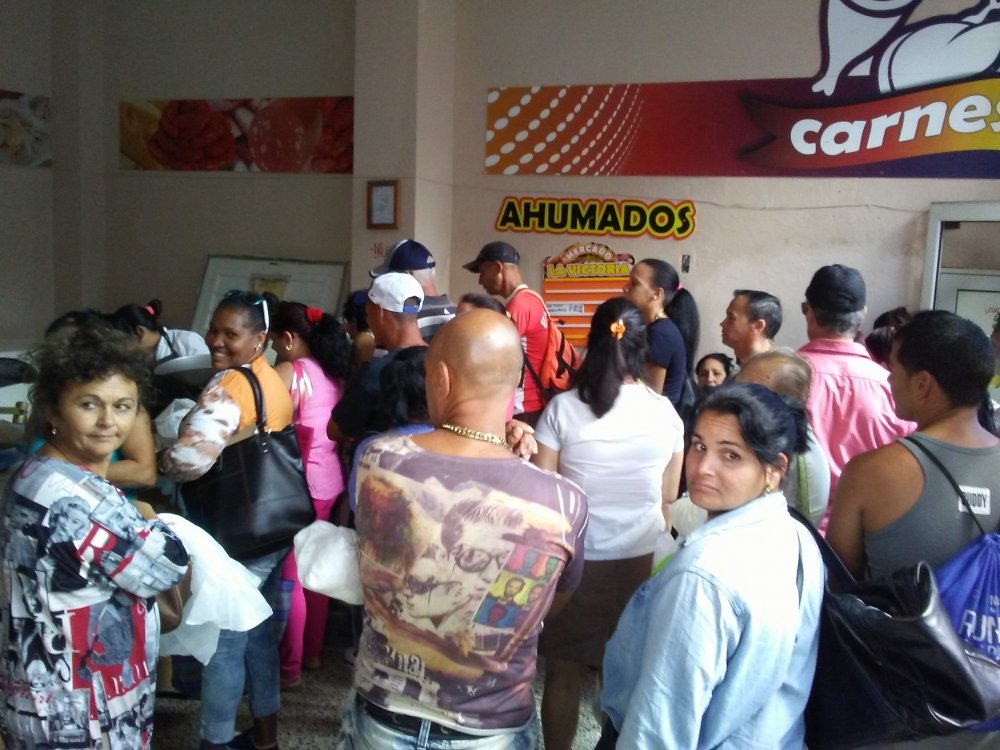
Before the total lack of will to make changes, and given that no miracle or saving source is seen on the horizon to subsidize the unquestionable failure of the system, Cubans have been plunged into the critical phase of the battle for survival in the midst of shortages, extreme rationing and hordes of people in the few markets where some foods in high demand are still marketed, especially oils and meat.

The shopping center Plaza de Carlos III, in the Havana municipality of Centro Habana, is one of a few favored markets enjoying what we could call “the assortment grace” and, consequently, a habitual scenario of that silent battle. Despite the small and limited variety of the supply of increasingly scarce products, in the meat department of this shopping center — as in the other regular city markets, including the one at 3rd and 70th, in the privileged neighborhood of Miramar — the supply of some of the most popular products has sustained relative regularity, so far.

As a result, there are daily swarming crowds at the Plaza de Carlos III, jam-packed for hours before the gates open that give access from the parking lot, which has been exclusively assigned for individuals who want to do their shopping at the butcher shop. The long line crosses a good part of the parking area, particularly on weekends, when many people also come from the provinces near the capital, or even from more distant places, where the shortages are atrocious.

It is generally unknown which products will go on sale each day, but the feeling of urgency and the need to bring food home does not allow most people viable options. Day after day, the same scene is repeated throughout the opening hours of the market: a constant human tide, forced to dedicate hours of their daily lives carting around food at prices that do not correspond to Cuban wages.

And while hardships are becoming the norm, the exclusions are growing at the same time. At the end of March, the directors of the Gastronomy and Services Company of Centro Habana, in a meeting with the directors of each establishment, reported that it is strictly forbidden for them and their subordinates to even mention the phrase “Special Period.

At the same time, the employees of the shopping centers that operate in foreign currencies received the same orientation. “Special period,” “crisis,” “shortages,” are some of the terms that have swelled the extensive list of subversive words, as if the terminology — and not the bad performance of the country’s administration — was the cause of the economic setback that dooms Cubans to a state of poverty.

Meanwhile, the regime has been oiling the mechanisms of repression and controls. The National Bus Company has recently begun to apply strong restrictive rules to control the contents of passengers’ baggage. Each traveler can transport up to two liters of edible oil to the interior provinces. There have also been drastic limitations on the allowed weight, with significant added fees for excess baggage.

Other food and hygiene products — such as bath soap, toothpaste and detergent — are also being restricted in baggage. According to the officials in charge of these controls, these measures seek to avoid speculation and smuggling on the black market, but this regulation also affects families who are forced to get their supplies in the capital city, all those necessities that have practically disappeared from the villages in the interior of Cuba.

“And that’s nothing, the worst is yet to come!” predict the most famous who lived through the unspeakable hardships of the 90s as adults, and know that, this time, the situation in the interior, as well as at the regional and international level, is a lot more complex than it was then, and doesn’t leave any room for extemporaneous optimism.

At any case it is a sentence much more realistic than all the unfulfilled promises of the Castro regime through more than 60 years, and more realistic than the Constitution, whose birth, on April 10th, was announced with all the solemnity and fanfare along that of its twin sister: the new Castro economic crisis, maybe the worst of all.

Translated by Norma Whiting