
The Recharge of Discord

Phone recharges now represent a very valuable source of income in foreign currency for the Cuban government. (14ymedio)

14ymedio bigger14ymedio, Reinaldo Escobar, Havana, 30 May 2019 — A new reproach has come to join the list of complaints that some Cubans living abroad make to their compatriots on the island. This time it is about requests from abroad to recharge phone balances: “You voted Yes on the constitutional referendum, you participate in the May Day march, you do nothing to overthrow the dictatorship and on top of that you ask me for a recharge,” respond some angry relatives.

The actors in this drama are three: the Cuban who wants connectivity; the State that keeps the money; and the emigrant who pays to recharge a mobile phone or a Nauta navigation account for a relative or friend still in Cuba.

For the resident in Cuba, connectivity can be considered as either a luxury or as an urgent need; everything depends on their occupational profile, their desire to be informed, their plans to emigrate or simply their vocation to behave like earthlings of the 21st century. They appeal to relatives abroad to recharge their phones because their wages do not allow them to pay the unjustifiable price imposed by the state telephone monopoly. continue reading

For the Cuban State, connectivity, whether to talk on the phone or to link to the network, has become the most profitable merchandise it can offer. The cost to the State is minimal, the price is disproportionate, the demand is increasing and a large part of the payment is made in real money — dollars, euros, pounds sterling or whatever currency is used by the generous relatives who buy the balance on the numerous digital sites that offer the service.

For the relative or friend who pays for the recharge, let’s say 20 dollars a month, this is a way to guarantee fluid communication with one’s family, while at the time supporting the possibility that the recipient in Cuba will find out what is happening in the world independently and may also, if they dare, participate as an activist by uploading their opinions or a video denouncing any abuse on the part of the authorities. Since most of the emigrants have to work very hard to earn a living, these recharges are usually a sacrifice, especially when they have more than one possible beneficiary on the Island.

As mobile telephony expands in Cuba, the demand for recharges from abroad grows. The possibility of connecting to the Internet from cell phones has triggered a consumption of gigabytes that, due to the high prices, is not within reach of the average purchasing power of the population.

It is for this reason that the state telecommunications monopoly Etecsa encourages, with tempting promotions, the purchase of balances from abroad. Pay $20 and get a bonus of $30 is one of the most repeated promotions, and the one that produces the most excitement among the possible beneficiaries.

It is well known that almost all of the remittances sent to Cuba by relatives living outside the country end up being spent at the counters of State markets. It has been estimated that for any merchandise sold in the “Hard Currency Collection Stores*” (TRDs) the State imposes a price that can exceed by 200% its costs to acquire or produce it.

Many people, especially retirees, survive thanks to these transactions. The ties of blood and affection towards a mother or a grandfather more than outweigh any political scruples.

But when the frequency with which Cubans on the island ask for a recharge reaches certain limits, “as if here money grows on trees,” many emigrants ask themselves two questions: What does the Government do with my dollars? Why do these “servile eunuchs, obedient rams, supporters of the dictatorship” want to connect to the internet?

The above-mentioned epithets abound in the networks. Perhaps they come from patriots who were deprived of their property, who endured long years of political imprisonment or who had to escape to avoid certain death. Or not. Sometimes those who have paid a high price for courage understand the cowards better.

In their idealistic desire to hasten changes in Cuba, especially when they have been in exile for many years, some emigrants would like to see a more immediate and substantial result from the help they provide. But gigabytes are not projectiles with an explosive charge, rather they are slow and subtle pushes against the wall of disinformation, windows from which to look out at freedom, tears to the veil that does not let one see the reality.

The photos and videos that showed the stampede of shouting protestors chasing Diaz-Canel’s presidential caravan in the town of Regla, the images of an angry protest in Guantánamo, the repression to which a march against homophobia on Havana’s Prado was subjected, the arbitrary detentions and beatings and other events of recent history, never disseminated by official media, are now accessible on YouTube. The recharges of discord are behind all that as well.

*Translator’s note: This is literally the name the State chose to give its network of stores that sell products in hard currency.

________________

The 14ymedio team is committed to serious journalism that reflects the reality of deep Cuba. Thank you for joining us on this long road. We invite you to continue supporting us, but this time by becoming a member of 14ymedio. Together we can continue to transform journalism in Cuba.
Instar Offers Two Residencies to Promote Civic Initiatives in Cuba

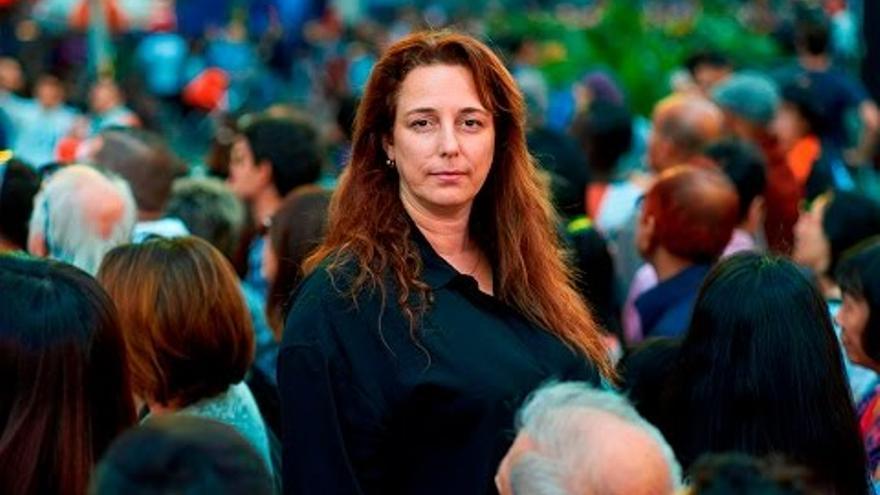
The artist Tania Bruguera directs the Hannah Ardent Institute of Artivism. (Youtube)

14ymedio bigger14ymedio, Havana, 30 May 2019 — The Hannah Arendt Institute of Artivism (Instar) is offering two Vita Activa (Active Life) Residencies “to promote civic initiatives with viable solutions in the short or medium term.” Every Cuban resident on the island can apply and novelty and creativity will be rewarded.

Vita Activa is looking for “projects which, using a strong theoretical and investigative base, are implemented in the public sphere,” explains Instar, the institute led by the renowned artist Tania Bruguera. The registration period has been extended until July 1, 2019 and individual or collective projects will be considered.

The jury that will select the winners will privilege those proposals that explore “new management models for the social and cultural development of a community.” The projects selected will be both “transdisciplinary artistic projects” and “innovative projects that start from any other social practice,” says the call for applications. continue reading

“Projects that are already in the process of being implemented and that need support will also be accepted, and priority will be given to those with the prospect to continue beyond the time of residency,” the call states. Projects will be evaluated based on a “sense of social justice, and the mutual trust generated by the project in the community and creativity,” it adds.

Two residences will be awarded and, during the first three months, the residents will have to “develop a research period to explore the potentialities and possible implementation of their proposal.” To achieve this they will have a stipend of 200 CUC per month, in addition to advice and logistical support from Instar.

The residency takes its name from the concept “vita activa,” one of the fundamental approaches of Hannah Arendt’s work “The Human Condition,” which designates three fundamental activities — labor, work and action — which condition and determine in a basic way the existence of man.

The Institute itself uses the term “artivism” to define itself based on the idea of combining art and activism, which results in socially responsible actions. It bears the name of Arendt, the political scientist who “studied totalitarian systems, both in capitalism and in socialism, and its effects on the concept of citizenship,” Bruguera said in an interview.

“In the following six months, the resident must implement the project in the space or community for which it was conceived with a budget of up to 5,000 CUC, depending on the production needs of the project.” The institute will work with the project during its first year and the results will be presented at the Instar headquarters in Havana.

The application for residencies is available on the Institute’s website and can be sent via email or presented in person to Instar headquarters.

The call emphasizes that the funds used for the residencies do not come from “donations from institutions or entities that incite violence, discrimination, demand ideological ties or demand commitments against our principles.”

Instar and Bruguera have been accused by the official press of working “actively to subvert the Cuban constitutional order” and receiving funds from the National Foundation for Democracy (NED).

________________

The 14ymedio team is committed to serious journalism that reflects the reality of deep Cuba. Thank you for joining us on this long road. We invite you to continue supporting us, but this time by becoming a member of 14ymedio. Together we can continue to transform journalism in Cuba.
Removing Life Support from a Comatose Patient / Somos+, German M. Gonzalez

New measures of the U.S. government will cut off the oxygen to a ruined economy, which so far has not imploded but has not yet taken off either. How bad will things get?

Somos+, Germán M. González, 26 April 2019 — When Donald Trump won the 2016 presidential election, the Cuban government and Communist Party assumed a disinterested attitude. At first, official propaganda outlets gave the event little attention and toned down their routine attacks on American leaders. That attitude persisted until some time after the presidential inauguration, when the growing closeness between the business-magnate-turned-president and Cuban-American politicians had become more apparent.

Initially, the new administration did not take harsher measures. It even maintained the policies of the previous administration in regards to matters of real interest to Havana: remittances, family visits and business trips by Cubans and Cuban-Americans to and from Cuba. But the power struggle in Venezuela was becoming ever more acute and Russia’s presence in the country was becoming increasingly obvious.

The Russian presence ran the gamut, from its highly publicized military presence to the much less publicized Russian appropriation of Venezuelan assets in an effort to secure loans and investments. It is worth remembering that these assets include, or may include, CITGO, a subsidiary of PDSVA (Venezuela’s state-owned oil and gas company), which owns an extensive number of properties and accounts for up to 10% of all the gasoline sold at U.S. service stations. continue reading

In other words, the Russian intrusion was not limited just to the proverbial “backyard.” It extended to the house itself, an unprecedented development, which made the Americans apprehensive. The situation began during the presidency of Barack Obama, who declared Venezuela a threat to national security, increasing the level of hostility. Nevertheless, we do not know why Cuba was not, until recently, part of the team of old hawks, known Latin American “specialists,” currently ruling Venezuela.

Recently, the U.S. canceled the agreement signed by the Major Leagues and the Cuban Baseball Federation (which would have been paid as the players’ agent), arguing that it was a Cuban government entity. Freighters owned by PDVSA and several international companies that transport oil from Venezuela were also sanctioned, striking at something of vital interest to the Cuban regime. The action involves freezing PDSVA assets under American jurisdiction, preventing financial transactions and blocking the company’s access to US ports.

It was during lunch with Secretary of State John Bolton on the 58th anniversary of their defeat during the Bay of Pigs invasion on April 17, 1961 that members of Brigade 2506 learned that the White House was applying new or toughened sanctions on Cuba, something that the State Department was putting into place that same morning. These include but are not limited to Title III and Title IV of the Helms-Burton Act, which allow individuals to file suit in American courts against companies that operate on property confiscated by the Cuban government. Enforcement has been waived every six months for the last twenty-three years.

The first cases were filed by Cuban-Americans on May 1. Potential plaintiffs vary from giant companies like Bacardi — it has annual receipts of 33 billion dollars, three times the value of all Cuban exports — to individuals whose small homes, cars, household appliances and personal effects were confiscated under Che Guevara’s philosophy that even toothbrush constituted private property.

The European Union and Canada have announced countermeasures to defend their interests. They involve various entities which manage the hard currency income generated by joint venture projects — tourism, airports, the port of Mariel, mining operations — between Cuba and its creditor nations. The projects are part of a “debt swap,” intended repay the enormous sums of money Cub borrowed from those countries.

It is an interesting development given that the Europeans, and especially Canada, have been accompanying Trump & Co. on his crusade against the Maduro regime and, like the Americans, are worried about Russia’s involvement in the western hemisphere. Title IV also allows individuals and their family members to be sued, a highly sensitive issue for businesspeople involved in global trade, especially if that trade is with the world’s most powerful economy.

Restrictions on travel and remittances. In 2018 some 658,000 Americans and 521,000 Cuban Americans visited Cuba, an increase of over 20% for both groups. According to the Havana Consulting Group, annual remittances in the form of cash and merchandise totalled 6.5 billion dollars. It is the country’s second largest source of hard currency after income from the labor force. The measure will limit the flow of travelers and remittances (one thousand dollars per quarter) and will hinder cruise operations associated with the use of confiscated properties.

Expanding the list of restricted Cuban companies. Currently there are more than 200 Cuban entities subject to economic sanctions by the United States. The list was created in November 2017 and expanded last March. Six more entities have since been added, among them Aerogaviota. The ruling prohibits financial transactions between U.S. citizens and firms with those business entities run by the Revolutionary Armed Forces and the Ministry of the Interior.

Cuba’s return to the list of state sponsors of terrorism. This measure and several others have yet to be adopted. But expectations are that, the next time the Department of State sends the new list to Congress, Cuba will added to it. International financial transactions by countries on the list are subject to extreme scrutiny. Individuals, companies and countries which engage in commercial transactions can also be penalized. The measure also means the chances are greater that the processing of visas will take longer and that state universities in Florida will have to cancel exchange programs with Cuban academies as well as student trips to the island.

This decision by the Trump administration is based on the presence of Cuban military and intelligence personnel in Venezuela, who are there to support the Maduro regime. The Cuban elite also has deep ties to organizations like the FARC and ELN in Colombia. Havana has close relations with Iran, North Korea and Syria, countries designated as sponsors of terrorism by the U.S. Department of State.

Cuba itself was on the terrorism list from 1982 until 2015, when it was removed by President Obama upon the restoration of diplomatic relations. In addition to Cuba, sanctions were placed the Central Bank of Venezuela, a Nicaraguan bank, and on a son of Daniel Ortega.

Conclusion. Based on news reports, there are clear indications that the second Special Period (one wonders why it is called this since we have been in this period, more or less, for the last sixty years) has arrived. The consequences and possible scenarios merit a separate discussion but, if anything is becoming clear with each passing day, it is the need to democratize the country and restore full rights. These include civil, political and economic rights for all Cubans, no matter where they live. If the party and government do not take action in this direction, it is sacrificing its own existence and our own national identity to the interests of caste and a political-economic system that has never worked.

Private Wireless Networks Will No Longer Be Illegal In Cuba

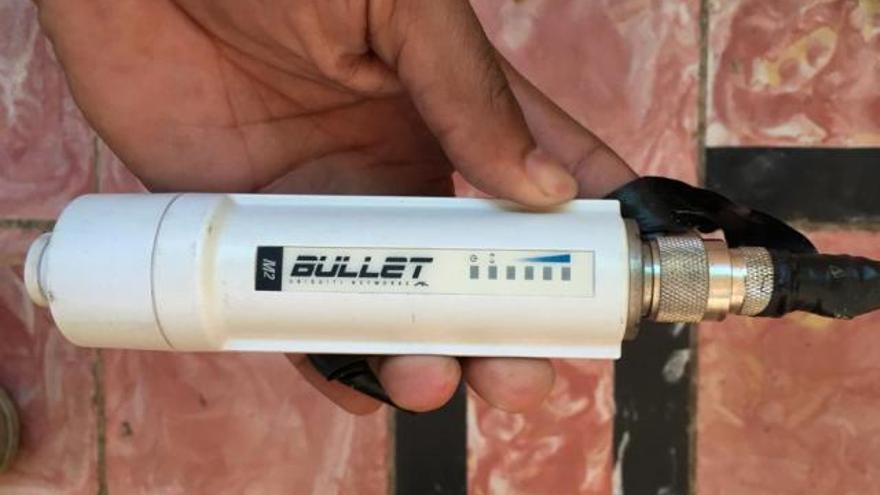
The Bullet is a device widely used by young Cubans to create Wi-Fi networks. (14ymedio)

14ymedio bigger14ymedio, Havana, 29 May 2019 — Starting this summer, Cubans will be able to legally use wireless devices to connect to the Internet from their homes or for the creation of private networks, provided that the use of these devices is not commercial.

The Government published two resolutions in the Official Gazette that define and legalize both wireless or wired interconnections between communities and the remote connection of people to the network of the Telecommunications Company of Cuba (Etecsa). The regulations will be take effect on July 29.

From that moment, any natural person can connect to the infrastructure of Etecsa via Wi-Fi with wireless devices such as antennas, NanoStations or Mikrotiks, all of which are very popular on the island but so far available only on the black market. continue reading

The users of these wireless networks will be able to use the frequencies of the band from 2,400 Mhz to 2,483.5 Mhz, and the band from 5,725 Mhz to 5,850 Mhz.

While a wireless network for domestic use only to connect within an address does not need a license, when it includes several homes or links several points outside them the administrator must request a permit. In this case, the price will be 10 CUP (Cuban pesos, roughly 50¢ US) and the permit will be valid for of 5 years. In addition, it will only be given to the owner of the property or, in the case of self-employed workers, the authorization of the landlord or owner of the premises.

Users of networks within a single address can not exceed 100 milliwatts of power (a reach of about 200 or 300 yards), which allows them to connect and share files or play without authorization.

Also available will be a license for wired and wireless networks (LAN / WLAN) when the device is outside the home for a price of 10 CUP, valid for two years. This type of network allows connecting a building or block as long as it does not interfere with public roads and does not exceed the 100 mW limit.

According to the official press, the Ministry of Communications will enable a retail network of approved equipment for the proper use of private data networks, whose technical frequency standards will be available to the user on the agency’s website, as well as the link to the products and brands.

To import a device, as long as it does not have a commercial nature, technical authorization must be requested through the Ministry of Communications website, by email or in person at the Territorial Directorates of the Technical Budget Unit for Control of the Radioelectric Spectrum.

The permit can be requested prior to the entry of the equipment at Customs, which will check it and verify that it is the same as what was declared, or it can be requested upon arrival at the Island. In this case it will be delivered within 30 days, when it has been verified that the equipment meets the requirements.

Private wireless networks have expanded in recent years on the island and have been an alternative to the problems of Internet connectivity. Among the best known is the so-called SNet, an intranet file exchange, instant messaging and games network that brings together tens of thousands of users in Havana and other cities.

That web of connections not only offers a cheaper internet experience but often is also free of censorship thanks to the fact that the flow of data passes through virtual private networks (VPN).

Police raids against wireless networks and the confiscation of their devices have been frequent. This occurs especially against those users who use nanoStations and Mikrotiks to extend the Wi-Fi signal from Etecsa that allows web browsing, and then charge others for redistributing the service.

___________________________

The 14ymedio team is committed to serious journalism that reflects the reality of deep Cuba. Thank you for joining us on this long road. We invite you to continue supporting us, but this time by becoming a member of 14ymedio. Together we can continue to transform journalism in Cuba.

Cuba’s Hand in the Venezuelan Talks in Oslo

Juan Guaidó was included in meetings in Oslo with the mediation of the Norwegian Ministry of Foreign Affairs. (@jguaido)

14ymedio bigger14ymedio, Jorge Hernández Fonseca, 22 May 2019 — After brilliant demonstrations as a wise opponent, Juan Guaidó has fallen into the trap he always claimed to reject: authorizing talks with Maduro. The reason: there is a new factor now at play in the equation, Castro’s Cuba.

According to press reports, the Oslo talks were initially suggested by Havana. Hence the danger of having planned a solution on the island that is akin to their interests, even if it means Havana has to deliver some piece of the complex chess game that is being played in Caracas. Maduro would be sacrificed.

Since the failed negotiations of the Venezuelan opposition with senior leaders of the Madurista dictatorship, it was already more or less clear that Havana’s plans of Havana could involve the exchange of Maduro for General Padrino. Behind the idea of General Padrino’s leadership as a condition for the transitional government was Cuban intelligence, trying to control the process and placing one of its best men to lead the changes towards “democracy.” This is a scheme Castroism already tried before in Nicaragua. continue reading

This most likely signifies that the opposition has received guarantees of putting in a relief player for Maduro in exchange for a transitional government plus elections, as Guaidó demands, but leaving intact the army led by Padrino and the party led by Diosdado Cabello.

This would be followed by elections that Castroism would be willing to lose, at the beginning (recalling Violeta Chamorro’s 1990 victory in Nicaragua), but would ensure a continuation of oil for Cuba and as well as of the Chavista scheme in Venezuela, incubating and waiting.

The scheme that Castroism promotes for Venezuela could now satisfy US requests that “Cuba send home its military,” and Cubans may suggest to the Americans a solution for the island similar to the Venezuelan one. It would withdraw from its 20,000 men from the country (almost all doctors) but leave intact the Cuban system of counterintelligence planted in the Venezuelan Army headed by Padrino. Within the Island, the process would continue without political changes and without elections, but with certain capitalist guarantees in the economy. Would the United States accept this?

There will be no democratic solution in Venezuela — nor in Cuba — that does not involve rooting out the Castroist ideology, something that the current Venezuelan opposition apparently is not very aware of when it demonstrates against against a military solution, although this would be the only way to completely “clean” the Venezuelan and Cuban Marxist panorama.

Nicaragua bears witness to the mistake of having allowed a half-way solution, leaving behind a party and a Marxist army, ever ready to return.

__________________

The 14ymedio team is committed to serious journalism that reflects the reality of deep Cuba. Thank you for joining us on this long road. We invite you to continue supporting us, but this time by becoming a member of 14ymedio. Together we can continue to transform journalism in Cuba.
Harassment Against ‘La Hora de Cuba’ Magazine Continues

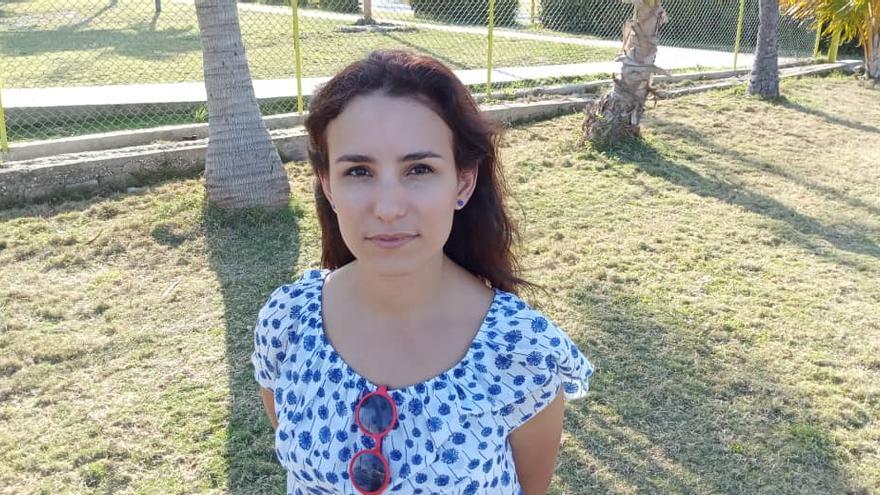
The editor of ’La hora de Cuba’ is the fourth woman on the team who has been barred from leaving the country. (Facebook / La Hora de Cuba)

14ymedio bigger14ymedio, Havana, 22 May 2019 — Cuban authorities prevented several collaborators of the magazine La Hora de Cuba, Inalkis Rodríguez, Iris Mariño and Sol García, from boarding a flight to attend an event in Trinidad and Tobago on the participation of women, to which they had been invited by the Simone de Beauvoir Leadership Institute.

Before leaving for the capital to take the flight, and so as to ensure they would “not make the trip in vain,” they passed through the Immigration office in Camagüey, Inalkis Rodríguez told 14ymedio in a telephone conversation.

“As soon as we said our names they explained that we were ‘regulated’ [the official euphemism for ‘banned from leaving the country’] and when we asked for more explanations they only added that it was “for reasons of public interest.”

In this case, as has happened in previous situations with other civil society activists or independent journalists, the immigration authorities did not explain what steps a person should take to appeal the so-called ‘regulation.’ “Ask the Prosecutor’s Office” was the response obtained by the La Hora de Cuba journalists.

Previously been banned from leaving the country were Isel Arango, the director of the magazine, as well as Henry Constantín, regional vice president for Cuba at the Inter-American Press Association (SIP), who, after two years of being banned from traveling abroad was allowed to leave the country a few weeks ago.

_________________

The 14ymedio team is committed to serious journalism that reflects the reality of deep Cuba. Thank you for joining us on this long road. We invite you to continue supporting us, but this time by becoming a member of 14ymedio. Together we can continue to transform journalism in Cuba.
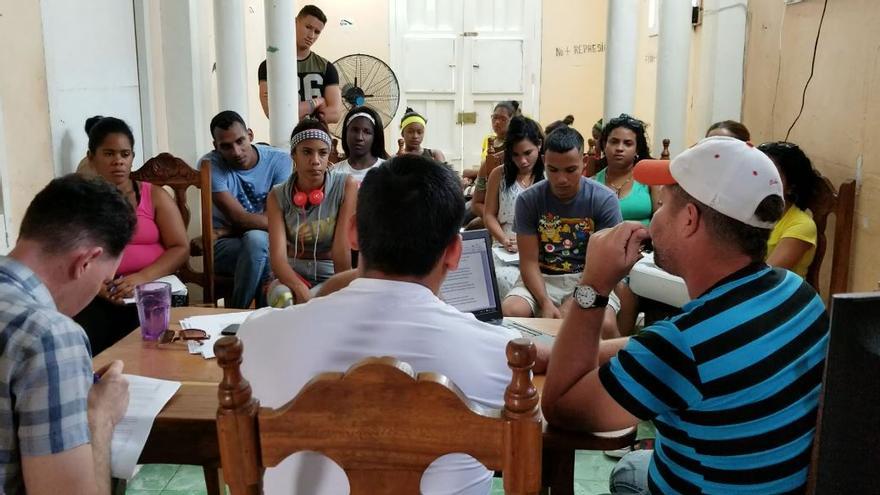
UNPACU Consolidates its Activities to Promote Youth Leadership

An UNPACU event focused on sparking involvement among younger Cubans.

14ymedio bigger14ymedio, Havana, 23 May 2019 — The Freedom and Democracy Academy (ALD) is a new project of the Youth Front of the Patriotic Union of Cuba (Unpacu) to promote citizenship and youth leadership within this opposition organization.

The academy, which carries out training activities on democratic values, is aimed at Unpacu members between 16 and 35 years of age in eastern Cuba.

Since its creation, under the direction of the opposition leader Carlos Amel Oliva Torres, the ALD has held two workshops and a reading circle in which 26 young people participated. continue reading

The first dealt with the characteristics and importance of democracy and the rule of law, and the second addressed the mechanisms of democratic participation, including referendums and legislative initiatives.

In the reading circle a group of young people met to reflect on a presentation by the American political scientist Francis Fukuyama, in which he analyzed the 15th anniversary of the fall of the Berlin Wall. The goal of the reading circle was to strengthen the qualities for analysis and spark a taste for reading and promoting debate and dialogue among young people to encourage them to be reflective and critical citizens.

This project has the support of the Political Institute for Freedom, a Peruvian NGO with the support of international organizations such as Atlas Economic Research Foundation, Friedrich Naumann Foundation, National Endowment for Democracy and RELIAL (Liberal Network of Latin America).

The following video is not subtitled. Our apologies

___________

The 14ymedio team is committed to serious journalism that reflects the reality of deep Cuba. Thank you for joining us on this long road. We invite you to continue supporting us, but this time by becoming a member of 14ymedio. Together we can continue to transform journalism in Cuba.
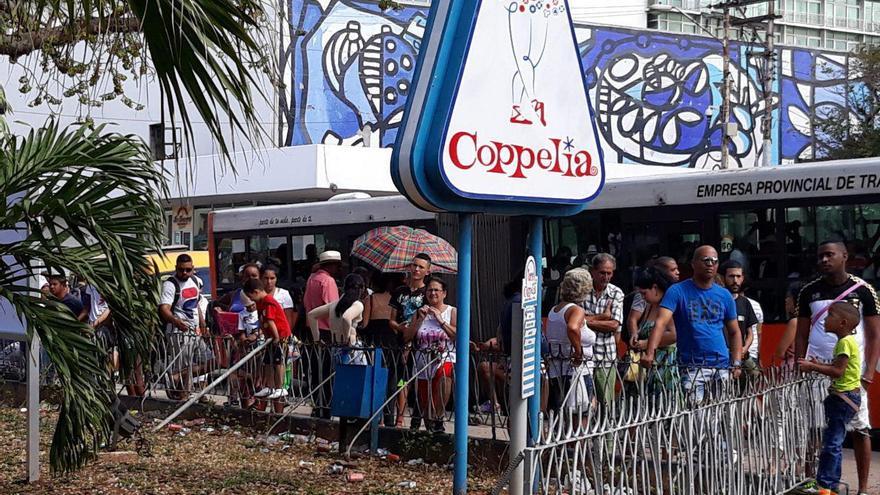
Cuba’s Iconic Coppelia Ice Cream Parlor Loses Flavor

The ice creamery Coppelia is still one of the most visited sites in Havana in spite of a significantly smaller menu.

14ymedio bigger14ymedio, Zunilda Mata, Havana, May 28, 2019 — Hugo is nine years old and has never seen a pistachio. But the word sounds so funny that he asks for an ice cream with that flavor in a privately owned spot on the corner of Línea and L streets in Havana. The menu at this small shop includes everything from the unusual cherry to the common lemon, a variety of choices that can only be found in the private sector.

The privately owned cafe Amore is located near the legendary ice cream parlor Coppelia but there are different management styles, a disparity in price and a chasm in the level of cleanliness between each. While the iconic state-run establishment only sells two or three flavors, the privately owned competition offers more than a dozen.

When Coppelia opened its doors in 1966, its different sections sold dozens of flavors and many possible combinations of ice cream, with candies and other items that could be added. Over the years, however, there were fewer and fewer choices, the quality of the ice cream declined and the lines became longer and longer. With the advent of flexible self-employment in the mid-1990s, competition also emerged. continue reading

“I have been in this business for almost twenty years,” says Manuel Octavio Gómez, a self-employed worker who began making ice cream in an old Soviet-era Aurika washing machine and now sells his products to various privately owned establishments in Havana. “At first I was selling only two or three flavors, but now I offer almost twenty,” he says.

“It took me years to figure out the level of creaminess that Cubans like and now I sell to private restaurants, cafes and customers who want a high-quality, more artisanal product,” he explains. “My ice cream is more expensive than those you can buy at Coppelia but the quality is better. Just try it and you’ll taste the difference.”

Cheleny Darias, administrator of the Coppelia factory, told the official press last year that the company provides two types of product to the centrally located state ice cream parlor. The “special” version contains 18% butter fat, is served in the tower section and is the more select and expensive option. A lower cost version contains only 14% butter fat and is served in the so-called canchas (soccer pitch) section on the ground floor.

Under the laws of supply and demand, private ice cream parlors can charge up to ten times as much as Coppelia. (14ymedio)

Customers often complain about finding shards of ice inside their ice cream, a limited number of flavors, flavors that are bland, and a lack of fresh fruit options. There are also often complaints about serving sizes, which are often much smaller than expected.

Ice cream is in high demand on the island, especially in the summer when temperatures are high. Faced with strict rationing of milk, many turn to this product as a sweet source of dairy. For decades the state has kept prices low by subsidizing places like Coppelia throughout the country, but the pilfering of supplies and limited choices have become increasingly common.

“I have a Spanish passport so I am allowed to travel frequently to Mexico, Panama and the United States,” says Gómez. “I bring back different extracts, dried fruits and also ideas to improve my product. Now I want to offer more natural fruit flavored ice cream because there’s a big demand for it among tourists. The would like to try something with pineapple, frutabomba, guava or mango because these are more local.”

“For years, when anyone thought about ice cream, they thought about strawberry and chocolate. Sometimes vanilla or custard, but it was all very boring. Now private shops like ours want to innovate and offer more options,” he explains. “I’ve made ice cream with tamarind, with walnuts and chirimoya, and even with mandarin oranges and mint, all without preservatives or additives,” he explains.

On Sunday an employee at Amore helped a girl make a decision by giving her small samples of different flavors until the little girl settled on a waffle cone with a scoop of chocolate covered strawberry for 1.50 convertible pesos ($1.50 US), the equivalent of almost two days salary for a public sector employee.

Coppelia, where a scoop of ice cream costs 1.50 Cuban pesos (about $0.06 US), has been closed for repairs during the month of May and is expected to reopen in June. The Coppelia factory is also scheduled to begin operations again by that date.

“Now that its ice cream is no longer of the same quality as it was twenty or thirty years ago, Coppelia’s main draw are the subsidized prices,” says Niuris Fonseca, a resident of nearby 21st Street, who has had both some of her best and worst moments here. “There are several hospitals and schools in the area so many patients and children are able to drop in for an afternoon snack.”

On the other hand, Fonseca believes Coppelia has deteriorated and is dirty. “It’s best to avoid the bathrooms and the spoons are often not well washed,” she laments. “There are also very few flavors and, what few they have, are not as good as before. Sometimes, if I close my eyes and taste them, I can’t tell if I am eating strawberry or orange-pineapple. They all taste the same.”

“A few weeks ago, I went with my daughters before they closed and the menu board outside indicated they had four flavors. But when we got inside, they only had vanilla and strawberry,” she says. She shared a table with man from overseas, who had wanted to experience the famous ice creamery. “He didn’t care that there were only two flavors because what he wanted was to visit the iconic building.”

Private ice creameries have opted to compete with Coppelia on its weak points. “Cleanliness, comfort, convenience and flavors you’ve never tasted,” explains an employee of an ice cream parlor located near Infanta Street. “It’s true that it’s not common for people here to order five scoops at a time, like they do at Coppelia, because it would be too expensive. But if you order one scoop, it’s a high-quality scoop.”

“All our products are made here on the premises and most are made from raw, natural materials, without chemicals or preservatives,” explains an employee to two curious tourists who have selected one soursop ice cream and another with mamey. “You don’t find this in any state-owned shop because they only make ice cream from mass-produced concentrates.”

The most difficult ingredient to source is still milk, although Gómez says that the newly opened wholesale markets for self-employed workers have helped him get powdered milk in bulk as well as cream. Other ice cream makers consulted said that farmers provide them with fresh cow’s milk, but most purchases are done informally.

“If you don’t want to spend a lot and fill up, go to Coppelia. But if you want to splurge and enjoy a good ice cream, then you have to go to a private ice cream parlor, which is where the best ice cream in Cuba is made today,” he explains proudly as he serves a chocolate scoop with chips in a slender cup and a scoop with sour apple in another.

___________________

The 14ymedio team is committed to serious journalism that reflects the reality of deep Cuba. Thank you for joining us on this long road. We invite you to continue supporting us, but this time by becoming a member of 14ymedio. Together we can continue to transform journalism in Cuba.

At Least Three Children Injured After a Collapse at a Cuban School

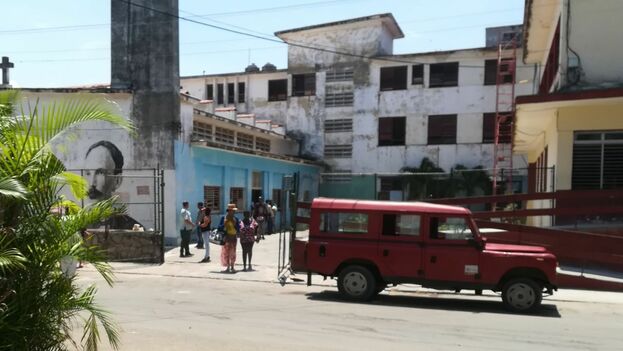
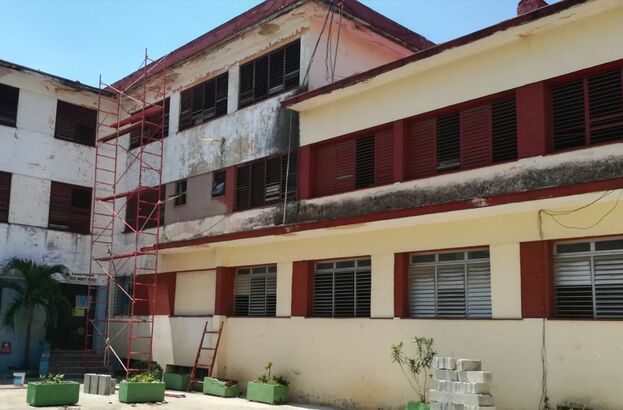
The entrance to the José Martí School in Havana’s Playa neighborhood, where three children were injured this morning by a falling cornice.

14ymedio bigger14ymedio, Havana, 23 May 2019 —  At least three children were injured in an accident on Wednesday morning when pieces of a cornice fell on the patio of José Martí Primary School, on 25th Street between 54th and 56th in the Buena Vista neighborhood of Havana’s Playa municipality.

According to what the teacher Ileana Prendes told the police, the events happened around 10:00 in the morning, when the third grade students were gathered on the patio waiting for a physical education lesson. “There were sitting in the shade and suddenly some pieces of the roof gave way, where the cornice was,” she said.

As the teacher explained, the children were immediately taken to the policlinic just to the side of the school. “The firefighters came from a station two blocks from here; the place was full of police and in three minutes we had ambulances to take the children to Juan Manuel Márquez Pediatric Hospital,” she added.  By two in the afternoon scaffolding had been erected to fix the problem and several neighbors offered to help with whatever was needed. continue reading

The place where the roof cornice fell on some students in a Havana school. (14ymedio)

14ymedio communicated with the hospital where the injured childred were taken but the medical center said it could not offer any information to the press about the health of its patients.

The country’s economic crisis since the end of the subsidies from the Soviet Union at the beginning of the 1990s is manifested in the deterioration of many of the school buildings. To this is added the budget cuts in services during the years of Raul Castro’s presidency. Cuba has 10,7070 schools and 1.7 million students.

According to declations from Education Minister Ena Elsa Velázquez  on the Roundtable TV program, in September of 2018, when the 2019-2020 school term began, 15% of Cuban schools were in poor physical condition.

_________________

The 14ymedio team is committed to serious journalism that reflects the reality of deep Cuba. Thank you for joining us on this long road. We invite you to continue supporting us, but this time by becoming a member of 14ymedio. Together we can continue to transform journalism in Cuba.
In Cuba, Access to the Internet Determines Who Eats

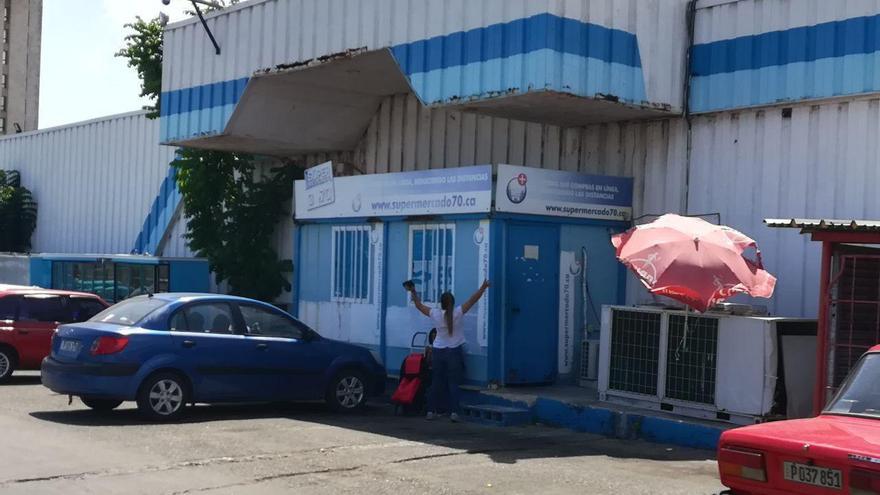
In an air-conditioned container, a few meters from the long line to enter the 3rd and 70th market in Havana, merchandise purchased ‘online’ is dispatched. (14ymedio)

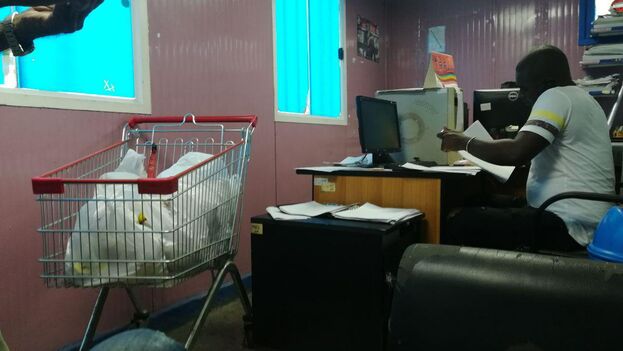
14ymedio bigger14ymedio, Marcelo Hernandez, Havana, 27 May 2019 — Under the sun, last Friday, dozens of people waited to enter the 3rd and 70th market in Havana and buy the two packages of chicken allowed per customer. Off to one side of the building, in a small office, those who arrive carry away several kilograms of the product, without rationing, because the transaction occurred via the internet, thanks to an emigrated relative living abroad.

On May 10, the Minister of Internal Trade, Betsy Díaz Velázquez, officially announced the application of measures to regulate the sale of food, personal grooming and cleaning products to avoid hoarding. The measure also includes hard currency markets which, since their creation more than two decades ago, had been marked by unrationed sales.

However, the restriction does not affect the offers of virtual stores, a topic that is not mentioned in the island’s official press, but that has ended up defining the economic status of thousands of families who receive help from emigrated relatives. continue reading

The air-conditioned container fills with people in the mornings. Customers arrive with an order number and hope that the food, purchased online through a virtual store by a relative abroad, will be available.

The premise of egalitarianism on which the regime was based ended in the 1990s, when the dollarization of the economy and self-employment began to create strong inequalities. The economic gap has continued to widen since then and those who have access to hard currency and who receive remittances from abroad have greater purchasing power. Now the digital universe is worsening the inequality.

Many Cubans do not look kindly on the fact that access to better food depends on the type of currency that is carried in your pocket. State employees and retirees, who receive a salary only in Cuban pesos, reject the harsh monetary reality of the island as discriminatory.

“This can not be, because I have come with the money from my salary to buy food and they only sell me two packages of chicken thighs,” complains Raydel Frías, a young engineer who tells 14ymedio that he had to wait for four hours.

“It’s not right that they ration the amount of chicken, hot dogs and other products here, but if someone buys on the internet there are no limits and they can buy everything they can afford,” insists Frias, annoyed. “That indicates that our money is worth nothing compared to dollars or euros.”

His opinion echoes those of other clients waiting in line. “Last week I received a package my sister, who lives in Atlanta, bought for me and I got five packages of chicken breasts,” he explains to this newspaper. “She also bought me four bags of milk powder online and, although it was almost twice the price, at least she could find it.”

The number of daily sales handled in this office averages around 60. (14ymedio)

“This ultimately leads to discomfort and inequalities. Why not also ration the amount of products sold online, so that we do not have to see these contrasts between those of us who work and stand in line and those who have relatives abroad?” questions a pensioner who lives only on his pension, equivalent to about 25 CUC (roughly the same in dollars).

In the online purchase, as a general rule, from the moment the relative places the order through the web page and the moment in which the order is picked up or delivered in Cuba, it takes between 12 and 20 days. Buyers can choose between having the products delivered, for which there is an additional charge, or free pickup at the store. Now, the shortages have lengthened the delivery times and the order can take up to a month to reach the hands of the recipient.

Distribution problems not only have to do with the scarce availability of merchandise, but also with fuel restrictions that have reduced the number of vehicles available to deliver the food to homes. “We have only two cars assigned to home deliveries in all municipalities of the capital,” laments one of the employees of the local annex to 3rd and 70th.

“When the product finally arrives, we notify the client by phone and we arrive at his house after 10:00 in the morning and before 3:00 in the afternoon,” explains the worker, who preferred anonymity. “We are very close to the line to enter the butcher shop and people protest because they see others leaving here with their hands full and they only get two packages of chicken.”

“There is a new form of inequality here that has to do with what kind of money you have and where you have it,” says a woman who is waiting in line. “I could have a wallet full of bills and they only let me buy two packages of chicken [parts], but a Cuban who has just arrived in Miami with $50 can send five complete chickens to his family, without limitations.”

On average, the 3rd and 70th shopping dispatch office receives about 60 orders purchased through the internet per day, says one employee. There are times when there are peaks of up to a hundred orders, but their dispatch capacity only lets them fill just over 30 requests on average. When they exceed 40 they have to work overtime.

“For three months the work in this place hasn’t stopped because many people are asking their relatives to buy on the Internet what they can not get in the markets here,” explains the worker. “We have seen double the amount of deliveries we have to manage each day and that has brought us delays and many complaints from customers,” he acknowledges.

“Of course, these complaints are not like those heard in the line outside,” says the woman. “People here are uncomfortable because their product is delayed but they know it will come, but in the market next door they can be waiting all day to buy something and not get it,” she says.

_____________________

The 14ymedio team is committed to serious journalism that reflects the reality of deep Cuba. Thank you for joining us on this long road. We invite you to continue supporting us, but this time by becoming a member of 14ymedio. Together we can continue to transform journalism in Cuba.
Fuenteovejuna: Lessons of a Leaderless March

Havana’s LGBTI Community carries out an independent march in favor of sexual diversity (Archival photo)

Cubanet, Miriam Celaya, Havana, 20 May 2019 — Echoes of the peaceful independent march carried out last May 11th by Cuban LGBTI activists in Havana’s Central Park and along the Paseo del Prado, continue to move social networks with mostly messages of support and solidarity towards this historically victimized community, which has been discriminated against, and also – unfortunately – with the repression that was unleashed against the protesters during and after the event.

We must recognize the courage and determination demonstrated both by the LGBTI in claiming their spaces, their identity and their rights, as well as other activists of the independent civil society that participated in the act in demonstration of solidarity and support.

Numerous have been the voices that have denounced the violence of the repression, reflected in the abundant graphic evidence provided by participants, press reporters and eyewitnesses, but despite the unjustifiable use of brute force, beatings and arrests against peaceful demonstrators, who only fostered messages of love and inclusion, the truth is that the march can be considered a success for the Cuban LGBTI movement and, by extension, for the entire civil society. continue reading

To objectively analyze the facts and understand the scope of a march that, in any other geographical context could be considered insignificant, it is necessary to divest the criteria of any prejudice or sexist, political-ideological or sectarian atavism. The ability to call and carry out an independent march in Cuba, in defiance of official regulations and without waiting for “permission” from the autocracy and its officials, constitutes a demonstration of legitimate citizenship on the part of a group of Cubans, beyond conditions and labels, which we should all celebrate and support, especially those who, from the time of the dissidence, are committed to the triumph of democracy.

Freedom of demonstration, then, should be understood as everyone’s right, not as a the property of anyone or any group, so that it would be healthy to abandon any hint of elitism, pedigree or “droit du seigneur”* and to ponder the facts for what was done, not for what some believe should have been done or said, which attitude – on the other hand – is typical of the Power that oppresses us all.

Some have criticized the demonstrators for not raising explicitly anti-government slogans – and needless to say that any movement, thought, or independent demonstration in Cuba is implicitly anti-dictatorial – or have reproached others for supporting the LGBTI march and (allegedly) “not showing solidarity” with some opposition groups. Fortunately, this reluctance to recognize the merit of the effort of others is a minority position.

A first relevant and peculiar element of the LGBTI march of May 11th is that it was not organized by a subject or by a personal leadership, but that it was developed in social networks from a group of activists that freely and spontaneously decided to express their determination to defend their rights to demonstrate peacefully in public spaces.

At this point, the effectiveness of social networks intelligently used for these purposes was demonstrated, even in a country where connections are precarious and excessively expensive in relation to income. Will and technology allied themselves, and the march was possible: an important lesson for all civic movement of these times.

At the same time, the “collective leadership” not only guaranteed the performance of the act by avoiding the usual limelight or egocentrism – which have caused so much harm to other civil movements and opponents in Cuba – but it also won the solidarity of other openly anti-government activists who demonstrated the respect and ethical stature of participating in it without trying to hijack the demonstration in favor of their own agendas or in pursuit of personal glory.

The horizontal perception of leadership, moreover, constitutes a strength because it dislodges the illogical traditional sense of the repressor, also accustomed to a strong vertical leadership in its own command structures. A collective leadership, on the other hand, has the advantage of relatively limiting the disarticulating and demoralizing effect of the political police in sectors of the independent civil society, since there is no individual or “ringleader” – as is usually referred to – to be located as mobilizing leader or generator of actions and proposals, whose movements can be constantly monitored or simply canceled, thus, the capacity of existence and growth of the independent group, the speed of organization of its actions, and the visibility of its proposals are enhanced .

It was not by coincidence that on May 11th, among the first detainees who were beaten by the repressive forces, were several well-known dissident activists – to whom, perhaps initially, the direction of the demonstration was mistakenly attributed – and it is not fortuitous that in the days following the march and until the moment in which this column was written, operatives and arrests have been carried out in the typical style of “kidnapping” of several participants, whose testimonies agree that their interrogators have insisted on the same recurrent point: “who organized the march?” “who is responsible?” Obviously, the regime needs a scapegoat and, most likely, in its absence, they will contrive one.

The concern and powerlessness of the Power are evident, and not only is such a disproportionate repressive effort against the managers of a demonstration perceived that, paradoxically and according to Mrs. Mariela Castro as the “maximum leader” of Cenesex, was tiny and did not represent anyone. The Roundtable, on Cuban TV on Monday, May 13th, in whose panel Mrs. Castro took part, devoted a not inconsiderable segment of its time on screen to disqualifying and trying to discredit both the march and its participants, a common practice of the regime, one which is increasingly less and less effective.

Without the slightest embarrassment, the members of the television panel lied about alleged funding received from the U.S. by the imaginary leaders of the march – although they conveniently omitted the financing that Cenesex receives from abroad – while they tried to minimize the number of participants and to distort the objective of the march.

Same as always, but different in that essential element: the regime desperately needs a guilty party, and a week after “the crime” the responsible party has still not appeared.

A little in jest, but very seriously, the situation evokes that piece by the famous Spanish Golden Age playwright, Lope de Vega, entitled Fuenteovejuna, in which peasants of that imaginary town assumed the collective responsibility for a revolt that ended the life of its abusive Knight Commander of the Military Order. Do the repressors want to know who organized the May 11th march? It was Fuenteovejuna. However, it is prudent to avoid anticipated triumphs, because the truth is that the Cuban dictatorship will definitively lose the game at the moment when all Cubans who aspire to live in freedom and democracy put aside our differences and we become exactly that: Fuenteovejuna.

*droit du seigneur: a feudal lord’s right to bed a servant girl

Translated by Norma Whiting

What Cuban Business Co-ops Really Need is Private Property

In Cuba, losses during harvest and after collection represent 30% of total production, plus an additional 27% is lost during distribution. (EFE)

14ymedio bigger14ymedio, Elías Amor Bravo, Economist, 24 May 2019 — Considering that they are essential to introducing fresh air into the rarefied Cuban agricultural system, farming cooperatives need much more than bureaucratic regulations purportedly aimed at “perfecting and updating the economic model.” First of all, little or nothing can be done in the Cuban countryside as long as the communist government resists giving up its claims to the land. Let me explain.

The state currently owns 78% of the country’s arable land. The ability of farming cooperatives to increase the amount of acreage under cultivation and achieve greater economies of scale depend largely on ideological and political considerations rather market conditions based on supply and demand. As long as models of business organization based on legitimate property ownership are not respected or fully integrated into the Cuban economy, land management by farming co-ops will not achieve the desired results.

Currently, 67.8% of farmland is under cooperative management. While this could be considered a success, I would argue that management alone is not enough. Decisive steps towards private ownership of land must be taken so that farming co-ops and all other producers can freely decide for themselves what to produce, and under what conditions, without interference from the state. We cannot pretend these are privately owned businesses under the pretense that they are privately “managed” without taking further action. Sixty years after land was confiscated from its legitimate owners, the state of Cuban agriculture remains far from ideal. And it will not seem like it is headed in the right direction as long as it has to adhere to the kind of rules that keep getting written. continue reading

We find ourselves in the odd situation in which the state acknowledges that it must rely on and support private farming cooperatives, putting them on an equal footing with other actors in the agricultural sector such as livestock and state-run farming operations. But it refuses to adopt the measures necessary for establishing a legal framework to provide institutional recognition of private property rights, without which the agricultural sector cannot prosper or increase its productivity. In this regard, recently adopted measures — Legal Decree #354 and Regulatory Decree #354, published in Official Ordinary Gazette #37 — are of little help when it comes to providing the types of reforms and modernization that cooperatives need.

The primary aim of these rules, in general, is to eliminate existing legislative ambiguity and little else. Don’t expect big changes. The land will still be owned by one entity: the communist state; and the principles that underpin economic activity will remain the same: bureaucracy, inefficiency and control.

Attempts to improve the cooperative system have focused primarily on doing away with some regulations, modifying others that have fallen into disuse and implementing so-called “guidelines” adopted at communist conclaves. These are better left forgotten. If “dissatisfaction with the processes of administrative management, operations, efficiency, hiring, monitoring, accompaniment and control by the companies” have really been detected, what reasons are there for not taking action and adopting, once and for all, a law that restores private enterprise to the Cuban economy, grants it legal rights and makes it the backbone of the economic system?

Cooperatives in other countries, such as Spain and Italy, are private enterprises with a social commitment, not simply managers of assets belonging to others. Here lies their success, in being the true owners of the wealth they generate, which is substantial.

The various measures recently adopted in Cuba seek to “harmonize the operation of cooperatives with the other actors in the productive sphere” and “consolidate the relationship between the cooperative and the agricultural enterprise to which it is associated by giving the latter the responsibility of providing the necessary attention to processes of management, planning, production and contracting of the productions aimed at satisfying the planned demand.” Does anyone really believe this can improve Cuban agricultural production?

In my opinion the only thing this will change will be the bureaucracy, which will tighten its procedures for control over the cooperatives, including consolidating the economic regime through the allocation and distribution of funds from the general assembly, and adopting a ridiculously ideological communist rule that “all cooperatives share common names,” as though fixing every problem boils down to a question of terminology.

The newly approved regulations do include some improvements, particularly for joint venture partners as well as small concessions to silence any possible protests. Cooperatives will be freed from the so-called “socio-cultural fund,” which will no longer be considered part of their assets and will no longer be retained to pay off joint venture partners. Similarly, “areas of collective use,” which are intended to provide services to cooperative members, are hinted at in the new regulations. But in any case, all of this is subject to “the country’s development programs of the country,” without further explanation. These are slim pickings.

In conclusion, Cuba’s cooperative system needs a lot more than a couple of decrees to move forward and become what it is capable of becoming: a real engine of productivity. The “improvements” on which the authorities are relying only mean more bureaucracy and control, without removing the legal, economic, commercial and logistical obstacles that hinder the dynamics of these operations. The road is long and the communist regime refuses to face reality. There will be food shortages and they will blame the embargo/blockade. But the real problem is to found in recently published decrees intended to take control of the cooperatives.

____________________

The 14ymedio team is committed to serious journalism that reflects the reality of deep Cuba. Thank you for joining us on this long road. We invite you to continue supporting us, but this time by becoming a member of 14ymedio. Together we can continue to transform journalism in Cuba.
Obsession in a Havana Theater

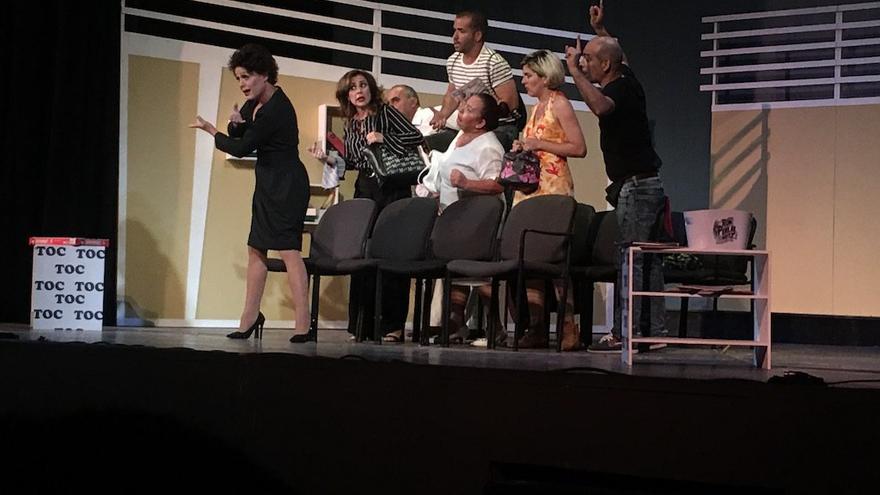
After waiting for a doctor who never arrives, his patients decide to hold their own group therapy session to discuss their obsessions (14ymedio)

14ymedio bigger14ymedio, Marcelo Hernandez, Miami, 25 May 2019 — Outside his office six patients await the arrival of their doctor. Each one suffers from an obsessive-compulsive disorder, a toc* in psychiatric jargon. Since there is no sign of the therapist, they agree to hold their own group therapy session in an attempt to alleviate everyone’s suffering.

This is the premise of Toc Toc, an amusing comedy now on view at the Sala Arenal after a successful two-week run at the El Sotano theater.

The French comedian and playwright Laurent Baffie (1958) was the first to successfully take on the challenge of making people laugh at the effects of a psychiatric disorder. In 2006 the play received the Molière Prize for theater. In 2017 the Spanish filmmaker Vicente Villanueva took the work to the big screen. continue reading

The production’s first surprise comes after audience members are asked to turn off their cell phones. They are then told they may take photos and make videos in order to publicize the event.

Little by little, the characters are introduced. First, there is Alfredo (Iván Balmaseda), a very respectable man who cannot control his urge to utter obscene words (Tourette’s syndrome). Then there is Vicente (José Alejandro), a taxi driver who feels the irrepressible desire to count everything, doing endless calculations in his head with each number (arithmomania).

Later, Blanca (Yamira Díaz), a nurse obsessed with cleanliness (nosophobia), appears. She is followed by young Lily (Ana Pomares), who suffers because she is forced to repeat everything she says (palilalia and pcolalia).

Maria (Yanel Gómez / Ludmila Alonso) is tormented by the obsession to constantly check everything (compulsive verification disorder). Finally, there is Boby (Rafael Alonso), the youngest of the group who is terrified of stepping on the floor and has a habit of arranging everything symmetrically (obsession with lines).

Once all the patients have arrived, the doctor’s secretary (played by the actor Jaime Jiménez) makes his entrance. These sporadic but vibrant appearances elicit reactions from the patients unlike those of any known pathology.

Director Hugo Alberto Vargas stages the comedy using a simple but flexible set design. The best moments are those that rely the movements of the actors, who come down from the stage and interact with the audience, who participate without being subjected to extreme pressures.

Leadership struggles, romances, quarrels and controlled mayhem are convincingly portrayed with both verbal and body language.

Obviously, the work has been adapted to appeal to a national audience, although at no time is there is any allusion to the country or city where the events are taking place. However, the jokes that drew the most laughter are ones that could only understood in Cuba, especially the one about “mild, subversive perfume.”

If there is anything that stands out in the Cuban version of Toc Toc, it is its cautionary moral message, its emphasis on the positive effects of human solidarity. But after two hours in which the actors have tried to convey the feeling that “not everything is hopeless,” it seems unnecessary to beat home the message so relentlessly.

It is undeniable that the entire audience was entertained, and not in a vulgar way, while learning something about disorders of human behavior.

*Translator’s note: Abbreviation for transtorno obsesivo compulso (obsessive compulsive disorder, or OCD) in Spanish.

___________________

The 14ymedio team is committed to serious journalism that reflects the reality of deep Cuba. Thank you for joining us on this long road. We invite you to continue supporting us, but this time by becoming a member of 14ymedio. Together we can continue to transform journalism in Cuba.
Not Allowed to Travel for Breaking Down the Wall of the Official Lie

Our colleague, Luz Escobar, was forces to remain earthbound by order of the authorities, who blocked her exit from Cuba. (14ymedio)

14ymedio bigger14ymedio, Luz Escobar, Havana, 23 May 2019 — It had been like launching a ship into space. I had to get a new passport, arrange for a visa and take care of all the tasks to prepare my home and work for my days of absence. When it was time to leave for the airport on Wednesday afternoon, I felt that I had run several laps. The idea of sleeping a while on the plane made me very excited, but that moment never came.

I planned to fly to the city of Washington, stopping in Miami, with American Airlines. For three days I would be in the capital of the United States to participate in the Independent Art and Journalism workshops organized by the Cuban Soul Foundation. To experience that city in the summer, without having to carry a heavy coat with me, filled me with hope.

However, when I stood in front of the immigration officer and she asked me to take a step back I felt that all my plans were collapsing. The woman made a phone call and a few minutes later an officer arrived and took my passport. Document in hand, the man went into a small office, used the phone, returned and said: “Come with me.” continue reading

Inside the office the man said grimly: “You are banned from leaving the country, you can not travel.” When asked about the reasons, he only added: “We do not know why.” To know more details I would have to go to the Citizens’ Immigration Office at 3rd and 20th, in the municipality of Playa, where the answers stretch out and the months can pass without receiving more information.

There are already many opponents, activists and independent journalists who have been prevented from traveling, under the euphemistically titled concept of “being regulated.” Some have finally managed to leave the island while others are still waiting for clarification of their situation. In some cases, after a refusal, they were told it was a mistake, which led me to ask the Immigration officer if perhaps they were confusing me with another person.

“No,” the man reiterated, assuring me that, in addition to seeing it in the National Identity System (SUIN), he had confirmed it by telephone with his superiors.

The new Immigration Law, in force since January 2013, includes in its Article 25 the prohibition of departure “for reasons of public interest or national security,” but nobody has yet told me that this is my case. As I am sure that I do not have any pending cases with the law, nor debts to a bank, nor I am a witness in any trial, I only have to conclude that it is a reprisal.

In recent years, denying one’s exit abroad has become a repressive method of State Security against uncomfortable voices. Many times the refusal of permission to travel is not permanent, but arbitrary and intermittent, which greatly hinders the affected person’s ability to lodge complaints with international organizations.

In my case, I was not allowed to board that plane because I practice journalism. I happened to be on the list of the “regulated” for relating the reality that surrounds me and I do not know when I will leave this Island again because I work in that “dangerous sector” that is the independent press. The relationship is direct: Every article I publish distances me still further from the steps of an airplane, but every story I bring to light is one more step to break down the wall of official lies.

___________________

The 14ymedio team is committed to serious journalism that reflects the reality of deep Cuba. Thank you for joining us on this long road. We invite you to continue supporting us, but this time by becoming a member of 14ymedio. Together we can continue to transform journalism in Cuba.

Havana’s Malecon Avenue Will be Closed to Vehicles on Weekends Starting this Saturday

The closed section of Malecon Avenue is framed between Peña Pobre streets, in Old Havana, and 15th street, in Vedado. (14ymedio)

14ymedio bigger14ymedio, Havana, 24 May 2019 — This Friday, Havana’s Provincial Road Safety Commission stated that Malecón Avenue will be closed to vehicular traffic on weekend nights as of this Saturday, May 25. The note indicates that the measure will be in force “as long as necessary” and comes almost a week after an accident that claimed the lives of five people along this street.

The Commission specifies that the weekend closings will be from nine o’clock at night “until the cultural and recreational activities scheduled in that area conclude.” The closed section is runs from Peña Pobre Street, in Old Havana, and 15th Street, in Vedado, the central corner where La Piragua is located, a square for concerts and cultural activities.

The note details alternate routes for drivers: Zulueta Street, Calzada de Infanta, San Lazaro, 25th, 23rd from O Street to G, Línea, Zanja, Reina and Salvador Allende, better known as Carlos III. continue reading

The Provincial Transport Company of Havana explained that bus routes 55, P16, P5 and P9, will travel from the Plaza of the Revolution municipality via P street, Infanta and San Lázaro streets, until they join their usual route. Service coming from the municipality of Old Havana, will operate via San Lázaro, Calzada de Infanta and 23rd.

The transport company offered “apologies for the inconvenience” and urged road users to comply with the provisions established to “avoid the occurrence of traffic accidents.”

This week five people died and almost a score were injured after being run over by an almendrón — a classic American car in use as a fixed-route shared taxi — that left the street and climbed the sidewalk in the area of 23rd and Malecón, a busy area during weekends.

In 2018 there were 10,070 crashes in Cuba that left 683 dead and 7,730 injured, with a frequency of one every 52 minutes, according to data from the National Road Safety Commission.

The country has a high rate of traffic crashes attributed, among other factors, to the advanced age of the fleet (most of the vehicles in circulation are more than 20 years old and many more than 60) and their precarious maintenance, which is frequently carried out in makeshift way

During the mandatory inspections carried out in 2018, “technical deficiencies” were detected in 44% of the verified cars (63,966), mainly due to the braking system, steering and lights.

_________________

The 14ymedio team is committed to serious journalism that reflects the reality of deep Cuba. Thank you for joining us on this long road. We invite you to continue supporting us, but this time by becoming a member of 14ymedio. Together we can continue to transform journalism in Cuba.