Day 15 of the Covid 19 Emergency in Cuba: My Doctor Friend Has Become a Patient

Saturday, the authorities have updated the figures of Covid-19: six deaths and 288 testing positive. (14ymedio)

14ymedio bigger14ymedio, Yoani Sanchez, Havana, 4 April 2020 — Today has been a bittersweet day. At home we have all felt good but a doctor friend is isolated and suspected of having Covid-19. He has spent years saving lives in a dilapidated Havana hospital but now it is his that is in danger. Very prepared and committed to his profession, he has now become a patient. My applause tonight will be dedicated to him.
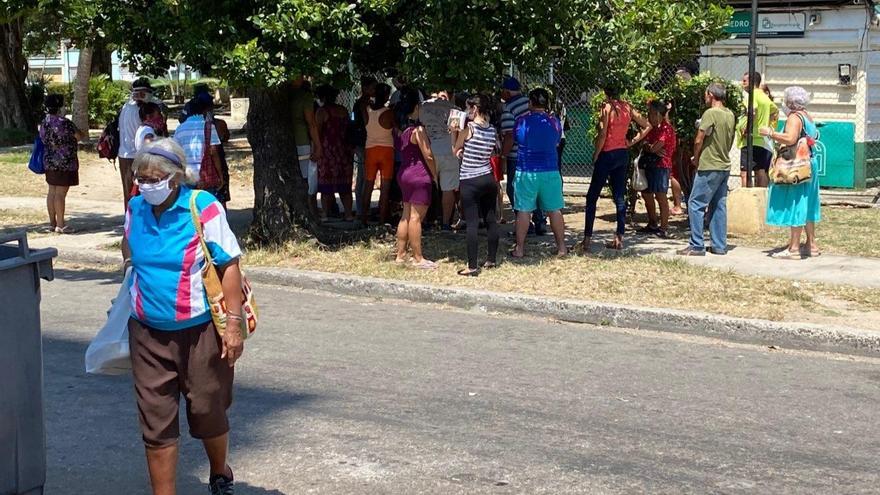

This Saturday, the authorities have updated the figures for Covid-19 on the Island, which has caused six deaths and 288 people testing positive. Of particular concern are the eight critically ill patients and the three seriously ill people, confirmed by sources from the Ministry of Public Health. The incidence of the disease in medical personnel is still a question mark.

My friend, a doctor, now isolated, tells me that the official warnings came late, that the protection measures took too long to arrive and that by the time he began to feel the first symptoms, he had been crying for more work gloves for weeks. “Before this, I received three or four a day to treat all patients, but with coronavirus you can’t do it that way,” he tells me on WhatsApp, his only current link with his family and friends. continue reading

I think about him, in an place of isolation where he cannot offer attention, but receives it, and it makes me sad. As a journalist, when I imagine a situation in which I couldn’t report what is happening, the feeling I get is thoughts of impotence. The forced and necessary quarantine is not just a hard blow for the economy and mobility of a country, but also for the professions that need to be in contact with people and with reality.

So among my great proccupations, along with the health of my loved ones and my own, is the situation of people like my medical friend who has become a patient and that of so many independent reporters that I know for whom the emergency has significantly reduced their ability to work, while the repression does not spare them. There is no scheduled applause at nine o’clock every day for the press, but it turns out that without them we would know little or nothing about the sacrifice of doctors, the agony of the sick or the resilience of societies.

Personally, today I have dedicated a brief tribute to all those journalists who keep us updated. It has not been complicated, because from the time I get up, my coffee has the flavor of reporting, my life revolves around the news and up to eight out of ten calls that come into our telephone line are from someone who wants to report an event fact, a mishap or get details of some happening. Our professional life is totally merged with our personal space.

On this 14th floor we try to stay healthy for our family and for our readers. Industries stop, roads empty, discos close their doors but who could imagine a world without news right now. We have a tough challenge and an immense responsibility: Who is going to tell us what is happening?

Years ago, when my son was young, I realized that as long as I had to take care of him, I hardly got sick. If any discomfort came, it would last me a few hours, hardly a day. I understood that when you are aware that you are looking out for someone else or others, it helps to strengthen us, at least emotionally and mentally to overcome adversities. It does not mean that we become invulnerable or immune, but that we learn to cope with difficulties knowing that someone urgently needs us to be healthy.

Readers are anything but children or patients, anything but vulnerable beings, anything but people who depend on us journalists. But while they are there with their voracity for information, their criticism of each of our reports, their harsh opinions when we are wrong and their words of encouragement when we are right, getting sick in a newsroom is something that we can hardly afford.

Today the onion that I planted a few days ago on the terrace of the Editorial Office has sprouted, we have named the new dog Chiqui because she is still small although she threatens to become Maxi, and we ate the last egg we had left from rationing. “We are breathing, no one with a fever, no one with a cough,” we optimistically respond to all the friends who call.

See other posts in this series.

_______________

COLLABORATE WITH OUR WORK: In this time of Covid-19 crisis, 14ymedio could really use your help to keep the news coming. Please click on this link to support our work.

We Need Your Help to Report on the Covid-19 Crisis in Cuba

In Cuba, the independent media suffer the limitations on movement imposed on their reporters, the collapse of the networks and the intensification of censorship. (14ymedio)

14ymedio bigger14ymedio, Havana, 29 March 2020  — These are difficult times for everyone and journalism is also being badly affected by the coronavirus pandemic. In Cuba, the independent media suffer the limitations on movement imposed on their reporters, the collapse of the networks and the intensification of censorship.

Our collaborators cannot come to our Havana Newsroom to deliver their work and, in many cases, they can’t go to a Wi-Fi zone to send updated content. They have to resort to mobile communications, which are very expensive on the Island.

For this reason, our communications expenses have increased at the same time that advertising revenues and readers’ contributions to our membership program are decreasing due to the uncertainty that is spreading throughout the world.

In these circumstances, continuing to prepare updated reporting on the Cuban reality, and providing you with quality and truthful information, becomes increasingly costly, as well as difficult. Hence, we are making a special call asking you to support us in these “times of coronavirus.”

You can contribute any amount you decide, through our PayPal account. Below is the “Donate” button that you can use or, if you prefer, access the link. Thank you very much in advance!

Please click on the image.

(Note, the ‘comma’ in the payment screen is a decimal point. Your choices are $10, $20, $50, or any amount you choose.)

Day 14 of the Covid-19 Emergency in Cuba

“Maybe that’s why, now, when I hear sirens again and again, I have a feeling that reality is collapsing around me.” (14ymedio)

14ymedio bigger14ymedio, Yoani Sanchez, Havana, 3 April 2020 — The Covid-19 emergency in Cuba has its own sound or rather its “no sound.” If, before, from our house we heard the constant roar of the nearby Rancho Boyeros Avenue, now there is a rare stillness that fills everything. A “collateral benefit” of the drama we are experiencing with the emergence of the coronavirus in Cuba is the decrease in vehicle traffic on the streets.

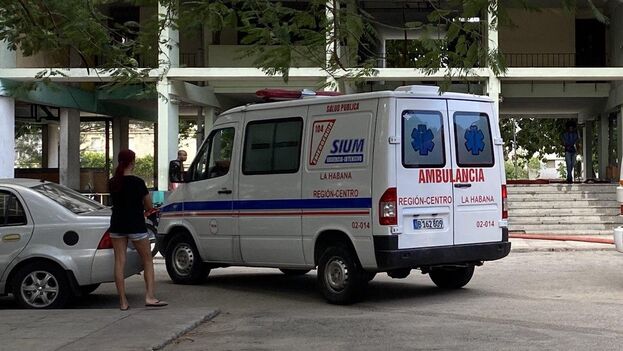
Occasionally, with increasing frequency, that calm is broken by sirens, as happened this morning. We were sitting around the table and heard the haunting sound. “If before it was once or twice a day, now it’s every hour,” said our son. We continued sipping our coffee, but the idea that in a vehicle traveling at full speed, running all the lights without stopping, there might be someone whose life was in danger, we choked on breakfast.

When I was a little girl and official television broadcast serials where Cuban intelligence agents infiltrated the exile, sirens abounded in scenes representing the world on the other side of the Florida Straits. There were almost always older men, surrounded by young, scantily clad women, a glass of whiskey in hand, perhaps a swimming pool, and the background noise of an ambulance, fire truck, or police patrol. continue reading

That was such a used dramatic image, that in my childish mind, outside of Cuba people were always one step away from being carried away on a stretcher, seeing their house burn down or being arrested. A small sonic detail became effective ideological propaganda to tell us that it was better to be inside the Island, safeguarded by that authoritarian father who is Castroism.

Maybe that’s why, now, when I hear sirens again and again, I have a feeling that reality is collapsing around me. If we add to this that the city is quieter than usual, the alarms are more prominent and seem even more dramatic. In a country where, as of today, official figures count 269 positive cases for Covid-19 and six in critical condition, there are reasons to be concerned.

This Friday I did not have to leave home. I made some croquettes, I stretched the rice I got yesterday and some carrots, also bought on Thursday in a nearby market, saved me and I could make a very tasty sauce. The canine and feline herd had to settle for a “vegetarian” proposal and one of the onions I planted a few days ago began to sprout. Life goes on, even though the city is sunk in lethargy.

The paralysis of transportation, the closure of many industries and some of the services, has meant that this morning we woke up with a clear and beautiful sky… at least in apart of the Cuban capital. Towards the south, the airport area and Santiago de las Vegas, it looked blue and clear, but in the direction of Central Havana, Old Havana and the Bay a cloud of smoke covered the city.

The Ñico López refinery continues to spread a dark stain over the neighborhoods as a result of the processing of hydrocarbons. In a territory where other industries are idled, that language of contamination is much more noticeable. That and the sound of sirens.

I continued planting this afternoon, attentive to the noises coming from the balcony. Today, I added some coriander seeds and also transplanted some positions of aloe vera, known in Cuba as sábila, which is the species of which we have the most specimens on this 14th floor balcony. The plants will germinate, grow and we will harvest them with that ” musical band,” with the background sound of anguish.

See other posts in this series.

_______________

COLLABORATE WITH OUR WORK: In this time of Covid-19 crisis, 14ymedio could really use your help to keep the news coming. Please click on this link to support our work.

The Communist Regime’s First Measures for Cuban Entrepreneurs: A Small Step

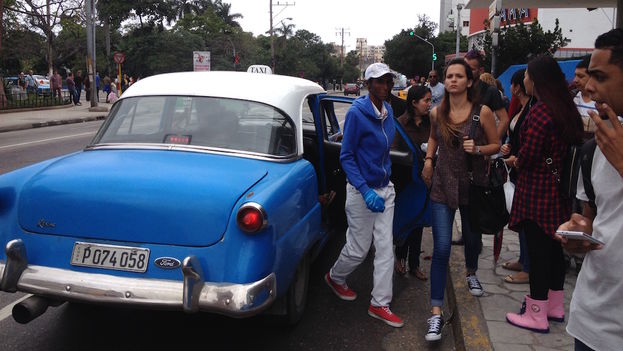
Passengers getting out of a private shared-taxi operated by a ‘botero’ in a time before the Covid-19. (14ymedio)

14ymedio biggerElías Amor Bravo, Economist, March 21, 2020  — Gradually we are learning about some of the measures the communist Cuban government is using to reduce the impact of COVID-19 on the activity of the private sector on the Island, led by the small businesses of self-employed workers.

In particular, apparently the Regime has approved a series of tax, work and lending measures that, generally, resemble those that other countries have adopted for self-employed persons and independent professionals. The details are given below.

The measures have already received positive reviews by some Cuban businessmen on Twitter and are considered “an important support for the thousands of enterprises that right now are completely affected by the world epidemic situation,” says Oniel Díaz, co-founder of AUGE and MP de Kreab in Cuba, which does consulting for private businesses. continue reading

“Furthermore,” he adds, “it was a wise decision for the prime minister to obtain cooperation from the private sector to make it possible for the more than 11,000 tourists who are staying in private rentals to leave Cuba. It’s not a minor detail.”

And, he emphasizes finally, that “cooperation, alliances and dialogue are the tools we have at hand to face together, in addition to this challenge, everything  ahead of us on the national economy front.”

I’m afraid that we must greatly lower expectations and say that with these measures, what’s most probable is that the entire Cuban private sector will have to struggle with an elevated mortality rate for small businesses and establishments. I have the impression that the measures have been designed specifically for the tourism sector, and they haven’t taken into account the fact that self-employment in Cuba is really much more diverse and varied, fortunately. What we need is reflection and a more accurate approach.

I understand that mortality won’t happen, for example, in the case of the high official of the Regime who rents rooms in his residence in Havana’s Plaza or Miramar neighborhoods to foreign tourists, because the income he gets from this activity complements his salary, which is higher than average. And he can even benefit from the fiscal cuts announced, because foreigners are not going to be arriving in the next months and his income will be temporarily crushed. The renegotiation of a loan, for those who are credit-worthy, can also benefit him.

In the case of many retired business people, the impact of COVID-19 and the measures detailed below can be inconsequential if the government keeps their employment and salaries intact.

Those Cubans who bet exclusively on self-employment activity and not only on tourism will have problems.

We are thinking, for example, about the thousand brave Cubans who travel every day with Spanish passports to the duty-free zones in Cancún, the Dominican Republic and even Haiti to bring back every kind of provision to be sold on the island. The brakes will abruptly be put on this channel because of the general closing of borders, and this was the main way for many small businesses to get goods and services. Without this supply, more small businesses will fail, since we can’t wait for the Communist Regime to improve the logistics of distribution in Cuba.

And what can the tenant farmer hope for when he can’t find the supplies he needs for production in the local economy? He has been forgotten, except for his debts with the bank which could be renegotiated. The crops will have to be harvested and brought to the markets, and in a situation of isolation and extreme hygiene measures, you have to ask what will happen to the small business workers who bring the merchandise and food to homes, like the pushcart vendors.

Even the brave taxi drivers (known as “boteros” or “boatmen”) in the Havana tourist zones could benefit from the planned measures for the reduction of income or exchange for credit, if they existed. In this case, the question is that if the boteros not only drive tourists but also a good part of the population, why is adequate public transport lacking? When isolation begins and the demand for national trips no longer exists, the situation will be much more serious. It won’t seem fair to the boteros, and they are right to ask why their monthly taxes aren’t reduced by 50% like they are in the case of food service activities. Why not them, too?

With these considerations, what I want to convey is that the measures of the Cuban Communist Regime are interesting for private tourism and are focused on something less than 3% of the economy’s GDP. The private activity in restaurants and lodging are important, but the reality is that most tourists stay in the hotels owned by the conglomerates of State Security and the Army, and they use the services of these networks.

The rest of the rich and varied private economy of professionals, designers, sellers and providers of personal services, in the spheres described and in others, find themselves abandoned and with an evident lack of response on the part of the authorities, who should be planning as the crisis advances. If this continues, the emerging private sector in Cuba will be pitiful after COVID-19.

Taxation

  • Extend the time for tax payments for businesses that suspend activity on their own or by governmental decision.
  • Reduce by 50% the payment of monthly fees for food service activities.
  • Authorize a reduction in monthly fees for administrators of tourist centers and sites with a high concentration of tourists.
  • Decrease to one single minimum payment the tax on bank accounts.

Employment

  • Protect the salary for contracted workers who continue to work at no less than the minimum wage of the country.
  • Extend the period of authorization for designated workers who fill in for an owner who is out of the country and unable to return for 3 months.

Loans

  • Stop collecting on authorized loans that can be restructured.

Translated by Regina Anavy

___________________

COLLABORATE WITH OUR WORK: The 14ymedio team is committed to practicing serious journalism that reflects Cuba’s reality in all its depth. Thank you for joining us on this long journey. We invite you to continue supporting us by becoming a member of 14ymedio now. Together we can continue transforming journalism in Cuba.

Day 13 of the Covid-19 Emergency in Cuba: The Daily Fight for Food

The Covid-19 crisis has only just begun on the Island, with 233 positive cases and six deaths, but the problem of access to food is already more serious. (EFE)

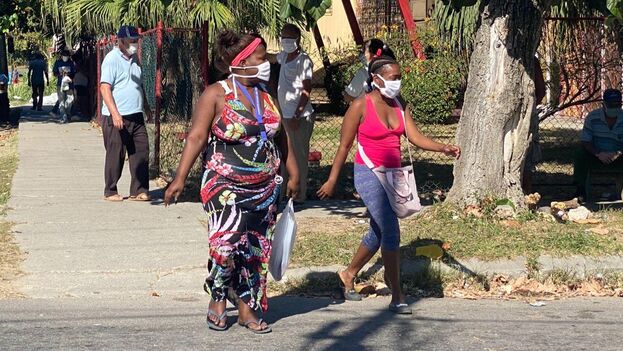
14ymedio bigger14ymedio, Yoani Sanchez, Havana, 2 April 2020 – A mask can be a protection and a shield. When part of the face is covered, it is easy to outwit the police. Something that shouldn’t normally matter, but that in Cuba can be vital. Now, when I blend into the crowd with my mask, I manage to mislead those who have been given the job of following me every day. Facemask and wig, facemask and hat… indecipherable formula.

So today I ventured out as a curly redhead with a ‘durako’* facemask. The neighbor who spies on me didn’t even realize it was me. I went out because we no longer have bread, we no longer have milk, we no longer have enough food for the herd that is made up of, in addition to three humans, two dogs and a cat. So, as the daily war cry on this island says: To battle!

I went out to the daily struggle, the one that those who run this country have not experienced for years, conscientiously ignore, and know that they cannot publicly acknowledge. It is the jungle, “every man for himself.” With my red curls I stand in line for chicken in a store on Calzada del Cerro. I must confess that when I faced the brawl necessary to enter, I restrained myself and missed my turn, lacking the aggressiveness to throw some elbows. I can’t do it anymore. continue reading

A crowd rushed in front of me. I tried to invoke the times when I fought, nearly coming to blows for food, but I did not succeed. I lacked the oomph. My neighbors in the Cayo Hueso tenement where I was born would disown me if I told them this. I even invoked my years, in the middle of the Special Period, when I was a boarder at the Socialist Republic of Romania High School and lived many days in which the “law of the strongest” prevailed, but today I did not manage to release my inner beast.

In the girls’ dorm where I lived in the 90s, we invented a lot of recipes to survive. I remember the day I stole an eggplant from the field where we worked and, after cutting it into slices, I put the electric iron on it, the one we used to remove wrinkles from our school uniforms. I added lemon and coriander. It was delicious. My classmates, who slept in the nearby bunks, called this “generation Y grilled steak,” in honor of the letter with which most names began at that time. That was the embryo of a blog that I founded years later.

Only he who has been hungry knows what hunger is. It is not just the howling in the stomach, the anxiety and the weakness caused by a decrease in one’s food intake. Hunger is an attitude and an emotional state: if you lack food, it is all you can think about it over and over, as happened to me and my fellow teenagers between the four walls of a concrete block in the municipality of Alquízar. Neither libido nor family mattered, we woke up and fell asleep thinking about what to put in our mouths.

Many in Cuba have spent decades feeling hunger, but all this can flare up now. Something as basic as chicken has become a luxury product. The Covid-19 crisis has only just begun on the Island, with 233 positive cases and six deaths, but according to what we read, the problem of access to food is already more serious than in the epicenters of the pandemic which Milan, Madrid and New York have become. They are living through dramatic days from the health point of view, but in our case with regards to the emergency in supplies, it’s out of the frying pan into the fire.

I no longer have an iron. Years ago I stopped trying to smooth out my clothes. Is it of any use? But today I remembered the eggplants that I ironed out in a dorm with narrow beds where nobody dared to sleep in the lower bunks because at night rats invaded all the spaces attached to the floor. Once I left some shoes and books down below and they’d been nibbled in the morning. After remembering that, I repeated to myself that I could face almost anything.

It does not matter if I am wearing a red wig and a mask that covers my entire face, I am a survivor, because I say so; all that’s left to see is what the last word is that the coronavirus has for me.

*Translator’s note: “Durako” refers to a kind of cosplay popular among young Cubans.

See other posts in this series.

_______________

COLLABORATE WITH OUR WORK: In this time of Covid-19 crisis, 14ymedio could really use your help to keep the news coming. Please click on this link to support our work.

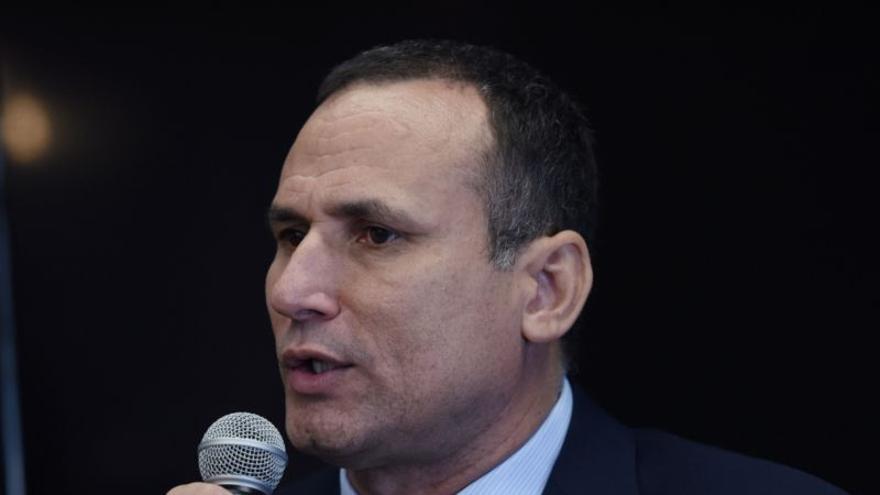
Jose Daniel Ferrer Released After Being Sentenced to Four Years of House Arrest

José Daniel Ferrer had been arrested in October 2019. (EFE)

14ymedio bigger14ymedio, Havana, 3 April 2020 — The government opponent José Daniel Ferrer was released this Friday after a six-month detention. The leader of the Patriotic Union of Cuba has been sentenced to four years and six months of house imprisonment, as confirmed by dissident Félix Navarro to 14ymedio.

Along with Ferrer, activists Fernando González Vaillant, Roilán Zárraga Ferrer and José Pupo Chaveco, members of Unpacu, were also released.

“I spoke with José Daniel just now, he is already out of prison, he was very happy and wanted to continue speaking but we cut it short because I know that there are many people who now want to speak with him,” Navarro explained to this newspaper. “He told me that he is still convicted and that he will continue his sentence but in house arrest for four years, both he and the other three activists.” continue reading

Shortly after being released, Ferrer told the Martínoticias website that on Friday morning he was transferred to the Provincial Court of Santiago de Cuba where he was notified of the sentence of four years of house arrest. In front of the authorities, the opponent stated emphatically: “I am going to continue protesting, I am going to continue fighting against tyranny until Cuba is free and democratic.”

Ferrer was arrested on October 1 and accused of assaulting another man, but, according to those close to him, it was a crime “prefabricated” by the Government. The Prosecutor’s Office initially requested a sentence of 9 years in prison and the sentence took weeks to be announced.

The trial against Ferrer took place on Wednesday, February 26, and lasted for fourteen hours. The delivery of the sentence was initially planned for March 12 but was postponed without the authorities giving any explanations.

Unpacu then denounced that in the courtroom “only some relatives were about to be present, however, more than 40 people were sitting there. Many belonged to the political police and others were completely unknown.”

The United States has spoken on numerous occasions in support of the leader of Unpacu, the last time through a report in which it regretted the human rights violations that occur on the Island. The US Secretary of State, Mike Pompeo, sent a letter addressed to his Cuban counterpart, Bruno Rodríguez, to ask for the dissident’s “immediate” release.

The European Union high representative for foreign policy, Josep Borrell, also demanded a fair trial for the opponent and told the press that the Union had asked to be present during the hearing but did not receive the go-ahead.

Human rights groups such as Amnesty International and Human Rights Watch along with institutions such as the Organization of American States (OAS) have also requested his release on several occasions.

The leader of Unpacu is one of the Cuban opponents best-known outside the Island, since he was part of the group of 75 convicted in 2003during the so-called Black Spring, and released between 2010 and 2011 on parole after a dialogue in which the Catholic Church and the Spanish Government mediated.

He was also one of the twelve dissidents from the Black Spring who decided to remain in Cuba after his release, while the rest moved to Spain and other countries.

________________

COLLABORATE WITH OUR WORK: The 14ymedio team is committed to practicing serious journalism that reflects Cuba’s reality in all its depth. Thank you for joining us on this long journey. We invite you to continue supporting us by becoming a member of 14ymedio now. Together we can continue transforming journalism in Cuba.

Jose Daniel Ferrer Released From Prison / Cubalex

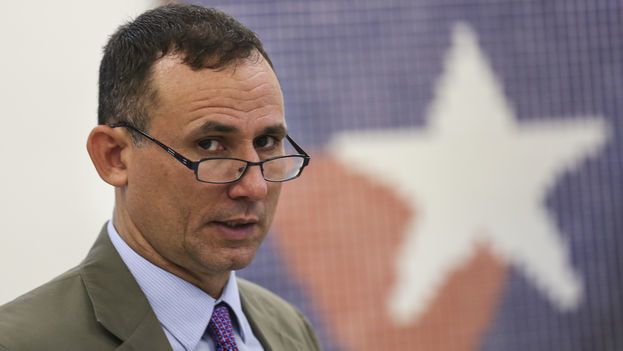
José Daniel Ferrer, leader of the Patriotic Union of Cuba, from before his recent arrest.

CUBALEX, 3 April 2020: The Cuban opposition leader Jose Daniel Ferrer, coordinator of the Patriotic Union of Cuba (UNPACU) has been given his freedom along with three other activists who had also been jailed.

Ferrer was locked up October 1st, 2019, and was tried last February 26th, along with the other members of the opposition, Roilán Zárraga Ferrer, José Pupo Chaveco and Fernando González Vaillant.

According to his brother, Luis Enrique Ferrer, UNPACU external representative, his prison sentence of four and a half years was replaced by house arrest.

The opposition leader spent 6 months in prison, following a highly irregular process, in which the Cuban regime violated its own laws. continue reading

March 12th was the date when the Tribunal should have passed sentence on the four members of the opposition. Nevertheless, in contravention of existing laws, the verdict was never made public. During the trial, the Attorney General ratified the recommendation for nine years for the UNPACU leader and seven and eight years for the other activists.

According to statements by Julio Ferrer Tamayo, a lawyer from the independent Cubalex Center for Legal Information, the judges charged with dispensing “justice” in the Ferrer case should be subject to disciplinary proceedings for failure to comply with the date set down for notification of sentence, in accordance with Art. 31 of the Law of Penal Procedure.

A wide international media campaign was mounted to urge the Castro regime to set free the UNPACU coordinator, along with the rest of the political prisoners.

UNPACU also publicised their concern over the condition of their principal leader, and for those Cubans in jail for peaceful political activism. The opposition group demanded the immediate freeing of all political detentions which were part of the extraordinary measures taken by the Cuban regime within the the state of emergency in force throughout the country.

 Translated by GH

Day 12 of the Covid-19 Emergency in Cuba

In Cuba, more than 200 confirmed cases of Covid-19 were announced, a figure that may skyrocket in the coming days when rapid tests will be administered. (14ymedio)

14ymedio bigger14ymedio, Yoani Sanchez, Havana, 1 April 2020 — It was known, but on this Island the rumors are weeks ahead of the official announcements. Sometimes, many times, the so-called Radio Bemba [gossip] knows in advance what, in time, the national press will publish as news. Days ago it was clear that the parade on May 1st would not take place and, since mid-March, in state workplaces many voices cried out for its suspension.

So yesterday, when it was confirmed that “calabaza, calabaza, nadie pá la Plaza” [pumpkin, pumpkin, no one will go to the Plaza] due to the dangers of a mass gathering with the advance of Covid-19 in Cuba, few were surprised. Without a doubt, the cancellation is a wise decision in a country where more than 200 confirmed cases of the disease were announced this Wednesday, a figure that could skyrocket in the coming days when rapid tests will be administered.

The same people who, until recently, insisted that there would be a parade at any price, now are conveniently silent and repeat that “the Directorate of the country knows what it is doing,” as a neighbor I met in the hallway told me this morning.  He is the same man who assured me a decade ago that a pound of pork would drop to 8 Cuban pesos (CUP) after some measures to promote state farms, but now it is at 50 CUP. continue reading

When I was a child I liked to go to the May Day parades with my parents. In addition to the hustle and bustle and general tumult, I loved some natural juices that were distributed for free to the participants and that, if memory serves me correctly, we called Jupuro. Once a year I had the chance to drink that nectar that came in a waxed cardboard box, all of which was a surprise to me, knowing nothing of tetrapacks and aluminum cans.

But later, the childhood enthusiasm passed and I realized that as a worker I was not going to be represented in a gathering that, instead of requests and demands, sings praises to power. When I graduated from university, for a long time I earned 198 CUP per month, less than $ 10, but I never saw a single poster in that “party of the proletariat” that demanded – in the Plaza of the Revolution – better salaries.

So I stopped going a long time ago and probably will only return to the parade on an International Workers’ Day when carrying a poster denouncing wage insecurity is not prohibited in Cuba and when the great boss, called the State, stops presenting itself as the savior of the working class. In reality, it earns huge capital gains, pays miserable wages, prohibits the right to strike, and condemns us to not even having a union to represent us.

Holding my proletarian diatribe within, today I worked on the flower boxes on my balcony. The potatoes are not yet germinating and they worry me, because all my hopes of having that tuber on my table in the coming weeks are pinned on my home garden. The plants that are beautiful are the flowers of my franchipani [plumeria rubra]. When I talk about the beauty of this shrub that stands on my balcony, most of my friends ask me “do you eat it?” and no, it is not eaten, but it is food for the soul, which is also essential in this time.

I haven’t felt well today. I don’t know if it’s the stress experienced in these “times of the coronavirus” or that the body starts to resent the tensions of waiting. Nothing worrying, just that these days any discomfort sets off the alarms and what was insignificant now becomes a suspicion.

But I’m fine. I write, I sow, I go out to buy food but, in addition, along with the diminished food that I get, I get stories: anecdotes, statements and even jokes that people want to share in extreme situations.

“This happens to us because we are alive, those over there no longer have this problem,” a flower vendor I found a few meters from the wall of Havana’s Colon Cemetery told me this morning. “Here we have coronaviruses, but in the ‘face-up neighborhood’ they would give anything to be on this side,” he emphasized with something that looked like a smile, but his facemask did not allow me to see it.

See other posts in this series.

_______________

COLLABORATE WITH OUR WORK: In this time of Covid-19 crisis, 14ymedio could really use your help to keep the news coming. Please click on this link to support our work.

Cuban Doctors Risk Their Lives To Escape The Shortages

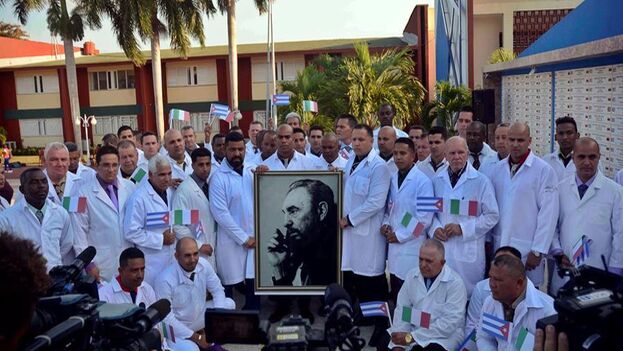
Cuban doctors who traveled to Lombardy in northern Italy displayed flags of both countries and a large photograph of Fidel Castro. (PresidenciaCuba)

14ymedio bigger14ymedio, Yoani Sánchez, Generation Y, Havana, 1 April 2020 — The applause was felt everywhere. This Sunday at nine o’clock in the evening, an ovation crossed Cuba, in tribute to the health personnel who are on the front line of confrontation with Covid-19. As in other countries affected by the pandemic, people have wanted to acknowledge the sacrifice of doctors, who in Cuba must not only deal with the risk of becoming infected, but also with the material deterioration of the hospitals and low wages.

For decades, the Cuban health system has been highly praised by official propaganda and has become almost a myth at an international level. The fact that healthcare is free of cost to all and available to all is presented as one of the great “achievements of the Revolution,” and, for many, the health of the Island is a benchmark of how the sector should be managed. However, discontent grows among Cubans about the dire state of the hospitals, where the patients themselves must bring everything from sheets to food.

As the coronavirus spreads throughout the country – where according to official figures there are already 170 people who have tested positive for the disease and six who have died— our entire health network is being tested. In support of the Cuban doctors, they have been trained in contingency and working with few resources, so they have a special capacity to deal with the shortage of supplies that is becoming even more acute right now. Many of them are “graduates” in the harsh school of chronic crisis. continue reading

This ability to do a lot with little is one of the strengths that Cuban doctors have exhibited in recent days to countries where the coronavirus is taking hundreds or thousands of lives. More than 40 nations have requested the support of the island’s health professionals, as reported by the Ministry of Public Health. A necessary request and, without a doubt, a wise decision, because they will receive doctors experienced in emergency situations.

However, it must be said that the fine print of these agreements between the Cuban Government and the countries that call for health personnel almost never makes headlines anywhere. Those doctors will provide their services in semi-slavery conditions because, of the money the hosts pay, only a tiny part will end up in their pockets.

Our self-sacrificing doctors will work, sweat, and risk their lives, but the biggest beneficiary will be a government that doesn’t show transparency about what is done with every centavo earned from medical missions. Although official voices repeat that this money is invested in improving national health facilities and services, there is no clear record and the same could go to save lives rather than to sustain the repression.

On the other hand, although the desire to heal is the main motivation of their work, these doctors will have to accept that their work is publicly dressed up in the robes of ideology. It is enough to see the images of the Cuban doctors before leaving for Italy, posing next to a portrait of Fidel Castro, to understand that their trip is also being used by the Plaza of the Revolution as a marketing operation. The authorities want to extract ideological revenue from the pandemic and spread the idea that an authoritarian model cuts freedoms but saves lives. In other words, in these regimes, it is not possible to behave oneself as a citizen, but rather as an eternal patient.

The official discourse is disrupted when one of those doctors decides not to return to the Island. From the smiling photo and the epithet “hero of the country” they will come to suffer the stigma of being considered a “deserter.” It is enough that a doctor fails to return from a mission for them to be forbidden to enter Island to be reunited with their family for eight long years and, in addition, they will lose the salary in national currency that they have already earned, which had been accumulating in a bank account in Cuba.

So why do they go to these missions where they risk their lives and where they earn so little, many will wonder. The answer is complex but worth exploring. The humanitarian vocation is part of the motivations, but there is more: Getting out of the island prison is a respite in the midst of such a hard daily life. Despite being in an emergency zone, over there they will have access to many more services and products, so they will be able to bring merchandise to Cuba that will relieve their situation and that of their family.

A few years ago I met a doctor, epidemiologist, and university professor, who accepted a medical mission in Venezuela because it was the only possibility of obtaining the resources to repair the roof of her house. On this island we have the harsh contrasts of running into a neurosurgeon who is going to operate on a brain without having had breakfast, because his salary is not enough to have a glass of milk each day, and of a nephrologist who asks his patients to buy him a snack to cope with the workday.

Despite the fact that some years ago the salary of health professionals became the highest pay in all of Cuba, right now it is very difficult to find any of them who earn more than the equivalent of 70 dollars a month, and this in a country where a liter of vegetable oil costs over $2.50 and in state stores a liter of milk costs more than $1.50. Our doctors live, practically, in penury.

All this and much more influences why they get on a plane to provide their professional services outside the country, even if they risk their lives and even though they know that the Government is going to keep most of their income. They also do it because they love their profession and one day they swore to face illness and death, because they are magnificent human beings, like all the doctors on the planet, and not because they profess an ideology or because they are members of a certain party.

They, our doctors, are the true heroes of these days and not because of what the official press says. So tonight, when the clock strikes nine, I will clap wildly for them on my balcony. I will do so to acknowledge their effort, but it will not be an ovation for the system that has condemned them to wage poverty and political docility. Come clap your hands for our white-coat heroes.

________________________

This text was originally published by Deustche Welle’s Latin America page.

COLLABORATE WITH OUR WORK: In this time of Covid-19 crisis, 14ymedio could really use your help to keep the news coming. Please click on this link to support our work.

Cuba Records its First Case of Local Transmission of COVID-19

The Cuban commercial network has again suffered shortages of products like chicken, powdered milk, cheese, yogurt, and detergent. (14ymedio)

14ymedio bigger14ymedio, EFE, Havana, March 28, 2020 — Cuban health authorities acknowledged this Friday the first case of local infection of COVID-19, which until now had only occurred stemming from foreigners or Cuban travelers arriving with the disease on the Island, according to official reports.

The Cuban Minister of Health, José Ángel Portal, reported this Friday during the television program Round Table that local contagion occurred in the “Cardenas municipality, in the Matanzas province” and came from a hotel host from Varadero.

That man was diagnosed with COVID-19 after being infected by “a group of Italian tourists,” and his case was included on the list of positives for coronavirus that was disseminated on March 21. continue reading

From this patient 53 contacts were identified, who went on to isolation and epidemiologic observation and, of whom, four family members and a friend were found positive for the novel coronavirus.

Until this Saturday, in Cuba 119 positive cases of COVID-19 had been confirmed, 2,000 people were isolated under observation, and 3 deceased, the last of whom was a 52-year-old Cuban man.

The World Health Organization (WHO) had reported Cuba as a country with local COVID-19 transmission since March 19, but it wasn’t until Friday that Ministry of Public Health authorities confirmed it.

 1/ Questions for the Ministry of Public Health Cuba

Why is the WHO reporting Cuba as a country with local transmission of COVID-19 since March 19, but it wasn’t until yesterday, Friday the 28th [sic], that Health authorities confirmed this on state media?

– @invntario March 28, 2020

On the other hand, the Cuban Government announced this Friday, March 27, 2020 measures in the economic sector and retail trade focused on prioritizing the production of food and controlling its distribution to avoid crowds in face of the complex scenario created by the COVID-19 pandemic.

The Vice Prime Minister, Alejandro Gil, explained during a television appearance that priority will be given to the production of food on the Island and concentrating resources on basic products, like the production of cement, medicine, cleaning products, and renewable energy sources.

“We must respond to this situation in an ordered manner, which allows taking a group of decisions to confront the pandemic with the least economic cost possible and that allows us to recover,” stressed the Minister, who also holds the office of Economy and Planning.

Gil called for looking for solutions “by our own hands,” which, in the realm of food, means promoting agricultural production with short cycle cultivation and the farming in urban spaces of products like plantains, corn, pork, rice, beans, and eggs.

The Minister said that the importation of basic products for feeding the population is “being carried out,” a line to which the country dedicates more than $2 billion per year. “A restriction in import supply is evident because countries are producing less, as well as difficulties in accessing financing sources and external credit, which demonstrates a decrease in the country’s productive levels and in foreign investment,” he said.

In recent weeks, the Island’s commerical network has again suffered from shortages in products like chicken, powdered milk, cheese, yogurt, and detergent, which has produced long lines and crowding that go against recommendations at the time of the contagious coronavirus.

Since last Tuesday the lines have begun to be regulated, keeping the proper distance of at least a meter between people. Stores must enforce the separation and it is necessary to avoid disorder, but the shortages and the popular fears have made it practically impossible to comply with those measures.

In face of the crisis, the Minister of Interior Commerce, Betsy Díaz, announced this Friday the “controlled and regulated” sale of a series of products, to avoid hoarding and resale. She specified that there are products that cannot be marketed by the “ration booklet.”

Starting April 30 there will also be distributed, in a controlled manner, to each person 10 ounces of peas and one pound of chicken — at an unsubsidized price of 20 CUP. In the case of cleaning products like washing and bathing soap, toothpaste, and bleach, those will be sold on a quarterly basis, in modules that will include a quantity of those articles according to the number of members in each nuclear family.

Translated by: Sheilagh Herrera

__________________

COLLABORATE WITH OUR WORK: The 14ymedio team is committed to practicing serious journalism that reflects Cuba’s reality in all its depth. Thank you for joining us on this long journey. We invite you to continue supporting us by becoming a member of 14ymedio now. Together we can continue transforming journalism in Cuba.

Day 11 of the Covid-19 Emergency in Cuba

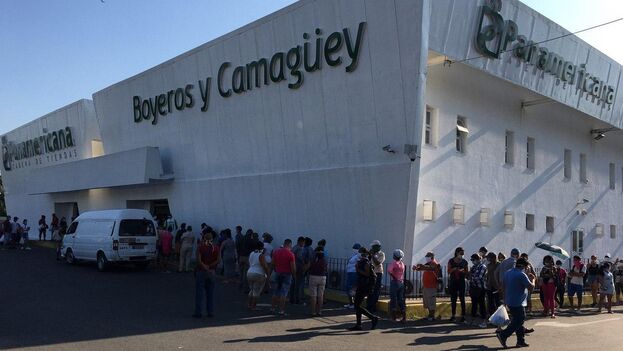
The Havana market in Boyeros and Camagüey usually has a short line but these days it’s exploded. (14ymedio)

14ymedio bigger14ymedio, Yoani Sanchez, Havana, 31 March 2020 – Two hours of lining up and it was only possible to buy two of each product. This morning we had to go out looking for some food because our reserves were depleted. We decided to go to a market on the corner of Boyeros and Camagüey that usually has a short line, but we were wrong. The line went around the building. In coronavirus times the offers decrease and the lines multiply.

The police presence is striking. Uniforms are inside the market, near the cash register, at the door of the warehouse, outside the store. We are in an undeclared “state of siege.” Legislation is fuzzy in this case. Can we leave our houses or not? How much of the same product can we buy? Official voices impose certain measures but there is no clear legality to uphold or define them.

Tempers, in addition, are heated. In the line this morning, two customers nearly came to blows. A fight in Covid-19 times is rare. If before people swooped down and shouted right into each other’s faces, now they squabble from a distance, a hullabaloo that marks the space. Even the ritual of anger changes in Cuba these days. continue reading

I returned home with two cans of sardines and a package of flour. It is what it is. Tomorrow I will improvise some croquettes. The search for food, which has always had a special role in this country, now absorbs everything, concentrates everything, surpasses everything. From the time we wake up, our life revolves around getting food and putting it on our plates. There are two obsessions: surviving and feeding ourselves.

Even ideology seems to be fading. The demonstrations of political fervor that were so frequent a few weeks ago have been suspended or postponed. The May Day parade, in a country where the only union allowed is a transmission-line from the Power to workers, has also been canceled. Reinaldo says that he remembers something like that in 1970 when the 10 million ton sugar harvest was attempted. But I was not born yet.

Today we venture to make a family lunch and invite those relatives we suspect we will go weeks without seeing again. It was like saying goodbye but in advance. The table was the center that brought us back together and, of course, the coronavirus dominated the conversation. We speak of positive cases of the disease already reaching 186 in the country, according to official data, and that at least six people have lost their lives due to the pandemic.

Until a few days ago, those were people who shared a table with their family just as we did this Tuesday. They breathed, they had dreams and they loved, but it all ended abruptly. Understanding that fragility gives us a special strength to deal with all this, because you end up understanding the true human measure in the face of chance, disease and the environment.

Before sitting down to our plates, we all went through the rituals of handwashing, keeping our distance, and kisses that are now given only with the fingers or a gaze. We will be many days or weeks without seeing each other, but this Tuesday we decided that illness and shortages are not going to take away the memory of a lunch together.

See other posts in this series.

_______________

COLLABORATE WITH OUR WORK: In this time of Covid-19 crisis, 14ymedio could really use your help to keep the news coming. Please click on this link to support our work.

Day 10 of the Covid-19 Emergency in Cuba

Days in coronavirus time pass differently. Before we were dominated by anguish and today we are at the mercy of an anxiety multiplied. (14ymedio)

14ymedio bigger14ymedio, Yoani Sanchez, Havana, 30 March 2020 — Mondays are always complicated. But this one dawned calm, with the city in a rare silence although the chimney of the Ñico López refinery had one of the tallest columns of smoke I can remember. The sound of the birds filled the dawn in this neighborhood where the fury of “cementing” each patio has not completely snatched the trees from us.

Days in coronavirus time pass differently. Before we were dominated by anguish and today we are at the mercy of an anxiety multiplied. The mother despairs because her son has to risk leaving the house and traveling on public transport; the entrepreneur is exposed to the danger of closing his business and not earning anything, or continuing to sell food and end up infected. The freelance journalist knows that his reporting capacity is currently being tested, but he is aware that censorship is mounting.

These are times when the worst and the best of each person come out. A close neighbor has hung a sign on his door so no one will knock on it, and he believes that hiding in his home will save him entirely. The problem is that the same neighbor depends on going out to buy the bread they sell in the rationed market every day, and actively participates in the meetings of the nucleus of the Communist Party maintained by retirees in the area. continue reading

He says he fought at the Bay of Pigs and that this virus was “created by the CIA.” He is neither an epidemiologist nor a doctor, but he is a fervent believer in what the national television news reports. Perhaps that is why, on Sunday night he went out onto his balcony to applaud the work of Cuban doctors, without knowing that the call for that ovation was something that had been forged in civil society and social networks, in tune with a similar gesture acted out days ago in Italy and Spain.

The clapping was heard loudly in our neighborhood, in honor of those Cubans who today are in hospitals facing Covid-19. A tough task in a country where official figures announce 170 confirmed cases of the disease and four deaths. Despite the context, there are always those who want to politically hijack the tribute to the doctors, but they are so ridiculous, and few, that they are drowned in the spontaneous applause.

Beyond those symbolic gestures, our lives change every day. It is not as if before we could use the adjective “normal” to define our existence, but it is that now the little that we felt safe in is gone or has changed. It is as if a building had its columns suddenly removed and the entire roof collapsed on its stunned residents.

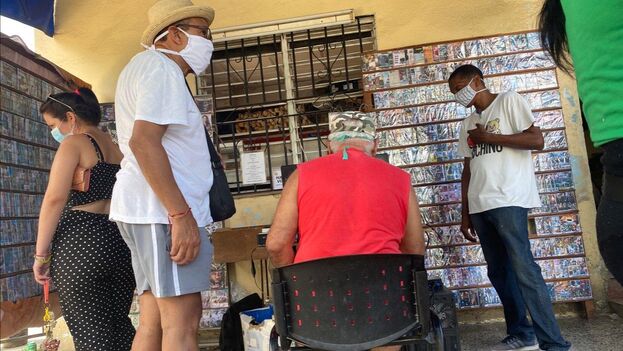
If before, in order to define Cuba, it had to be emphasized that “without sugar there is no country,” now it is worth adding that “without the ‘weekly packet’” we could not guarantee that the nation that we knew until yesterday remained. For both skeptics and the credulous, it is worth announcing that since Monday the private store in our neighborhood that every week sold — religiously and without fail — that ubiquitous udiovisual compendium, has closed. It is not there, it’s gone… and we, thousands of addicts, are left in the lurch, literally staring at our blank screens.

In the afternoon, when the sun fell a little, I transplanted an oregano in the earth on my balcony, and a rosemary plant. “Rather dead than without spices,” I said to myself and touched my nose (for luck), that rare geography that the coronavirus has amputated for us because putting our fingers to our faces is a danger in these times.

Perhaps my militiaman neighbor, in partisan quarantine, will knock on my door in the next few days asking for some “flavor” to add to his food. I’ll be here. There are things that unite and tragedies are one of them.

See other posts in this series.

_______________

COLLABORATE WITH OUR WORK: In this time of Covid-19 crisis, 14ymedio could really use your help to keep the news coming. Please click on this link to support our work.

“We are Isolated But Not Protected”: The Truth About an Isolation Center in Cuba / Miriam Celaya

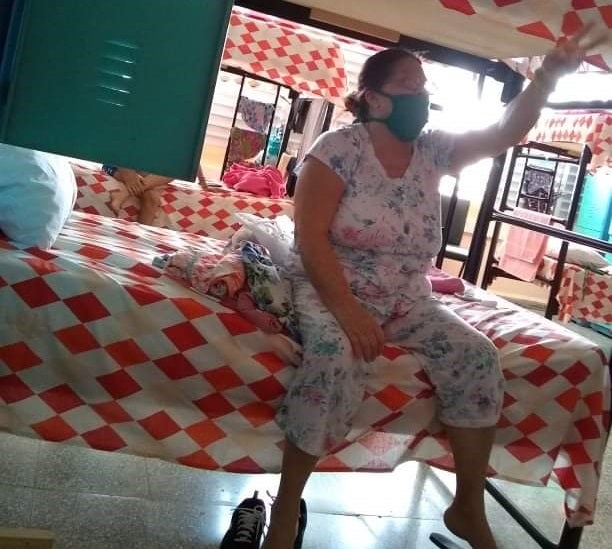
Dormitory at the isolation center (Author’s photo)

Cubanet, Miriam Celaya, Havana, 30 March 2020 — On March 23rd, in his presentation on the Roundtable broadcast on all Cuban television channels, Cuban Prime Minister, Manuel Marrero Cruz, reported about new official measures that would deepen controls to combat the spread of the COVID-19 pandemic on the Island. Among them, it was established that all Cubans residing in the country, on their arrival from abroad, would be placed in solitary confinement to serve a mandatory two-week quarantine before returning to their respective homes.

In order to comply with this measure, said Marrero Cruz, all the necessary conditions had been created in centers specially designed for such purposes, to which travelers would be driven directly from the airport, under strict police control, and duly transported by State buses. Additionally, it was established that the travelers’ relatives would not have access to the airport to avoid any possible contagion and spread of the disease.

Unlike other practices whose compliance has not yet been verified in practice, the isolation and transfer to isolation centers of Cuban travelers went into effect immediately. continue reading

Magela was one of those Cubans who arrived back in Cuba on Tuesday, March 24th and was surprised by what seemed to her a true state of siege at José Martí Airport in Havana. The police deployment, health personnel and border authorities controlling each traveler, issuing orders and preventing their departure, evoked a Hollywood movie atmosphere.

“There was an air of uncertainty and fear among us” stated Magela. “I know that taking measures to prevent the disease from spreading in Cuba is necessary, but it is such an impressive situation to find all those personnel in their protective suits, and it is so strange to feel treated as someone with the bubonic plague that fear took hold of me. Deep down I felt a very strong wish to cry.”

However, Magela set out to assume the inevitable. In the end, she felt that undergoing quarantine was the safest thing for her and even her own family. It was reasonable and necessary, she told herself. And without protest, with other traveling Cubans like her as companions, she got on the bus that would take them to the isolation center.

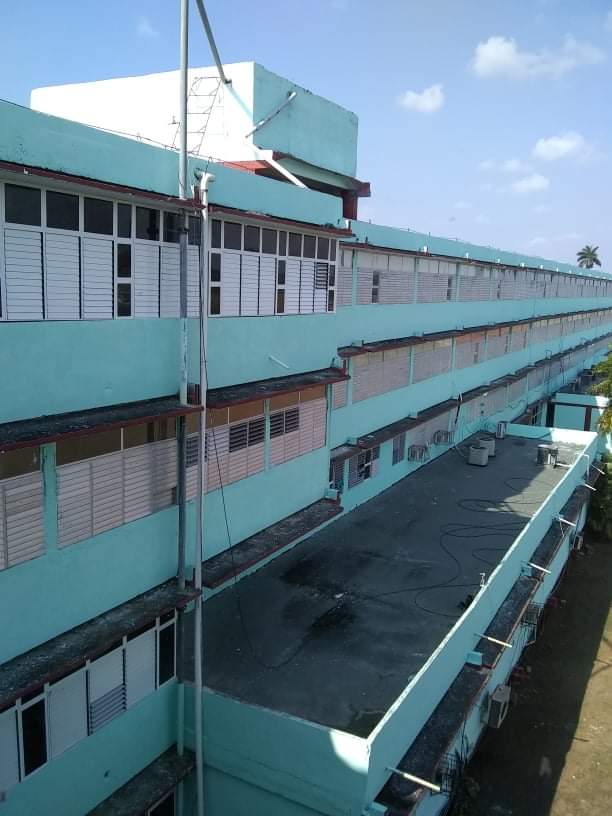
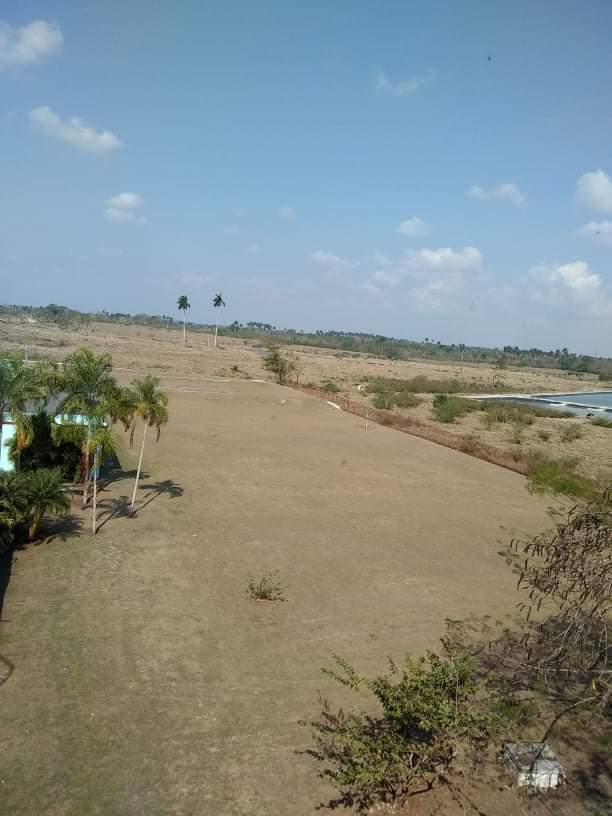
“Thus, we entered the center on Tuesday afternoon. They told us that we were in El Cotorro, but I don’t know this place. It is a rural center, away from everything. If you look out the windows, all you see are fields.”

The first thing that surprised Magela at the isolation center was the forced proximity to the rest of the recluses. Several bunk beds were placed too close to each other, forcing promiscuity, as dangerous as it is unnecessary, especially in a facility that, according to those in charge of the place, has a capacity for 600 people.

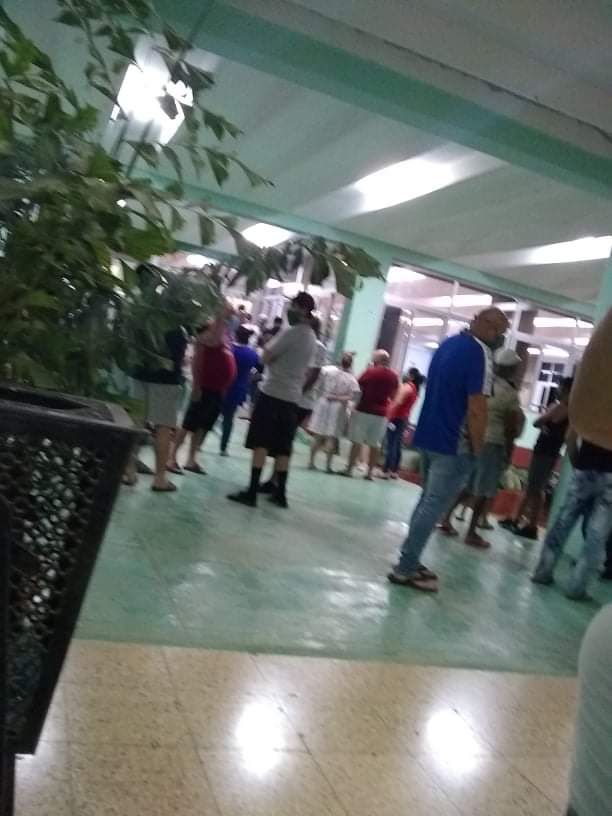
“There are only around 200 here for now, in addition to the staff, but people crowd in the lines at the dining room because we are all hungry and sometimes meal waiting times are long. Even though they give us protective masks that we must use, there is not enough control over the distance between us. In addition, there are always people who are undisciplined or unaware of the risk.”

To make things worse, men and women share bathrooms on each floor, which further affects privacy. Magela believes that this results from the fact that “they,” the ones in charge, were filling the floors as travelers arrived. It seems that they did not take into account separating the bathrooms used by women from those used by men. It’s terrible.”

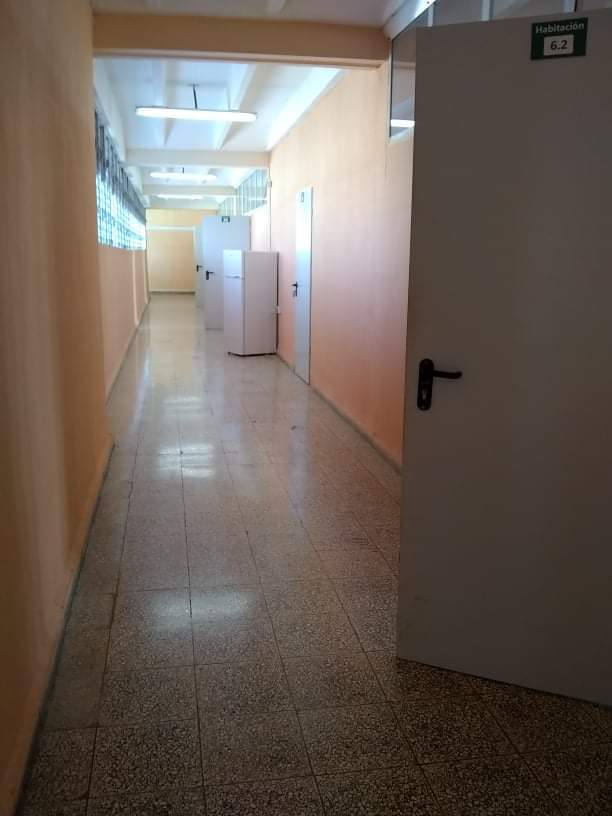
Another point that concerns Magela is that of cleanliness. “There are a lot of us, and hygiene is not as it should be. It has been talked about endlessly that hygiene is the most effective measure to combat the corona virus, right?  Well, that is not the case here. In general, everything looks clean, but when you look at the details you realize that the required hygiene is lacking. The mirrors are stained with soap and everyone’s splashes, the normal fluids of personal hygiene — hand, face, mouthwash — are poured in the sink and they do not receive a thorough cleaning. There is also no cleaning in the rooms or hallways.”

I asked one of the people in charge if they have not raised those concerns with management. “They tell us that nobody wants to come to clean because people are afraid of catching it.” Those confined there cannot clean either, since they do not have the resources and means of protection to do so.

It is true that they deliver protective masks and chlorinated solution daily, plus they also supplied the travelers with soap and toilet paper upon arrival, but Magela declares that “conditions were not set up as they should have been. I tell you that it is not the fault of the personnel assisting us, but I do believe that it was the duty of the State to protect us with the necessary means if this confinement was to take place.”

And after a brief pause, she adds: “They (the government and the authorities in charge) think that what they are giving us is more than sufficient and get upset when one asks a question or demands something. And if you protest, they label it a gusanería*. That is not the case.  We are asking about the reality we are living here and not about lies or insults. It turns out that in the end we are isolated but not protected. We are all very afraid of catching it because nobody knows who may or may not be an asymptomatic carrier of the virus.”

Of course, no one has been tested to rule out contagion. For this, it is necessary to present symptoms, although this waiting threshold supposes the possibility of infecting others.

Magela says she understands the situation in the country, and the importance of this quarantine, but she is frustrated because she expected better conditions. “I think that the resources that have been invested despite the country’s shortages are useless, since the fundamental thing at the moment is true isolation and hygiene and we have neither.”

“For example, the protective masks are changed every day, but not so the sheets and towels. They tell us that these must come from a company, and we don’t know which or when. I believe that if nobody can come to do the cleaning or if there are no answers to our concerns, they are going to have to find some solution. Let the FAR (Revolutionary Armed Forces) or another organization respond”.

Here I feel compelled to remind Magela that, among the strengths of the Revolution that the high authorities of Cuba so much like to mention, are the mass organizations – CDR (Committees for the Defense of the Revolution), FMC (Federation of Cuban Woman), and others – and also that vanguard of society, the PCC (Cuban Communist Party). Perhaps they should designate hygiene care in isolation centers a shock task for the communist militancy. After all, aren’t they the first line of defense fighters? Here is a good time to demonstrate their courage and spirit of sacrifice when the Homeland calls.

Despite everything, Magela does not want to be unfair. “Let me tell you that the food is not bad, considering the shortages that exist in Cuba. In the dining room they give us chicken, rice, beans, salad, ham, yogurt… The truth is that we have nothing to complain in that regard.”

There is also a cafeteria at the center, although not everyone is able to purchase stuff.  “How it works is that they sell us in new Cuban convertible peso (CUP), but the majority of us confined here have US dollars. Let’s remember that there is a ban on taking Cuban currency out of the country and we are returning from abroad with foreign currency.”

This is another detail that the authorities have not taken into account. Consequently, the few who have CUC or national currency – who perhaps took it on their trip abroad in violation of the provisions of the law – now have an advantage over the rest. Thus, the national adage is fulfilled, where the cheater wins, often protected by the State itself.

But there is no end to the calamities. “Another problem is mosquitoes. Although they spray every day, we cannot sleep at night because there are so many mosquitoes.” However, those who are confined on the big Island do not have mosquito nets assigned to them, which introduces the additional risk of a dengue outbreak, another health scourge that is already endemic in Cuba, striking the population with more or less intensity every year. Let’s keep our fingers crossed.

Magela has little data left on her phone, the balance of the service she purchased is very low, and she still wants to send me some photos. She will not be able to buy a new round of minutes/data to connect to the Internet, nor will she have a way to communicate, unless her family or friends purchase additional time, because there is no free access for the purchase of telephone cards in the center. “Upon arrival, we were told that the Cuban telephone company Etecsa would give each one of us a free 5 CUC phone card to use, but we have not received it yet. They have already told us that people from Etecsa are here, and we are hoping that they will give us the cards today.”

On the other hand, I expect more. I hope that the official practices this time are not just letters piled on paper and all the necessary conditions are created for the safety of our quarantined compatriots, especially in terms of issues related to the strictest hygiene standards, the greatest possible respect for privacy and the proper distance between quarantined inmates. These are the minimum guarantees that we must demand of a Power that professes solidarity and presents itself as humanistic, and that asserts itself as a world-class medical power. There has never been a better time to prove it.

*Gusanería (Nest of maggots) Very informal, pejorative term used when referring to counterrevolutionaries

Bathroom area (Author’s photo)
Isolation Center, Cotorro, Havana (Author’s photo)
Area around the Isolation Center is remote and rural (Author’s photo)
Waiting for food. (Author’s photo)
Interior hallway. (Author’s photo)

Sinks. (Author’s photo)

Water, The Best Ally Against COVID-19, Doesn’t Reach Many Cuban Homes

Authorities are also working on the reorganization of transportation, a very problematic means of spreading the virus in Cuba. (EFE)

14ymedio bigger14ymedio, Havana, March 25, 2020 — The most effective and accessible enemy of the virus, water, isn’t so easy to obtain in Cuba, troubled by drought and the deficient management of a supply more necessary than ever against COVID-19. In Havana, 468,721 of its 2.2 million inhabitants suffer water shortages, according to authorities.

The capital has 111 supply sources affected, 89 partially and another 22 totally, and only one of the five basins that supply them is in good shape, as Antonio Rodríguez, director of the National Institute of Water Resources (INRH), explained this Tuesday on the Roundtable TV program. The deficit rises to 2,447 liters of water per second so far this March with 58,500 people being supplied by cistern trucks.

The shortage of water for lack of rain affects 469,000 people in the western area of the Island, the majority in Havana; some 23,000 in the central area, and some 21,000 in the east. continue reading

According to Rodríguez, among the most affected municipalities in the capital are Arroyo Naranjo, Central Havana, Old Havana, La Lisa, and Boyeros, although he warned that there are also problems in the others. The official pointed out that complaints and inquiries about service have increased and it has been necessary to increase the telephone capacity to deal with them.

“We have the advantage of the fact that we continue working on the interconnection of systems within the capital, to better distribute water,” he said. The works in various areas are accelerating to improve the situation, said Rodríguez, and the drilling of refill and supply wells is being worked on.

Additionally, two small desalinization plants have been installed and other wells will be activated as easy access points. In the capital, the director announced, theoretically there is an average of 648 liters per inhabitant, but the problem of pipe and network leaks (up to 2,000) prevent that quantity from reaching its destination and although 78% of the pipes have been renovated, only 36% of the networks are working properly.

Rodríguez also said that on Monday water arrived in water trucks to 31,909 people in Havana and that measures are being taken to adjust the supply and restrict the sources of shortages to the large consumers, in addition to reinforcing state inspection.

In the midst of all this, the weather forecasts are not optimistic and it will continue raining little at least until April, for which reason the official asked, as usual, for a rational use of water.

José Angel Portal Miranda, Minister of Public Health, also appeared on the program, where he took stock of the situation in Cuba, not without first highlighting that the Coronavirus is affecting 168 countries and that the most afflicted currently, according to the speed at which is spreading, are Italy, the United States, Spain, and Germany.

Cuba has had until now 48 confirmed cases, 29 Cubans and 19 foreigners. All the cases are considered to be imported, since the contagions are not considered to be local until they are transmitted between two people who have not left the country. Three of the cases are serious, there is one discharged and one deceased, while the rest remain stable.

Additionally, 1,229 people remain under observation, 1,055 Cubans and 174 foreigners, “admitted in isolation centers and hospitals planned with this in mind,” specified the Minister of Health.

“We have moved forward to the prevention phases, with measures like the partial closing of borders, because the majority of cases have been linked or were coming from abroad,” argued the Minister, despite the fact that the only control carried out until now was at ports and airports, through which, precisely, the coronavirus has entered.

The Minister of Health insisted that vigilance measures be maintained, specifically among the elderly and other vulnerable groups, and reminded that every province has facilities designated for measures of isolation, hospitalization, and control.

Portal Miranda reviewed other measures, like those taken in the reorganization of health services, with treatments been postponed with the exception of emergencies, and the holding of routine visits (aimed, thus, at reducing the number of patients) and the maternal and infant program.

“We reiterate the call for social distancing and for everyone to stay informed by official media, because the key is in prevention. Nobody can substitute what is necessary to do for their own protection. The success of everybody is in prevention,” stated Portal Miranda.

Reynaldo García Zapata, governor of Havana, asked the population to comply with the measures announced “by the highest leadership of the country.”

The official insisted on the role of the popular councils to guarantee vigilance and to respond to whoever needs help to comply with isolation. He also explained that 3,875 tourists remain isolated in hotels and 5,620 who remain in rented houses will be transferred.

García Zapata said that 770 points of sale have been set up for takeout food, and they are working on having all places able to provide that service, do so. Points of sale of bleach have also been raised to 123, one in every popular council.

Translated by: Sheilagh Herrera

_________________

COLLABORATE WITH OUR WORK: The 14ymedio team is committed to practicing serious journalism that reflects Cuba’s reality in all its depth. Thank you for joining us on this long journey. We invite you to continue supporting us by becoming a member of 14ymedio now. Together we can continue transforming journalism in Cuba.

Monica Baro: "You Can’t Sacrifice Yourself for a Utopia" / Ivan Garcia

Iván García, Havana, December 9th, 2019 — This interview is the fruit of much bargaining. In various profiles that Journal of The Americas aims to publish on independent Cuban journalists of different generations, the name Monica Baro is underlined in red.

The plan was to open the season with an interview of the brilliant young reporter from Havana, who at 31 years of age publishes El Estornudo (The Sneeze), a digital publication of narrative journalism. But Monica was impossible to catch. When she was not travelling abroad, she had a lot of work. Time and again she postponed the date of the interview. I refused to give up.

Finally, on Tuesday, December 3rd, we managed to meet at the Cafe Fortuna, on First and 24th Street in Miramar, a neighborhood in the west of Havana caressed by the breeze from the Atlantic Ocean. The locale was decorated in a vintage style, dimly lit with poems by Chaplin adorning the walls. The servers were dressed in 1950s sailor outfits. continue reading

Twelve minutes after the agreed-upon hour, Monica appeared in black jeans covered in patches. Her hair hung loose and she wore a plastic Made in China watch, a white pullover emblazoned with an image of Frida Khalo, a smile and glasses that gave her a quirky, intellectual air. Monica was in her element.

I heard her name mentioned for the first time in 2014. It was a hot afternoon in summer, in a bar a stone’s throw from the Bay of Havana, where we, a group of independent journalists, would go to drink beers once a month. We would speak about our families, baseball and soccer, as well as local and international politics. But the majority of our time we dedicated to talking about journalism. I don’t recall if it was Jorge Olivera or Victor Manuel Dominguez who mentioned an interview that a Monica Baro had published in OnCuba.

When I read the interview, I found myself more interested in the questions the reporter was asking than the interviewee’s responses. Reading the byline at the end I learned that the reporter was a recently graduated journalist. She had worked in the publication Bohemia and at the Institute of Philosophy. A short while later, as I was revising articles in the Wi-Fi park of La Vibora, I stumbled across Monica again, this time in the independent newspaper Periodismo de Barrio, with a report on a woman who lived in extreme poverty in deep Havana.

Already, journalist cliques were babbling about Monica Baro. It was clear that she was in another league. And then the awards began to pile up. The last, the Gabo Prize, she received in October 2019 in Colombia for her investigation ‘La sangre nunca fue amarilla‘ (The Blood Was Never Yellow), published in Periodismo de Barrio in February of this month.

But Monica remained shrouded in her natural humility, dodging spotlights and praise. When she sat on the stool at Cafe Fortuna, after the usual greeting, she ordered a refreshment. I made the most of it and told her she was more difficult to trap than a politician. She smiled, tilted her head and we began to film.

Iván García: Monica, are you planning to leave, to emigrate?

Monica Baro: Not so far. I am not sure if I will stay in Cuba indefinitely, it is impossible to tell. You never know where you’ll end up.

Iván García: I am going to describe to you two hypothetical scenarios. One, Cuba 2059, Monica, grandmother to a couple of grandchildren, prepares to cover the centennial of the disaster called the Cuban Revolution for El Esturnudo. Second scenario, Monica, 71 years old, already retired, remembered for her contributions to Cuban narrative journalism. Which scenario do you think the future will bring? Do you sincerely believe there is a solution for Cuba?

Monica Baro: I believe so. There are those that think that Cuba will change in two years. Others say five, ten. The truth is that I don’t know how much time Cuba will need to democratize and become a country that respects political liberties and freedom of expression. To be a decent country, where people can have a future and develop themselves openly. But I persevere. This is not something that gives me pause. I think that one has to be in a place one wants to be and is happy.

If I am here it is not because I feel a certain commitment to a certain cause or to the democratization of the country. I am in Cuba because the work that I do here makes me happy. The day that this work no longer makes me happy, I’ll leave.

For a long time the government, and the most rancid left on the continent, have wanted to inoculate us with the idea that you have to sacrifice yourself and everything for the cause and put the interests of society in front of the interests of the individual. And I believe that this is not healthy for any cause. I believe that causes have to be the ones that make people happy.

If you are defending human rights, the freedom of expression and independent journalism, it is because it makes you happy. When I worked for the review Bohemia, I interviewed Pepe Mujica at a CELAC event, and something he said stuck with me: “A generation cannot sacrifice itself for a utopia.”

It is the same on the individual level. You cannot sacrifice yourself for a utopia. For me, utopia is the present. It is not the future. It’s today. And for me, since I graduated in journalism in 2012, every day that I have been in Cuba I have been living in my own utopia, my happiness.

Iván García: Independent, free and alternative journalism, as you call it, arose at the end of the 1980s. Afterward, in the 1990s a number of independent journalism agencies were established that abused the use of the opinion column. But, at the same time, street journalism began, with reports and chronicles from that other island that the regime tries to ignore.

In 2007 the blog Generation Y was started by Yoani Sanchez, which undoubtably marked a new era in freelance journalism with the appearance of new digital publications.

With the relaxation of tensions of the Obama era in 2014, a wave of talented journalists surged forward, exploring that which I call the new Cuban narrative journalism. This is a deliciously different kind of journalism of undeniable quality, and it has awakened suspicions in some independent journalists of the barricade, decidedly anti-Castro. It is said that this new group does not compromise, that they are a fifth column that rejects the current themes of Cuban society and look a bit from above the shoulders of the rest. What is your take on this topic?

Monica Baro: I think this is another political miseducation that we have inherited from the government. We think that we have the authority to judge the political and social leanings of other people. In issuing judgement, we believe ourselves to be the judge of others. It is sad, a culture that we have to overcome, to be constantly questioning that if you are committed to this, I am more committed than you are, a logic that really shocks me.

I make a fair effort not to fall into this vicious cycle, but I don’t want to claim that I am a stranger to this culture. I was educated in Cuban schools, I was indoctrinated, we are part of the same society. One should always question their way of interacting with others, their way of conversing, their way of treating people who are different and think differently than you. And it shouldn’t be that you put yourself in a position of moral superiority to issue judgement, since those who judge believe that they have the moral superiority to do it.

Iván García: Do you believe that this has happened?

Monica Baro: Yes, of course. All those who can say that El Estornudo, Periodismo de Barrio or El Toque are not more radical media, because they don’t deal with more political themes, are obviously making judgements. And for me there is a logical explanation: these media are drawing a border between activism and journalism. I am aware that there are some media that do both simultaneously. I understand that there are publications that engage in political activism. I myself have engaged in political activism on social media in defense of political liberties, freedom of the press and of expression.

In a way, when you create independent journalism in a country where there is no freedom of the press you are defending the right to freedom of the press and freedom of expression. But you have to know there is still a border between journalism and activism. It is important to respect this, as it is what guarantees that what you publish as a journalist has more credibility.

Genre journalists are here for a reason. When you want to give your opinion, you do so. When you go to investigate, you investigate. You demonstrate with facts, you contrast your sources, using various sources if you are going to denounce something.

You try to respect these genres that are here for a reason. And also respect a profession that has rules and norms that are not by choice. They are there to ensure that, first, you protect yourself, second, you protect your sources, and, third, the information that you publish has the effect you are looking for. This is not to say that a journalist, when they leave their office, goes and serves in a political party, of course. But you have to know where the limits are.

Iván García: I am going to give you some bad news and the good news. Digital journalism, just like traditional journalism, has not recovered from the crisis that the introduction of new technology created. The majority of media has not found an effective business model. And the worst part is that, for the past ten years, even now, Chinese media has been using robots as presenters.

They say that artificial intelligence and robots will substitute for a large number of journalists, in particular those who write news. I suspect that the journalists that will remain are those who can tell stories differently, to be read by an audience of readers nostalgic for the Sunday paper.

The good news is that this kind of advanced technology will take a while to reach Cuba. Has the though ever crossed your mind to abandon journalism and take refuge in literature or poetry?

Monica Baro: I don’t know. I don’t think I’ll ever leave journalism. What I want is to tell stories, and journalism gives me this space. Nonetheless, at some point I would love to write literature. In fact, when I first started to write as a child of eleven years, I did not start as a reporter. I liked to write stories and novels. When I was twelve I wrote pages and pages of things. This was where I started, with fiction. But my main interest is telling stories. I would love to write screenplays, but without completely giving up on journalism. The only difference would be that one contains fact and the other fiction.

Iván García: Do you think that social media is harmful to serious journalism?

Monica Baro: Social media is a tool used by people. I do not see it as something abstract, as it has its own life. I do think that we have to educate ourselves about the use of social media, especially when it comes to the consumption of news and information.

Many people say “I read it on the internet,” but the internet is not a source of information. We have to know how to identify which sources are trustworthy, why they are trustworthy or not. People have to learn how to consume journalism. To look up the sources and citations from news articles.

I think that schools should include, as another required subject, a course on how to protect yourself on the internet and how to consume information from the internet. But I don’t believe that journalism will disappear, as journalism does not just inform people but also helps them to understand. Literary journalism is trying to provide something different, other focuses. It does not just aim to give cold hard facts.

Iván García: But then this happens: a joke or fake news generates thousands of comments on social media. Regardless, a deep and entertaining piece like ‘La sangre nunca fue amarilla’, which you published in Periodismo de Barrio, and was awarded the Gabo Prize for Journalism, barely had comments on the site.

Feedback, when there is any, stays in the intellectual world. And then something strange and dangerous happens–those who read your article begin to think themselves reporters and communication professionals. And these articles never reach the people they were aimed at. Not even through reposts.

Monica Baro: This report, ‘La sangre nunca fue amarilla’, took me three years, between research and editing. Of course at times one can feel a bit decieved. But I keep insisting.

The server brought something to eat. Monica mentioned that she’s a fan of cinema.

“From when, on the 5th of December, the annual Cinema Festival starts in La Habana and until it ends on the 15th, I turn off my cellphone. I love classic black-and-white films. Every night I go to see a movie.”

She enjoyed Joaquin Phoenix’s version of the Joker. She loves Tarantino.

“Have you seen his latest film, Once Upon a Time in Hollywood?” I asked.

“No, how was it?” She wanted to know.

“Very good, Tarantino in his purest form.” I said.

We finished eating and returned to the task at hand. She told me that State Security had detained her only once.

“It was in Guantanamo, in 2016, during Hurricane Matthew. I am also regulated (restricted from travelling abroad). At least for now.”

She doesn’t see herself as a political figure. “It’s not my responsibility. Politicians, democracy, have to come to different agreements to be able to govern. I prefer to judge them as a citizen from the perspective of journalism.”

She has her habits and manias. “Before sitting down to write, preferably in the morning, I have to bathe, then I drink coffee and burn some incense, in that order. I don’t have to isolate myself. I can write just the same in an airport at peak hours. I read a lot, at all times,” she confessed.

She respects political columnists. She thinks that they should have broad historical knowledge, a lot of information and a good analytical capacity to write. But they also have to be willing to jump in and give their opinion in any them when needed. Monica Baro is one of the forty Cuban women who signed a letter petitioning an Integral Law against Gender Violence and last November she presented to the National Assembly of Popular Power.

Night had fallen in La Habana. I bid farewell to one of the young voices for change in Cuba. A woman fighting for a different kind of journalism. And for democracy in her country.

Text and Photography: Iván García

Note: On the 5th of December, after this interview, it was announced that four Cubans, the journalists Mónica Baró Sánchez and Carlos Manuel Álvarez, the filmmaker José Luis Aparicio Ferrera and the environmental entrepreneur Alexander López were included in the list of 100 young Latinos who believe in and inspire a better world, created by the periodical Avianca. About Monica, the Colombian publication wrote that the Cuban woman, connected to alternative media like Periodismo de Barrio, El Estornudo and El Toque, won the Gabo Prize of Journalism in 2019 in the Best Article category for her report “La sangre nunca fue amarilla.”

 Translated by: Geoffrey Ballinger