A Teacher in Ciego De Ávila, Cuba, Is Murdered by Her Ex-Partner After Days of Harassment

With this new case, the list of deaths due to gender-based violence on the Island stands at 33 so far this year.

Miriela Mesa Hernández taught classes at the Carlos Manuel de Céspedes elementary school / Facebook

14ymedio bigger14ymedio, Havana, November 4, 2025 — The observatories Alas Tensas (also see here) and Yo Sí Te Creo en Cuba reported on Tuesday the murder of Miriela Mesa Hernández, 45, in Ciego de Ávila. The NGOs denounced that the case occurred “after days of harassment that were ignored.”

According to the report, the attack against the woman, a 45-year-old teacher at the Carlos Manuel de Céspedes elementary school, occurred on Sunday, November 2, in the town of Falla, in the municipality of Chambas.

According to testimonies gathered by organizations and statements from Mesa Hernández’s niece, Yoania González Castillo, the crime occurred between 6:00 and 7:30 p.m. in a place known to locals as the Parque de las Mentiras [Park of Lies]. The assailant, identified as Osvany Noa, the woman’s ex-partner, attacked her, stole her cell phone and a bicycle, and then fled the scene. Although the organizations do not mention it, in a post this Monday, activist Guillermo Rodríguez Sánchez detailed that the murder allegedly took place in front of Mesa Hernández’s six-year-old daughter.

The couple had separated four months ago, and since then he had been constantly harassing her through Facebook and in public.

The publication also reported that family members and friends claim the couple had separated four months ago and that, since then, he had been constantly harassing her through Facebook and in public.

Neighbors also indicated that, days before the crime, Osvany Noa had broken into a house throwing stones and showing a knife while threatening Miriela Mesa with the message: “This is for you.” continue reading

The observatories expressed that the femicide leaves a community “deeply dismayed” by the loss of a woman described as “noble, cheerful and dedicated to teaching.”

Furthermore, they emphasized that this case “once again highlights the lack of effective protection mechanisms against gender-based violence in Cuba. Despite a history of harassment, threats, and public complaints, no preventative measures were taken that could have averted the crime.”

With this new case, the of deaths this year due to gender violence on the Island stands at 33 – according to the count by 14ymedio – seven of which, almost a quarter, were registered in August alone .

Last year, this newspaper counted 52 femicides based on independent records.

Last year, this newspaper recorded 52 femicides based on independent records. According to figures from the Cuban Observatory on Gender Equality, a total of 76 gender-related murders were prosecuted in the country last year, in which the victims were over 15 years old. The organization does not specify the dates on which the crimes were committed, but they most likely occurred in 2023 and 2024.

Furthermore, according to independent counts, from 2019 until this Tuesday, the Alas Tensas and Yo Sí Te Creo observatories in Cuba have documented 303 murders due to gender violence on the Island, “a figure that represents an underreporting of gender violence” in the country.
____________

COLLABORATE WITH OUR WORK: The 14ymedio team is committed to practicing serious journalism that reflects Cuba’s reality in all its depth. Thank you for joining us on this long journey. We invite you to continue supporting us by becoming a member of 14ymedio now. Together we can continue transforming journalism in Cuba.


Marco Rubio Meets in Washington With Cuban Opposition Leader José Daniel Ferrer

The Secretary of State reiterated his commitment to “the pursuit of democracy, prosperity and fundamental freedoms” on the Island

The meeting comes as the State Department intensifies its criticism of the Cuban regime and increases pressure on its main allies in the region. / X / Marco Rubio

14ymedio bigger14ymedio, Havana, November 5, 2025 — US Secretary of State Marco Rubio met Wednesday in Washington with Cuban opposition leader José Daniel Ferrer, who arrived in exile on October 13 after being forced to leave the island. In an official statement, State Department Principal Deputy Spokesperson Tommy Pigott said that “Rubio expressed his admiration for Ferrer’s courage and resilience in the face of the Cuban regime’s oppression.”

According to the statement, the secretary and the leader of the Patriotic Union of Cuba (Unpacu) spoke about the situation in the east of the country after the passage of Hurricane Melissa, which left behind a trail of destruction and poverty in provinces such as Santiago de Cuba, Holguín, Granma and Guantánamo.

Ferrer, who was recently released from prison and forced to leave the country after years of imprisonment and harassment, insisted on the need for humanitarian aid from Washington to reach “the people” directly and not be channeled through the regime. In his conversation with Rubio, he emphasized the role of the Catholic Church as a reliable conduit for distributing assistance amid the collapse of the state social welfare system.

He described the Secretary of State as a man “very intelligent and very well informed about everything that happens in Cuba”

“The United States is committed to supporting the Cuban people in their pursuit of democracy, prosperity, and fundamental freedoms,” Rubio reiterated, describing the work of Ferrer and other dissidents as “fundamental to the pro-democracy movement on the island.”

The Secretary of State, who took office earlier this year as part of the Republican administration, also posted a message on his X account: “We continue reading

are pleased that he has been freed from repression, and the United States continues to support Ferrer and all Cubans fighting for freedom and justice.” The message was accompanied by two photographs of the meeting at the State Department building and has received tens of thousands of views. [130,000+ as of this translation]

In a video posted on social media, Ferrer thanked Rubio and his team for their solidarity with the Cubans affected by Hurricane Melissa. He described the Secretary of State as “very intelligent and very well informed about everything that is happening in Cuba.”

This Wednesday afternoon, the leader of UNPACU will receive the Freedom Prize, awarded by the International Republican Institute (IRI). Ferrer, 55, stated that he will accept the award on behalf of all those imprisoned under tyrannical regimes.

The meeting with Ferrer comes as the State Department intensifies its criticism of the Cuban regime and increases pressure on its main allies in the region. Rubio, a politician of Cuban descent and a staunch critic of Castroism, has reiterated that his administration will not resume cooperation channels with Havana as long as repression continues and there is no concrete progress toward political opening.

____________

COLLABORATE WITH OUR WORK: The 14ymedio team is committed to practicing serious journalism that reflects Cuba’s reality in all its depth. Thank you for joining us on this long journey. We invite you to continue supporting us by becoming a member of 14ymedio now. Together we can continue transforming journalism in Cuba.

In Addition to Former Minister Alejandro Gil, Several High-Ranking Officials of the Regime Will Be Tried

The prosecution is seeking a 30-year prison sentence for the former head of the Economy department and minimum sentences of 15 years for the others.

Alejandro Gil Fernández, at the National Assembly of People’s Power, in a 2023 photograph. / Escambray

14ymedio bigger14ymedio, Yaiza Santos, Madrid, November 5, 2025 – The imminent trial of former Economy and Finance Minister Alejandro Gil Fernández, accused of serious crimes such as embezzlement, money laundering, and espionage, involves some twenty other defendants, including “a member of the National Assembly of People’s Power and a secretary of the Communist Party.” This is according to a source familiar with the case who requested anonymity for security reasons.

The same informant denies that the prosecution has requested a life sentence for the former official. “The request for him is 30 years, while for everyone else, the minimum sentences requested are 15 years,” he tells 14ymedio. He continues, stating that there are 15 defendants “plus another five or six who were released on bail.” Regarding some of them, he asserts, “their names are not being released; they are under strict secrecy, which implies that they could be military personnel or high-ranking officials.”

The source also reveals the whereabouts of Alejandro Gil, whose location has been unknown since his arrest in March 2024: in the maximum-security prison of Guanajay, Artemisa, “under a regime against state security.” This is the same prison where, for example, political prisoner Luis Manuel Otero Alcántara is serving his sentence, and where former Interior Minister José Abrantes was arrested in 1989 and died.

Gil is in the maximum security prison of Guanajay, Artemisa, “under a regime against the security of the State”

This Cuban ventures that it is highly unlikely the trial will be public, as requested by the former minister’s daughter, Laura María Gil González , in a series of Facebook posts the day after the Prosecutor’s Office statement was released. In them, she stated that her father “remains steadfast in his defense and will not, under any circumstances, acknowledge any crime he is continue reading

accused of that has not been duly verified.” She also requested “an open trial, where anyone who wishes to participate can do so, and that it be televised live” by both national and international networks, and covered by “official and unofficial media outlets.”

According to legal experts consulted by this newspaper, the fact that Alejandro Gil is being accused of espionage, one of the most serious crimes in the Cuban Penal Code—which, on paper, even carries the death penalty—is what justifies a closed trial. When asked about this, the former minister’s sister, María Victoria Gil, a lawyer by training, agreed: “I think they’ve brought up this charge far too thin to justify the closed-door trial, arguing that it is a crime whose public disclosure would harm sovereignty and national security.”

After her niece’s posts became public, Vicky Gil confessed to this newspaper that, once again, she doubts the process and, above all, doubts that her brother is a spy. Thus, she fully agrees with Gil González in demanding a transparent process: “I’m skeptical about everything, but I do believe that the only opportunity to clarify things is through a public trial, in which the international press can participate.”

This Wednesday, Laura María Gil once again addressed the issue on her Facebook page. In her post, she refers to Tuesday’s broadcast of “Con Filo” —where the Prosecutor’s Office’s Friday statement was mentioned in passing but the topic was not explored in depth—a program to which she expresses her “respect” and about which she says: “Finally, an official media outlet recognizes, in its own way, what the presumption of innocence truly means and that one cannot speak without foundation.”

“Finally, an official media outlet acknowledges, in its own way, what the presumption of innocence truly means.”

At the same time, she laments the “wave of accusations, insults, apathy, offenses, vileness, and pettiness” she has suffered in recent days, among which the word “traitor” stands out. “From my first statement, I reiterated that my cause is not political. I am not asking for heads to roll, nor for the participation of international media to undermine the cause, but rather for them to act as an impartial third-party observer to reflect reality,” she states. And she argues: “It is dishonorable and reprehensible to insult a daughter in such a way for demonstrating unconditional love for her father and defending him with justice and truth, guaranteeing due process. My demand for a public trial is based precisely on the civic transparency we have so often praised: if it was a state secret, then it shouldn’t even have been mentioned.”

Her posts have resonated in various media outlets and, above all, have garnered numerous comments from Cubans both on and off the island. Many criticize her for not speaking out in the past when so many imprisoned individuals suffered unfair and opaque trials, such as the protesters of 11 July 2021. Others condemn Alejandro Gil as a disastrous Minister of Economy, but most express themselves in understanding terms, like the user Dyrack Yai: “Even without agreeing with anything your father defended and being against this ‘government’ administration, I recognize and defend your absolute right to advocate for justice for your father. That is true democracy: understanding and empathizing with others on a human level, setting aside petty squabbles.”

Until his dismissal in February of last year, Alejandro Gil was not only Minister of Economy and Planning, but also Deputy Prime Minister and Miguel Díaz-Canel’s right-hand man. On March 7, 2024, a criminal case was initially announced against the official in a brief statement signed by the president himself, alleging, without further details, “serious errors committed in the performance of his duties.”

The next thing that was known about the case, 20 months later, was the statement from the Prosecutor’s Office last Friday, where, without providing numbers or names, it spoke of “other defendants” and reported that Gil was accused of “espionage, acts detrimental to economic activity or contracting, embezzlement, bribery, falsification of public documents, tax evasion, influence peddling, money laundering, violation of the rules for the protection of classified documents and theft and damage of documents or other objects in official custody.”

____________

COLLABORATE WITH OUR WORK: The 14ymedio team is committed to practicing serious journalism that reflects Cuba’s reality in all its depth. Thank you for joining us on this long journey. We invite you to continue supporting us by becoming a member of 14ymedio now. Together we can continue transforming journalism in Cuba.

The Rebellion of the ‘Clarias’: Cracks in the Cuban Regime in Its Terminal Phase

If the Prosecutor’s Office announcement about Alejandro Gil was a “smokescreen,” it backfired spectacularly.

President Miguel Díaz-Canel and his then Minister of Economy, Alejandro Gil Fernández, in an archive photo. / Facebook/Pinar del Río Provincial Education Directorate

14ymedio bigger14ymedio, Yunior García Aguilera, Madrid, November 3, 2025 –  “The Communist Party of Cuba must demand the dismissal of its first secretary and president of the country, as well as that of Manuel Marrero Cruz.” Thus, without mincing words, the pro-government psychologist Suzanne Felipe, speaking from her Facebook wall, demanded the removal of Miguel Díaz-Canel and the prime minister, due to their close ties with the ousted Alejandro Gil. What was most striking was not her audacity, but the avalanche of likes, thumbs up, and supportive comments from other “revolutionary” profiles.

The scene would have been unthinkable just five years ago. But in today’s Cuba, where economic collapse has made commonplace the corruption, darkness, and hopelessness, even the clarias (catfish) —that digital army that once blindly defended “continuity”—seem to have lost faith in the anointed Díaz-Canel.

When the Prosecutor’s General’s Office published the litany of serious crimes attributed to the former Minister of Economy, many interpreted the news as a distraction, a smokescreen to cover up the devastation left by Tropical Storm Melissa in the eastern part of the country. But this time, the smoke got in the eyes of the regime’s own firefighters.

The Gil case threatens to become a political hurricane far more devastating than Melissa.

The Gil case threatens to become a political hurricane far more devastating than Melissa, further damaging the already precarious image of the establishment and unleashing what some have mockingly dubbed “the rebellion of the clarias.”

If the announcement was intended to distract, to mask the widespread perception of a failed regime, it backfired spectacularly. Neither the military helicopters rescuing isolated families nor the choreographed news reports on the National News managed to impose a different narrative. Within the ranks of officialdome itself, the only topic of conversation is: who were Gil’s accomplices, and how far do these corrupt loyalties extend? The alleged continue reading

crime of “espionage” by a high-ranking figure—an extremely rare accusation in the recent history of Castroism—only fuels the feeling that something has broken down at the very heart of power.

The internal cracks had been simmering for some time, ever since Havana tentatively dared to pay tribute to another Caribbean hurricane: Celia Cruz. At the Fábrica de Arte Cubano (FAC), the epicenter of half-tolerated independent art, an exhibition was organized, along with a performance of protest following censorship, and even a star was unveiled in honor of the Queen of Salsa. This was enough to send the hardliners into a rage.

In his Facebook group, Rodrigo Huaimachi—a Chilean proletarian, excuse me: a property owner, living in Havana—was tearing his revolutionary clothes and threatening the Colombian Air Force with popular reprisals: “They will have to rectify this, or the people will have to take matters into their own hands.” The tone was more Castro-like than Castro himself. One of his followers even proposed destroying the star dedicated to the Queen of Salsa “with sledgehammers.”

Faced with the indifference of the club and its supporters—built, not by chance, on the ruins of an old oil factory—Huaimachi broadened his offensive. His new target was Carlos Miguel Pérez Reyes, a congressman and mipymero [small business owner], accused of ideological lukewarmness for expressing overly cautious opinions about Celia Cruz. Haila María Mompié also fell victim to the fire for organizing a mass in honor of the singer, as did the Minister of Culture himself, Alpidio Alonso, accused of turning a blind eye to the issue.

Not even the most loyal propagandists escaped the blows. Even Pedro Jorge Velázquez, alias El Necio (The Fool), a regular defender of the official line, was torn to shreds by the Chilean, who called him a “likes hunter,” politically unprepared and with a profound ideological dizziness.”

The Party apparatus, accustomed to controlling the narrative, is facing a digital rebellion from its own creations.

The troubadour Raúl Torres, a singer known for official funerals and the author of a couple of good songs, also didn’t want to be left out of the show. He complained on social media that his projects were shelved due to a “worm-like bureaucracy” and practically demanded his own star. In a burst of performative Fidelism, he declared: “Sooner rather than later they’ll find out that here nobody who is not with Fidel is going to take advantage.”

But the true epicenter of the earthquake remains the Gil case. His abrupt downfall, the nebulous accusation of espionage, and the media censorship surrounding him have unleashed a Category 5 political storm within officialdom. The Party apparatus, accustomed to controlling the narrative, is facing a digital rebellion from its own members, who now doubt, confront, and, most seriously, go off-script.

The “monolithic unity” proclaimed by the regime is crumbling before everyone’s eyes. Gone are the days when they controlled the narrative—as in the Ochoa case—nor can they silence the families of those who have fallen from grace—as in the times of Carlos Lage and Felipe Pérez Roque. Now everyone has a phone where they can break the silence and amplify their opinions.

The clarias —those amphibious creatures that live in the mud—have begun to leap out of the pond. If this new storm makes anything clear, it’s that Castroism, in its decrepit and recycled form, has lost its monopoly on faith. And when believers begin to doubt, the churches empty faster than the wine cellars.

____________

COLLABORATE WITH OUR WORK: The 14ymedio team is committed to practicing serious journalism that reflects Cuba’s reality in all its depth. Thank you for joining us on this long journey. We invite you to continue supporting us by becoming a member of 14ymedio now. Together we can continue transforming journalism in Cuba.

A Scandal Overshadows the Victory of Cuban Yadier Del Valle in Mixed Martial Arts

The FBI is investigating whether his opponent, Isaac Dulgarian, obtained money from bookmakers to throw the game.

Cuban Yadier del Valle debuted with a “controversial” victory against American Isaac Dulgarian. / Instagram

14ymedio bigger14ymedio, Havana, November 4, 2025 – The Ultimate Fighting Championship (UFC) has suspended American mixed martial arts fighter Isaac Bulgarian for alleged fight-fixing. Bulgarian was favored against Cuban debutant Yadier del Valle in their fight last Saturday. However, moments before the bout, the odds favored the Cuban fighter and even predicted a first-round victory, which ultimately occurred.

“We take these allegations very seriously, and along with the health and safety of our fighters, nothing is more important than the integrity of our sport,” the UFC said.

According to the investigation, Integrity Compliance 360 ​​(IC360), a company that tracks abnormal market patterns and collaborates with the UFC, flagged an unusual amount of interest in betting on Del Valle. Best Fight Odds had him at 285/+240. Journalist Ariel Helwani noted the unusual activity.

The reporter clarified that the Cuban was not involved in the shady dealings. “Del Valle capitalized on the mistake, took his opponent’s back, and locked in a rear-naked choke that forced the American to submit in the first round,” Sport reported on its website.

The scandal envelops the American fighter. According to the expert, “at the gym, Isaac faces some of the best fighters in the world and not only holds his own, but sometimes even surpasses them.” continue reading

American Isaac Bulgarian allegedly threw the match against Cuban Yadier del Valle. / Instagram

Helwani believes that, given the suspicion that the American was going to throw the fight and the precedent of the illegal betting scandal that has come to light in the National Basketball Association (NBA), the fight should have been stopped.

The journalist said the UFC was aware of a possible match-fixing scheme. “There were several conversations with Dulgarian and his team about this activity,” Helwani stated on his social media, but he ruled out any involvement of the company in these “illicit activities.”

Bookmakers William Hill and Caesars Sportsbook issued refunds hours after the fight ended due to the match-fixing controversy.

The Federal Bureau of Investigation (FBI) is investigating Dana White’s company, a leading mixed martial arts promotion. The agency is “seeking to determine whether there was deliberate manipulation of the outcome or a leak of privileged information,” the website Sport reported .

The UFC has been a magnet for gamblers seeking illicit profits. Helwani confirmed approaching various fighters “asking them if they would be interested in losing for a certain amount of money.”

Isaac Dulgarian was a student of former fighter and trainer James Krause, who was suspended from the UFC after the controversy surrounding Darrick Minner’s fight against Shayilan Nuerdanbieke. Minner refused to disclose that he was entering the fight injured and lost in the first round.

____________

COLLABORATE WITH OUR WORK: The 14ymedio team is committed to practicing serious journalism that reflects Cuba’s reality in all its depth. Thank you for joining us on this long journey. We invite you to continue supporting us by becoming a member of 14ymedio now. Together we can continue transforming journalism in Cuba.

Cuba’s Officialdom Denounces “The Hijacking of the Role of the Central Bank of Cuba” by ’El Toque

The new campaign against the daily publication of exchange rates in the informal market reflects the authorities’ panic over the collapse of the peso.

The appreciation of the US dollar seemed unstoppable, rising from 360 pesos in May to 490 at the end of October / 14ymedio

14ymedio bigger14ymedio, Madrid, 4 November 2025 —  The war against El Toque has returned as quickly as the sharp rise of the dollar in recent weeks on the informal currency market, followed by an unusual pullback with the arrival of Hurricane Melissa. The appreciation of the greenback seemed unstoppable, from 360 pesos in May to 490 at the end of October. And yet, less than a week after reaching its all-time high, the dollar has retreated to 430 pesos in what appears to be more of a truce than a change in the upward trend.

This is not the first campaign by the regime against El Toque, which has been publishing up-to-date information on the informal currency market for years. The attacks, carried out through the state-run press and social media, intensify whenever the currency’s upward trend accelerates.

This time, the starting gun was fired by Foreign Minister Bruno Rodríguez last Saturday, when he published a diatribe in X against the independent media outlet, which he directly blames on Washington. “The US government organizes, finances, and directly executes a comprehensive destabilization program, as part of its economic war against Cuba, using Cuban-born operatives based in the United States and other countries,” he wrote.

According to the minister, “their mission is to depress the income level of the population through speculative manipulation.”

According to the minister, “their mission is to depress the population’s income level through speculative manipulation of the exchange rate, directly impacting price increases, the spreading of intimidating and alarmist messages on social media, and thus disrupting the natural behavior of the market.” In his statement, Rodríguez asserted that this causes severe damage to people’s incomes and affects the continue reading

macroeconomy. “This involves laundering money from the U.S. federal budget, using funds allocated by the U.S. Congress and channeled through the State Department, non-governmental organizations, and contractors,” he said.

With the floodgates now open, Cuban economist Andrés Martínez Ravelo continues down this path, publishing an opinion piece in the newspaper 5 de Septiembre this Tuesday. The expert from Cienfuegos accuses El Toque of “penetrating the country’s economic logic, displacing legitimate monetary institutions.” Although experts have frequently criticized the Central Bank of Cuba for abdicating its responsibilities as the highest authority on monetary policy by leaving its powers in the hands of the government, Martínez Ravelo maintains that it is ElToque that is usurping its role and encroaching upon state sovereignty.

“The Central Bank maintains an official rate of 1 dollar = 120 pesos. However, that rate has been eclipsed by the Representative Rate of the Informal Market (TRMI), published by a website that operates from abroad and has de facto assumed the role of exchange rate benchmark,” the economist argues, unaware that this summer Minister Joaquín Alonso Vázquez revealed during a meeting that the Government is the first to use that reference when making very similar calculations.

Minister Joaquín Alonso Vázquez pointed out during a meeting that the Government is the first to use that reference

At that time, Pavel Vidal himself, the Cuban economist in charge of the Observatory of Currencies and Finance of Cuba (OMFi), considered that this was proof that “for those responsible for economic policy, the value and trajectory of the dollar price in the informal market is a useful and necessary reference.”

Martínez Ravelo, however, asserts that “there is no other documented case in which a digital platform without a headquarters in the country, financed by foreign agencies,” sets a benchmark. The economist reviews the latest statistics, which indicate that from January to October the dollar rose from 265 pesos to 490, while the euro increased from 280 to 540 pesos. “This sustained increase has had a direct impact on the decrease in the purchasing power of Cubans, due to its influence on the real prices of goods and services,” he laments.

In his opinion, private businesses – which account for 55% of retail sales – “adjust their prices to maintain profit margins in foreign currency,” he says, a dynamic that is not reflected in the consumer price index (CPI), “which is not related to the everyday perception of citizens.”

The economist dedicates two paragraphs to the recurring official discourse on US pressures, economic warfare, destabilization, the CIA and the NED, until reaching his conclusion: Cuba’s monetary sovereignty “has been hijacked by those who design and finance the aberration that they themselves propagate.”

Although the text has not yet been answered by those mentioned, economist Pedro Monreal entered the debate this Monday to respond to the foreign minister. “Someone should explain to the Ministry of Foreign Affairs that the devaluation of the peso in the informal market, and the informal market itself, primarily express the failure of the ‘design’ of the ‘restructuring’. Murillo can surely enlighten them on the subject by repeating what he said in October 2021,” he asserted.

Prime Minister Manuel Marrero announced to the Cuban Parliament the long-awaited establishment of a floating exchange rate for the peso.

At the end of last year, Prime Minister Manuel Marrero announced before the Cuban Parliament the long-awaited establishment of a floating exchange rate for the peso, although several Cuban economists had already pointed out the difficulties of such a process. In August, Vidal advised the government to set the new exchange rate at 400, approximately the most common rate then in the informal market and close to the rate the Ministry was using, albeit unofficially.

At that moment—coinciding with a rebound in the dollar’s price—the economist took the opportunity to reiterate, yet again, the OMFi’s complete lack of influence on the value of money. “This is further confirmation that the indicator offered by El Toque does not interfere in a speculative manner, but merely reflects the trends and needs of the foreign exchange market.”

____________

COLLABORATE WITH OUR WORK: The 14ymedio team is committed to practicing serious journalism that reflects Cuba’s reality in all its depth. Thank you for joining us on this long journey. We invite you to continue supporting us by becoming a member of 14ymedio now. Together we can continue transforming journalism in Cuba.

Andy Pagés, the Youngest Cuban in History To Win Two World Series

At just 24 years old, the outfielder was decisive in the last championship of the Los Angeles Dodgers.

The Pinar del Río native said he is willing to be part of Team Cuba in the next World Baseball Classic / Facebook LA Dodgers

14ymedio bigger14ymedio/SwingCompleto, Havana, 3 November 2025 — Cuban baseball player Andy Pagés is now the youngest player from the island in history to win two World Series titles in Major League Baseball (MLB). The outfielder from Pinar del Río earned his second title in the world’s best league last Saturday, when the Los Angeles Dodgers defeated the Toronto Blue Jays 5-4 in Game 7.

At just 24 years old, Pagés was a defensive key player in the Los Angeles Dodgers’ championship run—their second in a row. In the ninth inning, he made a near-miraculous catch in center field with the bases loaded and two outs, in Toronto. Had the ball hit the ground, it would have meant the title for the Canadians, but his intervention allowed the Dodgers to force extra innings , where they prevailed in the eleventh.

The numbers the player has achieved in the Major Leagues also bring him closer to one of the most iconic feats of a Cuban in MLB: that of Orlando “El Duque” Hernández. The Havana native won three consecutive World Series with the New York Yankees between 1998 and 2000, in addition to a fourth in 2005 with the Chicago White Sox, although the pitcher did so debuting in the Major Leagues at 32 years old.

Andy Pagés also became the ninth Cuban with at least two World Series titles in his career.

With his back-to-back championships with the Los Angeles Dodgers, Andy Pagés also became the ninth Cuban with at least two World Series titles. The list includes names like Aroldis Chapman (2016, 2023), Yuli Gurriel (2017, 2022), José Canseco (1989, 2000), Jorge Soler (2016, 2021), and Dolf Luque (1919, 1933).

He also joins an even more exclusive list: that of Cuban players who have won two consecutive titles. Before him, only Orlando Hernández (1998-2000), Bert Campaneris (1972-1974), and Tony Pérez (1975-1976) had accomplished this feat. His case is particularly noteworthy because he is the only player to achieve this as a position player in his first two seasons in MLB. continue reading

Although this postseason he had a modest offensive average of just .078, after four hits in 51 at-bats, with one run batted in and two runs scored, in the regular season he recorded 27 home runs (more than double that of last season, when he became the first player born in Cuba with a home run in a playoff game as a rookie), 86 runs batted in, 74 runs scored, 154 hits, 27 doubles, one triple, 14 stolen bases in 21 attempts and 29 walks.

Among the Cubans who played this season in the MLB, he led in home runs and was first in RBIs

Also, among the Cubans who played this season in the MLB, he led in home runs, was first in RBIs, second in hits , fifth in doubles, fourth in runs scored, third in stolen bases and second in extra-base hits.

His numbers have also made him the twelfth Cuban in Major League history to achieve a season with more than 150 hits, more than 25 home runs, and more than 85 RBIs, but only the second to accomplish this feat before turning 25. The previous one was José Canseco in 1988, at 23 years old, when he collected 187 hits , 42 home runs, and drove in 124 runs.

Looking ahead to 2026 and the World Baseball Classic to be played in March, the Pinar del Río native, who went to the United States in 2017 in search of reaching the Major Leagues, said he is willing to be part of Team Cuba – if he receives permission from his team – despite having been rejected at the time by the selectors of the Island’s national team.

____________

COLLABORATE WITH OUR WORK: The 14ymedio team is committed to practicing serious journalism that reflects Cuba’s reality in all its depth. Thank you for joining us on this long journey. We invite you to continue supporting us by becoming a member of 14ymedio now. Together we can continue transforming journalism in Cuba.

Without Major League Baseball Players or Players From the Champion Las Tunas, This Is How Cuba Is Going to the Copa América

The absence of baseball players is generating controversy among specialists in the discipline.

Cuba has assembled a 27-player team to compete in the Copa América in Panama. / Jit

14ymedio bigger14ymedio, Havana, 3 November 2025 —  The Cuban Baseball and Softball Federation excluded from the national team players from the two-time champion Las Tunas club for the upcoming Copa América. The selection, which determined the 27-player roster for the competition to be held from November 13-22 in Panama, was based, according to federation officials, on “descriptive and predictive statistics, batting average against elite pitchers throwing over 90 miles per hour, tactical effectiveness, and fit to the playing system.” However, the decision has drawn considerable criticism from experts.

Among the athletes who make up Team Asere, as the national baseball team is known, there are no Major League Baseball players. At the end of October, the Arizona Diamondbacks and Miami Marlins prohibited players Jean Walters and Yiddi Cappe, respectively, from playing in the Americas Cup for Cuba. The island’s sports authorities also failed in their efforts to include Francis Eduardo Texidó of the Los Angeles Angels. continue reading

The players called up by manager Germán Mesa who have experience in foreign teams are those who play in the tournaments of Japan, Nicaragua and Venezuela.

The players called up by manager Germán Mesa who have experience playing for teams abroad are those who play in the tournaments of Japan, Nicaragua, and Venezuela.

The pro-government journalist Boris Luis Cabrera acknowledged in his report in Prensa Latina that “there will always be details that fuel the controversy,” although he tried to downplay it by pointing out that although “there are names that provoke applause and others that generate frowns, each one chosen has the merits to wear the four letters.”

Cabrera noted that Roberto Sulivan Baldoquín from Las Tunas was left off the roster due to injury. Fans also lamented the absence of players such as Dennis Laza from Mayabeque and Yasiel González from Holguín, “who are currently enjoying strong offensive performances during the regular season.”

Journalist Pavel Otero questioned on his Facebook page “Por La Goma” the marginalization of Mayabeque baseball player Denis Laza, “the most consistent player in Cuba in recent years based on his statistics. He is also a very versatile and necessary athlete, despite his age.”

The commentator emphasized that Laza “is not the classic veteran who can only be used as a designated hitter or pinch hitter,” because, “he still runs, steals bases, bats, bunts, and defends the outfield with the same skills as a 25-year-old.”

On October 20th, the veteran baseball player expressed his enthusiasm for being considered by manager Germán Mesa. “I’m always ready to represent my country because it’s the highest honor a Cuban baseball player aspires to,” he told the program Swing al Aire.

“Again, an injustice has been committed against Denis Laza, one more on his shoulders, and this time with the rejection of almost all Cuban fans,” Otero added.

“Again, an injustice has been committed against Denis Laza, one more on his shoulders, and this time with the rejection of almost all Cuban fans,” Otero added.

In response to the discontent, Boris Luis Cabrera anticipated: “There will be time to criticize later, if the occasion warrants it, because when the ball is thrown in Panama, it won’t be Matanzas, Holguín, or Las Tunas that is playing. It will be Cuba playing.”

The catchers traveling to Panama are Andrys Pérez García, Andy Yaniel Cosme Oliva, and Raidel Abel Sánchez Trutié. The infielders include Bárbaro Erisbel Arruebarruena Escalante, Cristian Leandro Rodríguez García, Luis Vicente Mateo Terry, Tailon Sánchez Díaz, Alexei Fernando Ramírez Rodríguez, and Yoel Yanqui Vera.

Joining them will be outfielders Yoelkis Guibert Stevens, Roel Santos Martínez, Alfredo Despaigne Rodríguez, Leonel Moas Acevedo, and Francisco José Martínez García. The pitching staff includes Pavel Hernández Bruces, Frank Luis Medina García, Darío Sarduy Medina, Yoennis Yera Montalvo, Armando Abdiel Dueñas Moré, Yunier Batista Ramírez, José Ignacio Bermúdez García, Yunieski García Viera, Yusniel Padrón Artiles, Randy Román Martínez Pacheco, Yadián Martínez Pérez, Michel Alejandro Cabrera Rodríguez, and Geonel Gutiérrez Jiménez.

Along with manager Germán Mesa Fresneda, the following are going: Noelvis González Matos, Pedro Luis Lazo Iglesias, Jesús Bosmenier Rodríguez, Rafael Muñoz Medina, Cecilio Javier Drake Carrera, Humberto Marcos Guevara Yervilla, Omar Linares Izquierdo, Francisco José Montesino Flores and Javier Pérez Peña.

____________

COLLABORATE WITH OUR WORK: The 14ymedio team is committed to practicing serious journalism that reflects Cuba’s reality in all its depth. Thank you for joining us on this long journey. We invite you to continue supporting us by becoming a member of 14ymedio now. Together we can continue transforming journalism in Cuba.

“I Don’t Know Where People Get the Dollars, But They’re Buying Them in Bulk”

Eggs imported from Brazil are priced in dollars in San José de las Lajas and sold in minutes.

Someone asks the price, another complains, and a third decides to take five cartons, with 30 units each. / 14ymedio

14ymedio bigger14ymedio, Julio César Contreras, San José de Las Lajas (Mayabeque)/ The white lights of the La Época market in San José de las Lajas, Mayabeque, illuminate the rows of eggs stacked on the counter. Arriving customers observe and consider their options. Someone asks the price, another complains, and a third decides to buy five cartons, each containing 30 eggs. “I don’t know where people get the dollars, but they buy them in bulk,” confesses an employee at one of the two state-run stores in the municipality that sell their products in US currency.

The price—$5.25 per carton—is equivalent to about 2,572 pesos, according to the informal exchange rate reported daily by El Toque. If paying in cash, customers must hand over six dollars and they receive their change in candy. “Since I don’t have a Classic card, I have no other choice,” protests Tamara, a retiree who has brought a small plastic container to protect the eggs.

“These days in San José, eating an egg is a luxury, not only because of the price, but because they’re nowhere to be found.” Her purchase, which she’ll share with a friend, she tells 14ymedio, will allow her to have lunch for a few days. “The cost is equivalent to more than a third of my pension. You can’t buy five or six eggs; you have to buy the whole carton.” continue reading

“The cost is equivalent to more than a third of my pension. You can’t buy five or six units, you have to take the whole carton.”

The images inside the market, operated by the state-run Tiendas Caribe chain, speak for themselves: shelves full of wine, mayonnaise, imported cookies, and eggs with commercial labels in English and Portuguese. The boxes clearly state their origin: Brazil. The promised “food sovereignty” has yet to materialize, and the data reveals that Cuba has had to import increasing amounts of this product, primarily from the Dominican Republic and Brazil.

Last August, the state-run newspaper Trabajadores described the current situation as the worst in 60 years, noting that in just three decades Cuba’s egg production plummeted from 2.717 billion in 1991 to only 385 million in 2024. Traditionally egg-producing provinces, such as Mayabeque, have seen their output plummet by more than 60%. Poultry farms, plagued by feed shortages and frequent power outages, are barely managing to meet domestic consumption.

“Even money can’t solve the problem sometimes, because the shortages are total,” says Vladimir, a resident who pays in dollars thanks to the help of his sister who emigrated. “The refrigerators are empty for most of the month, and the stores that only accept MLC (freely convertible currency) are even worse,” the lajero admits.

In the Cuban diet, eggs have become the emergency animal protein: they replace pork, chicken, and fish.

In the Cuban diet, eggs have become the emergency animal protein: they replace pork, chicken, and fish, all of which are increasingly expensive, in a country where this October a pound of pork steak reached 1,000 pesos. But eggs aren’t cheap either: today a carton of 30 costs almost half the average monthly salary—about 6,500 pesos—a proportion that illustrates the crisis without needing additional figures. “Cartons of eggs are being sold on the street for up to 3,000 pesos, but that is when you can find them,” says Vladimir.

In the aisles of the La Época market, a mixture of resignation and routine hangs in the air. No one argues, no one smiles. Each customer carries their carton as if it were something fragile and precious, a relic that will soon vanish. Outside, the heat beats down on the sidewalk, but inside, the air conditioning continues to hum above the well-lit shelves. For a few minutes, before the eyes of those arriving and seeing the stacks of the sought-after product, the scarcity seems to have been suspended. Then someone asks if there will be eggs next week, and the employee replies without looking up: “No one knows that.”

____________

COLLABORATE WITH OUR WORK: The 14ymedio team is committed to practicing serious journalism that reflects Cuba’s reality in all its depth. Thank you for joining us on this long journey. We invite you to continue supporting us by becoming a member of 14ymedio now. Together we can continue transforming journalism in Cuba.

The ‘Virus That Is Going Around’ and Wreaking Havoc in Cuba Has No Name

The government speaks of a “controlled outbreak” while a doctor from Villa Clara explains that she is “very worried about this chikungunya situation”

Fumigation in Matanzas. / Girón

14ymedio bigger14ymedio, Dario Hernandez, Havana, November 3, 2025 —  In recent weeks, hospitals and clinics across Cuba have been filled with patients suffering from high fever, rashes, joint pain, and extreme fatigue. The lack of reagents in laboratories and the high number of patients who don’t even go to the hospital make it difficult to determine whether they have dengue, oropouche, chikungunya, Zika, or another arbovirus, all transmitted by mosquitoes.

Juan Carlos, a 38-year-old Havana resident, is still recovering from what he calls “the virus,” without knowing whether it is the dreaded chikungunya. “This week I went to a friend’s café several times. People were arriving looking like zombies, with red, swollen eyes. Several businesses in the area are closed because the workers got infected too. In Regla, it’s normal for an entire block to be infested,” he tells 14ymedio.

His account, filled with details about the aftereffects and daily challenges, reveals the rigors of convalescence. “First, I had mild muscle aches. That night I had a very high fever and chills. At dawn, my whole body was covered in a rash. By eleven in the morning, I couldn’t move from the bed. I developed sores in my mouth and my face peeled,” he says. “Moving caused me pain. Luckily, I had my girlfriend, who made me soup and gave me paracetamol. I thought about the people who have no one, because moving from one room to another was a feat.” continue reading

The official bulletins on the health situation are vague and very general.

“The saddest thing,” he adds, “is that nobody knows for sure what they have. Since there are no reagents for the tests in the hospitals, you assume you have one of the variants and simply call it ‘the virus.’ That’s how we live: diagnosing by guesswork.”

Official bulletins on the health situation are vague and very general. Press conferences at the Ministry of Public Health mention a resurgence of these illnesses, but updated figures and statistics are lacking. So far, only one number has been published: three deaths from dengue fever this year. But social media tells a different story: names, photos, and farewells from neighbors, doctors, and family members who have succumbed to what people call, with resignation and fear, “the virus that’s going around.”

Dr. Perla María Trujillo Pedroza, a specialist in Comprehensive General Medicine at the Manuel Piti Fajardo Polyclinic in Santo Domingo (Villa Clara) with years of experience in provincial hospitals, decided to break her silence on her Facebook page . “I am very worried about this chikungunya situation,” she wrote, “I don’t know if it’s because I’m experiencing it firsthand or because this researcher’s insatiable spirit makes me see beyond what we can currently perceive.” Her post, shared hundreds of times, is a professional cry of alarm amidst a health crisis that the government prefers to call a “controlled outbreak.”

“If the first cases date back to July 2025, how is it possible that there still isn’t a clinical guideline for managing this disease?” the specialist asks. “Wake up. Cuban doctors are improvising as we go in treating chikungunya, especially in its subacute phase.” In her own hospital shift, she recounts, she treated 47 patients with symptoms consistent with the virus. “Of those, 34 had been sick for more than 15 days, and 28 were in the subacute stage. That’s 82%, well above what the literature reports.”

Her calculations—and the frankness with which she shares them—stand in stark contrast to the opacity and institutional triumphalism. Meanwhile, in the neighborhoods, testimonies are multiplying of people bedridden, unable to walk due to joint pain, or with peeling skin after several days of fever. “Why isn’t anyone talking about the implications of this developing into a chronic condition?” Trujillo insists. “This causes a severe, debilitating form of polyarthritis. What will become of this country’s already fragile economy when medical certificates or sick leave requests from workers who must care for their nearly incapacitated elderly relatives flood in?”

In the emergency room of the Calixto García Hospital in Havana, the scene is the same as Dr. Trujillo describes. Nieves, an oncology patient, went there last Friday seeking relief from unbearable joint pain. “They had nothing to soothe the pain, and the place was full of people with similar symptoms to mine, especially many elderly people,” she recounts. “After an hour in line and hearing everyone being told to ‘rest and drink plenty of fluids,’ I decided to go home.”

“Nobody gives you a clear answer, they don’t even know if this could complicate the treatment. They just tell you to rest.”

Nieves fears she won’t be able to attend her chemotherapy session this week. “I’m very weak. No one gives you a clear answer, they don’t even know if this could complicate the treatment. They just tell you to rest.” In several Havana hospitals—according to medical sources consulted by this newspaper—the same scene is repeated: overcrowded wards, doctors without specific medications, and reports of cases with prolonged aftereffects.

“I’ve had the symptoms for a month now, and I’m using my body as a guinea pig,” confessed Dr. Trujillo. “I can’t just let myself die from the pain; many people depend on me. If I get positive results, I’ll let you know.” In another era, such a voice would have been attacked by the official medical establishment. Today, her colleagues respond with encouraging emojis and expressions of gratitude in the comments.

Partial data obtained by specialists within the health system itself indicate that the incidence of arboviruses in Havana and Santiago de Cuba has doubled since July. In the capital alone, the Calixto García, Freyre de Andrade (Emergency) hospitals and the Pedro Kourí Institute of Tropical Medicine (IPK) account for the majority of admissions, but confirmatory tests are rarely performed.

Chikungunya, a name that in the Makonde language of Africa means “to become contorted with pain” (referring to the severe joint pain caused by the disease), arrived in Cuba in 2014. It is transmitted by the same Aedes aegypti mosquito that carries dengue and Zika, which thrives in untreated yards, uncovered water tanks, and flooded neighborhoods. The rains from Hurricane Melissa and the lack of sanitation could further increase the insect’s presence, especially in the eastern part of the island.

On the news, the advice to boil water and use mosquito nets is repeated, but there’s no mention of the overcrowded hospitals, the sick leave, or the patients who haven’t been able to walk for weeks. Meanwhile, in the halls of the Calixto Hospital, on the streets of Regla, or on Facebook walls, the entire country continues coughing, trembling, and asking itself, without an answer: what is the real name of the disease that has us like this?

____________

COLLABORATE WITH OUR WORK: The 14ymedio team is committed to practicing serious journalism that reflects Cuba’s reality in all its depth. Thank you for joining us on this long journey. We invite you to continue supporting us by becoming a member of 14ymedio now. Together we can continue transforming journalism in Cuba.

More Than Six Decades of Political Purges in Cuba

The fall of Alejandro Gil Fernández is yet another chapter in the political liturgy as a reaffirmation of power.

In 2009, Raúl Castro decided to reorganize power after his brother’s departure from public life. / Granma

14ymedio bigger14ymedio, Havana, November 2 2025 — In Cuba, the powerful don’t usually fall with a bang; rather, they slip into silence. Some disappear after a brief statement, others vanish with a eulogy that sounds like an epitaph. The political history of the last half-century on the island can also be read as an inventory of those who have fallen from grace. From the disciplinary Marxism of the 1960s to the distrustful technocracy of this century, the “mistakes” of the ministers and cadres of the Communist Party have been as predictable as the way the State buries them, with slogans and without explanations.

The downfall of Alejandro Gil Fernández, former Minister of Economy and Planning, accused of espionage and other crimes, is not an anomaly. It is merely the latest chapter in a political ritual that has been repeated with revolutionary punctuality since 1959: the purge as a reaffirmation of power.

There was a foundational fall, one that left its mark on the grammar of revolutionary power: Huber Matos, commander of the Rebel Army and hero of the Sierra Maestra, was the first man to discover that dissenting from the course of the process was equivalent to treason. In 1959, barely ten months after the triumph, Matos sent a letter to Fidel Castro denouncing the communist drift of the new government; the gesture cost him twenty years in prison. The official press portrayed him as a “counterrevolutionary” and a “traitor to the homeland,” while in the streets his name was erased from murals as quickly as new slogans were written. His case made it clear that, in the Revolution, trials are not so much about clarifying, but about warning.

In the 1960s, when the fledgling revolutionary process was just getting started, another offensive began. In 1968, Aníbal Escalante, a leader of the continue reading

United Party of the Socialist Revolution, was accused of belonging to a “micro-faction” and sentenced to fifteen years in prison. The official press didn’t speak of ideological differences but of “divisive activities,” and Escalante, who had helped found the Party, ended up as an example of what should not be repeated. He died in exile.

It was a time when a single phrase was enough to make someone disappear: “The comrade has been relieved of his responsibilities.”

The method was established: identify, isolate, and erase. It has never been about justice, but about harsh political pedagogy.

In the early 1970s, the “purges” became routine, though without such high-profile names. Bureaucrats, artists, or intellectuals who didn’t fit the mold of the “New Man” disappeared from the public eye, reassigned to administrative positions or agricultural work. It was a time when a single phrase was enough to make someone vanish: “The comrade has been relieved of his responsibilities,” news anchors would frequently read.

But the greatest destructive blow was undoubtedly in 1989, the same year the Berlin Wall fell, when the Cuban Revolution decided to put itself on trial. The so-called Case No. 1 led to the execution of General Arnaldo Ochoa, a hero of Angola and Ethiopia, along with Tony de la Guardia and other high-ranking officers, accused of drug trafficking and treason. It was a carefully televised spectacle, a mixture of internal purge and exemplary message. While the communist world teetered, the Cuban regime preferred to settle scores behind closed doors. The trials were presented as an act of moral cleansing, but in reality, they served as a warning: no one was—nor could aspire to be—above the Commander-in-Chief.

The process marked a before and after in Cuban politics. From then on, the word loyalty became more a matter of survival than conviction. The execution of Ochoa—a popular figure even among the military—sealed the end of the illusion of pluralism within the regime. From that point forward, the Revolution learned to purge without bullets. Silence, discreet seclusion, or the disappearance of one’s face from the official press were enough. The general’s death not only closed an era; it inaugurated the modern method of socialist disgrace.

The case of Carlos Aldana was the tropical version of a handbook of political errors: a man who believed that power was a matter of intelligent speeches, not timely silences. In the early 1990s, Aldana was the public face of the Party, the one in charge of “correcting errors,” and, according to many, the only one who spoke with any degree of frankness. But frankness, in Cuba, has always been a risky business. In 1992, he disappeared from the scene with a statement from the Central Committee that sounded more like an epitaph than a sanction: “serious errors and indiscipline.” No one explained further. His name became taboo, and his downfall marked the beginning of a long political winter where loyalty outweighed intelligence.

The two most promising figures in the Government went from the ministerial office to irrelevance in a matter of days.

Then came the downfall of Roberto Robaina, foreign minister during the years of the Special Period. Young and charismatic, the potential successor was dismissed in 1999 for “conduct unbecoming of a leader.” There was no trial nor details, but the message was clear: too much visibility is dangerous in a system that distrusts those who attract too much attention. Today he paints and avoids the cameras.

Forty years after Escalante’s “micro-faction,” came the “macro-faction” of 2009. That year, General Raúl Castro decided to reorganize power after his brother’s departure from public life and, in the process, sacrifice several of the most well-known figures from the previous period. In a letter published by the official press, Fidel Castro described Felipe Pérez Roque, Minister of Foreign Affairs, and Carlos Lage Dávila, Vice President of the Council of State, as men who had been seduced by the ‘honey of power’.

It was a political execution with biblical rhetoric. The two most promising figures in the government went from ministerial office to irrelevance in a matter of days. There were no legal charges against them, only the public vilification of their names and reputations. Lage got his white coat back, Pérez Roque his anonymity. In Cuban slang, they were on the “pajama plan“: neither fully condemned, nor ever rehabilitated.

Along with them fell other lesser figures: Otto Rivero, architect of the “Battle of Ideas,” and Carlos Valenciaga, Fidel Castro’s young secretary, who were erased from the organizational charts of Cuban power. Their names did not appear in any court records, but popular wisdom understood: it was a settling of scores between the new group at the helm and the one leaving the scene.

The case of former Minister of the Food Industry, Alejandro Roca Iglesias, sentenced in 2011 to fifteen years for corruption in a business deal with Chilean businessman Max Marambio, ushered in a phase of “economic” purges. It was the era of the technocrats, those who negotiated directly with investors and controlled foreign currency. “For serious ethical and moral deficiencies,” declared the Granma newspaper . No one ever mentioned him again.

Something similar happened with Juan Carlos Robinson, first secretary of the Communist Party in Santiago de Cuba, accused of corruption and sentenced in 2006 to 12 years in prison. The official statement, true to form, spoke of “improper conduct” and “violations of revolutionary ethics.” In reality, it was an internal power struggle: the infighting within the PCC after the strain of the Special Period. Until recently, Robinson was the last high-ranking leader to face formal legal proceedings.

In Cuba, trials against high-ranking officials are less frequent than “losses of confidence,” but the outcome is identical: invisibility.

Since then, the punishments have been more administrative than criminal. Yadira García, Minister of Basic Industry, and Rogelio Acevedo, head of Civil Aeronautics, were dismissed in 2010 for “deficiencies in their work.” There were no courts or defenses, only the word of a Council of Ministers, as cryptic as it was terse.

The recent downfall of Alejandro Gil Fernández, a symbol of Raúl Castro’s economic orthodoxy, seems to be reviving that old script. His arrest and subsequent conviction mark a turning point: for the first time in over a decade, someone who held the position of minister is formally facing criminal proceedings. The official press initially spoke not of “mistakes,” but of serious crimes and later of espionage. Behind this rhetoric, however, lies the same logic as in the 1960s: a system that doesn’t trust its own personnel and that needs, every so often, to offer a political sacrifice on the altar of revolutionary purity.

The mechanism repeats itself because it works. In Cuba, trials against high-ranking officials are less frequent than “losses of confidence,” but the outcome is identical: invisibility. The punishment is not prison, but oblivion. Those who fall, almost all men who believed they were part of the inner circle of power, end up out of the spotlight, writing reports for some minor company or, if they are lucky, exporting their talents to exile.

Amid the wreckage of so many broken loyalties, the case of Alejandro Gil only confirms that Castroism, more than a political process, has been a chain of forced successions. In six decades, the pattern hasn’t changed: every time the system runs out of steam, it looks for someone to blame. And the chosen one, as in any good communist fable, is usually the one who, until yesterday, appeared smiling in the official photograph.

____________

COLLABORATE WITH OUR WORK: The 14ymedio team is committed to practicing serious journalism that reflects Cuba’s reality in all its depth. Thank you for joining us on this long journey. We invite you to continue supporting us by becoming a member of 14ymedio now. Together we can continue transforming journalism in Cuba.

Chinese Ambulances and Funeral Tricycles, a Belated Response to the Deterioration of These Services

The purchase of small vehicles, such as Foton minibuses, is a response to the shortage of fuel and foreign currency.

They are identical to microtaxis, but without rear seats, with red crosses and siren lights. Tribuna de La Habana

14ymedio bigger14ymedio, Havana, 25 July 2025 — We have to admit it: Eduardo Rodríguez Dávila seems to be the only minister in Cuba who is really taking action, even though his solutions are partial and insufficient in the face of a system that is in ruins – and also in financial ruin. The pro-government media outlet Tribuna de La Habana announced today the addition of 15 new ambulances for the capital. And the Minister of Transport himself posted on his Facebook page that they plan to purchase 120 vehicles for funeral services.

We have been closely following this matter of the 100 Chinese Foton minibuses that have joined the public transport fleet. It is true that initially the plan was to run them only on the streets of Havana. But then they changed their minds, in the face of a barrage of criticism from other provinces, which always have to make do with used vehicles. continue reading

Each area showed such enthusiasm for its new Chinese buses that they seemed to be welcoming a “victory parade”.

With the wisdom of Solomon, the minister “responded” to the complaints and divided the batch: 50 for Havana and 50 for five other provinces. The local media in the receiving territories enthusiastically celebrated the arrival of 20 units in Santiago de Cuba, 10 in Holguín, the same number in Camagüey, five in Villa Clara and another five in Ciego de Ávila, the province that won the national performance competition for the 26th of July. Each region showed such enthusiasm for its new Chinese buses that they seemed to be receiving a “victory parade”.

There are only fifteen ambulances for now. They look identical to microtaxis, but without rear seats, with red crosses and siren lights. The Tribuna article was quick to clarify that another 50 will arrive later, which will be distributed throughout the rest of the island. However, they claim that they constitute an “innovative operating model”. What did they mean by that? They do not say. According to the pro-government media, this system has shown “positive results in terms of efficiency and coverage”, although the report itself acknowledges that not all existing needs are yet being met.

Although coordination between the Ministries of Transport and Public Health is highlighted, the oversight mechanisms are not explained, nor is public data presented on response times, availability by municipality or actual coverage areas. In a context where citizens complain daily about the lack of medical transport, the announcements seem more like a communication strategy than a structural response.

Tricycles to be used in funeral services. Facebook / Eduardo Rodríguez Dávila

While the modernisation of these services is being touted, the funeral transport system – another sensitive issue – is also undergoing reform, with the purchase of 70 petrol hearses and 50 electric ones, according to a statement by Minister Rodríguez Dávila. This is a belated response to years of complaints about the deterioration of the service, which has led to such painful scenes as coffins being transported in wheelbarrows used for construction.

Now, however, the minister is publishing images of modern tricycles, with colours appropriate for their function, aerodynamic bodywork and less need for spare tyres. In the comments, many people are thanking the minister. And one of his 73,000 followers even says: “At least… there is one ministry that is working.”

“At least… there is one Ministry that is working.”

These efforts, all financed by the Public Transport Development Fund, reflect an attempt at modernisation within the country’s economic constraints. But they also reveal a fragmented vision, focused on palliative measures rather than structural solutions. The purchase of small-capacity vehicles – such as Chinese minibuses or Zycar electric carts, recently introduced in some tourist areas – is more a response to fuel and currency shortages than a fundamental redesign of the transport system.

According to the minister, the decision not to use these new buses for tourism is because they were purchased specifically for the public sector. But this separation between tourist transport – which is privileged, with access to modern vehicles and guaranteed fuel – and public transport – which is in permanent crisis – only reflects the enormous gap between sectors within Cuban society.

Announcements about ambulances, minibuses and funeral tricycles, although necessary, should not serve as a smokescreen for the reality: a collapsed system that requires, at the very least, truly profound and urgent reforms.

Translated by GH

____________

COLLABORATE WITH OUR WORK: The 14ymedio team is committed to practicing serious journalism that reflects Cuba’s reality in all its depth. Thank you for joining us on this long journey. We invite you to continue supporting us by becoming a member of 14ymedio now. Together we can continue transforming journalism in Cuba.

There Was No Blackout at Cuba’s 26 July Event, but Neither Were There Any Ideas for Overcoming the Crisis

Prime Minister Manuel Marrero called, to “convert the people’s efforts into tangible results”, without saying how.

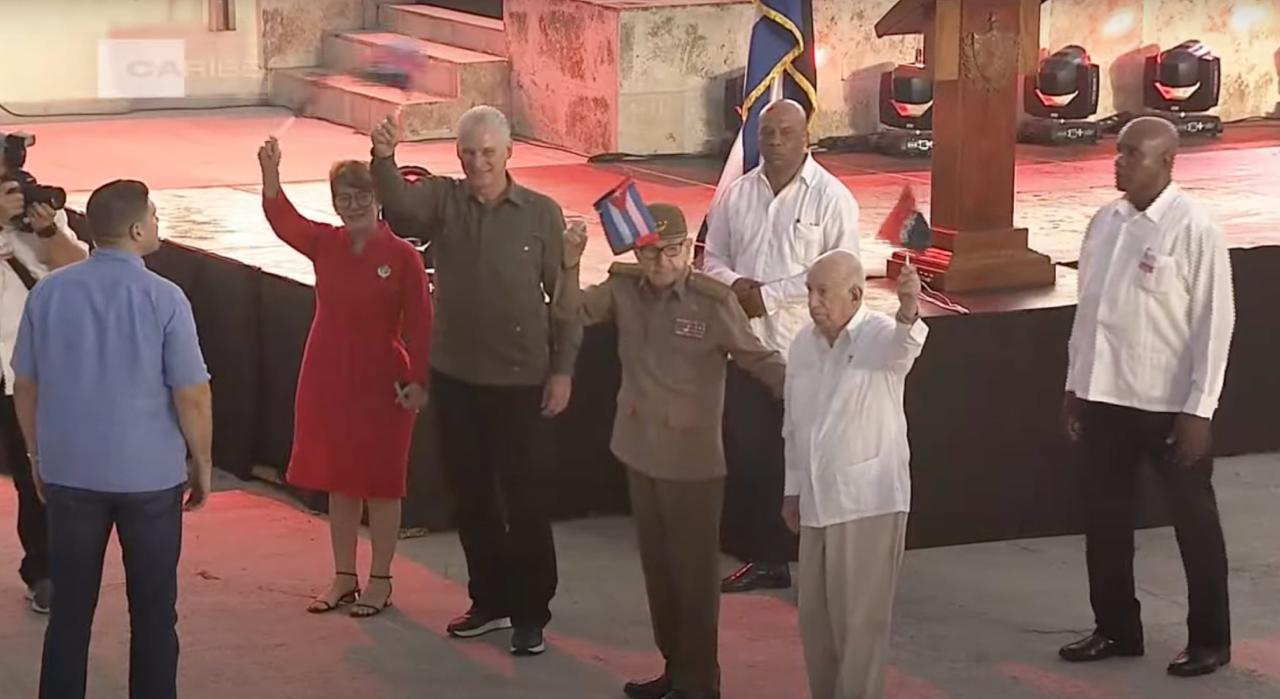
Raúl Castro and his group at the closing ceremony./ Televisión Cubana

14ymedio bigger14ymedio, Havana, 26 July 2025 — Cuban Television, which broadcast the event this morning — always reserving time to make whatever cuts may be necessary — with all the usual fanfare, marked by tearful evocations of the failed assault on the eastern barracks of Moncada and Carlos Manuel de Céspedes in 1953.

There was no shortage of mournful images of Fidel Castro, Miguel Díaz-Canel’s shiny skin, or dramatisations – both on stage and off – to satisfy the few “historical figures” remaining in the Revolution. Ramiro Valdés and José Ramón Machado Ventura were other representatives of the old guard who attended an event that this year has been subdued and required people to be transported in from neighbouring provinces.

At 94 years of age, Raúl Castro prefers to leave his comfortable retirement only on special occasions, when he takes the opportunity to pat Díaz-Canel on the back, applaud his management and pretend that the country is not falling apart. And the event in Ciego de Ávila was no exception.

There was no shortage of the usual sanctimonious theatrics over the ’blockade’, but there was also self-criticism in the ’show’.

There was no shortage of the usual hand-wringing over the blockade, but there were also some self-criticisms in the performance that fell this year to Prime Minister Manuel Marrero — a role that the year before had been assigned to Salvador Valdés Mesa — since, from 2023 onward, the president prefers not to take centre stage.

According to Marrero, the country faces “enormous challenges” as never before, but he says he is convinced that continuing to do the same thing will bring different results this time: “Yes, we can, thanks to the determination, hard work, intelligence and commitment of the Cuban people.” The “annoying power cuts” that affect citizens so much were continue reading

brought up, although during the ceremony the power did not go out once in Máximo Gómez Báez Square.

He also mentioned other shortcomings such as problems with food supplies, drinking water, transport and medicines, as well as rampant inflation, and stressed the urgency of “removing obstacles, correcting deficiencies and turning the people’s efforts into tangible results”.

As for the “imperialist enemy,” Marrero assured that “it does not rest in its efforts to destroy the Cuban Revolution” and that it seeks “to take advantage of any internal difficulties to sow discouragement, divide, and provoke social unrest that would justify intervention.” He also called for “defeating any attempt at subversion” with “historical experience, unity, political awareness, and morality.”

The crisis was quickly buried by the great “efforts” that the government made this year in Ciego de Ávila.

However, the crisis was quickly buried by the great “efforts” that the Government made this year in Ciego de Ávila, which in practice translate into painting and using tar to cover potholes: seven solar parks built in nine months; achievements in sports and tourism; renovation of a hospital; 22 health centres; 16 schools; the theatre; a home for children without parental care; the agricultural market; 702 electrified farming areas and 25 new water pumping services.

Sancti Spíritus went through the same experience last year, when it was similarly renovated, but today it looks as if the streets have not seen a lick of paint or a single sack of cement.

As for Díaz-Canel, in his brief speech he fulfilled expectations with his usual rhetoric full of clichés and bellicose tones, with phrases such as “Turning setbacks into victories”, “We live under a hegemonic imperialism that encourages wars” and “Through solidarity we resisted the attacks of imperialism”.

The night ended with applause for Cuba’s friends – the same 500 foreigners who march every year on May 1st or participate in political events – who travelled to support the celebration, with leaders dancing to the salsa rhythms of Arnaldo y su Talismán, and with Raúl and his cohort waving Cuban paper flags at full speed and leaving the stage to the Marcha del 26 de Julio.

Translated by GH

____________

COLLABORATE WITH OUR WORK: The 14ymedio team is committed to practicing serious journalism that reflects Cuba’s reality in all its depth. Thank you for joining us on this long journey. We invite you to continue supporting us by becoming a member of 14ymedio now. Together we can continue transforming journalism in Cuba.

The Holguín to Guantánamo Train Runs Again After Months Stuck With No Fuel.

The four cars can carry between 600 and 700 people, for a price ranging from 135 to 150 pesos.

The route was set for Tuesdays, Thursdays, and Saturdays. / Cubadebate

14ymedio bigger14ymedio, Havana, 25 July 2025 — Ferrocarriles de Cuba has relaunched one of its most popular routes and, at the same time, one of the most irregular: the train from Holguín to Guantánamo. With the energy that only the 26th of July brings, the company announced this month that the reopening of the route is not only “a temporary measure for the summer season, but is planned as a permanent transport solution”. That is, as long as there is fuel and functioning technology, the same two issues that kept the thing at a standstill for months.

The official press release on the restarting of the line seems to be an exact copy of the one published a year ago with the same announcement. At that time, the train travelled on alternate days and the authorities promised that the route would not disappear again. By November, however, the route was only running on Saturdays due to a lack of fuel and, at the beginning of this year, it was suspended again.

The train was suspended as soon as the harvest began and the wagons were put back to their original purpose: transporting cane.

A year earlier it had had the same problem. After starting to operate with machinery from the sugar industry, the train was suspended as soon as the harvest began and the wagons were destined for their original purpose: to transport sugar cane.

With such a “track record”, it is not surprising that passengers doubt the reliability of the service, which reappears only around National Rebellion Day.

Given the doubts, the authorities claimed that the train had a broken locomotive, which made it impossible – due to the chronic lack of these engines on the island – to resume the service. According to Pedro Durruty Martínez, deputy director of Ferrocarriles in Guantánamo, bringing back the train “required repairs and structural modifications to guarantee the safety and reliability of the service, as the cars are just shells with no real support under the floor”, according to Granma, the Communist Party newspaper. continue reading

The route was fixed for Tuesdays, Thursdays and Saturdays, with five wagons.

The media describes the maintenance work as a “feat”, which entailed the manufacture from scratch of the necessary parts by the workers of the Guantanamo workshop Vanguardia Proletaria.

The route is set for Tuesdays, Thursdays and Saturdays, with five carriages – four for passengers and one for parcels and luggage – and capacity for between 600 and 700 people. The price, according to Granma, ranges between 135 and 150 pesos “depending on the section, a rather more affordable alternative to private transport”.

“And what about Santa Clara to Morón?”

Far from celebrating the news, as the authorities expected, passengers have taken to the press to criticise the poor state of the railways. “A lot of people hope that in this holiday season, August, the Bayamo-Guantánamo train, which has not been running for years, and also the Holguín train., will be started up. They could alternate them and so help families who are separated by high ticket prices and the limited availability of transport,” suggested someone in Granma.

“And what about Santa Clara to Morón , which hasn’t run for over six years and nobody knows anything about it?” another reader asked in Cubadebate.

Ferrocarriles de Cuba has added other routes, although most have been in the western provinces. In Havana, the train to Expocuba, which the authorities went on about as an option for visiting the park during the summer, was started up in early July.

The train to Playas del Este takes more than an hour and a half for a journey of just 25 kilometres.

However, on a visit to the fairgrounds – using the line – 14ymedio saw that the train was travelling practically empty and that, of the passengers who get on, hardly any went to the final destination. With three carriages and a price of 20 pesos, the vehicle is designed to carry 204 people and makes stops in Luyanó, Dolores, La Víbora, Naranjito, Miraflores, Los Pinos, Alcázar, Arroyo Naranjo, Galápagos, Calabazar and La Piscina.

Around the same time, it was also reported that the train to Playas del Este, which takes more than an hour and a half for a journey of just 25 kilometres, was launched.

Earlier, in June, the Los Arabos-Matanzas route was revived. The Matanzas Provincial Transport Directorate announced on that occasion that the line will run on Mondays, Wednesdays and Fridays, departing at 4:40 a.m. and returning at 3:30 p.m. Initially, it will have only two cars of 80 passengers each, with the possibility of increasing to four in the future.

Translated by GH

____________

COLLABORATE WITH OUR WORK: The 14ymedio team is committed to practicing serious journalism that reflects Cuba’s reality in all its depth. Thank you for joining us on this long journey. We invite you to continue supporting us by becoming a member of 14ymedio now. Together we can continue transforming journalism in Cuba.

Alejandro Gil’s Sister Says the Prosecutor’s Office Will Ask for “Life Imprisonment” for the Former Minister

María Victoria Gil Fernández, a resident in Spain, cites a “source close to the investigation”

María Victoria Gil Fernández, a resident in Spain, cites a “source close to the investigation”

14ymedio bigger14ymedio, Madrid, 1 November 2025 — “If Alejandro Gil has been capable of betraying his principles, I will not hesitate to wish that the full weight of the law falls upon him,” his sister María Victoria asserted this Saturday in statements to 14ymedio. She added that a “source close to the investigation” has “guaranteed” her that the prosecution is seeking a “life sentence.”

María Victoria (Vicky) Gil Fernández feels “hurt and ashamed” by the information the Cuban Attorney General’s Office has provided about her brother, the former Minister of Economy and Finance, accused of espionage, embezzlement, money laundering, and falsification of public documents. “I think of my parents who, wherever they are, must be covered in shame. The upbringing they gave us siblings was based on honesty and justice.”

Her words leave no doubt that, far from the view she shared with this newspaper in March 2024, when she emphasized the presumption of innocence for the then recently detained man, today she is closer to believing in her brother’s guilt.

The former Cuban television presenter, a lawyer by training and currently residing in the Canary Islands, considers “the sum of the alleged crimes exceptional,” especially that of espionage, “which is punishable by death.”

“In all cases, the defendants were asked to face prison sentences.”

When asked about the other defendants, about whom the prosecution has provided no information, Vicky Gil claims to know nothing more than what was “broadcast last night on Cuban Television’s flagship program.” Regarding her sister-in-law, Gina María González, and her nephews, she says, “I don’t know their situation because I have them blocked.” continue reading

The brief statement released by the Attorney General’s Office already suggested that the maximum penalty—death by firing squad—would not be sought in this case, even though it remains in force under the Penal Code. “In all cases, the defendants were offered prison sentences,” the statement read, indicating that the use of a penalty that has not been applied since 2003 was ruled out.

The former minister’s sister also hasn’t shed any light on Alejandro Gil’s whereabouts, which remain unknown. In her interview last year, she speculated: “In Cuba, there are special houses, belonging to State Security, very nice houses, in Miramar and Nuevo Vedado, where they take high-level, high-ranking people, in quotes, who are being investigated. That was the case with Carlos Lage and many others. They have every luxury and every comfort, and they aren’t mistreated, not at all. He must be in one of those houses; I don’t know which address.”

On that occasion, Vicky Gil also said: “Until the Public Prosecutor’s Office formally charges him with a crime, you can’t call him corrupt. That’s why I said I would file a lawsuit against the program ‘Con Filo’, because the presumption of innocence is mandatory.” The former presenter was surprised that in early February, when Gil was dismissed as minister, Miguel Díaz-Canel, with whom she was very close, had congratulated her on her birthday.

For the first time, the possibility of serious crimes “against the security of the State” is mentioned.

“The biggest contradiction is that the president of the Republic of Cuba dismisses my brother and that same day congratulates him on the achievements he has made, and my brother replies: ‘Thank you, Díaz-Canel, we are still with you,’ and then on March 7 they announce that they are investigating him. How can the president of Cuba not know what is happening?” she told 14ymedio.

The case of the former minister, dismissed in February 2024 after being presented for years as the “technical face” of the Díaz-Canel government, remains shrouded in secrecy and suspicion. For over a year and a half, the official narrative was limited to mentioning “serious errors in the performance of his duties,” without specifying concrete charges. However, in the Attorney General’s recent official statement, the possibility of serious crimes “against the security of the State” is mentioned for the first time.

Regarding the possibility of an exemplary trial, broadcast on television, the former presenter of the program De la Gran Escena added in her 2024 interview: “If a trial is held, as was done with [Arnaldo] Ochoa, where the State cleansed itself of all its crimes with one person, it acted cruelly knowing what was really behind Ochoa, the corruption that existed, I will go.”

The comparison with Arnaldo Ochoa, executed in July 1989 after a summary trial for drug trafficking and treason, was not accidental. The pro-government program Con Filo had used images of the general to refer to the case of Alejandro Gil, demanding “the full force of the law” against the ousted former minister.

____________

COLLABORATE WITH OUR WORK: The 14ymedio team is committed to practicing serious journalism that reflects Cuba’s reality in all its depth. Thank you for joining us on this long journey. We invite you to continue supporting us by becoming a member of 14ymedio now. Together we can continue transforming journalism in Cuba.