The Journalists Club of Mexico Is an Instrument of Cuban and Russian Propaganda

Some 72% of the magazine’s content distributed by the Club comes from RT, Sputnik and Prensa Latina to promote “freedom of expression and journalistic rigor”


At the Journalists’ Club, five blocks from the headquarters of the Mexican government, a ceremony for the 60th anniversary of Prensa Latina / SPR took place

14ymedio bigger14ymedio, Mexico City, December 7, 2025 — From Mexico, with public resources, the narratives of the regimes of Russia and Cuba are being disseminated. According to a report published this Sunday by Factchequeado, a US fact-checking institution, the Journalists’ Club, a Mexican non-profit organization that claims to promote “journalistic excellence since 1952,” acts as “a propaganda facade” for both governments.

The Club uses a magazine called Journalist Voices, its “news organ,” to republish information from official agencies in Russia and Cuba. According to the research, since April 2025, almost three-quarters of its content (72%) is taken from state media, mainly from the Russian RT and Sputnik (53%), followed by the Cuban agency Prensa Latina (18.6%).

Although the Journalists’ Club claims to promote “freedom of expression and journalistic rigor,” it is now “a pro-Kremlin and anti-Western propaganda conduit,” according to an analysis by the Alliance for Securing Democracy of the non-partisan German Marshall Fund. The author of the report added that the page “amplifies the narratives of the Russian and Cuban regimes while publicly presenting itself as a genuine national journalistic project.”

The page “amplifies the narratives of the regimes in Russia and Cuba while publicly presenting itself as a journalistic project”

The Journalists’ Club shows a clear inclination in favor of the present and past government in Mexico, and it’s no wonder. It benefited financially under Andrés Manuel López Obrador, an open sympathizer with the Cuban regime. From 2020 to 2023, it received 951,000 pesos (about $ 51,000), for advertising in the magazine that it “publishes,” although it is not known where you can get a physical copy, and despite the fact that its Facebook page has only 2,600 followers. continue reading

The Club is run by Celeste Sáenz de Miera and Mouris Salloum George, the editor responsible for the publication. Just last April, he was recognized by the Government of Vietnam “for his work in spreading the values and the resilient spirit of the Vietnamese people.”

Previously, in 2019, at the headquarters of the Journalists’ Club, five blocks from the Palacio Nacional, the seat of the Mexican government in Mexico City, Salloum George led a ceremony for the 60th anniversary of Prensa Latina. At the event, the then director of the agency, Luis Enrique González, stated that his “mission” to “counter the campaigns of disinformation and manipulation about the Cuban revolution” was still “in effect.”

Salloum George led a ceremony for the 60th anniversary of Prensa Latina

As for Celeste Sáenz de Miera, in 2017 she headed an event in which a prize was given to the RT channel for its “contribution to the plurality of information.” In her message, the journalist, who says publicly that “the deliberate violence of lies” must be denounced and that her organization defends “truth as an ethical obligation and backbone of journalism,” pointed out that the role played by the Russian channel on the international scene “is fundamental, since it contributes in a decisive way to the plurality of information with unquestionable quality and rigor.”

In 2023, at an event where she presented a prize addressed to the Russian propaganda media Tsargrad for its coverage of the invasion of Ukraine, Sáenz de Miera even told the Russian ambassador to Mexico, Viktor Koronelli — who that same year was sent to Cuba to occupy the same post — that the Journalists’ Club was “the Mexican home” for diplomats from Russia. The envoy from Moscow, who was in charge of receiving the recognition, stated that “we have other media in Russia, and I believe that in subsequent years all of them will be given these types of awards.”

Translated by Regina Anavy

____________

COLLABORATE WITH OUR WORK: The 14ymedio team is committed to practicing serious journalism that reflects Cuba’s reality in all its depth. Thank you for joining us on this long journey. We invite you to continue supporting us by becoming a member of 14ymedio now. Together we can continue transforming journalism in Cuba.

The Cuban Regime Organizes a Low-Profile Event in Support of Nicolás Maduro

In Díaz-Canel’s absence, Foreign Minister Bruno Rodríguez presided over the podium and avoided mentioning the contacts with Washington regarding Maduro.

The official event on 17th Street in Havana unfolded amid predictable slogans and speeches that insisted on a narrative of “imminent aggression.” / Cubadebate

14ymedio bigger14ymedio, 7 December 2025 —  Havana awoke this Saturday to an official event on 17th Street in El Vedado, hastily convened and with a discretion that contrasted sharply with the massive demonstrations of Venezuelans scattered throughout Latin America in support of María Corina Machado, the 2025 Nobel Peace Prize laureate. While in Bogotá, Lima, and Panama, tricolor shirts, flags, and signs celebrating the opposition leader predominated, in Havana the event organized by the Cuban government reiterated its condemnations of Washington, its accusations of war threats, and its unequivocal support for Nicolás Maduro.

The absence of President Miguel Díaz-Canel—whose presence has been constant at international events of government propaganda—set a low tone from the outset. In his place was Foreign Minister Bruno Rodríguez, accompanied by the secretary of the Federation of Cuban Women, Teresa Amarelle Boué, and the Venezuelan ambassador to Havana, Orlando Maneiro Gaspar. None of them mentioned the rumors circulating for days about alleged talks between Havana and Washington regarding Maduro’s uncertain political future.

Anonymous sources cited by Reuters on Saturday indicated that “some members of the Cuban regime” have made discreet contact with U.S. officials to explore possible scenarios should Maduro leave power. According to the report, among the options discussed is a “world without the Maduro regime,” which reveals that certain circles within the Cuban power structure are already analyzing the feasibility of a change in Caracas in light of escalating sanctions, international pressure, and military operations.

After more than a quarter of a century of “violations, death and misery,” the country finds itself “on the threshold of freedom”

In contrast to the cold official ceremony this Saturday in Havana, the streets of Latin American cities were filled with thousands of Venezuelans called upon by Machado to march “for peace and freedom,” four days before she will officially receive the Nobel Peace Prize in Oslo. In Bogotá, Mauricio continue reading

Vaquero, of the Comando con Venezuela en Colombia (Command with Venezuela in Colombia), summarized the sentiment of many, stating that after more than a quarter of a century of “violations, death, and misery,” the country is “on the threshold of freedom.” Vaquero’s words, far removed from the defensive tone of the speeches in Cuba, reflected the conviction that the international distinction awarded to Machado is a symbolic blow to Chavismo.

In Panama, dozens of Venezuelans marched from the Cinta Costera to the Plaza de la Democracia. “We are proud to have a Nobel laureate who has fought for the freedom of an entire region,” said Ricardo Contreras, one of the organizers. The march, which many described as “full of light and hope,” was a far cry from the rigid atmosphere of the event in Havana, where every speech seemed like a rehearsed recitation of the panic within the Castro regime over the potential loss of its main ally in the region.

Lima was also the scene of a demonstration in front of the Venezuelan Embassy, ​​where the diaspora — 1.5 million migrants in Peru — carried replicas of the Nobel Prize medal, flags, and signs with phrases such as “The Nobel Prize belongs to those unjustly detained” and “The Nobel Prize belongs to those who have given their lives for this struggle.” Verónica Durán, of the New Global People Alliance, stated that the prize “is a victory for all of Venezuela.”

Venezuelans have reacted with outrage to the death in custody of Alfredo Díaz, former governor of Nueva Esparta, after a year of isolation at the SEBIN (Bolivarian National Intelligence Service). His death adds to a string of at least six opposition members who have died in prison since November 2014, and to a record that, according to Foro Penal (a Venezuelan human rights organization), includes 17 political prisoners who have died since 2014. Both the NGO and María Corina Machado denounced these deaths as part of a pattern of torture, isolation, denial of medical care, and stalled trials, while the country continues to hold 887 political prisoners.

Today, Havana’s calls to action lack force, overshadowed by the internal crisis and a population increasingly unwilling to validate official spectacles.

Meanwhile, the official event on Havana’s 17th Street unfolded amid predictable slogans and speeches that insisted on a narrative of “imminent aggression” by the United States. Dr. Idalmis Rodríguez, chosen to speak as “a representative of the forces defending peace,” criticized the awarding of the Nobel Peace Prize to Machado, calling it a “grotesque contradiction” and accusing her of calling for foreign military intervention. This worn-out rhetoric was heard by a small audience, composed mainly of mobilized activists and state officials.

The ambassador of the Caracas regime, Maneiro Gaspar, for his part, reiterated the claim that his country has faced “a real threat” since August and denounced “murders in the Caribbean Sea,” referring to the US attacks on some twenty vessels linked to drug trafficking. Even so, he went so far as to announce “exponential growth of 6%,” an economic optimism that contrasts sharply with the crisis gripping the country and the lack of enthusiasm among Venezuelan emigrants to return home.

Amarelle Boué reiterated the sanctions as “collective torture,” the denial of links between the Venezuelan regime and criminal organizations, and the demand to “keep your hands off Venezuela.” But neither she nor the other speakers addressed a persistent underlying issue: what role does Havana play in the diplomatic maneuvering surrounding Maduro’s political future?

For decades, Cuba was the natural stage for large-scale “anti-imperialist” demonstrations, but today these events lack force, overshadowed by the internal crisis and a population increasingly unwilling to endorse official spectacles. The fact that the government opted for a modest event and that Díaz-Canel remained on the sidelines reinforces the impression that the priority at this moment is not Venezuela, but rather the island’s own political survival.

____________

COLLABORATE WITH OUR WORK: The 14ymedio team is committed to practicing serious journalism that reflects Cuba’s reality in all its depth. Thank you for joining us on this long journey. We invite you to continue supporting us by becoming a member of 14ymedio now. Together we can continue transforming journalism in Cuba.

The Ferocious Reign of Reinaldo Arenas, the Writer the Cuban Regime Could Not Silence

Memoirs of the author who transformed exile, desire, and rebellion into his own literary territory

Arenas represents what they have not been able to erase: the memory of the free body. / Margarita Camacho

14ymedio bigger14ymedio, Noemí Herrera, Miami, 7 December 2025 — This December 7th marks 35 years since Reinaldo Arenas decided to say goodbye to the world, and I still find it difficult to write the word “death” without feeling that it falls short. Arenas didn’t die in 1990, in that New York apartment where illness and poverty gradually consumed his body; what was left behind was the physical matter that could no longer accompany his voice.

The work of the Holguín native, however, continues to breathe with an almost ferocious intensity, untamed, that insists on relentlessly challenging the certainties of Cuban power. And it is that Arenas, even from beyond the grave, remains the regime’s bête noire: a writer they could never tame or reduce to an anecdote, and whose words still resonate with a freedom they have never been able to silence.

To write about Arenas from this distance is also to remember the man before the myth.

My first readings of Arenas were furtive, almost clandestine, as if the book feared being discovered. I remember opening Celestino antes del alba [Celestino Before Dawn] and feeling as if someone were tearing me away from the domesticated literature I had read until then. Everything in his prose was excess, delirium, defiance. He wasn’t trying to please, he was trying to break free. It was, for a young reader, like witnessing a fire: you can’t look away, even though what is burning frightens you.

I’m also told that he laughed with a disarming force, that even in the tightest spaces he found a glimmer for the ‘fiesta’

While studying Philology at the University of Havana, I had an opportunity denied to millions of Cubans: to learn of Arenas’ existence. No, I didn’t learn of him because his work was required reading in Cuban or contemporary literature courses, but because his books circulated from hand to hand in an essential initiation rite for anyone wishing to call themselves a student of the Faculty of Arts and Letters.

My readings of his work— his delusions, his irony, his depths —were also intertwined with accounts from friends who knew him in Havana, in the literary offices where he was viewed with suspicion, in the National Library where he worked among other’s manuscripts while his own was taking shape in the undertow. They always speak to me of his gaze: a flash of insolence that was continue reading

simultaneously tenderness and defiance. They also tell me that he laughed with a disarming force, that tightest spaces he found a glimmer for the fiesta, for unbridled imagination, for the freedom that the system sought to wrest from him.

That freedom is, perhaps, the key to his writing. Arenas invented a prose that moved between fury and laughter, between baroque outburst and wounded confession. El mundo alucinante [The Hallucinatory World] and, of course, Antes que anochezca [Before Night Falls], form not only a literary body of work, but an emotional constellation where childhood, repression, eroticism, hunger, desire, guilt, laughter and revenge intertwine. In his pages, the Island appears as a territory of unbearable beauty and systematic violence; a place where the dream of freedom is always a struggle. Arenas understood, more than any other Cuban writer of his generation, that imagination could become a highly effective tool of resistance.

He continued writing even in the worst of times: persecuted for his homosexuality, imprisoned in El Morro, watched, silenced, driven into literary secrecy, forced to flee. But his work is not that of a victim; it is that of a rebel who made writing an exercise of insurrection. His prose, so marked by the political incorrectness of real life, anticipated a way of narrating the Cuban experience from the margins, far from the revolutionary solemnity that sought to monopolize the national narrative.

AIDS, which in those years was a silent and stigmatizing executioner, cornered him, but did not stop his creative impulse

When he arrived in the United States as part of the Mariel boatlift, he carried with him accumulated traumas but also an undiminished will to name the disaster he was leaving behind. New York was for him an ambiguous territory: refuge and exile, a space of freedom and also the stage for the disease that relentlessly advanced.

AIDS, which in those years was a silent and stigmatizing executioner, cornered him, but it did not stop his creative impulse. Antes que anochezca [Before Night Falls] —one of the most powerful memoirs in Latin American literature—was born from that urgency to tell everything before physical silence took hold. Those who were with him during those months have told me repeatedly that he wrote as if each sentence were a race against time, with the awareness that the truth had to be told forever.

Thirty-five years later, Arenas occupies a place that not even his enemies could deny him: that of a major writer in the Spanish language. His influence reaches generations who read in him not only a denunciation of totalitarianism, but also a celebration of desire, a radical approach to identity, and a stylistic freedom that transcends categories. Contemporary Cuban literature, fragmented and multifaceted, carries in its DNA something of his irreverence and his courage. In Latin America, his name has become synonymous with aesthetic and ethical resistance.

What is most surprising is that his work continues to be uncomfortable for those who govern Cuba. Arenas represents what they have been unable to erase: the memory of the free body, the imagination that knows no borders, the word that returns again and again to remind us that repression is never invincible. He himself knew that all censorship is useless in the face of a book that finds its reader.

Today, when I remember him, I don’t think about his death but about the power of his legacy. Arenas wrote to survive, and he survived through his writing. In a time when so many voices are still silenced, his work remains a fierce reminder that freedom begins with daring to tell one’s own story, even when the whole world conspires to prevent it.

____________

COLLABORATE WITH OUR WORK: The 14ymedio team is committed to practicing serious journalism that reflects Cuba’s reality in all its depth. Thank you for joining us on this long journey. We invite you to continue supporting us by becoming a member of 14ymedio now. Together we can continue transforming journalism in Cuba.

La Habana No Aguanta Más / Havana Can’t Take it Anymore

“This was the first time I’ve heard people openly criticising the government in front of me, a foreigner”

“So is there any solution?” I ask. “Get rid of the Communists” / 14ymedio

14ymedio bigger14ymedio, Cath Forrest, London, 7 December 2025 — “Volver … que veinte años no es nada” (“Returning … for twenty years is nothing”) goes the song. But arriving back in Havana after a gap of twenty years is a shock.

The city was always crumbling, that was part of its charm. But the view over the rooftops of Central Havana now resembles a war zone, its pock-marked concrete drained of all colour except for the shining golden dome of the Capitolio, restored with Russian money. Along the iconic facade of the Malecón, with its once picturesquely faded pastel colours, many buildings have collapsed altogether like jagged missing teeth, while others have been brutally replaced by giant international hotels. The micro-brigade housing that sprouted so hopefully along the coast to the east in the 1980s is now badly in need of repair.

There were always power cuts and they never kept to the published timetable. But now, at least in the part of Central Havana where I was staying, the lights go out every single evening for at least five hours, and usually for several in the daytime as well. This is deeply demoralising. As is the sight of the towering new Iberostar Hotel in the Vedado, with all its lights blazing, while below it the whole surrounding district is plunged in darkness.

Ever since the dollar was legalised and the country opened up to tourism in the early 1990s, there has been a growing rift between tourists, who can have things, and Cubans who cannot. It often appears that all the resources of the state are being thrown at tourism, in a kind of national prostitution. This divide has now reached a level that is frankly ugly. It’s not much fun for the tourists either, unless continue reading

they have the hides of rhinos, which some obviously do. They hire the famous old Chevrolets and Buicks that have been done up to gleam in fabulous colours, and parade up and down the Prado in them, waving their arms in triumph and hooting their horns. No wonder the once utterly lovely Parque Central is now swarming with hustlers, like the worst of Venice.

But the effect is much more damaging than that, distorting the whole economy. A dollar, originally intended to be equal to one peso, is now worth over four hundred, so that the money Cubans earn – the average salary is about 6500 pesos a month – is effectively worthless and prices are insane. Unlike in the “Special Period in Times of Peace”, there is food available. But a single tangerine from a barrow on the street will cost you 600 pesos. An old man sits under a tree in the Vedado, eating a cake he has begged from a fancy cafe, while behind him another man rummages in a heap of rubbish piled against the wall of a dilapidated but still graceful home. Inside the cafe, Cubans are welcome but the prices are pegged to the dollar so that a pizza costs nearly 2000 pesos, ten times the usual price.

All this, combined with the sorry state of the streets, where paving stones jut in the air, holes gape in the ground and sewage runs down the gutters, means that it is no longer safe to walk alone after dark. Twenty and even thirty years ago tourists were already the target for robberies. Here my comparison has to be with forty years ago, when, as a young, fair-haired foreign woman, I could take two buses home to a distant suburb at three in the morning with absolutely no fear. It was the safest place in the world. The change doesn’t only affect tourists. An elegant lady outside one of the few cinemas still open advises me to go to the 2pm show as otherwise I’ll have to leave in the dark. “Ah, how I used to love to sit in the cinema,” she sighs, echoing my thoughts exactly.

I should say that these were my impressions on first arrival in Havana as a tourist and that I soon adapted enough to be able to enjoy again the endless beauty of this city and the natural, quiet courtesy of its citizens away from tourist hotspots.

The great difference on this occasion was the attitude of Cubans themselves. They have always grumbled, played around with every new adversity with sharp, black humour, that old blitz spirit. But this was the first time I’ve heard people openly criticising the government in front of me, a foreigner. “It’s all Fidel’s fault, he destroyed our industry,” says Milagro, an old woman sitting on a doorstep in a blackout. “They’ve forgotten Che,” wails her friend Ilsa, beside her, “They’re hypocrites who send their children abroad to be educated.” “We’re too weary to go on strike, we just keep each other laughing,” says a mother trying to cook with arthritic hands in another power cut. A taxi driver tells me that people would protest but “We can’t afford to go to jail on top of everything else.” A shop boy compliments me on my Spanish and I reply that I worked here before he was born: “Ah, so you caught the good times” “Yes” “That’s all over now, isn’t it?” Two young men in a local cafeteria are agreed that “Everything is destroyed.” “So is there any solution?” I ask. “Get rid of the Communists” answers Yoel, quick as a flash.

____________

COLLABORATE WITH OUR WORK: The 14ymedio team is committed to practicing serious journalism that reflects Cuba’s reality in all its depth. Thank you for joining us on this long journey. We invite you to continue supporting us by becoming a member of 14ymedio now. Together we can continue transforming journalism in Cuba.

Russia Joins the Governments That Warn of the Risks of Travelling to Cuba Because of the Arbovirus Outbreak

Moscow’s warning adds to those already issued by several foreign governments against non-essential travel to the Island

People line up at the post-arbovirosis clinic. / 14ymedio

14ymedio bigger14ymedio, Havana, December 6, 2025 — The epidemiological situation in Cuba is so serious that even an ally like Russia has been forced to issue a new international alert for its travellers. The embassy in Havana, citing a statement by the Ministry of Foreign Affairs of the Russian Federation, has advised its citizens to take extreme precautions against the resurgence of cases of dengue and chikungunya. Suggested measures include the use of repellent, closed and long-sleeved clothing during periods of high mosquito activity and avoiding areas with stagnant water.

Concern about the epidemic in Cuba has been noted in Russia in recent days. The press has reacted with growing alarm, calling into question the safety of travelling to the island during the holiday season.

Epidemiologist Guennadi Onishchenko of the Russian Academy of Sciences advised citizens to “return their tourist packages” and opt for destinations near Moscow, considering that “taking the risk of contracting an infectious disease is, at the very least, unwise.”

The Russian Foreign Ministry has advised its citizens to take extreme precautions against the epidemic in Cuba

Gazeta called the situation “critical” and estimated that there are currently about 1,500 Russian tourists in the most affected areas, of whom at least 14 are ill.

The actual numbers of infected Russians seem to be higher. Cases of people with the virus often appear on social media. In the Facebook group “Russians in Cuba,” tourist Anna Lynn recounted the case of her husband, infected with the virus in Holguín and with a 104 degree (F) fever. “We called the doctor and the diagnosis was chikungunya. But they told us there is no treatment, only water and rest. I’m very worried,” she said. continue reading

Other countries like the US, the UK and Canada have previously warned about the epidemiological situation on the island

The health situation on the island and the recent warning issued by Moscow could affect the number of Russian visitors in the coming weeks, which would further accentuate the current drop of 36.2% in Russian tourists for the first ten months of this year (99,908, instead of 156,614 in 2024).

Other countries have previously issued warnings. One of the first was the US, which in September issued through its Embassy in Havana a health alert for all citizens who want to travel to Cuba, due to the outbreak of chikungunya. The risk was then determined at Level 2, which requires taking “additional precautions.”

The Government of Canada maintains its warning to “exercise a high degree of caution” when travelling to Cuba, updated on November 25, 2025. Cuba is explicitly included as a destination at risk from mosquito-borne diseases.

The UK Foreign Office, in its recently updated travel guide for Cuba, reported on the declared epidemic of arbovirosis on the island and advised travellers to take precautions to prevent bites.

Several warnings mention that the risk is not only from arbovirosis but also from a health infrastructure in crisis, with shortages of medicines, irregular water supply, and difficulties in accessing adequate medical care.

Translated by Regina Anavy
____________

COLLABORATE WITH OUR WORK: The 14ymedio team is committed to practicing serious journalism that reflects Cuba’s reality in all its depth. Thank you for joining us on this long journey. We invite you to continue supporting us by becoming a member of 14ymedio now. Together we can continue transforming journalism in Cuba.

Cuba Will Go to the World Baseball Classic and Has Now Handed Over a Preliminary Roster of 50 Players

Manager Germán Mesa’s call includes Andy Pagés, Yoán Moncada and Zach Neto, while the case of Yariel Rodríguez is still not defined

Players Andy Pagés, Yoan Moncada and Zach Neto are on the roster that was handed over by manager Germán Mesa for the World Baseball Classic. / Archive Photo/Jit

14ymedio bigger

14ymedio, Havana, December 4, 2025 — Finally, and after weeks of uncertainty, Cuba will participate in the World Baseball Classic. According to Cuban Baseball Digest, the Island’s national team “has the necessary permits and will soon announce its participation in the tournament.”

The same media reported that the negotiations of the Cuban Baseball and Softball Federation (FCB) with the US Major Leagues “have been positive and have made significant progress.” The publication comes days after World Classic president Jim Small said in Puerto Rico that the so-called Team Asere would be part of the event in March.

This Wednesday, journalist Francys Romero reported that the FCB handed over a preliminary roster of 50 players. In addition, he stressed that no one from the Cuban federation was present at the Winter Meetings 2026, which took place in Orlando, Florida, and no one is expected to “attend the winter meetings.”

This Wednesday, journalist Francys Romero reported that the FCB handed over a preliminary roster of 50 players

Among the players chosen by manager Germán Mesa are Andy Pagés, Yoan Moncada and Zach Neto. The inclusion of Yariel Rodriguez is contemplated; however, Pelota Cubana USA journalist Yusseff Diaz said that the inclusion of the ball player is still under debate. Although the pitcher has expressed continue reading

interest in playing for the Island, there are managers who do not forgive him for breaking a contract in 2023 with the Japanese team of the Chunichi Dragons.

The Mesa team has Pagés as an outfielder; however, there is still no response from the Los Angeles Dodgers team where he plays. Victor Labrada (Seattle Mariners) and Albert Lara (Laguna Union Cotton Growers) are in the line-up.

The Mesa roster also lists Zach Neto (Los Angeles Angels), free agents (FA) Andy Ibáñez, Yoan Moncada, Ernesto Martínez Jr., and Yiddi Cappe (Miami Marlins), Alexander Vargas (Cincinnati Reds) and Jean Walters (Arizona Diamondbacks).

Mesa envisages Omar Hernandez (Kansas City Royals) as a catcher. For pitchers it has Daysbel Hernández (Atlanta Braves), Ryan Fernández (Saint Louis Cardinals), Lázaro Estrada (Toronto Blue Jays), Rafael Sánchez (Toronto Blue Jays) Yariel Rodríguez (Toronto Blue Jays), Emmanuel Chapman (Pittsburgh Pirates), Denny Larrondo (FA), Pedro Santos (FA), Jorge Marcheco (Los Angeles Angels), Silvano Hechavarría (Toronto Blue Jays), Josimar Primo (Mayagüez Indians), Osiel Rodríguez (León Bravos), Jan Carlos Hechavarría (Los Angeles Angels), Robert Roilan Portuondo (Pittsburgh Pirates) and Elián Leyva (FA).

The list also includes left-handers Daviel Hurtado (New York Mets), Darién Núñez (FA), Julio Robaina (Guasave Cotton Growers), Francis Texidó (Los Angeles Angels), Randy Labaut (FA) and Andrés Pérez (Jalisco Cowboys).

Translated by Regina Anavy

____________

COLLABORATE WITH OUR WORK: The 14ymedio team is committed to practicing serious journalism that reflects Cuba’s reality in all its depth. Thank you for joining us on this long journey. We invite you to continue supporting us by becoming a member of 14ymedio now. Together we can continue transforming journalism in Cuba.

With the Defeat of the Left in Honduras, the Cuban Regime Loses a Second Ally in the Region

The two right-wing candidates – one supported by Trump – are tied and have obtained 80% of the votes according to preliminary data.

Salvador Nasralla and Nasry Asfura (left) lead the provisional results. / Televisión Azteca

14ymedio bigger14ymedio/EFE, Tegucigalpa, 1 December 2025 — Three days after Prime Minister Ralph Gonsalves’ crushing defeat in the Caribbean islands of Saint Vincent and the Grenadines, Havana loses another ally, this time in Honduras, where elections were held on Sunday with high voter turnout and decisive results.

Conservative candidates Nasry Tito Asfura, from the National Party – for whom US President Donald Trump asked for votes – and Salvador Nasralla, from the Liberal Party (centre-right), are leading the preliminary count early on Monday morning with a narrow margin in favour of the former, signalling the return of the right to power.

With 44.23% of the votes counted, Asfura had obtained 597,184 votes (40.39%), while Nasralla had obtained 579,626 (39.20%), results that mark a change in trend in Honduras, which has been governed by the left during the last term.

The ruling party candidate, Rixi Moncada, from the left-wing Liberty and Refoundation Party (Libre), was relegated to a distant third place with 287,166 votes (19.42%), forcing her leaders to be cautious and asking supporters to remain “ready for battle” until the count is complete.

The first preliminary results took more than an hour to be published by the three councillors of the National Electoral Council.

The first preliminary results took more than an hour to be published by the three councillors of the National Electoral Council (CNE) due to technical problems and the expectant gaze of the hundreds of election observers present in the room.

In a brief and angry message before the first count was known, Asfura demanded that the president of the CNE, Ana Paola Hall, speed up the preliminary report.

“We demand that Ana Paola Hall, I don’t know what she’s waiting for, come out and do her duty. We can’t have a country waiting, on tenterhooks, in darkness. Do it, for the sake of democracy. The law continue reading

says so. Thank you, Honduras. We are here to serve you, and we stand firm,” said Asfura, who told reporters, “With the help of God and the Honduran people, we are going to win this election,” and warned that “this is not over until the last vote is counted.”

The general elections in Honduras took place on Sunday without major incidents, with minor reports of delays, alleged impediments to observers during the count, and damaged ballot boxes, but with a high turnout of more than 2.8 million voters (out of a total of 6 million eligible voters) at polling stations, according to initial data.

This participation has been applauded by the United States, which is “closely monitoring” the electoral process in Honduras.

In addition to asking for votes for the presidential candidate, Trump promised that if he won, there would be “a lot of support” for this Central American country ravaged by poverty and waves of migration of its nationals to the north, considering it to be the “only true friend of freedom in Honduras”.

With Asfura, Trump also stated that he sees the possibility of “working together to fight the narco-communists” and confront Venezuelan President Nicolás Maduro.

This support from Washington, just days before the elections, came in the form of a future pardon for former president Juan Orlando Hernández (2014-2022), convicted of drug trafficking in the United States and from the same political party as Asfura.

The American justified the controversial decision on Sunday and claimed, without evidence, that the previous government had “set up” the Honduran. “The people of Honduras really thought they had been set up (…) a trap by the Biden administration, and I looked at the facts and agreed with them,” he told reporters aboard Air Force One on his way back to the US capital.

Trump did not cite any evidence and did not directly blame Biden, but rather the advisers who worked for the Democrat during his presidential term (2021-2025), despite the fact that the case was tried in court.

Trump did not cite any evidence and did not directly blame Biden, but rather the advisers who worked for the Democrat during his presidential term (2021-2025), despite the fact that the case was tried in court. “If someone sells drugs (in a country), that doesn’t mean you should arrest the president and put him in prison for life,” Trump said of the Hernández case.

Hernández was part of a group of individuals investigated by the Drug Enforcement Administration (DEA) since 2013, the year in which he was elected, for activities “related to the importation of cocaine into the United States.” The document was made public as part of the case against the former president’s brother, Juan Antonio Tony Hernández Alvarado, who was sentenced to life imprisonment on charges related to cocaine trafficking to the United States.

With all this, Asfura leads the vote count by a narrow margin over Nasralla, the conservative who remains “optimistic” and hopeful that the results will be reversed to end 16 years of absence of the Liberal Party, but without the support of the United States.

Following the victory of the current president, Xiomara Castro, of the Libre Party, in the last elections, Nasralla held one of the three presidential appointments (vice-president) until April 2024, when he resigned due to confrontations with the president and her husband, Manuel Zelaya, who is also the general coordinator of the political party.

Translated by GH

____________

COLLABORATE WITH OUR WORK: The 14ymedio team is committed to practicing serious journalism that reflects Cuba’s reality in all its depth. Thank you for joining us on this long journey. We invite you to continue supporting us by becoming a member of 14ymedio now. Together we can continue transforming journalism in Cuba.

The Cuban State Uses Gender-Based Violence as a Tool of Repression, Amnesty International Reports

Testimonies show that authorities use, among other biases, “the maternal role to try to get women to abandon activism.”

Yenisey Taboada Ortiz, mother of political prisoner Duannis León Taboada, a political prisoner from 11 July, is one of the people interviewed for the AI report. / Facebook

14ymedio bigger14ymedio/EFE,  Madrid, 26 November 2025 — On Wednesday, the human rights organisation Amnesty International (AI) denounced the violence perpetrated by the Cuban regime against women activists, journalists and human rights defenders through gender-based abuse and authoritarian practices.

“It’s not traditional repression,” said Johana Cilano Peláez, AI’s regional researcher for the Caribbean and author of the report They Want Us To Be Silent, but we continue to resist: authoritarian practices and state violence against women in Cuba, are documented in the 40-page report,” she told the EFE news agency.

The activists also receive threats of “denial of food, medicine, visits, telephone calls and harsher sentences for their detained children” if they continue their work, explains the researcher.

Many mothers and wives of people imprisoned for political actions have been forced to strip naked in order to be allowed to visit them.

Amnesty also denounces “the subordination of the judicial system to political power,” the lack of mechanisms for reporting and redress, and the absence of a comprehensive law against gender-based violence as “factors that perpetuate impunity.”

Cilano Peláez emphasises that repression does not affect all women equally, given that institutional violence intersects with gender, race and socioeconomic status. continue reading

“Black women suffered more severe treatment, and physical violence occurred earlier than in the case of white women. We also saw that activists from poorer neighbourhoods or those further away from the capital were more vulnerable,” she points out.

For the report, AI interviewed 52 people, 34 of whom were female victims, specifically analysing the cases of five of them. Yenisey Taboada, Luz Escobar, Carolina Barrero, María Matienzo, Camila Lobón and Alina Bárbara López were interviewed and revealed that the pattern of state violence is neither incidental nor isolated, but rather “structural and sustained”.

Furthermore, black women, single mothers and women of diverse sexual orientations face aggravated forms of violence, which requires an urgent intersectional response, warns AI.

Amnesty International points out that these situations occur in an environment of restrictions on the exercise and defence of human rights, where the subordination of the judicial system to political power, the lack of mechanisms for reporting and redress, and the absence of comprehensive legislation against gender-based violence perpetuate impunity.

“The international community cannot continue to remain silent in the face of the differentiated repression suffered by women in Cuba,” stressed Ana Piquer, Amnesty International’s regional director for the Americas. “Women defenders in Cuba are punished not only for speaking out, but also for being mothers, journalists and social leaders. The state uses gender-based violence as a tool of repression: it seeks to break their dignity, their family environment and their collective strength,” she added.

The organisation stresses that the lack of guarantees, the lack of judicial independence and the absence of political freedoms stifle any potential legislation that, on paper, appears beneficial for the protection of women.

The document includes a section analysing Cuban legislation, which was praised yesterday by the official press as a benchmark and model for the protection and integration of women in public life. AI considers, however, that there is a recurring lack of statistical data – specifically on deaths due to gender-based violence, whose announced updated register has been reserved for internal consumption – and an absence of regulations demanded by feminist associations.

What’s more, the organisation emphasises that the lack of guarantees, the lack of judicial independence and the absence of political freedoms stifle any potential legislation that, on paper, appears beneficial for the protection of women.

The report concludes with a specific section calling on the Cuban authorities to end gender-based harassment of women activists. “It is time for States, especially inter-American organisations and the European Union, to demand concrete protection measures. State repression against women activists and defenders in Cuba constitutes a form of institutional gender-based violence that must be made visible and publicly condemned.”

AI calls for specific protection measures for women human rights defenders and sustained monitoring by the international community.

“What we saw is that repression against women is systemic and differentiated. The state exploits motherhood and punishes those who have less visibility or resources more harshly. That is why sustained international action is needed,” concludes Cilano Peláez.

Translated by GH

____________

COLLABORATE WITH OUR WORK: The 14ymedio team is committed to practicing serious journalism that reflects Cuba’s reality in all its depth. Thank you for joining us on this long journey. We invite you to continue supporting us by becoming a member of 14ymedio now. Together we can continue transforming journalism in Cuba.

The Cuban Regime Defends Itself Against Accusations of Links With Drug Trafficking

Cuban regime hastens to deny the statements of ‘El Pollo’ Carvajal on the role of Havana in the creation of the Cartel de Los Soles in order to flood the US with cocaine

Havana avoids, as a general rule, giving public explanations about internal security, but this time it responded immediately. / Facebook / Minint

14ymedio bigger14ymedio, Havana, December 4, 2025 — The Cuban government, aware of its current vulnerability, is reacting with unusual speed. Hours after the letter of Hugo “El Pollo” Carvajal — former head of Venezuelan intelligence — was published, in which he accuses the Chavista regime and Cuba of having designed a drug trafficking strategy against the US, Havana convened a press conference to clarify that “Cuba is not a producer of drugs or a drug transit country.”

Officials from the Ministry of the Interior and the Ministry of Justice met on Thursday at the International Press Center. They offered an image of control, but the timing of the appearance exposed the political urgency. Carvajal’s letter, addressed to Donald Trump, details two decades of narco-terrorist operations, cooperation with guerrillas, electoral manipulation and a close relationship with the Cuban intelligence services. In one of his most forceful statements, the former Venezuelan general claims that “this plan was suggested by the Cuban regime to Chávez in the mid-2000s,” referring to the use of drugs as a geopolitical weapon.

The presence of Justice Minister Oscar Silvera Martínez, First Colonel Ibey Carballo, and Colonel Juan Carlos Poey underscored the exceptional nature of the press conference. Havana generally avoids giving public explanations about internal security, but this time the complex domestic crisis, as well as the U.S. military deployment in the Caribbean, are accelerating the actions of the oldest dictatorship in the Western Hemisphere.

Poey, head of the Interior’s anti-drug agency, described the US military presence in the area as “a serious threat to Cuba’s security and sovereignty,” and he added an argument that tried to turn the tables: “The synthetic drugs circulating today in Cuba come mostly from the United States.” continue reading

Carvajal says that Cuban intelligence showed him “their networks inside US naval bases and thousands of spies sent to the US over decades”

To soften the tone, Carballo, second-in-command of the Border Guard Troops, emphasized cooperation with Washington: “We exchanged real-time information with the US Coast Guard. We gave them position, heading and characteristics of the drug boats.”

Carvajal’s letter, addressed to Trump from an American jail, is not limited to describing crimes. It situates Cuba directly as a key actor in the construction of the so-called Cartel de los Soles, affirms that Cuba provided strategic advice, and states that Cuban intelligence showed him “its networks inside US naval bases and thousands of spies sent to the US over decades.”

It also states that criminal groups such as the Tren de Aragua were formed “on the orders of Chávez and then Maduro, with coordinated support from the Ministry of the Interior and security forces,” and that some of these operatives were sent abroad. Although Cuba is not mentioned as a participant in these gangs, it does appear as an adviser and ally of the structure that created them.

The publication of the text coincides with an increase in US military pressure in the Caribbean. Washington has directly linked Venezuelan president Nicolás Maduro with drug trafficking and offered a valuable reward for his capture. US military presence near Venezuela has been considerably strengthened, with deadly attacks on drug traffickers’ boats, threats to extend them on land and the imposition of a total closure of Venezuelan airspace. In this context, any reference to Cuba’s role acquires additional weight.

At the conference, the Minister of the Interior reported that more than two tons of drugs have been “secured” in Cuba so far this year, although without detailing the routes, networks or those responsible. Authorities acknowledge an increase in consumption, especially among young people, but do not publish complete statistics. The internal response remains focused on speedy trials, long sentences and exemplary punishments.

Carvajal mentions the use of armed groups such as FARC, ELN and Hezbollah in Lebanon in coordinated operations with Caracas and Havana, as well as the export of manipulable electoral technology to other countries through the company Smartmatic

Silvera insisted that the Cuban position is “preventive” and allows the island “to not be a producer or transit country.” However, he did not explain why the Government had now decided to make a public statement on the subject, nor did he directly mention Carvajal’s allegations.

The speed with which the conference was organized, the presence of high-ranking officials and the emphasis on cooperation with the US suggest that the Government’s priority was not to inform the Cuban public, but to respond to the international impact of the testimony of the former head of Chavista intelligence.

Carvajal not only points to Havana as an advisor of the cartel run by the Venezuelan leadership, but also claims that diplomats and North American officials have collaborated with Caracas and that Russia set up a listening post on the Venezuelan island of La Orchila with the knowledge of Cuba. These allegations extend the case far beyond drug trafficking and place Cuba within a network of operations that, if confirmed, would have military, diplomatic and national security implications for Washington.

The document also mentions the use of armed groups such as the FARC, the ELN and Hezbollah in Lebanon, in coordinated operations with Caracas and Havana, as well as the export of manipulable electoral technology to other countries — including the US — through the company Smartmatic. Although the official conference avoided addressing any of these points, the coincidence with the accusations underlines the gravity of the moment.

The accusation that Cuba is directly related to an organization officially classified as terrorist places the regime in a very delicate position, just when tension is growing in the Caribbean and when Havana depends on any economic relief, financial or migratory to try and get out of the worst economic crisis since 1959.

Translated by Regina Anavy

____________

COLLABORATE WITH OUR WORK: The 14ymedio team is committed to practicing serious journalism that reflects Cuba’s reality in all its depth. Thank you for joining us on this long journey. We invite you to continue supporting us by becoming a member of 14ymedio now. Together we can continue transforming journalism in Cuba.

In Guantánamo, Cuba, Good Eyesight Has Become a Luxury Due to Shortages at State-Run Opticians

This has led to the private market taking the place of official provision.

The few state-owned opticians that remain open are just urban decoration rather than a real service. / Screenshot

14ymedio bigger14ymedio, Guantánamo, 30 November 2025 — In Guantánamo, the word “optician” is now pronounced with a hint of irony or nostalgia. It is as if people were talking about a service that existed in the past—imperfect rather than efficient, but at least it existed—and that today survives only as a sign on a shopfront. In the city centre streets, where the sun mercilessly bounces off the pavements, more and more people walk around squinting, holding their phones inches from their noses or wearing glasses patched up with adhesive tape.

The lack of lenses and frames in state-run opticians affects the quality of life of those who have been waiting for years to get better glasses, or contact lenses or buy prescription glasses that allow them to walk down the street without straining their eyes in the glare.

In front of one of the closed opticians, a woman in her sixties holds a pair of broken frames and says with resignation: “I come whenever I can to see if they’ve got anything, but nothing,” she tells 14ymedio. “Sometimes they don’t have frames, and most of the time they don’t have the prescription I need, as I’m short-sighted.”

A man in a work uniform says he has been trying to replace his glasses for months: “They tell me to come back in two or three weeks to see if any supplies have arrived, but they’ve been saying that since last August.” The scene, repeated in various parts of the city, shows closed shops, empty continue reading

display windows and employees who can only offer apologies.

No lenses, no frames, no screws, no hinges

“There are two in this area where only the guards are there because they have been without materials for so long that even the other employees no longer go to work. One of those premises has even been turned into an apartment,” complains the customer who needs glasses “to read and see up close”. His solution for the moment: to use his wife’s glasses, which, although they aren’t the same prescription, at least “prevent him from cutting his finger with a knife”.

In Guantánamo, the few state-owned opticians that remain open are more urban decoration rather than a real service. The furniture is there, and so are the cases and mirrors, but they don’t have the essentials: there are no lenses, no frames, no screws, no hinges. A woman points to the door of a shop that was once a landmark in the city: “This place has been closed for a long time. They took away the equipment. They tell people to go to another municipality, but there aren’t any there either.”

This has led to the private market taking the place of the official network. Just join any buying and selling group in the area to see an almost endless selection of modern frames, striking colours, children’s designs and lenses “for close-up vision” or “for reading”.

This abundance contrasts with the state’s poverty, but it comes at an exorbitant price: a simple pair of +1.75 glasses costs more than 900 pesos in Guantánamo. If they are of better quality or have a higher magnification, they can cost up to 1,800 or 2,000 pesos. The national average wage is around 6,500 pesos per month, so a worker has to spend between 15% and 30% of their income just to see clearly what is in front of them.

“I perform magic,” says one of these private technicians with a laugh, “but not miracles.”

My work is sewing, how can I do it without glasses?” asks a woman who proudly shows off a pair brought to her by her niece from Jamaica. Others agree: “Everyone depends on those who travel,” “if you don’t have family abroad, you’re lost,” “seeing well is a luxury now.”

For those who can’t afford a new pair, they can go to repairers: artisans of detail, guardians of an almost ritualistic skill. Few remain in Guantánamo, mostly older men who work at tiny tables, surrounded by magnifying glasses, recycled screws and worn tools. They can straighten an arm, put a piece of wire where the hinge broke, or tighten whatever is loose. But making glasses from scratch requires machinery that only the state has. “I do magic,” says one of these private technicians with a laugh, “but not miracles.”

The crisis has consequences that are not always visible. Not being able to use glasses affects productivity, learning and safety. A retired teacher explains that many older adults stop reading or doing other activities because they do not have glasses, and that this “closes them off”. Others mention frequent headaches, stumbling when walking, and difficulty performing basic tasks. In a city where many people work in manual labour, the inability to focus properly becomes an economic barrier.

Meanwhile, on the streets of Guantánamo, people can be seen squinting, enlarging the letters on their mobile phones as much as possible, or wearing frames patched up with adhesive tape. For those who cannot afford the high prices of glasses on the informal market, the city is becoming a blurry landscape.

Translated by GH

____________

COLLABORATE WITH OUR WORK: The 14ymedio team is committed to practicing serious journalism that reflects Cuba’s reality in all its depth. Thank you for joining us on this long journey. We invite you to continue supporting us by becoming a member of 14ymedio now. Together we can continue transforming journalism in Cuba.
Cuba Punishes Its Basketball Player and Argentina Humiliates the Island Team With a 105–49 Score

The national team needs to beat Uruguay and Panama to advance to the qualifier for Qatar 2027

Cuba had a poor 26 percent in field shots against Argentina. / Facebook/351 deportes

14ymedio bigger14ymedio, Havana, December 2, 2025 — Argentina swept the Cuban national basketball team from the court with an overwhelming 105-49 score at the Obras de Buenos Aires stadium, in what was their second qualifying match to advance to the World Cup in Qatar 2027. Faced with the abysmal difference of 56 points, the official media Jit acknowledged that “a pragmatic analysis of what happened is urgently needed.”

With the argument of a Cuban basketball team “reduced to alarming levels” by injuries and absences, the same media tried to minimize the fall, mentioning the foul by injury of basketball player Reynaldo Garcia, in addition to the losses of Anthony Rodríguez and Pedro Bombino.

For its part, the Argentine newspaper La Nación said that the Cuban team arrived in Buenos Aires with nine players. At the “last moment” the Cuban Basketball Federation “called Joan Gutiérrez, who days before had played with Gimnasia de La Plata in an Argentine League match against Villa Mitre.”

The controversial absence in the team led by Osmel Planas was that of Karel Guzman. According to Jit, the athlete “did not arrive at the headquarters due to errors in the coordination of his trip.” However, the reality is that “they did not give him the official passport to board the flight” to Argentina, and he was stranded in Havana. continue reading

Karel Guzmán, according to Jit, “did not arrive at the headquarters due to errors in the coordination of his trip” to Argentina

The regime punished the athlete for denouncing the bad practices and poor management of the Cuban federations. “The effort that we make in coming to play for the national team, although it is something we want, is not very valued by the federation. We always come with the best attitude, but there are times when we get there and there are extra things not related to basketball that affect us,” said Guzmán.

The basketball player was barred by the Cuban Federation of Basketball from traveling despite having an official passport, a confirmed flight ticket and his return flight already paid for, according to sports specialist Henry Morales.

At the end of the match against Argentina, Marlon Díaz, who is Cuban, confirmed to the Argentine media that Guzmán “was not given his passport.” When questioned about the reason, he replied: “These are things that happen, and we don’t know exactly why.” Planas, the coach, only would comment that the basketball player “could not travel for document reasons.”

Sobre el aspecto deportivo, Cuba presentó un deficiente 26 por ciento en tiros de campo. Lo sobresaliente fue, según medios oficialistas, la actuación de Ibrahim Echevarría, quien consiguió un doble-doble de 12 puntos y 13 rebotes.

On the sporting aspect, Cuba presented a poor 26 percent in field shots. According to official media, the performance of Ibrahim Echevarría was outstanding, with a double-double of 12 points and 13 rebounds.

Cuba has matches ahead against Uruguay and Panama, which it must win in order to continue to advance to the World Basketball Championship of Qatar 2027.

Translated by Regina Anavy

____________

COLLABORATE WITH OUR WORK: The 14ymedio team is committed to practicing serious journalism that reflects Cuba’s reality in all its depth. Thank you for joining us on this long journey. We invite you to continue supporting us by becoming a member of 14ymedio now. Together we can continue transforming journalism in Cuba.

Ecuador Detects Two Cases of Chikungunya in Visitors From Cuba

Ecuador’s Ministry of Public Health has activated a protocol to monitor all persons entering the country from the island.

PúblicaHealth authorities in Ecuador inspect homes near those of the patient with chikungunya in Portoviejo. / Ministry of Public Health

14ymedio bigger14ymedio, Havana, 23 November 2025 (delayed translation) — Ecuador’s Ministry of Public Health (MSP) “activated protocols for the containment and prevention” of chikungunya after confirming two cases in travellers from Cuba who entered the country last Thursday. “Both patients were notified immediately” and their progress is being “actively monitored and recorded,” the agency said.

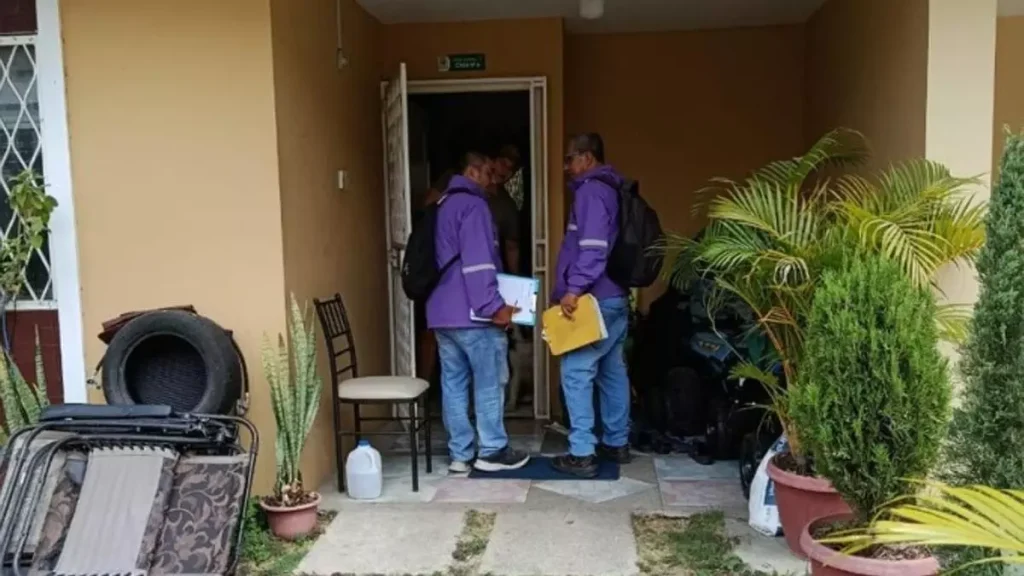
The MSP stressed that in response to the outbreak of the virus – which is the main disease affecting the island with a cumulative total of 31,513 cases, of which 61 are in serious condition and 20 are in critical condition – alerts have been activated and “people coming from the island” who enter Ecuador are being registered and monitored.

One of the confirmed cases was reported by the National Reference Centre for Exanthematic, Gastroenteric and Vector-Borne Viruses of the National Institute of Public Health Research (Inspi). A second patient is a woman who lives in a private residential complex in Portoviejo and who, according to Freddy Macías, head of the Vector Control Brigade in Zone 4, “entered Ecuador already infected”.

Macías recalled that a week before the cases were confirmed, an epidemiological cordon was activated in the Portoviejo region. Once the patient with chikungunya was identified and located, the specialist explained to local media outlet La Veci, health authorities carried out a second cordon consisting of “inspecting homes and searching for breeding sites” of mosquitoes that transmit the disease. A third stage will be carried out during the week. “The controls seek to cut off any possibility of local transmission around the patient,” he added. continue reading

Epidemiological authorities are searching for breeding sites of mosquitoes that transmit chikungunya. / Ministry of Public Health

The cases triggered an alert in Ecuador, where the virus had been under control since 2023, when a visitor with chikungunya was recorded. Epidemiological surveillance figures reveal that the main concern is dengue, with 15,814 patients as of last October, 61,404 in 2024, 27,906 (2023), 16,402 (2022), 20,689 (2021) and 16,741 (2020).

As part of measures to eradicate dengue, Zika and chikungunya, Ecuador encourages the formation of mingas (community brigades) that collect tyres and waste that can serve as mosquito breeding grounds, thereby reducing the risk of these diseases spreading.

For its part, Inspi trains community health teams to identify vulnerable areas and implement preventive measures.

At the end of September, the US Embassy in Havana issued a health alert for anyone wishing to travel to Cuba due to the outbreak of Chikungunya. The risk was classified as Level 2, requiring “additional precautions” to be taken.

The diplomatic headquarters recalled that this virus is transmitted by mosquitoes and that symptoms, mainly fever and joint pain, appear between three and seven days after the bite. In addition, the Mexican Ministry of Foreign Affairs also recently issued a travel alert to the island due to the “worsening health situation resulting from the spread of arboviruses.

Translated by GH

____________

COLLABORATE WITH OUR WORK: The 14ymedio team is committed to practicing serious journalism that reflects Cuba’s reality in all its depth. Thank you for joining us on this long journey. We invite you to continue supporting us by becoming a member of 14ymedio now. Together we can continue transforming journalism in Cuba.
The Increase in Chikungunya Cases Is Creating a “Dangerous” Situation, Cuban Authorities Admit

Infections have risen by 23.2% in a week and the number of patients in intensive care, including many minors, has grown from 96 to 156.

Cases have increased by more than 23% this week, although there is optimism for December. / Archive/ 14ymedio

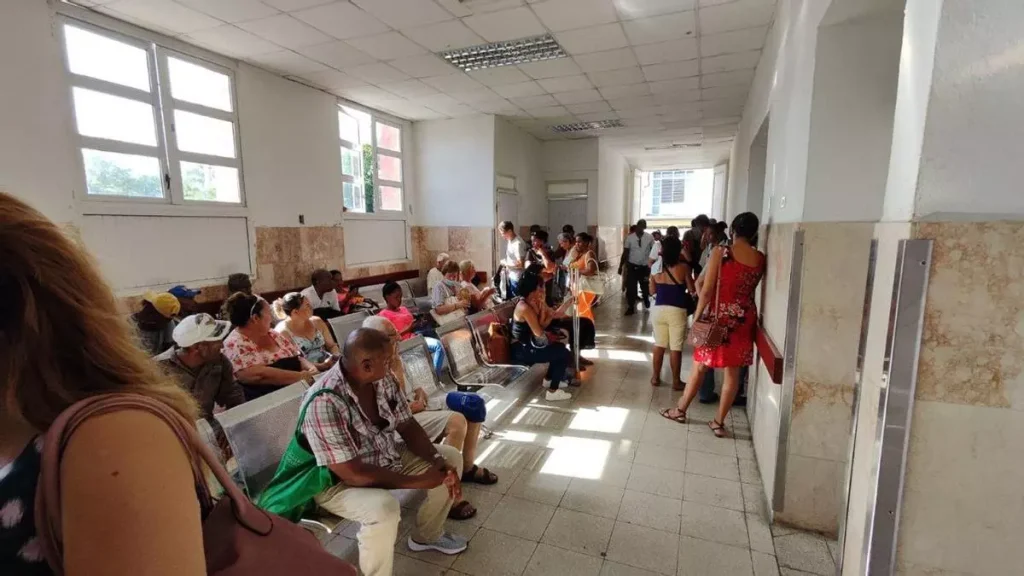
14ymedio bigger14ymedio, Madrid, 25 November 2025 (delayed translation) — Data on the arbovirus epidemic that Cuba has been experiencing in recent months is alarming health authorities, who on Monday warned of a 23.2% increase in chikungunya infections compared to the previous week. Carilda Peña García, Deputy Minister of Public Health, said that at the end of last week, 7,700 new cases of this disease had been recorded and, although she did not provide specific figures for dengue, she also confirmed an increase in the incidence rate.

In total, the country has recorded 39,760 people with “non-specific fever syndrome”, 15.8% less than the previous week. The official was optimistic about the future, stating that “historically, November is the most complex month for arboviruses, with dengue fever being hyperendemic.” This data led her to believe that there would be an improvement in the first or second week of December, also in the case of chikungunya, which is transmitted by the same mosquito.

At the moment, with 156 patients in intensive care – 96 more than the previous week – there is little cause for celebration. The Deputy Minister acknowledged that the situation “is considered dangerous” because there are many serious and critical cases. Of the latter, 34 (out of a total of 35) are under the age of 18. As for the seriously ill, the figure rises to 121, 96 of whom are minors.

There are 35 critical cases, 34 of whom are under 18 years of age. As for serious cases, the figure rises to 121, 96 of whom are minors.

Peña García explained that he is aware that there is underreporting because many people do not go to medical centres. However, he added that all suspected cases are counted, even if they have not been diagnosed in laboratories, which is common in epidemic situations. On Monday, of the 7,700 cases, 137 were confirmed by PCR, a test reserved for identifying and characterising serious cases or the onset of outbreaks. continue reading

As for dengue fever, transmission is widespread, with cases still present in 14 provinces – Sancti Spíritus, Villa Clara, Havana, Guantánamo, Ciego de Ávila and Santiago de Cuba leading the way – and the incidence rate has risen to 22.6%. The figures have not yet been updated in the World Health Organisation (WHO) documentation, so people do not know how many infections there are. At the end of last week, three deaths and 9,602 infections had been reported, which is a high rate of 87.79 per 100,000.

Although Peña García insisted on the importance of seeing a doctor, especially for vulnerable population groups, many cases are not counted officially. “All of us who don’t go to the doctor and heal ourselves at home are not included in this figure. Conduct a block-by-block survey to see how many of us there are,” said a Cubadebate reader in response to the news. Another user asked the authorities to be more specific about the cases of deaths circulating on social media.

“Could you clarify whether there have been any deaths from this cause and, if so, how many? There are all sorts of rumours circulating about hospitals and funeral homes being full, the virus spreading for several weeks, and not a single death? Something doesn’t make sense, and I do not believe that any deaths are a crime or the fault of the Ministry of Health, as is the case anywhere else on the planet in similar situations. Thank you. We await your response,” he asked. The only deaths known to date directly associated with dengue fever are three, announced in October. Since then, rumours have been spreading like wildfire.

The authorities claim that the procedure has not been widespread because there are “limitations on fuel and insecticides, but priority was given to areas with the most active transmission.”

The deputy minister explained that the Aedes aegypti infestation is considered high, with 8,545 outbreaks. The municipalities with the worst indicators are Camagüey, Pinar del Río, Sancti Spíritus and Havana. In the latter, as in Santiago de Cuba and Granma, fumigation targets are being met, another fact that is highly questioned on social media, where hundreds of voices claim that no action is being taken. The authorities admit that the procedure has not been followed everywhere because there are “limitations on fuel and insecticides, but priority was given to areas with the most active transmission in order to reduce the vector population and break the chain of transmission”.

The situation has prompted the Dominican Republic to take action. On Monday, it announced the intensification of epidemiological surveillance and vector control measures throughout the country, “as part of the ongoing prevention and response strategy to the chikungunya outbreak reported in Cuba and other Caribbean countries”.

The country’s Ministry of Health said there will be intensive fumigation campaigns, scrap metal removal and community education, as well as active screening for fever and surveillance at airports, ports and border crossings. The minister asked citizens for their cooperation, especially in keeping yards clean and removing water tanks that encourage mosquito breeding.

Translated by GH

____________

COLLABORATE WITH OUR WORK: The 14ymedio team is committed to practicing serious journalism that reflects Cuba’s reality in all its depth. Thank you for joining us on this long journey. We invite you to continue supporting us by becoming a member of 14ymedio now. Together we can continue transforming journalism in Cuba.

The Wife of 11 July Prisoner Yosvany Rosell García Warns of His Critical Condition Due to His Hunger and Thirst Strike

The US Embassy condemns “the abuse and mistreatment suffered by political prisoners in Cuban regime prisons.”

Yosvany García Caso and his wife, Mailín Rodríguez Sánchez. / Facebook

14ymedio bigger14ymedio, Madrid, 17 November 2025 — Yosvany Rosell García Caso, who has been on hunger strike for 26 days in the Cuba Sí prison in El Yayal (Holguín), has declared that he will also stop drinking liquids. His wife, Mailin Rodríguez Sánchez, told 14ymedio about this after finding out on Monday.

The situation of the political prisoner, sentenced to 15 years in prison for participating in the peaceful demonstrations on 11 July 2021, “is becoming more critical every day,” says his wife, who says she feels desperate. “They are already transporting him in a wheelchair because he cannot stand,” but despite this, she complains, “he has not been transferred to a hospital.” García Caso suffers from several conditions, including heart disease, hypertension and chronic gastritis.

The daily life of Rodríguez Sánchez and his three children is now even more complicated because they have all contracted chikungunya, one of the arboviruses spreading across the island in epidemic form. “We all have the virus and are recovering. This is terrible,” he says. “Here on my block, we are all laid up.”

“They are already transporting him in a wheelchair because he cannot stand”

Various international bodies have spoken out in favour of the political prisoner in recent weeks. On Monday, the US Embassy in Havana did so via its social media accounts, condemning “the abuse and mistreatment suffered by political prisoners in the Cuban regime’s jails”. It is alarming, says the diplomatic headquarters in X, “that 11 July prisoners such as Yosvany Rosell García are on hunger strike to protest against the constant abuses. We join their demand for the release of all political prisoners”.

García Caso announced in a handwritten letter that he would go on hunger strike from 23 October and demanded to be transferred continue reading

to a punishment cell as a “new form of protest” against the “continued imprisonment of all political prisoners”. In his letter, the activist expressed his “unequivocal support for maximum pressure from the United States Government on the narco-terrorist Cuban Government”.

He concluded with a postscript: “What you do only for yourself vanishes when you die; what we do for others is our divine legacy.”

Handwritten letter from prison signed by political prisoner Yosvany García Caso. Courtesy

Several organizations have also spoken out about the prisoner, including the Cuban Observatory for Human Rights, which on Friday issued an alert “regarding the grave risk to his life with each passing minute,” demanding “adequate medical attention and his immediate release.” Cubalex, for its part, noted that hunger strikes are “an extreme measure resorted to by people deprived of their liberty when they are denied effective avenues to report abuses or assert their rights.”

García Caso himself had already staged numerous similar protests to denounce his conviction, which he considers unjust and the result of an arbitrary trial. These hunger strikes—six up to September 11, 2022—are, according to the Justice 11J list of prisoners, what caused the gastritis he suffers from.

Arrested at his home on July 10 for a pot-banging protest, according to the same NGO, García Caso was arrested again for his participation in the July 11 events. Almost a month later, he was transferred to the Holguín Provincial Penitentiary. With alleged prior drug trafficking charges, he was accused of assault, public disorder, spreading epidemics, and incitement to commit crimes, and was initially sentenced to 20 years in prison, and later, on appeal, to 15 years.

Translated by GH

The Cuban Spy Who Gave the Information To Shoot Down the Planes of Brothers to the Rescue Dies of a Virus

Juan Pablo Roque González infiltrated the organization in Miami and returned to Cuba just before the attack

Juan Pablo Roque, during an interview given to América TeVé in 2012. / Capture

14ymedio bigger14ymedio, Madrid, November 28, 2025 — Juan Pablo Roque González, alias “Germán,” one of the Cuban spies involved in the shoot-down of Brothers to the Rescue planes in 1996, has died in Havana at the age of 70. This was confirmed this Friday from Miami by his ex-wife, Ana Margarita Martínez, who stated that his death occurred on November 25.

In an interview with Mario Vallejola, a Cuban journalist living in the US, the woman explained that he died from “a virus, one of those that is going around Cuba now.” He had undergone a heart operation and was in “delicate” condition.

“In an ironic turn of events, his death occurred on the same date that Fidel Castro died, the same dictator he served,” said Martínez, who has always maintained that Roque hid his true job from her during the marriage. She referred to this again in a social media post: “Although our marriage was later annulled in court, the consequences of his deception were profound and personal. He never faced earthly justice for his actions.”

Martínez states that, before the death of her ex-husband, she felt “obliged to address a chapter that left a deep mark on my life and in our Cuban-American community.” Roque González — recalls his ex-wife — was a member of the so-called Wasp Network, “and his betrayal caused immense damage,” not only to her and her family, “but also to the brave volunteers of Brothers to the Rescue and all those who have fought tirelessly for freedom, truth and human dignity.” continue reading

The woman explained that “he died from a virus, one of those going around Cuba now.” He had undergone a heart operation and was in “delicate” condition.

In her post she mentions the four victims of that attack — Mario de la Peña, Carlos Costa, Pablo Morales and Armando Alejandre Jr. — volunteers from the Brothers to the Rescue organization, which helped exiled Cubans and promoted freedom on the island. On February 24 almost 30 years ago, they flew in three small planes to track the rafters in the Florida Straits.

Only one returned to the Opa Locka airfield in north Miami. The other two were pulverized by missiles fired from two MiG fighters of the Cuban Air Force. Havana — then with Fidel Castro still in full power — claimed that the aircraft violated the airspace of the country, but both the US and the exile community maintained that the attack took place over international waters.

Roque González himself, a lieutenant colonel of the Cuban Revolutionary Armed Forces, served as a pilot for Brothers to the Rescue, which he infiltrated after simulating his desertion from the island in 1992, swimming to the US naval base at Guantánamo. He returned to Cuba one day before the attack and never faced justice.

His story was different from that of the five Cuban spies convicted in 2001 by the US for conspiracy to commit murder and espionage, as well as being unregistered agents of a foreign government. Arrested in 1998 in Florida while carrying out intelligence work for Cuba, the regime deployed an intense and costly propaganda campaign for their release, elevating them to the status of heroes.

The figure of Roque González gained prominence five years ago, when Netflix aired the controversial film “The WASP Network,” where he was played by actor Wagner Moura

One of them, René González, was released in 2011, and three years later, Fernando González completed his sentence, after which both returned to Cuba. In December 2014, as part of the thaw initiated by President Barack Obama, with Raúl Castro succeeding his brother Fidel in the Plaza de la Revolución, the three who remained serving sentences in the US — Ramón Labañino, Antonio Guerrero and Gerardo Hernández Nordelo — were released and deported to Cuba. In return, the Cuban government handed over Alan Gross, a contractor imprisoned on the Island for trying to deliver satellite connection devices to the Jewish community.

The figure of Roque González gained prominence five years ago, when Netflix aired the controversial film “The WASP Network,” where he was played by actor Wagner Moura. Ana Margarita Martínez, who was played by Ana de Armas, filed a lawsuit against Netflix, claiming that the film distorted reality. It was not the only lawsuit over the film: José Basulto, founder of Brothers to the Rescue, also sued for presenting him as a terrorist, although he finally settled with Netflix.

The attack on the planes took place at a time when the US administration was considering lifting the embargo on the island. In response to the shoot-down, the opposite happened: then-President Bill Clinton signed the Helms-Burton Act and intensified the economic sanctions against Cuba.

Translated by Regina Anavy

____________

COLLABORATE WITH OUR WORK: The 14ymedio team is committed to practicing serious journalism that reflects Cuba’s reality in all its depth. Thank you for joining us on this long journey. We invite you to continue supporting us by becoming a member of 14ymedio now. Together we can continue transforming journalism in Cuba.