
A Year After Hurricane Ian in Cuba, Thousands of Cubans Are Still Homeless in Pinar Del Rio

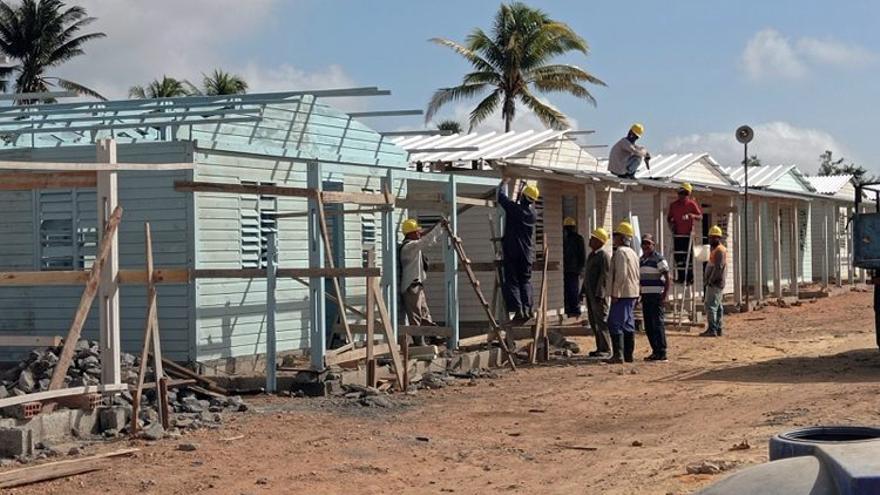
Housing construction in Pinar de Río a year after the passage of Hurricane Ian. (Guerrillero)

14ymedio bigger 14ymedio/EFE, Havana, 27 September 2023 — Hurricane Ian, whose passage through Cuba happened a year ago this Wednesday, and which caused six deaths and significant material damage, continues to hit the population of Pinar del Río, the most affected by the hurricane. From the beginning, the Government made promises to rebuild the more than 102,000 damaged homes, but twelve months later, only 45% have been repaired. In the worst situation are the more than 12,000 residents who suffered the collapse of their homes, of which only 3% have been rebuilt.

Luis Manuel, 48, from Pinar del Río, residing in the municipality of San Luis, says he has “lost hope” of rebuilding his house. For a year, his family has been living in an improvised structure that they built where the pigsty used to be, as he told 14ymedio by telephone. With pieces of wood and tin they created a covered space where they sleep at night and perform their daily tasks.

“Resources have arrived but everything is very poorly organized,” complains Luis Manuel. “Everything is centralized in a small group of officials who decide what materials go to each family,” he explains. “They are the ones who must review each case, and only with their signature can you go to the points of sale even if the Housing technician has already reviewed the situation of your house and has given an opinion of what is needed.”

The pinareño considers that the whole mechanism has been marked not only by slowness and lack of efficiency but also “by cronyism. From the first day, there were people who were barely affected who got zinc slabs, steel, beams and sand; but for us, who lost everything, it has been a trickle of resources, and we have not yet been able to complete the material needed to raise the walls.” continue reading

They tell us that there is no cement, that only a certain number of blocks arrived and they have to prioritize the most serious cases, but one sees that no progress is made and that those of us who are worse off are still just as bad

“They tell us that there is no cement, that a certain number of blocks arrived and they have to prioritize the most serious cases, but one sees that no progress is made and that those of us who are worse off are still just as bad,” he says. Luis Manuel’s family obtained a mattress donated by the Red Cross and received help from the Catholic Church with “medicines and some clothes.”

In the municipality of La Coloma, in the middle of the tobacco zone, the situation is similar, according to the Spanish agency EFE. “Driving through some areas,” EFE says this Wednesday in a report, “is a leap in time, as if it had barely been a few weeks since Hurricane Ian hit that area.”

The Cuban Government recently said that it intended to rehabilitate at least the “total and partial roof collapses” by the end of this year. The hurricane also took its toll on the region’s main economic activity: tobacco cultivation. According to official figures, a total of 11,554 drying houses for of tobacco leaves were completely or partially damaged, around 90% of the total. A year later, 3,816 (32%) have been completely rebuilt, and another 1,180 (9.8%) are under construction. Almost two-thirds are gone.

The absence of this key infrastructure led to about 14,826 acres being planted, just over half of those initially planned, with the consequent economic damage to producers, tobacco manufacturers and the Cuban State.

Among the testimonies collected by EFE in La Coloma, the discontent is evident. “No one has come here. Ever,” José María Puentes, 86, who lost his house, told the agency in tears. In the same way, Juan Pablo Ferreiro, 49, added: “What I can say is that no one has come here. They had a little piece of paper (a form for what you needed for your  house), and it became saltwater.”

And he said he wanted to talk to Cuban President Miguel Díaz-Canel, “to tell him that he forgot about Pinar del Río.” The president, in the days after Ian’s passage, visited Pinar del Río on several occasions and La Coloma on more than one, but, according to the residents, he did not stop at the homes on the road that leads to this town.

Translated by Regina Anavy

____________

COLLABORATE WITH OUR WORKThe 14ymedio team is committed to practicing serious journalism that reflects Cuba’s reality in all its depth. Thank you for joining us on this long journey. We invite you to continue supporting us by becoming a member of 14ymedio now. Together we can continue transforming journalism in Cuba.
Mexico Reports the Arrival of up to 16,000 Migrants per Day at Its Borders

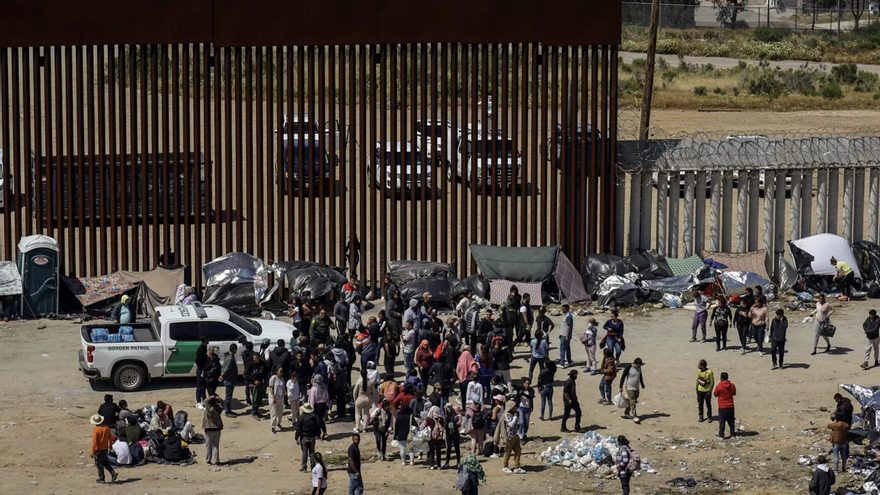
Migrants in a camp next to the wall on the northern border of Mexico. (EFE)

14ymedio biggerEFE (via 14ymedio), Mexico, 2 October 2023 — Mexican President Andrés Manuel López Obrador, reported on Monday the arrival of up to 16,000 migrants per day on the northern and southern borders of the country in the last migratory wave.

“In recent times, through the Darién [Jungle], which is a very dangerous area, up to 4,000 migrants to the south of Mexico passed through the borders of Colombia and Panama. Now, on the border of Chiapas, the number has increased to 6,000 per day, and last week (the figure) reached 10,000 migrants per day on the northern border,” he said.

His statements come amid the “unprecedented increase in migrants in Central America and Mexico,” as the International Organization for Migration (IOM) warned last week.

The Mexican Government gave these figures while commenting on the accident that left 10 migrants dead and 15 injured, mostly from Cuba, in a traffic accident in the Mexican municipality of Pijijiapan, 93.2 miles from the border city of Tapachula, in the southern state of Chiapas. continue reading

The Mexican Government gave these figures while commenting on the accident that left 10 migrants dead and 15 injured, mostly from Cuba

Mexican President López Obrador recognized that migrants “pass through Mexico with many risks: violations of their human rights, gangs that kidnap migrants, murders and misfortunes due to accidents in transport because they hire trucks in poor condition, trailers.”

Mexico is experiencing a new migratory wave in recent weeks, as shown by the suspension of freight trains due to the presence of thousands of migrants on the cars and the tracks, demonstrations at the borders, camps on the Rio Grande on the border with the U.S. and clashes with Mexican and American authorities.

In this context, the president raised his demand that “together with the Government of the United States, a plan be carried out for development, for cooperation, for the benefit of the peoples of Central America, the Caribbean and other Latin American countries.”

“Deep down, it is the need to go out and look for life, find work and well-being, and those causes must be addressed. There should not only be arrest or coercive measures like building walls, which occurred to one U.S. president,” he said.

The president pointed out that this week a U.S. delegation formed by the Secretary of State, Antony Blinken, the Secretary of Homeland Security, Alejandro Mayorkas, and the Attorney General, Merrick Garland, will arrive in the Mexican capital.

In addition, he reiterated that he will meet with foreign ministers from countries sending migrants to bring a proposal to the U.S. President, Joe Biden, at a possible meeting in Washington.

“We are going to have a meeting with U.S. officials and also with foreign ministers from neighboring countries to discuss the current migration issue and address the causes, which is what we have always done, because we are helping,” he concluded.

Translated by Regina Anavy

____________

COLLABORATE WITH OUR WORKThe 14ymedio team is committed to practicing serious journalism that reflects Cuba’s reality in all its depth. Thank you for joining us on this long journey. We invite you to continue supporting us by becoming a member of 14ymedio now. Together we can continue transforming journalism in Cuba.

Thousands of Migrants Challenge Operations on Mexico’s Trains To Reach the United States

The National Institute of Migration (INM) promised to monitor, together with Ferromex, the main points where migrants board the trains. (EFE)

14ymedio biggerEFE (via 14ymedio), Juarez, October 2, 2023 — Despite the operations of the Government of Mexico and the railway company Ferromex, thousands of migrants continue to risk their lives and ride the country’s trains, in particular “La Bestia,” [The Beast] to reach the border with the United States.

In Ciudad Juárez, on the border with Texas, EFE documented the arrival of one of these trains, which arrived from the Mexican city of Torreón with at least 500 migrants, some on the roof of the wagons and others inside the cars.

The Venezuelan Jesús Armando Barroso Barroso explained in an interview that traveling by rail is the only option, since the Mexican authorities stop them if they travel on the road, even if they go by bus.

They always stop you and take you off the bus. They don’t let you buy a ticket because they want you to walk the whole time

“They always stop you and take you off the bus. They don’t let buy a ticket because they want you to walk the whole time,” said the migrant, who after two months of travel arrived in Ciudad Juárez, where he hopes to cross to the American city of El Paso.

He said that as he passed through the city of Chihuahua he saw thousands of people waiting to get on a train and was frustrated by the possibility of continue reading

Mexico returning them to their country of origin, as the Mexican Government promised U.S. Customs and Border Protection (CBP) it would do.

The operation also contemplates rapid expulsion over Juárez bridges for migrants who cross the Rio Grande and surrender to the U.S. immigration authority.

It also implies the “return” of “secured” immigrants in Mexico to their countries of origin, with whom the country would negotiate to accept their citizens back. The migration travels by train.

The controversy over migrants in Mexico began on September 19, when the Ferromex company suspended 60 freight trains in the presence of more than 4,000 migrants and reported “nearly half a dozen unfortunate cases of injuries or deaths” on the tracks or cars in the midst of a new migratory wave.

The National Institute of Migration (INM) then promised to monitor together with Ferromex the main points where migrants board the trains. But migrants continue to arrive on the train to Ciudad de Juárez, one of the epicenters of the migratory wave in Mexico.

“We have fought a lot to be able to achieve our goal. We want to get to the U.S. to continue fighting for our families. Why are you going to return us? All we want is to pass through,” Barroso added.

Enrique Valenzuela, coordinator of the State Population Council (COESPO), acknowledged this week that despite the operations implemented by Ferromex and the state of Chihuahua, groups of people are constantly arriving in the city, mainly on board the freight train.

The controversy over migrants in Mexico began on September 19, when the Ferromex company suspended 60 freight trains in the presence of more than 4,000 migrants

However, it ruled out having official data on the number of migrants in Juárez, arguing that it is a very fluctuating figure.

In recent days, the migrants who arrive aboard “The Beast” have gone straight to the Rio Grande, just in front of gate 36 of the border wall, where they have stayed for up to five days waiting for attention from the U.S. authorities, according to José Gregorio, who arrived today on the train after three months of crossing.

“At night it’s cold and hot during the day. And there’s hunger too, because you can’t get off the train. There are people who stop and throw things up to us so we can grab a bottle of water or a loaf of bread,” José said.

“We have had to sleep on the street, but thank God we have always run into good-hearted Mexicans who have helped us,” he concluded with tears in his eyes.

Translated by Regina Anavy

____________

COLLABORATE WITH OUR WORKThe 14ymedio team is committed to practicing serious journalism that reflects Cuba’s reality in all its depth. Thank you for joining us on this long journey. We invite you to continue supporting us by becoming a member of 14ymedio now. Together we can continue transforming journalism in Cuba.
The Exodus From the Countryside to the City in Cuba Has a Face: Young Women of Reproductive Age

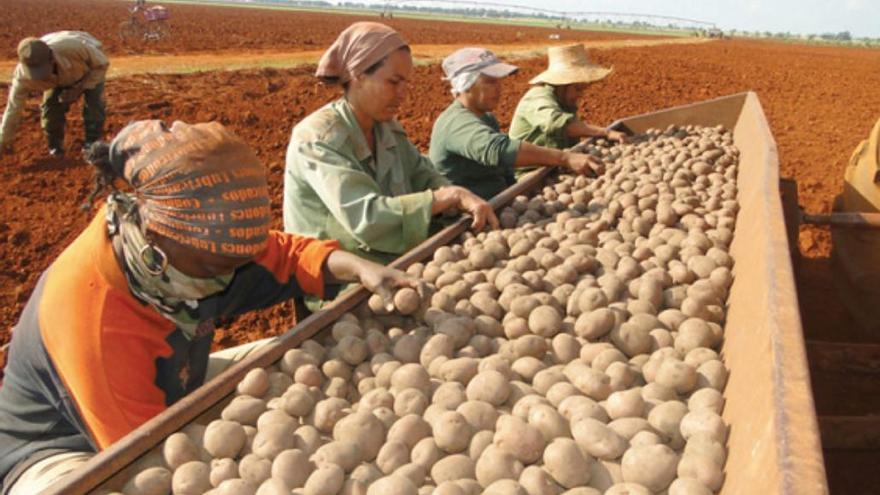
Those who work directly with the land do so, according to the official, relying on “family support.” which is not reflected in the ministry’s figures. (5 de Septiembre)

14ymedio bigger14ymedio, Havana, September 30, 2023 — Of the 994,000 Cubans registered as workers of the Ministry of Agriculture, only 60% are directly linked to production. That number – barely 596,400 farmers – is symptomatic: very few want to work in the island’s fields, marked by the lack of inputs, insecurity and crime.

“Are we running out of workers in the fields?” asked an analysis in the official magazine Cubahora – responding to a broadcast of the official program Cuadrando la Caja [Squaring the Box]. The answer, after the alarming number of active farmers offered by the ministry’s personnel director, Adriana Ballester, is affirmative.

The problem, the official explained, is also sociological. The majority of residents in rural areas – 23% of the Island’s population, about 2.3 million people – tend to move to cities and towns. Internal migration, which is carried out precariously and in the midst of “serious economic and social difficulties” – direclty effects the availability of labor in the fields and is the reason why in Cuba we cannot speak of “food security and sovereignty.”

Those who work directly with the land – “cooperativists, usufructuaries* and tenants” – do so, according to the official, counting on “family support,” and this labor does not appear in the ministry’s figures. However, he clarified, the outlook is not so dark and there are “motivations to remain in the countryside, especially among those young people descended from predominantly rural families, with an interest in working the land.” continue reading

Those who work directly with the land — “cooperativists, usufructuaries and tenants” -– do so counting on “family support”, which does not appear in the ministry’s figures

That the countryside is losing population – while the cities become increasingly overcrowded – is a pressing problem for Juan Carlos Alfonso, deputy head of the National Office of Statistics and Information (Onei). According to the manager, the share of Cubans who live in cities – currently 56% – will continue to grow compared to those who live in towns and rural areas.

Most of the Cubans who leave the countryside, he adds, are women of active and reproductive age. The danger, Alfonso says, is that “the permanence of women in the countryside is vital” so that “families” continue to emerge that, over time, will provide workers to the agricultural sector.

However, the situation is not the same in all provinces. While Havana is, “by definition,” a totally urban area, in several eastern provinces, such as Granma, 40% of the population lives in the countryside and mountains. It also coincides that the eastern rural areas are the ones with the greatest male presence and the ones that age the fastest, according to Onei.

These characteristics have generated a “situation” that Alfonso did not dare to describe with any adjective.

Why do rural residents emigrate? After a long reflection on how little blame should be attributed to the State in these phenomena, which does not cease “monitoring” the agricultural issue, María Ofelia Rodríguez – from the Center for Demographic Studies of the University of Havana – admitted that there is a problem with salary “incentives” and that the farmers are not paid according to their results. In addition, there are difficulties with marketing, not to mention transportation, “road problems,” fuel for cooking food in remote environments, among others.

Most residents in the areas rural areas – 23% of the Island’s population, about 2.3 million people – tend to move to cities and towns

Rodríguez said she was also concerned about another side of the problem: the fact that “gender relations” are “asymmetrical” between farmers and their wives, which “affects this mostly female migration to urban areas.”

It is also difficult to access Health and Education services in the fields. Hence, many families “feel the need to bring their children nearer to schools, to get closer to hospitals, which are mainly concentrated in areas that are not the classic rural settlements.”

None of the experts who appeared on Cuadrando la Caja alluded to an additional problem: the insecurity of rural areas, theft of livestock and banditry, which has motivated the farmers themselves – in the face of the inaction of the Police – to organize shifts of guard and “parties” to patrol the properties.

In Granma, several farmers interviewed by 14ymedio are clear that, if they do not protect their farms against rustlers, no one will do it for them. The measure they have taken will not be ideal, they believe, but it is the most effective: “We are arming ourselves.”

*Translator’s note: Usufruct, a form of leasing, is defined in Wikipedia as follows: “Generally, a usufruct is a system in which a person or group of persons uses the real property (often land) of another. The “usufructuary” does not own the property, but does have an interest in it, which is sanctioned or contractually allowed by the owner.” Articles in Translating Cuba that address usufruct.

____________

COLLABORATE WITH OUR WORKThe 14ymedio team is committed to practicing serious journalism that reflects Cuba’s reality in all its depth. Thank you for joining us on this long journey. We invite you to continue supporting us by becoming a member of 14ymedio now. Together we can continue transforming journalism in Cuba.
Mexico Has Sent 200 Million Dollars Worth of Oil to Cuba This Year, According to Experts

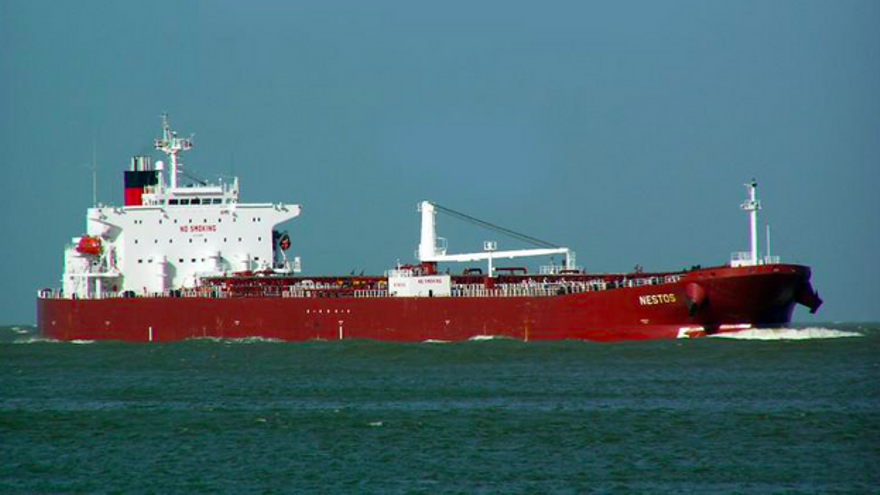
The Cuban-flagged tanker Vilma, which since July has made two trips between Mexico and Cuba. (Vesselfinder)

14ymedio biggerEFE (via 14ymedio), Havana, 30 September 2023 — Mexico has sent about 200 million dollars worth of oil to Cuba this year, according to calculations by the Energy Institute of the University of Texas (USA), to which EFE had access.

This year Mexico, through its state-owned Petróleos Mexicanos (Pemex), has become one of the largest suppliers of crude oil on the Island, which practically depends on imports from allied countries such as Russia and Venezuela for its energy system.

So far, it has not been revealed whether these barrels have been donations, sold with a long-term credit or are part of any bilateral agreement, such as the hiring of Cuban doctors, as is already the case with Venezuela. The shipments have generated some controversy in Mexico.

According to the study, prepared by crossing data from tracking platforms of oil tankers with market prices on a daily basis, Cuba has received a total of 2.81 million barrels of crude oil and derivatives from Pemex since March. continue reading

So far, it has not been revealed whether these barrels have been donations, sold with a long-term credit or are part of any bilateral agreement

The last shipment on record is from September 16, when the Cuban-flagged tanker Vilma arrived at the port of Cienfuegos with 350,000 barrels of crude oil – valued at 29.4 million dollars – from Pajaritos (Veracruz, Mexico).

In August, Mexico sent 465,000 barrels worth $36.2 million, while in July it was 730,000 barrels worth $49.4 million.

However, this situation could take a drastic turn. In recent days, Mexican Foreign Minister Alicia Bárcena told the Bloomberg agency that her country is evaluating “options” to charge Cuba for the fuel it sends.

For Cuban academic Jorge Piñón, a researcher specializing in Cuba at the Energy Institute of the University of Texas, this decision is largely explained by the increase in the price per barrel in international markets, which currently trades at around 100 dollars per unit.

“With these barrels that Mexico, Russia and Venezuela send to Cuba, they lose the opportunity to sell the oil in international markets and have a positive cash flow,” he said in an interview with EFE.

Cuba is going through a new crisis due to fuel shortages, a situation that will continue to cause new and prolonged blackouts  throughout its geography, the Government warned this week. Much of Cuba’s energy generation system depends on different imported fossil fuels.

With these barrels that Mexico, Russia and Venezuela send to Cuba, they lose the opportunity to sell the oil in international markets and have a positive cash flow

According to Cuba’s Minister of Energy and Mines, Vicente de la O Levy, the countries that supply the Island “have not been able to comply” with their agreements, and therefore the Cuban Government is being forced to go out “to buy almost every day.”

Piñón stressed the seriousness of the situation. According to his data, the Island has not received Russian crude “for months,” and since 2016, Venezuela has decreased the daily shipment from 100,000 barrels to currently around 57,000.

Cuba’s Minister of Economy, Alejandro Gil, said on state television that a “more rational” use of fuel is being “planned in detail” in the next two weeks. This has caused a sudden increase in the now infamous lines at the country’s gas stations.

Given the lack of fuel, Gil said, Cuba will undertake savings measures to guarantee the “vitality” of the main activities of the population and the economy.

Translated by Regina Anavy

____________

COLLABORATE WITH OUR WORKThe 14ymedio team is committed to practicing serious journalism that reflects Cuba’s reality in all its depth. Thank you for joining us on this long journey. We invite you to continue supporting us by becoming a member of 14ymedio now. Together we can continue transforming journalism in Cuba.
Cuba: False Emissaries of Peace

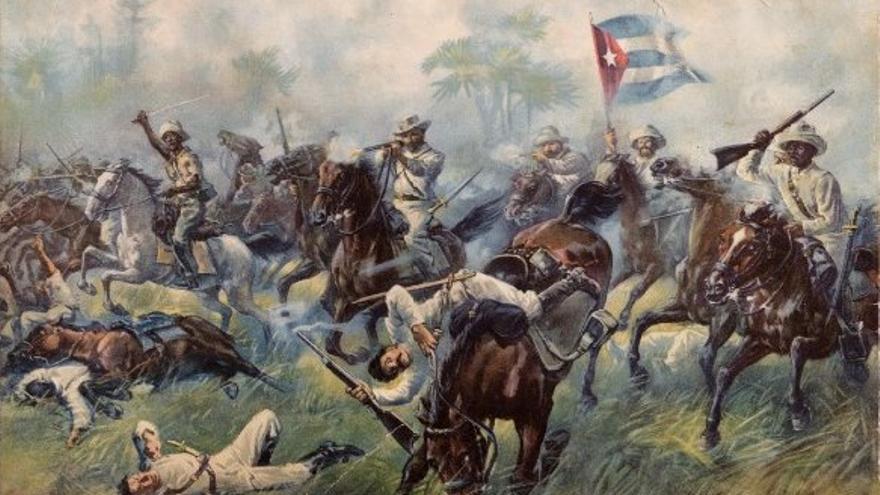
The Army of Liberation was riddled with internal strife, plagued by regional divisions, defeatism and poor discipline. (Wikimedia)

14ymedio bigger14ymedio, Yunior García Aguilera, Madrid, September 27, 2023 — By 1877, the Ten Year’s War was was at an impasse. The Spanish had not managed to defeat the Cuban guerillas and the insurgents were nowhere close to a decisive victory. The Army of Liberation was riddled with internal strife, plagued by regional divisions, defeatism and poor discipline.

Vicente García, who had led a seditious revolt in Santa Rita, refused to abandon his territory to join the western invasion. Holguín declared itself an “independent canton” outside the control of the Republic in Arms. And the secretive Republican Unity society in Las Villas was unaware that Gómez and Maceo were leading the war effort. The Cubans were also dealing with a chronic shortage of military hardware, lack of support from the Cuban emigré community and an intelligent enemy in the guise of the new captain-general.

Martínez Campos, a military officer from Segovia, had been a professor at the General Staff School and was the leader of the1874 military coup in Spain. There he was known as the man from Sagunto who restored the Spanish monarchy, famously proclaiming Alfonso XII king of Spain under a carob tree.

But conditions in Cuba were such that the Spanish also found themselves unable to prevail in the conflict. With an army that was ill-prepared, even more badly dressed, and poorly fed, nine out of ten soldiers were being felled by yellow fever and other tropical diseases, not guerilla machetes. The idea of signing a peace deal was in the minds of the combatants on both sides.

However, a law prevented the insurgents from even mentioning the subject. The Spotorno Decree, adopted by the House of Representatives of the Republic in Arms, proscribed the death penalty for anyone, Cuban or Spanish, who turned up on the battlefield talking about peace.

Then a singular character showed up in Havana: William Pope. He claimed to be a member of the “Peace Council”,  bishop-elect of Haiti and envoy of the U.S. secretary of state. His mission was to meet with the insurgent leaders and negotiate the controversial capitulation.

One cannot talk about peace in today’s Cuba. The regime subjugates its citizens with an iron fist. Prison and exile are the predictable outcomes for anyone who dares to raise his or her voice

The meeting took place secretly on May 11, 1877, at the governmental headquarters of the Republic in Arms. The then-president, Estrada Palma, was rumored to have annexationist ideas. At the meeting there was talk of continue reading

paying Spain a figure of between 100 and 150 million pesos to buy independence. That money, of course, would be lent by the United States. And although it was not entirely clear to the rebels, the seeds of ending the war without having defeated the enemy had been sown.

It is said that Bishop Pope later met with Martínez Campos, who told him he was not authorized to accept such a proposal, urging him to instead travel to Madrid and present it to senior government officials. Pope celebrated a military mass in Santiago de Cuba’s cathedral, where he was given a bishop’s ring by the captain general.

But this is where the story gets murky. It turns out that Pope was not American after all but Irish. Nor was he a bishop, just a priest with outsized ambitions. The man apparently dreamed of distinguising himself by playing mediator in some important affair and, perhaps, serving as bishop of Havana. Years later, Máximo Gómez would find him in a Honduran prison, convicted of stealing some religious vestments and a Holy Communion chalice.

In December, 1877, the House of Representatives overturned the Spotorno Decree, paving the way for the Pact of Zanjón, which was was signed on February 10 the following year. Antonio Maceo famously rejected the treaty in a document known as the Baraguá Protest. He would acknowledge shortly thereafter, however that the conditions necessary for carrying on the fight were not there. The Bronze Titan was forced to negotiate with Martínez Campos for a letter of safe conduct out of the country to exile in Jamaica.

Enrique Collazo would write, “The Cuban people, deaf for ten years to our cries of glory and agony, watched impassively as the revolution died, drowned in the blood of its martyrs.” It was the end of a long war that fizzled out without achieving its basic objectives.

One cannot talk about peace in today’s Cuba. The regime subjugates its citizens with an iron fist. Prison and exile are the predictable outcomes for anyone who dares to raise his or her voice or engages in even the most peaceful of protests. And though there is no Martínez Campos in the government, ready to negotiate, there is no shortage of Popes who talk falsely of bridges, of peace, of love.

____________

COLLABORATE WITH OUR WORKThe 14ymedio team is committed to practicing serious journalism that reflects Cuba’s reality in all its depth. Thank you for joining us on this long journey. We invite you to continue supporting us by becoming a member of 14ymedio now. Together we can continue transforming journalism in Cuba.
The Cuban Regime Has No Solution for the Port of Mariel Crisis

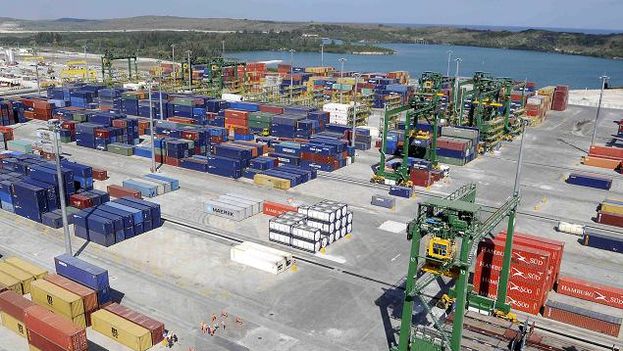
Mariel Special Development Zone – ZEDM

14ymedio bigger14ymedio, Elías Amor Bravo, Economist, 27 September 2023 — Cuban state press just released information on freight traffic through the port of  Mariel’s container terminal. Forecasts for this year point to around 300,000 twenty-foot container units (TEUs), a figure close to what it was before the COVID-19 pandemic. But it’s too early to celebrate for several reasons. First of all, Mariel plays only a marginal role within the Latin American and Caribbean region. The numbers say it all.

The most important ports in the area in terms of volume are, in descending order, Colón in Panama, Santos in Brazil, Manzanillo in Mexico, Cartagena in Colombia, Panama Pacific, Callao in Peru, Guayaquil in Ecuador, Kingston in Jamaica, Buenos Aires’ two urban ports, San Antonio in Chile, San Juan in Puerto Rico, Buenaventura in Colombia, Caucedo in the Dominican Republic, Lázaro Cárdenas in Mexico, Limon Moin in Costa Rica, Veracruz in Mexico, Freeport in the Bahamas, Itajai in Brazil, Valparaíso in Chile, and Altamira in Mexico.

Yes, you heard that right. In this long list, Mariel is nowhere to be found. Castro triumphalism aside, we are talking about a marginal facility that goes unnoticed amid the extensive and consolidated network of Latin America and the Caribbean ports.

The U.N. Economic Commission for Latin America and the Caribbean (CEPAL) took a look at the volumes these ports handle and all of them clearly have figures much higher than the meager 300,000 TEUs that the Cuban press touts as evidence of Mariel’s success. The port of Colón alone moves more than four million TEUs, a volume so much greater than Mariel that it is hard to phathom. This does not stop Mariel’s deputy-director from trying to highlight the importance of the increase in containerized goods passing through the port.

But a measly 300,000 TEUs simply confirms that Mariel is a business failure. Despite all the time that has passed and all the money that has been invested, the port has still not been able to turn a profit. Business failures are a feature of Cuba’s communist regime. While other ports in the region benefit from the growth commercial and passenger traffic, Mariel is still trying — after three years — to get back to 2019 levels. Back then, what they call “infrastructure services to shipping companies” amounted to 800,000 TEUs. The master plan calls for a total capacity of three million TEUs using twenty-four Super Post Panamax cranes. We’ll see if they can make that happen but it does not look like it will be easy.

Meanwhile, the regime keeps on doing what it does: investing in hotels which remain empty because there aren’t enough tourists. So now it is focusing its investment strategy on Mariel in hopes of creating what the container terminal’s general director, Martín José Spini, describes as the continue reading

most modern infrastructure in the region. These Castro-era managers do not know how lucky they are not to have to answer to boards of directors keeping an eye on the cash flow and monitoring the return on their investments.

The regime, relying on an anachronistic view of maritime traffic, is convinced that it must invest in Mariel, and not just because it could be a possible source export earnings. They believe it could be an ideal transfer point, a stopover between Asia and ports in the Gulf of Mexico and the Caribbean. Someone should tell them that the Manila galleón — the old trade route that once operated between Spain’s colonies in the Americas and its Asian territories — dried up a long time ago. And 21st-century China sees no need to revive it.

Work is being done to enlarge the channel so that the container terminal — the primary user of the Mariel Special Development Zone — can accomodate Neopanamax vessels. These large ships measure 366 meters long by 52 meters wide, with and underwater depth of 15 meters. Dredging the channel, an expensive operation that was carried out in three stages, involved biological studies, environmental impact studies and technical-executive projects, all done entirely by GeoCuba Estudios Marinos.

As almost always happens in these cases, the regime is blaming Mariel’s failure on the Torricelli Act, part of the framework of economic, commercial and financial sanctions that make up the U.S. trade embargo on Cuba. According to the port’s management, the law hinders the ability of ships that dock at Cuban ports to later use U.S. ports, a limitiation that precludes, for the time being at least, the possibility of using Mariel for transhipments.

Okay, but everyone already knew this would happen back when Mariel’s Brazilian backers laid the first stone there years ago. The dispute with the United States has being going on for six decades so those who risked their capital on Cuba’s communist regime knew what they were getting into.

No one could expect a change in the status quo without the regime making some moves towards democracy and freedom. So no one can use the embargo as an excuse because it was an issue that existed before work on the Mariel project began. If the situation remains unchanged, the person responsible is the one who refuses to budge.

The Mariel authorities are trying to carry on with this adventure, knowing it won’t get them very far. They hope to do this by providing trade and transport services to ships that transit through the Caribbean on their way to other ports in the region, Asia and northern Europe. Their selling point is the chance to cut transit times and freight costs but they are clinging to an outdated idea of how trade works that makes little sense in these times.

Low TEU levels are not the only indicactors that Mariel is in crisis. There is also in the inadequate infrastructure that makes it unable to compete with the large, consolidated ports of Latin America and the Caribbean. It’s a wasted effort. Communist leaders should spend some time visiting ports like the one in Panama more frequently.

____________

COLLABORATE WITH OUR WORKThe 14ymedio team is committed to practicing serious journalism that reflects Cuba’s reality in all its depth. Thank you for joining us on this long journey. We invite you to continue supporting us by becoming a member of 14ymedio now. Together we can continue transforming journalism in Cuba.
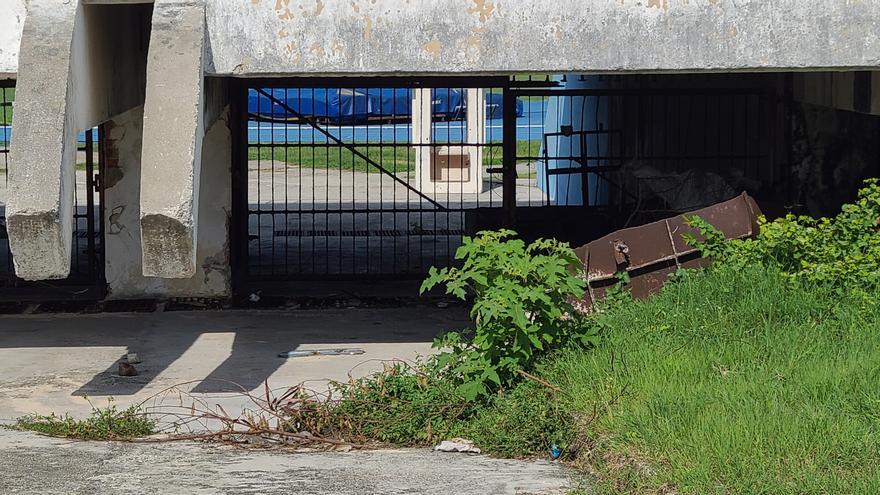
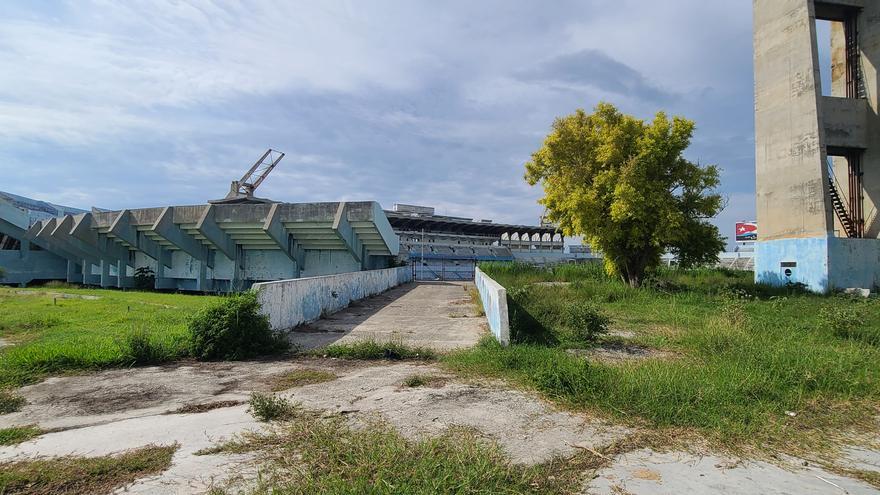
Havana’s Pan American Stadium, Another Ruin of Cement and Rusted Steel in the Cuban Landscape

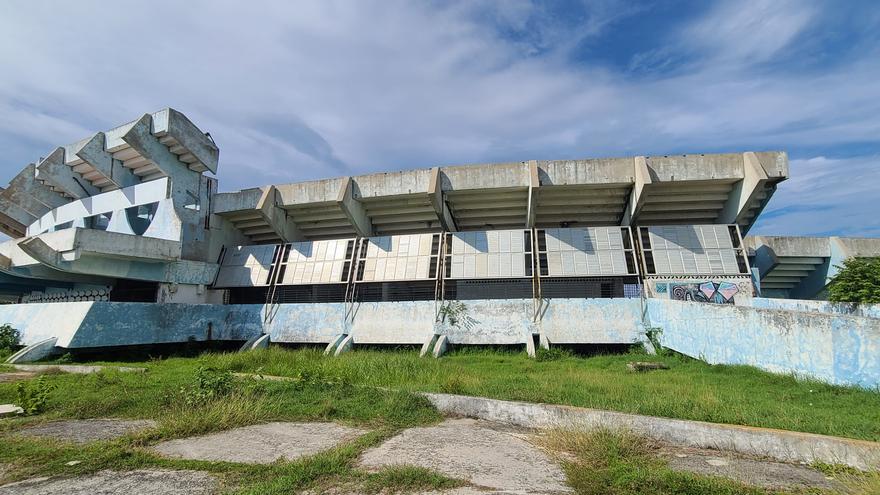
Two factors have accentuated the decline of the place: the poor quality of the materials with which it was built and the proximity of the coast and the salt air. (14ymedio)

14ymedio bigger14ymedio, Nelson García, Havana, 30 September 2023 — Three decades of abandonment weigh on the Pan American Stadium in Havana. The cornerstone of a pharaonic sports complex built by Fidel Castro in 1991, after fulfilling its initial purpose – to demonstrate to the world that socialist Cuba was capable of organizing a high-caliber event – now ​​its decline has been unstoppable.

The logistical deployment for the XI Pan American Games, far beyond the Island’s possibilities, and the fall of the socialist camp months after the event was held, accelerated the arrival of the so-called Special Period. Since then, as a kind of symbol of the debacle, the stadium has reflected the country’s historical ups and downs.

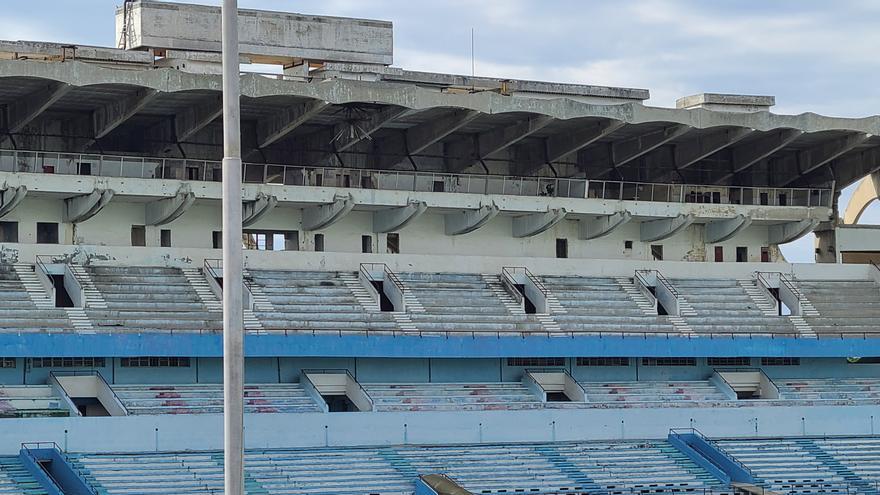
Two factors have accentuated the decline of the premises: the poor quality of the materials with which it was built – fueled by Castro’s haste – and the proximity of the coast and the salt air, which has been wearing down the structure for years. The result, which those who cross the Monumental Road towards Alamar, Cojímar and Guanabo now see, is a unpainted mass, with the stands eaten away by rust and without lights in its tower.

The Stadium workers have nothing to do, but they have been instructed to be “on guard” due to the poor conditions of the fence that surrounds the facilities. (14ymedio)

Two workers – a man and a woman, both in their 40s – kill time in the stadium lobby. They have nothing to do, but they have been instructed to be “on guard” due to the poor conditions of the fence that surrounds the facilities. “We’ve been asking them to fix it for years,” says the man, who leans his heavy metal seat against the wall.

The woman, who is resting on a mat in poor condition, agrees with her partner. “People come here at night,” she warns, sitting up. “It is not unusual for one to come across an unpleasant situation or some ’gift’, such as used condoms and excrement.” continue reading

Although the appearance of the Pan American Stadium is that of a ruin, many athletes still train there, in addition to members of the national athletics team. When they finish running – in full sun and without the proper equipment, the workers say – it is “normal” that the showers have no water and that the young people have to return, sweaty, to their homes.

Although the Pan American Stadium looks like a ruin, many athletes still train there. (14ymedio)

Last March, the official press published a report on the package of “fixes” for the facilities that the Government had financed. According to Cubadebate, authorities had worked hard to “rescue” the one-time sports colossus in Cuba. The repair, judging by the media’s own photos, consisted of the construction of a “modern gym” – in reality, with only a dozen pieces of equipment – ​​and the partial remodeling of the lobby.

Mildred Pérez, director of the stadium, then warned that the rehabilitation will be “gradual” and that it would be marked by “the economic limitations suffered by the country in general, which prevents having a larger budget.” However, the official stressed her faith that, with “the will to do a little every day,” the stadium will change. “For the better,” she clarified.

Photos from 1991 show Castro euphoric, in front of the international delegations, in the same stands that are unpainted today. (14ymedio)

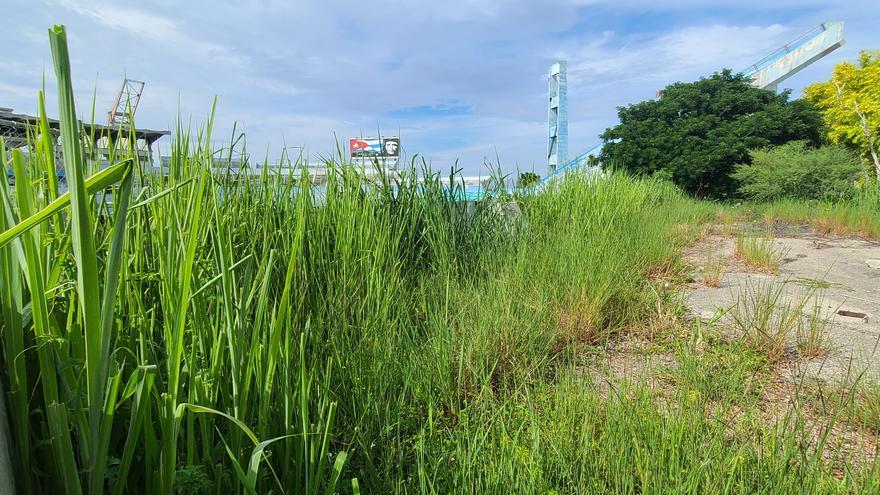
The reality of the building, which once had capacity for 35,000 spectators, is different. The only thing that looks renewed in its surroundings is a billboard of Che Guevara, which stands out among the weeds. The stadium is not alone in its decline: it is accompanied by other facilities of the Pan American Park, such as the Baraguá swimming pool complex, part of the Village that would house the 5,000 visiting athletes, the 19 de Noviembre tennis courts and the Reinaldo Paseiro velodrome.

Photos from 1991 show Castro euphoric, in front of the international delegations, in the same stands that are unpainted today. The tracks where the legendary Ana Fidelia Quirós and Alberto Cuba ran are in an unacceptable state for an Olympic champion.

“A little painting today; some seats tomorrow, but nothing that solves the real problem. The Pan American Stadium is no longer going to give this country a single dollar, and they know it,” concludes the stadium worker before returning to the mat . Above the lobby door, with a smile of confidence in the future of socialism, a drawing of Tocopán – the tocororo mascot of the games – continues to welcome visitors.

The only thing that looks renewed in its surroundings is a poster of Che Guevara, which stands out among the weeds. (14ymedio)

____________

COLLABORATE WITH OUR WORKThe 14ymedio team is committed to practicing serious journalism that reflects Cuba’s reality in all its depth. Thank you for joining us on this long journey. We invite you to continue supporting us by becoming a member of 14ymedio now. Together we can continue transforming journalism in Cuba.
Cubalex Denounces the Death of a Man in Baracoa, Cuba, After a Police Beating

A resident of the Joa district, Sanamé was detained by the Police “in the Puente de Miel area, town of Cabacú.”

14ymedio bigger14ymedio, Havana, 30 September 2023 — The Cuban Elionorkis Sanamé Durán died on September 26 as a result of a beating by the Baracoa Police, Guantánamo, according to a complaint made public by Cubalex, which confirmed the information with sources from that locality.

A resident of the Joa district, Sanamé was detained by the Police “in the area of ​​Puente de Miel, town of Cabacú, when he was transporting half a bag of powdered milk,” details a posting on Facebook . “They handcuffed him and took him to the PNR (National Revolutionary Police) station where, with the handcuffs on, he was sprayed with gas in the face and beaten by several officers.”

Cubalex adds that “several sources in the area stated that Sanamé’s screams could be heard from outside the station.” “He was transferred to the Octavio de la Concepción y de la Pedraja General Hospital, in Baracoa, where he died of a heart attack, according to the doctors’ findings.”

In its complaint, the organization clarifies that “in photos of the body published on Facebook by the independent journalist Yoel Acosta, injuries can be seen” on the man’s body. continue reading

“They handcuffed him and took him to the National Revolutionary Police station where, with handcuffs on, he was sprayed with gas in the face and beaten by several officers”

The émigré Ricardo Galbán, who runs the page “Baracoa People Denounce” page, details that several years ago the family of the deceased had had a dispute in court over “the injustices that are committed daily in that town.” Sanamé “was convicted and had only been on the street for 27 days, after serving his sentence, when they killed him.”

“The police murdered him handcuffed and the Baracoa coroner certified that it was a heart attack although he knows that he was beaten by the police. It was the police who killed him,” Galbán emphasizes.

Sanamé’s death is not an isolated event. After the Island-wide mass protests of 11 July 2021, episodes of police violence have been increasing. One of the most unfortunate and tragic cases was in Santa Clara, the murder of the young man Zinédine Zidane Batista Álvarez.

On July 1, Batista Álvarez was involved in a brawl over a property in the El Condado neighborhood. As a result of the police intervention, an agent immobilized the young man and finished him off with his pistol.

The father of the murdered man, Yosvany Batista, told 14ymedio that “the police did not try to calm the situation but instead intensified the violence.” The family tried, without results, to initiate legal proceedings against the officer who committed the murder, with license plate number 15388 and identity unknown.

It is not the only case, although it is one of the most serious, in which the impunity with which agents of the Ministry of the Interior act has been confirmed. Following the “combat order” issued by Cuban President Miguel Díaz-Canel on 11 July 2021, the officers, uniformed and dressed in civilian clothes, have beaten, arrested and harassed numerous citizens on the Island.

____________

COLLABORATE WITH OUR WORKThe 14ymedio team is committed to practicing serious journalism that reflects Cuba’s reality in all its depth. Thank you for joining us on this long journey. We invite you to continue supporting us by becoming a member of 14ymedio now. Together we can continue transforming journalism in Cuba.
‘They Are Afraid That Other Cubans Will Decide To Do the Same as Me: Desert’

Joel Suárez suffered harassment by the State, as well as a period of imprisonment, obstacles to finding work and “moral assassinations.” (Screen capture)

14ymedio bigger14ymedio, Havana, 28 September 2023 — Joel Suárez Orozco, the former Cuban diplomat who denounced last week, in an interview with journalist Mario Vallejo, the harassment to which State Security had subjected him after abandoning his job in the Cuban mission at the UN, responded to the accusations of “traitor” launched by the official Cuban press.

In a new conversation with Vallejo this Tuesday, Suárez responded to an article in Granma signed by Michel Torres, spokesman for the regime and presenter of the program Con Filo. Torres’ text begins by promising an “unmasking” of Suárez, which never arrives. “A traitor does not gestate spontaneously. If we review his story, his road map, we will find the trail of a person who is two-faced,” he dramatizes.

“The fate of traitors is always the same: they end up condemned to universal contempt”

“Betrayals, outrage, disgust – even on rare occasions they can hurt, but the fate of traitors is always the same: they end up condemned to universal contempt,” continues the presenter, who ironizes about the “lies” that the former diplomat told Vallejo during the protests of Cubans on September 19 in front of the UN headquarters, after the arrival of Miguel Díaz-Canel in New York.

Torres also takes the opportunity to question the veracity of the “serious and objective ’free press’,” which, he assures, is not interested in “triangular sources” if the interviewee already says everything that is expected of him. Torres presents himself as the connoisseur of the truth about the diplomat with whom, he explains, he has friendships in common. Several paragraphs later the reader, who waits for the delivery of the “impostor” on a silver platter, is disappointed, because the alleged revelations are never shown.

In Tuesday’s interview with Vallejo, asked about Torres’ article, Suárez responds that, if a dictatorship calls him a traitor, “that means I’m on the right side of history.” continue reading

“In the article there are extraordinary displays of power; there is even a demonstration of banishment, although I had already been banished from the moment I realized that in Cuba I was never going to be a person again,” the Cuban continues. “It is also a call to discipline because they are afraid that others [diplomats] will decide to do the same thing as me: desert.”

Faced with the questioning of his ties with the Government of the Island, Suárez responded that it is “common” to have such doubts. “In a country as rarefied as ours, where we have been taught to fear, to distrust, where it is a common practice to introduce spies – because State Security works that way – there is a legitimate space for doubts,” he said.

What kind of person would I be, if I were willing to sacrifice my family for the regime?”

However, he said, “it would be a very nicely interwoven story on the part of counterintelligence.” “My daughter and my wife crossed all of Central America alone to reach the United States. They crossed rivers on inflatable rafts and faced corrupt police officers along the way. What kind of person would I be, if I were willing to sacrifice my family for the regime?” he argued.

“Who hasn’t the Cuban government deceived? Who hasn’t been a victim of that country’s deception? Who wasn’t a prominent pioneer*? Who didn’t get a kiss from the homeland?” asked the former diplomat. He also said that, after the protests of 11 July 2021, many Cubans began to notice the government’s tactics to maintain control.

“Those who work for the Cuban government today know that they work for a dictatorship. No matter how great the brainwashing is or their personal interests in working for a dictatorship, they know it, and many of them suffer from that work,” he added.

Suárez worked throughout 2020 in the Cuban United Nations mission, located on the third floor of the headquarters of this international organization, south of Manhattan (New York). “While you are in Cuba you can’t know what freedom is (…), and this country (USA) gave me that. It gave me the possibility to look over the wall and say: ’They have lied to me all my life,’” Suárez said to Vallejo, present to cover the demonstrations called by exiled Cubans.

During the interview, which lasted about 10 minutes, Suárez recounted the frequent obstacles and harassment he suffered from the State when he told them that he would not continue working in the Cuban mission at the UN, which even included a period in prison, the inability to find work and “moral assassinations.”

*Translator’s note: The José Martí Pioneer Organization was created in 1961 to replace the banned Association of Scouts of Cuba.

Translated by Regina Anavy

____________

COLLABORATE WITH OUR WORKThe 14ymedio team is committed to practicing serious journalism that reflects Cuba’s reality in all its depth. Thank you for joining us on this long journey. We invite you to continue supporting us by becoming a member of 14ymedio now. Together we can continue transforming journalism in Cuba.
The Cuban Economy is Close to Collapse

Cubans’ wages grew insignificantly compared to the increase in inflation and even lost a lot of value at the exchange rate with the dollar. (14ymedio)

14ymedio bigger14ymedio, Elías Amor Bravo, Economist, September 29, 2023 — In the latest edition of the State TV’s Roundtable program, Cuba’s Minister of Economy Gil reaffirmed the “socialist” model to get the Cuban economy out of the rut, a combination of rejection of the market and a determined commitment to planning that are, in short, the causes of the vicious circle in which the economy finds itself. There is no better way to die by killing. Castroism, in the terminal phase, can still cause a lot of damage to Cuban society. Because contrary to what the minister said in the program, Cuba’s economy is not on “any path of economic recovery.” It’s very close to collapsing. No one should be fooled.

There is not a single indicator of the economy that improves. In fact, the Roundtable gave examples of short-term anxiety for survival and mentioned the case of children’s milk, which is not assured, or coffee deliveries that are increasingly dependent on imports. There is no area in the Cuban economy that shows positive data, and it cannot continue like that.

Even the renowned “regulated basic basket” is at the center of citizens’ concern, because there have been delays and products that have not been able to be delivered in the corresponding month. External dependence on food requires having foreign currency that the people don’t have. The solution for the communists is to stop importing and to reduce the population’s food. A disaster. continue reading

The Roundtable focused on the analysis of the “complex situation that the country is experiencing in terms of electricity generation due to fuel deficit, as well as the impact on other priority aspects for the people,” with the participation of the aforementioned Alejando Gil and the Minister of Energy and Mines, Vicente de la O Levy.

Vicente de la O Levy was in charge of starting the program and explained “the country’s strategy to guarantee the stability of electricity service, especially in the months of July and August” with high level of consumption. He referred to an action plan aimed at increasing the hours of planned maintenance, in order to recover power and not have to work against the accumulating effects. In that sense, he cited the recovery of Unit 6 of the Mariel Thermoelectric Plant and the sites of Mariel and Moa themselves, which allowed the incorporation of more than 300 megawatts (MW). However, blackouts continued to occur.

He also talked about the drilling of two Energás gas wells, which were not available due to lack of fuel and the maintenance to Felton. The minister said that all these actions bore very good fruit, and that, despite a record increase in consumption in July and August, it was possible to maintain service with minimal effects, which only reached 2% compared to the previous year, maintaining the well-known blackouts, always present in the reality of the country.

The minister also said that there is now greater availability in terms of power than in previous moments, but he said that “the problem is in the fuel,” and despite the efforts made with all the fuels, the problem remains. At that point, he said that “we have not reached zero, nor are we going to reach zero” – a really disturbing phrase that gives a fairly approximate idea of the current situation.

Regarding the energy matrix, consumption is still highly concentrated in non-renewable energies. The current model has really changed little from the one that existed in Batista’s time, despite the fact that 64 years have passed. This is the case of diesel, of which Cuba consumes between 120,000 and 130,000 tons per month.

So that in the face of the impossibility of acquiring fuel, the only way to alleviate the shortage is by reducing consumption, and here the minister spoke of energy-saving measures, both in the state and residential sectors, the latter with the highest consumption of that service. Yes, energy savings in Cuba. Seeing is believing.

The minister is asking Cubans to live in the dark, since, he said, a 20-watt light bulb turned off in four million homes, means a savings of about 8 MW, which is what a municipality consumes on average. The minister wants a better organization and rational use of air conditioning equipment, but although he didn’t say it, that means turning everything off and returning to the caves.

And at this point, after explaining the severity of the moment, he pointed out that an improvement can occur from October, with the entry of Energás, and again, the gradual arrival of fuel. This argument served for the usual bravado against the northern neighbor and the embargo/blockade, which, according to the minister, continues to be the main obstacle to accessing spare parts and other necessary resources in the maintenance of thermoelectric plants. False. The main obstacle is Cuba’s lack of credit in the international financial markets because of not paying its debts. Things have to be explained, and the truth should always be told.

He then said that he continues the action plan to recover the generation units with the use of national fuels, which are highly polluting and go against any environmental effort. He also said that the Electric Union, in its strategic development, is moving towards renewable energies, to achieve independence from imported fuels, but he did not cite percentages or investment value.

At this point, the Minister of Economy Gil said that saving does not mean to stop doing but to consume less without paralyzing activities, and he added “that the top management of the country, in a meeting with the authorities of all the provinces, analyzed in detail the strategies that are to be adopted in each territory.” And here came the surprise of the night when the minister recognized that among the decisions are those of “postponing activities that are not of an urgent nature, resuming teleworking where possible, and reducing the use of high-consuming equipment, such as air conditioners in offices,” measures that recalled the times of the pandemic.

These decisions, although the minister does not acknowledge it, imply a decrease in the level of activity in some workplaces, which accentuates the severity of the economic stagnation and recession in which the Cuban economy finds itself, and with it the difficulties to get out of the current crisis. The solutions and alternatives that the authorities are looking for, once again, go against the economic situation that is meant to be fixed.

The decision to prioritize fuel to agriculture in this period of deficit, to guarantee the production and supply of food to the agromarkets, is a desperate action that says very little in favor of who adopts it if then there are effects due to lack of fuel in public, local, intermunicipal, interprovincial, workers’ transport, and the ferry to the Isle of Youth.

The most serious of all is that this set of measures arise from an exercise of central economic planning, which is still in the DNA of the Cuban communist regime. This is summarized by Minister Gil when he says, “All those who receive fuel designations know the amount decreed and can better organize themselves to look for  available alternatives. It’s a momentary experience that we can maintain.” Does he really think that’s the case?

The minister was convinced that there will be palpable effects, and that the economy is approaching a scenario of contraction, but “there will be no collapse.” It is not so clear that this will be the case since Prime Minister Marrero, a few days ago, said about the energy saving measures that they “must be extended to all economic actors,” in clear contradiction to that discrimination expressed by the minister. The Cuban economy has been collapsing for a long time, and, what is worse, to deny it or not recognize it is a reckless attitude of the authorities. They should take a look at themselves.

Translated by Regina Anavy

____________

COLLABORATE WITH OUR WORKThe 14ymedio team is committed to practicing serious journalism that reflects Cuba’s reality in all its depth. Thank you for joining us on this long journey. We invite you to continue supporting us by becoming a member of 14ymedio now. Together we can continue transforming journalism in Cuba.
Moscow Is ‘In Contact’ With Havana About the Cubans Hired To Fight in Ukraine

The Cuban Government insists it has no participation in the recruitment of its citizens to fight with Russia. (Mario Vallejo)

14ymedio biggerEFE (via 14ymedio), Havana, 28 September 2023 — The Russian ambassador to Cuba, Viktor Koronelli, said on Wednesday that Moscow and Havana are “in contact” and “working” to clarify the issue of hiring Cubans in both countries to fight on the Russian side in the war in Ukraine. Koronelli made these statements to the international media outside an act of gratitude by the Cuban Government for a donation of 650 tons of vegetable oil from Russia and the World Food Program (WFP).

“The competent bodies are working and are in contact with both the Russian and Cuban sides,” said the diplomat, who acknowledged that his embassy is aware of Cubans who had gone to Russia “to prepare militarily,” but that he did not know the specific figures.

The Cuban government announced earlier this month the dismantling of an alleged Cuban recruitment network, after various media reported that there were groups of mercenaries from that country fighting on the Russian side in the invasion of Ukraine.

The competent bodies are working and are in contact with both the Russian and Cuban sides

A team of Ukrainian hackers leaked images, obtained from the mail of a Russian soldier, of about 200 passports of Cubans who are allegedly serving as mercenaries hired by Russia. continue reading

As a result of these incidents, the Cuban Foreign Ministry categorically rejected any form of participation in the invasion of Ukraine and stressed that mercenarism is a crime in their country.

The Cuban government has regularly used the Kremlin’s rhetoric to refer to the invasion of Ukraine but has chosen to abstain in the majority of votes on Ukraine at the United Nations.

Cuba and Russia have been close political allies for decades, as a result of the strengthening of their ties during the Cold War (1945-1991). Bilateral relations have received a new impetus in recent months, especially with the visit to Moscow of Cuban President Miguel Díaz-Canel.

Political contacts have multiplied, and ways have also been sought to increase economic exchanges, which in 2022 totalled 451 million dollars.

Translated by Regina Anavy

____________

COLLABORATE WITH OUR WORKThe 14ymedio team is committed to practicing serious journalism that reflects Cuba’s reality in all its depth. Thank you for joining us on this long journey. We invite you to continue supporting us by becoming a member of 14ymedio now. Together we can continue transforming journalism in Cuba.
The Spanish Police Says That the ‘Clairvoyant Monk’, Leader of an Extortion Ring, Escaped to Cuba

Juan Herrero during a participation in the television program “First Dates.” (Screen capture)

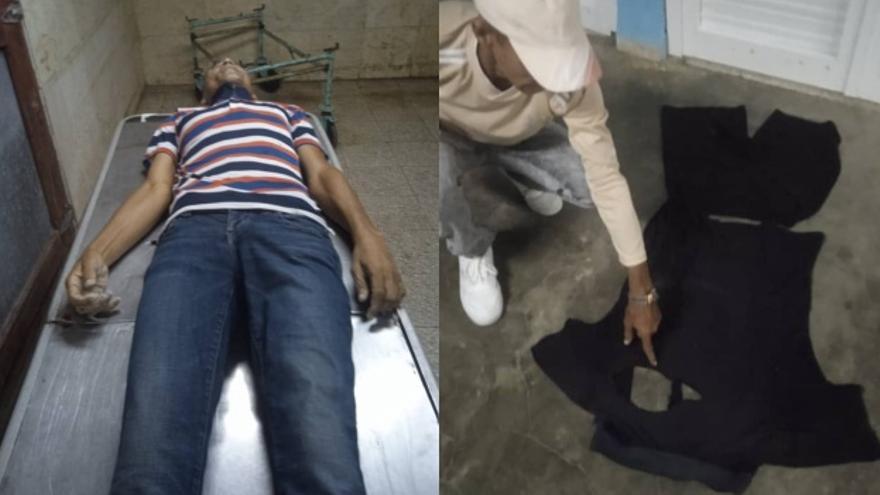
14ymedio bigger14ymedio, Havana, 28 September 2023 — The alleged leader of an extortion ring targeting celebrities in Spain, Juan Herrero, could have been sustaining the entire operation from Cuba, the Spanish National Police revealed this week. According to the Spanish media, which had access to the statements, they planned to request assistance from the authorities of the Island to capture the alleged ringleader, known as the “Clairvoyant Monk” for publishing videos of “prophecies” on the Internet. The press also revealed that Herrero has been in Cuba since at least January, and two orders have been issued to search for and capture him. However, during an interview with the TardeAR program broadcast on Tuesday, the alleged criminal stated that he was simply under investigation and was in his “residence” in Bilbao, in the Basque Country.

During the program, the Spanish journalist Malu Zamora, who said she had followed the case of the Clairvoyant Monk for two years, explained that her “sources in Cuba” had managed to locate Herrero in Havana, that he also maintains several businesses “that are doing quite well” on the Island and has “Russian citizenship.”

According to Spanish media, the authorities are aware that the fugitive profits from online divination services from the Island

The journalist noted that, during the investigation of Francis Montesinos, a fashion designer and one of the victims of the blackmail, it was discovered that the phone number through which they tried to extort the money was Cuban.

According to the statements of the Police to the press, the criminal organization recruited minors under the age of 18 whom it sent, through telephone contacts, to have sexual relations with personalities from Valencia, declaring that they were already of legal age. Days later, the young people contacted the celebrity again to ask for large sums of money in exchange for not sharing the recordings in which they had sex. continue reading

In the interview presented in TardeAR, Herrero denied all accusations and any relationship with the criminal network. He even alleged that he was a victim himself and explained that in 2022 he had relations with a young man who ended up extorting him in the same way as the rest of the victims. “A day after leaving he called me and told me that he was actually 15 years old and that if I didn’t send 100,000 euros to an account in Morocco he would share a compromising video on social networks,” he said.

The Valencian newspaper Las Provincias, which has also closely followed the story of Herrera, reported that the judge of Liria, a municipality of Valencia, denied a first request from the National Police to request assistance from the Cuban authorities and requested that they present evidence that the fugitive was on the Island.

According to the media, the Police are aware that the fugitive profits from online divination services from Cuba and, among the evidence that incriminates him as the leader of the extortion ring, there is a conversation he had on WhatsApp with the minor who blackmailed Montesinos about the amount of money demanded of him in exchange for not disseminating the intimate video.

Translated by Regina Anavy

____________

COLLABORATE WITH OUR WORKThe 14ymedio team is committed to practicing serious journalism that reflects Cuba’s reality in all its depth. Thank you for joining us on this long journey. We invite you to continue supporting us by becoming a member of 14ymedio now. Together we can continue transforming journalism in Cuba.

Cubans Go without Food as the State Grants Concessions to Government-Controlled Businesses

Three organizations proposed several measures that would have ended state control of farmers, farmland and private businesses. (14ymedio)

14ymedio bigger14ymedio, Havana, September 27, 2023 — Three independent organizations released a statement on Tuesday calling on the Cuban government to grant greater economic and market freedoms to address the structural crisis facing the country. The League of Independent Farmers, the Latin American Federation of Rural Women and the Independent Trade Union Association of Cuba also condemned the government for granting privileges to micro, small and medium-sized and businesses (MSMEs) —  many of which operate simply as importers — instead of prioritizing domestic production to alleviate what they describe as a “famine” plaguing the island.

They claim MSMEs, which began playing a dominant role in the Cuban economy last year, are simply a mask that allows the government to pretend it is creating a market-oriented economy. “Nothing could be further from the truth. They are not a step towards economic freedom but rather another ruse to avoid it,” the statement reads.

The document also claims that the objective of this “fake private sector” is to avoid foreign sanctions on the state sector

The document also claims that the objective of this “fake private sector” is to “avoid foreign sanctions on the state sector,” specifically sanctions by the United States. In reality, officials have for years tried to financially strangle hundreds of private-sector businesses.

“MSMEs, have to go through a long approval and registration process that subjects them to ideological discrimination. They are not even the first step in the right direction… That would involve the creation of a genuine private sector and full respect for a basic set of freedoms,” the document states. continue reading

“We do not need food import companies like Gaesa [a business conglomerate run by the Cuban armed forces] and its MSMEs, but economic freedom to grow it in Cuba. Crushing agricultural producers while granting privileges to MSMEs is not the way to ensure the nation’s food supply. When the freedoms that we demand are respected here, the Cuban diaspora will be the primary initial investor in the reconstruction of a country with full rights,” the statement continues.

The organizations also point out that, in April 2020, independent Cuban farmers proposed five measures to guarantee food security. “None of the were adopted. Instead, more than sixty that proved unworkable were decreed,” they add. “This was acknowledged during the last session of the National Assembly. Today the specter of hunger haunts Cuban citizens.”

Among the measures being demanded of the state is the establishment of a title registry without “selective and exclusive authorizations” of lands, undertakings and private businesses; respect for the farmers’ authority over their lands, what they produce and the right to sell their production without state intermediaries; the freedom of each business to choose the investors, partners, employees and marketers it prefers, inside or outside the country; authorizing the private sector to participate in auctions on an equal and transparent footing; and the establishment of guarantees against expropriations, as well as the management of legal conflicts through an independent court.

“This crisis is, above all, the result of a failed system of state control that hinders domestic economic freedom. This is not something that can be corrected through dialogue. Free expression, even on the Internet, is now impossible without running great risks under the new penal code. But it is our right and duty to do so,” explained the organizations, which also demanded the release of all political prisoners.

Some analysts, such as the Cuban economist Pedro Monreal, have also expressed concerns over the political nature of these companies. “MSMEs are not just businesses; they are political expressions,” claims Monreal in a post on X (formerly Twitter). “Even a partial and incomplete economic transformation involving dynamic new players has political ramifications in the sense that it suggests a redistribution of control over assets and income, which is one of the bases of power.”

No matter how you dress them up, MSMEs will always be perceived as a calculated risk by the politically powerful who authorized them.

“No matter how you dress them up, MSMEs will always be perceived as a calculated risk by the politically powerful who authorized them,” he claims.

Release of the document coincided with a meeting in Miama between seventy Cuban businesspeople living on the island and a group of Cuban-Americans trying to encourage Cuba’s private sector. Days earlier, during a visit to New York to attend the United Nations General Assembly, President Miguel Díaz-Canel met with a group of U.S. businesspeople to discuss “new business opportunities” in Cuba.

Several officials from the Cuban delegation reported, without providing further details, that the regime is considering allowing Cuban-Americans to own businesses on the island and, to this end, is preparing to adopt economic “transformations” to attract potential partners.

____________

COLLABORATE WITH OUR WORKThe 14ymedio team is committed to practicing serious journalism that reflects Cuba’s reality in all its depth. Thank you for joining us on this long journey. We invite you to continue supporting us by becoming a member of 14ymedio now. Together we can continue transforming journalism in Cuba.
Huge Puddles on the Street and No Water at Home Due to the Rupture of a Pipe in Havana

The broken water pipe and the roadworks have left a huge swimming pool a few meters from the Ministry of Agriculture. (14ymedio)

14ymedio bigger14ymedio, Havana, 26 September 2023 — A huge swimming pool has been formed a few meters from the Ministry of Agriculture, located in the capital neighborhood of Nuevo Vedado. Just one block away, on Marino Street on the corner of Santa Ana, the Havana water company has been making repairs since Monday on the pipe that supplies the Palatino tanks, built at the end of the 19th century in the municipality of Cerro.

Yesterday, the provincial press echoed an announcement by the company on social networks explaining why, since the early hours of the morning, there were residents from a large part of the municipality of Plaza de la Revolución without water, and many replied that they had already spent four days without a supply.

“The maintenance and repair brigades worked uninterruptedly with the aim of restoring service in the shortest possible time.”

“Once the repair work is finished, water service will be restored to its normal hours,” the text reads. continue reading

This Tuesday there was no one working on repairs. (14ymedio)

Around noon this Tuesday, the Editorial Board of 14ymedio, located in the affected area, which had been without service for more than 48 hours, although the most significant thing, as can be seen in the image that accompanies this text, is that no one was working on the repairs.

The report speaks of an “unforeseen” break, but for years the residents have denounced the deterioration of the road that passes over the pipe. The street had been sinking for a long time, and many warned of its possible collapse.

Three months ago, this newspaper reported a pothole a few meters from the current break, which now had to be opened to repair the structure. The depth of the hole was so alarming that the residents chose to sign it on their own, trying to avoid a misfortune.

The disdain with which the authorities have dealt with this street clashes with the high presence of official buildings, where there is also the headquarters of Panataxi, the fleet of “yellows” destined to transport tourists from José Martí International Airport to Havana, where numerous officials park their vehicles.

Translated by Regina Anavy

____________

COLLABORATE WITH OUR WORKThe 14ymedio team is committed to practicing serious journalism that reflects Cuba’s reality in all its depth. Thank you for joining us on this long journey. We invite you to continue supporting us by becoming a member of 14ymedio now. Together we can continue transforming journalism in Cuba.