Two Cuban Athletes Under the Age of 20 Flee in Mexico and Nicaragua

The baseball player Miguel Neira escaped before this Wednesday’s match against Panama, in Managua. (X/@francysromeroFR)

14ymedio bigger14ymedio, Havana, November 29, 2023 — The escape in Mexico of María Carla Pérez, a Cuban player of Basque pelota, and that of pitcher Miguel Neira in Nicaragua both occurred this Wednesday. They are the most recent of the stampede that hinders Cuban sports. With these desertions, there are now 69 athletes on the Island who have abandoned their official delegations, according to journalist Francys Romero.

Pérez, a member of the U-19 national team, took advantage of her stay in Mexico, where the Basque pelota, U-22 World Cup was held, to escape. The young woman, a resident of the province of Villa Clara, was one of the stars of her specialty last year, during the National Youth Championship held in Guantánamo.

The regime has not yet pronounced on these departures. “Unfortunately, the Island’s authorities seem to care little about the desertions of high-performance athletes,” said Swing Completo magazine. “No matter when, how or where, abandonments continue to be day-to-day news in Cuba. And so it will continue…,” the sports publication said ironically.

The escape of the Villa Clara athlete in Mexico came several days after the bronze medalist in the Central American Games in weightlifting, Elizabeth Reyes Entenza, escaped in Guadalajara (Jalisco), shortly before her continue reading

presentation at the Paradero Sports Center, where she was to participate in the 192-pound category in the Youth World Championship.

Athlete Maria Carla Pérez left the Cuban delegation in Mexico. (X/@francysromeroFR)

Hours after Pérez’ escape in Mexico, journalist Francys Romero reported that Miguel Neira, one of the players of the Cuban team that participates in the U-23 Pre-World Cup tournament, had also escaped. The young left-handed pitcher of Los Gallos de Sancti Spíritus, had played a prominent role in last Sunday’s match in the pre-World Cup, in which his team beat the Curaçao national team 5-1.

Neira, 19, was on the list of the Cuban team that this Wednesday faces Panama in the U-23 pre-World Cup tournament, held in the Panamanian capital. According to the reporter, “he left the hotel where they were training at noon.”

“I classified Neira as the number 3 prospect on my list of the 25 best under-18 talents of 2022,” Romero recalled, affirming the talent of the player from Sancti Spíritus.

These escapes add to the list of 14 athletes who stayed in Chile after the Pan American and Parapan American Games. While their request for refuge is resolved, 11 of these athletes already have a temporary visa, which has allowed them to train and look for employment in the South American country.

Translated by Regina Anavy 
____________

COLLABORATE WITH OUR WORKThe 14ymedio team is committed to practicing serious journalism that reflects Cuba’s reality in all its depth. Thank you for joining us on this long journey. We invite you to continue supporting us by becoming a member of 14ymedio now. Together we can continue transforming journalism in Cuba.

American Singer Norah Jones Cancels her Concerts in Cuba

The announcement at the beginning of November about what would have been the artist’s first concerts on the Island caused controversy among Cubans. (EFE)

14ymedio bigger14ymedio, Havana, 29 November 2023 —  The American singer and songwriter Norah Jones, who had scheduled two shows in Havana for next February, has canceled her concerts. The news was confirmed to the independent press by the agency Dreamcatcher Events, in charge of organizing the show.

“Norah decided to cancel,” Danny Heaps, founder and manager of the agency, responded to Diario de Cuba without giving more details. He also offered his apologies to those who had already planned to attend the event.

The cancellation of Jones’ concerts ruins the tourist packages that several companies offered to American tourists – for up to $8,600 – for a four-day, all-inclusive experience at the Grand Aston Hotel in Havana, with tickets to the artist’s performances on February 17 and 18 at the Teatro Martí. continue reading

The cancellation of Jones’ concerts ruins the tourist packages that several companies offered to tourists

The rumor about Jones’ absence had spread since days ago, when several users noticed that the promotions and invitations to the event, published on the singer’s networks, the reservation website and the Dreamcatcher Events profile, had been removed.

The performances, according to what appeared on the event’s website – which now redirects users to the main page of Dreamcatcher Events – would have been part of the Norah Jones: Live in Havana program, in which Cuban musicians such as Alain Pérez and the group Síntesis would also have participated.

“I hope to learn more about the country’s rich musical heritage and share my music through two shows at the historic Martí Theater,” Jones wrote at that time, in a post that has been removed from her wall.

The announcement at the beginning of November about the artist’s first concerts on the island caused controversy among Cubans, the vast majority of whom questioned Jones for performing in “a country that violates human rights” and where “all the money her songs generate will end up in the hands of the regime.”

Cancellations of renowned artists at events on the Island have become more frequent in recent years, as Cuba has suffered the debacle of its international reputation. Musicians such as the Spanish duo Andy y Lucas, the composer Alex Ubago and the American rapper Arcángel have been several of the most notable absences on Cuban stages in recent years.

____________

COLLABORATE WITH OUR WORKThe 14ymedio team is committed to practicing serious journalism that reflects Cuba’s reality in all its depth. Thank you for joining us on this long journey. We invite you to continue supporting us by becoming a member of 14ymedio now. Together we can continue transforming journalism in Cuba.

The Bodies of Ten Women Who Died in an Accident in Mexico Arrive in Cuba

Shakira Martínez, from Holguín, died in a traffic accident along with nine other Cubans, while trying to reach the U.S. border.

14ymedio bigger14ymedio, Havana, 15 October 2023 — This Sunday, relatives of Shakira Martínez received the body of the 21-year-old who died along with nine other Cuban women in a traffic accident on October 1 when the truck they were traveling in to reach the U.S. border was driven at excessive speed and overturned in Pijijiapan, in the Mexican state of Chiapas. A source confirmed to 14ymedio that after 9 o’clock in the morning, the body of the Holguinera was already at the funeral home at the entrance of the province.

With the video of a plane taking off from an air terminal, the Cuban Embassy in Mexico announced on Saturday that “according to the family’s wishes” the “bodies of Cuban citizens who died in the accident in Chiapas” were returned. As has been usual in such matters, no details on the number of victims or their names were provided.

The main diplomatic office limited its statement to saying that consular officials and Mexican authorities were traveling on the flight.

A nurse at the Pijijiapan hospital confirmed to this newspaper that in addition to Shakira Martínez, the victims included 23-year-old Dayanes Morales Piedra, Naelis Carrillo Rodríguez, Aylen Moreira Guimarais, María Fernanda Lara (12), Zulema de la Caridad Amarral Valverde (16) and Alicia de la Caridad Rodríguez Montero (22). continue reading

The accident recorded 15 injured, whose names were revealed by the user Ernesto Sánchez. Among the injured Cubans are Danelis Talavera Sánchez, 32; Maylen Melisa Aliaga Tamayo, 24; Ariany Nolasco Moreyda de la Caridad, 7; Yaritza Alen Cuitic, 44; Eliani Dueña Carrillo, 6; Melisa Guiarte Serrano, 18; Eylisa Mauro Chávez Prieto, 20; Sonia Tamayo Rosales, 53; Dykenia Rodríguez, 46; Diana Iris Lozano Moleón, 26; Armando Cárdenas Céspedes, 60; Alejandro Adrián Velasco, 12; Yorlayne Valverde Pastol, 17; Roos Liz Cortina Mandearabe, 18; and Félix Arreaga Suárez, 46.

The desperation of Cubans and the difficulties in obtaining a letter of safe-conduct that allows them to travel freely through Mexico has led Cubans to pay truck drivers to take them out of the state of Chiapas so they can continue their journey to the U.S.

The desperation of Cubans and the difficulties in obtaining a letter of safe-conduct that allows them to travel freely through Mexico has led Cubans to pay truck drivers to take them out of the state of Chiapas so they can continue their journey to the U.S.

The Chiapas District Attorney’s Office opened an investigation for the crime of negligent homicide in “traffic events” against the person or persons responsible for this accident. So far, the driver, who fled after the accident, has been identified as the guilty party.

Among the Cubans who are stranded in Tapachula, there is fear of being detained and deported due to the delay in immigration procedures. A source from Migration confirmed to 14ymedio that the 138 Cubans deported on Saturday “were at the Siglo XXI Migratory Station”, which is located in Tapachula.

The Cubans were taken to the airport in five vans from the National Migration Institute and “a luxury bus”. The operation was overseen by Carlos Eduardo Espinoza Morales, who has been exposed by migrant defenders for “abuse of authority.”

Translated by: Dylan Roberts (Spanish 321, University of Miami)

____________

COLLABORATE WITH OUR WORKThe 14ymedio team is committed to practicing serious journalism that reflects Cuba’s reality in all its depth. Thank you for joining us on this long journey. We invite you to continue supporting us by becoming a member of 14ymedio now. Together we can continue transforming journalism in Cuba.

Cuba’s Official Press Annoyed by the Forecasts of Another Disastrous Sugar Harvest

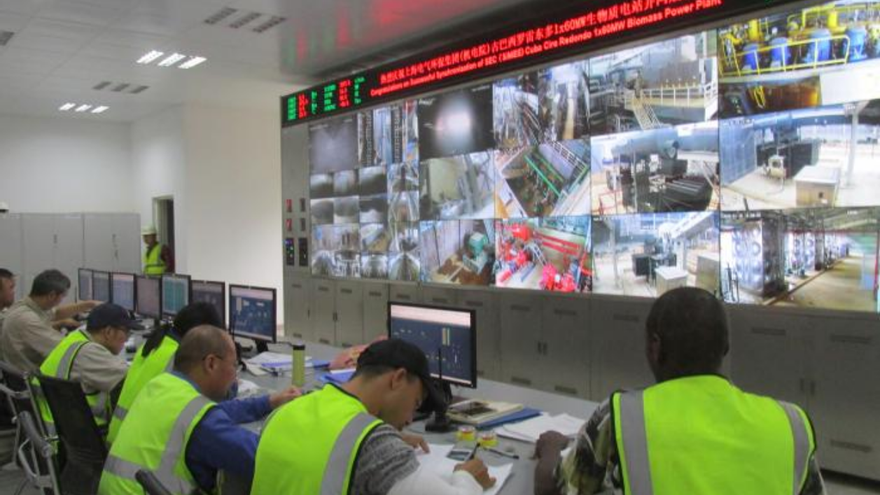
The Ciro Redondo plant in 2020, with Chinese operators and bilingual panels. (Granma)

14ymedio bigger14ymedio, Madrid, 27 November 2023 — Everything seems to indicate that we will have to dust off the headlines warning of the worst sugar harvest in the history of Cuba. The official State newspaper Granma warned this Sunday that the campaign will take place in a “very tense scenario” and closes the door to optimism, regretting that, despite the more than 100 million pesos invested in its modernization, the Ciro Redondo power plant in Ciego de Avila will once again fail to meet forecasts.

The center and the bioelectric plant were to start and synchronize on December 22, although it was planned to start grinding on December 10 to gain an advantage. To do this, several construction works had to be completed, including a retaining wall for the bagasse yard and the assembly of the bearings. If this is not finished in the few remaining days of the month – and everything seems to indicate that it will be – the forecast will go to waste, warned Vidal Martín Sarduy, administrator of the mill.

Two national companies are identified as responsible for this matter, Cubana de Bronce, which has not delivered two pieces, and the Industrial Technical Services Company Fábrica Comandante Manuel Fajardo Rivero    

Two national companies are identified as responsible for this matter, Cubana de Bronce, which has not delivered two pieces, and the Industrial Technical Services Company Fábrica Comandante Manuel Fajardo Rivero, in Manzanillo (Granma province), from where several repaired pumps were to arrive on time but don’t seem to have done so. continue reading

The harvest should last 86 days in which Ciro Redondo has the goal of producing some 34,000 tons of sugar “if no other inconveniences occur in the process,” says the official organ of the Communist Party, accustomed as the country is, to all kinds of incidents.

Granma regrets that the plant, the most modern in the country after having received a large investment, has become “repeatedly non-compliant.” The mill had been achieving its forecasts for eight years until, in the last four, things have completely changed. This is influenced, the newspaper points out, by the fact that it has not finished its “marriage” with the bioelectric plant, which adds a recent one to its other multiple failures: vibrations in the generator rotor.

As a consequence, the part has had to be extracted and taken to Havana so that Biopower and the Power Plant Maintenance Company can repair it within a period that could be 12 days, but only in the event that the resources of the People’s Republic of China” to fix the ventilation duct plates, “which could be one of the causes of the imbalance or vibration, without ruling out those that could appear when the most exact reviews and diagnoses are carried out,” the media details.

The failure of this synergy is a new mishap in the Cuban industry, which not even a year ago spoke of synchronization – a fact that involved generating energy from sugarcane and marabou biomass – as “an unprecedented energy experience.”

The twinning of the two industries began the previous year, also billed as a “national milestone.” The experts announced that the combination was “forced to run close to perfection” to avoid interruptions in the electrical system, but the breakdowns have been constant, realizing the fears already expressed from the beginning. “If any of these processes fail, the setbacks will return,” Martín Sarduy warned.

To make matters worse, Ciro Redondo accumulates a debt that continues to increase. The last time the data was updated, at the end of 2021, the figure exceeded 74 million pesos (more than three million dollars at the official exchange rate), but since then things have not improved, which suggests that there has been an increase.

The last time the data was updated, at the end of 2021, the figure exceeded 74 million pesos (more than three million dollars at the official exchange rate), but since then things have not improved

The mill was part of the list of plants that did not meet forecasts, which is believed to be as extensive as the previous year. In 2022, the authorities revealed that of the 35 that were active, 32 failed due to a long series of problems ranging from breakdowns to delays in milling, rain, fuel shortage, inadequate water supply or lack of “work discipline.”

The 2021-2022 harvest* was closed with 473,720 tons – instead of the projected 911,000 – which was not even enough to cover the domestic demand of half a million tons and left the export commitments of 411,000 tons uncovered.

As an immediate consequence, the authorities planned that in 2022-2023 there would be a more rational harvest, using fewer resources but with the aim of achieving commitments. Among the measures, the number of plants that had to produce were reduced to 23.

The production figure achieved in that season, which concluded in May of this year, has not been officially disclosed; Homero Acosta Álvarez, secretary of the National Assembly and the Council of State, indicated in an official report that it would barely reach 350,000 tons.

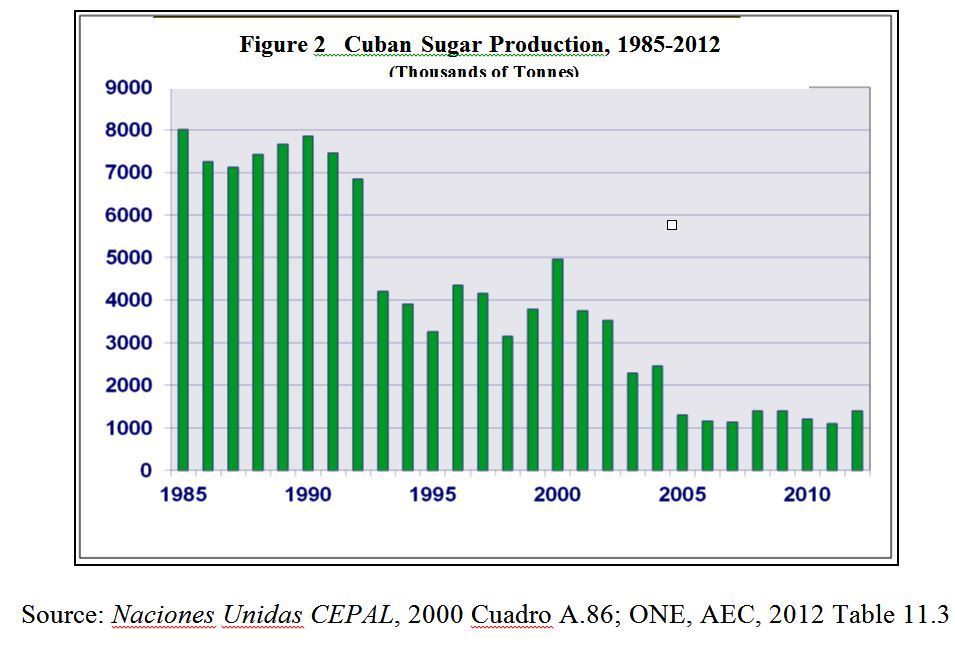
*Translator’s note: the chart below tracks Cuba’s sugar harvest between 1985 and 2012. Additional data from wikipedia: “Sugar production from the 2021-2022 was only 52% of the goal for the season, approximately 474,000 tons. That was about half of 2020-2022 production and the lowest since 1908.”

____________

COLLABORATE WITH OUR WORKThe 14ymedio team is committed to practicing serious journalism that reflects Cuba’s reality in all its depth. Thank you for joining us on this long journey. We invite you to continue supporting us by becoming a member of 14ymedio now. Together we can continue transforming journalism in Cuba.

Cuban Court Finds Professor Alina Barbara Lopez Guilty of ‘Disobedience’

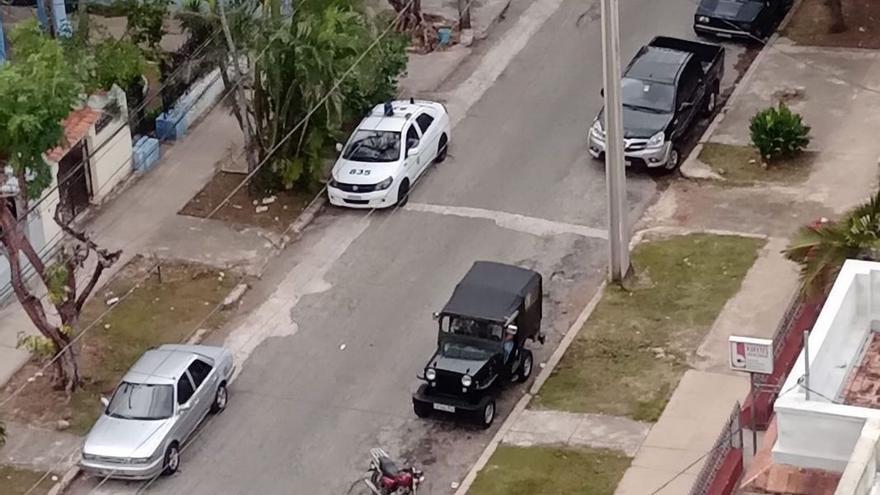
Police surveillance at Boris González Arenas’ house, this Tuesday. (Facebook/Juliette Isabel Fernández Estrada)

14ymedio bigger14ymedio, Havana, 28 November 2023 — The Cuban intellectual and historian Professor Alina Bárbara López Hernandez has been found guilty of “disobedience” in the trial to which she was subjected this Tuesday in Matanzas. She herself reported it in a Facebook postin which she also denounces the number of arrests and abuses that State Security has carried out in recent hours. # In addition to the details of the arrest of the writer Jorge Fernández Era, just when he was going with her to the Municipal Court, the professor says that there are two people whose whereabouts are unknown: Mario Ginés González and Ilonka Amuchastegui.

Both, says the historian, whose source is the father of her daughters, managed to get to the court, but when they tried to enter — “since it was said that it was a public hearing” — they were taken to the police station.

The journalist Boris González Arenas, the historian Alexander Hall, the researcher Dmitri Prieto and the activist Raymar Aguado, for their part, are under police surveillance stationed in front of their homes.

The teacher reports that there are two people whose whereabouts are unknown: Mario Ginés González and Ilonka Amuchastegui

Aguado himself had explained in a Facebook post that he was ordered to appear this Monday at the Central Havana Police station, at the corner of Zanja and Dragones, “for the purpose of being interviewed for committing a possible crime,” according to the summons. In his post, he took the continue reading

opportunity to send his “support” to Alina Bárbara López Hernández.

“Another mockery of the Rule of Law and the 2019 Constitution,” lamented Alexander Hall when he saw his home under siege at dawn. Prieto, for his part, claims that the agents threatened him on Monday with charging him with a “crime of disobedience” if he left his house, in Santa Cruz del Norte, Mayabeque.

As for González Arenas, says his wife, Juliette Isabel Fernández Estrada, he has been suffering police harassment all this week, “to prevent him from free movement outside the home.” And before this Monday, Saturday, seven years after the death of Fidel Castro.

Likewise, journalist Neife Rigau has had her mobile data taken away, as reported by Henry Constantín, also due to the trial of the Matanzas historian. “Regime with fear, a lot of fear,” pointed out Constantín, the director of La Hora de Cuba.

Due to this raid, hours before his trial, this Monday, López Hernández expressed a particular “I accuse” against the State Security organs “as those most responsible for the abuses and illegalities that are committed daily in my country against a defenseless citizen who is prevented from exercising her rights.”

The “true cause of so much repression and precautions is fear,” she asserts in her text, where she “reassures” the authorities: “I have never called on anyone to demonstrate or create disorders

The “true cause of so much repression and precautions is fear,” she asserts in her text, where she “reassures” the authorities with sarcasm: “I have never called on anyone to demonstrate or create disorders. Unlike you, I believe in the individual and ethical responsibility of the people.”

More than a dozen organization demanded that the Cuban authorities annul the judicial process against the professor, whom they describe as a “recognized historian trained in Marxism and committed to the causes of the left.”

For the platforms Cuba Siglo 21, the Cuban Observatory of Human Rights, Cuido 60 and the Observatory of Cultural Rights, among other signatories of a document last October , the cause of the siege against the teacher has been her exercise of the “right to free expression and freedom of academic research.”

Prisoners Defenders spoke in the same vein , calling the accusation against López Hernandez “false.”

The trial, initially scheduled for November 16 and later postponed, is the latest episode of harassment that includes a ban on leaving the country and that began last year, when the event for young artists The Worst Generation was censoredLópez Hernández was going to preface a book that would have the same title and that the regime also prevented from being carried out.

She herself reported the harassment, but stayed on social media. After receiving several requests from State Security to be questioned, she presented a “formal complaint and annulment action against the official summons” to the Matanzas Provincial Prosecutor’s Office . With this, the teacher managed to get State Security to annul the summons.

The trial, initially scheduled for November 16 and then postponed, is the latest episode of harassment that includes a ban on leaving the country and that began last year

Three months later, inspired by the Matanzas action, Jorge Fernández Era presented a similar claim, of nullity for violation of the Criminal Procedure Law, after receiving a summons from the political police, and did not obey the summons.

The writer said at that time that the officer who approached him expressly reminded him not to be inspired by the case of Alina Bárbara López Hernández, warning him that “Matanzas is not Havana.”

Last April, López Hernández was detained for several hours by State Security after protesting another detention of Jorge Fernández Era in the same Freedom Park.

After being released, she recounted in a long Facebook post the details of her arbitrary detention for exercising “a constitutional right in a country without political rights,” and announced that on every 18th day she would demonstrate peacefully.

Her requests would be four: “a democratically elected National Constituent Assembly to draft a new Constitution applicable in all its parts”; “that the State not ignore the critical situation of the elderly, retirees, pensioners and families who are in extreme poverty”; “freedom for political prisoners without mandatory exile”; and “cessation of harassment of people who exercise their freedom of expression.”

____________

COLLABORATE WITH OUR WORKThe 14ymedio team is committed to practicing serious journalism that reflects Cuba’s reality in all its depth. Thank you for joining us on this long journey. We invite you to continue supporting us by becoming a member of 14ymedio now. Together we can continue transforming journalism in Cuba.

Political Police Isolate Opponents During EU Representative Eamon Gilmore’s Visit to Cuba

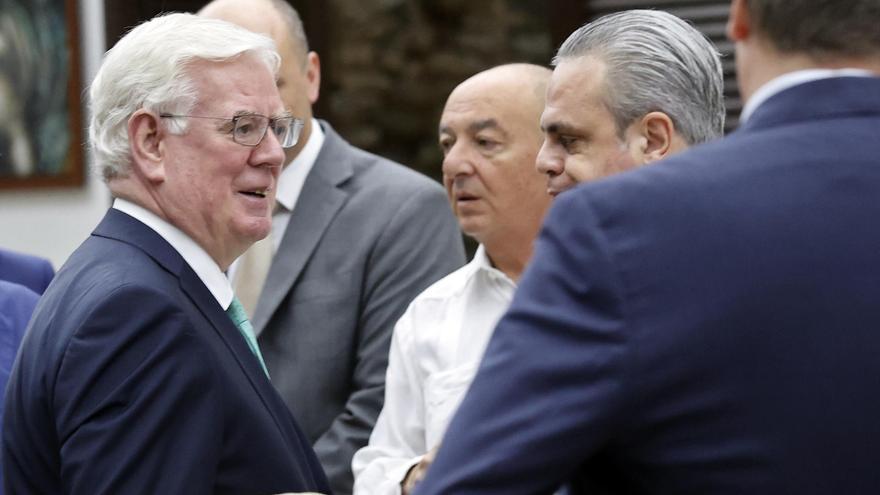
The special representative of the European Union for Human Rights, Eamon Gilmore, with representatives of the EU, this Friday, in Havana. (EFE/Ernesto Mastrascusa)

14ymedio bigger14ymedio, Madrid, 24 November 2023 — Before the  of the European Union’s Special Representative for Human Rights, Eamon Gilmore, landed in Cuba, State Security had already detained Professor Pedro Albert Sánchez and Dr. Fernándo Vázquez, both activists, who had announced their intention to meet with the Irish senior official.

Ana Elvis Amaya, wife of Pedro Albert Sánchez, told 14ymedio that she went this Friday to the Vivac de Calabazar detention center, in Havana, and they confirmed that the activist is there and that he has not eaten for two days. The professor insists that he will remain without eating “because he had warned that if they arrested him again he would refuse to eat food.” Amaya, however, was not able to see him, although she was assured that he would have a visit next Thursday.

While Dr. Vázquez was released on Thursday, the former’s whereabouts were not known until this afternoon. Activist Carolina Barrero, currently residing in Spain, made public several videos in which Professor Albert Sánchez announced his intention to hold a sit-in in Lennon Park in Havana to try to get closer to Gilmore, whom he had sought to contact through a letter to explain the situation of political prisoners on the Island.

“I chose that park because there is a monument to the Freemasons, who are a symbol of fraternity, decency, unity, and patriotism. Let us not forget that among them were Maceo, Martí and many others, almost all the great heroes in the history of Cuba were Freemasons,” details Professor Sánchez, who also considers the place an open and striking space, where State Security could not intervene. He didn’t even have that option. continue reading

The activist also considered the place an open and striking space, where State Security could not intervene

In the videos published by Barrero, Sánchez tells the story of his arrest on 11 July 2021, his time in the Valle Grande prison, the death of his mother while he was in prison and his conviction, as well as his subsequent release – home freedom — for health reasons. “I suspect that this audio is going to be a little strong and maybe it will be the last, or maybe it will be the most important of my life. Frankly, I hope it is both: the last and the most important of my life,” he says excitedly, admitting that he would prefer to die in prison.

Before disappearing, Sánchez left Barrero the four clips with the request to “bring it to light” if something happened. “Maybe one day it will be useful, at least for those of us who seek love and justice. Maybe it will be a useless audio for those who choose hatred and revenge.” Barrero disseminated them on Thursday afternoon, 48 hours after losing contact with the professor.

Sanchez sent an email to the EU office to ask Gilmore for a meeting with members of independent civil society, such as himself or Professor Alina Bárbara López Hernández, whose trial is scheduled for the 28th, who participated in a meeting in May with the high representative of foreign policy of the 27 European countries, Josep Borrell.

“I would ask you: Do you have the possibility of visiting the relatives of the political prisoners in Cuba and the political prisoners? I would ask you other things: To what extent, when a representative of the European Union comes to Cuba, do you manage to have contact with the true Cuban reality , with the citizens? And from there, is compliance with human rights or the violation of human rights really valued?” the professor said, speaking to Martí Noticias this Tuesday, shortly before his arrest.

“My admiration to all my brothers who are in prisons, for their courage,” he said, reporting that a patrol was guarding the entrance to his home. “We live in a constant regime of tyranny”  

Fernando Vázquez, who was released after a brief detention, said that he had been detained at the door of his house at 9 a.m. on Wednesday and taken to the Zapata and C police unit, where he remained until 6 p.m. “My admiration to all my brothers who are in prisons, for his courage,” he said, warning that a patrol was guarding the entrance to his home. “We live in a constant regime of tyranny,” he lamented.

As reported by the EFE agency, Gilmore insisted this Friday that the dialogue he is going to maintain with Cuba also sometimes involves “questioning” and “challenging” the positions of the interlocutor. Gilmore made these statements at the beginning of the main formal event of his two-day visit to Havana, the fourth Human Rights Dialogue between the EU and Cuba.

“Today we will debate issues of economic, social and cultural rights, as well as civil and political rights. On some issues we will maintain common positions and on other issues we will question and even challenge the other side. That is what it is about,” said Gilmore, He added that they seek to maintain an “honest dialogue” within the framework of the Political Dialogue and Cooperation Agreement (ADPC) that since 2017 has articulated bilateral relations between the Island and the community bloc.

For his part, the general director of Multilateral Affairs and International Law of Cuba, Rodolfo Benítez Verson, highlighted in his opening words the “high relevance” that the ADPC has for his government and the “excellent opportunity” that holding this dialogue represents. in particular.

He also stressed that Havana aspires to maintain “a respectful and constructive exchange, among equals, on political, civil, economic, social and cultural rights, including the right to development.”

The meeting began at 9:00 in the morning in the protocol rooms of Cubanacán and is expected to last four hours

The meeting began at 9:00 in the morning in the protocol rooms of Cubanacán and is expected to last about four hours. The EU, which has not released the agenda of the visit, indicated in a previous statement without providing more details that the community representative “plans to meet with a wide spectrum of actors from different segments of Cuban society.”

Gilmore began his political agenda in Havana this Thursday, whose first day was reserved for meetings with officialdom, including a visit to the National Assembly, where he was informed of the recently approved laws that, for the regime, represent a modernization of the system, and they highlighted their commitment to human rights, as pointed out by the Foreign Minister, Bruno Rodríguez, in his speech in Geneva for the UN Universal Periodic Review of Cuba on this matter.

Brussels, aware of the challenge, has explained that the trip is part of the European Union Community’s purpose of maintaining “constructive but critical” contact with Cuba, as established in the Political Dialogue and Cooperation Agreement. It is the fourth human rights meeting since the mechanism was approved in 2017. “The EU special representative plans to raise a number of issues including those highlighted in recent EU statements on the human rights situation in Cuba” said a press release from his office.

Among the organizations that wanted to take advantage of the visit to denounce the situation of repression in Cuba are the Justicia 11J collective, Prisoners Defenders and Amnesty International, which this Thursday recalled the “mass incarceration” of protesters that occurs on the Island, with at least 13 “emblematic” prisoners of conscience – among them Luis Manuel Otero Alcántara, Maykel Osorbo Castillo and José Daniel Ferrer – and the regime’s “sophisticated machinery of control over freedom of expression and assembly.” Another international NGO, Human Rights Watch, referred to the “systematic repression of critics and dissidents” on the Island.

“They just told me that they called a mother I know and that she is going to meet with two more,” said Fonseca

Gilmore, who has published a message on X saying that he will try to address “a wide variety of topics” on his trip, he expects to meet with the families of several political prisoners, according to France Presse this Thursday, citing Roberto Pérez Fonseca’s mother Liset Fonseca as a source. “They just told me that they called a mother I know and that he is going to meet with two more,” said Fonseca, a resident of San José de las Lajas, in the province of Mayabeque.

The visit of the high-ranking European official comes the same week in which the death of Luis Barrios Díaz, a 36-year-old 11J prisoner, due to an allegedly poorly treated respiratory condition, was revealed. As reported this Thursday by the Madrid-based NGO, Prisoners Defenders, the witness who led to his conviction was Lázaro Julián García Matamoros, who allegedly infiltrated the protests and who “testified as if he were a model citizen.”

Prisoners Defenders argues that García Matamoros was “an old acquaintance expelled from the opposition for infiltrating.” “The most creative thing that the Prosecutor’s Office has done in this case is to provide as evidence the testimony of Lázaro Julián García Matamoros (…), an alleged former activist who was ’convicted’ and released from prison with an agreement with State Security to work for the counterintelligence service as a State agent,” the organization denounced.

______________

COLLABORATE WITH OUR WORKThe 14ymedio team is committed to practicing serious journalism that reflects Cuba’s reality in all its depth. Thank you for joining us on this long journey. We invite you to continue supporting us by becoming a member of 14ymedio now. Together we can continue transforming journalism in Cuba.

Mexico Investigates the Links of Coyotes of the Cuban Mafia With 12 Rafters Arrested in Cancun

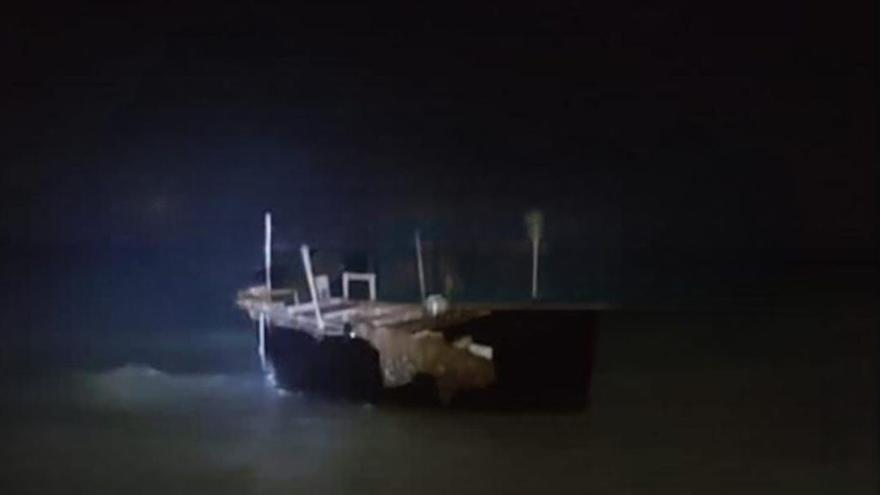
A group of Cuban balseros (rafters) was arrested while abandoning a boat in Cancun (Quintana Roo). (Saber Politico)

14ymedio bigger14ymedio, Ángel Salinas, Mexico, November 28, 2023 — The authorities of Cancun, in the Mexican state of Quintana Roo, are investigating whether the 12 Cuban rafters arrested this Monday, four women and eight men, are related to the network of coyotes that has operated under the command of the Cuban Mafia since 2009 in the region. “The raft was located when it was approaching Chac Mool beach, and from the moment they disembarked they ran to Kukulcán Boulevard,” officer Jacinto Pech May tells 14ymedio.

The agent says that the migrants were guided by at least three people who managed to escape. “At least six people fled, including three who indicated the route they should follow, but most of them were intercepted on the boulevard.”

Despite the fact that several of the members of the Cuban Mafia are continuing with judicial proceedings in the United States, Pech May does not rule out that “groups of coyotes who have ties to this criminal network are operating on their own and transferring Cubans clandestinely.” However, the detainees would only say that they entered the country illegally. continue reading

According to the investigations, the Cuban Mafia, through Maikel Antonio Hechavarría Reyes and Mónica Susana Castillo, was in charge of nabbing Cubans, and in Mexico, they were subjected to threats and extortion.

According to the investigations, the Cuban Mafia, through Maikel Antonio Hechavarría Reyes and Mónica Susana Castillo, was in charge of nabbing Cubans, and in Mexico, they were subjected to threats and extortion

In September of last year, a fisherman pointed to Cancun as one of the routes used by coyotes and rafters to escape the Island. “We are cantankerous, and if we help, we are not going to confess it,” Javier Robles told this newspaper in reference to fishermen who transport migrants clandestinely.

Before the pandemic, illegal exits took place from Pinar del Río, which is 220 miles from Cancun and 211 miles from Isla Mujeres, two of the points marked by authorities for the rescue and arrest of Cubans on the high seas. The coyotes charge about $7,000 for the transfer.

Pech May accepts that last year several arrivals were recorded, but in 2023, the “rescues” of migrants by land have been registered when “they are intercepted by the National Guard and Migration agents on their crossing by bus.”

Regarding the rafters, the officer mentioned that after verifying that the migrants were in good condition, they were handed over to the National Institute of Migration (INM). “Their situation will depend on the authorities; for our part, there is no crime.”

Translated by Regina Anavy

____________

COLLABORATE WITH OUR WORKThe 14ymedio team is committed to practicing serious journalism that reflects Cuba’s reality in all its depth. Thank you for joining us on this long journey. We invite you to continue supporting us by becoming a member of 14ymedio now. Together we can continue transforming journalism in Cuba.

Cuban State Company Acopio Owes Millions of Pesos to Farmers in the Province of Las Tunas

Las Tunas farmers have demanded that state companies pay them on time. (Periódico 26)

14ymedio bigger14ymedio, Havana, November 28, 2023 — The state companies of Las Tunas are being suffocated by debts, the provincial authorities lamented on Tuesday. Among the defaults to its suppliers, the unpaid credits in the bank and the lack of budget, the worst situation is presented by Acopio, with millions in defaults, followed closely by the provincial Directorate of Education and several cooperatives.

The crisis, the official State newspaper Granma explains, has put Acopio between a rock and a hard place, largely responsible for the lack of food in the province, since it is up to them to manage both state and private food production. The warning of the suppliers, the newspaper admits, has been clear: if they do not pay their debts, they will soon run out of products.

At the moment, the situation is not very hopeful. “Today we have 67 million pesos committed for credits that we have not been able to amortize,” acknowledged Javier Velázquez, commercial director of the company. “With the new measures adopted by the country, we market only 5% of what is produced, destined, for example, for social consumption and medical diets. Due to the credits, the bank withdraws 80% of our daily income, and what we have marketed this year is negligible,” explained the manager. continue reading

In addition, the company is in the middle of negotiations with the Banco de Crédito y Comercio (Bandec), with which they maintain several active debts and many overdue, to receive more financing. “We hope that now, with a certain intention of strengthening the state part, we can also obtain more production. We have been negotiating with the bank the possibility of new financing, to be able to recover as a company,” but, says Velázquez, the prices imposed by the State also take their toll.

According to Maikel Cera, general director of Acopio in Las Tunas, the differentiated prices for the population, imposed by the municipal governments, diminish the profit margin of the company

According to Maikel Cera, general director of Acopio in Las Tunas, the differentiated prices for the population, imposed by the municipal governments, reduce the profit margin of the company, which remains at a few cents. Also, he says, they compete with “intermediaries” who sell the same products at higher prices but pay “cash on the spot,” something that the company cannot do due to lack of liquidity.

As for the Bandec branch that manages the company’s credits, with whose directors Granma also spoke, the panorama they offer about Acopio is no different. So far this year, says Leancy Richard Collazo, director of the bank, three financings were approved for the company. “They have about 66 million in credits in force, of which 23 million are due.”

“We have restructured 18 million to help them have enough solvency to request new financing and liquidity to acquire products,” he says.

Several credit and service cooperatives (CCS) in Las Tunas also revealed their concern about the debts they continue to contract with producers without a guarantee of payment. This is the case of the CCS Sabino Pupo, from the municipality of Manatí, whose associated producers have filed complaints about the delay in payments.

The transfer arrives on time, but then the cash is delayed, and we have hired workers who do not have cards”

“The transfer arrives on time, but then the cash is delayed, and we have hired workers who do not have cards,” claimed Diosmani Ramírez, one of the milk producers associated with the CCS, who explained that the payments are delivered half in cash and the other by transfer. “In addition, there are many payments that are still in cash, so there are ATMs in the municipality. We have to go to the bank, and although they help us, they can’t always give us the figure we ask for,” he added.

The same thing happens in the CSS Conrado Benítez, of the municipality of Colombia, whose directors admitted that “it is almost never possible to pay (the suppliers) within the month” stipulated in the contracts. The debtor, in this case, is precisely Acopio, who has not delivered the corresponding amount to the banana and corn farmers of the CCS.

Arelis Calvo, in charge of economics in that cooperative, admits that the annoyance among the members is widespread. “Some come to me and tell me that it is better to sell on the outside, because they have the money fast in their hands, and they also need to eat and feed their families. “Our CCS complies with what it agrees; we have been vanguards for three years. So, why aren’t we being paid?”

Mailín Utria, general director of the Cárnica Las Tunas Company, also gave a part of the situation of the entity in his charge. “We have managed to maintain some stability in terms of payments. We were managing to make them between 20 and 25 days, but sometimes that period was extended to 30 days,” he said. However, the attempt to be punctual without having the budget brought consequences.

“We have seen the need to apply for bank loans to be able to honor those payments, because the financial situation of the company is tense, due to a high number of accounts receivable because of customer defaults,” said Utria, who acknowledged that in 2023 they assumed credits worth 130 million pesos, and now they have requested 80 million more.

We have found ourselves in the need to apply for bank loans to be able to honor those payments, because the company’s financial situation is tense, due to a high number of accounts receivable 

Education, although budgeted by the State, also has a rope around its neck. “In our case, we have debts amounting to 30 million pesos from accounts payable, including those of the cooperative and farming sector. Those high balances do not respond to negligence or lack of control, but to the tight situation we have with the budget,” explained Yaimara Martínez, head of the accounting and finance department of the entity.

“Our sector needs more than one hundred million pesos today to close the year. At the beginning of this year we stopped receiving more of the 180 million in relation to our preliminary project and, on top of that, up to now they have withdrawn 23 million. In addition, we pay the debts from 2022 with the 2023 budget. The Finance directors have not been able to support our needs,” she complained.

According to the official, Education only receives money permanently to pay the workers’ salaries. The rest depends on the contributions of other companies and “economic actors” to the State budget, but this system is also in crisis, since the tax agencies are having problems with their own finances.

“We are dealing with the Finance and Prices directors to see if at least part of the budget that we used to pay the previous year’s debts is replenished,” Martínez said.

For now, the only solution that Education has found to relieve the debt pressure is to extend the terms of the contracts – which require payment in 30 days – to 60 and 90, “so that they do not become aged debts so quickly, since there is no liquidity to pay.” More than a solution, however, the measure only serves to lengthen the wait of those who demand to be paid for their work.

Translated by Regina Anavy

____________

COLLABORATE WITH OUR WORKThe 14ymedio team is committed to practicing serious journalism that reflects Cuba’s reality in all its depth. Thank you for joining us on this long journey. We invite you to continue supporting us by becoming a member of 14ymedio now. Together we can continue transforming journalism in Cuba.

Managua, Caracas and Havana: Migration as a Business

Terminal 3 of the José Martí International Airport in Havana. (14ymedio)

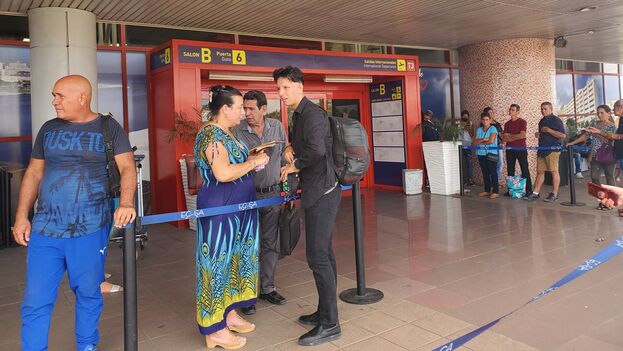
14ymedio bigger14ymedio, Yoani Sánchez, Generation Y, Havana, 29 November 2023 — Most of them are men, carrying only a small backpack as luggage. The line to check in at the Conviasa counter at Havana’s José Martí airport moves quickly. The flight goes direct to Managua, but the Nicaraguan capital is only the gateway to a route that will reach the southern border of the United States. Despite the recent sanctions imposed by Washington on the owners and executive of airlines that profit from the Cuban immigration drama, the planes continue to take off towards Nicaragua.

A few days ago Marco de Jesús’s world fell apart. With the tickets, for him and his brother, already purchased from the Dominican company Air Century to travel to Managua, a brief email notified them of the cancellation of that connection. It was one of the first companies to react to the new US visa restriction policy aimed at the airline companies that have been selling migrants from the Island tickets to Central America at “extortion” prices.

For this 38-year-old Havana native, the US penalty could not have come at a worse time. After selling his home and an electric motorcycle, he had managed to raise the more than 4,000 dollars that the two tickets for the short section between Havana and Managua cost him. “We have everything ready to leave and now we are making claims to get our money back,” he says with uncertainty. Although he agrees that such high prices are “an abuse,” he is willing to pay that amount again or more in order to “leave this country.” continue reading

“We have everything ready to leave and now we are making claims to get our money back”

Daniel Ortega’s regime understands well the desperation of Cubans. With the visa exemption for the island’s nationals, which came into effect at the end of 2021, it killed two birds with one stone: taking part of the large dividends left by this constant flow of migrants and, in the process, increasing the pressure on the US border, with the consequent increase in internal criticism of the immigration policy of Joe Biden’s Administration. Ortega filled his pockets with the urgency of some, and put his archenemy from the North on the ropes.

Competing for the pieces of that cake, amassed with the restlessness of thousands of people eager to leave the Island at any cost, others such as the Venezuelan state-owned Conviasa and the Havana regime itself also joined in. Behind the scenes, the Cuban authorities presumably allowed, and turned a blind eye to, the advertisements with supposed tourism packages to see “the Nicaraguan volcanoes,” when everyone knew that these were trips of no return. For two years money flowed into the pockets of all three regimes. No one knows for sure how much they pocketed, but given the cost of each ticket, it could be millions of dollars.

Now, part of the tap has been turned off with the new penalty implemented by Washington, but it is a just a question of time before tricks and detours appear to maintain these lucrative connections. Marco de Jesús and his brother do not want to admit it, but they are just pieces being played with by the three insatiable authoritarianisms when it comes to appropriating resources and for which migration is the new spearhead of their geopolitics.

________________________

Editor’s Note: This text was originally published in Deutsche Welle in Spanish.

____________

COLLABORATE WITH OUR WORKThe 14ymedio team is committed to practicing serious journalism that reflects Cuba’s reality in all its depth. Thank you for joining us on this long journey. We invite you to continue supporting us by becoming a member of 14ymedio now. Together we can continue transforming journalism in Cuba.

Cuban Basketball, One of the Sports Most Affected by the Exodus of the Young

The Cuban basketball base shows its shortcomings in the Eide facilities in Ciego de Ávila. (Invasor)

14ymedio bigger14ymedio, Havana, 28 November 2023 —   Basketball is one of the sports most affected by the unstoppable migratory exodus on the Island. This is stated by Yunier Valdivia Rodríguez, deputy provincial director of sports activities in Ciego de Ávila. “There are fewer students, as they resign for reasons related to the end of a scholarship or a change of decision about their future,” he told the official newspaper Invasor.

Despite the fact that basketball is one of the sports with the highest number of followers and practitioners in that province, the official says that last year, between schoolchildren and youth in the School of Sports Initiation (Eide), there were barely 54 players. At the beginning of 2023 there were 41, and in the entire course there were no more than 50.

With 47 players between schoolchildren and youth of both sexes, coach José Echarte Vázquez accepts how complicated it is to set up tournaments in Ciego de Ávila. The squads are at the limit, because at least each team must have 10 players to have substitutes for each of the five athletes on the court. The panorama looks very different from the 90s, when he played with Georffrei Silvestre and Yoan Luis Haití. “When we were 13-15 years old, we had 17 or 18” members. continue reading

The Cuban basketball foundation is crumbling. Valdivia Rodríguez recognizes that the crisis has spread to the lack of teachers. Of the eight that the Eide had to count on, there are currently six, one of them “hired by the hour.” The casualties, he points out, “migrated” or “sought a source of employment that pays more.”

Eide auxiliary courts are made of cement, which can cause injuries. (Invasor/Michel Guerra)

Moisés Bravo Torres, a well-known headhunter and teacher, says he is tied to the Eide because basketball is his life, “not because it allows me to fulfill the demands in my house.” He admits that coaches have been “forced to change activities” to generate twice as much income. “My salary does not exceed 5,500 pesos with all the years I have of experience, and that is not enough in these times.”

The boys that Bravo Torres is recruiting train in the Auditorium, a place that reflects the shortcomings of Cuban basketball: the court is made of cement, where injuries are more frequent; there is only one hoop to score, and the bathrooms are in poor condition. In addition, the eight balls given to them by the Eide at the beginning of the year have already deteriorated.

To this must be added that “we are at an international disadvantage because, along with the crisis, there is no practice at these ages,” Bravo says.

For his part, Echarte considers that “the main problem is that you don’t compete. It is very difficult to set up a match with the neighboring provinces. Here you train more than you play, contrary to the rest of the world. We wait eleven months for the national, and sometimes it’s ’we’ll see’.”

The declared Most Valuable Player of the last Superior Basketball League, Joan Carlos Gutiérrez, told Play-Off Magazine, that the lack of “a good court, better training equipment and the lack of international experience” are the impediments faced by players.

Gutiérrez indicated that he has to resort to the black market to get sneakers “because there is no place to buy them on the Island,” and the same “happens with the knee pads and the sweatshirts.” In order to develop, the support of the family is essential. In his case, it’s his mother and sister who have covered these expenses.

The lack of footwear and socks is experienced from the early stages. According to Valdivia, footwear is obtained in the informal market for no less than 60 dollars, and players use it only for competitions, with the risk of being injured during training with inappropriate shoes.

The Eide court is damaged and must be urgently replaced. (Invasor/Puyol)

Joan Carlos Gutiérrez says that “basketball is a sport that is currently undervalued in Cuba, and the solution is not in the hands of the athletes.” Gutiérrez considers it essential to “improve training conditions, promote more international experience and motivate the players and new generations.”

The budget of 70 million pesos that the Eide received this year was “insufficient” to carry out significant work in a training center with more than 700 students. The court is destroyed and needs to be replaced, which has led to training in the Giraldo Córdova Cardín multipurpose room and on cement courts.

The shortcomings in basketball are not new. Invasor revealed in a 2005 report on the Eide the terrible conditions of the dormitories, the sports areas and even the food. The precarious condition of the bathrooms forced more than 300 students this year to live overcrowded in another building with the rest of the athletes and prevents the school from increasing its staff. An investment plan for improvements is planned for 2024, but this, for the moment, is only a wish.

Translated by Regina Anavy 

____________

COLLABORATE WITH OUR WORKThe 14ymedio team is committed to practicing serious journalism that reflects Cuba’s reality in all its depth. Thank you for joining us on this long journey. We invite you to continue supporting us by becoming a member of 14ymedio now. Together we can continue transforming journalism in Cuba.

‘Now They’re Closing the Ration Stores in Cuba, Yes, Totally’

Miniscule and dirty, a portion of beans “for two people,” was sold for 20 pesos, said the shopkeeper. (14ymedio)

14ymedio bigger14ymedio, Juan Diego Rodríguez, Havana, 27 November 2023 — A handful of black beans, a little salt and four pounds of rice: the list of what they were distributing this Monday in a bodega (ration store) in Centro Habana, to give an account of the calamitous state of the rationed market in Cuba.

Miniscule and dirty, the beans were sold for 20 pesos a handful, which does not reach a pound “for two people,” said the bodeguero (shopkeeper). Katia, a resident of the area, made a face. “With a teenage son, I don’t have enough to even start with this.” And the little bit of salt, the woman of about 40 continued, she hadn’t been able to get it for two months.

As for rice, the four pounds they gave on this occasion were divided into two: two pounds of one donated, free, and another two parboiled, paid. “One bad and the other worse,” lamented Katia, who recalls that before they gave seven full pounds in state establishments at the beginning of the month, “and now they distribute it divided into three.” continue reading

“With a teenage son, I don’t have enough to even start with this”

“The oil hasn’t come, the eggs haven’t come. Now the bodegas are closed!” she cried. “It’s a total slap in the face. There is nothing, and you have to buy it in the private stores at their prices. Look at the bodeguero there, a whole month doing nothing.”

The spectacle in state establishments is like watching a movie of the living dead, the example of a society with vital minimums. In the bakery, customers showed their ration books, paid and went away shuffling, with such apathy that some forgot to take the bread. “Look at that,” said a man in line. “They have their heads somewhere else, and they know that the bread is inedible.”

Translated by Regina Anavy

____________

COLLABORATE WITH OUR WORKThe 14ymedio team is committed to practicing serious journalism that reflects Cuba’s reality in all its depth. Thank you for joining us on this long journey. We invite you to continue supporting us by becoming a member of 14ymedio now. Together we can continue transforming journalism in Cuba.

Cubans Threaten To Protest if the Authorities Don’t Restore Water Service

Workers from Aguas de La Habana repairing a leak in the municipality of Cotorro. (Facebook/Aguas de La Habana)

14ymedio bigger14ymedio, Havana, 27 November 2023 — The state company Aguas de La Habana reported this weekend that several municipalities in the capital will not have drinking water for 12 hours, starting at 6:00 am next Tuesday due to “maintenance work.” The announcement did not take long to provoke a barrage of negative comments from those who have gone, they say, up to a week without the service.

“In several areas of the municipality of Cotorro, especially in the center, water arrives with very little force,” Tomás, a retiree who lives in that area, explains to 14ymedio. “The problem has existed for several days, and it is not even one of the municipalities that will be affected” during this Tuesday’s repairs, he says.

Also, he says, in the Paraíso neighborhood of the same municipality there are “supply problems. In other [neighborhoods] there is not as much instability with water, as in San Pedro, where I live, but it is an exceptional case. All of Havana has a serious problem with the water supply,” he adds.

People are very upset, because they call to find out what’s going on and are told that everything will be resolved soon

“People are very upset, because they call to find out what’s going on and are told that everything will be resolved soon, or they just don’t answer the phone,” he says.

Tomás’ words are the same as those that have been repeated by customers for months, in the publications of Aguas de La Habana. “It is disrespectful to publish that from Tuesday the 28th there will be no water in Central Havana, when it has been six days since the Popular Council of the Sites (…) had water. This happens because the water is not pumped and reaches the continue reading

homes by gravity and in our case it doesn’t, because [we are on] the center of the slope with a little more height,” complained a Reina Street resident in the comments of the official media Tribuna de La Habana, which reproduced the announcement.

The netizen also complained that they no longer know who to turn to, because the telephone help lines for the population don’t ’pick up’. “Now, as if that were not enough, the news is that from Tuesday there will be no water, as if these past days everything worked well. We are desperate and helpless,” she said, adding that the provincial authorities promised to send them a water truck, which would solve the problem. “The truck never arrived; it was just words,” she said.

The avalanche of comments that appear in the publication of Aguas de La Habana suggests the cartography of the city’s problems: water scarcity in Bahia, impacts on the Guiteras distribution, leaks in San Miguel del Padrón, and the list continues.

“Do you think someone deserves to go a week without water? They don’t even send a water truck so we can at least cook and bathe, as any human being deserves,” protested another user.

“Today it’s been 15 days since we had water on my block, in the Wajay neighborhood, and complaints have been made. The delegate and the president of the council do not respond or carry out any action; even the bosses of Aguas de la Habana are aware and don’t deign to do anything if there is no signed document. I hope there is no need to have a march with pots and pans [a cacerolazo*], which is what will get their attention with immediate effect and without a signed document,” said another user.

On most occasions, the areas mentioned by customers are not among those where Aguas de La Habana has anticipated interruptions to occur

On most occasions, the areas mentioned by customers are not among those where Aguas de La Habana has anticipated interruptions to occur. The official list includes, for this Tuesday alone, impacts in part of the municipalities of Plaza de la Revolución and Boyeros, absence of service in El Cerro, Centro Habana and Habana Vieja, and minor interruptions in Diez de Octubre,  Luyanó and El Sevillano.

These areas are supplied by the Cuenca Sur reservoir, where  maintenance work will be carried out on the water conductors and the electrical system, the entity reported.

In contrast, other customers report that in their neighborhoods there are water leaks that have been draining for months without being repaired. “If you go from Boyeros to Ayestarán through the area of Bohemia magazine, you will have to roll up your pants because there is a lake of clean water,” says a nearby resident.

Some flooded, others in drought. The habaneros still can’t live in peace with the network of pipes that, instead of headaches, should bring them comfort.

*Translator’s note: A cacerolazo [from the word ’cacerola’ — casserole in English], is a form of protest where people bang on pots and pans.

Translated by Regina Anavy

____________

COLLABORATE WITH OUR WORKThe 14ymedio team is committed to practicing serious journalism that reflects Cuba’s reality in all its depth. Thank you for joining us on this long journey. We invite you to continue supporting us by becoming a member of 14ymedio now. Together we can continue transforming journalism in Cuba.

The Housing Construction Plan Is Not Fulfilled in Cuba Due to Lack of Cement and ‘Working Methods’

The plan needs 83 million concrete blocks per year, but in 2023 barely 43 million were fabricated. (Guerrillero)

14ymedio bigger14ymedio, Madrid, 28 November 2023 — For some reason, the plan to build with clay has not penetrated the Island. In the middle of the year, the authorities of the sector spent a long time explaining to the population the benefits of this material, in which the Island is rich, when it comes to building a home: “an economic, environmentally friendly and viable way,” they strongly recommended, while talking about the export of marble and cement to capture foreign exchange.

Five months later, the result is disappointing, and Deputy Prime Minister Ramiro Valdés Menéndez couldn’t hide his anger at the Minister of Construction, René Mesa Villafaña, when he noted that he was supposed to erect “floor, wall and ceiling elements” with these materials. “They were being raised. Where are they?” the commander scolded. “There are directions to build the ovens. There are plans delivered to the territories. Do they do it? They don’t do it. Why don’t they do it? Where is the discipline? Where is the control? There are directions and, simply, in the territory they are not executed.”

By the end of October, the plan had been fulfilled by just over half (54%), having built 13,300 dwellings in the country

The reprimand came in the middle of a meeting of Prime Minister Manuel Marrero with the local and state authorities to analyze the poor progress of the housing program that, once again, will fail miserably. By the end of October, the forecast had been fulfilled by just over half (54%), with 13,300 dwellings having been built in the country. The official press, in line with the conclusions of the meeting, admits that the main responsibility was the lack of steel and cement, but did not hesitate to distribute blame by attributing some to “the methods and ways of working.” continue reading

Dilaila Díaz Fernández, general director of materials of the Ministry of Construction, explained that to meet the needs of the Housing program, 83 million concrete blocks are needed per year, but in 2022 barely 39 million were reached, less than half, although it was “the best production” in the 12 years that the local production plan had been in operation.

In a country accustomed to worse results, it is no small matter that this year production has increased, producing four million more pieces, but this only covers 52% of what is needed. The result is the shortage of housing and the unfortunate conditions that exist.

The official asked for production to be accelerated and, returning to the local, insisted that it is necessary to “design and build with red clay.” This was followed by the scolding of the leadership of the Communist Party, which alternated with the usual calls for voluntarism.*

“We have to start a different system and promote this as an essential, social, revolutionary movement, to be able to give an answer to the population,” said Marrero, who urged companies, organizations and households to get involved in the world of ceramics.

“We need the population to see that in this very complex, sensitive issue, that affects so many people block by block, there is an additional effort, a different way in which this program has been focused, which is more participatory than ever, that companies are helping, that there is popular participation, that there is a different approach,” he continued, stating that “things cannot be delayed.”

The official, however, emphasized the need for new rules that improve relations between state and private entities and take advantage of Idle capacities

The Deputy Minister of Economy and Planning, Johana Odriozola Guitar, spoke of proposed changes, but the two that she mentioned are not a novelty. On one hand, she spoke of decentralization, a task that was already addressed when the State decided to delegate most of the complex issues to the territories. On the other was the “approval of new economic actors.” The production of construction materials is one of the most frequent activities of the private sector, although well below gastronomy and food production, according to official data from the first quarter of the year.

The official, however, emphasized the need for new rules that improve relations between state and private entities: “taking advantage of idle capacities”; increase the supply and income of state workers; increase production by coordinating with private companies; repair paralyzed production lines; and identify new business opportunities and “price agreements.”

As a novelty, this did advance the creation of a National Institute of Non-State Economic Actors, which will be subordinate to the Council of Ministers, with all that this implies.

The meeting also discussed the future budget and the need to protect the most vulnerable, but the results do not allow us to maintain optimism. “We have to face 2024 in a different way. We are going to have the same challenges, the intensified blockade, the same currency limitations, fuel problems. Therefore, we do not have the right to make a plan that is more of the same,” Marrero warned.

The prime minister spoke of a new year of “much justice,” but before which “more planning” will have to be done, due to the difficulties. “We have to play the role that corresponds to us, transform the Government’s control for food production, taking into account that 80% is in non-state productive people and forms, as well as strengthening the local development strategy, based on the real potential of the municipalities to meet the demands of the population,” he said. Again, he didn’t explain how.

We have to face 2024 in a different way. We are going to have the same challenges, the intensified blockade, the same currency limitations, fuel problems

After the echo of Ramiro Valdés’ anger, the prime minister ended the meeting with best wishes and words, talking about the benefits of decentralization, how to better exploit the “potentialities both spiritually and materially, and put together a great movement in tribute to the triumph of the Revolution and the people who work so hard and have had to face so much.”

According to the latest balance sheet of the Ministry of Construction, Cuba needs to build about 20% more houses to end its chronic housing deficit, which exceeds 800,000 homes. Since 2021, barely around 50,000 have been built. In addition, in mid-July the housing program built with state subsidies had only 13% execution, the eradication of dirt floors 9%; and of the 9,000 tenements in the country, barely 154 had been eliminated.

*Translator’s note: Voluntarism means individual initiative, something contrary to Marxist-Leninist ideology.

Translated by Regina Anavy

____________

COLLABORATE WITH OUR WORKThe 14ymedio team is committed to practicing serious journalism that reflects Cuba’s reality in all its depth. Thank you for joining us on this long journey. We invite you to continue supporting us by becoming a member of 14ymedio now. Together we can continue transforming journalism in Cuba.

European Union Envoy for Human Rights Met With the Cuban Families of the Prisoners of the 11 July 2021 Protests

The special representative of the European Union (EU) for Human Rights Eamon Gilmore met with Cuban PresidentMiguel Díaz-Canel. (Revolution Studies)

14ymedio biggerEFE (via 14ymedio), Madrid, 25 November 2023 —  The repression of dissent, the violation of political rights and the situation of prisoners sentenced for the protests of 11 July 2021 (11J) were the main complaints from Cuban civil society to the delegation of the European Union (EU) who visited the country this Thursday and Friday.

EFE spoke with three of the up to eight members of civil society that it has identified who met privately with the head of that community delegation, the EU Special Representative for Human Rights, Eamon Gilmore.

In addition to Gilmore’s official meetings, in which he met with representatives of the Ministries of Foreign Affairs, Interior and Justice, the EU diplomat’s agenda included interviews with relatives of prisoners, independent journalists, LGBT activists and critical intellectuals.

Professor Alina Bárbara López Hernández told EFE “I found him impressed with what he saw. If you will, alarmed. Hopefully he has positioned himself well,”  she said, after having had a telephone conversation with Gilmore because she could not travel to Havana due to a medical condition. continue reading

“I found him impressed with what he saw. If you will, alarmed. Hopefully he has positioned himself well”

This Marxist historian and editor, who defends “socialist ideas” and is against the blockade (embargo), will be tried next Tuesday for an alleged crime of disobedience. López could be sentenced to one year in prison.

López Hernández told Gilmore that her case is due to her “deep criticism of the single-party system,” “the State ideology,” the Government’s constitutional breaches, “the repressive attitude” of the authorities and “the control of the economy by the military. “This is inexcusable for this Government,” she said.

She also denounced that Cuba is “a factory of new prisoners” and that we should not limit ourselves to asking for the release of people currently in prison, but rather “understand that the system generates these reactions.”

The ’11J’ prisoners were, according to Gilmore himself, a “predominant” topic in his institutional conversations. On Friday afternoon he met for two hours with about five relatives.

One of them, who spoke on condition of his anonymity, told EFE that the meeting was very positive and that they found him to be “receptive” and “moved” by the complaints made to him. The relative also emphsized that going to the European embassy was not an easy task, because there were State Security agents to prevent his passage.

“It was good, very good. (He was) very receptive, wonderful. And at all times he told us that everything is being done is for the freedom of political prisoners,” summarized this relative, who claims that Gilmore referred at all times to those imprisoned as “political prisoners.”

“(He told us) that he really wanted to see the family members in person and listen to them. I told him about the torture, about everything. He understood us and hugged us,” he concluded.

The Island is currently suffering a “humanitarian crisis” and it is “timely” for the Cuban Government to have “a powerful interlocutor”

Journalist Maykel González Vivero, who also met with the European diplomat, highlighted to EFE that Gilmore “took special interest in the political prisoners.” “I told him that I had arrived in Cuba at a particularly paradoxical time. On the one hand, since the approval of the 2019 Constitution, the country recognized more citizens’ rights than ever before. However, in these same years, the Government also had violated the human rights of a greater number of people,” he said.

He argued that the Island is currently suffering a “humanitarian crisis” and that it is “timely” for the Cuban Government to have “a powerful interlocutor” to talk about human rights. “We need to keep the doors to the world open,” he said.

In several conversations, the case of Luis Barrios Díaz, a 36-year-old prisoner convicted of participating in the 11 July protests and who died last Sunday, was addressed. According to family, friends and NGOs, the young man died from a respiratory condition that he allegedly developed in prison and that was not adequately treated.

Activists and NGOs have reiterated in recent days their criticism of the Cuban Government regarding Gilmore’s visit and some have insisted on the need for the European diplomat to visit Cuban prisons, something that has not happened.

____________

COLLABORATE WITH OUR WORKThe 14ymedio team is committed to practicing serious journalism that reflects Cuba’s reality in all its depth. Thank you for joining us on this long journey. We invite you to continue supporting us by becoming a member of 14ymedio now. Together we can continue transforming journalism in Cuba.

Steps Towards the Disaster of Cuba’s ‘Bancarizacion’ [Banking Reform]

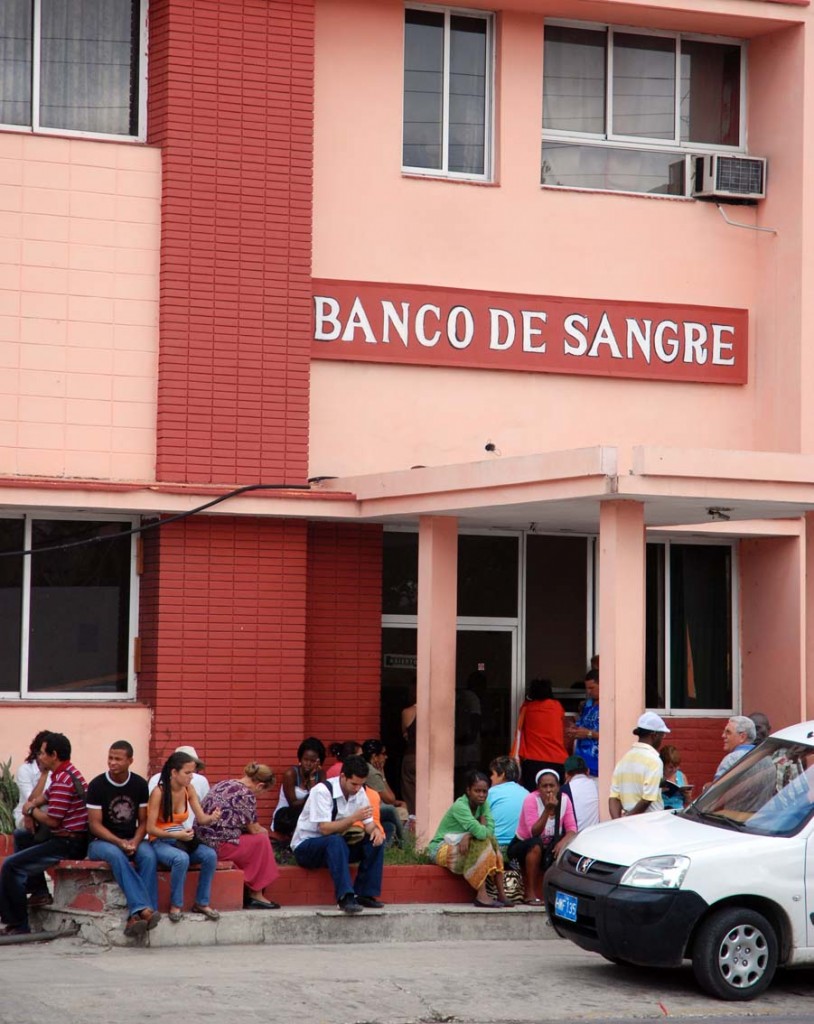
The sign on this building says ‘blood bank’, but in Havana the term could just as well refer a currency bank, with its crowd of tired discouraged people waiting for ‘change’, or at least a cash transfusion. (14ymedio)

14ymedio bigger14ymedio, Elías Amor Bravo, Economist, November 25, 2023 — Bancarización* (banking reform) in Cuba is becoming a one-act comedy for those who are bored with the low quality of the script and the cast that participates. Almost half a year after the approval of Resolution 111 of the Central Bank of Cuba, the conclusion that can be reached is that the process goes on as usual, without order or agreement, and the attempts of the leaders to cover it with a certain order fall on deaf ears. It’s like a second edition of the disaster of the Ordering Task,** but this time stumbling over the same stone. Incomprehensible. Take a look at what was said on State TV’s Roundtable program by Joaquín Alonso, president of the Bank, and his subordinates Julio Pérez, general director of Payment Systems of the Bank, and the vice president, Alberto Quiñones.

It should be emphasized that for any spectator who followed this edition of Randy Alonso’s primetime program, it is most likely that in the end he had more doubts and concerns than at the beginning. All the participants skirted around the issue, and none dared to recognize the obvious: a new failure of the communist regime is just around the corner.

And the first to contribute to the confusion was Joaquín Alonso, when he said that in Cuba there is talk of how to “bancarizar operations, instead of accessing the banking service, because all the actors of the economy already have full access to banking services,” which, he said in a surprising way, “makes us different from other nations.” Of course, saying that and saying nothing is the same thing, because Randy didn’t ask the question he should have asked right away: so why do Cubans continue to use cash in their usual transactions? continue reading

“All the actors of the economy already have full access to banking services,” which, he said in a surprising way, “makes us different from other nations.”

It goes without saying that none of the participants said anything like that. They dedicated themselves to citing the strong investments in technological equipment and point-of-sale terminals, which are then not taken advantage of, highlighting that “with the available resources, the colleagues of Etecsa, Enzona and the banking system have linked to each other, and we have the possibility of continuing to make progress in the bancarización of transactions.” But again, why do Cubans use cash and flee from the banks? It’s the same as tourism: why are they building hotel rooms if they are left empty?

The president of the Bank then said one of the things that attracted the most attention, that one reason it’s necessary to develop bancarización is in the high cost of cash. Yes, you have heard correctly: the president of the Bank said that “using banknotes means importing paper, inks, maintaining the equipment; then you have to transport them, distribute them, count them; and with about 10 uses in the economy they deteriorate, and then you have to destroy the banknotes and produce them again. It is a permanent cost in all banking operations, and it requires a large workforce, equipment and energy consumption.”

Unbelievable but true. Cuba has problems producing banknotes for its monetary system. Have you ever heard of a single country in the world that claims to have this problem? Of course not. It doesn’t exist. Only in Cuba. Now relax, because the farce had just begun. 

Unbelievable but true. Cuba has problems producing banknotes for its monetary system. Have you ever heard of a single country in the world that claims to have this problem? Of course not. It doesn’t exist. Only in Cuba. Now relax, because the farce had just begun. <– leave here and also make a ’quote’

The president of the Bank then said that “among the factors that lead to the increase in the price of transactions is the growth and emergence of new economic actors; there are more and more entities to attend to and more monetary circulation. At the same time, more economic actors involve a greater number of people who go to the bank to deposit and withdraw cash, which also makes banking operations more expensive.” In the absence of blaming the embargo/blockade, they now blame the new economic actors.

Another blunder, because in reality the cause of the increase in monetary circulation is not a small and barely marginal private sector that fights against state power to open spaces, but a deficit of the uncontrolled state sector that has to be financed with sovereign bonds that eliminate the liquidity of the banks and put them at the service of a state that only squanders the money in expenses. Of course no one said this, but it’s the reality.

That is, according to this argument, people leave jobs in state banks because the work is boring, with no expectation of improvement and poorly paid. In other words, it’s the opposite of what happens with banks in the rest of the world.

But the president of the Bank continued and said that “to the above is added a distortion in the salaries of people who work in the state sector in relation to workers in the non-state sector. The bank is not one of the entities that pays the most in salaries and profits, so we have had a significant decapitalization in our workforce, and the employees are affected.” That is, according to this argument, people leave jobs in state banks because the work is boring, with no expectation of improvement and poorly paid. In other words, it’s the opposite of what happens with banks in the rest of the world.

And not content with the ridiculous comments he had already made at this point in the program, the president of the Bank took another leap into the void to say that “two contradictory aspects then come together: we increase wages, and every day more employees leave. Despite the empowerment we have given employees by raising their salaries, establishing indicators of payment by results, we have only 84% of our staff left.” How unfortunate. And of course, where there is more concentration of economic activity and population is where that 84% suffers the most. Nothing to see or say, not a practical solution.

Just the eternally repeated message that “we will continue to face that problem from the Central Bank and, above all, from the Metropolitan Bank. We will continue to identify what to do so that people will go less to a bank to get cash. One of the lines of action in that sense is bancarización, which has been happening gradually for some years.” Unbelievable.

Next he wanted to explain why it was necessary to accelerate bancarización from last August. He said that “since before 2020, transactions and the use of electronic means of payment had been growing. In the pandemic period, home operations also increased, and electronic commerce was enhanced. In 2022 there was still a growth in bancarización transactions, but now in 2023, after the pandemic, there has been a relaxation in all those mechanisms, and we went back, from 78% in the payment matrix of these operations, to 75%.”

Where is the centrally planned economy that is unable to foresee behavior as simple as this?

And he concluded by pointing out that “from August to date, after the approval of Resolution 111, those operations have been growing at a monthly rate of 0.6%; and we expect to close the year with a growth of almost 30% in operations through electronic payment channels.” Where is the centrally planned economy that is unable to foresee behavior as simple as this?

However, the president acknowledged at this point that “the tendency to withhold cash in the hands of the population is maintained, above all, by a group of non-state economic actors.” And in this regard he added that “the cash that is kept out of the bank continues to grow, and this is a harmful phenomenon for the economy, because it causes an increase in prices.” In other words, on the one hand, electronic operations increase, but on the other, cash transactions are maintained. Where exactly are we? How is it possible for all this to happen in an economy that barely grows by 1.8% and is practically stagnant?

“They need to create certain scenarios in the economy so that the new actors can fully develop, without the need to retain cash; a phenomenon related to the reduction of offers and the increase in actors itself.” Have you understood anything? Not me.

Well, in reality, they don’t know, because the president of the Bank said at the time that “they need to create certain scenarios in the economy so that the new actors can fully develop, without the need to retain cash; a phenomenon related to the reduction of offers and the increase in actors itself.” Have you understood anything? Not me. What scenarios must be created in the economy for the development of cashless actors? Let him explain it.

And of course, having arrived at this point and with a threatening tone, he said that “cash withholding is not always due to lawful needs. For example, it is done to access foreign currency, since the State cannot offer a foreign exchange market, because the country’s economy has a deficit in that sense.” The question is why the state does not undertake the reform of the foreign exchange market and maintains the absurd status quo.

In addition, he accused the use of cash as a factor that does not allow the banking system to increase the loan fund necessary to leverage and finance the economy of the private and state sectors. That is, the president of the Bank seeks more liquidity for the state deficit, and he asked for clarity in the transactions. Maybe he should start with his own.

He then asked people to deposit money into their accounts and assured them that “bank secrecy is one of the inalienable principles of the system,” when Cubans of several generations know that this is not the case. As if the population had money left over to deposit in banks and also had some interest in electronic payments in shops. More than one spectator had to turn off the program at this point.

Afterwards, Julio Pérez, general director of the Bank’s Payment Systems, said that one of the commitments is to reconcile the work done in recent months with all economic entities, so that they can see their main ally in the bank. And Alberto Quiñones, vice president of the Bank, said that the premise of bancarización contains a gradual creation of conditions, and accelerated progress happens when those conditions are created.

In relation to Point of Sale (POS) Terminals, he said that they are working, and he encouraged their use mainly in TRD and Cimex stores. In this sense, he pointed out the work of Fincimex and REDSA in sustaining the network of POS and ATMs in the country. A lot of emphasis on the means, but never on the results: that’s the model.

Finally, there was talk of the Caja Extra service, the creation of bank cards linked to salary payrolls and bank accounts to collect taxes from private actors, whom he accused of withholding cash for an alleged practice of price differentiation depending on the payment channel, which he described as an illegality that the population cannot accept.

And in this regard, he insisted that economic actors must have the QR Code of the business available, “and not the staff, who therefore do not receive the bonus percentage for the use of payment gateways.” And for the same reason, he pointed out that “the population cannot be required to pay in foreign currency, except for the stores in MLC***.” In fact, it was confirmed that on January 2, “the business that does not have the conditions created for the population to pay through electronic gateways will not be able to provide services.” Not a good idea.

Translator’s notes

*Bancarización  is a term used in Cuba and other Latin American countries. All economic transactions are made by debit card, including cash withdrawals and the payment of salaries. The term does not have a counterpart in English so the Spanish term is used throughout this translation.   

** The Ordering Task is a collection of measures that include eliminating the Cuban Convertible Peso (CUC), leaving the Cuban peso (CUP) as the only national currency, raising prices, raising salaries (but not as much as prices), opening stores that take payment only in hard currency, which must be in the form of specially issued pre-paid debit cards, and a broad range of other measures targeted to different elements of the Cuban economy.

***”Stores in MLC” only accept payment in hard currency, and are also the primary ‘physical’ stores in the country that sell anything beyond the most basic items, outside the informal/black market.

Translated by Regina Anavy

____________

COLLABORATE WITH OUR WORKThe 14ymedio team is committed to practicing serious journalism that reflects Cuba’s reality in all its depth. Thank you for joining us on this long journey. We invite you to continue supporting us by becoming a member of 14ymedio now. Together we can continue transforming journalism in Cuba.