Fidel Castro Threatens with “The Strategic Victory” / Katia Sonia

Like a birthday present to himself, the Cuban ex-president Fidel Castro launched a book in which he narrates as episodes his experiences in the Sierra Maestra during the fight against Fulgencio Batista.

In this memoir narrated in epic tones, he deletes all those who then didn’t see clearly the destiny they’d been fighting for and separates them from the so-called Revolution Triumphant: we do not find anecdotes of Huber Matos, nor of Mario Chanes de Armas and many others whom, for more than fifty years, he has tried to silence with his twisted arguments.

After four years out of the game and his role in the leadership of the Revolution, a little more incoherent, Fidel Reappears to minimize once again the figure of his brother who, by his order, replaced him as dictatorial ruler; he called a special session of the “Cuban Parliament,” no, that is not a typo, it is how to recognize the Cubans of the National Assembly of People’s Power; everything’s OK, you have to keep fighting…

There will be twenty-five chapters numbered after the fashion of Castro, who will torture the nationals with the endless round tables, headlines and a great reduction in the insufficient production of books and school supplies for the school year 2010-2011, because all the printers are working overtime to guarantee the release of “Strategic Victory.”

These 84 threaten more of the same, fifty years of badly told stories that express the extreme will of the author; so come on down, here comes the cake.

August 12 2010

Fidel Castro, Present and Past / Yoani Sánchez

Fidel Castro’s return to public life after a four-year absence provokes conflicting emotions here. His reappearance surprised a people awaiting, with growing despair, the reforms announced by his brother Raúl. While some weave fantasies around his return, others are anxious about what will happen next.

The return of a famous figure is a familiar theme in life as in fiction — think Don Quixote, Casanova or Juan Domingo Perón. But another familiar theme is disappointment — of those who find that the person who returns is no longer the person who left, or at least not as we remember him. There is often a sense of despair surrounding those who insist on coming back. Fidel Castro is no exception to this flaw inherent in remakes.

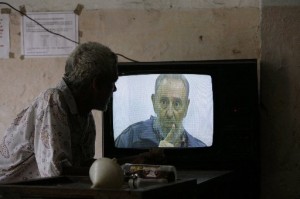
The man who appeared on the anniversary of “Revolution Day” last week bore no resemblance to the sturdy soldier who handed over his office to his brother in July 2006. The stuttering old man with quivering hands was a shadow of the Greek-profiled military leader who, while a million voices chanted his name in the plaza, pardoned lives, announced executions, proclaimed laws that no one had been consulted on and declared the right of revolutionaries to make revolution. Although he has once again donned his olive-green military shirt, little is left of the man who used to dominate television programming for endless hours, keeping people in suspense from the other side of the screen.

The great orator of times long past now meets with an audience of young people in a tiny theater and reads them a summary of his latest reflections, already published in the press. Instead of arousing the fear that makes even the bravest tremble, he calls forth, at best, a tender compassion. After a young reporter calmly asked a question, she followed up with her greatest wish: “May I give you a kiss?” Where is the abyss that for so many years not even the most courageous dared to jump?
ad_icon

A significant sign that Fidel Castro’s return to the microphones has not being going over well is that even his brother refused to echo, in his most recent speech to parliament, the former leader’s gloomy prognostication of a nuclear armageddon that will start when the United States launches a military attack against North Korea or Iran. Many analysts have pointed out that the man who was known as the Maximum Leader is hardly qualified to assess the innumerable problems in his own country, yet he turns his gaze to the mote in another’s eye. This pattern is familiar, with his discussions of the world’s environmental problems, the exhaustion of capitalism as a system and, most recently, predictions of nuclear war. Others see a veiled discontent in his apparent indifference toward events in Cuba. Yet this thinking forgets the maxim: Even if he doesn’t censure, if Caesar does not applaud, things go badly. It is unthinkable that Fidel Castro is unaware of the appetite for change that is devouring the Cuban political class; it would be naive to believe that he approves.

For years, so many lives and livelihoods have hung on the gestures of his hands, the way he raises his eyebrows or the twitch of his ears. Fidel watchers now see him as unpredictable, and many fear that the worst may happen if it occurs to him to rail against the reformers in front of the television cameras.

Perhaps this is why the impatient breed of new wolves do not want to stoke the anger of the old commander, who is about to turn 84. Some who intended to introduce more radical changes are now crouching in their spheres of power, waiting for his next relapse.

Meanwhile, those who are worried about the survival of “the process” are alarmed by the danger his obvious decline poses to the myth of the Cuban revolution personified, for 50 years, in this one man. Why doesn’t he stay quietly at home and let us work, some think, though they dare not even whisper it.

We had already started to remember him as something from the past, which was a noble way to forget him. Many were disposed to forgive his mistakes and failures. They had put him on some gray pedestal of the history of the 20th century, capturing his face at its best moment, along with the illustrious dead. But his sudden reappearance upended those efforts. He has come forward again to shamelessly display his infirmities and announce the end of the world, as if to convince us that life after him would be lacking in purpose.

In recent weeks, he who was once called The One, the Horse or simply He, has been presented to us stripped of his captivating charisma. Although he is once again in the news, it has been confirmed: Fidel Castro, fortunately, will never return.

Originally published in the Washington Post, August 5, 2010.

August 13, 2010

A Caribbean Tunisia / Miriam Celaya

For a few moments, while looking in astonishment at my television screen, I assumed that some paramedics would show up and, straitjacket in hand, definitively remove the decrepit orator from the scene, as happened years ago with Habib Bourguiba in faraway Tunisia. It was Saturday, August 7, and I could not believe that Mr. F, in a public speech broadcast live and addressed to the full Cuban Parliament, unleashed the greatest avalanche of nonsense that has ever been spewed, with complete self-confidence and without a single one of those present daring even to cough. After half a century of an absurd and vivid unreality, I haven’t lost the ability to be amazed. I confess that, much to my regret, I felt badly, a kind of guilt by association simply from watching the magnified ridicule of others. I also imagined the discomfort of the most clearheaded of those spectators (deputies, they say) pretending to take seriously the embarrassing errors flowing from an already too deteriorated brain. But many of them were shameless enough to applaud, ask questions and even flatter the orator. It was the biggest farce I have ever seen. However, despite the exaggerated shows of submissive support (or perhaps because of them), never did F seem to me so lonely and helpless.

Only in the opening minutes did the loquacious octogenarian manage to refer to “the Soviets” (who “are working” to avoid the nuclear conflagration that is coming) and the “Soviet Union” (which currently has serious problems with forest fires), with a present conviction as if twenty long years had not passed since the total collapse of that socialist monstrosity known as the USSR. The blunders of the old man followed one after another with complete impunity. Thus, F included new scientific evidence such as “Evolution began about 4,000 years ago…” or “18,000 years ago there was only fire on Earth…” and even some otherwise sage advice, “We already know that the sun will go out one day…” My anxiety grew as time passed and I started to bite my fingernails, but no paramedics appeared with a rescuing straitjacket. This time, definitely, it was not only F who was the victim of his proverbial arrogance… it was obvious that some elements of the higher-ups had a particular interest in publicly exposing this speaker’s remains.

I couldn’t stand the pain and turned off my TV, convinced that this country is sick. Since then I’ve been overwhelmed by a strange feeling encompassing shame, helplessness and anger. For the first time I excuse (partly) F for what is happening now; he is nothing more than an old man who suffers from the mental incapacity to critically distinguish reality from his own delusions. Perhaps he no longer has the lucidity to pay for his numerous crimes. But that huge hall was packed with other culprits; there was the president of this country and the president of the parliament, there were the more than 300 deputies and guests of the occasion, a whole herd of rip-off artists who continue to thrive in the shadow of the benefits they receive for their symbolic jobs and for their merits as active participants in the collapse of Cuba, while society is increasingly submerged in the worst of its permanent crises. They are also responsible for what happens in the future.

What interests are in motion through this lamentable theater and what perverse strategy is capable of supporting a farce like that orchestrated on Saturday the 7th, even at the risk of provoking greater instability than that in which we already live? Only THEY know, but I suspect that today we have more reasons for alarm than for laughter. If the factions vying for power in Cuba are divided between a deceitful and slow reformer and a deranged druid with messianic manias, we’re in real trouble. In the meantime, this Island has neither helmsman nor leader. How much would I have given that Saturday morning so that we Cubans, who do not have a real parliament, would at least have had some paramedics as timely and efficient as those in Tunisia!

Luis Orlando Photography

August 12, 2010

Inconceivable / Claudia Cadelo

Reina Luisa Tamayo and her daughter. Photo by: Claudio Fuentes Madan

There are things I’ve thrown in the trunk of the “incomprehensible.” I would say I won, they defeated me, I couldn’t bear it, they beat me. I refuse to exhaust my brain one more instant in trying to find some logic, some, even minimal, sense. In the package – I confess that there are several, too many – is the return of Fidel Castro, the “measures” of Raul Castro, the signers of the open letters from UNEAC – the Cuban Artists and Writers Union – the special session of the National Assembly, the gossip with Elian Gonzalez, the mind of Randy Alonso, the dead of Mazorra, the permission to leave or travel permit, the ideological “utility” of the Roundtable  TV show, the ethics of Orlando Zapata Tamayo’s doctor, the shame of those who today wear the olive-green uniform, or the morality of the Party militants. The list, I swear to you, could become extremely long.

There are, however, other kinds of rebel events that also fall into the sack, that I can’t understand either – including some I understand even less – but I can’t stop coming back to them over and over, analyzing them, dismembering them. They haunt me, they rob me of my sleep. I feel that they shouldn’t exist, or more to the point, that they CAN’T exist. My rationality tells me that they are impossible, my brain screams at me with desperation that people who are paid to beat a mother, to prevent her from visiting her son’s grave at the cemetery, or putting flowers on it to pay tribute to her dead son, these people can’t exist.

I fall back on science, I want to analyze it like a reality show: I want to know what each one of the repressors (actors and directors) of Reina Luisa Tamayo do when they get home. Put a pot of beans on the stove? Open the windows as night falls? Hug and kiss their children before bedtime? Sleep the sleep of the innocent or do nightmares haunt their dawns? Laugh out loud? Look in the mirror and see… what? Enjoy the rain? Chat with their neighbors? I can’t help it, my mind makes its calculations and finds them to be unreasonable: At best, they don’t breath oxygen, or perhaps they are not mammals, it declares. Then I protest: NO! I already told you, they are human, human like everyone else! But the other me, impartial, is unmoved: They must be another species, they must be another species.

August 11, 2010

Free From Fear / Miguel Iturría Savón

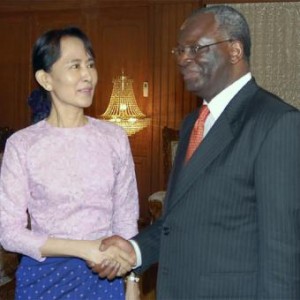
During May, a Spanish friend of mine brought me three books.  One was from Xavier Rubert de Ventos about the book of Aung Suu Kyi (leader of the Burmese opposition), and two others were published by Cubanet in 2006; the first was about the essay The Power of the Powerless from the Czech writer and politician Vaclav Havel, and the second was How The Night Came, written by the ex-commander Huber Matos who tells about the Cuban revolutionary process and about the installation of the Castro dictatorship.

They are three different works that differ and converge in regards to the subject of totalitarianism, and which offer some key suggestions on how to confront fear and repression.  Since they are books that are banned in Cuba, I will briefly comment about the one least smuggled throughout our island, the one written by Aung Suu Kyi entitled Free from Fear, edited in Barcelona in 1995 by Galaxia Gutenberg.

Aung Suu Kyi received the Nobel Peace Prize in 1991.  The previous year she had won the elections in Burma, while heading the National Democratic League, but the military prevented her from taking power.  Despite the deprivation and confinement she still is under, she analyzes the essential problems of her country.  They are general reflections that reach out to readers of various interests, and they do not harm the sensibility of those whose opinions differ.

In Free from Fear, which contains a prologue by Vaclav Havel and Maria Luisa Penela, the leader of the opposition movement of the Asian archipelago describes the corruption in her country, the most intimate of mechanisms used by those who hold on to despotic power, and the need to overcoming fear- that emotion which deforms the soul and bends willpower, gives way to oportunism and other attitudes that favor domination over the masses, which we can relate to here on this end.

She highlights that “Fear turns us into complices of oppression, just like bravery makes us allies of the truth” She then warns that, “In order to reach that truth we should free ourselves from the debilitating virus known as fear, which erodes our reason and conscience, eclipses us, hurts us, and humiliates us.”

The vital experience of the author allows her to appreciate the fact that “Servitude is not only a condition, but also a passion,” a passion previously described by Hegel and Goblot, and later analyzed by Canetti and H. Arendt, according to X.R. Ventos, who assures that Suu Kyi, like Havel, “inverts the logic of distinction between a deprived morale that refers to sentiments or convictions, and a supposed public morality, that should be a secretive, astute, Machiavellian, and full of historic Missions or of Universal Destinies, or Utopian revolutions.  This mix of cynicism constitutes the current political “common sense” that Suu Kyi denounces as a variant of fear itself.”

The Burmese fighter is demanding an intimate moral compromise before prudence or political knowledge:  “Less ideals and more principals, less ideology and more integrity.”

In closing, we must point out that: “One of the most harmful forms of fear is the one that masquerades as common sense or prudence, and rejects as thoughtless or frivolous small acts of courage that maintain the sense of dignity and respect for oneself. ”

She appeals for a “heroism without illusions” recalling that “saints are sinners who continue on with the struggle.”  A struggle… more heroic when conscience holds that its objectives are as unreachable as they are unrenounceable.

Aung Suu Kyi’s book, like the generalizations made by Vaclav Havel in The Power of the Powerless, acquires a value thanks to its universality, its accurate perceptions about totalitarianism, and because it differs from traditional politics and the electoral discourses offered by Justice, Freedom, or Abundance, but without freeing us from the fear that keeps us from reaching those goals.

Translated by Raul G.

August 8, 2010

Retiring the Demons / Miguel Iturría Savón

I heard an old joke the other day while I waited at the bus terminal in Havana. It was about the ex-president Fidel Castro Ruz, who returned to the media during the last weeks of July, despite his deteriorated state of health. Such an appearance was subject of much irreverence. However, the official press of the island only pointed out the tragic, yet comical, declarations made by the veteran commander.

In the joke, Fidel comes out of hell and explores the island, where he confirms that nobody remembers him. He also notices that there are no statues, monuments, plazas, or institutions that evoke his name or his work. Finally, he arrives at the National Library and after he searches around for a while he finds an encyclopedia that includes this in the index card: “Fidel Castro Ruz, Cuban dictator who reigned during the era of “Los Van Van.”*

I only hear Fidel Castro’s (and his brother Raul’s) names every once in a while in jokes. Up to now, there are certain comparative relations between taunts and the supporting media of the mandarins, whose figures surpass the popular imagination, especially Fidel, who is bent on giving off the notion that he is healthy and well, while warning about international catastrophes as if he did not live on the island, or as if it were impossible for him to get out of his state of limbo.

Such jokes prove that not even excessive power can free a man from being made fun of. At the bus stop and in the buses, their names are barely ever mentioned. In public areas like parks, waiting rooms, and in long lines outside stores, there are more than enough allusions made to unleash the criticisms, especially among young people, whose irreverence shatters the limits of respect.

Trapped in the time of the Castros, with so much propaganda about heroes, wars, blockades, productive methods, historic anniversaries, and social promises, people who lack agendas express their opinions with jokes and brief phrases that demystify the rhetoric and confirm the hopelessness; as if all the scarcities and tensions of immediacy bring to the forefront the narrow interests and petty passions of official discourse.

The more Fidel Castro tries to confuse or misinform Cubans (like a gas lamp in the middle of a dark cave), the more their indifference grows in regards to his “historical legacy.” The jokes replace the “veneration” that the people show him. For many, he is no longer the Commander, but instead he is the Mummy, the Ghost, the Deceased One, the Prophet of War, the Risen Devil, or the Old Hag.

Raul Casto, who is less historic and less popular cannot avoid the list of retired demons, which includes Ramiro Valdes Menendez, the triad of Jose Ramon (Balaguer, Machado Ventura and the Spaniard Fernandez), Ricardo Alarcon (spokesperson for the heroes), and semi-gods like Abelardo Colome Ibarra (aka Furry), Casas Regueiro, Ulises del Toro (General Marabu), and other uniformed figures who head all sorts of ministries and make up the Political Bureau of the Communist Party.

*Los Van Van — a popular Cuban musical group

Translated by Raul G.

August 11, 2010

Between Two Walls / Yoani Sánchez

Finally, I sit down in the chair of a hotel, open my laptop, and look from side to side. Seeing me, the security guard mutters a brief “she came” into the microphone pinned to his lapel. Afterwards some tourists appear, while my index finger works the mouse as fast as it can to optimize the few minutes of Internet access. It’s the first time in ten days that I’ve managed to submerge myself into the great world wide web. A list of proxies helps me with the censured pages and I will see the Generation Y portal from an anonymous server, the bridge to banned sites. In three years I’ve become a specialist in slow connections and badly performing public cybercafés under surveillance. Feeling my way, I administer a blog, send tweets that I can’t read the responses to, and manage a nearly collapsed email account.

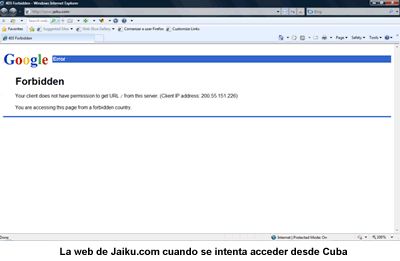
After bypassing the limitations to reach cyberspace, we Cubans see the censorship that grips us from two different sides. One comes from the lack of political will on the part of our government to allow this Island mass access to the web of networks. It shows itself in blogs and filtered portals and in the prohibitive prices for an hour of surfing the WWW. The other – also painful – is that of services that exclude residents in our country under the justification of the anachronistic blockade/embargo. Those who think limiting the functionality of sites like Jaiku, Google Gears, and Appstore for my compatriots will have any effect on the authorities of my country are naïve. They know that those who govern us have satellite antennas in their homes, broadband, open Internet, iPhones full of applications, while we – the citizens – trip over screens that say “this service is not available in your country.”

Just as we get around the internal restrictions here, we also sneak through the closed gates of those who exclude us from abroad. For every lock they put on us there is a trick to picking it open. But it still frustrates me that after avoiding the State Security agents below my apartment, paying a third of a monthly salary for an hour of internet time, seeing the animosity in the faces of the guards at the hotels, seeing that Revolico, Cubaencuentro, Cubanet and DesdeCuba continue in the long night of the censored sites, I go and type – like a conjurer of relief – a URL and instead of opening it seems to me that a wall has been raised on the other side.

August 11, 2010

Impunity, an Order from the General / Luis Felipe Rojas

Photos:  Luis Felipe Rojas

Before General Raul Castro had even finished giving his discourse before Cuban legislators on August 1st, his armies had already rushed on more than twenty human rights activists in the Eastern region of the country.  The indiscriminate hunt had arrived.  The purpose was so that these activists would not reach Holguin, get close to Banes to the house of Reina Tamayo, and to prevent them from leaving their homes.

The phone did not stop ringing with people calling us to inform us about the detentions.  Some even thought of it as a Black Summer.

There were some house arrests.  Anni Sarrion, Aurelio Morales Ayala, Martha Diaz Rondon, and Gertrudis Ojeda Suarez were all beaten when they tried to get to the house of the independent journalist Caridad Caballero Batista in Holguin.  Caridad, her husband, and her son were all dragged on the floor and the officials tried snatching their photo camera.

Omar Wilson, from Moa, was trying to get to the house of a friend in Holguin when he came under attack from the military operation.  He felt it so intensely that he experienced tremors from a disease he suffers from.  He went from the street to detainment in a hospital and he spent more than 48 hours there in a very delicate state of health.  Francisco Luis Manzanet and Carlos Manuel Hernandez, both of whom were trying to help, ended up spending two nights in the cold jails cells of the G2 (Secret Police) of Holguin.

In some of these cases, the arrests lasted until the afternoon of August 5th.  And, on that same day, 5 activists were detained in Santiago de Cuba after they commemorated the tragic events of the Maleconazo in 1994.

The Cuban president has incited a tainted war among Cubans.  He has returned to the rhetoric of not allowing impunity.  The ones who act unjustly are the political police and their civilian helpers, those dressed in olive-green, or that very police unit which claims to call itself National and Revolutionary.  It is to the point that all streets are just being watched.  They are just waiting for a protest or any display of nonconformity, waiting for the whistle that will go off in the headquarters of the G2.

Translated by Raul G.

August 10, 2010

Old Wineskins / Regina Coyula

Most people I know didn’t sit in front of the TV to watch the special session of the National Assembly called by Fidel Castro in order to analyze current international events; it seems they didn’t care about it. But it was interesting. It allowed me to see Fidel almost live. Almost, because the broadcast must have been delayed by a few minutes to fix any unexpected blunders. Nevertheless some gaffes couldn’t be edited out; always a risk when broadcasting live.

We have heard very often about the subject of this session, even before the caller’s reappearance, but always under his aegis. The subject was that war that Obama has delayed just to make Fidel look bad. But our fiery ex-president doesn’t give up: If the war doesn’t begin, it will be thanks to the immense, international and intense campaign started by him with his historical letter last week to the American president.

After Fidel read his message, some of those present “spontaneously” intervened to read prepared written statements, always starting with a compliment to the top leader. Then, as if they were in school, deputies were given three questions as homework. Questions they will have to answer using a new angle defined by the former president. I couldn’t help thinking of storing new wine in old wineskins.

War and the environment are his concerns. (In his crusade for the environment, he always references the French documentary Home, which is good, but very inferior to An Inconvenient Truth, the overwhelming documentary presented by Al Gore.)

After seeing what I have seen since his resurrection, I have no doubt that Fidel’s race for the Nobel Peace Prize should be taken seriously.

Translated by: Xavier Noguer

August 11, 2010

collaborations from VOCES 1… / Orlando Luis Pardo Lazo

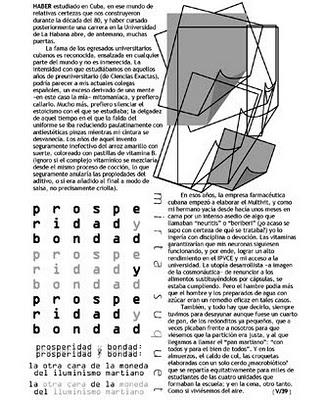
PROSPERITY AND KINDNESS: THE OTHER SIDE OF THE COIN of the Enlightenment Marti

Mirta Suquet

HAVING studied in Cuba, in this world of relative certainties they built for us during the eighties, and having subsequently completed a course at the University of Havana, many doors opened in advance.

The fame of Cuban university graduates is recognized and praised, and not undeservedly, in any part of the world. The intensity with which we studied in those years in the High School of Sciences, might seem, to my Spanish colleagues today, excessive, stemming from a mythomaniacal mind — in this case mind — and I prefer to remain quiet about it. Even more, I prefer to silence the stoicism with which we studied; the skinniness of that time in which my uniform skirt was gradually, with unaesthetic tweezers, being taken in while my waist diminished. The years of that invention, surely ineffective, of yellow rice colored with Vitamin B pills. (I don’t know if the vitamin complex would be blended in during the cooking process, which surely would annul the benefits of the additive, or if it was added at the end like salsa, not exactly Creole.)

In those years, the Cuban pharmaceutical company began developing the Multivit, and as my brother had been lying in bed for a few months with an intense siege of something called “neuritis” or “beriberi” (or perhaps it was known with certainty what it was?) I ingested them with discipline and devotion. Vitamins would guarantee that my neurons would continue functioning, and thus I would achieve a high score on the IPVCE exam, and my access to university. The Utopia being developed in the image of space flight, allowed is to replace food with capsules.  But hunger was stronger than humans and sugar water preparations were an effective remedy in such cases.

Also,I have to admit, we always had breakfast even if just a quarter of a bread roll, perfectly round and small, at times cut in front of us so we could see that the partition was fair, what we came to call “Marti bread”: “With all and for the good of all.” And at lunch, cabbage soup, the croquettes made with one “macrobiotic” (?!) pig which was distributed equally to thousands of students in the four units that made up the school; and for dinner the same again. It was as if we lived on air.

Instead, we survived expanding our vital intensity to unsuspected limits. We didn’t give up the marches, parades, danced, field work and study. We resisted and asked the body to withstand double sacrifices: that we wouldn’t faint and we wouldn’t fail, that our fevered heads about support our projects and goals. The year 2000 was ours, and we were building a better and more prepared society. No doubt.

Wasting away was the quixotic ideal of the revolutionary left, the intellectual dreamer, the vanguard of bohemian transgressive. The belly would distinguish from the hoarding and pedestrian bourgeoisie of the refined aristocracy; it was, from the time of Cervantes’s text, the symbol of baseness and ignorance. As the gentleman tells his squire: “I, Sancho, was born to live dying, and you to die eating.” To live dying, to die eating, a pun too well-known by Cubans and sung as a hymn of war.

The Revolution leased out, by dint of food hardships, this well codified semiotic. In those years, the belly could be the footprint of a diversion of resources, illicit enrichment. Today it is the corporal mark of bad nutrition, the return of bread, rich sauces, while anorexic Europe boasts of its defatted food.

I remember on one occasion, we were promised that the semester’s pig would be given to the most outstanding group of the school for their members to have a party and invite their relatives. To promise this in 1993 was like announcing a day in paradise with a round-trip ticket. The group chosen was ours, after we had excelled in all the challenges of the competition. And days before the fiesta they canceled the invitations to our families — because only the city fathers would have the privilege of attending — and bit by bit we they were gilding the pill until from that pig we barely saw the croquettes. Faced with our protests, the director shamed us, “Arguing about a plate of cracklings!” and adding, “The true revolutionary does not live to eat, but rather he eats to live.”

I swear I repeated that phrase many times as a talisman against gluttony. And I searched for it in Marti’s work without finding it, until one day I found in The Miser by Molière, with an erudite footnote that said he was a Latin adage: “ede ut vivas, ne vivas ut edas.” In the play, one of the characters, Valerio gives Harpagon cooking lessons on how to make a dinner with little money: “We have to serve things that one can eat just a little of and be satisfied at the beginning… Some good beans, a little cake with chestnuts.” Infallible method: A plate of black beans!

Instead, the phrase of Marti that can be read in every Cuban classroom was that which prescribed what the purpose of culture should be: Freedom. To be educated is to be free.

Culture and freedom are terms written in determined contextual repertories of the Marti maxim, anchored in an ahistorical eternity, signifying almost nothing. They are two of the most productive concepts inherited from the control technologies of Modernity that, established as absolute, have obscured the ideology through which such signs become operative. The Enlightenment belief supposes a free will anchored in knowledge, but today we know that just “knowing” is the domain in which we are instituted like predetermined subjects, and that free will has ceased to be, long ago, a tangible possibility.

In any case, following Foucault, culture is a space of intervention and resistance — where the micro-physics of power is exercised — precisely because it is the network where systems of social identification are built. Freedom, in contrast, is, however minimally, that moment of resistance, of permanent tension that makes us constantly moving, as subjects, toward the absolute but always unattainable aspiration of power: the immobility. And as we move, we cancel the perfect definition.

The resistance — and the freedom — in the present moment we are living, strictly speaking, or primarily, comes through the resistance of the body. I am not speaking of official resistance, that asked for in exchange for collapses and massive holocausts, but the daily resistance, the only way to guarantee a minimum of freedom, and that includes, as strategies, the bazaar, the black market, improvisation, the scam. The search for alternatives to finding ways to live and parallel or compensatory happiness. To resist and resolve. To resolve to continue resisting. (Seen like this, the culture understood as erudition doesn’t guarantee, in the national terrain, any liberty. Other type of culture is imposed to manage to survive: the “struggle.”)

In the article “Traveling Teachers” from which the Marti precept is extracted, the idea of a human telos directed toward satisfying the desires of the body — the previously mentioned “live to eat” — is also repudiated: “Most men have slept on the ground. They ate and drank, but did not know. (…) Men are still eating machines, and relics of their worries.” Indeed, if we reverse the sentence it would say: when a relic of worries — among them, and critically, lack of food — torment man, he becomes an “eating machine.”

The obsession with the lack of food was what made us talk all day about impossible foods and sign in unison at the movies faced with a succulent scene. In Paradiso, the food leads us to a huge spinning mill that we barely dream faced with the appetizing proliferation of ingredients and dishes that mingle in the “gossá familia,” this metaphysical orgy in which entails all pleasures. Our table, small and dingy, no long assuming an enjoyment that promises a long-lasting, detailed tasting of unexpected combinations: new species, new textures and rhythms of swallowing and, what is most regrettable, no longer reconnects as the purest of religions: it does not encourage conversation until that state of light in which the dialog fills the ear like a crustacean fills the mouth. Colonel Cemi said, around the laden table: “The pleasure, that is for me a moment of clarity, presupposes dialog. (…) Without this dialog we’re invaded by a sensation of fragmentary vulgarity around the things we eat.”

With anguish, I recognize in Paradiso the mirage that counteracts the radiant poverty of Lezama, the real hunger of the writer, as Reynaldo González remembers in the program of Amaury Pérez, “With two that is wanted.” According to González, when he took his piece of meat, he went to the house of Lezama and sacrificed it in feeding not just the “spirit” of the teacher.

It happens, however, that we return to Marti’s phrase that combines culture and freedom to comment on a serious sin of omission. The phrase, in reality, is a kind of syllogism with three indispensable propositions that concatenated: “To be good is the only way to be happy. To be educated is the only way to be free. But in common human nature, one must prosper to be good.” Or, and it’s the same thing, prosperity would be the basis of this ethical edifice in which, after reaching well-being, one could be good (and, thus, happy) and learned (and, thus, free). “And the only way,” Marti continues, “open to continued and easy prosperity is that of knowledge, cultivating and taking advantage of the inexhaustible and indefatigable elements of nature.”

Close the idea, and return the role of knowledge, in this case, applied: culture is associated in its etymological sense to cultivate, fertilizing prosperity through work and the effective enjoyment of the goods we possess. This would make us prosperous and, again, free and good. (Marti, in turn, does not advocate that the farmer abandon the furrow to become learned; that the fields be filled with the invasive marabou weed while the minds are cultivated, but that a kind of “traveling teacher” goes to where the workers are, offering alternative knowledge.)

That goodness is related to prosperity (the bonanza) is not a contradiction — as revolutionary ethics almost always claimed, confident in the formative value of misery — though neither is it an a priori. But individual fulfillment offering prosperity (and not exactly for the well-being involved, but for the process of finding well-being) might make us better, but this feels like something out of a self-help manual.

We remember that the word “prosperous” comes from the Latin properus-a-um, endowed with the prefix “pro” (forward, in favor), and the Indo-European root spe. The Latin word spes (esperanza – hope) contain t same root. Etymologically “prosperous” means, then, going toward the expected, or as expected. Prosperity is the favorable course of an action or performance the success of a business and no, necessarily, an enrichment that embarrasses of discredits the owner. Rich, or wealth, however, come from the archaic German riks — the origin of the word reich — and have the Indo-European root reg (rey — king — regent); which means that in this case, the link between Power and peculiar seem to be contained in its origins. Villagers could never be rich — nor the farmers Marti refers to in the cited article — but they could be prosperous.

What my present colleagues don’t know is that the learning itself came to us with blood, or better yet, with hunger, and when we had to read so many books it helped to forge us as philologists, lying on the bunks of the dorm at F and 3rd with barely any toast and some tea in our bellies.

To have studied in Cuba was a real privilege. To have been a student of brilliant professors who throughout my life tried to make up for what the body lacked with the illusions of culture. They also gradually grew thinner; some seemed to expire after the lesson and continued to cling to their barely paying jobs. I remember our joy in some “little jaunt” we would have coincidentally sent some professor who never traveled on, so he could “recover.” On his return he told us proudly he had saved a lot of money and so was able to buy some books that were needed for the Department. And in fact, he might have gained a few pounds, barely changing his usual clothes, from some used clothing store, just like ours.

Today, much of what I owe to him, is not my enjoyment of the letters, but my quixotic taste for teaching (hard-fought labor, as everyone knows, with wealth, but not necessarily with prosperity), is not on the faculty. And I’m viscerally sorry that the students don’t have the opportunity to know the lean body and feverish agitation of Salvador Redonet; the almost mystical consecration of Ofelia García Cortiña; the folksy simplicity of Amaury Carbón,with his white, almost transparent, guayabera; the strength of Nara Araújo, full of farewell projects, and others many of whom have died in recent years, in full harness. Or the clueless genius of Beatriz Maggi, the stoic resistance of Teresa Delgado, the humility of Lupe Ordaz, and so many others who have retired or withdrawn from the institution. To their classes, one had to go, even when all you’d had to eat that day was a packet of peanuts bought from the nearest seller.

Now, I don’t know if with the plan for “emerging teachers,” some child could appreciate, in twenty years, the education received and the initial stages, the most important. I don’t know if the mere fact of having studied in Cuba will continue to be praiseworthy. I don’t even know what the motivations are that today drive young people to study: I suppose they are not the same as they were for us, or perhaps better. I trust that the profession that formed you could be exercised in society and that, once you have reached competency, it opens the doors to you to reach the necessary and earned reward. The prosperity that, according to Marti, would make us good and happy. That which does not conform with an old norm in which one has to decide whether to feed the body or the spirit.

August 11, 2010

Cuban Counter-Intelligence Demands Respect for the Military / Iván García

Military institutions always produce fear.  Even if they treat you with respect.  This past Monday, August 9th, Havana looked a lot like London.  A thin and bothersome rain had been pouring down all day, so much so that even our bones were soaked.

Saturday, the 7th, a State Security official had dropped off a citation for an interview with Colonel Enrique from Military Counter-Intelligence.

At around 9 in the morning, I arrived at the armed forces center, where they train elite troops. A friendly official offered me a rain coat and then led me to a building painted in lime green with light red trimmings.

The building looked like a detention center.  A young chubby man led me to a small waiting room, but first he asked me to turn in my cell phone.

The room was tiny and consisted of metal furniture with black leather.  The A/C was turned up to the max.  Apparently, the measures to save energy are strictly enforced throughout the country, but not in this military unit.

Colonel Livan, from Military Counter-Intelligence, and a major dressed in civilian clothes (and who said his name was Aguila and that he was from State Security) were my amiable interrogators.  After taking down some notes, they got straight to the point.

They were upset because of an article I wrote entitled “The liberation of the political prisoners reinforces the role of the Cuban military“, which was published in the newspaper El Mundo (‘The World’) on July 14th.  According to the officials, in the article I gravely discredited Cuban military institutions.

A debate began.  I alleged that it was my personal opinion.  They respected my opinion, but felt that I had been subjected in appreciating the role of certain generals.

“Cuba is a country of rights, and before reaching any penal sanctions, we warn people as many time as we must,” major Aguila told me in a low and neutral voice.

I jumped up like a spring.  “Do you think that in a country of rights a person gets cited for writing a newspaper article?” I asked him frankly.

“In other countries they don’t cite you, they kill you,” interupted Colonel Livan.  Both officials made it clear to me that, although there is some level of tolerance towards the independent press and the opposition, permissiveness should not be confused with impunity.

We never agreed on who was right.  It wasn’t about that.  I explained my reasons to them as a man who feels free enough to write and have different opinions from the official discourse.

I consider it to be my right.  They didn’t oppose that.  They asked me to have more respect when it came down to judging the “brave armed forces which have gained so much prestige worldwide for their struggle in liberating other countries.”

Whatever the case may be, it was not a dialogue of the deaf.  At one point, I suggested to Colonel Livan that, if he wished, he could write a reply and that I would be in charge of sending it to El Mundo so they could publish it.  This was after I pointed out that the website receives over 24 million views.

After his initial astonishment at the invitation, he told me that Cuban military institutions do not need to engage in a debate with a simple journalist over such a specific subject.

In the end they cited me with a “Warning,” where the officials wrote down their motives and I wrote mine.  They said goodbye and told me I could leave.  And I did so under an intermittant rain.

In sum, the Cuban special services wish to send a direct message to the dissidence and independent journalists.  There is a fine line that cannot be crossed.

The point is that they don’t even know which are the frontiers that cannot be trespassed.  Even though both officials were actually kind, soldiers always produce fear.  And don’t ask me why.

Ivan Garcia

Translated by Raul G.

August 10, 2010

Island Authorities Serve Notice That They Will Not Stop The Repression / Laritza Diversent

Following the release of 21 political prisoners, the Cuban government insists on reminding the dissidents and independent journalists that they will continue their repressive policies. On the morning of this past August 9th, Military Counterintelligence and State Security agents summoned independent journalist Iván García for an interview.

The official summons is one of the means used by law enforcement agencies to intimidate dissidents. Generally, the authorities do not comply with the legal requirements for carrying out this judicial undertaking. In their conduct they are acting on their own and in disrespect of the law.

The officials claim that the reporter “discredited” military entities in one of his articles published in the Spanish newspaper El Mundo. To defame, denigrate, or disparage the institutions of the Republic, the mass organizations or social policies of the country, or the heroes and martyrs of the homeland, is considered by the criminal code to be a crime against public order. But they preferred to give an official warning.

The record of official warning, in the legal system, is a cumulative precedent that justifies the future implementation of a judicial procedure for pre-criminal dangerousness for antisocial behavior. Penalties can reach up to 4 years imprisonment, and this is one of the criminal charges most frequently used against people who disagree.

General of the Army Raul Castro, in his speech on August 1st regarding the release of 52 political prisoners convicted in 2003, warned that “there will be no impunity for the enemies of the fatherland.” García believes that officers who attended were given extended words of the President of the Councils of State and Ministers.

This past August 5th, the day of the 16th anniversary of the “Maleconazo” – the popular uprising that preceded the exodus of 1994 – police and State Security agents stopped a number of dissidents near the Malecon as they entered the U.S. Interests Section in Havana, Cuba, the only place that offers free internet to Cubans.

Obviously, the government has made it clear that they expected a different reaction from the European Union and Washington with regard to the recent humanitarian gesture. Maybe it is sending a message to remind them that, at any time and for any reason, they can once again fill the prisons with political prisoners.

Laritza Diversent

Translated by Tomás A.

August 10, 2010

The Face of Magical Realism / Ernesto Morales Licea

Yes, it’s magical realism. Sometimes more evident, sometimes less. But the way one lives on this island at times verges on the incredible, and one has to remember that we live in a land of exceptions, comic or ironic, cruel or terribly sad, where everything can be believed.

It so happens that a friend of mine recently realized that to be able to enjoy certain attractions in Cuba she needs to first show a passport certifying her status as a foreigner or a Cuban residing overseas. She learned her lesson during a visit to one of the hotels of warm beaches and frozen coconut desserts that most of her compatriots have never known.

She was on the arm of her husband, an Italian national she married in 2004, who she lives (to this day) legally in Cuba. Somebody else was also holding her hand: little Dimitri, their son, who’s 4-years-old.

Obviously she was able to visit that tropical paradise, located in Holguin province, thanks to her husband’s money. My friend is a dentist who graduated with a golden diploma. Her husband, a native of Florence, has worked in everything from fixing windows in the Galleria degli Uffizi to working as a mason. Words from his own mouth.

They both knew that her academic achievements were useless when it comes to paying for leisure activities or feeding Dimitri well. (I think I also know that, harsh as it seems, without his money the marriage would never have been possible). But this incident showed them that there were still some things to learn.

Damn the Florentine husband for believing in the enjoyments that one can so easily access in his home country. The moment he asked to use one of those fast jetskis we usually see in the hands of tourists, riding the waves of our beaches, he understood a harsh fact of life in Cuba, a fact George Orwell would describe thus: even though the hotel contract says all guests are equal, some guests are more equal than others.

The friendly hotel employee asked, before delivering the vehicle, to see both of their passports and their son’s. Taken aback, the husband showed him the bracelets worn by all guests. And then the employee patiently explained:

“Only foreigners or Cubans residing overseas can ride motor vehicles. Cubans can ride on a beach bicycle or a surf board, but not on anything with an engine. Cubans have access to the beach bikes, the surf boards, but not to anything with a motor.”

The Italian man tried in vain to explain (first calmly, then feeling insulted) that he had been living in Cuba for years with his wife and little Dimitri, and that this rule made no sense to him.

Of course, the hotel employee didn’t have any obligation to convince guests of the fairness of rules made by his superiors. Even more, he shouldn’t linger on their details to avoid giving away “sensitive” information. So without further ado he put on his tourism worker smile, and apologized for the inconvenience.

The three stared at each other, astonished. The Italian father and the 4-year-old kid (having both Italian and Cuban passports) could ride the waves under the shining sun on the jetski, while the Cuban mother would have to look on from the beach, maybe with a Mojito in her hand, maybe feeling anger and impotence strangling her throat.

Of course, none of this happened. The three went back to the pool, and other less restricted areas of the hotel. But between them, a blurred silence made things different. From now on nothing would be the same, there would be no true enjoyment after the humiliation suffered by the young lady.

Afterwards, talking about the event, someone opened Pandora’s box. A fearless worker dared to tell them about the origin of the rule: After the government allowed Cubans to stay in hotels previously open only to foreigners, the unthinkable happened.

A strong young man took a jetski to the water in an Holguín beach. Beachgoers saw the jetski gaining speed. What they didn’t see was that it stopped, someplace along the beach, to pick up a companion loaded with travel supplies, including fuel, water and food, and then set course for the horizon.

They were stopped by the Cuban Coast Guard, a few kilometers from the beach. Their final destination, and their punishment are unknown. What is known is that they both sent a clear message to the hotel executives, and of course to those of every other hotel in Cuba: in a country with a thirst for freedom, men will try to use even the faintest of opportunities. Sad, but so true.

From then on, the rule was applied without hesitation. Cubans must pay the same price as foreigners to enjoy these places that look like a postcard, regardless of the fact that they are almost unaffordable to most Cubans. Once inside they have the same rights than foreigners… except for the use of motorized water vehicles.

Poor country. It needs to soil the dignity of its children in order to keep them home. It needs to humiliate them, take their worth, put on them the label of potential deserters, because you can’t trust the intentions of an innocent looking beach-goer. And why can’t you? Because behind the look of innocence there might be a soul in need of freedom, of independence, that will risk his life and throw himself, like so many brothers, into the unforgiving sea.

I want to believe that after many Cuba Libres and watching cable TV, my friend started to feel better and decided to enjoy the amenities of the hotel. After all, she should know she was privileged to be able to, during her vacations, do something more than to vegetate in front of the TV, and stew in the heat.

But I refuse to accept that this country where the reality sometimes seems too much like a fictitious face, is the country we Cubans really deserve, and the country for which so many men gave their blood and their lives.

Translator: Xavier Noguer

August 9, 2010