Hookers and Thieves Could Increase With The Layoffs / Iván García


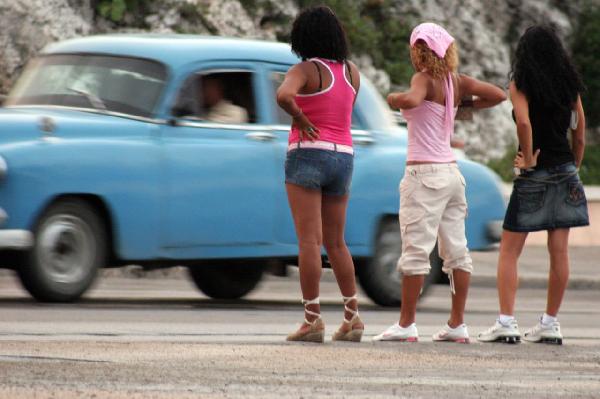
Troubled waters, a growth in the number of jineteras — prostitutes — and thieves. With the number of unemployed expected to be more than a million in the coming year, the streets of Havana will be getting more dangerous and cheap hookers will be the order of the day.

Loipa, 24, draws his weapon. After a stint in jail she thought she’d redeemed herself. And she started work as a receptionist at a business. But she was the first to be laid off.

The only option they offered her was as a farm laborer. Then she decided to return to the “trade” she knows best: hooker. “I don’t think the police presence will be too severe, I will be engaged in a lot of things. Now I’m going to offer my services, even in national currency, but in foreign currency, of course, if I can catch some ‘yuma‘ (foreigner). It will be hard. There aren’t enough tourists for the number of prostitutes in the country, there’s three of us for every one ‘yuma,'” commented this mulatta with expressive eyes and a striking mole under her mouth.

Competition in the prostitution world in Cuba is strong. There is a legion of teenagers between 14 and 17, still students, who spend their free time selling their bodies. Cheaply.

The crippling economic situation, that has lasted 21 years, and the growing number of hookers swarming the streets, has lowered prices in the island’s pleasure market. Already no outsider pays more than 30 convertible pesos (35 dollars) for a hot night with a whore. For 70 convertible pesos (85 dollars) you can take a couple of lesbians to your room.

When they give another turn to the screw of harsh living conditions in Cuban life, it’s not unreasonable to think that the number of “sex workers” will shoot up. The same as other illegal activities. The thieves are also having a field day.

In times of crisis and hardship, delinquency rears its head. Havana is not yet a city where violence is a problem. It’s far from being Caracas or Juarez. But so many unemployed people, with no future and empty wallets, is a perfect breeding ground for thugs to prosper.

The black market has dried up, leaving the residents of the poor neighborhoods, who live by doing “bisne” (business) under the table, few alternatives. The women, young or old, if they have a good butt and have grown up with the promiscuity, might be thrown into the street. Not to protest. To “search for bread” (prostitute themselves).

Black men, strong and athletic, could begin to try their luck as ‘pingueros‘ (‘dick-men’, i.e. toyboys), which until now has been the province of good-looking whites and mulattoes, gays and transvestites. Or they might “specialize” in stealing music equipment from the cars of tourists, or in the “art” of swiping the bags of visiting foreigners.

The news is very bad for the police force. A ton of disgusted people without money, who are trying to put food on the table by any means possible, and to dress in the latest fashions, is a more serious matter than it might seem.

Loipa has already gotten her start us a hooker. She lost fifteen pounds at the gym and is chasing after the first tourist to buy her two or three dresses, high heels and a nice perfume. That’s a starting point.

Her ultimate goal is that of any prostitute. To marry a foreigner with several credit cards in his pocket. Loipa’s hope is that the United States Congress will end the travel ban for Cuba.

“If this happens, I’m going to ‘hacer el santo‘ (make an offering to the gods). But all I want is just let the gringos come. I am waiting for them with my legs open,” she says, laughing.

Like Loipa, thousands of Cubans pray for this measure to pass. The Americans are seen as a lifeline. And not only by the hookers. Also by the Castro government.

October 7, 2010

Zoé Valdés, a Pen Like a Whip / Iván García

On one of those nights in Havana, when the sky is clear with a handful of stars as a witness, someone told me that the Castro brothers feel a particular hatred for three Cubans. The list, what a coincidence, three writers: Guillermo Cabrera Infante, Reinaldo Arenas and Zoé Valdés.

The resentment was so great, this person told me, that they even performed curses, with the bones of the dead and elephant tusks brought from African soil. I don’t think that’s true. But I have to admit that this woman from Havana, born with the Revolution on May 2, 1959, is feared by more than the Castros.

Zoé Valdés uses her pen like a whip. She usually fires high caliber bullets. Between prose and poetry, this woman with 22 published books and a collection of prizes in her Parisian bag, writes for the Spanish and European media. She has a personal blog and whoever wants to read or hear it will hear how she sees Cuba and the world, without any rose-colored glasses.

Her brain is directly connected to her tongue: critical, controversial and bold. At times vitriolic, most of the time gently. With a recurring dream: to walk with her daughter along Havana’s Malecon and through Old Havana’s cobblestone streets.

Valdés’s grudge is exactly that: Fidel Castro has usurped her Havana. And the sensitive and altruistic novelist will never forgive him. When the dark years have become a part of our past, perhaps Zoe will devote herself to writing children’s books. From her house in Paris, she has given us an interview.

La Nada Cotidiana (1995) (The Daily Nothing) has become one of the most read of your novels by Cubans on the island. Do you expect that El Todo Cotidiano (The Daily Everything), your latest novel, will be also?

“Although El Todo Cotidiano is not a continuation of La Nada Cotidiana, we can talk about it as Part Two, because the people, for the most part, are the same; We also find characters there who represent other exiles. I hope that many people in Cuba will read this novel, because my natural reader, despite the censorship and the ban on my books in Cuba, is the Cuban reader.

“This is a more thoughtful novel, choral, Pantagruelian, Gargantuan, where there is a great deal of humor but also the Cuban drama from both sides, without morals or moralizing, which is always expected — coming from both sides — of a Cuban novelist. My writing is absolutely subversive and amoral, where desire is the direct resource and freedom, in all its enormity, is the environment in which the characters are moved.

Was it the success of La Nada Cotidiana that led you to continue the saga?

“No, it wasn’t the success of La Nada Cotidiana that drove me to take up writing the novel El Todo Cotidiano. It was the character of Ida, who is the mother of Yocandra, in La Nada Cotidiana. This has partly to do with it being partially autobiographical, because the character has become a literary institution: when I could get my mother out of Cuba, after a great and traumatic effort caused by the Castro dictatorship, I lived with her for two years in Paris. She loved everything about this city, and lived as if she had forgotten the long years during which she had resisted and sacrificed under the Castro regime. She only remembered her life from before 1959, and was enormously appreciative of how she was living. But my mother was very sick, and she only enjoyed two years of freedom.

“As she was dying, she told me I should write this story, of those two years. It all started with her but at one point I needed Yocandra, that it, I used the daughter to better observe the grand the great transformation of a lady — her mother — who had to go into exile, fight the world, and who dares, and so then I had to resuscitate her (Yocandra), and the rest. I started writing and came to the point where it was telling me this was El Todo Cotidiano, that I was telling the daily lives of those Cubans in Paris, mixed with other exiles, from other places that had little to do with the island. And it was all very dramatic and also humorous, because they had already changed, they saw life differently, they were involved, including emotionally, with other realities, but the one thing that didn’t change was the island. So it was born, and in this way the cycle closes.”

On the island, there are those who see you as a feminine version of Guillermo Cabrera Infante, wielding the machete of slaughter against the Castros.

“Guillermo Cabrera Infante is one of my literary fathers, I think the most important. He was a friend, and still is, because through Miriam Gómez, his widow, we have continued codes of understanding, of love, of respect. She is a great friend, she has fought for his work, and she is a great Cuban, universal. My work is inspired in part by Guillermo, that is, in his Havana, but I tell my story, and also I constantly learn from François Rabelais. I deeply love Manuel Mujica Láinez, Lydia Cabrera. They are also literary parents, Then I have literary examples, which can even be my own age, or just a few years older. That’s the case with Reinaldo Arenas, who is two generations — if we count five years — ahead of mine.

“But Guillermo is the author I admire, and the friend, also very loved; for me it is a great honor to be compared with him. I think that we both assume the social and political commitment of the writer, but in reality, between us, we spoke little about it, we only discussed (he most of all) that marvelous Cuba that he lived, and literature and film. In France it is natural for writers to be politically involved with their opinions, even if they don’t belong to any party. This is something I essentially learned in France, where I knew what it meant to live in freedom. Something that for Cubans is extremely difficult.

“I also want to say something about being the machete — as you have called it — anti-Castro, it turns out it is not easy, no special resources are given, in fact it closes many doors, even today, when people want to believe, or see Cuba as a social example. I don’t see myself like that, as a machete, I only respond when someone asks me about politics. I am usually a calm person, but yes, I say what I think, and as I defend human rights for the world, I defend them for my country,  as I cannot defend them in the land where I was born. And I did it long before, from my world, that of literature and cinema, within Cuban in the 1980s and up to the mid 1990s.”

How do you see the situation in Cuba right now? What about the Cubans, including opponents, independent journalists and bloggers?

“I’m a hopeful pessimist in relation to Cuba, at the moment. Because I think that only with the passing of both brothers, number 1 and number 2, and the chaos that will remain, can we resolve the Cuban situation. I never expected anything of Raul Castro, because I know well how communist, totalitarian, countries work. And I will continue expecting nothing.

“But I think he has in his hands the possibilities of parting ways with his brother and delivering the country to the Cuban-Americans who have studied and lived under capitalism, and who have made fortunes, with which they could settle on the island, and in the end they are Cubans; and not, on the other hand, giving it over to the Chinese, the Russians, just for two examples.

“The exile of the political prisoners, and the continuing imprisonment of Biscet and others who have refused to accept exile, speaks to the real intentions of Raul Castro, who is fundamentally following the same hard line. You can’t expect anything else from a person who executed innocents from the first day of the Revolution or the Castro Revolt. The abnormal is how the world had already become accustomed to seeing the normal succession of the Castro-Communist-Dynasty, period. I just hope to see how things go, it can’t get any worse, and then the changes that will be caused by the laws of nature. We know they are preparing their children for the Castro legacy, but I’m not so sure people will put up with it.

“As for the opponents, the independent journalists and bloggers, I think they are all necessary, with their different points of view. Personally, however, I dismiss those who want to keep sucking, now “rebelliously,” at the tit of the Castro regime. I deeply regret that being anti-Castro has become a way of living. That said, I recognize those who have made our country great in recent times: the majority are black, loudly calling for freedom and democracy, without the Castros, and every day they are persecuted, beaten, tortured, imprisoned and murdered as was the case with Orlando Zapata Tamayo.”

Most Cuban exiles tend to keep alive the hope of returning to their homeland before they die. Is this one of your wishes?

“I would like to return, of course, but not to destroyed country. I have my tomb in Père Lachaise cemetery in Paris, together with my mother. For my eternal rest, I like this place. With the summer sun, and covered in snow in the winter. I am fascinated by snow. I travel a lot, I have other commitments with other people I also love and respect deeply. Thanks to my author’s royalties I am able to help in some places, as in the case of Haiti and Pakistan, I have been able to build shelters and schools for teenagers leaving prostitution. I speak very little of this, because I want to offer support in silence, and when I can, and now make some kind of public fanfare of this. I love Cuba deeply, it is my country, and I will return without any doubt. At the moment, for now, I only aspire to continue writing, to learn from other places, and to further integrate myself into this country that gave me the possibility of being truly free.

Finally, I wonder what is daily life like for Zoé Valdés and her family in the City of Light.

“I work night and day, I have never stopped working on a thousand things at once: my books, films, the production of the films of Ricardo Vega, my husband, and mine, and also the art gallery. I get up and then turn to my notebooks and the computer, later I work on other issues that have nothing to do with my books, I return to writing and I read very late into the night. Ricardo also has his work and our daughter is at school.

“I love Paris, it is a city that each day brings something new, culturally and from all points of view. I could not live in the future without this city. Although I said the same about Havana. What happens is that Havana lives inside me, inside my dreams, and my nightmares. You will notice when you read El Todo Cotidiano, and I think you will really enjoy it.”

Iván García

October 6, 2010
Recycling / Claudia Cadelo


Photo: Claudio Fuentes Madan

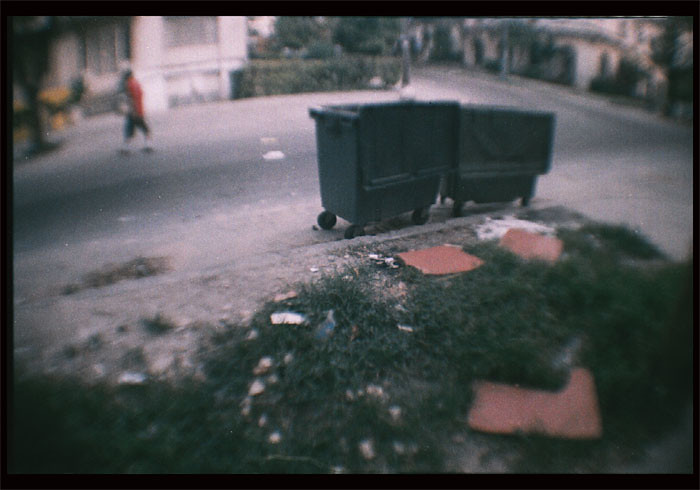
One of the new self-employment “activities” approved by the Cuban government is the controversial “recyclers-sellers of raw materials.” This toughest “private enterprise” encompasses Havana’s beggers who survive on collecting what the rest of the society throws out.

Several years ago Claudio Fuentes Madan was making a series of paintings using the city’s waste, which brought him into contact with many of these men and women who eat, literally, garbage. For the most part they are people without homes (and no possibility of acquiring one since buying and selling property is forbidden to Cubans). They spend the night in the most sinister places in the city (areas of destroyed hospitals, abandoned buildings declared uninhabitable because of the risk of collapse, parks far from the center, and that part of the urban landscape that is essentially shanty towns). They often live as “illegals,” under a Stalinist law that prevents anyone without a permanent address in Havana from staying in the city. To prevent disease, Claudio told me, they mix gasoline or kerosene into the water they use to bathe with, which they do at the home of an acquaintance, paying a modest rent in advance for the use of the sanitary services.

These are people who from now on will have to pay a percentage of their earnings to the Cuban state. It’s so sadistic it’s hard to imagine. You feel like covering your eyes with both hands like during the bloody scenes in terror movies. But this isn’t a movie, it’s what remains of the socialist economy.

One wonders why this business appears to be — I can’t think of another adjective — prosperous enough for the State to decide to relieve its beneficiaries of a portion of their earnings. It turns out that true civics, that legendary course that my parents studied in primary school and I did not, has lost its semantic meaning in Cuba. People do not feel responsible for recycling the trash: if the state needs raw materials, that’s its problem. That’s why the recycling centers — the “offices for the recollection of raw materials” — are ignored; only the dumpster divers bother to take there the plastics and cans that they find in the garbage cans.

The other day a friend collected all the bottles that had accumulated in his home over the years, and set out — the paradigm of the New Man — to take them to the closest center. On arriving he discovered he had to take all his “recyclable material” home again, because he didn’t bring them in a sack consistent with what they would accept. Late that same night he gave them to a girl with a cart collecting rubbish in the city. She had changed her work schedule from three in the afternoon to three in the morning.

October 8, 2010

Mario Vargas Llosa: A Nobel Long Delayed / Yoani Sánchez

The literature of Mario Vargas Llosa has been the source of several key turning points in my life. The first was 17 years ago, during a summer marked by blackouts and the economic crisis. With the intention of borrowing The War of the End of the World, I approached a journalist expelled from his profession for ideological problems, with whom I still share my days. I keep that copy, with its cracked cover and yellowed pages, as dozens of readers have found their way with it to this Peruvian author banned in the official bookstores.
Then came the university and while I was preparing my thesis on the literature of the dictatorship in Latin America, he published his novel The Feast of the Goat. My including an analysis of his text on Trujillo gave no pleasure to the panel that evaluated me. Nor did they like the fact that of the characteristic of the American caudillos, I highlighted only those displayed by “our own” Maximum Leader. Thus, the second time a book by today’s winner of the Nobel Prize in Literature marked my life, because it made me realize how frustrating it was to be a philologist in Cuba. Why do I need a title — he told me — that announces I am a specialist in language and words, when I may not even freely assemble sentences.

So Vargas Llosa and his literature are responsible, in a direct and “premeditated” way, for much of who I am today: for my matrimonial happiness and my aversion to totalitarianism, for my betrayal of philology and approach to journalism.

I am preparing myself now, because I fear that the next time a book of his falls into my hands its effect will last another 17 years, and once again slam the door on my profession.

October 8, 2010

The Color of Life / Ángel Santiesteban

Camilo Cienfuegos, by Alexis Esquivel

THAT MORNING MY mother didn’t threaten me with if I left my breakfast I wouldn’t go to Salvador’s study to see him paint. Those words were enough to accept any of her commandments.

Salvador had become used to my presence. I understood not to bother him. From a corner, I watched his ritual of preparing the oils with the care of a great alchemist. I was trying to learn his every move because I aspired to be his amanuensis. For me, happiness was being able, one day, to prepare his palette, squeeze the tubes, and even, with time, help with a precise stroke. I delighted in seeing how canvas ceded space to other colors. Unintentionally he was introducing me to a world of lines, dots, a kaleidoscope of images that never repeated themselves. In the end, tired, he covered it with a pure white cloth to protect both it and the eyes of his daughter and wife.

But that morning my mother didn’t mention my friend Salvador. And as a symbol of disobedience, I left the completely full glass of milk. I looked in her eyes but she avoided me. She said I could no longer watch him paint: he had died at dawn. I didn’t know this word and shrugged my shoulders. Then she explained that death was like the uncle who left on a raft whom we would never see again. I ran to drink my milk, I didn’t want this punishment, but she stopped me and held me to her breast. That morning I fell asleep on the sofa and had a fever. The neighbors approached, watching me with pity. Mysteriously they whispered in each other’s ears. Salvador’s study would never again open in my presence. I lost my appetite and the hole in my life seemed like it would never be filled.

I even looked through the window of Salvador’s house and I saw him hiding in the green of his last painting, he put his finger to his lips so he wouldn’t be discovered, then he laughed. I kept quiet about the last secret he shared with me. He taught me not to reveal the themes he painted when the curious asked. Sometimes I caught myself talking to him. It was enough to know that he was still there, putting the final touches on an unfinished painting. So from that day I knew that death is inconclusive; to the rest of the world, I’m crazy. A started taking the pills the psychologist recommended.

Since that experience I fight against what seems definitive. I know that behind every breath, image, word, is the bravery of someone who patiently waits to be heard, seen, named. The opportunity is also a cry of hope.

October 6, 2010

From My Window / Rebeca Monzo

I’m not a photographer but I love photography. I have a son who is one, and a very good one, with many awards here on my planet. When I leaned out the window a few days ago and saw these colors, I ran to find my little camera and tightening the strap around my wrist I pushed it carefully through the blinds to capture the moment. Incredibly, as I pressed the shutter, I thought of him, of my other son, of my beautiful granddaughters, whom I barely know, of my friends who have left, and it saddened me not to be able to share this impressive vision with them.

When I think that they had to leave and miss these sunsets (even though they may enjoy others), simply for having lost here, in the land of their birth, the horizon, I feel something inside me breaking.

To travel, to go to live in another country, to stretch other links, to return, and to leave again, is the most natural thing in the world, but to have to leave what is yours indefinitely, because you have no future there, no options, this is not fair. Even more so when you grow up hearing it said in school and in the media that everything that was done was to make a better future for you.

October 6, 2010

Weekend Movies / Regina Coyula

cortesía Orlando LuisThis weekend I saw on TV two very different movies, both very perturbing because of what they show in regards to the relation between reality and fiction. The movies were Agora, on the Friday time slot for movies, and The Experiment on Saturday.

The movie Agora takes place in Alexandria during the final years of the Roman Empire when Christians, after many years of persecution, win the streets and obtain power. We had seen the suffering of Jesus’s followers, the cruelty and spite which they suffered at the hands of the pagans. But, what happens when Christians obtain power? They mimic and even surpass those who had the power before them, they desecrate the symbols of the past: temples, statues, and in what will be a sign of the dark centuries ahead, they destroy the Library of Alexandria.

The other movie, with superb acting by Adrien Brody and Forest Whittaker, tells the story of a group of people who volunteer for an experiment on the conditions experienced on a prison setting, who are surprised to find out that a few of them will act as guards while the rest will be the prisoners. What happens when regular men obtain power? Cruelty, sadism. The experiment ends, predictably, when the prisoners rebel.

So much time has gone by, and things still do not improve when it comes to human relations.

Translated by: Xavier Noguer

October 6, 2010

The Treasure / Ángel Santiesteban

Photo AP

I WAS IN MY NEIGHBORHOOD cruising the streets on my scooter like a Caribbean Quixote in the year 1992. One afternoon, I turn the corner of my house and notice a neighbor stopped on his bike, one foot on the curb of the sidewalk, the other in the street, an arm on the handlebars, with his head resting on his forearm which served as his pillow, looking like a rag doll. Something I’d rarely seen in that man who, from the time I was a child, I’d watched go into his house near mine; I turned the wheel of my scooter to go back. As I came up to him I saw that, despite the noise of the scooter’s engine, he didn’t raise his head.

I asked him if I could help. He said something I couldn’t understand, I lowered the throttle on the bike and got closer, he cocked his head and I could see his pale face, “Hold me,” he said. I quickly turned off the scooter and took his arm, “I’m dizzy,” he said again, and I felt his body trembling like the page of a book. I suggested he breathe deeply. He could barely manage it. At times his legs buckled. I discovered that despite his weakness he was protecting something in his other hand, his fist closed against his chest. I offered to hold it and he shook his head. He made an effort to lift his head and look at me. I kept holding him up. He said he knew he shouldn’t have done it but he didn’t have any other choice. For lunch he had just had a little rice, and he went to his sister-in-law’s house to look for something, for his wife, at least, to have to go with it. He no, he’d gone for a week with only rice and he wasn’t complaining; but he knew that she, even though he did everything in his power, wouldn’t be able to eat; then his sister-in-law gave him the last one left, and he looked at his closed fist. With great care he opened his hand, and before my eyes appeared a hen’s egg.

October 7, 2010

Crossing the Barbed Wire with the Blue Bird / Luis Felipe Rojas


I spent the night of September 30th traveling, and part of October 1st on the expressway of Farola in order to get to Baracoa. The 7th session of the committee of the Eastern Democratic Alliance was to be held in Maisi, but the detentions began on Friday and did not cease until Sunday. The grand total of detentions was 19, with 6 deportations to Camaguey, Guantanamo, Santiago de Cuba, and las Tunas. There weren’t any beatings and there was less confrontation than other times, but it was still a mass operation which included the extensive search of the beaches which they thought we would try to escape by in order to get to Maisi.

In my case, I was detained along with 5 other human rights activists. Amid all of this, I noted something interesting: we spent various hours stationed on the outskirts of the road waiting for a military transport to take us to the police unit in Baracoa. When we got there, a political police officer ordered for us to be removed from the barracks immediately, a much different scenario than the usual, where we are nearly always put in cells instead. While we traveled aboard the olive-green jeep I thought that I was the king of the internet, for I was using Twitter to report the names of those who were detained, in order of the news I was receiving. I could already picture myself turning into a blue bird and flying to the homes of friends outside of Cuba and telling them the news.

But what a fiasco, none of my 140-character messages arrived at their destination, yet each and every one of them was charged to my account. The list of the detainees was the same as always: Rolando and Nestor Lobaina, Idalmis Nunez, Omar Wilson, Jorge Corrales, Belkis Barbara Portal, Virgilio Mantilla — in sum, 19 peaceful dissidents who were impeded from freely walking towards the lighthouse of Maisi, the eastern-most point of the island. There, we were planning to read the calling for the Unity in Diversity document which the Democratic Alliance had launched, but since such acts were impeded two days later, while we had been released we re-grouped in a central area of the city.

Early that day, we silently walked more than ten blocks, all the way to the bust of Marti where we placed a floral gift and sang the anthem before the eyes of hundreds of Baracoa natives. The Cuban G-2 (secret police) watched us during the entire process but did not impede the march. I’m starting to think that they did not want to repeat the macabre spectacle which they carried out last August when they took part in the condemnation mob against the Rodriguez Lobaina family. During those days, I could easily notice the air of disgust towards the political police which permeated among many locals after the beatings and barbaric acts which were carried out in the home of the brothers, where they used rocks to shatter the windows of the apartment where their father lives, and when they beat up some inhabitants.

To top it off, my old Sony digital camera ceased working, and seemingly forever. This is why I haven’t been able to take a single photo as I am used to doing on any of these trips. This time, you will all have to just settle with these bunch of words, believing or disbelieving what I say.

Today, many of us who report from this eastern cave have our cell phones blocked from making calls to places outside of Cuba. Meanwhile, Cubacel still continues charging us their draconian rates. The police continues to restrict our movements, shoving gags in our mouths so we won’t speak up, and strictly spying on us wherever we go. And as if that wasn’t enough, Twitter has just shut off the only ray of light we had left upon their shutting down messaging through the phone. In which direction are we headed? Reporting what really happens in Cuba, which is ignored by the popular media outlets, will become a rare privilege if the Great Blue Bird does not come back.

* Friends who have showed solidarity and who have found out about the difficulty of sending messages through twitter with our cell phones have opened a provisional account, which we dictate through the phone, to cross the barbed wires from Holguin to Guantanamo.

@alambradasCuba @RRLobaina @jccpalenque

Translated by Raul G.

October 6, 2010

Computer Glitch and Missing Translations / Iván García

Note to the readers from the translators:

Please accept our apologies for the gap in English translations!

A few weeks ago some “behind the scenes” technical changes were made in Ivan’s blog in Spanish, which we weren’t aware of on the “English side.” From that time the “automatic post grabber” for the translating site, HemosOido.com, could no longer pick up the posts because it was searching for the “old” computer code, not the new one.

Unfortunately, it took us a little while to realize there was a problem, and then quite a bit longer to fix it because, frankly, our volunteer programmer has been completely swamped with her “regular job.”

It is now fixed and we will, entry by entry, fill in all the missing entries from September, and of course keep the translations coming going forward.

Again, our sincere apologies! And please… those of you who are bilingual… translate Ivan so we can catch up!

October 7, 2010

Custom Filters / Laritza Diversent

Cubans who opine publicly regarding the Government, are condemned to suffer confiscation. The Customs Office for Post and Shipments (APE), an entity which is part of the General Customs Office of the Republic (AGR), has a filter for seizure for shipments abroad, applicable to dissidents.
Within the last 2 months, this agency has confiscated 2 shipments that had been sent to me from the United States. I was advised on the 13th of August about the most recent, via the “Resolution of Forfeiture #1209” dated the 29th of July, 2010, and an Act of Forfeiture and Notification, both documents signed by Danny Samada Rivero, Inspector of Customs Controls.

Had this occurred once, one could consider it an issue of chance. A second occurrence would be a purposeful act of viciousness; but if other people with the same uneasiness regarding the political situation suffered the same indignities, then it’s a matter of a strategy of the State. A subtle form of punishing those who dare question the status quo of the system.

I have no doubts, this administrative act has a political underpinning. Its not a coincidence that it applies since various months to the forfeiture of shipments from abroad to various dissidents against the Government, including Yoani Sanchez, the author of the “Generation Y” blog.

As per Samada Rivero, the contents of the package were contrary to the general interests of the nation. He used Resolution #5-96, from the Manager of AGR, as the basis for the forfeiture. The first was applied by the resolution of forfeiture no. 978, on 8 June. On that occasion Raimundo Pérez García, Inspector Control Customs seized the shipment arguing the same reason and legal basis.

Resolution No. 5 of the AGR, existing since 1996, allows the application within the national territory, of the International Convention on the Suppression of the circulation and traffic in obscene publications.

The rule prohibits the importation by shipments, of “any object whose content is considered contrary to morals and good customs or which go against the “general interest of the nation”. In addition, the seized products are to be delivered to the corresponding body of the Ministry of the Interior.

Under both resolutions customs Control Inspector, Samada Rivero and Pérez García, failed to explain in what way the imported articles affected the general interests of the nation. Most of the products were for personal hygiene, health and for use in an office, of general, every-day use for a household. The same products are for sale in State shops and foreign currency stores, within the national territory.

At the end of July, I lodged an appeal to the head of the customs, requesting cancellation of the first resolution of confiscation. On August 17, I was notified of the resolution of Appeal No. 231 of 2010, denying my claim.

The officer, Raúl Gómez Badía, the ultimate authority of the organ of the State in question, considered the measure applied by the customs inspector, Raimundo García Pérez, as being correct. That decision exhausted the administrative process open to appeal the decision; the next recourse is the judicial path in open court. My next step will be to claim my rights before the revolutionary courts.

Perhaps the new offensive has another goal. Destroy attempts to re-establish communication between Cuba and the United States. The products were imported from that northern country through agency “Universal Postal service” in the Office of international exchange (OIC). Cuban and American representatives initiated talks to standardize the service of mail between the two countries in September 2009.

On the other hand, the filters of the Customs Agencies show that political interests that run the country, supersede the interests of all Cubans. It punishes equally, applying the legislation extraordinarily and arbitrarily to a group of citizens who publicly express their feelings about the Government.

September 11, 2010

Spontaneous / Claudia Cadelo

Photo: Claudio Fuentes Madan

I’ve been left a little traumatized after the celebrations of the CDR. Between the discussion on the bus, my neighbors’ Sunday volunteer work, and the reggaeton on the 28th until 1:00 in the morning; right now I feel a sense of “been there, done that… and never again would be too soon.”

It turns out that Sunday was a “voluntary workday.” Obviously El Ciro and I weren’t aware of this, so when he went downstairs with the dogs and found an old man weeding the grass, with his last ounce of strength, he said, “Compadre, let me do it, I’m younger.” So as he cleared the block of every weed, “the guy with the list” approached and said, “Hey compadre, leave that, it’s already been checked off.” El Ciro looked up and discovered that in addition to having taken part in voluntary work, he was, in effect, the only one who had actually done any work. As for the others, it was grab a brick, move it from the right to the left, and then look at the guy with the list and say, “check me off.” I remembered the time the mutt broke the light on the stairs and El Ciro (one hundred percent private initiative) changed it without saying anything to anybody. A neighbor told me later that a meeting had been planned to define a repair strategy: “How much money to be collected from each apartment, who would collect it and who would spend it.” We had skipped all the steps.

For the party it was the same. In my building, by ten o’clock at night, the only person awake is me. My poor neighbors closed their eyes four hours later because they “had to celebrate” September 28th, the fiftieth anniversary of the Committees for the Defense of the Revolution (CDR).  After midnight I heard an innocent neighbor ask why they hadn’t had the party on Friday or Saturday. Poor thing, she doesn’t know that you dance on the scheduled day, you work on the scheduled day, you sleep on the scheduled day and you live according to the schedule.

October 6, 2010

Possible Utopia (II) / Miriam Celaya

An image that threatens to multiply. Photograph by Orlando Luis

Despite the apparent ease with which life goes on, the magma is rising from the bottom and nobody can predict how events that will put an end to the Cuban dictatorship will unleash. Just in the last few days, events have accrued which, directly or indirectly, have an impact on this country, strongly staking a reality that, until recently, has been characterized by paralysis. Now everything has begun to move in reverse (a good example of that is what is already known as “the medieval list,” the 178 lines that, according to official publication, will receive self-employment licenses, to which we will devote a little more space in another post), but that –paradoxically- could mean a step forward if we take into account the popular ancient principle “the good thing about this is how bad it is getting.” Anyway, it has never before been worse, and there are premonitions in the breeze that things may even get worse.

A very brief overview of the most relevant events is: the upcoming layoffs will leave us half a million unemployed in just six months, a significant increase in the self-employed tax, the piecemeal sale of the country to potential (and real) foreign investors, Decree-Law 273 of August 13th, 2010 (see The Cuban Official Gazette website), and the South American gorilla -Hugo Chávez’s- formidable slap in the face in Venezuela’s recent parliamentary elections and the consequent and immediate increase in oil prices in Cuban sales channels, which, as expected, will mean increased prices in transportation, food and other goods in the very near future.

The social climate is tense and the old socialist ship is listing, threatening to do a 360◦ turn. There is a generalized feeling of worry and uncertainty, and it can be seen in every corner of this city. The new wave of misery that lies ahead is compounded by the growing discontent, the lack of confidence in the future, in the “revolution” and its leaders, as well as the ever increasing prevalent belief about the failure of the system and the uselessness to renew a clearly obsolete model. I do not remember ever before having found as persistent and epidemic social unrest reaching from the highest rated of the intellectual ruling caste to the poorest and most fragile sectors of the population.

Early yesterday morning, a middle-aged and apparently very poor woman was picking up a shopping bag full of plastic bottles lying next to a waste collector in front of my building. “Let me take this before they tax me for it,” she said, with a smile that was part bitter and part accomplice. Because, my friends, the popularly called “deep sea divers”, previously persecuted and heavily fined by the authorities for creating unhealthy conditions in the city causing filth, in addition to offering a lamentable image for foreign visitors, now, by the grace of new official measures of self-employment and of official “euphemistology” will not only receive the new title of “recycling- sellers of raw materials”, but also need licenses to perform the same work for which, until just yesterday, they were being punished. Additionally, they must pay taxes in exchange for being submerged, almost all day, in the filthy detritus of nearly three million people, which confirms that crap is also the property of the state.

Some denominations from the famous medieval list, so-called because it contains related occupations and types of work organization that do not correspond with present times, are truly amazing: water bearers, a joke on the water and sewage system, to the embarrassment Albear and others; lumberjack, in a country where deforestation has been rampant for over 500 years; travel managers, individuals who shout the destination of cars for hire or at fixed taxi line entrances and bus terminals; collectors-sellers of natural resources (¿?) manufacturers-sellers of religious articles, among others. Other occupations hitherto clandestine and not requiring any more than the personal initiative of those performing them, as in the case of those braiding hair, fortune tellers and the so-called “Habaneras” (usually young women who are dressed in colorful costumes, supposedly belonging to the colonial era, who walk through some of the historic places and charge tourists wishing to take their picture), will join the ranks of the self-employed, and will be obligated to also contribute to the Treasury. They seem to have thought of everything, except a line that will soon be greatly increased … the beggars. The lords of power could consider including beggars on the self-employed lists, of course, while they seek a more noble title for the occupation. We know they are talented in this regard.

However, the very government engaged in violating the law that is trying to have so many who go astray “on their own” jump through the hoop of the legalities, faces a difficult challenge. I don’t think that they have sufficient repressive personnel to detect and punish the army of offenders, which will remain the majority, given that the only true act of defiance for this imperiled and fearful people has always been irreverence. The street cries of many of those who have been practicing these arts for years is that they will not request a license because, far from being an advantage, it will impose a heavy tax on their meager personal and family income. The government is fighting a war that it has already lost: it seeks to exploit the working population while preventing the formation of a middle class, able to surpass the official interests and give way to independent citizens. Such efforts, as happened with the system, are doomed to failure. The sad picture of the Havana night of September 27th, on the eve of the 50th anniversary of the CDR’s, with a few and isolated campfires, where small, pathetic, hungry groups cooked their traditional watery meals to share in their poverty, should be a clear signal that loyalty and subservience are concepts that are also depleted. There is nothing to celebrate. Not yet.

Translated by: Norma Whiting

October 1, 2010

The Journalist Reinaldo Escobar Enters the Debate / Polemica, The 2007 Intellectual Debate

“The Little Email War,” “Little Glasnost,” “Rebellion of the Intellectuals” or “The Created Situation,” have been some of the names used to baptize this phenomenon which I prefer to call, “words of the intellectuals” (with the “of” in bold and underlined). Evidently a hole has been opened in this Pandora’s box (which was a gift from Zeus himself), where it is not the evils that populate the world that are escaping, but rather the outrages committed against freedom of expression.

I promise not to use this space for personal complaints, in the first place because I feel a profound gratitude to those who, in December 1988, banned me from practicing the profession of journalist. To them I owe my freedom, which I exercise from Cuba, although sadly not in the media permitted in Cuba.

As it is not possible to answer, argue or support each deserving idea, because that would imply writing a book, I will limit myself to giving my opinion about what I believe is fundamental in this issue, which after all is not, not even remotely, the appearance on the small screen of those who once were the obedient adherents of a policy. What seems to be clear to everyone is that there are open wounds, self-criticisms to make and discussions to foment.

I can understand the horror of the newly vindicated, faced with the renewed vindication of their executioners; what I cannot seem to understand at all is the simplicity of confusing the systemic with the causal.

Just like a bus that is already full, those who are already on the first step of the discussion ask to close the door because there isn’t room for anyone else, but those of us who are left behind, those who here are below, we think differently.

I believe that the basis of all the wrongs that have occurred is the intolerance of difference, which is not limited to the nearly defeated intolerance of different religious beliefs, or to the repudiation of different sexual preferences. I am speaking about the unconquered intolerance of diverse political opinions. I would like to know on what general principle we can build tolerance for one particular kind of diversity without applying this to other kinds of diversity.

Since that fateful day in which the cultural politics of the Cuban Revolution was subjugated to a sectarian phrase — Within the Revolution, everything, against the Revolution, nothing — the abyss opened. Because from that moment a group of people were conferred, or conferred upon themselves, the right to define the boundaries of what could be catalogued as revolutionary, meaning what could be published, shown and disseminated. And since the creators of literature, painting, music or cinema usually fulfill themselves when their work becomes something tangible for the public, they begin the create in that direction and there begins the self-censorship; because there is only one way to be sure that what we do cannot be classified as “outside of the Revolution,” and that is to do only that which is clearly for and within the Revolution.

That gray five-year period was only the act of drawing the dividing line a few meters closer to the border. The original sin was to conceive the border.

Some of those who are participating in this discussion are not disputing the right of the government to decide whether to publish a work based on its political affiliation. The only thing they are contending is that they and their work should be considered unwavering supporters of the Revolutionary line. Others want to go further, which is why, in this debate, many things are being discussed at the same time.

Víctor Fowler, with his habitual lucidity, introduces the idea of a “catalog of practices of cultural violence.” All of the anecdotes fit into this catalog: prison for the translator of the prophecies of Nostradamus, the famous Padilla case, the firing of Eduardo Heras, the sanctions against Norberto Fuentes, the ostracism of so many illustrious names: Cintio, Eliseo, Lezama, plus the endless list of the unknowns, as always, who in obscure cities of the country defiantly read a combative poem in a literary workshop session or who, in a provincial radio broadcast, dare to introduce an uncomfortable song by Frank Delgado. The question is how far do we take this list, and if we should pay attention to those already on board, who are shouting to close the door once and for all so the journey can continue, or if we should continue letting more people get on until the bus bursts.

Who gave the order to close the expositions of the group Arte Calle? What should we call the decade in which they banned Pedro Luís Ferrer? What color was the five-year period in which Antonio José Ponte was expelled from UNEAC? Who was the Minister of Culture when the movie “Monte Rouge” was blocked from being shown in the Cinema Festival? What, if not “The Black Spring of 2003,” should we call that moment when the poet Raúl Rivero was imprisoned?

Esteban Morales himself, former dean of the Faculty of Liberal Arts, classifies as “Saturn devouring the children of the Revolution” not just subordinates of Luís Pavón, but militants of the Communist Party who, in the seventies, carried out relentless purges in the school of journalism, and who today publish in the daily newspaper, Granma, and no one bothers them.

And all this is being discussed today perhaps because some advisers in the Cuban Radio and Television Institute (ICRT) who work on the program Impronta [Imprint] are just historians versed in the 19th century and wouldn’t know who directed the National Culture Council 30 years ago. I wonder what would happen if, as a part of “50 Years of Victories,” someone were to recount the exploits of Hubert Matos in taking the city of Santiago de Cuba, or if someone who does not know the secret versions of the story, speaking about the events of Granada, would mention Colonel Tortoló as an emulator of the Bronze Titan. I bet that nobody would ever make the mistake of making a Impronta episode about Doctor Hilda Molina, however much she deserves it.

What really happened is not that one day it was mentioned to someone that it deserved to be buried in silence, but just the opposite; it’s that it has been too quiet for too long, and not only in the area of culture. As the critic Orlando Hernández has bravely pointed out, “It would be very sad if all this fell into the ridiculous Complaints and Suggestions Box at the Ministry of Culture, or if it were converted into a minority’s collective catharsis.” I believe that the criticism or self-criticism remains unresolved not only in the case of the First Culture Congress, which changed its name in its second session to become the Congress of Education and Culture. The Military Units to Aid Production (UMAP), the Revolutionary Offensive of 1968, the repudiation rallies of the 1980s, the unmet Food Plan of 1990s, the sinking of the tugboat 13 de Marzo, and the infinite lists that so many victims could rightfully assemble, are also in need of a self-criticism; to do otherwise would make it very difficult to honor someone on television without running the risk that the person interviewed would have another “imprint” in his illustrious biography.

Not only revolutions, but also history in its entirety, is staged by men who,in carrying out the projects they put forward, experience successes and failures, greatness and baseness, nobility and villainy. Cuba’s is far from a celestial history, though many have insisted on sweetening it. It seems as if once again someone has tried to marry us to a lie and to force us to live with it, but fortunately, someone also has taught us that it is better to let the world collapse than to live a lie.

I don’t want to finish this intervention without referring to the cryptic Declaration of the Secretariat of UNEAC, published on Thursday, January 18.

To say that the cultural politics of the Revolution, established with those Words to the Intellectuals — Within the Revolution, everything, against the Revolution, nothing — is irreversible, is to affirm that Luís Pavón did not manage to reverse it and therefore only was consistent with it to an extreme degree. In that we are in agreement. What I cannot agree with is the element of terror the text introduces with the mention of a supposed annexationist agenda on the part of those who have wanted to take advantage of the situation created. I call on them to show a single paragraph of the debate with the stink of annexationism. Although it is suggested that this is the consensual response of the debate’s initiators, evidently it is a text that Leopoldo Ávila would proudly sign.

I propose a full debate on all these matters. Since UNEAC — the Cuban Writers and Artists Union — has decided not to hold its proposed congress, now that the Communist Party of Cuba has not held its either, we will do it ourselves in a theater, at the ballpark or in the middle of a field, without the rapid response brigades to impede its meeting, and where the entire world can speak, the communist, the social democrat, the Christian democrat and the liberal, and if the annexationists have something to say, we will listen to them also.

Finally it seems healthy to me that those of us who participate in this discussion do not share a common position. We are not going to repeat the model affirming that “this is not the moment to have divergences among ourselves because we should unite against the common enemy.” Much less will we proclaim something like, “Against the reign of Pavón everything, for the reign of Pavón nothing.” Please, let us not start in the same way. Fortunately, like Pandora’s mythical box, the only thing that hasn’t escaped is hope.

Reinaldo Escobar

Translated by Ariana

January 31, 2007

Closed, for Cubans / Henry Constantín

There are regions in my country where I still cannot enter. At least not unless if I am loaded with official documents, authorizations, guarantees, and recommendation letters. An entire list can be made out of these things. I’m used to it: In Cuba, one can write – actually, those in power have already done so – an infinite list of the things that are restricted for Cubans. There is a list of web sites which I cannot enter, a list of magazines and newspapers which are not allowed to be read in libraries (the list includes any which display my rulers committing any errors worth silencing), another list of films, such as “Before Night Falls” and “The Lost City”, which I can’t find in any of the state video stores or movie theatres. As for musicians that are prohibited from receiving any radio or TV play – Alejandro Sanz, Willy Chirino, Porno Para Ricardo, etc. The most outrageous situations is that of the people whom we are not supposed to call by phone or visit in person – but I do it anyway, and that’s why I probably am included in that list, too. There is yet another list which consists of historical people who cannot be mentioned without evoking much offense – commanders Eloy Guiterrez Menoyo and Huber Matos, president Estrada Palma, and so on. There are dozens of lists which are composed of well-off people the same way that there are those made up of everyday people in Cuba. But it is these outlawed regions of our geography which interest me the most on this Travel Report.

The post with which I inaugurated this blog was about how I could not enter the Cape of San Antonio in Guanahacabibes – in the far Western part of Cuba – for the simple reason that I was not a tourist. At that time, the functionaries of the Ministry of Science, Technology, and the Environment denied me the entrance, just as the orders mandated they do so to every Cuban resident on the island. While I was getting over that frustrating trip, a few vehicles with tourist license plates swiftly passed by, heading towards the Cape. They braked right by me, asking (in Andalusian and Italian accents) the solicitous guard where their destination lay as he opened the entrance gate.

In the extreme opposite of the country, halfway from between Baracoa and the Yumuri river – on the North coast – there lies another one of those “border” spots. In it, some locally known cavers, carrying all sorts of official authorizations, waited for almost an hour under the mid-day sun until the official decided that they could pass towards the Maisi Point.

The Sabana-Camaguey archipelago, which borders the northern coast of the central provinces, is also prohibited. It’s made up of a strip of hotels from Santa Maria Key to Paredon Grande, with very little terrestrial access – some anti-ecological and enormously steep embankments from Caibarien to Turiguano – where vehicles which transport Cubans are carefully searched by police officers, who check to see how many documents people are carrying, or who make them get out of the car and stay there. And you can’t just go in under the pretext of simple tourism. If you don’t have a hotel reservation, or if you don’t have any credentials such as being an employee or participant in an already registered event, then you can’t go in.

The same thing occurs in Sabinal, which is less exploited touristically, and also in Romano Key, the largest and most conserved of the keys. As if it wasn’t enough, there is at least one of those small islands which requires a double authorization project: Paredon Grande. Any Cuban who gets there must show his/her permits, and since the terrestrial path goes through Coco Key (where in the entrance of Turiguano they already searched through the papers) then it turns out that you would get searched twice.

But on the Isle of Pines, which still has the official name of “Island of Youth”, it is an even more ironic case. Up to well into the 20th century, Cuban sovereignty was not well defined in terms of this rugged area and with regards those supposed North-American colonizers. And now, in the 21st century, for a national resident to access that minor southern island (the most extensive and inhospitable) it requires even more permits and processes, moreso than a European Union citizen trying to pass from one country to another. And let’s not even mention Largo Key, which lies about 100 kilometers to the East: I’ve only been able to see it from an airplane.

But it isn’t just land that is forbidden. There are also bodies of water which surround the island (and which are supposedly considered territorial waters) which the authorities consider to be malignant for Cubans. A couple of youths from Smith Key (or “Granma Key” as it is officially known) who are owners of boats which are used to explore the interior bay of Santiago de Cuba, opened their eyes wide in disbelief when I suggested to take a look into the exterior part of the bay, where the Morro Castle starts to rise. “That’s forbidden”. And this is a national mandate: any Cuban who is riding upon any sort of water vessel must be heavily armed with authorizations, if not he or she runs the risk of spending the night in a prison.

In all of these cases ecological protection, which is the justification for restricting or controlling the access to protected zones in the world, is discarded simply because of the differences which exist for a foreign citizen and a national resident who wants to visit any of these areas. The foreign visitor would be content just to go in and take a quick look, while a Cuban, when he or she has no reservations (if the area is a hotel zone) could wait up to three months while searching for authorizations from up to half a dozen functionaries — and that really is a valid justification! And, mind you, this is always with the risk present of having such access being denied just because of trivial whims.

Where our internal exile is really colossal is in Caimanera, the city closest to the perimeter of the US Naval Base in Guantanamo. We Cubans consider the territory where the Base is located to be part of our country, and we hope that one day it will really be that way. Of course, we can’t enter that place, but in addition, those who run this country have really gone to the extreme, so much so that in Caimanera, a city which is fully national, no Cuban can get in unless they are pre-authorized and justified by an application filled out by any family they have who are residents of that town, and even they, the family, have to inform the authorities first.

The reason for so much discrimination is really shameful: trying to keep Cubans from leaving the country illegally (perhaps our island is a jail, which is supposed to be the only place where anyone can escape illegally from), protecting the environment, (which they protect from us Cubans who go by foot, and not from foreigners who drive down such zones with their polluting automobiles which can easily exterminate any endangered species), and to prevent diversions of naval vessels and any provocations to the Base…

Out of all these excuses, and out of all the flagrant discrimination which they conceal, we can reach some painful conclusions. The most obvious: that Cubans who are residents of their own country are not considered to be citizens who possess inviolable rights before the State (whose sole purpose is to guarantee these rights), and instead, our role is something very different. We’re supposed to be people who live in a place where others rule, and where our value is below that of politics and the interests of our rulers. The colossal fear which these individuals have of losing authority through illegal exits, improbable clandestine disembarkations, or through the psychological pressure of a conflict with the Naval Base, can never make sense in the 21st century to continue discriminating against its own citizens. This only accelerates the need to get the leaders out of the way, for they have already lost the opportunity to fix things. Today, the goal is very clear: tear down all the silent walls and discrimination which the fears of an older generation erected, be at peace with our own people, and reconstruct our pride.

When any Cuban can stare out to the sea from the Cape of San Antonio, without blushes or permits, then that will be a good sign.

Translated by Raul G.

September 25, 2010