Chavez’s Defeat and the Economic Reforms in Cuba / Iván García

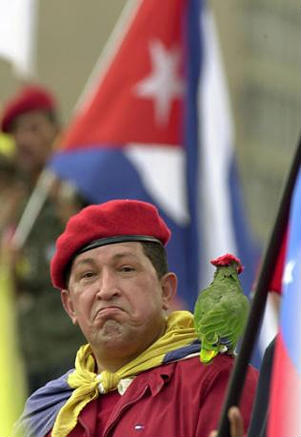
Maybe he was surprised that Chavez was defeated in the popular vote. In Havana alarms went off. The unstoppable South American Santa Claus is a very valuable asset for the Cuban political strategy. He is its strong man.

He’s also fundamental for supporting an economy that is foundering. The frenzied Chavez offers the oil the island needs, to avoid slipping into and age of darkness, at rock bottom prices.

That’s why the leaders pamper him despite his drivel and verbal incontinence. Maybe his political mentor, Fidel Castro, is upset because of the Caracas autocrat’s mania to hold elections every time he feels like it.

It’s a known fact that Castro does not believe in that damaging vice called democracy, nor in holding referendums. Even less in holding a referendum just to lose it. Tough guys like the mythic bearded one only hold elections if they know for certain that they’ll win more than 95% of the votes.

That strange habit of the swarthy caudillo’s trying his luck at the ballot, keeps the island’s rulers on their toes. It’s a known fact that the fall of the Soviet Union threw Cuba suddenly and without warning into a crisis which has lasted for 21 years, and which in its darkest days took us close to the stone age.

Castro knows that the Cuban government can’t allow another violent worsening of conditions, with food shortages and 14-hour blackouts. That could be the end of his revolution. Already, advisers are looking through their files for contingency plans, just in case Chavez loses power in 2013.

To stop being the beggars of the Caribbean, living off the resources of another country, it’s urgent to get the weakened internal economy rolling again. This is the time for the fans of the Chinese Model. They’re probably on edge.

They think this is the time to speed up the reforms and economic openings. It’s a task for titans. And there’s little time. The red commander could lose his post in three years. There aren’t many options at hand. The most feasible is to bet on the market economy but keep a tight hand on the reins of power, like China does.

Playing two cards. Capitalism on the outside and socialism on the inside. Of course, that needs improved relations with America, and Obama lifting the embargo.

The wise make their estimates. Maquiladoras — cross-border factories — would come by the dozen, and the hundreds of thousands on unemployed would work for a pittance. Like the Asian Giant, Cuba offers a cheap, docile workforce, with a union that will not encourage them to protest or strike.

In that economic model, with the worst of wild capitalism, fans may forget a little detail. Cuba is not China. It doesn’t have an internal market of a billion people and Cubans do not work like slaves.

Whatever it is, something must be done to take the local economy out of its slump. Chavez is no guarantor. Maybe it’s time to speed up the changes. It would also reveal if the policies of the Castro brothers are aligned or not.

If stagnation continues, it would risk their continuity in power. And that is a powerful incentive to speed up the reforms.

Translated by: Xavier Noguer

Coffee Without Milk / Iván García

In this Cuban autumn of 2010, with memorable rains in the center and east of the Island, we breathe the air of pessimism. A new crisis. Another one. Fed up with material and spiritual shortages. We are one of the countries of the world best prepared to suffer. A benefit of the Castro brothers’ revolution.

Before going to school, children under 7 drink a glass of milk; up to that age it is guaranteed by the rationing system. The older children, unless their parents have money, plain coffee or whatever they can get for breakfast.

Milk is a luxury in Cuba. Cows are a luxury in Cuba. The alternative, for those who can afford it, is powdered milk, at 5.25 CUC for just over two pounds (about $7 U.S.). Or on the black market, 30 Cuban pesos ($1.25 U.S.) for a pound. When you can find it, which is almost never.

Now, according to the shopkeepers, the State proposes to eliminate coffee from the ration. No big deal. Some ten ounces a person, of horrible quality, every two weeks.

But it’s the breakfast of choice of ordinary Cubans, it’s all they have. Even coffee off the ration is in danger of extinction. It we believe the official press. Cuba had to spend 40 million dollars to buy coffee on the international market.

So, there have to be cuts. And as it’s always the people who suffer the consequences… goodbye coffee. In the 1960s, Cuba produced 60 million tons of coffee. In the 1940s Cuba exported coffee.

Forget Fidel Castro’s outlandish idea of growing coffee the length and breadth of Havana so the capital could become self-sufficient. The problem is, anything he touches disappears.

And he turned his hand to coffee. So it is starting to become scarce, we have to have hard currency to buy it. Who can do that. But what with the poor people, without access to dollars or euros, drink when they get up in the morning? Maybe hot water with lime or something like that. Or “rooster soup” (hot water with brown sugar).

I’d like to know if the black nectar has also disappeared from the offices of the Communist Party Central Committee and the other senior agencies, where the leaders take a little cup of the brew and save the rest in their large imported thermoses.

Strong coffee, good quality. Of course the bosses don’t have to cinch in their belts. They’re the leaders. They’re different.

Photo: Inflekt, Flickr

October 9, 2010

Woman and Sagittarian / Juan Juan Almeida

My name is Rosalba Susini, I was born December 5, 1974 in Old Havana, and today I am an American citizen.

I studied at the teacher’s training college of Cojimar, East Havana. I graduated in 1993.

I Cuba I had no problems until, like all families, mine also split up. My father came here when I was 6. He returned in 1994, and have a huge hug, I breathed deeply and called forth all my courage and whispered in his ear what all kids tell their parents, even today, “I want to go.”

Imagine, my mother there, my father here, and me, a young girl. At that time people were leaving Cuba through a third country. We tried to go to Panama but that was frustrated because my mother would not give me permission to leave, she worked in the hospital at La Covadonga.

In 1996 I had the chance and I threw myself on a raft. The trip was horrible, I don’t even like to talk about it; but I can tell you that if you were born in the same circumstances, living without freedom, you would have done exactly the same thing.

It was hard, very hard, 8 years without my seeing my mother until I could bring her over. More than once I asked permission to enter my country but I always got, from the Cuban authorities, the usual response with no explanation: “Your entry permit has been denied.”

I have been here 14 years, the punishment is indefinite, and when you ask for a reason, everyone looks away. My grampa died, I couldn’t see him. My grandmother lost her mind, she doesn’t know who I am. My aunt us very old. It is not fair to have to ask permission to enter your country.

Havana is my obsession. I frequently dream I travel there without telling anyone and that I land at the airport and go straight to my house, stand at my door and people start screaming, “Rosabla’s here! Rosalba’s here!…” I don’t know if it’s the excitement or for the block party; but my dram is over. I wake up. In my dreams I always go… but I never arrive.

October 9, 2010

HONOR TO HIM WHO DESERVES IT / Yamil Domínguez

THE CONSULTATION

HONOR TO HIM WHO DESERVES IT

Wilfredo Vallín Almeida, 27 September 2010, La Víbora, Havana

Since launching this section, The Consultation in the Digital Spring, we have received a great number of communications in different ways. Many of them from people with different types of problems: from a housing issue to police harassment, from threats based on gender to people condemned to twenty or thirty year sentences for both common and political reasons.

The sad — and unusual — thing is that often the problems are created because they were given the wrong advice from the legal standpoint by… the authorities of this country. And, in these authorities we include the police all the way to the courts and even higher.

Furthermore, we are showered with questions that are also very different. We try to help in specific cases of legal problems and to answer questions, always in accordance with our knowledge and the legal information at our disposal, both of which don’t always cover the entire spectrum of the inquiries.

In this situation, the great majority of problems that come to us are that, PROBLEMS. Thus, they represent, to us, a great satisfaction when we what we can communicate is not a problem but a SOLUTION that can be given to… the appropriate authorities.

For more than a year, in this same column, we have published a case titled “It Being Proved That.” I am going to reproduce a brief fragment of this to set the stage for the reader.

“…I have before me a copy of the record of Yamil Domínguez Ramos, U.S. citizen (Cuban law does not accept double citizenship), with the Sentence No. 3 of 13 January 2009 of the Supreme Court, that was sent to me by his family and where his appeal for a violation of the law and the ratification of his ten-year sentence was dismissed, and if you read carefully the entire history of this case… it is far from being absolutely clear that anything was ‘proven’.”

Before our involvement, and in a supportive action that we had not seen before, a large group of people within civil society decided to help Yamil and his family and started a beautiful campaign for his release, added to which was a brave hunger strike launched by he himself, leading eventually to a letter from the First Vice-Minister of Justice directed to the appropriate court.

To our immense satisfaction, the letter is completely in line with our own appraisal of the case and does proper justice to the case of Yamil Domínguez. Given this case, we were sure that the courts involved would review the investigative phase of the case, to the benefit of, and justice for, the accused.

It’s possible that we do not agree ideologically with the First Vice Minister of Justice, but in the same way that we bitterly criticized this entire unjust and arbitrary action on the part of the authorities, it is also our duty to acknowledge every just act on their part, and with regards to the First Vice Minister, we do so in this case.

Honor to him who deserves it, as we were taught by the greatest of all Cubans.

With regards to the person of this Vice Minister we offer our acknowledgment for her civic valor and her actions upholding the law. It is an example of what we always ask from the authorities: to act in strictest conformance with the law, without distinction with regards to persons, because we are all equal under the law according the Constitution of the Nation.

And for Yamil, his family and all who desire good (because this is a formidable young Cuban), and who are delighted, our congratulations for your happiness, which is also ours.

vallinwilfredo@yahoo.com

October 10, 2010

Che’s Grandchildren / Iván García

Forget the New Man Che Guevara dreamed of one day. We said goodbye long ago to that guy dressed in a uniform twelve hours a day and on the weekends we would prefer to read realistic Russian works like Volokolamsk Highway and How The Steel Was Tempered, before having a beer and listening to the geniuses from Liverpool. That New Man never put down roots in Cuba.
This incorruptible man with his unlimited hatred of the imperialist enemy, who didn’t enjoy drinking rum with coconut water on the beach, a hooker at his side, could not be cloned on the island of sugar cane.

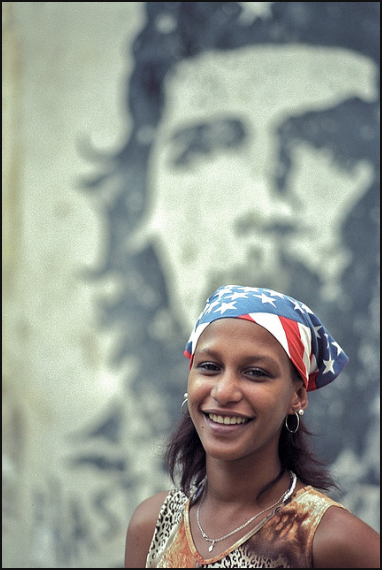
Guevara must be turning in his granite and marble mausoleum where his remains rest outside of Santa Clara, some 200 miles east of Havana. Now, in 2010, teenagers and young Cubans see Che as a marketing fetish; clothes and objects with his image on them clutter the foreign exchange stores.

Yesenia, 19, loves rock, detests the Castro government, but wears a Dior T-shirt with the face of the guerrilla saint. “I read that in real love Che was rigid, authoritarian and violent, but the Argentine was charismatic because he wanted to be different from the rest,” says the girl, sitting with her friends listening to music on their Mp3s.

The children of those who waged war on African soil and who instead of the Bible read Che’s Reminiscences of the Cuban Revolutionary War, are closer to his time than their parents. They are allergic to slogans and revolutionary marches. No one can inculcate them with the idea of voluntarily working to clear the marabou weed without charging a cent.

These grandchildren of Che think of visas to the United States or Spain. They go to good discotheques. Drink Coca Cola and quality whiskey. Dress in the latest fashions. Dance to Shakira’s waka-waka, and if they have hard currency, they take a snort of cocaine.

The most nonconformist in Cuba today are precisely the young people. They want to live in a democracy. For them, Ernesto Guevara is a myth. And a legend what can be worn on a watch or tattooed on an arm, like Maradona.

The current generation of Cubans now prefer to sit in the park or on the Malecon with their iPhones or Blackberries, sharing psychedelic music and talking nonsense. They don’t hate the gringos. On the contrary. They fight for Made in USA products.

Forty-three years after his death in Bolivia, the New Man dreamt of by Che has become a boomerang.  At least in Cuba.

Photo: volkerfoto, Flickr

October 9, 2010

A Sky The Color of Winter / Rebeca Monzo

On my planet the sky dawned today the color of winter. It looks like when a cold front comes. Still hot, but there is a breeze and the sun is less aggressive. Magnificent day to go out and do things.

Passing Zapata and 12th, opposite the cemetery entrance, all the activity called my attention. It looked like they were preparing for an event. I didn’t pay too much attention, because I am hoping I am going to hear it first by shortwave.

Upon arriving at the Immigration officer, to ask them to search for my other grandfather, I met a friend in the line. She came to apply for a Permit to Reside Abroad (PRE), and she showed me the front page, all in black, of the Granma newspaper she had in her hands. Suddenly my heart leaped. Has it happened and I haven’t heard. Impossible, I would notice in the street, and all along the way, except at the cemetery, everything seemed normal. When I read it, I was afraid. They have issued a decree establishing October 6 of every year as Victims of State Terrorism Day, for all the Empire’s acts of terrorism we have been subjected to.

Gentlemen, you cannot assign terrorism to one name. Nor democracy.

Terrorism was the plane in the Barbados, terrorism is the ETA, terrorism is the FARC, terrorism was the twin towers, terrorism is Al Qaueda. Everything that wants to impose through acts of force, that involves the death of innocent people, whomever does it and wherever it comes from. To claim the lives of others, destroy public buildings, plant bombs, kidnap, impose ideas and social models by force, in my humble opinion, this is terrorism. A sky the color of mourning, like the terrorist want to impose, is not the same as a sky the color of winter, like today.

October 6, 2010

NIGHTERATURA FOR SANDRA / Orlando Luis Pardo Lazo

NIGHT OF THIS NIGHT WITHOUT NIGHT

Orlando Luis Pardo Lazo

Night in Cuba can be as claustrophobic as the sunny days. You sweat. You stink. You’re exhausted. Desire disappears. It is better to die than to be depressed by the national nightmares on top of the tedium of your coming day.

But the summer is over, however unlikely. October blows its mysteries of a bad month for mediocrity. It’s even cold. The direction of the air changes, the atmosphere is open to the sky. The stars rotate counterclockwise. The moon doesn’t show itself too much. Everything is noble grey. The nights shrink, there is no distance between objects. Lightness is synonymous with Freedom. There is no government nor resistance. There is only Cuba, the only one. The one of truth. Cuba unrecognizable, or at least unknown.

And then we breathe. That. For the first time in this year we Cubans her breath. O2: oxygen, orlando… Click Play.

I go outside. I record in mp3 syllables what Havana dictates to me. I am privileged, I recognize it, I am a tiny imitation of god. I wish the entire world was under my skin, shivering under my sternum. So much reality still virgin. So much luxury and so much splendor. All of a sudden visible, soft, hyper-real. An unexpected city. Suicide.

Down below the Ceguera hospital looking for the midnight music of the sea. I go alone, as appropriate to all limited experience. Unlimited. Seventieth street has preserved its decorated trees. Subversive roots that cracked the solemnity of the concrete. Also granite benches. A desolate funeral. A bookstore without illusion. State cafeterias that deserved to be bombarded by a multinational force. Riotous semaphores for anyone. I crossed on the red, the green and the yellow. No one saw me, not even me. I’m a ghost, of course, but the ghost of a real citizen who is leaving our performance of a country.

On 19th the P-10 bus crosses in front of me, very long, bright and colossal, empty of people, driven automatically, perhaps, from the general headquarters of the Yutong company that made the bus, pure material imported from the future Caribbean that never was. What loneliness so healthy. Where are the Cubans at this time without time? Who will wish me luck and not assassinate me, a shadowy zombie exiting socialism? When will the asphalt end and I will finally tread the dogtooth that is our most faithful border? Why did I not fall asleep forever in one of those plastic cans with signs in Catalan?

It should not dawn. They should not dawn. We should not dawn.

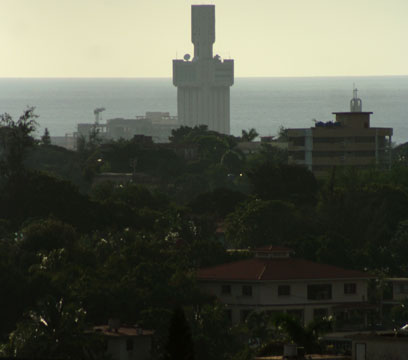
The Russian embassy is a quadratic syringe. I’m sorry, it always seemed precise to me in its deformity. It’s a lizard, a symptom, simply sensational. I imagine it full of spies and satellite dishes, maybe micro-satellites and isotopes and some sad girl with a handkerchief of icons on her head, cut out of one of those colored magazines from the eighties.

I don’t know what I am listing. I am in ecstasy. I speak alone, like the locos, all the fault is the mp3’s.

An estate. The pines still uncut. Democracy will enter Cuba by this avenue, I know. The architecture predisposed. Beauty calls. Even if dawn never breaks, Havana may be saved.

The sea. Next to the Dutch or Hispanic or Swiss hotel, or what I know of the H’s H-Europeans H-invoked now. Little waves. Foam. Salt on my myopic lips. Fear of not being afraid and going with my clothes and boots into this sea. Hiding myself with humility. Under that immaculate odor of cosmic milk from above. Constellations, galaxies, high points of light that never blink. The sense of this place escapes me. I would undress, touch my body, explode. Orlandoisms that don’t fit in the prudish country that persistently kicks us. As a teenager I was like this, pleased with the outside world. Without penalty. Without asking pardon, but with dread. A patrol approaches me from the alley that bites the reefs of the sea.

ID card, of course. We un-inhabit the Island of Identification. My hair makes them nervous. My height. My mannerisms. My clothes. My voice on the mp3. Distilled truth. I am, for an instant, immortal. Immoral.

Two hours later I’m back on 70th Street. The intermezzo doesn’t matter, does not fit in the fragility of this narration. Nothing happened. Decrepit dialogs of authority. Winks of the author. Official fiction. Tonight we were unstoppable, Cuba, me and those who right now follow with the view my voice (just in that ungrammatical order). It is the kind of anecdote that turns exclusively in me. I have told it in Sad Tiger and Decalogue of the Year Zero. A mistake. Horror always is.

Seventieth street above is just exquisite. It never reaches 31st. Snoring mansions illuminated, with their dead owners in the cemeteries of some other country. Roofs slender, curved, futuristic, classic. There were men living in this story. Their mistake was not to leave too early, but to abandon us parting from here (to the papyrus here). A Cuba of mute memories pressing on our retinas, throats and heart. Click Stop.

I turn to home. I hear it. I type, I tremble. I am in an invented winter. Some cats are disemboweled on the other side of my wide open window. The red sky. Drizzle. Hoot. I p[ray that the night does not end now. I pray never to find a line that accommodates the final period without violence.

October 7, 2010

AND WHAT ABOUT MY CUBA…? / Orlando Luis Pardo Lazo

2010 — Mario Vargas Llosa, Peru

2009 — Herta Mueller, Romania and Germany

2008 — Jean-Marie Gustave Le Clezio, France and Mauritius

2007 — Doris Lessing, United Kingdom

2006 — Orhan Pamuk, Turkey

2005 — Harold Pinter, United Kingdom

2004 — Elfriede Jelinek, Austria

2003 — J. M. Coetzee, South Africa

2002 — Imre Kertesz, Hungary

2001 — V. S. Naipaul, United Kingdom

2000 — Gao Xingjian, France

1999 — Gunter Grass, Germany

1998 — Jose Saramago, Portugal

1997 — Dario Fo, Italy

1996 — Wislawa Szymborska, Poland

1995 — Seamus Heaney, Ireland

1994 — Kenzaburo Oe, Japan

1993 — Toni Morrison, United States

1992 — Derek Walcott, Saint Lucia

1991 — Nadine Gordimer, South Africa

1990 — Octavio Paz, Mexico

1989 — Camilo Jose Cela, Spain

1988 — Naguib Mahfouz, Egypt

1987 — Joseph Brodsky, United States

1986 — Wole Soyinka, Nigeria

1985 — Claude Simon, France

1984 — Jaroslav Seifert, Czechoslovakia

1983 — William Golding, United Kingdom

1982 — Gabriel Garcia Marquez, Colombia

1981 — Elias Canetti, United Kingdom

1980 — Czeslaw Milosz, Poland and United States

1979 — Odysseus Elytis, Greece

1978 — Isaac Bashevis Singer, United States

1977 — Vicente Aleixandre, Spain

1976 — Saul Bellow, United States

1975 — Eugenio Montale, Italy

1974 — Eyvind Johnson, Sweden; Harry Martinson, Sweden

1973 — Patrick White, Australia

1972 — Heinrich Boll, Germany

1971 — Pablo Neruda, Chile

1970 — Alexandr Solzhenitsyn, Soviet Union

1969 — Samuel Beckett, Ireland

1968 — Yasunari Kawabata, Japan

1967 — Miguel Angel Asturias, Guatemala

1966 — Shmuel Agnon, Israel; Nelly Sachs, Sweden

1965 — Mikhail Sholokhov, Soviet Union

1964 — Jean-Paul Sartre, France

1963 — Giorgos Seferis, Greece

1962 — John Steinbeck, United States

1961 — Ivo Andric, Yugoslavia

1960 — Saint-John Perse, France

1959 — Salvatore Quasimodo, Italy

1958 — Boris Pasternak, Soviet Union

1957 — Albert Camus, France

1956 — Juan Ramon Jimenez, Spain

1955 — Halldor Laxness, Iceland

1954 — Ernest Hemingway, United States

1953 — Winston Churchill, United Kingdom

1952 — Francois Mauriac, France

1951 — Par Lagerkvist, Sweden

1950 — Bertrand Russell, United Kingdom

1949 — William Faulkner, United States

1948 — T.S. Eliot, United Kingdom

1947 — Andre Gide, France

1946 — Hermann Hesse, Switzerland

1945 — Gabriela Mistral, Chile

1944 — Johannes V. Jensen, Denmark

1943 — No prize awarded

1942 — No prize awarded

1941 — No prize awarded

1940 — No prize awarded

1939 — Frans Eemil Sillanpaa, Finland

1938 — Pearl Buck, United States

1937 — Roger Martin du Gard, France

1936 — Eugene O’Neill, United States

1935 — No prize awarded

1934 — Luigi Pirandello, Italy

1933 — Ivan Bunin, stateless domicile in France

1932 — John Galsworthy, United Kingdom

1931 — Erik Axel Karlfeldt, Sweden

1930 — Sinclair Lewis, United States

1929 — Thomas Mann, Germany

1928 — Sigrid Undset, Norway

1927 — Henri Bergson, France

1926 — Grazia Deledda, Italy

1925 — George Bernard Shaw, United Kingdom

1924 — Wladyslaw Reymont, Poland

1923 — William Butler Yeats, Ireland

1922 — Jacinto Benavente, Spain

1921 — Anatole France, France

1920 — Knut Hamsun, Norway

1919 — Carl Spitteler, Switzerland

1918 — No prize awarded

1917 — Karl Gjellerup, Denmark; Henrik Pontoppidan, Denmark

1916 — Verner von Heidenstam, Sweden

1915 — Romain Rolland, France

1914 — No prize awarded

1913 — Rabindranath Tagore, India

1912 — Gerhart Hauptmann, Germany

1911 — Maurice Maeterlinck, Belgium

1910 — Paul Heyse, Germany

1909 — Selma Lagerlof, Sweden

1908 — Rudolf Eucken, Germany

1907 — Rudyard Kipling, United Kingdom

1906 — Giosue Carducci, Italy

1905 — Henryk Sienkiewicz, Poland

1904 — Frederic Mistral, France; Jose Echegaray, Spain

1903 — Bjornstjerne Bjornson, Norway

1902 — Theodor Mommsen, Germany

1901 — Sully Prudhomme, France

And not one of them from Cuba!

October 10, 2010

Oil, Chapter 2 / Regina Coyula

Photo courtesy of Orlando Luis

On July 8 I published a post about my alarm about the oil drilling practically at the entrance to Havana Bay. Well it turns out that a well between East Havana and Cojimar had to be sealed because of the leak of very dangerous sulfurous gas. The work being done in Mariel to “move” the commercial activity to the Port of Havana, the cleaning of the bay, including decommissioning the refinery, all with the idea of converting the capital’s harbor into a marina focused on tourist cruises and private pleasure boats, is in direct conflict with this unusual drilling.

The gas is toxic, full stop.

October 4, 2010

EATING THE CABLE / Orlando Luis Pardo Lazo

PULL YOUR GROUND WIRE

Orlando Luis Pardo Lazo

Once again, like every few months, they were in the neighborhood collecting cables. Lawton dawned shifting into reverse. Vans from the telephone company, ETECSA, or the Ministry of the Interior (MINIT) or both. Cooperation from the Committee for the Defense of the Revolution (CDR) along with the National Revolutionary Police (PNR). Running around at the last minute on the roofs and in the corridors to be avoid being caught in flagrante. Throwing the anonymous cables into the middle of a lot or a yard. Fines of thousands of pesos to the providers of clandestine signals. And here nothing has happened, ladies and gentleman, but to put the cables back and wait for Papa State’s next raid; apparently he doesn’t like foreign television: it seems that only the top officials (and also Amaury Pérez Vidal) are authorized to watch anything other than Cuban TV (TVC).

María Elvira y Oscar Haza, go home…!

It’s funny how the Havana government likes to wear itself out money. It’s possible that the Cuban establishment is just that: the cunning art of ruining the economy of a nation.

Everyone knows that the illegal market for cable TV has stabilized at a relatively cheap 10 CUC a month (about $12 U.S.). So it’s not unusual to find buildings with dozens of clients, nor blocks where there are more than a hundred (it’s rumored that in Bauta and its surrounding towns there are thousands). The Ministry in charge, perhaps the Ministry of Community Common Sense, should have normalized the situation long ago, not repressing it by force but assuming that the Cuban people are a part of the planet. And they want to see. Will they finally learn, the towering leaders of the Revolution? In addition to living, we shall see what we shall see!

Until recently no cell phone in Cuba actually belonged to a Cuban citizen. How long with they stay immersed in the stupidity of not allowing us to independently connect cables that free us from the four educational channels and allow us to mass-mediocresize ourselves in peace?

Everyone knows that the average Cuban spends his time consuming audiovisual junk. Soap operas, shows by who knows who, reality TV, comic caricatures that go back to the 1950s, and even media crisis news of the worst Latino channels. All in Spanish or, worse, dubbed. All at the speed limit. Ephemeral. Amnesia producing, after the tapestry of instantaneous super-information, Futile future. I know I look like an evangelist for the Round-table show on Cuban TV, but I feel bad about the consumption statistics of our tired culture even before the start of whatever will change.

Of course, the dozens and dozens of viewers affected by the State in Lawton yesterday, tolerated it all with their usual indecency. Not a single protest, not one hard stare, head held high, not a whispering little voice wondering what was going on or how long so much arbitrary randomness would last (right now Amaury Perez Vidal and the rest of Havananothing are going to enjoy their illegal satellite TV).

In truth, when I think about it now, it’s possible they may not deserve any other kind of television ever. Every people has the imbecile box it deserves. Bon appetit, Cubavision.

October 8, 2010

In Limbo / Regina Coyula

Courtesy of Orlando Luis
Those who have heard of me, and who sincerely, or with teeth bared, support the government, I am a a person of rights. Of rights because I want a democracy where people exercise free expression and all the other freedoms that help a nation to prosper, because they believe that my critical views are those of a mercenary seeking patronage, or because I have political ambitions for the future; because I don’t like this Revolution that has degenerated into a government — to say it the Mexican way — that has been experimenting for more than 50 years without success for the economy, but with notable success in managing to stay in power.

Those who have talked with me know that I am against the Embargo, that I put Bin Laden and Posada in the same box, that I defend the right of every citizen to education and health care along with the other human rights, that I cannot find the logic in having people inconceivably rich who don’t worry about the hunger of the Third World; fine, these people would label me like the leftists.

There are conventions which they have accustomed us to: right = bad, left = good. But there is nothing better than politics to show the ambiguities of labels on one side or the other. I am not even capable of calling myself politically postmodern like a dear friend of mine. I feel in limbo in this area. And from my limbo, dreamy and Utopian, I continue to imagine a country where there is room for leftists, rightists, post-modernists, limbo-ists and, like the nautical compass, all the positions in between.

October 8, 2010

The Country of Our Dreams / Rebeca Monzo

Those childish and youthful dreams were a long time ago, when we were excited to see the flag and hearing the first notes of the national anthem could move us to tears.

I remember years ago, being in Madrid at the International Crafts Fair, with some of my students and I heard in the distance the first notes of our anthem. I trembled, felt my throat go dry and, excusing myself from them, left to go where those first notes were echoing. I was dressed in campaign mode: jeans, t-shirt and sneakers to be able to run between the different pavilions. Suddenly, when the music great louder and clearer, I saw standing in front the then Cuban ambassador to Spain, with the doctor who had spent a lot of time taking care of my mom. We were both surprised. He very elegant, his wife like she’d stepped from the pages of Vogue. I was embarrassed but noticing my confusion he gave me a hug that surprised everyone present, then, when I’d regained my composure, he asked me an uncomfortable question, “And what about you, what are you doing here?”

“It’s a long story,” I answered, while saying my goodbyes and getting away.

Later, back home, I remembered those verses by Martí that were always my among my favorites:

“The mother love of the Country is not a ridiculous love of the land, nor of the grass our plants walk upon. It is the invincible hatred of anyone who oppresses it, it is the eternal rancor of anyone who attacks it.”

To feel oneself Cuban, to be Cuban, it is not necessary to live in Cuba (an absurd criteria they would like to impose upon our culture). To be Cuban is an innate condition, incorporated into the depths of our feelings, there is nothing nor anyone that can stop it, no decree can exclude it, they would have to tear out our soul. My country is my family, my children, my friends, my neighborhood, the place where I was born. Country is much more than an anthem and a flag.

October 9, 2010

Those Who Don’t Want to Leave Will be the Last to Get Out / Iván García

Photo: Pedro Argüelles Morán, the first political prisoner who declared he would not leave Cuba.

Perhaps as a punishment for their decision not to leave Cuba, the prisoners of conscience from the Black Spring of 2003 who have chosen to remain in their country will be the last batch to come out of prison.

This was announced by Cuban Foreign Minister Bruno Rodriguez Parrilla in an exchange with the New York media. I don’t know if it is a concerted strategy by Spanish Foreign Minister Miguel Angel Moratinos, General Raul Castro and Cardinal Jaime Ortega, as had been expected that the “plantados” — those who refuse to emigrate — will be the last to be released.

There is also a serious drawback. Rumors are that the political prisoners will be released on “extra-penal license,” an ambiguous legal term, which has already been applied to dissidents from the Group of 75 such as Martha Beatriz Roque, Jorge Olivera, and Oscar Espinosa Chepe, among others.

Said “license” is an open invitation to the government. And under certain circumstances, they could be returned to prison. It’s a sword of Damocles hanging over the heads of released opponents and independent journalists who remain in Cuba.

I would like to know if the plans of the triumvirate of actors in who negotiated the prison releases of 52 dissidents, anticipated that these “extra-penal licenses” would be kept in place against the opponents who don’t want to go into exile.

It was a masterful psychological move by the regime. It is not easy for a group of men who have spent more than 7 years behind the bars of a cell, to say no to a friendly phone call from Cardinal Ortega, suggesting they can go to Spain voluntarily in a matter of hours, if they wish.

Among those refusing to leave are Pedro Argüelles Morán, Oscar Elias Biscet, Arnaldo Ramos Lauzurique, Guido Sigler Amaya, Angel Moya Acosta, José Daniel Ferrer García, Héctor Maseda Gutiérrez, Librado Linares García, Eduardo Díaz Fleitas, Félix Navarro Rodríguez, Iván Hernández Carrillo and Diosdado González Marrero.

Among the group of those released and exiled to date (of which two are in Chile and the United States), some wanted to stay at home and then changed their position. Perhaps pressure from their families or because of fear that the government, at any time, could change its mind and not allow any more exits to Spain.

Everyone already knows how the regime works. They are unpredictable. The mood of the brothers from Birán varies in accord with certain regional and global events. And the majority of imprisoned opponents know that.

None of those who have left have done so with pleasure. They had wanted to remain in their provinces to continue working peacefully and writing their points of view about the reality within the island.

Almost three months have passed since the government statement, where they agreed to release the 52 prisoners of the Black Spring over the course of four months and it’s clear that their strategy was to try to have the least number of dissidents remaining in the country.

They are uncomfortable people. The fewer of them remaining in Cuba, the better for the Castros.

October 1, 2010

Being a Dandy is Now an Official Trade in Cuba / Iván García

Photo: Andry Bracey, Flickr

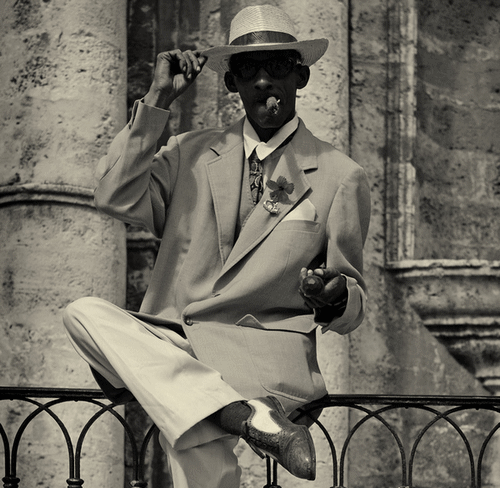
On the streets of Havana you can see older men dressed like dandies, which used to be seen as an eccentricity. Not anymore. It is one of the 178 activities the government has authorized for self-employment.

It is one of the most striking, but not unique. The activities also include fortune teller, and the “Havana woman,” as they have decided to call those women, almost all of the black, who in recent times can be found in the colonial areas of the city: colorfully dressed, smoking cigars, selling flowers, or giving spiritual consultations to distracted tourists.

Novelties aside, the fact is that hundreds of jobs were eliminated in Cuba after the arrival of the Castro brothers. In their place others grew up, creations of necessity.

One of them — and with this name, at least, it doesn’t appear on the list issued on September 24 — is that of debris collector. Jose, 53, unemployed, charges 100 Cuban pesos (4 dollars) for each sack of bricks, stones, pipes, pieces of wood, and leftovers from home repairs. “I put the sack on a cart and empty it in the first vacant lot I find.”

Luisa, 64, retired, works cleaning rice at home. For each pound she charges two Cuban pesos (ten cents on a dollar). “I already have an established customer base. I earn about 100 to 200 pesos a week and with that I can buy pork and food at the farmers market.”

Although not included in the official list, such work already forms a part of the native landscape. Older people sell “jabitas” (nylon bags), newspapers, single cigarettes, peanuts and homemade candy. Others, younger, prefer to refill cigarette lighters. Yes, the same ones that in other countries are thrown away.

After 1959, the wearing of suits, collars and ties went out of style in Cuba. The Mao style prevailed.

Men dressed alike, thick cotton, opaque colors and Russian boots. That’s when the tailors started their decline.

Lacking material, the dressmakers became “patchworkers.” Thanks to Rosa, 71, many neighbors can cover themselves with sheets and dry themselves with towels that are more or less decent.

As a patchwork specialist, Rosa cuts out the worn parts of a sheet or towel and on her old Singer sewing machine, joins them with pieces in better condition. “I don’t trash the worn out bits, I throw them in a box and give them to a relative who uses them as wadding to stuff mattresses.”

If there is a trade in high demand in Cuba in 2010 it is mattress repair. And the same for the private shoe repairers, plumbers and electricians. Although no one is as well as paid as the car mechanics, charged with keeping the ancient American cars rolling.

With or without a license, for a long time one has been able to hire clowns for children’s party, and photographers, who have become experts in photo-montages or Photoshop work for weddings, baptisms and birthdays. One of the most successful private businesses is the legion of specialists in quinceañeras — the celebrations for girls when they turn 15 — from gown rentals to the choreography and editing of the party video.

Unlike seamstresses and refillers of lighters and mattresses, this sort of trade in a luxury in a country full of shortages. Similar is everything relating to dogs, an activity that is emerging from the closet of illegality. Orlando, 39 and gay, alternates giving ladies haircuts in their homes with the attention and care of their dogs. “The little tame dogs, I bathe them and do their hair. If the owner pays me I make clothes for them. For the big fierce ones, I don’t want to know,” he says, laughing.

Those are for a braver race of men among whom we find Manuel, 43, who pocketed almost two thousand Cuban pesos (80 dollars) in a month — four times his salary — training German shepherds.

Perhaps they don’t earn as much, but the dandies are more picturesque. At least they don’t have to tramp around the city selling peanuts, cigarettes and newspapers.

October 3, 2010

Monologue of an Unemployed Cuban / Iván García

Photo: Jan Sochor

“I’m sick of everything. Fidel Castro and his brother Raul’s “blockade.” I can’t stand one more speech. It’s all lies. False promises. At this point in my life, after working for 50 years and fighting in all the wars they sent me to, they come and say now is the time to build socialism.

“Fuck this government. And what hurts most is to see how they’ve used me. I’ve been manipulated like a puppet. That’s what I’ve been: a common puppet moved at their will. This is as far as I go, as Saramago said.

“Not one day more will I support those two who have ripped off my future, my dreams, even my family. For supporting them I lost three marriages and neglected my children. Both left the country and we stopped talking, because I was a Party member. The first thing I’m going to do is call them ask them to forgive me.

“After taking part in every kind of Revolutionary idiocy, from planting coffee in the Havana Cordon, cutting cane like a slave in the ten Million Ton Harvest, even training the Latin American guerrillas in subversion and putting my own skin on the line in the wars in Angola and Ethiopia, now comes some guy wearing his white guayabera and chatting about the past and after giving me a pat on the back, he tells me I should write a book about my Revolutionary career and suggests I should rent out my Russian car, my Lada. And the only thing I have after half a century of being a true believer, I should chase some bucks with the Lada? That’s the solution they have for me, after leaving me in the street without even a latchkey?

I’m 68 and now that I’m old it seems I’m not the right person for my job. That we have to do everything to move the country forward. That the economy can’t support State paternalism. Then, why the fuck did they install it? Nobody, at least no one I know, asked the government to be our father.

“I don’t have a cent and the easiest thing is to lie and pretend that we’ll keep applauding those who are leaving us unemployed. Machiavelli is a baby at the tit next to the Castros. To do this to me, who never stole a thing; who traveled halfway across the world in the name of this government, and it never crossed my mind to flee with a suitcase full of dollars. They throw me out like some disposable object.

“That hurts. But the worst thing is that they’re not capable of facing reality. And they say what goes on in Spain is bad, the United States is hell, and nuclear war is around the corner. They are not capable of explaining, looking you in the eyes, that the Cuban system is broken and we have to change it.

“At this age, I have to go back to my beginnings, when I was 18-years-old and driving a taxi to help my widowed mother. I don’t mind that I had to do that. What pisses me off is having been such an asshole. I distanced myself from a part of my family and many of my friends because they thought differently.

“Now, after it’s all gone to hell, I feel like a free man. Without political strings. I’ve learned my lesson. I hope it’s not too late.”

October 7, 2010