Moa, The Promise And The Deception / Luis Felipe Rojas

www-flickr-comphoto.jpg

The eastern half of the country has seen the ghost of development go by in official speeches and in the trains and planes going to Havana or overseas. When a high government official tediously insisted on making promises of economic development, immediately the political machine would start a “shock public works project.” Who doesn’t remember the power plant of Nuevitas, the Nickel factory in Moa, the cement factory in Santiago de Cuba, or the expansion of the hotel capacity in the Guardalavaca zone, in Holguín ?

Not so long ago I went back the Nickel producing region in search of a half-buried story which started there and which is being continued in the Che Guevara plant in Moa, where an unforgiving wind took more prisoners to Villa Marista — the notorious State Security prison in Havana — without any explanations.

Several questions kept going around my head. I knew that I could share all of them with my readers, but I hurried on to those related to the prisoners in February. I delayed the one related to the environmental pollution and respiratory diseases suffered by many over there, but the note about an arrested and jailed manager who was transferred to the oncology ward of the provincial hospital led me to an article written by the exiled journalist Juan Carlos Garcell. It says: “Medical sources reported on a study made in 2002 regarding respiratory diseases in workers exposed to the lateritic mineral dust in the Che Guevara factory (Moa) during a five-month period, and which covered the 926 workers belonging to the seven departments where exposure was the greatest. The study noted that the most prevalent pathology was chronic obstructive lung disease; 83.42% had a normal hematocrit; altered respiratory functional tests were found in a 42.33% of subjects; and 66.33% had acute pulmonary lung disease as a radiological sign.”

I thought about the former manager who had a marginally better life than a common worker, I thought also of the others. The air they breathe over there doesn’t have the name of the one who will breathe it, it’s always polluted.The dust rises and goes along the streets and highways destroying promises without discriminating based on age or hierarchy. Where did they go, the dreams of thousands of young men who moved from Havana and Matanzas to Moa to build a new country?

When some of these megaprojects stopped working as propaganda, the dreams went bust. The ramshackle buildings, increasing cost of food, and deficient local management transformed these so-called “industrial cities” into abandoned cemeteries.

History’s paradox, government’s lies, deceit and false promise, become reality, now raised as a flag by the humblest of citizens.

* The article was published in the illegal monthly journal El cubano libre (The Free Cuban) in 2006, and several of its authors received threats for their part in exposing it.

Translated by: Xavier Noguer

October 28, 2010

The Battle Continues Between the “Appropriate” and the Corrupt / Miriam Celaya

Margelis works in a company belonging to the Gastronomic Enterprise in Centro Habana and is a member of a rationalization committee that includes those who are in charge of the dismissal of some of their colleagues. The task is just as thankless as it is extremely complex for several reasons: in recent times, the individual acting as director of the company was ousted when they discovered millions of pesos missing, which led to his placement under precautionary measures “while the case is investigated” and replaced him with a punctilious uniform, who, showing admirable zeal in debugging field leaders in the municipality, has removed more than one manager and other leaders, and has kept on whipping those who still have not fallen under his purifying rage.

Further complicating matters, it is known that in these culinary centers there are long-standing corrupt goings-on that manifest themselves in different ways: defrauding customers — preferably foreign tourists — which translates into illegal sales of counterfeit products such as cigars and rum; they are places for offering the services of prostitutes and others; wages are not paid to workers by the administrator. Under the pretext of assigning such wages towards the maintenance and renovation of the facilities, such wages are appropriated by the administrator with the prior consent of the employees, who sign the roster, taking into account that they will earn more by cheating customers than by collecting the pay that is legally due to them.

Add to this that there are dining facilities (bars, restaurants and cafes in the above mentioned network) in which the administration has disproportionately inflated the employee roster in order to be able to appropriate more wages every two weeks. Since it is such a profitable activity, lots of candidates fill positions as bartender-waiters who will report net earnings of 80 to 100 CUC in each work shift, which in turn produces more income to managers, who sell each of those openings for 200 CUC plus get a share of the ill-gotten gains of his employees, turning a blind eye to illegal activities going on at the establishments with their full consent. It is, therefore, a closed cycle of corruption in a society completely foul from the bottom up, caught in a system that, when the individual initiatives of Cubans are cancelled, the effect of the loss of value corrupting every place increases exponentially.

These days, Margelis must decide, along with the other commissioners, which ones of these thieving associates (who, along with her, and just like her, cheat customers and bribe the bosses) meet the appropriateness requirement to remain as part of the gang and who will be abandoned to their fate when they are laid off. She lives mired between anxiety and distress, because she knows that in her environment — as if it were a Sicilian mafia — relative job security is based on a silent system of loyalties, and betrayal is punished harshly.

Nobody is safe, neither Tyrian nor Trojan, and while the funnel of the wreck keeps widening, almost no one understands that there is no use trying to ward off the effects of failure if the causes of so many evils are not eradicated. Purges and dismissals will not make the economy function, just like they will not end the thievery from the State, the smuggling and corruption, nor will the desperate and insufficient government measures turn this obsolete machinery productive. The only thing that can really break the cycle of corruption and loss of values from which Cuban society suffers today is the disappearance of the system that engendered them.

Translated by Norma Whiting

October 26, 2010

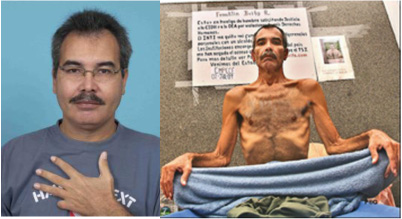
Requiem for Franklin Brito / Ricardo Medina

Franklin Brito. Source: Google Images

The just will remain in memory, and will not fear the onslaughts of evil…

On Monday, August 30, I received a heartbreaking text message from the author of Generation Y, Yoani Sanchez: “Now Chavez has his Zapata,” referring to the death while on hunger strike of the Venezuelan farmer Franklin Brito. The government of Hugo Rafael Chávez Frías had confiscated, through rigged constitutional amendments, the lands that he owned.

So, in six months, was repeated the death of a man on hunger strike, demanding what was denied to them by their countries (Cuba and Venezuela), Orlando Zapata Tamayo, Havana, Cuba, February 23. and Franklin Brito, in a Military Encampment, Venezuela, August 30. Both deaths have shocked the democratic world, especially those who have suffered for a long time the most cruel dictatorship of America (the Castro regime) and a political imprisonment.

I, who witnessed and lived the abuses suffered by political prisoners in Cuban jails for fifteen months and three days, who suffered particularly because of the abuses and beatings that were borne by the martyrdom of the Cuban political prisoner Orlando Zapata Tamayo. Therefore, before this news, after a moment of meditation I raised to God, with tears in my eyes, a fervent prayer for the souls of these two men.

From my priestly vocation I could not support the hunger strike, although I recognize it as a means of struggle and complaint. I also believe that the integrity of the person making it can not be questioned by anyone, let alone a doctrine.

The church teaches us to look after our bodies at all costs, as the abode of God. The scriptures tell us all sins against God the Father will be forgiven, all sins against God the Son will be forgiven, but not sins against the Holy Spirit, whose temple and refuge is your body.

In my prayers I said to my God: “Lord, and those rulers who are NOT capable of acceding to the just demands of these children of yours, who proclaim convenience and Christian times and children of the church, how much of the blame for these martyrs is their share?” At the same time, I dared to gave answers to my Father, saying in this conversation: “I think, Lord, that these dignitaries must atone for their proper three-quarters of those failures.”

Accept, Lord, into your holy bosom, the souls of your servants, Orlando Zapata Tamayo and Franklin Brito and grant them eternal light and peace.

AMEN

Rev. Ricardo Santiago Medina Salabarría

New Farming Push / Luis Felipe Rojas

Photo: Luis Felipe Rojas

Since a wave of new unemployment is occurring throughout the country, domestic initiatives are also being pushed. The state co-operatives do not allow anyone else on their staff or in their plant, and as for the surplus going towards agriculture…we’re going to have to see about that, my friend. Sharecroppers in every corner sharpen their tools and stuff near their homes in order to try to make the land produce. Now, there is a surplus of working hands in the defective state-run system, and the simplest of the working peasants are taking in their urban neighbors.

Rafael, for decades, suffered the scorn of those who thought they were secure at their desks, while he sat on the seat of a truck or at the security checkpoint of a factory.

Today, those who scorned him are sitting at the door to his house, having been propelled to the countryside to find a spot where they can join their peers in the countryside. Since I am not a prophet, weatherman nor an economist, I usually contradict myself: I am betting there will be an individual push; the desire not to die of hunger will make many more look to the land they once trod with disdain to find where the fruit will come from to put on their tables.

The more you press play, the Maroons were more runaways. There is a binge of optimism, this will not release all lines, but will drop some blindfolds and unplugging some ears of stone.

Them more they tighten the game, the more the wild ones push back. It’s not a rash of optimism, this will not loosen the mooring ropes, but it will drop some of the blindfolds and unplug some of the ears of stone.

October 3, 2010

Night of the Witches / Rebeca Monzo

In reality, I like the haunted nights, and once a year a Halloween wouldn’t be a bad thing. But…

Here on my planet, the nights are no longer bewitched, in fact almost all are full of witches or witchcraft. They tell me that to celebrate Halloween in other countries, the children dress up, go out to walk through the neighborhood with their parents, going from door to door looking for treats. Here, they knock on the door at any time of the day or night and take off running, and when you look out to see who’s there, there’s no one. You don’t have any candy for yourself, much less to give away. As for film premieres, when we go out in the streets we can see, without even buying a ticket, several horror films: The Haunted Bus; The Assault in Broad Daylight; The Rage at the Bakery; The Onion Ghost; Life for a Little Trip; In Pursuit of Potatoes; The Chicken Pilot, etc.

Tobe dressed as a witch or a demon, is nothing out of the ordinary, in fact it’s a daily thing. At least these are the references copied from video clips. So tomorrow will not be an extraordinary day on my planet. Witches and warlocks will head out into the streets, to face our daily demons.

Happy Halloween to all of you!

October 29, 2010

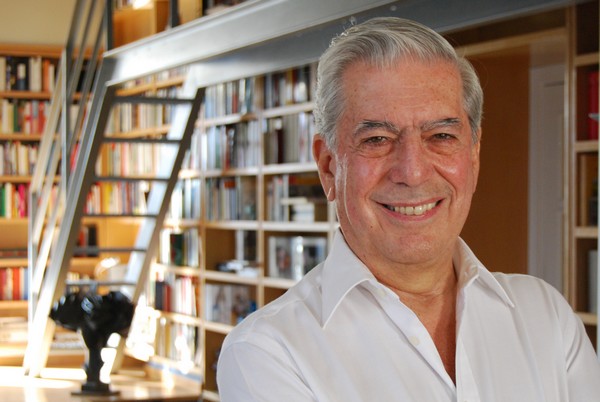
Chronicle for Mario / Iván García

In the Havana of the ’80s, many of us young people were living without a future. Between guitar chords and conversations, at the foot of the bust of Jose Marti, at the entrance to the La Vibora Institute, we gathered at night to drink alcohol diluted with water, which cost 5 pesos a bottle from the house of a black woman, Giralda.

I took a blow. I don’t remember what the dissident picketing boys were protesting with a way of life that tried to turn us into Revolutionary leaders, but I borrowed a book by Mario Vargas Llosa, covered with a photo of Fidel Castro smoking a cigar and laughing like a hypocrite.

It was the City and the Dogs. At that time, so as not to attract attention, people used to cover the “banned” books with Revolutionary covers. I read it in one sitting. And now I confess I never gave it back. I was seduced by the Peruvian writer to the point that I have reread it at least ten times.

Later, when they threw me out of History class because I disagreed with the professor when he assured us that, for capitalism and the Americans, their days were numbered. I went to the school library. Hiding there, I read The Green House, published in 1965, the year I was born.

Nearly two decades later, one dark and warm night, I was going home when a police patrol, after searching me and checking my ID, with a big heavy Russian flashlight, reviewed in great detail the book I was carrying.

“Whose book is this,” asked the angry nervous officer. I thought of answering that he could see with his own eyes who the author was, but he was in a bad mood and I didn’t feel like sleeping in a cell at the police station that night.

“The author is a friend of the Revolution,” I lied. “He tells the story of an attack on Trujillo, the Dominican tyrant.” It was the Feast of the Goat. The cop looked me up and down disdainfully, and then threw open the door of his Russian Lada and told me, “Disappear mulato, the oven’s not for cupcakes.” It was March, 2003.

Eight years earlier, in 1995, I had started as an independent journalist at the Cuba Press agency. In this time I’ve had a number of inspirations. My mother, Tania Quintero, who gave me her love of journalism. Raul Rivero, poet and teacher of the craft, with his agile prose. Reinaldo Escobar, deep and analytical. Luis Cino, for his culture and mastery in Spanish. Claudia Cadelo and Laritza Diversent, two blogging lionesses.

But there are some special people who engage me to the point of delirium with the way they write.

At first, I tried to imitate them but over the years I learned that the bar had been set too high. Gabriel Garcia Marquez and Carlos Alberto Montaner are two of those. Mario Vargas Llosa is the other.

October 29, 2010

Orphaned From Journalism (Part 3, Final) / Ernesto Morales Licea

I do not think there is better way to weigh the worth or the worthlessness of the media in a country, than to carefully analyze what they themselves do.

Like few other jobs in the world, journalism has a peculiarity which at times is its own worst enemy: its raison d’etre is public consumption. No other profession is as visible, as this mass communication, where millions of brains interpret and evaluate the product you have offered for their consideration.

In the case of the Cuban press, the manipulation of information, concealment of events of interest to society, and the total absence of critical views or in-depth analysis of the political and social framework that governs the destiny of the island, represent some of the characteristics that could be seen as increasingly visible endemic ills.

For each of these points, the same newspapers we read every day, the same National Television, offer endless arguments that at times, rise to the level of attacks on the intelligence of the media consumer.

Let’s look at a few examples.

A CERVANTES PRIZE FOR A SAD TIGER

On April 27, 2009, the Holguin newspaper posted an article signed by Petra Silva Cruz, entitled The Two Cuban Cervantes Prizes.

In this article, the author briefly reviews the life and work of two immortals of Cuban literature: Alejo Carpentier and Dulce Maria Loynaz. Both were awarded the highest recognition of Hispanic literature, the Cervantes Prize.

After perusing it, the reader is left stupefied by a brief — brief but of staggering proportions — omission, a paradox worthy of comic theater. It so happens that the Cervantes Prize has been won by not only two, but three Cubans. Three. And the third is a child of the same province as this newspaper, Holguin.

Guillermo Cabrera Infante was born in 1929 in the Holguin village of Gibara, which is also famous for supposedly being the first place that Christopher Columbus set foot in his discovery of the island

Cabrera Infante was awarded the Cervantes Prize in 1997, and his novel Tres tristes tigres (“Three Sad Tigers,” but renamed in translation: Three Trapped Tigers) is generally considered a masterpiece.

So why has this man, considered a master of contemporary Latin American narrative, been so blatantly robbed of his Cervantes Prize, and that by a newspaper which — carrying the absurdity a step further — represents the region of his birth?

It’s very simple. Because to be Cuban, according to the official press, is to support the system and the government. Both have the uncanny ability to strip the citizenship of those who are disaffected, successfully re-baptizing these people as “stateless” and “traitors” for their choice to disagree with the official party line.

As a consequence, therefore, there is no media outlet in this country where one can mention the name Guillermo Cabrera Infante.

But as it would be too much to ask the triumphalist propaganda not to refer to the two Cervantes winner who remained in the Island, the awarded tigers are reduced to two with no concern for the veracity of the information, an insult to journalistic decency.

A BASEBALL GAME THAT NEVER ENDS

Baseball World Cup in Havana, 2003. Fighting it out for a place in the semi-final were two opponents who played with real passion: Cuba and Brazil.

The course of the game was worthy of a Hollywood script, with spectacular plays, last-minute photogenic fly balls, and nerves stretched to the point of delirium.

Now Cuba has the opportunity to leave Brazil on the field: it is the 9th inning and the stellar Yulieski Gourriel reaches third on a triple setting off a euphoria from one end of the Island to the other.

But the game is not yet won.

Next up is another prodigious player. His name: Kendry Morales. (Currently he is the star first baseman of the Anaheim Angels in the American major leagues.)

His phenomenal home run stops physical time for Cuba’s fans. The film of his figure rounding the four bases is repeated ad nauseam on national television.

But something unexpected was about to happen: Shortly thereafter, Kendry Morales left the country en route to his dreams of playing in the American majors. His departure from the island took place just before the National TV sports journalist, Julia Osendi, was to present a flowery piece about current events in “revolutionary baseball” on the TV show The Roundtable.

I am sure it could not have been easy for her. She had to talk about the 2003 Baseball World Cup, and its most electrifying game: the one decided by Kendry with his spectacular home run. But in her report, she only mentioned the triple by Gourriel. The home run hit by the former player from Cuba’s Industriales team never happened.

To be allowed to present her work, Osendi had to vaporize the same athlete whom the entire country had loved with a passion, on behalf of a political precept that considered him a deserter and an enemy, and therefore someone who could not be mentioned in the media.

Judging by this story, once Kendry is erased from history, Yulieski Gourriel is still standing at third base, waiting for a cleanup hitter to drive him home. The game is not yet over.

IDENTITY THEFT

I am sure that future researchers seeking to conduct a sociological assessment of this Caribbean island, through the newspapers preserved in libraries, television news reels recorded on old tapes or digital copies, will be faced with a dilemma: Accept as valid the historiographical material, adulterated, incomplete, and warped to accommodate the political interests of the national press in these times; or resort to the true chronicler of our recent history: Art.

In the History of Cuba that I want to read some day, it will be awarded to art, to the artists of this country, to provide the reference points and social analysis that by definition should have belonged to journalism.

Why? Because it is only through a handful of films and documentaries, reckless songs (which would cause their singers to be banned), irreverent novels (whose authors would be officially banned), that a Cuban can find a representation — good and bad — that he can identify with.

Only through plays which would be quickly be censored, through art exhibitions closed down, has an entire country managed to express itself in a more or less public way without the support of a responsible and incisive press.

What has brought this about? A substitution of identities, where, even though it is art that has been tainted at times with too much social criticism, Cubans have found voices that finally say what the media has been shamefully silent about.

Cubans have had to flock to theaters to hear the incendiary words of a homosexual discriminated against, expelled from his country, for daring to prefer strawberry ice cream over chocolate. They must read the novels of Pedro Juan Gutiérrez, the stories of Ángel Santiesteban, the testimonies of Amir Valle, to find a reflection of reality flooded with beggars, prostitutes and rafters, because from national television’s viewpoint there are only permanent headlines of exemplary workers and production plans far exceeded.

The conclusion in this respect was given to me by the singer-songwriter Pedro Luis Ferrer in an interview that I conducted just two years ago. To my question about why one finds more information about his rift with the Cuban government than about his musical career, the artist replied:

“I accept it as an inevitable phenomenon: in places where the press doesn’t play its role, and doesn’t say the things that have to be said about politics or the economy, people substitute values, and they approach art to find the news they cannot find in journalism. Consensus sites are created in art, while they should have been created in other areas.

“To change that would require politicians to do what they have to do. And journalists and economists do what they have to do. And then it would not be necessary for Pedro Luis Ferrer to say in his concerts and interviews what, by definition, should have been theirs to say.”

FINAL BALANCE OF THE ORPHAN

A people orphaned from journalism can not be healthy enough to build a just society. A society which is, as Jose Marti, the Master, said, “With All and For the Good of All.”

A public orphaned from public debate, creates a place where the alternative media (blogs, underground musicians, underground television serials) have gone on to become essential for the information-hungry city, which has no real tools to generate plurality of thought. Much less democracy.

The dull and obedient journalists in Cuba carry on their shoulders the responsibility for what we now, regretfully, see: a society incapable of civilized debate. Those journalists must take the blame for the mental deformation that has made Cubans a people without the will to value even our most elemental human rights.

I believe that within a people so orphaned from journalism, the voices from alternative platforms, with huge dangers and threats, with good decisions and regrettable deviations, have carried the weight of national and international information, and one day could be accepted as the bright spot in the darkness, the Yang within so much Yin.

I refuse to be pessimistic, but around me, for now, I can not see any other examples of real journalism, free and consistent with the social reality.

September 1, 2010

Ivan The Terrible / Luis Felipe Rojas

Photo: Luis Felipe Rojas
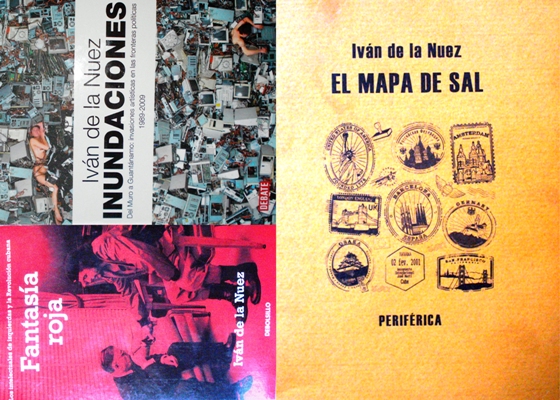
I met Ivan de la Nuez one day in February of 1998. It was in Holguin, and he wasn’t present but someone gave us a catalogue of an exposition which he had displayed over at Barcelona. I had quickly read it on the Cuba Gazette multiple times. But now, I’ve received three of his colorful books wrapped in nylon: “Three Messages, Three Suggestions, Three Literary Cartographies to live without Fear, or to at least hold hands with someone who will guide you through the anxieties we live with today”, “Where do we live?”, and “Who brought us to this catastrophe known as post-communist Cuba”. They are answers that are found attached to the pages of these books. Out of all them, the one which most interests me is the boldest of publications, the book called “The Map of Salt”, now nearly ten years after its publication in Periferica. After a decade of circulating through the hands of readers all over the world, it has arrived in a dark provincial corner of this island. And that’s how the paradoxes are, the pretexts, the destinies. Since Ivan has proposed to dismantle the myth of insularity and the supposed national identity, to dismount them in the sense of discovering them, removing the veil, the sequin, and the false hieratic pose, he has then attempted to build over the very salt and ruins of what we are today.

They are a set of magnificent essays. Matias Perez, the legendary character from Havana, the National Anthem mixed with individualistic insinuations (not as a warlike march), and an imported reference to Che Guevara, all parade before the cynical and sarcastic prose of Ivan. The expressions of those identities, in the words of Hanna Arendt, go beyond any physical marks — I’ll remember that always.

The Map of Salt which De la Nuez would return to the world a decade ago was intended to continue showing us the path of new discoveries of disillusion, apathy, and the rejection of a unitarian national mark of being Cuban, and has returned today, with much more strength. This is the map of an observer who has been left awestruck before all the events of the last 20 years, and has changed the iconic Korda photo with a hairy Che amidst the breezes of Havana in the 1960’s with a dead guerrillero in a laundry room of La Higuera. The socialist world, eaten up by its own rodents, the New Man that Guevara himself wanted, forced to fill out immigration papers which deny a world open to everyone, and a socialist youth, supposedly limpid, forced to eat at McDonald’s (symbol of “wild capitalism”) because of the rationing.

It’s a good attempt by Ivan, trying to recover his life right at the point where his dream was crushed. It’s the best possible reason to celebrate the ten-year anniversary of a book we could barely find in Cuba, that Map of Salt that we couldn’t taste back then, but which is given context by the deficiencies of our nation. For now it’s enough to be able to read his Red Fantasy (published by Debolsillo, 2010) and Floods (Debate, 2010), with the certainty that one is attending a first act. Half a year is nothing compared to five centuries of delay.

I invite my readers to reach out to Ivan (who isn’t so terrible). To read his books, which are a reconstruction of that traveler we all are, carrying the island on our backs… or maybe to just ignore him. Who knows.

Translated by: Raul G. and Xavier Noguer

September 7, 2010

Empty Hallways / Yoani Sánchez

Ministry of Agriculture building in Havana

Ten in the morning. In those hallways where last week people gathered and chatted during working hours, today not a soul passes. What happened in the seventeen floors of the Ministry of Agriculture that no one steps foot outside their office? The answer is simple: Many fear being on the list for the next cuts, so they avoid appearing away from their posts and thus seeming to be dispensable. Where before they roamed around the office, arms crossed, the strategy now is to look busy, even if it means having to sit behind one’s desk for eight hours.

This scene is not an exaggeration. A friend who works in one of these state agencies, where over-staffing is a chronic disease, described it to me. She explained that there’s not even a long line in front of the water cooler like there was in the past, but that not even that will save them from layoffs. The institution has told them that only those who are indispensable will remain and some have already been notified of their dismissal. My friend squints her eyes and laughs. “They are certainly not going to kick out the director, nor the secretary for the nucleus of the Communist Party, and much less the woman who runs the union,” she concludes, sarcastically.

I’m surprised by the mixture of fear and disdain with which Cubans have taken the drastic reductions in personnel already implemented. On the one hand no one wants to lose their job, but on the other there’s a feeling that unemployment can’t be worse than working for the State. When I recommended to my friend that she take out a license to become a self-employed button-coverer, or a coat-hanger maker, she jumped up from her chair waving her hands, No! No! “If my name is on the next list,” she said, “I’m going to create a scene that will be heard in the office of the minister and every hallway.” But I don’t believe her; like many others she prefers to hide her protest.

October 29, 2010

Orphaned From Journalism (Part 2, Almost Final) / Ernesto Morales Licea

If someone were to ask me, what is the principal weakness, the most glaring problem suffered by Cuban journalism today, I believe I could summarize it without hesitation: It doesn’t resemble Cubans.

It doesn’t resemble anyone. Neither the audience to whom it is addressed, which recognizes less and less these triumphalist news items they read and hear everywhere, nor does it resemble even those who fabricate it. I, along with Leonardo Padura, also believe that there are great journalists in this country — as there are great practitioners in nearly all our social spheres — but they lack a medium in which to practice.

Bearers of the word are not lacking. What nobody sees around them is a democratic platform in which the word is free.

A first element to consider is the distance between the reality reflected in the media, and what every Cuban knows from his own experience starting from the time he opens his eyes in the morning.

The newspapers talk about exceeding targets, labor efficiency, clever methods of cultivation in agriculture, and the same reader who follows the news with his eyes, then has to ask himself through what loophole did the food evaporate, that food the media promised would not be missing from his table.

Cuban Television has patented a macabre cliche it repeats every year with manic precision: All the conditions are guaranteed for the start of the new school year.

We’re already coming to the end of August; it’s only a question of days until the phrase is heard on National Television News.

The journalists, adapting their rigorous questions to comply with the directives of whatever sphere, without going into great detail, without conducting an interview, reproduce the complacent (and often false) words of some officials who announce the upcoming opening of Cuban schools will occur without any mishaps.

What then do the hundreds of thousands of students who walk the halls of the high schools, the universities, find on the first day of the school year? They find a desolate landscape lacking chairs, tables and blackboards; unmotivated teachers discouraged by the lack of current literature needed for the curriculum.

The list of similar differences is endless.

But I think there is a central issue that, in my view, is the principal fault of Cuban journalism, and its professionals.

Zero coverage

How many issues vital to the public welfare and national public opinion have been ignored by the journalists in this country? How much information has been withheld from the citizens who consume what the media tells them as their only possible way of understanding the national and international reality? How unprotected have national analysts left a people? People whom they should defend and protect with their questions, faced with their totalitarian leaders entrenched in power for life?

A perfect example of this would be the uncompleted history of an event that is taking place on the Island today, and about which the rest of the world possesses much more information than the people who live where the event is taking place.

This is the release of prisoners of conscience imprisoned during the Black Spring of 2003. The well-known 75.

What has been the media coverage inside the country of this event which would be socially important in any country in the world? None. Zero. The totality of information available to Cubans from the officially controlled media, has been the trifling note published by the Catholic Church in the Granma newspaper, when the prisoner release was made official. A note, to paraphrase Garcia Marquez, whose wording served not to tell but to hide.

The international media reported extensively today on the release process — and later the exile — of these independent journalist; and in Cuba, the country’s owners continue to speak of apocalyptic nuclear threats, the tension in the conflict with Iran, and books about the guerrilla adventure in the Sierra Maestra.

Stunning, startling disinformation.

Three Examples of the Information of Bewilderment

Taking as a reference point that note published by the Cuban Church on page 2 (inside) of the newspaper Granma, we can deconstruct a trend in the media that has been verifiable for too many years.

Something we could call information about the confusion.

It would be presented something like this: an incident takes place on this Island of Events. The official media (which is all the media there is) look elsewhere, and Cubans, well trained in the exercise, must appoint themselves — it’s never been said better — to clandestinely ferret out the desired information.

However, later, for reasons of political expediency, the establishment decides to respond to some kind of international media pressure. And does so from its media. That is: from ALL its media.

But as connecting to the Internet is an impossibility for the reader, he can only read Granma or Juventud Rebelde (Young Rebel) every morning, sometimes wondering what they’re talking about in these articles which, logically, make no sense.

Here are three recent examples.

1. One day young Eliecer Avila from Las Tunas, from a packed room at the University of Information Sciences (UCI), challenges the president of Cuba’s National Assembly, Ricardo Alarcón de Quesada. First the BBC and then the whole world are talking about it: a young computer science student had the unfathomable courage to ask uncomfortable questions, and to publicly demonstrate his disagreement with the head of his parliament.

Who heard about this in Cuba? Only owners of a computer, with a USB port-connected DVD player, the friends of friends who could access the video. The Cuban press remained absolutely mute.

When they wanted to “disprove” before the whole world that there had been any dissent from this young peasant activist, National Television headed off at full speed to his eastern hometown and stood him before the cameras where he confirmed his support for the Revolutionary process.

The problem was, he was providing follow up to an event that had never been reported on national television.

2. In 2007, a prominent intellectual signing himself James Petras published, together with Robin Abaya, an essay entitled Cuba: Continuing Revolution and Contemporary Contradictions, a serious analysis of the Cuban reality.

Both Petras and Abaya are recognized as comitted intellectuals of the Left. But like so many academic progressives, they tried to defend a social model which is impossible to subject to rational thinking.

Ignoring the stagnation of a country that, like the pillar of salt going back to Sodom has not advanced for decades, is something that requires great persistence from mentally handicapped people, but not from men with their own ideas.

But we all know that admitting criticisms, wherever they come from, has not been a tradition in this land of dreams.

A few days later, Fidel Castro reappeared on the front pages of all the newspapers, and made speeches on all the radio and television newscasts, with a Reflection entitled The Super-revolutionaries, which was an apparent reaction to James Petras’ and Robin Abaya’s article.

The huge percentage of Cubans, completely uninformed about what he was talking about, totally unable to access the original article, could not understand what this exposition of the Comandante was all about.

3. Last, but not least: A poor man dies a grisly death in a hospital in my country. He dies of hunger. Having begun his strike from Kilo 8 prison in Camagüey, 86 days later he stops breathing in the General Hospital of this same city. His name is now sadly famous, Orlando Zapata Tamayo.

Of him, of his martyrdom while he was still alive, very few Cubans knew anything. A few activists from opposition parties knew of him, as did the privileged ones who have access to the Internet. No one else.

The rest of us Cubans living on the island learned of this painful case more than a week after his death, when National Television received the order to counter the huge wave of international protests that were beginning to spread with an awesome force.

I was one more of those taken by surprise, one more of those dismayed with what seemed like something taken from a horror fantasy; and this had just happened right under our noses without a single decent journalist being able to inform his people of the disgrace. A national journalist delivered an embarrassing report on primetime news which simply slandered Zapata Tamayo, manipulated his story and bent the news to the will of the journalist.

The reporter told us that Zapata had been treated at the hospital, never mentioned that he had been on a hunger strike, nor even that he was a prisoner. It was a story that began with the last days of a man whose previous acts we were not given to know.

A journalistic aberration

I cannot describe today the feelings of pain and overwhelming impotence that overcame me after contemplating this material. Minutes after seeing it I wrote an article titled The Death That Never Should Have Been, which is still circulating on the web.

I believe that was the decisive article that led to my expulsion from Cuban institutional journalism.

Julito’s Dream / Rebeca Monzo

My friend tells me that he arrived late and tired to his house, and he leaned back on the living room sofa.

Then his usual friends started arriving. He led them to the basement, where his cellar was. Three spotless rustic tables and benches were all the furniture of the room, which had a very pleasant ambiance thanks to the Spanish bodegón decor.

Soon the three tables were taken. On the tables were various kinds of tapas, full of ham slices, cuts of Galician chorizo, anchovies, eel al ajillo, and delicious Spanish tortilla. All of these were paired to the excellent wines.

Cachita, a regular at the place, possessed maybe by the spirit of a Spanish dancer, left the bench and started dancing and applauding between the tables. Soon everyone was singing in unison. As the bottles emptied, the heat went up. Everyone laughed, singed, and partied, expressing all the joy that a Rioja wine can give. Suddenly, two police vehicles arrived, called maybe, by a resentful neighbour who wasn’t invited. When the police officers opened the vehicles’ doors to push the cheerful guests in, Julito, shaking his head and leaping off the sofa, woke up: Everything had been a dream.

“Only in dreams,” he told me. “How could I have a small business at home, even if I were authorized? Where was I going to get the hams, the wines, and everything else ? Maybe I could have the tortilla, but sometimes you can walk the whole city and not find potatoes. If they liberalized private businesses for real, I could import the wines and the charcuterie. But they will never do that, at least not during this regency. Anyway, for as long as I dreamt, I had fun. Dreaming doesn’t cost a thing!”

Translated by: Xavier Noguer

October 28, 2010

Orphaned From Journalism (Part 1) / Ernesto Morales Licea

Just recently I discovered with regret that I had only one task pending in my passage through the institution of Cuban journalism. A yearning that had been building since my feverish college days maybe five or six years ago.

That is, to attend as a delegate a National Congress of the Union of Cuban Journalists. A difficult undertaking for someone who was not linked to this organization of the Cuban press, and who was not a member of the Union of Young Communists.

It so happens that these congresses stir in me an irrepressible curiosity which, clearly, I can no longer satisfy first hand. Like secret organizations, like the rituals of mystical sects, this meeting where specialists would gather to discuss or analyze a profession that does not exist in their country, seems to me an exotic thing worthy of having lived through and immortalizing in marble.

It would be the same to me if Cuba decided to hold a National Symposium on Eskimo Culture.

To speak without shame about journalism, in a country that has killed its essence, can only be understood as a cruel irony. In any case, it has not lost its attraction for me, nosy person that I am.

I think had I been able to get myself a seat I would have played an amusing game of suppositions. The game would have been this: guess, behind the poses of the meeting, which of these royal colleagues were the ones who thought of themselves as the paladins of information in Cuba, the ones who slept soundly thinking themselves the defenders of the public truth; and which only played the role to survive, knowing in their heart of hearts that real journalism was much more than obeying directives without any opportunity to ask questions.

Because yes, contextualizing a phrase by Pedro Luis Ferrer, there is a question I haven’t stopped asking myself from the moment I became a communications professional in Cuba: are many of the journalists of this country aware of the past that awaits them?

Are they aware of what it will mean, in the future of conciliation that I want to imagine without bitterness or violence, to read what they wrote, full of lies or hiding the truth, repeating the slogans of the tabloids; hearing themselves on the radio energetically supporting decisions which, in the privacy of their own homes, they criticized just as much as everyone else? Seeing themselves applauding in front of the television cameras while listening to speeches they didn’t even want to attend?

I’m speaking not from the point of view or distance of someone who has long since lost contact with our reality. I speak with the knowledge of someone who knew the circumstances, who until just a few months ago talked ad nauseum with my journalist colleagues, believing in our bonds of friendship and listening to revealing testimonies about the blatant and cruel hypocrisy that surrounds journalism in my country.

Any time you evaluate a phenomenon as complex and diverse as communication, in a country of exceptional conditions, multiple possibilities always present themselves, inviting us to dissect the various parts of Cuban journalism. Looking inside one of the leading causes — I say this without hesitation — of the strictures of thought that the society in which I live suffers today.

Just a starting point

I don’t have to make any special effort to remember the initial event that made me question, honestly, the world I was about to join. It happened in an editing booth at the local television station in my province. The year was 2004. I had just turned twenty.

A well-known colleague was editing some material about the single comparison most recreated and manipulated in our national history: Cuba, gray and weighed down, before 1959, vs. Cuba resplendent after 1959. The voice over emotionally narrated the transition, from darkness to light.

But an unforeseen delay threatened the program: the presumably ancient images of the impoverished nation were nowhere to be found. They had looked through all the files, in vain. The documentary had to air the following day.

That journalist’s solution is something I will never forget. She probably will.

She extracted a cassette from among her things. She mounted it and told the editor to capture what came next. Before us was a succession of images of malnourished children with distended bellies, ruined houses threatening to collapse on the camera itself, mud and misery, hunger in hundreds of faces, people in rags, skeletal dogs eaten by scabies.

I was struck dumb. Not by the gruesome impression of the scenes before me, but by my sense of what the journalist was about to do.

The images had been taken (I believe for internal consumption within certain political circles) a week ago in a rural village called Rio Cauto in the province of Granma. The color of the DVC Pro camera they had been taken with revealed their currency. This was no problem, however, for the cubicle with the latest editing software.

Removing the color was the work of seconds. The editor said nothing. Soon the same hungry faces emerged, the same third world landscape, but now in the black and white of a distant past, to which, according to the material, we should never return.

The voice overs of that journalist, now an icon in the local press, spoke of the misery of living on the island before 1959, while images taken just a few miles from home the week before, flashed on the screen. Minutes later, the montage displayed the rebirth of the country in colorful scenes of smiling healthy children and the openings of new buildings.

I didn’t have the courage to watch the film, the following day, when it aired in primetime.

August 22, 2010