Trafficking or Theraputic Use? / Miguel Iturria Savón
 While the international press spreads the case of the American contractor Alan Gross, held prisoner on the island for supposed espionage, and lodged a year ago in a special room of a Havana military hospital, another US citizen survives in a wheelchair in the Combinado del Este prison in Havana. He is Chris Walter Johnson, he was taken prisoner at the Rancho Boyeros airport in August 2009 and tried on this past 26th of December 2010.
Chris Walter Johnson wasn’t contracted by any US agency nor was he in contact with the Jewish island residents who today deny knowing Alan Gross. A decade ago, he came as a tourist and enjoyed the sunshine, the girls, and the other kindnesses of the tropics, including marijuana, which he consumed from adolescence in Los Angeles, California, one of the states of the American Union where you can acquire it by medical prescription and the authorities are betting on its legalization.
The citizen Chris Walter Johnson, 58-years-old, is a ship captain and owner of a small fishing business. In ten years he traveled twice to Cuba, where he cultivated friendships, had girlfriends, and a daughter.
Chris’s disgrace began in July 2009, on meeting a Cuban married to a Mexican woman, who proposed that they go to Cancún to buy clothes. Besides clothing, they acquired a kilogram of marijuana, brought in by Chris in a jelly jar and in a bag placed in his underwear. On returning, the Yankee sailor made things more complicated by offering the Customs officials who detected the drugs at the Havana airport two thousand dollars. Instead of returning to the hotel, he was lodged in La Condesa, a prison for foreigners, accused of drug trafficking and attempted bribery.
The accelerated deterioration of his health motivated Chris’s transfer to the hospital for inmates located in the jail at Combinado del Este. There he waits in a wheelchair, among sick murderers, the pains of an old diving accident, depression, and hope.
An MRI detected that Chris suffers a tumor lesion in his medullar canal, which requires surgical intervention. He suffers, besides, from degenerative disk disease, positional vertigo which prevents him from standing up, and osteoporosis. The medical commission which examined him believes that, because of these problems, Chris Walter Johnson is not compatible with the regimen of imprisonment. His clinical chart was analyzed in the trial which took place this past December 27th.
After a year and four months of being locked up, the case of Chris Walter Johnson was adjudicated and awaited sentencing. The prosecutor asked for 20 years imprisonment, but for his deplorable state of health it is possible that in short order his furlough or expulsion from national territory could be ordered, but between Cuba and the United States there is no agreement that regulates extradition.
 Perhaps Chris may not be one of those thousands of patients who invent reasons to obtain prescriptions for marijuana in California, one of the 13 states in the American Union which is betting on the legalization of this recreational drug, which produces a state of relaxation and serves to treat glaucoma, diabetes, depression, multiple sclerosis, and chemotherapy side-effects among other things; but at the same time it is contraindicated for diverse conditions such as headache, chronic bronchitis, etc., which also produce lesions in memory. God willing you recuperate outside Combinado del Este. Happy 2011, Mister Chris.

Translated by: JT
January 11 2011
Voces 4: Unstoppable / Miguel Iturria Savón
As an end of year gift, the fourth edition of the magazine Voces is now circulating on the ‘Net, located at www.vocescubanas.com/voces and presented this past 26th of December in the apartment of Yoani Sánchez and Reinaldo Escobar, founders of the Cuban Blogger Academy, which has published these pages without censorship since August, far from official mandates and political factions.
In the same way as the previous issues, Voces bets on the freedom of expression from a position of freshness and originality. Its format includes texts from 20 authors on 60 pages, with cartoons by Belén Cerros, blogger “La Vida Agridulce”, the index and back pages designs of Rolando Pulido, and composition in the care of writer and photographer Orlando Luís Pardo Lazo, responsible for drawings and figures that match up games with letters, arrows, and numbers that create suggestive blank spaces which compensate for the simplicity and absence of sections, footnotes, authors’ notes, and editorial fluff.
Voces 4 deals with themes and figures that cover the vastness of interests of those who approach the Cuban from cyberspace. Exiled and unexiled voices that measure the island’s space in its connection with the world: social, political, and cultural problems, poems, book reviews, narrative pieces, chronicles and current analyses, such as “Truth as Life’s Logic”, which constitutes the communique-denunciation of Hip Hop Patriot Squadron, with which the magazine ends.
It starts with the essay of Vicente Echerri “About a Fractured Identity”, which analyzes the destruction — and the transformation — of the Cuban nation, the identity to which we cling; the abolition of the social contract and other problems that change triumphalist visions of the island’s future.
The sociopolitical theme is approached with critical and polemic sense in texts such as “Cuban Socialism: Juggling At The Edge of The Abyss”, from Reinaldo Escobar, who reports on General Castro’s discussion before the regime’s Parliament; “In Defense of Wikileaks”, from Ernesto Fernández Busto; while Iván de la Nuez offers “Politics: Humanity’s Heritage?”, while Rosa Maria Rodríguez Torrado chips away with “The Honey of Power, Reforms, and Plantation?”, and José Gabriel Barrenechea asks “Is Reform Beginning?”.
Poetry, better dealt with than in the previous edition, brings us four unpublished works, two from the dramatist and narrator Abilio Estévez, who bequeaths “Of the Gods/Of the Tightrope Walker”; while Feliz Luis Viera gives us two unpublished poems from “The Fatherland is an Orange”, one about whores and the other around the notion of a fatherland.
The diverse narrative gallops through the testimony of Yoani Sánchez (“Country Girl of Havana Center”); the travel chronicle “In Puerto Plaza, Without a Visa”, by Armando Añel; the story “In the Office”, by Mabel Cuesta, and the fiction of Omar Alfonso Requena — “A Probable Vasumitra”. Jorge Enrique Lage’s “Flash Forward”, the 12 posts of the anonymous Zorphdark and 19 untitled vignettes from Orlando Luís Pardo Lazo, who fantasizes about his encounter with Aki, a Japanese girl who serves him under the pretext of offering her enlightening writings about love and existential aloneness.
Voces 4 includes, in its turn, four pieces of literary and cultural criticism. Tania Favela broaches “The Temptations of Lucio Gaitán”, reviews the book “An Old Trip” by Manuel Periera; also described by Eliseo Alberto, who dedicates the title “Favorable Wind” to it. To Miguel Iturria Savón is owed “The Carnival and the Dead”, about the novel of the same name by Ernesto Santana, Kafka Prize of 2010. While Néstor Díaz de Villegas surprises us with “The Philosophy of T-Che”, where he compares the legend of Jim Morrison — “false idol of a liberation theology” — with the market imperatives that the images of Che, Scarface, and other contemporary icons impose.
Translated by: JT
January 12 2011
False Unanimity / Iván García
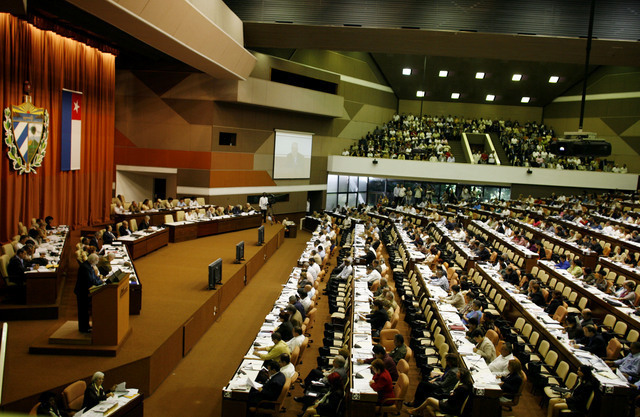
Either President Raul Castro is deluding himself or he is trying to deceive Cubans. One of the two. Let’s give him the benefit of the doubt.
If Castro the Second is pretending to be sincere when he speaks with severe disgust about the artificial unanimity and complacency practiced at all official levels in the country, then he should implement, once and for all, the long-heralded “revolutionary democracy.”
It’s a contradiction. The General shakes with rage before the final vote, which is feigned and compliant, both in the Parliament and the Council of State. But then, when the time comes to raise a hand, everyone, absolutely everyone, votes in favor of the proposals put forth by the government.
I don’t know of any deputy to the National Assembly who has suggested a single project agreed to by the citizens he represents. In no session of the boring and monotonous national parliament does anyone dare to propose economic methods that are different from those offered by the chiefs in olive green.
In Cuba, the opposition departs from the government line. It is the only one qualified to offer and provide solutions. The Communist Party and other social organizations are merely bystanders, a well-tuned chorus.
It’s amazing that the 611 deputies agree on the shape and design with which they intend to revive the depressed national economy. Not one single deputy disagrees or has doubts. At least publicly.
It can’t be said that Cuba is the most democratic country in the world when everyone in the government accepts any law or project with his head down, applauding. The executive branch is the one that curtails discussion of differences, by permitting only “constructive criticism.”
Of course, the deputies and party members are afraid to come out against any proposal that has the approval of the Castro brothers. Non-acceptance of the laws and wishes of the hierarchy can mark them as undesirables. Or worse, as counter-revolutionaries, a sure passage to hell in the revolutionary island paradise.
The only ones who openly criticize and put forth different proposals are the opposition and independent journalists. Some might be unrealistic. But if the government at least would hear or analyze them, you might have more elements on hand when making laws that affect all of society.
It’s easier to disparage the dissident movement. The big problem with Cuba is to break in a real way, not in words, the false unanimity of the state representatives. Discrepancies enrich dialogue, according to Raul Castro.
But in practice, they prefer to listen to the instrumental music, without fanfare and pleasing to their ears, played by their followers in the forums.
If they really want to stir up the system and hear truly critical voices, they will have to acknowledge the dissidence, which exists in spite of everything. And it’s not unanimous within itself; on the contrary. Therein lies a healthy difference.
Translated by Regina Anavy
January 10 2011
Unfinished Business / Miriam Celaya

One year goes out and another comes in while the exact classification for much “unfinished business” in the excessively long Cuban dictatorship fail to get a mention. And as if that weren’t enough the well-known major doubts — those that relate directly to the old yearning for freedom, democracy and human rights, as necessities that ever more Cubans demand — the regime still owes us answers to specific issues that arose, in the complex national life, in the year just ended.
For my part, I can’t help but remember that soon it will be one year since the tragic death of dozens of mentally ill patients at the Havana Psychiatric Hospital, known as Mazorra, in subhuman conditions and circumstances that have never been clarified, despite official announcement of “a commission to investigate the facts.” Of course, like all commissions here, this one is anonymous.
Curiously, the unfortunate crash of an Cuban Aerocaribbean plane in the center of the island in which 68 people — mostly foreign tourists — lost their lives in the last quarter of 2010, has already been investigated and explained, with the results published in the national press. True, the sad lunatics of Mazorra were all Cubans, which could be a determining factor in this case: the crazies are of little interest to anyone; and if, in addition, they are national crazies, they seem to be unimportant even to Cubans who indifferently pass by, believing they enjoy mental health. The average Cuban suffers from a ferocious amnesia… about anything that doesn’t affect him directly; so the government maintains the right to continue, without the slightest embarrassment, its display of solidarity on health care with other countries in the world, and what’s worse, it continues to be praised and recognized by international organizations which, it seems, are as insensitive and amnesiac as the people here.
The other matter pending which I want to refer to today is the release of the political prisoners of the Black Spring who remain imprisoned after the unmet commitment by the dictatorship to the Catholic authority and, thus, to Cubans. These are the prisoners who have refused to leave the country, those who reject exile, those who will not surrender. Everything indicates that the Cuban government, like the senior Catholic hierarchy on the Island and the brand new mediator of the occasion — the Spanish government — have agreed to to cover the unjustified prolongation of the euphemistically called “process of liberation” with a pious mantle, take a break, and quietly celebrate their Christmas: undoubtedly 2010 turned out to be, for them, a tremendously hectic year from the political point of view. The cardinal, for his part, had the kind charity to officiate at a mass in La Habana prison, Merry Christmas! It must be an almost burlesque phrase in that place. Perhaps the anointed also trust in the enduring Cuban amnesia will exonerate them of all charges. Or perhaps they have been infected with the same disease?
January 4 2011
From the Hand of Kafka / Rebeca Monzo
 I’m sure if this gentleman were alive today, on my planet, he would write of local customs.
I went with my friend Regina to the Veterinary School, because her puppy needed emergency surgery. I did not want her to have to undertake this sad errand alone.
It had been many years, thank God, since I had been inside this campus. On arrival, the impression was horrible: the state of abandonment, deterioration and filth hit me. Who is last in line for surgery? I asked. I immediately marked our place behind a lady carrying a little sata puppy with a strong demo. There was a German Shepherd with an ingestion of pork, and a cocker spaniel puppy with the same. It was still very early. Later the line swelled with the new patients arriving. One was brought in a wheelbarrow used for construction materials.
When we got ourselves organized and were waiting our turn, an employee shouted that the power company had informed them that today would be a “free hand” in the whole area. In other words, there’s not going to be any power until who knows when. My friend and I bristled. The thought of having to repeat the ordeal, we were not amused, when another voice, this time from one of the doctors, announced that surgery would continue because they were going to operate with the light from the sun. Yes, you heard it right, “A Pleno Sol” just like the movie, but without Alain Delon in the leading role!
A dog owner approached us and told us all the services offered in this place, but the only inconvenience was they could cut the dogs’ toenails but they didn’t have the clippers for it, and also they could vaccinate but right now they didn’t have any vaccines, and they could wash and style the dogs except right now they didn’t have any water and the electric clippers were broken.
Finally, after a long wait, even though we were third in line, but some emergencies arrived which logically had to go first, we could see the lamentable conditions of the place didn’t stop the magnificent and brave surgeons, saving the life of each little animal, spending the day in the “sunlit” operating room.
Hats off to the vets!
January 7 2011
A Different Sunday / Rebeca Monzo

This Sunday would have been tedious and boring like all the rest, if we hadn’t gotten an unexpected and agreeable invitation: Evelio Tieles and Francis, his wife, called to invite us to a great concert being given in the Covarrubias Room of the National Theater.
We arrived early, a little before eleven in the morning, the hour scheduled for the even to start. The theater is usually full, moreso when the National Symphony announces a virtuoso like Tieles as the soloist. A real treat on a planet where good choices are few.

The room was completely full. For the opening the orchestra directed by the Maestro Enrique Perez Mesa honored us with the Simple Symphony by Benjamin Britten. Spectacularly well executed.
In the second half: the only Concerto for Violin and Orchestra in D major, Op.61 by Ludwig van Beethoven. Evelio Tieles soloist.
The audience enthusiastic, a standing ovation for the orchestra, its director and Maestro Tieles, making them return to bow several times. The applause did not stop in appreciation of such a wonderful morning gift.
January 11 2011
A Hope that Doesn’t Fade in Cuba / Iván García
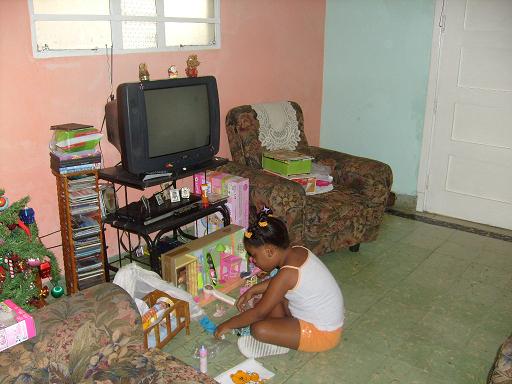
On the eve of Three Kings Day, Melanie Garcia, 7 years old, feels that the hours take years. At 5 pm she wants to go to bed, to shorten the time. Intensely she lives the hope of getting up before dawn and discovering what new toys the Three Wise Men from the East brought her.
In spite of everything, the tradition has been maintained for centuries. It’s been a dangerous crossing. Families wanting to keep the custom have fought against an atheistic state that decided to bury it five decades ago.
Fidel Castro struck the first blow to the magic world of children in the ’60s, when he distributed three toys per child by state decree. He decided to become the only Wise Man.
He even changed the months. He exchanged January for July, a month where they sold toys by the ration card. Just five days after coming down from the Sierra Maestra, he sent a message round to all segments of society.
From a war plane he dropped thousands of toys to children living on the hillsides of the eastern provinces. The idea wasn’t bad. They were kids who were dirty and full of parasites, whose only toys were chickens and pigs.
But after the altruistic gesture he sent a coded message in red: from now on, the State would appropriate tasks hitherto performed by Catholic and social institutions. Then you know what happened.
January 6 disappeared as a holiday. In his 52-year-long journey through the honey of power, Castro sought to undermine the religiosity of the population. Temples were closed. Some priests were expelled and others disparaged.
In pursuit of building the first communist society in America, many things had to be changed. And Three Kings Day was one of them: they considered it a petty bourgeois backwardness. More important than the toys, U.S. imperialism was to be buried in the dustbin of history.
Boarding schools prepared children and young people to be future soldiers of the country. The theme was “study, work and rifle.” Five decades later, the same government decided to sweep under the carpet part of its original sins.
Long ago, toys were removed from the ration card. Now they sell for hard currency, available only to families that receive remittances. These days, shopping at the Commodore Center, west of Havana, is a madhouse of parents buying toys.
The offers vary, but the prices go through the roof. A game is over $100. A bike, the same. A doll with a battery that says three sentences costs more than $60. Barbies, which you can have for $50, are piled on one part of the counter. The cheapest toy is equivalent to two months’ salary for a worker.
January 6 is just one more date to the Cuban authorities. There are no parades through the streets of the city. But if you wake up early that day, in the neighborhood you will hear the din of the little ones, finding a toy in some corner of the house
There are other happy moments for children on the island. But the Day of the Kings is the icing on the cake. If you have any doubts, just ask Melany Garcia.
Photo: Havana.
From Tania Quintero: “My granddaughter Melany with the toys that the Kings brought her on January 6, 2009. See, on the left, the cradle of wood, there are still carpenters in Cuba who make them, just like 60 years ago, when I was a child. I am glad that this tradition has not been lost in a world of increasingly sophisticated electronic toys.”
Translated by Regina Anavy
Originally posted: January 7 2011
The Knots in the Gag / Reinaldo Escobar
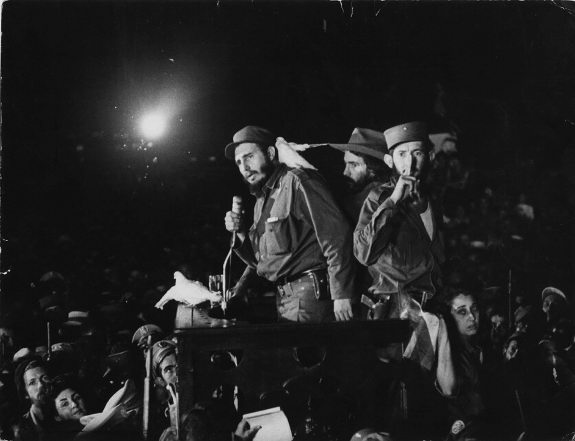
Havana, January 8, 1959. The dove had already defecated on his shoulder; the other bearded one had already answered the question, “How am I doing, Camilo?”; Habaneros had already started to worry about such a long speech warning them that things would be more difficult from now on. So comandante Dermidio Escalona ordered the unruly capital crowd to shut up.
No one could calculate, then, the significance of that gesture, no one could suspect that half a century later the performance artist Tania Bruguera would recreate the scene in her production “Tatlin’s Whisper,” in which we had one free minute before the microphone, dove included.
I leave you the image here, and this link conjured by technology and nostalgia, so that we can assess what could have been and was not, and calculate what could be if we were less obedient to the order to shut up.
January 10, 2010
The Country of Long Shadows / Yoani Sánchez
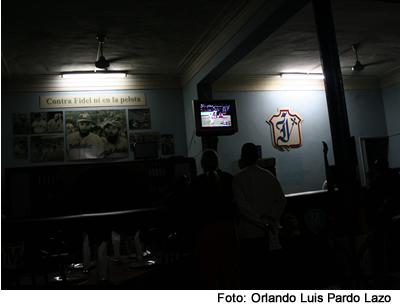 There are two men on the corner. One is wearing an earphone while the other peers into the door of a building. All the neighbors know perfectly well why they are there. A dissident lives on one of the floors of the building; two members of the political police watch who comes and goes and keep a car nearby to follow him wherever he goes. They don’t try to hide because they want this person, who signs his name to his critical opinions, to know they’re there; they want his friends to distance themselves so as not to end up caught in the network of control, in the spiderweb of vigilance.
It is not an isolated case. Here, every non-conformist has his own shadow — or a whole group of shadows — who follow him around. The so called “securities” also use sophisticated monitoring techniques that range from bugging phone lines and placing microphones in homes, to tracking the location of their targets through signals from their cell phones. The effects on the personal lives of those who suffer these operations are so devastating that we have come to refer to State Security by terrible names such as “The Apparatus,” “The Armageddon,” or “The Crusher.”
But not even these soldiers dressed in civilian clothes can escape popular scorn. Several jokes are making the rounds about the inordinate number of “securities” surrounding each individual opponent. Whispering and looking over their shoulders, many comment sarcastically, “There is so much manpower needed in agriculture, and look at these guys here, spending the whole day watching someone who thinks differently.” Because, indeed, what a contrast it would be if, instead of criminalizing opinion, they devoted themselves to productive labor; if instead of projecting their long shadows over the critics of the system, they let them fall over some lettuce or tomatoes, over the furrows — now empty — that they could help to plant.
The Revolutionary Counteroffensive / Regina Coyula
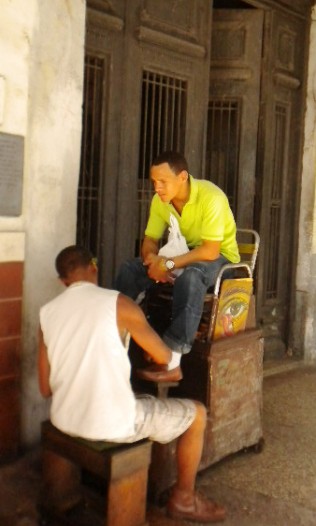 In an early hatching of 2011, my city is full of tiny businesses selling useful and useless things. Some sidewalks in Havana these days remind me of the nervous and chaotic pulse of an Asiatic city. Many people with a doorway on a more or less busy street have taken out a license to survive on their own; others set up a rough metallic shed coarsely made, the ugly and poor version version of a container to sell pizzas for eight pesos. Everything that disappeared during the so-called Revolutionary Offensive in 1968, the little that was left in private hands after the nationalizations of 1960.
But nothing productive.
On all the streets — Carlos III, Ayestarán, 42nd Street, Diez de Octubre and Avenida 51 — you can find clothespins, eyeglasses, dye, plastic cups. And disks, disks and more disks. Predominantly rough shelves with disks when you pass through these emerging businesses. National music, foreign, children’s, TV series. The success of this business isn’t strange, a celebration of piracy in a country used to seeing cartoons, soap operas and movies on national TV where they “modestly” cover the logo of the originating broadcaster.
Watching this winter hatching, I surprise myself thinking about the layoffs that have begin and the available options for the “available.” It’s difficult to undertake these activities in the already congested streets of my city.
January 10 2011
Half a Year / Voices Behind The Bars / Pedro Arguelles Moran
Six months have passed since I turned down the opportunity to go into exile. During all that time, the communist Cuban regime has been breaking its own promises of releasing us—the members of the group of the 75 who have decided not to abandon our homeland. On numerous occasions during this half year they have moved away from shattering the infamous gates that separate us from our family and social environment. Clearly, the totalitarian Castro regime does not have the least will to free us and they intend to banish us at whatever cost. There is simply no possible justification to hold us hostage as prisoners.
There is no pressure that can possibly force me to abandon my country, and much less to abandon the exalted and dignified civil struggle for the respect of human rights and freedoms inherent to the dignity of all human beings. In a very stubborn way, these rights and freedoms are being systematically and institutionally violated, from the very moment the government seized power by force of arms, intimidation, and terror in 1959. We will continue working peacefully to achieve the so yearned-for and suffered democratic transition to a state where rule of law, civil society, and social justice all thrive.
Pedro Arguelles Moran
Prisoner of conscience, Canaleta provincial prison in Ciego de Avila.
January 10, 2011
Sparklers and Bottlerockets / Orlando Luis Pardo Lazo
Pauper’s pyrotechnics of the proletariat and Olé…!
January 1 2011
Looking For the Guilty / Laritza Diversent
 Heaven and earth came together for Danay when Lester, her ex-spouse, confessed to her with tremendous calm that he didn’t love her. He tried everything to save his 10 month-old marriage. The young lady, until yesterday a Christian, lost faith in God and in man. Today she is looking for the guilty party who left her with the bitter aftertaste of feeling used.
Danay de la Caridad Gonzales is 17-years-old. Since she was little her parents raised her in the dogma of the Protestant Christian religion. Today she resides in Mantilla, a marginal neighborhood of Arroyo Naranjo, the poorest area in the City of Havana.
Lester Martinez is 23-years-old and is a native of Palma Soriano, in Santiago de Cuba. He’s been living in the capital illegally for three years. The biggest test of his love for her was that he should convert to her religion, despite the scant grace that God gave her and her bony body, which gives her away as a legitimate child of the “Special Period”.
God put them together in a simple ceremony before the parishioners of her church. They lived together in one of the rooms of the girl’s parents’ house. A housing unit constructed on what had been, years before, a garbage dump. A few meters away, the streams of the neighborhood’s sewers run. The authorities declared the area unhealthy.
To conform to the laws of God and man, it only remained to legalize Lester’s situation in the capital. His having come from another province in the country required that processing take place according to what was set out in Decree 217/97 of “Migratory Regulations for the City of Havana.”
There was a detail the youths didn’t count on. According to the rules of the decree, the local authorities don’t recognize a home as having a “permanent character” when the housing unit located in the capital is in an unhealthy zone. The unconditional love of Danay could not prevent Lester putting an end to the relationship. It wasn’t known if God or the rules of Decree 217/97 wanted it that way.
“Why did you marry me?” asked Danay. The young man arrived at the capital in search of better living conditions. However, it was impossible for him to get the 150 pesos of convertible currency together that they charge for making the change of address official. Because of this, he couldn’t continue his studies nor could he work legally.
Lester was tired of living the gypsy life. Avoiding the fines imposed by Decree 217/97, he spent three months around Bejucal, and another three in Mantilla, in the house of the cousins who’d helped him get settled in the big city, the one he couldn’t know nor enjoy for fear that he might be recognized by a policeman and be deported to his place of origin.
Nothing justifies deceit, Danay decreed. She looked at the sky and asked “Where were you, God, that you didn’t spare me this deception? Why did you permit me to be used this way?” Then she looked at the ground and, with irony, said to the young man, “Until death do us part, or until you realized you couldn’t change your address?”
The Lord lost a sheep from His flock and Lester, despite his guilt, learned that it wasn’t enough to marry a resident of the capital to make his change of address official, and with that to exercise his right to free circulation and residency.
He’s still reluctant to return to his home province. In the future, he will remember that his future wife must reside in a healthy zone and in a housing unit with minimum conditions insisted upon by the migratory regulations of the City of Havana (more than 25 square meters of livable space plus 10 for each co-resident).
Danay feels victimized by everyone, at least by those who put Decree 217/97 into effect; a rule that turns a Cuban into an illegal in his own country. The same one that lets Lester, as a means of legalizing his situation in the capital, marry with or without love.
Translated by: JT
January 8 2011
These Peculiar Guidelines / Claudia Cadelo
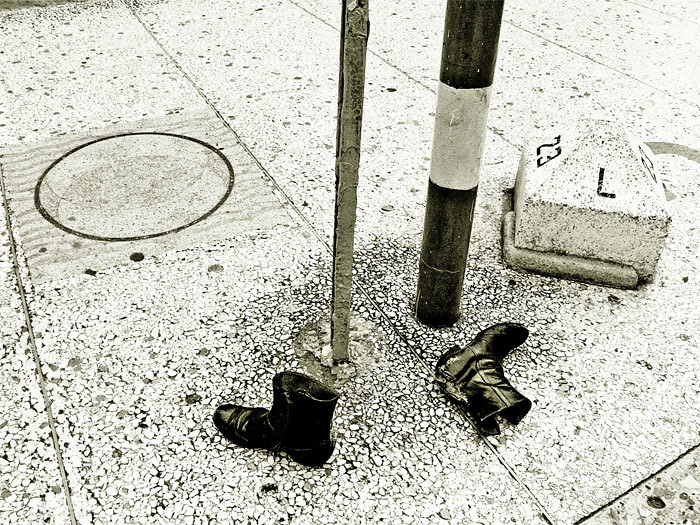
At the Committee for the Defense of the Revolution they are talking about the guidelines for the next Communist Party Congress. Despite the fact that, according to the Official Gazette, some of the proposals in the guidelines have already been passed as laws and the parliament hasn’t had its chance to display its unanimous approval, here in the neighborhoods we’ve already begun to stage the play and recite the script. After a ten-year gap since the only legal party in my country met, it would seem that the communist ideology is the last imperative of the meeting. There’s even a joke going around saying they’re going to change the name of the party.
But people are tired. People stopped recognizing socialism, even in books, long ago, because the history of the Revolution seems too much like the history of a 19th century capitalist monopoly. In parliament no one has been classified as “unqualified” or “unreliable” (as they have been on the layoff lists), and not one delegate to the National Assembly has been laid off under the concept of inflated payrolls. It is in the neighborhoods where 500,000 CDR members are going to be left “unoccupied.” So the spirit of the meeting is tense; even the poster announcing it reminds us: “Attendance will be taken.”
My friends tell me (the meeting in my neighborhood hasn’t happened yet) that things got hot. One retiree said it was time to see young people leading the country, another said he was tired of discussing planning and reforms that never changed anything, a lady announced she is retiring because as long as they aren’t talking about raising wages they can’t count on her, and the Party member murmured, ending the meeting, which would be the last time the core would be called together. Raul Castro’s government has reached out to a people who are tired and skeptical, and bored with seeing the same movie over and over.
The blindness of power has no limits. The other day I heard that the son of a high-ranking military man (he doesn’t want me to say his name) complained that disposable diapers are expensive and hard to find. His father then asked him, “But son, aren’t they given out in the ration book?”
January 10, 2011