In Holguin, Cubans Gather En Masse To Buy Liquid Gas Before The Arrival Of Hurricane Oscar

The power cut of more than 30 hours, leaving mobile phones and radios without charge, left Holguín residents unaware of the arrival of Hurricane Oscar / 14ymedio

14ymedio bigger14ymedio, Holguín, 20 October 2024 – Hundreds of Holguín residents have been gathering en masse since this morning at retail outlets of liquid gas, in order to buy fuel that will allow them to cook food over the coming days before the arrival of hurricane Oscar. According to the island’s Meteorology Institute, Insmet, the hurricane will hit eastern Cuba this Sunday at category level 1 and with winds of up to 140 km/h.

“There are more than 300 people here, and there are even more of them stretching around the corner”, Mariana, a resident of Hilda Torres provincial district explains to 14ymedio; she has joined the queue for gas at sales point number 14. “There are 18 points in total and all are in the same situation”.

Because of the huge power cut that has affected the island since Friday morning, Mariana has lost a number of food items. “A lot of things have gone off because the fridge stopped working”. In that situation, she says, she doesn’t know how she’s going to cope with hurricane Oscar, which threatens to bring heavy rains to the western provinces.

To make things worse, she points out, the hurricane will arrive at a moment of maximum tension when official information is only circulating on social media but internet connections are sparse and unstable. “I have a radio connected to a rechargeable lamp, and taking this up to the third floor we can manage to hear some reports”, the woman explains, but adds that her situation is “privileged” because “although more than half of Holguín continue reading

residents know that a hurricane is coming they don’t have any details about it”.

The General Staff of Cuban Civil Defence put out an alert on Saturday night, before Sunday’s impact of the hurricane on the east of the island. The hurricane, which, the day before had reached category 1, also threatens the Turks and Caicos islands and the southeast Bahamas, according to the U.S National Hurricane Center (NHC).

The Municipal Defence Council session in Nuevitas before the “fake news” declaration about Hurricane Oscar / Facebook /Yara de Cuba

Sitting opposite Miguel Díaz-Canel at a nighttime meeting which produced more promises than solutions, the authorities issued advice to Guantánamo, Holguín and Las Tunas, Santiago de Cuba, Granma and Camagüey.

At six in the morning the eye of the hurricane lay over the island of Gran Inagua in the eastern Bahamas, at 130 km to the northeast of Punta de Maisí, at the extreme eastern edge of Cuba, and at 240 km to the east of Punta Lucrecia, Holguín. When it arrives this afternoon on the north coast of the provinces of Guantánamo and Holguín its speed and movement will gradually start to diminish.

Image of hurricane Oscar’s trajectory / Conagua

Civil Defence directed an increase in vigilance, in risk reduction and an increased watch on areas which are most vulnerable. “People are advised to keep an eye on information from Insmet and the Civil Defence, and to comply with instructions”, he added.

Insmet specialists forecast for Sunday a gradual increase in the area of showers, “rain and electrical storms – which may be intense in some eastern and mountainous areas”. There are also warnings of increased wind speeds, which, in the afternoon and evening will reach between 85 and 100 km/h.

Translated by Ricardo Recluso

____________

COLLABORATE WITH OUR WORKThe 14ymedio team is committed to practicing serious journalism that reflects Cuba’s reality in all its depth. Thank you for joining us on this long journey. We invite you to continue supporting us by becoming a member of 14ymedio now. Together we can continue transforming journalism in Cuba.

The Bubble That Was Once the Havana Film Festival Has Burst

With few screening rooms and precarious means, the once prestigious cultural festival is in complete decline

Cine Chaplin, during the day of the Havana festival devoted to Palestinian films / 14ymedio

14ymedio bigger14ymedio, Natalia López Moya, Havana, 14 December 2024 — A journalist takes notes on the terrace of the Hotel Nacional in Havana while interviewing an Argentine film director. At another table, an actress poses for photographers, and, in the beautiful garden, a feature film producer asks a young cameraman to take several shots of the Malecón. The unreal bubble breaks as soon as you leave the imposing building that brings together the main guests of the Havana Film Festival.

“I have come for more than 20 years almost every December, with the exception of the break due to the pandemic,” a Latin American reporter who prefers to remain anonymous tells 14ymedio. “This year I have been very affected by the low quality of the Festival and the number of beggars that are seen around cinemas and hotels. I have not even been able to sit down and enjoy a coffee because immediately someone arrives asking for money or food.”

With a credential hanging around her neck, which opens the doors of all cinemas and parallel events, the freelance journalist has been attentive to every detail. “The first problem I came across is that the press release, which used to have all the information very well organized, is a disaster this year. They don’t even put the time accurately because they don’t know when the electricity will go off and they’ll have to suspend the projection.”

“The Festival has shrunk; now it’s only on 23rd Street”

“The Festival has shrunk; now it’s only on 23rd Street. The screenings used to be in other neighborhoods or in the Glauber Rocha room [municipality of La Lisa], for example, but that no longer exists,” she points out. The event has taken refuge in a few spaces where “a lot of the Cuban audience can’t come because of the fuel problem.”

For independent journalist Luis Cino, a collaborator of Cubanet, the reduction of screening rooms is a serious problem for the Havana cultural scene. “What kind of film festival is this in a city where out of 138 cinemas there are only four left (Yara, Charlie Chaplin, 23 and 12 and Acapulco), all in El Vedado, which is almost impossible to get to due to the lack of buses?” continue reading

To the few venues included in the program must be added the impairment caused by blackouts. “We arrived at the 23 and 12 cinema to see the movie Matar a hombre, by Orlando Mora Cabrera, and everything was in the dark. There was no poster or anything explaining if they were going to show it another day, a total lack of respect for the public,” says Anthony, 23, a student at the Enrique José Varona University of Pedagogical Sciences.

Cinema of 23 and 12, in El Vedado, Havana, in total blackout / 14ymedio

Together with his friends, the young man also spent an afternoon in front of the Chaplin cinema and was surprised by the red, green, white and black colors of the Palestinian flags hanging on the facade. Outside, an employee with a sad face urged passers-by to enter. “There were four cats in the main room. We went in to sit down because we were tired, and the others who were there were people who use the cinema to sleep because they don’t have a house.”

“The only moment of festival enthusiasm was the premiere of the series One Hundred Years of Solitude in the Yara,” says Anthony. “There were a lot of young people and it was nice, but the rest of the venues have been pretty dead. Almost all the theaters I entered were practically empty.” From a generation that consumes audiovisual material mainly on mobile devices, Anthony believes that “with this lack of charm, they will not attract people to the festival.”

This year not only were the places for the screenings limited but the event brought together only 110 films in competition, 89 fewer than last year, from 42 countries. Cuban productions of numerous filmmakers who have emigrated in recent years were missing from the festival. Their works either have been censored or they have decided not to present themselves as an act of protest over the lack of freedoms on the Island.

“I find it shameful that today someone sits down to quietly listen to the false speeches of violent men, liars, proven abusers and verified human rights violators,” said producer Claudia Calviño on her social networks. She and her husband, the independent journalist Abraham Jiménez Enoa, have been exiled. “Those who sit there (in the same place from where combat orders are given), to listen without question, without recognizing the suffering of the suppressed, are, in fact, endorsing impunity and oblivion.”

“It gives the impression that no one believes this and that they have put on the Festival so they can say that they did not suspend it”

Her attitude coincides with that maintained by Eliecer Jiménez Almeida, resident in Miami and director of the documentary Veritas (2021), who explains without mincing words his absence on the Billboard of the Festival. “Until Cuba freely exhibits the films of Orlando Jiménez Leal, Néstor Almendros, Jorge Ulla, León Ichaso, Iván Acosta, Miguel Coyula and a long list of directors among which I include myself, I am not interested. Solidarity for me is a matter of principle.”

To cover up the obvious reduction in venues and films suffered by the event, the official organizers placed platforms and sales kiosks along the main avenue of El Vedado and a stage at the intersection of 23rd and 12th streets for musicians and audiovisual materials. Public bathrooms outside the Chaplin Cinema increased the feeling that they were attending a carnival or a street fair.

Playwright and poet Norge Espinosa complained harshly about these additions in a text published in Café Fuerte: “I wonder what Alfredo Guevara would say about his poster plastered everywhere, with closed streets for musical presentations, gastronomy and a street-carnival atmosphere, in search of an image of what is supposedly popular. The festival never needed such things, nor the portable public toilets placed in front of the ICAIC [Cuban Institute of Cinematographic Art and Industry].

For filmmaker Armando Capó, director of the film Agosto (2019), the diagnosis is very pessimistic. “The film festival has no soul. It has lost it despite the effort of its work team. This has been achieved by speeches that rewrite history. The annulment of Cuban filmmakers. The idiotic carnivalization of the spectacle.” In his opinion, the event “looked like a representation for foreign filmmakers, a staging for the authorities, needing to hear what they want to hear. A parallel reality where the Assembly of Cuban Filmmakers does not exist.”

“It gives the impression that no one believes this and that they have only put on the Festival to say that they did not suspend it,” Anthony considers. For the Latin American journalist, the immersion in the event has left a deep and sad impression. “The filmmakers are fed up and very upset. I talked to some who told me that they were not even going to go to the closing because they already knew what it was going to be: official speeches ensuring that everything went very well, when the truth is that the Festival is broken, completely broken.”

Translated by Regina Anavy

____________

COLLABORATE WITH OUR WORKThe 14ymedio team is committed to practicing serious journalism that reflects Cuba’s reality in all its depth. Thank you for joining us on this long journey. We invite you to continue supporting us by becoming a member of 14ymedio now. Together we can continue transforming journalism in Cuba.

President Díaz-Canel Calls on Cubans To Join a ‘March of the Fighting People’ Against the US

“The optimists, the group in which we revolutionaries belong, believe that the important thing is to have conquered the test,” said the president, without specifying what that supposed victory is. 

Miguel Díaz-Canel, this Friday, at the closing of the Plenary Session of the Central Committee of the Communist Party of Cuba. / Estudios Revolución

14ymedio bigger14ymedio, Havana, 14 December 2024 — In response to Cuba being kept on the US list of countries sponsoring terrorism for another year, President Miguel Díaz-Canel has called for a “march of the fighting people” on December 20. In his speech this Friday, on the second and final day of the Plenary Session of the Central Committee of the Communist Party (PCC) – a speech described by the official press as “rich in reasons, enlightening on possible paths, with a scope that generates emotions” – the president lashed out against the “imperial blockade” and “the unjust inclusion of Cuba on the list of countries supposedly sponsoring terrorism.”

Before reaching that point, however, the speech began vaguely. “Another tremendous year is about to end. The pessimists will say that it could not have been worse. The optimists, the group in which we revolutionaries are militant, believe that the important thing is to have overcome the test. And the lessons it leaves us,” said Díaz-Canel, without specifying what this supposed victory continue reading

consists of when, at the same time, the Plenary session of the PCC recognized the “complex moment” that the Island is experiencing.

“We will overcome the current difficulties with creativity”

The president also said that the “most recent electoral result in the United States,” which gives Donald Trump a second presidency, “did not surprise us, just as we are not surprised by the euphoric dance of the haters, desperate to celebrate the end of the Revolution that they have not been able to defeat.”

His forceful words, however, barely concealed his usual voluntarism*: “We will overcome the current difficulties with creativity, by strengthening development programs based on talent, innovation, work and creative resistance.”

The concept of the “march of the fighting people” is the work of Fidel Castro, who used it for the first time in 1980 to name the pro-government demonstrations against the Cubans who stormed the Peruvian Embassy in April of that year and whose action gave rise to the Mariel exodus [also known as the Mariel Boatlift].

Those demonstrations became a sadly famous chapter in recent history on the island because they included aggressive slogans such as “Get rid of the scum!” and the derogatory use of the term “worm” to describe those who wanted to emigrate to the United States. Those days were also marked by physical violence and acts of repudiation organized in schools and workplaces against those who declared their intention to leave the country.

According to EcuRed, more than a million Cubans participated in those demonstrations, a figure that the regime has not been able to attract with its calls for a long time, among a population increasingly diminished by apathy, discontent and unstoppable migration.

*Translator’s note: The principle of relying on voluntary action (used especially with reference to the involvement of voluntary organizations in social welfare) – Oxford Dictionary

____________

COLLABORATE WITH OUR WORKThe 14ymedio team is committed to practicing serious journalism that reflects Cuba’s reality in all its depth. Thank you for joining us on this long journey. We invite you to continue supporting us by becoming a member of 14ymedio now. Together we can continue transforming journalism in Cuba.

Gerardo Díaz Alonso, Arrested During the 11J Protest in Cárdenas, Dies of a Heart Attack in Prison

He was serving a 14-year sentence for “sabotage and public disorder”

Gerardo Díaz Alonso, imprisoned for 11J, with his wife and one of his children / 14ymedio

14ymedio bigger14ymedio, Havana, 18 October 2024 — Political prisoner Gerardo Díaz Alonso, 35, who was serving a 14-year sentence for participating in the anti-government protests of 11 July 2021 (’11J’) in Cuba, died this Thursday in the Canaleta high-security prison in Matanzas. The cause of death was a heart attack, according to activist Aylín Sardiña Fernández posting on Facebook.

Díaz Alonso was tried for “sabotage and public disorder” after joining the protests in Cárdenas. Since then, “marked” in the eyes of the regime, the young man has experienced one injustice after another. On the day of his arrest, he was beaten into a patrol car and spent several days incommunicado, in a state of forced disappearance.

The trial was held in December 2021, but he received his sentence on 29 January 2022 without the knowledge of his family, who did not find out about the sanction until the following February 3rd, which prevented him from appealing. “Because it was from the military prosecutor’s office, we had only five days,” his wife, Mercedes Sánchez, explained to 14ymedio, adding that the papers arrived late and they were not even informed of the sanction by phone. Eleven other people were sentenced long with him.

On the day of his arrest, he was beaten into a patrol car and was held incommunicado for several days, in a situation of forced disappearance.

The father of two young children, Díaz Alonso entered prison with a kidney condition, which worsened after he went on a hunger strike to protest his sentence. At the time, his partner told this newspaper that she feared that her husband’s body “would not continue reading

react very well.”

As soon as he arrived in prison, he was placed in a punishment cell, from which he did not leave until his strike made the authorities nervous. After he was released from confinement, he was taken to an infirmary because his health had worsened. His mother went to visit him during this period. “He became very ill” when she saw him, said Mercedes Sánchez, who also visited the prison at the time: “He was thin, his face had no color and he was moving sideways,” was her description at the time.

Various independent media outlets and organizations have reported on the conditions in which prisoners live on the island. One of them was Cubalex, which last September accused the authorities of “arbitrarily and discretionarily using confinement in punishment cells, and exceeding the time stipulated in their own norms for this practice.” The prisoners suffer “cruel and inhuman treatment.”

In its report, the NGO said that during the first half of this year, at least 26 people died in the island’s prisons – four per month, on average – although the scarce official data forces us to consider that the number is barely a “significant underreporting of the real numbers,” according to the same report. Gerardo Díaz Alonso was added to that list this October, without the authorities having offered any explanation for his death.

During the first half of this year, at least 26 people died in the island’s prisons, four each month, on average.

The extreme conditions in Cuban prisons have also led more than one inmate to commit suicide. This is the case of Yosandri Mulet Almarales, who was also imprisoned for protesting on 11 July 2021, and was sentenced to 10 years in prison for sedition. He died in the Julio Trigo hospital in Havana, where he was admitted on August 22 after jumping into the void at the Calabazar Bridge during a parade. In June 2022, he had also tried to take his own life, reported the Cuban Prison Documentation Center. Mulet Almarales was barely 38 years old.

The same organization reported in early September that at least a dozen Cuban political prisoners were at risk of suicide. In another report, it documented three “events of suicidal ideation,” three self-harm incidents, and six attempts to take their own lives among 10 Cuban political prisoners (seven men and three women), since January 1, 2024.

There are a total of 1,113 political prisoners in Cuba, according to the latest count by Prisoners Defenders published on Thursday, which records 62 people incarcerated who “suffer from clinically diagnosed mental health disorders.”

____________

COLLABORATE WITH OUR WORKThe 14ymedio team is committed to practicing serious journalism that reflects Cuba’s reality in all its depth. Thank you for joining us on this long journey. We invite you to continue supporting us by becoming a member of 14ymedio now. Together we can continue transforming journalism in Cuba.

In Villa Clara, Cuba, Farmers Deliver 60,000 Liters of Milk a Day, 40 Percent More Than a Year Ago

According to the State, producers have accumulated a debt of more than 10 million liters

The new prices for each liter of surplus milk for producers came into effect on March 1, rising from the 20 pesos previously paid to the current 38. / 14ymedio

14ymedio bigger14ymedio, Madrid, 15 October 2024 — Acopio, Cuba’s State Procurement and Distribution Agency, is collecting barely 60,000 litres of milk a day in the province of Villa Clara, 40% of what they collected last year, when the average was 150,000. At this point, the State says that farmers have accumulated a debt of more than 10 million litres, an amount that, they say, is increasing. The result, they lament, is that “for the first time in history in the month of October the entire demand for ‘special’  diets — for children, sick people and seniors — cannot be met.”

The data was released by official journalist Jesús Álvarez López, reporter for the provincial radio station CMHW, in an opinion article published this Monday, in which he describes producers and those who participate in the informal market – that is, the majority of the population – as “merchants of disorder” for continuing to seek profit by buying and selling milk on the sly, despite the fact that since March Acopio has been paying more per liter.

In addition, he also accuses the authorities of being “technocrats who don’t even take the time to listen and think, and who want to solve everything with money,” but who don’t know how to properly manage payments or breaches of contract. In this regard, he specifically points to banking, which is responsible, according to the conclusions that Álvarez draws from the comments he hears on the street. continue reading

“If the magnetic cards had reached each producer with the same speed as our elderly retirees received them, no producer would be owed a penny”

“If the magnetic cards had reached each producer with the same speed as our old retirees, who were not even asked if they had cell phones, no producer would be owed a penny. The money would be on their card, even if they were suffering the same hardships that we all suffer when they demand cash for what we need to buy,” he complains.

The new prices for each liter of surplus milk for producers came into effect on March 1st, rising from the 20 pesos previously paid to the current 38 pesos. At that time, Alvarez had already warned that the measure could be a failure. “Will the price increase prevent the diversion of milk? Life will convince much better than my words of warning after so much time,” he said, going on to argue that if the cost per liter continued to rise on the informal market and was paid, this would mean that “around 6 billion pesos would go on the street,” with “no other effect for consumers than continuing to increase inflation.”

Now, the journalist recalls having drawn attention to the fact that paying more money was not the answer. “Today we are worse off,” he says. And he adds: “If the State decided to pay 100 pesos per liter, the ’merchants of disorder’ would pay more and in cash.”

Álvarez says that “it is unethical to justify the diversion of milk or its derivatives to obtain cash, while putting food intended for children and the sick at risk,” but he does not exempt the authorities from responsibility. He claims that the “municipal milk groups do not work” and therefore do not provide the necessary solutions, while state companies do not even know what is happening.

“And the one who siphons off the milk is just as guilty as the one who doesn’t demand what is his,” he concludes.

The deficiencies of the collection system are in the news every day. A little over a week ago, several cattle ranchers from Sancti Spíritus reported to this newspaper the constant non-payments by the State due to lack of cash. Without paper money, they said, they refuse to fulfill their commitments with official companies.

“I’ve been selling milk on my own for a couple of weeks now. I didn’t make any money selling it to the state anyway because the payment is bad. That same liter of milk that I deliver after fulfilling my commitment, for which I only get paid 38 pesos, I sell on the street for 120,” a rancher told 14ymedio.

Most of the milk contracted by the State is distributed through the rationed market for children under seven years of age and people on medical diets, in addition to reserving a portion – when possible – for senior citizens’ canteens and child care centers.

In Villa Clara itself, as reported by this newspaper on Saturday , milk has begun to be transported in refrigerated tanker trucks stored in warehouses, also air-conditioned, to discourage farmers from selling it illegally. The guajiros occasionally attributed their breaches of contract – and the diversion of the product to the informal market – to the poor conditions of the State for preserving milk, but with this new method there is no longer an excuse.

____________

COLLABORATE WITH OUR WORKThe 14ymedio team is committed to practicing serious journalism that reflects Cuba’s reality in all its depth. Thank you for joining us on this long journey. We invite you to continue supporting us by becoming a member of 14ymedio now. Together we can continue transforming journalism in Cuba.

The Cuban Military Industry Has Become a Manufacturer of Material for the Gaviota Hotel

Instead of weapons, the UIM is dedicated to making mattresses and lounge chairs for tourists, and medical supplies.

Cuban President Miguel Díaz-Canel visits one of the factories of the business group. / Estudios Revolución

14ymedio bigger14ymedio, Juan Izquierdo, Havana, 6 October 2024 — The Cuban Armed Forces control four business groups that are rarely mentioned in the official press. These are Geocuba – the best known – the Construction Union, the Agricultural Union and the Industrial Union. The latter, after the recent death of General Juan Cervantes Tablada – its director for several years – was said to be in charge of ensuring the renewal of Cuban weapons, one of the best kept secrets of the regime.

More eloquent about the work of the Military Industry Union (UIM), but without providing too many details, the Armed Forces website says that its mission is the “repair, manufacture, modernization and development of weapons and military technology, as well as other productions and services for the FAR (Revolutionary Armed Forces) and the economy.” It was founded on December 23, 1988 and its headquarters are on Santa Ana Street, between Loma and Bella Vista, in the Havana municipality of Plaza. Its website is disabled.

A recent issue of the magazine Verde Olivo offers more details about the Union, created with Soviet money through arms “development projects” agreed to with the Kremlin. A large part of its current staff has worked there since the 1980s, when the entity was dedicated to the “marketing of articles for military use”; it is not known with which countries or institutions.

In archival images released earlier this year by Cuban Television, Union technicians were shown repairing rockets and military vehicles, “in preparation for the Special Period that was already looming” and the fall of Soviet patronage in the 1990s.

Since then – and under the command of Cervantes Tablada – the Union seems to have changed its task, at least in the public eye, and although it claims to maintain “the combat readiness of the FAR war material,” it is continue reading

dedicated to the manufacture of other equipment. It now defines itself as a “scientific-technological park,” whose leadership is unknown, although years ago they had a general coordinator, First Colonel Ángel Franco Vélez .

In images released by Cuban Television, Union technicians were shown repairing rockets and military vehicles.

Its main current client is Gaviota, the Army hotelier, to which the Union supplies spare parts and equipment. From manufacturing and repairing weapons, the company went on to make doorknobs, metal containers and cisterns, as well as doors, tiles, aluminium carpentry elements, furniture, mattresses, lounge chairs, hygiene products, floor tiles and light bulbs.

They have a “software and electronics” program dedicated primarily to virtual game simulators – which are used for military training – and a series of electronic products intended for medicine. For this, they have the Grito de Baire Research, Development and Production Center, which manufactured 255 artificial respirators during the coronavirus pandemic and is now manufacturing hip prostheses.

Today, the Union manages a Vestibular Studies System, responsible for checking all pilots, divers and parachutists in Cuba. They also created an Autonomic Nervous System Explorer, which “assesses the risk of sudden death, cardiac ischemia and syncope.”

The Union, however, avoids talking about its role in the training of Cuban soldiers, who are trained in simulators of national manufacture. An unusual report on the military schools in Las Tunas, broadcast on Cuban Television in mid-September, confirmed that the basic training of the Army’s tankers is done in shooting and driving simulators designed by the Union.

Major Eider Cardet explained that the “block of simulators” under his command had several modalities used by the Cuban Army: tank, infantry and BMP-1 firing (Boyevaya Mashina Pekhoty, the name the Soviets gave to combat vehicles lighter than a tank). BMP-1 ammunition is “costly for the country,” the report said, so the simulators are indispensable.

Vagueness in its public reports is a hallmark of the Military Industry Union. Gone are the days when the entity boasted of its two most memorable contributions to weaponry: the Mambí-1 AMR rifles and the Alejandro, a sniper rifle. The Mambí, a 2.10-meter, 14-kilogram weapon, is a semi-automatic rifle that the Cuban military used during the Angolan war in the 1980s, especially against land vehicles.

As for the Alejandro, inspired by the Soviet Dragunov and named in homage to Fidel (Alejandro) Castro – who used a similar weapon, with a telescopic sight, to avoid combat and not risk his life, during his stay in the Sierra Maestra – it weighs five kilograms and measures 1.12 meters.

Vagueness in its public reports is a characteristic of the Military Industry Union

In an attempt to shed light on the Union’s current work, the General Military Forum – a space for discussion on armaments in with registered Cuban commentators – dedicated one of its spaces to the Cuban industry. The first ideas raised had to do with the opacity of the institution, since the official sites that describe its work are blocked or corrupted.

One user claimed that the Union had “a series of factories for the production of light infantry weapons, ammunition, mines and other means of various kinds,” a fact confirmed by Verde Olivo. Another pointed out its alleged links with the Spanish company Ingemat, dedicated to industrial automotives, although the company’s website does not state that it has relations with the Cuban Army.

With the rapprochement of the Cuban Armed Forces with Russia and Belarus – there have been frequent exchanges between senior officials from the three countries in recent months – new doors are opening for the Military Industry Union. Cervantes Tablada himself had studied engineering in the Soviet Union and in the island’s arsenals, recently filmed on Russian television, there are quite a few pieces of equipment from the former power.

When Miguel Díaz-Canel, escorted by Cervantes Tablada, visited the Union facilities at the end of 2023, the military man told him that he had 1,300 people, including military and civilians. Astonished, the president said that they were an example for the “socialist company,” because they produced more than any state-owned company. The FAR minister, Álvaro López Miera, approved the comment, but added: “Without neglecting defense for a second.”

____________

COLLABORATE WITH OUR WORKThe 14ymedio team is committed to practicing serious journalism that reflects Cuba’s reality in all its depth. Thank you for joining us on this long journey. We invite you to continue supporting us by becoming a member of 14ymedio now. Together we can continue transforming journalism in Cuba.

Opponent Maikel Herrera Bones Dies, Months After Being Hospitalized for Oropouche Fever

  •  11J prisoner Andy García Lorenzo has been on a hunger strike for 12 days, and his family fears for his life
  •  Independent journalist José Gabriel Barrenechea denounces from prison: “I am kept locked up to silence a critic.”
Activist Maikel Herrera Bones, in a file image. / Facebook

14ymedio bigger14ymedio, Madrid, 9 December 2024 — The opponent Maikel Herrera Bones, 48, died at the Pedro Kourí Institute of Tropical Medicine, in Havana on Saturday night, after being hospitalized for more than four months. The news was released by relatives of the activist on social networks and confirmed by some independent media.

According to Martí Noticias, the health of Herrera Bones, who had human immunodeficiency virus (HIV) since 2012, deteriorated due to the “instability in the supply of the medicines he needed and the lack of an adequate diet.” He got hopelessly ill after contracting Oropouche Fever and had to be admitted to the hospital, where he passed away.

“Maikel, who did so much for the freedom of his homeland without asking for anything in return, will not have the beautiful floral arrangements, masses or the grave he deserves,” Roberto Márquez said on Facebook.

Last October the patient was already in serious condition, very deteriorated neurologically

Yoel Parsons Bones, Herrera’s cousin and also an activist, told the same newspaper that the family was trying to get him a humanitarian visa to be treated in the United States. It was last October, and the patient was already in serious condition, very deteriorated neurologically.

To continue his activism “independently,” Herrera Bones left the Patriotic Union of Cuba (Unpacu) and the Cuba Decide platform, in which he had been active, in 2021. This was clarified by Ana Belkis Ferrer García, sister of José Daniel Ferrer, leader of Unpacu, through Facebook.

“In 2020 he suffered seven months of provisional imprisonment in the prison for HIV patients in Güines, Mayabeque, for publicly protesting the lack of electrical service in his community,” Ana Belkis Ferrer said, adding: “If we had been able to get him medical attention in exile, we would have taken him out, but unfortunately we were not able to achieve it with Maikel, continue reading

nor with Cristian Pérez Carmenate and Pablo Moya Dela; nor have we yet achieved it with Raul González, among others.”

Cuba Decide also published its condolences: “We deeply regret the death of Maikel Herrera Bones after years of harassment and repression at the hands of the regime for his struggle for the freedom of Cubans. For years Maikel dealt with health problems and constant medical complications. This brave young Cuban gave his youth to the cause of human rights and for several years promoted Cuba Decide.”

“If something happens to Andy, you will be responsible”

Andy García Lorenzo, sentenced to four years in prison for participating in the demonstrations of 11 July 2021, has been on a hunger strike for 12 days, and his family reports that his life is in danger. According to Pedro López, father-in-law of the activist’s sister, Roxana García, the prison authorities took “letters and documents that he considered important,” away from him. When they weren’t returned, he went on a hunger strike. His family learned of this nine days after he stopped eating.

The last time his mother, Dairy Lorenzo, was able to see him in Guamajal prison in Santa Clara, where he is serving his sentence, “he was very depressed and short of breath, and it was difficult for him to stand,” López said.

This Sunday, Roxana García made another appeal on social networks, explaining that although her mother managed to talk to the medical staff and was told that they had “the necessary materials,” “they have not performed medical tests, which leaves us uncertain about his true state of health.” And she warned: “We demand that the regime act immediately. This is not a matter of pride, it is a matter of life or death. If something happens to Andy, you will be responsible.”

Another political prisoner in Santa Clara, José Gabriel Barrenechea, sent a letter from prison in which he stated: “I am kept locked up to silence a critic, in his analysis and publications, of the Government’s management and the real possibilities of the Cuban socio-political system to get the country out of the crisis in which it is immersed.”

Undersecretary Eric Jacobstein spoke, in addition to independent businessmen and religious leaders, with relatives of political prisoners

The independent journalist was transferred to La Pendiente prison on November 18, ten days after being arrested for his participation in the popular protests that took place, a day earlier, in the municipality of Encrucijada, Villa Clara, after two days of blackouts. In his letter, he says that the demonstration was “spontaneous, massive and peaceful” and “had no other intention than to demand the replacement of the electricity after 45 hours without it and a week in which we had power for no more than 10 or 12 hours in total, in short intervals of two or three hours.”

According to the Denunciation Center of the Foundation for Pan American Democracy (FDP), the penitentiary center where Barrenechea is currently located is “known for its conditions of extreme overcrowding and for housing prisoners of all kinds,” and his stay in it “represents a serious risk to his life.”

Also, a letter signed by more than 200 journalists, activists, intellectuals and academics was released in which they demanded the immediate release of Barrenechea. The letter emphasized that the reporter, a collaborator of 14ymedio among other media, had been arrested “for political reasons,” in “frank violation of his rights.”

The text was signed by journalists Boris González Arenas, Camila Acosta Rodríguez and Yoe Suárez; playwright Luis Enrique Valdés Duarte, the coordinator of the Patmos Institute, Mario Félix Lleonart, analyst Juan Antonio Blanco, political scientist Armando Chaguaceda and academic Alina Bárbara López, among others. “We demand the immediate release of the writer and activist and, by extension, of all political prisoners in Cuba,” they demanded in the letter.

That request was reiterated by US officials visiting Havana last week on the occasion of the biannual talks on migration. According to U.S. Undersecretary of State Brian A. Nichols, U. S. Deputy Undersecretary Eric Jacobstein, independent businessmen and religious leaders conversed with relatives of political prisoners. “They stressed the important work they do to improve conditions in Cuba and called for the immediate release of people unjustly detained,” Nichols tweeted.

Translated by Regina Anavy

____________

COLLABORATE WITH OUR WORKThe 14ymedio team is committed to practicing serious journalism that reflects Cuba’s reality in all its depth. Thank you for joining us on this long journey. We invite you to continue supporting us by becoming a member of 14ymedio now. Together we can continue transforming journalism in Cuba.

‘Now We Are Supposed to Buy from the State but I Do Not Do Business with the State’

Small and medium-sized private businesses (MSMEs) that are not willing to accept the Cuban government’s new rules are liquidating their inventory and going out of business.

The new measures do not only affect private businesses that sell food, though this is one of the most open types of businesses. / 14ymedio/ Archive

14ymedio bigger 14ymedio, Natalia López Moya, Havana, 11 December 2024 — Cookies, soft drinks and bouillon cubes are some of the items on a list that is making the rounds from cell phone to cell phone in Havana’s Sitios neighborhood. In a WhatsApp group, local residents inform each other of the new clearance prices of these products in a nearby privately owned store. “Buy now. This is the last month the store will be open,” reads the text.

The Official Gazette recently announced a resolution that prohibits micro, small and medium-sized enterprises(MSMEs) from selling wholesale merchandise without state involvement. It also prohibits self-employed workers from doing any wholesale transactions, a move that has caused many small privately owned shops to either liquidate their entire stock to comply with the new law or to shut down permanently. “We don’t import but we do buy from a couple of private companies that do — always through a state intermediary — which saves us from all the paperwork of bringing the products in from overseas,” says Pablo, who owns a small store near Carlos III Avenue.

Pablo, an alias this businessman uses to avoid retaliation, began selling off his merchandise in early November after learning that new measures would soon take effect. “I only have a few items left so we are doing an end-of-year sale and offering discounts to clear everything out before December 20. We will not be open at Christmas and by 2025 we won’t even be in business anymore,” he explains. continue reading

“I only have a few items left so we are doing end-of-year sales and offering discounts to clear everything out before December 20

Pablo says that he has two main suppliers, “an MSME that imports frozen foods such as chicken, ground beef and pork from the United States and another that imports detergent and soap as well as shelf-stable foods from Mexico.” Going forward, both companies will not be able to sell this merchandise wholesale to small private retailers. “Now we are supposed to buy from the state but I do not do business with the state, he says.”

Pablo’s distrust comes from having worked for more than two decades at an affiliate of Cubacontrol, a state-0wned company that oversees many of the island’s commercial transactions. “I was an insider and I know how things work at those places. What will happen is that everything will become slower, more difficult, more bureaucratic and that’s really not for me. My wife and I started this business because we wanted to improve our lives, not give ourselves heart attacks.”

A well-stocked store on Central Havana’s Reina Street that used to sell soft drinks, beer and wide variety of knick-knacks has also been closed for a week. Local residents tell would-be customers looking for the place that it has gone out of business. “They closed and sold off what they had left,” says a retiree who is disappointed by the owners’ decision. “The lady who rented them the living room in her house loses that income. And now when you want a smoke or a cold drink, you have to walk further to get it.”

Private businesses that sell food are not the only ones affected by the new measures. “Buy the whole lot. We are having a clearance sale,” explains an ad from a small company that sells wholesale ceramic tiles. “Spanish ceramics. Big discounts if you buy the whole lot, which includes all documentation from [the port of] Mariel. Everything above board. We are not making a profit. We want to clear out our stock before the end of the year.” Several rows of boxes with tiles in different sizes, textures and colors can be seen in the accompanying photos.

“Spanish ceramics. Big discounts if you buy the whole lot, which includes all documentation from [the port of] Mariel

Other construction material suppliers are also selling off their inventory in order to comply with the new regulations. Henceforth, they will be required to buy wholesale from state-owned companies acting as middlemen. “We didn’t have much left in stock because these past few months have been challenging. Almost no new merchandise came in. We’ll see how things go under this new law before closing down for good and then get a different business license to deal with the new conditions,” said the owner of a business that sells cement and tools as well as kitchen and bath plumbing fixtures.

For someone named Raúl Rojas Leiva, having the state act as middleman is a recipe for disaster: “If Cuban distribution companies have so much transportation, infrastructure and commercial experience, why don’t orders arrive on time? Why do these distribution companies sell almost nothing? And I mean nothing,” he asks on the local government’s official Facebook page, which officials in Havana launched in hopes of convincing businesspeople of the new resolution’s benefits.

“Big clearance sale on footwear for men, women and children. Don’t miss out. Don’t say we didn’t warn you,” reads an ad from another MSME, this time in Havana’s Tenth of October district. “It’s all quality merchandise, imported from Panama and currently worn round the world. No old models,” the vendor states. Unlike other store owners who are hoping to stay open under the new legislation, she is taking a more drastic approach. “We are going out of business because our supplier says that he will no longer be able to sell to us wholesale.”

In the case of this shoe store, the closeout also includes the house where the merchandise is displayed. “If you want to buy a two-story house near Santa Catalina, this is your best option. The ground floor is configured to accommodate a business, which is currently a shoe store but can be renovated to house a hair salon, spa or a small grocery,” writes the seller, who adds, “Stay tuned on our WhatsApp channel because we will be getting rid of everything, including the mirrors.”

____________

COLLABORATE WITH OUR WORKThe 14ymedio team is committed to practicing serious journalism that reflects Cuba’s reality in all its depth. Thank you for joining us on this long journey. We invite you to continue supporting us by becoming a member of 14ymedio now. Together we can continue transforming journalism in Cuba.

Spain Dismantles a Network of ‘Coyotes’ That Charged 10,000 Euros for Transporting Cubans

Spanish National Police during an operation in Malaga. /  National Police

14ymedio bigger14ymedio, Havana, 8 December 2024 – The Spanish National Police on Saturday dismantled a criminal network of 36 members, including ringleaders and coyotes, who illegally transported at least 67 Cubans to Europe with false documentation. The migrants paid up to 10,000 euros for the journey through several European countries, which in some cases included traveling hidden in trunks.

The smugglers operated in Serbia, North Macedonia, Greece and Spain, and recruited the Cubans through the website of an alleged travel agency – the name of which was not disclosed – said the European Police Office (Europol) and the European Union Agency for Criminal Judicial Cooperation (Eurojust).

The migrants were given tickets in Cuba to board flights to Belgrade (Serbia), “normally making a stopover at the airport in Frankfurt (Germany),” the investigation details. Thanks to a visa-free agreement between Serbia and the island, Cubans can travel to the Balkan country as tourists, although they must meet several requirements, such as having a letter of invitation and proving economic solvency.

From Belgrade, they were moved by land “to Greece, passing through North Macedonia, being housed during the journey in the houses of the criminal continue reading

network”, according to data provided by the Spanish authorities.

The Spanish National Police arrested 36 members of the migrant smuggling network. / National Police

The transportation was carried out by coyotes who facilitated the border crossings in a clandestine manner, and “in which on many occasions the lives of the migrants were endangered as it was carried out in the trunks of vehicles circulating at high speed,” stresses the National Police. Once in Greece, the organization gave the Cubans “fake or authentic Spanish documents of people with similar features” – a method known as look-alike – with which they traveled by air from Athens to Spain.

The police had been tracking the traffickers since last January when German authorities alerted about a Cuban traveler with a stolen identity document (DNI). The woman arrived from Belgrade and was bound for Madrid. The Prosecutor’s Office of the Audiencia Nacional opened an investigation and was able to confirm this modus operandi in at least 40 cases.

The Second Central Court of Instruction was in charge of the follow-up of the investigation and this Saturday the arrest of 36 people involved was announced. Among the ringleaders, three were arrested in Alicante and one in Malaga. The rest of the arrests took place in Alicante (7), Barcelona (6), Las Palmas (4), Santa Cruz de Tenerife (4), Guipúzcoa (2), Balearic Islands (2), Madrid (2), Cáceres (1), Segovia (1), Toledo (1), Vizcaya (1) and Zaragoza (1).

As part of the process, three house searches were carried out where the authorities found “7,550 euros in cash and abundant computer material and documentation relevant to the investigation,” which is still ongoing.

Translated by LAR

____________

COLLABORATE WITH OUR WORKThe 14ymedio team is committed to practicing serious journalism that reflects Cuba’s reality in all its depth. Thank you for joining us on this long journey. We invite you to continue supporting us by becoming a member of 14ymedio now. Together we can continue transforming journalism in Cuba.

Santiago de Cuba’s Main Hospital Is Falling Apart and Its Doctors Are Desperate

Photographs taken by a doctor show the filth and the deplorable state of the surgical unit.

Leaks in the surgical unit of the Saturnino Lora Provincial Hospital in Santiago de Cuba. / 14ymedio

14ymedio bigger 14ymedio, Santiago de Cuba, 13 December 2024 — The Saturnino Lora Provincial Hospital, located on the central Avenida Libertadores, is the most important hospital in Santiago de Cuba. As such, it has the most specialists, the most patients, and is the preferred center for the most serious cases. Its surgical unit, in particular, is of utmost importance. For example, it cares for those injured in traffic accidents or patients who need difficult operations.

With these credentials, and according to the common reference to the Island as a medical power, anyone would imagine it, if not modern – it was “refounded” 65 years ago, as a continuation of the general hospital created, in another location, in the 19th century – then well-maintained. Or at least, like any self-respecting health centre, clean, with basic hygiene measures. Nothing could be further from the truth.

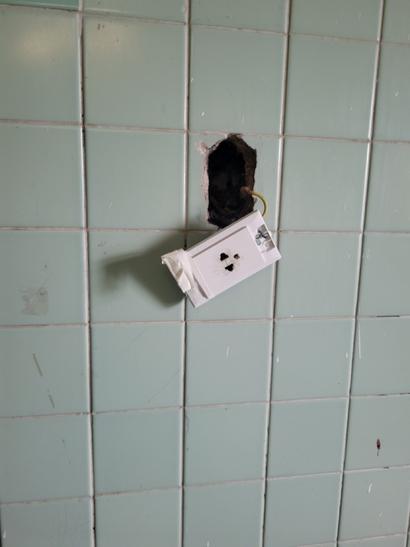
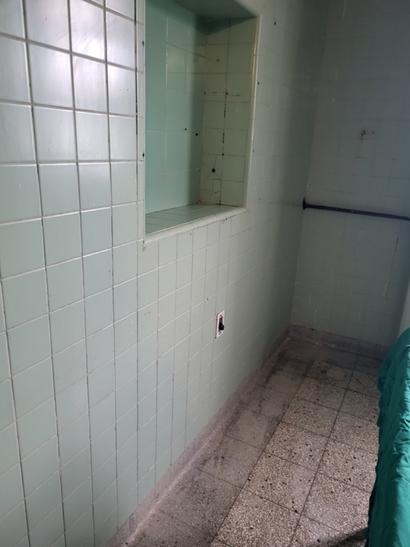
Drips collected in precarious recycled plastic or metal containers, sheets used to dry the water that falls to the floor, rusty oxygen cylinders, plugs without outlets, switches pulled out of the frame, with the cables hanging, as if violently torn off, broken light fixtures, without their white neon tubes, aged air conditioning units, which sound like the engine of an old car, half-broken windows, with traces of green paint, peeling walls, cracked tiles, humidity so severe that it accumulates on the ceilings, black on black. The panorama, offered by some photographs that have reached this newspaper from the surgical unit alone, is chilling. continue reading

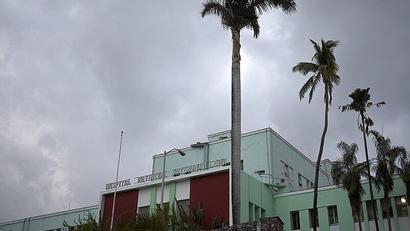
Facade of the Saturnino Lora Provincial Hospital, on Libertadores Avenue in Santiago de Cuba. / CC

The granite tiled floor barely hides the dirt in the hospital section that should be spotless, due to the risk of infections patients are exposed to during surgery. The authorities, however, say nothing of this when reporting on the “major repairs” that the Saturnino Lora has been undergoing “for several months.”

In a note published last November, Sierra Maestra speaks extensively of the “constructive work” being carried out at the center. Among these, the “separation of emergency and urgency,” which although they are synonyms in Spanish, is explained in this way by the director of the hospital, Ana Lubín García: “Now the color code can be followed: red is the patient whose life is in imminent danger, yellow is the patient who has suffered an injury, but whose life is not in danger, but who must be treated urgently, and green is that patient who can arrive under their own power and whose life is not in danger.”

The doctor does not mention the surgical unit at any point, but she does mention “the pharmacy, the blood bank, the sterilization area, electromedicine and the medical room located on the second floor,” where the works “are progressing, despite the lack of some expensive and imported materials.”

Window in the surgical unit of Saturnino Lora. / 14ymedio

Patients are well aware of the dire situation at Saturnino Lora, and few are silent about their criticism, especially on social media. In 2020, during the Covid-19 pandemic, when, like the rest of the centers on the island, it was overwhelmed, it was one of the hospitals that received the most complaints. In addition to the lack of medicines, the precarious hygienic conditions – including the lack of water in the bathrooms – and the stench, in recent years the people of Santiago have added complaints about mistreatment by the staff.

In the face of this, however, overwhelmed healthcare workers are reacting. One doctor from the hospital, who spoke to this newspaper on condition of anonymity, said: “Patients, in moments of extreme adversity, cry out: medical negligence! and demand that doctors be guillotined or burned at the stake. But I ask you to ask yourself: in what conditions do our doctors work? Do they feel safe working? Can they give it their all for their patients?”

With grueling shifts and a salary that barely covers daily expenses, without the necessary supplies to be able to care for the sick, the doctor feels as desperate as the population: “Years of study, dedication and sacrifice are thrown away when, thanks to neglect, mistreatment and threats, many abandon their careers. Few know about it and those who do prefer to remain silent.” And he begs: “The next time you see a doctor or nurse, do not judge them. They do not build hospitals, nor make medicines. They give their hearts and a lot of love, even putting their own lives at risk.”

There are electrical outlets sticking out of the wall, with the cables hanging down, as if they had been torn off violently. / 14ymedio

What is happening at Saturnino Lora, in any case, is similar to what is happening in other hospitals in the country. Just a year ago, six doctors from the Carlos Manuel de Céspedes Hospital in Bayamo, Granma, were convicted of medical negligence after the death of a patient. One of them, Ristian Solano, who received the most severe sentence, three years of house arrest, publicly defended himself, explaining that the death was inevitable, and declaring himself “disappointed” by the lack of support from the Ministry of Health, to which he and his colleagues had filed numerous complaints about the lack of resources.

The case unleashed a wave of solidarity among colleagues in the profession and activists on and off the island. For example, Cuban doctors living abroad Alexander Jesús Figueredo Izaguirre, Arnoldo de la Cruz Bañoble, Sergio Barbolla Verdecia and Jorge David Yaugel signed a harsh letter addressed to Minister José Ángel Portal Miranda, in which they described the punishment of the Bayamo health workers as a “national shame.”

The mottled tile floor barely camouflages the dirt in the hospital section that should be the most spotless, due to the risk of infections. / 14ymedio

“The accusers should – do they know this? – point out those truly responsible for this death. These doctors are also victims of the conflict between their professional commitment and the impossibility of succeeding in the conditions in which they are forced to operate on their patients,” the doctors wrote in their statement.

For them, “those responsible for diverting the resources provided by the medical brigades” [sent to work in other countries which pay the Cuban government for their services] should have been brought to court. They pointed out that “the regime has received billions of dollars in the last decade,” money that “has not been invested in the Cuban health system as was argued at the time to justify the arbitrary deduction of 70% to 90% of the salaries of the brigade members over all these years.” With this, they asserted, “there would have been more than enough to maintain the health system in optimal conditions and pay decent salaries to the professionals in the sector.”

____________

COLLABORATE WITH OUR WORKThe 14ymedio team is committed to practicing serious journalism that reflects Cuba’s reality in all its depth. Thank you for joining us on this long journey. We invite you to continue supporting us by becoming a member of 14ymedio now. Together we can continue transforming journalism in Cuba.

When You See a Dictator Fall, Put Your Tyranny on Hold

From this part of the world, more than one authoritarian ruler must have nightmares since Al Assad fell.

For a nonagenarian like Raúl Castro, it must be especially difficult to deal with what has happened. / Prensa Latina

14ymedio bigger14ymedio, Yoani Sánchez, Generation Y, Havana, 13 December 2024 — The big news of the end of the year is, without a doubt, the flight to Moscow of the Syrian dictator Bashar al-Assad. The collapse of his regime, which opens up a range of possibilities and fears about the political direction that Damascus will take, also refreshes lessons about tyrants that, although well-known, should not cease to be repeated and taken into account. Like a paper tiger, the once fierce leader escaped with his family, left his officials in the lurch and abandoned his army. More than one authoritarian ruler in this part of the world must have had nightmares since then.

He who until a few weeks ago seemed to be a man firmly in power, who had managed to resist a long civil war and was beginning to be reinserted in international organizations such as the Arab League, in just a few days escaped from his palaces, boarded a plane with his family and ended up in Moscow. His soldiers hurriedly removed their uniforms and left them lying in the street, the jailers guarding the fearsome Sednaya prison fled and the Baath party he led has suspended all its activities “until further notice.” The autocrat’s entire apparatus of control and coercion collapsed, despite the fear of the population and the support of Russia.

On this side of the Atlantic, the images of the Syrian people entering the richly decorated rooms where Al Assad lived and the opening of the cells full of opponents must have cost more than one person their the peace of mind. For some time now, the unpresentable regimes of Nicaragua, Venezuela and Cuba have also been eager to show their closeness to the Kremlin. They appear in photos with officials, ministers and military officers under the orders of Vladimir Putin to, among other things, send the message that behind their backs the fierce Russian bear is rising. They use their proximity continue reading

and political harmony with Moscow also as a warning of invulnerability and strength.

On this side of the Atlantic, the images of the Syrian people entering the richly decorated rooms where Al Assad lived and the opening of the cells full of opponents must have cost more than one person their the peace of mind.
However, along with Assad, the great loser in Syria has been Russia, which, bogged down in the invasion of Ukraine, could not defend its crony Damascus. Neither the naval base in Tartus nor the planes with pilots sent by Putin prevented the fall of a dynasty that robbed its people of their freedom for more than half a century. Nor did the diplomatic complicity that Moscow displayed with Damascus in international forums protect it. In a few days, all that became just words, gestures and the past.
For a nonagenarian like Raúl Castro, who maintained ties of collaboration and complicity first with Hafez al-Assad and later with his son, it must be especially difficult to deal with what has happened. The world he knew no longer exists: the socialist camp imploded, the Berlin Wall fell, political allies have been losing power one by one or dying in oblivion, and more than one of his close caudillos has been swept away by the pressure of their own people. And to make matters worse, Moscow no longer seems to inspire the fear it once did, it is not capable of looking after the backs of its cronies. The only option for his fellow authoritarians now is to take refuge in Putin’s land.

________________________

Editor’s note: This article was originally published in Deutsche Welle in Spanish.

The Línea Street Tunnel in Havana is Pitch Black

The time when the Orquesta América sang “they want to cross the tunnel” to celebrate that engineering work is long ago

The Linea Tunnel in Havana connects El Vedado with the Miramar neighborhood / 14ymedio

14ymedio bigger14ymedio, José Lassa, Havana, 12 December 2024 — In Havana there are several types of darkness. There is the one that is sought voluntarily, for a romantic moment, and the other, the most common, is the one imposed by the crisis. The fuel shortage extends blackouts throughout the city, and the deterioration of public lighting makes places like the tunnel on Línea Street turn pitch black. The road that connects El Vedado with the Miramar neighborhood is now a gloomy place that drivers avoid.

“I haven’t been here for a long time and my hair has stood on end,” commented on Wednesday the driver of a car linked to the La Nave application that moved a customer from the vicinity of Central Park to the vicinity of the Karl Marx theater. “With your eyes accustomed to sunlight you move on to this that has a few lamps that do not illuminate anything. It is very dangerous because even if you have good headlights in the car there is almost no visibility,” explains the taxi driver.

The road that connects El Vedado with the Miramar neighborhood is now a gloomy place that drivers avoid

“I felt like someone entering a cave; this is very dangerous and it seems that no one cares,” said a passenger, who could not help but cling to the seat while he and the driver traveled the little more than 200 meters of the underground road. The next time they have to go west of the Cuban capital, it is unlikely that they will choose to immerse themselves in a passageway that could be a scene in a film about a trip to hell.

At night the situation is even worse, because although the pale interior lights are a little more noticeable, they are so immersed in the shadows that it is even difficult to distinguish the lanes. If, on top of this, there is a power cut in the area, then the risks multiply and you have to rely on the headlights, keep your hands firmly on the wheel and appeal to luck so as not to collide with anything or come across some other surprise on the way. continue reading

Lately only bad news emerges from the central tunnel. Last February, several Internet users complained about the water that fell on windshields, blocking the vision of drivers. Those complaints came just a few months after the road was closed to carry out repair work that included painting the side walls at both entrances with an intense blue color that can’t be seen in the dark.

Havana, the city that in the 50s was at the forefront of urban and architectural innovations in Latin America, was left with only three tunnels to channel traffic. Two of them pass under the Almendares, now turned into a pestilent and reduced river, while the third and more impressive is immersed in the waters of the bay. The one that connects Línea Street with Miramar is the oldest, and the amazement it caused after its inauguration was even reflected in a catchy song.

Lately only bad news emerges from the central tunnel. Last February, several Internet users reported the presence of leaks on social networks

It was the well-known musician Enrique Jorrín who composed the theme that later became popular with the Orquesta América. Then, that engineering work was attractive because of its modernity and the romantic atmosphere felt when crossing it. On the stage and phonographs you could hear: “All the people in Havana who like to drive / when they go out / they want to cross the tunnel … And now the little ones say / when they see the car: let’s go to the tunnel, my darling, / let’s go to the tunnel, my love.”

However, fear has never been a good ally of flirting, so now everyone is in a hurry and holds their breath when they cross through the tunnel. No one sees, among so much darkness, an opportunity to fall in love or curl up. Rather, muscles twitch, eyebrows furrow and a chill runs up the neck until they reach the other side. Only then a sigh of relief runs through the inside of the vehicle. The dangerous tunnel has been left behind.

Translated by Regina Anavy

____________

COLLABORATE WITH OUR WORKThe 14ymedio team is committed to practicing serious journalism that reflects Cuba’s reality in all its depth. Thank you for joining us on this long journey. We invite you to continue supporting us by becoming a member of 14ymedio now. Together we can continue transforming journalism in Cuba.

Lacking Tasty Food and Electricity, Dinos Pizza in Cienfuegos Puts Tables Outside To Attract Customers

Every weekend, tables block the passage on the sidewalk in front of the establishment. / 14ymedio

14ymedio bigger14ymedio, Julio César Contreras, Cienfuegos, 7 December 2024 — The strategy of some state-run businesses in the city of Cienfuegos, which, in the absence of appetizing dishes, seek to attract customers by extending service beyond their walls, is similar to the joke repeated decades ago by Cuban comedian Chaflán. When a wife suggests to her husband that they go out to eat, he answers: “Let’s move the table to the patio.”

With red tablecloths, small plates and even an ashtray, several tables at the Dinos Pizza restaurant block the way on the sidewalk in front of the restaurant every weekend. Passersby have to make their way around the obstacles, although they never see anyone sitting on the stools, enjoying an aperitif or paying the bill. “It takes a lot more than putting all these things out for people to want to eat here,” says a nearby resident who mocks the initiative.

Inspired by the terraces of restaurants and cafes very common in Europe, employees have moved the service outdoors because if diners do not come inside looking for a tasty meal, then they have to go out to catch them even if it means interrupting their path and causing them the occasional start if they walk distractedly along the sidewalk.

“Only a tourist falls into that trap,” said a young man near the tables, which were arranged as if part of a stage set. The state-owned Dinos Pizza chain, run by the Palmares SA Extrahotel Company, sells mainly fast food. At its peak, at the beginning of this century, when the Venezuelan oil subsidy encouraged large investments in public services, the franchise was very popular. continue reading

The supply crisis and competition from private businesses have hit Dinos Pizza and other state-owned businesses hard. / 14ymedio

However, the lack of budget, the supply crisis and competition from private businesses have hit Dinos Pizza hard, turning it into little-visited, filthy establishments with a limited menu. “The workers are trying to keep it from closing, but now with all the adjustments that have taken place in the gastronomy sector, they demand profitability and a certain volume of income which they have a hard time obtaining,” says Julia, a retiree from Palmares who is aware of the difficulties that the company is going through, speaking to 14ymedio.

“Now, all the managers and officials are talking about the so-called productive linkage with the new economic actors, but here in the city of Cienfuegos there are few state-owned businesses that have achieved this.” The Dinos, which displays some of its chairs and tables on the sidewalk, “does not receive any payment in foreign currency, so it has very limited ability to purchase products that require freely convertible currency (MLC). For example, if they want to offer customers a mojito, they cannot close a deal to buy bottles of Havana Club in a store in that sells only MLC.”

“Several premises that were previously managed by Palmares have been handed over to private MSMEs, but some are still under state management, although it is clear that they are suffering losses and, sooner or later, they will have to close,” adds the woman. “The employees themselves try to delay the inevitable because they know that, when it passes into private hands, the State will offer them a position in a worse location. Most do not accept the new position and end up going home.”

“I think this is more about presenting a certain image of commercial dynamism and that this is a normal city,” warned a customer outside a central store, a few meters from El Prado, who came across a table, also on the sidewalk, where bottles of sweet wine, vinegar and a rum “so bad that it doesn’t even have a label” were on offer.

On a table, also on the sidewalk, bottles of sweet wine, vinegar and rum were offered. / 14ymedio

The man points to another reason for the increase in sales “outside the door.” “Here we spend almost the entire working day without electricity, in those interior spaces there is no one, neither the workers nor the customers who can stand it,” he explains, and behind him the interior of the shop is practically dark due to the blackout. “Taking the products out onto the street is the only way to be able to sell them, because nobody wants to go into that wolf’s mouth.”

The goods, tablecloths and forks left out in the open are faced with another serious problem: the lack of hygiene. “In Paris or Madrid these tables will look very nice, almost on the street, but here there is a lot of accumulated dirt, a lot of people wandering around and asking for money, a lot of abandoned animals that approach you to ask you to give them some food,” laments another customer who barely read the menu at Dinos Pizza and immediately turned around.

Although the name bears the traditional Italian dish, the disappointed customer did not find on the menu board those five letters that are universal and understood everywhere on the planet: pizza. “There is a lot of apathy, the employees move as if in slow motion,” the woman concluded. A tourist passing by the restaurant ended up sitting in one of the seats in front of the small plate and the glass ashtray.

For a few minutes, before the traveler read the menu, that red tablecloth, with its cutlery, looked like any other in a distant city, where terraces are part of the local gastronomy and are customers’ favorites. That impression only lasted a few minutes, until the man noticed that he was in the middle of a set, got up and left.

____________

COLLABORATE WITH OUR WORKThe 14ymedio team is committed to practicing serious journalism that reflects Cuba’s reality in all its depth. Thank you for joining us on this long journey. We invite you to continue supporting us by becoming a member of 14ymedio now. Together we can continue transforming journalism in Cuba.

France and Germany Award Human Rights Prize to Cuban Activist Marthadela Tamayo

The award recognizes nearly 20 years of commitment to promoting the rights of Afro-descendant women and girls on the island

Marthadela Tamayo told EFE that she felt “great pleasure” at the recognition for herself and her organization. / Facebook

14ymedio biggerEFE (via 14ymedio), Havana, 11 December 2024 — France and Germany have awarded Cuban activist Marthadela Tamayo the Franco-German Human Rights Prize, the embassies of these European countries announced on Wednesday.

The award, as explained by the organizers on social media, recognizes nearly 20 years of commitment to promoting the rights of Afro-descendant women and girls on the island, as well as those of LGBTIQ+ people and against all forms of discrimination.

Tamayo told EFE that she felt “great pleasure” at the recognition for herself and her organization, the Committee of Citizens for Racial Integration (CIR), a group founded in 2008 in Havana.

The identity of some of the award winners has not been published to protect their identity.

“This award encourages us to continue working in the fight for human rights in my country. It is a commitment to defend the rights of women and socially vulnerable populations, such as Afro-descendants and LGBTIQ+ groups,” said the activist. continue reading

Along with Tamayo, the following individuals have been recognized in this edition of the award: South African Melanie Judge, Cambodian Mao Map, Fijian Ratu Eroni Ledua Dina, Indian Anjali Gopalán, Israeli Maoz Inon, Palestinian Issa Amro, Serbian Marijana Savic, Sudanese Samia Hashimi, Tunisian Wahid Ferchichi, Turkish Feray Salman, Ukrainian Kateryna Pryimak and Venezuelan Yendri Velasquez.

The identities of some of the winners have not been made public to protect their identity, the organizers of the awards said on their website.

The Franco-German Human Rights Prize has been awarded annually since 2016 to honor personalities from around the world who have made special contributions to the promotion of human rights in their countries.

____________

COLLABORATE WITH OUR WORKThe 14ymedio team is committed to practicing serious journalism that reflects Cuba’s reality in all its depth. Thank you for joining us on this long journey. We invite you to continue supporting us by becoming a member of 14ymedio now. Together we can continue transforming journalism in Cuba.

The Courts Are Multiplying Exemplary Trials to Intimidate Cuban Society

These sentences emphasize the regime’s concern about the rise in crime.

The first week of the month has been a hive of publications of news about trials in the official press. / Cubadebate

14ymedio bigger14ymedio, Madrid, 10 December 2024 — Cuba’s official press has been illustrating these past few days with a series of “exemplary” trials, an adjective little appreciated in modern criminal law, which considers that justice should be fair and not exemplary. One of the latest to come to light is the one that imposed sentences of 20, 25 and 30 years in prison for murder in Santiago de Cuba, a case that did not become public knowledge at the time it occurred.

The events date back to December 4, 2023, during a birthday party that was being celebrated in El Castillito, a town in El Cobre. The three convicted appeared at the party with a large knife and a machete hidden in their clothes. According to the newspaper Sierra Maestra, the presence of these people disturbed the atmosphere, turning it violent and, without it being recorded how a brawl started, one young man died, another was almost killed and four were injured.

“Thanks to the effectiveness and promptness of the Ministry of the Interior in their arrest and the subsequent clarification of the facts, these people are at the disposal of the courts,” the note highlights, describing a model trial with all procedural guarantees. In it, the three accused were convicted of possession of weapons, public disorder, attempted murder and homicide. Although the date of the trial is not specified, it is known that they are still within the period to lodge an appeal. continue reading

“Thanks to the effectiveness and promptness of the Ministry of the Interior in their arrest and the subsequent clarification of the facts, these people are at the disposal of the courts”

The note begins with another trial, also held in Santiago, for a less serious crime. In that case, the defendant accused of attempted robbery with violence was sentenced to 10 years in prison, since, in addition, he had been a repeat offender, having been tried on two previous occasions for the same type of crime as well as “maladjusted social behavior.”

The incident occurred in the city of Santiago de Cuba, between Corona and Enramadas streets, when the accused attacked the victim with a knife, threatening to stab her if she did not hand over the glasses she was wearing. “The acts he committed are extremely serious and threaten public peace and social order,” the article adds.

Also this Tuesday, Cubadebate reports on a new case against drug trafficking. In this case, the trial, held “recently” in Havana, was massive, since there were 45 people accused of crimes of this type. The heaviest sentence fell on a person accused of possession, commercialization and distribution of drugs, “for the purpose of personal enrichment.” The sentence was 15 years in prison for the accused, who was arrested in the act of committing the crime.

“The prosecutor stressed the importance of the ruling for public order, pointing out aggravating factors such as the large quantities of drugs, the participation of minors and the recidivism of the accused, which could lead to harsher sentences as part of Cuba’s ongoing efforts to combat drug-related crimes,” adds the article, which joins the one reported this Sunday in which the Prosecutor’s Office requested 20 years for a Havana man for selling cannabinoids.

A man was tried and sentenced for exactly the same crime and will have to serve 19 years in prison after having introduced drugs into the prison upon his return from a pass. The case occurred in Camagüey and was reported by the newspaper Adelante on Saturday.

A man was prosecuted and sentenced for exactly the same crime and will have to serve 19 years in prison after having introduced drugs into prison upon his return from a pass.

Another case has emerged in Holguín in which two people were sentenced to six years in prison for illegally slaughtering cattle and trafficking their meat.

Each and every one of the trials announced these days has a coda paragraph explaining the educational, prophylactic or preventive importance of the publicity – it is inferred – given to these cases, which took place within what the authorities have called the “National Exercise of Prevention and Confrontation of crime, corruption, illegalities and social indiscipline.”

As part of this process, which began on December 2 , “more than 4,000 preventive and prophylactic actions have been carried out, which involved the transfer to police stations of more than 3,300 people involved in crimes and illegalities,” Colonel Deniset González reported on television.

The data is of all kinds, from the 100 people tried for theft and receiving cattle to the 50 people prosecuted for price violations, another 15 warned and 900 fined, all of them workers and owners of private businesses. There was also talk of violations of traffic regulations, “non-compliance or abandonment of guard duty,” and supervisions of very specific areas, such as young people presented as troublemakers, as well as shopkeepers, administrators and gas distributors, among others.

In addition, the completion of criminal proceedings has been “strengthened” with a view to taking precautionary measures or requesting the opening of oral proceedings quickly. Among the priorities, the officials interviewed said, has been “the confrontation of crimes that affect the national electrical system,” including the theft of insulating oil, acts that could lead to an accusation of the crime of sabotage.

For violations and crimes of an economic or fiscal nature, more than 200 fines worth 2.18 million pesos were imposed and tax debts of more than 61.3 million pesos were determined.

For violations and crimes of an economic or fiscal nature, more than 200 fines were imposed worth 2.18 million pesos and tax debts of more than 61.3 million pesos were determined, in addition to the confiscation of 3.4 million pesos in cash to be deposited in banks.

The most striking data relate to “price control.” The Minister of Finance and Prices, Vladimir Regueiro Ale, said that 508,845 inspections have been carried out “and a level of non-compliance has been detected that we have not been able to rectify. The main incidents are related to abusive or speculative prices, irregularities in weighing and concealment of goods. This persists and, therefore, greater control, greater consistency and greater confrontation are required in each of the territories.”

It is not surprising, rather the contrary, that the minister confirms that irregularities occur both in the state and private sectors. As a result, hundreds of thousands of fines have been imposed which, although they contribute 814 million pesos to the state coffers, do not seem to be large if divided among those sanctioned, since the average is only 2,600 pesos (about 8 dollars in the informal currency market).

The minister summarized that, as far as fiscal control is concerned, more than 6,000 “control actions” have been carried out, which have allowed 680 businesses to be temporarily closed “until the economic actor rectifies its behavior and acts in accordance with what is established. Otherwise, it will be closed permanently.”

Maricela Sosa Ravelo, vice president of the Supreme People’s Court of Cuba and also present in the program dedicated to offering these data, specifically those in the criminal field, stated that “citizen tranquility is essential and, therefore, the acts committed against our agents of the Ministry of the Interior are serious acts.”

The multitude of reported cases is intended to demonstrate the state’s control over crime, but it also highlights its inability to prevent it and shows that the population’s fears of increasing crime are not unfounded.

____________

COLLABORATE WITH OUR WORKThe 14ymedio team is committed to practicing serious journalism that reflects Cuba’s reality in all its depth. Thank you for joining us on this long journey. We invite you to continue supporting us by becoming a member of 14ymedio now. Together we can continue transforming journalism in Cuba.