The ‘Most Modern Aqueduct in Latin America’ Is in Manzanillo, Where the Residents Receive Water Every 45 Days

Anyone who wants to save the 50 or 70 pesos they charge for a 20-liter bottle must stand in long lines to obtain water


Carrying water has become a daily task for the population / 14ymedio

14ymedio bigger14ymedio, Carlos A. Rodríguez, Manzanillo (Granma Province), 7 January 2024 — Housewives, doctors and engineers, children and adults over 70 stand in long lines at any time to carry water in Manzanillo, in the province of Granma. It doesn’t matter that it’s 5:00 in the morning and they have to go to school or work later, or if it’s at night. Nor whether they are healthy or have heart disease, hypertension, hernias or any other health problem. Anyone who wants to save the 50 or 70 pesos charged for a 20-liter bottle or the 5,000 that the water truck charges cannot miss this appointment, which confirms the failure of the new aqueduct that the authorities announced – with their usual triumphalist spirit – in 2005.

The new infrastructure of the city of Manzanillo was announced as the most modern aqueduct in Latin America and was supposed to solve the severe crisis in the water supply, since it would provide the service 24 hours a day, 7 days a week. The project returned hope to a city, which despite being on the banks of the Guacanayabo Gulf, with an important water table and wells just 10 kilometers away, suffered a shortage due to the deterioration of the hydraulic infrastructure.

The new infrastructure of the city of Manzanillo was announced as the most modern aqueduct in Latin America / 14ymedio

The reality was very different from what was planned, since not even in the beginning could the promise be fulfilled, except in the upper part of the city. In the populous neighborhoods of Caymari, Taíno, Dagamal, Horacio Rodríguez and Orestes Gutiérrez, the water supply cycles began every three days, quite an achievement if you take into account that, at present, the cycle is 45 days. Some areas even go two to three months without water, a continue reading

situation that, especially since 2021, seems to be permanent.

The authorities have been exposing on local television and radio programs for almost 20 years what they consider the causes of the disaster: continuous leaks in the pipes, breakdowns in the pumps or in the storage and distribution tank within the city, the chlorine deficit, dispenser problems and, of course, power cuts. Endless misfortunes for “the most modern aqueduct on the continent.”

Some areas even go two to three months without water, a situation that, especially since 2021, seems to be permanent / 14ymedio

In the absence of solutions, the population has seen the need to turn the transport of water – in all types of containers and at any time of the day – into a daily task, although it often involves carrying it from a distance of 300 meters to their homes.

Elizabeth, a 37-year-old worker, says she prefers to go before dawn to get to work on time. She, her two teenage children and her husband get up early to collect as much as they can on each trip and, if possible, rest one day before repeating such a tiring task.

“In the municipality there are already two pumps to relieve the crisis, but no cement to repair them,” says Jorge, a 72-year-old retiree who carries, almost daily, two water bottles in a wheelbarrow. It takes him at least three hours, between waiting and walking.

Manzanillo is still without solutions today, but full of ditches like scars, left by the Aqueduct company / 14ymedio

Meanwhile, the abundant leaks found throughout the hydraulic network not only mean the loss of water but also the waste of what was invested in its sanitation, including chlorine, electricity and human resources, a highly worrying situation in a city that suffered a cholera outbreak in 2012. That year, almost 90 people were diagnosed with the disease and three died. Since the cholera epidemic in Cuba in 1882 and a last handful of cases in 1959, the condition had been eradicated.

Manzanillo is still without solutions today, but full of ditches like scars, left by the Aqueduct company. Scars or wounds that demonstrate indolence in the face of a thirsty people.

Translated by Regina Anavy

____________

COLLABORATE WITH OUR WORKThe 14ymedio team is committed to practicing serious journalism that reflects Cuba’s reality in all its depth. Thank you for joining us on this long journey. We invite you to continue supporting us by becoming a member of 14ymedio now. Together we can continue transforming journalism in Cuba.

Goebbels in Havana

The Cuban regime has always relied on the 11 principles of the Nazi minister’s propaganda.

The principle of unanimity is based on making people believe that all Cubans are Fidelistas and communists. /CC

14ymedio bigger14ymedio, Rolando Gallardo, Huesca (Spain), 5 January 2025 — The propaganda machine of the Cuban government is unmistakably inspired by the teachings of the terrible Nazi minister Josef Goebbels. His words echo in my head as a statement of the character of the Cuban Revolution: “The bourgeoisie must yield to the working class…. Whatever is about to fall must be pushed. We are all soldiers of the revolution. We want the victory of the workers over filthy profit. That is socialism” (quoted in Doctor Goebbels: His Life and Death). The slogans of the “Ñico Lopez” Communist Party University are a discursive copy of Goebbels. Goebbels’ contributions in the field of propaganda make Cuban socialism akin to German National Socialism.

It is necessary to review Joseph Goebbels’ 11 principles of propaganda to understand how the Cuban regime uses Nazi mechanisms against the Cuban people and its rebellious freethinkers.

11 Principles for 1 Revolution:

Principles of single enemy and contagion: For the Revolution, there are not numerous adversaries, there is only one that manifests itself in various forms. Imperialism is always linked to dissidents; it does not matter that there is no proof. If you are against it, you are a “gusano” (worm) in the service of imperialism. The image of the Cuban “gusano” is not accidental, it was one of the many used by the Nazis to represent the Jew, depersonalize them and then execute them in mass without remorse. The independent journalist, the sportsman who flees, the doctor who abandons a mission or the citizen who demands humanitarian intervention in times of crisis is just continue reading

as much an enemy of the Revolution. Those who dare to contradict will be in the same bag.

The image of the Cuban “gusano” is not accidental, it was one of the many used by the Nazis to represent the Jews.

Principle of Transposition: Goebbels recalled that for effective propaganda it is necessary “to make the people believe that hunger, thirst, scarcity and disease are the fault of our opponents and to make [the] sympathizers repeat this to themselves at all times…” All the mistakes and negative tendencies of the regime and the failures of past, present and future rearrangements are the fault of imperialism, mafias and traitors. For the propaganda, the corruption, brazenness, incoherence and bad decisions they make daily are not, and cannot be their fault.

Principle of Exaggeration and Disfigurement: To turn any anecdote into a serious threat, no matter how small. The country is falling, garbage is overflowing, and people are starving, but the news in the official media is the invasion attempts on a jet ski of two dangerous counterrevolutionaries who intend to exert terrible actions against Cuba. They have very well-oiled mechanisms for stories of this kind, which must be believed no matter how implausible

Principle of Vulgarization: “All propaganda must be popular” If they are hungry promise lots of chicken and if it is ostrich, so much the better. Say adorable idiocies, the media will put up with everything and the masses will eventually forgive you. Democratizing idiocy is a guarantee of communicative effectiveness, adapting political communication to the least intelligent of the individuals to whom it is addressed. “The larger the mass to be convinced, the smaller the mental effort to be made. The receptive capacity of the masses is limited and their comprehension is scarce; besides, they have a great capacity to forget,” said Goebbels.

Principle of Orchestration: Propaganda should be like a catchy summer song: a few ideas, repeated to exhaustion, from all possible angles, but always aiming at the same conga-style refrain: “Hey I am Fidel,” “We are continuity,” “Cuba advances and that hurts them.” Repeating things with no practical sense but with an air of confidence. This is the origin of the famous phrase: “If a lie is repeated enough, it ends up becoming the truth,” in people’s minds. That is why they insist that the socialism of the PCC (Cuban Communist Party) is viable, only that, of course, they do not let them. How convenient!

Principle of Renewal: It is vital to constantly issue new information and arguments at such a pace that, by the time the adversary responds, the public is already interested in something else. The adversary’s responses must never be able to counteract the growing tsunami of accusations. For this, the regime takes permanent measures and countermeasures with the promise that everything will improve, that now they will build what they have never built. And, boy, are they effective: they have been telling the same story for almost seven decades and there are still those who swallow it hook, line and sinker as if it were the first day. It is enough to compare Granma’s slogans of the 60’s and 80’s of the last century with the current ones. It is the same melody, only now with a couple more off-key notes.

Principle of Verisimilitude: To build plots from different sources, through the so-called probe balloons or fragmentary information. They use phrases from their allies in this or that country, from loyal intellectuals, and from media such as Telesur that serve the same political agenda. So, if NTV (National News) quotes a seemingly foreign media, or a foreign friend of the regime’s, or they showcase the increasingly fewer Spanish artists they have on their payroll, everything seems more real and they manage to convince many that the first world is worse off than Cuba and that in the largest Island of the Antilles, there is an oasis of prosperity.

Principle of Silencing: To remain silent on issues for which there are no reasons and to conceal the news that favors the adversary, also by counter-programming with the help of like-minded media. In particular, denying any right to reply and denying access to divergent criteria in the partisan spaces they call public media.

Propaganda always operates based on a pre-existing substratum, be it a national mythology or a complex of traditional hatreds and prejudices.

Principle of Transfusion: As a general rule, propaganda always operates based on a pre-existing substratum, whether it is a national mythology or a complex of traditional hatreds and prejudices; the aim is to disseminate ideas that can take root in primitive attitudes. They set some Cubans against others, manipulate history and take the issue to the confrontational plane between nation and colonialism. On that line, they develop the Castro mythology and his epic fight against an imperialism ready to attack at any moment. Although the Cuban Army does not have the military capacity for a frontal clash with the United States, the technological gap being evident, they still call for ridiculous exercises to keep active the imminence of the myth of the invasion or the idea of a besieged place.

Principle of Unanimity: To convince many people that they think “like everyone else,” creating the impression of unanimity. The false unanimity, the promulgation that all of Cuba is communist, Fidelista, and whoever is not is because he is an ex-Cuban, a non-patriot, a lackey, a mercenary and all the appellatives that the propaganda promotes. And this practice extends to the structures of the State, where it is not necessary to choose a president among several options and projects since ratifying the candidate imposed by the single party is enough. In the same way, laws are passed and, when they fail to be implemented, there is nothing to fear because there are enemies to blame.

Epilogue

Goebbels’ principles have found a natural extension in the Cuban regime. Propaganda is the oxygen of the Revolution, and as long as the slogan that hunger and misery are the enemy’s fault resonates, the spirit of the Nazi minister will continue to walk the streets of Havana. What is the Cuban Revolution if not the most perfect incarnation of Goebbels’ words, sacrificing the self for the whole, dooming entire generations to the service of a lie repeated a thousand times over? While they demand sacrifices from the hungry, they live like kings.

Translated by LAR

____________

COLLABORATE WITH OUR WORKThe 14ymedio team is committed to practicing serious journalism that reflects Cuba’s reality in all its depth. Thank you for joining us on this long journey. We invite you to continue supporting us by becoming a member of 14ymedio now. Together we can continue transforming journalism in Cuba.

In Guanabacoa They Remember With Nostalgia La Cotorra, the Company That Distributed Water Throughout Cuba

The springs of Loma de la Cruz are in good condition, but no one exploits them anymore

The abandonment of La Cotorra reflects a loss of identity and collective memory / 14ymedio

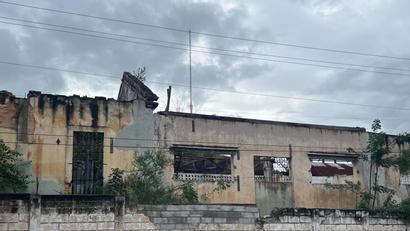
14ymedio bigger14ymedio, José Lassa, Havana, 6 January 2024 — “It was the water that we drank in my house, and a fleet of trucks delivered 20-liter glass bottles at home,” Ramón sighs at the ruins of La Cotorra, one of the most emblematic companies of pre-revolutionary Cuba. Uncovered roofs, cracked walls, chipped paint and weeds growing wildly among rusted iron are all that remain now of the factory, located at the entrance of Guanabacoa (Havana), on Corral Falso Avenue.

“We bought water from the trucks that distributed it,” Ramón continues. “At home they put it in some metal containers where you could swing the bottle forward to extract the water. We were regular customers of La Cotorra and we never lacked water. The same truckers had you change the empty for the full, carrying it on their backs in a very characteristic way, and they took the water everywhere. It cost 20 cents.”

Uncovered roofs, cracked walls, chipped paint and weeds growing wildly among the rusted iron is all that is left now of the factory / 14ymedio

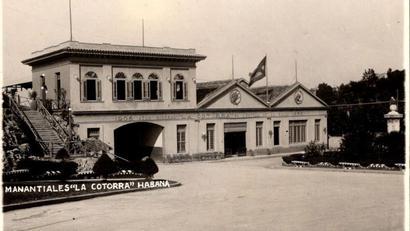
The man’s nostalgia is evident; he knew the factory when the Soviet subsidy still kept it active. La Cotorra, however, knew better times. Its foundation dates back to the early nineteenth century, when the Galician immigrant Claudio Conde Cid – who began in 1905 to transport water from the Isle of Pines to Havana – acquired in 1915 the land in the Loma de la Cruz, known for its springs, including the famous Chorrito del Cura.

Those first years were dedicated by the company to bringing water to the capital under the La Vida brand, but it soon began a much larger continue reading

deployment aimed at exploiting local resources. In 1920, the company completed the construction of an industrial complex that included purification, packaging and distribution facilities, along with gardens and halls that became popular spaces for social events.

The company became one of the great economic centers in the area, not only because of the water it distributed, but also because of the employment and social activities it generated. In the 1940s it had 42 distribution trucks and 69 branches throughout the country, and produced about 20 million bottles in 1959.

The company became one of the great economic centers in the area, not only because of the water it distributed, but also because of the employment and social activities it generated / Archive

After nationalization in the 1960s, the company was converted into the Administrative Unit that controlled water and soft drinks. Several local brands were unified, and the name was changed to José Ramón Reyes Moro, in honor of a soldier from Guanajuato who fell at Playa Girón. In that decade and the next, there were still years of splendor for the company, as Julián, a neighbor of the Habana Nueva neighborhood, points out.

“Although I was born in 1968, the service still existed. In my grandmother’s house it was the water we drank. Over the years, the bottles were used to make rice wine that my great-grandmother loved,” he recalls. Little by little, like so many facilities on the Island, the money stopped flowing and the deterioration became increasingly pronounced.

In 1986, the official newspaper Granma itself reflected on the deterioration of the industrial facilities. The lack of maintenance and the precarious conditions of the infrastructure, which included defective boilers and obsolete filters, began to diminish production.

During the Special Period, the social halls and the playground disappeared, becoming offices and warehouses. The springs of the Loma de la Cruz, once an inexhaustible source of pure water, stopped being exploited due to the proliferation of houses, which made the neighbors think that the water was contaminated. The plant was dedicated solely to marketing water from the El Gato aqueduct, and, in 1997, the management became part of the Beverages and Soft Drinks Company of the City of Havana.

However, an expert in the field, Laureano Orbera, points out that, despite the widespread deterioration, the springs of the Loma de la Cruz are in good condition. In a study conducted in 2005, Orbera and a team discovered twenty virgin wells with a constant flow of one liter per second and adequate mineralization. Despite the constructions that have invaded the Hill of the Cross, the deep water remains intact, although its medicinal and valuable waters remain inaccessible due to the lack of adequate infrastructure for its exploitation.

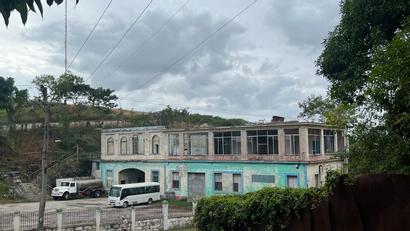
Today, the factory operates as a parking lot. Collapsed, it remains closed, with access to its interior forbidden. The image is very different from the memories of Monica, who went to visit it as a child with her school.

Today, the factory operates as a parking lot. Collapsed, it remains closed, with access to its interior forbidden / 14ymedio

“There was a sculpture of a parrot in the center of the gardens resting on a concrete slab that covered a large well or pond of crystal clear water with blue rock walls. There was a large park where the trucks that distributed the water were parked. At the top of the factory were the offices and a large hall where activities, meetings, birthdays, dances, etc. were held. Now it is a garden, playground and gastronomic center, but the restoration has been horrible.”

The deterioration is not only physical. The abandonment of La Cotorra reflects a loss of identity and collective memory. The history of this emblematic water company is in ruins, and with it, the future of a heritage that was once vital for Guanabacoa.

Translated by Regina Anavy

____________

COLLABORATE WITH OUR WORKThe 14ymedio team is committed to practicing serious journalism that reflects Cuba’s reality in all its depth. Thank you for joining us on this long journey. We invite you to continue supporting us by becoming a member of 14ymedio now. Together we can continue transforming journalism in Cuba.

Cuban Military from Gaesa Partner with the Spanish Vima in Another Dollarized Store

Customers can pay with MLC, but employees suggest that they are going to remove this option

Faced with the delay in the line to check out and the subsequent protests from customers, this Sunday, the employee argued: “And what do you want me to do, if I’m the only one?” / 14ymedio

14ymedio bigger14ymedio, Juan Diego Rodriguez/Olea Gallardo, Havana, 6 January 2025  –Although it has not attracted as much attention as the Supermarket on 3rd and 70th, which opened a day later, the store on Infanta and Santa Marta in Havana is another of the new “dollarized” Caribe stores that the military conglomerate Gaesa (Business Administration Group) opened in recent days through its Cimex corporation. In this case, the establishment is presented as “a collaboration project with the supplier Vima.”

In fact, its shelves, which are impeccable and full, carry a few Chinese products but are mainly dominated the Vima brand, founded by the Spaniard Víctor Moro Suárez and much reviled by the inhabitants of the Island for its low quality.

Unlike 3rd and 70th, cash dollars are not accepted at Infanta and Santa Marta, but, as at the brand new Miramar establishment, you can pay with the Classic card, which is recharged with US currency.

“It is nice and has many things, but as always, not everyone can afford this.” / 14ymedio

Another difference is that you can still pay with freely convertible currency (MLC), although employees suggested that this will not be the case for long. “You can pay with MLC, but I recommend that you get the Clásica card, because the lines to get it afterwards are going to be violent,” said a cashier at Infanta and Santa Marta to a customer who was entering for the first time. “Are they going to remove the MLC?” he asked, to which the woman replied: “That’s what they say.”

Posters distributed by the store and other employees, as well as Cimex’s own posts on its social networks, also encourage users to buy the Clásica card, which costs 5 dollars (one of which remains as a balance). Operative in hotels, state stores and gas stations in dollars, its use applies a 5% discount in stores and 10% in hotels, but with each refill one dollar is “discounted.” continue reading

Although the country’s top authorities have not said anything about it, the obligation to pay in dollars and the incentive to use the Classic card – created at the beginning of last year – can be considered as another step towards the dollarization of transactions in Cuba, which Prime Minister Manuel Marrero spoke about last month before the National Assembly and, with it, the effective end of the use of MLC.

Facade of the Cimex and Vima store on Infanta and Santa Marta, Centro Habana. / 14ymedio

The first thing that catches your attention at Infanta and Santa Marta, however, is the number of security guards multiplying in the corridors. Above all, in contrast to the only worker who performs the function of checking the bags on the way out. This Sunday, faced with the delay in the line to leave and the consequent protests from the customers, the employee argued: “And what do you want me to do, if I am the only one?” To which a man snapped: “But look how there are people here doing nothing, they should put someone there to help you.”

“It’s nice and has a lot of things, but as always, not everyone can afford this,” lamented a pensioner outside the shop who only bought a 3-kilogram package of powdered detergent (for $8.95). “And well, a lot of green,” she said, highlighting the color of Vima. “I didn’t buy any food, because I can’t even look at that brand, which isn’t exactly cheap.”

Highly criticized by Cubans for its poor quality, Vima has been present on the island, with privileges that most companies do not have, since 1994, although it was registered in the National Registry of Foreign Commercial Representations only in October of last year.

Some of Vima’s prices at the new Infanta and Santa Marta stores. / 14ymedio

The partnership with Gaesa is not new for Vima, which has its headquarters in Havana in the Berroa area, owned by the Armed Forces business consortium. Its founder, Víctor Moro Suárez, has lived in Cuba for more than 25 years and was president of the Association of Spanish Businessmen in Cuba.

Before this rebirth, the store on Infanta and Santa Marta had gone through different stages. With the dollarization of the economy in the 1990s, it became one of the best-stocked markets in the Cuban capital – like the old “diplotienda” on 3rd and 70th, opposite the new Supermarket – where one could pay directly with the US currency and later with convertible pesos.

Posters distributed by the store and other workers, as well as Cimex’s own posts on its social networks, also encourage users to buy the plastic card, which costs $5.  The lower sign says: “This unit sells products that can be paid for only by magnetic card backed with freely convertible currency.” / 14ymedio

Located in a border area between Centro Habana and Cerro, the store is surrounded by very poor neighborhoods, such as the El Platanito settlement. Its wealthiest neighbors were, until recently, the residents of the nearby Fama y Aplauso building, whose apartments were distributed among Cuban cultural figures, spokespeople for the regime, and journalists prominent in the so-called Battle of Ideas, an ideological turnaround promoted at the beginning of this century. However, the most powerful figures have ended up moving out of the building and into neighborhoods to the west of the city. The new market thus has to deal with the impoverishment of a neighborhood where the dollar does not circulate, and even less so the Clásica card.

____________

COLLABORATE WITH OUR WORKThe 14ymedio team is committed to practicing serious journalism that reflects Cuba’s reality in all its depth. Thank you for joining us on this long journey. We invite you to continue supporting us by becoming a member of 14ymedio now. Together we can continue transforming journalism in Cuba.
The Garbage on El Chacón Beach Has Ruined the Fame That Hemingway Gave to Cojímar

In its time, El Chacón was one of the most beautiful places on the coast of Havana / 14ymedio

14ymedio bigger14ymedio, José Lassa, Havana, 5 January 2025 — “Take care of your people. Your garbage pollutes.” The sign on a small wall on the beach of Cojímar – known as El Chacón – east of Havana, becomes a bad joke when the visitor looks out at the coast: a long landfill, with several strata, between the weeds and the sea.

Cojímar is still the town of Santiago, Hemingway’s battered fisherman in The Old Man and the Sea. But to the poverty of the town, which was already a humble but very lively community in the 1950s, are now added entire months of waste accumulation. Almost a year ago, when a reporter from 14ymedio toured Cojímar and Alamar, El Chacón was already submerged in the garbage, dragged from the bay and the river of the area.

“The beach was a place where families and tourists came to enjoy themselves. Sometimes I feel helpless when I see how everything has deteriorated,” says Ana María González, owner of a small coffee shop in the area. The woman remembers the times when the beach was full of laughter and children. “On weekends I prepared lunch, and we went to the beach to spend the day. It was a close and cheap option, and my children had a great time.”

“Take care of your town. Your garbage pollutes,” says a sign on a small wall on the beach / 14ymedio

At the time, El Chacón was one of the most beautiful places on the capital’s coast. At the end of the coastal curve is the 17th century “castillito” that was the last bastion against French pirates and English invaders. The old tower gave charm to the place, in whose waters sailed the yacht Pilar, of the American Nobel Prizewinner (1954), in search of Nazi submarines that – it was thought at the time – loaded fuel in some Cuban key. continue reading

Now, however, “the fall in tourism has made the authorities prioritize other areas,” laments Miguel Ángel Rodríguez, a veteran fisherman from Cojímar. “We used to have tourists buying fresh fish right here. Now, they don’t even want to get close.”

Some insist on setting a date for the decline of El Chacón: 2017, the year of Hurricane Irma, which devastated the northern coast of Havana. However, it’s the tide and the river current that have, over time, returned to the area’s inhabitants everything they have thrown in the water.

No one wants – or can – walk along the beach anymore. Not to mention swimming in its waters. You can barely see a path of sand below the carpet of waste: it shows that, in spite of themselves, many residents of Cojímar must cross the beach.

You can barely see a path of sand between the carpet of waste. It shows that, in spite of themselves, many residents must cross the beach / 14ymedio

The complaints that frequently appear in the Havana press have been worthless. Reinier Torres Cruz, a resident of Cojímar and president of the Alto Voltaje motorcycle club, led a beach cleaning in 2019. His description of the landscape, published in Trabajadores, already presaged the current situation.

“The river brings the largest amount of garbage to the beach,” Torres explained. “It is dragged from Regla and Guanabacoa, and, as if that were not enough, there are industries that also dump their waste in the river. That’s why it takes so much work to keep our bay clean.”

In August 2024, the Regional Office of Culture for Latin America and the Caribbean, in collaboration with UNESCO, carried out cleaning work. They collected as many as 150 bags of garbage.

On December 15, the restored Golfito de Alamar – currently leased to a private company – organized another garbage collection with private businesses in the area. “It’s a collective effort, but we need more support and education on conservation,” one of the volunteers told this newspaper at the time. “People don’t understand that every little gesture counts.”

Complaints about the precarious state of El Chacón have even reached social networks / 14ymedio

Complaints about the precarious state of El Chacón have even reached social networks, where neighbors publish photos of the garbage that the sea deposits on the sand. “We can’t go on like this,” an Internet user living in the area recently commented. “I have lived here all my life and have never seen anything so sad. The beach is part of our history and is now disappearing.”

The little beach continues to attract Cojímar’s garbage. The fact that the place is no longer among the sites of tourist interest has condemned it to permanent neglect by the authorities. Defeated in its war against the landfill, like Hemingway’s old fisherman, El Chacón appears to be very unlucky.

Translated by Regina Anavy

____________

COLLABORATE WITH OUR WORKThe 14ymedio team is committed to practicing serious journalism that reflects Cuba’s reality in all its depth. Thank you for joining us on this long journey. We invite you to continue supporting us by becoming a member of 14ymedio now. Together we can continue transforming journalism in Cuba.
Olympic Champion Jordan Díaz Wants To Take His Family out of Cuba and Bring Them to Spain

The Paris 2024 triple jump gold medalist has bought a house in Spain to live in with his family from Cuba

Jordan Díaz, Cuban, with two of his medals won as a Spanish athlete / Instagram/Jordan Díaz

14ymedio bigger14ymedio, Havana, 5 January 2025 — The family of the Olympic gold medalist in triple jump, the Cuban Jordan Díaz, is in the process of leaving the Island. The naturalized Spanish athlete gave the news in an interview offered to the newspaper El País: “I want to bring them, so I have bought a house for them to come.”

Díaz, who deserted from the Cuban national team in 2021 to seek a “better future” for himself and his family, said that his parents supported his decision at all times. “When my parents gave me their blessing, they told me, ’you have to go, you have to leave if you want to be great’.”

The athlete recalled: “It’s not a matter of one day saying I’m going to leave and nothing happens. You have to really think about it, see the consequences it can bring you, think about friendships, all the life you have led here, your family.” continue reading

Díaz’s career has been on the rise since he arrived in Spain. He trains with Iván Pedroso, the former Cuban champion who has won medals for his training work in Venezuela and Spain. After winning the gold at the Olympic Games in Paris 2024, the triple-jumper beat Spain’s absolute record on four occasions and placed it at 17.87 meters, achieved in the local Championship held in Nerja.

Triple-jumper Jordan Díaz during his participation in the Olympic Games in Paris 2024 / Instagram/Jordan Díaz

Before the Olympics, he was crowned in the 2024 European Athletics Championship with a jump of 18.18 meters, the third best jump in history and a record for Spain. “I didn’t have more than 18 in mind; I think it’s an incredible score,” he told the same newspaper.

For his achievements on the track he was awarded the ICON Award. “It’s a great prize. All recognition is good and all prizes are important for an athlete, because you see how in the end the work you are doing is rewarded,” he said.

Díaz focuses his goals for this year on completing the triple crown with the World Athletics Championships, which will be held in 2025 in Japan. He has dedicated part of his training to perfecting his technique, which has also helped him overcome the fibrosis he suffers as a result of poorly healed injuries and the tendonitis he had in Cuba.

“Cuba’s method is not to do many sprints but to work more on the jump. That’s why I had a lot of power there, I did taller jumps to gain distance, but when you approach with more speed and lower the jump angle, you pull further forward. That’s what Iván has changed for me, and thus we have obtained better results. That’s why I need to be physically well,” said the medalist.

Translated by Regina Anavy

____________

COLLABORATE WITH OUR WORKThe 14ymedio team is committed to practicing serious journalism that reflects Cuba’s reality in all its depth. Thank you for joining us on this long journey. We invite you to continue supporting us by becoming a member of 14ymedio now. Together we can continue transforming journalism in Cuba.
The Prensa Latina Correspondent in New York Abandons Her Post and Stays in the United States

The agency has experienced several casualties in recent years and lacks staff

Borrego graduated from the Marta Abreu Central University of Las Villas / LinkedIn/Elizabeth Borrego

14ymedio bigger14ymedio, Havana, 4 January 2025 — Prensa Latina lost one of its key correspondents this week. Elizabeth Borrego Rodríguez, head of the official Cuban news agency at UN headquarters in New York, informed Prensa Latina that she was leaving her position to stay in the United States, after more than a year of reporting for the organization, reported El Vigía de Cuba.

The resignation of the 31-year-old journalist after little time in the position affects Prensa Latina, which increasingly resorts to younger collaborators, who, like Borrego, do not seem to last. “She had only been on the job at United Nations headquarters for a little over a year. She called Prensa Latina in Havana to say that she was not returning,” an employee of the agency confirmed to Cubanet.

Before arriving in New York, Borrego was a correspondent in Venezuela, from where she sent articles validating the actions of the Caracas regime, an ally of Havana, which were then reproduced in the provincial press of the Island. The Cuban government has stationed several of its most notable propagandists in Caracas, such as Pedro Jorge Velázquez, known as El Necio [The Fool].

Born in Sancti Spíritus and graduated from the Marta Abreu Central University of Las Villas with a thesis about Noticiero Estelar [another official news source], Borrego is the daughter of Juan Antonio Borrego Díaz, who continue reading

died in 2021. He was the director for almost 24 years of Escambray, the newspaper of the Communist Party in Sancti Spíritus. In addition, he was a correspondent for the State newspaper Granma for 30 years and a collaborator of Cubadebate, where his articles appeared frequently. After his death, the Journalistic Innovation Award that bears his name was created.

After his death, the Journalistic Innovation Award that bears his name was created

From the UN, Borrego diligently performed her work, which consisted mainly of criticizing the economic “blockade” of the United States, asking that Cuba be removed from the list of countries sponsoring terrorism and applauding the pleas of the foreign minister, Bruno Rodríguez Parrilla. “Unilateral coercive sanctions prevent enjoyment of the rights to food, education, health and development [of Cubans],” she wrote in her last article, published by Prensa Latina on December 10.

Occasionally, she also worked on other topics, such as a report dedicated to Latin American women that she published in 2024, or the recent deliveries of UN donations to those affected by hurricanes Oscar and Rafael on the Island. “Borrego did her job very well. She is a good journalist, but, like every young person, she dreams of having children and leading a dignified life, and that is impossible here,” explained a source close to El Vigía de Cuba.

He also said that Prensa Latina has a lack of journalists: “The blow is hard, because more and more young journalists are leaving, the most talented, some with important positions or in wonderful places, without us being able to do anything at all to avoid it.”

However, he says that the reactions within the agency do not always support the decision of the young reporter, and some believe that her departure is a “treason” to the agency that entrusted her with an important position.

Inside the agency, some believe that her departure is “treason”

According to Cubanet, with a source in Havana, the agency tries to keep the UN correspondent active with the support of Washington correspondent Daisy Francis Texidor, of “very discreet professionalism as she showed in Mexico, but an old collaborator of Cuban intelligence.”

He also adds that Francis “was closely linked to the environment of Los Cinco,” – The Five – in reference to the spies in the service of the Cuban government that Washington arrested in 1998. He also recalled the departure in recent years of two other important correspondents of Prensa Latina: Néstor Marín, in London, and Miguel Lozano, in Madrid.

On December 30, the arrival at Miami International Airport of sports commentator Sergio Ortega and his family, who emigrated definitively to the United States and plan to settle in southern Florida, was also in the news. The journalist is the son of Manolo Ortega, who was a “personal friend” and official presenter of Fidel Castro in political events.

Translated by Regina Anavy

____________

COLLABORATE WITH OUR WORKThe 14ymedio team is committed to practicing serious journalism that reflects Cuba’s reality in all its depth. Thank you for joining us on this long journey. We invite you to continue supporting us by becoming a member of 14ymedio now. Together we can continue transforming journalism in Cuba.

A New Year’s Eve without Pork, Rice, Beans, Yucca or Tomato — the Five Pillars of the Cuban Family Dinner

Many Cuban households are reducing portion sizes, cutting back on the number of traditional items on the menu or simply working with whatever happens to be available.

Rice for sale at the Young Labor Army market in Havana’s Nuevo Vedado district. / 14ymedio

14ymedio bigger14ymedio, Natalia López Moya, Havana, 31 December 2024 — On December 31, the Cuban dinner table will reflect a year marked by higher food prices and shortages of basic products. New Year’s dishes will cost more to prepare than they did twelve months ago. While imported ingredients will play a larger role, the holiday meal will be little different at some homes from the meager rations of any other day.

Pork, rice, beans, yucca and tomato — the inseparable quintet of the Cuban New Year’s Eve meal — are among the ingredients in shortest supply. The situation is such that some households are opting to reduce portion sizes, cut back on the number of traditional items on the menu or simply work with whatever is available and affordable.

Among the items seeing the largest price increases in 2024 is pork, which sold for 1,000 pesos a pound in December. At some markets in Havana, such as the one on 19th and B streets in Havana’s Vedado district, it was going for 1,200 pesos, almost double what it cost at Christmas in 2023. A shortage of animal feed has hampered domestic production, resulting in a proliferation of American pork loins, which now dominate the market. Steak, pork rinds continue reading

and fried pastries have become luxuries in a country where the average monthly income is 4,648 pesos (USD $193.62 at the official exchange rate) according to the National Office of Statistics and Information (ONEI).

One of the main price increases in 2024 has been for pork / 14ymedio

The tomato is not far behind. The fruit — typically thinly sliced, seasoned and served with lettuce or cabbage — was 400 pesos at the Plaza Boulevard market in Sancti Spíritus in December 2024. The previous January it was going for only 100 pesos at the same market. By July it had completely disappeared due a supply shortage. The market, which is located in a region with a long agricultural tradition and whose prices 14ymedio tracks every week, has become a gauge for measuring a crisis that has burned through wallets and charred household finances.

The fruit has reached 400 pesos in the Plaza Boulevard market in Sancti Spíritus this last month of the year. / 14ymedio

In Cienfuegos province, another agricultural region, black beans closed out the year at 400 pesos a pound, a price in excess of $1.30 USD at the informal exchange rate. In other regions the price exceeded $1.50. The legume is one of the foods most severely impacted by the drop in domestic production. Faced with an avalanche of foreign labels, Cubans now find themselves having to learn the names of this product in other countries, buying packages whose labels read “porotos,” “alubias” or “habichuelas.”

In the province of Cienfuegos, black beans closed the year at 400 pesos per pound. / 14ymedio

However, it is rice that has undoubtedly been the biggest headache for Cuban cooks in 2024. Stores selling rationed goods are only now, in late December, getting around to selling November’s allotment of the popular grain. After seeing prices soar in the last five years, rice is now selling on the open market for close to 200 pesos a pound.

Imported 0ptions, sold mainly in one-kilogram packages, are of higher quality and are more carefully presented but cost more than 400 pesos. This basic ingredient, essential to almost every lunch or dinner, has driven the island’s food costs through the roof. At Holguín’s Los Chinos marketplace, the prized item was going for as much 240 pesos a pound in August. Though it had fallen to 190 pesos by year’s end, this is cold comfort to those households whose only source of income is a state pensions or a government salary.

Rice has undoubtedly been the biggest headache for Cuban kitchens this year. / 14ymedio

The news is not good for yucca either. In December 2023 it cost 50 pesos a pound at Cienfuegos’ Plaza La Calzada market. A year later it is nearly 70 pesos at the same location. The dramatic fall in domestic production threatens to further reduce the number of cassava crops, a food inextricably linked to national identity. The steepest decline can be seen in the state sector as evidenced by this graph prepared by economist Pedro Monreal based on data from ONEI.

The debacle is most evident in the state sector. / Pedro Monrael

Those who decide to forego the usual New Year’s Eve dinner in favor of a popular lifesaver in times of scarcity will not have an easy task either. Prime Minister Manuel Marrero Cruz recently recalled Raúl Castro once saying that it would be a shame if we ever had to import sugar. “Well, we are now experiencing that shame because we are now importing sugar,” he admitted. Even without data on the sugar sector for the past year, the average Cuban knows what is going on. There is no sugar and prices are skyrocketing, hovering around 400 to 600 pesos per pound in recent weeks.

The situation is summed up in the November consumer price index. ONEI reports that raw sugar rose by 16.12% while the refined version rose by 10.98%. “Milordo” or “munga” — a recipe in which a couple of spoonfuls of sugar are mixed in a glass of water — has also become unattainable for many Cubans this New Year’s Eve.

The crude product rose by 16.12%, while the refined product rose by 10.98%.

____________

COLLABORATE WITH OUR WORKThe 14ymedio team is committed to practicing serious journalism that reflects Cuba’s reality in all its depth. Thank you for joining us on this long journey. We invite you to continue supporting us by becoming a member of 14ymedio now. Together we can continue transforming journalism in Cuba.

Beggars Proliferate on the Streets of Cuba, Living Replicas of San Lázaro

Many are accompanied by a small statuette of the saint and a cardboard box to deposit the quilos.

The glances, always on the ground or lost somewhere in the street, say it all. / 14ymedio

14ymedio bigger14ymedio, Juan Diego Rodriguez, Havana, 17 December 2024 — In Cuba, every corner has its Saint Lazarus. Bent over, propped up by crutches or moving in a wheelchair, dressed in the jute that characterizes the saint or in the rags of Babalú Ayé. You don’t have to go to the famous Havana sanctuary to find yourself face to face with an old man, a sick person or a beggar.

People are not sure whether this December 17th is celebrated by the Catholic saint who got up and walked, St Lazurus — the beggar with dogs — or the Yoruba orisha. The only thing that is clear is that Lázaro – a name that Cuban mothers often give to their children if the pregnancy was difficult – is synonymous with suffering, and that is never lacking.

Since colonial times, when African slaves mixed their tradition with that imposed on them by their masters, Saint Lazarus was the saint closest to the terrestrial and, therefore, the most venerated; sometimes even above the Virgin of Charity (Ochún) or Saint Barbara (Changó). The drums of his “wake,”as in the song by Bola de Nieve, can be heard from the night of December 16th in any part of the country and the church collection boxes are filled with coins collected throughout the year in homes.

Silent and in the company of these symbols, Cuban beggars rarely really ask for anything. / 14ymedio

The average Cuban cares little about the theological boundaries between the orisha and the biblical figure. There is no beggar on the island who does not carry a small statuette of the saint and a cardboard box to deposit the
quilos, pesetas and pesos, and sometimes a few bills.

Silent and in the company of these symbols, Cuban beggars rarely really ask for anything. You see them – like the one that on Tuesday was near the Parque de la Fraternidad – hunched over, with nylon bags around him, a bottle with a little soda and some violet piece, the color of Babalú.

Reduced to pure bones, a beggar washes his feet in a ditch on Reina Street. / 14ymedio

The glances, always on the ground or lost somewhere in the street, say it all, like that of the old woman who – cart in hand, jute robe, and a little box with Saint Lazarus on it – was selling oil sitting near a line.

On Rodríguez Street, a “diver” explores a gigantic landfill with his crutch. Reduced to pure bones, another beggar washed his feet in a ditch on Reina Street. It is enough to continue walking through Havana for the list to continue.

On Rodriguez Street, a diver uses his crutch to explore a giant landfill. / 14ymedio

In the land of the Lazaruses, the gigantic advertisement on the scaffolding surrounding the old Payret cinema, opposite the Capitol, is shocking. The photographic exhibition Grandmothers and Grandfathers on loan, by Monik Molinet, is the exact opposite of reality. Rosy-cheeked, peaceful, in houses made of slabs and with happy faces, the “borrowed” elderly have little to do with the mistreated Babalú Ayé or with so many Cubans who resemble him.

____________

COLLABORATE WITH OUR WORKThe 14ymedio team is committed to practicing serious journalism that reflects Cuba’s reality in all its depth. Thank you for joining us on this long journey. We invite you to continue supporting us by becoming a member of 14ymedio now. Together we can continue transforming journalism in Cuba.

Cuba’s Military Company Gaesa is Responsible for the ‘Abrupt Impoverishment’ of the Country

‘The Miami Herald’ reveals that the hotel arm of the conglomerate has 4.261 billion dollars in its accounts

The K Tower in Havana, a symbol of Gaesa’s opulence, whose construction continued despite all the crises. / 14ymedio

14ymedio bigger14ymedio, Havana, 1 January 2025 — Gaviota, one of the hotel companies owned by Gaesa — the economic and financial arm of the Cuban military — has roughly 4.261 billion dollars in “current assets.” The figure, accessed by The Miami Herald after the military conglomerate’s “rare leak of financial records,” gives an idea of the power of the Armed Forces, which several economists describe as the Island’s “parallel government.”

The amount is one of the few that the documents express in dollars. Between Gaviota and Almest, the all-powerful real estate company from which the hotel investments come, the figure totals 22,765 billion pesos.

The report, signed this Monday by journalist Nora Gámez, states that if the amount is converted into pesos using the state exchange rate of 24 pesos per dollar, the figure is close to 95 million dollars, an overwhelming number considering the extreme crisis situation in the country. Gaviota also has 51 billion pesos in “long-term or permanent investments” and 1.7 billion pesos in food.

The case of Almest, founded in 1994 as the “main investor” in Gaesa hotels, is notable in fiscal terms.

The case of Almest, founded in 1994 as the “main investor” in Gaesa hotels, is notable in fiscal terms. The company received 668 million pesos from state coffers, but paid only two million pesos in taxes, the newspaper says.

The Miami Herald points to Gaviota and Almest as the main culprits of the country’s “abrupt impoverishment” and the worsening of the current Cuban crisis. Gaesa has spent years “diverting billions of dollars of the continue reading

country’s foreign exchange earnings to relentlessly build new hotels despite the deteriorating situation.”

According to economist Pavel Vidal, interviewed by The Miami Herald regarding the leak, Gaesa has not only harmed Cubans, but also the government of the regime, whose authority has been reduced to a symbolic level.

The frantic construction of hotels by order of the Armed Forces, in a context in which the economy “is falling apart,” is the greatest evidence that centralized government planning belongs to the past, Vidal believes.

Gaviota’s financial assets are, they say, 13 times greater than the amount Havana needs, but lacks, to supply the Island’s pharmacies

To underscore the contrast between Gaviota’s coffers and the government’s difficulties in sustaining the country, The Miami Herald cites Cuban authorities, who say they need $339 million annually to supply the Island’s pharmacies. Gaviota’s financial assets are, they say, 13 times greater than the amount Havana is lamenting the lack of.

Gaesa’s millions are “hidden.” The military has been clever at registering its business abroad and maintains the opacity of its transactions at all costs. In addition, thanks to its control of remittances entering the country, it has seized a large amount of foreign currency since 1990, the year it was founded, the newspaper reports.

By referring only to Gaviota and Almest, the leaked documents only offer “a glimpse” of Gaesa’s true power, The Miami Herald acknowledges. To properly gauge its reach, one would need to know the financial ins and outs of other companies under the military umbrella, such as Cimex, Etecsa, Habaguanex, Almacenes Universal and Grupo Palco.

Gaesa has also protected itself from government auditors, who are not authorized to inspect the conglomerate’s records. Not even the Comptroller General’s Office has jurisdiction over the Armed Forces, which invoke “superior discipline and organization,” as former Comptroller General Gladys Bejerano, who was dismissed shortly after the interview, admitted to EFE.

____________

COLLABORATE WITH OUR WORKThe 14ymedio team is committed to practicing serious journalism that reflects Cuba’s reality in all its depth. Thank you for joining us on this long journey. We invite you to continue supporting us by becoming a member of 14ymedio now. Together we can continue transforming journalism in Cuba.

A ‘Coyote’ Abandons 25 Cubans in an Area of Mexico Controlled by Narcos

The Mexican Border Police transferred the Cuban migrants to the Immigrant Prosecutor’s Office /FGE of Chiapas

14ymedio bigger14ymedio, Mexico City, 3 January 2024 — A coyote abandoned 25 Cubans on Thursday in the trailer of a cargo truck on a road in the Ignacio Zaragoza ejido, in the municipality of Suchiate, Chiapas, bordering Guatemala. The migrants were rescued by state police, who after a medical check-up, handed them over to the Immigrant Prosecutor’s Office to determine their status.

These Cubans, among whom are several women and minors, asked to communicate with 14ymedio, but the authorities denied it, arguing that “the investigation could be hindered.” The minors were taken to a shelter of the National System for the Integral Development of Families (DIF) in Tapachula.

From Tecún Umán, in Guatemala, to Suchiate and Tapachula, in Mexico, the authorities carry out tours to combat irregular entries. However, they have not been able to eradicate the networks of coyotes in the service of criminal groups.

Of an average of 1,200 migrants who illegally enter Mexico daily through the Guatemalan border, at least 50% are being kidnapped by “cartels in the municipality of Suchiate,” denounced priests from the San Andrés Apóstol parish and the Pastoral Coordination of Migrants in Guatemala. continue reading

The Chiapas State Prosecutor’s Office is investigating a network of coyotes in the state / FGE of Chiapas

Father Percy Cervera of Guatemalan Pastoral confirmed the increase of “migrants of 56 nationalities” in the last quarter of 2024 who seek to reach the United States. They have become a vulnerable group that is “prey to criminals, authorities, transporters and many people who take advantage of their situation,” he said.

For his part, the priest of the parish of San Andrés Apóstol de Ciudad Hidalgo, Heyman Vásquez Medina, warned Diario del Sur in August last year of the presence of coyotes under the control of factions of the Sinaloa Cartel and the Jalisco New Generation Cartel. They “arrive in vans wearing balaclavas and with weapons. They intercept the migrants and take them to farms, where they keep them for days until their relatives pay the sums they demand,” he said.

The Associated Press agency documented the kidnapping of migrants in Suchiate last November. Before crossing the river that separates Guatemala from Mexico, they are detained by human traffickers. Heyman Vázquez, parish priest in Ciudad Hidalgo – a town near the border – said in the same interview that the cartels dominate both sides of the border. “They are the ones who say who passes and who doesn’t.”

The migrants are grouped and taken to a farm known as “the chicken coop” or “la gallera.” There they demand 100 dollars for transit duty, and those who pay are marked and released. Those who cannot cover the fee remain in place, but the sum is increased by the food they receive. “When they can’t pay with money, they pay with their bodies, especially women, adolescents and homosexual men,” Enrique Vidal Olascoaga, general director of the Fray Matías de Córdova Human Rights Center in Tapachula, told the same agency.

Translated by Regina Anavy

____________

COLLABORATE WITH OUR WORKThe 14ymedio team is committed to practicing serious journalism that reflects Cuba’s reality in all its depth. Thank you for joining us on this long journey. We invite you to continue supporting us by becoming a member of 14ymedio now. Together we can continue transforming journalism in Cuba.

A Truck Carrying Passengers Overturns in Camagüey Leaving One Dead and Dozens Injured

The vehicle overturned on a bridge known as El Francés

The injured were taken to the José Espiridón Santiesteban Báez municipal hospital. / Radio Santa Cruz

14ymedio bigger14ymedio, Havana, 2 January 2025 — One dead and 63 injured, including 13 minors, was the toll of an crash this Thursday morning at kilometer 71 of the highway that connects Camagüey with Santa Cruz del Sur. According to information from the official profile of Radio Santa Cruz, a private truck used for transporting passengers overturned on a bridge known as El Francés.

According to the report, the driver lost control of the vehicle. The first published images of the crash show the truck that fell to the side of the road in an area full of vegetation. The front area, where the engine is located, and part of the driver’s seat were practically crushed.

The photographs show the presence of neighbors who are assisting and trying to help those left behind in the truck, something that is also mentioned in the Radio Santa Cruz report: “The solidarity of the locals was not long in coming, who massively went to the institution in the white coat sector to support in whatever was necessary.”

The same profile also stated that “members of the Ministry of the Interior and the main political, governmental and Public Health authorities immediately went to the scene.” continue reading

The photographs show the presence of neighbors who assist and try to help those who remained in the truck.

Reporting on Facebook, the witness said that “at all times, the necessary medical and nursing staff and the essential resources for the care of all these people have been available.” He also detailed that the injured were transferred to the José Espiridón Santiesteban Báez municipal hospital in ambulances and alternative transport.

The incident had already been reported on social media hours earlier. “We had been hearing the ambulances passing by for a while and we knew that something had happened,” said one Facebook user, adding that “these accidents are preventable. They are racing around in trucks and this is not the first time that a truck on the Santa Cruz highway has overturned on a bridge.”

Several Facebook users initially reported that there were at least two dead, an eight-year-old child and an adult. However, the official report stated that the deceased is Ramón Chávez Águila, although it did not specify his age. An Internet user, Yanecita Mesa, said in the Revolico Santa Cruz del Sur group that the person who died is her “cousin Ramoncito,” a name that matches the one in the report.

After the crash, many Internet users in the province called on the population to come and donate blood.

This is the third traffic crash in less than two weeks on the island that has resulted in deaths. During the last days of December, the deaths of five people, two of them minors, were reported in two crashes in Ciego de Ávila.

The government has blamed the “human factor ” for the crashes in the country. “The frequency and dynamics of traffic accidents in the country continue to be marked by the irresponsibility of drivers and pedestrians,” said the official newspaper Granma in January of last year, which attributed 91% of the accidents to the population.

This is the third crash in less than two weeks on the island that has left people dead

However, in many cases, the wear and tear of the cars, which exceed their useful life by years, with between 40 and 70* years of operation, as well as the poor condition of the roads in the country that are used by the majority of the population, have contributed to the constant occurrence of traffic accidents in the country.

According to data published by the Ministry of the Interior’s traffic authorities, crashes on Cuban roads decreased by 13% (543 fewer) in the first half of last year compared to the same period in 2023, and the number of deaths and injuries fell by 23% and 5%, respectively. However, these data do not reflect the decrease in the population, mainly due to emigration.

Meanwhile, 8,556 crashes occurred throughout 2023, which represented a 13% decrease compared to the 9,848 reported in 2022. There were 5,938 injuries, 7% less than the previous year, but the number of deaths increased (729), according to official figures.

*Translator’s note: Many American cars manufactured as early as the 1950s remain in daily use in Cuba.

____________

COLLABORATE WITH OUR WORKThe 14ymedio team is committed to practicing serious journalism that reflects Cuba’s reality in all its depth. Thank you for joining us on this long journey. We invite you to continue supporting us by becoming a member of 14ymedio now. Together we can continue transforming journalism in Cuba.

In 2024 Oil Shipments From Venezuela to Cuba Fell by Almost Half

Although Venezuelan fuel exports increased by 10%, donations to the Island fell from 56,000 barrels per day to 32,000

The ship ’Alicia’, one of the tankers that usually bring oil from Venezuela

14ymedio bigger14ymedio, Madrid, 3 January 2025 — Fuel shipments from Caracas to the Island fell by more than 42% in 2024. The data, published by Reuters, is even more striking if we take into account that Caracas increased its oil exports in the same period by 10.5%, and its crude oil production by 17%, from the 780,000 barrels per day (bpd) of the first 11 months of 2023 to the 914,000 bpd of the same period last year.

“While Venezuela struggled with frequent refinery cuts last year, exports of crude oil and fuel to its political ally Cuba, which has been facing a severe energy crisis, fell to about 32,000 bpd from 56,000 bpd the previous year,” the British agency reported.

On the other hand, total exports decreased to 756,000 bpd in December, compared to a maximum of 974,000 bpd in November, because, explains Reuters, “one of the four Pdvsa crude upgraders had operational problems.”

The annual increase in exports took place despite the political instability in Venezuela, because partners of the Venezuelan state-owned PDVSA who have licenses granted by Washington took more shipments. Reuters alluded to the results of the presidential elections last July, whose triumph was attributed to Nicolás Maduro. This result has been questioned internationally and gave rise to demonstrations with hundreds of arrests. continue reading

Pdvsa and its joint ventures exported 772,000 barrels per day last year, the highest figure since 2019

These individual licenses, in force since the beginning of 2023, are the main element that caused Venezuelan fuel exports to the United States to skyrocket exponentially, by 64%, to about 222,000 bpd last year. The numbers make the United States the second largest export market for Caracas, behind China, which took 351,000 bpd, 18% less than the previous year.

On average, the British agency indicates, Pdvsa and its joint ventures exported 772,000 barrels per day last year, the highest figure since 2019, when Washington, under the presidency of Donald Trump, imposed energy sanctions for the first time.

Much of last year’s export profits, Reuters highlights, come from the American oil company Chevron. In addition, shipments to Europe tripled in 2024, up to about 75,000 bpd, thanks to the authorization of the US to European producers such as the Italian Eni, the Spanish Repsol and the French Maurel et Prom.

These gains, Reuters also estimates, “could be in danger” in the face of Trump’s imminent arrival at the White House for the second time. The president-elect and his team appointed for the State Department, headed by Cuban-American Marco Rubio, have already announced more pressure on the Maduro regime.

For the specialist, in any case, 2025 will be an “extremely difficult” year for the Island

The reinstatement of sanctions against Caracas by the next US president would, however, be beneficial for Cuba and Mexico, in the opinion of Jorge Piñón, a Cuban analyst at the University of Texas in Austin.

In an interview with the Spanish agency EFE published this Thursday, the specialist, a 14ymedio source for information on energy, indicated that Pdvsa, in fact, has given priority to companies such as Chevron and Repsol and has left Cuba “at the end of the line.” He pointed out the minimum shipment from Caracas to the Island, 23,000 barrels per day, compared to the 2023 average of 55,000 bpd.

Given this scenario, Piñón also commented that Mexico has displaced Caracas as the main sender of fuel to Havana, which is a problem for President Claudia Sheinbaum with Trump’s arrival in power on January 20.

“The United States and Mexico have a very close relationship in energy matters. That is not something that can be closed or turned off overnight,” the expert told EFE, pointing out that it is a card that Trump can play, as well as for the Pemex refinery in Texas. “Ninety percent of the natural gas that the United States exports through pipelines goes to Mexico, which represents 65% of Mexico’s natural gas consumption.”

“If Marco Rubio and Trump say: ’Fine, we are going to go back to the sanctions again,’” Piñón declared. It would benefit Cuba and Mexico, because the oil Venezuela sends to the US would go to Cuba instead, and on the other hand, Mexico would not have to send crude to Cuba, for that matter, and would not be exposed to possible sanctions from Washington.

For the specialist, in any case, 2025 will be an “extremely difficult” year for the Island, which has just ended 2024 with three total collapses of the National Electric System (SEN).

Based on official data from 2022, Piñón told EFE that Cuba has a daily deficit of about 80,000 barrels of liquid fuel. He calculates, based on international shipments from Venezuela and above all from Mexico, that the demand in 2024 was reduced by 20,000 barrels per day.

Translated by Regina Anavy

____________

COLLABORATE WITH OUR WORKThe 14ymedio team is committed to practicing serious journalism that reflects Cuba’s reality in all its depth. Thank you for joining us on this long journey. We invite you to continue supporting us by becoming a member of 14ymedio now. Together we can continue transforming journalism in Cuba.

After Hurricane Rafael, All the Resources of the Cuban State Were Put at the Service of the Mariel Special Development Zone

With more than 10,000 workers in its facilities, the Zone is the most important economic enclave in Cuba / Canal Caribe

14ymedio bigger14ymedio, Havana, 4 January 2025 — The Mariel Special Development Zone (ZEDM) in Artemisa recovered in record time after the passage of Hurricane Rafael in November. Construction materials of military origin arrived; fuel was allocated in the midst of a supply crisis, and there was direct supervision of the regime’s main plan, headed by President Miguel Díaz-Canel.

The impact of the hurricane was considerable: 29 of the 49 businesses based in Mariel suffered damage. “Catastrophic” was the adjective used by its managers to describe the panorama in an extensive report on Cuban Television. However, neither the blackout nor the crisis in which the country was immersed during those days was an obstacle to sending all possible resources to the ZEDM.

Ana Igarza, director of the Free Zone, said that before 36 hours had passed, reconstruction activities had already resumed. Electricity for the entire area was restored in less than three days, thanks to a legion of workers from the Electric Union who arrived the day after the hurricane.

Electricity for the entire area was restored in less than three days, thanks to a legion of workers from the Electric Union

The Army also intervened from the first moment. The governor of Artemisa, Ricardo Concepción, said that the Cuban military sent him more than 40,000 fiber cement tiles manufactured in entities of the Military Industry Company. “Today all municipalities now have materials,” he said. The role continue reading

of the Western Army in Mariel’s record reparation has been “determining,” Concepción admitted.

The foreign companies that operate in the ZEDM, according to Televisión Cubana, are “godparents” for Mariel’s schools, and financed their recovery. For the governor, the visits of Díaz-Canel and Ramiro Valdés also had a military character: both were wearing olive green uniforms.

Most of the report deals with the opinions of foreign managers in the ZEDM, especially those who suffered the most damage. This is the case of Brascuba Cigarrillos, whose director, the Brazilian Gustavo Leite Machado, said that his factories had lost 50% of the roofing. The chimneys, machines and power plants were damaged by the rain. “The water fell directly on the machines, and the parts rusted. A dismantling and cleaning process was necessary,” said Robinson Tamayo, Cuban director of Brascuba.

Most of the report deals with the opinions of foreign executives in the ZEDM

Maylin Carmente, director of administration of the Mexican Richmeat, said that the blackouts affected the production of processed meat “considerably.” The plant, like that of Brascuba, suffered structural damage.

About 25% of the roof of the company Nescor – which produces crackers, coffee and similar products – was cut down by the hurricane. “It was quite difficult to see a factory like Nescor in that condition,” said its director, Jorge Rivas. Although he claims to have enough raw materials to continue working, he predicts that 2025 will be a hard year for the company.

Suchel, another of the famous tenants of the Zone, had damage to its drying tower, ceiling and walls. The hurricane prevented the launch of several lines of detergent, which the company expected to sell this year.

Thai Binh Green, a disposable diaper and paper factory that built an extensive photovoltaic park in Mariel, was badly damaged by the hurricane. They need “more than a million dollars to rebuild the park,” said its director. The shipments of solar panels promised by China as the “definitive solution” to the Cuban energy crisis arrived a few days later.

With more than 10,000 workers in its facilities, the Free Zone is the most important economic enclave in Cuba. The Government spends about 300 million dollars a year maintaining its structure, according to Ecured. Its area is 213 square kilometers and has four large Chinese cranes. Not willing to lose its most important economic bet, the Cuban Government has a motto for the ZEDM, according to Igarza: “There is no pause.” And, unlike what happens in the rest of the country, there was a lot of hurry.

Translated by Regina Anavy

____________

COLLABORATE WITH OUR WORKThe 14ymedio team is committed to practicing serious journalism that reflects Cuba’s reality in all its depth. Thank you for joining us on this long journey. We invite you to continue supporting us by becoming a member of 14ymedio now. Together we can continue transforming journalism in Cuba.

Letter to the Three Wise Men, an Impossible Mission for Cuban Parents

In Cienfuegos, families avoid walking with their children along the boulevard, where toys are sold at unattainable prices

Older children know that magic also has its limits. / 14ymedio

14ymedio bigger14ymedio, Julio Cesar Contreras, Cienfuegos, 5 January 2025 –“Dear Three Wise Men, we want a stuffed panda bear and a soccer ball,” is how the letter from Susana’s seven-year-old twins begins. The paper, folded and placed inside a shoe near the window, has sparked a constant calculation in the family to determine whether they will be able to fulfill these wishes. Unlike other years: “there are products, what there is not is money,” says the worried mother.

On the boulevard of the city of Cienfuegos, stuffed animals, dolls and all kinds of children’s entertainment have been gaining ground in recent days. Private merchants, who display their wares on tables, small kiosks or rented state premises, know that the tradition of Melchor, Gaspar and Baltasar remains deeply rooted in Cuba despite official attempts to eliminate it.

Susana, 39, grew up in a time when Christmas and the Three Wise Men were considered “petty bourgeois weaknesses” by the government. “That’s why I take it very seriously that my children can live this illusion that I didn’t have,” she tells 14ymedio. But the Cienfuegos native’s efforts are not enough to satisfy the wishes of both children. “It’s very hard to tell them that I can’t spend so much.”

Susana earns about 7,000 pesos a month from her job as a university professor. “I’ve seen the stuffed panda bear on the boulevard and it costs 20,000 pesos, the ball costs about 3,000, that’s more than three months’ salary without spending a centavo on anything else,” she estimates. In other years, continue reading

however, the problem has been the lack of products on the market and the limited variety of toys for children.

At another point of sale, the merchant has dressed up as a clown to attract child customers. / 14ymedio

“Now there is everything, I have seen dolls that cry, cars operated by remote control and every toy one can imagine.” The parents of many Cienfuegos children have chosen not to walk with them along the boulevard. “If by any chance they pass by there with their children or grandchildren, they take them away quickly to avoid a bad time,” she explains. But it is difficult to hide the plastic cars, the stuffed dinosaur or the Superman that jumps out at you on one of the tables on the central street.

At another point of sale, the shopkeeper has dressed up as a clown to attract child customers unaware of the tightness of their parents’ wallets. “I want a Mickey Mouse,” dictated a little girl to her grandmother who was helping her write her letter to the Three Wise Men earlier this year. “I also want a kitchen set with some pink pots,” the little girl added. In the old lady’s mind, each new order was adding up numbers, zeros and costs.

Other, older children know that magic also has its limits. “You have always been good to me, but my mom told me that things are bad,” wrote a fourth grade student who wants a water pistol and a new school backpack with a picture of Spiderman. The total of his requests is around 15,000 pesos in the stores on the boulevard.

“When I was a child, my parents had it easier because nobody received anything from the Three Wise Men,” Susana reflects. In those years, the mid-80s and early 90s, all the toys sold in the country came through the rationed market for industrial products. “There weren’t, like now, all these very attractive imported products.”

On the boulevard, stuffed animals, dolls and all kinds of children’s entertainment have been gaining ground. / 14ymedio

Previously, through a complex sales mechanism, Cuban families had the opportunity to purchase gifts for their children during the month of July. These toys were divided into three groups, according to the complexity and quality of each one: basic, non-basic and targeted. After long lines and after presenting the ration book, parents could buy dolls, board games and other children’s entertainment.

“Most of the time you got something you didn’t like,” Susana recalls. “Now there are many options and also many contrasts. In my block there are several children whose parents live abroad and they send them good toys or money so that their grandparents can buy them here. You can’t compete with that,” she stresses. The woman has tried to warn her twins that it is likely that the Three Wise Men will not be able to fulfill all their requests.

Susana feels that she needs to write her own letter to Melchor, Gaspar and Baltasar. As an adult who grew up without following traditions, her letter will begin by asking for a salary that will allow her not to have to choose between feeding her children or buying them toys.

____________

COLLABORATE WITH OUR WORKThe 14ymedio team is committed to practicing serious journalism that reflects Cuba’s reality in all its depth. Thank you for joining us on this long journey. We invite you to continue supporting us by becoming a member of 14ymedio now. Together we can continue transforming journalism in Cuba.