Rescuing Feudalism / Fernando Damaso

Archive photo

When the “update of the model” was announced a few years ago, it was seen by many as a possible though certainly very limited way to slowly stimulate the country’s stalled economy. The first disappointment came with an absurd list of medieval-era professions in which self-employed workers were allowed to engage. The most optimistic observers felt this was only the beginning and that more options would be added later. Since nothing was said about regulating the exercise of these professions, it was thought that more information would be forthcoming. Some even more optimistic observers dreamed that authorization would later be extended to small and medium-sized businesses.

After a few years and the addition of only a few more medieval-era professions, regulations and stipulations began to be established. By then even some less bright citizens began to realize that the “update” was nothing more than a shell game, a stalling tactic not unlike that of “blind man’s bluff.”

Let us remember that slavery was replaced with feudalism, which represented an advance in economic productivity. It later gave way to capitalism, which constituted an even greater advancement by introducing new means and methods of production. Karl Marx, whose work is considered the pillar of socialism and communism, argued that socialism would be superior to capitalism and would advance the engines of productivity even further, fulfilling the ever growing needs of humanity until true communism was ultimately achieved. Lenin later altered and co-opted this theory to make it conform to circumstances in Russia and provide it with a theoretical and allegedly scientific basis. What later came of all this theory and practice is all too well-known.

Nevertheless, it makes no sense for Cuban authorities, who call themselves socialists, to impose medieval methodologies and practices on self-employed workers. To expect  artisan craftsmen to be able to supply the private marketplace in the 21st century without also allowing small and medium-sized business access to industrial production constitutes a mistake of major proportions, or at the very least a serious misunderstanding of how material goods are produced in today’s world.

Cuba and Cubans are familiar with capitalism with all its pluses and minuses, though more so with the former than the latter. We are familiar with socialism too, though in this case with more of its minuses than pluses. Trying to impose medieval methodologies and practices on the output of the self-employed (they dare not call them private sector workers) is a ridiculous political and economic policy. Those who think and act in this way are doing nothing more than demonstrating their by now well-known inability to resolve Cuba’s problems.

26 September 2013

Jurassic Park 80 / Rebeca Monzo

I live on a planet called Cuba. I belong to a species that almost became in extinct here in the 1980s. In later years I became, like many of my species, a “protected specimen.”

But in this nature reserve we do not all enjoy the same privileges. There are specimens with much more flexibility in their necks and knees who enjoy greater protection.

I, like many, am a mere number in this great park. But rather than that being a disadvantage, this gives us a certain level of protection, allowing for “small freedoms,” which we realize we must exercise with caution. However, there are others — the more “notorious” ones —  who are not allowed them, though they enjoy other, greater advantages.

During the above-mentioned decade there was exhibition of the plastic arts* that lasted only twenty-fours hours and ended like “the party at Guatao.”** Because of a huge confrontation between the public and officials over the artworks on display, the exhibition was shut down, sparking the subsequent exodus of participating artists as well as the imposition of disciplinary measures on its organizers, which left a great void in this artistic field.

Since then, certain people with some power and comparatively open minds decided to “protect” plastic artists lest they disappear entirely. It was then that we became part of this great Jurassic Park, of which I am fortunate to be a member. We are “independent artists”… until someone takes it upon himself to declare otherwise.

*Translator’s note: Art forms which involve physical manipulation of artistic media such as clay by moulding or modeling. Examples include sculpture and ceramics. 

**A Cuban expression meaning an otherwise successful event that ends badly or in violence.

29 September 2013

Bad Seed / Jose Antonio Fornaris

Ads for food in the Revolution newspaper of 16 Nov. 1959. Photo by Jose Fornaris

HAVANA, Cuba , September, www.cubanet.org – It is not possible to find antecedents —  apparently they don’t exist — or any  other moments in history when Cuban agricultural production fell as deeply and as long as in recent decades.

As long ago as 1960, Fidel Castro assured that there was a plan to supply poultry meat to the internal markets as of January of the following year. And he added, “Starting in 1962 the food supply will be fully resolved.”

A little later he affirmed, “It is in agriculture where we have immediate possibilities. It is in agriculture where the fruits are going to be seen most quickly… The development of livestock goes hand in hand with the development of sugar. Meat is red gold.”

Castro’s last attempt (there were many) in the agricultural sector, was the so-called “Food Plan.” The only thing that materialized from it was the image of a farmer carrying a bunch of bananas which is on the back of the 20 peso note.

Fidel’s brother, General Raul Castro, is following in his footsteps in this matter. Since taking power, he has been looking for the magic wand to make the earth bear fruit, even moderately.

The latest effort in this direction was the National Meeting of the Agricultural Sector Producers, which ended on 14 September at the Lázaro Peña theater in Havana.

Raul Castro sent a message to the event; in one paragraphs it reads, “In recent years, various measures have been adopted, in accordance with the Guidelines approved by the Sixth Congress of the Cuban Communist Party, to eliminate the obstacles that hinder development of this sector. However, there still remains much to be done to make the contribution of agriculture to the national economy greater, without which we can not move the country forward in a sustainable way.”

In the early years of the Fidelistas coming to power, the contribution of agriculture was still outstanding. And that could be appreciated in the markets. But in 1962, the regime was forced to establish rationing for essential goods.

From that moment, the shelves of retail stores began to be emptied and the lack of food began to worsen, until today, when food prices are infinitely greater than they were at that time.

Why, for centuries, was the land of this Island able to provide different types of provisions and, instead, for more than half a century now, it is insufficient? The answer is obvious.

Jose Antonio Fornaris, Josefornaris@gmail.com

Note: Photo is of food ads published in the Revolution newspaper on November 16, 1959.

From Cubanet

26 September 2013

No Coma Tanta Pinga Coma Andante / Porno Para Ricardo, Gorki Aguila

Gorki Aguila
The musician Gorki Aguila detained at the 6th Police Station in Havana at 2:00 in the morning this Sunday.

Site manager’s note: While we wait for more news about Gorki’s arrest, we post this video version of one of Porno Para Ricardo’s “signature” songs — with lyrics in Spanish and English below. The original music video is here.

The [coma-andante] walking coma, wants me to work
El coma andante, quiere que yo trabaje

Paying me a miserable salary
Pagándome un salario miserable

The walking coma wants me to applaud
El coma andante quiere que yo lo aplauda

After he talks his delirious shit
después de hablar su mierda delirante

No walking coma
No coma andante,

Don’t you eat this dick, walking coma
no coma uste´ esa pinga coma andante

Don’t eat so much dick, walking coma
No coma tanta pinga coma andante

Don’t eat so much dick, walking coma
No coma tanta pinga coma andante

If you want me to work give me some money
Si quiere que trabaje pasme un varo por delante

Don’t eat so much dick, walking coma
No coma tanta pinga coma andante

Don’t eat so much dick, walking coma
No coma tanta pinga coma andante

Don’t eat so much dick, walking coma
No coma tanta pinga coma andante

You are a tyrant and there’s no one who can stand you
Usted es un tirano y no hay pueblo que lo aguante

Don’t eat so much dick, walking coma
No coma tanta pinga coma andante

Walking coma, you hold elections
El coma andante, hace unas elecciones

that you invented to stay in power
que las inventó el pa´ perpetuarse

Walking coma, you want me to go and vote
El coma andante quiere que vaya y vote

To keep fucking myself over
para el seguir jodiendome bastante

No walking coma
No coma andante,

Don’t you eat this dick, walking coma
no coma uste´ esa pinga coma andante

Don’t eat so much dick, walking coma
No coma tanta pinga coma andante

Don’t eat so much dick, walking coma
No coma tanta pinga coma andante

If you want me to vote give me a boat so I can leave
Si quiere que yo vote ponga un barco pa´ pirarme

Don’t eat so much dick, walking coma
No coma tanta pinga coma andante

Don’t eat so much dick, walking coma
No coma tanta pinga coma andante

Don’t eat so much dick, walking coma
No coma tanta pinga coma andante

You and your brothers cantankerous old fools
Usted y sus hermanos puros viejos petulantes

Don’t eat so much dick, walking coma
No coma tanta pinga coma andante

No, no… No coma tanta pinga
No, no… coma andante

No, no… No coma tanta pinga
No, no… coma andante

Called to be Mosquito Hunters / Jose Hugo Fernandez

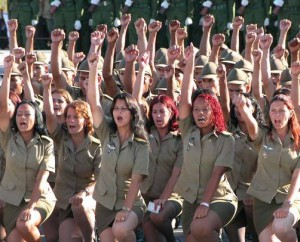
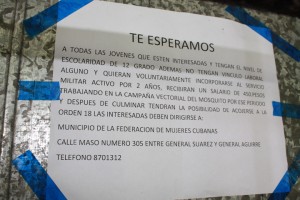
mujeres-cadetes-cubanas_internet-300x242HAVANA, Cuba, 27 September 2013, www.cubanet.org – The generalship of the regime is showing particular interested in incorporating women into the army. In several sites in Havana where people gather signs have been posted lately calling on young unemployed women to sign up for active military service. The proposal includes two supposedly tempting benefits: a starting salary of 450 Cuban pesos a month (the basic salary of professionals in Cuba), and the chance to take advantage of the so-called Order 18, of the Revolutionary Armed Forces, which allows them to opt for university majors of their choice, with study facilities, according to their new circumstances.

Suddenly, one might think that this project is another nod from the regime to international progressives, whose members might easily have noticed the rancid sexism that prevails in the uniformed forces on the Island, where, if they are not abundant, there is also a lack of women, though they fill ornamental roles.

It seems then, that among the “reforms” to update their particular socialism, the generals resolved to finally grant women their rightful place among the ranks. However, if that were the purpose, it’s thinly reflected in some of the details of the call. For example, the professional salaries (which aren’t) that these young women will be paid from the start, don’t seem targeted to stimulate their attraction to the military life, because during their first two years they will work as civilians in the mosquito vector campaign, work already performed by hundreds of thousands of women and men (for a much lower salary) without the academic requisites they are demanding from potential candidates.

So these girls are not going to serve directly as the olive-green uniformed, nor are they going to study in the military academies to become technicians and officers in the army. Apparently, their recruitment will not entail any direct benefit to the FAR. They are being called to take on a civilian task, for which they will receive a “privileged” salary, along with other facilities, on behalf of an employer who does not need them.

Anuncio-de-Reclutamiento-de-mujeres-para-las-FAR-colocado-en-un-mercado-de-El-Cerro-en-La-Habana-Foto-de-Jose-Hugo-Fernandez-300x200
Ad to recruit women for FAR posted in a market in El Cerro in Havana – Photo by Jose Hugo Fernandez

This leaves some doubts in the air, in addition to two or three half-baked conjectures.

Is the call nothing more than a new strategy to confront the practice of prostitution, continually growing and more scandalous among young Cuban women? Do the generals really believe that with a salary equivalent to less than 20 CUC a month, and offers of university entrance, they are going to manage to recruit girls en masse for their later control under the military regime? If so, why summon only those with twelve years of schooling? And why does it have to military who take on an eminently civil responsibility? Is it that the civil institutions are not sufficiently reliable, or they can only attract these young women with the economic incentive needed to inflate the payrolls, only to encourage these young women?

Any effort is welcome to try to contain the marked tendency of young Cuban women today towards prostitution. But paying a professional salary to high school graduates to devote themselves to hunting mosquitoes for two years, doesn’t seem a very lucid approach, neither in terms of civic rescue, nor as a response to the demands of the gender advocates.

To make matters worse, the decision contains at least two staggering inconsistencies. On the one hand, those who work in the mosquito control campaign have had their wages lowered recently, to the point that these girls would earn 100 Cuban pesos more to do the same job, but with less experience. On the other hand, it represents a useless swelling of payrolls, at exactly that time when they’re talking about laying off the hundreds of thousands of State employees as the regime insists on the need to eliminate unproductive jobs.

The anxiety of the generals before the imperative to win the support of these girls is understandable. Especially if we give credence to the assumption that the heir to the throne, Mariela Castro, convinced them that any good work they undertake against prostitution, shall be promptly rewarded by the praise of liberal forums and the international press. But it wouldn’t cost them anything to chart their strategies better, so as not to so obviously shoot themselves in the foot.

José Hugo Fernández. Note : The books of this author can be purchased here.

The Night of the Long Scissors / Camilo Ernesto Olivera

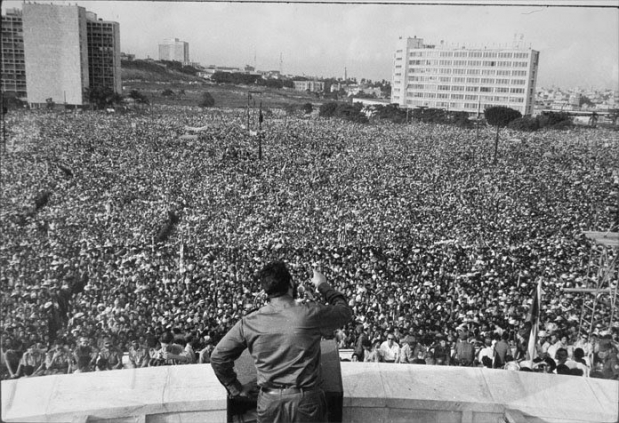
Fidel Castro Speaking in 1968

On 13 March 1963, during a commemoration on the steps of the University of Havana, Fidel Castro said: “For there walks a specimen, another byproduct we must fight (…), many of these lazy ‘hipsters,’ children of the bourgeois, walk around in their too-tight pants, some of them with a guitar thinking they’re Elvis Presley. And they have taken the extreme liberty of going to public spaces and freely organizing their ‘feminine shows’ (…), they are all linked, the little lumpen, the lazy, the Elvis Presleys, the tight jeans.

Then Castro added, “Don’t let these ‘hipsters’ think the streets of Havana are the streets of Miami.”

Also on a March 13th, but in 1968, Castro himself launched the so-called General Revolutionary Offensive, an operation that gave the coup de grace to small- and medium-sized private businesses, and that also killed the nightlife in the capital and in the whole country.

In the final months of 1967, in Czechoslovakia, the process of social democratization began that was remembered as the “Prague Spring”; something that set off an alarm in almost all the countries tied to the Soviet axis.

On 21 August of that year Russian military power occupied Czechoslovakia and dismantled the government of that country with the consent of the then Kremlin strongman, L.I. Brezhnev. This same year, in May 1968, there was the student rebellion that turned France upside down.

Meanwhile, in Cuba, in the months before March 1968, the usual audience of the nightclubs walked up and down La Rampa trying to kill their boredom. They take a turn around the central tower of the Coppelia Ice Creamery, along with spells at the cafe known as El Carmelo at 23rd, near the intersection of this street and the Avenue of the Presidents.

Other places frequented were the terrace of the cafe at N and 21, next to the Hotel Capri, the gardens of the Hotel Nacional gardens, and, in the area where it was located at the time, the Czechoslovak House of Culture.

A segment of youth, those who were assigned the adjective “enfermitos” — little sick ones — walked La Rampa at risk. The “hipsters” of the time, with their tight pants of Chinese khaki, their sleeveless shirts with embroidered decorations and their modified workboots. Long hair was the privileged headache of some.

In those days the young poet from Holguin, Delfín Prats, read his poems, “Language of Mutes,” in public. The Beatles’ White Album was listened to in secret.

At the same time, Ana Lasalle and her enthusiastic court of rabid leftists ravaged Vedado. The frenzied Communist lady actress wielded her scissors against manes and miniskirts. These scissors had their longest night on 25 September 1968, exactly 45 years ago today.

Around 9:00 at night that Saturday, a police cordon with uniformed and plainclothes officers fell on the area. The indiscriminately took prisoner everyone from casual passersby to pimps who besieged the Hotel Capri, where sometimes Greek or French sailors from ships anchored in the harbor stayed. The detainees were classified into three groups: Homosexuals, Hippies, and the third classification: Improper conduct.

According to those who experienced the events, two members of the rock group Los Pacificos were arrested very close to the corner of N and 23rd. That group, like another named Los de León (later, Los Kents), were very popular at the time among young rock fans in the Vedado area.

The group Los Pacificos didn’t survive the consequences of that harsh and bitter night and broke up.

In his speech on Tuesday, 28 September, Fidel Castro referred to the events of the previous Saturday. He justified the raid as a part of the offensive being waged against “social evils.” He generally accused those arrested of being involved in vagrancy, pimping minors and other things of this type.

On Sunday 12 October, the newspaper Juventud Rebelde (Rebel Youth) published an extensive compendium about the raid that had occurred days earlier. The headline read, “Yankee Dream Destroyed, the boys of the fourth world.”

Other articles appeared in the style of: “How do bands of juveniles converted into vehicles of imperialist propaganda think and act?” There was also a photo essay, with images of some of the boys arrested under the title, “Is this what you want for your son?”

Specifically, an article by the journalist Alfredo Echarry noted: “Encouraged by the role models of imperialism and inspired by the workings of their youth gangs, they try to give a structure to disorganization. Immediately, groups and bands identified by different names begin to emerge, among them: The Zids, Los Chicos Now, Los Chicos Melenudos, Los Betts, Los Chicos de la Flor, Los Chicos del Crucifijo, Los del Palo, Los Sicodélicos, Los del Banano…” Within Echarry’s article, the term “ideological divisiveness” was the condemnatory stigma.

Today, 45 years later, the ghosts of that night of the long scissors seem to be revived in the schools. The “moralizing” offensive of Raulism evokes the demons of “the night of the three P’s” and that tragic 25 September 1968.

Although it seems incredible, the Revolutionary terror lurks still, ready to attack and “bring to heel” a society ever more disenchanted and rebellious.

Camilo Ernesto Olivera, Havana

From Diario de Cuba

25 September 2013

The Beggars are Foreigners / Cuban Network of Community Spokespeople, Elizardo Rodriguez Suarez

mendigos01400-300x262
Beggars in Havana’s streets

Artemisa, Cuba, September 26, 2013, Elizardo Rodriguez Suarez / Cuban Network of Community Spokespeople / www.cubanet.org.- Reports on Cuban television news show beggars from other countries, mainly from the United States of America, the so-called “homeless,” and broadcast to the Cuban people their needs and the fact that the American government doesn’t help them, despite the fact that there are shelters in that country, which are refuges for homeless people.

They do not, however, show a single example of national beggars. In the journalistic investigative show, “Cuba says,” which airs twice a week after the Television News, they could devote a show to the dumpster divers where people ask God to find something they can sell so they can feed their children.

An example of this is the Güira de Melena municipal landfill in Artemisa Province, where some people look through all that smelly garbage, their everyday livelihood, moving the rubble to find useful items and aluminum cans, jars, and other things that the Recyclable Materials Company buys

The Cuban beggars, in short, are not televised.

From Cubanet, 26 September 2013

Bathing Alternate Days / Rosa Maria Rodriguez

Image taken from Todo Fugas

Every other night between 8:00 and 10:00 the zone where I live “has its turn” at the water, and when it runs for a while, my block shows itself off like a shiny glass mirror.  It is because the conducting pipe from the aqueduct “comes out” in that section — and in many others in different blocks, neighborhoods and municipalities — and in the absence of street cleaner cars, which have not been seen in years in Havana neighborhoods, we are left the impotent alternative of watching as the water leaks out cleaning and polishing my asphalt artery under the opaque light of an ephemeral Chinese fixture.

In Vibora it is now tradition that each time it rains the roadways flood and the neighbors and pedestrians feel like wrecks adrift on the water and waste, because they do not sweep the streets and the trash from the containers that they begrudgingly pick up are dragged to the nearest drainage and clog them.  After the downpour passes, it is common to see much filth trapped by the tires of parked cars on the side of the street and much filth and various objects — buoyant or not — change places because of the waters.

It is ironic to sit in front of the television and see spots directed at citizens that speak of hygienic-sanitary measures and encourage the saving of the vital liquid in our homes, which seems fine to me.  ”Drop by drop water is depleted,” says one of these.  We all know the importance of this liquid for satisfying fundamental human needs, and industrial activities and very necessary energy resources depend on it.

Nevertheless, the vital liquid that we consume domestically is contaminated with waste water due to the quantity of broken pipes and drains that exist and that are the result of years of negligence.  In the same way, while in many places in Havana the leaks are public, in others they have not had running water for years, months or days because of the poor organization and distribution of the supply and because the aqueduct networks are too old.  Almost all date to before 1959, so that in more than 54 years there has not existed the political will to solve this paramount subject for the people.

When a pipe breaks in the street and the neighbors call the state entity “Havana Water,” their plumbers show up as if they were tire patchers, armed with pieces of tubeless tires for wrapping the pipe and solving the problem as if it were a flat tire.

Maybe some think that I should be happy because my block is bathed on alternate days but there are so many places in our country and in the Cuban capital that lack that valuable liquid, that I cannot help but think of the cleanliness that many public offices in Cuba also need, whose bureaucrats do not stay in them because of their efficient management or for the service they offer the people who supposedly elected them, but because of their unconditional adherence to a contaminated regime of administrative inefficiencies and sewer politics for decades.

Translated by mlk

28 September 2013

They Pick up the Prostitutes but Not the Trash on the Streets of Havana / Orlando Freire Santana

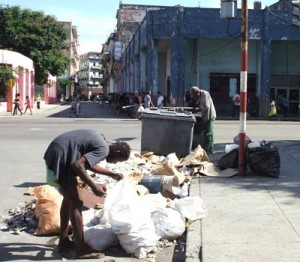
Trash dumped at Aquila and Estrella Streets. Photo by Orlando Freire Santana

HAVANA, Cuba, September, www.cubanet.org – At almost the same moment that Mariela Castro declared that Cuba only penalizes pandering, but not prostitution, police officers in uniform and in plainclothes conducted an operation against prostitutes who frequent Águila Street, between Monte and Estrella, in the municipality of Centro Habana.

The place had lately become a stronghold of cheap prostitution in Havana, basically targeted to domestic customers. For only six CUC — the equivalent of six dollars — five for the prostitute and one for the rent of the room, one can access those services. Of course, this “cheap prostitution” is relative, as six CUC are a third of the monthly salary of the average Cuban.

Veterans with experience in the meat trade alternated with young newcomers from the interior of the country or girls from Havana who decided to leave school and go out to “fight” for their daily bread. And although that area, on more than one occasion, has been the target of other police actions against prostitutes, repression never reached the levels of bygone days. Just as Mariela, the sexologist of the ruling dynasty ,also announced the upcoming celebration in Cuba of a symposium on prostitution and sex tourism.

25-prostitutas-carroOne of the girls who managed to escape the raid told us the modus operandi of the authorities on that occasion. The first to act were the uniformed police. They could not pick up many girls as they managed to flee. A few hours later, when apparently it was all over and prostitutes returned to their task, the repressive forces decided to change the strategy. Some agents dressed in civilian clothes, approached the girls and proposed a transaction. Once they were accepted, the agents identified themselves and they were arrested right there.

According to the witness, the detainees were forced to board a police truck and then driven to the National Revolutionary Police (PNR) Sector located in Reina Street near the corner of Rayo. There a few were released after receiving a warning letter — the first step to a subsequent arrest — but most were taken to the cells at the police station on Zanja Street, waiting for a trial that could condemn them to several years in prison.

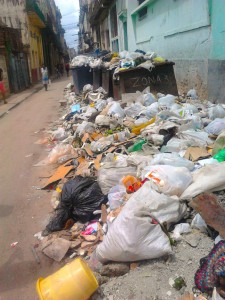
And while that stretch of Águila Street was witnessing such a manhunt, very nearby, at the intersection of Angeles and Estrella Streets, a giant trash dump threatened to worsen the already deteriorating hygienic conditions faced by residents of that municipality and the rest of the city.

After the four containers for receiving solid waste were full, more than 20 or 30 yards of the street were occupied by wastes of all kinds. One would think that the leaders of the Castro regime’s planning decided to remove the fuel from the Communal Service Department vehicles charged with picking up the trash, and give it to the vehicles of the PNR that undertook the “patriotic” labor of cleaning Havana’s streets of prostitutes.

The Cuban leaders haven’t been able to rid themselves of the habit of constantly creating new campaigns to solve problems. First it was the health campaign against dengue fever and cholera. Now, it seems, it doesn’t matter how many Cubans get sick. The priority in the days to come is to get rid of the prostitutes so Mariela Castro can invite the attendees of her symposium to roam the streets of Havana and to see for themselves that the accusations that Cuba promotes prostitution, sex tourism and trafficking, are mere fabrications by the enemy, intended to denigrate the work begun by her uncle and now continued by her father.

Within several months, when Mariela’s symposium is history, no one would be surprised if Águila Street, between Monte and Estrella, is once again overrun by new practitioners of the oldest of trades.

Orlando Freire Santana

From Cubanet, 24 September 2013

They Demolished Their House by Mistake / Leonardo Calvo Cardenas

IMG_3774HAVANA, Cuba, September 23, 2013, Andy www.cubanet.org.- Andy Joel Cabrales and Thais Maylen Franco, in an act of desperation, with their two young children on Friday afternoon, positioned themselves in front of the Provincial Court of Havana headquarters to demand a solution to the tragedy they are living.

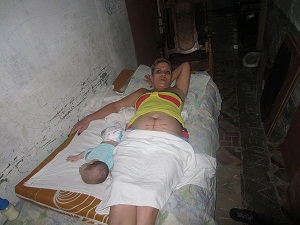
Ten days ago they inhabited a house in good condition at 315 Muralla Street, between Compostela and Habana in Old Havana, when workers from the Municipal Housing Directorate arrived to demolish a building. And they mistakenly destroyed the bordering house.

Since then, this family of ten people, including children of seven, one, and a baby five days old, all suffering from bronchial asthma, lives among the ruins of what was once their home, now in danger of total collapse.

Given the repeated demands of the victims, housing officials claim that they have no answer for the case. And in the provincial government offices they were limited to “orienting” them requesting a hearing at the Department of Population Assistance, which does not guarantee any solution.

In their desperation, the victims have turned to the Communist Party Central Committee, also with no response. The family reported that no health authority has been concerned about the health conditions of the children, or the young mother, still in quarantine from her recent cesarean.

Several citizens who supported the protest were arrested outside the Capitol building. The municipal director of housing, local government officials and Communist Party verbally committed to solve the case.

Human rights activists, lawyers and independent journalists will follow up on the unfortunate event.

By Leonardo Calvo Cardenas, montesinos3788@gmail.com

From Cubanet: More pictures here.

22 September 2013

Building Collapse in Havana Leaves a Woman Trapped in the Rubble / Julio Cesar Alvarez

Escuela-pedro-Maria
Pedro Maria School this morning. Photo: Julio César Álvarez

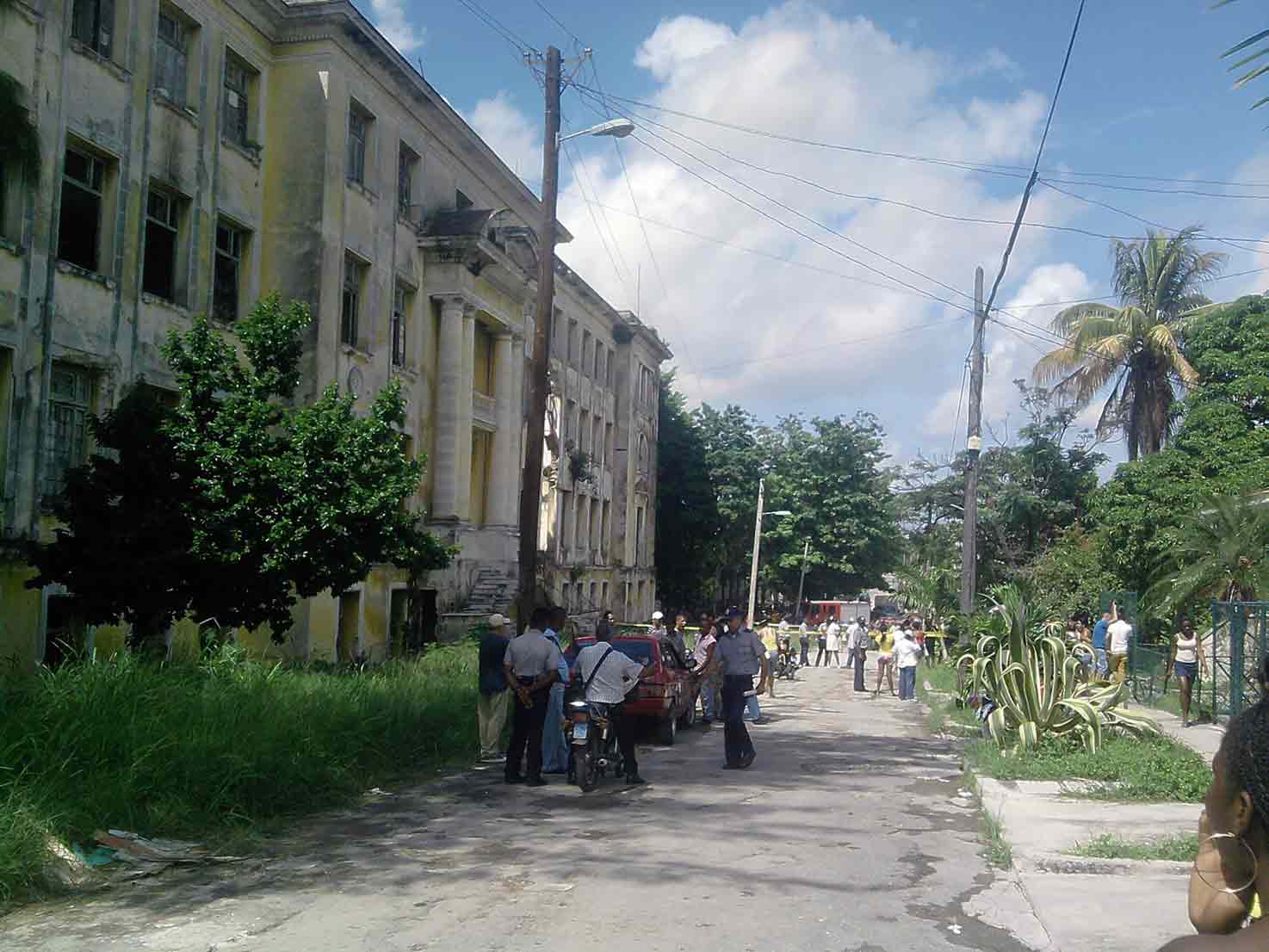
HAVANA, Cuba, September 23, 2013, www.cubanet.org.- A partial collapse of a former school in ruins, occurred this morning in Havana, trapping a woman in the rubble, according to information from the scene of journalist Julio César Alvarez.

The Cubanet reporter says that it is the former Pedro Maria Rodriguez Elementary School, located on Calle Carmen, between Cortina and Figueroa in La Vibora, where eleven families lived. Around half past nine this morning, part of the building collapsed. At the time of this writing, rescue teams were trying to rescue the trapped body of Isabel Fernandez Gutierrez, 50. It was also learned that another local resident was hospitalized with a panic attack triggered by the crash.

The eleven families had lived for years among the ruins of the school, but had applied repeatedly to the authorities for housing.

UPDATE: In the afternoon, the family of Isabel Fernández Gutiérrez still had no news. Apparently they could not recover her body. Government officials in the area brought two trucks and a bus in order to relocate the residents to a shelter, but they remained firm: They said, or housing, or nothing. The situation was tense.

Note: Also contributing to this report was journalist Miladis Carnel Gonzalez of the Cuban Network of Community Communicators.

From Cubanet

23 September 2013

Havana: “I Was Abducted by State Security” / Lilianne Ruiz

lilianneG2HAVANA, Cuba , September 2013, www.cubanet.org.- Lech Walesa Institute in Warsaw hosted a workshop on nonviolent struggle (from September 4-14), participating in it were a group of human rights activists, political opponents and independent journalists living on the Island.

Leannes Imbert, who leads the Observatory of the Rights of the LGBT Community in Cuba, and is also Cubanet correspondent, was invited.

She says that one day before her departure, on September 3, she left early to complete the last steps in preparation for her journey.

On G Street at the corner of 21st in El Vedado, a green Lada car was waiting with two agents of State Security, who did not allow her the option of refusing to get in.

These arbitrary arrests and kidnapping have an extralegal character:

“They were not wearing uniforms with badges, they did not show an arrest order, they did not allow me to call my family. They took me not to a police station, but to a house on the outskirts of the city,” says Imbert.

“Later they took Avenue Boyeros, at the intersection of 100th Street they turned the corner and drove on a street that a sign showed to be El Cotorro. But they continued toward a rural area.

“We came to a very well-built house that could easily be confused with a family home, with a fence and very well painted facade.”

Once inside, they invited her to take a seat, insisting on a specific place:

“I assumed the place they pointed to was in the view of the camera so they could film it.”

In the house the only people visible were in domestic service. However, the victim’s mobile phone remained outside the room, indicating that there had to be Ministry of Interior workers in other rooms, in charge of what they call the “technical operation.”

Imbert referred to the words they used to express their main concern; they were:

“Be careful with what you say out there. Many people have left and have been saying things they shouldn’t say, things about the Cuban Government. The result is they’re not going to be leaving any more.”

According to Imbert, they showed her photos of her activities and reiterated the threat to condemn her to 20 years in prison for the things she’s writing and the people she meets with. But they said automatically that they were very worried and wanted to look after her. They mentioned her family, saying “you know your mother is sick and it won’t go well for her if you go to prison.”

At 4 pm that day she was released and allowed to leave for Poland.

In Warsaw

During the ten days the workshop lasted, in addition to talks, the Cubans visited the Institute of National Remembrance, dedicated to documenting the unfortunate events that occurred during the period of Soviet occupation and the government of the Polish Communist Party.

In this Institute are the files of people who belonged to or who collaborated with State Security in charge of implementing the Communist terror in all countries where such a party governs.

“Physical evidence is still appearing of what the brutal repression meant for these people, in certain periods in history.

“For example, someone knows that in an area there was some killing of people who were against Communism; then forensics goes in. In the 21st century human remains were found,” says Imbert.

They were also invited invited to participate in street protest, led by veterans of the Solidarity Union (which today is a Movement). One week a year they recall the protests that ended the Communist dictatorship, and take advantage of it to address the current government on today’s issues.

This time it was about a demand to increase pensions.

“There is a culture of protest in Poland. It paralyzes traffic. There we saw the police working to create security around the protestors. One of them took a picture of the current Polish Minister of Finances and hit her in the head. No one did anything to him.”

They were able to see first hand that the majority of time the government responded, giving legal status to the citizen demands, and the society has been transformed in a non-violent way.

Back in Cuba

Imbert arrived at Jose Marti International Airport on September 14.

On the third day of her return, the same agents in the same green Lada were waiting for her outside her house. The scene was repeated:

“They approached and warned me to get in the car. They took another road and I had the impression that the house where they took me was farther away.”

This time they were interested in the photos that Imbert saved on her phone, photos of Poland.

“They were trying to get information about the participants and the organizers, using the method of appearing to have a conversation with no pressure, commenting on the photos and asking questions, which I didn’t answer.”

Among their sarcasms, they let her know that they were at the airport the day she returned because, according to what they said, they noted the amount of luggage she had.

This time the detention lasted from the early hours of the morning until 6:00 in the evening.

Nonviolent Struggle

Communist dictatorships produce a complex social situation. Besides engendering fear among residents about loss of employment, freedom, even your life, they maintain a discourse that they are acting in the name of peace and for the freedom of the people from capitalist oppression. This combination of factors is extremely disturbing.

But in Europe, even the ones that appeared to be the most impregnable, these dictatorships were overthrown when the citizenry realized they wanted a future of freedom and agreed to participate in the change, which they achieved through non-violent struggle.

Poland overcame the dictatorship in 1989. The Solidarity Union  managed to mobilize the population, which was determined to challenge the Communist Party government, and through labor strikes, mass protests and civil disobedience, the public will rescued, one by one, the kidnapped freedoms.

Note : Any similarity to the Cuban dictatorship is not pure coincidence.

By Lilianne Ruiz

From Cubanet

22 September 2013

CDR: Symbol of Snitching / Julio Cesar Alvarez

CDR-vigpol-300x200HAVANA, Cuba, September, www.cubanet.org – In the same way that a blind woman with scales is an allegory of justice and a skeleton with a scythe is the allegory of death, the image that identifies the CDR should be the allegory of betrayal.

The creation of the Committees for the Defense of the Revolution in Cuba was a Machiavellian political monstrosity, conceived to reveal and suppress all forms of opposition to the nascent Communist dictatorship.

“We will establish a system of Revolutionary collective surveillance, and everyone will know who lives in the block, what those who live in the block do, what relations they had with the tyranny [of the Batista regime], where they work, who they meet, and what activities they get involved in.”

Those were the words of Fidel Castro, spoken on September 28, 1960. The apparatus of the most formidable surveillance and repression of the Communist dictatorship began to take form, implemented by the rebels in January 1959.

c646e75122cbd2e60a4639f925f1c9d518649bff-300x201The scapegoats to justify its creation were the same ones the government has used ever since: imperialism and the opposition.

“We can say that the Committees for Defense were engendered in the public square, in the midst of the struggle against imperialism, in the heat of battle and the insolent noise of the counterrevolutionary bombs,” Fidel Castro once said.

But creating such a massive apparatus of betrayal and repression could not be the work of a night of fireworks. The people of Cuba already knew well the sound of those explosions, thanks to the terrorism work of the rebels themselves led by Fidel Castro over the whole of the island to destabilize the dictatorship of Fulgencio Batista.

It was, however, a well-conceived plan and organized in the style of Hitler, to make massive political denunciation the ultimate weapon against dissent.

The CDR has been, in addition, the shock troops against opponents. Beatings, threats, psychological terror, destruction of property. Each and every one of these methods have been used systematically against active opponents.

The people’s mob, which is not all Cubans, has found in this organization an oasis of impunity to unleash their passions when they are incited against their neighbors.

Criminals and corrupt officials, however, have had better luck. The CDR doesn’t watch and betray them with the same frequency as it does the opponents. Among them and the organizations of the past there has always existed a kind of symbiosis, where many times it is the money from the crimes and corruption that have paid for the pigs’ heads and the drinks for the street parties, where they celebrate the birth of this organization.

The wood for cooking the stews burns again this September 28th on the streets of the island, like the fires of the inquisition burned the heretics. This is the 53rd birthday of a Castro regime organization dedicated to political betrayal, or as we say here in Cuba, to snitching.

By Julio Cesar Álvarez

From Cubanet

27 September 2013

The Slow Death of the Committees for the Defense of the Revolution (CDR) / Orlando Delgado

cdr270913The Cuban Government is ready to celebrate another congress of one of its most sui generis organizations: the so-called Committees for the Defense of the Revolution (CDR). This organization, in theory, brings together more than 8 million people and was created to monitor and inform on individuals or groups who from early on showed their disagreements with the Castro regime and its Marxist ideology. Castro himself had no shame in declaring (in the excitement of those early years) that these committees arose to “see what people do and what they are dedicated to.”

His words legitimated and protected the snitching and opportunistic denouncing of others, and the grossest violations of people’s privacy. The CDRs became the primary link in the chain of control that the Government exercises over its citizens, still reflected in the slogan of the repeated Castro conclaves: “United, vigilant and combative.”

These words call on what the ordinary Cuban now has the least inclination to do, because whom are they going to spy on and combat? Will it be the neighbor who has a better standard of living thanks to the fact that he now works in a warehouse where he can “find things.” Or the neighbor who feeds her children through prostitution or selling what falls into her hands? And so we could list thousands of activities considered illegal by the Government that are a part of daily life on the island.

Last September 27th (the evening of the day before is chosen to anticipate the 28th, the day of its creation), in many Havana neighborhoods there was not the traditional bonfire and stew that usually “celebrates” the   such a negative organization. Not even in the most critical years of the regime, in the 1990s, did the neighbors fail to get together a little soup pot and fill the block with flags. But if there is something relentless it is the passage of time and although the Castro clan resists challenging it, the CDRs (the whole system) shows a prolonged wear.

Proof of this is that long before the regime filled with city with yellow ribbons to divert attention from the pressing problems of Cuban society, they were gradually pasting a new sticker on the doors of the presidents of the CDR to reaffirm that here lives the maximum leader of the block and the organization is working, or seems to be working, although many of the residents of the place do not know that person and show their apathy towards the sporadic calls to activities.

In the dreamed of transition, this organization would be the first to be dismantled to make way for full respect for the most elemental individual freedoms and a legitimate Rule of Law, which itself would lead (stripped of authoritarian or vertical elements) to an effective community life.

Orlando Delgado | Havana

From Diario de Cuba

|27 September 2013