3D Movie and Video Game Rooms Going Underground / Julio Cesar Alvarez

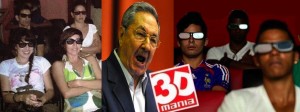
cine-3D-composicion-300x112Havana, November 2013 – Movie and game rooms created by the private sector to stave off boredom is a sample of what can be achieved in a short time with the decentralization of the economy. The government’s recent ban on these recreational activities, shows who is holding back the changes.

What is Cinema: Art? Cultural colonization? Brainwashing? Entertainment?

Most viewers say, when asked, they are looking to be entertained, have fun, let out a few choice words when technology and ingenuity show them something surprising. At least, for many, this is the sine qua non ingredient of “the stupendous reality called cinema,” to quote Ortega y Gasset.
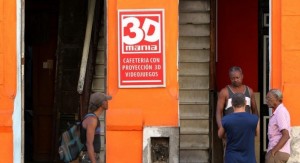
cine3D-cafeteria-y-video-juego-300x163On the other hand there are the the ideal comfort conditions to enjoy a movie. Most respondents mentioned an air conditioned room, comfortable chairs or armchairs, being about to snack or nibble on something while watching the movie. Some want to enjoy a drink at this moment.

These two conditions, a good time and comfort, are met in the private 3D moving rooms serving the public, although they don’t have a license to practice the activity.

Although Fernando Rojas, the Deputy Minister of Culture said on 27 October that they did not intend to prohibit this type of activity, but to regulate it, the fact is that the Cuban 3D movie room owners woke on 2 November to find their exhibitions prohibited.
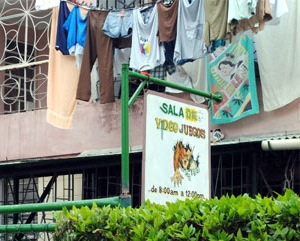
sala-videojuego01“The exhibition of films, which includes 3D rooms and computer games, have never been authorized and this type of self-employment activity will cease immediately,” read the information note published by the official organ of the Central Committee of the Cuban Communist Party on Saturday, 2 November.

The owners of such rooms, such as Ronny in Vibora, hoped that the government would grant licenses to legalize them, even if they were supervised by the municipal Ministry of Culture. “I’ve invested thousands of dollars in the business. What am I supposed to do with all this equipment. How can I recover my investment?”

The House of Culture of the 10 de Octobre municipality, had among its plans to contract this type of service as activities for children. But with the new ban no one dares to talk to them about it.

“It wasn’t a bad idea. The kids love the 3D cartoons, the glasses amuse them, and they see their favorite characters in this dimension. If we managed to get some of these 3D owners to set up this kind of exchange, we can bring 3D to more kids who have few chances to go to a private function,” said a cultural promoter from the House of Culture, who preferred to remain anonymous.

The video game business

Less widespread than 3D movies, but gaining customers in parts of the city, is the video game business. The El Maravilla Technopremier, a complex technology for the self-employes, on 10 de Octubre avenue, between San Francisco and Concepcion, offers a variety of IT services, such as software installation, hardware repairs, printing and scanning, computer classes, and a modern video arcade that runs 24 hours, allowed us to take photographs, but declined to give statements.
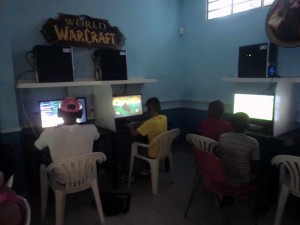
Sala-video-Juego-de-El-Maravilla-300x225
The video game room El Maravilla, photo, Julio Cesar Alvarez photo

At a price of 20 pesos in national currency per hour, the room has networked computers to play games like Call of Duty, Word of Warcraft, FIFA, and others. It also has Xbox 360 with Kinect (Body Motion Detector) with more than 30 games in this class. Quite a deluxe set compared to what they can offer with the old software and computers at the Youth Computer Clubs.

With the new ban, the kids who currently attend these places, which are more than a few, will have one less place to play the video games they like. They will have to line up again at some Youth Computer Club to access games authorized by the”cultural politics of the government,” such as Gesta Final, a Cuban videogame that recreates the period 1956-1959, when the rebels led by Fidel fought in the hills of the Sierra Maestra.

“At the rate we are going we will have to go underground to see movies or play the games that we like,” said Juan Carlos, a 16-year-old fan of computer games.

For ordinary Cubans, the decision to ban the 3D movies and video game rooms means fewer entertainment options for a people tired of seeing what they force to watch you to see in the cinemas, falling apart from time and ineptitude.

But for the soldiers of the Cuban Ministry of Culture, a Goebbels-inspired institution responsible for ensuring the “purity and quality” of what is displayed or played with the greatest concern being “the final triumph of a mass preference for Hollywood movies that enthrone banality and trashy entertainment.”

Julio Cesar Alvarez

Cubanet, 4 November 2013
Manuel Cuesta Commits to a “Common Strategy” for Change in Cuba / Manuel Cuesta

MORUA-300x228
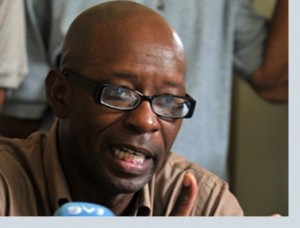
Manuel Cuesta Morúa

On Monday, Cuban dissident Manuel Cuesta Morúa, spokesman for Progressive Arc of Cuba, and a Cubanet journalist, committed to a “common strategy” of the opposition to bring about political change in the island, and he denounced the repression exercised by the Government over private initiative in the economy.

Cuesta Morúa, on a visit to Spain, said in a press conference that “Cuba is changing, it is a fact… but not as result of a citizen strategy to move towards democracy,” but as “a kind of social mutation.”

“The people,” said this social democratic leader, “have been seeking their own paths… to confront that difficult reality we’ve been living for more than fifty years.”

According the the Cuban opponent, the Government, “has no national project to resolve the serious accumulated problems and the reality of daily life for Cubans… it’s mission is to remain in power,” he concluded.

In this situation, the strategy of civil society is “to connect citizens with a new strategy of consensus, with the end of seeking a new constituent assembly.”

Failure of economic returns

He denounced the failure of economic reforms the Executive tried to make in 2008 and said that there is a “profound social fragmentation” on the island, along with signs of “racism, poverty, extreme poverty.”

He said that Raul Castro’s government exercises repression over private initiatives through “taxes, lack of incentives, or outright repression,” because “he is not interested in generation a middle class.”

However, he said that “the only coherence for a national project in Cuba is a political opening accompanied by an economic opening.”

As an example of the failure of the Cuban economy, he said that the remittances coming in the country from Cubans abroad reach $5.1 billion dollars, versus $4.1 billion from tourism, the sale of drugs and sugar.

“We rely more on the support of our families than on the production of Cuba, “ he said.

According to the opponent, the reforms announced by the Castro Government, such as the elimination of the dual currency, is due to pressure from potential foreign investors that require improvements to develop their projects on the island.

With regard to the travel and immigration reform that allows Cubans to leave the island, Costa Morúa affirmed that it is “collateral damage” that they had to accept on the request of some “partners” of Cuba who asked for “gestures” to support them in the international community.

He also said he is in favor of lifting the U.S. Embargo of Cub, which “doesn’t help society nor the democratization of the country,” and provides “the best alibi” for the Government, “nationalism.”

Asked about the possible assassination of the regime opponent Oswaldo Payá, he said that he, “doesn’t subscribe to that thesis… I don’t think there’s clear evidence that points to a State plan to assassinate Oswaldo Payá,” dead after a car accident last year on the island.

He said he believed that his death answers “to the inability, lack of professionalism of the Cuban intelligence services, which followed him and weren’t able to control the harassment to which he was subjected.”

From Cubanet, 4 November 2013
Prison Diary LXIV: The Dictator Doesn’t Learn That Infamy Multiplies The Opposition Forces / Angel Santiesteban

The Mistake of the Dictator

The great slip-up of dictators is to come to believe that the pain from the abuses they cause is sufficient to overwhelm their opponents. For them, arranging for mobs of criminals, people without principles or feelings, mercenaries who obey those who pay them, although only pauper’s wagers, and like a dog who submits in exchange for a bone, they follow orders to be sadistic.

Cuba is a breeding ground of these dogs who bite right and left to protect their food. They prowl around their bowls fearing someone will snatch them. Then, they are so committed, they know no way out. Their recurring nightmares are those they subjected to justice who will spend many years in prison. So they are determined to scare off those who pursue political change, and so avoid being punished for their misdeeds.

When it comes to justice, as opponents we suffer their beatings, prison, exile. Paying the price of these experiences only strengthens our ideals, deepens the necessary convictions more and more to fight for a better Cuba where individual liberties are guaranteed, as explained by the Constitution of the United Nations in its Universal Declaration of Human Rights, which Cuba has evaded for more than five years by not signing the UN Covenants, in order to continue its flagrant violations of Cubans’ most elemental rights.

Several countries, hiding behind “respect for the right of peoples to choose their politics and regime,” have become accomplices of totalitarianism, as if Cuban citizens have chosen famine, family division, laziness, fear, denunciations and State terror against everyone who is opposing the system.

Unfortunately, there is an embargo on Cuba. I am sure that if the dictatorship, as has been demonstrated, had  power — which thanks be to God they don’t because of their own ineptitude — today we would even further away from the possibility of achieving the democracy and freedoms that every day we crave more, and that for us are the only possible path to the social development of the nation.

The embargo, even if it hurts us, should continue. “Friend” countries of the dictatorship, and even those who are not, have the luxury of playing with “respect for the rights of others,” when the dictatorship itself does not respect individual opinion. While they  frolic, Cuban continues to survive badly, accepting as an everyday thing that its children throw themselves into the sea trying to reach a better life.

In this same interval of time and actions, opponents persist and their dreams and rights, and risk their lives, like Laura Pollán and Oswaldo Payá, among other brave fighters, and resist the beatings and humiliations, because what the dictators do not learn is, it is only cowardice that corrodes and is able to feed their fears, and their infamy multiplies the forces who oppose them.

The image I carry with me and that feeds me, is to imagine them asking to be forgiven, justifying the unjustifiable, claiming they were following orders or did not know, and returning to the coffers of the State the stolen money scattered across the globe. Because that will be the only way to prevent the next leaders from repeating this dark part or our history. Then, I do want to hear that not forgetting is synonymous with bitterness. I prefer to be convinced that justice is the equivalent of shame.

4 November 2013

Upon Returning from Distant Shores / Reinaldo Escobar

The impressions of recent days will not fit in the brevity of a post, but it is my fault for not updating my blog while outside Cuba. First of all, friends. Embracing Ivan Canas, Pablo Fernandez, Celso Rodriguez, former colleagues of the magazine Cuba International (I had already seen before Raul Rivero and Manuel Pereira Salado Minerva); reconnecting with José Antonio García, Adolfo Fernandez, Jose Antonio Evora, Alcibiades Hidalgo; to meet personally dozens of compatriots in exile whom I knew only from telephone contact, old and young generations of Cubans, all of them anxious to do something for their country, “How can we help?” they asked in every corner we visited … “How about this?” And one assumes the huge commitment of lifting spirits or lowering expectations and finally returning to the island to see with the renewed perspective provided by the interweaving of views with different trends.

Upon returning from distant shores one’s soul is filled with mourning and shadow: the repression increases, the process of reforms stops and reverses, fear silences protests, simulation sculpts masks, corruption metastasizes, cities crumble, while others continue to sing their eternal flattery of the powerful, the media hides the reality and the reality suffocates citizens, who confront the dilemma of emigrating, faking compliance, or challenging. Cuba is going badly and time threatens to make the damages caused irreversible. I am overwhelmed by the responsibility of not doing enough.

4 November 2013

Cuba’s Monetary Unification: a Turn for the Better or for the Worse? / Haroldo Dilla Alfonso

Photos: Juan Suarez

HAVANA TIMES —The announcement that the Cuban government plans to eliminate Cuba’s two-currency monetary system has awakened numerous concerns among common citizens and analysts. This was to be expected, for, even if we assume the simplest and most vulgar point of view on Cuban reality, it is clear that this is a serious issue that is going to change many of the rules of the game on the island’s playing field.

We should not imagine that the world is going to change after the two peso currencies are fused into one, but neither should we underestimate the significance of the measure.

I think that one of the most interesting things we find in the First Report of the Cuban Civil Society Consulting Group recently published by Cubaencuentro – I haven’t been able to find out who these people are – is the statement that some believe Cuban society is changing for the better and others for the worse. Ignoring such changes condemns us to idly imagine a society which is disappearing more and more every day.

The two-currency system was an emergency measure implemented by Cuba’s political class during the worst moments of the stifling economic crisis it brought about. It was also a monetary scheme suited to the economic system Fidel Castro then envisaged: a dual economy with a dollarized, dynamic sector, and a weak, Cuban-peso sector sustained by infusions from the first via payment balances.

It was the system that the military conspired against with its company streamlining campaign throughout the 90s and what former vice-president Carlos Lage promoted with unbridled Fidelista fervor until his political decapitation some years back.

The two-currency system has been maintained, and not without reason. Future studies will reveal to what extent the existence of the two currencies and parallel economies, and the diffuse border between the two which always provided those who crossed it with differential profits, has been a key factor in the original accumulation of Cuba’s emerging bourgeoisie, a class which today is nestled in the folds of the country’s political elite, the black market and foreign investment.

Currently, however, the two-currency system proves unworkable in terms of affording Cuba the quota of technical rationality and transparency its system requires.

READ THE REMAINDER OF THIS ARTICLE HERE, IN THE HAVANA TIMES.

The Havana Times translation is from the original article in Cubaencuentro.

28 October 2013

Laurels, Laura / Rosa Maria Rodriguez

It has been two years since Laura Pollan abandoned her physical presence and became eternal.  Now she is in the Sta. Rita Parish, the Quinta Avenida walk, and in many Havana streets where they saw her walking invincible clutching her peaceful gladiola.  She is also in her family, who lived and saw grow her example of a small woman who demanded liberty for political prisoners and rights for Cubans in general and who confronted the paramilitary mobs however huge.

She is in the world, which followed her brave citizen journey and distinguishes and remembers her with the respect and dignity that she deserves, and she is also in all of us who pay tribute out loud through the media or in the anonymous silence of our thoughts.

From her clear eyes she gave us the clarity of a journey that is shortened more each day in order to truly institute respect for fundamental rights of all society and to democratize our country.

She contributed her integrity and efforts to shorten that distance and to make the government’s decadent hardliners release — even with the legal structure of their election — the Cuban political prisoners that had been sentenced to disproportionate penalties for peacefully dissenting from the Castro dictatorship.

This October 14 we faced again an act of repression, intransigence and abuse on the part of the Cuban government against the Ladies in White.  The violent eruption of pro-government gangs at #963 Neptune Street, the headquarters of the organization that was Laura’s home, when they were about to carry out a tribute for the second anniversary of her death, is a proof of how much some government leaders exert themselves to feed the infantile fairy tale of “citizen justice” that “spontaneously” defends the inefficient government that ruined Cuba and that “sacrifices itself” in command for more than 50 years.

That well-crafted, although unworthy strategy of turning society against itself is a tall tale designed to intimidate people and keep them paralyzed so that they can continue to easily exercise power and control.

Between the years 2010 and 2012 we lost several comrades in arms.  They were three consecutive years that made the world pay more attention our country and be concerned about those deaths so opportune for the Cuban regime.

Laura left us in 2011 and the future of Cuba is still being decided between ineluctable changes that will necessarily come, the minimum proposals to day from  Raul Castro, which do not solve Cuba’s big problems and the potential ones which the government undertakes in trying to carry out in order to keep or recycle the fiefdom that they inherited from their relatives and staunch supporters from the highest military ranks.

The year 2013 is almost over and he offers Cuba true and false signals that the authorities detail in order to confuse the international community, but mainly in order to prevent the country’s senior management from changing hands.

Laura, like many, knew this, so from the field of flowers where her daughter stands alert, combative and victorious, and her example is multiplied and many other gardens of gladioli continue to march to achieve a real democratic state of law in Cuba, and to prevent another group of dishonest men from kidnapping the country’s government.

24 October 2013

Young people from all of the Americas ask for plebiscite in Cuba now / Orlando Luis Pardo Lazo

1381986206_plebiscito+cubaIn this forum the delegations from Cuba, Haiti, Puerto Rico and Dominican Republic ask for a vote on the following declarations:

“At the XXIII Submit of Iberoamerican Chiefs of State and government under the slogan of: Alliance for new paradigms; young representatives of 25 Iberoamerican countries with the objective of taking on the challenges and problems of the region we will get together in the Iberoamerican vanguard marking 500 years since the discovery of the Pacific Ocean, from the 13th to the 16th of October in Panama City, Panama.

“Conscious of our responsibility for the development of Iberoamerican countries we declare necessary that with our commitment to action and the critical support of the leaders of local institutions and multilateral organs we’ll contribute to:

“Considering the importance of sustaining a healthy relationship between all the countries of the Caribbean region. We call attention to the worrisome situation in Cuba related to human rights and recognize a historical solidarity between the Haitian and Dominican countries. Taking into account the petition that thousands of Cuban citizens that using their constitutional right (Article 88g) propose that the citizens are consulted over legal changes that would guarantee fundamental liberties; the petition of Haitians and Dominicans to review order TC/06168 dated September 27, 2013 of the Constitutional Tribunal of the Dominican Republic that will leave without nationality a significant population of Dominicans descendants from foreigners, mainly Haitians.

“We resolve:

“We call on the Cuban government to answer a democratic proposal for a plebiscite of its citizens and invite the Dominican Constitutional Tribunal to review their decision.”

 Translated by LYD

16 October 2013

Reasons to be Incredulous / Fernando Damaso

John Lennon statue in Havana park. Photo: Rebeca

When we talk among friends of the things we discuss in Cuba, some label me incredulous. I will tell you the reason, and try to explain my incredulity, in that they are too old (older than 54) listening to the old and new storytellers telling the same stories. Of course I’ve ripped the pages from many more calendars than they have.

They talk to me of some decentralization of power, of a little economic autonomy in the state enterprises, the reduction of bureaucracy, control of corruption, self-employment, flexibilizations and many other updates, and it makes me smile. The authorities, as a rule, like to show the carrot, but usually placed at an elusive height, adding many obstacles as well. This tactic has been used many times and has not changed, because so far they have been successful.

Some tell me now that the situation is the same, because everything has become very complicated, and the more responsible citizens question and demand something that didn’t happen before. This, according to them, has forced the authorities, even against their will, have to offer a little more, and also they have to compromise on some economic and social issues, never politics, because the update of that is never contemplated in their calculations.

These realities make hope flourish in some of the youngest (those who haven’t opted to leave) but, unfortunately, they are only elements in the struggle of the authorities to gain more time at the least cost possible. It’s good to remember that our authorities only know two speeds, first and reverse, and that there are others to move forward. When applying the first, and producing a slow movement, they are frightened and immediately shift into reverse to return to the starting point.  So it has been before and is repeated now with the private shops, the 3D movie rooms, bars and other businesses.

To expect serious changes and reforms that solve national problems, is not a part of the approved Guidelines. I have said and repeated to the old and new storytellers: Here there is no reform, there are only updates of the same model to make it more prosperous and sustainable. A word to the wise!

2 November 2013

The Long-Awaited End to Cuba’s Two-Currency System / Ivan Garcia

526ae183c9902-617x330Danilo, an illegal hard-currency speculator, has had a busy week. “I buy dollars, euros and convertible pesos. But after the government announced it would move to a single currency, I am without funds,” he says from a centrally located Havana boulevard.

Some of the CADECA currency exchanges have closed early because they did not have enough “chavitos“  to carry out transactions in convertible pesos, the stronger of Cuba’s two currencies.

Although the regime is trying to ward off panic by issuing an official statement indicating that the measures to be implemented will have no effect on savings, there were long lines to be found at branches of Banco Metroplitano.

“In only five hours fourteen customers closed their hard-currency accounts at the bank where I work” said an employee. The news comes as no surprise to one segment of the population.

An avalanche of rumors in mid-August about a possible devaluation of the convertible Cuban peso, or CUC, led hundreds of people to exchange their Cuban pesos, or CUPs, for hard currency.

“Two months ago I withdrew all the chavitos from my bank account and bought pesos. It isn’t clear how currency unification will be implemented but rumors are that, before it disappears, the convertible peso will be gradually devalued,” says a self-employed worker.

In Cuba rumors are often more credible than information found in the state-run media. Eusebio, an economist, believes the dual-currency system leads to distortions in prices, accounting practices and domestic commercial transactions.

“Many local businesses are profitable because they sell their merchandise in convertible pesos. For example, domestically produced mayonnaise sells for between 3.0 and 5.5 CUC, or roughly 75 to 132 CUP. Once currency unification occurs, this disparity will disappear and inflated prices, which result from the stronger currency, will have to be adjusted. Nothing will be solved by replacing the chavito with the Cuban peso if stores maintain rigid price structures in CUC or CUP. The real price of rationed rice is not 20 centavos a pound, nor is 800 CUC — or 20,000 CUP — the real price for a plasma screen TV. Currency unification will be complicated. Businesses will be affected and could suffer losses,” he claims.

Some chain stores are already selling products in pesos tied to the exchange rate of the convertible peso. Magaly, a high school teacher, does not believe this will solve anything. “If a large segment of the population cannot afford to pay 25 chavitos for food, they won’t have 625 pesos for it either,” she notes.

An official with a state agency asks for patience. “The salaries of employees who work in profitable industries which generate income in hard-currency (such as tourism, healthcare, Cubana de Aviación or ETECSA*) will begin earning salaries based on the new paradigm relatively soon. Their buying power will be increased. It will be healthy for the consumer as well as for society to re-emphasize the value of work. The inverted pyramid, where professionals earn salaries lower than that of a garbage collector, will gradually change,” though he did not provide details.

The convoluted announcement published in Granma raises more questions than it answers. People hope that by year’s end the guidelines for creating a single currency will begin to take effect.

When Fidel Castro made it legal to possess dollars on June 26, 1993, the Cuban peso and the U.S. dollar went into circulation. In May 2004 the United States fined the Swiss bank UBS for violating the embargo and for having “laundered” almost four billion dollars destined for Cuba. Fidel Castro was furious. Six months later, in November 2004, the dollar was replaced with the convertible peso. But for Castro it was not enough to remove the dollar from circulation. In March 2005 he imposed an 18% surcharge on dollars sent to the island.

When his brother Raul came to power in 2006, the goal became to attract more greenbacks, so he reduced the surcharge on the dollar to 10%. In spite of this undue financial burden, high food prices in hard-currency retail stores and slow turnover of hundreds of inventory items in state-run stores, the volume of remittances from family members overseas has grown phenomenally.

In the year 2000 the country brought in 986 million dollars in remittances. By 2013 it had grown to 2.6 billion. It is estimated to surpass 2.8 billion in 2013. This does not include almost three billion additional dollars in the form of food, clothing, cell phone account payments, household appliances and medications that enter the country through “mules” and travel agencies based in Florida.

A casual poll of twenty or so Havana residents, who these days argue passionately over the ramifications of currency unification, suggests that the main problems will continue to be poverty-level salaries and excessive regulation in an inefficient system.

According to the National Office of Statistics and Information the average salary in Cuba is about 466 pesos or some 20 dollars a month. In spite of lukewarm economic reform efforts, agriculture has yet to take off and industry needs something more than good intentions to be efficient.

Cuba imports everything from fruit for the tourist industry to toothbrushes for sale to the public. No one believes for a moment that the doing away with the dual-currency system will improve his or her quality of life. Rather, it will represent the beginning of a new set of challenges.

Iván García

Photo: Diario de las Americas

*Translator’s note: The state-owned telecommunications company.

29 October 2013

Civil Disobedience Cuban Style / Ivan Garcia

cuba-people-beyonce-620x330In Cuba people seldom go to extremes. Here you will not find a Mohamed Bouazizi ready to turn himself into a human bonfire in front of the Ministry of Housing to protest excessive taxes.

There are, however, a lot of Bouazizis around. Their way of rebelling is different. Cubans do not take to the streets to express their discontent. Nor do they organize massive demonstrations with signs or set up protest camps.

They protest at a snail’s pace or with sit-down strikes. Or they steal what they can from their workplaces. Or they behave inappropriately in public or they fail to pay their taxes.

During this month of October the tension within one segment of the population has been palpable. Private taxi drivers are furious. Many have received a notice from the tax office telling them of new levies they must pay.

“I have to pay $15,000 pesos ($740 US). And I know of cases in which taxi drivers have to pay $30,000 pesos ($1,300 US). There is one thing you can be sure of: Just like the rest of them I will not pay one cent,” says one Havana taxi driver, the veins in his neck bulging.

It’s obvious that the regime wants everyone to pay their taxes. They explain that is not an invention by Raul Castro. And like fearful parrots, the official media repeats that “our citizens should learn to have a tax-paying culture, those tax revenues become social benefits”.

The arguments fall on deaf ears.  The resentment that prevails among the self-employed workers sees that the States sees them as the enemy.

I’ll give a little bit of history. Throughout the years, the regime harassed the self-employed.  One night in 1968 all small businesses were closed. From grocery stores and hamburger vendors to Chinese restaurants and shoe repairers.

When in 1994 Fidel Castro opened the faucet to certain private initiatives he didn’t do it to slowly introduce liberal methods or a market economy.  No. It was a matter of political survival.

The public accounts were in red.  The State had to deflate if it wanted to be profitable.  Then it loosened its grip and permitted minor trades like umbrella repairers, peanut sellers or raw material collectors.

You could also sell coffee, rent a room or set up a restaurant with twelve chairs.  Always with the imposing high taxes to slow the capital accumulation.

At the end of 1999 Hugo Chavez came to the Miraflores Palace in Venezuela. A Santa Claus with petro-dollars. Castro took a step back and self-employed work was marginalized. Between 1995 and 2003, the number of self-employed dropped from 170,000 to 150,000.

But in the national landscape there was news. Fidel departed from power in July 2006 due to illness. The natural heir, his brother Raul, is almost the same although with different strategies.

He eliminated absurd prohibitions that classified Cubans as fourth class citizens. He allowed the rent of land, made it legal for Cubans to frequent tourist facilities, and legalized cell phones, the purchase and sell of homes and cars, and as of January, travel abroad.

Currently there are more than 436,000 self-employed workers.  According to the government, self-employment “has come to stay”.  But ordinary Cubans seem to be distrustful.

Other economic openings were cut off at the root with legal penalties and scorn in the public media.  Naturally, people think that the story could repeat itself.  Even more when they know that the government allows self-employment as long as they don’t make too much in profits.

Small businesses are controlled by an army of inspectors and harassed by high taxes. Therefore, the escape door of many self-employed workers is tax evasion.

In the island, citizens’ dissatisfaction is not a synonymous of strikes, indignant marches or street protests. The Cuban Bouazizi prefers the passive disobedience, either by stealing at work or not paying taxes.

 Ivan Garcia

Photo: Under the rain, people wait in front of the Saratoga Hotel to get a glance of Beyonce and her husband, rapper Jay-Z during their April 2013 visit in Havana to celebrate their fifth wedding anniversary.  Taken by NY Daily News.

Translated by LYD

2 November 2013

One Year Outside Cuba, Within The Country / Luis Felipe Rojas

Photo: “Self-Portrait of exile. Nostalgia machine.”

It is exactly one year ago to the day that I left Cuba to enter the other Cuba. They gave me a kick, manu militari, and so I came to fall on this side of the lost country.

Miami gave me the opportunity to speak in the tongue of my grandparents, to return to the preferred palate of my grandparents.  I have achieved the dreams of my grandmother Maria: I drank Jupiña, I tried Materva and I ate again the guava pastries that my godfather Mayaguez used to make.  In that sense the nostalgia machine is still oiled, as always.

Here I have been bored since the police don’t ask me for my identity card nor do they ask for how many days I’ll stay in Little Havana.  My children Malcom and Brenda don’t have to put their hands to their foreheads in each school activity and say that they want to be like Che, that Argentinian fan of multiple and foreign deaths, foreign lands, foreign women, foreign families, to live a borrowed life, to jump from melancholic guerrillas to adolescent T-shirts.  My children are free because they are learning how to be.

It’s been a year since I came to a country that is a lot more generous than it is described to be, from the hand of Lori Diaz and the International Rescue Committee (IRC, “Ay-Ar-Cee, how can we help you?”).  I came to a Miami even more generous, where civil society is so organized that there was no need for a campaign for a foreign lady to give me the first $40 in her checkbook for the month and she treated us in a café.  From the hand of Ivon, Berta, Idolidia and Mario we all went through the first and hard hurricanes of red tape and we came out sane and happy, thanks to God and to them.

Miami gave me back my bicycle and a pain in my calves the first months; the bus and the fright of the next stop.  Here again I published a book and read poetry without demand for political ideology affiliation, at least that’s what Idable and Armando have shown me.  Miami gave me a microphone and a website so I can talk to Cuba at every second as if I was a ubiquitous man, Borgian, and I have been able to interview people from Baracoa, Puerto Padre or Jaimanitas without being afraid of the police attacking my house.

For the past year I’m happy playing dominoes and war. Twelve months I’ve been lounging on Saturdays in the grass with my wife Exilda, (at Tropical Park) looking at the sky to give thanks and ask for another wish: like two children, or two fools, but happy as never before.

P.S: There are other names and beautiful sunsets to mention, but no thanks.

Translated by: Shane J. Cassidy

25 October 2013