“500 Times I’ve Looked at a Place to Hang Myself” / Lilianne Ruiz

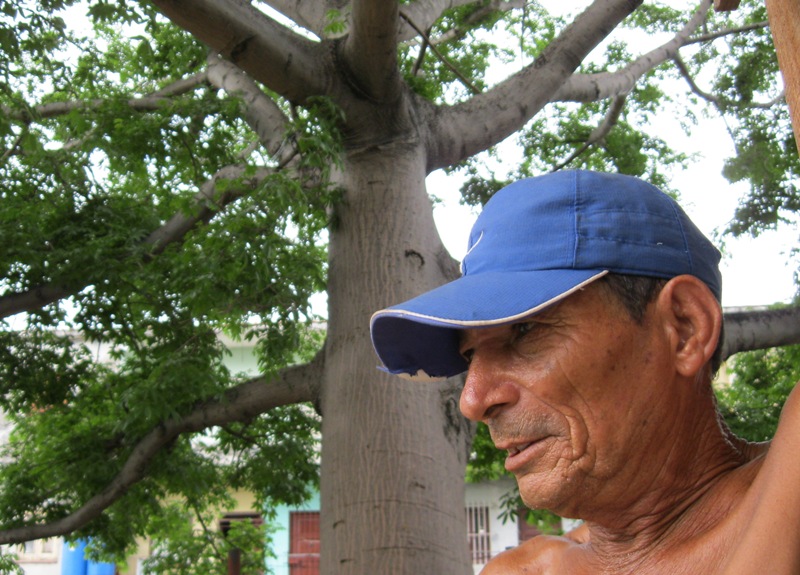
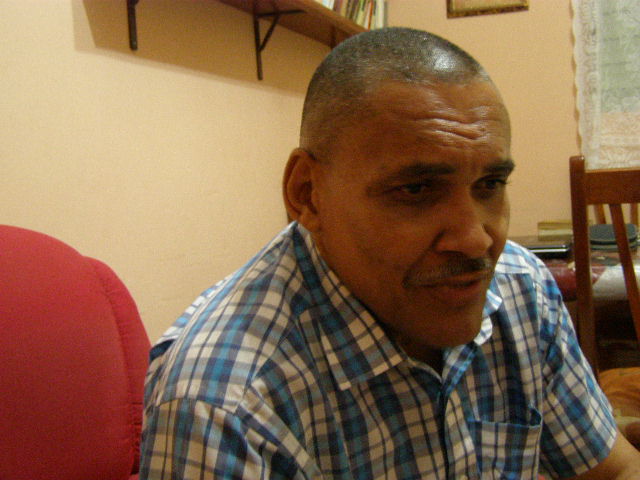
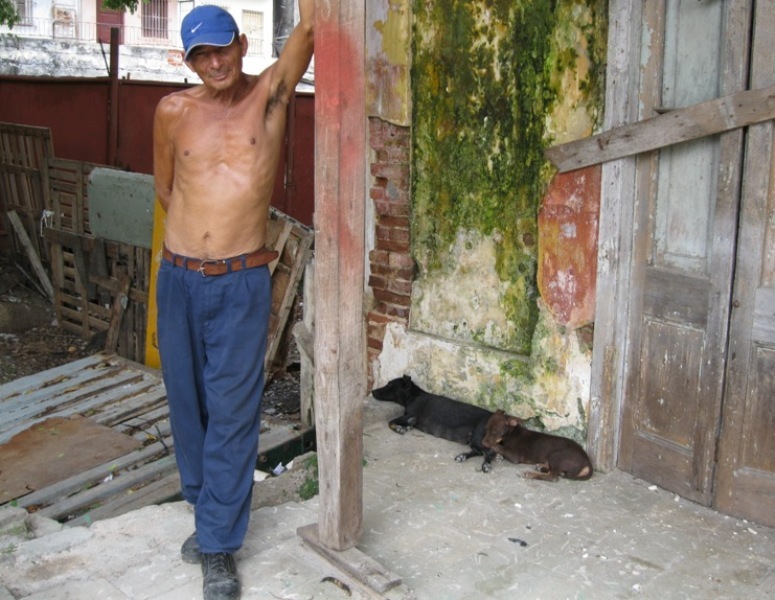
HAVANA, Cuba, November 2013, www.cubanet.org.- Giraldo Rodríguez Comendador, 76, can’t cross the avenue because cataracts cloud his vision. Every day he has to decide whether to seek the evidence of this 42 working years (to initiate a process that would culminate in a 250 peso pension — Cuban pesos, not the ones convertible into dollars, about $10), or to set himself to the little “errands” — as he calls them — to survive.

Most of the time he’s forced to the second option, not just because hunger is an undeniable fact, but also because he is losing hope.

In 2006, when he retired — from the Ministry of Construction in Las Tunas where he worked as a driver — they told him that his record didn’t appear, that it might even have been devoured by flames. I’ve heard, on other occasions, of people with a problem like his, but until today I didn’t understand that a lost work record multiplied by zero equals the sacrifice of an entire life.

To alleviate his desperation a little, a social worker appeared and offered him the assistance of 142 Cuban pesos, but Rodríguez Comendador expressed his indignation.

“Like me there are a few, at least in Las Tunas, who have demanded and taken the charity given to them. And they are satisfied with that. I am not a beggar. To me they must give what is mine.”

To get “his” he has to go to every place where he worked and get them to sign documents that support his having been on the payroll, and then go to the Collective Law Firm and hire a lawyer to make his claim. One of the inconveniences he confronts is that most of his peers have retired. Others have changed jobs. He says that once he met the boss he had when he was working on the El Cornito dam.

“He said to me, ’Boy, go to Los Pinos, to the human resources department of Removal and Construction, and I’ll send you a truckload of witnesses.”

But the witnesses weren’t enough to authorize paying the pension, which is processed through documents like the work record. They will only certify, in an extreme case like his, that he worked in a specific place for a determined amount of time.

“Seven years ago I was on the ropes. Even my knees gave out when I was walking. I was convinced I’d lost my working years. For nothing, because they mistreated me like they are mistreating me today. I worked to have what’s mine, for myself I don’t worry that there’s a law that obliges children to take care of their parents,” he says.

As for hiring a lawyer, the fee for labor processes isn’t very high. But Rodríguez Comendador asks:

“How amI going to hire a lawyer? I don’t know the medical prescriptions I’ve lost out on because I can’t buy medicines that cost 19 pesos.”

He went out again to look for work, but no one gave him any; because he’s of retirement age he doesn’t have valid documents and can’t do temporary work.

Also, as blind as I am, they put me on the truck to throw dirt, mud, cow manure, and I do it because I need the pesos. He knows that I’m blind, so what he’s going to do is take off. My situation is absolutely terrible situation.”

When asked if he’d been hungry, he remains silent for several seconds. And then answers, like someone who rising above his honor made a stack of old crumpled papers:

“Imagine it; if I tell you no, I’m lying. Charity doesn’t solve the problem: They’ve given me a blanket and I had to sell it to eat, a pair of shoes and I had to sell them to eat.”

So there is no doubt when he says,

“Me, you tell me to take an iron bar to the train station for 10 pesos and I hoist it on my shoulder and I take it.”

But the urgent question is, how long can he continue to take his body to the extreme of exhaustion with such bad nourishment?

This doesn’t seem to worry him more than how he is going to get by day-to-day.

“I’ve caught myself at six in the morning, thinking. And what can a man think when he’s at a crossroads like I am?”

The little light fades and he says,

“I’ve thought about hanging myself, girl. Five hundred times I’ve looked at an iron bar back there where I can hang myself, but I see this fat woman you see sitting over there, that’s my wife, and I change my mind. Anyway, I have to die of something.”

By Lilianne Ruíz

Cubanet, 12 November 2013

castroisms / orlando luis pardo lazo

and that’s how life surprises you on a saturday night in manhattan, as if it were the most uninhabited corner of havana. there are no differences. the world is like this. horizontal and simultaneous. we are all here and now. we are all contemporaneous and we act to probe the limits of god.

so in my country there are thousands of state bodies. the only way a country has to exist is through the death of its citizens. the revolution is above all necrophilia. democracy would not have to be any different. it’s very easy to talk about transitions and pacifism. this is an outrageous naivete. or a hypocrisy that disgusts me.

there is no social change without control over who dies and who can live. to me, right now, the cuban democrats are telling me all the time: shut up, asshole, you’re not one of us, you don’t agree with us for the criminal cause of freedom.

you know what? stuff your democracy. i never asked to be part of the pie. i’m free. and what’s more, i’m cute. and what’s more, i’m madly lucid. and what’s more, i’m touched by the gift of language and imagination. and what’s more, you all remind me of little castros. you think in castroism. you talk like castros. you gesticulate like castros. without castro you would be lost in the universe. you are castro. not the replacement castro or a posthumous castro of the opposite sign. no. you are really castro, i’m telling you. more castro than castro, because castro improvised on his trail of nameless murders and you are doomed to imitation, which is always more authentic than the original.

and that’s how life surprises you on a saturday night under the leonids falling in the skies of manhattan and you realize we never knew each other. fortunately. there is cubanness far beyond cubans. the united states is the only third world country, this is obvious. but it is the only country. the rest are a battleground, slaughter as training, as entertainment, as sterility. the stars fall one after another and there is nothing to do but watch them fall one after another without anything more to do than to watch them fall one after another.

i am going to die in this country. i don’t know if they will send castro’s executioners to kill me or if i am going to die alone, walking through the tunnels of some pissy station, or in one of the corridors of a thousand doors in the buildings where cubans in this city are hiding from cuba. i want to bear witness at least to the looks. in havana it is no longer possible to look. in manhattan it’s impossible to stop looking and for them to stop looking at you. the people have a barbaric beauty. but they have forgotten. they talk too much. the american language is one of the worst in the universe, communicating nothing, pure emptying of guts. i wonder if americans won’t have a lot of fear of speaking. the english in my father’s books like a dead language. the colloquial english like a triumph of castro in america.

midnight approaches. the trains rush everywhere. i open my mouth and don’t pronounce a single word. for the first time i have hopes, for the first time i am afraid. i don’t want to be them, i don’t want to be you, i don’t want to stand in for the little castros. i don’t want to think in castroism. to speak like castros. to gesticulate like castros. to be another castro of authentic imitation lost on the planet. i don’t want to be me again.

16 November 2013

Cuban Airports: The Chokepoint / Yoani Sanchez

José Martí International Airport tower

People crowd together in the suffocating heat, some are holding signs with names printed on them. The flight from Madrid just landed at José Martí International Airport, bringing tourists and many nationals now living in Spain. Each person must wait forty minutes to an hour — at least — before finally passing through the exit door. Havana is one of the world’s slowest airports, the worst lit, and with the fewest services for the traveler.

In a country that receives almost three million tourists a year, updating its airport facilities is vital for the economy. If these places don’t meet international standards, it’s unlikely that the island — in the short or medium term — can play host to more visitors.

Aware of its major shortcomings, ECASA (Cuban Airports and Aeronautical Services S.A.) has begun a process of remodeling some of its arrival and departure lounges, but the problem requires more than adjustments and redesign. Its principal limitations are not only material, but also its excessive controls, the lack of comfort, and the attitudes of its employees.

Departure lounges, restrictions and inadequacies

Alina has arrived at the Havana airport three hours early, but it may not be enough. She can check in only at the airline counter, as there are no machines to perform the procedures independently. This limitation lengthens the lines, slows the whole process of obtaining a boarding pass, and feeds the image of an always crowded lounge that characterizes José Martí Airport.

A frequent traveler to Spain, thanks to her new EU passport, Alina has come prepared for a cramped and awkward process. She flies through Terminal 2 because Terminal 3 — larger and more modern — is being remodeled and recently experienced a fire. In her bag she carries a snack made at home, because she knows the prices there are stratospheric and the offerings are very limited.

Poor signage completes the picture. For ten minutes the frustrated customer looks for a bathroom but the directional signs are scarce and not very visible. Few of the ceiling lights are on, which makes the various areas of the lounge dark. Still, every passenger must pay the airport tax. In the line to hand over 25 convertible pesos ($28 US), one hears the tourists complaining about the tenuous relationship between the price and the quality of the facilities. Cuban passengers, however, remain silent, not wanting to cause problems for themselves just when they’re about to leave the island.

Without a Wi-Fi network to access the Internet, any modern airport falls several points on the scale of quality. With regards to communication, no embarkation point in Cuba is competitive, not even Varadero. The few public phones and the lack of a wireless network diminish the chances to communicate. To this is added the TVs buzzing away with their tired tourist announcements or overly ideological programs like Cubavision’s Roundtable. Nor is there a stand selling magazines or newspapers, just some souvenir kiosks where they sell the works of Ernesto Guevara and the speeches of Fidel Castro.

Alina is also prepared to avoid boredom while waiting, and has brought some headphones to listen to music on her phone. She waits at the exit doors — there are only two: A and B — until an employee shouts out that her flight is already checking in.

Arrivals and the collision with reality

Humberto arrives after a trip to the United States. This was his first trip abroad, so he’s still stunned by the size of the Miami airport. On the plane back to Cuba he’s filled out the Customs form and in his pocket he has a copy of the boarding pass he got at the exit. He joins the long line for immigration and next will have to answer a brief medical questionnaire which he will also have to sign. A few steps away the luggage waits, the slowest point in the entry to Cuban territory. Every suitcase will be put through a scanner to investigate its contents.

After analyzing each bag or suitcase, they will attach “markers” to those that need to be inspected. A small red strip tied to the handle may mean it contains some home appliance or computer. If instead, it contains an external hard disk, then they write some initials on the paper strip that identifies the flight. There is no way to avoid this process. The customs officers are trained to keep out a long list of objects.

Humberto’s granddaughters, born in Coral Gables, have given him a laptop and a smartphone. So he must go to the table where they open his suitcase and minutely search everything. They take the computer to an office, where they probably inspect its files or make a copy of them. He’s already waited an hour and a half since the plane touched down and will probably wait a little longer.

While they search his belonging they tell him he can’t make calls on his cellphone. “Welcome to Cuba,” he tells himself when an officer asks what those “bullet-shaped” pressed cotton things are. “Tampons for my daughter,” he responds grumpily.

Two hours after arriving in his own country, Humberto passes through the gate in Terminal 2. At the same time, Alina is already seated on her flight to cross the Atlantic. Looking out the window she whispers, “Goodbye Havana airport, I hope I don’t see you for a long time!”

The post Aeropuertos cubanos: el nudo en el embudo appeared first on Generación Y – Yoani Sánchez by

17 November 2013

Does Human Trafficking Exist in Cuba or Not? / Victor Ariel Gonzalez, CID


“Cuba is not the place of origin, transit or destination of human trafficking”.  This was declared by Isabel Moya Richard, the director of ’Editorial de la Mujer’ (A Cuban Women’s Federation publisher) on November 1.  However, later in the article it is stated that in 2012 fourteen people were convicted of trafficking.  So, the phenomenon does exist.

The aforementioned director recognises that it is important to prevent these practices through an orientation towards healthy sexuality, implementing “sexual education in all levels of education”.

She adds that “another key matter is the work of the Ministry of Tourism to avoid campaigns that could associate Cuba with ’sexual tourism’”.  The matter “is not easy” given the advertising image of a paradisaical beach (main natural resource for Cuban tourism) upon which usually walks a woman whose figure indirectly offers to the visitor the possibility of finding sexual pleasure.  This aesthetic concept implies a distortion of the female image and its association with a product that sells.  Paradoxically, this phenomenon, equally common in western market economies, has been criticised by the Cuban government, that for reasons of “avoiding turning women into merchandise” has gone so far as to prohibit the possession of pornography.

In various civil independent society publications, foreign as well as Cuban, accounts appear that bear witness to the sexual exploitation of Cuban adolescent victims. They speak of families that agree to “offer” their daughters to a foreigner who promises to take them with him to give them a better life and in this way the girl is able to help those who she leaves behind.

Prostitution is a hidden subject in Cuba. The critical economic situation has contributed to the growth of this phenomenon in recent years to never before seen levels.

In respect to human trafficking we can also include those who are victims of irregular migratory trafficking.  Although it is not necessarily related to prostitution, conditions in Cuba also give rise to a high number of illegal immigrants, those who pay exorbitant prices to arrive to the U.S.A. by sea or via third countries such as Mexico.  The price of a “ticket” is above 8,000 CUC.

By Victor Ariel González

16 November 2013

Translated by Peter W Davies

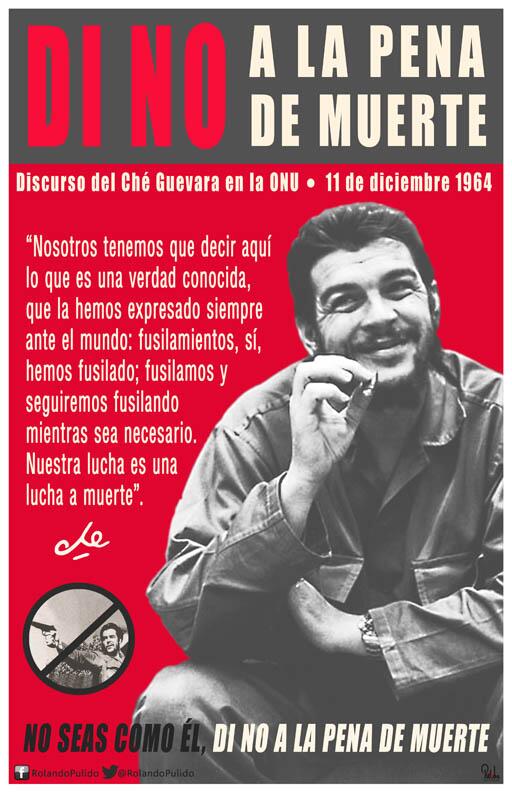
Don’t Be Like Che: Say No to the Death Penalty / Rolando Pulido

Poster: Rolando Pulido

SAY NO TO THE DEATH PENALTY

Che Guevara speaking at the United Nations: 11 December 1964

“We have to say here what is a well-known truth that we have always expressed before the world: firing squads, yes, we have executed; we execute and we will continue executing as long as necessary. Our fight is a fight to the death.” Che

DON’T BE LIKE HIM. SAY NO TO THE DEATH PENALTY

The Body of an Island, the Soul of a Continent / Yoani Sanchez

Photo: Orlando Luis Pardo Lazo

A walk in Cuba, where the future left one day for the north, and never returned. The most famous Cuban not named Castro, Yoani Sánchez, offers her vision of its unique streets. El Pais, 14 November 2013

———————–

Contrasts, anachronisms, they are an inseparable part of Cuba. The lights and shadows that make up this reality have come stumbling into the XXI century. A poet defined the island with a phrase that can be confirmed at very step: “the damned circumstances of water everywhere.” But so it is,   sea, sea and sea, wherever you look. Not only the blue waters where the kids dive, but also the sea of nostalgia, of enclosure, of dreams, of the rafters… A country difficult to decipher, even for those who were born here.

Here, everything moves more slowly. As if the life of eleven million Cubans passes in slow motion. A jalopy effect reinforced by all the mansions that haven’t had their moment to perish before the skyscrapers. Architectural gems, their columns cracked by the years and lack of resources. Arabesque mosaic floors, chandeliers preserved by a grandmother. Splendor and necessity shaking hands.

Far from the historic heart of the city, with its hotels and opulent restaurants, extends the real Havana. At any hour it’s surprising how many people are in the streets. We are looking at a pedestrian city, in part because for decades the buying and selling of cars was prohibited. So Cubans are used to walking long distances or waiting hours for the bus. Reinforcing the impression of immobility, of statism.

The art of waiting

Waiting is just one of those components inherent to the identity of the largest of the Antilles. A popular joke says, “Yoga must have been invented in Cuba,” given the patience people show in the face of long lines and the longest-serving leaders. But when it’s time for fun and dancing, it’s as if the minute hand speeds up, jumping. Even today, Havana retains some of the nocturnal glamor that led to its nickname, “the Babylon of the Caribbean,” during the first half of the last century.

The dual currency — the Cuban peso and the Convertible peso — determines the type of fun people can access. The poorest make their own drinks at home, with cheap alcohol and a little sugar and lemon. However, in recent years good restaurants, known as paladares — palates — have also proliferated. With a blending of island and international cuisine, they have been able to prosper thanks to the economic relaxations of the last five years. Tourists make up the core group of customers, but their tables also serve Cubans from the exile and the emerging business class on the island. Approaching midnight some of the olive-green ruling class might even show up, dressed in plain clothes.

But the main magic of this country is not in its present. Curiously, its two main attractions lie in the past and in the future. What was, with the old cars still cruising the streets and that pride of having a city that shares posters with Paris, New York, Buenos Aires… But an opposing force compels us to look toward what’s ahead. Because Cuba is one of those countries with a keyed up potential.  A cradle of thinkers, philosophers, musicians and artists, a tour reveals the creativity of its people.

The same poet who so masterfully defined the island also said that “if Kafka has been born in Cuba he would have been a writer of manners.” Because the absurdity is present on all sides. From the dentist who eats pizza while attending to the patient with a toothache, to the convoluted paperwork required to un-enroll a dead person from the rationing system. Daily life that is inexplicable and unheard, but also captivating and unique.

No subtitles

The cellular structure of Cubans lies in the tenements, known as “solars.” Those old mansions that with time and economic problems have been divided and populated with multiple families. A central courtyard, a communal bath, the roof where teens raise pigeons, towels of indecipherable colors on the clotheslines. The solidarity of people overcoming material shortages, domino games, a mother who shouts her son’s name from the balcony, “Yunisleidy!”

A week is not enough, a hotel is not enough, nor is a look out the window of an air-conditioned bus. In Cuba, you have to live on the streets to understand its contradictions. For example, that a few yards from the Plaza of the Revolution an enormous illegal market in building materials flourishes; or that many of children who in school chant the slogan “pioneers for Communism, we will be like Che,” then go to the sea to look north, toward the desired shore.

Because Cuba is an island with continental yearnings, eager to be more, to go faster, to go further. A teenage country whose arms and legs are growing, trapped in a very tight dress. To visit its reality leaves no one indifferent. Like a postcard in sepia, that instead of placing it in some framework, forces us to immerse ourselves in it, to live it, to suffer it, to love it.

14 November 2013

“Schools in the Countryside” Suspended Because of Dengue Fever / CID

Santa Clara, Cuba November 13, 2013. Officers of the Ministry of Education (MINED),   Central Region, at a government meeting on Monday the 11th, suspended the Schools in the Countryside program for November and December, because of the complicated epidemiological situation in the province.

Guilfredo Martin Betancourt, a MINED official, said the province is experiencing cases of cholera and dengue fever, without giving specifics with regards to numbers, given the environmental and social indiscipline problems.

Captain Robert Rodriguez said, during a meeting with families of the students at the school, that since the beginning of the summer rains and despite the efforts of workers in the provincial health system, foci of the vector (mosquitoes) have accumulated in the capital city and other municipalities.

Yudmila de la Caridad Vázquez, a teacher of the institution, told this publication that the curriculum of the Cuban school is planned such that students from eighth grade upward, spend 30 days of work in the fields, thereby strengthening the Marti principle of Work Study, but that this time the suspension is the right thing to do, because they can not endanger the health of students.

15 November 2013

Antonio Rodiles: Creating an Opposition Movement Within Cuba? / Ivan Garcia

Antonio-Rodiles-620x330Far from being an association of think tanks or elite academics, Estado de SATS (State of SATS) is a project which brings together the various political and civic points of view to be found within the tiny illegal world of Cuban dissidents.

At one of their gatherings a highly regarded opposition figure like Manuel Cuesta Morúa might offer a talk on racial issues, a panel of independent attorneys might discuss legal matters with the audience, or a rapper named Raudel might give an hour-and-a-half long concert.

Estado de SATS often serves as a point of cultural, social, political and even sports contact for Cuba’s opposition. The physicist and mathematician Antonio Enrique González-Rodiles Fernández (born 1972 in Havana) is its most visible face.

His home in Havana’s Miramar district, with its spectacular view of the Atlantic Ocean, serves as the headquarters for Estado de SATS activities. Once an event is announced, the security services begin mobilizing. 

A surveillance camera has been placed very indiscreetly along one side of the house. Suzuki motorcycles — the sturdy type used by counter-intelligence agents — prowl the surrounding area. And not infrequently one or two dissidents are detained. Harassment has become part of the landscape.

On the evening of Thursday, October 11, Rodiles was screening El Súper, a classic 1978 Cuban exile film by Orlando Jiménez Leal and León Ichaso. It tells the story of a  family which has recently arrived in New York from the Caribbean.

Antonio Rodiles is perhaps Cuba’s most promising dissident by virtue of his extensive education as well as his formal manner of speaking and interacting with people. Dressed in a short-sleeve Prussian blue shirt and black slacks, and amid the din of houseguests and audio equipment, Rodiles spoke with me.

“The repression and harassment of Estado de SATS is cyclical,” he tells me. He mentions the detention of the former political prisoner José Díaz Silva and his wife, who is a member of the Ladies in White. Both were collecting signatures for Citizens’ Demand For Another Cuba. On the following day a Miami-based newspaper, Diario de Cuba, reported the couple had been released.

Demand For Another Cuba was launched in Havana in 2012. Among other things the petition publicly calls for a debate on the country’s dual currency system, the right of workers to a living wage, the right of all Cubans — no matter where they live — to launch financial projects in their own country and free [open] access to the internet.

Demand For Another Cuba also calls upon the regime to the ratify the United Nations’ Convention on Civil and Political Rights and the Convention on Economic, Social and Cultural Rights, which were signed by Cuba on February 28, 2008 in New York.

Rodiles is not optimistic. “I don’t believe the will is there to ratify them. It was a tactic meant to make a good impression in the eyes of the world. Remember that in 2008, when Barack Obama became president of the United States, the government of Raul Castro was trying to take on a reformist profile.”

Estado de SATS began operations in the summer of 2010. In the past three years arbitrary arrests and harassment by State Security have become routine. Last year Rodiles himself was detained for nineteen days in a foul-smelling jail cell in Havana’s Tenth of October district. 

“We have gone through some bad times,” he says. “There are cycles. It’s like a wave, with stages in which the level of repression is low and others when it spikes. It is a surgical kind of harassment. Repressing twenty opponents is not the same as having to repress ten thousand disgruntled people. Special services is trying to patch the wound before it occurs.”

A series of actions carried out by Estado de SATS in the private employment sector has raised alarms with some of those in charge of keeping tabs on them. Any attempts to build bridges with non-dissident groups often makes agents of the secret police very nervous.

Rodiles knows this. He is convinced of the necessity to build a more effective opposition movement within Cuba. Leaky pipes which waste fifty-eight percent of the country’s drinking water, the chaotic state of public transport, a low-quality educational system, and dilapidated hospitals affect Castro loyalists as well as opponents.

This is why Rodiles is trying to be more inclusive. “There are many ordinary Cubans among the 4,200 people who have signed the Demand For Another Cuba petition. Mismanagement by the state harms everyone, whatever that person’s ideology.”

I ask him how he sees himself in five years. Antonio Rodiles looks at the intense blue sea, which he can almost touch with his hand and answers, “I like politics. Economics too. It’s not that I am capable of giving up everything for politics, but I believe it is one path.”

Iván García

Photo: From “Cubans Are Losing Their Fear,” and interview published in ABC on September 20, 2013.

Further reading: The Opposition in Cuba: Calling Ourselves to Account

14 November 2013

Russian Millionaires Come to do Business / Tania Diaz Castro

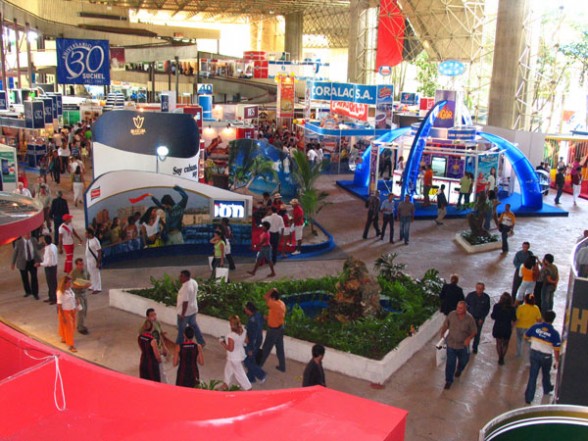
Havana, Cuba, November 2013 – www.cubanet.org.- Mr Rodrigo Malmierca, minister for external trade and foreign investment, said that in the 31st Havana International Fair (HIF), held from November 3 to 9, the participation of various foreign delegations shows that “our country is not alone and there is no economic blockade of worldwide power that is capable of changing our course”.

Does this mean that the Castro regime will stop requesting the end to the blockade or commercial, economic and financial embargo imposed on Cuba by the United States?

The embargo was imposed in October 1960 when Fidel Castro illegally occupied properties owned by North American citizens and companies.  In 1992 the embargo became law when Castro refused to take steps towards democratization or to show respect to the Universal Charter of Human Rights.

More than twenty years later, the Cuban military dictatorship continues to violate the world’s most respected citizen rights and further impoverishes the country.

On the streets many ask what purpose 31 fairs that look for countries to trade with Cuba have served if Cubans continue to live in poverty, subsisting on incomes much less than a dollar a day, the same as those who live in sub-Saharan Africa.

it isn’t understood why numerous Cuban companies received prizes and mentions for many of their products exhibited at the 2013 HIF while in Granma, the official newspaper of the Central Committee of the Cuban Communist Party, the poor quality of the country’s products and services are criticised almost daily.

If the 2013 HIF welcomed Russian millionaire businessman — there are more than 20 in the country including one woman, Mrs Yelena Baturina, wife of the mayor of Moscow — why isn’t anything known of the commercial agreements that were reached with them?

How can we forget February 22 of this year when Russian president Dimitri A. Medvedev, visiting the island, signed an agreement about the “adjustment of Cuban debt to the Russian Federation, for credit granted during the period of the defunct USSR?

How can we forget that days afterward on May 22, the president of the Russian Federation Council, Ms Valentina Matvienko, expressed to Granma “We are pleased to have found a solution for the readjustment of debt”.

It is said that it refers to thirty billion dollars, an impressive figure.

How then will the insolvent and inefficient Cuban dictatorship be able to pay?  Why haven’t the technical aspects of the signed agreement signed by Ms Matvienko and the Cuban National Assembly “for a prompt ratification of debt and approval in the Russian parliament” been explained to the people?

Nothing is known. Only that the Russian business advisor in Cuba, Vadim Tiemnikov, visibly moved on television, thanked the Cuban authorities celebrating the 96th anniversary of the Great October Socialist Revolution, despite having dismantled socialism some twenty two years ago.

Despite the Havana International Fair of 2013, Cuba will continue to be a country weighed downed by marginalization, by the shortage of basic food products, with miserable salaries and fields infested with the invasive marabou weed, without a fishing industry or merchant navy, the livestock industry on its knees, the sugar industry in its worst state in history, an obsolete ration book system (Lenin’s idea) and a military dictatorship that asks the people to change their mentality although the people still doesn’t know how the hell they should change their mind.

Tania Díaz Castro

Cubanet, 13 November 2013

Translated by Peter W Davies

The End of the Good Star / Regina Coyula

Estrella Madrigal Valdés

Estrella Madrigal Valdés

I do not believe it, but the rumors circulating about Estrella Madrigal Valdés, former president of the Chamber of Commerce are diverse and nothing good (for her).

They say her replacement was announced shortly before the Fair of Havana, that she is under investigation at home unable to leave, that she (or her spouse, depending on the version), has businesses and bank accounts in Panama or Bahamas.

These are comments from MINCEX  workers and foreign firms, in the press that hasn’t reported even a word on the matter. In any case, it is no surprise that another “box” until yesterday of the highest confidence, fall into a web of corruption. Moreover, if the Comptroller General’s Office finds no others, it’s for to lack of resources (or authorization), because in times of crisis, people can adopt the motto of the CIMEX Corporation’s chain of dollar stores: “Mine first.”

15 November 2013

Blue way, white night / Orlando Luis Pardo Lazo

December 10.  It was a foggy day and the remembrance of other similar birthdays, including those old songs in Armenian played many times and out-of-date.  December 10.  It was a Friday, as usual, and I picked up the phone.  No one in the world dials 71-12-10, the whole world knows that “the selected number is out of service or out of the coverage area”.  December 10.  I put that homeland ballad from the beginning of the 80’s:  …blue way and white nights of our lost Erevan, tralali, tralala… on the Russian record player.

It was soft, it was strong. It was a long time since any music band had reminded me that it was possible to sing like this, kissing the lips of the microphones still not in stereo, undressing the acoustic sex of the guitars, barely touching the cymbals of the percussion: pure scratch of the acetate or the staff and a pull from almost 20 years inside the speaker, from the depths of its sound or its muteness.

I was a child in 1984, but I still remember it well. Not only the melody, but also the blue ways and the white nights of our beloved Erevan. There in Armenia: not at the end, but at the beginning of the world.

We were traveling in a bus. I was 12-years-old and I was departing from my homeland for the first time. The family was traveling to Moscow and it was on the next seat where I met her. She, the only love of my life whom I never had the shame to say that I loved. She, and her ambiguous name: Ipatrik.  She was 15-years-old and had very short hair. Red. And her eyes. Her eyes: what to say finally, her gaze was like suddenly discovering the rest of reality. The remains of the reality.

Night was falling. It is a saying, in my homeland night never falls completely. The sun only hides, but it doesn’t get entirely dark. The sky turns red, like her hair, and then orange, and then yellow and then planet green and then bright purple and then white and then even more white, almost mercury and that means that it is already past 12:00 and midnight begins to fade directly into dawn. Nameless rainbow. Just in that color, without color; the bus stopped in her village, Añipemza and she got off without my knowing. I saw her stumbling toward my seat with the ticket still in her hand, desperately looking for the number 666.  And then I saw her suddenly sitting next to me. She looked directly in my eyes and started to cry. And that was the beginning of my no story with an unpronounceable word pronounced ipatrik.

The rest was the love and the sound of love in the languid voices of the Asbarez group, amplified today in mono by the speakers of my Russian record player and those of that interstate bus: …blue way and white nights of our lost Erevan, tralali, tralala… …your name is the light of the soul, although war takes us so far that memory can’t reach…

That’s how the two vocalists of Asbarez sang: red-haired, like the night already dead and you. That’s how I sang for you, in an inaudible voice so low, of course, just pure confusion before your older girl pouts. And so I stole or invented for forever that sleepless scene of socialism of the heart, in 1984.

And you know what? I have never been as real as when I heard that song, that thirty years later seems to sound the same on my acetate disk, but is missing the half bite that, when you finally stopped crying you offered me:

“You want it?” and you took the first bite.

An apple. I had never bitten a bitten apple. I was disgusted or I don’t know what.  And that disgust was the most delicious sensation that fits inside an Armenian man who had just turned twelve-years-old and discovers his first woman three years — almost a lifetime — older.

An apple. A bitten apple. An apple bitten by you, Ipatrik. And all this is like part of a dawning in Euroasia, the great razed continent. By the first great war, two short for us to realize what had happened. And by a precarious peace afterwards, too long for us not realize what was still to come.

“Thank you,” I said, between formal and embarrassed by the surprise and the saliva.

And you smiled, and almost pushed me by the neck to force me to swallow the pieces. Exactly, baby food. A half digested pulp that you gave me tongue to tongue directly from your mouth, that smelled like alcohol more than apple. And it tasted just like the bitter salt of all your fifteen-year-old tears, though I didn’t yet know your age. You tasted like virgin saliva and fermentation, the milk of a future mother, and the memory that is impossible not to love.

…Why are the white nights so short if the blue way is so long?… now sang the two singers from Asbarez. I felt dizzy, but never in the universe did I stop kissing you.  Not even to swallow. Until from so much happiness and lack of oxygen I suppose I passed out.  Or something like that and no less ridiculous.

The bus arrived at the border with Grusia and you stayed there. I read it in Georgian in your eyes made from instantaneous and real cider. That would be, in any case, your small stateless homeland; since I don’t think you belonged to any lips or place. A sign announced that Tbilisi: our beautiful academic-industrial capital was 10 kilometers from there. And, since then, that was all my orientation I had to look for you until today. Do you understand where my pain comes from and my indolence towards Georgia: my envy, my longing, my jealousy?

Ipatrik made me look outside, through the Calobar glass. The turnaround looked blue, although the whitish night and the two-voice choir of my speakers in mono:…white nights that no blue way is able to reach, without coming or going from our lost Erevan, tralali, tralala…

–Every time you are so alone and you always will be, every time you have a secret love and you always will have, every time you turn twelve years older, and perhaps this will happen in your life up to twelve more times, every time you find a bitten apple disgusts you although you want to be disgusted, every time you swallow saliva with fifteen-year-old tears and your thirst is not quenched, every time someone looks deep into your eyes and still you cannot see yourself, remember that my name was Ipatrik and that always, whatever the color of the sea or the mud, I will continue loving you from seat 666 of an interstate bus from a country that disappeared.

I couldn’t hear anything any more. I would only let her broken voice ring and ring in my Armenian ears, mixed with a homeless ballad from the Asbarez group. I was still in trance. It’s that no one ever spoke to be like that before. It’s that no one had ever spoken to me before.

Ipatrik let her eyelids fall, heavy as curtains, and with them also closed our non-story of love, or at least of the word love. Ipatrik stretched the gloved index finger of her left hand toward me and warned me:

“Don’t look for me there,” and signaled then with the same finger towards somewhere outside the window, toward the empty turnaround or the ambiguity of a fragile border between the mimetic republics of Georgia and Armenia.

And she jumped up from my side, suddenly. Just as she had some, almost without my noticing it. Ipatrik, I-patrik: the one with no homeland, I decomposed the name to better pronounce it in a low voice… blue way and white nights of our lost Erevan… The melody was soft, it was strong: a pain and a relief at the same time.  Isn’t love the same as the only impossibility to love?

The bus started. Grusia inside first and Russia inside after, up to the same heart of the great capital: Volgograd, Kuibichev, Kazán, Gorki and the Citizen Station in Moscow. Days and days and nights and nights of travels without you. My parents would look at me with sarcasm and would smile:

“You are not that young,” my father Armenak would tease me.

“You have graduated ahead of time from TV heart-throbs,” my mother Takuji would tease me.

And they would sink back and spy on me again from the back seat. And I also smiled at them, assuming the comical price of the situation. I knew I would be miserable for life, hiding it from my parents, incapable of overwhelming them because in the end they would laugh together. Because we were going to the hospital. Because Armenak my father was afraid that he was dying — once again — as it was his custom throughout a long and sorrowful life to the end without the any diagnosis of illness.

And so I smile at them both today, both recently deceased, incapable of telephoning anyone on this birthday of the Armenian records on the Russian record player in a neighborhood called Lawton on the outskirts of Havana, city on the outskirts of an island called Cuba, nation on the outskirts of an unconnected history.

December 10. Among the memory of other similar birthdays,  a bit unfocused by a certain ancient haze, often out and outdated during the real Fridays of the world. December 10. And, as usual, my mobile 71-12-10 started to ring: endless ring-rings that by some miracle I decided to answer, not to be discourteous on my birthday. And just in case it might be her, appearing again, symmetrically, from any phone in any address book or guide of my memory of the world: I-pratik.

It was a wrong number. It was just the Asbarez disk. Isn’t every call, in the end, a wrong number? The silence was thick, unbearable, suicidal. …Although the war takes us so far that…

7 November 2013
To a Certain Extent, We’re All on Parole / Juan Carlos Linares

HAVANA, Cuba, November-www.cubanet.org — “La Libertad Extrapenal” — similar to parole — is a punitive category in which the offender does not live in prison, but has their civil rights suspended, and may even go back to prison if the authorities so decide. Jorge Olivera Castillo finds himself in this condition, along with another 13 or 14 other victims of the diabolical 2003 crackdown known as the Black Spring, who decided to stay in Cuba. To them, the government will not let them go overseas on a visit.

Recently, I asked Olivera (presiding over the Cuban Writers Club) why they haven’t coordinated jointly a legal challenge to get rid of this vexatious status. His answer was:

“Many friends have encouraged me to hire a lawyer and file a complaint in court, claiming our arguments, because it is a paradox that other human rights activists, independent journalists and bloggers who have done the same things we did and for which we were sentenced, are allowed to travel.” Maybe next year action will be taken against this anachronistic remnant of Fidel Castro.”

Technically, Olivera’s penalty is set to expire in 2021, and so he remains in the list of political prisoners. When asked if all those compatriots who are under the same injunction receive the same restrictive treatment, he told me, “At least everyone who has gone to inquire at the immigration offices has been told that for the moment we do not have permission to leave the country, that is, we are in the same black list,” and he points out, “If instead of asking for permission for we asked for it for final departure I believe they would give us authorization.”

The government certainly will justify that every ex-convict has legitimately invalidated his naturalrights; however, in this case it is poisonous to dismiss these 13 or 14 Cubans who were sent to prison for defending something intrinsic in every civilized society: the defense of human rights. Specifically, they apprehended him when he was the director of Havana Press, a pioneering Press Agency of independent journalism.

The 75 prisoners of the repressive wave would be released for real or supposed health reasons, and also because of the huge pressure from the international community. And in your case (I inquired), in addition to these two reasons, don’t you think the was the added “blessed” concern that the inmates with whom you coexisted, and your guards, could only be wondering who the fuck gave the order to imprison such a noble and decent man?

“Well,” said Olivera, smiling, “the prisoners there didn’t believe that I got 18 years just for writing, that my crime had to be something big. The truth is they gave us parole because of a confluence of political factors, and because of arrogance (of the Castro brothers) not to give an inch before the whole world, and to grant us a pardon or an amnesty. Also, the severity with which they treated us accelerated the process of declining health in most of our cases.”

So, our conversation turned to the Cuban Writers Club, a new project funded in 2007. Today there are around 40 members: novelists, short story writers, poets, from almost all the provinces. They have plans to create a contest that includes all genres.

Oliver is a full member of the Pen Club of Cuba in the exile, and has received a fellowship from Harvard, as a writers, thanks to a proposal from the Pen Club of England.

Finally, I ask him for an opinion: Those of us here who oppose the regime, and we know our authorities well and the laws they hide behind, could we claim that we all live on parole?

And smiling, he confessed, “To a certain extent, yes.”

by Juan Carlos Linares

Cubanet, 13 November 2013

Men Working / Regina Coyula

Several television programs have the format of a presenter-moderator with invited guests to discuss a specific topic of national events over which they have some political or administrative responsibility.

Free Access on the province-wide Havana channel, and The Round Table with its new interest in internal problems, or Open Dialog, on channels with national reach, are the most high-profile in this format. The viewers can call or write in so as to –  if in addition to agreeing with the space and at the right moment, say it in the “correct” way — receive a response from the organizers.

By strange coincidence, overweight officials, very uncomfortable in front of the camera and with the limited language that characterizes them, offer explanations — justifications we might say — of the unsatisfactory performance of the areas within their responsibility, and what is very significant is how a phrase is always repeated, one that the functionaries seem to feel very comfortable: “We’re working on that.”

For decades, that phrase has been the wildcard of the leadership that thrives in the Cuban bureaucracy. Making it no surprise to see the impoverishment of goods and services destined for our working people. This deterioration didn’t happen over night, and not seeing in these bosses a well-argued and convincing explanation should discourage even the most sincere believers in the economic reforms.

Indeed, it’s completely clear what the guests to these programs of Cuban catharsis have been working on with visible success. Four aspects, namely: breakfast, lunch, dinner and snacks.

14 November 2013

Paperboys Made in Cuba / Victor Ariel Gonzalez Celaya

Photo from Cubanet
Photo from Cubanet

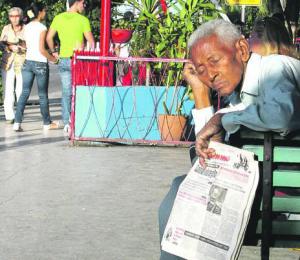
Isn’t it totally iconic that the four or five newspapers — no more — that are sold in Havana are distributed by old men?

Whether it’s a way to flagellate myself, make myself laugh, and even to get a spark that sets off something I end up writing about, every day I go and buy one or two of these gray pamphlets that should contain news. I recognize that sometimes they succeed.

And one of the things that marks this regularity is that I always buy them from a quite old gentleman. It’s not that it’s always the same seller: what I mean is that in Havana it’s the old men who sell the newspapers, and in the morning, at dawn, you can see long lines of old men (if we add their ages these lines would be millennial) waiting at the newsstands to buy what they then sell for a profit.

So let’s compare this: if you watch a movie and see a newspaper seller, for example, in the United States. His figure is diametrically opposed to the “dealer” here because he has, let’s see, a bike, he rides through a nice neighborhood, and he’s no more than 11 or 12 years old. He’s a child who sells newspapers to Americans. He rides quickly through on his bike, hefting a canvas bag with with its umpteen pages (obviously the newspapers there breakfast better) and then he gets lost on his bike, zigzagging childishly between one sidewalk and the other.

Now I turn my gaze to the daily Cuban move, where I am my own hero: I’m walking down the filthy Carlos III Avenue (and still I have a song in my chest just being out there) until I reach a corner where waiting for me is a gentleman who could be my grandfather, surroundied by newspapers on the ground. I look at the old man, who must be more than seventy, and give him a peso or two for a few printed sheets.

These veterans of whom I speak are part of an army that is our living image. This is because the situation facing the elderly in Cuba is the extract of Revolutionary history. There is no one more helpless, no one from whom they’ve snatched more because, to me at least, I have overabundant youth and strength, but I don’t have all the freedom I want; to them, all that remains is pure waiting while their strength and the years of their youth are left behind, “compensated” by a pension so miserable that they have to walk around, with their tottering steps and trembling hands, selling the newspaper Granma, peanuts or candy.

4 November 2013