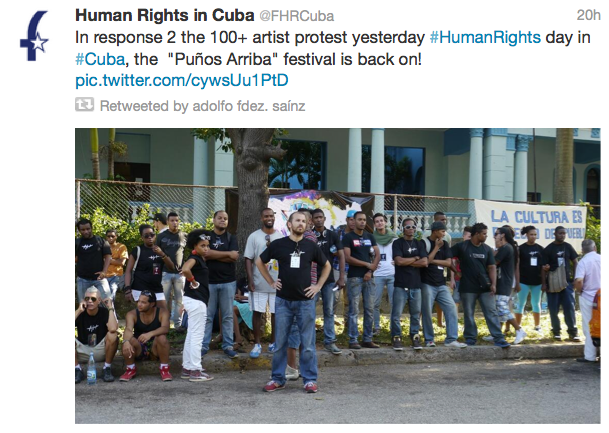
Successful Protest / Adolfo Fernandez Sainz
English Translations of Cubans Writing From the Island

The great specialty of Cuban journalists is to inflate balloons, darken with dust clouds the reality of what happens in the archipelago, and, in passing, to lick the feet of the dictators.
The most outstanding in this work are those who write for the Granma newspaper, who were chosen for it precisely: manipulable beings who practice a profession that they denigrate, disrespect, and who some day will come to form part of the anthology of the unremarkable.
Oscar Sanchez Serra, in the publication last Friday on the 6th of this month, in the official press of the Communist Party, talking about the Universal Declaration of Human Rights, has once again demonstrated, by the cynicism with which he refers to the Magna Carta — our Constitution — calling it “dreams and illusions,” how disgusting it is to him to mention it.
For the Castro government, it has been a stumbling block for the more than half century that they have exercised its flagrant violation, like all dictators, of course. No economic achievement (there are none), nor social, justifies the least deprivation of Universal Rights, whether they comply with them all or violate them.
The hack believes that hiding in the historic calamities that happened in the world might justify those in our own country, and so, in that spectrum of examples that he mentions, like the Second World War until the more recent ones in Iraq and Libya, and world prostitution among other examples, he entertains the readers and makes them forget those that they violate before our eyes and remain silent about, like the beatings and arrests of the Ladies in White and the abuses against the opposition, in spite of recognizing that “Our little country is not paradise.”

 The reporter never mentions, I suppose out of respect for ridicule, that Cuba recently became part of the United Nations’ Human Rights Council; he does not even hint at national problems, hiding behind the manipulative machinery that the system exercises in the methods of revealing, in the best style of Nazi propaganda in the time of Hitler, and wears himself out citing what happens in the hemisphere, something like asking why ask for human rights for Cubans if the same thing happens in other parts of the world. And with cynicism he jokes about the United Nations’ Magna Carta.
Really more than a journalist he lets himself be seen as an agent of State Security in the most humiliating service to the dictatorship. It was like a prelude to what happens in the days preceding the commemoration of December 10th, International Day of Human Rights.
The arrests of the brave and peaceful Ladies in White once more occur for dozens of days before. Recently, on her arrival at the airport from Europe, the leader Berta Soler was abused, harassed and abducted to be taken in an official car which left through one of the side doors, and so to avoid her being received by her daughter and her husband Angel Moya (who on parole after being sanctioned in the Black Spring, forming part of those 75 opponents of the totalitarian regime, that remain standing as flags against the regime).
The abuses, outrages and detentions of the Ladies in White, are only the gasoline that fuels their silent protests, while they walk with gladioli in their hands.
How much shame that journalist must feel who endorses the governmental abuses! Because it is not worth mentioning, comparing it with those semi-literate men and women who operate as henchmen, and are the instruments of punishment against the opposition, one supposes that it is not the case, that there exists a difference, at least you would want that; now we speak of supposed journalists, professionals who should love their profession, at least they should above all, and not in exchange for largesse, by miserable others, and accept pandering to a system that grows increasingly impossible to sustain.
Again the Human Rights party in Cuba will be held with the pain of the opponents who expose their bodies to be beaten and confined in punishment cells, and unfortunately, also, to be attacked under the complicit silence of the corroded people, thanks to the terror imposed by the State, of those who live within and outside of the country, almost in their totality, because of institutional fear that assures and occupies itself with punishing all who confront it.
Those within fear losing their work, their children’s education; those outside fear reprisals against family members that they left behind, and then that they would be refused the opportunity to come visit them.
While that silence happens, women and men, legitimate children of this people, weary of famine, face each other in their streets demanding democracy. The Ladies in White endure the beatings and vexations.
The space Estado de Sats will try to fulfill the program in a plural meeting in Havana in order to discuss the destiny of the future Cuba where all Cubans participate.
The members of the UNPACU will end up confined, some with open cases and sent to prison, others returning home with fractures.
That is the daily reality of the opposition on the island. Except that, in that same instant that the beatings and arrests occur, others see a film, open a beer, and watch their children eat ice cream, satisfied, they think that now they achieved their rights and now done their duty by Jose Marti!

Angel Santiesteban-Prats
Lawton prison settlement. December 2013.
Translated by mlk.
10 December 2013
 11 December 2013

11 December 2013

11 December 2013
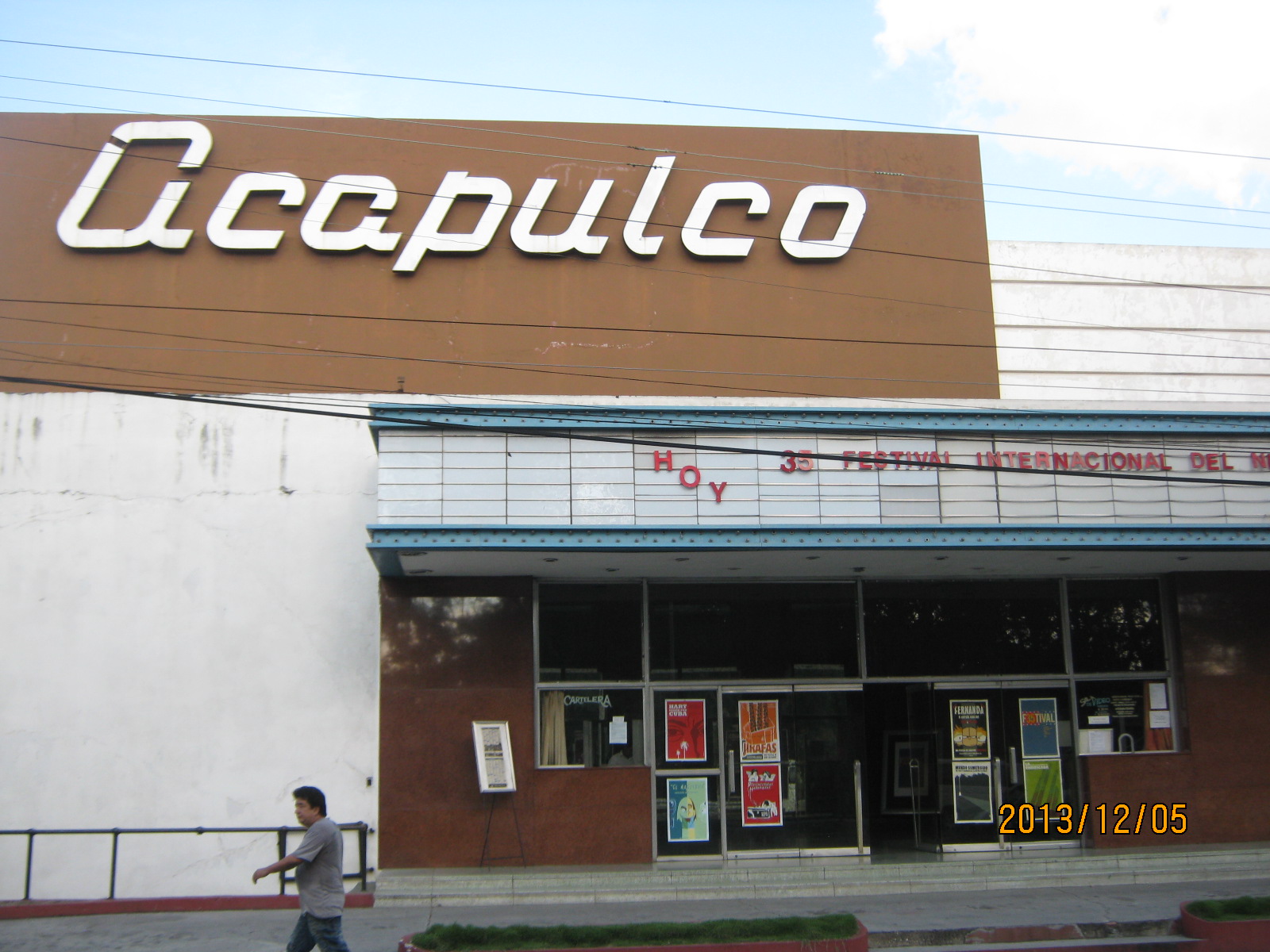 It’s common knowledge that our country is celebrating a so-called Festival of New Latin American Film although nothing about it seems new. On my end, I was not able to see any screenings in person because I am caring for my husband who is recovering from recent surgery and is home-bound.
Obstacles notwithstanding, movies were brought to my home for viewing*. I felt somewhat out-of-sorts because I had no say on the days or exact showtimes, let alone movie choice. Unwittingly, I got two flicks: “Strange Factors” and “Unwanted Visitors.“
The first movie was the worst: Very crude and unoriginal. I had the first one projected on the landing of the staircase which leads to my apartment. The other was surprising but predictable because from my balcony I could see the actors’ wardrobe and wheels: Plaid shirts and a Suzuki motorbike**.
Both movies had police state settings although the second movie was filmed in our living room. Clean and respectful language was obvious, especially in the latter of the two films. Both films shared a common goal: To communicate that I should not try to exercise the right of free assembly and association, particularly on December 10-11, International Human Rights Day, rights granted to us under the UN Charter to which our country is a signer.
From these surprising displays of power, one thing we’d like to make clear to everyone: We are human beings who love and cherish freedom. As such, we will continue to exercise our rights yet remain respectful and consistent spectators, never forgetting this old cinema with its grotesque, crude and outdated films. This we’ll do until the moment the big screen spells The End.
Translator’s notes:
*Rebeca is being sarcastic in this article; the two “films” were in fact two visits — from her ’neighbors’ and the police — warning her not to participate in activities on December 10, Human Rights Day. (See link to a similar post by Regina Coyula.)
** That is the “uniform” and “vehicle” of the police in plain clothes.
Translated by: JCD
9 December 2013

Photo: Rebeca
There are those who think that, given the ongoing deterioration to the healthcare, education and athletic systems, the main monuments to Cuban socialism are the plazas of the revolution, built mostly in provincial capitals and in some municipalities.
Nothing could be further from the truth. The main monuments to Cuban socialism are the countless failed projects and plans scattered throughout the country.
Remember there was the Havana greenbelt, which was going to solve the capital’s agricultural needs and even produce coffee for export. There was the Harvest of Ten Million, which would have placed us at the forefront of world sugar production. There was the Havana Metro, whose offices, subway lines and stations would have alleviated the problem of public transport. There was Nuclear Electro Cienfuegos, which would have addressed the electrical power shortage.
There was a textile plant in Santiago de Cuba, which would have produced all the fabric necessary to clothe every Cuban. The towel factory, which would have manufactured ten million towels annually, one for every Cuban at the time. The plan for growing micro-jet bananas, which were supposedly adaptable to climate variations anywhere in the country. The candy and soft drink factories in every province, which were supposed to meet the needs of children. The list goes on and on, but you get the idea.
One crazy idea after another, none of which were based on economic reality. We have spent too many years applying fanciful economic policies based on volunteerism, presenting imaginary ideas as though they were attainable realities, with the goal of keeping hope eternally alive for a people mired in poverty. It would be best if, in this time of economic “updating,” we did not add any new “monuments.” The ones we already have are more than enough to guarantee that no one forgets what socialism in Cuba represented.
11 December 2013

The Cuban government has cracked down hard on dissidents who dared to go out on December 10th, the day when the world celebrated Human Rights Day, according to sources from the island who have posted on the social networks.
In Baracoa, Jorge Feria Jardinez and Roneidis Leyva Salas, activists with the Eastern Democratic Alliance (ADO) and the John Paul the 2nd Movement, were arrested while distributing leaflets about this issue, said Rolando Rodríguez Lobaina, ADO Coordinator, in his Twitter account (@ Lobainacuba).
On the same social network, Lobaina reported arrests, beatings, and acts of repudiation in locations around Buenaventura, with the detention of Nelson Avila Almaguer, Ramón Aguilera, Jorge Carmenate, and Nirma Peña, all four with ADO. He added that activists were stationed in front of the town’s police station demanding the release of their brothers in the cause. In the same province, but in the village of Velazco in the municipality of Gibara, paramilitary mobs in coordination with State Security and the National Revolutionary Police (PNR) attacked the house of activist Damaris García, fired tear gas, and beat and arrested peaceful activists.
Among those arrested with Damaris were Marta Alina Rodríguez Pérez, Walfrido Pérez García and Gelasio Pupo Verdecia, all from the same opposition alliance.
In the capital arrests occurred when activists, artists, and other members of the independent civil society tried to reach the headquarters of the Estado de Sats Project, led by Antonio Rodiles. According to the twitter account of Ailer María (@ ailermaria), his wife and arts coordinator of the project, they had learned of more than a dozen arrests that occurred starting on December 9th when participants in the 1st International Conference on Human Rights tried to approach the site. The venue was harassed by an act of repudiation, a military siege, and a “revolutionary act” by the well-known orchestra “Arnaldo y su talisman,” according to reports arriving from Havana. Other groups suffered persecution, harassment, and abuse at their homes.
Bertah Soler, leader of the Ladies in White and 2005 Sakharov Prize winner, was arrested along with her husband, Angel Moya Acosta, when she had summoned her members and the entire civil society to march and gather on the corner of 23rd and L, across from the Coppelia ice cream parlor. Those who made it were violently arrested and transported to remote places; Soler was taken to the village of Tarara.
On the morning of December 10th, President Raul Castro attended the funeral of South African president Nelson Mandela. He was greeted with an unanticipated “handshake” by U.S. President Barack Obama, who said in his speech: “There are leaders who support Mandela and do not tolerate dissent,” a clear allusion to the Cuban dictator and to the President of Zimbabwe, Robert Mugabe, also present at the gathering.
Translated by Tomás A.
11 December 2013
 While President Raul Castro pays homage to the late Nelson Mandela with a speech on unity, tolerance and reconciliation, acts of repression throughout the width and breadth of Cuba speak otherwise.
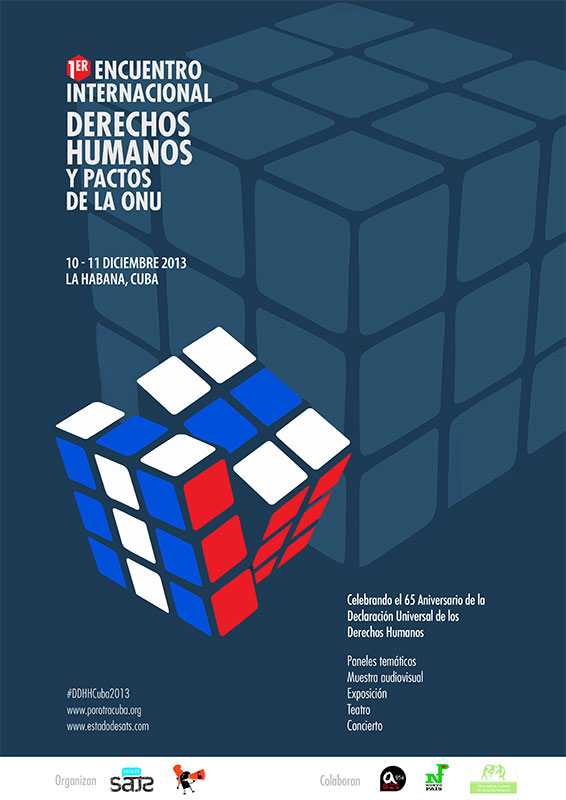
Antonio Rodiles’ house, headquarters of SATS, has been literally under siege since the night of December 9, Human Rights Day, by State Security, which is preventing access to it. As though that were not enough, today they mobilized neighbors and Young Pioneers from neighboring schools to liven things up with shouts, music and political slogans. They have surrounded the property with the goal of intimidating and sowing confusion so that, in the midst of this confusion, they can arrest anyone trying to approach the building.
While many have not been able get there, others have found various ways to circumvent the cordon and attend a function celebrating a day much feared by Cuban authorities. But undoubtedly the most shameful thing about all of this is their having used schoolchildren for political ends, probably without the knowledge of their respective parents, an action with should warrant the attention of UNICEF. I believe that today’s actions have been possibly the worst tribute paid to Human Rights Day or to the late African leader.
11 December 2013

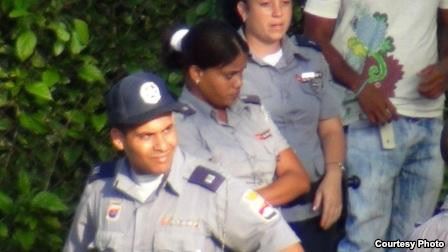
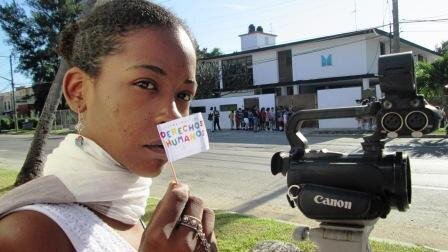
The following video shows the violent arrests of Ladies in White and the scene in front of Estado de SATS, with a short interview of Antonio Rodiles inside the conference.
11 December 2013
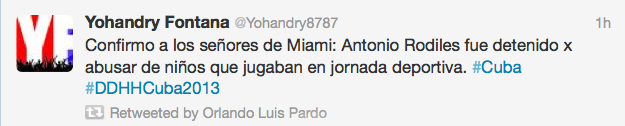
That is: One or more Cuban schools suddenly decided they would hold a “sports day” on a residential street in front of one particular house where there happened to be a conference on human rights underway. Apparently one of the children’s “sports” is make posters denouncing the conference and its participants.
Editor’s note: Translating Cuba does not normally translate (and interpret) the voices of the regime — they can do that for themselves. However, given the events around World Human Rights Day, it seems appropriate to give our readers this real time detail regarding how the regime spins the violent arrest of a peaceful man (helpfully retweeted by Orlando Luis Pardo Lazo).
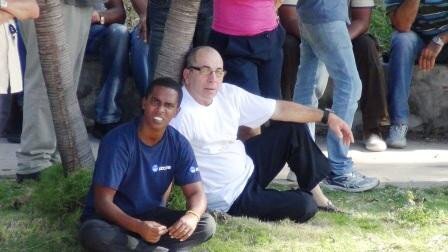
From www.cubanet.org.- Agents of the State Security (the political police) just kidnapped Antonio Rodiles, leader of the independent social-cultural group Estado de SATS, using extreme violence, according to what could be learned from the activist and journalist Camilo Ernesto Olivera. Rodiles stepped a few yards off his property to ask some schoolchildren to stop painting signs on the street against the attendees of the Human Rights Conference being held at house beginning yesterday.
There was an altercation with the police and State Security rapidly stepped in. As Rodiles was being detained his wife and his mother, Ailer Gonzalez and Gladys Fernandez respectively, protested and were surrounded by the government demonstrators, children and adults.
Then began a typical act of repudiation (insults and expletives) like those held in the early 80s against those leaving the country. At the time of this writing the two women remain under siege.
On the closing day of the First International Conference on Human Rights being held in Rodiles’ home, the house remained surrounded and the use of children as political mediators, with songs, music and government banners, continued. Camilo Ernesto Olivera underscored how unfortunate it is that the State gets involved in this situation to block the Conference.
The Washington Post carried an editorial in support of the Rodiles: Antonio Rodiles boldly confronts the Castro regime
11 December 2013
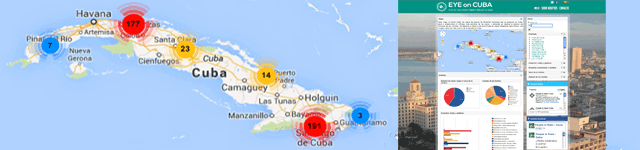
Miami, Florida, December, www.cubanet.org-The organization People in Need, based in The Czech Republic has launched the project EYE ON CUBA, a new interactive map which documents and geographically pinpoints the abuse of Human Rights in Cuba.
Through an intuitive interface the site shows the number of abuses committed in each of the Island’s provinces. Zooming-in geographically by using the zoom in (+zoom) or the zoom out (-zoom) buttons, the map is able to show in detail each particular case of abuse.
The search for information is simplified by the filters located to the right of the map which include categories such as Province, civil and political Rights, economic and social Rights and the victim’s gender and the authors of such crimes. The categories group multiple filters which can be added to one’s search criteria. The site also has a series of graphics which lists statistics and trends for the data entered, making the analysis much easier to comprehend.
From a technical point of view, the map is based on Google Maps’ application programming interface (API.) The information on the website’s data base is combined in real time with Google Maps geographical information in order to created a hybrid web application (mashup) which combines the usefulness of both functions.
The cases of abuse shown in the website are based on the exact documentation recorded for each existing case made by actual activists who work day in and day out on behalf of the protection and defense of Human Rights in the country.
Cuba is a signatory of the Universal Declaration of Human Rights and is a member of the United Nation’s Human Rights Council, but in spite of that, the government violates human rights and they refuse to acknowledge their defense as a legitimate activity, denigrating local Human Rights groups, harassing, beating and detaining in order to punish activists who try to document these abuses.
The project has as a principal objective helping Cubans exercise and demand their rights through the local initiatives which encompass all the Cuban provinces. On top of offering direct ground assistance, the protect helps bring awareness to the international community and bring international attention about the most flagrant cases of abuse.
The map does not reflect all the Human Rights cases of abuse committed in Cuba, but it does give a personal focus about each case and it does help stir public emotion with the victims’ stories.
Cubanet, December 9, 2013
Translated by: Adriana Correa
The greatness of Nelson Mandela clearly shows the deficiencies of the world’s current political class.
If the Fab Four from Liverpool revolutionized music, and the Scottish scientist Alexander Fleming discovered penicillin one morning in 1928, which definitely slowed the deadly pandemics, Madiba leaves as a legacy a master class of how to do politics in difficult times.
The current statesmen should take note. Given the hesitations and weaknesses of Obama (who does not want, does not know how, or is unable to deal with a hostile Congress and is overwhelmed by the worldwide spying of his special services around the globe), the gross mismanagement of Mariano Rajoy in Spain, or a dyed-in-the-wool autocrat like Syria’s Bashar al-Assad, who continues to slaughter his own people, every self-respecting statesman should learn from the political strategies of Nelson Mandela.
Mandela was not perfect. He was labeled a communist and disruptive, and until 2008 the FBI had him on their list of “terrorists.” But he knew how to maneuver in the turbulent waters of a nation where state racism prevailed, in the intrigues of his party, the African National Congress, and to achieve the miracle of national unity in South Africa.
The colossal undertaking began in jail. From a cell in Robben Prison, where for 27 years he was behind bars, until 1994 when Madiba became president, he understood that in conditions of political fragility, his mission was to make sure that everyone saw themselves represented in the first democratic government of their country.
He was a president for all South Africans. Not just for his supporters. He could have taken revenge. He had the majority. He controlled all the levers of power that would have allowed him to polarize society and adopt strategies of retaliation on behalf of justice for his people, where a majority of 27 million blacks were excluded and oppressed for decades by a regime that represented 3 million whites. He did not. He overcame hatred. He learned to forgive.
In his five years in office, Mandela sat chair of his magnificent policy. His ethics, honesty, and transparency were his hallmark. He was a partner of one and all, without ever compromising his political perspective. A man of diplomacy and respect for others.
His great friend in the Americas, Fidel Castro, retired from power, could also learn some lessons in transparency from Mandela’s conduct.
No one can doubt the sincere friendship that joined Castro with Madiba. Months after leaving prison, in July 1991, he visited Cuba. The Battle of Cuito Cuanavale, where Cuban and Angolan troops destroyed several South African columns, was the final blow to the hateful apartheid regime.
But the two statesmen are nothing alike in their methods of achieving national harmony. If Fidel Castro had been like Nelson Mandela, he long ago would have been sitting at the table to negotiate with his political opponents.
First he would have visited with the dissidents. Then with the White House. If Mandela had been Castro, the embargo would be ancient history. That ability of Mandela’s — to adapt to changing times and live with democratic rules — is something the former Cuban president does not have.
The first Castro still thinks like a fossil of the Cold War. The current dissidents should also take note of the attitude and strategies of Mandela.
If Madiba had been leader of the opposition on the island, he would have done more than send messages to the outside world denouncing violations of human rights. After analyzing the internal situation, he would have opted for a bigger and better job of social and political campaigning in neighborhoods and communities.
What could a guy like Mandela not have accomplished, if upon talking to ordinary people he had noticed that 8 out of 10 Cubans are tired of the old government and disgusted with the economic mismanagement of the Castros?
In Cuba we would have needed a Nelson Mandela. His precepts should be written in Gothic letters. And the devalued Criollo politicians, or those who aspire to be, should read them once a week. As if it were a Bible.
Iván García
Video: On June 27, 2008, Nelson Mandela and his wife Graça Machel attended the celebration of the 90th birthday of the man who changed history in South Africa. Fifty thousand people gathered in Hyde Park in London. At the outset, actor Will Smith spoke this phrase by Peter Gabriel: “If the world could have a father, the man who we would choose would be Nelson Mandela.” A highlight was the presence of Amy Winehouse (1983-2011). She sang “Free Nelson Mandela,” by Jerry Dammers, released on March 5, 1984, by the English group The Specials A.K.A., and which circled the world seeking the release of political prisoner 46664. It is one of the most famous songs dedicated to him. The others are: Ordinary Love (U-2), Mandela (Hugh Masekela), Nelson Mandela (Youssou N’Dour), Public Enemy (Prophets of Rage), Mandela (Carlos Santana) ; Freedom Now (Tracey Chapman) and Asimbonanga, by Johnny Clegg, written in English and Zulu. In this video you can see Mandela dancing and waving to the author and to the public in 1999, when he was 81 years old. — Tania Quintero
9 December 2013