From the Cosmos to the Absolute Limit / Juan Juan Almeida

One 29th of January, but in 1942, Arnaldo Tamayo Méndez was born in the city of Guantanamo, Cuba, the first Cuban, and the first Latin American, cosmonaut.

What Cuban doesn’t remember the joint Cuba-USSR flight undertaken in the Soyuz 38 space craft commanded by the Russian Yuri Romanenko on 18 September 1980?

Obviously the man with the fridge isn’t Tamayo, but another Cuban who with sweat and toil is attempting to conquer his cosmos.

Translated by GH

30 January 2014

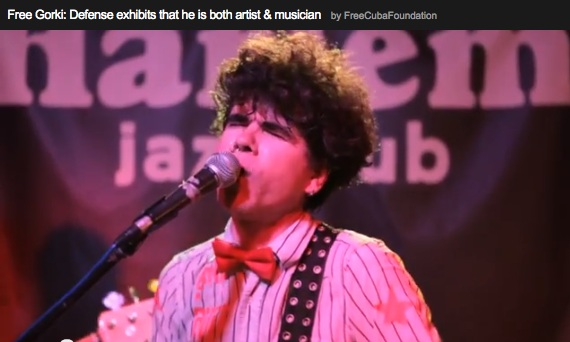
#FreeGorki: Defense exhibits that he is both artist & musician

Free Gorki: Defense exhibits that he is both artist & musician

Click here for the 26 videos

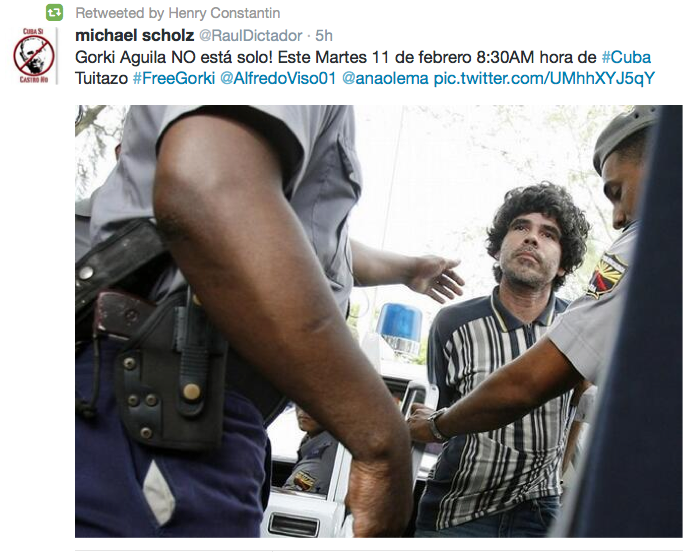
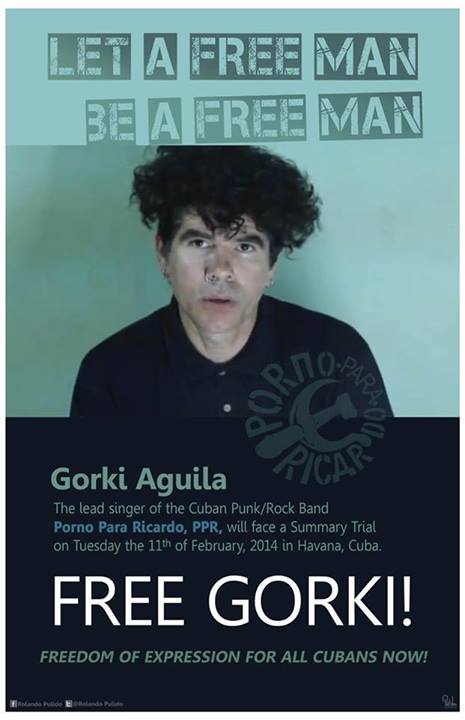
Screen Shot 2014-02-06 at 10.39.24 PMGorki Luis Aguila Carrasco is the lead singer of the Cuban Punk rock band Porno para Ricardo. He has been targeted in the past for his political beliefes and threatened with prison. On September 30, 2013 agents of the Castro regime arrested Gorki and confiscated medication prescribed to him by a Mexican doctor for epilepsy that the Cuban punk rocker has suffered with since childhood. In a Cubanet interview on October 16, 2013 Gorki explained his situation: “I don’t know what they accuse me of, nor do I have a trial date.” That has now changed. On a citation for summary judgement dated January 27, 2014 Gorki is called to attend a summary trial on February 11, 2014 where he will stand as the accused. Under the rules of the game of the Castro regime he is already guilty. It is up to all of us to campaign for his freedom. Follow the hashtag #FreeGorki on twitter. Please sign the Avaaz petition that is circulating. Castro apologists claim that Gorki is not a musician and that is the reason for this playlist to demonstrate that they are lying.

PLEASE SIGN THE PETITION

Raul Castro on a Tight Rope / Miriam Celaya

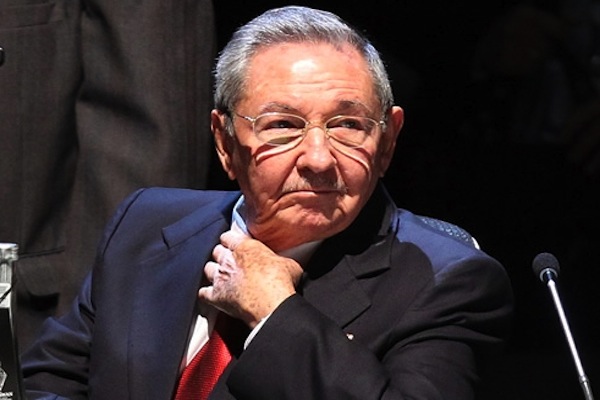
raul-castro-mano-en-el-cuelloRaul Cast has the choice to either deepen the openings or go backwards. In both instances, he will have to face the consequences.

HAVANA, Cuba, January. According to Castro II, the General-President, the seven years he has spent as head of government have been, according to his own express desire, barely a “period of experimentation”, in which he has been forced to relax existing laws in an agonizing effort to “update” — not reform — a model that had demonstrated obsolescence since its inception.

At first glance, it would seem that we are in a continuation phase of the experiment that started in January 1959, and the period between July 2006 and December 2013 is just “more of the same” as some like to repeat. But there are certain details that dramatically change the setting, inconsistent with the intentions of the official plan and the results of the experimentation.

Self-destruction

The fact is that the “Raúl” phase of the experiment surrendered the foundation over which Fidel’s revolution was erected (except, of course, the power of historical and social control mechanisms, such as the monopoly of the press, information and repression), placing us in front of a curious process of self-destruction of the system from which, subsequently, the same class would emerge at the helm, but in a different political system. We would be thus helping an “experiment” called sweeping the last remains of the paradigm of Marxist breath by the same class which imposed it, to reinstate a market economy, paradoxically intended to perpetuate the power of the supposed enemies of capitalism. continue reading

The Cuban revolution, characterized by a series of improvisations and campaigns, did not found an ideology that would sustain it in theory, or an economy that would support it in practice. At present, it appears to be moving towards an incoherent scenario in which the ruling elite, capitalist in practice, though with a socialist discourse, would cohabit with the governed, subsisting under “socialist” conditions in practice, but with capital as their utmost aspiration.

A successor at age 75

Between the two extremes, a “buffer zone” would be made up of a managing breed, dispensable if necessary, though privileged in power with broad economic advantages and committed to it. It would consist of managers of emerging sectors with access to monetary and material benefits – such as travel abroad — and by certain executives who have been creating a gastronomic empire under the guise of “partnerships” since the 1990’s, for example some restaurants in Chinatown and other areas, and by the new, rich proprietors who have been emerging from the elite cultural sector.

Bankrupt Economy

In retrospect, one can say that, for better or worse, Cuban reality has changed more in the last seven years than in the previous 20 by a combination of factors that, nevertheless, do not depend on just the will of the government, and stem from the urgent need for changes due to the structural crisis of the system with a bankrupt economy. These changes somewhat break the monolithic immobility characteristic of totalitarian regimes and create elements that weaken it from within.

This applies, for example, to the official program of layoffs in many industrial State centers, unable to maintain subsidies and the inflation of the plans, in addition to the authorization and extension of the private labor market — euphemistically called “non-State forms of employment”, and more generally” self-employment” — having undergone successive changes from its original constraints, which officials have been forced to adjust, between advances and regressions, due to pressure from the new emerging and independent sector, which consider themselves as workers who contribute to the economy and to the State despite the controversial and abusive taxation system and the numerous restrictions that hinder their prosperity and development.

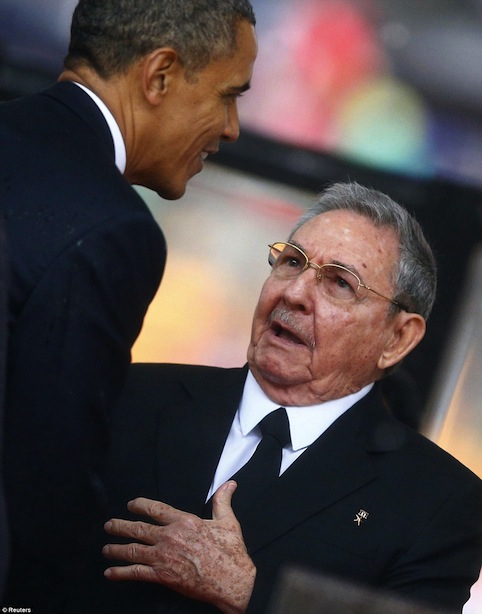
Raul and Obama at Mandela's Funeral
Raul and Obama at Mandela’s Funeral

Despite the slow pace of the program’s “update” and the many reforms that have been implemented, such as the distribution of land in usufruct — a form of leasing — to private farmers and successive concessions; the sale of homes, cars and other properties among individuals; the independent contracting of cellular phone service; the authorization to sell computers; the creation of an internet connection service, though riddled with surveillance checks and excessively expensive; the adoption of non-agricultural cooperatives and, most recently, the emigration reform and car sales by the State at absurdly high prices, among others.

The General-President has not managed to stop the deterioration or to advance the economy. He also has not been able to prevent the nascent exodus towards the provinces, featuring groups of self-employed who have begun to claim their rights spontaneously, and to express their dissatisfaction with the limitations of licenses and the repressive measures that restrict their activities.

In 2013 and already in the initial weeks of 2014 there have been several strikes and demonstrations in the interior, like the bus drivers in Bayamo and Santa Clara in 2013 and the small business owners who have carried out small strikes and demonstrations in several locations in Cuba — also in Santa Clara and Holguín — as well as in some municipalities in the capital, which are just a sample of the power of a private sector driven by interests that go beyond the frameworks of political and ideological commitments that can focus on rights that are eminently civic.

So 2014 could turn out to be an interesting and perhaps decisive scenario from many angles. After coming full circle, we should begin to notice the fruits of the government’s socio-economic strategy and enjoy some benefits, but it appears that the opposite will happen.

The government has the choice to deepen the openings and implement real reforms, or to go backward. In both cases, it will have to face the consequences. The “liberated” sectors that have begun to stir by themselves within a very limited space face the challenge to push and expand the gap. Meanwhile, the shortages within society are growing, there is increased repression, and discontent is growing. Maybe the General-President should consider taking a breather to meditate on the idea that speeding it up a bit would be healthy for all.

Cubanet, February 4th, 2014 | Miriam Celaya |

Translated by Norma Whiting

“Cuba Magazine” Style / Yoani Sanchez


Our apologies, we do not have subtitles for this video. Article 53 of the Cuban Constitution (referenced in the video) reads:

ARTICLE 53. Citizens have freedom of speech and of the press in keeping with the objectives of socialist society. Material conditions for the exercise of that right are provided by the fact that the press, radio, television, cinema, and other mass media are state or social property and can never be private property. This assures their use at exclusive service of the working people and in the interests of society.

Reinaldo speaks little of his time as an official journalist. When he does, it is with a mixture of frustration and relief. The first from his responsibility for the fabrication of so many stereotypes, and the second because by expelling him from the newspaper Juventud Rebelde (Rebel Youth) they turned him into a free man. Cuba International Magazine holds a prominent place in his memories, as he worked there for almost fifteen years.

In our house we have created an entire category of news with the name of this publication. When a provincial correspondent speaks on TV of the marvels of a battery factory — without mentioning how many are actually being produced — we watch, laugh, and say to ourselves: “This is in the worst style of Cuba Magazine.” If there is an article in the press presenting the life of a small provincial town through rose-colored glasses, we connect this, as well, with the editorial approach that has done and is doing so much damage.

Mayerín, unlike Reinaldo, just graduated from the Faculty of Social Communication. Sometimes he calls from a public pay phone to tell me about his latest article on a digital site he collaborates on. “Did you see,” he asks me, “what I managed to slip in in the third line of the second paragraph?” So I go check my reporter friend’s daring and find that instead of writing “our beloved and invincible Commander-in-Chief,” he has simply put “Fidel Castro.” Keep up your daring work!

Several generations of information professionals have had to approach their work through censorship, ideological propaganda and the applause of power. Sugarcoating reality, using national media as a showcase for false achievements and filling newspapers with a doctored and distorted Cuba, these are some of the evils of our national press. If these deformations leave a sour taste the mouths of readers and television viewers, the effect is even worse on the journalists themselves.

The informants end up prostituting their words to stay out of trouble or to earn certain privileges, and the social prestige of the reporter plummets and the press becomes an instrument of political domination. For this informant, who as a child dreamed of uncovering some scandal or investigating an event to its ultimate consequences, all he is left with is folding or breaking down the door, continuing to put make-up on reality, or being declared a “non-journalist” by the government.

6 February 2014

Mariel, Brazil, Havana and Washington / Ivan Garcia

Lula-Castro-Puerto-Mariel-655x337-620x330Miami would like to remain Latin America’s main commercial port. In June 2013 President Barack Obama toured the $1.2 billion renovation and expansion now being carried out at the port of Miami.

Commercial interest is reflected in large-scale investments in the ports of Norfolk, New York, Baltimore, Charleston, Jacksonville and Savannah. According to the American Association of Port Authorities (AAPA), public-private partnerships will invest up to $46 billion in port infrastructure.

With the expansion of the Panama Canal and the introduction of a new generation of container ships know as post-Panamax, which can pass through the canal with almost three times as much cargo, commercial trade in the Americas will experience a profound change.

The numbers dazzle the experts and countries in the region do not want to be left behind. Their primary interest is, of course, the vast market to the north that Canada and the United States represent.

But no less important is being positioned as a leader in the interregional port trade. This has unleashed a veritable “port war,” which has led to multimillion-dollar investments and higher concentration, with fewer ports for maritime traffic. These will have to be both larger and deeper to accommodate ships which will be bigger and can carry more goods.

Experts agree that post-Panamax traffic is likely to be concentrated in trans-shipment ports, as was the case with air transport. With that in mind, the Dominican Republic, Colombia, El Salvador, the Bahamas, Costa Rica, Jamaica and Cuba are investing heavily in improvements and modernizations to their major port facilities. continue reading

The Cuban government has placed special emphasis on developing the port of Mariel, located 45 kilometers west of Havana, due to its excellent natural conditions. The project is backed with 682 million dollars from public and private Brazilian investors.

The first stage could be completed by the end of this month to coincide with the visit of Brazilian president Dilma Rousseff to the CELAC conference, which will take place on January 28 and 29.

Construction is being carried out by the Brazilian firm Odebrecht. Management of the port and its container terminal, which in the future will be able to handle up to three million containers, will be provided by a Singapore-based firm.

Nine-hundred million dollars have been invested in the first phase. And in keeping with the trade demands of the future port, the Cuban regime has designated it a special economic development zone with its own special jurisdiction.

In the area surrounding the port of Mariel, an area of some 465 square kilometers, the government has begun making direct investments to benefit economic sectors such as biotechnology and textiles, among other areas.

The port of Mariel is geographically well-positioned for regional commerce. Under normal conditions, without an embargo by the United States, it would be a formidable competitor to its counterpart in Miami.

But under current circumstances, given the burden of the U.S. trade embargo, it is not unreasonable to ask if such a monumental investment would be beneficial to the Cuban economy.

In the past Fidel Castro came up with irrational economic schemes such as the plans for harvesting ten million tons of sugar, intensive farming or the construction of a nuclear power station in Juraguá, Cienfuegos, 300 kilometers east of Havana, where he wasted billions dollars with no results.

Castro II has abandoned the colossal volunteerism of his brother. With the usual paucity of information, the regime has yet to set forth the operational strategy it plans to deploy after the inauguration of the port of Mariel.

If one thing is clear, it is that as long as there is an embargo, whose rules stipulate a six-month prohibition from entering U.S. ports for ships which have dropped anchor in Cuba, the docks of Mariel will come out the loser, even without ever having engaged in the regional competition of post-Panamax ports.

The largest share of interregional trade is with the United States, Canada and Mexico, which are economic partners. The twenty-eight E.U. countries will think twice before making large investments in Mariel.

China is only an ideological partner of the Castros. In trade and finance it is tied to the United States. With characteristic pragmatism Beijing will keep placing its bets where the  money is.

And the money is in the north or in regions of Latin America such as Brazil, Chile, Colombia, Argentina, Venezuela and Peru. I do not believe many ships flying a Chinese flag and trading with the United States will anchor in Mariel as long as the embargo remains in place.

Carrying a weight like that around one’s neck makes it difficult to attract large amounts of capital from leading companies. Of course, neither Raul Castro, Brazil’s former president, Lula da Silva — whose government authorized the expenditure — nor its current president, Dilma Rousseff, are fools.

A year ago the Brazilian foreign minister, Antonio Patriota, offered some clues when he publicly stated that the decision to invest in the port of Mariel was based on a post-embargo scenario.

The political strategy of Cuba’s autocrats is also moving in that direction. Regime officials are wearing out the soles of their shoes travelling the world in an attempt to attract fresh capital for the Mariel development zone.

And working through the U.S. Interests Section in Washington, they are lobbying to create and business-friendly atmosphere with the powerful clan of Cuban-American entrepreneurs.

Seeking the repeal of the embargo is perhaps the number one priority of the Cuban Foreign Ministry. The timid economic reforms and requests for dialogue with the United States by General Castro are made in hopes of lifting the embargo.

Except a few statements on Cuba by Obama and a handshake with Raul Castro at Nelson Mandela’s funeral, the White House has so far not been seduced by the aging president.

Cuba is not China. It does not have that country’s huge market and a significant portion of its economy depends on remittances from Cubans living on other shores.

Washington continues to demand that Cuba respect human rights and democracy, and hold free elections — something it did not do with China or Vietnam —  but in this regard the island has very little to offer.

The political retirement of Castro II could change the political dynamic between the two countries. But as long as the embargo is in place, a sizable project, such as the port of Mariel, makes little sense. Any real uptick in the Cuban economy — whether in trade, tourism or new technologies — will always be diminished by the negative impact of the embargo.

At this stage of the game, if the military government really wants to undermine the foundation for the embargo and offer its citizens its citizens a prosperous society, it must come up with some clear-cut political changes. Otherwise, we will remain stuck in a time-out.

Photo: President Raul Castro and former Brazilian leader Luiz Inacio Lula da Silva during his visit in January 2013 which marked the start of the expansion to the port of Mariel, which was made possible by a major investment from Brazil. From Infolatam.

Iván García

18 January 2014

Antunez and His Wife Arrested and Disappeared

Iris Tamara Perez, center, and Jorge Luis García (Antúnez), right

CUBANET – The house of opposition leader Jorge Luis García (Antúnez) has just been sacked this morning after State Security foreces (political police) carried off him and his wife, Iris Tamara Perez, as well as the noted activist’s brother Loreto Garcia, and his wife as well Donaida González Paseiro.

The events occurred in the morning in the town of Placetas, in Santa Clara province. According to exclusive reports from the Human Rights Activist on the island, Martha Beatriz Roque Cabello, the house was taken by agents looted, and painted with blue oil point on the outside. In the absence of Antunez and his wife they stole a flat-screen television, fixed line telephone, computers, printer, scanner, suitcases with clothes, shoes, as well as  diplomas Antunez had received on his recent trip to the United States for being an open and constant fighter, documents that were hung on the walls.

After the arrest, according to Roque Cabello, the government’s paramilitary mobs held a rally and an act of repudiation, a common practice of the dictatorship since the ‘80s, the purpose of which is to publicly humiliate people. continue reading

Of those arrested , Antunez ‘s brother, Loreto Garcia, has already been released and it is he who is narrating what happened, according to Roque Cabello.

The whereabouts of Antunez and his wife, at the time of this writing, are still unknown.

Roque Cabello , who knows perfectly the ways of the State Security , believes that looting with impunity will be a standard practice going forward in the life of opponents.

Jorge Luis Garcia (Antúnez) and his wife returned to the island last December 31, after an intense tour of the United States, where they shared an agenda with the opposition in exile.

5 February 2014

Granma Eggs / Juan Juan Almeida

The objective of the Poultry Company of the Cuban province of Granma, for the year 2014, is to increase egg production. It exceeded last year’s in the company’s balance sheet, last January 29th.

Juan Carlos Reyes, sub-director of Combined National Poultry (CAN), highlighted the support and dedication of the local Granma workers and reported that although there are material limitations, the level of resources on some lines will be higher this year which has just begun. Nevertheless this month, January, they didn’t produce more than 700,000 eggs owing to defaults in contracts and deliveries of feed.

The poultry breeders, notwithstanding their difficulties, are seeking increased efficiency, and doing the impossible in order that everyone can have eggs.

Translated by GH

30 January 2014

Gorki Aguila Again Threatened with Prison: Sign the Petition

PLEASE SIGN THE PETITION

Poster by Rolando Pulido

In 2008 international pressure and media attention,”converted” the four-year sentence Gorki was facing for the same “crime” — “pre-criminal dangerousness” — to a $40 fine.

Yoani Sanchez chronicled that victory here. And Claudia Cadelo wrote about how she learned to face her fears through the successful effort to free Gorki, here.

The regime hopes we are looking away this time. The only protection this musician has is your solidarity.

PLEASE SIGN THE PETITION


Hello, my name is Gorki Águila I’m the leader of the band Porno para Ricardo, I’m an artist and I’m a musician. And I’m here to denounce this new crime that the government of the Castros would like to do to me.

I’m an opponent to this unjust regime. Now the new thing that they want to do with me is a summary trial. Something that is a tremendous injustice. I don’t know if you know this but summary trials have always been held in totalitarian governments. They are characterized, among other things, by not giving access to the defense to the case files of the prosecution.

This means that the defense will not be able to prepare itself correctly and that they will be able to do with you whatever they want.

This is why I am appealing to solidarity from all of you so that you will help us once more with this new crime by the Cuban government, before this new injustice, to unite and make this visible in the media.

To denounce it and to use it to support also other persons, who like me, are engaged in resistance to this regime.

I’m very grateful for the support. And I’m an optimistic guy and I believe that we will succeed if we join together before this situation.

PLEASE SIGN THE PETITION

More from Gorki on Translating Cuba is here.

From Paranoia to a Scream (Freeing Gorki “Last Time”) / Claudia Cadelo

segundo_cartel-copy-english.jpgPLEASE SIGN THE PETITION TO FREE GORKI THIS TIME

By Claudia Cadelo De Nevi

On Friday night, after the release of Gorki and when we had already been to his house, he asked Lía if she had been to the beach. Well, it is simply impossible to narrate the last four days in two hours. He didn’t know yet that we had been at the court from eight in the morning, that we had been burned by the sun the whole day and that later two storms had rained on us… and that we were all there – the diplomats, the press and us (I say “us” because some of us didn’t know each other from before, so it was simply us, those who had been there).

I write this note because I want to share my experience in this act of solidarity that artists and non-artists (like me) have had with him and with ourselves, clarifying that I refer to physical artists, painters and writers, because I didn’t see a single musician, not even the most “underground” of the underground.

My friends call me a paranoiac; I am the one who lives in fear, who never opens the windows, who never speaks of politics, I am afraid of the dark, I don’t go out after ten at night, not even to the corner. But nothing had made me as afraid as I was for the last four days starting on Monday (and it still hasn’t left me). continue reading

However, getting to know people like Yoani, seeing her at my side with the banner in her hand, after having talked to her two or three times on the telephone, driven by faith, to see us all today helping Gorki, Ciro, Renay and Herbert, my friends holding the ground with me and rising to overcome our fears and doubts, with friends overseas moving heaven and earth and, finally, managing to convert a sentence of four years into four days… to me it still seems like a miracle.

I feel pity for those who haven’t called me, who have been hiding from me in case I might ask them for help, for those who said “yes” but didn’t come, I regret they haven’t experienced the happiness of the end, the sensation of having achieved the unachievable.

I believe today marks a turning point from “No we can’t” to “Yes we can.” We have shown that things can change, that we can stand up to injustices and the abuse of power and that fear is NOT infallible.

By Claudia Cadelo in Yoani Sanchez’s blog, Generation Y
31 August 2008

PLEASE SIGN THE PETITION TO FREE GORKI THIS TIME

Brief chronology of a victory (Freeing Gorki “Last Time”) / Yoani Sanchez

0,,15388840-GEX,00

PLEASE SIGN THE PETITION

How did it occur to us to go to a concert by Pablo Milanes to ask for the liberation of Gorki? That is something that has the trademark of the spontaneous and the haste of that which can not be postponed or thought better of. Ciro, Claudia and I talked about it among ourselves and immediately decided to do it because to organize or arrange actions too much is the fastest way for “them” to find out about it. None of us stopped to think about the repercussions of what would happen, because only he who has something to lose weighs his actions, with the same care that a housewife handles the tins in the market. continue reading

All photos below by: Claudio Fuentes Madan
emilio-english.jpg
Thursday before the concert.

luis-copy-english.jpg

Thursday, 28th, 7:30 p.m.
A group, among whom were Ciro, Claudia, Hebert, Emilio and me, met at the Coppelia bus stop to leave for the concert at the Tribuna Antiimperialista [Anti-Imperialist Grandstand]. At this time we were already being followed by some nervous boys of the political police and the police operation was impressive. It was still daylight and Pablo Milanés was singing when we arrived at the Protestómetro [Protest station]. We found a varied set of people there, including many military and some from the international press. For nearly forty minutes we were waiting for reinforcements but in the end we decided to take action without counting on those who were lost in the crowd, or who had never arrived, or who once there had changed their minds. The plan was to display two posters with the name of “Gorki” and to shout his name. That was meant to remind the musicians giving the concert that we had hoped for a pronouncement from them about the arrest of the leader of Porno para Ricardo.

Thursday, 8:35 p.m.
We are in the area to the left of the grandstand, as close to the stage as we can get and away from a group carrying thick sticks with their respective Cuban flags. Polito Ibáñez and Pablo Milanés had just finished singing “La soledad” [Solitude] and a brief pause gave us the opportunity for them to hear our shouts. At the count of one, two and three, Claudia and I displayed the fabric which lasted for just seconds in the air. I remember that we cried out, at least three times, the name of Gorki. People dressed in civilian clothes came out of everywhere and snatched the sheet painted with black spray paint. The women who fell on top of us were hefty ladies pulling our hair and shaking us. The men got the worst of it when the supposed “enraged people” doled out professional karate kicks to neutralize them. I remember the fear on the faces of the spectators who did not expect our action, and also the stampede of those who ran, leaving behind their shoes and the piece of the poster that I was able to keep in my hand. Ciro and Emilio were beaten and dragged into the security area at the side of the grandstand. Claudia managed to escape, as did Hebert, and I got away from a hand that grabbed me while calling for reinforcements. At the same time, a woman friend was arrested in the guest area for writing a paper asking Pablo for a few words of condemnation over the arrest of Gorki. We were never able to display the second sheet.
afuera-english.jpg

PLEASE SIGN THE PETITION

Thursday, 8:45 p.m.
The audience close to the incident dispersed and at the corner dozens of policemen began pulling up in trucks. Ciro and Emilio found themselves in the midst of mass of soldiers with batons and well built civilians who hit them repeatedly. Claudia and I met up and decided to leave the grandstand to connect to the internet immediately and relate what happened. The streets of Vedado had never seemed more inhospitable than on this Thursday night, with police stationed on every corner. We thought to ask for help, but at one house where we went they told us clearly that we had to leave. We then decided to separate with a premonition that it might be worse later.

Thursday, after 9:00 p.m., Claudia managed, thanks to the solidarity of some friends with internet access, to send a brief message that was the first chronicle of what happened as told by one of the protagonists. The message was very vague because we did not know then how many had been arrested or what was happening with them. The rest of the night we spent making calls and answering the questions of those who had already heard about it.

Thursday, after midnight, at almost one in the morning, Ciro called to tell me he had been released. During the more than three hours he was at the station at 21st and C, a member of state security wanted to impress on him that he knew everything about him, including that he had played on a football team. He told him that the arrest had been a misunderstanding and that the police intervened only so that the “people” wouldn’t lynch us. He argued that the people in the audience had thought we were going to display a counterrevolutionary poster and because of that we had been surrounded. Strange people that on the one hand can’t distinguish between a short name and a slogan, but are expert in the martial arts.

During the early morning we made telephone calls to other friends and musicians telling them to arrive early at the Popular Municipal Court at Playa. I believe that no one could sleep in the hours between the release of Ciro and Emilio and arriving at the corner of 94th and 7th Ave. The blows hurt more away from the heat of the action, but the fear subsided.

Friday 8:20 a.m.
A dozen friends were already stationed at the door of the court by the time I could sneak into the area that, since early in the morning, was surrounded by an intense operation. It seemed as if those who were there were dangerous armed terrorists, because nothing else could justify so many members of the Apparatus [State Security] on every side. I could see one of those who followed us the night before and realized that Operation Gorki was of the greatest importance for them as well. Looking at these nervous members of State Security, I always ask myself if we couldn’t include in their curriculum a course on managing better camouflage. It’s that they all resemble one another, with their perfect crew cuts, their wide shoulders, and their checked shirts or striped pullovers. Has no one told them that from every pore they look like soldiers in civilian clothes? In the academy, aren’t they warned that their grim looks, such serious faces and their total lack of swing, reveals their covert work? Please, can someone give them training to appear as simple, ordinary people.

Friday from 9: 00 a.m. until 6:00 p.m.
The foreign reporters were everywhere, and also some diplomats and a group of friends came by the score. I regretted the absence of the Cuban artistic community, especially the musicians who should have been there to support their colleague. However, I was not surprised that no rapper, troubadour or reggaeton artist appeared outside of the court. Many were not informed, and others weighed the loss of small privileges as too high a price to pay for a punk singer who had been previously convicted. Some friends who tried to reach the site were stopped by the police siege. The presence of the artist Sandra Cevallos, who has already repeatedly faced the hairy arm of censorship, stood out. Some of the faces I found there were the same as those from the outskirts of Casa de las Américas [House of the Americas] on January 30th, the day of the debate of the intellectuals. It appears that there are some people accustomed to protesting in front of all the doors.

The lawyer, a very young man, had been hired just two days earlier, after the repeated refusal of several lawyers to take over the case. The crime was the previously announced pre-criminal dangerousness and they blamed all the delay in starting the trial on the fact that the file had not arrived. Gorki’s father, a man of 75, appeared very nervous and the police guarding the court would respond to questions only from him. Several young defendants charged with the same offense were tried while we waited. I remember a thin mixed-race man who left in handcuffs and on seeing the cameras and microphones hit upon this to say, “As far as is known, we condemn people for taste.” I do not know whether the foreign press was able to film his words, but I want to record them here because I expect that by his gesture of courage he will have won retaliation.

Under a pine tree on the sidewalk in front of the Court was the group of friends. Emilio showed his blows and his teeth that had been loosened the previous night, while my mobile phone did not stop ringing with calls from all over the world. Ciro responded to journalists and a national television camera filmed everything we did. A very young girl, who was there without her parents’ knowledge, told me worriedly, “If we are on the Roundtable television show this afternoon, I don’t know how I’m going to explain it to my mom.” I thought of my son, waiting at home, away from the blows, the police, the injustice, confident that his mom would return and Friday would be another normal day. Remembering Gorki, his father, his daughter Gabriela, who at some point would be informed, I sat tight in the street and shook off the fatigue, the sadness and the fear, that never completely dissipates.

Despite being surrounded by the “compañeros of the checked shirts,” the presence of the international press protected us. How times have changed, I told myself, seeing the care taken by the police not to charge us, in front of the cameras. Even so, to see the foreign correspondents confirmed that I’m not made of the right stuff to be a journalist. I cannot stay behind the lens without getting involved. This work of entomology that consists of observing and reporting, but not intervening, is definitely not made for me. Being a blogger I can also be a part of what’s happening, so I am stuck with this role.

Deferring the start of the trial appeared to be a maneuver to test the stamina of those of us waiting outside the court. Planned for nine o’clock in the morning, the trail actually began around 6:30 in the evening. In this time some had left, others joined us, and a couple friends looked for something to eat. The informal market also benefited from our wait, because a lady managed to sell to us, despite the police fence, popcorn, cookies and potato chips. We had our rain shower at four in the afternoon and when the sun began to set we looked like we had spent the entire day at the beach. The point of no return had happened at noon and after that hour no one moved from there.

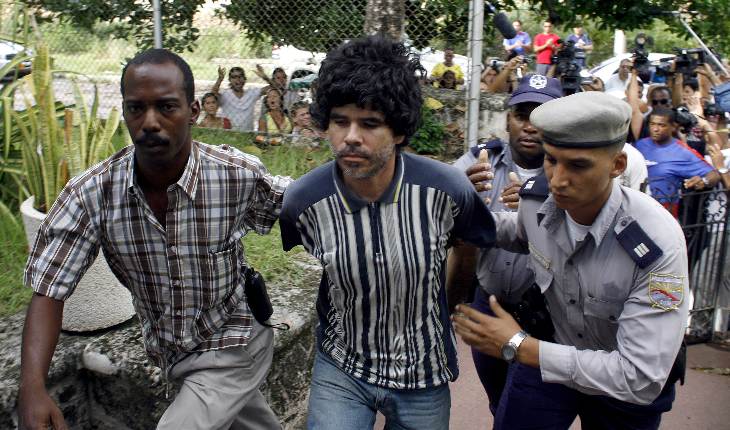
When the time approached for the arrival of Gorki, the men stationed at the corners began to close the fence. Maybe they thought we were going to attempt a daring rescue or something like that, but in reality we had reached an agreement to applaud and shout the name of the accused when he appeared. The police cars parked and security rushed to close a circle around him. Still, the foreign press was able to capture his face with a four-day beard, the handcuffs, and the shout of “Gorki” that resounded on the corner. The tension was palpable on every face but, without bragging, “they” were more nervous.

6:00 p.m.
The trial: I managed to enter the courtroom, next to Ciro, Claudia, Emilio, Diego Ismael and his girlfriend, Elizardo Sanchez and his wife Barbara, Francisco Chaviano, Gorki’s father Luis, Alexander the photographer, Javier, Claudio, Rene Esteban, and others whose names I don’t know and a pair from security who were stationed in a corner. The hall was nearly full when we entered because they had also summoned the relatives of a young man who would be tried later. The judge, a young woman, called for calm and presented the case. We learned at that time that the offence had been changed to “disobedience.” Gorki did not know if the punishment for that crime was more or less, but it mattered little: the circus had begun.

Under the gaze of a bust of Marti and with the national shield present, the first witness for the prosecutor appeared, the Head of Sector for the zone where Gorki lives. A brown man, with an accent from the eastern part of the country, he appeared very confused in front of all the press and the surprising support for Gorki he could see in the room. The police argued that the practices of the group bothered the neighbors and that they had already worked “preventatively” with the accused. The next witness was the former head of sector, who confirmed the testimony of the previous witness and emphasized that the rocker was a recidivist. Finally, they called a lady named Heidi to testify. A face marked by bitterness came into the room and identified herself as the President of the zone of the CDRs [Committees for the Defense of the Revolution] and a member of the Preventative Commission formed by the leaders of the block. When they asked her about Gorki’s social behavior, she warned that he “did not participate in the activities of the CDR, did not guard and did not vote… his social conduct can be summarized as making noise with his music and bothering the neighbors.”

The young defense lawyer stuttered before the “hot potato” in his hands, but managed to submit a letter from Gorki’s workplace confirming his employment. The prosecutor then asked for a monetary penalty for the accused and everyone breathed a sigh of relief. Six hundred Cuban pesos was the fine set; anyone would pay any amount, with their eyes closed, to not have to be in prison even one hour. The trial had ended and we felt all the exhaustion of the two days come over us.

The police “kindly” took Gorki in the patrol car to collect his personal belongings and then took him home. Outside we felt like jumping up and down and shouting his name. We left there in a group because we knew that if we separated “the boys of the batons” might dare to go after us. Fifth Avenue was the scene of joy, pats on the shoulder, contained laughter, and retelling of everything that had happened. We arrived at Gorki’s house and he had already shaved his grey beard. A bottle of rum left a backpack and fatigue mattered little, nerves were calmed, and the rocker’s father asked if we wanted to “kill his son.”

We had succeeded, Gorki was with us thanks to all those who were mobilized outside and inside. To those who signed the letter demanding his freedom, to the reporters who spread the word of his incarceration, to the sign ripped in seconds but recorded for years, in summary, thanks to the strength and the cry of thousands of citizens, organized spontaneously and confronting a machinery that is not accustomed to give ground. The boiling oil of the authoritarian, secretive and ideological judicial system was left with the desire to fry Gorki. We proved that if we engage in such actions more often, others could also walk free on our streets.

PLEASE SIGN THE PETITION

Yoani Sanchez from her blog Generation Y
31 August 2008