The Cuban Government Admits That Solar Parks Will Not Solve the Energy Crisis

Domestic oil production fell to 40,000 barrels per day in 2024 and only covers a third of consumption.


According to the Minister of Energy and Mines, within the Government there was skepticism about building the solar parks / Xinhua / Joaquín Hernández

14ymedio bigger14ymedio, Madrid, 24 March 2025 — As if he were acting in a suspense series, Cuba’s Minister of Energy and Mines, Vicente de la O Levy, is gradually revealing information in an interview with the official newspaper Granma, which published chapter 1 this Monday. Tomorrow, Tuesday, we will know in more detail if the new Chinese solar parks will provide electricity only during the day, as they do not yet have the “batteries that accumulate the charge for when there is no sun.”

However, the minister has already gutted much of the script by recognizing that photovoltaic energy and renewables in general will not solve the deep crisis of the national electricity system (SEN).

The authorities said a few weeks ago that four facilities with a capacity of 200 megawatts (MW) are expected, but De la O Levy specifies in the interview that they haven’t yet put in the batteries . “Let’s say there is the whole container, with the entire automatic part, the electronics and other components. Only at the end does the battery go in,” he clarified. The quick explanation given by the minister is that they will not be unloaded for a while, and their placement is simple – “like drawers” – so progress has to be made first on the construction.

The authorities stated a few weeks ago that four facilities with a capacity of 200 megawatts (MW) are planned, but De la O Levy specifies in the interview that they still don’t have the batteries installed

However, the official added that the mere fact that the parks generate only during the day already reduces the bulky fuel bill. “When we have 1,000 MW of renewable energy, we will be saving fuel, which is fuel that we can rely on for generation at night,” he says.

The interview focuses, in large part, on fossil energy. De la O Levy made it clear that the import of oil is a bottomless pit for state accounts. “The oil bill is the largest in Cuba – more than food, more than medicine, more than anything. And of the imported fuel needed to sustain the entire economy, electricity generation is the largest consumer: more than half of all the fuel used by the country goes to generating electricity. Agriculture, the pumping continue reading

of water, the sugar harvest, transportation, the entire chain of the domestic economy: everything consumes less fuel than the generation of electricity,” he claims.

In these circumstances, the minister explains, national oil production, which is essential for thermoelectric plants, cannot be allowed to fall. Its decline is due, he says, to the same reason as the failure of the power plants. “Deterioration, lack of resources, spare parts. Oil production is not drilling a well and that’s it, it starts to come out. No.” De la O Levy says that the country did not have the supplies to keep many wells active, and they had to be closed. In addition, he said, there are few pipelines to move the crude oil. It has to be moved by road, which returns us to the starting point: there is no fuel.

The official explains that an analysis certified that “not even national crude oil would be enough for the thermoelectric plants. Moreover, even if we had all the thermoelectric plants available it would not be enough,” he says. As the Communist Party newspaper points out, production dropped to 40,000 barrels per day (bpd) in 2024, which “only covers a third of consumption.” By way of comparison, it can be remembered that in 2008, Cupet extracted 68,493 bpd – 71% more – according to the National Bureau of Statistics and Information (Onei).

The minister gives a detailed explanation about the Cuban thermoelectric plants, designed to operate with “excellent quality fuel” from the USSR. “When the Soviet Union disappeared, we stopped having, overnight, all the fuel, which reached 12 million tons [a year],” he says. This forced the thermoelectric plants to be adapted to the national crude oil, which is highly corrosive.

“When the Soviet Union disappeared, we stopped having, overnight, all the fuel, which reached 12 million tons [a year]”

“The life of thermoelectric generation units was shortened, the period between maintenance, because Cuban crude oil has very high levels of sulfur and vanadium, which, when burned in the boilers and there is humidity, generate sulfuric acid, which accelerates corrosion. This is combined with the deterioration due to old age, due to the years of operation of the thermoelectric plants,” he details. And he gives a concrete example: “If a bearing lasts 60,000 hours and at 60,000 hours you don’t replace it, it will break, which triggers a progressive deterioration of the system.”

De la O Levy confirms that there has been a very significant drop in investment for energy generation: from more than 1 billion dollars and up to 2 billion at the time of the Energy Revolution in 2005, to the 250 or 350 billion that would be needed now “if the electrical system were working well.” But, he recognizes, there have been years in which it has not been possible to invest that money. “It has not been possible, because the country has not had enough income, due to the limitations we know. So, if oil production is decreasing, if we do not have the finances to import the millions of tons that the economy needs, the first thing [we must do] is to stop that decrease, while reducing fuel consumption and expanding generation capacity.

That is when the conclusion is reached, the minister explains, that photovoltaics has all the elements to recover a good share of the energy system as quickly as possible, despite the skepticism of the authorities. “There were colleagues who warned that it would be a very difficult process to invest in this situation when there is no cement, steel and many other resources,” he says.

To save this situation, moderate parks (21 MW) have been chosen in different provinces. The latter makes the investment territorial, which is the first thing that helps since, if there is no sun in one park, there may in another. “The average distance designed between parks is just eight kilometers. There may be shade in the area of one park, and in the other, eight kilometers away, there might not be the same shade. It is a distribution design that also helps the regulation of voltage, from the National Electric Charge Office,* and through a system that is also being used with the installation.”

At this point the journalist asks for an explanation about the accumulation of energy, and it is revealed that the containers have arrived but the batteries have not yet been installed. “It will be necessary to detail this explanation later,” the editor intervenes, notifying the readers that they will have to wait for the next installment of the interview.

De la O Levy also insists that it is impossible to make a direct calculation and think that if the country has 1,500 MW of deficit, with 1,000 MW from the photovoltaics there will still be a third unresolved. The forecast is for the peak schedule. On the other hand, the effect will be varied. It will depend on whether the imported fuel has arrived for distributed generation, the condition of the thermoelectric plants, the climate and the generation of the [solar] parks.

To date, there are three synchronized and functional solar parks: School of Nursing (Havana), Mayor (Cienfuegos) and La Sabana (Granma).

In addition, the minister also indicates that the wells are producing 6% of the proven national reserves, and it is necessary to investigate to take advantage of at least 10% or more. “Areas have been identified in which there are oil fields: Boca de Jaruco, between Fraile and Jibacoa; the area of La Habana del Este and Alamar; and south of the deposits of Puerto Escondido and Canasí. This year an exploratory campaign is planned that will allow the incorporation of between three and five wells.” The minister did not consider it necessary to explain how the closure of production wells is compatible with the decision to open new ones.

* The National Electric Charge Office is subordinate to the Electric Union of Cuba, which operates the National Electro-Energy System.

Translated by Regina Anavy

____________

COLLABORATE WITH OUR WORK: The 14ymedio team is committed to practicing serious journalism that reflects Cuba’s reality in all its depth. Thank you for joining us on this long journey. We invite you to continue supporting us by becoming a member of 14ymedio now. Together we can continue transforming journalism in Cuba.

Shutting Down Radio Martí is the Cuban Regime’s Fondest Desire

Ceasing the broadcasts of these entities results in a great lack of information among those fighting against dictatorships.

Educating about freedoms and citizen prerogatives is a function that Radio Martí completely fulfilled / Radio Martí

14ymedio bigger14ymedio, Pedro Corzo, Miami, 23 March 2025 — This is not the first time I have written about Radio Martí, an entity that for many Cubans is an informational battering ram against the systematic and permanent lies of the Cuban dictatorship and its associates in Venezuela, Nicaragua and Bolivia. The Voice of America (VOA) and other similar agencies of the United States federal government have also done so for decades.

Transmissions are an expensive service that must be re-evaluated in its management without being eliminated. In any government entity, regardless of the country, mistakes are made and it is likely that acts of corruption are not lacking. However, the solution is never to throw out the sofa*, but rather the subjects who have carried out a bad administration, might be sanctioned judicially if the crime requires it.

Without a doubt, denouncing autocracies is an essential mandate of democracies. Educating in aspects such as citizen freedoms and prerogatives is an obligation for all of us who enjoy the freedoms and rights that make this great nation an example. Radio Martí, despite its inefficiencies, completely fulfilled this function for Cuba.

It is true that its transmissions have not overthrown Castro’s totalitarianism, nor has the VOA destroyed the regimes of Venezuela, Bolivia and Nicaragua. However, by duly fulfilling its mission of providing true and balanced news, it cooperates with those who actively, and in different ways, fight the autocrats.

For more than six decades the Castro dictatorship has proven to be the most dangerous and consistent enemy of the United States in the Western Hemisphere

Ceasing the transmissions of these entities generates a great informational helplessness among those who fight against dictatorships. It must be borne in mind that if “knowledge is power,” ignorance on the part of opponents of continue reading

what is happening in Cuba and in the world leads them to absolute defenselessness.

For more than six decades, the Castro dictatorship has proven to be the most dangerous and consistent enemy of the United States in the Western Hemisphere, promoting throughout Latin America proposals contrary to American democracy.

Its weapons have been propaganda and terrorism, and it is the transmissions of these federal stations that neutralize the string of lies and deceptions that the Castro-chavista regimes manufacture against their people.

Cuban totalitarianism has used its vote in international organizations to favor resolutions against the United States, benefiting the enemies of Washington – Russia, China, Iran and North Korea – for at least fifty years.

According to numerous complaints, military and espionage bases of some adversaries of the United States have been installed in Cuba, consistently undermining US national security.

The regime has infiltrated the U.S. with its spies and has captured lackeys in universities and government agencies with the aim of obtaining information, while showing itself as an innocent victim of all kinds of aggression by the White House against its own people. Radio Martí has destroyed those lies for almost 40 years, thanks to a programming that, without being perfect, has always told the truth.

Radio Martí has destroyed those lies for almost 40 years, thanks to a programming that, without being perfect, has always told the truth

I joined Radio Martí in 1998, under the administration of Roberto Rodríguez Tejera, a man who, to my knowledge, completely fulfilled the mandates of his position.

I can assure you that during these 23 years I did not agree with many of the things that happened and even less with some of the executives of the Office of Transmissions to Cuba (OCB). However, I consider that “the Mission,” as the late Cristina Sansón said, is the most important thing, which is why I do not understand those who attack the station with the intention of destroying it. It is true that it had flaws, we all know that, but Cubans on the Island need it to continue to fulfill its functions.

I dare say that, despite its deficiencies and probable improper handling, the OCB has fulfilled its objectives of bringing the truth to Cuba and making many citizens on the Island oppose totalitarianism, because they have known the truth through the radio waves of Radio Martí. Opposition leaders, such as José Daniel Ferrer and Félix Navarro, and independent journalist Reinaldo Escobar also request that it not disappear.

*Translator’s note: A common Cuban expression that comes from the following joke: [Briefly]…A man comes home to find his wife and her lover having sex on the sofa. Enraged, he throws the sofa out the window.

Translated by Regina Anavy

____________

COLLABORATE WITH OUR WORK: The 14ymedio team is committed to practicing serious journalism that reflects Cuba’s reality in all its depth. Thank you for joining us on this long journey. We invite you to continue supporting us by becoming a member of 14ymedio now. Together we can continue transforming journalism in Cuba.

Nostalgia for Radio Martí in Cuba, the Soundtrack of the Longing for Freedom of Information for Decades

  • “It’s where I first heard the real truth,” Tomás recalls
  • Numerous voices inside and outside the Island speak out against Trump’s decision to paralyze the station
Radio Martí was for at least a decade the only alternative source of news in a country where the Communist Party had a strict monopoly on information / Al Jazeera

14ymedio bigger14ymedio, Olea Gallardo, Havana, 17 March 2025 — During the Rafter Crisis unleashed in Cuba between August and September 1994, after the so-called Maleconazo, thousands of inhabitants of the Island tuned in to Radio Martí for one main reason: every day, the names of those rescued at sea were read there. It was, for many, the only way to know if their relatives were alive.

Years earlier, the station widely covered Case number 1 of 1989, when Arnaldo Ochoa and other high-ranking soldiers were executed, accused of drug trafficking and high treason. “If it had not been for Radio Martí, very little or nothing would have been known about the true involvement of the Castro regime in drug trafficking, ivory trafficking in Africa and other excesses,” says María, a resident of El Vedado in Havana. Like so many compatriots, she is dumbfounded that the current US president, Donald Trump, has suspended, by an executive order that includes other federal projects, the operations of the media, which this Monday is no longer broadcasting live.

Radio Martí – later called Radio and Television Martí when it had its own channel – was for at least a decade, since its inauguration on May 20, 1985, the only alternative source of news in a country where the Communist Party had a strict monopoly on information, until independent media appeared in the late 90s. As a part of Radio Broadcasting to Cuba, created in 1981 by then-President Ronald Reagan at the behest of anti-Castro leader Jorge Mas Canosa, it transmitted by short wave, and its signal could be heard in several Caribbean countries.

“Very few on the Island dared to give statements directly to Radio Martí, and those who did were repressed”

“At that time there were very few on the Island who dared to give statements directly to Radio Martí, and those who did were automatically stigmatized and repressed,” recalls María, who remembers the maneuvers that had to be done in the houses to tune in. “You had to have a certain type of radio and put it in a certain place. My father discovered that if he lay down on the bathroom floor and put it on the tiles, he picked up the station better, so the bathroom became a very busy place.”

Aware of the power of providing information other than the official one, the regime immediately jammed the signal with an annoying interference. “It continue reading

could barely be heard and had a noise, brbrbrbr,” imitates Tomás, a resident of Centro Habana, who claims to be a listener of the station since he was a teenager. “The neighbor next door put it on and taught me how to look for it on the radio and I put it on too.” At that time, says the man, there was no other universe than the one presented on national television. “We were completely oblivious. Here we thought that the world was a disaster and that Cuba was paradise.”

In its programs at that time, you could learn about the consequences of hurricanes crossing the Island – something that official propaganda always tried to minimize – or officials who had deserted on a trip abroad, or even international sanctions against the Havana regime. Tomás concludes: “Where I first heard the real truth was on Radio Martí.”

It also served, for example, to know what number came up in the “bolita,” the illegal lottery that is played on Cuban streets

The musical theme at the beginning of the broadcasts was repeated several times during the day and in some way became the soundtrack of our desire for freedom of information. “When you heard that cadence coming from a home in some tenement, you knew that the family was listening to the forbidden station,” María continues.

When I was little and heard it for the first time, it was in the middle of the Special Period,” says Josiel, an immigrant in Florida. “I soon sensed that it was something forbidden because in the neighborhood many spoke quietly when they mentioned this station.” Josiel says that he was not very aware of what was happening, but he associates Radio Martí with some neighbors who “made rafts with truck bodies” and reached the Guantánamo Naval Base.

As an adult, the young man continues, he visited the house of an uncle in Santiago de Cuba, who was very critical of the regime and a “faithful listener of Las Noticias Como Son (The News as it is).” In a similar way, María believes that the political transformation of her father, who ended up denying the Communist Party of which he had been a member, “was partly due to Radio Martí, which he greatly admired.”

There were consequences to getting involved in some way with the station. In the repression of the Black Spring, the mere possession of a shortwave radio to capture the signal or having ever spoken through microphones, via phone call, were considered incriminating evidence against the activists and independent journalists who were tried in those days of 2003.

“It can be reactivated with fewer staff, but nothing guarantees us employment”

The medium did not always have such a serious task. It also served, for example, to know what number came up in the “bolita,” the illegal lottery that is played on Cuban streets. “There were people on my block who only tuned in for that,” explains Gabriel, now a resident of Miami. His first memory of Radio Martí was not as a listener of the station but as a student, at the beginning of what was called the “Battle of Ideas“: “The first thing I heard were attacks made by teachers against that medium, which they called an enemy. In the classrooms we were constantly bombarded with rants against everything related to the Cubans in Miami.”

This 35-year-old father, a Trump supporter, does not believe that the closure of Radio Martí will be definitive. In this regard, he mentions the president’s own order, issued as “temporary,” and the promise of Cuban-American Republican congressmen Carlos Giménez, María Elvira Salazar and Mario Díaz-Balart to “work” to guarantee the continuity of broadcasting.

“Radio Martí has been key to counter the propaganda of the Castro/Díaz-Canel regime. While the programs and agencies of the federal government are restructured, I will continue to work with President Trump to ensure that the Cuban people have access to the uncensored news they need and deserve,” Salazar wrote on his social networks.

Martí Radio Television workers who a few days ago maintained optimism, this Monday were more hopeless. “It can be reactivated with fewer staff, but nothing guarantees employment,” one of them told 14ymedio on condition of anonymity.

“The freedom and democratization of Cuba is not only of interest and benefit to Cubans but also to the United States”

For the time being, numerous voices inside and outside the Island have spoken out against the presidential decision. On Monday, the Assembly of the Cuban Resistance urged Trump on Monday to help, instead of ending Radio and Television Martí. “The preservation and strengthening of this means of communication is indispensable for the Cuban people,” the Miami-based coalition, composed of 53 groups, stressed in a statement. It also reiterated: “The freedom and democratization of Cuba is not only of interest and benefit to Cubans but also to the United States.” It recalled that the Havana regime “has installed on its territory military and espionage bases of the adversarial regimes of the United States and has consistently undermined US national security.”

For its part, the Council for the Democratic Transition in Cuba, based in Madrid, expressed its “deep concern about the order to dismantle the United States Agency for Global Media (USAGM), which includes the temporary suspension of funding for Radio and Television Martí. ” This “has already brought negative consequences, such as the receipt of dismissal letters by workers, who are in a situation of uncertainty.”

In a statement made public on Monday, the organization emphasizes that these media “have played an essential role in offering truthful information to the Cuban population, breaking the regime’s information monopoly and acting as a necessary counterweight to state propaganda.” In addition, it points out that they have also been “key elements to promote independent journalism, peaceful resistance against repression and censorship of the Cuban regime.”

And they warn: “The disappearance of Radio and Television Martí would represent a significant setback, benefiting exclusively the Cuban regime in its propaganda discourse both inside and outside the Island. In addition, it would strengthen the propaganda and misinformation of other authoritarian regimes that already have a presence in Cuba and in the rest of the world, such as the Russian media, Russia Today (RT), CGTN of China, HispanTV of Iran and Telesur of Venezuela, which would also affect the democratic interests of the United States and the West in general.”

José Daniel Ferrer, leader of the Patriotic Union of Cuba (UNPACU), spoke along the same line. In repeated posts on his social networks, he highlighted that Radio and Television Martí is “a necessary and inseparable symbol of the cause in favor of freedom and democracy in Cuba.” He understands “any necessary restructuring” so that “these platforms constantly improve and are more effective and of greater scope,” but affirms that “they must not cease to exist.”

“Its total absence would greatly benefit the discourse and propaganda of the Cuban communist regime and the anti-democratic media increasingly present on our continent”

“Its total absence would greatly benefit the discourse and propaganda of the Cuban communist regime and the anti-democratic media increasingly present on our continent,” insisted the historical opponent. He asks that the president of the United States allow Radio and Television Martí “to continue to give voice to our people, oppressed and silenced by a brutal and tyrannical enemy of the United States and the entire West.”

Miriam Leiva also lashed out against the measure. In a post published on Facebook, the independent journalist recalled her collaboration, over more than 20 years, with Las Noticias Como Son, the program presented by José Luis Ramos, Amado Gil and her husband, Oscar Espinosa Chepe, which cost him the regime’s reprisal. “In his trial as part of the 75 of the Black Spring of 2003, the prosecutor used his participation in that program. Chepe replied that if they didn’t want him to do it, ’give me space on national radio’. The response to him was harsh and offensive.”

In the same publication, Leiva recalled, in capital letters, that Radio and Television Martí never paid them (something, by the way, that other collaborators expose as a criticism and that has been a frequent source of discomfort among reporters living in Cuba, who did not even benefit from phone recharges by the station). Not in vain, the journalist relates how the regime has recently congratulated itself on the cancellation of the programs that help independent media and human rights activists. Leiva concludes: “With this dismantling, the Cuban government has won.”

Translated by Regina Anavy

____________

COLLABORATE WITH OUR WORK: The 14ymedio team is committed to practicing serious journalism that reflects Cuba’s reality in all its depth. Thank you for joining us on this long journey. We invite you to continue supporting us by becoming a member of 14ymedio now. Together we can continue transforming journalism in Cuba.

“We’ll See if We See Each Other Again,” the Last Message Her Daughter Sent Her Before She Disappeared in Mexico

Relatives reported the disappearance of Meiling Álvarez Bravarez and Samei Armando Reyes Álvarez from 21 December. / Margarita Bravo

14ymedio bigger14ymedio, Ángel Salinas, Mexico city, 12 March 2025 — Margarita Bravo has not heard from her daughter, Meiling Álvarez Bravo, 40, and her grandson, Samei Armando Reyes Álvarez, 14, for 81 days, and the Cuban consulate in Mexico, to which she appealed, asked her to “stay strong.” The two of them, along with four other Cubans, Dairanis Tan Ramos and Elianis, Jorge and Lorena, who were in Tapachula, Chiapas, have been missing since 21 December.

“Breakfast is here, we might leave now, mami. Kisses, I’ll write to you later.” This was the last audio message Bravo received from her daughter that day. Months of uncertainty and worry have followed since then. This Havana native tells 14ymedio that her daughter and grandson left in search of a better future, but their journey has turned into a nightmare.

The woman says that the last point of reference for her family members was a house near Parque Hidalgo, in Tapachula. From this place they were to be picked up by a coyote identified by the alias Chapín. “The man was paid 2,000 dollars” to take them by boat to Juchitán, in the state of Oaxaca, so that they could avoid the checkpoints of the National Migration Institute (INM).

When she did not hear from Meiling and Samei, who usually provide travel updates, Margarita dialled their cellphones, but got no answer to the calls or messages. “I don’t know what’s happening, the messages aren’t being received.” continue reading

An acquaintance, she continues, filed a report with the Chiapas State Attorney General’s Office about the disappearance of Meiling and Samei. She also “presented herself at the Siglo XXI and Huixtla migration stations, but there is no record of them there.” She also contacted the Cuban Consulate in Mexico to present the case.

Dairanis Tan Ramos is among six Cubans who disappeared in Chiapas last December / Facebook/Dairanis Tan Ramos

From Nebraska (USA), another daughter, Mayelin, contacted the coyote, but he told her that he knew nothing about the Cubans, that “the National Guard probably had them.” When asked about their whereabouts, he changed his story and said that “they were probably arrested by immigration agents.”

This Chapín even suggested that they could have been victims of kidnapping by the criminal cells operating in the region. When questioned about the money he was paid for the transfer, he stated that the Cubans had left with another coyote. “I don’t have anything to do with them any more,” he said.

“We don’t know if it’s true or not, because he was the one who was paid,” says Margarita.

Meiling and Samei entered Mexico through the southern border on 18 December. They had started their journey on the 12th of the month, when they left the island on a flight to Nicaragua. According to Margarita Bravo, a couple of Guatemalan coyotes identified as Marilyn and Rafael took them to the Guatemalan border.

Among the missing is also Dairanis Tan Ramos. The migrant, from Camagüey, according to a cousin’s report on Facebook, has had no contact with her family since 18 December.

In addition to these disappearances, there has been a wave of kidnappings of Cubans in Tapachula. A man ordered “Take the Cubans away,” on his radio, to his armed accomplices, according to a witness. Since November, there has been no news of Reynaldo Leyva Izquierdo, 54, Dalviris Domínguez (47), Leonel Gutiérrez (28) and Jorge Luis Gutiérrez López (58), who didn’t make it to the USA .

In the same month, Cuban nationals Leydi de la Caridad Rodríguez Acosta and Ana Mercedes Capetillo Savón were also kidnapped and murdered. Their dismembered bodies were left in a waste tank between the Chiapas communities of Pumpuapa and Nueva Granada.

Translated by GH

____________

COLLABORATE WITH OUR WORK: The 14ymedio team is committed to practicing serious journalism that reflects Cuba’s reality in all its depth. Thank you for joining us on this long journey. We invite you to continue supporting us by becoming a member of 14ymedio now. Together we can continue transforming journalism in Cuba.

Sherritt’s Two Power Plants in Cuba Were Key to Solving the Blackout

The Canadian power plant contributed about 816 gigawatt-hours in 2024 to the national electricity system and allowed the reconnection of the thermoelectric plants.

The multiple deficiencies of the western power plants cause the Boca de Jaruco to be overloaded when the connection is established

14ymedio bigger14ymedio, Havana, 20 March 2025 — The gas power plants of the Canadian mining giant Sherritt in Boca de Jaruco (Mayabeque) and Varadero (Matanzas) were key pieces in returning electricity to Cuba during the most recent blackout. Without those two supports, the precarious frame of thermoelectric plants, stations and generators that the authorities call – not without irony, after four disconnections in less than six months – the national electrical system (SEN) would not have returned to the ring.

For businessman William Pitt, from whose family Fidel Castro confiscated in 1960 several properties with mining value, the data has a personal connotation: “We are contributing to the illumination of Cuba with the theft of our mines,” he tells 14ymedio. The Government pays Sherritt for the electricity production of the Jaruco and Varadero plants with minerals extracted from the confiscated mines in the east of the country.

Pitt, who has continuously denounced the plunder of Sherritt and its properties by the Cuban State, also underlines the fact that Cuba depends on a foreign company to solve a serious energy crisis like the one that occurred on March 14, when the disconnection of the SEN was announced. This “significant” dependence was admitted by the company in its annual report: Sherritt contributed about 816 gigawatt-hours (GWh) to the SEN in 2024. continue reading

The scourge of Boca de Jaruco is the Guiteras itself, because of the frequency with which it breaks down

Thanks to the Boca de Jaruco, Pitt points out, it was possible to start the western system. However, the multiple deficiencies of the western power plants – the most important in Cuba is the Antonio Guiteras, in Matanzas – cause the Boca de Jaruca to overload when the connection is established and its disconnection mechanism is activated. It is an automatic strategy “to prevent the plant from being damaged,” he adds.

The scourge of Boca de Jaruco is the Guiteras itself, due to the frequency with which it breaks down. Its disconnection in fact, caused the December blackout. Pitt does not rule out that the damage to other power plants in the area, such as the Mariel or Santa Cruz del Norte – usually mentioned in the litany of breakdowns reported by the Electric Union (UNE) – contributes to the overload.

A similar situation affects the Sherritt plant in Varadero, indispensable to start the eastern section of the SEN. If the Guiteras is the one that affects the reconnection of the West the most, it is the Felton plant, in Holguín, that fulfills that disastrous role in the East.

Sherritt does not come to the aid of the regime out of solidarity, Pitt warns. Every megawatt, every start-up maneuver, every solution comes with a price that Cuba pays in minerals, since it lacks money to pay off its debts. “Sherritt has had to resort to extracting even more minerals from the mines of Moa (Holguín) without having to pay the Government extra and thus considers those minerals as partial payment of Cuba’s debt. But that’s not enough.”

Every megawatt, every starting maneuver, each solution comes with a price that Cuba pays in minerals

Pitt, who claims that Castro’s maneuvers against his family wrecked the Cuban mining sector, does not lose sight of the historical roots of the situation: the nickel and cobalt that Sherritt extracts from Moa, and with which the regime negotiates, belongs to his family. It is “mineral stolen from mines that belong to my sisters and me,” he asserts.

The regime is not the only one that goes through a financial squeeze. Sherritt, as reflected between the lines of its annual report, is “on the verge of bankruptcy,” according to Pitt. The company is facing, says the businessman, an “unsolvable problem” at the end of this month, when it holds its shareholders meeting.

“The fall in the price of nickel and cobalt in the world market, together with the economic and political conditions that exist in Cuba, have caused Sherritt losses year after year.” Faced with this scenario, shareholders will have to vote for the best solution to get rid of the financial disaster in the next two years.

The initiatives that have so far been useful, such as the Cobalt Exchange – a pact that allows the exploitation of mines as a means to compensate for the Government’s million-dollar debt – or the improvement of some of its facilities, are not enough to avoid bankruptcy, Pitt says. “We have not been able to get Cuba to pay,” he explains, and with Sherritt’s constant support for Energas – its Cuban partner – and from blackout to blackout, the debt continues to grow.

“Sherritt’s directors recognize very well the possibility that the company will dissolve and cease to exist”

“Sherritt’s directors recognize very well the possibility that the company will dissolve and cease to exist, and they are desperately trying to invent some way to avoid bankruptcy. Not being able to do so with profits from its businesses, the directors have decided to prolong Sherritt’s corporate life by extending the payment schedule,” Pitt explains.

The company itself has the obligation to pay off a debt of 220 million dollars before 2026. Through a complicated restructuring mechanism, its managers hope to be able to extend the deadline until 2031.

It is just a “patch,” explains the businessman, and its success depends on factors that are not in the hands of Sherritt, such as global prices for nickel and cobalt. Or an even more difficult panorama to predict: the future of Cuba.

Translated by Regina Anavy

____________

COLLABORATE WITH OUR WORK: The 14ymedio team is committed to practicing serious journalism that reflects Cuba’s reality in all its depth. Thank you for joining us on this long journey. We invite you to continue supporting us by becoming a member of 14ymedio now. Together we can continue transforming journalism in Cuba.

Silence of Cuban Authorities in the Face of the Spread of Hepatitis A in Havana

 In the municipality of Diez de Octubre, the infection has especially affected children.

Image of a hospital waiting room in Havana / 14ymedio

14ymedio bigger14ymedio, Juan Diego Rodríguez, Havana, 23 March 2025 — A “huge” package of cookies and a bottle of carbonated soda – in addition to a lot of insistence – was what it took for Luis to get the hepatitis A reagents he needed to diagnose his children “appear” in a hospital in the municipality of Diez de Octubre, in Havana. In recent weeks, the disease has spread silently through the capital, affecting mainly children, without the Public Health authorities saying a single word.

A cart-pusher by profession, Luis’ trips throughout the municipality have allowed him to notice the expansion of the disease. In the very building where his children live in Lawton, he explains, all the children were infected at the same time.

Nadia, a resident of Luyanó, has noticed with concern the same thing in her neighborhood. Her children attend a nearby high school, and a few days ago they began to show symptoms of the disease: nausea, weakening, fatigue, abdominal pain and loss of appetite. They are not the only ones, she warns: “Half the school has been sick with the same thing.” continue reading

Trying to counteract precarious health care, parents have learned to detect symptoms on their own. “I asked a doctor friend for advice and, because of my children’s symptoms, she diagnosed them with hepatitis. However, she made it clear to me that without reagents to confirm it in a laboratory it is still a conjecture,” she explains.

“She herself told me that they’re not even sure if what they are treating in the hospitals is hepatitis or not, because it inflames the liver as well as the pancreas,” she claims. The lack of a clear diagnosis, she continues, is very dangerous. “A neighbor my daughter’s age was not diagnosed in time. They thought it was only a stomach ache, and by the time they realized, her feces were almost white.”

A solution that people often resort to, she says, “is to pay ’on the left’ some laboratory technician to do the analysis”

A solution that people often resort to, she says, “is to pay a laboratory technician ’on the left’ to do the analysis. I know of people who have paid 1,000 pesos, because if you wait for supplies in the hospitals, you’ll never get tested. As soon as you arrive they are already telling you that there are no reagents.”

Nadia is a regular customer of Moraima, a woman from Matanzas who comes several times a week from the municipality of Jagüey Grande to Havana to sell tamarind pulp. A few days ago, as soon as they set foot in the Santos Suárez neighborhood, customers surrounded her, and her bottles of tamarind paste “flew away.”

The woman had never had such a successful sale, and, when she inquired, there was only one reason: “there are many people with hepatitis, and tamarind and fruits in general relieve symptoms.” As she explains, in the absence of medicines and better foods such as quality fruits and vegetables – rarely within the reach of Cubans – doctors prescribe infusions with tamarind stems and sweets with tamarind syrup.

Hepatitis A has not been reported in the official media since January, when Escambray published an article on the number of cases detected in Sancti Spíritus throughout 2024. In total, 1,080 diagnoses were made, and at the beginning of this year there was still an upward trend.

“For a fairly long period – about 10 years – Sancti Spíritus did not report an increase in cases like the current one, because there were many measures for other diseases that weakened the presence of hepatitis A. Today that cycle has been broken in our environment, and we do have to talk about an increase in cases if we compare it to previous years,” clarified a doctor interviewed by the local newspaper.

The authorities also recognized that the figures could be below the actual number of cases

Authorities also recognized that the figures could be below the actual number of cases due to people refusing to go to hospitals.

So, to prevent the spread of the disease, the doctor recommended to keep control over all the food and water that is consumed, especially with regard to hygiene and, in general, “clean up all the piles of garbage and micro-dumps to avoid environmental pollution.”

Hepatitis does not seem to be the only epidemic in Havana. Norberto, a doctor from Camagüey who traveled to the capital for a couple of weeks to take a course, tells this newspaper that brucellosis is also circulating. “It is a disease that cows transmit to humans through milk,” explains the health worker, although there are variants that occur in dogs and pigs that can also infect humans, although it is unknown which one is present in the city.

In January, Adelante warned about the increase in cases of brucellosis – of low incidence in the population – in Camagüey. According to the media, the cases could be related to the sale of pork and beef, in addition to dairy products, and the symptoms are similar to those of other diseases such as dengue fever. “In the case of the indirect route of contagion, there is transmission through contaminated food like raw milk, cheese from unpasteurized milk, and raw and poorly prepared meats,” he added.

To avoid both brucellosis and hepatitis, hygiene and the selection of foods with little chance of being contaminated are important factors

To avoid both brucellosis and hepatitis, hygiene and the selection of foods with little chance of being contaminated are important factors. However, for Nadia and Luis, both pieces of advice seem to allude to situations that escape their hands.

According to the cart driver, the healthy foods to which Cubans have access are limited, either because of the high prices or because “they are not found in the markets.” Nadia, for her part, says her effort to keep her environment clean is not always enough. Near her house, on Tejas Street, “there is a burst pipe that takes up a whole block. The people who live there are constantly surrounded by that dirty water and bad smells,” she says.

The proliferation of garbage dumps on every corner of the neighborhood is another thing that worries her, as she is aware that contaminated water and accumulated garbage are a breeding ground for disease: “I don’t know how we’re still alive.”

Translated by Regina Anavy

____________

COLLABORATE WITH OUR WORK: The 14ymedio team is committed to practicing serious journalism that reflects Cuba’s reality in all its depth. Thank you for joining us on this long journey. We invite you to continue supporting us by becoming a member of 14ymedio now. Together we can continue transforming journalism in Cuba.

The Clásica Card, A Trap That Scares Away Tourists in Cuba

In its eagerness to extract more dollars from foreigners, the Government forces them to pay with plastic and prohibits them from using cash.

K Tower employees received rapid training last year on how to operate the Clásica card. / 14ymedio

14ymedio bigger14ymedio, Natalia López Moya, Havana, 22 March 2025 — A tourist enters the cafeteria of the Grand Aston Hotel in Havana and is immediately approached by an employee who warns him that if he’s an American, he can only pay with the Cuban Clásica card. The traveler takes some bills from his pocket, but the waiter shakes his head: “No, dollars aren’t accepted here.” A minute later, the customer has left, and the place is empty again.

The dollarization of the Cuban economy is most fully expressed in the Clásica card. Created in early 2024 by the Cimex corporation, part of the military-controlled Grupo de Administración Empresarial SA (Gaesa), this payment option has, so far, caused more problems than solutions in the tourism sector. Delays, complaints, and doubts surround the latest financial innovation from national banks.

“They told us this would make it easier for Americans and Cuban-Americans to spend more during their stay, but it’s not working,” an employee at the Iberostar Marqués de la Torre hotel, located a few meters from Havana’s Central Park, explains emphatically. The employee, along with his colleagues, received rapid training last year on how to operate the Clásica. “They told us great things about this option, but in reality, it only brings disappointment.”

The sources of discontent are multiple. “American tourists are generous, but they expect efficient and fast service, without delays. So when they order a drink at the bar or go to a restaurant for a meal and are told they first have to buy the Clásica Card at the front desk, it’s like having a bucket of cold water thrown over them.” On multiple occasions, the man has seen guests “turn around and say they’ll go to a paladar [a private restaurant].” continue reading

During the first two months of this year, 38,757 Cuban emigrants and 25,197 Americans visited the island

Although the tourism sector is not experiencing a favorable outlook, 38,757 Cuban emigrants and 25,197 Americans visited the island during the first two months of this year. Among the former, many stay part of their visit with relatives but also choose a tourist accommodation to treat their loved ones to a few days away from the power outages and everyday problems.

Cards issued by US banks don’t work in Cuba due to the economic sanctions imposed by Washington. For this reason, tourists arriving from the United States are forced to buy the Clásica card to access a wide variety of services. “When Marrero talked about dollarizing the economy, we all thought they would use cash directly, but that hasn’t been the case,” complains the Marqués de la Torre employee.

“The simplest thing would have been to allow the dollar to circulate freely in hotels, but they say that’s not possible for now, because if they let it circulate here, it will spread everywhere and sink the Cuban peso.” For the time being, authorities prefer to encourage the use of the Clásica and avoid direct payments in US currency. “We’ll see when they come to realize this mechanism is useless,” he concludes.

For the employee, as for many other professionals linked to tourism, it remains contradictory that cash payments are allowed in the dollar-denominated stores that have begun to open throughout the island since the beginning of this year. Many wonder why US currency can be used in those markets but not in hotels. The answer points to a decision that is more political than pragmatic.

Outside the Tropicana cabaret, an employee tried to explain to an American couple this Saturday that they had to first buy a Clásica card to pay for admission to the venue, which, despite the crisis and the exodus of many of its dancers, continues to define itself as “a paradise under the stars.” With a look of confusion, the visitors finally agreed to exchange their bills for the blue plastic card.

To obtain a Clásica, tourists can go to a bank branch, an exchange office or to the hotel reception.

To obtain a Clásica card, tourists can go to a bank branch, a currency exchange office (CADECA), or to the reception desk at hotels and recreational centers where they are also sold. The purchase price of the card is $4, and the service charge for reloading it is equivalent to an additional $1, for a total of $5 for the first time. After that, each reload costs $1.

The couple visiting the Tropicana had to shell out $155, $75 for each ticket, plus the purchase price and the top-up service fee of the Clásica. The card will most likely fly off in the tourist’s pants pocket to the United States, having been used only once, as is the case with most tourists who are forced to buy it.

The Clásica card is not linked to a personal bank account, nor does the cardholder’s name appear on the card. “Upon departure, the cardholder may be reimbursed for the unused amount up to a maximum of 100 US dollars or the equivalent in another available currency, provided they present their boarding pass,” explains Fincimex, but the refund depends on many factors.

René, a Cuban who has lived in Miami for more than 20 years, knows the difference between words and deeds. He recently traveled to the island to visit his few remaining relatives in Havana. He took the opportunity to pack two suitcases full of old family photos, belongings from his late mother, and other mementos with more emotional than material value that he wanted to take back to the U.S. He had the misfortune that, the night before his return to Florida, the national electrical grid went out.

Upon arriving at the Delta airline counter in Terminal 3 of José Martí International Airport, René thought he’d been saved from being stranded in Cuba due to the power outage. When he tried to pay the $80 fee the company was demanding for two suitcases—$35 for the first and $45 for the second—he ran into a problem. “We don’t accept US cards or cash in dollars,” the employee stated.

The woman told him he had to go to the Cadeca on the ground floor of the airport and buy a Clásica card to pay for the right to have his luggage put in the plane’s hold. The terminal’s escalators weren’t working, and only one elevator provided transportation between floors. Alone and carrying two bags, René had to wait patiently in line to use the elevator.

When he arrived at Cadeca, the workers were having lunch and card sales was at a standstill.

When he arrived at Cadeca, the workers were having lunch, and card sales were at a standstill. After half an hour, service was reactivated, and the Cuban-American purchased a Clásica card for $80, but the employee who served him didn’t warn him that he would only have $75 left, after deducting the $5 in fees. The result: long minutes wasted again in the line at the elevator and at the airline counter, only to have to return to Cadeca to deposit more cash and reach the $80 required by Delta.

“They rejected about ten of my 20-dollar bills because they said one had a dent here, the other was a little worn, and some had a bent corner. Not even the US Federal Reserve is that particular about paper money,” he laments. “If they say they want dollars, they can’t be carrying those exquisite things because money that’s worth something deteriorates; it passes from hand to hand; it’s not meant to be hung in a museum.”

When the eventful expedition ended, there were only about 40 minutes left until the plane was due to take off. “Because of the Clásica card, I almost ended up in Cuba,” he told this newspaper after his return to Miami. He couldn’t even give his family in Cuba the card so they could recharge it later, as he had chosen to go to the airport alone. Now, in a drawer in his Hialeah apartment, he keeps the memory of the awful time he had in Havana.

____________

COLLABORATE WITH OUR WORK: The 14ymedio team is committed to practicing serious journalism that reflects Cuba’s reality in all its depth. Thank you for joining us on this long journey. We invite you to continue supporting us by becoming a member of 14ymedio now. Together we can continue transforming journalism in Cuba.

Without Homes or Resources on the Island, Cubans with Humanitarian Parole Are Still Confident They Won’t Be Deported From the U.S.

Amanda and Carlos try to resist panic: “Some solution will appear, and in the meantime, stay positive.”

Some Cubans had predicted the imminent end of the Humanitarian Parole Program on several occasions, considering it legally very precarious. / 14ymedio

14ymedio bigger14ymedio, Natalia López Moya, Havana, 22 March 2025 — Carlos, 22, arrived in the United States under the Humanitarian Parole Program in August of last year. His parents and brother had already obtained the same permit in the spring of 2023, just months after the program was implemented. Although the rest of the family has already been able to benefit from the Cuban Adjustment Act and has permanent residency, the young man has not yet met the temporary requirement of remaining in the United States for one year to benefit from the same mechanism.

The news of Donald Trump’s revocation of Humanitarian Parole, which will take effect on April 24, has worried him, but he remains optimistic. “I think we have to wait and see what happens because this measure of revoking parole still has to stand the test of time, of a possible lawsuit in court, and of the practicalities of how it will be carried out.” In his case, he believes that “something will appear” so he won’t have to return to the island where he has “no home, no family, no resources to survive.”

“I believe I am an immigrant who can contribute a lot to the United States.”

Amanda, Carlos’s wife, who is still in Cuba, doesn’t see it the same way. From Ciego de Ávila, she tells 14ymedio that she’s worried about the possibility of the young man being deported. She herself has already suffered the cancellation of the Humanitarian Parole Program for Cubans, Venezuelans, Nicaraguans, and Haitians. “My parents and I had submitted all the paperwork and were waiting for a response when everything went down the drain,” she laments.

In her case, she’s exploring a way out through Canada. “I applied for a visa, and if it’s accepted, I’ll try to settle there. If Carlos has to leave the United continue reading

States, we can meet there,” she speculates. But Canadian authorities have announced that they are seeking to reduce immigration this year by discouraging asylum seekers and restricting the number of visas they issue. The couple’s options may be affected by this scenario.

“What we have decided is to not sit idly by and to keep the faith that we will be reunited outside of Cuba,” Amanda insists. “Even if Carlos has to leave the United States, it won’t be to return to Ciego de Ávila. We’ll see what we’ll do at that point, but for now, we’ve decided to avoid reading all the news that only scares us more and to wait for him to receive some official communication about his case. In the meantime, stay positive.”

This Friday, the Trump administration released a resolution signed by the Department of Homeland Security (DHS) announcing, starting next month, the revocation of Parole for migrants from the four countries who entered through the program and have not yet regularized their immigration status.

Some Cubans had predicted the imminent end of the measure on several occasions, considering it legally precarious. Others have applauded its cessation, believing it was a gateway that Joe Biden opened for the regime to fill the US with spies. On social media, there are numerous comments alluding to the “poor memory” of exiles, who fail to remember that in the 1960s, 1970s, and 1980s, people left Cuba “fleeing the dictatorship” and never returning.

The ’Parole’, implemented by the Joe Biden administration, was intended to stop undocumented persons from entering the United States.

However, they allege, many of the Cubans who arrived later soon return to the country they supposedly fled. There are people from the island—a Cuban woman who has been exiled in Miami for more than three decades adds—who entered the US “without being properly legalized.” They are now in a precarious situation “because of the Democratic administration of Joe Biden,” which has not provided them with immigration stability.

It was because of Biden, she insists, that both innocent people and “criminals and agents of State Security, oppressors, and all kinds of people” entered the US. With the “immigration cleanup promised in his campaign, Trump is keeping his promise,” one on-line commenter summarized.

The Humanitarian Parole Program, implemented by the Biden administration, was intended to curb the entry of undocumented immigrants into the United States by offering an organized and legal route. However, the immigration program “no longer represents a significant public benefit” and is “incompatible with the foreign policy objectives” of the new administration, the resolution clarifies.

A Havana resident who arrived in Miami with Parole who now has residency, but is now in Cuba, told this newspaper that she “rushed to change her ticket” to return to Florida as soon as possible. “I imagine the airlines will be overwhelmed with so many people who will return to the US before this damn measure goes into effect.”

In just two years of operation, more than half a million migrants from the four affected countries arrived in the United States, and many of the Cubans were able to acquire permanent residency thanks to the Cuban Adjustment Act.

Since his arrival at the White House on January 20, Trump has issued executive orders and decrees left and right to curb the entry of migrants into the country. The cancellation of the CBP One application for requesting political asylum from Mexico was another of the most impactful measures for Cuban exiles.

The president also announced the implementation of another program, CBP Home, through which undocumented immigrants can self-deport with the guarantee of being able to legally enter the United States in the future.

____________

COLLABORATE WITH OUR WORK: The 14ymedio team is committed to practicing serious journalism that reflects Cuba’s reality in all its depth. Thank you for joining us on this long journey. We invite you to continue supporting us by becoming a member of 14ymedio now. Together we can continue transforming journalism in Cuba.

Difficult Times for Journalism or a Moment to Grow?

Now, when so many reporters are left without work, it is worth asking where the Latin American press has failed.

Voice of America is one of the media outlets affected by the USAID shutdown. / VOA

14ymedio bigger14ymedio, Yoani Sánchez, Generation Y, Havana, 22 March 2025 — Things are bad for the press when newspapers themselves become the protagonists of the daily news. In recent weeks, we have witnessed an avalanche of headlines about funding cuts to many of the media outlets in Latin America that have gained audiences and prestige for their reporting. The paralyzation of activities by the United States Agency for International Development (USAID) has jeopardized the work of thousands of reporters, editors, and audiovisual professionals throughout the region.

From El Salvador to Mexico to Cuba, the front pages of numerous newspapers have come to a virtual standstill due to a lack of resources to carry out their work. But tearing one’s garments serves little purpose in the current panorama. The scenario could, however, be more fruitful than meets the eye. Crises and moments of greatest danger often give rise to the most lasting solutions. One of the lessons we must learn from this situation is precisely that relying on a single source of funding condemns the press to collapse when that patron or donor turns off the tap.

The need to diversify revenues should be a priority for any newsroom. Advertisements, membership programs, sponsorships, and agreements with entities such as universities, foundations, and international organizations could help reduce dependence on budgetary allocations that are at the mercy of the decisions, likes, and dislikes of the current leader. If we don’t broaden the spectrum of financial sources, journalists risk having our reporting work cut short by a slashed snippet in a president’s office. Relying primarily on one source of income is irresponsible and dangerous.

The halt in USAID activities has jeopardized the work of thousands of reporters, editors, and professionals in Latin America.

Now, when many reporters are left without a salary to pay their bills and support their families, it’s worth asking how the Latin American press has stumbled by failing to create a more diverse and solid financial ecosystem. Beyond criticizing the current US administration and tearing our hair out over the end of certain budgets, we need to reflect on how we have failed our journalists and our audience by depending so exclusively on a single source of income.

Every crisis forces us to grow, and this one will be no exception. The press will emerge from the current slump reinvigorated and improved. Dreams will likely have to be scaled back, projects will be canceled, staff will be cut, and the frequency of updates will slow down on many digital sites. However, the media outlets affected today will also mature and comprehend a hard lesson: the press cannot operate with its back to corporate management. Producing dividends to sustain part of its work must be among those premises carved in stone in every newsroom, along with the need to verify sources, to have truth and accuracy as our guiding principle, and to commit to the constant pursuit of professionalism and the information service to society.

This doesn’t mean we have to become bankers or brokers; it means we understand, in its proper measure and importance, that the health of our coffers is just as important as the quality of our publications.

________________________

Editor’s Note: This article was originally published in Deutsche Welle in Spanish.

____________

COLLABORATE WITH OUR WORK: The 14ymedio team is committed to practicing serious journalism that reflects Cuba’s reality in all its depth. Thank you for joining us on this long journey. We invite you to continue supporting us by becoming a member of 14ymedio now. Together we can continue transforming journalism in Cuba.
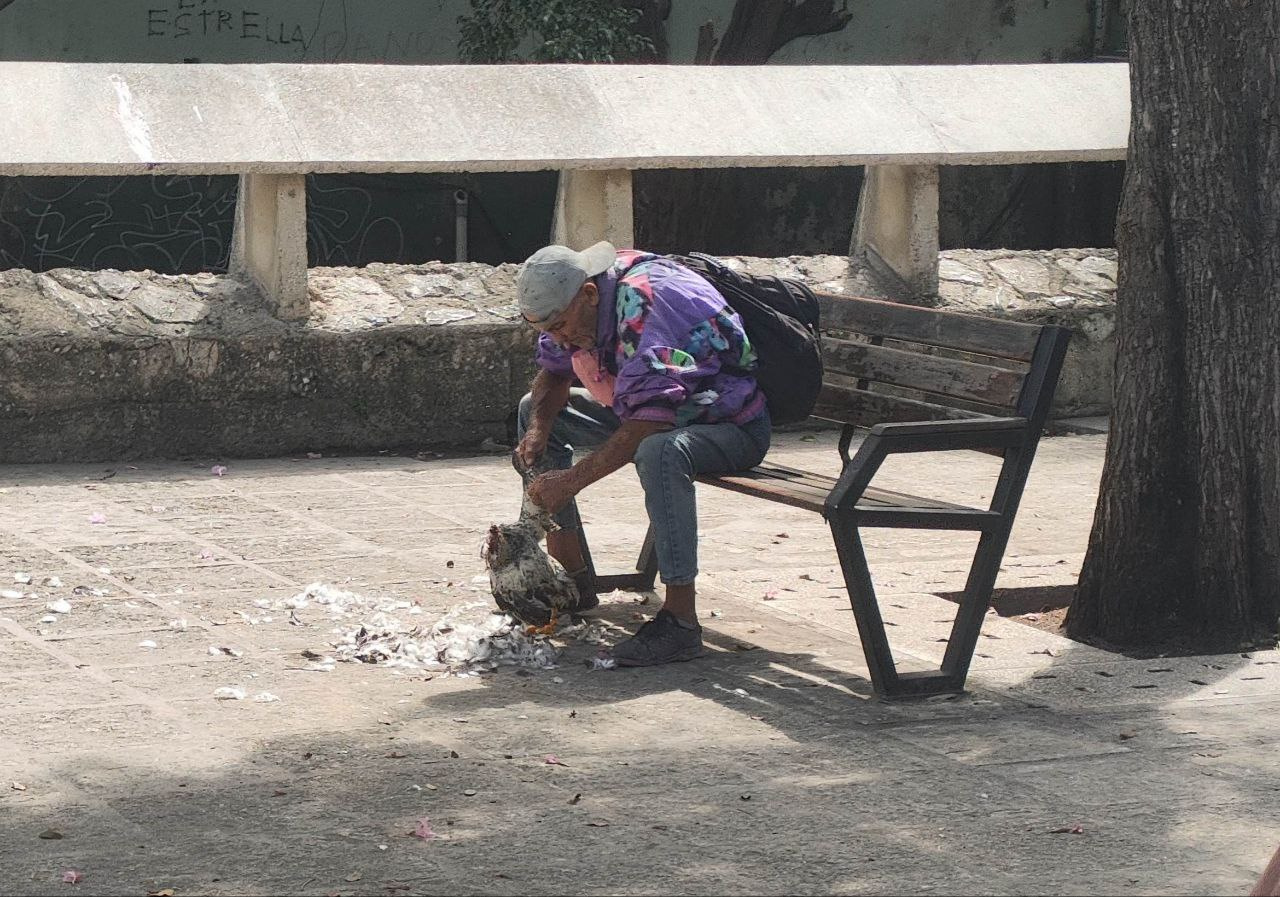
Central Havana, Transformed Into a Court of Miracles Where the Homeless and Desperate Gather

Sitting on a bench, a man plucked a rooster recovered from the trash this Friday.

The rooster was part of the remains of a Santeria ritual or some other syncretic religion. / 14ymedio

14ymedio bigger14ymedio, Juan Diego Rodríguez, Havana, 21 March 2025 — Just a decade ago Fe del Valle Park in Central Havana was a hive of activity. People of all ages, but especially young people. The spot—named after the “heroine” who died in the El Encanto department store fire in 1961—was home to one of the first 35 Wi-Fi hotspots installed by Etecsa, the State’s telecommunications monopoly, before mobile internet was allowed. Standing or sitting on the ground, huddled together, concentrating on a mobile phone, tablet, or computer, dozens of Cubans were using the slow connection—it cost 2 CUC an hour—as if their lives depended on it.

Today, the landscape is very different. The people who live in the park are mainly homeless. Homeless, desperate for food, some clearly suffering from mental health problems. Many of them sleep there. A photo taken this Friday showed this. Sitting on a bench, a man was plucking the feathers from a headless rooster.

Not far from him, on another bench, was the footprint: a black garbage bag, torn and half-open, filled with objects from a ritual offering that had been scattered.  / 14ymedio

It was the remains of a Santeria ritual or some other syncretic religion. Not far from him, on another bench, was the trace: a black garbage bag, torn and half-open, filled with scattered ritual offerings, including a broken figure of an Indian, common in spiritualist practices in Cuban homes and cemeteries. “That’s where he took it, I imagine, to eat it,” observed an elderly witness. continue reading

According to one specialist on these rituals, “it seems that the chicken was a sacrifice to a dead person—to the dead person who lived in the broken Indian—and that’s why it was kept outside the house: offerings are made to ancestors in the courtyards, far from where one lives.” Far from being reused for anything, the expert continues, “they are left anywhere to rot, because, as a santero told Lydia Cabrera, the dead don’t chew with their teeth.”

In a few minutes he had de-feathered the animal, which suddenly looked gaunt and whitish. / 14ymedio

Oblivious to the rest of the world, and without any remorse—Santeria dictates that the remains of the offering be buried in a cemetery or in the jungle—the man worked quickly and skillfully. Within minutes, he had plucked the animal, which suddenly looked gaunt and whitish.

“That doesn’t even have meat, you’ll know if it’s rotten,” said the same old man, who claims to reject these “obscurantist” practices: “This is a malignant country, that’s why we haven’t gotten ahead, nor will we.”

____________

COLLABORATE WITH OUR WORK: The 14ymedio team is committed to practicing serious journalism that reflects Cuba’s reality in all its depth. Thank you for joining us on this long journey. We invite you to continue supporting us by becoming a member of 14ymedio now. Together we can continue transforming journalism in Cuba.

Trump Revokes ‘Parole’ for Cubans, Haitians, Nicaraguans and Venezuelans From April 24

In the document prepared by the Department of Homeland Security, it is argued that this program is “incompatible with the foreign policy objectives” of the current Administration.

Many Cubans benefited from the ’humanitarian parole’ program / Mario Vallejo

14ymedio bigger14ymedio, Havana, 21 March 2025 — Donald Trump’s government has set a date for the revocation of the temporary protection status known as Humanitarian Parole. It was implemented by the Biden Administration and benefited more than 530,000 Cubans, Haitians, Nicaraguans and Venezuelans. It will terminate on April 24, when the resolution signed by the Department of Homeland Security will be applied. The official announcement will be published on March 25 in the Federal Register and will take effect 30 days later.

The rule indicates that people who have Humanitarian Parole and do not have a legal basis to stay in the United States after the end of the permit must leave the country before the date on which their parole ends.

The Humanitarian Parole Program, approved by Biden, favored the legal arrival in the United States of 110,240 Cubans, Haitians (213,150), Nicaraguans (96,270) and Venezuelans (120,760). The latest data published by the federal agency recorded 110,970 travel authorizations for Cuban citizens.

The document argues that this migration program “no longer represents a significant public benefit” for the United States and is “incompatible with the foreign policy objectives” of the Trump Administration. continue reading

The text was published this Friday in the Federal Registry, the official newspaper of the US Government

The text was published this Friday in the Federal Registry, the official newspaper of the US Government, in which rules, regulations and other statements from federal agencies are disclosed. It will be officially published on March 25, the day the measure will come into force.

Last January, a few days after Trump assumed the presidency, a memo was leaked, indicating how the officials of the Immigration and Customs Control Service (ICE) could proceed with the expulsion of some 1,400,000 people who arrived in the country under one of the asylum programs created by the previous Administration, including the Humanitarian Parole Program.

Trump believes that both the Humanitarian Parole and other programs under the CBP One appointment application were never legal, so those who came to the U.S. through them should be expelled, an anonymous source from National Security told The New York Times.

The idea of these programs, as Biden Government officials explained at the time, was to grant beneficiaries a legal entry to the United States so that they could then take advantage of other immigration programs such as Temporary Protection Status (TPS) or asylum.

The document argues that this immigration program “no longer represents a significant public benefit” for the United States

This new decision, therefore, leaves people who are currently in the country with Humanitarian Parole in legal limbo, while waiting for their immigration processes to be resolved.

This is the case of many Cubans, who entered with this program and are waiting to receive permanent residence under the Cuban Adjustment Act. However, in mid-February, the Administration ordered a freeze on the applications of migrants who arrived in the United States under these mechanisms during Biden’s mandate.

The decision affects the majority of Cubans who have arrived in the last two years. According to a memorandum from the United States Citizenship and Immigration Service (USCIS) to which CBS News had access, officials will no longer be able to process petitions for this and other benefits if they are requested by migrants who arrived under the policies of the previous administration.

The news network also reported that the authorities decided to paralyze all requests because cases of fraud were taking place. In order to avoid this, they are expected to improve investigation procedures and thus reduce “concerns related to national security and public safety.”.

Translated by Regina Anavy
____________

COLLABORATE WITH OUR WORK: The 14ymedio team is committed to practicing serious journalism that reflects Cuba’s reality in all its depth. Thank you for joining us on this long journey. We invite you to continue supporting us by becoming a member of 14ymedio now. Together we can continue transforming journalism in Cuba.

The Cuban Prime Minister and Foreign Minister Tour Africa in Search of Political and Economic Support

Despite opposition rejection in South Africa, Bruno Rodríguez managed to renew a cooperation agreement that was very beneficial to Havana.

The Cuban Prime Minister embraces the President of the Republic of Congo, Denis Sassou Nguesso / Estudios Revolución

14ymedio bigger14ymedio, Havana, 19 March 2025 — Cuban Prime Minister Manuel Marrero hugged Denis Sassou Nguesso, President-for-life of the Republic of Congo. “It has been a historic visit, very exciting, a reunion between two governments and sister countries,” he said on Tuesday when closing a day of meetings in Brazzaville, the country’s capital. The Congolese did not want to be left behind: “No matter how long the night is, the sun will shine for the Cuban people.”

“We are very satisfied, and we believe we have met the objectives to raise economic and trade relations to the same level as policies,” added the Cuban leader, trade being the central issue. Marrero had previously met with his counterpart, Anatole Collinet Makosso, and the delegations of both countries agreed to update the “potentialities for cooperation, strengthen collaboration in public health, technology, science and innovation, training of human resources, tourism development, culture; and the development of the hydrocarbon sector,” among other collaborations.

The Congo, like the rest of Africa, has been negotiating, although, as usual, it is not yet clear for what or how. The Cuban Prime Minister is in Africa on a trip that continues tomorrow to Namibia and Equatorial Guinea. He is accompanied by an important entourage, which includes the Minister of Public Health, José Ángel Portal Miranda; the Deputy Minister of Foreign Trade, Déborah Rivas Saavedra; and the Director General of Bilateral Affairs of the Ministry of Foreign Affairs, Carlos Miguel Pereira Hernández. continue reading

The independent press has focused on the fact that Marrero has included his wife in the delegation

The independent press has focused on the fact that Marrero has included his wife in the delegation, although it is worth remembering that Yadira Ramírez Morera is the communication director of the Ministry of Tourism, a department that also seeks agreements in Africa.

Yesterday, Marrero, along with the Congolese prime minister, paid tribute at the mausoleum of Marien Ngouabi, the fourth president, who played a role in African liberation struggles. Marrero also laid a floral offering in front of the monument dedicated to the former president of the country, Thomas Sankara, a revolutionary leader nicknamed the “African Che Guevara.”

The show does not end there, since Bruno Rodríguez Parrilla, Minister of Foreign Affairs, is doing his own African tour, which began on Friday, March 14, in Burkina Faso. Rodríguez commemorated the 50th anniversary of diplomatic relations between Cuba and Burkina Faso, the same as he did in Ethiopia, where he held meetings with the authorities and emphasized “Cuba’s will to strengthen cooperation” in these times of crisis.

In Ghana, the Cuban Foreign Minister also made the obligatory floral offering, in this case to the Marxist Kwame Nkrumah, “founding father of the Ghanaian nation and symbol of African unity,” in the words of Prensa Latina. Rodríguez took the opportunity to recall on his X account that the Pan-African leader was the first in the region to meet with Fidel Castro.

For decades, the Island has sent doctors to Ghana, and there was a controversy years ago over a speech that clashed with the official position

“I participated in a meeting with the Solidarity Movement with Cuba, graduates from our country and Cubans living in Ghana, as part of my official visit. I thanked everyone for their support for our country and their invariable solidarity with the Cuban people,” the foreign minister said in another post. For decades, the Island has sent doctors to Ghana, where there was a controversy years ago over a speech that clashed with the official discourse of the Island’s authorities.

In 2018, the then Deputy Minister of Health Marcia Cobas complained that the Government of Ghana had a debt with Cuba of. 4.7 million dollars, an amount accumulated for at least eight years. “It’s not fair,” the official said during a visit in which, according to local media, she deplored that attitude and said that even poorer countries, such as Chad, paid on time.

Two weeks ago, in an episode of State TV’s Round Table program aimed at praising the work of medical missions in the face of Washington’s new sanctions, the Government argued that only countries “that have a little more economic solvency” pay. “There are 25 countries where the missions are still totally free, because they have no resources to contribute to Cuba. We remain there with 25 cooperation agreements that do not generate a penny,” they claimed in contradiction with that demand.

Rodríguez’s most important meeting, however, was in Pretoria, where he met with the Minister of International Relations and Cooperation, Ronald Lamola “to promote bilateral relations.” It is another of the meetings of which no detail has been revealed, because in the relations of the Island with African countries there is always some gain for Cuba that takes time to become public.

This is the case for the beginning of the Kgala cooperation plan, a new suit in the old disguise known as Project Thusano, a military agreement between Cuba and South Africa that was in force between 2015 and 2025, through which, according to the opposition, Cuba earned 1.7 billion rands (93.6 million dollars) in “irregular” expenses. Among the best known cases of that agreement is Cuba’s sale of Heberon Alfa R for the coronavirus crisis, whose purchase was made by Defense without the required authorization by Health. At the beginning of covid-19, Cuba believed the virus was a bacteriological weapon, and in that operation alone, the Island pocketed almost two million dollars, which would have been 17 million if the purchase had been completed.

The Democratic Alliance (an opposition group in South Africa) recalled this week that an audit revealed that “the cost of maintaining and repairing military vehicles through Cuban suppliers was 2.8 times more expensive than if local mechanics had been used.”

In addition, 136% more was invested in medical training on the Island than it would have cost in South Africa, which did not translate into better knowledge since only 28% of students passed the validation exam afterwards.

In January of this year, when Thusano expired, the creation of Kgala was announced. “Despite the attempt of the Department of Defense to rethink the project with a new name, the reality remains the same: an expensive and politically motivated operation that is a complete waste of South African resources,” argues the organization, which has asked the Government to paralyze it.

Translated by Regina Anavy

____________

COLLABORATE WITH OUR WORK: The 14ymedio team is committed to practicing serious journalism that reflects Cuba’s reality in all its depth. Thank you for joining us on this long journey. We invite you to continue supporting us by becoming a member of 14ymedio now. Together we can continue transforming journalism in Cuba.

Cuban School Manuals Since 1901: From Education To Indoctrination

A Spanish institution digitizes more than 50 20th-century textbooks.

Fidel and Raúl with pioneers on the Central Committee, in which they celebrated the first Children’s Day in Cuba, on July 6, 1973 / Cubadebate

14ymedio bigger14ymedio, Havana, 16 March 2025 – The text books with which many generations of Cuban children were educated since 1901 can be found today in the Manes archives, a Spanish institute dedicated to the conservation and narration of South American educational thinking. The project, with more than 50 school manuals already digitised, allows us to take the pulse of changes in Cuban pedagogy and their relationship to the political propaganda of each historical era.

According to Manes’s website, the aim of the exhibition is to provide reflection on how teaching has evolved in the island since the end of Spanish dominance. Two German institutes – Leibniz, and Georg Eckert – financed the Cuban historians’ digitisation process.

The material, available free to download, are mostly books on Reading, History and Geography, as well as Morals and Citizenship (two subjects which were key to citizenship training during the Republic), Natural Sciences and Pedagogy. Each one of the original books are kept in the José Martí National Library in Havana.

The oldest records in the collection are those of ’Courses of Study, and Teaching Methods for Public Schools’, printed in 1901 in Havana by the Board of Superintendents of the nascent Republic. This manual attempted to lay the foundations for an education service in a country which, though only recently emerging from war, was ready to “achieve the progress desired” by those who had lost their lives in the wars of the nineteenth century. continue reading

The oldest records in the collection are those of ’Courses of Study, and Teaching Methods for Public Schools’

In its preamble, the text denounced the schooling situation in the country, and the “monstrous barbarisms” of the language. The authorities also wanted Cuban children to learn mathematics, so that “those who are able to work out for themselves their exact change (in a shop) won’t be vulnerable to being swindled”.

They also insisted on the study of agriculture – depending on the region – as well as arithmetic, needlework and civic instruction. In this latter subject the syllabus required the teaching of “the need for keeping promises, of always being punctual, of using courteous language, of never using bad language and always using moderate tones in speech”. And to “erase any superstitious behaviour”.

Because of the proximity of the USA to Cuba, children were also to be taught the history of that country, and they argued “the influence of Cuba in the independence of the United States”. In June 1900, whilst this manual was being written, 1000 Cuban teachers attended a Summer School at Harvard, to train in the most up to date pedagogical thinking.

During the following decades, the biggest names in teaching on the island, like Ramiro Guerra, were consolidated. A number of titles authored by Guerra, the most significant Cuban historian of the first quarter of the century, are among those digitised by Manes – titles having such significance that not even Fidel Castro could banish them completely from schools.

Such is the case of his ’Manual of Cuban History’ – a voluminous recounting, in more than 700 pages, of colonial history – which continues to be the text par excellence for the teaching of history on the island, including at university level.

But by 1968, when People & Education published ’My First Book’, by Josefina Díaz Entralgo, the context, just as much political as educative, had completely changed. The content, overseen by a series of education authorities – a fact which is flagged up in an initial note – was aimed at first grade children:

“One, two, three! Soldiers marching!” is one of the slogans that appear, along with a corresponding image, in the first pages of the book, mixed in with elements of daily life. “I’ll be a pioneer”, “The Sierra” – in capital letters, refers to the Sierra Maestra where Fidel Castro’s forces were based – “We are like soldiers with their rifles”, or, “No one must drop out of line”, are some of the other illustrations.

In a few lines, Entralgo sums up what a child of six should learn about the military

In a few lines, Entralgo sums up what a child of six should learn about the military: “Yesterday, a soldier from the Revolutionary Armed Forces came to talk to us in our classroom. He’s our friend. We met him in November when we visited his base… After he left, we children were thinking, ’How brave are those soldiers of the Revolutionary Armed Forces! They love Cuba very much and are always there to protect it”.

“Eusabio’s parents told him that before, life was very bad in the mountains. The people of the Sierra suffered a lot: the children didn’t have school”, says another passage. “But Fidel and the rebel soldiers fought there and now there are many new things in the Sierra. There are roads and hospitals and lots of schools. The Revolution changed life in the mountains. All the people there are happy now”.

The first edition alone of ’My First Book’ – still read in schools until recently – was printed 80,000 times. But beginning with the Congress of Education and Culture in 1971 – the starting shot for a period of repression in schools and cultural centres – school textbooks no longer even attempted to disguise their motive of indoctrination.

Although Manes, founded in 1992, doesn’t have those texts in their collection, other repositories, like that of the Ministry of Education itself do have them, and they facilitate confirmation of the high level of political, ideological and pro-military content that these school textbooks – still in use today – are filled with.

Translated by Ricardo Recluso

____________

COLLABORATE WITH OUR WORK: The 14ymedio team is committed to practicing serious journalism that reflects Cuba’s reality in all its depth. Thank you for joining us on this long journey. We invite you to continue supporting us by becoming a member of 14ymedio now. Together we can continue transforming journalism in Cuba.
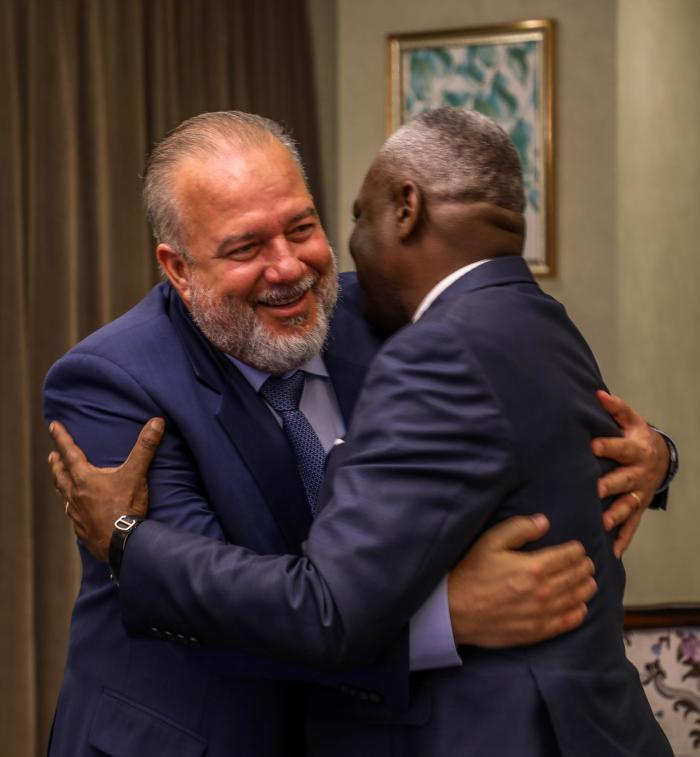
Under the Gaze of ‘Che’ Guevara the Dollar Comes to Stores in Cienfuegos, Cuba

The store, located on 37th Avenue, reopened with the new payment method last week.

Facade of the La Valenciana store, now selling in dollars. / 14ymedio

14ymedio bigger14ymedio, Julio César Contreras, Cienfuegos, 18 March 2025 — Unafraid of ideological contradictions, the stern visage of Che Guevara, “a knight without blemish or fear”—a verse from a poem dedicated to the guerrilla—crowns the building that houses the first dollar store in the city of Cienfuegos. The store, located on 37th Avenue, reopened last week with the new cash payment option, a transformation evident as soon as you look in its windows and see its shelves packed with products.

La Valenciana is now a place where los fulas [dollars] have swept away the previously freely convertible currency (MLC) with which commerce operated. Retaining the name of Agua y Jabón [Water and Soap] the Italian chain with more than fifty stores across the island, the establishment now displays a different image that goes beyond the increased variety and quantity of merchandise for sale.

“I was surprised to see so many lights on inside,” said Isabel, a nearby resident, speaking to 14ymedio this Tuesday. She was also surprised by the doorman’s friendliness. “He welcomed me with a smile and told me that payment could now be made in dollars.” A quick glance around the room, albeit with limited air conditioning, revealed shelves full of laundry detergent, dish soap, hair conditioner, shampoo, brooms, and all sorts of household cleaning products.

“He welcomed me with a smile and told me that payment could now be made in dollars.” / 14ymedio

Sponges, air fresheners, mosquito spray, and toilet paper are also part of the offerings at this store, which is jointly managed by the state-owned Tiendas Caribe. “When this sold in MLC [moneda libremente convertible/freely convertible money], it was almost empty,” noted a young continue reading

woman who was also surprised by the change inside the store. “There’s quite a variety of detergents, and they also have toilet bowl descaler, which I haven’t found here in Cienfuegos for a long time,” she summarized.

However, the young woman preferred to remain cautious and not let her enthusiasm run wild: “Now the question is whether they’ll be able to maintain the supply because, as we know, a new broom sweeps clean,” she concluded at the counter where an employee was checking out another customer. The man, who had bought a pack of toilet paper and a cleaning bucket, paid with a $20 bill. The change was returned: partly in US bills, and instead of coins, in candy, a widespread practice in other dollar-denominated markets that have opened across the country.

The difference with other stores in the city that continue to operate in hard currency or pesos extends beyond the variety of products. “I didn’t see any employees playing on their phones or leaning on the counters,” Isabel explained to this newspaper after leaving La Valenciana, where she ultimately settled on just a handle for her old broom and a box of hair dye, all for a little over $10.

At the entrance, a sign warns that, in addition to dollars in cash, Visa, Mastercard, the Russian Mir, and the Cuban AIS, Viajeros, and Clásica cards are accepted. These cards are issued by national banks and operate only in foreign currency. However, power outages can make electronic payments difficult in a city that has experienced consecutive blackouts of more than 20 hours a day so far this year in the weeks hardest hit by the energy shortage.

Keeping the Agua y Jabón name, the store now displays a different image that goes beyond the increase in variety and quantity of merchandise. / 14ymedio

“I prefer to come with the dollars my daughter sends me,” summed up an elderly man who approached with “the exact amount” to buy some laundry soap. “I’m not in the mood to leave the change as a tip, nor am I interested in candy, because I wear prosthetics and don’t have grandchildren living here with me,” he concluded. The bill was exactly four dollars, which the customer paid in one-dollar bills.

Others prefer to receive the candy instead of the corresponding cents, or simply leave the difference as a tip for the employees. “At least this gives us a little money from time to time, because when we were in MLC, our pockets suffered the consequences. Listen, we didn’t get anything!” commented one employee who, a few months ago, was on the verge of being laid off, precisely because of the crisis that had gripped La Valenciana.

“I’m optimistic because when it comes to the dollar, everything improves,” he says. “It’s good for us until the power cuts off, because then customers have to pay only in cash and our opportunities to earn a little extra money increase,” he explains to this newspaper. “The most generous are the Cuban-Americans who come to visit and leave 40 cents here, a little there.”

While in other stores, the power outage is the golden excuse for halting sales, closing the doors, and canceling entry to the public, this isn’t the case at La Valenciana. Even during lunchtime, employees take turns to avoid interrupting service, and when the power goes out, instead of processing bills at the cash register, they write them down on a piece of paper.

As in those verses dedicated to Che Guevara, the face that welcomes customers on the rooftop of the dollar store, when the power goes out at La Valenciana, everyone continues working “en lo oscuro, señora, en lo oscuro” [in the dark, madam, in the dark].

____________

COLLABORATE WITH OUR WORK: The 14ymedio team is committed to practicing serious journalism that reflects Cuba’s reality in all its depth. Thank you for joining us on this long journey. We invite you to continue supporting us by becoming a member of 14ymedio now. Together we can continue transforming journalism in Cuba.

Two Injured in Building Collapse on Diez De Octubre Avenue in Havana

A woman and a 15-year-old girl were taken to the hospital known as La Benéfica, neighbors told ’14ymedio’.

This Sunday, the neighbors on the street were gathered around a woman who was talking to them with a list in her hand. / 14ymedio

14ymedio bigger14ymedio, Juan Diego Rodríguez, Havana, 16 March 2025 — At least two people were injured Saturday night when an apartment building collapsed, at number 552 on Diez de Octubre Avenue, near the corner of Santa Irene Street, in Havana. During a visit to the site Sunday morning, several neighbors told 14ymedio that the injured were an adult woman and a 15-year-old girl.

According to testimony from some of the neighborhood’s residents, the victims were taken to Dr. Miguel Enríquez Hospital, known as La Benéfica. Some also told this newspaper that they were one of the families who had occupied the building, which was abandoned due to its deterioration, although 14ymedio was unable to corroborate this information.

Several images of the incident, which occurred inside the building during a national blackout, were shared on social media. The videos show the presence of a fire truck, an ambulance, police officers, and several paramedics transporting one of the injured women on a stretcher.

This morning, the street’s residents were gathered around a woman who was chatting with them, holding a list. A plainclothes political police officer on a motorcycle watched closely, registering the victims and their losses and promising some assistance or temporary shelter.

At the improvised dump site in front of the building, a ’diver’ was searching for trash buried beneath the rubble. / 14ymedio

The presence of authorities didn’t stop the criticism from those who lived in the neighborhood and observed the scene from afar. “You can’t even go out [to the street to protest] because there’s so much repression. They put in place that law that says you can’t even criticize this on social media. And continue reading

that collapse, the roof falling on you in the middle of the blackout…” lamented another neighbor.

In addition to the building’s situation, residents are focusing on obtaining ice to preserve food and water to consume while the power outage lasts.

In a video shared on social media by residents of the building, several people are seen gathered around the fire truck, which, along with the vehicles passing by on the street, provided the only light in the area.

At the improvised dump in front of the building, a ’diver’ was searching for trash buried beneath the debris that had fallen from the building.

Building collapses in Havana are a reality Cubans have had to get used to. Especially in older neighborhoods, the fear of a roof collapsing or a facade beginning to peel off is heightened if there’s a storm or a hurricane is approaching.

The collapses in Havana are a reality that Cubans have had to get used to.

In mid-February, a building located on San Bernardino Street, between Durege and General Serrano, in the Santos Suárez neighborhood of Diez de Octubre, collapsed, leaving a dozen families homeless.

Residents piled the few belongings they had managed to extract from the fragments of the wall on the side of the street while several state employees used a crane to demolish the three-story tenement. The building had been declared uninhabitable, according to residents, but with nowhere else to go, many families continued to live there.

At the end of June 2024, when Havana experienced several days of storms, at least 19 buildings suffered partial or total collapses, according to this newspaper’s information.

____________

COLLABORATE WITH OUR WORK: The 14ymedio team is committed to practicing serious journalism that reflects Cuba’s reality in all its depth. Thank you for joining us on this long journey. We invite you to continue supporting us by becoming a member of 14ymedio now. Together we can continue transforming journalism in Cuba.