This is how Cuban President Miguel Díaz-Canel dodges the uncomfortable questions from a friendly journalist from Folha de S. Paulo.
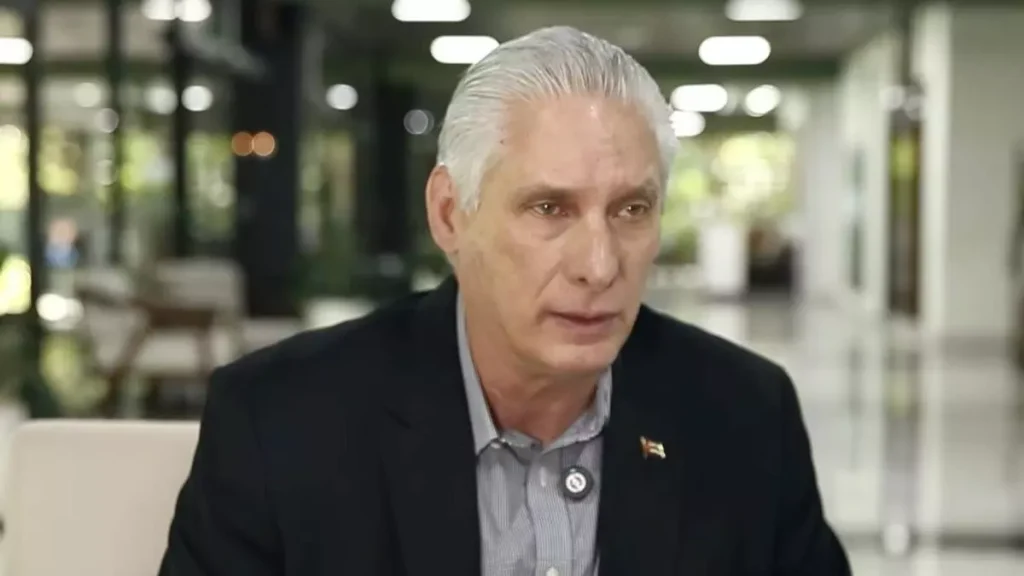
 14ymedio, Rolando Gallardo, Madrid, August 24, 2026 – The interview, granted to Mônica Bergamo of Folha de S. Paulo and published on August 23, 2026, begins with a scene bordering on surrealism. Before the first question, Lis Cuesta, the first lady, uses saliva to smooth her husband’s gray strands, trying to tame unruly hair over a drawn, gaunt face. It is the image of power without filters. But as soon as he begins to speak, the fragility disappears: Díaz-Canel regains narrative control with figures, dates and metaphors already repeated in at least five previous interviews.
That control is the most revealing fact: not what Díaz-Canel says, but that he had already said it as a theatrical performance to NBC, Newsweek, RT en Español, Radio 750 and now Bergamo. The “multidimensional war” and the same dates as the origin of the “energy blockade” return with a fidelity that demonstrates the practice of a permanent memorization exercise: the emphasis always falls in the same place, the silences are repeated, and even the pauses come at the same point in each answer.
He constantly repeats the word “genocide.” But the term, as he uses it –and as he demands “international condemnations” for it– does not correspond to the legal standard he invokes. The 1948 Genocide Convention requires proof of the specific intent to destroy, in whole or in part, a national, ethnic, racial or religious group “as such.” Washington’s sanctions, however harsh and questionable they may be, are intended to pressure a government clinging to power, not to annihilate or depopulate the Cuban nation. It is a political accusation prepared for the headlines of the state-run press.
The journalist recounts that, while traveling around the Island, she heard an expression that did not come from the dissidents but from the streets, from ordinary people: “internal blockade.” Díaz-Canel denies it twice
The most interesting moment, however, lies in the crack that Bergamo manages to open. The journalist recounts that, while traveling around the Island, she heard an expression that did not come from the dissidents but from the streets, from ordinary people: “internal blockade.” Díaz-Canel denies it twice and reduces it to “dissatisfaction with bureaucracy and slowness,” ending with a categorical phrase: “even if we had done everything right, without defects, the main cause… is the blockade.” First he shrinks the problem; then he dismisses it.
The pattern is measurable. Over the course of the hour, words that shift blame to Washington – blockade, genocide, sanctions, imperialism, suffocation, pressure, crime – appear 79 times. An acknowledgment of his own failure appears only once and is neutralized in the following sentence. Seventy-nine to one, it is clear that for Diaz-Canel the regime bears no blame.
That exclusive causality also does not withstand comparison with Cuba’s economic history. The deterioration of health, education and vaccination is not recent: it has been developing for nearly two decades and became more exposed during the pandemic, when the State allocated 45.5% of its investment to real estate services – the domain of Gaesa, the military conglomerate that controls tourism – compared with barely 0.8% for health, while hundreds of Cubans died from a lack of oxygen. Gaesa today controls between 40% and 70% of the Cuban economy, with revenues three times the State budget. Eight economists consulted by EFE in 2025 agreed that sanctions harm the country, but that the deeper problems come from the model: centralized planning is, according to Pedro Monreal, “the pillar that does not work.”

The figures Díaz-Canel gives on infant mortality are accurate: the rate, which historically hovered between 4 and 5 per thousand live births, ended 2025 at 9.9, according to the Ministry of Public Health itself, a figure confirmed by the UN. The deterioration is real. What is not true is to present it as sudden damage caused solely by this year’s energy blockade: the indicator had already been rising since 2018, the same years in which the country was building luxury hotels that today have occupancy below 30%.
There lies the real diagnosis, beyond any reading of his state of mind: a president managing real data from a country in collapse, and who, instead of using them to open a serious conversation about 20 years of bad decisions, reinserts them into the narrative already prepared to absolve himself of blame. When Bergamo takes him into territory he does not control, the response is not an argument but a shutdown: “If you don’t live in Cuba, you can’t understand what the blockade is.” A phrase that cancels the question, and the exact distance between the script and the real country that Bergamo found cooking with charcoal.
Translated by Regina Anavy
______________________
COLLABORATE WITH OUR WORK: The 14ymedio team is committed to practicing serious journalism that reflects Cuba’s reality in all its depth. Thank you for joining us on this long journey. We invite you to continue supporting us by becoming a member of 14ymedio now. Together we can continue transforming journalism in Cuba.