Havana withdrew half of its diplomats from South Korea without explanation, although it denies that the decision was politically motivated.
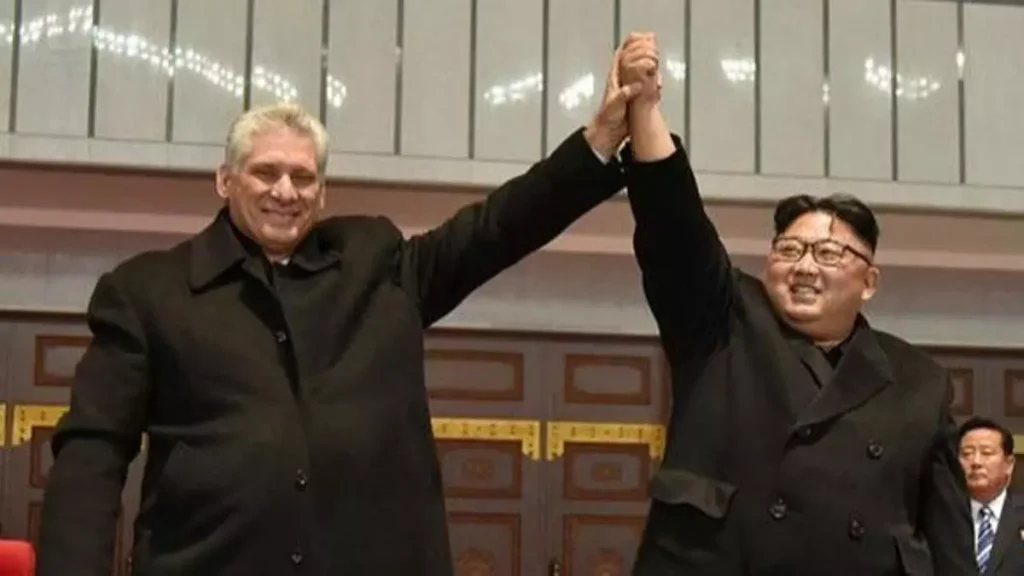
 14ymedio/EFE. Havana, October 11, 2026 / Cuban leader Miguel Díaz-Canel reiterated this Saturday the “commitment to developing the historic bonds of friendship” between Cuba and North Korea, as he congratulated leader Kim Jong-un on the 81st anniversary of the founding of the Workers’ Party, the ruling party in the Asian country. The message comes less than a month after Havana cut its diplomatic staff in South Korea by half, a decision it has not publicly explained and which has raised questions about the future of relations between the two countries.
“Congratulations to Comrade Kim Jong-un and to all members of the Workers’ Party of Korea on the 81st anniversary of its founding. We reiterate our commitment to developing the historic bonds of friendship,” Díaz-Canel wrote on his social media.
Cuban Foreign Minister Bruno Rodríguez also joined in the commemoration and reaffirmed the “will to continue consolidating” the bonds of “brotherhood, solidarity and cooperation that unite both parties, governments and peoples.” North Korea celebrated one of its principal political anniversaries this Saturday, marking the founding of the organization that has governed the country since its establishment.
On September 17, Havana withdrew two of the four diplomats posted to the Cuban Embassy in Seoul
The congratulations come at a delicate moment for Cuban diplomacy on the Korean peninsula. On September 17, Havana withdrew two of the four diplomats posted to the Cuban Embassy in Seoul, which had opened just fifteen months earlier.
As revealed by the South Korean newspaper Seoul Economic Daily, citing diplomatic sources, the officials returned to Havana on the instructions of the Cuban authorities and not as part of a routine rotation. Only Ambassador Claudio Monzón Baeza and Counselor Patricia Flechilla Prometa remained at the mission.
When asked by the newspaper, the Cuban Embassy stated that it was an internal administrative decision, with no political significance or connection to bilateral ties. However, it offered no concrete explanation for the reasons behind the cutback, which were not communicated to the South Korean authorities either.
The move caused unease in diplomatic circles in Seoul, where the establishment of relations with Cuba had been regarded as a success because it is one of Pyongyang’s traditional allies. Some sources cited by the newspaper raised the possibility that the reduction was a sign of displeasure on Havana’s part, although there is no evidence that it was a response to North Korean pressure. South Korea, for its part, maintains five officials at its embassy in the Cuban capital and has not announced any changes to its representation.
In February 2024, Cuba and South Korea established diplomatic relations after more than six decades of estrangement.
The rapprochement between Havana and Seoul had marked a major diplomatic shift. In February 2024, Cuba and South Korea established diplomatic relations after more than six decades of estrangement. The announcement came as a particular surprise given the Cuban Government’s historic alliance with North Korea, which until then had stood in the way of ties with its southern neighbor.
The decision was met with displeasure in Pyongyang, which for decades had counted Cuba among its closest political partners outside Asia. Subsequently, both capitals made progress in opening embassies and in commercial, cultural and cooperation exchanges.
Despite the reduction of staff in Seoul, there are no signs of a break in relations. In fact, on October 4, a South Korean Cultural Week began in Havana, organized with the participation of the South Korean Embassy, South Korea’s Ministry of Foreign Affairs and Cuban cultural institutions.
Fidel Castro visited Pyongyang in 1986, on what would be his only official visit to the country
The activities included exhibitions, lectures, artistic performances and events dedicated to the Korean language, the traditions of the Asian country and K-pop music. The official news agency Prensa Latina itself covered the event, which took place while questions persisted over Havana’s decision to reduce its diplomatic staff in Seoul.
Cuba’s relationship with North Korea dates back to 1960, when the two governments established diplomatic ties at the height of the Cold War. Since then, ideological affinity and political cooperation have shaped contacts between the two communist regimes.
Fidel Castro visited Pyongyang in 1986, on what would be his only official visit to the country. During that trip he met with Kim Il-sung, founder of North Korea, and with his son and successor Kim Jong-il, respectively the grandfather and father of the current North Korean leader.
More recently, Díaz-Canel traveled to Pyongyang in November 2018 and was received by Kim Jong-un, with whom he held talks at the headquarters of the Central Committee of the Workers’ Party. The visit reaffirmed an alliance that both governments continue to proclaim through official messages and declarations of solidarity.
Translated by GH.
______________________
COLLABORATE WITH OUR WORK: The 14ymedio team is committed to practicing serious journalism that reflects Cuba’s reality in all its depth. Thank you for joining us on this long journey. We invite you to continue supporting us by becoming a member of 14ymedio now. Together we can continue transforming journalism in Cuba.