Trump’s veto on travel from 19 countries, including Cuba, “puts at risk” the generation of taxes, warns a report.
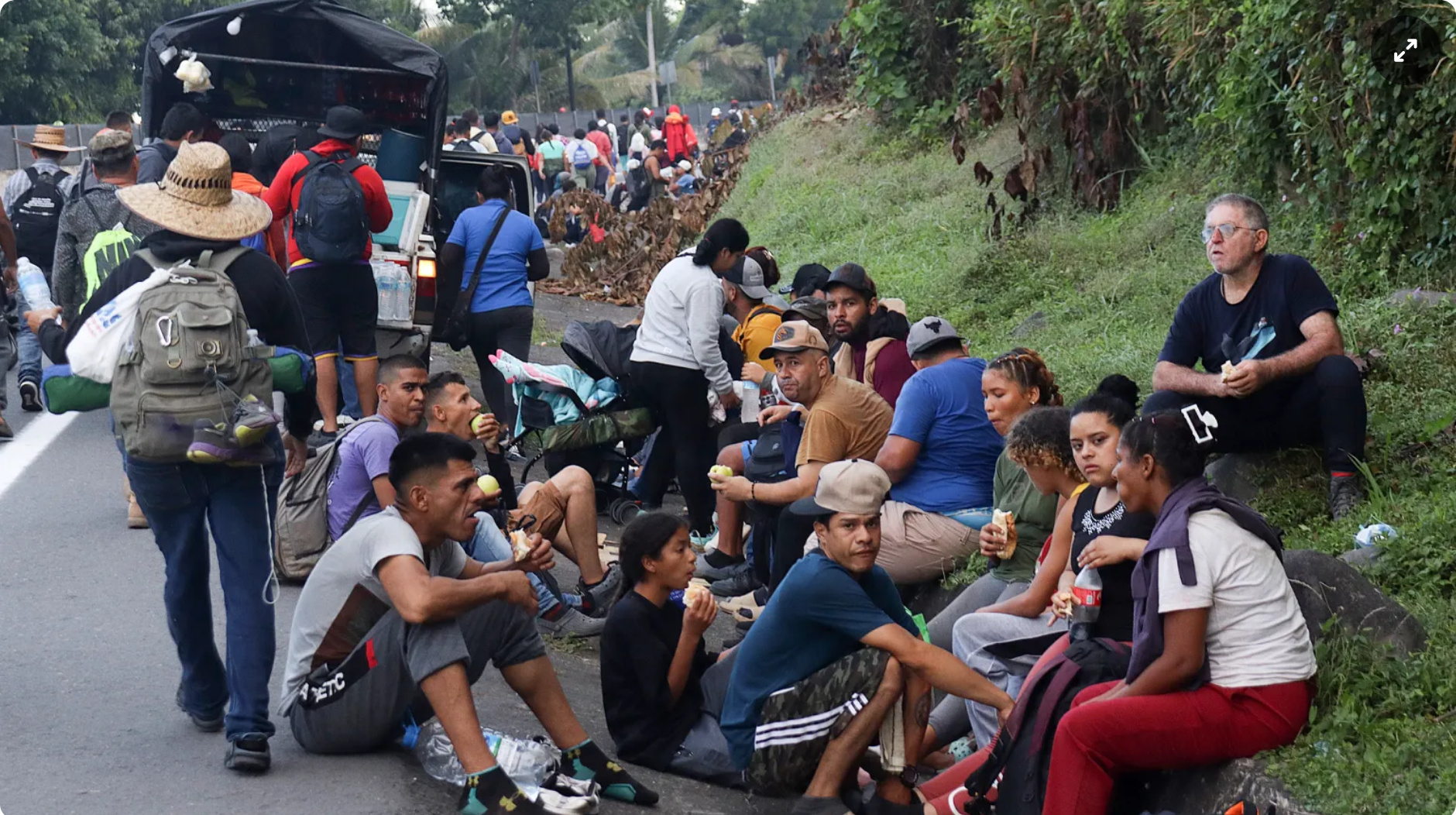
 EFE (via 14ymedio), Tapachula/Washington, August 7, 2025 — Hundreds of migrants, mostly Cubans, set off on Wednesday in a new caravan from the southern border of Mexico, looking to reach the north of the country. There they hope to regularize their documents to be able to travel to Canada or other countries that offer work, in the face of the tightening of US immigration measures.
“We want to get to Monterrey because the embassies of Canada and Germany are giving us visas to work and to populate their cities,” Maydali Barajo, a Cuban woman who travels with her grandson, told EFE.
The woman explained that they had the illusion of making their dreams come true in Mexico, but the country “denied it.” Now, she says, they want to look for other horizons “where we can realize ourselves as human beings and be the honest people that we are. And fight and help those we left behind.”
La Cubana points out that she went to Mexico because she hoped that the government would welcome them and give them work opportunities after Donald Trump “closed the dream to the whole world” of entering the US. But both the Mexican Commission for Aid to Refugees (COMAR) and the migration authorities “refused everything.”
‘La Cubana’ points out that she went to Mexico because she hoped that the government would welcome them and give them work opportunities.
In the caravan there are women and men, old people and children, who are undertaking this journey on federal highway 200 despite the risks and dangers.
This was after their stay in Tapachula, Chiapas, where they had been waiting several months for the resolution of an unsuccessful asylum application.
Prior to their departure, Father Heyman Vázquez Medina, pastor of San Andrés Apóstol in Ciudad Hidalgo, Chiapas, prayed with the migrants and asked them to remain united on their way towards their next destination.
The priest said that the migrants want to reach a city so they can work, have a better quality of life and live with dignity, but he regretted that the authorities intimidated them to avoid mobilizations.
“It’s a way of telling them: ’We’re going to hold you,’ of scaring and intimidating them so that they don’t have the courage to leave. The migrants are determined; it’s good, positive, that they come out, that the government and the world realize what is happening in Chiapas,” he said.
Juan Ríos, a Nicaraguan migrant, spokesman and coordinator of the group, told EFE that they organized themselves voluntarily because they do not want to stay in Tapachula. Although some have found employment, they face 12-hour working days for a salary of only 200 pesos per day (about $10.75), while conditions in the shelters are precarious.
“We have no destination in the United States. Our destination is to get to Monterrey, because most want to travel to Canada, Germany, Switzerland and Australia, which are giving work visas,” he said.
He also argued that they are not criminals, but working people. ” We are university students; here there are doctors and nurses who are suffering under a regime, for example in Cuba, Venezuela and Nicaragua.”
The Trump administration eliminated a number of immigration programs and benefits created by his predecessor, Joe Biden, including the Humanitarian Parole Program for Cuba, Nicaragua, Venezuela, and Haiti, and the CBP One application, which allowed people to request an appointment to legally cross the border.
As a result, more than half a million people have been left in legal limbo, while the courts decide on the legality of the programs, or directly on an irregular migration situation.
More than half a million people have been left in legal limbo, while the courts decide on the legality of programs, or directly on an irregular migration situation.
Trump is seeking to accelerate deportations and detentions to fulfill his campaign promise to expel the more than 11 million undocumented migrants living in the country.
Another part of his migration plan, the ban on travel to the US from 19 countries -among which is Cuba- puts “at risk” and impacts the generation of $715 million in taxes and $2.5 billion in purchasing power, according to a report by the American Immigration Council published this Wednesday.
“Those affected by this travel ban are students, workers and family members who pay taxes, support local economies and hold jobs in industries with massive shortages,” the report says.
According to the American Immigration Council, Trump’s measure puts the generation of 2.5 billion dollars at risk, because “thousands of workers cannot enter the country or move freely in the territory.” The analysis says that during 2022, the nearly 300,000 people representing the 19 banned countries generated $3.2 million in labor income and $715 million in taxes.
The human and social impacts also include family division, as some 2.4 million people in sanctioned countries are naturalized, but now many of their relatives will not be able to visit them.
Finally, the US Immigration Council considers that the veto is an exclusionary measure towards Muslim and African groups and questions the reasons Trump gave as justification for implementing the migration veto, recalling that at least 13 of the affected countries have very low rates of migration violations.
Translated by Regina Anavy
____________
COLLABORATE WITH OUR WORK: The 14ymedio team is committed to practicing serious journalism that reflects Cuba’s reality in all its depth. Thank you for joining us on this long journey. We invite you to continue supporting us by becoming a member of 14ymedio now. Together we can continue transforming journalism in Cuba.