Díaz-Canel responds to the protests with a phrase directed at the US: “Let them bang the pots for our neighbors up north”
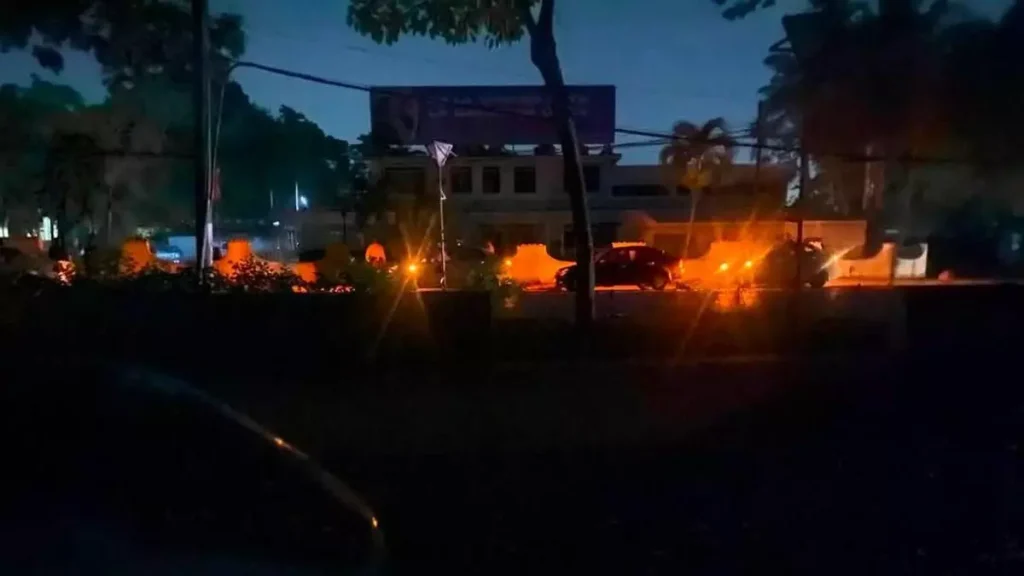
 14ymedio, Madrid, July 5, 2026 / Shortages, the deterioration of living conditions, and power outages – which in some areas already exceed 30 consecutive hours – are compounding with high temperatures, forcing many families to sleep in their doorways in an attempt to escape the heat. Against this backdrop, protests over the prolonged blackouts continue to multiply in several cities across Cuba.
According to Sunday’s bulletin from the Cuban Electric Utility (UNE), the situation will continue to worsen: the state entity is forecasting a peak-hour shortfall of 2,230 megawatts (MW), against an estimated demand of 3,100 MW. This is the largest generation deficit recorded to date, equivalent to 72% of the energy required.
Popular discontent has been reflected in figures from the Cuban Conflict Observatory, which recorded 107 protests during June. Havana and Santiago de Cuba topped the list of provinces with the highest number of demonstrations. According to the report, many of these took on an openly political character, with actions, slogans, and demands of an anti-government nature.
On Saturday night, residents of the municipality of La Lisa, in Havana, once again gathered in front of the municipal headquarters of the Communist Party to demand the restoration of electrical service, after going roughly 30 hours without power. Testimonies circulated on social media mention the deployment of police patrols and State Security agents around the site.
This marks the second protest in front of that government building in less than a week. Last Tuesday, after roughly 50 consecutive hours without power, residents of the same municipality gathered there to demand the return of electricity. According to testimonies, neighbors chanted: “The people, united, will never be defeated,” ironically repurposing one of the slogans historically associated with the government.
“People are banging pots, some more resentfully than others. I say: fine, let them bang the pot for our neighbors up north.”
That same irony resurfaced during Saturday’s protests in Santiago de Cuba. At the city’s School of Medicine, students staged a cacerolazo*, a pot-banging protest, after going roughly 24 hours without electricity. According to testimonies circulated on social media, part of the protest came from foreign students at that school. Among the slogans heard was “Down with Batista,” a reference to the dictator Fulgencio Batista. The double meaning appears to respond to the climate of repression and surveillance surrounding areas where protests are reported. Electrical service was restored shortly afterward.
Also on Saturday night, pot-banging protests were reported in Alamar, where several participants shouted “Freedom.” Reports of pot-banging also came in from the Havana municipalities of Plaza de la Revolución and San Miguel del Padrón, a simultaneity that is becoming increasingly common, despite the repression.
On July 3, President Miguel Díaz-Canel referred to the protests in an interview given to the Puerto Rican outlet Claridad. “People are banging pots, some more resentfully than others. I say: fine, let them bang the pot for our neighbors up north, since they’re the ones who’ve left us with this blackout,” he stated.
In the same conversation, the president acknowledged the severity of the situation the country is facing. “Here there are shortages of transportation, food, medicine, here there are prolonged blackouts of more than twenty hours. That causes dissatisfaction, no one can be happy, the people are suffering,” he said, though he attributed the crisis exclusively to the US embargo.
“We are not going to make changes to the political system. We continue to defend our socialism.”
The interview focused mainly on the recent reform package, which has been met with skepticism by many Cuban citizens. Regarding those measures, Díaz-Canel acknowledged that there were “divided opinions” within the inner circle of power, though he insisted: “We are not going to make changes to the political system. We continue to defend our socialism.”
Meanwhile, the situation of the National Electrical System continues to deteriorate. The Electric Utility describes the scenario as “extremely complex” and is maintaining daily deficits exceeding 65% of national demand.
Of the country’s 20 thermoelectric plant units, 11 remain out of service: six due to breakdowns and five for maintenance. Among them is the Antonio Guiteras plant in Matanzas, the largest in the country, which has suffered 17 breakdowns so far this year and continues to be one of the leading symbols of the deterioration of Cuba’s electrical infrastructure.
Translator’s note: Cacerola translates as casserole or pot, and a cacerolazo is a common form of protest, where people bang on pots and pans.
Translated by GH
______________________
COLLABORATE WITH OUR WORK: The 14ymedio team is committed to practicing serious journalism that reflects Cuba’s reality in all its depth. Thank you for joining us on this long journey. We invite you to continue supporting us by becoming a member of 14ymedio now. Together we can continue transforming journalism in Cuba.