With the regime’s top brass present, the presentation of an AKM assault rifle to the old troubadour has something grotesque about it.
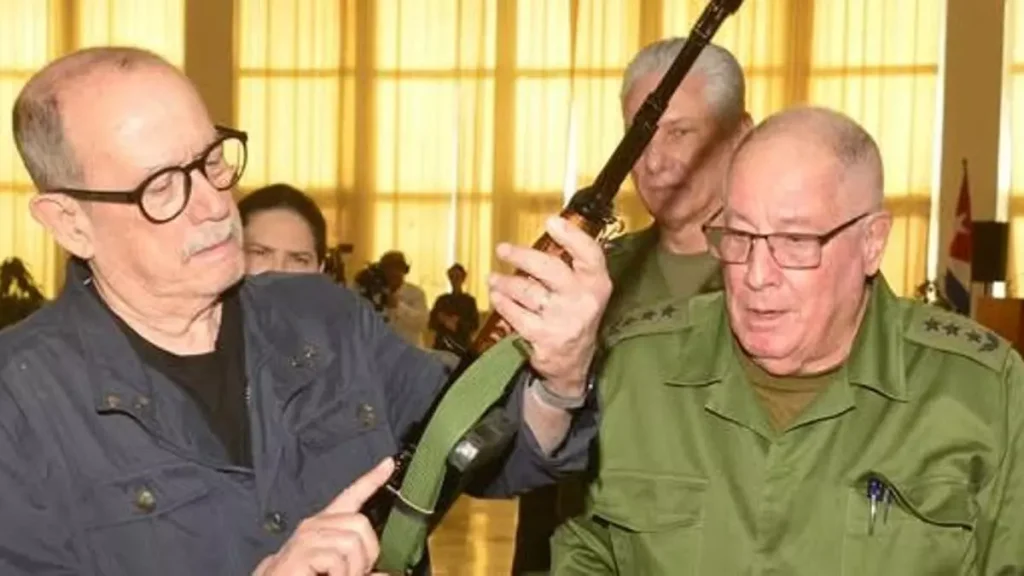

Yunior García Aguilera, Madrid, March 20, 2026 / It looked like a meme or an image created with artificial intelligence. But it wasn’t. The official website of the Ministry of the Revolutionary Armed Forces (FAR) released a photograph of the moment an elderly Silvio Rodríguez received an AKM rifle. Alongside him are the Minister of the FAR, Álvaro López Miera, and Cuban PresidentMiguel Díaz-Canel. It was not, therefore, a social media prank or an apocryphal parody, but an official act: the delivery of a weapon of war to a civilian, endorsed by the highest authorities in the country.
The scene is both grotesque and revealing. Grotesque, because it is difficult not to see in that image the symbolic collapse of a figure who for decades sought to embody the critical, or at least reflective, conscience of the Revolution. Revealing, because it ultimately reveals with brutal clarity what was perhaps always there. Silvio never managed to escape the magnetic pull of the “r” in Revolution, with all its implicit violence. Everything else—his doubts, his nuances, his tactical silences, and his occasional gestures—is dwarfed by this photograph in which he appears not as a troubled singer, but as a privileged wielder of a firearm.
From a legal standpoint, the scene is also incongruous. Decree-Law 262 on weapons and ammunition allows civilians to obtain certain licenses under very restrictive conditions, but generally excludes weapons of war such as rifles with a caliber greater than 5.6 millimeters and automatic or military-grade weapons. An AKM, in its standard configuration, hardly fits the bill as a civilian weapon for home defense, hunting, or sport shooting. Hence, the photograph not only carries a disturbing political undertone but also a clear whiff of impunity. In a country where the average citizen’s every move is regulated, seeing a troubadour publicly receive an assault rifle with the blessing of those in power conveys not legality, but arbitrariness.
Silvio, at 79, belongs to a generation of artists who experienced firsthand the structural distrust of power
After the Island-wide protests of 11 July 2021, Dayana Prieto and I met with him and his wife, Niurka González, at one of their luxurious recording studios. Looking for the exact address, we approached several people queuing in front of a store in the area. We asked an older woman if she knew where Ojalá Studios was located. And she, with that blend of dry humor and popular wisdom that survives even in poverty, replied, “I wish I could get some chicken in that line.”
The conversation with Silvio lasted about 70 minutes and was recorded at his request. In that meeting, he promised to make “a call” to request the release of political prisoners. It is possible he did. It is also possible that, if he did, no one on the other end paid much attention. The episode accurately portrays his true place within the system. Because those in power are willing to use him whenever his rhetoric suits them, just as they are willing to ignore him when it becomes inconvenient.
Silvio, at 79, belongs to a generation of artists who experienced firsthand the Cuban regime’s deep-seated distrust of intelligence, sensitivity, and independent thought. Some broke with the regime outright. Others remained silent. Others learned to survive in hushed tones. And some, like him, dedicated a considerable part of their lives to demonstrating loyalty to their oppressors, whom they never fully trusted.
This is not to deny his musical stature or his importance in Cuban culture. His work is part of the country’s emotional archive. But it is also true that, for many young people, his songs evoke less lyrical epics than open-air public demonstrations, acts of self-affirmation, the pedagogy of sacrifice, and the background noise of a system that has turned scarcity into doctrine. It is no wonder, then, that the number of Cubans for whom Silvio no longer represents poetry, but rather the soundtrack of a failed and dying regime, is growing.
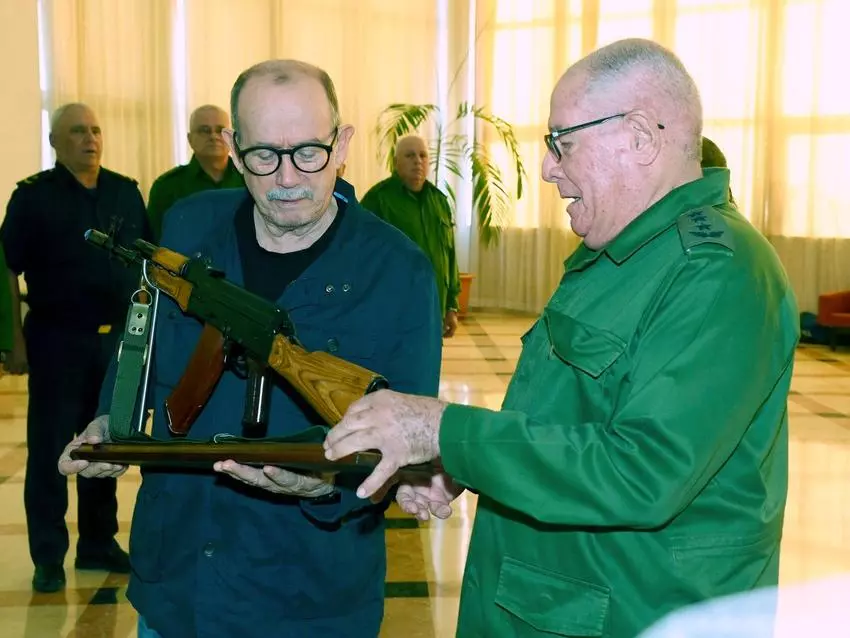
In recent days, Silvio had publicly demanded* his AKM, “if they attack,” referring to a hypothetical US aggression. But while that external enemy has yet to appear on any shore, within Cuba signs of discontent are multiplying: protests, pot-banging demonstrations, student sit-ins, repression, and surveillance. The real threat is not the US Marines; it is the citizens who can’t take it anymore.
Hence the inevitable question: Why arm a well-known civilian now? Against whom is this “resistance” envisioned? Against a nonexistent landing or against Cubans protesting because they have no electricity, no food, no hope? Has the order to start a civil war been given? When the government distributes rifles in the midst of a social crisis, the message ceases to be metaphorical and becomes dangerously concrete. Especially when, in Morón, there are reports of a teenage protester being shot—and not just with a rubber bullet.
That’s what makes the photograph so sinister. While in various parts of the country young people are harassed, repressed, or shot for protesting, the State stages the presentation of an AKM to one of its most famous artists. While some young people demand the bare minimum to study and live, other aging—and wealthy—men continue to embody the internal violence of the besieged city. While the youth try to free themselves from fear, the nomenklatura and their well-paid cronies cling to the stagecraft of war.
The memes about Silvio don’t stem solely from the cruelty of the internet and social media. They arise, above all, from the brutality with which Cuban reality has become more ferocious than any war anthem. For years, the singer-songwriter sought to present himself as an uncomfortable conscience within the Revolution. Today, he appears as something else entirely: the disciplined image of an artist who couldn’t overcome the “r” in Revolution, but seems capable of wielding a Soviet rifle. Silvio has just composed his own requiem.
*On social media he posted: I demand my AKM, if they [the US] launch an attack. And let it be known that I mean it, Silvio. 18 March 2026
______________________
COLLABORATE WITH OUR WORK: The 14ymedio team is committed to practicing serious journalism that reflects Cuba’s reality in all its depth. Thank you for joining us on this long journey. We invite you to continue supporting us by becoming a member of 14ymedio now. Together we can continue transforming journalism in Cuba.