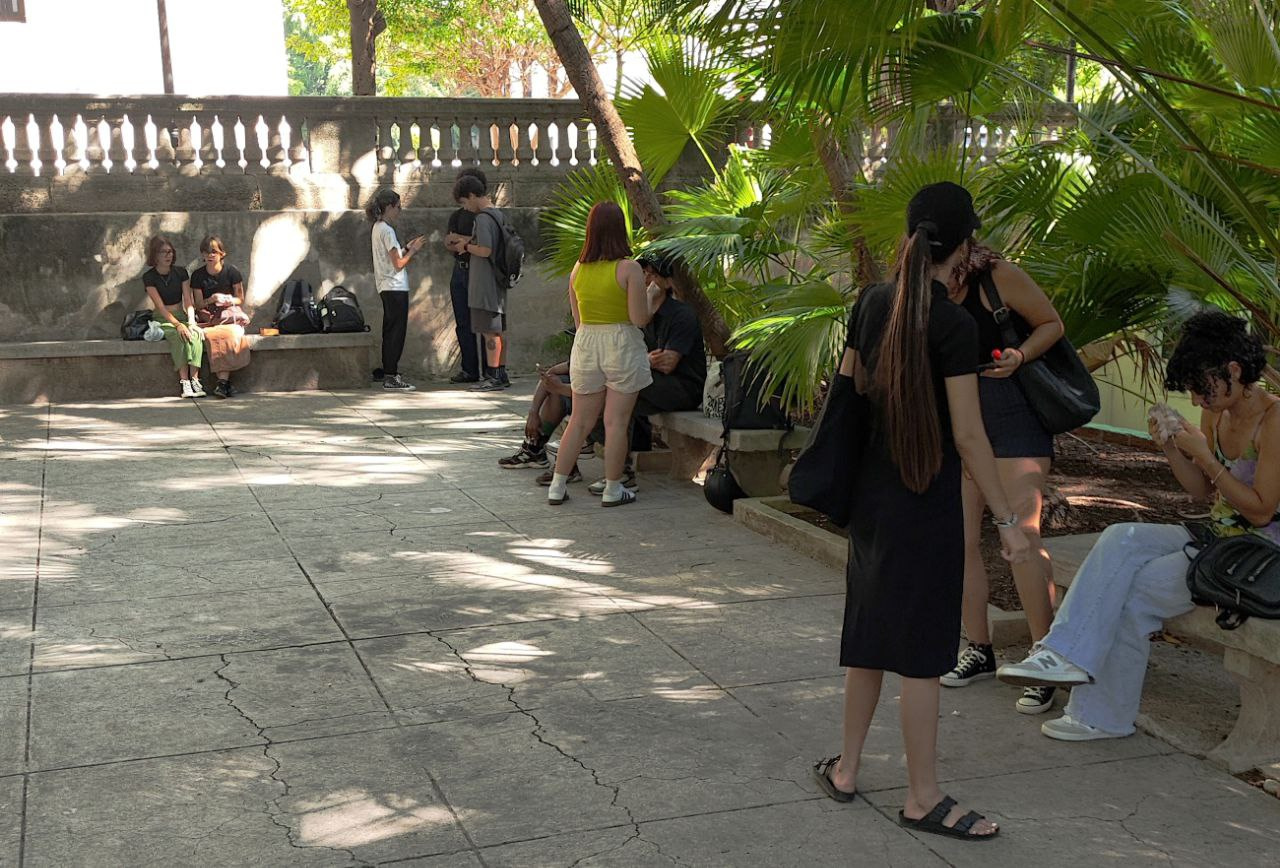
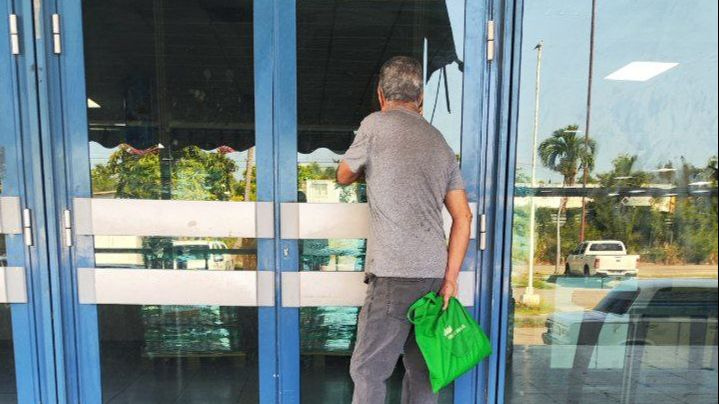
Revenues from hotels, shops, restaurants, and pharmacies have fallen by almost 30%.
Migrants gather near the Comar (Comar) to apply for asylum. / Facebook/Rey Garcia Villa
14ymedio, Angel Salinas, Mexico City, June 11, 2025 — “Some businesses are on the verge of collapse,” says Miguel Reyes del Pino, a hotel entrepreneur from Tapachula, Chiapas. Without migrants, whose number has declined radically with the new US administration, and tourism (the city doesn’t have the charm of other places in Chiapas), the rooming houses, restaurants, inns, shops and pharmacies “look almost empty,” and their income has fallen by almost 30%.
Luis García Villagrán, of the Centro de Dignificación Humana A.C., explains to 14ymedio that an individual migrant’s daily expenses are 300 pesos (almost 16 dollars). “We are talking about basic expenses: travel, meals, water, buying a cigarette, a soft drink or a telephone recharge.”
Villagrán says that it was common to see migrants “eating in the market, shopping in stores, looking for places to sleep and receiving shipments. Now there is hardly anyone in the streets, and without them, the activity has dropped a lot.”
About the various businesses on the verge of collapse, the activist says: “It really hurts them. Before they did not want to see the migrants, but today, now that they’re gone, they feel the blow. Tapachula is largely dependent on migrant money, and that’s what the authorities didn’t understand.” continue reading
Yaniel Ponce de León, a Cuban, is still waiting for an email from the Mexican Commission for Aid to Refugees (COMAR) to finalize his process and regularize his stay. “For a month I ate two meals a day of bread and hotdogs. At first they were from the Oxxo, where they sold me three for 20 pesos (a dollar),” and I got water from the tap. A Coca Cola was too expensive for me.”
“For a month I ate two meals a day of bread and hotdogs. At first they were from the Oxxo, where they sold me three for 20 pesos (one dollar),” says Yaniel Ponce de León
The migrant indicated that he slept for days between cartons in the Bicentennial Park, because renting a room cost 1,500 pesos (79 dollars) for two weeks. It was crazy, I couldn’t pay them.”
Odalys, a Cuban woman, told the local media Diario del Sur that “just to go to work, pay for transport, breakfast, a meal, some water, all simple, I spend 300 pesos, since one meal is between 80 and 90 pesos, and water is 25 or 30 pesos.”
The migrant told the same media that in the eight months she has been in Tapachula, she hasn’t been in a restaurant. “We are spending on the basics and saving money here, because what we earn is not enough for anything.”
The city on the border with Guatemala once housed up to 120,000 migrants who sought to reach the United States, but with the arrival of Donald Trump as president, “the American dream was cut short,” says attorney José Luis Pérez.
The National Institute of Migration has stopped publishing updated reports since last December. “COMAR reported 5,700 applicants at the end of last year. Certainly many migrants have returned to their country, but others continue to arrive,” says Pérez.
Translated by Regina Anavy
____________
COLLABORATE WITH OUR WORK: The 14ymedio team is committed to practicing serious journalism that reflects Cuba’s reality in all its depth. Thank you for joining us on this long journey. We invite you to continue supporting us by becoming a member of 14ymedio now. Together we can continue transforming journalism in Cuba.
An employers’ organization says Havana owes more than 350 million euros to some 300 companies.
Mesol is an importer created by Meliá to bring to everything it needs for its hotels in Cuba / Melia
14ymedio, Havana, 12 June 2025 — Cuba’s financial crisis and its informality in paying its debts have made even its historical partners begin to distrust it. This Thursday, resentful of the defaults to several companies in Catalonia, the employers’ organization Fomento del Trabajo Nacional, which brings together entrepreneurs from that region, denounced the debt of more than 350 million euros (406.5 million dollars) that Cuba has with 300 companies in Spain. Fifteen per cent of them, he says, are in a “critical” financial situation or have had to close down.
Bearing in mind that 40% of the companies with which the island is indebted (some 120 companies), mostly SMEs and micro-enterprises, are Catalan, and that the closure of several of them has led to the disappearance of jobs. The association has been operating since 2023 the Platform of Affected by the Cuban Government’s Defaults, which includes companies from all over the country “damaged” by debt.
Also, they say they has notified the Spanish government of the debt, as well as parliamentary groups, “with the aim of activating mechanisms that allow us to recover the amounts owed and avoid the disappearance of the affected export business network.”
“The outstanding debts are mainly related to export operations, many of them humanitarian in nature”
“The outstanding debts are mainly related to export operations, many of them humanitarian in nature, essential for sectors such as health and food in Cuba,” says Fomento, which regrets that the debts persist “despite the historical commercial relationship between Spain and Cuba, with Spain being one of the main investors in the Island.” continue reading
The Island’s private debt with hundreds of Spanish companies has increased from the 336 million dollars last claimed by the then Minister of Industry, Trade and Tourism of Spain, Reyes Maroto, who called for a “gradual” plan for payments during a visit to Havana in 2019.
In November 2024, during a presentation to the Congress of Deputies, the Secretary of State for Economy and Enterprise Support, Israel Arroyo, admitted that Cuba owed another 2 billion euros in debts to multilateral agencies. “It is a difficult problem to solve as long as Cuba cannot pay, because right now the situation is what it is,” said Arroyo with resignation.
The head of the portfolio then explained that most of the debt has a historical origin, which comes from the former Development Assistance Fund, from the 80s and 90s. To try to resolve the situation, three agreements have been signed in recent years with Cuba, the first two in 2015 and 2016, in which there was a restructuring with an extension of the deadlines. In 2021, another agreement was also signed to renegotiate payments, in this case without removing the debt. But the problem with Cuba “is that it cannot pay that debt,” Arroyo insisted.
Cuba’s problem “is that it cannot pay that debt”
In 2015, Cuba signed with the Paris Club the forgiveness of $8.5 billion of the $11.1 billion debt that Havana owed since 1986. Spain, which is part of the group, also negotiated on that occasion the restructuring of the short-term debt for $201 million, most of which was forgiven.
While the small Spanish entrepreneurs are not willing to lose their money, others with less risk of disappearing if business with Cuba falls apart, such as the large hotel companies, continue to invest in Cuban hotels. This is the case of firms such as Meliá, with more than 30 facilities throughout the country, and Iberostar, which recently took over the management of the hotel located in the controversial Torre K hotel project.
The operations of these companies have also not been free from difficulties. With the dramatic drop in the arrival of tourists in recent years, hotels are barely full – Meliá’s occupancy in 2024 was just 40% – and the economic crisis makes supplying hotels with basic products an odyssey. Meliá, for example, had to create its own importer, Mesol, to ensure supplies of all kinds, from food and drink to security measures and maintenance.
The Cuban Government’s eagerness to obtain foreign currency has also hurt foreign entrepreneurs, who last April received with displeasure the news that Cuba would not allow them to repatriate their earnings in foreign currency. To soften the blow to its partners’ finances, the Regime then promised that they could open unlimited hard currency accounts, but their operations would be restricted to the country.
Translated by Regina Anavy
____________
COLLABORATE WITH OUR WORK: The 14ymedio team is committed to practicing serious journalism that reflects Cuba’s reality in all its depth. Thank you for joining us on this long journey. We invite you to continue supporting us by becoming a member of 14ymedio now. Together we can continue transforming journalism in Cuba.
Two doctors told ‘14ymedio‘ that the bank told them it did not have the foreign currency to pay them what they were owed under the contract upon their return to the island.
The contract states that Antex, “provided there is cash available for this purpose, will credit the Worker (…) one hundred percent of the amount in USD from his monthly salary” // Embassy of Cuba in Angola
14ymedio, Natalia López Moya, Havana, June 12, 2025 — After years of being on a medical mission in Angola, the Cuban doctors, when they return, are meeting with a very unpleasant surprise. The banks do not have hard currency for them to withdraw the dollar amount accumulated in their accounts. The only legal alternative left is to use their savings in freely convertible currency (MLC), an option they consider “armed robbery.”
Ana Isabel, a Cuban doctor whose name has been changed for this report, spent two years at the Hospital Materno Infantil do Camama Dr. Manuel Pedro Azancot de Menezes in Luanda. Separated from her family, the specialist placed all her hopes on the money that, while she worked on the African continent, was accumulating in her account at the Banco Popular de Ahorro (BPA) on the island.
“We were supposed to receive a total of $1,200 dollars per month. There they had to give us $200 in kuanzas [the official currency of Angola] and the other $1,000 would be deposited in Cuba,” the doctor tells 14ymedio. ” But in Angola, they never gave us the $200; something always happened and we were given only $100 (82,500 kuanzas), with the option that the family in Cuba could withdraw another $50 from the bank depending on the availability of hard currency at that time.” continue reading
“There they never gave us the $200; something always happened and they gave us only $100 (82,500 kuanzas), with the option that the family here could withdraw another $50 from the bank depending on the availability of hard currency at that time.”
Cuban professionals in Angola had to tighten their belts, because, although they have free accommodation, food and other expenses paid, “Sometimes I couldn’t even recharge my phone. But I thought that all this sacrifice was worth it if I had my dollars guaranteed when I returned, as the contract with Antex [Corporación Antillana Exportadora S.A] promised,” explains Ana Isabel.
The Antex Corporation, an entity included on the black list of the Office of Foreign Assets Control of the United States Treasury Department (OFAC), belongs to the Cuban military conglomerate Gaesa. The entity manages businesses on Angolan territory ranging from the construction of motorways, through the repair of aerodromes to travel agencies. Between 2013 and 2017 alone, Angola paid more than $1 billion to Antex, according to research published by El Toque.
The contract of Antex, Corporación Antillana Exportadora S.A. / 14ymedio
Cuba has more than taken advantage of the participation, financed by the former USSR, of its more than 300,000 soldiers in the civil war in Angola between 1975 and 1991. It has done this precisely through Antex. According to the Portuguese press, in 2015, 70% of the health personnel in that country were Cuban.
In the document signed by all Cubans on official mission to Angola – more than 2,000 now among doctors, nurses, health technicians, builders, drivers and higher education teachers – it is stated that Antex, “provided that cash is available for this purpose, shall credit the Worker during the month preceding the date of his return to the Homeland, one hundred percent (100%) of the amount in USD from his monthly salary”. For most doctors, the cumulative amount is between $20,000 and $22,000.
“When we returned, we were told that the bank had no hard currency available and that we could only access money through our cards in MLC”
However, the contract has become a worthless piece of paper. ” When we returned, they told us that the bank had no hard currency available and that we could only access money through our MLC cards”, explains the doctor to this newspaper. She, however, feels lucky. ” On my vacation in Cuba, in the middle of the mission, I was able to withdraw $1,500, because at that time the bank had availability, but now it doesn’t and probably won’t in the short term.”
Last February, a group of doctors complained to Antex about the lack of hard currency. The official response then was that they were working to switch their magnetic cards to the Classic prepaid mode, so that they could buy in the dollar stores that began opening on the island since the beginning of this year. “It was not ideal, because most people want cash, but at least we could buy some products necessary for day-to-day.” But the promise has not yet been fulfilled. “We have been robbed of our money,” a doctor says bitterly.
“We have to sell our MLC in the street, under the risk of being caught by the police and convicted for the crime of illegal currency trafficking, and then buy the dollars we need on the black market,” says Maria Isabel, aware that the informal exchange rate is now 260 pesos per MLC and 375 for each dollar.” With the cards we have now we can’t go to any of those markets, like the 3rd and 70th in Miramar. The ones we can use are almost empty, dark stores that don’t even have detergent.”
Arnaldo, a doctor, experienced a similar situation. After working for two years in several hospitals, including the Comandante Raúl Díaz-Argüelles, in Cuanza Sur. The professional, also with his identity protected to avoid retaliation, tells this newspaper that he had to “pluck up courage” in the last year of his stay in Angola to not desert. “I did not miss the hospital because they treated us like garbage, but in Cuba I have my parents who are very old, and I can’t leave them alone.”
Arnaldo knows that for his work as a doctor, Angola pays Antex $5,000 per month. Of that, the doctor received only $100 each month, in kuanzas. “The bank account in Cuba was designed for my return, to use that currency to go to Brazil with my brother, to make my way there and be able to get my parents out soon after,” he says. But of the money in the BPA, he has not yet been able to touch a single dollar.
Arnaldo knows that for his work as a doctor, Angola pays Antex $5,000 per month. Of that, the doctor received only $100 each month, in kuanzas.
Unlike Ana Isabel, when Arnaldo was on vacation in Cuba in the middle of the medical mission, he could not access a single dollar from his account, although the contract ensures that he could draw up to 50% of the amount accumulated during that break. They told me that they had no availability at the bank even though I had made the withdrawal request a few months earlier from Angola,” he says. “Nor did it help that I was given a hard time about the crisis and told that the country does not have access to international currencies.”
“The contract says very clearly that the account that Antex opens to deposit part of our salary is in dollars,” explains Arnaldo. “We were told that they guaranteed the withdrawals once we returned without deserting the mission, but the truth is that I have not been able to get anything out of the bank”. The doctor feels cheated and regrets not having accepted some proposals to move to the private sector that he received in Angola.
Contract with Antex, Corporación Antillana Exportadora S.A. / 14ymedio
“I made good friends there, including Cubans who work on their own in clinics in Luanda, and they told me to stay, not to return to Cuba, that I was going to make money, but I thought Antex would fulfill the contract and so I returned.” On several occasions, when the meager $100 he received in Cuanza del Sur did not suffice to eat, he had to ask his brother in Brazil for help. “No one can believe this, but when I went on vacation to Cuba a friend had to loan me some dollars so that I could have some money there.”
“I received proposals to do some consulting on my own and earn a little money directly but that was very dangerous. Because if you did work outside and they caught you, they would send you back to Cuba with a penalty, and they could take all the money accumulated in your account, so I didn’t want to risk it,”,says Arnaldo. His restraint did not serve him very well.
“Now I’m like a criminal; I had to set up an account with another name on Facebook to see if someone wants to buy my MLC in pesos and then try to buy dollars.” His goal is to recover at least between 5,000 and 8,000 dollars to buy the plane ticket that will take him off the island and leave him with something for the journey to the Brazilian border.” I’m tired of talking to Antex and the bank; now all I want is to get out of here”
Translated by Regina Anavy
____________
COLLABORATE WITH OUR WORK: The 14ymedio team is committed to practicing serious journalism that reflects Cuba’s reality in all its depth. Thank you for joining us on this long journey. We invite you to continue supporting us by becoming a member of 14ymedio now. Together we can continue transforming journalism in Cuba.
Priest Lester Zayas’s car was vandalized, and a photo taken at the nursing home of nun Nadieska Almeida was manipulated.
Nadieska Almeida (in the center), at the nursing home where she works, in a 2022 photo / Facebook
14ymedio, Havana, June 9, 2025 — “I don’t think, I don’t hope, I don’t see anything of value in the revolution. So many lies, so many ways to crush my people, so many deceptive promises”. These are the words expressed this Monday by the Mother Superior of the Daughters of Charity in Cuba, Nadieska Almeida, days after receiving a visit from government officials at the nursing home where she works.
According to her post on Facebook, the government visit -“mandatory for the subsidy that is given to all nursing homes for the elderly and hospitals”- was normal. “I do not object; it’s simple: there is nothing to hide and much to express, because the elderly are also suffering the hardships that the country is going through, with the aggravating factor that many lack the human warmth of their family, which no one can replace,” she explains. They are meetings, she continues, that “at least serve to tell someone truths, without fear, face to face and with respect, although as it usually happens, nothing is resolved”.
Something extraordinary happened afterwards. At the meeting, the authorities asked to take a photo and the nun agreed. However, days later she received “the surprise that, without permission, they had put her on social networks with the following caption: ’United for a revolutionary ideal’. This caused Almeida “much annoyance, as one would expect”, and it was what drove her to write her text and lash out against the Revolution.
“How can I believe in a project that continues to claim the lives of young people who are forced into military service? How can we believe them when they want to silence the crying from hunger of our children and old people”?
“How can I believe in a project that continues to claim the lives of young people who are forced into military service? How can we believe them when they want to silence the crying from hunger of our children and old people? How can we believe them when they once again plunge us into isolation, disconnection, when they shamelessly lie to us and insult continue reading
the intelligence of an entire people with prices that are unattainable for many?” she says, in clear allusion to the phone and internet price increases (tarifazo) of Etecsa. “How do they expect us to work together if they are able to threaten to remove the subsidy if anyone disagrees? How can we believe right now that our young students are being threatened for claiming their rights and those of the people”?
Sister Nadieska is blunt: “No, the Revolution is not an ideal. It’s a failure; it’s a guillotine that is killing us year after year; it’s a circus where you can be a puppet that will later be kept in a miserable trunk because they have already squeezed out the last of your energy. Walking through our streets we see so many combatants who say with pain: ’I fought for this and they have abandoned me”. They dare not even pronounce the name. What can we expect? A project that is leading us more and more to misery: almost permanent darkness, coal, slow death, suffering and despair”.
Invoking the Gospel to offer hope and encouraging to people “to seek and trust in divine companionship”, she also urges them to “not be silent”. With “respect for those who continue to believe in the project”, she states that “the regression of these almost 66 years should lead them to think that it is now the time to let others propose a truly democratic State, one of justice and rights”. And she concludes, quoting the late opponent Oswaldo Payá: “The night weighs on us enough to have the courage of a mambí [independence fighter] and tell them once and for all that the night will not be eternal”.
“That’s how our car looked after a long night of blackouts all over El Vedado,” wrote Lester Zayas / Facebook
The Mother Superior’s publication takes place a few days after the priest Lester Zayas reported the break-in of his vehicle. “It is true that coincidences exist, but do they always happen at the same time? So our car looked like this today after a long night of blackouts throughout El Vedado, right in front of our convent”, wrote the Havana priest on June 3.
He illustrated the publication with an image of the vehicle with a broken window and part of the radio destroyed. He offered poverty as the first explanation but then let it be understood that the “vandalism” could actually be “a form of revenge against some people for expressing a common feeling”.
The priest was referring to a long article he wrote and published the day after president Miguel Díaz-Canel appeared in a new edition of his podcast to offer explanations for the blackouts. Faithful to his ironic style, Zayas expressed his amazement at the lack of a “good advisor” to the leader of the island.
Point by point, the priest reviewed the arguments put forward by Díaz-Canel, which he calls a “grotesque, ugly and unacceptable mockery”
“It has been absolutely disturbing to me to see a ruler – the one of my country – standing in front of thousands of spectators (and I say thousands, because others, lacking electricity, couldn’t watch, and some no longer turn on the television), addressing the people, blaming them for what, in no way, can be their fault,” he said. “Have thermoelectric power plants in Cuba been privately owned? Have they been in the hands of the MSMEs? Have they been owned by the people”?
These were rhetorical questions, which preceded a harsh reprimand to the president-designate, to whom he addressed these words: “It is the State that you represent that is solely guilty for the energy failure. If you want to blame the embargo, blame it. But the sole responsibility for dialogue with those who have imposed the embargo, and negotiation, agreement and reaching solutions, is yours and the Government you represent”.
Point by point, the priest reviewed the arguments put forward by Díaz-Canel, which he calls “grotesque, ugly and unacceptable mockery”. “What do you and those who advise you intend to do? When the electricity comes on, should we continue to cook with coal so as not to overload the SEN [national electricity system]? Should we not take advantage to run the water that for months doesn’t arrive in many places? Should we stay in darkness and without fans? Do those who advise you know that when they turn on the power at dawn, people get up at that time to cook, wash, and carry out household tasks which, until then, are impossible and inhuman to carry out”?
“Tell your advisers to get into the car of the head of the American Embassy, invite him to go for a drink and learn together how the people really live”
Stating, as the president did, that electricity consumption goes up at noon and that it wasn’t that way before “shows an immense lack of respect for the people. Consumption will always rise at the time you put on the power, after 19, 25, 30 hours of blackout”.
And he recited a litany of things that shouldn’t be asked of Cubans, who are wrapped in suffering, such as that they should “continue cooking with coal”, whose price is 1,500 Cuban pesos a bag; or that the “elderly people with bedsores, in poorly ventilated rooms and without electricity continue resisting”; or that mothers “look elsewhere when they see the lives of their children languishing without even being able to put cartoons on the television, so that at least they can forget the hunger of their empty stomachs”; or telling the young people to “hold on and give up their lives in the name of an ideology that they did not choose, that they only inherited and about which they have not been consulted as to whether or not they want it”.
Similarly, the priest finds it intolerable “to criminalize the legitimate right to protest because there is no food, because there is no current, because every day there is less”, as well as calling anyone who cries out “food” and “freedom” a “criminal”.
He also has words for the regime’s criticism of Mike Hammer, head of mission of the United States Embassy in Cuba, who persists in his intention to visit every corner of the island and listen to ordinary citizens. “You can’t condemn an ordinary official for doing what all the Party cadres should be doing: mingling with the people; having a dialogue with the people; learning how they feel; even joining the protests of the people; because in principle, they too are the people and should know and feel the same as those who protest”.
Except, he adds, “that it can’t happen because then they would no longer be authentic representatives of the people”. Thus, he recommends: “Tell your advisers to get into the car of the head of the American Embassy, invite him to go for a drink, and then learn together how the people really live: the reality, not what you see on the news”.
Doing that, he concludes, “they would have realized how absolutely unpopular and ill-advised Etecsa’s new rates have been. Don’t your advisers know what the people earn? Don’t they know that the data package is the only way for thousands of elderly mothers to see their children’s faces? Do those who advise him not know that such measures only increase the pain of remoteness and frustration of those who, separated by distance, have no other means to feel close? Don’t they know how much joy they snatch through a video call, how many ’Dad, I love you!’, ’Mom, I miss you!’s have been ended?” Zayas continues.
The text concludes by stating that the Cuban people “want to obtain the legitimate right to eat with dignity, to have 24 hours of electricity, to speak freely, to be consulted about what they want and desire, to not be afraid to protest if it is necessary, with the dignity that characterizes us, if we feel that we are mocked or denied”. If the present leadership cannot permit this, Zayas urges them to leave “someone else in charge” so that “our people can still be saved”.
Translated by Regina Anavy
____________
COLLABORATE WITH OUR WORK: The 14ymedio team is committed to practicing serious journalism that reflects Cuba’s reality in all its depth. Thank you for joining us on this long journey. We invite you to continue supporting us by becoming a member of 14ymedio now. Together we can continue transforming journalism in Cuba.
Teachers and students report a strong presence of political police agents in universities.
Many students prefer not to sign their complaints or communications for fear of direct reprisals / 14ymedio
14ymedio, Havana, 10 June 2025 — The Cuban regime has intensified, during the last few hours, the harassment against the student protests unleashed by the state telecommunications company Etecsa’s ’tarifazo’ – a sharp increase in phone and internet rates. While the spokesmen for official propaganda speak of “dialogue” and “normality”, the state apparatus has deployed its repressive arm with the active complicity of academic authorities and the leadership of the Federación Estudiantil Universitaria (FEU), an organization hijacked by the Union of Young Communists.
On social networks, videos circulate in which several students denounce the presence of State Security agents inside universities.
Officials from the Ministry of the Interior have summoned students in the last two days, visited their homes, inspected university dormitories and forced digital group administrators to close them down. One student, at the Central University Marta Abreu de Las Villas (UCLV), was forced to read a “rectification of attitude” to his classmates in order to avoid major sanctions. The Havana Technological University, the most active student group, disappeared from the digital map after an “unofficial” visit by two men dressed in civilian clothes. From Holguín, a young teacher reports anonymously that her family fears for their safety after receiving a visit from two counterintelligence officers in their own home.
Not all are willing to renounce their demands
Many students prefer not to sign their complaints and statements, for fear of direct reprisals. Some people subtly record the interventions of agents and officials and then send those materials to influencers on independent media. Despite decades of fear and institutional pressure, not everyone is willing to renounce their demands.
This Monday, a part of the UCLV student body published a statement in which they denounce institutional censorship, complicity of the representatives of the FEU, opacity in the negotiations, as well as the attempt to criminalize peaceful protest by “institutional clientelism”, that is, “prizes” for those who betray their colleagues. They demanded the immediate end of the unpopular Etecsa rate increases and the withdrawal of State Security agents from the campuses. The statement concludes with a phrase rescued from Republican politician Eduardo Chibás: “honesty against money”.
Miryorly García Prieto, a student movement activist, received a police summons this Tuesday
Not even those who aren’t directly involved in the protests have escaped the repressive machinery. Miryorly García Prieto, an activist in support of the student movement, received a police summons on Tuesday, with barely 45 continue reading
minutes to respond. The document, signed by a captain with the surname “Martínez” and an illegible first name, was full of errors: from incorrect personal data to the use of the word “sympathize” instead of “appear”.
Her “interview” was atypical. She was to be received by a captain of the political police but was interrogated instead by a major of the National Revolutionary Police (PNR), who allegedly knew very little about her. The major, visibly upset, threatened to charge her with replicating “false information,” referring to student statements shared by the activist. He also mentioned the crime of “disobedience” without clarifying further details.
A similar complaint came from the activist Raymar Aguado Hernández. Around 1:30 p.m., the PNR sector chief in the Cayo Hueso neighborhood, identified as Oribel Diaz, threatened him with “consequences” if he does not show up this Wednesday at the Zanja and Dragones police station. The officer did not specify the reason for the summons.
Several telecommunications agents have returned their business licenses
The impact of repression against protests has also been felt in the digital world. Between June 4 and 6, tags like #InternetParaTodos and #NoAlTarifazo reached high levels of activity. However, from day eight, many sites were shut down or silenced. Publications with these slogans were dropped, not because of apathy, but because of the repression and high costs of web browsing implemented since May 30.
The economic blow from Etecsa’s new policies – limiting recharges paid for within Cuba to favor those paid for from abroad in hard currency – has been felt strongly throughout the island. Several telecommunications agents have returned their business licenses as a result of the drastic drop in revenues, according to what one told this newspaper. The MSMEs, for their part, try to contain the bleeding of followers on social networks by offering tips to save mobile data, although visits to their sites continue to decrease, and customer dropouts continue to increase.
Some now dare to call the events “The Data Spring”
Meanwhile, the Cuban regime deploys a repressive strategy that seeks to disrupt unity among students, in addition to accusing exiles and Washington of being behind the protests. But this time something seems to have changed. The split between those in power and the students has become visible. Solidarity with those who protest has even come from sectors of the international left that, until recently, solidly defended the Cuban government. Some already dare to call the events “The Data Spring”.
Translated by Regina Anavy
____________
COLLABORATE WITH OUR WORK: The 14ymedio team is committed to practicing serious journalism that reflects Cuba’s reality in all its depth. Thank you for joining us on this long journey. We invite you to continue supporting us by becoming a member of 14ymedio now. Together we can continue transforming journalism in Cuba.
They warn that the currency will reach or even exceed 400 pesos.
Photo of a currency exchange counter in Cuba, September 2023 / 14ymedio
14ymedio, Madrid, June 9, 2025 — The calm that parallel exchange rates have experienced in Cuba over the past year seems to be coming to an end. So believes the Cuban Currency and Finance Observatory (OMFi), which shared on Monday its monthly report warning with a spoiler: “June could be a busier month in the informal Cuban currency market”. Thirteen months ago, the dollar hit its peak, selling for 395 pesos on May 9, 2024, and after a long period of stagnation at 340, the rise has been consolidating slowly, to reach 375 pesos.
By the end of this month, the OMFi estimates a rise of at least 15 pesos (4%) in a central scenario, but warns: “In the maximum (most extreme) scenario, the dollar rate would increase 38 CUP (10%); which would occur if the excess demand expands”. A similar account remains for the euro, which has remained higher recently but may rise more slowly, between 3% and 7%. This would mean that both currencies will come to touch or even surpass 400 pesos.
If this situation is reached, warns Pavel Vidal, the Cuban economist responsible for the Observatory, it is possible that a “downward correction” will happen, since in the past, the exchange rate of 400 pesos per dollar worked as a “psychological barrier”. In that case, a scenario of uncertainty and volatility in the market would return, which has not been seen since last year.
It is possible that a “downward correction” will happen, since in the past, the exchange rate of 400 pesos per dollar worked as a “psychological barrier”
In that context, the Cuban regime unleashed a campaign of attacks on El Toque, the media to which the OMFi belongs and the first to publish the rate of the informal foreign exchange market daily, which it accused of manipulating prices and generating expectations. The Government accused the publication of wanting to bring the rate up to 500 on dates close to July, seeking a repeat of the Island-wide 11J protests in 2021, which had erupted three years ago. But time eventually showed that the markets stabilized and currencies fell regardless of the alleged dark interests attributed to El Toque to push them up. continue reading
In this Monday’s newsletter, the OMFi analyses the latest inflation data, as well as causes and prospects. The May CPI showed that prices are contained in the official market, a very partial figure given the great weight of the informal economy in the daily life of the island, even though they continue to rise: 0.8% in May, 7.45% monthly and 16.4% year on year. The respite is not trivial, since in May 2024 it was double (15.2% accumulated and 31.1% year-on-year), but the mere number is not useful if we do not look at all facets.
As the OMFi report warns, the fall of the CPI is positive in that it transfers less uncertainty to businesses, which can count on fewer price swings and thus plan with more margin and tranquility. But it indicates that the deficit is being contained, as the government has been warning since last year, which in turn has another good consequence: less currency issue is needed to finance it, and this cuts the excess cash in circulation, which puts pressure on prices.
Inflation has been high for so many years, without compensation for wage depreciation, that the population is overtaken
However, in the social sphere it has counterproductive aspects. On the one hand, which has been much talked about, it reveals a lack of public spending, supposedly aimed at improving the living conditions of the population or meeting the needs of the most vulnerable. On the other, inflation has been high for so many years, without compensation for the depreciation of wages, that the population is overtaken. In fact, as several economists have already stressed, including the OMFi in previous reports, the fall in inflation may also be due to the limit at which families seem to be reaching.
“Certain key products may have reached a price ceiling in the short term because of the impossibility for the consumer to continue paying for them. This does not imply that supply conditions have improved but that limits of demand are becoming determinant in price behavior,” states the report. In addition, there is another factor that will not appear in the data analysis: there are goods that simply do not exist, no matter how much money is available. This is the case for many basic services, such as electricity, water and fuel: even if some remain on the informal market, shortages are rampant.
“A lower rate of inflation does not mean that prices go down or that households gain purchasing power,” the report regrets. In addition, it warns of a curious phenomenon approaching in the short term. In the next official data, there will be a significant upsurge in inflation, forced by the stratospheric rate increases of Etecsa, the so-called ‘tarifazo’. The telecommunications sector has been stagnating for years with figures around 0.1% for most of its price increases. Next month there will be several figure increases for phone and internet services, resulting in a high CPI that will surprise no one.
But, warns the OMFi, “nevertheless, its net effect over time can be anti-inflationary since it also helps to generate tax revenues and reduce the amount of pesos in the hands of the population”. It would be the same reason why the high CPI of the months in which tobacco and alcohol costs multiplied, as well as fuel prices, ended up resulting in the containment of inflation.
“The new rise in prices of public services is part of a logic of adjustment which disproportionately affects the purchasing power of households, while the government continues to evade structural reforms of the exhausted centralized economic model monopolized by state enterprises. Since the government does nothing important to promote productivity and economic efficiency, it seeks to expand income extraction through selective dollarization and price increases”, concludes the document.
Translated by Regina Anavy
____________
COLLABORATE WITH OUR WORK: The 14ymedio team is committed to practicing serious journalism that reflects Cuba’s reality in all its depth. Thank you for joining us on this long journey. We invite you to continue supporting us by becoming a member of 14ymedio now. Together we can continue transforming journalism in Cuba.
In the eastern province, the dean of the Faculty of Social Sciences has threatened students, while the university rector asks for “no repression.”
Faculty of Mathematics and Computer Science at the University of Havana, this Monday / 14ymedio
14ymedio, Havana, 9 June 2025 — The students of the Faculty of Mathematics and Computing (Matcom) of the University of Havana, the first student group to call a strike against Etecsa’s price increases (el tarifazo) — which affect internet and phone service — is also the first to cancel the strike this Monday, while it continues in other parts of the country, particularly at the Faculty of Social Sciences in Holguín.
The voting at Matcom reveals, however, a high level of discrepancy, since only 51% of participants (173) voted in favor of returning to the classroom, while 82 students were opposed and 25 abstained, according to information provided by the Council of the University Student Federation (FEU).
During the coming week, says the text, they will wait for the results of the working group that is evaluating solutions to the conflict, while other ways of showing their dissatisfaction and concern that do not affect the teaching are considered. They express confidence that a solution will be found to ensure “the right of the people to free access to information and communications”.
The hill of the University of Havana is apparently back to normal]
This Monday, according to 14ymedio, the hill of the University of Havana is apparently back to normal. There was student movement at Matcom, while the cafeteria near Philosophy, History and Sociology was closed for electrical problems. The students rested in the shade on the benches of one of the courtyards.
In contrast, the situation is different in the east of the country, where, according to sources, the dean of the Faculty of Social Sciences in Holguín has personally warned the scholarship students, one by one, of the consequences for their future employment. Despite this, the majority of students at the provincial university are not going to class, whose rector has called for “no repression of the students”. Students are coming to the classrooms, according to these same sources, only to meet and organize the protests. continue reading
The unrest generated in the universities remains latent, whatever the decision, to the point that the official media, La Joven Cuba, published an editorial whose title itself points out the gravity of the situation for the authorities: “Time is running out”, and it develops the idea that this crisis “may define the fate of the country”.
Students in the courtyard of the cafeteria of the University of Havana, closed this Monday for electrical problems / 14ymedio
The editorial goes beyond the mere tarifazo in practical terms and questions the actions of a government that makes decisions without the citizenry and without responding “effectively to the demands rightly made”. It says that what happened was predictable. According to 14ymedio sources, the workers of the state telecommunications monopoly, Etecsa, did not know until Friday the 30th what the price changes were going to be. “It’s going to be loaded,” said a Holguín employee at the meeting, where several warned of the criticisms that would rain down.
The editorial of La Joven Cuba says that the tarifazo goes beyond a specific issue and channels a malaise that spreads like an oil stain by the impoverishment of “many segments of the population”. Meanwhile, it reproaches, nothing changes in the political culture of the State. “Those who designed and supported the announcement of the measures assumed that it was enough to communicate them for the people to accept,” a decision that not only is a “communication error” but also a “political” one.
The text goes further: it deplores the verticality of the State and points directly to the military conglomerate Gaesa, the real owner of Etecsa, which is “a very difficult obstacle to overcome” for its “preponderance” in the economy and the fact that it “escapes” not only from popular control but also from the supervision of the State and the Comptroller’s Office.
The editorial also asks for explanations – coinciding with what this newspaper warned about after the appearance of Miguel Díaz-Canel in a podcast – because the alleged technological disaster of Etecsa has neither been reported nor planned to avoid this situation. “And, above all, why should the population pay more for services that don’t improve and suffer, without alternative, the consequences of the poor management”?
The text leaves no stone unturned. It accuses the government of leaving the country without a business law in a situation of economic collapse; of continuing with a dollarization that does not offer outlets to the population but only more problems; and, above all, of “entrenching itself in the notion that current conditions cannot be changed”. Although it admits that there are limitations arising from the blockade, this argument cannot be used by the government without being accompanied by the “necessary criticisms of its economic and political management”.
“The Cuban Government seems to be more comfortable making strong denunciations of what the opposition says or does, rather than addressing the real problems facing it internally,” it continues. However, it does consider that “although the PCC has lost leadership, opposition movements organized inside and outside the country have not been able to fill these gaps – among other factors, because they do not present a viable and credible plan to improve the living conditions of the majority”.
The long text ends by urging authorities to realize that the main damage “is not to people’s pockets, but to trust, already difficult to sustain” and reminds them that they have less than two months to act. “If the government is not able to reverse course; if the National Assembly of People’s Power does not reflect this malaise with debate in July; if ultimately, the politics do not change and the integral reform of the economy is not pushed once and for all, the time will come when there will be no room for maneuvering, no political confidence to rescue”.
Meanwhile, groups protesting the tarifazo continue to emerge. On Monday, the messages of rejection from several Christian churches in Cuba, such as the Pentecostal, the Presbyterian and the Baptist, traditionally linked to the opposition, have spread, according to Martí Noticias. In addition, a call for a “boycott” by the exile community continues to circulate on social networks, asking that those in the community not contribute by paying for recharges in the hard currency that the regime so desires.
“I would never dare to ask them to stop sending remittances for food, because, unfortunately, food for Cubans depends on the people they have on the outside. But the phone refills are different; it will not affect them greatly if they cannot access more data with gigabytes”, said activist Saily González Velázquez, who lives in Miami. She, like other exiles, accuses the state telecommunications company of carrying out a new kind of “apartheid” among Cubans, this time a technological one.
Translated by Regina Anavy
____________
COLLABORATE WITH OUR WORK: The 14ymedio team is committed to practicing serious journalism that reflects Cuba’s reality in all its depth. Thank you for joining us on this long journey. We invite you to continue supporting us by becoming a member of 14ymedio now. Together we can continue transforming journalism in Cuba.
“If this trend continues, there will be no livestock in approximately 15 years.”
Managers interviewed believe that with a little expertise, all producers could meet their agreements with the State / 14ymedio
14ymedio, Madrid, June 10, 2025 — At the end of 2024, Camagüey had 432,749 head of cattle, after losing more than 66,000 in those twelve months alone. ” If this trend continues, in about 15 years there will be no livestock” in the province, concludes Granma, who wants to make clear that it is based on these data and not on speculation. The official daily publishes this Tuesday the second part of an article aimed at addressing the livestock situation in that territory, formerly at the forefront of the sector.
The first, released on Monday, was dedicated to the collapse of milk production, and, although no figures were provided for the liters delivered to industry, it could be concluded that they were smaller than the 50,000 needed for children, according to the officials themselves. In today’s text, the amount is still unclear but the newspaper asks “how a province of 70 and 80 million liters of milk came to be producing less than half of five years ago.” In 2019, Camagüey reached 91.7 million liters, while in 2023 it was 42. The plan for this year is 44.6 million.
This time, Granma focuses mainly on the loss of livestock, without which, logically, the quantity of milk drops. Last year, there were 58,963 deaths “for various causes” in the province, and 7,143 illegal slaughters of livestock, but also 4,300 deaths so far this year. The blame, according to the authorities of the sector, falls on the farmer. continue reading
Last year, there were 58,963 deaths “for various causes” in the province, and 7,143 illegal slaughters of livestock, but also, so far this year, 4,300 deaths have been recorded
“During these last years there has been very bad management of the mass. One of the reasons, to cite an example, is that many producers applied for land for livestock without knowing how to raise it. That is also why there was a rise in the deaths of animals, mainly last year”, says José Antonio Gil Pérez, head of the Livestock Department of the Provincial Delegation of Agriculture.
René Mola Valero, director of Acopio was also interviewed in the first part of the publication, and he agrees, and is in a position to do so because of his “guajiro roots”. He believes that it is easy to comply with the agreement, since fewer animals are always contracted than predicted births, 55% of cows and 30% of heifers. “You already have the necessary conditions to meet the plan. In addition to that, the contracting policy states that the farmer delivers 87% of the milk to the industry”, he asserts.
Gil Pérez insists on the “shortcomings” that are counted so far, among them “producers who did not prepare for the dry period” and others who “made mistakes in the procurement process itself”, which forces a recalculation “to give the farmer who has failed in the first quarter the opportunity to recover in spring”. There is no mention of the reasonable complaints of the producers, who this Monday told Granma that non-payments are the order of the day and that stores with the necessary supplies are empty.
The official gives only a couple of optimistic data, and it is that in March the livestock numbers increased compared to the previous month. However, the numbers still look poor, since the goal for the end of the year is to grow by 55%, and by this date “they should be around 15%”, he notes. However, six of the 13 municipalities in the province are below 10 per cent. Pérez is also pleased that there were more than 1,000 fewer illegal slaughters than in the previous year, although they are already at 1,600.
The disadvantages mentioned by the managers include the lack of nitrogen and transport, both necessary for insemination and which have led to the choice of direct mounting, although the quality of the process suffers. “We are looking for funding to set up a small nitrogen plant at the artificial insemination site and put this important process back into operation,” says Pérez.
If the province’s 533 refrigerators were working well, 384,300 liters could be stored, practically all the milk that can be collected in a day, adds the official, deploring the conditions
The lack of money even affects the refrigeration. Although Camagüey has 177 centers and 44 cold milk delivery points, some 80 refrigerators (15%) are broken, and there are no spare parts to repair them. ” There will always be producers from whom, because of poor conditions or due to distance, it is not economical to collect milk, but those in are the minority”, he says. If the 533 refrigerators of the province were working well, 384,300 liters could be stored, practically all the milk that can be collected in a day, adds the official, deploring the conditions.
Another financial issue is that related to the lack of cash, which hits the sector especially and which, according to Gil Pérez, he is trying to solve by negotiating with the banks, although without results, as seen when talking with the farmers. There is also no hard currency, the incentive used in Nicaragua but not available for the Láctea company.
Danilo Porto Valdes, director of that entity, says they have been punctual with payments in March, without specifying whether the example is random or is just a month in which it was achieved. ” Every day, we pay for 10,305 liters at 70 pesos and lose 31 pesos, because the subsidy only pays 39, which then has to be recovered with other productions; however, deliveries, instead of growing, are decreasing compared to the previous year by 187,200 liters of milk”, he reveals.
The manager complains that the company faces multiple expenses, having to fetch and deliver milk every day with diesel, repairing the trucks they use for delivery and paying their workers, which doesn’t balance with the subsidy paid by the State for the milk. “According to a study carried out by the University, in 2024 we lost 222 million pesos, all without giving up on profits and improving the salary of our workers”, he says. “That is the effort this socialist State-owned company is making to get 25 cents’ worth of milk for each child.”
Translated by Regina Anavy
____________
COLLABORATE WITH OUR WORK: The 14ymedio team is committed to practicing serious journalism that reflects Cuba’s reality in all its depth. Thank you for joining us on this long journey. We invite you to continue supporting us by becoming a member of 14ymedio now. Together we can continue transforming journalism in Cuba.
Coming from Canada, the ‘Santamaría’ arrived at the port of Cienfuegos on June 6 and is waiting at sea.
The grain arrives on the island imported from countries such as Brazil, the United States, Guyana, and Vietnam / 5 de Septiembre
14ymedio, Mercedes García, June 10, 2025 — The cargo ship Santamaría has not yet unloaded in the port of Cienfuegos because the Cuban authorities have not paid for the rice.
The grain, intended for the quota of the June basic family basket, has not reached the ration markets in Sancti Spíritus.
Ration store employees are forbidden to post “no rice” signs to prevent photos of the shortage ending up on Facebook
The stores and warehouses of the rationed market in Sancti Spíritus received the news this Monday like a jug of cold water poured over them. They will have to continue waiting for the rice that is in the hold of the Santamaría, the ship with the Panamanian flag that came from Canada and arrived in Cienfuegos on June 6. The lack of payment is keeping the cargo on board and consumers waiting without explanation.
“I was going to put up a sign saying there is no rice, but we are directed not to put up anything, because then people take a photo and post it on Facebook,” says the employee of a ration store (bodega) in the Kilo 12 neighborhood, where most of his colleagues have been delaying the issue for days. The bodega is, in fact, so empty that in the last few days, only “some sweets for children are left”. continue reading
The stevedores and other workers in the sector are becoming accustomed to this type of situation. “We were summoned to unload the rice, but the men on the ship won’t deliver it until they see the money,” an employee of the Ministry of Internal Trade tells 14ymedio.
“Before, this happened once in a while, but now every time we have to stop a distribution operation of some product, especially rice, because it has not been possible to pay for the cargo at the port,” he says. “The month is already moving forward, and if this takes a few more days, people here won’t have rice until the second half of June, if they are lucky, and if not, they are left without rice until July or August,” he regrets.
“You can see that the rice intended for the basic basket doesn’t arrive, but the product continues to come in,” says a woman
“You can see that the rice intended for the basic basket doesn’t arrive, but the product continues to come in,” says a woman. In the private stores of Sancti Spíritus, a pound of imported rice now ranges between 240 and 300 pesos, depending on the quality and whether it is sold in bulk or in one-kilo packages, far from the 155 pesos per pound that was imposed as a price cap on the whole country in March.
The grain, indispensable in the daily menu, which Cuba imports from Brazil, the US, Guyana and Vietnam, constitutes in many households an essential nutritional support, given the high prices of animal proteins, vegetables and produce.
The rice that ends up in private stores comes through state importers, which individuals are obliged to use. Even the stevedores, trucks and warehouses used for the goods channel the supply to the MSMEs. But while the products destined for the ration book do not reach the province, “the containers for the MSMEs do not stop.”
The cost to unload the Santamaría is not known, but the amount is part of the “more than 300 million dollars” that the Cuban government annually spends to import rice for subsidized sale, according to vice president Salvador Valdés Mesa in February. The figure may be even higher. According to the 2023 data, 343,305,000 dollars were invested that year, a record figure in the last five years (in 2019 it was 239,725,000 dollars), especially if one takes into account the decline in population.
“We need to increase national production so that this currency can be used to meet other needs,” said Valdés Mesa
“We need to increase national production so that this currency can be used to meet other needs,” said Valdés Mesa, amid the popular unrest that had caused the delay of several months, from the arrival of the rice quota corresponding to December 2024, that finally, in many provinces, Cubans only managed to consume in mid-February of this year.
The delay in unloading ships due to the Government’s inability to pay is becoming more frequent. In April of last year, up to eleven ships surrounded the island for several days loaded with food, as acknowledged by the first deputy minister of Foreign Trade and Investment, Oscar Pérez-Oliva Fraga, in the first podcast of Miguel Díaz-Canel. The situation has been admitted on many occasions by the authorities, who attribute it to the consequences of US economic sanctions that not only affect bulk carriers but, frequently, the electric power.
In September 2024, while the Cubans were suffering one of the largest waves of power outages that year, four tankers waited in Cuban ports for payment before being unloaded. Less than a month ago, there was a similar situation with liquefied gas, which according to the Minister of Energy and Mines, Vicente de la O Levy, has not been supplied in Cuba for 117 of the 150 days of the year.
Translated by Regina Anavy
_______________
COLLABORATE WITH OUR WORK: The 14ymedio team is committed to practicing serious journalism that reflects Cuba’s reality in all its depth. Thank you for joining us on this long journey. We invite you to continue supporting us by becoming a member of 14ymedio now. Together we can continue transforming journalism in Cuba.
“They don’t care about principles, what matters is winning,” a source close to the FCB tells ‘Swing Completo’
Baseball players who joined the national team of Cuba in the Premier Tournament 12 / JIT
14ymedio/Swing Completo, Havana, June 9, 2025 — Players who “do not have a political stance against the government” could be “eligible” for the Cuban national team to participate in the 2026 World Classic. According to a source close to the Cuban Baseball Federation, quoted by Swing Completo, “this is something to resolve” in order to have a competitive team.
The source revealed, at least to Swing Completo, that they lack the Government’s approval to make the official announcement. Article 1.6 of the regulations of the National Series states that “players who have not left delegations or contracts managed by the FCB, who are not sanctioned and who possess a Cuban passport or identity card, may be authorized to play, with the prior application of the athlete to the province with which he wants to play and with the approval of the CNB”.
FCB members are willing to renounce the principles that, in the past, were an impediment to calling for other players. “They don’t care about the principles; what matters is to win, or at least not make fools of themselves,” said the same source.
“However”, he stressed, “the players who have spoken ill of the government or take a political position against it would never be considered.” continue reading
One of the figures excluded and reviled by the Cuban authorities for defecting in 2009 in Rotterdam, Netherlands, is Aroldis Chapman, the “Cuban Missile.” The athlete does not forget that they called him “traitor, worm and sellout.” For this reason, he has rejected any possibility of defending Cuba in international events.
“I think all those people who are convening the players who are here and those going to the Classic are the first who should be respected and not everyone else,” he said last March.
The same position is taken by the exiled players who in 2023 formed the Cuban Professional Baseball Federation (Febcube). The group includes Yulieski Gurriel, Guillermo Heredia, Raisel Iglesias and José Abreu, among others.
Official journalist Pavel Otero said that the FCB has already contacted 10 players who play in the United States Major Leagues and several Minor Leagues. Yoan Moncada, Andy Ibáñez, Andy Pagés and Daysbel Hernández would be on that list, in addition to Yariel Rodríguez.
“We have already personally spoken to more than 10 active players in the 40-man Major League roster,” said Otero. “Almost all the headliners for most positions are already written down.”
Translated by Regina Anavy
____________
COLLABORATE WITH OUR WORK: The 14ymedio team is committed to practicing serious journalism that reflects Cuba’s reality in all its depth. Thank you for joining us on this long journey. We invite you to continue supporting us by becoming a member of 14ymedio now. Together we can continue transforming journalism in Cuba.
The company will suspend all flights to Santiago de Cuba during the summer.
An American Airlines plane at Havana’s José Martí International Airport on October 30, 2022 / 14ymedio
14ymedio, Havana, 8 June 2025 — American Airlines, which manages most of the flights between the United States and Cuba, asked the Department of Transport (DOT) last Friday to decrease the number of its routes to the island this summer, including all connections with Santiago de Cuba. The reason, it explained, is the low demand for trips to the country in the summer period, stirred up by Washington’s policies towards Havana.
The company’s application was made two days after the Donald Trump administration proclaimed the restriction of most visas for Cubans who wish to enter that nation, in addition to citizens from six other countries.
“According to the Report on Excess of Stay [in the US], Cuba had an excessive stay rate with B1 and B2 visas of 7.69%, and with F, M and J visas of 18.75%,” specifies the proclamation. Consequently, the US suspends the entry of Cubans with visas B1 and B2 (business and tourism, respectively), F and M (academic and technical studies), and J (cultural exchanges). “Consular officials will reduce the validity of any other non-immigrant visa issued to Cuban nationals to the extent permitted by law,” it adds.
The company’s application was made two days after the Trump administration proclaimed the restriction of most visas for Cubans
As a result, American Airlines expected a significant drop in the number of flights this summer between Cuba and the US, which would put it in financial difficulties if the DOT does not agree to reduce the number of connections. continue reading
“In view of these current challenges and with a view to deploying its scarce aircraft more efficiently, American seeks a temporary suspension of a limited number of its services between the United States and Cuba for the remainder of the 2025 summer season,” the company said in its application, cited by the digital portal AirlineGeeks.com.
The routes from Miami to Havana and Santiago would be most affected by the cuts, and, at the request of the airline itself, the latter could disappear during the coming months. In the case of the capital, American Airlines hopes to modify the permission granted by the DOT last March to cut up to a maximum of three of its eight daily frequencies from Thursday to Monday, and up to four on Tuesday and Wednesday.
“The previous exemption already covered specific frequencies for American’s service to Camagüey, Holguín, Matanzas/Varadero and Santa Clara, which remain unchanged in the new application,” AirlineGeeks said.
“The previous exemption already covered specific frequencies for American services to Camagüey, Holguín, Matanzas/Varadero and Santa Clara, which remain unchanged in the new application”
According to the platform, the company argued that if granted permission – “limited to the rest of the summer season 2025” – the DOT would give it time to “better adapt its capacity and services to market conditions.” There is no indication, however, of when the Department could issue its verdict.
Cubans living abroad, although far below the number of Canadian tourists, are the second largest group of travelers arriving annually to the island. Many of them come from the United States, where the main community of Cubans abroad is located, so a decrease in flights could have a negative impact on the already depressed tourism rates on the island.
However, it will not be the first time that this sector has faced suspension of air routes due to low demand. In recent years, with the country’s loss of prestige as a tourist destination and the consequent drop in visitors, several airlines have suspended their routes. This is the case of the Swiss Edelweiss and the German Condor.
In the case of Condor, the Cuban government itself decided to take over the route so as not to lose more passengers. According to the Minister of Transport, Eduardo Rodríguez Dávila, the connection is the first one established by Cubana de Aviación between the two countries in 20 years.
Translated by Regina Anavy
____________
COLLABORATE WITH OUR WORK: The 14ymedio team is committed to practicing serious journalism that reflects Cuba’s reality in all its depth. Thank you for joining us on this long journey. We invite you to continue supporting us by becoming a member of 14ymedio now. Together we can continue transforming journalism in Cuba.
“It hasn’t been open for a month,” an employee of a small candy kiosk told ’14ymedio’.
The 3rd and 70th supermarket started selling in dollars in the 90s / 14ymedio
14ymedio, Juan Diego Rodríguez, Havana, 8 June 2025 — The showdown between the American dollar and the freely convertible currency (MLC) continues to be won by the dollar. The supermarket on 3rd and 70th, in Havana, has finally succumbed to the lack of supplies and the tough competition from its neighbor, the well-stocked store in fulas [dollars], inaugurated in January this year. This Sunday, customers who came to one of the most famous stores since the 90s in the neighborhood of Miramar found its doors closed and the interior dark.
“It hasn’t opened for a month,” said an employee selling jam from a small kiosk outside, the only place that survived the debacle. With his face glued to the glass, a customer tried to decipher whether there was any merchandise left that foreshadowed a reopening. The damaged door, the dirty glass and the floor slabs full of holes do not augur, however, a rapid return from what became more than three decades ago a place frequented by diplomats, officials and foreigners.
This Sunday, customers who came to one of the most famous shops in the neighborhood of Miramar found its doors closed and the interior dark / 14ymedio
The store that was an emblem of dollarization from 1993 and then opened to the public has succumbed due to the weakness of the freely convertible currency. Its shelves and refrigerators, with scarce products, have not been able to compete with the new store, located on that same corner but across the street, on the ground floor of the hotel Gran Muthu Habana. continue reading
Its shelves and refrigerators, with few products, have not been able to compete with the new place / 14ymedio
Belonging to the Caribbean Stores of the Cimex corporation, one of the many branches of Cuba’s all-powerful Armed Forces Business Management Group, the luxurious establishment admits three forms of payment: cash dollars, foreign cards and the so-called Classic card that is recharged with dollars. While the opponent’s butcher shop languished, its refrigerated windows were exhibiting hams, cuts of beef, countless sausages and those chicken breasts that many Cuban families have not tasted for years.
A month ago the battle ended quietly. Collapsed on the canvas from lack of resources, unable to recover, the market in MLC ended up surrendering. On the other side of the street, propped up by greenbacks, its foreign-currency adversary has continued to earn, since then, tens of thousands of dollars every day.
Translated by Regina Anavy
____________
COLLABORATE WITH OUR WORK: The 14ymedio team is committed to practicing serious journalism that reflects Cuba’s reality in all its depth. Thank you for joining us on this long journey. We invite you to continue supporting us by becoming a member of 14ymedio now. Together we can continue transforming journalism in Cuba.
There is talk of a list of 10 U.S. Major League players to whom the Island will send an invitation.
Yoan Mocada, in the center, during the game against China’s Taipei team / Jit
14ymedio/Swing Completo, Havana, 8 June 2025 — Yoan Moncada, Andy Ibáñez, Andy Pagés and Daysbel Hernández are the players who have expressed their interest in playing with Cuba in the 2026 World Classic. Yariel Rodriguez could join them. He is backed by several Inder managers, despite having broken a contract in Japan, for which the Cuban Baseball Federation (FCB) demanded 10 million dollars for “damages.”
A source from the Island confirmed to the specialized media Swing Completo that there is a list of at least 10 Cuban Major League players who will be sent an invitation.
Moncada was part of the national team selection that failed in the Premier 12 tournament. The athlete from Cienfuegos, who was injured for most of the year, on that occasion “asked to be included” in the roster of 60 players, according to the specialized media Pelota Cubana.
“My dad wants to see me play for Cuba, and that’s all I care about,” says Andy Pagés / El Extrabase
Moncada, who in 2015 was signed by the US Boston Red Sox for 31.5 million dollars, took advantage of the window to get a third-base contract with the Los Angeles Angels.
The Los Angeles Dodgers player, Andy Pagés, has expressed his desire to join the Cuban national team. The athlete would thus fulfill his father’s wish. “From the beginning, I said yes. Already there were people who did not accept it and others who did,” he told Pelota Cubana USA. “I don’t worry about that. There will always be people who say bad things and others who support me. As I said, my dad wants to see me play for Cuba, and that’s all I care about.” continue reading
However, in the participation of Pagés in the World Classic, warned Andy Lans, “the most logical thing would be to think that the outfielder sees the above-mentioned competition as a possibility to display his skills. He is not the only one.”
In the case of Daysbel Hernández, his talent as a pitcher has been revealed with the Atlanta Braves / Francys Romero
In the case of Daysbel Hernandez his talent as a pitcher has been revealed with the Atlanta Braves in the Minor Leagues; his aspiration is still to reach the top circuit. The FCB has expressed its interest in being part of the pre-selection, and the specialized media see him as an option for a relief pitcher.
Andy Ibáñez was already part of the Asere team version and would be ready to return if there is a call. Another option is Ernesto Martinez Jr., who is with the Milwaukee Brewers and considered a promising prospect.
Translated by Regina Anavy
____________
COLLABORATE WITH OUR WORK: The 14ymedio team is committed to practicing serious journalism that reflects Cuba’s reality in all its depth. Thank you for joining us on this long journey. We invite you to continue supporting us by becoming a member of 14ymedio now. Together we can continue transforming journalism in Cuba.
A group of academics, artists and journalists publish a letter of “support and solidarity” with the students protesting huge price increases for internet and telephone service
Students of the Faculty of Medical Sciences of Havana / Facebook
14ymedio, Havana, 7 June 72025 — After a “process of deep reflection,” the students of the Faculty of Medical Sciences of Havana – the elite of the “army of white coats” that Fidel Castro considered unconditional defenders of the Revolution – have also joined the virtual protests against the rate increases, known as ‘el tarifazo‘ [huge rate hike], announced by Etecsa, the country’s communications monopoly. The Federación Estudiantil Universitaria (FEU) of that institution reiterated, in a cautionary statement, its “firm position” against the decision of the telecommunications monopoly on prices.
The letter, spread on social networks, is a reaction to the meeting held between the FEU and the authorities of Etecsa last Thursday, in which representatives of the students proposed changes such as facilitating the creation of “new national technology companies or associated MSMEs,” to enable cash payment in both pesos and dollars, to reduce the dependence on digital platforms such as Transfermobile and to “promote agreements with countries such as China or Russia to obtain financing and improve the technological infrastructure.” However, the answers given by the authorities were, it says, “insufficient and evasive.”
Raising the tone, the medical students reproached Etecsa for ignoring “the structural needs of millions” and proposing minimal solutions that do not solve the main problem. “We do not accept that a part of the student population should be privileged while workers, scientists, teachers, the elderly and our own families are excluded.”
They also pointed to the FEU administrative authority in the University, from which they expected the “leadership,” “accompaniment” and “support” that “never arrived.” “The absence of our superiors at decisive moments was not only strategic, it was symbolic: an expression of the abandonment that we are no longer willing to tolerate,” says the document in which, a few paragraphs later, the FEU of the faculty breaks with the administration: “They don’t represent us!” continue reading
After ensuring that they will not admit “empty structures or disconnected hierarchies,” the students called on other university faculties of the Island to join in the student demands
After assuring that they will not admit “empty structures or disconnected hierarchies”, the students called on other university faculties of the Island to join in the student demands. “We are not alone. We join the wave of courageous announcements from sister faculties (…). There can be no development without connectivity. There can be no revolutionary morality without the right to criticism. There can be no justice if the majority is sacrificed in favor of a few.”
Similar notes of “rejection” and “disagreement” with the measures of Etecsa have been published by students from other careers, such as Tourism in Havana in recent days. There have also been videos of young people holding meetings with authorities in which they question the decisions of a system that “does not solve” problems and that, despite the daily crises, “takes away what allowed us to escape from reality.”
Etecsa’s policies, which they accuse of violating the contract that obliges the company to notify the population of any change in its services one month in advance, “is not a mistake, it is a pattern,” continues one of the students in these meetings. “How often are decisions taken that affect millions without consulting us? (…) We are taught to resist, but that is not synonymous with submission,” they say.
There is also a message circulating on social networks and WhatsApp groups of dubious origin calling for a “mobilization” of students to hold sit-ins in front of universities and marches on campuses. This text has been denounced as false by the activist Yamilka Lafita, who said that this type of communication ends up “tarnishing and delegitimizing the civic, critical and honest work being done by students from various faculties in the country.”
“This type of content, manufactured by interests outside the student body, only serves to divide, confuse and stop the conscious awakening of those who, from the classrooms, are demanding rights, dignity and real participation,” she highlighted on her Facebook page, which she manages under the name of Lara Crofs.
Other sections of the population have also expressed their discontent and supported the students’ demands. This is the case of a group of academics and intellectuals who have written a letter in “support and solidarity with the students of the Island, calling on the international community to defend the students and teachers from reprisals that they are suffering for making their claims public.”
Other sectors of the population have also expressed their discontent and supported the students’ claims
“For the first time in decades, the Cuban student community, honoring old republican traditions of participation in political and social affairs, has raised its voice in the face of this outrage, even calling for a national university strike,” says the text, adding: “It has become a target of the repressive machinery of the regime, which has already launched an information manipulation campaign, because it hopes that a similar persecution will be unleashed against them as was used against the protesters of July 2021.” At the bottom of the statement, dozens of activists, artists and intellectuals have left their signatures.
The citizen platform Archipelago has also put in writing its “admiration” for the university students, who have decided not only to protest but have called for a student strike. “Who said the young people were lost? You are the protagonists of a unique moment, and you are regaining the hopes of millions. You are making history,” it published, thanking the young people for showing that “Cuba is alive.”.
Despite the unprecedented mobilization that the country is experiencing against a decision taken by the regime, the authorities have made it clear that they will not back down, arguing that Etecsa needs currency to guarantee its services and that there is no other option.
Last Thursday, the law students at Holguín University went one step further and filed a lawsuit against the telecommunications monopoly that probably no court will admit. The students questioned the ’tarifazo’ on mobile and data services, describing it as “exclusive, classist and contrary to the law,” supporting their claim in the Constitution and the Penal Code.
Translated by Regina Anavy
____________
COLLABORATE WITH OUR WORK: The 14ymedio team is committed to practicing serious journalism that reflects Cuba’s reality in all its depth. Thank you for joining us on this long journey. We invite you to continue supporting us by becoming a member of 14ymedio now. Together we can continue transforming journalism in Cuba.
The boys were identified by some neighbors on social networks as Luis Antonio and Maicol
Archive photo of Bauta, Artemisa / CC
14ymedio, Havana, June 8, 2025 — The municipality of Bauta, in the province of Artemisa, experienced a day of mourning after several fatal events resulted in the deaths of three minors. In the first case, a three-year-old girl drowned on the beach, and two teenagers, 13 and 16, were struck by lightning.
According to the official press, which barely revealed details about the incidents, the girl and her family lived in the municipality of Caimito but were allegedly on holiday in a house at Playa Baracoa.
In the case of the teenagers, the local newspaper, El Artemiseño, said they were struck by lightning around 5:30 pm on Saturday while playing football “outdoors” in the neighborhood of Pita, in the popular council Urban 2 of Bauta. The boys were identified by some neighbors on social networks as Luis Antonio and Maicol, without giving any last names. continue reading
They were struck by lightning near 5:30 pm on Saturday while playing “outdoor” soccer in the Pita neighborhood
While in other countries warnings are frequent to the population to take shelter when there are thunderstorms, the weather reports on the island rarely include calls to the population to protect themselves from lightning, which is usually fatal when it hits someone.
In July 2020, two people died and 12 others were injured in the municipality of Florida, Camagüey, due to an electric shock. The victims of the accident were traveling along a road in the territory when they were struck by lightning, and the survivors had to be admitted to local hospitals.
Cuba records an annual average of 54 deaths from lightning strikes, the leading cause of death due to meteorological phenomena on the island, with 1,742 deaths between 1987 and 2017, according to the latest available data from a study carried out by specialists of the Island’s Meteorological Institute (Insmet).
At that time, lightning deaths exceeded those caused by hurricanes, tornadoes and other natural phenomena, although the erosion of infrastructure and lack of resources to protect citizens may have influenced these figures in recent years.
Translation by Regina Anavy
____________
COLLABORATE WITH OUR WORK: The 14ymedio team is committed to practicing serious journalism that reflects Cuba’s reality in all its depth. Thank you for joining us on this long journey. We invite you to continue supporting us by becoming a member of 14ymedio now. Together we can continue transforming journalism in Cuba.
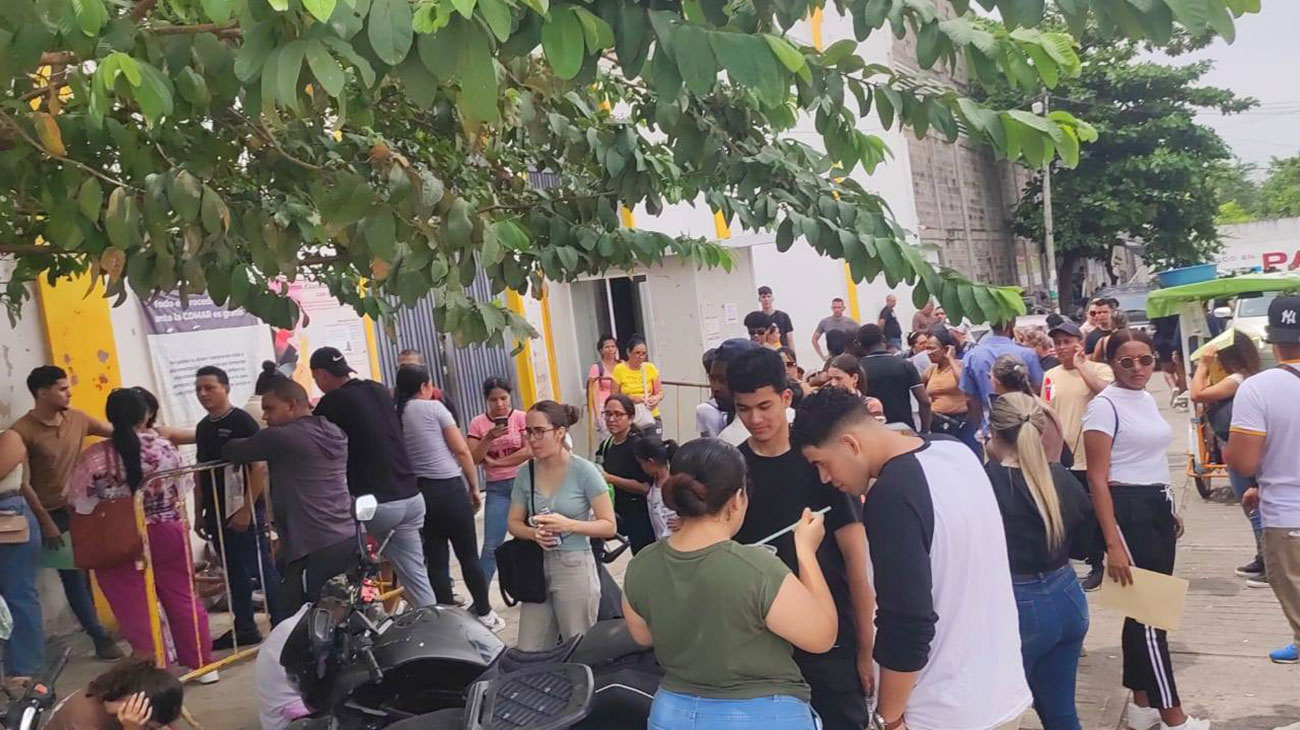
 14ymedio, Angel Salinas, Mexico City, June 11, 2025 — “Some businesses are on the verge of collapse,” says Miguel Reyes del Pino, a hotel entrepreneur from Tapachula, Chiapas. Without migrants, whose number has declined radically with the new US administration, and tourism (the city doesn’t have the charm of other places in Chiapas), the rooming houses, restaurants, inns, shops and pharmacies “look almost empty,” and their income has fallen by almost 30%.