Teachers and students report a strong presence of political police agents in universities.
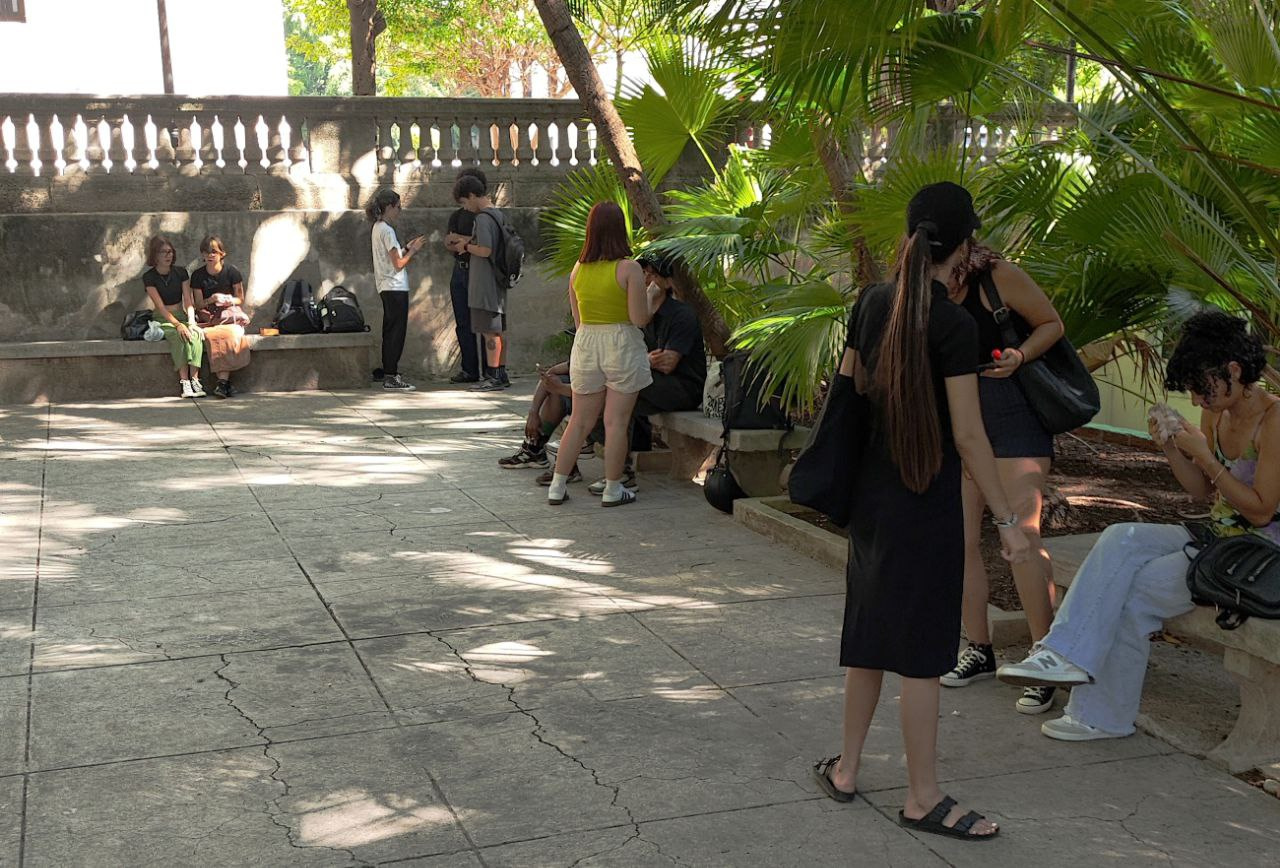
 14ymedio, Havana, 10 June 2025 — The Cuban regime has intensified, during the last few hours, the harassment against the student protests unleashed by the state telecommunications company Etecsa’s ’tarifazo’ – a sharp increase in phone and internet rates. While the spokesmen for official propaganda speak of “dialogue” and “normality”, the state apparatus has deployed its repressive arm with the active complicity of academic authorities and the leadership of the Federación Estudiantil Universitaria (FEU), an organization hijacked by the Union of Young Communists.
On social networks, videos circulate in which several students denounce the presence of State Security agents inside universities.
Officials from the Ministry of the Interior have summoned students in the last two days, visited their homes, inspected university dormitories and forced digital group administrators to close them down. One student, at the Central University Marta Abreu de Las Villas (UCLV), was forced to read a “rectification of attitude” to his classmates in order to avoid major sanctions. The Havana Technological University, the most active student group, disappeared from the digital map after an “unofficial” visit by two men dressed in civilian clothes. From Holguín, a young teacher reports anonymously that her family fears for their safety after receiving a visit from two counterintelligence officers in their own home.
Not all are willing to renounce their demands
Many students prefer not to sign their complaints and statements, for fear of direct reprisals. Some people subtly record the interventions of agents and officials and then send those materials to influencers on independent media. Despite decades of fear and institutional pressure, not everyone is willing to renounce their demands.
This Monday, a part of the UCLV student body published a statement in which they denounce institutional censorship, complicity of the representatives of the FEU, opacity in the negotiations, as well as the attempt to criminalize peaceful protest by “institutional clientelism”, that is, “prizes” for those who betray their colleagues. They demanded the immediate end of the unpopular Etecsa rate increases and the withdrawal of State Security agents from the campuses. The statement concludes with a phrase rescued from Republican politician Eduardo Chibás: “honesty against money”.
Miryorly García Prieto, a student movement activist, received a police summons this Tuesday
Not even those who aren’t directly involved in the protests have escaped the repressive machinery. Miryorly García Prieto, an activist in support of the student movement, received a police summons on Tuesday, with barely 45 minutes to respond. The document, signed by a captain with the surname “Martínez” and an illegible first name, was full of errors: from incorrect personal data to the use of the word “sympathize” instead of “appear”.
Her “interview” was atypical. She was to be received by a captain of the political police but was interrogated instead by a major of the National Revolutionary Police (PNR), who allegedly knew very little about her. The major, visibly upset, threatened to charge her with replicating “false information,” referring to student statements shared by the activist. He also mentioned the crime of “disobedience” without clarifying further details.
A similar complaint came from the activist Raymar Aguado Hernández. Around 1:30 p.m., the PNR sector chief in the Cayo Hueso neighborhood, identified as Oribel Diaz, threatened him with “consequences” if he does not show up this Wednesday at the Zanja and Dragones police station. The officer did not specify the reason for the summons.
Several telecommunications agents have returned their business licenses
The impact of repression against protests has also been felt in the digital world. Between June 4 and 6, tags like #InternetParaTodos and #NoAlTarifazo reached high levels of activity. However, from day eight, many sites were shut down or silenced. Publications with these slogans were dropped, not because of apathy, but because of the repression and high costs of web browsing implemented since May 30.
The economic blow from Etecsa’s new policies – limiting recharges paid for within Cuba to favor those paid for from abroad in hard currency – has been felt strongly throughout the island. Several telecommunications agents have returned their business licenses as a result of the drastic drop in revenues, according to what one told this newspaper. The MSMEs, for their part, try to contain the bleeding of followers on social networks by offering tips to save mobile data, although visits to their sites continue to decrease, and customer dropouts continue to increase.
Some now dare to call the events “The Data Spring”
Meanwhile, the Cuban regime deploys a repressive strategy that seeks to disrupt unity among students, in addition to accusing exiles and Washington of being behind the protests. But this time something seems to have changed. The split between those in power and the students has become visible. Solidarity with those who protest has even come from sectors of the international left that, until recently, solidly defended the Cuban government. Some already dare to call the events “The Data Spring”.
Translated by Regina Anavy
____________
COLLABORATE WITH OUR WORK: The 14ymedio team is committed to practicing serious journalism that reflects Cuba’s reality in all its depth. Thank you for joining us on this long journey. We invite you to continue supporting us by becoming a member of 14ymedio now. Together we can continue transforming journalism in Cuba.