
The Adventure of Opening an Account in Cuba in MLC (Hard Currency)

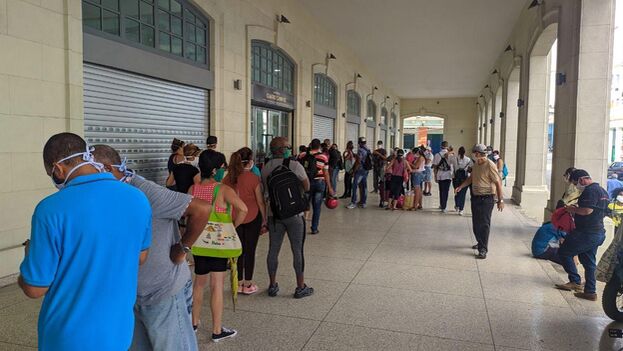
Waiting in line. A daily fact of life in Cuba.

14ymedio bigger14ymedio, Elías Amor Bravo, Economist, July 26, 2020 – Imagine that you’re going to your bank to open an account. One of the simplest operations in any country in the world.

You really could save yourself the trouble, if you want, because online banks offer a way to do that. In Cuba, it’s more complicated, although this option also exists.

On the Island, it’s normal to have to visit the bank, and in addition, to hurry, because there are only three places where you can open the account, and you will probably have to wait in long lines. Specifically, you can open the account in the Bank of Credit and Commerce (BANDEC), the Metropolitan Bank (BM) and the Peoples’ Savings Bank (BPA), all of them State controlled.

After waiting for hours, you address the employee and tell him you want to open an account in freely convertible money (MLC — moneda libremente convertible) so you can buy goods and services in the MLC shops, which are usually better supplied than the regular State stores. Your goal is to get the debit card associated with the MLC account, so you can buy everything.

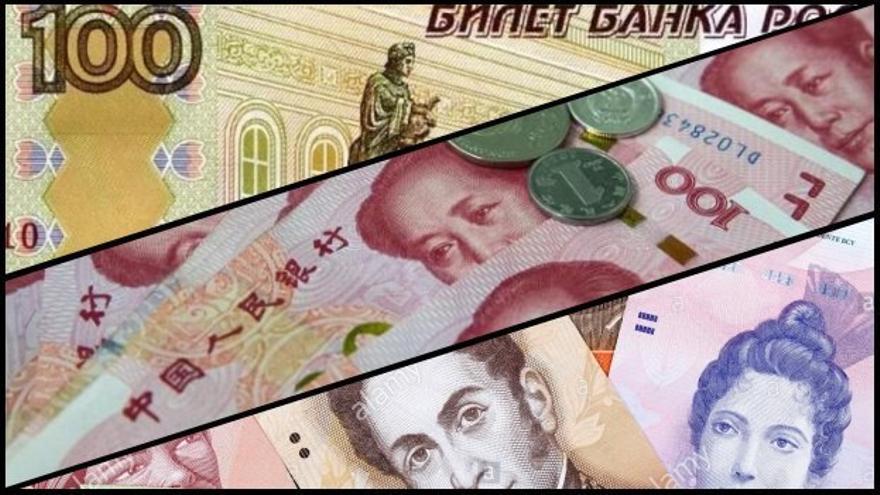
The first thing the employee clarifies is that the MLC shops are accepting U.S. dollars and euros. You can forget about using any money from Cuba’s commercial friends, like Venezuela, China and even Russia. They also accept, with a certain reluctance, Canadian dollars, British pounds and Swiss francs. And other currencies, like the Mexican peso, the Japanese yen, the Danish crown, the Norwegian crown and the Swedish crown, but they tell you that the account will be denominated in U.S. dollars, in accordance with the official exchange rates.

You’ve come well prepared, with your identity card (for example, your drivers’ license won’t work, but it’s okay, irregularities are thereby avoided), and you’re surprised when the employee informs you that you don’t need money to open the account. What’s more, don’t worry because the account can be opened with a zero balance. You don’t understand anything, and the wad of bills you have in your pocket is worrisome, because the employee is blunt when he tells you that the account has to be supplied with transfers made from the exterior – from abroad – whether through a bank or by Fincimex (the financial arm of CIMEX, a State entity) with remittances.

With a certain resignation you sign the first pile of papers, and stamps and other administrative elements are added. In the conversation with the employee, he suggests that you use the AIS USD card, which Fincimex offers the population, and he even promotes your request from overseas; in other words, the possibility exists that remittances from the exterior can be requested in the country where you are located. The employee can’t avoid commenting that my card might take a long time, we don’t do well with plastic here so it’s better to get the card outside, you would be able to make purchases sooner.

While the employee introduces the information into a computer, which crashes several times (the network is slow and the employee complains), he comments that BANDEC (a credit bank) offers anyone the possibility through the Transfermóvil application to request an MLC card without having to come in person to the bank branch (the online option). You think it’s a pity you didn’t know this before. You could have saved a lot of lost time, but in Cuba now it’s understood. And besides, you want to go with your card in hand to teach your friends and family how to use it.

But then comes the critical moment. When it seems that everything is ready and that the card is now within reach, the best part arrives. The employee tells you that the card won’t be there for 7 to 10 days, and it could be longer, and he asks for your phone number so he can call you when it arrives. Resignation. It’s not possible to leave the bank with the card.

Then you remember a similar transaction performed by a relative in a bank in Hialeah some months before, and how he left triumphant with the card, with assurance, with a policy of credit and several gifts from the bank. A different system. Once more, the employee whispers, to avoid being heard, deficiencies exist in the deliveries, and we’re continuing to work on this.

The fact is that when Monday comes you still don’t have the card, and when you consult with friends from work you realize that some have spent two weeks waiting, without news. The shops are open, but people can’t buy with cards that were issued by the banks. The lines shown on Cuban television are due to the fact that many buyers have other cards that can be used the same way.

In effect, in addition to the cards from BANDEC, BM and BPA, there are the AIS USD cards of Fincimex, which function in these shops and also in the other electronic payment channels of the Cuban banking system. You thought about the Visa card that was brought back from one of your trips to Miami, which you couldn’t find anywhere.

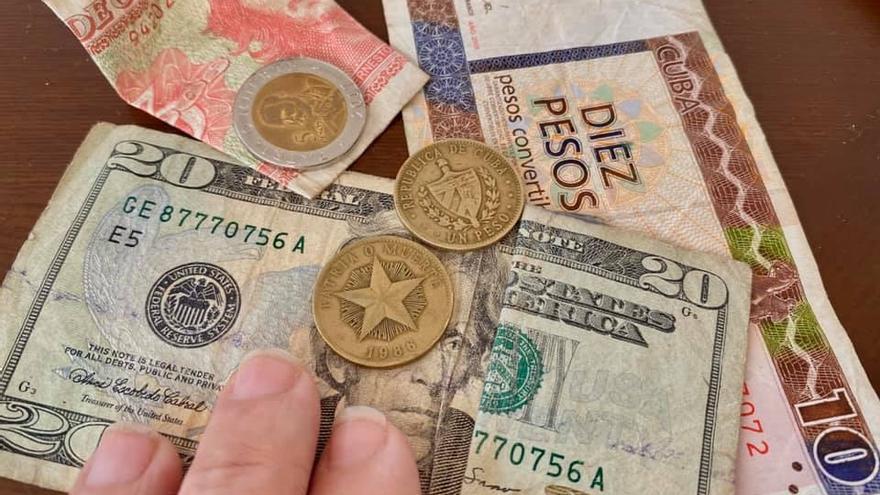
The employee has you sign several papers, while he gives final instructions. With this account and debit card you can go to another shop, not only to the USD one, and use it the same way. You also can access ATM machines and withdraw money, but be careful, you won’t get dollars or euros, only Cuban convertible pesos (CUCs), at the same exchange rate that the bank has right now for the U.S. dollar.

Then, you dare to formulate a question, only one. Are you sure that the tax on the dollar has been eliminated? The employee smiles and informs you that it was eliminated on Monday, July 20, in accordance with the measures approved recently by the Cuban Government. Before, if you came to the bank with North American dollars in cash, a 10% discount would apply. For example, if you brought 100 dollars they would deposit 90 in your account. Now that doesn’t happen. And he goes back to insist, again, that the account is now open and you don’t need to deposit cash right now.

However, he reminds you again about the three ways to have funds on the MLC cards. He recommends a bank transfer from the exterior and also by way of remittances through Fincimex.

The second can be through a transfer you receive from another USD account, between individuals.

The third is cash, and it can be in North American dollars or other currencies.

At this point, you wonder why they rejected your cash deposit and whether you understood anything at all.

Translated by Regina Anavy

___________________

COLLABORATE WITH OUR WORK: The 14ymedio team is committed to practicing serious journalism that reflects Cuba’s reality in all its depth. Thank you for joining us on this long journey. We invite you to continue supporting us by becoming a member of 14ymedio now. Together we can continue transforming journalism in Cuba.
Is Our National Money Still Worth Anything?

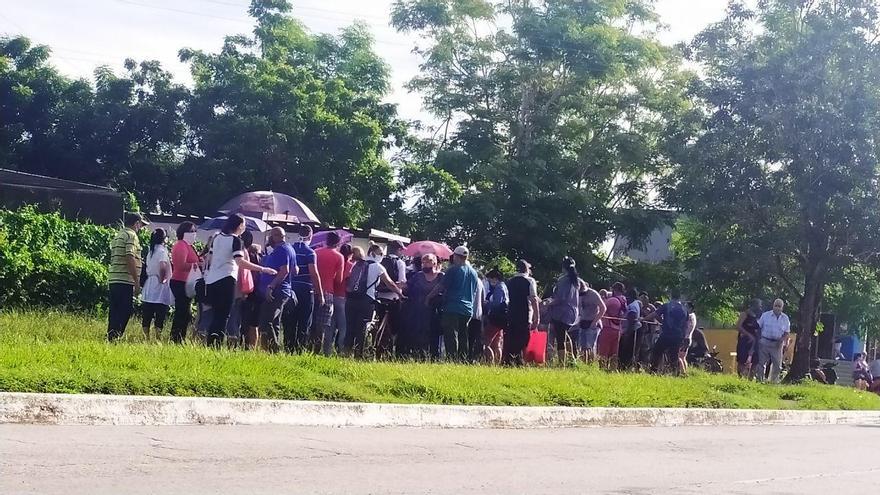
Many Cubans felt upset after standing in line and then seeing that the products they wanted in the hard-currency (divisa) stores were not abundantly available. (Facebook)

14ymedio bigger

14ymedio, Havana, July 21, 2020 – “Since I’ve had the use of reason they’ve inculcated us with the idea that we’re all equal, and now I understand that it’s not true,” writes Avelino, one reader among many of Cubadebate. Since Monday they’ve made their frustration clear about the beginning of the sale of food and hygiene products in hard currency, divisas. The official newspaper has received, up to now, around 70 comments that criticize the measure in a tone that’s closer to disappointment than indignation.

“How do I explain to my kids that their papá, a professional who studied and remained in Cuba, can’t buy the things they want, and the child of someone who doesn’t work and sells dollars or has a business can? Do you think the kids today want to be PhDs? Wouldn’t it be better to leave the country or sell dollars? Marx was clear: man needs to cover his basic needs in order to do the rest later. This is the despair that today weighs on the hearts of many Cubans.” Another reader, a PhD professor in science, writes: “People need real reforms that benefit their economic status.” He says he’s written several times before but wasn’t published.

Cubadebate published on Monday night a Quick Guide to the MLC (money freely convertible, e.g. hard currency) shops in Cuba, which explains the conditions for having access to buying in these establishments, how to set up bank accounts and obtain funds, and the list of basic, prioritized products that will continue being sold in the CUC and CUP (Cuban convertible and Cuban peso) stores. This list approximates quite well the one advanced by 14ymedio on Friday, although it adds some home appliances and construction materials and eliminates some of the food products listed by this newspaper. continue reading

The list is one of the points that has generated the most annoyance, as several comments reflect: “I still can’t understand which food products are considered high or medium range. Whatever product is being sold today in U.S. dollars is what people need. In fact, they’re what we already consume. Is mustard or Cuban ketchup really a luxury item?”

“I saw coffee today in the MLC shops. Do they also have it, as they say on the list, in the CUC shops?” asks someone else. “Because it’s been gone for a while.”

It hasn’t gone over readers’ heads that they couldn’t find a lot of the products seen in the widespread images in the new stores, and that they spent long hours in line trying to bring them home.

“Today in these shops they’re offering the same products that used to be sold in the CUC stores. They disappeared for months at the beginning of the pandemic, but now they’ve resurfaced in the MLC shops and are only a dream in the CUC stores,” reproached a woman.

Others prefer to cast a vote of confidence, but they don’t hide their discouragement. “It’s said there will be different products and that the ones we saw today are the same products that were in the CUC stores three or four months ago. We’re hoping this isn’t a way to make things more difficult for us. I have faith in our Government.”

But already some have determined that the new sales measure will have undesired consequences. “I just saw on [the on-line ad site] Revolico on Facebook that a 5 kg package of detergent that’s worth less than $6 is already being sold at 40 CUC [Roughly $40 US]. This only makes everything worse and encourages the businessmen and coleros (people paid to stand in line for someone),” responded a reader, to someone who asked what people who don’t have hard currency will do.

This question was the one that caused the most anxiety. It’s calculated that in 2019, about $3,716,000 in remittances was received by Cubans, and, although there are many beneficiaries (according to Western Union data some 62% of their offices), a large number of people are at the mercy of their salaries. The pandemic, with the closing of borders and the suspension of tourism, has left many others without hard currency.

“How are those who only have access to CUPs going to manage? What should we do to meet our budgets?” asks another bothered reader. “Why didn’t they do this 30 years ago so we could have avoided the dollar flight? Why are we so late in taking measures to stimulate the economy? They should give us answers to the problems now, because we’re losing capital. This has been the saddest moment to implement these measures. Many people are upset by their lack of access to hard currency and the shortages,” reasons a commentator.

“The Cuban who lives from his salary. How can he go to these shops?” continues another. “The shops in CUCs are mainly not supplied and the lines go on for kilometers. Please, we can’t pretend this isn’t happening. We’re realists. Go ahead and publish this if you want, but many people agree and we have the right to express our displeasure.”

But some readers, a few, have supported the Government’s decision. “The same shops, the same products, but those who have U.S. dollars will be repaid, indirectly incentivized to collect hard currency. Without creating social differences, without handing over monetary sovereignty to our historic enemy, without adding more money to the already complicated monetary unification,” defends a woman. Others try to calm the most annoyed, asking them for patience, because they’re convinced, as the authorities have assured, that the liquidity will permit them to improve the offers in Cuban pesos later.

“If we want to shop in the CUC stores, they have to be supplied. We shouldn’t be afraid or anxious about whether they’re filled with every type of product. And what about the CUP stores?” a reader asks Cuban president Díaz-Canel. “Is our national money still worth anything?” asks another.

Among all the comments, a reflection. “I don’t understand why the euro is elevated above the CUC and now dollars are back, when there’s an official international exchange rate between these two hard currencies. The citizen ends up receiving less than he had before.”

Translated by Regina Anavy

_________________

COLLABORATE WITH OUR WORK: The 14ymedio team is committed to practicing serious journalism that reflects Cuba’s reality in all its depth. Thank you for joining us on this long journey. We invite you to continue supporting us by becoming a member of 14ymedio now. Together we can continue transforming journalism in Cuba.
‘We Don’t Accept These Currencies’ : Rubles, Yen and Bolivars Excluded From Hard Currency Accounts

“Rubles, yen and bolivars cannot be deposited in hard currency accounts,” say bank employees. (Collage/14ymedio)

14ymedio bigger14ymedio, July 24, 2020 – The currency of the Cuban Government’s main political allies are excluded from the hard currency that can be deposited in bank accounts whose debit cards work in the State stores that sell food and cleaning products in freely convertible money (MLC). The State bank branches aren’t accepting deposits of Chinese yen, Russian rubles or Venezuelan bolivars in these accounts, as confirmed by 14ymedio.

“No, we’re not accepting these currencies,” is the categorical response of an employee at the Playa branch of the Banco Metropolitano. This newspaper received identical responses from a bank office in Old Havana, another in Vedado and a fourth in Central Havana. In each case, the workers were clear: “You can’t deposit cash in rubles, yen or bolivars in hard currency accounts.”

The steps to obtain the debit card start with opening a bank account in MLC, but there’s no indispensable requisite for depositing funds. “The client can come, get his card and then after receiving it begin to deposit. Yes, of course, the deposit has to be in currencies authorized by the Central Bank,” clarifies an employee of the branch on the ground floor of the Ministry of Transport. continue reading

On the list appear U.S. dollars, euros, pounds sterling, Canadian dollars, Swiss francs, Mexican pesos, Danish krone, Norwegian krone, Swedish krona and Japanese yen, but notable by their absence are the currencies of the countries with a political rhetoric more sympathetic to Havana: Venezuela, China and Russia.

“In January, I had some Chinese clients stay for three weeks, and before leaving they gave me some yen, so I got my hopes up about depositing them and buying some soap and toothpaste that were missing from the normal stores, but they told me that I needed hard currency,” Rosa María, owner of a rental home in Nuevo Vedado, told 14ymedio.

Something similar happened to a young man from the municipality of Cerro, who still had a few rubles left from his trip to Moscow last year. “I could use them to take a taxi from the airport in case I returned, but since I didn’t go back I now wanted to deposit them to get some things for the baby girl my wife and I just had.

In the bank branch at Línea and M in Vedado, the employee interrupted the young man’s question. “When I told him that rubles were worthless he looked disgusted and told me, ‘nothing of the kind, they were currencies of Canada, the U.S. and Europe, countries with strong money’. The young man left although he could have started the application for a debit card in MLC. ‘It will be empty a long time because I don’t have divisas’.”

In Venezuela, there are thousands of Cubans on official missions, and thousands of Cubans travel to Russia each year because they don’t need a visa to go there. As for China, tourism to Cuba has grown considerably these last years, so the possibility of getting money from these three countries is much easier than getting euros or British pounds.

On July 16, Miguel Díaz-Canel confirmed what this newspaper had already said about the opening of shops offering basic products in foreign money, exclusively through debit cards associated with national bank accounts, although the shops in Cuban pesos and convertibles would keep functioning in parallel.

These shops opened last Monday, and a wave of indignation was raised among those who lamented that the products which were scarce in the Cuban peso market now were abundant in these shops with prices in hard currency.

Translated by Regina Anavy

_______________

COLLABORATE WITH OUR WORK: The 14ymedio team is committed to practicing serious journalism that reflects Cuba’s reality in all its depth. Thank you for joining us on this long journey. We invite you to continue supporting us by becoming a member of 14ymedio now. Together we can continue transforming journalism in Cuba.
Without Chicken, With Long Lines and Police Surveillance, the Sale of Food in Hard Currency Begins in Cuba

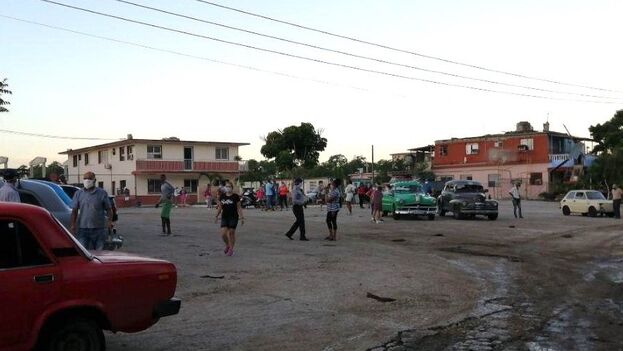
In the city of Sancti Spíritus, the line formed outside the Zona+ shop before dawn. (14ymedio)

14ymedio bigger14ymedio, Havana/Sancti Spíritus, 20 July 2020 — Since before dawn on Monday, the same scenes repeated themselves throughout the Island in front of the new divisa (hard-currency) shops: people lining up before the 9:00 a.m. opening, much police surveillance and, finally, not one single piece of chicken, the favorite product. The 14ymedio reporters confirmed this in several shops in Havana and the provinces.

The first light of day barely began to outline the contours of a park near the market of Boyeros and Camagüey in Havana, one of the places chosen on July 20 to offer food, domestic appliances and cleaning and personal hygiene products in “freely convertible money” (MLC), using debit cards.

Before 7:00 in the morning, more than 200 anxious clients had already accumulated in a scattered and chaotic line. Most of them were trying to shelter from the rising sun and the swarms of mosquitos that were taking advantage of all those bodies gathered together.

At the first light of dawn, some 250 people were already waiting near the shop of Boyeros and Camagüey to buy in divisas. (14ymedio)

A little later, an employee accompanied by a police official with two stars on his lapel approached the beginning of the line and began to assign the first 100 people to enter the shop in a group. The customers asked so many questions that the handover of the numbered tickets was interrupted several times by calls for silence and calm from the police official, who threatened to stop assigning numbers if they didn’t cool it. continue reading

Then came an employee who presented himself as the “head of the business” and addressed the line near the police, to explain the details of what was for sale. Now the sun was burning everyone’s shoulders, adding one more hardship for hundreds of customers who, upon arriving, were warned that they couldn’t take photos and would only be allowed to pass in a group when the previous one left.

“This shop has two categories: the sale of electronics, in addition to food and cleaning products,” screamed the employee so the whole line could hear. “This means that, for the sake of control over the electronics, the first 10 in line must hand over their identity cards to make sure they can get domestic appliances.” To the surprise of those who were waiting patiently, he added, “Just because we sell in MLC doesn’t mean that things aren’t limited.”

There followed an extensive explanation about the rationed equipment. “The air conditioners are limited to four per person; right now we have eight freezers in the shop, and more will be coming this week.” But cold water was really thrown on everyone when he said: “We can’t sell chicken. Until they supply all the shops in the country with chicken, we can’t.” A murmur of resistance came from the crowd.

Dozens of people were waiting Monday on the Boulevard de Sancti Spíritus to enter the shop La Colonial. (14ymedio)

“It’s the same line everywhere,” someone declared. “There are fryers but no refrigerators. We have a virtual shop, Almacén Habana, and the articles they sell on the website are the same ones they have here.”

The panorama at that hour was quite different outside the Doble Nueve shop, on Havana Boulevard, which was selling personal hygiene and cleaning products in MLC. Without customers, the morning’s peace was interrupted only by a police presence and the questions of some curious people who were passing by. The possible reason for the contrast is the shop’s location in the municipality of Centro Havana, where a low-income population resides.

The situation repeated itself at the nearby shop La Arcada on the same street, where the neighbors preferred to continue their daily activities earlier in the morning before stopping at the shop windows, where plenty of preserves, pasta and grains were on display.

At Línea and 12, the central corner of Vedado, the buying power of the district was noticeable. Some 100 people were waiting to enter the shop; they already knew by the rumors that there was beef, ground turkey and cheese in the refrigerators, plus shampoo, a product that has disappeared from the Cuban convertible (CUC) and Cuban peso (CUP) shops in the last weeks.

“There’s no powdered milk, only evaporated,” warned a beleaguered customer who approached to talk with the first buyer who left the shop, with two bags half-full. “She told me that what they have is more or less the same that they had some years ago in the shoppings (the CUC stores), no more no less,” says the woman.

“I came to look for a package of chicken breast at 33 CUC,” comments another customer who had been there before dawn but had given up on the line because the product she wanted wasn’t for sale. “The offers weren’t what I was hoping for; from what they announced it seemed like they were going to have everything, but it’s not true,” whined another.

At Línea and 12, the central corner of Vedado, the buying power of the district was noticeable. (14ymedio)

The frozen chicken, normally imported from the United States or Brazil, has become a national obsession these last months, and the lines to buy it, in strictly limited quantities, can last for days. There was an expectation that these supposedly “high-quality” shops would sell this type of meat.

In other provinces, the assortment is poorer than in the Cuban capital. The Zona+ shop in Sancti Spíritus didn’t have chicken; nor did it have detergent or oil. People decided to organize themselves with a view to the next few days in hope of a greater supply. “Let’s make a list for those who are waiting for new products,” recommended a customer.

“Hey, Mercedes, it’s the same old shit! There’s nothing, the only thing that’s changed is the money,” yelled an annoyed Santería woman from one side of the line. She said she had been there since 4:00 in the morning in order to, finally, “not enter the store, because they have nothing of what they said they were going to have.”

On the Boulevard de Sancti Spíritus, La Colonia, an old discotheque transformed into a CIMEX (Cuban army corporation) money exchange business, managed to attract dozens of the curious from early morning. The line is some distance from the entrance of the premises, and only customers in the vicinity who already have a ticket are let through. Each time someone comes out with a bag and walks a few steps, a nest of curious hornets falls on the person to ask questions.

“Do they have powdered detergent? What about toothpaste? Did you see if they have yogurt? How are the prices? Do you know if they have enough ground meat or if they got just a little?” The questions come from all sides. One woman with a serious face and nothing in her hands comes back through the door a few minutes after entering. “I stood in line for fun,” she announces in front of the grim expressions of the police, who are staked out along the whole street.

As far as prices go in the 74 new shops along the length and width of the country, customers complain that they are “higher than the exchange rate for CUCs to dollars” if you take into account the taxes in CUC of the shop merchants. But, yes, “everything was very clean, with air conditioning everywhere, and the employees were very friendly,” says a customer from the shop at Boyeros and Camagüey.

The shop La Colonia, on the Boulevard de Sancti Spíritus, was an old discotheque transformed into a business. (14ymedio)

“I remember in the ’90s when they opened the dollar stores that all of them were really nice, but then they deteriorated little by little,” adds the same woman. “I don’t know how long this one will stay in good condition, but if it’s anything like the country, maybe 15 days. It all begins well and then half a month later doesn’t function. I came today even though I had to stand in line.”

A glass jar with 1.8 kilos of preserved white asparagus, of the Spanish brand Aldaketa, costs a little more than 68 dollars, practically the double of what this product sells for in other shops outside the Island.

Among the predominant brands are the Spanish Vima and Celorrio, in preserves, and Kiriko in personal hygiene and cleaning products. Also, the Gallo and Romero for pasta or Luengo for beans, packaged in Spain but produced in the Ukraine.

Translated by Regina Anavy

__________________

COLLABORATE WITH OUR WORK: The 14ymedio team is committed to practicing serious journalism that reflects Cuba’s reality in all its depth. Thank you for joining us on this long journey. We invite you to continue supporting us by becoming a member of 14ymedio now. Together we can continue transforming journalism in Cuba.
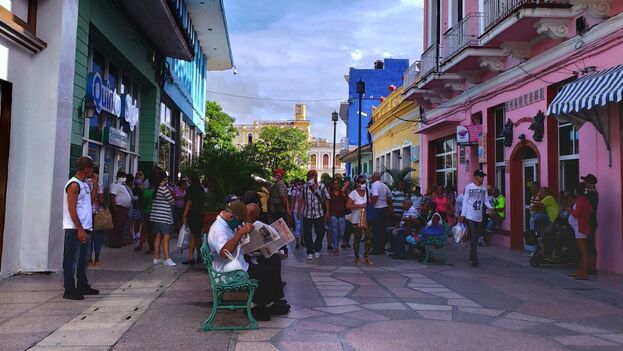
In the Middle of the Pandemic 31 Cuban Balseros Arrive in Miami

According to official data, so far in fiscal 2020, which began in October, 96 Cubans were intercepted at sea. (CBP)

14ymedio bigger

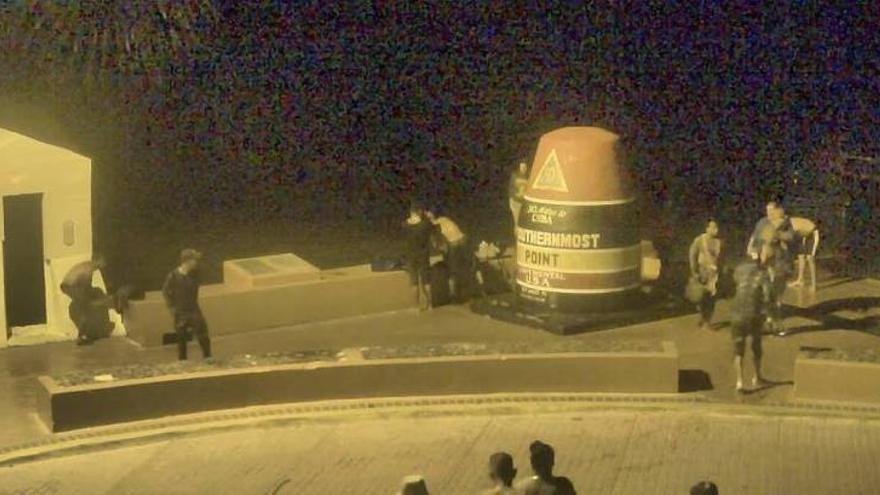
14ymedio, Havana, July 17, 2020 – A group of 31 Cuban balseros (rafters) arrived at dawn on Thursday on the coast of Cayo Hueso, Florida, according to local media reports. A short while after their arrival, authorities announced the arrest of 20 of them in Miami.

According to the migratory agreement signed under Barack Obama’s administration with the Cuban Government, the migrants will be returned to Cuba.

“Twenty Cuban migrants were arrested in the Miami sector,” John R. Modlin, the head agent of U.S. Customs and Border Protection, said on Twitter.

“The migrants were exposed to extreme temperatures in an overloaded, homemade boat without safety equipment. This type of trip from Cuba, it’s dangerous!” he added. continue reading

The landing was filmed by a couple who, in an interview with America TV, explained that they were shocked to see a mother holding a child among the rafters.

Junior Ramos and Katherine Molina were the young people who filmed the arrival, and according to what the migrants told them, it took one and a half days to get there from Cuba.

“We two were there and welcomed them to a free nation,” said Ramos. The couple confessed that the event would mark them “for life.”

According to official data, so far for fiscal 2020 (which began in October), 96 Cubans have been intercepted on the high seas. In 2019, a total of 481 immigrants from the Island were captured on the journey.

In 2017, Obama eliminated the policy of “wet foot, dry foot,”,which allowed Cubans who set foot on land to be admitted as refugees, with an expedited path to permanent residence.

Before the end of the “wet foot, dry foot” policy, in 2016, the U.S. Coast Guard counted the arrival of 1,845 rafters. In 2007, another tense year for U.S.-Cuba relations, the number reached 4,161.

The Cuban Adjustment Act, still in effect, allows for the regularization of migratory status for Cubans after one year of residence in the U.S., but it requires that they be admitted legally at the border. If they’ve arrived illegally by sea, they can’t invoke this rule. However, not all legal routes are closed, Alejandro Vázquez, an immigration attorney, told the Nuevo Herald.

“Immigrants who arrive by sea and aren’t detained can request asylum like anyone else,” he said.

The lawyer assured that even those Cubans who are detained upon arrival and show credible fear of returning to the Island can be released under personal recognizance or bail, pending an asylum trial, or remain detained pending a repatriation trial.

Translated by Regina Anavy

____________

COLLABORATE WITH OUR WORK: The 14ymedio team is committed to practicing serious journalism that reflects Cuba’s reality in all its depth. Thank you for joining us on this long journey. We invite you to continue supporting us by becoming a member of 14ymedio now. Together we can continue transforming journalism in Cuba.
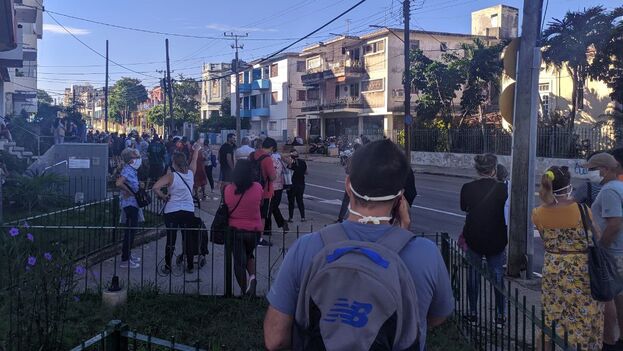
The ‘Truly’ Convertible Money Now Prevails In Cuba

Besides household appliances and auto parts, Cubans can now buy food and personal hygiene and cleaning products with dollars in the CIMEX* shops. (14ymedio)

14ymedio bigger

14ymedio, Reinaldo Escobar, Havana, July 16, 2020 – in the midst of a growing shortage in Cuban markets, the Government has decided to increase the distance between consumers and merchandise, improving the capacity to buy for holders of debit cards that can only be nourished with foreign currency. This commercial modality started at the end of last year for the sale of household appliances and auto parts, but now it’s being applied to food and personal hygiene and cleaning products.

The reason for this “partial dollarization” of commercial activity is that despite its name, the CUC (Cuban convertible peso) is not a convertible currency in international markets. It doesn’t make sense for the State to buy merchandise abroad in euros, yen or dollars to sell it later in the internal market in exchange for a piece of paper that has no real value and can’t be exchanged off the Island for any other currency.

Monetary unification has been announced many times, only to be postponed. As of yesterday, the Cuban peso (CUP), with which salaries are paid, won’t inspire envy, and the chavito (slang for the Cuban convertible peso) is now humiliated. What is valuable for real life will be the currency that is truly convertible: dollars, euros, yen or crowns. It’s not important that customers can’t get their hands on it; it’s enough that an electronic device can read the card and verify that the value is there. continue reading

In the absence of a political explanation that justifies this measure, it will undoubtedly be supported with reasons related to the restrictions imposed by the U.S. on Cuba, and with the infallible argument that what is collected will swell State funds in order to maintain social benefits. So a privileged minority that has access to foreign currency will finance a deprived majority.

When Fidel Castro introduced the dollar into the economy, he already accepted foreign investment and authorized self-employment, arguing that he was doing it to save the Revolution’s achievements.

Almost three decades later, it should be stated that, more than “saved,” these achievements only survived, at a high price and a highly regrettable standard. At this point, it’s not possible to go back to repeating the same argument.

Among the foreseeable consequences of this risky step, salaries will be farther away from being the natural support of the family economy, since almost everyone who has access to the debit cards won’t be part of the work force. This isn’t money earned “with the sweat of the workers,” but rather received as a handout or gift from the exterior.

The already growing social inequality will now extend to a highly sensitive sector: nutrition. What they’re going to sell in these stores aren’t “delicacies” but rather products of primary need, for which there’s a pressing demand.

What are they going to tell the kids of someone employed by the State when they ask why some of their classmates bring food to school for snacks that they can’t get?

Despite what is established in the Cuban Concept of the Social and Economic Model, in the Communist Party guidelines and in Article 65 of the Constitution, the new rule now won’t be “to each according to his work” but rather to each according to their relatives or friends abroad who are ready to send remittances. As a result, no one will now have the same enthusiasm for “the common work that provides justice to all,” but will strive to improve their personal relationships.

The dollarization of one indispensable part of retail commerce isn’t in itself bad news. It’s almost a blessing that this has been established by the present authorities, so that there won’t be leftist criticism of those who, after a foreseeable change, propose that everything be dollarized. In this sense they are already including other “advances,” like the elimination of workers’ dining rooms, the closure of Schools in the Countryside or the elimination of illegal gratuities.

The defect in this measure is its incoherence in relation to the other economic, social and political factors. It’s enough to remember that point 19 of the macroeconomic policies of the Party guidelines proposes “consolidating the pecuniary functions of the Cuban peso, with the goal of strengthening its role and preponderance in the monetary and financial system of the country.” Can undercutting the ability of the Cuban peso to convert itself into goods and services be a way of strengthening it?

When complaints about poverty are combated by arguing the inviolability of principles, believers close their mouths and forge ahead; but something will have to happen when principles are trampled underfoot and the suffering increases.

*Translator’s note: CIMEX is a State-owned Import-Export corporation. Its financial branch, FICIMEX, controls credit card transactions in Cuba and remittance wire transfers from other countries.

Translated by Regina Anavy

______________

COLLABORATE WITH OUR WORK: The 14ymedio team is committed to practicing serious journalism that reflects Cuba’s reality in all its depth. Thank you for joining us on this long journey. We invite you to continue supporting us by becoming a member of 14ymedio now. Together we can continue transforming journalism in Cuba.
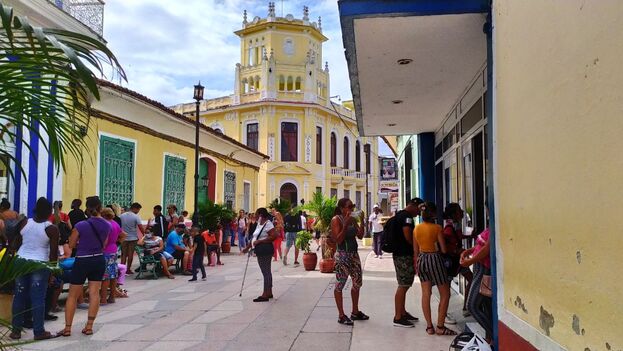
Elimination of the 10% Tax on the Dollar

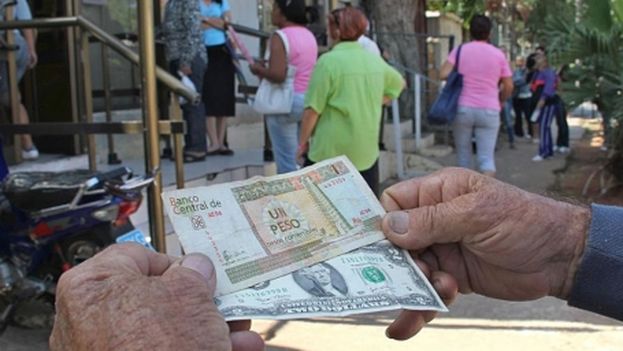
The Cuban convertible peso and a US two dollar bill. (EFE)

14ymedio bigger

14ymedio, Elías Amor Bravo, Economist, July 17, 2020 – Let’s imagine a government that spends 61 years calling another government an enemy, accusing it of economic harm. That includes, among other things, a prohibition against using the other country’s money. It also condemns to prison those who are caught transacting on the informal economy (the black market). Then, having said this, the government has no other solution but to return to authorizing transactions in said prohibited money for the purchase of food and cleaning products that are basic to the population.

And in addition, the authorities of this government maintain that the same old measure is fair and benefits all Cubans inside and outside the country. Incredible, because this is Cuba in the time of Díaz-Canel, and this is how the international communication media have covered this news coming from the Island.

Fidel Castro did it another way. When, in the middle of the Special Period he saw that the dollar was devouring the Cuban peso and that the national money was scorned by the population in the face of the free-for-all that brought with it the collapse of the Berlin wall, he created a fictitious currency, the CUC (Cuban Convertible Peso), in order to collect hard currency directly, and he didn’t bat an eyelid. continue reading

The dual currency in Cuba has been here for a quarter of a century and could continue indefinitely, in spite of the strain it puts on the functioning of the economy.  But Fidel Castro created the CUC, and no one up to now has had the courage to eliminate it. The CUC won’t survive the present measures. That’s for sure.

But let’s go to the heart of the matter, which has attracted the attention of the international media. It’s clear that this country, which had prohibited the use of the foreign enemy’s money, had established a tax of 10% on transactions, generally on remittances made in said currency. All of a sudden they decide to eliminate this tax. As there are few governments that act this way, you have to ask why the Cuban Regime has decided not to charge this 10% on transactions in dollars.

The question is easy to answer. Basically, a system of commercial intermediation was conceived last year with the sale of appliances, air conditioners, computers, auto parts, refrigerators, etc., and now they want to extend it to basic goods and cleaning products in 72 shops that will certainly have everything, as opposed to the State stores where, after long lines and wait times, you normally can’t get the product you want. Let’s say that, in addition, they have announced more products and shops for August. The Cuban Government sees commercial transactions with hard currency as a way to overcome the present Covid-19 crisis.

Why are we saying this? Basically, because now food can be imported and paid for with the hard currency that’s collected in the dollar stores by the sale of products—hard currency that doesn’t exist in the national economy because tourists haven’t come to the Island in four months, as the Minister of the Economy recognized. Thus, the dollars needed to buy corn or rice from the U.S. can be obtained in the shops which sell in Moneda Libremente Convertible [Freely Convertible Money). These shops are being inaugurated on Monday, July 20, by the Communist Regime, and everyone is very happy because the threat of a food crisis is thereby removed from the dismal scenario of the Cuban economy.

But this same measure has two sides, like the money. Side A is positive, because it allows Cubans who have access to dollars to open accounts in certain banks, obtain debit cards and embark on buying what they want in the stores. But the question is, what happens to the 80% of Cubans who have no access to the dollar, nor family in the exterior to send remittances?

This is Side B. They would have to save a lot, which is very complicated with the salaries they are paid, and they would have to exchange Cuban pesos with the dollar. The Cuban peso will be the first to notably depreciate in the informal market, and, most probably, these Cubans won’t be able to buy anything in these stores.

Surely Cubans will regulate this injustice in the informal economy, with creative formulas that show us how clever and capable they are. Meanwhile, State Security is training to put an end to the so-called “illegalities”, which are nothing less than a cry for freedom.

For the moment, let’s say adiós to the 10% tax on transactions with dollars, which Fidel Castro also established in 2004 to respond to what he called “attacks of the embargo”. The reality is that nothing has changed since then, even if the application of Title III of the Helms Burton Law has made things more complicated. Now the Cuban Communist Regime has decided to eliminate the tax so people won’t lose that 10%, which still doesn’t make anyone jump for joy.

No one should expect these measures to revolutionize an economy that, according to the latest data from CEPAL (the Economic Commission for Latin America and the Caribbean), will sink to -8% in 2020 (remember that in April they had estimated only -3.8% because things were going badly, and what is worse, much worse, is that this decline will continue). The Government has reacted by applying, inside the profit margins allowed, a measure that tries to obtain all the hard currency circulating in the country from remittances (the only hard currency that presently comes in).

The older generation remembers Fidel Castro’s dialectic against the U.S. and the threat of the dollar. Decriminalizing the possession of dollars took place in 1993 during the so-called Special Period, but before that date many Cubans suffered imprisonment and heavy fines for having dollars. History can’t be easily forgotten, and much less should it fall into oblivion when the past is reconstituted.

Before 1959, the U.S. wasn’t insulted for meddling in the Cuban economy. Prices in stores were established in dollars, and the peso was on a parity with the dollar. The Cuban economy rested on more solid fundamentals.

So much demagoguery and long hours with speeches empty of content in order to stop selling pork, shampoo and hamburger meat in dollars to Cubans in a series of select shops. Basic products in prices given in dollars in a country with two official currencies in circulation, the historic Cuban peso and the Castro invention called Cuban Convertible pesos. Sometimes history goes backwards from good sense to those who offend it by playing Russian roulette. What’s going to happen in Cuba starting from next Monday, July 20, has a lot to do with those lost battles by governments and political regimes, in which there is no type of justification for supporting them.

What’s bad about all this is that they want to present these measures as something beneficial for the Cuban people, when they aren’t. That 80% of Cubans don’t have access to the dollar leaves many people on the margin of this commercial system oriented to capturing hard currency. This causes discontent, because no one is going to understand this difference. In Cuba, the access to buying goods and services that don’t exist in other shops isn’t going to be a function of the value of work, strength, motivation or performance, without having family or friends in the exterior to send dollars. Is this the moral lesson that the Castro Regime wants Cubans to have? If those who govern the country have nothing better to do than insult those who question these measures, let them retire and make way for others. They are losing very valuable time that can’t be recovered. Luckily, Cubans know it.

Translated by Regina Anavy

____________

COLLABORATE WITH OUR WORK: The 14ymedio team is committed to practicing serious journalism that reflects Cuba’s reality in all its depth. Thank you for joining us on this long journey. We invite you to continue supporting us by becoming a member of 14ymedio now. Together we can continue transforming journalism in Cuba.
Cenesex Talks About Political Manipulation and Yusimi Persists

Yusimi González in her interview with Francisco Rodríguez Cruz, as reported by the journalist on his Facebook page.

14ymedio bigger

14ymedio, Havana, July 16, 2020 – The discussion about the homophobic statements attributed to an official of the Cuban Institute for Radio and Television (ICRT) has prompted the National Center of Sex Education (Cenesex) to make a statement giving a soft rap on the knuckles to Yusimi González Herrera and the organization, whom we’ve invited for a dialogue. In a meeting, González criticized the “affected voices” of some professionals on national radio because they don’t transmit a “credible message” to the audience.

“These last few hours we have become aware of an audio that is circulating on social networks in which Yusimi González Herrera, Director of Communication and Content for the Cuban Institute of Radio and Television and Deputy of the National Assembly of People’s Power, uses expressions that could be considered discriminatory in an analysis about the work of announcers, journalists and collaborators of Cuban radio,” Mariela Castro, Director of Cenesex, published on her Facebook page.

“Our mission and commitment to educate on subjects of sexual and reproductive rights prompt us to speak with the official and her institution. Such situations confirm for us the need to continue our work of training and awareness in the ICRT. Prejudices are not quickly overcome and thus require a permanent formative impact,” adds the text. continue reading

For this center, success with the official confirms the importance of “continuing to defend an educative process that sometimes may be more difficult”.

“We go forward together and close the doors to any manipulation that tries to convert these rifts into a political weapon in order to discredit what we are advancing,” concludes the note.

Yusimi González was interviewed by the journalist Francisco Rodríguez Cruz, who has offered a preview of the conversation; the entire text will be posted Thursday on his blog, Paquito de la Cuba.

“I’m sorry that I hurt people with a manipulated audio; really the one who should apologize is the person who manipulated this audio and used it to hurt people, to make them feel excluded and humiliate them to some extent. That never has been the intention of the Cuban Institute of Radio and Television. The Institute works with everybody; it has an inclusive policy,” says the representative in the preview video, which barely lasts two minutes.

González adds that the Institute “wants all its professionals, whatever their specialties, independently of their sexual orientation or any limitation or disability they have, to come into what is their house, which always receives everyone when they come to construct, unite and dignify a social project.”

The leaked audio generated a wide rejection in the LGBTI community on the Island, and some on social networks even have asked that the official be fired after this incident.

Translated by Regina Anavy

__________________________

COLLABORATE WITH OUR WORK: The 14ymedio team is committed to practicing serious journalism that reflects Cuba’s reality in all its depth. Thank you for joining us on this long journey. We invite you to continue supporting us by becoming a member of 14ymedio now. Together we can continue transforming journalism in Cuba.
Cuban Radio and Television Must ‘Be Careful About Political Propaganda Voices’

After the stir caused by her statements, Yusimi González excused herself from an interview with the journalist Francisco Rodríguez Cruz. (Facebook/F.R.C.)

14ymedio bigger

14ymedio, Havana, July 17, 2020 – “We have to be careful about the voices that transmit our political propaganda.” Thus, Yusimi González Herrera, a representative of the Cuban Institute of Radio and Television (ICRT), tries to explain what she said. Her controversial statements about the abundance of “high-pitched” voices on the Cuban airwaves became news this week.

In a new audio shared this Thursday on social networks, González, in conversation with Alfredo Zamora Mustelier, director of programs and the head of ICRT’s propaganda, spoke about the importance of the “architecture” and “design” of voices used to transmit political propaganda. “Can you imagine how people called to a march feel when they hear a high-pitched voice?” asked Zamora, provoking laughs among those present.

“More than that, Zamora,” interrupts González. “We have to be careful about the voices of those who transmit our political propaganda,” she explained, alleging that “they contain our identity, the defense of the Cuban nation, the country”. continue reading

After the stir caused by her statements, González excused herself in an interview with the journalist Francisco Rodríguez Cruz, whose full text was disseminated Thursday in his blog, where he said that the audio, the first of those played, corresponds to “a work meeting that lasted several hours”.

“It’s my voice and it comes from a meeting I had in 2016 about techniques of locution and other questions. It was a work agenda, and this was among the themes we discussed,” González said.

“What were we defending at that time and still defend today? That our channels and emissions all have a profile, a profile that defends and defines us, from rhythms, a profile across editorial lines, of sounds, timbres, tones. (…) That’s what we were talking about. (…) I believe the fragment that was selected comes from here, when we referred to high-pitched voices. There are high-pitched voices that work for one type of program, but not for another,” she added.

González said that the audio was “edited” to “convey the idea of the person who edited it” and “to imply that the station was evaluating high-pitched voices and whether people with this type of voice could work in the communication media, when it’s not true”.

“It’s never been the position of radio or television to limit anyone by sexual orientation, disability or skin color. This isn’t the case.”

In addition, she recognized that it’s possible that “at some moment” the Institute of Radio and Television could have been wrong “because humans can always improve themselves”, but she noted that they “knew enough to offer apologies”.

Asked if a specific apology for her words in that meeting would be fitting, she said that anyone who knows her “knows that this audio isn’t how I think”. However, she said she was sorry that some people “felt hurt” because “no one has the right to hurt anyone”.

Upon ending the interview, González denied having been aggressive, “as a professional, mother, daughter”, or that she also hurt her family and friends. “A speech has been manipulated, a contribution or a construction of my thinking at that moment. It has been used to injure other people, to try to create divisions, to mistreat people. And that’s not fair, it’s not something good people do, it’s not real”, she concluded.

Translated by Regina Anavy

____________

COLLABORATE WITH OUR WORK: The 14ymedio team is committed to practicing serious journalism that reflects Cuba’s reality in all its depth. Thank you for joining us on this long journey. We invite you to continue supporting us by becoming a member of 14ymedio now. Together we can continue transforming journalism in Cuba.
Without Water There Won’t be Squash in Urban Gardens

On the official list of commercial varieties of squash that the Ministry of Agriculture maintains there are almost 20 names. (14ymedio)

14ymedio bigger14ymedio, Marcelo Hernández, Havana, July 14, 2020 – Boris grows cucumbers, some varieties of garlic and aromatic herbs on the patio of his house in La Lisa, Havana. He says he’s preparing “for what’s coming, which will be hard,” so he’s filled about 20 plastic containers, which used to hold paint, with a little earth and gravel, and the incentive of necessity.

“I’m not going back to living in another Special Period,” he explains to 14ymedio. “When I was 12 they sold some little chicks that we had to raise at home, but they all died a little later because in my family there are mechanics, engineers and even a dentist, but no one knew how to grow food or raise farm animals.

Once he noticed that the present crisis was going to get worse, this graduate in geography, who works as a waiter in a paladar (privately-owned home restaurant) decided to learn the A-B-Cs of creating a garden on his patio, in a space of about four or five meters with a concrete soil, at the end of a hallway with several apartments on each side. Now he spends most of his time there. continue reading

In the last few months, as the shortage of products grew and Boris’ family spent more and more time finding certain condiments, he planted oregano. “It grows anywhere, so it’s a good way to prove that I can do it.”

“Then I added basil, garlic, several rosemary and parsley plants, which also did very well. As I felt more secure, I added cucumber and chili peppers, but I’ve had the most success with herbs for seasoning or making tea,” he says. “We can’t survive with this but at least we’ll have something to give taste and variety to the food.”

Several of his neighbors also benefit from the garden, something that has brought relief in the middle of the pandemic, with the farmers markets in the zone very short of food and the little carts almost missing from the streets because of police control. “I’ve turned into a real guajiro!” jokes the improvised farmer.

But now that he’s conquered his initial inexperience, Boris is facing other problems. “The delivery of water is what causes the most harm, because in this zone it’s been almost a week without it coming,” he laments. “I’ve had to carry water from other neighborhoods not only for the bathroom and mopping, but also for irrigation.”

Last March, the capital had 111 water supply sources damaged, 89 partially and the other 22 totally, and only one of the five water systems is in good shape, a situation that barely has changed with the passing weeks. Some neighborhoods in the capital have spent almost two weeks without receiving service.

As the shortage of products grows, many Cubans take a chance on growing aromatic herbs and vegetables on their patios. (Flickr/Alexander.Kafka)

“A garden in every house and in every neighborhood sounds very good, but when people start growing everywhere, what’s going to happen with the little water we have?” asks Boris’ neighbor, who approves of the practice of growing food but worries about the building’s cistern “drying up”. However, he admits that the garden’s garlic and chives have “saved several meals”.

“You throw a few seeds, wait a few days and there it is,” is how Felipe Agüero describes it. He’s a retired truck driver who began planting on a small parcel behind his building in Reparto Bahía in Havana. Cucumbers, aromatic herbs and several papaya plants are his greatest pride, but these days it’s the squash that is the butt of most of his neighbors’ jokes.

“I had squash before all this racket started, and it’s not one of the most interesting things to plant,” he clarifies.

Gerardo González, Vice President of the Committees for the Defense of the Revolution (CDR) and ex-spy imprisoned for years in the U.S., called for a massive planting of squash, triggering  all kinds of jokes on social media. “If every CDR produces one squash and there are 138,000 CDRs in the country, then there would be 138,00 more squash,” affirms González during a visit to Camagüey.

On the official list of commercial varieties of squash that the Ministry of Agriculture maintains they are almost 20 names, but, in practice, there are six which are the most common on tables. The differences go from the form, passing to the size, the texture of the shell and even the arrangement of the seeds inside.

“You can grow squash year-round, but you have to be very careful in the months of July and August because there’s a lot of blight when it’s hot,” warns Agüero. “What I produce here is very small, but to grow it seriously, you must have good seed and keep the irrigation stable, something very difficult to do in the city.”

He waters his small garden by a hose connected to the building’s water supply. “When there’s no water it’s lost work because all the strength in the seeds can be gone in a few days, which has happened to me many times.”

“Here what I can get are seasonal herbs for cooking, but it’s clear that my family can’t live only on this,” says Agüero. “Sometimes it’s only a distraction for me, to pass a little time outside the house and think about something other than my problems, but the fear I have now is that they’re saying if you already have a garden, you don’t need to buy in the bodega (ration store).”

It’s better not to talk to Agüero about pineapple. “Anyone who asks you to plant pineapple everywhere knows nothing about agriculture,” he points out. “It’s a very aggressive plant because its leaves poke and cut,” and it’s not advisable at all to plant pineapple on a patio, a terrace or in a garden because it’s a danger for people, animals

“When I was a boy and lived in Quivicán, my father used to plant pineapple to separate the other crops, like a kind of natural barrier to prevent the cows from getting into the more sensitive crops, and also to dissuade thieves,” he remembers.

“It’s better for me to continue with my herbs to solve my problem a little, and I’ve even been able to sell some. Basil is the favorite because people use it a lot for religious cleansings,” explains Agüero. “With the money I get for the basil, I go and buy the pineapple or squash that I can’t find in the store.”

Translated by Regina Anavy

_________________

COLLABORATE WITH OUR WORK: The 14ymedio team is committed to practicing serious journalism that reflects Cuba’s reality in all its depth. Thank you for joining us on this long journey. We invite you to continue supporting us by becoming a member of 14ymedio now. Together we can continue transforming journalism in Cuba.
Miami Judge Dismisses the Application of Helms-Burton to Carnival

Carnival began its cruises to Cuba in 2015, after relations were re-initiated between Havana and Washington under Obama’s mandate. (EFE)

14ymedio bigger14ymedio, Havana, July 13, 2020 – A federal judge in Miami last week dismissed the lawsuit against Carnival Cruise Line brought by a Cuban American, Javier García-Bengochea, who says he is the legitimate owner of the property seized in the port of Santiago de Cuba.

García-Begochea, a neurosurgeon and resident of Jacksonville, inherited the property from a cousin who lived in Costa Rica, and the Cuban Government appropriated it in 1960.

In the judgment of the magistrate, James Lawrence King, although the plaintiff legally received his inheritance, non-U.S. citizens are not allowed to claim confiscated properties in the U.S. by taking advantage of the provisions of the Helms-Burton Law, something that Congress, said the Judge, had tried to avoid. continue reading

The plaintiff’s lawyers announced that they are considering possible options for the future, although some media, like The Wall Street Journal, consider that this could set a bad precedent for the hundreds of claimants in a similar situation, either because the court dismisses their lawsuits or because this case disincentivizes the presentation of others.

Carnival had already requested last year that the complaint be dismissed. The cruise company alleges that the heir who originated the claim wasn’t in conformance with Costa Rican law. In addition, García-Bengochea acquired the land in 2000, after the cut-off date specified by Helms-Burton, which is March 12, 1996.

John Kavulich, President of the U.S.-Cuba Trade and Economic Council, and contrary to the re-activation of Title III of Helms-Burton, said that the judge in Miami “has set the tone for other judges”.

When Title III took effect, an avalanche of demands was expected, since nearly 6,000 claims valuing over two billion dollars had already been certified by the U.S. Government for citizens who had lost property in Cuba.

However, barely thirty lawsuits have been filed against hotels, airlines or financial institutions, including hotel search companies. Among those affected are Amazon, Melía, Société Générale S.A. and American Airlines.

According to Kavulich, many were waiting for the first judicial pronouncements to calculate the probabilities they had for winning some compensation by virtue of the law.

García-Bengochea also had claimed in 2017 a compensation of more than six million dollars from Communications Construction Company Ltd., headquartered in Peking, for “trafficking” with the same property in Cuba.

Translated by Regina Anavy

_______________

COLLABORATE WITH OUR WORK: The 14ymedio team is committed to practicing serious journalism that reflects Cuba’s reality in all its depth. Thank you for joining us on this long journey. We invite you to continue supporting us by becoming a member of 14ymedio now. Together we can continue transforming journalism in Cuba.
Melia Suffers a Reverse in a Spanish Court Over Its Hotels in Cuba

The Hotel Sol Rio y Luna Mares, in Playa Esmeralda, Holguin, is on land that belonged to the Sanchez Hill family before 1959.

14ymedio bigger

14ymedio, Havana, July 10, 2020 – The court of Palma (Baleares),which is in charge of the Sánchez Hill family case against the Melía group over the exploitation in Cuba of two hotels, has rejected three petitions from the company, according to Vozpópuli, which revealed on Friday the contents of the resolution approved on July 6.

Melía, which managed the hotels Paradisus Rio de Oro and Sol Rio y Luna Mares on lands expropriated in Holguín from the family after the 1959 Revolution, alleged that the demand is a covert attempt on the part of the heirs to evade the European rules and apply extraterritorial law in Spain. At the root of the adoption of the Helms-Burton Law in 1996, the European Union preventively created a cutoff statute that annulled the effect of foreign resolutions.

The court rejected this allegation upon considering that this supposed intent isn’t proved. The Sánchez Hills initiated the lawsuit in 2019 under the U.S. law, but the Spanish court dismissed the case for lack of jurisdiction, so the family decided to invoke the crime of illicit enrichment, which can be investigated in Spain. Upon reopening the case for this presumed crime, the court believes that there is no proof of intent to use Helms-Burton. continue reading

Melía’s second petition raised a prejudicial question to the European Union Tribunal of Justice so that it would indicate how to proceed. This type of consult is done by European judges so that the cases raised are adjusted to the communitarian right when there is some doubt. The Palms court thinks it’s not necessary to appeal to Luxembourg and that the case can be resolved with the strict application of applicable Spanish law.

Finally, Melía asked that measures be adopted to maintain the confidentiality of the trial and requested the Sánchez Hill family to sign a non-disclosure agreement, since they think the documentation could be used for a future trial in the United States. The Court considers that there is no reason to adopt measures that are “restrictive and contrary to the principle of publicizing the proceedings in a democratic society”.

Melía told the Spanish newspaper that it is not surprised by the decision and is sure that the court will rule in its favor because “there are elements of facts and rights so the lawsuit will be dismissed in its entirety”.

The Spanish court can’t judge claims for goods confiscated in Cuba, but it can pass judgment on what is raised now as a personal claim of action for compensation from a company headquartered in Spain.

However, the hotel still will enter an appeal before this Saturday. If it does so and is rejected, proceedings could be initiated for the Sánchez Hill family to reclaim 10 million euros.

Translated by Regina Anavy

________________

COLLABORATE WITH OUR WORK: The 14ymedio team is committed to practicing serious journalism that reflects Cuba’s reality in all its depth. Thank you for joining us on this long journey. We invite you to continue supporting us by becoming a member of 14ymedio now. Together we can continue transforming journalism in Cuba.
Some 40 Cuban Health Workers Have Fled From Qatar In The Last Few Years

The Cuban Hospital of Qatar, inaugurated in 2012, is considered “the jewel in the crown” of the international Cuban medical missions”. (Facebook)

14ymedio bigger14ymedio, Havana, July 12, 2020 — In spite of the vigilance and fear of being discovered in the middle of preparations, some 40 Cuban health workers have escaped from the official mission in Qatar. In order to accomplish this, they had to pretend, lie or disguise themselves, according to an extensive report published on Friday in the Spanish newspaper El Mundo.

The article reports the testimony of three professionals who worked in the modern installations of the Cuban Hospital in Dukhan, 80 kilometers west of Doha. The health workers relate the story of their flight, “worthy of a Cold War spy movie”, says the text, in which the anonymity of those interviewed is preserved in order to avoid possible reprisals.

“I remember I was very afraid of being discovered. I dressed like an Arab. I put on a tunic and a scarf. I had to disguise myself every time I visited the U.S. Embassy in Qatar,” said Yadira, a young nurse who escaped from the official mission and now lives in the United States. continue reading

The Cuban Hospital in Qatar, inaugurated in 2012, is considered “the jewel in the crown of the international Cuban medical missions”, a prosperous business managed by the Company for Cuban Medical Services. Yadira worked for more than two years in the installation and remembers the control over the Cuban staff.

“I’ve always been a rebel, and it’s very difficult for me to follow orders I don’t find logical. Some people accept certain things; others, no. They wouldn’t let me get married. There were many reasons why I didn’t feel free to choose,” she explains. “I had time to prepare my flight; I trained myself mentally and avoided doing anything that could give me away.”

Alexis, another nurse who served in the hospital for more than three years, shares similar experiences. “The pressures start when you arrive. In the airport, before saying hello, they take your passport and make you know that all your movements will be controlled. They make you aware that you are simply a chess piece and that you will be moved as they choose.”

Qatari Government sources insist that the hospital center is a private organization, but the lack of transparency even involves the amount of money that Cuba receives for each professional. “They never told us how much the Corporation was paying for each one of us. Unofficially it was said that they were paying 13,200 euros monthly for each nurse. We were receiving a monthly salary of 1,000 dollars,” comments Alexis.

The location of the hospital, in a zone with very high temperatures the whole year, near the main gas and oil field of Qatar Petroleum, also favors control over the personnel. “It seemed incredible how in the middle of a desert there could have been something so amazing. It had technology that I couldn’t even imagine existed,” admits Rolando, another of the nurses who escaped from the Cuban mission.

The three health workers benefited from the parole program for medical professionals created by the U.S. in 2006, which was in force for more than a decade. “I had to go several times to present documents and tests that showed my identity. And yes, that was very stressful. I had to go disguised to the appointments. If they found out what I wanted to do, they surely would have sent me back to Cuba,” remembers Rolando.

“After some months they advised me that my request had been approved. But as I didn’t have my passport, I had to wait until I could take my vacation in Cuba. Once in Holland, with a visa in hand, I could buy a ticket for Miami,” he says.

The fear of reprisals if the authorities detected their intentions obliged the workers to sharpen their wits. “A short time after arriving at the hospital, the abandonments began. They started by going to Europe and the U.S. The pressure on us grew. We had to attend weekly meetings and listen to constant political harangues. There were people dedicated to controlling us,” says Alexis.

“At the peak of the exits, two or three professionals were deserting every 15 days. Around 40 people left, and there would have been much more if the program hadn’t been abolished in 2017,” commented the nurse, who also had to resort to dissimulation to avoid the possible presence of snitches.

After making contact with the U.S. Consulate in Qatar, Alexis acquired the traditional attire of Qatari men—a thawb, the white tunic, and a ghutra, the scarf—to go to his meetings in the embassy.

“Through a fake email account I made contact with the Embassy. It’s very complicated because the Cuban personnel in Qatar are isolated in the desert, and the Government of Cuba is interested in keeping them there. They have control over your movements, they know when you go out and the hours you do. You have no right to take private transport and can only travel in buses to specific places and at concrete times,” he relates.

“It was hard to make appointments at the Embassy when you supposedly were going somewhere in Doha to buy something and to leave from there disguised as an Arab to go to the Embassy, with the fear that they were photographing you and that someone might see you,” Alexis says.

“I made four visits to the U.S. Embassy, all incognito, with my cell phone turned off and a very high stress level. I used parasols, caps and everything that could keep someone from recognizing me. The Embassy is about 300 meters away from a highway, in a flat space where there’s nothing. You have to cross it and it’s said there are people from Cuban State Security taking photos of everyone who enters and leaves.”

The “deserters”, as the official Cuban propaganda calls them, are punished with being prohibited from entering the Island for a minimum period of eight years, the loss of their professional accreditation and family separation, but even so the escapes continue. “There was a psychological shock. Everyone was speculating, jokingly, about who would be the next to abandon the mission,” says Alexis.

“There were previous cases that didn’t turn out well, and you had to have a plan B and C.  The consul escorted me on the return trip to Cuba. The layover in Holland offered me the opportunity to do what I had to do to escape. It was a hard decision, because since then, I haven’t been able to hug my family,” remembers Yadira.

The coronavirus, with infection rates going up on the Arabian Peninsula, has been converted into a buoyant economic opportunity for the battered economy of the Island. To the 300 professional health workers who recently landed in Kuwait are added almost 200 of the Henry Reeve contingent who were working in a field hospital in the Industrial Zone of Doha.

“We were isolated in a golden cage, and we couldn’t drink alcohol or eat pork, which in Qatar is a right for foreigners who can get a license to buy them. They weren’t letting us do so many things and there wasn’t much we could do,” Alexis concludes bitterly.

Translated by Regina Anavy

_______________

COLLABORATE WITH OUR WORK: The 14ymedio team is committed to practicing serious journalism that reflects Cuba’s reality in all its depth. Thank you for joining us on this long journey. We invite you to continue supporting us by becoming a member of 14ymedio now. Together we can continue transforming journalism in Cuba.
A New Call For Possible Dialogue In Order To Overcome The Crisis

Masked police agent controls line to buy food in Havana (File photo)

14ymedio bigger14ymedio, Elías Amor Bravo, Economist, July 8, 2020 — The virulence of the economic crisis that is battering Cuba, as a consequence of containment measures for the Covid-19 pandemic, is becoming more serious and profound than expected. Spaces for dialogue are opening up because of the surge in outbreaks, which create uncertainty about the future.

The data and information trickle in drop-by-drop for the authorities to confirm. And if it’s true that no data exist on the economic situation, some that are known, like the statistics on travelers, are frightening. In May, only 993 visitors arrived, which represents a decrease of 99.7% compared to the same month last year. Tourism has disappeared from the Island, and possibilities for recovery are scarce.

Certainly it won’t happen in 2020. The authorities will go back to their sales pitch to explain the failure, but they won’t have far to go. The forecast for economic development in Cuba has to be revised downward and thus assumes that the economy can collapse, given the great importance of the State in all economic activity. continue reading

There is nothing now that allows anyone to have any real confidence in the future of the economy. Our estimate of the drop in the economy’s GDP was initially situated around -6.2% when CEPAL* showed only -3.8%. The data and information that come from the Island require caution and point to a particularly important decline, probably in the neighborhood of -10%, almost three points lower than the initial estimate. This puts Cuba among the countries that could be the most affected by the crisis in Latin America, although it won’t be the only one.

The fact that we’ve revised our initial prediction downward shows the lack of confidence and credibility in the authorities to surmount the present crisis. It’s difficult for any country to try to confront such a situation on its own, so this whole experience is going to be harder and more complex than was believed.

In reality, there isn’t any analyst who thinks that a true recovery of the Cuban economy will happen in the last two quarters of the year, so 2020 will be remembered as a time when the Cuban economy came close to collapse, because of the intensity and unexpected origin of the crisis.

The updated forecast contemplates a complex international scenario for tourism, with risk factors of difficult control from the Cuban perspective, which will have a potential negative effect on recovery. This downward trend of tourism will coincide with lower remittances, a low level of foreign investment and fewer exports of minerals and tobacco.

As a consequence, hard currency will be scarce, and that will put the brakes on imports. In addition, on the internal front, the agricultural sector won’t be capable of producing sufficient food for the whole population. The authorities know this, and the building industry isn’t going to bail out the economy because the State’s budget has committed resources to current expenses, which will have limited impact in terms of growth.

In sum, these factors, together with inattention to the self-employed, abandoned to chance by the Government, depend on the political goodwill of the leaders and their ability to promote measures that really serve to bring the economy out of the hole it’s in. Perhaps if, instead of making individual decisions based on communist orthodoxy, all sectors of the economy, State and private, came to the table for a dialogue, the Regime leaders would realize the enormous importance and the social support they would have; for example, if they approved a special fund to help the economy recover.

Decisions of this type could serve to establish the basis of an economy centered on a common goal, incorporating an integral plan of reforms and support for the private entrepreneurial fabric. At the same time, resources could be generated for the social protection of the least-favored groups because of the crisis.

The authorities of the Cuban Regime still haven’t accepted that they have a long and difficult process of recovery ahead of them, a great challenge in the coming months, which will demand far-reaching measures that, alone, might not give them the results they need. The moment for dialogue and consensus has arrived.

Unilateral Communist decision-making must end. If they want to light the way to the first fruits of recovery, they have to participate in all the plans for aid proposals, and they must have the funds and tools available to transform the economy. Díaz-Canel’s government must understand that the survival of the Cuban economy depends on being able to confront the task of economic reconstruction by collaborating with all State and non-State economic agents, and by promoting  a climate of political and social dialogue on new foundations, which will help Cuba return, as soon as possible, to a sense of sustainability and fiscal consolidation.

The challenge in the next few months is to support a progressive return to growth and consolidate the first fruits of the recovery. Without dialogue, it will be impossible.

*The United National Economic Commission for Latin America and the Caribbean

Translated by Regina Anavy

______________

COLLABORATE WITH OUR WORK: The 14ymedio team is committed to practicing serious journalism that reflects Cuba’s reality in all its depth. Thank you for joining us on this long journey. We invite you to continue supporting us by becoming a member of 14ymedio now. Together we can continue transforming journalism in Cuba.

Blackouts and Covid Outbreaks Appear in Havana

The authorities will control the perimeter affected in Lawton from 8:00 pm as well as the seven bus stops on routes 1 and 23 so no one can get off. (Amy Goodman/Flickr)

14ymedio bigger

14ymedio, Havana, July 9, 2020 — The epidemiological situation is complicated in Havana, and the light at the end of the tunnel never arrives. This couldn’t be better said. On Wednesday, while part of the capital was living in a blackout that lasted for nine hours, the authorities, in their daily meeting about supervising the pandemic, were claiming that the “consumption of electricity” is stable.

It was only one of many good-news articles that they wanted to send through the official press. There’s chicken, “there’s no problem with the supply of flour,” the bank branches in the whole country are working and Guantánamo and Santiago de Cuba are keeping a lid on Covid-19.

Transport is also in a favorable situation, and even the sale of tickets is beginning on Thursday in the province of Matanzas, which has entered into phase two, for travel beginning on Tuesday, according to Eduardo Rodríguez Dávila, the Minister of Transport. continue reading

Everything is going well, according to the Government. Less so in Havana, of course, where there hasn’t been electricity, transport doesn’t function (the First Minister said he received complaints of overcrowding, and the President requested staggering work hours to avoid crowds), and the pandemic hasn’t abated.

On Tuesday, they activated isolation measures for four blocks of Pilar-Atarés, in the municipality of Cerro, yesterday they announced the closure of a quadrant of Lawton, in Diez de Octubre, and the strengthening of monitoring measures in Arroyo Naranjo. Without forgetting that a focus point in Centro Habana is still active.

Some 7,000 people were affected by the isolation in Lawton, where they detected four cases of coronavirus in the last few days, covering the perimeter between Fonts, Aguilera and Calle 13 to the west; Calle D in the south, Porvenir to the west, and Calle 14 y Juanelo to the east. The area is divided, in turn, into two zones: one for the population that lives in one of them, which includes 10 blocks, where PCR (polymerase chain reaction) tests were given; while for the remaining group, 16 blocks long, they will do rapid testing.

Among the measures that the residents have to live with, in addition to tests and monitoring, is the use inside and outside their homes of masks, which is difficult to supervise; although, according to the official press, severe actions will be taken if citizens violate the provisions.

In addition, hawking remains prohibited, as does the increased sale of chlorine, hypochlorite and disinfectants, and the homeless population will be attended to. The authorities also have said that they will distribute food and water to homes of the vulnerable population and will organize commercial activity to minimize the usual tumult associated with buying.

The authorities will control the perimeter from 8:00 pm, as well as the seven bus stops on routes 1 and 23, so that no one will get off.

Until the results of the tests are released, no one can leave the zone, insisted Luis Antonio Torres Iríbar, President of the Consejo de Defensa Popular (Popular Defense Council). He urged that food be guaranteed for the residents and asked for “conscience and discipline.”

The situation in Arroyo Naranjo is different. There have barely been two cases of Covid-19 in 15 days, with known sources of contagion and contacts, who tested negative. However, its proximity to the province of Mayabeque, where there have been cases, has been the motivation for taking measures.

In this sense, the norms are more general: maintaining distance, using a mask, washing hands, disinfecting homes and other areas with a solution of water and alcohol.

Also, more medical attention has been requested, and supervision for taking temperatures and testing the population, beginning with work centers. Supplies of food and articles of hygiene are equally needed.

“You have to remember that these places are on the front line of Covid, not in the first phase of recuperation, and, thus, they must comply with all the measures,” said Torres Iríbar in reference to the affected zones in the capital, like Centro Havana, San Miguel del Padrón, Cotorro and Cerro. In Cerro, the most recent, confirmed cases now reach 20, although El Cotorro continues to be the municipality with the highest rate of incidence.

Yanet Hernández Pérez, the Vice Governor of Havana, claims that the province fulfills the five criteria noted for being in the first phase of recuperation: the rate of incidence, the reproductive index, the number of active cases, the positives whose source of infection is known in the last 15 days and number of events open to the public.

Translated by Regina Anavy

_________________

COLLABORATE WITH OUR WORK: The 14ymedio team is committed to practicing serious journalism that reflects Cuba’s reality in all its depth. Thank you for joining us on this long journey. We invite you to continue supporting us by becoming a member of 14ymedio now. Together we can continue transforming journalism in Cuba.