They Voted for Everything to Continue the Same / Ana Mercedes Torricella

elecciones1
My neighbor Nelly, when she learned that I did not go vote and I again clarified that I did not want to leave Cuba, told me: “You independent journalists and dissidents are going to be alone with the hard-liners and the snitches! Come on, you have to leave, there is nothing else!”

cubanet square logoCubanet.org, Ana Mercedes Torricella, Havana, 22 April 2015 – On Sunday, April 19, those who voted in the municipal delegates election of the Popular Power did it under compulsion, as is customary. They voted, like it or not, for business as usual and for “the same people.” In other words, “these people,” as many Cubans say in reference to the regime.

For the majority, the voting does not matter. Their most expensive and cherished interests are food and the money to acquire it.

I have some neighbors who live a misery of fear. The youngest, who was very beautiful, managed to marry an Italian, and she move to Genoa. Some years ago, when she came to visit Cuba, she bought gifts and brought them Euros. But that family did not use that money to buy furniture or to fix the dilapidated dwelling: they used it to buy stereo equipment. Currently, they alleviate their hunger with blaring music, which they listen to while they drink rum or some other cheap liquor. continue reading

Often they get the speakers to the front door. So the whole neighborhood feels the music. They get them out when it is one of their birthdays, for Mother’s Day, the end of the year or any other day that there is something to celebrate. And also when there is some party for the Revolution or what they call elections.

Last Sunday, from before midday, my neighbors had the speakers out and put on the music. If that can be called music. They were the first to vote. “To get out of that shit fast,” they told me. They voted for any of the candidates. It was all the same to them. Later they ended the day with reggaeton and cheap alcohol.

My neighbors speak horrors of “these people,” they say that they owe them no gratitude, but they give no sign of giving up voting and every time insist that they need them for something, the recommendation certificates that the CDR (Committees for the Defense of the Revolution) grants to “those who fulfill the work of the revolution.”

Compulsion, extortion and blackmail are the mechanisms for arranging massive membership in the CDRs, the FMC (Federation of Cuban Women), the CTC (Cuban Workers Center) and the other official organizations that the regime puts forward as “civil society.” Repression, always present, completes the picture of the necessary unanimity.

That was the scene on Sunday, April 19, in the districts open to called elections for delegates to the municipal assemblies throughout Cuba.

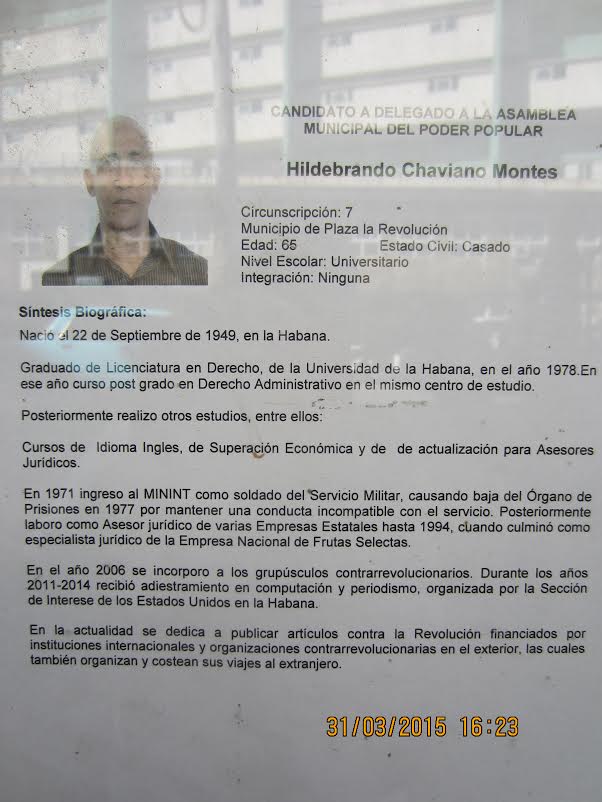
The candidates’ biographies had the usual typographical errors in full view with almost no one interested in reading them. Maybe with a little more discretion than on other occasions, the PC (the trusted people of the only party) indicated for whom to vote.

According to preliminary official figures, 85% of registered voters voted. Then they corrected and added a little: 87.30%. We suppose that the true percentage of abstention was higher. Now the government does not dare to speak of more the 97% participation as it used to some years ago.

A 13 to 15% abstention rate may be normal in other countries, but in Cuba it is quite significant: here the only ones who do not vote are those who are openly against the regime.

To not answer the call to vote suggests losses that not everyone is ready to assume. He who works for the master, omnipresent, omnipotent, and omniscient state may lose his job. He who is self-employed might lose his license. He who lives in the limbo of a tolerated illegality, like the lottery bet takers or the vendors of something stolen for someone, will have to confront the police.

In these terms, the best thing is to go vote early and not look for trouble. “Overall, everything is going to be the same!” is the general consensus. No one wants to look for trouble, and not going to the polls is certainly looking for big and very serious trouble.

My neighbor Nelly, when she learned that I did not go vote and I again clarified that I did not want to leave Cuba, told me: “You independent journalists and dissidents are going to be alone with the hard-liners and the snitches! Come on, you have to leave, there is nothing else!”

This is a bleak truth. Especially for young people. Like Nelly. Almost no young person has plans for the future in Cuba. All aspire to go. Anywhere. By plane or raft, with passport or without. They no longer want to share the air with “these people” who don’t let them live. Much less to bring children into this corrupt environment. So, Cuba languishes, ages, dies of stagnation.

On Sunday April 19 they voted for everything to remain the same, which means not only bad, but worse.

Translated by MLK
138 Votes for Chaviano / 14ymedio, Victor Ariel Gonzalez

Vote count in polling station number 2 of Hildebrand Chaviano’s district (14ymedio)

In the polling place on the ground floor of the FOCSA building, the vote count placed the opposition candidate only 18 votes behind the candidate who won the nomination

14ymedio bigger14ymedio, Victor Ariel Gonzalez, Havana, 20 April 2015 – At polling station number 2, located on the ground floor of FOCSA, the vote count ended near seven in the evening, and Hildebrando Chaviano, the opposition candidate, came in last place. So far, no news. But things change if the data are analyzed. Of the 448 valid ballots, Hidlebrando Chaviano received 105, only 18 fewer than the candidate finally nominated. A complete triumph for someone described by the official biography as “counterrevolutionary.” Also, 14 blank ballots and 25 cancelled ones were counted at this polling station.

“The population is not prepared, there is much ignorance and confusion created against us but even so, much has been achieved because never before has it come to a candidacy,” the lawyer explained to the EFE agency; he is a resident of the Havana neighborhood El Vedado where he ran and was elected by the residents of his zone. continue reading

In all, Hildebrando won 138 votes in his district, according to the telephone report by the opposition candidate himself minutes after the count ended. His colleague Leonard Hernandez, of Digital Spring, was an observer at the other polling station that completes the district (number 1 on 13th Street between M and N) and said that there were 33 ballots for the opposition candidate there.

Outside of polling station number 2, a small group of Government sympathizers began to scream “Viva Fidel” and other repeated slogans. Among them were numerous agents from State Security who observed each movement and each visitor. The international and Cuban press crowded the office in which the polling station was situated.

With the votes of the two polling stations added, the total of valid votes in the district was 741, according to information supplied by Chaviano. The winner, with 208 votes in his favor, received 28% of the total valid votes, while the support for opposition candidate Chaviano was about 19%, only nine points behind for this unprecedented candidacy.

“The changes have to be mental, above all losing fear and deciding to vote for the ones that you truly want, not for what they have always placed here for me which is not going to solve anything,” said the dissident who believes that his candidacy has given the citizens of his zone the opportunity to be “a little disobedient.”

Translated by MLK

Press Freedom in Cuba Is the Most Threatened in the Americas / 14ymedio

At the beginning of March, official journalist Leandro Perez was detained in Cuba while he was photographing an arrest (Indomar Gomez/14ymedio)

The Island is among the top ten countries of the world with the greatest censorship

14ymedio bigger14ymedio, Havana, 21 April 2015 – The control that the Cuban government exercises over the media was one of the strictest in the world in 2014 and the most rigid in the Americas, according to the report published Tuesday by the Committee For the Protection of Journalists (CPJ). The nonprofit organization with headquarters in New York, which works to protect the world’s press freedom, puts Havana in 10th place on the list of States with the highest levels of censorship but notes “significant progress” in recent years.

The CPJ’s report stresses that “print and broadcast media are totally controlled by the single party and have to be ‘in line with the objectives of the socialist society.’ Although the Internet offers some space for critics, the service providers block the undesired content,” as is the case with 14ymedio. continue reading

The organization highlights the difficult situation of independent journalists and bloggers who have to use websites hosted outside of the Island or access foreign embassies or hotels in order to have an unfiltered Internet connection. In spite of the opening of some critical spaces, this content mostly continues to be inaccessible to Cubans who still do not have a high speed Internet connection.

The research by CPJ highlights that visas for international journalists are awarded selectively and that the Government “continues to persecute critical journalists through harassment, surveillance and short-duration detentions,” citing the cases of Juliet Michelena Diaz and Angel Santiesteban Prats.

The greatest worry in the case of Eritrea centers on the possible death of five journalists arrested in May 2001, about which exiled colleagues raised the alert. Faced with the impossibility of being able to confirm it, the CPJ keeps the professionals on the list of prisoners in order to prevent the case from falling into oblivion.

North Korea, with tightly controlled and centralized information, occupies second place on the list. The official number of people possessing mobile telephones (excluding those that arrive as contraband from China) is about 9.7%. The control of information in the Asian country is so remarkable that all mention of Jang Song Thaek, the ousted and then executed uncle of the leader Kim Jong-Un, has been eliminated even to the point of editing the audio-visual material in which he appeared in order to suppress images of him.

The tactics used by Eritrea and North Korea are repeated to different degrees in other countries with strong censorship. The repressive regimes cling to power thanks to a combination of monopoly over the media, harassment, surveillance, threats of prison for journalists and restrictions on the entry of and movement by foreign correspondents.

Seven of the ten countries with the greatest censorship – Eritrea, Ethiopia, Azerbaijan, Vietnam, Iran, China and Burma – are also among the world’s greatest jailors of journalists, according to CPJ’s annual prison census.

In Saudi Arabia – the country with the third greatest censorship – the monarchy in power does not limit itself to silencing domestic dissidence, and partners with other Governments of the Gulf Cooperation Council in order to assure that criticism of institutions in each of these countries is harshly repressed.

In Ethiopia – fourth in the ranking of countries that censor – the threat of prison has contributed to a strong increase in the number of exiled journalists. The anti-terrorism law approved in 2009, which criminalizes any coverage that according to authorities “foments” or “offers moral support” to illegal groups, has been imposed on many of the 17 journalists who are prisoners of the country’s jails.

Vietnam – the sixth most-censored country – uses a vague law against “the abuse of democratic liberty” in order to incarcerate bloggers, and Burma – the ninth – is supported by the Official Secrets Act of 1923 in order to prevent criticism of its military forces.

In Azerbaijan – the fifth most-censored country – the criminal defamation laws have been extended to social networks and can carry up to six months in jail. Iran, seventh on the list, has one of the world’s strictest Internet censorship regimens, with millions of websites blocked.

The other four countries (Belarus, Equatorial Guinea, Uzbekistan and Turkmenistan) were close in finishing the ranking, since they all have every few independent media outlets.

Translated by MLK

The “Opening” by “Granma” / Diario de Cuba, Hildebrando Chaviano Montes

In a passage about today’s elections, the Communist Party newspaper “Granma” says that “every citizen has the right to a single vote […] regardless of [his] political position.”

DiariodeCuba, Hildebrando Chaviano Montes*, Havana, 19 April 2015 — The daily Granma, in its Wednesday, April 15 edition, brings a timid message of opening hidden in an article about the Cuban electoral system.  The mention that “in the process of electing delegates to the Municipal Assemblies the vote is characterized as being:  free, equal, secret, direct, nominal and preferential (Prieto Valdes and Perez Hernandez)” may not call the attention of many readers.

However, the mentioned authors make a contribution to the Constitution of the Republic itself when they explain that “every citizen has the right to a single vote and of equal value, without regard to race, religious belief, skin color, political position.”

The passage, although incomplete in my opinion, obviously is supported and inspired by Article 42 of the Cuban Constitution which says:  “Discrimination on the basis of race, skin color, sex, national origin, religious belief, and any other offense against human dignity is proscribed and prohibited by law.” continue reading

The substitution, however, of the phrase “any other offense against human dignity” by the more specific “political position” is noteworthy for being the first time that there appears in the official organ of the Communist Party an admission that different political positions exist in Cuba and above all, that they have equal value.

The express recognition by the mentioned jurists that Cuban political thought is not a single one but is rich in its diversity, as in any other country on the globe, is the first public gesture that could lead to a lifting of the strict blockade on ideas imposed since 1959.  Some may think that the Government is manipulating a sensitive topic in order to ingratiate itself with old and new friends, but at this point speculating with pretty words does not seem smart.

Moreover, and at the risk of being accused of being a dreamer, naïve and even a collaborationist, this could well be the antecedent of future changes announced in an obsolete Constitution whose roots date to 1917 and which stopped being justifiable many years ago, above all in Latin America, a natural environment in which Cuba seeks to insert itself but where the left is not entirely red but more pink, generally respecting the market economy and democratic institutions.

“Chavista” Venezuela constitutes the exception to the political pragmatism of the Latin American left; taken by the hand of Castro I, it jumped into the abyss into which apparently Castro II does not wish to accompany it; he increasingly distances himself from his predecessor, undoing as he can the inherited absolutist framework.

Triana Cordovi in Economics and Prieto Valdes and Perez Hernandez in Law, are for the moment isolated authorized voices whose academic discourse has nothing to do with the Real Socialism defended with shouts and blows in Panama a few days ago.

All of Cuban society is obligated to force the necessary changes.  In the same way that according to those illustrious professors the votes of those who have a different political position are equally valid, so is the candidacy of anyone who does not profess the Communist faith.

Discrimination on the basis of political ideas is as offensive to human dignity as racial discrimination; a change with respect to the official discourse tempered with the current times would go a long the way to replace the absurd ideological hatreds with tolerance and civilized dialog among all Cubans, for the good of all Cuba.

*Translator’s note: Hildebrando Chaviano Montes is an opposition candidate for the local People’s Power; the regime allowed his candidacy but his “biography” (the only campaigning allowed) identifies him as a “counterrevolutionary… funded by foreign groups.”

Translated by MLK
The Forbidden Fruit for Cubans / Cubanet, Isis Marquez

FRESAS-DE-LA-DISCORDIA
On the Calipso farm they cannot give interviews to uncertified journalists. Nor are photos permitted. (Photos Isis Marquez)

Any farmer caught selling to the general population the strawberries that he cultivates will be fined 1000 CUP* (national currency) and have his land confiscated

cubanet square logoCubanet.org, Isis Marquez, Havana, 17 April 2015 – The strawberry is the forbidden fruit for Cubans. Its limited national production is for tourists and for the olive green hierarchy. The State limits the production because it sells for 2.4 euros per kilogram on the international market. Some say that it was introduced onto the island in 1965. Fifty years have passed and still the Cuban people cannot consume this exquisite strawberry. Maybe the Cuban government pretends that its people do not eat these fruits, which are anti-oxidant and anti-carcinogen?
Caption:

Benefits of the strawberry

The strawberry is a short cycle fruit rich in vitamin C. Its compounds have a high anti-oxidant power, as well as increased anti-cancer activity, and it prevents aging of the brain.

In February Cubanet had the opportunity to speak with vendors Kolia Morejon and Jorge Aspen, who said: “We are here because our client left us loaded. We have to sell the product to passersby before they go bad. We sell the small tin for 1 CUC*, the big one for 3 CUC. continue reading

Cubanet decided to investigate where the strawberry is cultivated for the purpose of investigating how and why the people do not have access to buying the “forbidden fruit” for their tables.

The odyssey of the strawberry

First you arrive at “Las Canas” community located on the border between Alquizar and Artemisa. Then you have to travel along La Roncha highway. From there on is where the communities called Maravilla, Calipso, Neptuno and La Pluma begin. In these inaccessible places is where strawberries are cultivated. These particular farms belong to the “Rigoberto Corcho” Cooperative of Artemisa.

Kolia Morejón and Jorge Aspen

On the Calipso farm as soon as I spoke with the producer Nadir Jimenez, he said: “I am sorry, we cannot give interviews to foreign journalists who don’t come certified with a letter from the Municipal Delegation of the ANAP (National Association of Small Farmers) in Artemisa or with a letter from the Ministry of Agriculture. Nor is it permitted to take photos of the crops. I am very sorry, but I cannot help you.”

Later, on the La Pluma farm, I was able to speak with a vendor identified as Julio Cesar Frias: “The strawberry is an exclusive product for the tables and the pastry shops of the 5-star hotels, and for some special contracts established with private bars and restaurants.”

And he assured: “We cannot market the strawberry to the population. Inspectors impose a fine of 1000 pesos in national currency and confiscate the farms. To go out to Havana to sell one can (5 kg) means dodging the control points, the police, the inspectors and the devil himself.” Frias concludes: “When we manage to overcome the controls, in Havana, we sell the frozen pints for 1 CUC and the big ones for 3 CUC.”

On La Roncha highway I found a couple who preferred not to be identified, and they had recently acquired a 3 CUC pot. They said: “The strawberry that is produced is for the trusted people of the area. If you have friends, good contacts with the “bigwigs” of business and the municipal ANAP, you can have the luxury of coming and buying. We recommend that no outsider approach anything here if he does not come well ‘endorsed.’”

Later a passerby identified as Norberto Joel Batista added: “The strawberry is only for the rulers of this country, the tourists, the military and the new bourgeoisie. For us there is no opportunity to buy the strawberry. Strawberries definitely are the Cuban’s ‘forbidden fruit.’”

Strawberry buyers who were not identified

Fruit for the privileged

Later, back in the city, I entered the “Betty Boom” snack bar, with very American style and design, which is on 3rd Avenue and 60th Street. There I consumed a strawberry frappe that cost 2.8 CUC for the large cup. The customers obviously were foreigners and privileged Cubans.

Translator’s note: Cuba has two currencies, the “Cuban peso” or CUP, also known as “national money,” and the “Cuban Convertible Peso, or CUC.” The CUC is pegged to the US dollar but with exchange fees costs roughly $1.10. The Cuban peso is worth about 4¢ U.S. Most wages are paid in Cuban pesos, and the average wage is generally the equivalent of about $20 U.S. monthly. Pensions are much lower.

Translated by MLK
Enough with the Charades, Cuba Deserves Free Elections / Cubanet, Roberto Jesus Quinones

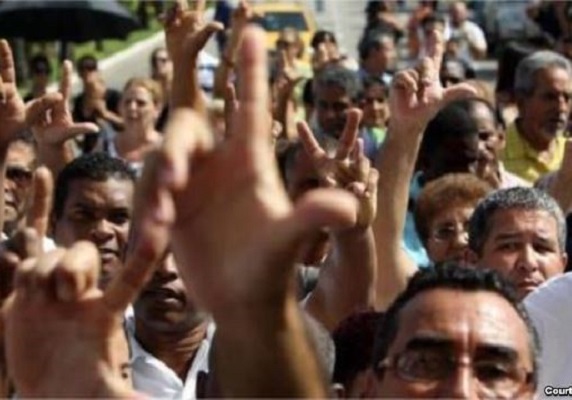
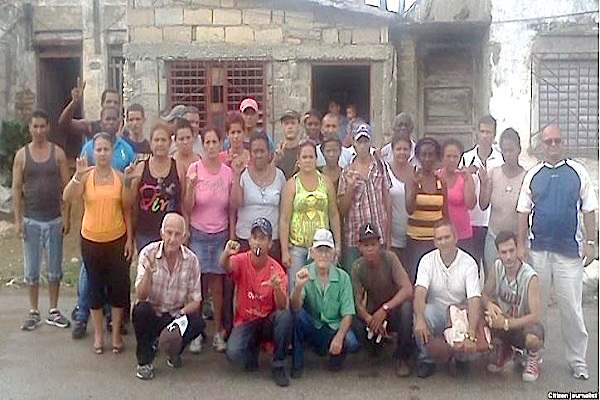
people with L fingers cuba

In order to “elect” there must be different political parties to choose from, and only one is legal on the Island: The Communist Party

cubanet square logoCubanet.org, Roberto Jesus Quinones Haces, Guantanamo, 17 April 2015 – Coming up on April 19 there will be “elections.” Many countrymen ask about the changes that the Electoral Law will introduce.

The most democratic electoral law in the world?

In Cuba there are no elections, just votes. There are no elections because in order to elect there must be different platforms, and here only one is legal. Absolutely all the delegates and deputies respond to this; that’s why it does not matter for whom you vote.

Every time one of the People’s Party (which is the “people’s” in name only) elections approaches, the official media overwhelm us citing the supposed blessings of our electoral law, according to them the most democratic in the world. continue reading

It is an illusion. The only supposedly democratic thing in our electoral system is the election of candidates as district delegates. It’s true that the residents of each of the zones into which the district is divided elect a candidate through a direct and public vote, but that is the visible tip of the iceberg. The hidden part is comprised of the multiple meetings of “the community revolutionary elements” – i.e., Party members, “combatants” (former soldiers), leaders of the Committees for the Defense of the Revolution (CDR), the Cuban Women’s Federation (FMC), etc – where those attending are directed how to block any candidacy unwanted by the regime and who to vote for.

The people that staff the polling stations are subordinate to the government. They count the votes and give the results to the stakeholders who are present at each polling station, but there exists no access by the people to the vote count in the Municipal Electoral Commission, which receives the results from each polling station in the district and reports who was elected.

The delegate as well as his voters lack any real power to make decisions and transform his neighborhood, and it is for that reason that the former has turned into a mere complaint clerk.

Finally, 50% of the delegates to the Provincial Assemblies from the People’s Power and the same percentage of the deputies that make up the National Assembly are not elected by the people but “handpicked” by the official Candidates Commission. In these assemblies there will never be a decent, hard-working and patriotic Cuban who disagrees with Communist ideology. So what is the democracy of this law?

A Cuba “with all and for the good of all”

The Constitution of 1976 in its preamble declares that it is the will of the government that the law of laws be presided over by the profoundly Martí desire to make the first law of our Republic be the worship by Cubans of the full dignity of man.

Article 1 states: “Cuba is a socialist state of workers, independent and sovereign, organized with all and for the good of all, as a united and democratic republic for the enjoyment of political liberty, social justice, individual and collective well-being and human solidarity.”

The drafters of the socialist magna carta deemed that such desire was fulfilled. But reality, more stubborn than any triumphalist sentence, proves that the Cuban state is not organized “with all and for the good of all,” as José Martí dreamed, but for the “Revolutionaries.” The other citizens are excluded, jailed and discriminated against. Reality demonstrates that a single political party supplanted the State and controls everything, prohibiting the existence of any other organization of that kind.

In such conditions there is neither democracy nor political liberty. There is no social justice because in order to access certain jobs and higher education, loyalty to the Communist Party and the Revolution is demanded and because increasingly the State abandons the elderly, the disabled and low income people.

There is no individual well-being because workers receive miserable wages and have to buy basic products in a currency other than that in which they are not paid and that is worth 25 times more. There is no collective well-being because public services degrade further every day, and health and education are in a precarious state. There is no human solidarity because there is physical assault and intolerance in the face of diversity, as was demonstrated once again at the recent Summit of the Americas. Of what full dignity of man do the Communists speak?

What many Cubans do want

What many Cubans do want is to enjoy the same civil and political rights that the citizens of 34 other countries in the continent have.

They want to decentralize the State’s absolute power and to build democracy from the neighborhood up because sovereignty lies with the people, and they have to have the means to express it. For that reason it is spurious for a leader who has not been elected by ordinary people to make a decision or to believe that he expresses the interests of an entire people without consulting the opinion of the citizens.

Cubans want to elect people who really represent them at the different levels of government and are not merely uncritically consenting.

They want all the delegates to the provincial assemblies of the People’s Power and the deputies to the National Assembly of the People’s Power to be elected in their districts through direct and secret vote, publicly verified, and that the same occur with those who lead those government organs and other important offices like prosecutors, tribunals and police units.

They want to choose the political program that most satisfies them and to elect their president in multi-party elections supervised by international agencies.

That is the desire of the majority of Cubans, and as long as it is not fulfilled, the Communists should have the decency not to talk about elections or democracy.

About the Author

jesus-quinones-haces.thumbnail (1)Roberto Jesús Quiñones Haces was born in the city of Cienfuegos September 20, 1957. He is a law graduate. In 1999 he was unjustly and illegally sentenced to eight years incarceration and since then has been prohibited from practicing as a lawyer. He has published poetry collections “The Flight of the Deer” (1995, Editorial Oriente), “Written from Jail” (2001, Ediciones Vitral), “The Folds of Dawn,” (2008, Editorial Oriente), and “The Water of Life” (2008, Editorial El Mar y La Montana). He received the Vitral Grand Prize in Poetry in 2001 with his book “Written from Jail” as well as Mention and Special Recognition from the Nosside International Juried Competition in Poetry in 2006 and 2008, respectively. His poems appear in the 1994 UNEAC Anthology, in the 2006 Nosside Competition Anthology and in the selection of ten-line stanzas “This Jail of Pure Air” published by Waldo Gonzalez in 2009.

Translated by MLK

“Many Voters Will Not Vote for Me” / Cubanet, Orlando Freire Santana

Hildebrando Chaviano (photo by the author)

“Some do not know me well, some are prisoners of fear.” Interview with opposition member Hildebrando Chaviano, candidate for delegate to the People’s Power.

cubanet square logoCubanet.org, Orlando Freire Santana, Havana, 15 April 2015 – Independent journalist Hildebrando Chaviano is one of the opposition candidates nominated by districts in the capital with a view towards the midterm elections to be held this coming April 19. In order to learn of the most recent events surrounding his nomination, we visited him in his apartment on the 28th floor of the Focsa building in the El Vedado neighborhood.

Q: Have you noticed any change recently in your neighbors’ treatment of you?

A: “I can tell you yes, indeed. But a change for the better. Neighbors approach me and greet me cordially. Even those who have never had a close relationship with me, now I notice they are friendlier.

“However, the neighbors from the building are one thing, and another is the workers of the State establishments located here in Focsa. Many of them, due to the extent of their working hours — especially those in the food business – will vote at this polling station on the 19th.   And certainly, I am aware that they have distanced themselves from me. I am convinced that they have been told categorically that they may not vote for me.

“Even recently there occurred a telling event. Some reporters from the German television station Deutsche Welle visited me. When they were leaving we came to the building’s reception area where they wanted to take some pictures of me. The receptionist, very startled, left the place, because according to her own words, ‘Not for anything in the world could I appear in those photographs.’” continue reading

Q: What has been the popular reaction to the exposure of your biographical data, full of insults for being a “counter-revolutionary?”

A: “My perception, basically through conversations with my neighbors, is that this time the biographies have been more widely read than in prior elections. They have even told me that they have seen passersby, who have nothing to do with this polling station, stopped in front of the photos and biographies.

“Most of the neighbors are convinced that the insults placed in my biography are revenge by the authorities for a nomination that they did not expect.”

Q: Do you believe that voters are ready to support an opposition candidate?

“It is undeniable that there are many voters who are not going to vote for me. I am not referring to neighbors from my building but to people in the rest of the district. Some because they do not know me well, and others are prisoners of fear. Among the latter ideas are entertained like ‘what if there is a hidden camera that films the voting,’ ‘what if each ballot has a password that identifies the voter’… Nevertheless, it is no less certain that people want something different, and many see me as a brave person who has decided to confront the machinery of power.”

Q: Do you believe that an opposition delegate can adequately carry out his work in the midst of the bureaucratic structures of the People’s Power?

A: “I think so, as long as you have a program of action. Because, look, here almost all the delegates that enter office do it without a defined program, and therefore they become simple ‘errand boys’ between their voters and the municipal governments. Under those conditions, obviously, they end up swallowed by the governmental bureaucracy, and they also lose the trust of the voters.

“I appreciate that my trips abroad have given me insights about initiatives that could be implemented at the community level.”

Biography written by the official electoral commission (photo courtesy of the author)
Biography written by the official electoral commission. Among other things it says that Chaviano is a counterrevolutionary and that his activities are funded by foreign groups (photo courtesy of the author)

Q: What message do you send to Cuban voters a few days before the election?

A: “The voters must lose the fear of voting for an opposition candidate. They should be convinced that it is possible to vote for a candidate who does not represent the interests of the government. Because even in the hypothetical – and almost impossible – case of finding out the identity of the voters, it would not be possible to repress so many people simultaneously.”

Translated by MLK
“The Regime Wants the US to Buy Cuba with the Dictatorship Included” / Cubanet, José Luis León Pérez

Guillermo Fariñas, coordinator of the "Juan Soto García Guilfredo"  United Anti-totalitarian Forum (FANTU), winner of the 2010 European Parliament "Andrei Sakharov" Prize
Guillermo Fariñas, coordinator of the “Juan Soto García Guilfredo” United Anti-totalitarian Forum (FANTU), winner of the 2010 European Parliament “Andrei Sakharov” Prize

“If the Cuban government aspires to be included among the democracies it must accept and respect the opposition.” Interview with Guillermo Farinas.

cubanet square logoCubanet.org, Jose Luis Leon Perez, Santa Clara, 7 April 2015 — Before leaving for Panama for the Civil Society Forum, Guillermo Farinas, Coordinator of the United Anti-totalitarian Forum (FANTU), who holds a critical view of the negotiations between Cuba and the United States, agreed to an interview with Cubanet.

What is your opinion about the Seventh Summit of the Americas, about the presidents of Cuba and the United States sitting for the first time at the same table?

Dialog is better than war. Personally, I think that Barack Obama erred by not taking into account Cuban civil society, the internal, non-violent opposition, when he took that step. But we must not concentrate on criticizing Obama, but the Raul Castro regime, his character and that of the top leaders, our true adversaries. continue reading

When Raul Castro returns from the Summit, will there be more tolerance toward the opponents?

The Cuban government wants the United States to buy Cuba with the dictatorship included. So far, the US administration says that it will invest in Cuba without dictatorship. I believe that depends on what happens in Venezuela. Fidel Castro and his brother have shown themselves to be opportunists. They are searching for another lifesaver, and they see it in the United States. But President Castro needs to understand that in order to be able to advance in this world he must comply with the Universal Declaration of Human Rights.

What do you hope for from the Summit for Cuba and Latin America?

That they engage in dialog and understand the different political trends and be able to come to agreements and forget historical strife, to strengthen Latin America as a zone of peace. With respect to Cuba, not just the government is represented at this Summit. There the world will be able to appreciate the presence of the opposition by Cuban civil society. It will be shown that in Cuba there is not that unanimity that the Cuban government has peddled for 56 years.

In your recent letter to Raul Castro, you sought to include in the new Electoral Law the Transparent Ballot Box project. What is your objective?

The Cuban government aspires to insert itself into the world but without fulfilling democracy, and with democracy there is no exceptionality: either there is democracy or there is not. That’s why we must fight. It is necessary, in order to avoid spilling blood, to take into account the different opinions. I raised it in my letter to Raul, as president of all Cubans, and not just the Cubans who follow his political ideals.

If the Cuban government aspires to join democracies, it must accept and respect the opposition that exists in any democratic country.

How did the Transparent Ballot Box project come about?

We agreed on it at a meeting of the United Anti-totalitarian Forum. Now we are raising awareness about other political projects in order to form part of the Steering Committee.

“Transparent Ballot Box” proposes that all political trends that exist in Cuba be represented and permitted to participate in the next general elections that are going to take place in the year 2018. Also that all public offices, including the President of the State Council and Ministers, be by direct vote. And that all citizens born in Cuba, although they may reside abroad, have the right to vote and to participate in the elections

We also think that all candidates for eligible public offices must have the material resources to be able to bring the messages of their respective plans in equality of conditions. And it is important there be international observers to supervise the election processes. These points that we ask to be included in the new Electoral Law are based on Article 88, subsection G of the Constitution of the Republic of Cuba.

Do the members of the Steering Committee represent all the opposition political trends?

This committee is not finished. On return from the Summit we will continue this labor. I can tell you about this committee that there are people from all over the country. We have not been able to speak with some but we are sure that they are going to accept this plan.

Members of the United Anti-totalitarian Forum

Do you plan to involve all citizens?

The most important thing is not that the opposition signs; we must add all the citizens who are discontented, hopeless, angered by the deceptions that they have suffered through for more than 56 years of Revolution, so that in a civilized way they ask the government to change. When ten thousand citizens or more present an initiative, their opinions have to be taken into account.

Do you think the government will permit you to gather the necessary signatures?

I think they are going to try to discredit Transparent Ballot Box, they will try to add false signatures, they will use blackmail in order to prevent people joining the project, they will try to create unfavorable states of mind, they will cultivate discouragement.

Against all that there are countermeasures. We must do something so that they regard us as people, as the non-violent opposition, as civil society independent of the government. We have to seek power in the number of signatures, which is the most important thing. When that happens, the governments of Cuba as well as the rest of the world cannot be indifferent.

According to 14ymedio, opponents like Hildebrand Chaviano, of Plaza of the Revolution and Yuniel Lopez O’Farrill of Orange Creek, could become pioneers of a nascent opposition within the government. What is your assessment?

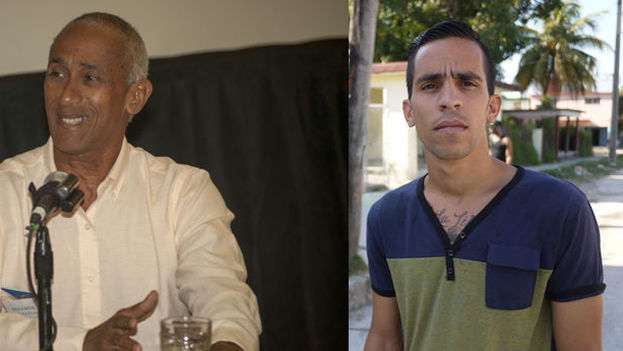
Hildebrando Chaviano and Yuniel Lopez OFarrill

In 1996, in the Santiago de Las Vegas township, the residents voted for an opponent who put himself forward, and the government committed him to a psychiatric hospital for three months. That they now permit several opponents to be nominated is a step forward. But it is too little, too late. They are doing it now because they want a democracy to appear where there is none, because there exists no law of association and parties, and without that, there will be no democracy.

Do you want to add anything for the readers of Cubanet?

I am sure that during the Summit, some members of independent civil society and the opposition will be the subject of attacks on the part of the intolerant followers of the government of Raul and Fidel Castro. We are prepared to refute the provocations with non-violent methods. In Panama it will be seen who the terrorists are, who imposes violence.

About the author

468.thumbnail

José Luis León Pérez

He graduated as a doctor and Comprehensive General Professor in the “Felix Varela” Higher Education Institute of Villa Clara in 2007. He worked in several ESBUs (Basic Urban Secondary Schools) in Santa Clara. He served as a Methodological Consultant and teacher in the “Lazaro Cardenas del Rio” Computer Science Polytechnic Institute located in the same city. He holds a Masters of Science in Education. He serves as a citizen-journalist and independent blogger. He is also a proofreader for the weekly El Cartero Nacan and Nacan magazine, both alternative independent publications. He was born in Santa Clara, Villa Clara, where he currently resides.

Translated by MLK

Castro Followers Attacked Peaceful Dissidents in Panama / Cubanet

Cumbre-cumbre

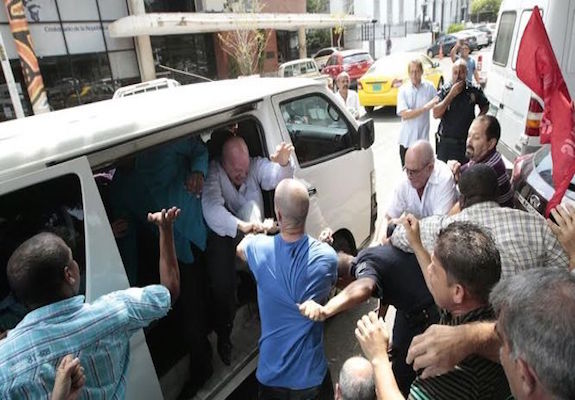
The opponents were putting flowers at a bust of Jose Marti. Cuban diplomats took part in the beating. The Castro-ites also interrupted the Civil Society Forum. See the video.

cubanet square logoCubanet.org, 9 April 2015 – A pro-Castro group today attacked Cuban dissidents in the heart of Panama City, where on Friday the Seventh Summit of the Americas will begin — in which Cuba will have a starring role due to the rapprochement with the United States; President Raul Castro as well as representatives of the opposition have been invited.

The dissidents claimed that on leaving a tribute at the bust of the Cuban national hero Jose Marti in Porras Park, located some yards from the Cuban embassy in Panama, they were surprised by the Castro followers.

“We went to the Jose Marti bust to leave a wreath. There were several people there who began to scream obscenities at us and tell us to leave. A moment later several people from the Cuban embassy came out and physically attacked us,” said Leticia Ramos, a member of the Ladies in White. continue reading

As she reported on the America Teve channel, a man identified as a diplomatic officer struck her. Orlando Gutierrez, Jorge Luis Garcia Perez, known as Antunez, and other opposition leaders were there also and were attacked.

These incidents are in addition to another confrontation that occurred in the opening session of the Civil Society Forum, which is being held parallel to the Americas Summit, when the governmental delegation decided to withdraw. “We as a civil society are defending our own, we cannot be in the same space” as the dissidents, Luis Morlote, a representative of the Cuban Artists and Writers Association (UNEAC), told reporters.

Morlote and several dozen Cubans with Cuban flags and pro-government banners, left the venue and expressed their indignation at the presence of opponents like Guillermo Farinas, Manuel Cuesta and Leonardo Calvo. The Cuban delegation said it was leaving the initial session but would return to the roundtable discussions that would take place Friday.

Cuba’s presence for the first time at the hemispheric event and its collateral activities was marked by the polarization of Cubans supportive of the revolution – the majority group – and the opposition attendees. “And no, we don’t feel like being a US colony” and “Out, out,” the pro-government Cubans shouted for more than an hour and a half; they also handed out a tabloid in which they accused the dissidents of being “mercenaries.”

The demonstration heated up the room and delayed the arrival of many of the forum’s invitees from other countries. “We expect reciprocity and understanding by all who come to our country,” said the annoyed Ruben Castillo, coordinator of the forum. “Civil society is going to participate in an elevated dialog,” he added. The forum, opened by the Panamanian president Juan Carlos Varela and the secretary to the OEA (Organization of American States), Jose Miguel Insulza, takes place from April 8 to 10 and seeks to make recommendations to the presidents attending the seventh summit.


Translated by MLK
“They Have Taken Everything from Me, Even My Family” / 14ymedio

Arian Gonzalez Perez (personal photo)

14ymedio bigger14ymedio, Madrid, 8 April 2015 — “How is it possible that I cannot enter my country?” Arian Gonzalez Perez asks himself time and again. This 26-year old Cuban, originally from Santa Clara, has lived in Barcelona for five years, and for that reason he was recently denied permission to travel to the Island and visit his sick grandmother.

“I feel like an outcast, very depressed,” he explains in a telephone conversation from the Catalan city. In his native country, he devoted himself to chess, but, like all players who remain living outside of Cuba, he was expelled from the ELO list (a chess player’s ranking) two years ago. In order to obtain the title of master of this discipline he will have to search for another national federation to cover him. “They have taken everything from me, even my family. It is very frustrating not to have rights,” he says. continue reading

Gonzalez was 21 years old when he decided to leave his country in search of a better future. “Desperate to leave the country, I left only at the first opportunity I had, but not before the Cuban authorities had denied me three trips. I came directly to Spain and did not even intend to stay, but I had to because of the poverty on the Island. I borrowed money and came, but the tournaments went badly for me and I could not pay the debt, so I stayed,” he says.

This law student thought that, when he had residence in Spain, he would get permission to travel to Cuba, but that was not the case. “It is inconceivable. Cuba is my country, it is my right and my family. This situation violates human rights,” he insists.

Gonzalez visited the Cuban consulate in Barcelona a year ago where they assured him that within a month they would have answered his request to travel to the Island, but the answer never came. “When I found out that my 81-year-old grandmother had fallen and broken her hip, I panicked and returned to the consulate. They told me they had no answer, and the civil servant that assisted me told me that I had defected,” he says sorrowfully.

As a result of these events, he decided to approach the human rights defense organization Amnesty International. “I believe that I should tell the truth and not be afraid of the injustices that are committed in my country; we Cubans cannot continue to permit this outrage,” he stresses. “It is time to add my two cents worth and fight for change.”

Gonzalez left Cuba before the reforms promoted in recent years by President Raul Castro, which he branded as “lies.” With the changes in the migratory law, the time limit for a citizen abroad to be classified as a defector and prohibited for eight years from returning has been extended from 11 months to two years. The young man charges that the rule violates Article 13.2 of the Universal Declaration of Human Rights, according to which “all people have the right to leave any country, including their own, and to return to their country.”

Arian Gonzalez, also stripped of his livelihood, was involved in a controversy in 2013 while participating in competitions under the Cuban flag. The chess player was subject to disqualification by the Spanish Grand Master Victor Moskalenko, who accused him of attending a tournament in Mollet del Valles (Barcelona) while drunk and cheating. Moskalenko extended his accusations to another Cuban federated chess player in Spain, Orlevis Perez Mitjans and asserted: “When you play against Cuban players, the other fellow countrymen are behind your back, bothering you… You are confronted not only with a player but with a team of gangsters.”

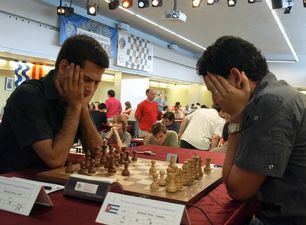
Arian Gonzalez Perez plays against Yuniesky Quesada Perez (personal photo)

Gonzalez, who defended himself then by writing a letter to the Competition Committee of the Catalan Chess Federation to seek measures against Moskalenko for libel and slander, denounces the governmental policy on chess. “Chess in Cuba is part of the Cuban government’s political monopoly. As in many other fields, this is a means for young people to be able to have the aspiration of leaving the Island and search for a better future. But many do not do it because chess at the world level is a poor sport while the Cuban government gives the Grand Masters a salary of 100 CUC which is high in comparison with the rest of the population.”

Arian Gonzalez now hopes that Amnesty International will press for authorization for his return to Cuba. The organization promised him an answer after Easter. “It would be an eternal frustration in my life if my grandmother were to die without me being able to see her 5 years after I said goodbye to her when I left Cuba.”

Translated by MLK

The Lying Cuban Press / Cubanet, Victor Manuel Dominguez

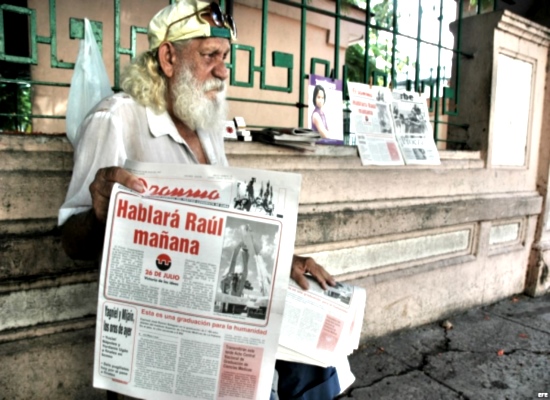
Archive photo Cubanet.org. An elderly man selling Granma. Headline: “Raul will speak tomorrow”

Montonous, grey, controlled, censored, demagogic, jingoistic, for more than half a century as spokesperson for phantom successes

cubanet square logoCubanet.org, Victor Manuel Dominguez, Havana, 31 March 2015 (Cuba Sindical) – The “Revolutionary” Cuban press, characterized as demagogic, monotonous, manipulative, with a grey design, poor quality paper, without stylistic and conceptual diversity, born of the mortal remains of a free press that was censored and later banned from the inception of the Revolution.

Always under state control, the role of spokesperson of governmental policy and ideology, the lack of objectivity is required, and the omission or disguising of what really is happening in the country. Faced with its pathetic role, several Cubans talked about censorship, rumors and secrecy in the national press.

The Tagline

“Still, we are lucky that we are not sentenced to jail for wiping our backsides with the image of Marx, Mao, Stalin, or the victorious face of a leader of the country on a first page, like the followers of Kim Il Sung used to be in Pyongyang,” Ernesto Penalver said ironically. continue reading

The former graphics worker for the newspaper Avance, the first media outlet closed by the revolution (1-19-1960), Penalver, at 75 years of age, resells newspapers in order to live. “Occupational hazard, sir. I cannot help but make the rounds. Although now I do it clandestinely and through the back door,” he said.

According to the septuagenarian typesetter, since the imposition by the Cuban authorities of “The Tagline” (12-27-59), a kind of opinion by the graphics workers who refuted, under each article, the supposed attacks against the Revolution, the end of press freedom that was seen coming.

“We did not write anything. The old communist agitators dictated and imposed it. After Avance, El Pais, El Mundo and the radio and television states CMQ were grouped together on March 31, 1960, into the Independent Front of Free Broadcasters (FIEL).

The unfortunate FIEL was the beginning of the end. Later would fall Diario de la Marina and the magazines Bohemia, Carteles and Vanidades, all with quality, without ideological restrictions, with diverse information, added Penalver. “In that year there was not a monkey with a brain in the press who would oppose Fidel. It was over.”

Newspaper and magazine vendor on Monte Street (photo by Victor Dominguez)

After getting up between five and six in the morning, Penalver says, he takes a swallow of coffee (if there is any), a bowl of Cerelac, if there is any left, and washes with stored water and unscented soap. Then he joins dozens of old people who stand in lines in order to buy and resell today’s national press.

Governmental Secrecy

“In Cuba we have good journalists, said a young woman who said she is named Isel. The only thing is that they are tied hand and foot, and above all, they are castrated of their opinion. Whoever steps out of the official line will never write a line in Cuba. At least in the national press. And examples abound to illustrate this point.

According to the young woman, the role of journalist hero and villain from the daily Granma in Santiago de Cuba, Jose Antonio Torres, first praised by Raul Castro in the newspaper itself and then accused as a spy and sentenced to 14 years in prison, is more than sufficient to discourage any kind of objectivity that questions the interests of the Communist Party and the revolution.

A worker from Water and Sewer Works who is tearing up Escobar Street from San Rafael to Malecon, asked if he likes the Cuban press, said, “I read between the lines. The truth is the opposite of what is said here. But, friend, what will I carry bread in or what are the kids at home going to use for whatever?”

Likewise, a lady who was buying the Cartelera supplement, with information about the month’s artistic events, said: “This is among the little that can be believed. Although sometimes you get to an exhibit or a theater, and the program is completely different. But at least it can be read.”

Later, regarding a question about the objectivity of the national press, she added, “Can print, television or radio press be believable when it talks about over fulfillments, advances, achievements, when the reality is inversely proportional to the report they give, as happens every day in this country?”

Also, she added, that hidden, almost non-existent, are the data about rates of violence in the country, the levels of drug use and prostitution, the alcoholism, thefts, some diseases, government corruption, other reports that could serve as a warning about the population’s behavior.

Another lady, who came from a battle royal to buy some potatoes at a Belascoain farmers market, said, “They don’t even blush when they talk about the victorious deployment of the potato harvest, knowing that people and they themselves have to fight and it’s not enough or to buy it from outside, from the scalpers, at two dollars a kilo. They are wholesale liars.”

Line of old people to buy and resell newspapers (Photo by Victor Dominguez)

In accord with many of those who spoke about the topic, the most read parts of the national press are the daily Juventud Rebelde’s complaints and suggestions section, Acuse de Recibo, and Granma’s letters to the editor, for being a kind of wall of lamentations where the people complain although nothing is resolved.

In these sections – a typical reservoir of calamities – are read complaints about mistreatment, dumps, collapses, blockages, withholding of wages, evictions, unfair penalties, illegal expulsion, lack of medicine, rallies, negligence, lack of control, corruption and fraud, among thousands of other acts that afflict the country’s citizens and are endemic within the Revolution.

Beyond publishing these bouts of complaint, only without solving them although the respective entities should respond to the people’s demands, Cuban journalists devote themselves to praising the phantom successes of the Revolution, and to pointing out the speck in the foreign eye of other nations at an international level, all the better if they are not members of ALBA (Bolivarian Alliance for the Peoples of Our America), CELAC (Community of Latin American and Caribbean States) or CARICOM (Caribbean Community).

Thus the press in Cuba, according to popular opinion, only serves for wrapping trash, plugging holes, stuffing mattresses, and, above all, as toilet paper in hospitals, recreation centers, work places, sports centers, schools, bus stations and homes. And maybe someone can read it from time to time.

About the Author

Victor Manuel Dominguez. Independent journalist. He resides in Havana, Cuba. vicmadomingues55@gmail.com

Translated by MLK

The Mariel Exodus: State Terrorism / Cubanet, Roberto Jesus Quinones

Posters from acts of repudiation during the Mariel Boatlift (1980)

Against the “scum,” acts of repudiation, beatings and humiliations. Against Florida, an invasion of the unemployed

Cubanet.org, Roberto Jesus Quinones Haces, Guantanamo, 1 April 2015 – On the first of April 1980 a bus was driven through the entrance to the Peruvian embassy in Havana; its occupants entered and sought political asylum. Unfortunately, the non-commissioned officer of the PNR (National Revolutionary Police), Pedro Ortiz Cabrera, lost his life in the event. The event was followed by others extremely traumatic for many Cubans due to their violence. All would be indelibly recorded in the nation’s collective memory and would reveal the terrorist nature of the Cuban regime.

Fidel Castro demanded that the Peruvian government immediately hand over the people who had forcibly entered the diplomatic headquarters. To have pleased him, long jail sentences and execution by firing squad undoubtedly would have been the sanctions applied. But the government of Peru did not agree, and the Cuban regime adopted a measure that, like the others taken in those days, made it seem to their proxies that the ball had been placed in the opponent’s court.

The Measures Taken by Fidel

Fidel Castro ordered the withdrawal of protection and monitoring from around the diplomatic headquarters, inciting all Cubans who wanted to emigrate to enter it. Very soon, thousands of people from all the cities and towns of the country crammed into the place turning it into a tangible reservoir of the discontent that now was sapping society. continue reading

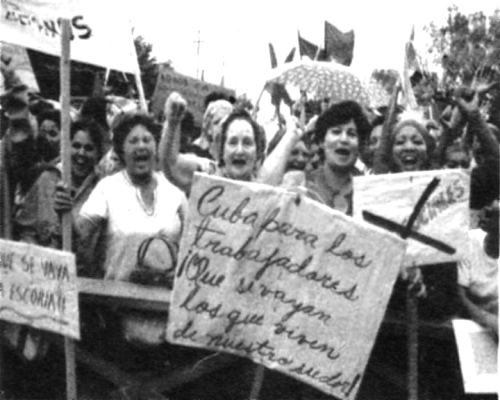
Cuba for the workers. Those who live on our sweat, let them go.
Mariel Boatlift act of Repudiation. “Cuba for the workers. Those who live on our sweat, let them go.” (Left side: “Let the scum go”)

The increase in the number of countrymen who wanted to emigrate was made evident, and the government, with the objective of discouraging the exits that it had sponsored, made terror its deterrent method par excellence. It was the first time that acts of repudiation were applied on the Cuban public stage. The beatings and humiliations abounded everywhere. The masses, encouraged by powerful groups and directed by individuals of doubtful social behavior, violated the most basic norms of respect for human dignity, and the country lived through several weeks of fascist practices that kept it on edge until the international community strongly protested.

The government demanded the refugees in the embassy and all those who desired to emigrate to present themselves at their places of employment or study in order to be given leave. The unemployed had to seek the document from the CDRs (Committees in Defense of the Revolution). That was the indispensable requisite in order to obtain the exit permit, and it would allow the mobs to intercept the petitioners in order to attack them.

Another Shameless Political Action

Some years had to pass to have access to other reports and above all to read and listen to the irrefutable testimonies on Radio Marti and right here, in order to understand the magnitude of the events and the perversity of the government in those demeaning days of our history.

With the single purpose of getting the advantage in a confrontation where he would always be seen as the victim due to the political, military, economic and moral grandeur of the opponent, Fidel Castro took dangerous offenders from the jails and put them in the embassy in order to create chaos, and then he demanded that the boats that came in search of relatives take these people as well. Together with them travelled not a few mentally ill, it was later learned.

It was a clever move, but of ephemeral value and revealing of the unethical essence of the regime whose immediate objective was to discredit the new emigrants, whom the government elite called “scum.” But also it tried to clean out the Cuban jails and export to the US potential disruptive social elements that Hollywood would portray in popular films like Scarface.

Time Relentlessly Passed

Thirty-five years after these events — which came to be known in the United States as the Mariel Boatlift — many of the Cubans who were catalogued as “scum,” thanks to their honest work and a society that is not perfect but that does guarantee all human liberties, enjoy a life in the US where maybe nostalgia for the home country occupies an important place, but one in which they live according to their way of thinking, with dignity.

Act of repudiation against the Ladies in White in recent times.

The Mariel Boatlift was not a success of the Castro regime; to the contrary. One highly placed leader from that time, Carlos Rafael Rodriguez, admitted to a Mexican magazine that the Revolution had nothing to be proud of with respect to what happened. It is rumored that it was the catalyst for the suicide of Haydee Santamaria and the object of analysis in the farewell letter that Osvaldo Dorticos wrote to Fidel Catro before dying from another gunshot. It was a Pyrrhic victory that very soon lost the artificial shine of the trappings that the Castro regime figureheads dished out in order to praise the supposed genius of the leader. His abuses, still unpunished crimes and inequities were unmasked to reveal the fascist essence of the methods used by the mobs encouraged and supported by the police and political leaders.

Since then the acts of repudiation against officially disfavored diplomatic headquarters and the peaceful opposition, especially the extraordinary Ladies in White and the brave members of the Patriotic Union of Cuba (UNPACU), are still practiced in the streets and before the homes of those harassed.

This, together with repression and constant vigilance by the state security forces as well as the government’s refusal to respect political and fundamental civil rights, shows that state terrorism is a practice entrenched in the Castro regime. The Americans should not forget it, especially now when, behind the abundant dividends, they try to remove Cuba from the list of state sponsors of terrorism.

About the author

jesus-quinones-haces.thumbnailRoberto Jesus Quinones Haces was born in the city of Cienfuegos September 20, 1957. Law graduate. He was sentenced in 1999 in an unfair and illegal way to eight years incarceration and since then has been prohibited from practicing as a lawyer. He has published the books of poetry “The Flight of the Deer” (1995 Editorial Oriente), “Written from jail” (2001, Ediciones Vitral), “The Folds of Dawn” (2008, Editorial Oriente) and “The Water of Life” (2008 Editorial El Mar y La Montana). He got the Vitral Grand Prize for Poetry in 2001 for his book “Written from Jail” as well as Mention and Special Recognition by the Nosside Juried International Poetry Competition in 2006 and 2008, respectively. His poems appear in the UNEAC Anthology of 1994, in the Nosside Competition Anthology of 2006 and in the selected ten-line stanzas “This Jail of Pure Air” produced by Waldo Gonzalez in 2009.

Translated by MLK

The Censors Talk about Censorship / 14ymedio, Victor Ariel Gonzalez

14ymedio bigger14ymedio, Victor Ariel Gonzalez, Havana, 30 March 2015 — The Surprised Pupil is a program whose first mistake is the name. With quite mediocre staging, presentation and content, really this television program has nothing surprising to see. But to hear, maybe some viewer or another was hoping that its most recent on-air output would tackle seriously a very thorny topic: censorship.

However, that viewer with high expectations was soon disappointed. Censorship is a problem that affects every Cuban producer today, but The Pupil did not worry about that. It was foreign censorship, that which nations supposedly suffer “under the dominion of big corporations,” that occupied the program.

There was even a segment dedicated to McCarthyism, that period of “repressive delirium” in the United States in which “great artists lived through times of accusations, interrogations, trials and torture,” said the program’s host. Not even hinted at were the anti-intellectual raids undertaken by the Cuban government, those whose spirit was defined by Fidel Castro in his phrase reminiscent of Mussolini: “Within the Revolution everything, outside the Revolution nothing.” continue reading

It would be too much to ask that they openly address chapters as regrettable as the Military Units to Aid Production (UMAP), the university purification processes, or the repudiation rallies. Or to remember how less than 40 years ago listening to The Beatles could lead to suspicion. Those pages of the national history have been forgotten by the official media.

If, after all, few know who Cabrera Infante, Reinaldo Arenas or Heberto Padilla were; and if the ghosts of Pinero or Lezama Lima have suffered exorcisms of posthumous atonement, then what sense does it make to speak of censorship in Cuba?

Maybe none for those guests who lent their words to The Surprised Pupil. They used, for example, statements by the actor Enrique Molina to a Spanish speaking chain for a digression about the financing of projects. As “there exists no state budget for filmmaking, [Cuban] directors have to seek financing abroad,” said he who played Silvestre Canizo on the popular soap opera Tierra Brava.

Molina, who obviously does not have any intention of demanding anything from the Ministry of Culture, blamed the lack of money on the lack of foreign producers “with good intentions and honesty” who seek something different than reflecting “the ugly things of Havana” or “everything challenging the politics of the country.” That, together with the difficulties that the “blockade” involves in bringing Cuban cinema abroad, constitutes censorship for this artist.

For the musician Fidel Diaz Castro, “the censors of the contemporary world have turned into diplomats” because they say: “My fellow, I would like to place your work, but that doesn’t sell.” Here he referred to the censorship imposed by marketplace preferences, although it could well be an attempt to justify his own incompetence.

Another of the guests was Iroel Sanchez, a key figure in the official blogosphere in a country without the Internet. The blogger spoke of a documentary that criticizes the media groups owned by financial conglomerates. “In the United States one can speak ill of a Democratic or a Republican president,” said Sanchez, “but (…) you cannot speak badly of the owners of those big finance groups that control the means of communication.”

Iroel Sanchez did not cite the example in which the governing party and the owner of the means of communication are the same. This is precisely the Cuban case where the Communist Party is the exclusive owner of the country’s media.

The common denominator throughout The Pupil was the American topic. Judging by the final message, there persists in that country a fierce repression of transnational reach. And as Cuban television said it, doubting it is strictly prohibited. There was no time to mention those on the Island who seek to issue a critical judgment outside of the given guidelines. Is that also the fault of an external enemy?

The Surprised Pupil is indeed very badly named. The greater error is having conceived as a surprise, and not as an insult, that the official discourse goes unpunished yet again. That is what happens when censors have no one to censor them.

Translated by MLK

“You have to hear every silly thing in this country!” / Cubanet, Orlando Freire Santana

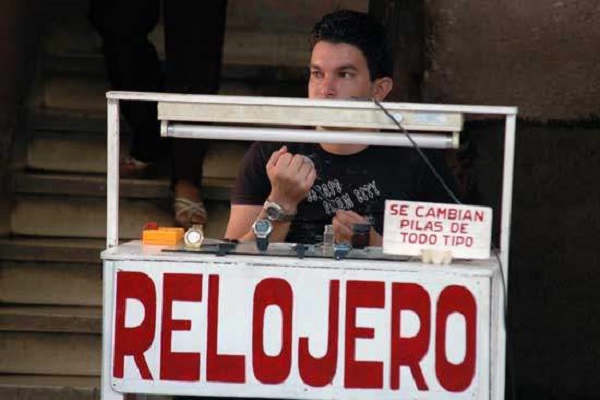
Self-employed watch repairer. “We change every kind of battery” Cuba_archivo

A letter published in the official Granma by one its readers asks the State to limit the prices charged by the self-employed in order to protect “the working people from abusive prices”

cubanet square logoCubanet.org, Orlando Freire Santana, Havana, 27 March 2015 – Notwithstanding the image that the Castro regime strives to present about small, private enterprise, in the sense of having expanded this activity as part of the economic transformations that are taking place on the island, the truth is that the non-state sector of the economy faces more than a few obstacles.

High taxes, lack of a wholesale market where supplies and raw materials can be acquired, the lack of recognition by the authorities of the total costs that private businesses incur, as well as the excess of audits of Sworn Personal Income Statements, among others, are some of the daily hurdles that stand in the way of the self-employed.

Last Friday, March 20, the newspaper Granma published two works that contain “recommendations” that could obstruct or kill self-employment. The first of these, “Money Well Paid?” is a report about the payments by state entities to self-employed workers in the Holguin province. continue reading

The very title of the report – with that question mark included – already allows a glimpse of the distrust of those kinds of transactions, that in the past year reached 36 million pesos. The Holguin authorities insist that state entities must exhaust all options that the providers from the government sector offer when acquiring goods or services. And only lastly to approach the self-employed workers.

The state payments to the self-employed in the referenced territory, with a view to exhaustive control, must pass through a bureaucratic structure that includes the Government Central Auditor Unit, the Commission of Charges and Payments, and the Provincial Administration Council. And by the way, what becomes of the highly vaunted “entrepreneurial autonomy” if the entrepreneurs can barely decide from whom to buy what they need?

The other material featured in Granma is the letter from a reader, “For the excessive desire to obtain greater riches,” in which he complains of the prices charged by the self-employed who entertain children in the Palmira township in Cienfuegos. In addition to that specific situation, the writer of the missive extends his criticism to all the self-employed and says in one paragraph: “I think that the Administration Councils, municipal as well as provincial, must control the prices of the offerings by the self-employed, protecting the working people from abusive prices and giving those people a legal foundation on which to demand their rights.”

It should be emphasized that an opinion of this kind, appearing in an official organ of the Communist Party, cannot be underestimated in any way. So began the attacks against the self-employed who sold home products, to those who were called “retailers.” In the end, that activity was prohibited, and many self-employed who used to hold those licenses lost them and were left unemployed.

When I commented to a café owner in my neighborhood about the Granma reader’s letter, the man reacted indignantly: “Don’t tell me…self-employed prices are abusive…Listen to me, abusive is the tax that I pay, which they have raised on me three times; abusive is that I spend more than 50% of my revenues on buying everything that I need to work, and the people from ONAT [the State tax collector] only recognize 25% as expense; and abusive was the fine that they imposed on me last year, of several thousand pesos, when they deemed that I had under-reported personal income. You have to hear every silly thing in this country!”

About the Author

orlando-freire-santana.thumbnailOrlando Freire. Matanzas, 1959. Graduate in Economics. He has published the book of essays, The Evidence of Our Time, Vitral Prize 2005, and the novel The Blood of Liberty, Franz Kafka Novels From the Drawer Prize, 2008. He also earned Essay and Story prizes from the magazine The Universal Dissident, and the Essay Prize from the magazine New Word.

Translated by MLK

An Afternoon for Danilo (El Sexto) / 14ymedio, Luz Escobar

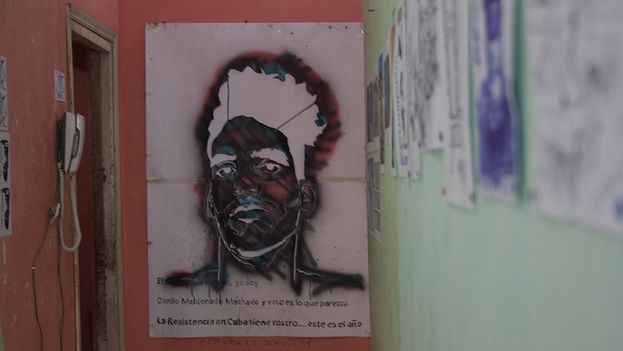
Danilo’s (El Sexto’s) works displayed on the walls of La Paja Records studio (Luz Escobar)
Danilo’s (El Sexto’s) works displayed on the walls of La Paja Recold studio (Luz Escobar)

14ymedio bigger14ymedio, Luz Escobar, 29 March 2015 – As part of the campaign to demand freedom for the artist Danilo Maldonado, known as “El Sexto,” several artistic activities took place this Saturday at la Paja Recold, the studio of the band Porno para Ricardo.

On the walls of the place were works by the graffiti artist who has been incarcerated since last December 25. El Sexto was arrested shortly before carrying out a performance that consisted of releasing in a public square two pigs with the names of “Fidel and Raul.” The crime that has been charged against him is contempt.

Several friends from all over the world and human rights organizations have demanded his immediate release. Yesterday’s activities joined those demands for his freedom. Among the most important moments of the afternoon was the performance by Tania Bruguera of The Whisper of Tatlin which opened the studio’s microphones to the fifty attendees of the encounter to ask for – in a minute each – Danilo Maldonado’s liberty. continue reading

The host band Porno para Ricardo, played the lead musical part with several songs from their repertoire. Subsequently rappers including El Opuesto, Maikel Extremo, Rapper Isaac and Lazaro Farise Noise appeared on stage. All demanded the release of the artist and demonstrated solidarity with his cause. Also a book was opened in order to gather signatures of support for the #FreeElSexto campaign. An option paralleling that already implemented on the digital platform Change.org and that is intended for those who do not have access to the Internet.

The artist Tania Bruguera told 14ymedio she had attended the event, “Because I think this is a case of the violation of the artist’s rights.” “It is not right that an artist who did not even carry out the work should be made a prisoner,” she stressed. Bruguera is precluded from leaving Cuba and is in the midst of legal proceedings because of events arising from her attempt to organize a performance last December 30 in the Plaza of the Revolution.

In spite of her delicate legal situation, the artist attended the event in order to offer her support to El Sexto’s cause. Because she says that “An artist that is in jail just for imagining a work and trying to make it, it is an injustice.” About the performance that the graffiti artist would have carried out, Bruguera points out that, “Public figures, whether politicians or celebrities, are likely to be criticized (…) they have to assume that people who do not have that power, they are able to make them aware of their discontent through humor and satire.”

Bruguera quipped that, “If they made prisoners of everyone who makes jokes about Fidel and Raul Castro, half the people would be incarcerated.” And she concluded, “The artist’s freedom lies in having the right to say symbolically whatever he wants.”

Gorki Aguila, meanwhile, explained that, “It is important that artists join together among themselves (…) art has an incredible power to summon.” El Sexto’s grandmother, attending the event, said that, “The right of a man to live as he wants to live must be respected, Danilo does not harm anyone, he respects everyone, but he also asks for respect for himself, that they let him do what he wants.”

With respect to the prison conditions in which this artist has lived, the grandmother says that, “He was sleeping on the floor for two months because for him, as for many other prisoners, there was no bed. They don’t let even an aspirin in. Danilo is chronically asthmatic, he had pneumonia, and they denied him antibiotics.”

The lady also told of the continuing threats by State Security to many of the invitees so that they would not go this Saturday to the tribute to El Sexto. The pressure included the visit of two officers to the home of Gorki Aguila in order to deliver to him a police citation that required him to appear at the police station that same afternoon. The musician refused to go on grounds that a citizen must be given at least 24 hours notice of such an action.

Lia Villares said that during the next Havana Biennial, which will get underway at the end of May, “We are going to do something.” The blogger anticipates that it will be, “A work by El Sexto that was not displayed here today.”

Translated by MLK