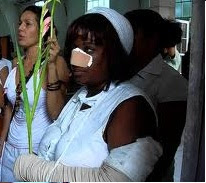
Angel Santiesteban in the RSF/AFP album that honors 100 heroes of freedom

Angel Santiesteban-Prats, who was recognized last year as one of the 100 Information Heroes of Reporters Without Borders, has been included in the photo album.

Reporters Without Borders and France-Press Agency have published a new photo album of the “100 heroes who defend liberty,” including Martin Luther King, Mandela, Edward Snowden and the Cuban blogger, Yoani Sanchez.

The album went on sale on Thursday, April 2, 2015. It costs 9.90 euros, and all the profits will be donated to Reporters Without Borders.

In the name of Angel Santiesteban-Prats, we are grateful to Reporters Without Borders for their solid support.

Angel’s Editor

Translated by Regina Anavy

2 April 2015

Prostitution in Cuba (I) / Angel Santiesteban

Ángel Santiesteban-Prats, 31 March 2015 — In the Alamar police station in Havana, the stepfather of a 14-year old minor has been accused by his ex-wife after discovering that the man who helped her raise her daughter was having sexual relations with the child.

Years after the visits of this “stepfather” to the home, where he felt he had the rights of a father over the girl, she discovered the love the child had for him. The police interrogated the parties, proving then what was certain, only that the minor child declared herself profoundly enamored of her “Papi,” that he never approached her, nor even hinted at anything ever.

But the wife began to observe the way the girl dressed — because she had family abroad — and above all she noticed the latest-generation cellphone, which the girl dreamed of getting. continue reading

Already at 14 the girl was giving away her recent-woman’s body, and she unlocked her virginity to that man who was 26 years older. It was barely noticeable when she showed her phone or the brand-name tennis shoes that none of the young boys of her generation could offer.

Finally, the police determined that if they were to lock up every man who let himself be seduced by a minor, the prisons wouldn’t be big enough. Today they’re already full, and since rape wasn’t involved, it was permissible. And they freed him.

“It’s normal,” said the official who led the investigation. “I’ve had worse cases of girls up to 12 years old who have relations with mature men.”

The stepfather sighed, relieved.

“Every night we detain girls practicing prostitution with the consent of their parents,” continued the official, who shook the stepfather’s hand before saying goodbye to him.

“It’s no wonder,” he said, looking at the cellphone in the stepfather’s hand. “With such a weapon you can make anyone fall into bed with you.”

Ángel Santiesteban-Prats

Border Guard Prison Unit. Havana. February 2015.

Translated by Regina Anavy

Two Types of Dissidence, Two Policies / Angel Santiesteban

Angel Santiesteban, 25 March 2015 — For the first time in the history of the violations against the Cuban dissidence by the political police of the totalitarian Regime, there are two lines of thought: one subdued and the other more severe.

Those in the opposition who have publicly supported the intention of the governments of the United States and Cuba to reconstruct diplomatic relations have had their rights respected to travel abroad, reunite, publish, etc.

But those who openly oppose the reestablishment of diplomatic relations, unless the Cuban Government respects human rights and frees the political prisoners, have been detained and had their passports take away, like the plastic artist Tania Bruguera, who was visiting the country, so that she now finds herself held hostage, and the activists Antonio Rodiles and Ailer Gonzales. continue reading

The Ladies in White, together with their leader, Berta Soler, and one of the 75 prisoners of the Black Spring, Angel Moya, Antonio Rodiles, Ailer Gonzalez, Claudio Fuentes and Tania Bruguera, among others, were captured, some for several days, and, coincidentally, have all opposed the reestablishment of relations.

It’s painful that this distance exists between both factions, which, when united, have suffered so much abuse from the dictatorship. Some who accept relations keep quiet about the abuses committed toward those who think differently.

In a certain way, they have to recognize that silence converts them into accomplices of the Regime. We can’t forget that in different ways, thinking from parallel paths, is precisely what transforms us in dissidence, because we came fleeing from belonging to that mob that accedes to the call of the Dictator, which sometimes, even in an indirect way, can manipulate us in its favor.

Although we think that others are wrong, we should defend their right to be so. There is no one dissidence that is bland and another that is extreme, only degrees that are necessary and that strive for the same thing.

Ángel Santiesteban-Prats

Unidad de Guardafronteras Prison, Havana. March 2015.

Translated by Regina Anavy


Cuba: Artist imprisoned for painting the names "Fidel" and "Raul" on two piglets / Laritza Diversent

After 90 days of imprisonment, there is no formal accusation against the artist, Danilo Maldonado.

Laritza Diversent, Havana, 25 March 2015 — Authorities are still imprisoning the artist, Danilo Maldonado, known as “El Sexto” (The Sixth), who was detained arbitrarily by the police.

Maldonado, 31 years old, is an urban artist and painter who finds himself accused of “aggravated contempt,” a charge that the Cuban State uses to incarcerate people who are critical of the Government. He presently is serving 90 days in preventive custody in Valle Grande, on the outskirts of the Capital.

On the afternoon of December 25, 2014, Maldonado staged a “show” in a spot in the city of Havana, when he was detained by police operatives. They arrested him for having two piglets in a sack. One was painted on the back with the name “Fidel,” and the other, with the name “Raul.”

Both names are common; however, the authorities assumed that they disrespected the Castro brothers, and they could impose on him a sanction of between one and three years of prison. continue reading

Cubalex presented an appeal before the Havana tribunal for the authorities to explain the motive for the detention, a recourse that was denied.

The prosecutor didn’t even formally present the accusation before the tribunal. Maldonado’s lawyer asked the authorities several times to allow him to await trial in liberty, which request was also denied.

In Cuban law, the crime of “contempt” is an amplified term that includes defamation or insults toward other Government employees, and it carries aggravated penalties when it is committed against the Head of State. The Inter-American Commission of Human Rights has said that this type of rule goes against freedom of expression and the free demonstration of ideas and opinions, which do not justify the imposition of sanctions.

Let’s not forget that all those people who exercise public office or are important statesman, like the Heads of State or the Government, can be legitimate objects of criticism or political opposition. Freedom of expression should take place without inhibition in the public debate about Government officials.

Let’s ask the Cuban State to guarantee and respect Danilo Maldonado’s right to freedom of expression, without restrictions. Furthermore, let’s ask the international community to speak up for his freedom and his right to a fair trial.

About Cubalex:

Cubalex, the Center of Legal Information, is located in Havana, Cuba. We are a non-profit organization founded in 2010, not recognized by the Cuban State. We offer free legal advice on housing, migration, inheritance, criminal appeals, constitutional procedures and defending civil and political rights, in the national and international arena, to Cuban citizens or foreigners who request our services.

If you want a consultation, you can find us through our email: centrocubalex@gmail.com;

or by telephone:  (537) 7 647-226 or  (+535)-241-5948

Translated by Regina Anavy

Five Years of the Blog “From Havana” / Ivan Garcia

Ivan Garcia, 8 March 2015 — When I decided to write a blog, at the end of December 2008, my pretensions were minimal.

I had decided to take a break in order to dedicate my time to my daughter, Melany, who was then two years old. Although I wasn’t writing, mentally I continued to be focused on journalism. Those were difficult times. Repression from the hard liners of State Security was at its highest point.

In March 2003, a choleric Fidel Castro had ordered the imprisonment of 75 peaceful dissidents. Among them, 27 free journalists. Independent journalism was going through its worst phase. continue reading

The best writers — Raúl Rivero, Ricardo González and Jorge Olivera —  were sleeping in uncomfortable and dirty cells. Others had gone into exile, like my mother, Tania Quintero. The rest of us journalists who were writing without State authorization and those who decided to remain in Cuba were afraid.

A fear that didn’t prevent me from continuing to report for Cubaencuentro, Cubanet and the Sociedad Interamericana de Prensa (Inter-American Press Society), among other online sites. In the middle of 2007, Juan Gonzalez Febles and Luis Cino decided to start a weekly. They formed Primavera Digital (Digital Spring) in a house in the Havana neighborhood of Lawton.

My intention was to join Primavera. But upon rereading an article that appeared in 2014 in Newsweek in Spanish, about the reach of blogs, I decided to change my plans. I liked the idea of writing and publishing, without a censor or an editor, those daily stories that many times are not news in the main media and that go into the recycling bin.

My technical deficiencies (I didn’t have a computer, digital camera or cell phone) delayed the project. At the beginning of 2007, a foreign journalist gave me an old Dell laptop. It’s been one of the best gifts I’ve received in my life.

Since 1996, when I began to write regularly for Cuba Press, until 2003, I wrote in a lined notebook. Later, Tania, also an independent journalist, would transcribe my work on a Olivetti Lettera 25 typewriter.

Some months after Tania went into exile in Switzerland, the Olivetti broke. A mechanic told me: “Throw it in the trash and buy another one.” The laptop revived my dream of creating a personal blog. However, problems followed.

One hour of Internet cost between 5 and 10 CUCs per hour in a hotel. In the U.S. Interests Section they offered free turns, but the paperwork was expanded and the telephones were always occupied.

I decided to open the blog with a part of the money that my mother sent me. In January 2009, I contacted Laritza Diversent, lawyer and independent journalist, and I proposed that she write about judicial matters. Luis Cino authorized me to publish her texts on Cubanet.

On January 28, 2009, on the portal Voces Cubanas (Cuban Voices), appeared the first post of the blog Desde La Habana (From Havana). It was entitled, “My Young Country” (see note at the end). The first administrator was Ernesto Hernandez Busto, an exiled Cuban who lived in Barcelona.

Beginning in January 2010, Carlos Moreira, a Portuguese friend, impresario and webmaster, altruist and in solidarity like few are, would be in charge of its administration and design. Until today.

The blog From Havana is a space dedicated to the marginal neighborhoods and to sports commentary, among other subjects. Also, it’s the site where I or other colleagues pour out our assessments about that Island that the government wants to ignore.

In a short time we had a million visitors. Not even in my wildest dreams did I think that some day the blog From Havana would reach that figure. There are so many blogs and web sites about Cuba that I sometimes think the subject of democracy and lack of freedom on the Island can become banal.

I try to tell stories in a pleasant way. It’s difficult to get figures and information. Doing investigative journalism in Cuba is foolish. I post by writing about what surrounds me, people of the barrio with whom I speak daily. Journalism and the blog have brought me many friends. And some enemies.

Believe me, I hope some day we can get to know one another in Havana. And if some post hurts your feelings or doesn’t agree with your point of view, understand that it’s nothing personal.

The blog has allowed me to grow as a journalist, even without the advice of my mother and my teacher, Raul Rivero, whose stories and articles are masterful. Now I learn from a distance.

No one graduates from journalism. While there are people like Moises Naim, Vargas Llosa or Gay Talese, to make art of this profession, we must still climb a few steps.

To you, readers and friends, my greetings and respects for using part of your time to read these stories from a guy who lives in La Vibora and signs From Havana.

Ivan Garcia

Photo: View of La Vibora, with the church of Los Pasionistas, one of the most beautiful in Havana and which I see every day from my house. It remains very close. From ojitoaqua, Panoramio.

See: My Neighborhood, My Little Country

Translated by Regina Anavy

Angel Santiesteban Included in the Defending Freedoms Project

1425271734_tom-lantos-human-rights-commission24 February 2015 — In December 2012, the Tom Lantos Human Rights Commission, together with the U.S. Commission on International Religious Freedom and Amnesty International, U.S., created the Defending Freedoms Project, with the objective of supporting human rights and religious freedom worldwide, with a particular focus on prisoners of conscience.

Specifically, the members of Congress who “adopt” prisoners of conscience, in solidarity with those brave men and women throughout the world, pledge to plead publicly for their freedom.

Ángel Santiesteban-Prats and the journalist José Antonio Torres, both Cuban political prisoners, have recently been included on the list.

1425271734_ai-usaThis new recognition of Ángel Santiesteban-Prats is added to what he recently received on behalf of the German Eurodeputy, Dr. Christian Ehlerquien, who assumed the political sponsorship of the imprisoned Cuban writer.

Translated by Regina Anavy

Seven Steps to Kill Orlando Zapata Tamayo / Luis Felipe Rojas

Orlando Zapata Tamayo

Luis Felipe Rojas — I published this post a few days after that needless death. Now I again denounce the death and express the same ideas about it. It’s my homage to my brother, Orlando Zapata Tamayo.

I am still experiencing the pain caused by that avoidable death, and I feel impotent because I didn’t attend the funeral honoring him due to political impediments, but that hasn’t stopped me from saying that in any case, what I present here seem to be the seven final steps that advanced the repressive machinery used to kill Zapata.

1. Setting up that para-judicial theater that imposed a sentence of 63 years on him for contempt.

2. The continuous beatings accompanied by obscene words and insults about his race and the region where he lived (shitty negro, shitty peasant). continue reading

3. Putting him in prisons that were located far away from his mother’s home (Prison Kilo Cinco y Medio in Pinar del Rio, Prison Kilo 8 in Camaguey).

4. The beatings in November 2009 in the Holguin jail when they knocked him down smashing his leg with a steel bar, on his knee cap, and that his mother saw again when she opened the coffin in her house in Banes and also discovered that there were other marks of the beating with clubs that he surely received months before.

5. The forced removal to Camaguey and the robbery of his belongings on December 3 when they confiscated the only food he was eating in prison. This was the fact that made in declare a hunger strike.

6. Taking away water for the 18 days in the middle of the strike even when he had said that he was declaring a hunger strike but would drink small amounts of water.

7. The maneuver of taking him to a hospital for prisoners in Camaguey, west of Havana, and putting him in a room that was not set up for treating prisoners in a grave condition.

I lack the power of analysis in this case, but please don’t keep saying that the government didn’t have a hand in his death. The execution order was given from the office of General Raul Castro Ruz.

Translated by Regina Anavy

23 February 2015

Salaries for Doctors on the Island Will Increase / Cubanet, Roberto Jesus Quinones

cubanet square logoCubanet, Roberto Jesus Quinones, Guantanamo, 16 February 2015 — A rumor is keeping  the medical sector in Guantanamo euphoric, and it provokes immediate outbursts of joy in hospital corridors, in homes and in every place the supposedly good news is known. No one knows the origin of the rumor nor its hidden intent.

According to those who are in charge of spreading it, very soon the government will increase the salary for doctors. And, as happens with every rumor, there are always those who know everything about it and affirm that the new increase will be put into force to try to contain the exodus of physicians abroad by way of continue reading

 a 30-day exit permit, a type of safe conduct that helps them flee.

These experts assure that the new increase will raise physicians’ salaries to 5,000 pesos per month (200 dollars), an astronomical pay in Cuba, but that they’ll only receive it if they agree to sign a document saying they will remain in the country for five or ten years without asking for the exit permit.

However, a few days after the rumor appeared, the voices of others begin to be heard. They speak clearly, affirming that not even with this increase, which would place the doctors in the vanguard of the Castro Communist labor aristocracy — now made up of Party and governmental bureaucracy along with the sportsmen of high performance and the high officials of the armed forces and the Ministry of the Interior — would they be able to contain the massive exodus of these professionals abroad. Above all to Ecuador, a country that doesn’t request visas and where there already exists a developing but prosperous Cuban medical community that has taken care of communicating to its colleagues on the Island the high lifestyle that is rapidly achieved in the land of Eloy Alfaro.

Because 5,000 Cuban pesos are around 200 dollars, a sum very inferior to what any Cuban doctor could earn abroad.

Between the well-being within reach and the promises of a prosperous and sustainable socialism, which no one knows when it will arrive nor if also there is another rumor or a new feverish chimera of the Cuban leaders, you don’t have to rack your brains to decide. Stupid people are more scarce every day, and the ideological teque* has been in intensive care for some time.

I don’t know what the government will do to stop this flight of doctors, which has a direct effect on one of its most trumpeted social accomplishments — currently in a very precarious state, among other things because of the lack of specialists — and on the export of health services, which is perhaps, together with tourism, the most lucrative activity of the Cuban economy at this time.

In case the rumor becomes a certainty, let’s see what happens with the other professionals, because the flight of qualified personnel is not limited to the medical sector. Pandora’s Box is open, and the government doesn’t give any signs that will let us believe it is possible to close it and, above all, to convince us.

*Translator’s note: “Teque” is literally a spinning top, and is used in Cuba to mean old, worn out, political harangues.

Translated by Regina Anavy

Cuban Irresponsibility Causes Shortage of Medications in Venezuela / Juan Juan Almeida

The medication crisis that was anticipated in Venezuela is a storm that scared people even before it began. Not only because the inventories of the Ministry of Peoples’ Power for the Health of Venezuela, a governmental organization of national jurisdiction, are practically exhausted, but also because some of the medications handled by the Cuban medical mission came into the country without the consistent rigor of matching them to a corresponding medical registry.

It’s repugnant to read how a country’s problems are met with messianic discourse and disgusting to hear how continue reading

some of the upper-echelon Venezuelan health officials justify the bad management, assuring people that the scarcity of medications is due to laboratory workers taking vacations, and the chains of distribution being altered because of an “economic war,” and that as a result of “enemy” propaganda there was alarm, which caused people to buy in 15 days what they usually buy over 2 months.

The Cuban and Venezuelan governments some time ago crossed the line of respect for human dignity, and for that reason, although I’m not giving the written numbers, I’m copying part of the report issued by the Analysis Group for Medications of the Cuban Medical Mission in Venezuela, received via email in the Ministry of Public Health in Cuba.

In this dossier there is evidence of unquestionable irresponsibility that crosses the criminal line, and a deficit of medications that the Biofarmacuba company hasn’t procured and won’t procure for delivery on the agreed-on dates in order to fulfill the recent yearly plan.

According to the report, there’s a mountain of medications lacking for the 2015 plan that Biocubafarma won’t be able to provide. I list some of them here:

1. Ampicillin 125 mg/5 ml p/susp x 60 ml: Out of stock in the warehouses.

2. Local anesthesia (cartridge of 1.8 cc: Out of stock. Pending (Dentistry).

3. Atropine 0.5 mg amp x 1 ml: Not in solution, controlled, without medical registration in Venezuela. (CDI, Surgery).

4. Atenolol 0.5 mg amp: In facilities. Pending arrival in Cuba of discontinued imported product.

5. Carbamazepine 200 mg x 90 tab: Not in solution because it is a controlled product. Imported. Not on medical registry in Venezuela (Peoples’ Medical Consult).

6. Cefalexina 500 mg x 10 cap: Pending production.

7. Ciprofloxacin 200 mg/100 ml BBO: Pending export (General Use).

8. Clorhidrato de tramadol 100 mg amp: Pending import permit.

9. Chlorpromazine 25 mg amp x 1 ml: Not in solution. Controlled product. Imported without medical registration in Venezuela.

10. Diclofenac sodium: 1 mg/ml col x 5 ml (Voltaren): Not in solution. Inventory expired (Eye Clinics).

11. Digoxina 0.25 mg x 20 tab: Out of stock. Pending removal from port.

12. Elitrol 1 x 5 ml fco: Out of stock. Pending arrival in Cuba of imported discontinued product.

13. Ergometrine 0.2 mg x 1 mil: Not in solution. Controlled and imported without medical registration in Venezuela.

14. Glibenclamide 5 mg x 10 tab: Out of stock in warehouses.

15. Hydralazine 20 mg amp x 1 mil: Out of stock in warehouses.

16. Hydrocortisone 100 mg bbo: Out of stock in warehouses.

17. Actrapid Insulin 100 u bbo x 10 ml. Out of stock.

18. Human Insulin 100 NPH bbo x 10 ml: Out of stock.

19. Isoprenaline 0.2 mg amp: Out of stock. Pending removal from port (High Technology Centers-CAT).

20. Meropenem 1G BBO: Unavailable for 22 weeks (Therapy and hospitalization).

21. Salicure-Test 50 det x 100 ml. (Clinical reagent).

22. Ureterovesical probe No. 18 x 20: Out of stock.

23. Coombs serum: Out of stock.

24. P Tubes/Pentra Complete Hematology packet x 400: Distributed one part of what was received because of their expiration dates. 

25. Thiamine 100 mg bbo: Not yet in solution due to technological problems (CDI).

26. Timolol Missing for 20 weeks. Reported by 12 states. Affected by material in the container.

27. Thiopental 500 mg bbo: Missing for 6 weeks. Affected by raw material.

28. Vitamin A and D2 drops x 15 mil: Not in solution, inventory expired (Peoples’ Medical Consult).

29. Vitamin C drops fco x 15 ml: Not in solution, inventory expired (Peoples’ Medical Consult).

This is enough without boring you to show that – as my grandmother, who didn’t have good sight but knew how to see – would say: It’s much easier to catch a liar than a cripple.

Translated by Regina Anavy

2 February 2015

“United States or Die” Demand Cubans in Veracruz / Luis Felipe Rojas

Photo taken by Universo Increible (Incredible Universe)

Rafael Alejandro Hernández Real, who says he was an agent of State Security in Cuba — infiltrated into the Eastern Democratic Alliance — in September 2014 chained himself in the Plaza Bolivar of Bogota, Colombia, and now is on a hunger strike, demanding that he be allowed to go to the United States, according to a report from Universo Increible.

“Ten young Cuban emigrants have declared a hunger and drink strike in the immigration station at Acayucán, in the state of Veracruz, in order to avoid being deported to Cuba. Right now there are seven men and three women. The group of strikers has been increasing before the official denials and threats of being returned to the island,” reports the news source.

Hernández Real made himself known in 2008 when, together with Eliecer Ávila and other students at the University of Information Sciences in Havana, they questioned the then-president of the Peoples’ Power National Assembly. Ricardo Alarcón. On that occasion Ávila and Hernández Real called for the freedom to leave the country, to visit historic sites of the world like “Che Guevara’s tomb in Bolivia,” and they questioned the supposed unanimity of the general voting that takes place in Cuba.

Translated by Regina Anavy

6 February 2015

Reflections from Companero Juan Juan / Juan Juan Almeida

1421794998_base-naval

As the debate continues, visitors come and go. It’s normal and forms part of the process of re-establishing relations between the United States and Cuba. Also in this exchange, in a not-too-distant future, the American government will return to its Cuban counterpart the territory occupied by the naval base at Guantanamo. And to reciprocate, the government of the island will accept that finally the imperial eagle will return to its original nest continue reading

at the top of the two columns that, together with the canons, human figures and chains, compose the monument to the victims of the Maine explosion.

I feel that both these things will happen, and I’m not making up scenarios in order to encourage a debate.

Time has shown us that, although the present economic environment is still challenging since there could be negative surprises, as far as the political structure goes, the Caribbean has been and is one of the most stable zones on the planet. So that keeping a military installation of such size in the heart of a place where there are no international conflicts, not even of low intensity, represents an excessive waste of time and an important squandering of money.

The Guantanamo Naval Base was established in 1898, when the United States military occupied the island after defeating Spain in what many of us know as the Hispano-Cuban-American War. Later, with the signature of the first president of the Republic of Cuba, Don Tomas Estrada Palma, on February 23, 1903, the U.S. obtained that much-discussed perpetual lease. It emerged as an historic anomaly and today makes no sense. Neither military, strategic, or regional.

1421794999_maine

For its part, the monument to the Maine was constructed in 1926, and in 1961 the man who “reflected” on it* ordered the imperial eagle taken down from the pedestal, because its figure was warping the new marketing image of the revolutionary government.

But given present circumstances and the indefinite absence of the insufferable “reflector,” the eagle means nothing more than the piece needed to complete the sculpture. I would dare say that because of the strange culture of rejection that we islanders have for everything that daily surrounds us, out of the two million Cubans who now live in Havana, not even 100 of them have bothered to read the inscription at the foot of the monument.

The return of the territory occupied by the naval base in the municipality of Caimanera in Oriente will be welcome, as will be the return of the image of the raptor to its environment on the Malecon.

Both events will be historic, but of no value. Since nothing about this presses the principle of democracy for a country that requests change and transformation, from the interior of a tempest hidden below a sea of apparent calm.

As that Cuban virtuoso said, known for being the king of the tambor** players and for the charming way he told a joke: “The agendas of governments are divorced from the people; politics get done in the street. The others react with the same naivety as an inexperienced mother.”

Translator’s notes:

*Fidel Castro’s column in Granma newspaper is called “Reflections of Fidel

**African drum

Translated by Regina Anavy

Cuba: The fight against Ebola is the new theater of war / Juan Juan Almeida

Every interesting story has light and dark parts, epic actions, and a protagonist who inspires. The rest consists of weaving reasons and emotions together by way of origami.

The Cuban government knows very well how to put into practice its habitual juggling act in order to locate itself opportunely at the center of all news flashes. Cuban doctors have been sent to fight the Ebola epidemic in West Africa, and by taking advantage of this, the government feeds the false image of having no self-interest in this new theater of war, where everything is tested, even human sacrifice.

We could see that during the recently-concluded Summit of the Bolivarian Alliance for the Peoples of Our America Trade Treaty of the Peoples (ALBA-TCP) the moment of emotion was at the meeting of the heads of state, delegations, and invited personalities with the Cuban collaborators from the medical brigades, who that same night, October 21, left for Liberia and Conakry, Guinea.

Hail, Caesar; those who are about to die salute you. They know that if they become contagious they can’t come back to the country until they are cured or die. A hard but wise decision, because the island is not prepared to receive the sick without activating the usual chain of errors that, as we already know and even have suffered, facilitated the epidemic proliferation of conjunctivitis, cholera, chikungunya, dengue fever, and a long list of contagious etceteras.

The photo of the Summit is beautiful, but the Summit didn’t provide much. A declaration with 23 points of agreement and little money. Cheap politicking. The illness continues unabated. According to data offered by Mr. Bruce Aylward, the Assistant-Director General of the World Health Organization, the situation is alarming. They have confirmed cases of infected people in seven countries, and it’s estimated that by the beginning of this coming December, if things continue as is, the number of people infected with Ebola could reach 5,000 to 10,000 cases weekly.

It’s clear that the Cuban government wants to pursue more than just aiding and combating the mortal virus. With this new crusade, in addition to confronting an emergency, it will receive a spurt of dollars to spend excessively without needing to justify it. The government is developing a strategy to favorably influence the UN vote on human rights and the American embargo. A key point.

It’s clearly persuasive. There is no greater veneration in the human condition than for the action of saving lives — even more captivating when the effort means risking your own.

We can criticize them or see from the computer how General Raul Castro and his buddies are gaining space in Realpolitik (practical interests and concrete actions). The other option would be to equal or, even better, to surpass them. To silence, with real actions, the humanitarian chatter of the Cuban revolution, its hapless friends of ALBA, and its cousins in the TCP.

But for that we would have to be ready not only to  help the needy but also to define who we are and what exiled Cubans can do. To act together with international organizations who work in the center of the crisis. To buy medical and hygienic supplies, protective uniforms, stretchers, gloves, disinfectants, and instruments for the centers that treat the sick. It’s not difficult.

Certainly we can continue believing that we create a homeland on the Internet, or we can grab the limelight away from the revolutionary government. But that, paraphrasing the title of the bolero, is for you to decide.

Translated by Regina Anavy

27 October 2014

Blatant Lies / Angel Santiesteban

During the days in which Ángel Santiesteban-Prats’ whereabouts were unknown, and with fears absolutely based on the illegal transfers that he experienced before, we filed a complaint with the United Nations Working Group on Forced or Involuntary Disappearances, so they would put it before the Regime in Havana to clarify his whereabouts.

Translation of letter from the High Commissioner’s Office of the United Nations Human Rights Commission:

Dear Mrs. Tabakman,

I have the honor of addressing you in the name of the Working Group on Forced or Involuntary Disappearances with respect to the case of Mr. Ángel Lazaro Santiesteban Prats (case no. 10005155).

In this respect I would like to inform you that the communication sent to the Government of Cuba on July 30, 2014, due to an administrative error, did not include the phrase “Marti TV (Miami, United States)” in place of “Cuban communication media.”

Furthermore, I want you to know that this correction of the case does not affect the decision taken by the Working Group during its 104th session, such as was communicated to you in its letter of September 30, 2014.

I would like to inform you that the Working Group will celebrate its 105th session between March 2-6, 2015, in the City of Buenos Aires, Argentina.

Sincerely yours,

Ariel Dulitzky, President-Presenter

They acted with the dedication and speed that an emergency requires, and, of course, the Castro dictatorship did not. They only responded to the Group’s requirement when it gave them the demand; that is, when Ángel already had been located by journalists from 14Ymedio. Thanks to them we knew where he was, although they couldn’t meet with him. The Regime had put him in the border military prison where he presently is. continue reading

I want to point out not only the fact that the Regime responded to the presenter for the Working Group, but they also took advantage of the occasion to lie blatantly and use against the “source” complainant the same strategies they use to falsely accuse and imprison the opposition. All thieves believe that others are like them.
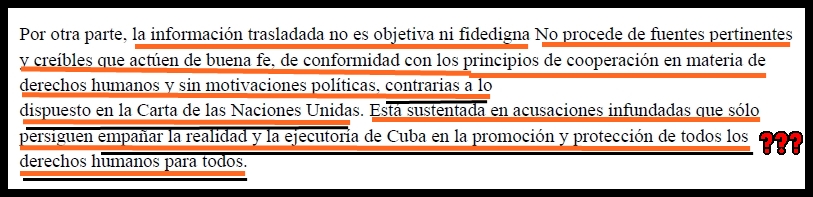
Translation of document from Cuban government:

On the other hand, the facts transcribed are not reliable. They don’t come from pertinent and credible sources that act in good faith, in accord with the principles of cooperation in the matter of human rights and without political motivation, contrary to what is set forth in the United Nations Charter. They are supported by unfounded accusations that are only intended to tarnish the reality of Cuba’s record in the promotion and protection of all human rights for everyone.

They exploited an involuntary omission in the group’s communication to the Cuban government to try to disqualify the complaint and the complainants. Now they have just communicated and corrected the omission – again – in order to continue supporting their lies, but they will preserve the same pathetic silence that they have with respect to the whole case.

I am transcribing here the response from the Regime (the complete document is attached in a link in this post):

Session: 104

Government Item

Date: September 4, 2014

The Government of Cuba reported that:

“The allegations about a supposed transfer of the citizen Ángel Lázaro Santiesteban Prats,

from the place where he was fulfilling a punishment of deprivation of liberty to a ’military base.’

“After investigation, it was demonstrated that:

“1. At 7:00 a.m. on July 21, 2014, Santiesteban Prats tried to escape from the center where he was held as a prisoner (with open living). Immediately complaint 38563/14 was filed in the station of the National Revolutionary Police of Municipio Diez de Octubre, for the crime of Escape of Prisoners or Detainees.

“2. At 1:05 a.m. on July 27, 2014, Santiesteban Prats was detained and transferred to the Territorial Department of Criminal Investigation and Operations, where he remains. He enjoys good health and receives all the benefits established in the Cuban penitentiary system.

“3. Santiesteban Prats himself admitted that he fled from the detention center with the goal of leaving the country in an irregular and covert manner, with support from the exterior, and to thereby avoid having to continue serving his sentence.

“On the other hand, the facts transcribed are not reliable. They don’t come from pertinent and credible sources that act in good faith, in accord with the principles of cooperation in the matter of human rights and without political motivation, contrary to what is set forth in the United Nations Charter. They are supported by unfounded accusations that are only intended to tarnish the reality of Cuba’s record in the promotion and protection of all human rights for everyone.

“In that sense, it is false that his presumed disappearance was related to ’declarations of a person associated with him in Cuban communication media in the days previous to July 20, 2014.’

“Nor for his activities as a writer and blogger was Santiesteban Prats sentenced to five years in prison for having committed common crimes, as regulated in the present Cuban Penal Code.

“He was accused by his wife, Kenla Liley Rodriguez Guzmán, in August 2009, of the crimes of Harm, Home Invasion, Injuries, Threats, Rape, and Robbery with Force. After investigation, the Prosecutor presented the case before the Provincial Court of Havana for the crimes of Injuries and Home Invasion.

“From that time they knew of his intentions to flee the country in an irregular and covert manner, incited by his sister who lives in the exterior, to evade his sentence. He finally tried, unsuccessfully, in July of this year, as already has been explained.”

Ángel Santiesteban, without even knowing of the existence of the complaint or this document, has already given an answer to that nonsense in the message that was sent explaining what motivated him to leave the Lawton prison settlement and saying that he would give himself up several days later. The only certainty in everything the dictatorship alleges is that he recognized that he abandoned the prison voluntarily, taking advantage of the movement of the prisoners who left for work in the morning.

The first lie, which falls of its own weight, is that “he receives all the benefits established in the Cuban penitentiary system.” Exactly because he DOESN’T receive them is the reason he left on his own to recover them (the 15 days of pass that corresponded to the last 10 months, which they arbitrarily denied him). He wasn’t “detained” on July 27 like they allege. He gave himself up, telling the official who received him that they still owed him 10 days of pass.

“On the other hand, the facts transcribed are not reliable. They don’t come from pertinent and credible sources that act in good faith, in accord with the principles of cooperation in the matter of human rights and without political motivation, contrary to what is set forth in the United Nations Charter. They are supported by unfounded accusations that are only intended to tarnish the reality of Cuba’s record in the promotion and protection of all human rights for everyone.”

Such a declaration merits nothing more than remembering that we are facing a dictatorship where neither law nor justice exists, in which they only administer rewards and punishments according to whether one is obsequious or opposed. The cynicism of those who work for the Regime is such that they have the nerve to mention the United Nations Charter and human rights. Does Mr. Dictator finally want to ratify the pacts of the U.N.? The biggest violator of all human rights on the continent makes believe that the complaint “continues tarnishing reality and the executive of Cuba in the promotion and protection of all human rights for everyone.” Ask him about all the executions, assassinations, tortures, imprisonments, and those who have been banished and forced into exile who have endured the said promotion and protection for 55 years.

Then they relied on the before-mentioned omission to lie again: “(…) It’s false that his presumed disappearance was related to ’declarations of a person associated with him in the Cuban communication media in the days previous to July 20, 2014.’ Now it’s already been explained to them that it was a matter of an omission, clarifying that it referred to the declaration of Angel’s son in a television program from Miami. How do they explain that they had prepared a transfer for Angel and that he complained only five days after his son said on Television Marti how he had been manipulated by his mother and the political police to lie and prejudice the case against his father? Wasn’t there a relationship with the said complaints? Are they trying to delegitimize the rumor that he denounced his imminent transfer on July 20 when on August 13 they incarcerated him where he said they would? The Regime knows perfectly well that there was an involuntary omission in the report, and they knew that it referred to the declarations of Angel’s son on Television Marti, who said that the political police were permanently spying on him, so that the Human Rights Commission granted cautionary measures for him also.

Ángel Santiesteban is the only “common” prisoner to whom the dictatorship has offered – on numerous occasions since he was incarcerated – freedom and banishment in exchange for renouncing his political position, documenting it in a video. Every time he has refused outright and denounced this in his blog. Even so, they continue stubbornly trying to convince him. So that “From this time they knew about his intentions to abandon the country in an irregular and covert manner (…)” is no more than another cock-and-bull story like the ones they habitually resort to in order to justify the unjustifiable: the lack of freedoms, guarantees, and protections for the citizen victims of the island prison.

Ángel never asked that they free him; he only requested a review of the trial with ALL the guarantees of due process that they denied him when they took him to prison. If they would proceed to carry out the review, he would be absolved, because the accusations aretotally false. That’s the reason they delay the review with the stupidest excuses, because they only pretend to penalize him by keeping him locked up: “Nor for his activities as a writer and blogger was Santiesteban Prats sentenced to five years in prison for having committed common crimes, as regulated in the present Cuban Penal Code.”

The accuser is named Kenia Diley Rodríguez Guzmán; only by reading how they refer to her in the response do we have proof of the “care” they put into fabricating causes of action, the accusations and the accusers. It doesn’t ever matter to them who has lied; the only thing that matters is that their lies serve the interests of the dictatorship: “He was accused by his wife, Kenla Liley Rodriguez Guzmánin August 2009, for the crimes of Harm, Home Invasion, Injuries, Threats, Rape, and Robbery with Force. After investigation, the Prosecutor presented the case before the Provincial Court of Havana for the crimes of Injuries and Home Invasion.”

I remember again that as there wasn’t any proof that would incriminate him, they condemned him after a report from a lieutenant, a handwriting expert, who alleged that “from the size and inclination of his handwriting, he’s guilty.”

In the end, there is little to add that is not already known.

The Editor

Translated by Regina Anavy

20 October 2014

Angel Santiesteban’s New Dossier

The mechanism of annulment is cleanly bureaucratic: You can’t hire an attorney without having completed the dossier. The prosecution prepares its case in the dungeons.

Lilianne Ruiz

Havana, Cuba.  In the doorways of Avenue Acosta, in the neighborhood of La Vibora, some faded beings sell aluminum scouring pads, Band-Aids and little boxes of matches. A few meters away, crossing Calzada de Diez de Octubre – formerly Jesus del Monte – is the former police station of Acosta and Diez de Octubre, which now advertises itself, by a lighted sign, as a Territorial Unit of Criminal Investigation and Operations of the Ministry of the Interior. The latest news about the writer, Angel Santiesteban, places him in the cells of that sinister place.

Another writer, the Czech Milan Kundera, victim in his time of the same procedures, pointed out that our only immortality exists in the archives of the political police. In this city of changed names, where poetry is a military choir, where the violation of human rights is called anti-imperialism and there is thoughtless defense of socialism, and where some nameless beings without a voice sell scouring pads in order to eat, I think about my friend who is experiencing the same awful misfortune.

Except for Daniela Santiesteban, his 18-year-old daughter, sufficiently bewildered and frightened to not want to speak with the independent press or the dissident friends of her father, no one else has seen him nor can corroborate that he hasn’t been maltreated, or that he really tried to escape from prison, as the authorities say.

The Territorial Unit building has checkpoint surveillance. It seems to be the entrance where the detainees are taken to the dungeons, which are in the basement. Those who have left that prison say that below there are around 70 cells. And that’s where they look for confessions in all the cases. It doesn’t matter if they don’t know the first thing about the crimes that the official presents to them. The dossier can be false. It takes time to complete, so that in order to obtain the auto-inculpation, the false confession, no attorney can be present. continue reading

This is the beginning of total domination: The detainees can’t count on having the right to an attorney from the beginning of the charging process. The mechanism of annulment is simply bureaucratic; you can’t hire a lawyer without having a dossier and the case number. The trial is prepared underground.

It’s in these cells where you can be interrogated at any time, where no family member can have access unless he’s also a prisoner and where even your diet has been thoroughly studied with the goal of crushing your feeling of having rights. It’s there that your dossier would be assembled and the charge against you enumerated in the most total incommunication. Hannah Arendt already said it, when in 1961 she formulated the expression “banality of evil” as a phenomenon that is characteristic of every dictatorship: The first essential step on the path that leads to total domination consists of suppressing the juridical person in Man.

There’s another front entrance to the building. Going up the stairs you arrive at a reception area that is garishly green, with a sepulchral silence. Ornamental plants, always the same: miserable malanga vines. Portraits of Castro and other allegorical figures of July 26 provide ambience, so you don’t have any doubt that you’re in Hell. In this mournful place, the guard refuses to answer my questions about the situation of the detainee. He says that only his family can see him, and that he is accused of “detainee evasion”. “I’m not giving you any more information”, he concludes. The expression “detainee evasion” appears to be nonsense. It’s not clear what the accusation is. Neither does he answer when I ask his name and military rank, in spite of the fact that I told him, before he asked me for my identity card, who I am and what I do.

I know Angel. Before being taken to prison he had time to leave the island, but that’s not his intention. His awareness of not being guilty of the crime that the political police fabricated in collusion with his ex-wife, Kenia Diley Rodriguez, who had already made threats that she was going to destroy him, made him believe until the last moment that it wasn’t possible that the authorities would go so far in the consummation of evil.

On one of those afternoons when we talked about this, he told me how at the beginning of the whole process, neither he nor the people who would serve as witnesses, making him believe that they would stand by him when his accuser, Diley Rodriguez, told her story, thought it possible that a case would be opened against him. But he armed himself with a dossier with the case number. Later, his lawyers told him that it was impossible that a trial would take place, because that would not be logical. And there was a trial. And the sentence? It was announced to him previously during a detention, by a minion of the political police named Camilo – famous for his sadism – with the exact number of years to which he was condemned. Five.

So that this isn’t the first dossier prepared against Angel Santiesteban.

Interview with Marti News

The Lawton military settlement, which presents itself as the Ministry of Interior Housing Construction Company, was the last place Santiesteban was seen. So I went there to follow up. The prisoners, through a fence, repeated to me the authorities’ version, but no one could tell me that they really saw him being transferred from the prison. They only affirmed what the authorities said.

A friend of the writer named Reinaldo Gantes Hidalgo was “visited” by State Security, in a move that can be part of the new judicial fabrication, to ask him if he knew where Santiesteban was. Another person, who asked me not to reveal his identity for fear of reprisals, was detained for a week, accused of complicity without any evidence, but he hadn’t seen Santiesteban either. And it’s clear that State Security wouldn’t spare itself some arbitrary detention with which it could propagate the version that matches their perverted goals.

Gantes Hidalgo told me that after the visit of the son of Colome Ibarra, the present Minister of the Interior, to the military settlement of the regime prison, in his position as the head of the MININT Housing Construction Company, and after the escape of a boatman, an inmate who managed to get to Miami, three guards kept watch on Santiesteban at all times, even when he went to the bathroom. All of which was again inconsistent with the official version.

If there’s a relationship between this visit and the increase in vigilance, we can only deduce this from the question that Colome Jr. asked him. With much sarcasm he questioned him about the woman who called the Directorate-General of Jails and Prisons to denounce Santiesteban for the possession of a laptop and a cell phone hidden inside the prison, and about a supposed plan to escape. From there they also started the records. With these notices it’s not very probable that Santiesteban would have improvised an escape from an island where there are police guarding almost every corner, and boats patrolling 24 hours a day thanks to Venezuelan oil.

All this points to a set-up. After which his son, Eduardo Santiesteban, 17 years old, conceded an interview to Karen Caballero, a journalist from Marti News, where he denounced the manipulation of State Security in the trial against his father. And so he began to demolish the first dossier. Let’s remember that during the trial, they used, as pretend proof, his declaration that Angel didn’t accompany him home in order to claim, in a rare sophisticated use of ubiquity, that he found him at home with his mother, Kenia Diley. As if by being absent from one place he would be fatefully in another.

So that the prosecutor’s maliciousness, added to the fact that trials aren’t independent, had the result of an unjust sentence based on ridiculous reasoning, twists and lack of proof.

Until Angel Santesteban commnicates his version, we can’t believe the authorities, who are dependent on a government of which it can be said that not only do they lie, but they also hardly ever tell the truth.

Published by Cubanet.

Have Amnesty International declare the dissident Cuban, Angel Santiesteban, a prisoner of conscience. Follow the link to sign the petition.

 Translated by Regina Anavy

18 August 2014

Amidst Rumors and Disinformation, Angel Santiesteban Continues Missing

{*Translator’s Note: Angel disappeared from prison on July 21, 2014. As of today he has not been heard from for 29 days.}

Five days* have passed now since the disappearance of the writer Angel Santiesteban in Havana, barely hours after he wrote a post from Lawton prison,  in which he announced to the world that there were strong rumors that the Regime’s prison authorities would transfer him to a higher security prison.

After his disappearance from said prison last July 21, without the Cuban authorities informing family members of anything, another rumor started circulating: supposedly, Angel Santiesteban had escaped. In a telephone call that the writer’s son, Eduardo Angel Santiesteban, made to the prison, worried at not knowing anything about his father, a minor official confirmed the rumor. “I don’t know if they did it to scare me, to make me more nervous than I am,” said the 16-year-old, on the Columbian television program, Night, Channel NTN24. In conversations with family and friends he has said that he feels this lie by the regime’s prison officials is a bad sign. continue reading

Maria de los Angeles Santiesteban Prats said the same thing, from Miami: “The telephone harassment I’m suffering since my brother disappeared in Cuba, and other information we have obtained and that can’t now be revealed in order to protect some people on the island and in exile, make me think that this is another maneuver of the dictatorship: Spreading this rumor about my brother’s escape serves only to deflect attention from something big they are doing to him and that they don’t want known.” In a conversation with the NeoClub Press agency, she affirmed that “They are blackmailing me; last night, for example, I received an anonymous call coming from Japan. They call me and tell me that it’s better that I shut up, that I’m going to end up losing.”

A simple analysis of the facts preceding Santiesteban’s disappearance is enough to confirm the family’s suspicions.

After many months without responding to the Request for Review of the judgment against Angel, undertaken by the defense attorney last year, the Cuban judicial authorities (as they have now demonstrated in this case, manipulated by the Cuban political police) received a hard blow which totally undid the judicial farce they prepared to condemn the lauded Cuban writer to five years for a supposed crime of domestic violence. One of the principal prosecution witnesses, the writer’s own son, Eduardo Angel Santiesteban, granted an interview to Television Marti, in which he explained that being a minor he was forced and manipulated by his mother – Kenia Diley Rodriguez – at the urging of Castro’s State Security, forcing him through psychologists and other specialists, to declare against his father.

In this interview, and in a later one on the television program Colombia Night, he confessed that he never saw anything like what his mother said Angel did, and that the political police took advantage of “amorous” problems between his parents, inciting Kenia Diley Rodriguez to collaborate in a plot to punish Angel’s dissident stance and the international denunciations that he made in his blog, The Children Nobody Wanted. This evidence, which exposed the dirty strategy of State Security, makes it logical to think that the regime would want to punish the writer and his family with this disappearance. It’s not an isolated fact, since every Cuban dissident who has been incarcerated can tell similar stories.

Another detail that casts doubt about the rumor of flight is the same post the writer sent from prison, hours before his disappearance, in which he made known that one of the possible reasons of his transfer was the fact that two high government officials, condemned for corruption, would be sent to Lawton prison, where he was located. Logic imposes itself: It was necessary to transfer Angel to avoid his making contact with these officials and thereby getting first-hand information about the corruption in high spheres of the island’s government.

A third event to take into account would be the constant threats that Angel received in the last months to stop writing denunciations in his blog. In spite of these threats, in spite of the fact that he had to hide in order to write and look for different ways of eluding the vigilance to get his writing out of prison, they didn’t manage to shut him up; so that, in communication with his friends and family, he had shown his suspicion that they would transfer him to a higher security prison (thereby violating the established legal procedure for cases with his sanction), if only to avoid his continued denunciation of the most sinister face of a dictatorship that pretends to show itself to the world as a truly human system.

Finally, as Angel Santiesteban’s international prestige has grown, the repressive forces of the regime have become more rabid and impotent. Its murderous blindness doesn’t permit them to digest the fact that important intellectual and international human rights institutions have their eyes on the writer, unjustly imprisoned on the island; that this world recognition has allowed him to receive the Jovenaje 2014 award, which is granted every year for the work and life of an important Cuban intellectual, and that Reporters Without Borders has included him on the list of the world’s 100 Information Heroes.

“Something big has happened and they are hiding it,” said Maria de los Angeles, Angel’s sister, in several interviews these last days. “I demand that they show my brother alive and well, because he never has had the intention of escaping.”

We have mentioned it many times but it’s good to remember it again: The little time he has been in prison, Angel was visited by agents of State Security to offer him his freedom in exchange for abandoning his antagonistic position and testifying about this compromise in a video. After roundly refusing, they told him he should look for a friendly embassy to arrange his deportation, something Angel also roundly refused. It’s also good to remember again how many times they threatened him with death, in prison or before.

Obviously they don’t make such proposals to a simple “home invader”; if anyone knows something about home invasions it’s the regime; it’s a daily practice with which they try to intimidate the valiant and peaceful opposition. And they know about maltreating women, which we can add to everything the world knows and consents to with its complicit silence. The Castro regime takes the prize for its duplicitous discourse, now charging Mariela Castro to “sell” the image of an open government that respects gender diversity. It’s enough to see the brutal images of aggression against the Ladies in White, to know their testimonies, along with that of other dissident women and LGBT activists who don’t conform to the designs of the dictatorship, to know how much falsity there is in that Castrista discourse.

Angel has spent five days* in an unknown location, and WE DEMAND HIS IMMEDIATE APPEARANCE IN PERFECT CONDITION. We demand that finally justice be done, and that after the Revision of the judgment, with all its procedural guarantees, he be freed because HE IS INNOCENT.

RAUL CASTRO is absolutely responsible for what can happen to Angel, and WE WARN THAT THERE ARE NO POSSIBLE ACCIDENTS to justify what they can do. The international community is witness to all this horror happening to Angel, and NOW THERE IS NO PLACE FOR IMPUNITY. The same goes for his minor son, EDUARDO ANGEL SANTIESTEBAN RODRIGUEZ.

The Editor

Maria de los Angeles Santiesteban, in the name of the whole family

Amir Valle

Lilo Vilaplana

Translated by Regina Anavy, August 18, 2014

26 July 2014