Cuba’s New Laws, a Strategy for the Debacle / Dimas Castellano

Dimas Castellanos, 1 July 2021 —  To improve the image of Cuban laws — outdated with respect to the international legal system — the Supreme People’s Court (TSP) submitted four preliminary drafts to the National Assembly of People’s Power for approval: Law on the Courts of Justice, Code of Proceedings, Law on Administrative Procedure and Law on Criminal Procedure. According to the president of the TSP, Rubén Remigio Ferro, it is “the most innovative proposal and the one that most intensely impacts the rights and guarantees of citizens vis-à-vis the Administration.”

In the following lines I present three factors that call into question the statement of the president of the TSP: 1- The subordination of the judiciary, 2- The international covenants ,and 3- The reason for the preliminary draft laws

Subordination of the judiciary power 

Constitutionalism, the foundation of governance, emerged in history as a necessity to establish limits to power. In Cuba, although it debuted at the beginning of the 19th century, it took shape in the Constitution of the Republic in Arms (Guáimaro (1869), which adopted the type of republican government, deposited sovereignty in the people, endorsed the division of powers and prohibited attacking the freedoms of worship, the press, peaceful assembly, teaching and petition or any other inalienable right of the people. From that root the Mambise constitutions of Jimagüayú (1895) and the Yaya (1897) were nourished.

The 1901 Constitution incorporated the essence and spirit of habeas corpus (a legal institution that requires the detainee to be presented within a certain period of time before the Court, which could order his immediate release), freedom of expression, the rights of assembly and association and freedom of movement. For its part, the 1940 Constitution endorsed the division of public powers, declared punishable any act of prohibition or limitation of the citizen to participate in the political life of the nation and incorporated new instruments that made it a model of democratic legislation for its time throughout the continent.

In 1959, when the 1940 Constitution was replaced by provisional statutes that governed for 17 years (the Basic Law), constitutionalism suffered a setback that was endorsed in the 1976 Constitution: the division of powers, equality before the law, freedom of speech, of press, assembly, association and demonstration. Among other rights, freedoms were subordinated to the Communist Party (PCC), declared the highest governing force of society and the State. Since then, the Judiciary, exercised by the Supreme Court, has never enjoyed independence up to today.

International covenants

If, as the president of the TSP said, “it’s a proposal that impacts the rights and guarantees of citizens,” why are the pacts — signed by Cuba in 2008 — on Civil and Political Rights, and on Economic, Social and Cultural Rights of the United Nations, which would have a greater impact on citizens, not ratified? continue reading

Since the aforementioned covenants “are based on the recognition of the dignity and equal and inalienable rights inherent in all human beings,” the signatory States “commit to respect and guarantee to all individuals who are in their territory and are subject to their jurisdiction, the rights recognized” in them; therefore, once ratified they are mandatory, which requires national legislation to correspond to them.

The reasons for the non-ratification seem to be related to the fact that in 2008, Cuba, in addition to holding the presidency of the Non-Aligned Movement, was elected to the United Nations Human Rights Council (HRC). Failure to sign them constituted a flagrant contradiction with the exercise of such responsibilities. In other words, the signing was the result of a situation, not of a political will for the improvement of human rights.

Why the draft laws?

On three occasions (2009, 2013 and 2018), the Government of Cuba was the subject of the Universal Periodic Review (UPR), which is carried out by the HRC on the members of the United Nations. On all three occasions, along with the recognition of certain advances, the HRC made hundreds of requests and recommendations and urged the island’s authorities to suspend short detentions, harassment and other repressive measures against independent activists and journalists; to reduce government control over the Internet; to allow delegates of the International Committee of the Red Cross to visit Cuban prisons without restrictions; and to ratify the International Covenants signed by Cuba in 2008.

The European Parliament at its plenary session from June 7 to 10, 2021, issued a resolution on human rights in Cuba, in which it condemned the existence of political prisoners, political persecution, acts of harassment and arbitrary detention of dissidents; attacks against artists of the San Isidro Movement, peaceful dissidents, independent journalists, human rights defenders and members of the political opposition; urged the Cuban authorities to release all political prisoners and detainees arbitrarily for exercising freedom of expression and assembly; called for the repeal of laws that violate freedom of expression such as decrees 249 and 370; warned that 199 cases of political prisoners had been registered, in addition to 65 new cases of political imprisonment in the last 12 months.

The European Union, in its “Annual Report on Human Rights and Democracy in the World,” on June 28, recognized that in Cuba “freedom of expression, association and assembly continued to be subject to significant restrictions in 2020, with reports of numerous arbitrary arrests and detentions.” Freedom of movement “suffered new restrictions due to the Covid-19 pandemic, since strict measures to contain the spread of the virus were used against activists.” Freedom of the press was among the ten least free countries. Contempt and the spread of epidemics were used to restrict citizen information on social networks, while several journalists and bloggers were fined under Decree 370. The document referred to restrictions on domestic and foreign travel and measures that prevent individuals from leaving their homes, which amounts to house arrest. It concludes by saying that the Government “doesn’t usually support the recommendations coming from EU member states.”

These requirements and recommendations, previously ignored, in the face of the worsening of the crisis forced the Cuban Government to change the external image without altering its totalitarian nature, which explains that while the draft laws were presented, arbitrary arrests and accusations, abuses and harassment against those who make use of freedom of expression are maintained against members of the San Isidro Movement, of the 27-N and other opponents, journalists and activists.

The solution to the deep crisis in which Cuba is immersed — the worst in its history — calls for putting the legal norms in line with those of the rest of the world and with its own history. The strategy of putting on makeup is the road to disaster.

Translated by Regina Anavy

A U.S. Businessman Believes that Biden Will Allow Banking Relations with Cuba

First American Bank now has the accounts of the Cuban embassy in Washington and the Cuban mission at the UN. (FAB)

14ymedio bigger14ymedio, Madrid, 28 July 2022 – John Kavulich, the first entrepreneur to obtain a US Treasury license for a private business in Cuba, believes that the Biden government will allow banking relations between the two countries, something that he considers a “logical” step, taking into account that his case wouldn’t be the only one.

“It wouldn’t make sense for the Biden Administration to continue to require funds moving from the United States to Cuba to pass through banks in third countries, where they then charge a commission for each transaction,” Kavulich, who is also president of the United States-Cuba Economic and Trade Council, told El Nuevo Herald in a report about the transactions of the island’s embassy in Washington.

Kavulich, who, pending the approval of the Cuban Government, has not given any details about the company in which he plans to invest “up to $25,000,” explained that whoever intends to put his money in Cuban private businesses needs to “have a direct, efficient and transparent means” to send the funds and receive their investment income, dividends and loan payments.

At present, this mechanism doesn’t exist, since embargo laws prevent direct transactions between the two countries. During the time of the thaw, the government headed by Barack Obama authorized U.S. entities and companies to open accounts in Cuba, but not so that the Cuban side could do the same.

Relations between Cuba and the United States are now much more tense than then, and Joe Biden is at a time in his mandate – burdened by the consequences of the pandemic, the supply crisis and the invasion of Ukraine – in which it is doubtful that he will expose himself to a confrontation with Florida, where a banking correspondent (collaboration of entities from different countries) with the island would not be welcomed. continue reading

However, the license granted to Kavulich and the announcements of new policies that will include the expansion of electronic payments and support for the private sector give hope to those who aspire to invest in the island. Added to this is the statement made by Havana last week, when it opened the door to allow foreigners to put money in private companies in Cuba, an idea rejected outright by some Florida politicians.

The information from El Nuevo Herald explains how a bank founded by a Cuban exile has ended up being the manager of the regime’s accounts in the United States, specifically that of the Cuban embassy and the Cuban mission at the New York headquarters of the United Nations.

In 1974, Carlos Dascal founded Continental Bank, the first bank created by a Cuban-American in the United States. This entity was absorbed in 2019 by First American Bank, an Illinois-based bank that acquired Cuban accounts in June after Centennial Bank “cut off all business relations” with Havana for its support for Russia in connection with the invasion of Ukraine, according to sources in El Nuevo Herald.

Centennial Bank had managed the accounts of the Cuban Government since it acquired Stonegate Bank, an entity authorized for this purpose by the Treasury in 2015. According to the same source, which asked to remain anonymous, First American Bank is currently negotiating with the state-owned International Trade Bank to open a correspondent account in Cuba.

Translated by Regina Anavy

____________

COLLABORATE WITH OUR WORK: The 14ymedio team is committed to practicing serious journalism that reflects Cuba’s reality in all its depth. Thank you for joining us on this long journey. We invite you to continue supporting us by becoming a member of 14ymedio now. Together we can continue transforming journalism in Cuba.

The Mexican Government Will Pay $2,000 a Month for Cuban Doctors

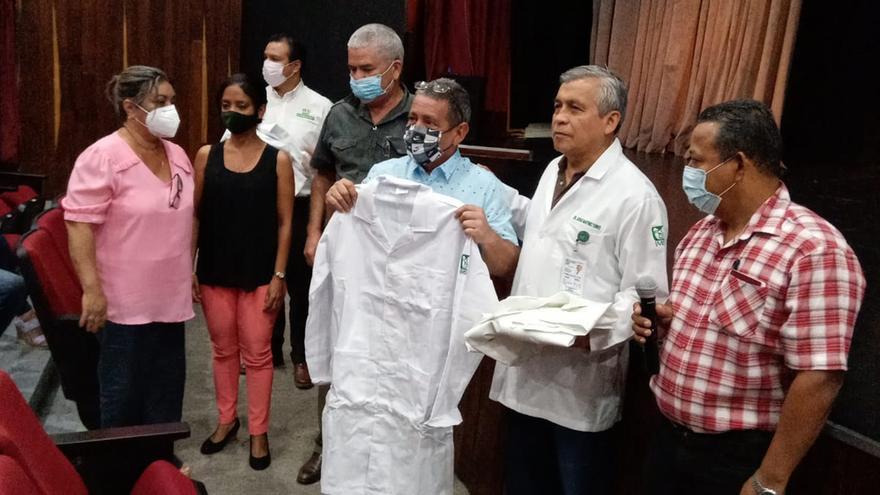
A delegation of Cuban doctors with health authorities in the Mexican state of Nayarit. (Government of Nayarit)

14ymedio bigger14ymedio, Ángel Salinas, Havana, 27 July 2022 — The 500 Cuban doctors who were hired by the Government of Mexico to provide services in marginal areas of the country will receive a salary similar to that of Mexican health workers. “They will receive between 41,784 ($2,042) and 35,237 pesos ($1,722) per month,” an employee of the Institute of Health for Welfare (Insabi) told 14ymedio.

The source specified that, because doctors who are in the state of Nayarit have specialties in anesthesiology, general surgery, gynecology and obstetrics, internal medicine and pediatrics, they must receive $2,042 per month. Although “it’s not established whether the money will be received by them or will go through the Government of Cuba,” the official said.

“Housing and food will be covered by the municipal authorities [of the cities] where each hospital is located,” the source added, and also explained that “every 180 days the immigration permit will be renewed.”

The call issued by the Mexican Social Security Institute and Insabi indicates that the contract for doctors is temporary and will last for four months, and that the doctors will be entitled to benefits and training. Mexican President Andrés Manuel López Obrador said on Monday that Cuban health workers “will be protected” at work. continue reading

López Obrador said that after Nayarit, the next states will be Tlaxcala and Colima, plus the Sierra de Guerrero, a region that was initially pointed out by the president as the one with the greatest health need and to which the 500 doctors from the island would be sent.

On Wednesday, the health authorities of Nayarit confirmed to 14ymedio that 47 Cuban doctors were taken to the hospitals that are located in the rural towns of Las Varas, in the municipality of Compostela, Puente de Camotlán (La Yesca), Jesús María (Del Nayar), San Francisco and Tondoroque (Bahía de Banderas), and to the municipal capitals of Santiago Ixcuintla, Rosamorada and Ixtlán del Río. Seven doctors were incorporated into the staff of the central hospital of Tepic.

The Cuban medical missions that provided their service during the COVID-19 pandemic were criticized for the lack of preparation of their health workers and the high costs they represented for Mexico.

A report revealed that doctors from the island limited themselves to “making beds, taking vital signs, conducting surveys and passing sponges to patients to bathe,” while the Cuban authorities proclaimed that mortality rates had decreased during their stay in Mexico.

In March 2021 it was announced that the administration of Claudia Sheinbaum, head of Government of Mexico City, spent a total of 150,759,867 pesos ($6,986,091) on the hiring of 585 Cuban doctors who were working in the capital from April 24 to July 24, 2020, once 14,884,785 pesos ($689,749) were added for the accommodation and feeding of the doctors. For the other brigades that have arrived in the country, the amounts disbursed to the Cuban Government are not known.

On the same subject, the coordinator in the Mexican Senate of the opposition National Action Party, Julen Rementería, accused the Governments of Mexico and Cuba of orchestrating a fraud by paying,12,692,940 dollars for the hiring of 585 untitled health workers from the island.

Translated by Regina Anavy

____________

COLLABORATE WITH OUR WORK: The 14ymedio team is committed to practicing serious journalism that reflects Cuba’s reality in all its depth. Thank you for joining us on this long journey. We invite you to continue supporting us by becoming a member of 14ymedio now. Together we can continue transforming journalism in Cuba.

Dengue Fever Puts the Cuban Health System to the Test Yet Again

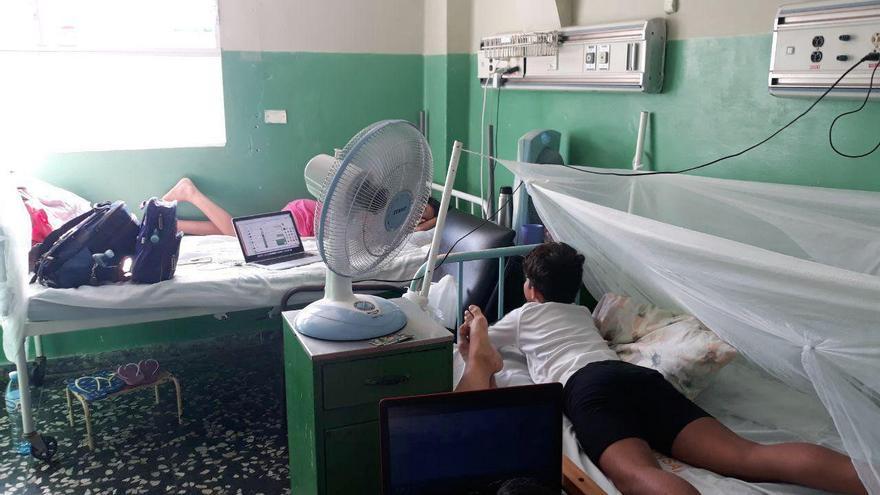
COVID-19 had left dengue fever in the background, but the disease is now spreading again on an island without supplies for prevention. (14ymedio)

14ymedio bigger14ymedio, Havana, 28 July 2022 — The Mario Muñoz Monroy hospital, in Colón, Matanzas, has been forced to open two rooms of 60 and 20 beds respectively to accommodate the “significant number of admissions” that dengue fever is bringing.

On Wednesday, the official newspaper of the province, Girón, reported an increase in fever consultations that is in line with the news coming from Sancti Spíritus, where the ruling party has recognized that fifty people are cared for daily for dengue fever, and that “some people have developed serious forms of the disease.” The worst cases in this province are concentrated in Cabaiguán and Trinidad.

In the case of Matanzas, the deputy director of Public Health, Andrés Lamas Acevedo, said that cases decreased in the last week in Colón, but from neighboring Calimete the visits of patients with complications are increasing. Jagüey Grande, Cárdenas and the main municipality are other towns that are the most affected.

Last week, the authorities recognized an incidence rate of 19.7 cases per 100,000. The Minister of Health himself, José Ángel Portal Miranda, admitted at a press conference the exponential growth of the disease in recent months and said that the worst is yet to come. In April, the incidence rate was 12.2 per 100,000 inhabitants, while in June it reached 46.3.

Health workers insist that the population must do everything possible to protect themselves because there are no insecticides such as Abate or diesel available to fumigate every six days, as established in the protocols. These limitations coupled with the summer heat and the long hours of blackouts are leading to the proliferation of a disease that had remained in the background during COVID. continue reading

In addition, it is estimated that the under-declaration of dengue fever is elevated. On one hand, many patients refuse to go to the doctor to avoid hospitalization due to the state of many centers throughout the island. On the other, there is a visible shortage of means for a correct diagnosis, and some patients claim that the required tests are not performed because the reagents are rationed for the most severe cases.

“We are alarmed,” an internist at a hospital in Havana told this newspaper, who said that more serious cases are occurring this year than usual. “In previous epidemics, perhaps approximately 10% of cases had warning signs (those that warn you that the patient is not progressing well), but now it is more than 30%.”

In recent weeks, networks have reported the deaths of several people due to dengue symptoms, but the authorities are reluctant to give numbers of deaths despite the demands of the population.

Translated by Regina Anavy

____________

COLLABORATE WITH OUR WORK: The 14ymedio team is committed to practicing serious journalism that reflects Cuba’s reality in all its depth. Thank you for joining us on this long journey. We invite you to continue supporting us by becoming a member of 14ymedio now. Together we can continue transforming journalism in Cuba.

Cuban Exile Raises about $13,000 to Replace Etecsa’s Controversial Billboard in Miami

Proposal to replace the advertising space that advertised telephone recharges with the Etecsa logo in Miami. (Telemundo 51/Capture)

14ymedio bigger14ymedio, Havana, 25 July 2022 — “Cuban exile is respected!” will say the Miami billboard that briefly housed an advertising message from the Cuban state telecommunications monopoly Etecsa announcing its telephone recharges. “We don’t want more communist propaganda,” concludes the new text that its promoters want to put on the edge of the Palmetto highway when they get the funds to pay for the space.

The previous advertising poster was removed on July 14, after a campaign on social networks in which the content of advertising placed on one of the busiest highways in Hialeah, where a population mostly of Cuban origin lives, was described as an “insult.”

After the rejection of the community, activist José Alberto García called for fundraising in Miami-Dade County to place the new ad for one month at a cost of more than $11,000. “The initiative is for Cuban exile to unite and in this way give an answer to the front men of the Cuban dictatorship and let them know that we are here, and we are going to put up our anti-communist billboard,” García told Telemundo 51.

On the billboard that was removed, one could see the actress Tahimí Alvariño, the advertising face of the Katapulk company, which sells food and toiletries for emigrants to buy for their relatives on the island, in addition to telephone recharges from Etecsa, the Cuban State telecommunications monopoly.

“For me it was a mockery of exile and so many people who have sacrificed themselves and fled that dictatorship. Don’t let them come and put a sign in our face and stand idly by. That’s not going to be allowed,” García said. continue reading

The billboard advertised phone recharges to Cuba, but it was removed after pressure from opponents in Miami. (Collage)

Another phrase that will be put on the new billboard, for which more than $12,000 has already been raised, will be: “Down with the dictatorship. Homeland and Freedom” along with the hashtags #CubaPaLaCalle [Cuba[ns] into the Street] and #LibertadParaLosPresosPolíticos [Freedom for the Political Prisoners].

Cuban-American businessman Hugo Cancio, owner of Katapulk and one of the island’s emigrants who maintains closer commercial ties with the Havana regime, then responded to the controversy in a written statement sent to Telemundo, in which he stressed that Etecsa is not sanctioned by the U.S. Government: “This is an activity authorized by the regulations of OFAC (the U.S. Treasury office in charge of applying the embargo).”

“Etecsa is the telecommunications company in Cuba where all Cubans inside and outside the island process their recharges and buy their data packages for the use of the Internet and other services,” he said, adding that his company did not want to “cause attention or controversy… We decided to offer this much-needed service to our customers and, being new, we wanted to give legitimacy to this management.”

Katapulk belongs to Fuego Enterprises Inc., a company founded by Cancio on December 30, 2004 in Miami. Last year it was one of the entities authorized by the Cuban Government for registration in the registry of foreign companies that do business with the island.

Translated by Regina Anavy

____________

COLLABORATE WITH OUR WORK: The 14ymedio team is committed to practicing serious journalism that reflects Cuba’s reality in all its depth. Thank you for joining us on this long journey. We invite you to continue supporting us by becoming a member of 14ymedio now. Together we can continue transforming journalism in Cuba.

Yaime Perez Says Goodbye to her Discus and the Cuban Delegation While in the United States

In her first Olympic Games, Yaimé Pérez threw the discus 57.87 meters. (EFE)

14ymedio bigger14ymedio, Havana, 26 July 2022 — Cuban athletics continues to add defeats. To the sporting failure at the XVIII World Athletics Championships that was held in Eugene, Oregon in the United States, where the Cuban delegation didn’t win any medals, is added the escape of the Olympic medalist and world champion of the discus throw, Yaimé Pérez, according to Play-Off Magazine.

The Santiago woman, who won seventh place in the Eugene World Cup, made the decision recently, the same media said. With her there are three members of the Cuban team who left, including the javelinist Yiselena Ballar who left earlier, and the physiotherapist Carlos González Morales who left this Tuesday.

“She is the 19th athlete to abandon the team in international events during 2022. Pérez, 31, won two Diamond Leagues,” journalist Francys Romero said on his social networks: “The official press has blamed the cancellation of the Cuba-MLB agreement for the exodus of baseball players. But these exits in more than five sports prove that the exodus is mainly for survival rather than for a future in sports.”

Yaimé Pérez is number three in the world ranking in the event, according to the Olympics portal. Her personal best is 69.39 meters, which she got in France (2019). In Tokyo 2020, her third Olympic Games, she reached third place.

Her ability has also been demonstrated by winning the Continental Cup in Ostrava (2018) and the U20 World Cup (2010). She also won a silver medal at the Pan American Games in Toronto (2015) and, four years later, won the gold medal in Lima (2019).

Last Friday Mario Planchet, Christian Temprano and Leonardo Acevedo, members of the Futsal Sub 20 team, didn’t show up for Cuba’s semifinal match against Nicaragua in the Uncaf FIFA Forward tournament, which is held in Guatemala.

The delegation informed the Guatemalan authorities of the escape to prevent Cuban soccer players from leaving the country, Prensa Libre published.

Translated by Regina Anavy 

____________

COLLABORATE WITH OUR WORK: The 14ymedio team is committed to practicing serious journalism that reflects Cuba’s reality in all its depth. Thank you for joining us on this long journey. We invite you to continue supporting us by becoming a member of 14ymedio now. Together we can continue transforming journalism in Cuba.

Coyotes Kept Five Cubans Hidden in a Feed Store in Central Mexico

Angélica María Rodríguez Varela and Ismael Meléndez Castro are held incommunicado at the Las Agujas migration center. (Collage)

14ymedio bigger14ymedio, Ángel Salinas, Mexico, 25 July 2022 — A warehouse intended to store feed was used by coyotes as a hiding place for migrants. In the building located on an embankment far from the town of San Miguel de la Victoria, in the State of Mexico, 225 undocumented people were found last Saturday, five Cubans among them.

Angélica María Rodríguez Varela, Isael Meléndez Castro and Junier Blanco Hernández, all of Cuban nationality, were transferred to the Las Agujas migration center, in Mexico City. Migration agents told them that they would be deported.

Rodríguez and Meléndez, originally from Pinar del Río, and Blanco, from Havana, sent their testimonies to our editorial staff. The 26-year-old girl with Passport K523299 said she was afraid that she will be repatriated to the island where she has suffered threats for demonstrating against the regime.

Meléndez, who studies at the University of Computer Sciences, told us that he was forced to leave Cuba after the harassment he suffered for participating in the demonstrations of July 11, 2021. “They accused me with false testimony and wanted to put me in prison,” he told 14ymedio.

Blanco asks to be allowed to continue on their way to the United States, where “we can ask for asylum.” The habanero stressed that they have not committed any crime and that their only fault was not to wait any longer in southern Mexico to complete the application process for a free transit laissez-passer.

Minutes after they were arrested by members of the National Guard and Migration, the Cubans had their cell phones confiscated and are now being held incommunicado at the Las Agujas station. continue reading

The case reached the ears of migrant defense attorney José Luis Pérez, who processed an amparo* so that they can be released and avoid any attempt at extortion by Migration agents, which happens often with undocumented migrants, mainly Cubans.

The detention of Cubans in the Migration Center “has become a means of raising money for the coffers of officials,” stressed the lawyer, who is based in the border state of Chiapas.

A statement from the National Migration Institute indicated that the 225 undocumented migrants were overcrowded and waiting to be transferred by the coyotes to the U.S. border. “People were rescued from a place where there was no light, and several children were found among blankets and backpacks without any hygiene measures,” an agent told 14ymedio.

Among the migrants detained are 194 from Guatemala, 14 from Honduras, nine from Nicaragua and three from El Salvador. The Guatemalans and Salvadorans will be returned to the south of the country.

Since October 2018, and despite the tightening of surveillance on the southern border of Mexico, thousands of migrants from Central and South America, but also from Cuba, Haiti and various African and Asian countries have entered Mexican territory with the aim of reaching the United States.

Coyotes look for routes for foreigners and sometimes park them in the states of Chiapas, Tabasco, Veracruz, Oaxaca, Puebla and the State of Mexico as an intermediate stop on their journey to the United States.

The region is experiencing a record migratory flow to the United States, whose Customs and Border Protection Office has intercepted more than 1.6 million people so far in fiscal year 2022, which began last October.

In addition, Mexico received a record of more than 58,000 applications for asylum in the first half of 2022, an annual increase of almost 15%, according to the Mexican Commission for Refugee Assistance.

*Translator’s note: An ’amparo’ is a request for protection

Translated by Regina Anavy

____________

COLLABORATE WITH OUR WORK: The 14ymedio team is committed to practicing serious journalism that reflects Cuba’s reality in all its depth. Thank you for joining us on this long journey. We invite you to continue supporting us by becoming a member of 14ymedio now. Together we can continue transforming journalism in Cuba.

Large Deployment of Security Forces on the Eve of July 26 in Cuba

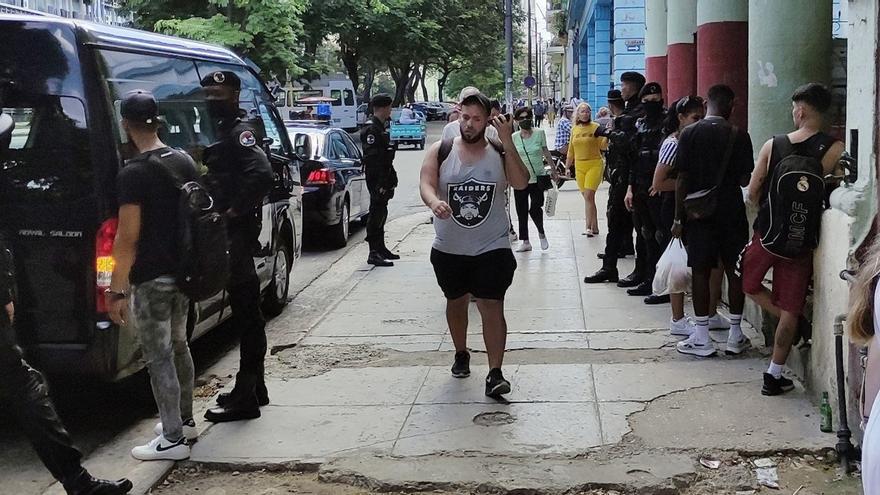
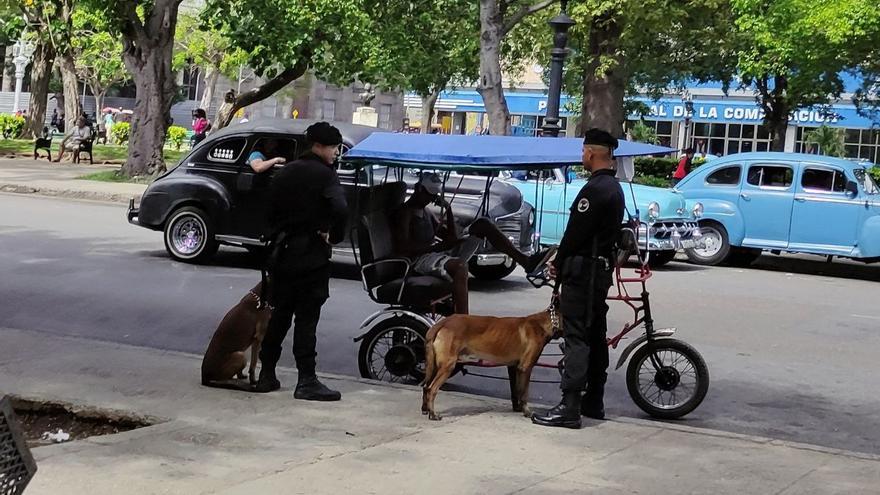
The people of the capital have noticed an unusual operation of the ‘black berets’ mainly in highly populated municipalities such as Central Havana and Old Havana. (14ymedio)

14ymedio bigger14ymedio, Juan Diego Rodríguez, Havana, 25 July 2022 — On the eve of July 26, the date of the celebration of the Cuba regime, and with an atmosphere full of protests over the long blackouts in the country, the streets of Havana woke up this Monday guarded by the Special National Brigade of the Ministry of the Interior known as the black berets.

The people of the capital have noticed an unusual operation of this repressive force mainly in highly populated municipalities such as Central Havana and Old Havana, while the country experiences three holidays from today until the 27th for the celebrations of the Day of National Rebellion (July 26), on the 69th anniversary of the assault on the Moncada barracks in Santiago de Cuba.

Among the most guarded areas are the vicinity of the Ministry of Energy and Mines, on Carlos III, between Oquendo and Soledad. It’s a strategic installation in these times of blackouts throughout the country, scheduled by the Electrical Union, which depends on this ministry. One of the offices of this state company in the province of Mayabeque was partially set on fire by protesters, who filmed the event late at night.

Two ’black berets’ in Fraternity Park in Havana on July 25, 2022. (14ymedio)

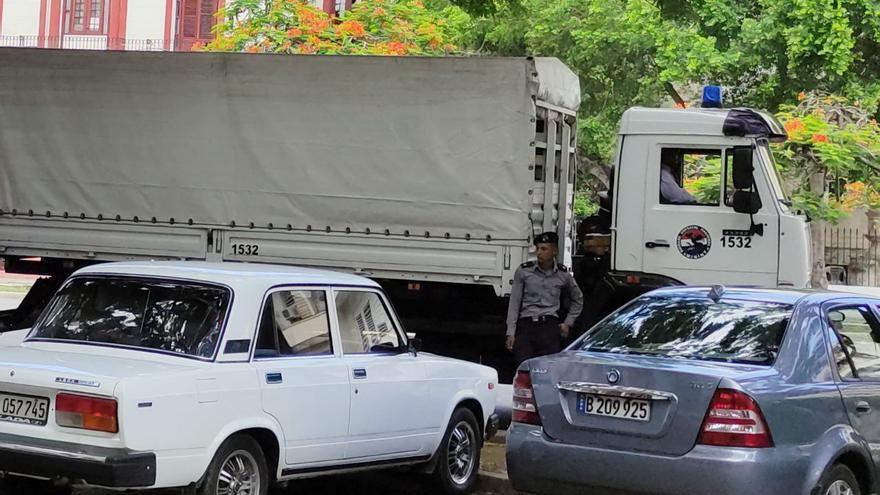
On another corner of Carlos III, between Soledad and Castillejo, very close to the ministry itself, a truck of the Special Brigade was guarded by several agents. The vehicle, with the number 1532, serves to transport the military, as was recorded during the days after the protests of July 2021, when the regime deployed its repressive arsenal and mobilized caravans in several cities. continue reading

In this area there is also Plaza Carlos III, one of the largest shopping centers in Havana, popularly known as “the palace of consumption.” For several years it has been the commercial lung of Central Havana, especially in the neighborhoods of Pueblo Nuevo, Cayo Hueso and Los Sitios. Both in this establishment and in other state centers you can also see the operational guards of police, other special forces and State Security officers dressed in civilian clothes.

But the ones who have attracted the most attention in the last few hours are the black berets, with their black uniforms and their inquisitive looks, as they observe the atmosphere in central areas of the capital and even walk with dogs guarding streets and busy squares such as Fraternity Park. Some residents report to this newspaper that when they approach this brigade, they prefer not to be using their cell phone because even that action provokes suspicion among the military.

One of the trucks in which the ’black berets’ move is located on Carlos III, between Soledad and Castillejo, in Central Havana. (14ymedio)

Because of the violence unleashed by the regime during the arrest and imprisonment of the demonstrators on July 11, 2021, the black berets together with the minister of the Revolutionary Armed Forces of Cuba, Álvaro López-Miera, are considered responsible for “serious human rights abuses.”

Translated by Regina Anavy

____________

COLLABORATE WITH OUR WORK: The 14ymedio team is committed to practicing serious journalism that reflects Cuba’s reality in all its depth. Thank you for joining us on this long journey. We invite you to continue supporting us by becoming a member of 14ymedio now. Together we can continue transforming journalism in Cuba.

Vietnam Donates 750 Tablets to the Cuban Assembly in Support of ‘Its Just Revolutionary Cause’

Tran Thanh Man, vice president of the Vietnamese National Assembly, presented the gift on Wednesday to Orlando Nicolás Hernández Guillén, the island’s ambassador to the Asian country. (Latin Press)

14ymedio bigger14ymedio, Madrid, 20 July 2022 — The Parliament of Vietnam has given 750 tablets, two servers, a storage device and two multifunction printers to the National Assembly of People’s Power to improve operational efficiency and in support of the “just revolutionary cause of the Cuban people.”

Tran Thanh Man, vice president of the Vietnamese National Assembly, presented the gift on Wednesday to Orlando Nicolás Hernández Guillén, the island’s ambassador to the Asian country, who thanked him for the donation and praised Vietnam, which “has always been side by side with Cuba.”

Hernández Guillén again accused the United States of damaging Cuba’s economic activity, specifically with regard to foreign trade and foreign investment. “No citizen or sector of the economy escapes the effects derived from this unilateral policy,” he insisted.

There was no shortage of mentions of Fidel Castro and his visit to the country 49 years ago. “Fidel, like Martí at the time, knew, with exquisite sensitivity, how to assess the high human and moral value of the [Vietnamese] people and engender a feeling that to this day keeps us united,” said the Cuban ambassador.

Thanh Man, for his part, responded that Castro’s phrase was “deeply engraved in the hearts of generations of Vietnamese,” referring to his words on that visit in September 1973: “For Vietnam we are willing to give even our own blood.”

The official followed the path of emotion and quoted Ho Chi Minh, in frank competition with Castro: “Vietnam and Cuba are separated by thousands of kilometers, but the hearts of the two countries are as close as brothers and sisters.”

The Cuban ambassador said that the Cuban authorities are waiting for the next official visit of the president of the National Assembly, Vuong Dinh Hu, and that they want to continue the path of cooperation that they have maintained for almost half a century.

Vietnam and Cuba maintain close commercial, economic and political ties, although in recent years their economic models have gone in different directions. The Asian country abandoned the Marxist planned economy and became a socialist market economy, a formula more similar to China.

Since then, the Vietnamese economy began to flourish, and now it is this country that provides aid to the island. The joint agricultural program allows Cuba, for example, to invest less in rice imports, since it receives about 5,000 tons of Vietnamese grain every year.

Translated by Regina Anavy
____________

COLLABORATE WITH OUR WORK: The 14ymedio team is committed to practicing serious journalism that reflects Cuba’s reality in all its depth. Thank you for joining us on this long journey. We invite you to continue supporting us by becoming a member of 14ymedio now. Together we can continue transforming journalism in Cuba.

Cuban Parliament Approves the Final Version of the New Family Code

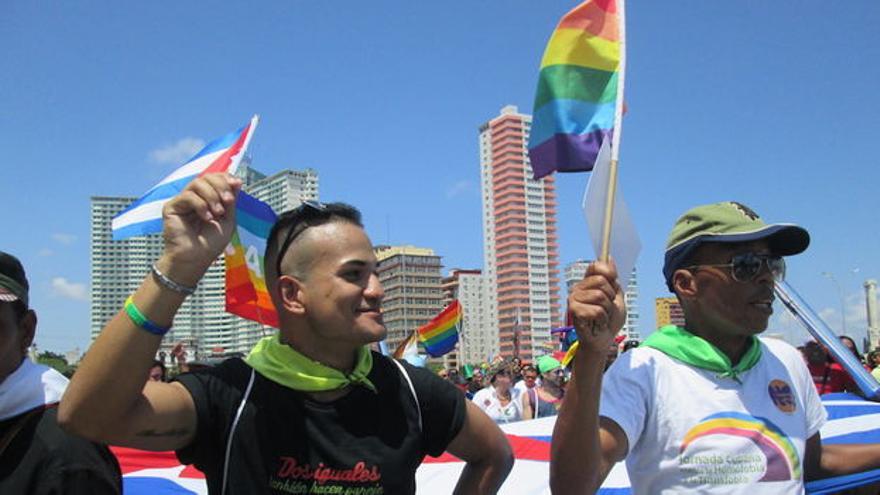
March against homophobia and transphobia in Cuba (14ymedio)

14ymedio biggerEFE (via 14ymedio), Havana, July 22, 2022 — The National Assembly of People’s Power (ANPP, unicameral parliament) of Cuba unanimously approved this Friday the definitive version of the so-called Family Code, which will be submitted to a popular referendum on September 25.

The deputies supported version 25 of this legislative package to regulate interpersonal relationships, which includes equal marriage, adoption by homosexual couples and surrogacy (“solidarity” in this text).

The regulations went through an extensive popular consultation between February and April, in which 6.4 million people participated, said the Cuban Minister of Justice, Oscar Silvera, before the plenary of the ANPP, among whom were the president of the country, Miguel Díaz-Canel, and his predecessor, Raúl Castro.

Silvera explained that as a result of this popular consultation, “47.93% of the general text and 49.15% of its articles were modified.”

If approved in September, the Family Code will replace the regulations in force since 1975.

The Family Code is the only regulation submitted to a referendum among the 70 updated after the new Constitution of 2019, including sensitive laws like the new Criminal Code. continue reading

During the consultation, 336,595 votes were recorded, and 434,000 proposals were collected. Silvera indicated that 61.9% of citizens pronounced themselves in favor of the code.

The Government has deployed an important media campaign that is flooding television screens and newspapers, and there are even special programs dedicated to explaining every detail of the 471 articles of the Code, in order to get majority support.

The new Family Code has generated controversy among those who don’t accept gay marriage and adoption by same-sex couples, such as some religious groups.

It is also rejected by some feminist groups that demand a specific law on gender-based violence and the criminalization of femicide. The Government says that there are already laws that punish these crimes.

Some opponents and activists have also taken a stand against this regulation because it comes from the Government.

No surveys on the degree of support for the Family Code have been disseminated among the Cuban population.

Translated by Regina Anavy

____________

COLLABORATE WITH OUR WORK: The 14ymedio team is committed to practicing serious journalism that reflects Cuba’s reality in all its depth. Thank you for joining us on this long journey. We invite you to continue supporting us by becoming a member of 14ymedio now. Together we can continue transforming journalism in Cuba.

There Will Be No Foreign Investment for the Private Sector in Cuba

One has to worry about what the communists don’t know how to do, which is nothing more than creating a favorable environment for the prosperity of business. (14ymedio)

14ymedio bigger14ymedio, Elías Amor Bravo, Economist, 23 July 2022 — In recent days, we have witnessed a torrent of measures by the Cuban regime to get the economy of the island out of the vicious circle in which it has been locked by the communist economic model that the authorities are stubbornly determined to apply.

And of all the ministerial hodgepodge of proposals, some hilarious ones such as the recovery of the “microbrigades” or the “in-person learning” reminiscent of the revolutionary old days, those related to foreign investment in Cuba have undoubtedly been the ones that have received the most attention — in some cases, resulting in undesirable confusion.

The person responsible for this mess has been the Minister of Foreign Trade and Foreign Investment, Rodrigo Malmierca, who reported in the National Assembly on the activity of his department, exemplified in the negotiation of 57 projects with foreign capital in prioritized sectors of the economy, valued at almost $5 billion, all of them still without a materialization date.

Malmierca, immune to discouragement and the fact that the application of Law 118 on foreign investment has been a resounding failure since 2014, told the deputies that “if you work well and make an effort, we have the conditions to attract more foreign capital despite the existing difficulties,” with less conviction than what these words really say.

The difficulties, in line with the official argument of the regime, come, of course, from the ‘blockade’, but also, and here comes the interesting thing, from what Malmierca called “works that depend on us, including delays in the procedures and the lack of preparation in the negotiating groups.”

Actually, if those were the obstacles to the development of foreign investment in Cuba, there could be some hope, but when you compare the Cuban experience since 2014 with that of, say the Dominican Republic, you can understand why foreign capital turns its back on Malmierca and, nevertheless, lines up to be able to enter the neighboring Caribbean island.

Trying to attract investment only with a law is a waste of time. First, you have to worry about what communists don’t know how to do, which is nothing more than creating a favorable environment for business prosperity, so that people can increase their standard of living and companies can operate freely. In Cuba, that is simply impossible, and therefore, not because of laws or obstacles, foreign investment passes it by. continue reading

But Malmierca knows how to catch attention and that is why, after recognizing that the management of his department leaves much to be desired (at the end of last year, 285 businesses had been approved in Cuba since 2014, 49 located in the Mariel Special Development Zone and 29 reinvestments), he announced that “about seven foreign investment projects linked to forms of non-state management are being studied, and the relevance of approving businesses in domestic trade is being analyzed.”

The deputies of the Assembly, who at that time were sleeping peacefully, felt a small convulsion. Some even used their mobile phones to say that Malmierca was thinking of authorizing foreign investment in the private sector. People couldn’t believe it.

So when the minister changed the subject and began to talk about the virtues of the unique digital window and the measures to attract foreign capital at the municipal level, everyone’s interest was in that mention of the possible entry of foreign investment into private businesses — something that, until now, had been banned. Everyone wanted more information, but the deputies of the Assembly rarely bother the top leaders of the regime, so it would be best to wait.

Little by little, the State newspaper Granma’s headline summary of the news — “There are possibilities of attracting more foreign capital” — began to run from mobile to mobile. Yes, but how would that idea be translated into reality, in view of the experience since 2014? It seemed evident that Malmierca was proposing an update of the policy for attracting foreign investment in Cuba and its flexibility in favor of more profits, as well as the actions being taken to encourage and improve this mechanism, but was there really a will to open foreign capital to the private sector?

Malmierca had said that the reforms that were going to be introduced would in no case mean that “the socialist character of our government would be violated,” but someone saw that the portfolio of opportunities for foreign investment had included, among other options, small projects and 60 others that emerged from the territories. They were no longer the great millionaire pharaonic projects that used to frighten foreign investors for the mobilization of required financial resources.

But so far, nothing more. The natural date would be the 38th Havana International Fair (Fihav-2022) to be held in November. Apparently someone said that there were preparations being made “for exceptional projects, and the strategic axes of the National Economic and Social Development Plan until 2030 will be taken into account.”

And reading the news, someone said they had mentioned it. Granma reported “the minister pointed out that another flexibility of the policy is the possibility that the more than 4,000 forms of non-state management can work with foreign investment, in accordance with the provisions of the law.” That’s it. This is the key to authorizing the entry of international capital into the private sector, but it’s advisable to read it in detail and to not be in a hurry.

“Working with foreign investment” is not well known and is not the same as receiving foreign capital and offering a stake in it, by the way, which at no time is mentioned. These are very different things, and until the proposal is outlined, you have to understand the first version: “work with foreign investment.” And that’s not nothing.

Then there are the dangers that aren’t obvious. If Malmierca wants there to be foreign investment in the retail sector, the first thing that has to be achieved, and this seems almost impossible in the Cuban economy, is that there are products to be sold and bought and also purchasing power to do so, and it doesn’t seem that these two parameters are currently in the reality of trade and the retail trade circulation of the Cuban economy.

Little by little, people calmed down. No one should expect any change in the foreign investment policy because the communist regime’s nature is to have absolute control of the economy and to prevent the accumulation [of profit] and the prosperity of private businesses. There will be no foreign investment in the private sector, at least with the 2019 communist constitution in force. The alarms stopped going off. It’s very difficult to get out of the vicious circle of the Cuban economy.
________________________

Note from 14ymedio: This article is reprinted with the permission of the author. I was originally published in Cubaeconomía.

________________________

Translated by Regina Anavy
____________

COLLABORATE WITH OUR WORK: The 14ymedio team is committed to practicing serious journalism that reflects Cuba’s reality in all its depth. Thank you for joining us on this long journey. We invite you to continue supporting us by becoming a member of 14ymedio now. Together we can continue transforming journalism in Cuba.

In Cuba There is Not Even Enough Sugar Cane to Make Guarapo

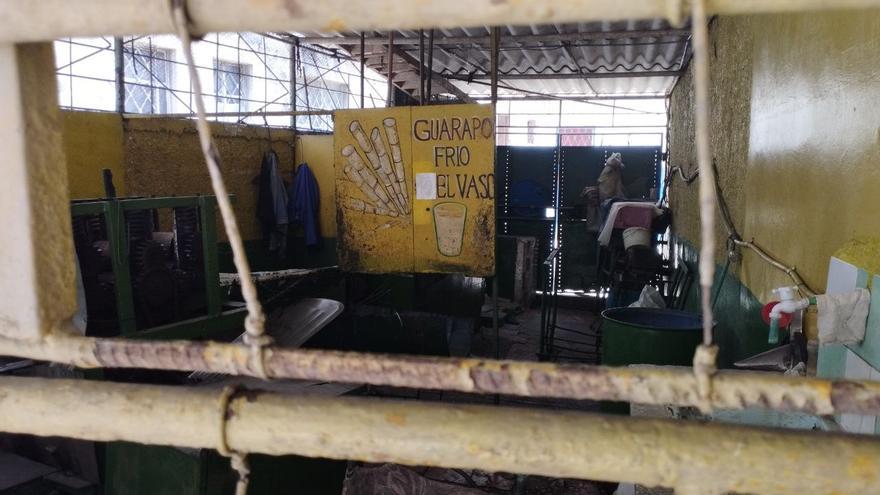
Guarapera on Infanta and Carlos III, in Havana, completely closed this Friday. (14ymedio)

14ymedio bigger14ymedio, Juan Diego Rodríguez, Havana, 22 July 2022 — The debacle of Cuba’s sugar sector, which recorded catastrophic harvests in the last two years, is affecting an entire cultural tradition in Cuba: the guaraperas, selling guarapo — sugar cane juice.

Instead of guarapo this Friday, they sold mango juice at the premises of Neptuno, between Belascoaín and Lucena, Central Havana. “There is not even a little piece of cane to grind,” the employee told a customer who went in to cool off in the middle of the hot morning in the capital. “The harvest hasn’t even given enough to tie a goat,” the man commented ironically, having to settle for mango juice and complained that it was acidic.

Not far from there, the guarapera located on Infanta and Carlos III, one of the ones that sells the most products in the capital, dispatching it even in bottles, is completely closed. An old woman who came to quench her thirst, turned around, disappointed: “This Revolution gives neither sugar, nor water, nor ice nor shame.”

Traditionally, guarapo has been a drink to quench thirst in the midst of high Cuban temperatures. Served with plenty of ice, it helps to cool one down, in addition to providing enough energy to continue on the road. However, it is also a fragile liquid, which quickly becomes acidic and must be consumed as soon as the cane is ground.

Guaraperas were very frequent in Havana, but in recent years they have disappeared and, currently, there are only a few scattered throughout the city. Given its rapid deterioration, the guarapo is not sold on an itinerant basis nor is it stored in cans or bottles. Although in other countries it has been preserved in containers, in Cuba it is still an ephemeral drink. continue reading

Therefore, going to a guarapera was, in addition to a necessity to relieve the heatwave, a cultural experience: the press crushing the cane, the liquid between yellow and milky coming out of the stalks, the fragments of ice served loudly in the glasses that were then filled with a sparkling and sweet drink. The first sip was like an energetic jolt that ran through the body.

The first blow to the guaraperas was a matter of hygiene, with the lack of detergent to wash the glasses. Then, the supply of ice and, later, the cane began to diminish. The blackouts have given the final blow to many of these places that need electricity for the cane presses. At the counters where a few years ago impatient customers waited while they watched the guarapo flow from the grinding mill, now there are only flies and silence left.

Translated by Regina Anavy
____________

COLLABORATE WITH OUR WORK: The 14ymedio team is committed to practicing serious journalism that reflects Cuba’s reality in all its depth. Thank you for joining us on this long journey. We invite you to continue supporting us by becoming a member of 14ymedio now. Together we can continue transforming journalism in Cuba.

Cuba Exceeds One Hundred Daily Cases of Covid for the First Time in Two Months

Health authorities warned ten days ago about a slight increase in Covid cases due to the subvariant BA.5. (14ymedio)

14ymedio biggerEFE (via 14ymedio), Havana, 23 July 2022 — Cuba exceeded one hundred daily cases of Covid-19 on Saturday for the first time in more than two months, confirming 114 new infections.

The last time the Ministry of Public Health registered more than 100 new positives in one day was on May 14, when it reported 103 infected.

Then, the number of people newly infected with SARS-Cov-2 began to fall for several consecutive days, and deaths were not reported.

The total number of PCR tests has also decreased, accounting for about 2,509 daily, according to official statistics.

“As of the end of yesterday, July 22, a total of 714 patients were admitted, 290 suspected cases and 424 active confirmed,” the Ministry of Health said on Saturday in its daily report on Covid.

Health authorities warned ten days ago about a slight increase in cases due to the circulation in the country of the subvariant BA.5 of the Omicron variant of the virus.

They assure that they maintain “control” of the disease, due to the high rates of vaccination with their own anti-Covid 19 formulas that reach almost 98% of the population considered “vaccinable.”

Havana and Matanzas lead the regions of the country with the most reported cases, although they don’t reach one hundred or the levels of last summer, when they exceeded a thousand.

On the other hand, this Saturday the World Health Organization declared an international emergency, due to the current outbreak of monkeypox, after some 16,000 cases have already been reported in 75 countries, many of them in Europe, where the disease was not endemic. Of the total, only five people with the disease have died. continue reading

The decision was announced at a press conference by the Director General of WHO, Tedros Adhanom Ghebreyesus, two days after an emergency committee with experts in this disease met to discuss the possible declaration, which will oblige national health networks to increase their preventive measures.

The committee had chosen not to declare the emergency at a first meeting held in June (when cases were at 3,000), and on this occasion, according to Tedros, there was also no total consensus among the experts, but the director general decided to declare the emergency in view of the high and growing number of cases in various regions around the world. At the moment, Cuba has not registered any cases of monkeypox.

Translated by Regina Anavy
____________

COLLABORATE WITH OUR WORK: The 14ymedio team is committed to practicing serious journalism that reflects Cuba’s reality in all its depth. Thank you for joining us on this long journey. We invite you to continue supporting us by becoming a member of 14ymedio now. Together we can continue transforming journalism in Cuba.

Tourism in Cuba in the First Half of 2022: From Information Manipulation to the Reality and the Inflation that is Causing Harm

In the middle of the week, calm reigned on the beaches of Varadero, which see the presence of Cuban tourists on Saturdays and Sundays. (Roma Díaz)

14ymedio bigger14ymedio, Elías Amor Bravo, Economist, 21 July 2022 — In the first six months of 2022, according to the National Office of Statistics and Information [ONEI], a total of 987,008 travelers arrived in Cuba, representing an increase of 557.3% over the same period in 2021, which is equivalent to 809,808 more travelers. Of these, there have been 682,411 international visitors, and they represent 596.3% compared to the same period last year. That is, 567,972 more international visitors than in the first half of 2021.

These data indicate that the Cuban tourism sector is growing and that it’s doing so at an important rate, multiplying by five the figures of the previous year. But once again you have to look at the information manipulation campaigns of the communist regime, and in this case, one can only question the data that, triumphantly, the leaders are offering.

And for four reasons.

First, because despite the dynamism that tourism is experiencing worldwide, the results of the last normal year before the pandemic, which was 2019, are still not achieved in Cuba. That year, at the end of the first semester, 2,561,719 visitors had arrived in Cuba, about three times more than this year, 2022, which, although it has improved compared to 2021, was a year of border closures until November, as a result of COVID-19 infections.

Therefore, it’s advisable to be cautious with the figures. The level of tourist activity in these first six months of 2022 barely reaches 27% of the 2019 figure, and that year 4.2 million tourists arrived during the year. The data for 2022 are still not good, and manipulation campaigns have to be considered, even more so when weak months are now coming for Caribbean tourism that coincide with the summer and the hurricane season. Once again, we will have to wait until November to see if the miracle takes place.

Second, because there are significant changes in the composition of tourism. In fact, the arrival of Canadians is activated and already accounts for 31.3% of the total, with 214,122 visitors (six points more than in 2019, for example). But it should be borne in mind that the second block is made up of the Cuban community abroad, which with 151,008 visitors, already accounts for more than a quarter of the total (ten points more than in 2019). And in third place, the United States, which with 40,600 is ahead of the Russians. continue reading

Leaders should be aware of this data and be careful when disqualifying and attacking their northern neighbor because they can affect demand preferences. Despite the “embargo/blockade,” tourists from the United States to Cuba outperform those from any European country.

Meanwhile, tourists from the markets of the old continent, despite the rise of traditional powers such as Spain, France or Italy, don’t show special interest in coming to Cuba, or they register growth much below the average, which, in the specific case of the Russians, confirms that the measures of the international community are taking effect.  Only 37,654 Russian tourists arrived in Cuba in the first half of the year.

Third, because other competitive destinations in the Caribbean have been launched so far this year, leaving Cuba far behind in the process of recovering tourism after the pandemic. This is the case of the Dominican Republic, which in the first five months of this year received a spectacular figure of 2,396,864 tourists out of a total of 3,000,000 passengers.

The results of this Caribbean destination once again leave Cuba far behind, almost 71% below, which shows considerable difficulty in growing tourism. Other destinations such as Cancun or Costa Rica also show positive data, which may indicate that Cuba’s tourism policy is not adequate and that it should be reviewed.

Fourth, because the results of this first quarter move the economy away from the objectives of the plan for 2022. And we can’t forget the almost sick relevance that Cuban communists attach to their plan for the economy, which is usually rarely fulfilled. If the results of these six months were doubled, tourism in Cuba at the end of the year would not exceed 1.3 million visitors, a figure that is far removed from the communist regime’s goal of 2.5 million, almost by half.

No. Tourism is not going well in Cuba in 2022. Growth is insufficient to overcome the crisis and has nothing to do with what is happening in other countries in the area that have been able to mobilize their market. The worst thing is that the Cuban private sector, linked to tourism, loses growth opportunities and remains stagnant, waiting for the situation to improve. And now there is inflation.

The inflation of the CPI, for example, of the “Restaurants and Hotels” component directly related to tourism, has confirmed the growing loss of competitiveness of the sector. The prices of this component until May increased by 24.61% year-on-year, two tenths less than the average of 26%. Rising inflation reduces the attractiveness of Cuban tourism and reduces demand. It’s a serious problem that the authorities don’t know how to solve.

The authorities have invested too much in the construction of hotels, and now when it comes time to occupy them, they find that other destinations in the area are more competitive in price because they have been able to tackle inflation with effective measures. Suddenly, in addition, they see that the euro and the dollar are on parity, and any possible attraction of European tourists is dismantled. The Cuban communist leaders have no idea how an economy is run, but they won’t accept this, and their obsession with intervening, planning and controlling economic activity has led to disaster. Likewise, for purposes of manipulation, it’s not good to give figures that are fake. Cuban tourism is a good example of this.

Translated by Regina Anavy
____________

COLLABORATE WITH OUR WORK: The 14ymedio team is committed to practicing serious journalism that reflects Cuba’s reality in all its depth. Thank you for joining us on this long journey. We invite you to continue supporting us by becoming a member of 14ymedio now. Together we can continue transforming journalism in Cuba.

After Three Months of Crossing, Two Doctors Harassed by the Cuban Regime Arrive in the United States

Cuban doctors Alexander Pupo Casas and Alexander Jesús Figueredo Izaguirre. (Facebook/Dr. Alexander Raúl)

14ymedio bigger14ymedio, Havana, 21 July 2022 — “Family, we are now in the United States.” With that phrase Cuban doctors Alexander Pupo and Alexander Jesús Figueredo reported on Thursday through Facebook that their three-month journey had ended. The doctors were forced to leave the island after being harassed by the regime.

“I am free, and soon my Cuba will be to take care of my people again,” Figueredo said. He clarified that his arrival in the United States was due to the fact that he “has been fleeing the Cuban nightmare” and was not in search of the American dream.

“[I brought] with me a bag of dreams that I never achieved on the island, some papers, a cell phone and my medical stamp, with which I once treated thousands of patients,” explained the health worker, who lost his job due to his confrontational stance against the Government. “There’s nothing here for me,  but I will remember that one day I was #108356.”

According to figures from the Customs and Border Protection Department, in the past nine months, 157,339 Cubans arrived by land in the United States. Of these, 16,170 requested political refuge in June alone.

Just on July 7, Pupo announced the dangers and insecurity faced by migrants on their journey to reach the United States. “Guatemala has been a total hell,” the doctor said in a video he posted on his Facebook account. “We had to hide from the police again,” he said as a group was watched hiding behind in the undergrowth. continue reading

Pupo reiterated that “in Guatemala, an immigrant lives with fear always present. The police mainly pursue Cuban emigrants to extort them.”

The health worker said on that occasion that “the coyotes were bad” and, because they didn’t pay the bribe to the officers, the group with which they were traveling had to go into the mountains.

“We’ve practically had to become soldiers  in here: jumping fences, hiding and trying to evade all the dangers among the pica pica* bushes,” the doctor explained. “It seems that the shocks are never going to end.”

Pupo recalled that from Nicaragua, his journey to reach the United States had been one complication after another. “Unbelievable what we have experienced in these last few hours: going hungry and in need… I wouldn’t recommend this to anyone.”

Before this publication, Pupo had confessed to 14ymedio that they had the most difficult emigration: without visas, without the support of diplomats, practically without money. “And there were those who said that we were financed, that we were well paid by the CIA,” he added ironically.

*Translator’s note: Source: The scientific name for Pica pica is Mucuna. The course hairs on the pods contain the proteolytic enzyme mucunain which cause the itch and sometimes blisters. 

Translated by Regina Anavy

____________

COLLABORATE WITH OUR WORK: The 14ymedio team is committed to practicing serious journalism that reflects Cuba’s reality in all its depth. Thank you for joining us on this long journey. We invite you to continue supporting us by becoming a member of 14ymedio now. Together we can continue transforming journalism in Cuba.