Around 14,390 Cubans became Spanish citizens in 2025, 79% more than the previous year, according to the INE
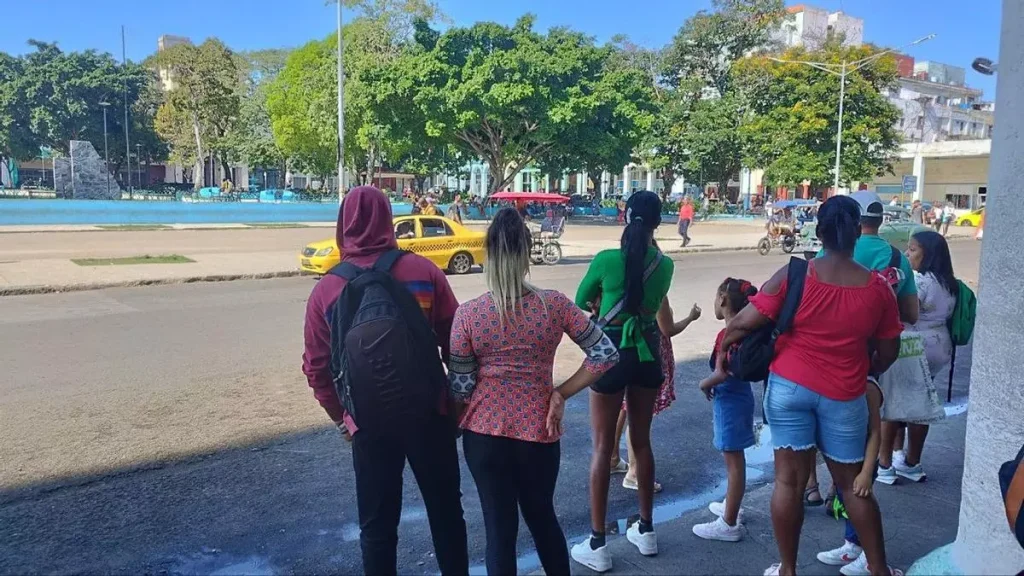
Nearly 300,000 people born in Cuba reside in Spain, according to INE data. / X/@monasterioR
14ymedio, Madrid, 31 May 2026 / Cubans ranked among the leading groups of foreigners to acquire Spanish nationality in 2025, according to data published last Thursday by the National Statistics Institute (INE).
A total of 14,390 Cuban-born citizens obtained Spanish citizenship during the past year, a figure that places Cuba as the sixth most common country of origin among new Spanish nationals, surpassed only by Morocco, Colombia, Venezuela, Honduras and Peru, and ahead of much more populous countries such as Ecuador, Argentina, the Dominican Republic and Nicaragua.
Compared to the 8,045 Cuban-born citizens who obtained Spanish nationality in 2024, last year’s figure represents almost double. Cubans represent one of the Latin American migrant communities with the greatest growth in Spain in recent years, a consequence of the wave of emigration triggered by the economic and political crisis on the island.
Cubans are the sixth most frequent nationality among ‘new Spaniards’
Cubans – among nationals of Ibero-American countries – enjoy advantages when it comes to obtaining Spanish citizenship, as they may apply for it after two years of legal residence, compared with the ten years generally required. In addition, many benefit from the so-called Democratic Memory Law, which allows descendants of emigrated Spaniards to obtain nationality. This law has had a particular impact in Cuba, where more than 600,000 people have begun or completed the process through continue reading
this route.
At the start of 2025, there were 252,290 residents born in Cuba living in Spain, according to INE reports. In the subsequent months, a further 43,300 arrivals from the island were recorded, according to the Continuous Population Statistics, as of 1 April 2026.
At the start of 2025, there were 252,290 residents born in Cuba living in Spain. In the subsequent months, a further 43,300 arrivals from the island were recorded.
According to the Jesuit Refugee Service, in 2025 there were 88,367 residents born in Cuba who retained Cuban nationality, and 61,209 held a residence permit. This is a population group that is “growing notably,” the organisation noted. Based on data from the start of 2025 provided by the Foundation of Savings Banks (Funcas), the centre estimated that the number of Cubans in an irregular situation in Spain stood at around 16,000, while 72,270 had legal or “quasi-legal” residency.
14ymedio has reported on several occasions on Cuba’s demographic collapse. The government acknowledges a population of fewer than 10 million inhabitants, while demographer Juan Carlos Albizu-Campos argues that the effective population may be around eight million – 24% less than just four years ago. Between 2021 and 2024, Cuba lost more than one million inhabitants to emigration.
In total, Spain granted nationality to 299,732 foreigners in 2025, the highest figure in the past decade.
In total, Spain granted nationality to 299,732 foreigners in 2025, the highest figure in the past decade. This represents an increase of 18.7% on the previous year.
The majority of the new citizens were of Latin American origin.Most of the grants were made on the grounds of residency. Of the nearly 300,000 applications resolved favourably, 253,836 corresponded to this procedure. The report also notes that the most common year of arrival among those who obtained nationality was 2019, indicating that the full process from arrival to the granting of citizenship took around six years in the majority of cases.
Catalonia, with 70,933 new Spanish citizens, and the Community of Madrid, with 69,566, together accounted for nearly half of all nationalisations recorded across the country.
Translated by GH.
______________________
COLLABORATE WITH OUR WORK: The 14ymedio team is committed to practicing serious journalism that reflects Cuba’s reality in all its depth. Thank you for joining us on this long journey. We invite you to continue supporting us by becoming a member of 14ymedio now. Together we can continue transforming journalism in Cuba.
The Island faces in 2026 the same structural crises that the US military occupation found in 1899. A thorough review of what that administration did reveals a historical parallel so precise that it is difficult to ignore
Nations are sustained by educated citizens, not by ignorant subjects. / Archive
14ymedio, Rolando Gallardo, Alicante (Spain), May 30, 2026/ The image is the same, even though the century has changed. In the Havana of 1899, US sanitary brigades moved through neighbourhoods devastated by war, destroying breeding grounds of the Aedes aegypti mosquito and fumigating homes to combat the yellow fever that was decimating an exhausted population. In the Havana of 2026, those same neighbourhoods accumulate tonnes of refuse on every corner, while dengue, chikungunya and the Oropouche virus spread unchecked under the same vector that Cuban physician Carlos J. Finlay identified more than a century ago. The mosquito has not changed. Nor has the neglect.
This parallel is not a metaphor: it is a diagnosis. Cuba today faces the same structural urgencies that the US military occupation found when it landed in January 1899, when General John R. Brooke inherited a territory in absolute ruins. The war of independence and the scorched-earth tactic had displaced hundreds of thousands of peasants towards the cities and shattered the Island’s economic foundations. Infrastructure was destroyed, public finances were non-existent, and institutional order was an aspiration more than a reality. What that administration had to build from scratch, incredibly in 2026, a third US intervention in Cuba would have to do exactly the same thing.
Brooke’s successor, General Leonard Wood, was a physician by training. He understood from the first day that no political order is sustainable over a sick population. Drawing on Finlay’s theory – who had spent decades trying to convince the scientific world that yellow fever was transmitted by mosquito bite – the Army organised an unprecedented environmental sanitation campaign: drainage of pools, destruction of Aedes aegypti breeding grounds, fumigation of homes, closure of insanitary cemeteries, construction of sewerage systems in Havana. The result was historic: in September 1901, the city recorded its last indigenous case of a disease that Spanish colonial rule had been unable to eradicate in four hundred years.
Drawing on Finlay’s theory, the US Army organised an unprecedented environmental sanitation campaign on the Island. / Archive
Today, the water and sewerage networks modernised in the early years of the revolution and left to their fate since the 1990s have collapsed in most provinces. The unofficial rubbish dumps that the State lacks the operational capacity to clear are feeding arbovirus outbreaks that spread without restraint. Any external stabilisation would have to launch, from day one, exactly the same all-out offensive that Wood and Dr Walter Reed carried out with the tools of 1900: elimination of breeding grounds, mass public hygiene, reconstruction of sanitary infrastructure. The difference is that in 1899 there was a three-year war to account for the destruction. In 2026, there are six decades of socialism and mismanagement.
The war had destroyed bridges, ripped up rails and left the roads in a state that made it impossible to move agricultural produce to the ports. The Wood administration undertook the repair and expansion of the rail network, restoring the continue reading
connections between the sugar-growing zones and the export ports. The logic was impeccable: without logistics there is no economy, and without economy there is no republic.
Cuba’s roads in 2026 are, across wide stretches of the interior, obstacle courses where metre-deep potholes coexist with stretches that are simply non-existent. The railway, which at the beginning of the twentieth century was one of the most modern in Latin America, today operates with Soviet rolling stock from the 1960s and 1970s on routes that take double or triple the reasonable journey time when they manage to function at all. A new administration could not repair this infrastructure: it would have to rebuild it. The accumulated deterioration far exceeds what a three-year war caused; it would demand an effort proportional to what Wood carried out, but incomparably more complex in technological and budgetary scale.
One of the least celebrated – but perhaps most decisive – chapters of that occupation was the dissolution of the Cuban Liberation Army
The Cuban sugar industry – the most sophisticated in the world in its day – had been dismantled by the conflict. The occupation administration actively fostered foreign investment to rebuild the sugar mills and modernise the machinery. Sugar began to flow again, and with it the fiscal revenues that would finance the rest of the reforms. In parallel, Wood reorganised the banking system and laid the groundwork for a currency that would be, in the following decades, on a par with the dollar: a reflection of an economy that, when operating under predictable market rules, was capable of generating real prosperity.
Cuba’s sugar output today does not reach 150,000 tonnes, compared to the ten million that the great epic harvest of 1970 attempted without success. The financial system operates with a schizophrenic monetary duality that has destroyed any external investor confidence. A hypothetical stabilisation would have to open to private capital – both domestic and international – the only sector with a proven track record of performance, while unifying and restoring credibility to a currency whose worth is not decreed: it is built with institutions that function.
One of the least celebrated – but perhaps most decisive – chapters of that occupation was the dissolution of the Cuban Liberation Army. Heroic in war, dysfunctional in peace, it was discharged in an orderly fashion, with compensation payments that allowed soldiers to reintegrate into civilian life. In its place, professional armed forces were built, sized to meet the real needs of the republic rather than the political appetites of strongmen. A nation cannot build democracy when it has an army that surpasses it in actual power.
More than a thousand Cuban teachers travelled to Harvard in the summer of 1900 to be trained in modern pedagogical methods. / Archive
The current Armed Forces, together with the Ministry of the Interior and the constellation of repressive entities that sustain the regime, are oversized relative to any real defensive need. They constitute, in practice, an apparatus of political control rather than an instrument of national defence, and a budgetary burden that the economy simply cannot bear.
A new administration would have to undertake, as Wood did with the Liberation Army, an orderly discharge process with the civilian reintegration of personnel. This chapter also has a geopolitical dimension that deserves to be named: Cuba is a North Atlantic nation, was an ally of the United States in the Second World War, and its position at the entrance to the Gulf of Mexico makes it a strategic actor of the first order. A professional, modern Cuban army aligned with democratic standards could, in the medium term, present solid arguments for integration into the security architecture of the Western Hemisphere.
Wood imported the US educational model with an ambition unprecedented in the region. Cuba went from having barely a few hundred operational schools to more than two thousand in three years. More than a thousand Cuban teachers travelled to Harvard in the summer of 1900 to be trained in modern pedagogical methods. It was the most lucid wager of the entire occupation: nations are sustained by educated citizens, not by ignorant subjects.
A nation that in the twenty-first century faces the same structural urgencies as in the nineteenth century has paid an extraordinary historical price for its political experiments
The paradox of 2026 is that the revolution achieved high literacy rates only to then produce decades of single-party thinking, intellectual hollowing-out and a brain drain that has left the Island without its best-trained generations. More than two million people have left Cuba between 2020 and 2024, a proportion of the population without precedent in peacetime. The reconstruction of a free, pluralist education system connected to international standards would be, as in 1900, the most worthwhile investment of any process of national reconstruction.
To name this scenario is not to desire it. It is to measure honestly the depth of the accumulated failure. A nation that in the twenty-first century faces the same structural urgencies as in the nineteenth century – the same diseases transmitted by the same mosquito, the same broken infrastructure, the same dependence on an external order to provide what the State cannot – has paid an extraordinary historical price for its political experiments.
The Cuban republic was born under the tutelage of a power that knew how to act as the adult when the Island could not yet be one. It grew up denouncing that tutelage as an affront, without ever building the institutional consensuses that make guardians unnecessary. And it reached old age – more than six decades of revolution – with the same shortcomings of its infancy, magnified by the pride of one who has not learned from its mistakes.
The true emancipation of Cuba will not come from any occupation or any tutelage, however well-intentioned. It will arrive on the day when its society, with its own institutions and its own democratic consensus, is capable of providing its citizens with the clean water, electricity, healthcare and freedom they have been waiting for across generations. Until then, history will continue doing what it does best: repeating itself, with a faithfulness that no longer surprises, but that still hurts.
Translated by GH.
______________________
COLLABORATE WITH OUR WORK: The 14ymedio team is committed to practicing serious journalism that reflects Cuba’s reality in all its depth. Thank you for joining us on this long journey. We invite you to continue supporting us by becoming a member of 14ymedio now. Together we can continue transforming journalism in Cuba.
Prosecutor Yara Klukas did not rule out further action against other regime officials. / EFE
14ymedio, Havana, 30 May 2026 / The Federal Prosecutor’s Office for the Southern District of Florida maintains that the indictment against Raul Castro for the shootdown, 30 years ago, of the Brothers to the Rescue light aircraft is not symbolic and that it is seeking to bring him before a Miami court. “We are waiting for Raul Castro. This was not a show,” said prosecutor Yara Klukas, second in command of that office, in an interview with Telemundo 51.
The official went further, stating that the former Cuban leader, aged 94, is considered a “fugitive” by the US justice system. The reason, she explained, is that he has not appeared before the court after an arrest warrant was issued against him and the other defendants in the proceedings. Klukas maintained that Washington has several avenues open to secure his appearance before a South Florida jury, though she did not specify what concrete mechanisms have been activated.
The indictment, declassified on 20 May by the United States Department of Justice, revisits one of the most serious episodes in recent history between Havana and Washington: the shootdown, on 24 February 1996, of two civilian light aircraft belonging to Brothers to the Rescue by MiG fighter jets of the Cuban Air Force. Four people were killed in the attack – three US citizens and one Florida resident, all of Cuban origin: Carlos Costa, Armando Alejandre Jr., Mario de la Pena and Pablo Morales.
The charges include conspiracy to kill US citizens, destruction of aircraft, and murder
The planes, the Prosecutor’s Office contends, were flying over international waters and were unarmed. Havana, by contrast, has maintained for three decades that it acted in response to violations of its airspace. That has been the crux of the diplomatic and legal dispute ever since, but the new indictment seeks to move the case beyond the political debate and place it on criminal grounds. continue reading
Raul Castro is not the only defendant. The case file also names the MiG crew members Lorenzo Alberto Perez-Perez, Emilio Jose Palacio Blanco, Jose Fidel Gual Barzaga, Raul Simanca Cardenas, and Luis Raul Gonzalez-Pardo Rodriguez. The charges include conspiracy to kill US citizens, destruction of aircraft, and murder. If convicted, some of the defendants could face life imprisonment or even the death penalty.
The Prosecutor’s Office places Raul Castro at the centre of the military chain of command that, according to Washington, made the attack possible. In 1996, Castro was Minister of the Revolutionary Armed Forces and had authority over the Cuban military apparatus, including the Revolutionary Air Defence and Air Force. For the prosecutors, that position directly links him to the operation that resulted in the shootdown of the aircraft.
Klukas stressed that the indictment was presented before a federal grand jury and that an active arrest warrant exists
The court document also maintains that the Cuban regime infiltrated Brothers to the Rescue through agents of the Wasp Network, who sent information about the organisation’s flights to Havana’s intelligence apparatus. According to the Prosecutor’s Office, that data was used by the Cuban authorities to prepare the military response against the light aircraft.
One of the elements that has reactivated the case is the presence in the United States of Luis Raul Gonzalez-Pardo Rodriguez, a former Cuban military pilot who was convicted in Florida for immigration fraud. Klukas avoided confirming whether he is cooperating with the Prosecutor’s Office, but acknowledged that having “a pilot on this side” in custody opened up new lines of investigation. Once his immigration case is concluded, he will be transferred to Miami to face proceedings for the shootdown.
The case carries a strong symbolic weight for the Cuban exile community, but the Prosecutor’s Office insists it is not merely a political gesture. Klukas stressed that the indictment was presented before a federal grand jury and that an active arrest warrant exists. She also confirmed that her office is working on investigations related to Cuba and did not rule out further action against other regime officials.
The case comes at a time of toughening US policy towards Havana and of growing pressure on figures within the Cuban regime. For Miami, the case represents the possibility of reopening a wound that never healed. For Havana, it poses the threat that one of its most prominent historical figures may suffer the same fate as Nicolas Maduro.
Translated by GH.
______________________
COLLABORATE WITH OUR WORK: The 14ymedio team is committed to practicing serious journalism that reflects Cuba’s reality in all its depth. Thank you for joining us on this long journey. We invite you to continue supporting us by becoming a member of 14ymedio now. Together we can continue transforming journalism in Cuba.
Economic changes will not be possible in Cuba without international humanitarian intervention
Between 2020 and 2024, 24% of the Cuban population has left the country and they are not coming back In 2025, the number of births fell to 68,000 – below what can be estimated for the year 1899
Interview with Juan Carlos Albizu-Campos
14ymedio, Rosa Pascual, Madrid, 29 May 2026 – Juan Carlos Albizu-Campos (1963) describes himself as a child of the Cuban baby boom – that generation now facing a serious short-term threat that nobody knows how to resolve: retirement. That is one of his greatest concerns, alongside concepts such as what he calls “demographic hollowing-out” and the Malthusianism of poverty.
A graduate in Industrial Economics from the University of Havana, he is one of the foremost experts in demography – which he also studied in Costa Rica and Paris – to the point that his is now considered the most reliable count, putting the Cuban population at 8,025,624, far from the official figure of 9,748,532. He argues, however, with full conviction that Cuba does not have a population problem, but rather a population with problems.
He believes that change in Cuba is “inexorable” and is optimistic that recovery could be faster than expected, though when pressed on timescales he warns it could take no less than four years. Even so, he returns to the same point more than once during the conversation: “Remember, I could always be wrong.” And laughs.
Question. Talking to a demography expert, it’s inevitable to start by asking your opinion on the new Migration Law, which has finally just been published.
Answer. It’s still very early, but I can see things I don’t like. First of all, this invention of “effective residence.” That smells just as bad as the changes made in 2013. Cuba started showing positive net migration balances, as if more people were coming in than leaving. But that was because they had changed the method of tracking. Now, since they’ve spent so long denying the migration figures and so long trying to mask the exodus, what it seems to me is that this “effective residence” concept is going to help mask the figures. Imagine that if you happen to spend 180 days in Cuba for whatever reason, you’re already an effective resident. If a population count or census is carried out at that moment, the person would show up as a permanent resident.
There’s something here that strikes me as incoherent with respect to the Constitution, because the Constitution is clear that Cuban nationality is unique. Multiple nationality is not provided for at a constitutional level. How can a decree be issued that accepts multiple nationality when the Constitution explicitly prohibits it? That is completely unconstitutional.
How can a decree be issued that accepts multiple nationality when the Constitution explicitly prohibits it? That is completely unconstitutional.
Q. I wanted you to talk to me in historical terms. Cuba went from a strong immigration movement in the first half of the twentieth century to having…
A. First third, first third.
Q. Yes, and then to having nothing.
A. Well, Cuba is quite a singular case. The thing is, it emerges from a process of “demographic depression” linked to the last war of independence, in which it loses around 300,000 inhabitants. In that war, a tactic of the Cubans was to destroy Spain’s economic base – the sugar industry – and the Spanish side responded by concentrating the rural population in the cities, in very poor living conditions, to deprive the liberation army of its social base. That ended up driving mortality rates to completely unprecedented levels. What has been estimated is that infant mortality in 1895 – the opening year of the war – reached 380 per thousand live births.
Cuba enters the twentieth century with a population of between 1.6 and 1.8 million, but then, when this new period of pacification arrives – American administration, organisation, restoration, sanitary clean-up and all that – the Cuban population has a sort of mini baby boom between 1899 and 1910. From there, Cuba’s birth rate begins a sustained decline, until reaching 1957, when the real Cuban baby boom begins, lasting until 1963.
In those years there were very strong emigration flows in many European countries, most notably Spain and Italy. In Cuba’s case, the majority of arrivals were Spanish. Bear in mind that all those who came between 1900 and 1930 or thereabouts – because the 1931 census already shows this phenomenon – essentially doubled the population through migration alone. And it’s interesting, because the metropolis that had opposed independence ended up repopulating the country. Eighty per cent of those migrants were of Spanish origin – young single men who married native women and passed on a pattern of fertility reduction, because you don’t migrate to have children, but to settle down and build a decent life.
Eighty per cent of those migrants were of Spanish origin – young single men who married native women and passed on a pattern of fertility reduction, because you don’t migrate to have children, but to settle down and build a decent life.
Families with fewer children found it easier to cope with the economic crisis of 1929-1933, because looking after ten children is not the same as looking after five. And that is an effect that has finally been described in more recent literature as the Malthusianism of poverty. That is to say: if you have few resources, the only option left is to reduce the size of your offspring, because every child born means an investment cost for their survival. And that’s happening now too – the latest measurement puts it at 1.29 children per woman.
Q. Yes, well, it’s similar here in Spain.
A. Of course, but in developed countries the fertility transition was driven by families with higher income levels and greater economic means – the same ones who most readily adopt new behaviours when it comes to family planning. But in Cuba’s case – and this contradicts the official line – what’s happening is a consolidation or a hardening of the fertility pattern of Malthusianism of poverty. And that explains the brutal falls in the number of births: since 2024 the figure stood at 71,300-odd, and last year it dropped to 68,000-odd – a birth figure that is below what can be estimated for the year 1899. Did you hear that right? 1899. People sometimes say “no, you’ve got the wrong date.” No – it’s 1899.
From around 1933-1934, Cuba’s migration balance reverses and it starts to become a country of emigration, not only to the United States but also within the region: Venezuela with the oil boom of the 1950s, Mexico, Puerto Rico…
Q. You argue that by 2030 the entire Cuban baby boom generation will be retiring. What can be done? Because this calls for an urgent solution and the outlook isn’t very encouraging.
A. And nobody mentions it! I’ve been battling with that issue for years. First of all, because since 2010 the economically active population has stopped replacing itself – more people are leaving than entering. And that’s before the latest wave of emigration. Moreover, Cuba was historically a country with very low utilisation of its workforce. People think the Special Period began in the 1990s, but the first time Cuba’s GDP actually falls is in 1985 – that’s when it starts, and it’s been going ever since. There has been a sustained decline in fertility since 2012 and also in life expectancy, and the process of demographic ageing has become entrenched – demographic ageing as a population structure concept, not just “getting old” – because of the 24% of the population I’ve calculated to have left, 80% of those people are aged between 15 and 59.
Q. Right, but so what would the solution be?
A. The solution has to be a change of model. In the second half of the 1980s, Vietnam was confronted with a famine, which led it to carry out the reforms it has been implementing since 1989. Within three years it had become the world’s biggest rice exporter. The Chinese did something similar – Deng Xiaoping began his reforms around 1980, and we all know how the Chinese economic story turned out. Whatever we may think or say about the political model, that is the reality. What happened to the Chinese and Vietnamese pension systems is that they are economically sustainable. Cuba’s is not.
If what needs to change hasn’t changed, we’re going to have a very hard time, because the State – which is already broken socio-economically – would have no option but to abandon people to their fate. In fact, it’s already happening in terms of healthcare collapse, food crisis… which gives the measure of a population being abandoned to its fate.
Q. Given all the expectations right now, do you think anything is actually going to change?
A. Look, the change is going to be inexorable. It will change because the system is heading towards a point of implosion. And that is unstoppable. It’s going to happen. And the ruling class is going to be smart enough to realise that if the situation implodes, they too will disappear. There’ll be no way out for anyone, and you could get a social explosion like July 11th, when the regime already made clear what its attitude would be.
The ruling class is going to be smart enough to realise that if the situation implodes, they too will disappear.
On top of that, this could happen in a context of migration closure – which is the other issue. Cuban emigration has been slowing down not because there are fewer people who want to leave, but because there are fewer opportunities, for example with a migration market as large as the American one. Though routes still exist: there are currently 135,000 Cubans with work permits in Guyana alone, and there are other corridors – Central American, South American, North African… I have a list of around 20 migration routes where a Cuban presence has been detected. The population drain will continue in this process I’ve called hollowing-out – an accelerated depopulation that moreover happens over a very short period of time.
Up to 31 December 2024, I have calculated the departure of around 24% of the population relative to 2020, in the absence of war – because this sort of thing is recorded in countries in full armed conflict, particularly in Africa. It’s a genuine displacement crisis.
Q. We’ve recently seen the US President say he knew many Cubans who were happy in the United States, but that now that Cuba was going to change they would return. Do you think that’s true?
A. So has Trump put the cherry on the cake of demographic theory? [laughs] Those return flows have never happened, and there might be people who want to go back to see where they used to live. What there could be is people interested in investing – that’s true – because some people say that even the investment process that’s needed is not all that complex or costly: that Cuba is very small (which was actually a factor in the demographic transition and modernisation in the first half of the twentieth century), that it’s a long narrow country where distances are very short, and where what’s needed is a level of resources that could be substantial initially, but will gradually reduce, just as they will be recovered as an investment.
The problem is whether the necessary legal framework exists to make that possible. Because what can’t happen is that you expect lots of people to come and invest in Cuba and then have their money taken away from them.
But emigration is now “the canary in the mine.” In the nineteenth century, miners took a canary down with them. If there was a gas leak, the canary would stop singing, or pass out, or die – and everyone would run. That’s what demography is doing: sounding the alarm, denouncing the action, the effect, the impact of factors that are not demographic in nature, but that affect it enormously. The question is: who wants to invest in fixing all that? That’s why the role of international organisations will be so important, because no private businessman is going to solve this on his own.
People will keep leaving, because if things change today that doesn’t mean there’ll automatically be jobs for everyone tomorrow, or that all the healthcare infrastructure will be completely renewed with brand-new equipment…
Q. How long do you think a degree of recovery might take?
A. I think there needs to be a stabilisation process of at least four years, in which many things are sorted out that necessarily have to contribute to development – restoration of transport, communications, social, economic and energy-production infrastructure. Because when the electricity goes, it doesn’t just go for me – it goes for the factory too.
I think there needs to be a stabilisation process of at least four years, in which many things are sorted out that necessarily have to contribute to development.
But one of the things that has to change is the legal framework of the system, because if you want to protect private investment, state investment, whatever kind of investment – you have to build a legal structure that makes that protection possible. And when you change the legal basis of the system, you are changing the system politically. Laws, the legal order… these are nothing other than the will of the ruling class. You have to change it politically. There’s no other way, because it’s a system – all the dimensions are connected.
Q. Do you think that change will come under the tutelage of the United States?
A. I’ve always said, since 2021 – since COVID – that Cuba needs an international humanitarian intervention. A humanitarian intervention like those in Syria, Kosovo, Haiti… There are intervention forces that have also brought with them what’s called an interposition force [like the Blue Helmets], which protects the population from violence. In fact, economic changes won’t be possible without that. Look at Haiti…
Haiti hasn’t managed it. And that could be… Well, there’s a great Cuban economist, Mauricio de Miranda, who talks about the “Haitianisation” of Cuba as a real, already-occurring process. And indeed, when you look at productivity indicators in the economy, Cuba ends up in last place… and if you’re in last place for labour productivity in the Americas, you’re in last place in the Western Hemisphere. Immediately below whom?
Q. Haiti.
A. Exactly. And if you take, for example, Hanke’s annual misery index, in 2021 Cuba was already in first place. Its position on the human development index has fallen to level 95. When the Tarea Ordenamiento* [the monetary reordering exercise] was implemented, I estimated inflation at 1,850%, Pérez-Castellanos at 1,840%, Hanke at 1,220%… We’re talking about four-digit inflation.
I remember once an American professor who came in the 1990s, when the boom in American university groups started – they would come for academic semesters. And this one brought his doctoral group along, saying: “In Cuba, students can see what happens when things are done badly. And no school of economics in the world teaches that.”
*English sources generally refer to it as “The Ordering Task”
This text was produced in collaboration with Cuba Siglo 21 as part of the project “Cuba: Stabilize and Develop”.
Translated by GH
______________________
COLLABORATE WITH OUR WORK: The 14ymedio team is committed to practicing serious journalism that reflects Cuba’s reality in all its depth. Thank you for joining us on this long journey. We invite you to continue supporting us by becoming a member of 14ymedio now. Together we can continue transforming journalism in Cuba.
Throughout the month of May, residents of Ávila have had bread on only two days
Bakeries are having to adapt to the new conditions, but can barely manage to produce decent-quality bread. / Tribuna de La Habana
14ymedio, Madrid, 29 May 2026 / This May, the people of Ciego de Ávila had bread for two days. That is how extreme the situation is, acknowledged Rafael Pina Joba, Director General of the Food Industry in the province, who described the amount of flour reaching the territory as “negligible.” In an interview with the local outlet Invasor, the official stated that in recent days the quantity of raw material received amounts to just 32 tonnes for the more than 430,000 inhabitants of Ciego de Ávila.
“In the current month, we had planned to deliver between four and five days’ worth of bread for the population,” said Pina, but the allocation received forced a much steeper downward recalculation than expected – and expectations were already more than modest. Public discontent is plain to see, above all because the pastry shops do have baked goods available.
“Very good question,” said Pina, when challenged on this point. “Following the directives that the country has in place, we are obliged as a company to steer ourselves toward new lines of production and to engage with the economic actors that allow us to increase production levels,” he explained. These agreements have enabled a type of flour known as “differentiated” – used for pastry-making – to reach the state industry.
These agreements have enabled a type of flour known as “differentiated” – used for pastry-making – to reach the state industry.
“The core mission of our company is to provide food to the people of Ávila and to be able to compete in the informal market with our products – to ensure that ours have a greater level of acceptance among the public,” the director argued. However, he acknowledged that quantities are scarce and are used almost exclusively, on the instructions of the Ministry of Commerce, for quinceañera cakes. The remainder is distributed in a controlled manner to vulnerable continue reading
communities, he maintained.
The official spoke about bread obtained through the ration book, a situation that is far from new. Until recently, the theoretical daily allowance was 60 grams – 20 grams below the previous weight, though the reduction came with a price adjustment that was poorly compensated by the complete absence of quality – but now even that is a utopia. The shortage of raw materials is compounded by the shortage of electricity.
“Because of the energy” – he said, without elaborating – “we have had to use more than 25 electric ovens in order to carry out the production that prevents the bread from going off, from turning sour, from our output being ruined. And we have tried to recover this production to provide a better service to the population, within our means,” he said. Pina also addressed the question of why dough is prepared in one location and baked in another – a process that likewise has a negative impact on bread quality.
“We would rather not do it that way, because it needs to be a continuous process,” he lamented, but there is no better alternative. “We have had to bring back our wood-fired ovens. And in some locations, during the few hours that production allows, the machines cannot work the dough because of the level of raw materials needed, and at certain moments we have had to move that dough to a unit that has electricity at that particular time in order to prepare it, and then bring it back to the original unit to bake it in the wood-fired ovens,” he explained. Things could be worse – there would otherwise be a risk of having to discard it altogether.
“At this moment we have no freely available bread. We are acquiring a small level of flour through economic actors and through the companies that can supply it to us.”
As for bread sold freely off the ration, that is out of the question. “At this moment we have no freely available bread. We are acquiring a small level of flour through economic actors and through the companies that can supply it to us,” he said. The expectation, nevertheless, is that if production is ever resumed, sales will be managed on a controlled basis.
The director also spoke about how the industry has had to reinvent itself – producing everything from croquettes with cassava, pumpkin and sweet potato extenders, to fried plantain chips and noodle soups. The situation is so outlandish that diversification has extended into areas with no connection whatsoever to the company’s core activity. “We are planning to open a shop selling vehicle parts and components, which will allow us to guarantee the wages of our workers. My company – it may not seem like it – has more than 1,300 employees across the province, and we have a responsibility to them and their families. To give them, at the very least, their minimum wage so that they can keep their households going,” he said.
The industry has a repair and maintenance workshop and is currently negotiating with various companies to lease out its machinery or the services of its workers – an arrangement similar to what it intends to do with the nine vehicles it has standing idle and plans to rent out to private operators.
What the official described illustrates the dramatic situation facing the bread industry, which was already coming from appallingly bad figures. In 2021, 446,500 tonnes of bread were produced across the island, compared with 176,400 tonnes in 2025. The figures show a 60% fall over four years – but everything points to the numbers for 2026 having no parallel whatsoever.
Translated by GH
______________________
COLLABORATE WITH OUR WORK: The 14ymedio team is committed to practicing serious journalism that reflects Cuba’s reality in all its depth. Thank you for joining us on this long journey. We invite you to continue supporting us by becoming a member of 14ymedio now. Together we can continue transforming journalism in Cuba.
The company seeks options to offset the effects of the collapse of international tourism
The move comes despite the dramatic fall of 55.8% in international visitors during April / ‘Sol de Cuba’
14ymedio, Havana, 28 May 2026 / The Canadian hotel chain Blue Diamond reopened three resorts this week on the beaches of Varadero, despite the dramatic drop in tourism (55.8% fewer arrivals in the first four months of 2026 compared to the same period the previous year). The announcement was initially disseminated in brief form by the Havanatur agency and picked up by the official outlet Sol de Cuba, which reported that on 22 May the Royalton Hicacos-Varadero – a five-star all-inclusive hotel with sea-view rooms and diving programmes – resumed operations.
The other two properties that reopened are the Resonance Musique, a four-star hotel offering sports courts and an extensive themed dining offer in addition to its beach, designed for groups and families, which reopened last Monday – the same day as the Resonance Blu Varadero, also four-star, “with direct beach access” and other services. The specialist outlet Reporturnoted this Wednesday that the move appears aimed at attracting domestic tourists.
“We are preparing new incentives to increase arrivals of Cubans living abroad; we want to develop that market,” Lessner Gomez, Director General of Marketing at the Ministry of Tourism, highlighted in April. continue reading
“We are preparing new incentives to increase arrivals of Cubans living abroad; we want to develop that market”
In an interview with Sol de Cuba, he said the aim was to boost the sector during the country’s holiday season. “We have done extremely important work to create every facility for Cubans living abroad and also for their families,” he added.
He also reported that the ministry had designed special programmes in Havana, Pinar del Rio and Varadero, including car rental and hotel services tailored to the needs of those travelling to the island to be reunited with their families.
On the subject of international tourism, the official denied that the sector’s collapse – far below pre-COVID-19 pandemic figures – is due to quality issues. Instead, he used the opportunity to blame “the laws and sanctions that the United States Government” has imposed on Cuba. “Otherwise, we would today have a peak season higher than last year’s, which was the trend that had been shown in January.”
His optimism, however, collides with the cold hard figures from the Cuban Government itself. In 2025, the island closed the year with barely 1.8 million international visitors – the worst figure since 2002, excluding the pandemic years. The hotel occupancy rate fell to 21.5% in the first half of the year, and the main source markets, Canada and Russia, also declined. Far off are the 4.7 million tourists reached in 2018, during the thaw with the United States.
Of last year’s international visitors, 754,000 were Canadian – the main source of foreign travellers to Cuba – representing a 12.4% drop compared to 2024
Of last year’s international visitors, 754,000 were Canadian – the main source of foreign travellers to Cuba – representing a 12.4% decline compared to 2024, according to official Cuban figures.
Blue Diamond’s properties, along with other major hotel chains, began to close last February due to a “critical shortage of fuel” for aircraft flying to Cuba, which led Canadian airlines – the source of the majority of their guests – to suspend their flights to the island.
Both Blue Diamond and the main foreign companies managing properties on the island were forced to close the majority of their hotels – already half-empty despite being peak season – and to concentrate resources in just a few of them.
Translated by GH
______________________
COLLABORATE WITH OUR WORK: The 14ymedio team is committed to practicing serious journalism that reflects Cuba’s reality in all its depth. Thank you for joining us on this long journey. We invite you to continue supporting us by becoming a member of 14ymedio now. Together we can continue transforming journalism in Cuba.
The drinking water system and transport have not ground to a complete halt thanks to probable fuel deliveries imported from Texas and Florida by private SMEs
In big cities, any failure of a booster pump or re-pumping system due to lack of electricity immediately affects thousands of people. / 14ymedio
14ymedio, Madrid, 28 May 2026 / As if the lack of electricity weren’t enough, the shortage of running water is emerging as the more serious problem for the Cuban population, with unpredictable consequences for public health. “It is one of the sectors hardest hit by the blockade, being among the country’s biggest energy consumers,” said Antonio Rodríguez Rodríguez, president of the National Institute of Hydraulic Resources (INRH), on Wednesday during the Mesa Redonda programme on Cuban Television. One of the most recent difficulties facing the institution is the lack of financing and suppliers’ fear of falling foul of the new sanctions, the official revealed.
Until recently, the state enterprise was making annual imports of close to 100 million dollars, but in the past year it managed to import only a tenth of that. “Today we have no operating credit,” he stated — a consequence of the sanctions imposed by the US on 1 May, compounded by the withdrawal of regular suppliers. “Others who still hold contracts are in a wait-and-see mode while they assess the legal implications of doing business with Cuba, as well as the banking obstacles to processing payments and the disruption of the maritime transport of supplies by international shipping companies,” he added.
Rodríguez said that everything possible is being directed towards recovering capacity, yet even so there are “around 2.7 million people affected on average by difficulties in the water supply” — not always the same territories or the same people. “They say they blockade the country because we supposedly violate human rights. And isn’t water a human right? Because every day their genocidal measures prevent that vital liquid from continue reading
reaching Cuban homes,” the official protested.
Among the biggest technical problems arising from the fuel shortage are unblocking pipes and cleaning cesspits, the tanker-truck service, fixing leaks, and the logistics of chemicals for purifying water
Among the biggest technical problems arising from the fuel shortage, he said, are unblocking pipes and cleaning cesspits, the tanker-truck service, fixing leaks, and the logistics of chemicals for purifying water. The enterprise receives just over a third of the fuel it needs. “With that 37% we’ve been muddling through, looking for alternatives to minimise the impact,” he admitted, without explaining where those reserves come from — reserves which at this point can only be being drawn from private-sector imports, which the Government itself described just days ago as insufficient for industrial-scale use.
Moreover, he continued, the lack of electricity is fatal for pumping. Cuba has 3,331 pumping stations that need to operate between 18 and 24 hours a day, but some operate for only two — “almost as if the water only flows while filling the pipe.”
In big cities, any failure of a booster pump or re-pumping system due to lack of electricity immediately affects thousands of people. “If the Marianao booster doesn’t have water, a significant part of the city goes without; the same happens if the El Gato or Palatino pumps fail,” he said, referring to Havana.
Of the 480 most important pumping stations in the country, which supply between 70% and 80% of the population, only 145 are on circuits protected from blackouts, and 73 have generators that are today themselves suffering from the fuel shortage. To make matters worse, frequency and voltage fluctuations are increasing failures across the entire pipeline and equipment network.
Of the 480 most important pumping stations in the country, only 145 are on circuits protected from blackouts
In these circumstances, work has gone into repairing domestic equipment — 17 pumps were imported but 245 were repaired on the island — and switching the existing grid to solar. So far there are 841 solar-powered stations serving around 500,000 people, and negotiations are under way to add 446 more, which would represent 37% of the total. In addition, he said, the plan is to add a further 520, bringing the solar share to 52% overall. Rodríguez did not mention with whom these agreements are being made, though it seems likely that China will be the supplier — as the world leader in the sector and a country with which Cuba has struck energy deals beyond the current solar parks.
During his appearance, the INRH president was joined by the Minister of Transport, Eduardo Rodríguez Dávila, who returned to the drastic cuts announced just over a week ago. Supply is so scarce that, he warned, ticket sales are being suspended — both at agencies and via the APK Viajando app — until the authorities work out how to prioritise travel for medical or family emergencies. The official acknowledged the risks of corruption and arbitrary decision-making that this decision might bring, but concluded there is no other option at this point.
On the subject of air transport — which has been domestic only since February — Rodríguez Dávila referred to the cancellation of Cubana de Aviación’s contract with the Spanish airline Plus Ultra, whose aircraft had covered the Havana–Santiago de Cuba route. The rest are being kept going “with great effort,” he said, as are all airports and seaports. With the bare minimum of fuel available — which, again, can presumably only be coming from private-sector imports — the absolute priority, he said, will be transporting food from the main ports to prevent shortages, followed by healthcare services, haemodialysis, and special education.
Rodríguez Dávila referred to the cancellation of Cubana de Aviación’s contract with the Spanish airline Plus Ultra, which covered the Havana–Santiago de Cuba route
He also described local transport as “deeply deficient” and said there is no alternative but to promote the use of electric tricycles and begin a census to legalise and certify vehicles assembled from parts, in offices that will run on solar panels to avoid disruption from blackouts. He also announced a long-term strategy involving the foreign-currency fund created two years ago with revenue from the sale of petrol in dollars, which until now has been used to set up solar stations and procure electric vehicles — including the 200 that are due to come into service for haemodialysis patients.
The government’s Mesa Redonda TV program had opened with more familiar ground: a review of the current situation with Rubén Campos Olmo, Director-General of the Electrical Union (UNE), who described as “devastating” the impact of the sanctions decreed by the US on 29 January banning fuel deliveries to Cuba. There was little that Cubans don’t already know and live with every day. Distributed generation that is not available now accounts for more than 50% of the total, averaging some 1,400 megawatts. “When the sun goes down, the system is left with only the output from the thermal plants and gas: just over 1,100, sometimes 1,200 MW, depending on how many thermal units are out of service at any given moment,” he said.
Campos pointed out that the 100,000 tonnes of crude donated by Russia proved that when raw materials are available the situation improves, and lamented that access to components for the thermoelectric plants is becoming ever more complicated. “Unless these coercive measures are reversed, electricity generation in the country will remain in a delicate balance, dependent on domestic crude, gas, and renewable energy, well below what the population and the economy need,” he warned.
As the sole lifeline he cited China — also glossing over the fuel arriving via private importers — which last year extended a credit for metals and parts intended to improve units 5 and 6 at the Renté plant in Santiago de Cuba, and unit 5 at Mariel, as well as Nuevitas, in July. By that point they hope to have added 1,000 MW more to the grid. Insufficient, but not negligible — provided there is no certainty that another breakdown won’t occur at the same time.
Translated by GH
______________________
COLLABORATE WITH OUR WORK: The 14ymedio team is committed to practicing serious journalism that reflects Cuba’s reality in all its depth. Thank you for joining us on this long journey. We invite you to continue supporting us by becoming a member of 14ymedio now. Together we can continue transforming journalism in Cuba.
The Cuban regime accuses the EU of lacking objectivity and independence from the United States
Cuban pensioners waiting to be served at a bank in Havana. / 14ymedio
14ymedio/EFE, Madrid, 25 May 2026 / The Cuban regime criticized the European Union (EU) for lacking “objectivity,” by failing to consider that United States sanctions are the main cause of the crisis on the Island, and expressed the hope that the European bloc’s position would be voiced with “independence” from Washington.
Cuban Foreign Minister Bruno Rodríguez posted a critical comment on social media this Monday about the EU’s positions, recently expressed by the EU High Representative for Foreign Affairs, Kaja Kallas, during a special debate on Cuba in the European Parliament.
Rodríguez stated that failing to recognize that U.S. sanctions, “the oil siege and the military threat” against the Island are “the main causes” of the crisis “strips the European bloc of objectivity and reveals a clear double standard.”
“Nor have we heard any concern or support from her for the many European companies and citizens who are being threatened and harmed by the latest U.S. measures, which are clearly extraterritorial and illegal in nature,” he wrote.
In the Cuban foreign minister’s view, Kallas would be expected to adopt “a consistent position” in line with “international law and the peace promoted by the European bloc.” continue reading
The country’s situation “is the result of decades of structural economic failures, bad policies, and the impact of ongoing external restrictions and measures”
“We hope that the EU’s foreign policy, in the complicated circumstances the world is living through, where the use of force and imperialist domination are being imposed, will express European independence and traditional European and multilateral values, as its citizens demand,” he added.
Rodríguez nevertheless acknowledged the humanitarian aid offered by the EU and several of its member states, as well as their “contribution to the development of bilateral cooperation” structured through the Political Dialogue and Cooperation Agreement.
He added that Cuba will continue to back a relationship with the EU based on “respect, equality and reciprocity.”
Kallas, speaking in the European Parliament, said that “a negotiated reform is preferable” on the Island, but called on Havana to “put an end to political repression” and to its “uncompromising control of the economy.”
The head of European diplomacy stated that the country’s situation “is the result of decades of structural economic failures, bad policies, and the impact of ongoing external restrictions and measures.” She also stressed that “the European Union does not finance the Cuban State” and warned that “humanitarian support will not resolve Cuba’s crisis, but will merely alleviate immediate human suffering.”
Translated by GH
______________________
COLLABORATE WITH OUR WORK: The 14ymedio team is committed to practicing serious journalism that reflects Cuba’s reality in all its depth. Thank you for joining us on this long journey. We invite you to continue supporting us by becoming a member of 14ymedio now. Together we can continue transforming journalism in Cuba.
“They give us 15 minutes of electricity, several times like that over the last three days, but yesterday was too much, and everyone came out together to bang their pots.”
An improvised kiosk keeps a small generator running, roaring like an old engine. / 14ymedio
14ymedio, Darío Hernández, Havana, May 25, 2026 / “Havana wakes up with bags under its eyes,” says a resident of Regla, though he makes it clear he is not trying to be poetic. The bags under their eyes are not from a night out, nor from age, but from that sticky darkness that falls over homes when the power goes out and turns the night into a test of endurance.
In his neighborhood, as in so many other parts of the Island, residents came out to bang pots after 27 hours without electricity. The noise of the pot-banging is the way of raising their voices for people who no longer know what to do about the heat, the mosquitoes, the spoiled food, the children unable to sleep, and the rage.
“The pots were ringing out on every block,” the resident tells this newspaper. According to other residents of the Havana municipality, the neighborhood had been without service for more than a day. When it was supposedly time for power to be restored under the block rotation system, a fault appeared. Then came the “on and off”: a few minutes of power, another blackout, another attempt, another wait. Until patience went out too.
“In the end they were giving us 15 minutes of electricity,” says the man, with those same bags under his eyes. “Like that, several times over the last three days, but yesterday was too much, and everyone came out together to bang their pots.” continue reading
“What the Electric Union reflects in its Telegram messages does not come anywhere close to reality,” another witness says
“What the Electric Union reflects in its Telegram messages does not come anywhere close to reality,” another witness says. Out on the street, the crisis is not measured in megawatts, but in hours without sleep.
A woman from the same neighborhood sums it up without metaphors: “Sleeping in Cuba has become a privilege.” Sleep depends on having a rechargeable fan, on having been able to charge it beforehand, on the battery lasting, on having a generator, on having fuel, on living in a house where some air comes in, and on the mosquitoes granting a truce.
“The power went out at 4:30 in the afternoon and came back at 7:30 in the morning,” one Havana woman says. “The whole night without power.” She puts the rechargeable fan on the lowest speed to stretch out the battery. But the heat is already starting to bear down. She opens the windows. At one in the morning she wakes up because of the mosquitoes, even though she lives on an upper floor. She closes the windows again. She turns up the fan speed. Then another problem appears: the noise will not let her sleep. Two hours later, the charge runs out.
“Then you turn on the generator and put the fan to charge,” she says. “And that is how the whole night has gone until the power comes back, and you have slept only a couple of hours.”
At dawn there is no rest. The plans for the following day are cancelled before they even begin. “There is no way anyone can cope with this,” she says. And then she immediately qualifies it, with a mixture of guilt and clear-headedness: “I consider myself privileged. I have a fan and a generator. Most people have nothing.” The question hangs in the hot room: how do the others sleep?
A teacher gives a simple and devastating answer. Adults no longer sleep. They spend the night fanning the children with a piece of cardboard so the mosquitoes do not bite them. When the power comes back, nobody celebrates anymore. People run.
Adults no longer sleep. They spend the night fanning the children with a piece of cardboard so the mosquitoes do not bite them. When the power comes back, nobody celebrates anymore. People run
“When the power comes on, whatever time it is, there is a mad rush: to charge everything, to cook, to put the washing machine on, always with the fear that it will not last long,” says the teacher, who spent 15 hours without service. She speaks from a house that gets sun all day and where the heat clings to the walls. The night before she tried to sleep, but she could not either. “I fell asleep from exhaustion, an uncomfortable sleep, not deep at all,” she says.
“I now know almost as much as Lázaro Guerra,” the woman says ironically, referring to the official face who gives the daily report on the energy crisis. “Until a few years ago I was a complete novice when it came to megawatts, circuits, synchronizations, deficits. Now I could give the energy report myself if I set my mind to it.”
“I woke up about five times in the early hours,” the same woman says. “Each time I checked the Telegram channel, hoping to see: ‘Block 1 begins the gradual restoration of service.’” The bureaucratic phrase has become a kind of civic prayer. It is waited for the way one waits for a sign.
“Look what we have been reduced to,” she says. “I feel as though I am begging for crumbs of a service that is a right and that is not free, because I pay for it every month.” Electricity thus appears like an intermittent handout. A concession that forces people to live with body and soul hanging on a switch.
The material deterioration brings another, more silent one: damage to health. One of the accounts speaks of a stomach ache after ordering food for delivery. He suspects it was in bad condition because of lack of refrigeration. “Or who knows how many times that food was frozen and thawed,” he says. He has gone days without drinking cold water. He has no strength. He feels “wrecked.”
“After 12 hours of continuous blackout, my mood changes. All you think about is how to get out of this. You don’t feel like reading, going out, watching something. Nothing. The body goes into survival mode.”
“Does anyone think about that, about the mental health of Cubans?” his partner asks. “The bags under my eyes are already part of my look, and with no cucumbers or potatoes to improve them.” The humor appears, but it does not save them. It barely lets them breathe amid the annoyance. “That is why people in the street are in a bad mood. The quality of sleep determines many things,” she insists.
“The worst thing is not the heat, or the mosquitoes, or the anxiety, or tossing and turning in bed at three, at four, at five,” the woman says. “The worst thing is opening your eyes and seeing everything dark, feeling that the night is swallowing you, along with the neglect, the lies of a Government that thinks about itself but not about its people.”
At seven in the morning, light begins to come in through a crack. But that is not a sign of relief either. It is the announcement of another day of work, queues, walking, finding something to eat, accumulated tiredness, and supposed normality. And, at the same time, the certainty that when night falls everything may happen all over again. “In Cuba you cannot sleep, much less dream,” says the resident of Regla, and he brings his fingers to the bags under his eyes, trying to rub them away.
Translated by GH
______________________
COLLABORATE WITH OUR WORK: The 14ymedio team is committed to practicing serious journalism that reflects Cuba’s reality in all its depth. Thank you for joining us on this long journey. We invite you to continue supporting us by becoming a member of 14ymedio now. Together we can continue transforming journalism in Cuba.
Donald Trump ruled out any escalation and added that he would soon make an announcement on the oil blockade he imposed on the island.
Dozens of members of the Cuban diaspora went this Wednesday to the Freedom Tower in Miami, an emblem of exile in this city. / EFE
EFE (via 14ymedio), Miami, Hugo Barcia, 21 May 2026 – A thunderous ovation was the thanks that Cuban community leaders in Miami gave the United States Government following the indictment of former Cuban president Raúl Castro over the shooting down of two small planes that left four people dead 30 years ago. They celebrated the fact that it sends a powerful message that “impunity for the executioners is over.”
“It is a very important message: the impunity of the executioners Cuba has suffered under for 67 years has ended. Raúl Castro’s impunity is over. It is a devastating message for that regime and for those people who fought so hard for their freedom,” Orlando Gutiérrez, secretary general of the exile organization Assembly of the Cuban Resistance (ARC), told EFE.
He was one of the dozens of members of the Cuban diaspora who went this Wednesday to the Freedom Tower in Miami, an emblem of exile in this city, to applaud and hear in person United States Acting Attorney General Todd Blanche announce Castro’s indictment.
Flanked by images of the four victims of the attack on two small planes belonging to the humanitarian organization Brothers to the Rescue — shot down by Cuban fighter jets in 1996 — Blanche charged the former Cuban president with the crimes of murder, conspiracy to kill Americans, and destruction of aircraft for allegedly giving the order to shoot them down.
Blanche charged the former Cuban president with the crimes of murder, conspiracy to kill Americans, and destruction of aircraft for allegedly giving the order to shoot them down.
The setting, the Freedom Tower, and the day, coinciding with what exiles celebrate as the island’s Independence Day, even though the Cuban Government does not commemorate the date in that way, fitted perfectly with the symbolism of the announcement.
“I passed through here when I came from Cuba with my parents. For me, this is emblematic. (…) For us, this is the gateway to freedom,” Cuban-American Guillermo Cueto recalled from inside the continue reading
Tower, guarded by slender columns and a monumental painting with maps of America and Europe.
The charges Castro faces, at 94 years of age and currently in Cuba, could mean life imprisonment or even the death penalty, according to the indictment.
“We would love to see Raúl in handcuffs in the United States, but above all in Miami,” said city commissioner Rolando Escalona, referring to the arrival in the United States of deposed Venezuelan president Nicolás Maduro after his capture last January.
Bryan Calvo, the mayor of Hialeah, the city with the highest proportion of Cuban population in the United States, hopes this will be “a first step toward direct action,” calling for it “not to remain a symbolic act” and for Castro and the other five accused to be brought before United States justice.
Bryan Calvo, the mayor of Hialeah, the city with the highest proportion of Cuban population in the United States, hopes this will be “a first step toward direct action.”
“It has to be more than what happened in Venezuela. There, only one person was removed from power. Here, what we as the Cuban community are asking for is for all these people to be removed, for there to be a new Government on the island,” he stressed.
The United States Government has not clarified the next steps in the case, although Blanche emphasized during the press conference that Castro will face justice “of his own free will or in any other way.”
United States President Donald Trump, however, ruled out in a message on Truth Social that there would be any escalation, and added that he would soon make an announcement on the oil blockade he imposed on the island, worsening its energy and humanitarian crisis.
The Cuban exile community blames the “Castro regime” for the increasingly miserable situation being experienced in Cuba.
That is why the potential capture of Castro, brother of Fidel Castro, is interpreted as the beginning of the end of the Cuban Government by most exiles living in Miami, considered the historic, cultural, and political capital of Cuban exile and the Cuban diaspora in the world.
In this regard, Miami-Dade County Mayor Daniella Levine-Cava told EFE that she has “great hope of seeing freedom and democracy in Cuba very soon,” and pointed out that Wednesday’s development is a sign that the Miami community stands with the Cuban diaspora.
A development which, once the euphoria of the announcement had faded, gave way to the silent routine of the Tower as a museum of Cuban memory and a symbol of exile in Miami.
Translated by GH
______________________
COLLABORATE WITH OUR WORK: The 14ymedio team is committed to practicing serious journalism that reflects Cuba’s reality in all its depth. Thank you for joining us on this long journey. We invite you to continue supporting us by becoming a member of 14ymedio now. Together we can continue transforming journalism in Cuba.
The deputy foreign minister and other guests on Mesa Redonda justify the shooting down of the two Brothers to the Rescue aircraft
The television programme Mesa Redonda was devoted this Wednesday to responding to the US criminal charges against Raúl Castro. / EFE
14ymedio, Madrid, 21 May 2026 / The United States’ ambivalent strategy toward Cuba has met its match in the island’s Foreign Ministry, which this Wednesday also responded to the same script with a bit of carrot and stick. On the day Washington indicted former president Raúl Castro over the shooting down of the two Brothers to the Rescue aircraft in 1996, Trump toned things down by saying there would be no “escalation”; while the regime, as if mirroring him, launched a furious attack on the judicial measure -above all through Cuba’s Deputy Foreign Minister, Carlos Fernández de Cossío -and held out a hand for dialogue, via Ernesto Soberón in New York.
Cuba’s ambassador to the United Nations spoke with The New York Times this Wednesday and insisted that the regime is willing to implement changes in its economy and Government, as well as wishing to continue negotiations with the United States, although he accuses Washington of acting in bad faith.
Cuba’s ambassador to the United Nations insisted that the regime is willing to implement changes in its economy and Government
“Cuba is willing to talk about everything with the United States. There is no taboo subject in our conversation. On the basis, as I was saying, of reciprocity and equality,” he insisted. Soberón said it was the first time a Government representative had granted an interview to the NYT because he considered it important to tell the American people that Havana wants peace and cooperation, but that statements such as Donald Trump’s “we will take Cuba” do not help.
Soberón Guzmán criticised the message Marco Rubio addressed to the Cuban people this Wednesday, saying that it denies US responsibility for the worsening conditions on the island since the oil blockade was approved at the end of January. “For anyone with the slightest bit of common sense, it is an insult to human intelligence,” he said.
“You don’t have to be a Nobel Prize-winning mathematician to realise that where things are taken out and taken out and nothing is put in, it runs out,” he said in relation to the end of the fuel that arrived aboard the Russian oil tanker Anatoly Kolodkin. Soberón stated that they expect to accept the 100 million dollars in aid offered by the US — which he nevertheless also described as an insult — and that, as confirmed by the recent visit to Cuba by CIA Director John Ratcliffe, cooperation is under way and can continue in areas such as migration, tourism, agriculture, medicine production and the fight against drug trafficking.
However, the diplomat questioned some aspects of the US electoral system — such as the influence of billionaire donors or the distribution of electoral districts. “Is that the democracy they want for Cuba? We are not interested,” he said. In any case, he argued, that is not Washington’s real motivation. “The United States maintains positive relations with various nations that lack democratic systems, so democracy in Cuba is not the continue reading
reason why the United States is applying this policy,” he concluded.
All those criticisms were, in any event, the conciliatory version. The other one, that of “fierce resistance”, was invoked by Fernández de Cossío on the television programme Mesa Redonda, devoted this Wednesday to responding to the US criminal accusations against Raúl Castro.
The official, who was accompanied by the director of International Law, Yusnier Romero Puente, and the president of Prensa Latina, Jorge Legañoa, denounced the operation as “fraudulent, because it has no legal basis, no political basis, and no moral basis” and said it “must be seen as part of the aggressive, growing escalation” that the US has carried out this year.
The president of Prensa Latina, Jorge Legañoa, denounced the operation as “fraudulent, because it has no legal basis”
“This is not an isolated event; it forms part of that aggressiveness, of a despicable act within that aggressiveness,” he said, in line with what was condensed in an official Government statement and in Miguel Díaz-Canel’s post on social media.
The full programme once again reconstructed the events surrounding the shooting down of the Brothers to the Rescue planes — which it constantly refers to as a terrorist organisation — from the regime’s perspective. The participants reviewed the “more than twenty-five serious and deliberate violations of Cuban airspace” carried out by the group and of which, they stressed, there is graphic evidence: recorded images in which the pilots themselves “boasted of being over Havana and of nothing happening from the military point of view.”
The regime’s second line of argument — and the one it insisted on most — is that the US had evidence that this was happening and did nothing to prevent it, as required by Article 4 of the 1944 Chicago Convention on International Civil Aviation. They also brought up again the warning notes sent by the Cuban Government to the US Government, and one by a US aviation official who left it in writing that there was concern in the State Department over “Cuba’s reactions to this flagrant violation.”
With all this, “they took the decision not to act. In other words, there was complicity in that act,” said Fernández de Cossío, who also demanded that the US show the satellite evidence proving that the aircraft were in international waters, ignoring the fact that this has been firmly proven in a report by the International Civil Aviation Organization, which is part of the UN system.
Legañoa, for his part, rhetorically asked what the US would do if someone violated its airspace and said that, in fact, it does just that
Legañoa, for his part, rhetorically asked what the US would do if someone violated its airspace and said that, in fact, it does just that. Without presenting a single example, he answered himself: “It would shoot it down. As has happened on various occasions, including civilian personnel, not military personnel. What has it done? Defend its airspace.” In reality, there is not a single documented case that would allow such a claim to be made. What the US has done, by contrast, is intercept civilian aircraft and force them to land when they violated its airspace. Precisely what Havana did not do.
There was a great deal of going over the events, all of it already known, but the most important part for Havana was to make the obvious clear: the indictment “forms part of a psychological warfare strategy,” although the objective differs depending on who is analysing it. In Miami, it is about applying maximum pressure for change without violence; in Havana, it is about preparing the ground for an invasion.
“The dark practice of the United States of using accusations such as these in order to act militarily against sovereign States is well known. Its shelter is not justice; its shelter is the use of the overwhelming military might possessed by the Government of the United States,” said Fernández de Cossío, who described these actions as “imperial arrogance.”
The officials also lamented Rubio’s video and the date chosen to give the act more symbolism. “What does 20 May mean for Cuban history? Interventionism. The date that marked the establishment of the neocolonial pseudo-republic, under Washington’s tutelage, remains today a symbol used by the anti-Cuban right to set its aggressive agenda against the Revolution,” said Legañoa.
Lastly, the deputy foreign minister considered that the US is trying to resort to “an illegal use of justice for United States political purposes.” All this, after “completely disconnecting Cuba from the international economy and by that route destroying the economy”, so as to present itself as the only alternative by taking advantage of the population’s understandable desperation.
Translated by GH
_______________________
COLLABORATE WITH OUR WORK: The 14ymedio team is committed to practicing serious journalism that reflects Cuba’s reality in all its depth. Thank you for joining us on this long journey. We invite you to continue supporting us by becoming a member of 14ymedio now. Together we can continue transforming journalism in Cuba.
The Secretary of State sends a video to the population on the day when the criminal indictment against Raúl Castro will be officially announced
Screenshot of Marco Rubio’s video addressing Cubans, released by ‘Axios’. / Axios/ State Department
14ymedio, Madrid, 20 May 2026 / Anticipation is running high on a Cuban Independence Day that will see the US indict former president Raúl Castro, news that was already more than expected after it was leaked days ago, but which comes with a new development first thing in the morning. Secretary of State Marco Rubio has addressed some direct words to the Cuban people in a video obtained by Axios, the outlet that the regime has turned into its new bête noire because of the leaks it has published on relations between the two countries and the Donald Trump Administration’s plans for the Island.
“President Trump is offering a new relationship between the United States and Cuba. But it must be directly with you, the Cuban people, not with Gaesa,” Rubio says in the message, later published by the State Department.
Judging by the leaked content, Rubio does not say anything he has not said before, although what is new is that he addresses the population directly and does so on a date of special historical importance, both for the opposition, which regards it as its national holiday, and for the regime, which has demonized a date it identifies with the celebration of a “bourgeois republic.”
The US Secretary of State, who is of Cuban origin, aims all his fire at the military conglomerate Gaesa, which he repeatedly accuses of stealing. “The real reason you have no electricity, fuel or food is because those who control your country have looted billions of dollars, but none of it has been used to help the people,” he says. In his speech, he highlights the contrast between “the wealthy elites” who run Gaesa and a population living through “unimaginable hardships.” continue reading
“Cuba is not controlled by any ‘revolution’. Cuba is controlled by Gaesa,” he insists. The official also recalls that Washington has promised “one hundred million in food and medicines for you, the people,” which will be distributed by “the Catholic Church or charitable organizations,” without the government conglomerate being able to keep them in order to “sell them in one of its stores.”
Marco Rubio draws on the estimates he has used in recent days, according to which Gaesa has billions of dollars in assets, although a recent analysis by The Economist stated that the successive failures of recent years — especially in tourism — have ended up leaving its funds at no more than one billion, pushing it into a situation close to bankruptcy. The military conglomerate owns 70% of the Cuban economy — as the Secretary of State recalls — but that would be precisely what has led it to figures in free fall.
“The real reason you have no electricity, fuel or food is because those who control your country have looted billions of dollars, but none of it has been used to help the people”
“The real reason you have no electricity, fuel or food is because those who control your country have looted billions of dollars, but none of it has been used to help the people,” Rubio says in the speech, adding that “the only role played by the so-called government is to demand that you continue making ‘sacrifices’ and to repress anyone who dares to complain.”
However, a better future would await the population, he says, if change succeeds. “You, the ordinary Cuban, [have] the right to own a business, whether a gas station or a media company. A new Cuba where citizens can vote for their leaders and complain about a failed system, without fear of going to prison or being forced to leave the Island.”
Rubio believes that there is nothing that makes Cubans different, since they “have reached the top of practically every industry in every country, except one: Cuba.” And he argues that this “is not impossible.” “All this exists in the Bahamas, the Dominican Republic, Jamaica and even just 90 miles away, in Florida. If it is possible to have your own business and have the right to vote near Cuba, why is it not possible in Cuba?”
The message comes to heat up the day on which the US Department of Justice will announce a criminal indictment against Raúl Castro over the shooting down of the planes belonging to the Brothers to the Rescue organization 30 years ago. The agency has summoned the media to Miami’s Freedom Tower at 1 p.m., where Acting Attorney General Todd Blanche and the US Attorney for the Southern District of Florida, Jason A. Reding Quiñones, will be present to make the announcement.
“Raúl has cultivated that loyalty every day which does not bend before either fatigue or hardship. That is why we love him as the steadfast patriot who teaches us to defend the Revolution, with tenderness and with a rifle, with study and with intelligence, with heads held high and hands extended”
The event will be historic for many Cuban exiles, although everything suggests that the US is trying, with this, to continue exerting pressure so that the regime gives way, and that it will not enter Cuba to arrest the ninety-something Castro. It is precisely his advanced age that the Union of Young Communists refers to today, having made public a statement — with an obvious whiff of a show of support on this day — to call for a march celebrating the 95 years that the former leader will turn on 3 June.
“Raúl has cultivated that loyalty every day which does not bend before either fatigue or hardship. That is why we love him as the steadfast patriot who teaches us to defend the Revolution, with tenderness and with a rifle, with study and with intelligence, with heads held high and hands extended,” the text reads. In the call, with references to the concept of “not giving up,” it asks that “this 95th be the enormous embrace for a dear friend and a leader proven in every trial.”
The statement has been circulated by an official press which, coincidentally, also today publishes a declassified US document showing that officials from the Federal Aviation Administration warned of the possible shooting down of the Brothers to the Rescue planes in 1996. “Someday the Cubans will shoot down one of these planes,” they wrote.
“The declassification comes amid a new political and media escalation surrounding that case,” says the text published by Cubadebate, without making any mention of Castro and the indictment that is on its way.
Translated by GH
______________________
COLLABORATE WITH OUR WORK: The 14ymedio team is committed to practicing serious journalism that reflects Cuba’s reality in all its depth. Thank you for joining us on this long journey. We invite you to continue supporting us by becoming a member of 14ymedio now. Together we can continue transforming journalism in Cuba.
The organization calls for a transitional government that would later hold general elections
Leaders of the Cuban American National Foundation in an interview this Tuesday in Miami. / Screenshot / Martí Noticias
EFE (via 14ymedio), Miami, 20 May 2026 / The Cuban American National Foundation (CANF), one of the leading exile organizations, presented a thirteen-point roadmap for the reconstruction of Cuba following the eventual fall of the current Government, including rejection of state control and the promotion of the private sector.
“After almost 70 years of communist dictatorship and destruction, Cuba has a historic opportunity to be free and rebuild itself as a beacon of prosperity, stability, democracy and free-market principles in the Western Hemisphere,” the CANF stated in the document.
Its publication coincides with a moment of maximum pressure from the United States Government, headed by Donald Trump, who has intensified sanctions against the Island in recent weeks, and is expected this Wednesday to accuse former Cuban president Raúl Castro over the 1996 shooting down of aircraft belonging to the organization Brothers to the Rescue.
The exile organization highlighted the need for national reunification, respect for human rights and individual freedoms, and the eradication of the Communist Party from political power.
Among the thirteen pillars for rebuilding Cuba, the exile organization highlighted the need for national reunification, respect for human rights and individual freedoms, and the removal from political power of continue reading
the Communist Party of Cuba.
“The new Cuba will reject dependence on the State, state control and the absurd rhetoric and policies that claim to create equality of outcomes, but only generate poverty and despair,” the organization said.
The new constitution proposes simplifying the system in order to avoid the risks of corruption, introducing strategic incentives for companies, and establishing free trade agreements with the US, Canada, Mexico, the European Union and Latin America.
In addition, it suggests a “predominantly private” healthcare system that would allow investment from abroad, as well as permitting universities from other countries to enter the Island.
In the event of the fall of the current rulers, the goal would be the formation of a transitional Government that would subsequently hold general elections.
In addition, it suggests a “predominantly private” healthcare system that would allow investment from abroad, as well as permitting universities from other countries to enter the Island.
This document joins other similar documents presented by other exile organizations, such as the Cuba Liberation Agreement, a strategic alliance signed last March by various groups, including the Assembly of the Cuban Resistance (ARC).
Since Trump’s return to power, the United States Government has intensified pressure on Havana with an oil blockade, while the president has suggested on various occasions the need for regime change on the Island.
Translated by GH
______________________
COLLABORATE WITH OUR WORK: The 14ymedio team is committed to practicing serious journalism that reflects Cuba’s reality in all its depth. Thank you for joining us on this long journey. We invite you to continue supporting us by becoming a member of 14ymedio now. Together we can continue transforming journalism in Cuba.
Near the telecommunications tower, the seafront promenade has become a kind of public video-call room
For months, this stretch of the Matanzas seafront promenade has become a kind of public video-call room / 14ymedio
14ymedio, Matanzas, Julio César Contreras, May 17, 2026 / At seven in the evening, when the sky over Matanzas Bay begins to turn grey and the cars thin out on the Vía Blanca, the Martí promenade fills with passers-by staring at their phone screens with the same intensity with which people once stared at the horizon. Some arrive alone, others as couples, others with small children running around near the granite benches while the adults try to catch an internet signal that appears and disappears like a mirage.
For months, this stretch of the Matanzas seafront promenade has become a kind of public video-call room, makeshift office and digital meeting point for those who, amid the blackouts and poor coverage, cannot get connected from home. The telecommunications tower in that part of the city is one of the few that still works, badly, when the connection goes down in the rest of the neighbourhoods.
When the browser on her phone starts going round and round in endless circles, Anays understands that, if she wants to speak to her sister, she will have to walk to the Martí promenade, about twelve blocks from where she lives, in the Versalles neighbourhood. “I have to do this every day at nightfall. If there’s no power, the coverage in my house drops almost completely. The problem is that at this time there is never any electricity,” complains the Matanzas resident, as she adjusts her mobile phone, looking for the exact angle where the video call will not freeze.
If there’s no power, the coverage in my house drops almost completely. The problem is that at this time there is never any electricity
The scene is repeated bench after bench. A woman in a pink dress anxiously checks the screen while a man beside her raises his head in resignation, as if expecting to find the signal floating among the clouds heavy with humidity. Farther on, beneath a flamboyant tree with spreading branches, a young man bent over his phone barely moves. His posture recalls the old fishermen of the shoreline, except that now no one is casting hooks into the sea, but trying to catch megabytes in the air.
As midnight approaches, dozens of people fight off mosquitoes around the antenna installed near the headquarters of the Municipal Committee of the Communist Party. “Even in this area the connection is sometimes terrible. Suddenly the call cuts off, the image freezes and, meanwhile, the minutes keep passing and the megabytes are being used up,” explains Anays, who still has not cooked the evening meal but gives priority continue reading
to the family conversation, even if that means going down and back up the hill in the dark every day.
In Matanzas, speaking over the internet has become a mixture of patience, strategy and physical endurance / 14ymedio
In Matanzas, speaking over the internet has become a mixture of patience, strategy and physical endurance. Some people leave home as soon as the power comes back in order to take advantage of the brief moment when the antennas work; others wait until the early hours because they say that “at that time you can browse a little better.” The younger ones know the exact spots where one extra bar of coverage comes in. “Here, close to the wall,” “under that palm tree,” “beside the bench,” are instructions heard as if they were coordinates.
“This country is getting worse all the time and now hepatitis is back,” says Tomás from another bench on the promenade while making a video call to his son, who has emigrated. “You sent me the top-up on Sunday and I only managed to receive it today, Monday. Now I’m going to try to save data as much as I can, because last month’s bonus was gone in less than a week.”
“This country is getting worse all the time and now hepatitis is back’
The man speaks loudly because there is a delay in the communication and he fears the call may drop at any moment. Near him, a dog sleeps on the cement while its owner stares fixedly at the phone connected to a pair of earphones. A few metres away, a young woman lights up her face with her mobile-phone screen in the growing gloom. The whole promenade seems to breathe to the rhythm of the intermittent connections.
“The truth is, I don’t know whether Etecsa has technical problems or is messing with us, but I get the impression that the amount of the top-up doesn’t match how long the mobile data is actually lasting,” Tomás insists. He then explains to his son that his wife could not come because it is her turn to look after the sick grandmother. “Don’t waste time calling me at home. Even if I climb onto the roof, I can’t hear you. Things are bad all over the city.”
The crisis makes no distinction between ages. “Your niece, to do a school assignment, spent more than an hour in Liberty Park downloading what she needed,” the man says, before again thanking him for the top-up sent from abroad. “If it weren’t for you, we’d be cut off.”
Getting connected on the Martí promenade is not a fashion, nor is it an excuse to look at the sea. Most people arrive exhausted after a day marked by blackouts, queues and heat. Yet, as night falls, the benches fill up again. The faces lit by the screens look like little modern bonfires in the middle of the darkness.
“I get the impression that the amount of the top-up doesn’t match how long the mobile data is actually lasting”
“My wife nearly fell the other day because of a pile of rubbish across the street after finishing the video call with our grandson,” says Eriberto, while making sure that his wife does not wander too far away with the phone in her hand. “The image freezes here too and you have to move around. But if we stay at home, we have no connection until after midnight.”
The old man looks around. There are already very few lights and the city begins to turn into one huge shadow. “Everything gets pitch black, and everywhere there’s a hole or a ditch full of rotten water,” he murmurs before getting up from the bench. Then he slowly puts away the phone, like someone protecting something too expensive and too fragile in a country where communicating with family has ended up looking more and more like a night-time expedition.
Translated by GH
______________________
COLLABORATE WITH OUR WORK: The 14ymedio team is committed to practicing serious journalism that reflects Cuba’s reality in all its depth. Thank you for joining us on this long journey. We invite you to continue supporting us by becoming a member of 14ymedio now. Together we can continue transforming journalism in Cuba.
José Daniel Ferrer, in Madrid, lashes out at European complicity with Havana
“Being their enemy is always better; it is the only way to get them to respect you,” Ferrer said, referring to Spain’s timid and complacent stance towards the regime. / 14ymedio
14ymedio, Madrid, 17 May 2026 / “Spain must stop giving oxygen to the Cuban dictatorship.” The dry, direct sentence summed up the message José Daniel Ferrer delivered this Friday at a meeting lasting more than two hours with dozens of Cuban exiles in Madrid. The opposition leader did not come to ask for symbolic gestures or lukewarm declarations, but for a concrete political decision: to suspend the Political Dialogue and Cooperation Agreement between the European Union and Cuba, a framework which, he denounced, has done more to sustain the regime than to improve the lives of Cubans.
In Cuban prisons, Ferrer saw padlocks and handcuffs bearing the inscription “Made in Spain”. The image served to point directly at Spain as the European country most determined to keep relations with Havana open. “After China, Spain has become one of the biggest exporters to Cuba of products used in repression,” he said before an audience that included, among others, Iván Espinosa de los Monteros, former Vox spokesman in the Congress of Deputies, and Rocío Monasterio, a Spanish-Cuban politician and former spokeswoman for that party in the Parliament of the Autonomous Community of Madrid.
The opposition figure, released from prison and sent into exile after spending more than twelve years in the regime’s jails, insisted that the Spanish Government cannot present itself as a defender of human rights while backing a policy of understanding with a dictatorship. “Spain must stop supporting an anti-democratic regime that violates the rights of all its citizens,” he maintained.
“It is a regime that only understands the language of pressure” / 14ymedio
During his stay in this country, Ferrer is scheduled to meet politicians from the People’s Party and Vox. For now, he has no meetings arranged with figures from the Socialist Government, although he said he would be willing to speak with them. His aim, he said, would be to repeat to them the same thing he has taken to other European countries: that Cuba does not need more diplomatic oxygen, but international pressure. “It is a regime that only understands the language of pressure,” he said.
Ferrer also recalled the attitude which, according to him, some Spanish officials posted in Havana maintained for years. In the days of the thaw, they avoided meeting opposition figures, even when Barack Obama continue reading
was able to do so during his visit to the Island. The explanation, he said, was that the President of the United States was allowed to do so because he was “the enemy”, whereas Spain was not. Ferrer would answer them with sharp Cuban humour: “Then being their enemy is always better; it is the only way to get them to respect you.”
“If he vomits it up, they pick it up off the floor and put it back in his mouth”
The most harrowing part of the meeting came when he spoke about prison. The leader of the Patriotic Union of Cuba (Unpacu) described humiliations, punishments and torture suffered by him and by other political prisoners. During a hunger strike, he recalled, they forced him to swallow rotten soup. A guard threatened him: “If he vomits it up, they pick it up off the floor and put it back in his mouth.”
Among the punishments, he mentioned the one the guards themselves know as “Shakira”: handcuffing the detainee by hands and feet for hours, forcing him to writhe in pain on the cold floor of a cell. Another method, he explained, consists of hanging the prisoner from the upper part of a grille, handcuffed, forcing him to remain for a long time barely supported on the tips of his toes.
Ferrer also spoke about the Catholic Church, an institution with which he has a relationship marked by gratitude and disappointment. He recalled moments when the church hierarchy acted as mediator to get inconvenient opposition figures out of Cuba, turning release from prison into banishment. But he distinguished that conduct from that of many priests, religious and laypeople who, inside the Island, he said, “have bravely defended the dignity of Cubans”, even from the pulpit, in the face of abuses by those in power.
“The advice of the regime’s thugs is not advice, it is threats,” he said, before recalling Samaniego’s fable ‘The Dog and the Crocodile’
The opposition leader devoted a central part of his remarks to political prisoners. He asked the exile community not to limit itself to providing economic support to families, but to accompany them emotionally and keep every case constantly visible. “The better known a prisoner of conscience is, the more careful they are about abusing him,” he said. For Ferrer, the most effective combination is for the prisoner to remain firm and for his family also to denounce what is happening.
He also warned against the silence imposed by fear. Many families, he explained, avoid denouncing beatings, threats or lack of medical care in the hope of protecting the inmate. But that strategy, he insisted, almost never works. “The advice of the regime’s thugs is not advice, it is threats,” he said, before recalling Samaniego’s fable ‘The Dog and the Crocodile’: one should not accept as guidance the voice of someone who wants to devour you.
Ferrer also devoted several minutes to the responsibility of the exile community. Leaving Cuba, he said, does not mean abandoning the struggle or becoming a spectator. To prove it, he showed on his phone a WhatsApp thread with an endless list of contacts with activists, relatives of political prisoners, independent journalists and opposition figures who are still inside the Island. “We have to talk every day with those who are over there,” he insisted.
When an activist knows that someone calls him, listens to him and publicises his case, he feels less alone in the face of the machinery of repression. Isolation, he recalled, is one of the regime’s most effective weapons.
“We have to talk every day with those who are over there”
He also referred to the emergence of new political parties and platforms in exile. He considered this positive, but issued a warning: the struggle against the dictatorship cannot be turned into an early election campaign. “The priority must be to end the dictatorship,” he said. Plurality will be indispensable in a democratic Cuba, but first, he stressed, “we have to win the freedoms that do not exist today”.
Ferrer called for coordination among organisations, activists, journalists, Churches, relatives of prisoners and emigrant communities. “The dictatorship is cohesive,” he recalled. Its apparatus, he said, acts together to repress, monitor, discredit, infiltrate and divide.
For that reason, he called on the exile community not to fall into rivalries manufactured in Havana. “Their main strategy has always been to set us against one another,” he warned. Differences of opinion, he added, must not become enmity or a public spectacle for the benefit of the regime.
His final appeal was less a speech than a warning. Cuba’s freedom, he came to say, will not come from international compassion or from agreements with the repressors. It will come when the tap of external legitimacy is turned off, when political prisoners are not left alone, and when the exile community understands that its strength lies not in competing for the future, but in pushing together against the present.
Translated by GH
______________________
COLLABORATE WITH OUR WORK: The 14ymedio team is committed to practicing serious journalism that reflects Cuba’s reality in all its depth. Thank you for joining us on this long journey. We invite you to continue supporting us by becoming a member of 14ymedio now. Together we can continue transforming journalism in Cuba.