SOMOS+, 21 March 2016 — A rain of journalists has fallen over the homes of certain opposition leaders. The majority of them seek to report these alternative voices and their works. Yet, the level of misunderstanding, or misperception among them is quite surprising since they’ve also been spoon-fed the official propaganda that manages to cross our frontiers. One of the most frequently asked questions is . . . How do Cubans feel about this political openness? Can’t you exercise your rights more?
It is clear that when thousands of them step foot on our soil and are face to face with our reality, they’ll be able to report a more accurate vision of the real impact of this process to their readers, as well as a truer assessment of our civil society and its oppressors who still repress, discriminate, and violate our rights. They’ll see our civil society remains firm, and with renewed strength, finds opportunities in this new context and continues to defend the idea of constructing a free and prosperous country with truly normal internal and external relations.
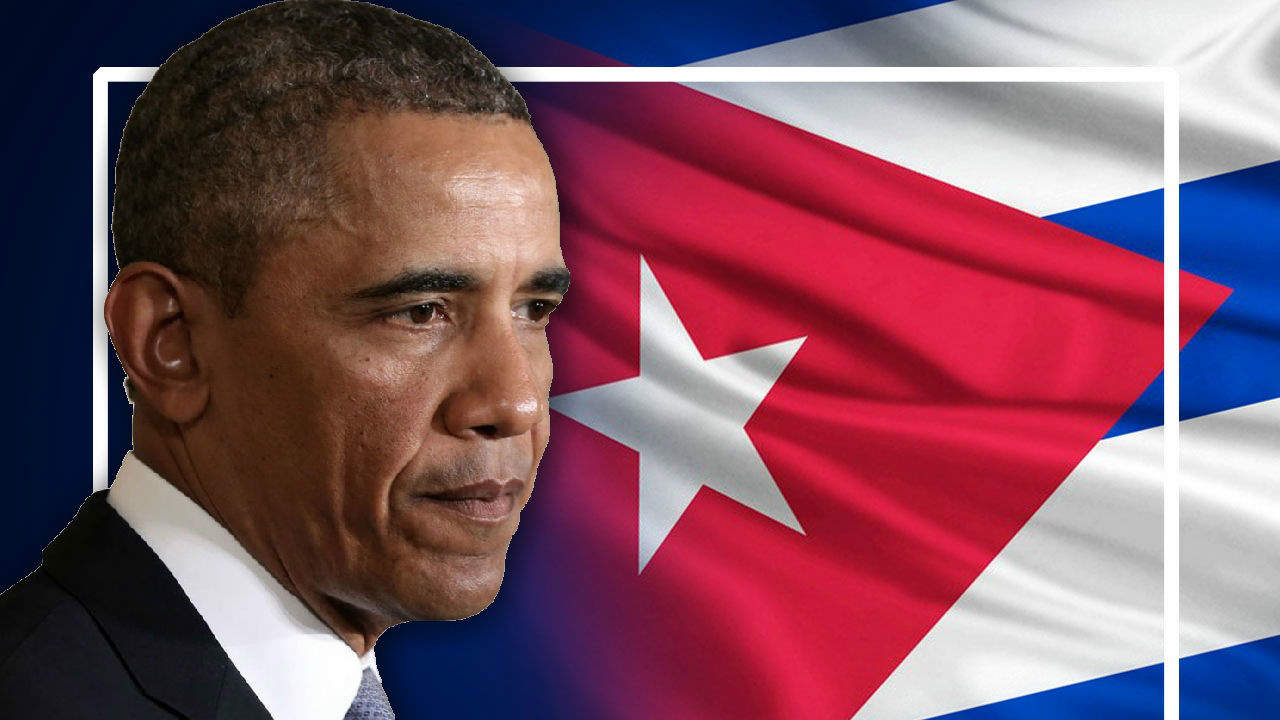
On the other hand, yesterday something unspeakable happened: with Obama on Cuban soil, NOT ONE channel reported any information. Telesur stopped transmitting after Obama and his family descended the steps of Air Force One. State TV, the only one that broadcasts music, football, etc. in Cuba… as if nothing was happening… made a bigger deal out of Maduro’s improvised visit than to one of the most important events of Cuba’s existence in years.
Somos+, Ezequiel Alvarez, 18 March 2016 — The struggle of an unarmed people, under a totalitarian dictatorship armed to the teeth, becomes a psychological battle of attrition. Since it is impossible to change a powerful system by a frontal attack, other tactics must be used.
The first step is the formation of a resistance capable of promoting changes, gaining the confidence of the people by offering them an alternative means of fighting.
Demonstrating with concrete actions that they can fight, seeking the formula that proves the existence of a resistance, able to fight and survive despite oppression, persecution, and all the system’s attempts to extinguish the anti-dictatorship spotlight. A resistance composed of patriotic believers in the cause who are willing, despite the obstacles, to put themselves forward at the historic moment for the common good of the nation. continue reading
The next and vital stage is the demoralization of the oppressive forces of the dictatorship: a dictatorship whose participants recognize that they are part of a corrupt system, and that they are fighting against the well-being of the people, can lose interest in participating and supporting the dictatorship in power.
So when the forces loyal to the dictatorship refuse to be part of the oppressive system, then the dictators lose power—against forces, which though lacking tactical capabilities have the moral strength, support, and sympathy of the people. The psychological structure that maintained the continuity of the dictatorship in power crumbles, and new alliances and loyalties forge the new power structure.
Assuring ourselves that a structural basis exists for the implementation of a democratic system, which resolves the problems and addresses the concerns of our people for freedom and progress, must be the work of the democratic resistance in order to advance the country to a better future.
Somos+, Ricardo Romulo, 25 February 2016 — I take a daily stroll through the streets of Old Havana and Central Havana, both so flooded with tourists and Cubans that it seems as if the city might sink beneath my feet at any moment, so poor is the quality of the construction work going on everywhere and so long are the delays in completing it.
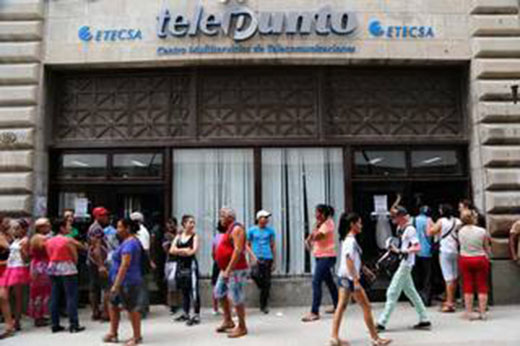
I see buildings with propped-up balconies on the verge of collapse, a huge line of tourists in front of the ETECSA telecommunications office and the CADECA currency exchange office between Obispo and Compostela streets. I catch the stench of the streams of sewage that run through the streets. The chaos doesn’t just result from ongoing electrical and telecommunications installations. All of it, taken together, makes it seem as if we’re in the middle of a civil war. continue reading
ETECSA and the Banco Metropolitano, businesses that serve both Cubans and foreign visitors, seem desperate to please the frustrated customers who wait hours to exchange a few euros or buy an internet card. And the cards are never available at any ETECSA office because they’ve all been sold on the black market at the price of three convertible pesos (dollars) an hour for internet service. That’s how the ETECSA salespeople make their living.
Likewise, only two currency exchange offices and three banks are available to serve the throngs of tourists in Old Havana.
Meanwhile, any Cuban who wants to use the “Nauta” email service on his or her cell phone can only do so at the Focsa Building in Vedado; none of the other ETECSA offices provide that service. ETECSA’s servers would crash if millions of Cubans were using Nauta to communicate with family and friends outside the country. And once you’ve managed to install Nauta on your cell phone you have to make three or four attempts before any connection goes through, and your account is charged while you’re struggling.
Text messages arrive up to three hours late, though a delivery confirmation was sent right away. When you call Customer Service, they say everything is fine and there’s no problem.
The ETECSA operators insist on maintaining this appearance of efficiency in their service to the national and international community in order to convey this message: “Other telecommunications companies are not needed in our country. Everything is fine. ”
Do they want to be the only company so they can keep track of what people are saying in Cuba? So they can keep tabs on those who think differently about changing the country’s political economy?
I have friends from around the world: Argentina, Italy, Canada, the United States, and France. I met many of them in the streets, during my daily stroll. I never miss the opportunity to invite them to ride a local bus so they can experience the everyday life of Cuban workers, who don’t know where their uncertain future is headed.
Everything lies in the hands of the lethargic administration that controls the Cuban government and strives only to defend its own interests and preserve the order that was imposed half a century ago. This administration is intent on controlling the lives of twelve million Cubans, including seven or eight million of us who have worked all those years in the aviation, construction, and oil industries. And yet we have nothing.
We have experienced firsthand the absence of labor movements or of any political party that truly represents and defends the interests of the working masses and of the nation. The Cuban administration has worked only to maintain and preserve the interests of state-owned companies that represent the power of the current government, which does nothing to improve the lives of Cubans but only offers pretexts for maintaining total control over the masses.
The current government opposes making the Internet fully available to the entire country. It opposes the existence of other political parties, and other, better, telecommunications companies. Free elections are not allowed, and neither are peaceful protests by Cuban citizens. No other transportation companies are accepted. Though they don’t openly object to it, the government doesn’t want business owners to hire their workforce directly and thus be in direct contact with those who are demanding better salaries.
That way the government can control the people, hold them subject to its will and keep pretending that we, the citizens, have the power. But they’re the ones who have it, and they use it to maintain a political apparatus that is alien to the life of a real Cuban citizen.
My friends from around the world, I want you all to know that the Cuban people want to get rid of this political apparatus that rules over our will. All it has done is support and enrich itself at the expense of ordinary citizens’ sacrifices and hard work. And all we want is for our voices to circulate, without barriers, to all countries in every continent, so that together we can achieve a better world for everyone.
Translated by Jessica Aucaguizhpi, Valerie Alvarez, Jeniffer Hernandez, Paola Moran, Jeanette Neto and Yolainny Reyes
Somos+, Evangelical Pastor Raúl Macías López, M.D., 23 February 2016 — Across the broad spectrum of Cuban reality, certain aspects stand out quite markedly. All around us we see contrasts and inequalities that give rise to fear over what the future holds in store and civic immobility in the present, with a tendency toward indifference (on the part of the people) and seizure of the truth (by the government). The combination of those factors keeps the radically transformative changes the country needs from taking place.
The prevailing single-party ideology has tried to monopolize political truth for the nearly fifty-eight years of its “irreversible”* existence. I want to emphasize “has tried” because, fortunately, in Cuba today there are as many ways of thinking as there are people who think. The voices of more and more citizens are raised to express an unstoppable and absolutely necessary diversity of opinions. This is clearly inevitable. continue reading
The philosophy of “here we all think alike” almost succeeded in banishing the resounding truth that “it is utopian to pretend everyone thinks alike,” in its attempt to enshrine a lie that was believed as if it were true. In reality, to really understand each other, we cannot separate this fatal pair: monopoly – single-party regime.
For far too long, power has basically been in the hands of the same people and families, and has been used only as a means of enforcing their illegitimate control. The Castro top management (the term I find the most polite) controls the media in the name of socialism and uses that control to disseminate its own “truths,” all of them aimed at maintaining a monolithic economic, political and social order that is unjust because it damages the nation through its now questionable irreversibility.
And that “injustice” —since I’ve mentioned the word— also has to do with the fact that behind the scenes almost everyone questions the official discourse. But interestingly, most Cubans have chosen to devote themselves to their domestic concerns, be it cuentapropismo (self-employment), professional aspirations, or religious beliefs, in order to distance themselves as far as possible, etc… And meanwhile we all just let “them” take care of the nation’s political future.
Therefore if we want to appeal to justice, we have to admit that we ourselves have contributed to the current situation by putting the rope around our own neck (or allowing it to be put there), thereby unwittingly collaborating in the monolithic single-party system’s monopoly on truth. We’ve readily accepted our defeat, without even needing to be convinced or seduced beforehand, without demanding that reasons for it be given. If someone says such and such thing, the rest of us blindly, unanimously, and dogmatically accept it as the truest truth ever spoken.
It is as if the ability to ask questions had been excised by a collective scalpel, by a kind of intellectual surgery, with the aggravating factor that the scalpel was in the wrong hands. When were we mutilated? When was our crucial need to engage in fair, open argument and debate whenever and with whomever necessary taken from us?
The single-party government’s monopoly on truth has this distinctive feature: it appeals neither to people’s intelligence nor to their ability to take the initiative. Instead the authorities veto individual liberty and subliminally control people’s ability to decide for themselves. As if they were robots, people are forced to make decisions that favor the authorities’ interests.
For how much longer are we going to remain in this limbo, trapped in other peoples’ schemes? What more will it take before we wake up and begin to march forward as a nation? By what right do a few people claim to be the only ones free to decide what is true and what isn’t?
Cubans: let’s defend our truths with respect, but let’s defend them! It’s not fair for anyone to monopolize the truth.
Collective truth is made up of the greatest number of individual truths. Let’s embrace inclusivity.
“To hide the truth is a crime; to hide part of the truth—the part that compels and encourages us—is a crime; to hide what is not in an adversary’s interests, and say only what is, is a crime” —Martí, Obras completas, Vol. 1, p. 291.
The greatest human who ever walked the earth said: “And ye shall know the truth, and the truth shall make you free” —John 8:32.
*Translator’s note: In response calls for democratic reforms and human rights in Cuba, the regime modified the constitution to make the current system “irreversible.”
Translated by Steven Aguirre, Diego Alvarado, Yulieth Galindo, Jemilcia Garcia, Iuliana Mazheika, Carlos Mojica, Clarissa Polanco, Gabriela Ramirez
Iliana Hernandez was the victim of a brief arrest in Cuba on March 8. (Facebook)
14ymedio, Luz Escobar, 14 March 2016 – The activist Iliana Hernandez has taken one of the most difficult decisions of her life, to resettle in Cuba after almost two decades living abroad. Nationalized with Spanish citizenship, the dissident has begun the paperwork to return to the island and continue her work in support of a democratic change within, according to what she told 14ymedio.
Hernandez published her decision on the social networking site Facebook, shortly after having been released after an arbitrary arrest on 8 March. The detention occurred when State Security stopped the car in which she was traveling, accompanied by Jose Daniel Ferrer, along 5th Avenue in Havana. continue reading
“I had had this idea for years and in January I wanted to do it but I didn’t have time,” explained Hernandez. The activist left Cuba on 13 August 1996, after several attempts to leave the island.
Current immigration legislation states that, after 24 months of an uninterrupted stay abroad, an emigration cannot return to live permanently in the country, nor own property here.
For the repatriation to become effective, the applicant must “have housing in Cuba or be sheltered in the home of a family member.” In addition, they must demonstrate with documentary proof that they have existing financial and housing resources in order to receive, shelter and support the returnee until they get housing and income of their own.
“Now I came for this purpose and I’m not leaving until I get my identity card,” she says. The activist works “online,” and believes she can continue to do so from the island despite difficulties in accessing the web. “They can’t threaten to deport me,” reflects Hernandez, who has served as a financial coordinator for Somos+ (We Are More) as well as being one of its founders.
The activist has visited a notary and presented the necessary documentation to begin the process of repatriation.
“One can not regret the decisions you make in life,” reflects Hernandez, but she says she has “thought this through very well.” The dissident affirms that she has wanted to return to the Island since the creation of the Somos+ movement. “We had a well-organized team on the outside, but now is the time,” she declared.
The Somos+ movement was created in March 2013 by Eliecer Avila, a computer engineer trained at the University of Information Sciences (UCI), and from its origins has been defined as a group focused on developing opinions and ideas with a vision of the future.
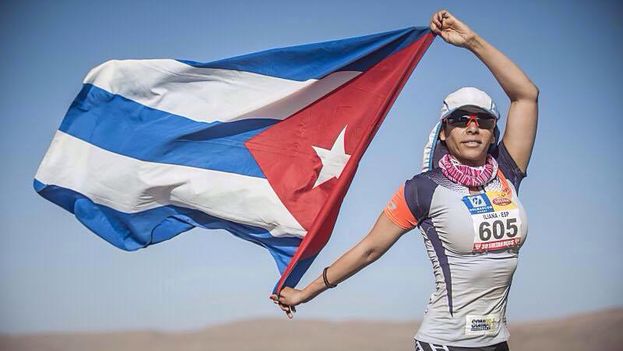
Iliana Hernandez was born in Guantanamo and has always been linked to the sports world. Last year the activist participated in the Marathon des Sables, a 144 mile race across the Sahara desert over seven days.
Somos+,Niurvys Roca, 22 February 2016 — Why is it that in Cuba we have elections in the schools, but there are no mechanisms for choosing the officials who represent our country? This is where my suspicion that we’ve accepted a great hypocrisy began. We’re taught from grade school to elect representatives who organize things and see to our needs, but then that doesn’t exist in the lives of Cuban citizens. Yet there once was a time when I believed school was training us to be decent people; I thought everything we learned there would also apply to everyday life later on.
It was the beginning of the school year and the School of the Arts was holding its annual election for the High School Students Association (Federación Estudiantil de la Enseñanza Media or FEEM). The elected student leaders would see to it that everything worked properly, would defend their fellow students’ rights, and would present their classmates’ most pressing needs to the folkloric personages whose job it was to see to those needs and offer solutions to problems. continue reading
We loved those election days. Everyone voted in secret, then students and professors gathered to learn the results. That year was different; my name was being whispered through the halls, and I was elected to represent the students. At first, I was none too happy about it. I thought I should be focusing on my studies; serving in student government would take a lot of time. Later, I realized I could do a lot to help my classmates and decided to take on the responsibility.
It all started off nicely. Among other things, we suggested reforms in areas we didn’t think were working very well. We also proposed ways of listening to students on a more personal level, and means of providing tutors for students who needed remedial training, as well as more hands-on attention for scholarship recipients.
That semester I had to work triple-time. In the morning, I had courses in my specialization, in the afternoon I had other courses, and there were almost always meetings, as well. These were held far from school, which affected the time I could spend in class. I remember getting home after 10 p.m. just to wake up at 4 a.m. the next morning because the P1 bus usually didn’t stop to pick up passengers at my stop. It was exhausting, but always worthwhile.
About halfway through my term as president, a shocking discovery was made: I was not a member of the Communist Youth League! That was when a man — I remember him: tall and dark-haired, with almond-shaped eyes — began coming to see me. Initially, his tone was friendly and concerned, but it quickly grew severe and even threatening. Sometimes I was pulled out of class in order to speak to him. I couldn’t understand how he could be more important than my classes, especially since he always said the same thing.
His concern was that I should become a militant in the Communist Youth League. I gave him the same answer over and over: “My mother lives in a so-called enemy country, and I need what she sends me for food and clothing. I don’t think anyone should be a militant in the Youth League without being a Communist. A good Communist proclaims equality without hypocrisy. To be a Communist, I must eat only what the Revolution provides, and I don’t know how other people do that but I can’t. Maybe I’ll have enough to live on when I start working, and then I’ll think about joining the League. Right now, I have to live up to my ideals, and refrain from proclaiming that everyone is equal, or else live by a double standard in order to appear equal to everyone else and comply with the norm.” I would end up adopting the kind of fake commercial smile that my boyfriend hates, which I put on when I dislike someone but have to get along with them just a few minutes longer.
The man harassed me for weeks. He even forced me to go to meetings where I remember expressing my dissent; my being there didn’t resolve anything. They talked about people in derogatory terms and I was constantly being pressured to join the Youth League even though I’d said again and again that it wouldn’t be possible. It was a tough time, but luckily I knew a million ways of evading the man without him spotting me. My friends, as a joke on him, would tell me when he was hot on my trail, and I managed to avoid 95% of his visits. His ultimatum was that I couldn’t be a student leader because I didn’t have a Communist Youth League ID card, to which I replied calmly, while at the same time letting him know he couldn’t play that game with me, “That’s not for you to decide. It’s for the people I represent to decide.”
I stayed on as president. The man, who couldn’t intimidate me — I only felt sorry for him — never shook any of my convictions: I know reality was not on his side. It was a truly enjoyable phase of my life; studying, writing essays, working on projects with amazing people who were focused on serious plans for their lives, and some teachers I will never forget. What I’m saying is that the weak minds that threaten us are just that: weak minds, other people’s victims. A man like that was no match for a 17-year-old girl.
I did things right. I wasn’t afraid to express my ideas. I knew the students were on my side because they saw me working hard for them. If we all achieve inner freedom, I am certain that all the tall men with dark hair and almond-shaped eyes will lose their power. No more excuses. Our first step is to gain inner freedom and practice change. If a 17-year-old girl can do it, so can you. Let’s begin by respecting what our hearts dictate, not our material needs, and confronting all challenges directly. There is nothing more beautiful in this short life than to be free within ourselves. If we desire a free nation, then let’s start acting like free men and women. If this idea catches on among eleven million Cubans, Cuba will be ours again.
Translated by Anabel Acevedo, Karina Aguaiza, Nicole Cantos, Kimberly Espinoza, Diego Maya, Ariel Pabon, and Sandy Sosa
Somos+, Amelia Albernas, 26 February 2016 — In my time, professors were proud of being what they were: a living gospel. We students were instructed by them and, furthermore, educated. The values and principles I have are thanks to my parents — one a psychologist and the other a history teacher — and to those teachers who had a true love for their profession.
Sadly, the new generations of Cubans don’t count and won’t be able to count on this. Material deficiencies and — why not? — spiritual ones, also, have wrecked the education that many of us received in past decades. The social and economic deterioration of the country has destroyed educational teaching. The exodus of teachers to other professions with better salaries is a reality that is striking but perfectly understandable. Our teachers lack great commitment, but it’s hard to ask for that commitment if salaries are low. continue reading
So it’s urgent and necessary that a profound change be produced in Cuban society and in the system of government, because a generation of sad, ignorant and lazy people will inherit this island, which José Martí defended with so much impetuous reason*.
It’s because of this that, today, I will share some ideas about what path our social project of Somos + should take in order to stop this disastrous process of demoralization in such an important sector as education. The nation owes an enormous debt to its teachers, and the general opinion is that there should be a more effective way to pay them.
The profession of teaching deserves respect and consideration.
Education, by necessity, should continue to be subsidized; this is an unavoidable principle for every nation and a human right. Apparently it’s not a way to earn money, but only apparently. In reality, school is the beginning of everything. Without an integral and convincing education it’s impossible to count on good professionals and technicians. But it’s to be noted that there should be no indoctrination and, much less, a personality cult of any man.
Education, for most of the dictatorial governments, means trying to direct children in order to reproduce the typical behaviors of the society they represent. For Somos+, education means making creators, inventors and innovators, not conformists. And because we have been and are witness to the enormous loss of values in the young generations that live today in our Cuban society, we champion an education where the maxim is to “drink from all sources, taking as a base the spring of our nationality**.”
Educating for creativity is educating for change and shaping people who are rich in originality, flexibility, future vision, initiative, confidence, risk-taking and readiness to confront the obstacles and problems that are presented to them in their lives as students and in everyday life, in addition to offering them tools for innovation.
Creativity can be developed through the educative process, favoring potentialities and making major use of individual and group resources inside the teaching and learning process.
Continuing with these ideas, we can’t speak of creative education without mentioning the importance of a creative atmosphere that fosters reflective and creative thought in the classroom.
The concept of creative education begins with the approach that creativity is linked to all spheres of human activity and is the product of a determined historical social evolution.
On the other hand, creative education implies a love for change. Creativity must be fostered in an atmosphere of psychological freedom and profound humanism, so that students feel capable of confronting what is new and giving it respect, teaching them to not fear change, but rather to feel at ease with it and enjoy it.
Based on our reasoning for a freer country, we state our principles:
“The best way to defend our rights is to know them; thus we keep faith and strength. Every nation will be unhappy as long as they don’t educate their children. A town of educated men will always be a town of free men. Education is the only way to free oneself from slavery.”
*Martí, José. Complete Works. Volume XVII.
**Taken from Ideas and Principles of the Movement Somos+.
SOMOS+, 20 February 2016 — We’ve got a special post today, an Open Letter written for us by Lizet González Rodríguez, a mother from Cienfuegos who recounts her battle against the ETECSA monopoly, in addition to giving us important details about her life and way of thinking. It also serves as a gloomy reminder of the constant and flagrant violations this company commits against the privacy of its clients.
We’ve faithfully honored this author’s text. It’s a bit extensive, but it’s worth it.
Somos+
From Lizet González Rodríguez — Thanks to the kindness of the Revolution and not my own, after 7 years of living with a Latin American student from the ALBA project in the field of Medicine, it is with a clean human conscience and without an eye for greed, that it was because of him, during the last year of his career, I was granted telephone service as a reward for my hard work, gained in large part due to my effort and sacrifice, and not due (at all) to the Cuban Revolution. It was through his stay in the house that we got to know other foreign students that would visit us for the friendship and familial support our home provided.
It’s well known that our only telecommunications company, ETECSA, famous for their poor understanding, or their complete ignorance of the difference between quality service and cost, offers internet services to foreign students in Cuba. continue reading
Since the company does not provide telephone services, these students visit homes like mine near the school of Medical Sciences that have telephone service in order to ask for permission to use the family phone and to link their internet account to our telephone number so they can stay in touch with their family abroad, thereby using the full palette of options. They can do this without signing a contract, or without any explanation of the ins-and-outs of the service, the account owner cannot use the service that is being linked to their own, and no favors, or exchanges of any kind takes place.
As another option, they sell a certain amount of hours for a price, and if they go over their allotted time, they incur extra cost; all this for an astronomical cost. After some time, practically at the end of the student’s course study, the one we let use our telephone service, we find ourselves summoned by ETECSA; they accused me, as the named owner of the telephone account, of committing fraud against the company, and I, as the account owner, and not the foreign student who had a contracted service with ETECSA, could do so without needing to authorize, nor officially sign as owner.
My story begins at the end of 2014, one morning I heard shouting in the streets and it was directed towards my husband. I got close to the door and saw three people, one in particular, a supervisor from ETECSA, Yoiner Besada Chaviano, whose photo I’ve attached to my letter, I got it from his Facebook profile, because I consider him to be the most sadistic and sarcastic person that could exist in this company, truly fear inspiring; he’s followed by two people, one who is the whistle blowing agent from MININT [Ministry of the Interior], who days earlier had been interrogating the neighbors.
But, not to get off topic, I’ll tell you how things went down. Not wanting to explain myself from behind the fence and in front of the neighbors, I invited them in my house.
Amusingly, supervisor Besada said they were there due to anomalies in my service and they wanted to check the service connection in the house, of course, without a service order, or warrant. I agreed since I had nothing to hide. They didn’t find what they were looking for. Afterwards, I told them to come outside to the patio to where the telephone connection hooked up and again, they didn’t find any “anomaly.” We went back into the living room where I asked them exactly what type of anomalies they expected to find? He said he wasn’t sure, but they were under orders from the Havana office’s anti-fraud department.
I kept pressing the question and he continued to be evasive. Finally, I asked the million dollar question: “Do you think it’s from an internet connection that a medical student has linked up with my phone?” He answered with another question as would any of his kind, “Ah, why do you have an internet connection?” “You should know,” I said, “it wouldn’t come in through thin air, nor satellite, but through an obsolete telephone cable.”
That’s when he gave me a summons and had me sign to the effect that my husband, who is the account owner, should appear at his offices next week to explain the use of the telephone services and another form where it said that our telephone service was under investigation. I didn’t sign this last form because I didn’t agree with it, not to mention, I wasn’t the user under contract.
My husband went to the interview where we left practically accused by a commission of telephone fraud and were to await a judgement. Two days later our service was cut off and the company had us under investigation. We were notified that same day of the suspension, which had to be done within 30 days, and our service remained cut off for 2 months despite the fact that the investigation was supposed to take only 9 days. Ok, fine, my questions are thus:
— How can they sell an internet service to a student without providing a personal line to link it and force him to give 2 telephone numbers of third parties in order to get service?
— How do you charge a telephone account, month after month, for access to ENET and continue collecting fees from a student for internet service if according to your company, it was fraudulent?
— How do you investigate and prosecute a national user if he never had a contract for said service and as a consequence, his link, if he wasn’t notified to verify what happened and inform him of his national rights and duties, or is that something too unimaginable to ask for?
— And finally, how could this national user be prosecuted for a fraud he didn’t commit due to not being the person authorized to use the said service, without being notified, but investigated, stepped on, judged, bullied instead of it being the foreign user who is the exclusive party?
In February of 2015, after 2 months and several weeks, the judgement on the investigation found the national user committed “telephone fraud” and was issued an excessive fine, based on the company’s losses, which as we all know is a totally inflated rate, it’s extremely expensive, well out of the financial reach of people who work and is compensated with only a part of their salary.
This supposed fee for “the alleged economic losses” incurred by ETECSA, was expected to be paid in CUC [hard currency], which is not the customary, monetary form of payment for services.
This case is based on subjective proof and threats, in findings of espionage through the use of the telephone service likely by cell phone (my cell phone), while they violated the terms of confidentiality of clients without any recourse, and they were always sure to note they wouldn’t give any data if we got a lawyer, and all the while, this threatened to uncover our own Pandora’s box: that our mobile telephone service, for which we Cubans pay a veritable fortune, has become our worse enemy; they tap all our calls and listen to our messages in a truly despicable manner and later use them against us.
And fine, I ask myself:
Where does this leave this dominated people’s rights to citizenship, to humanity?
How far can the impunity of man go? How can they reduce us to a bare minimum?
In this abusive and arbitrary, and somewhat polemic case, I was found to be acting as “head of a group,” named without much explanation (since I wasn’t the account owner, but my husband).
Just the chilling image of a video conference, they’d say from Havana, could very well be from the office next door, explaining via antiquated and stupid equipment run by a paid underling which they claim are the same services used by the Highest Offices of the Province so they can speak to their families abroad, some because they can’t afford it economically, and others so they’re not monitored by machinery used for spying by those they flatter and defend. Betraying themselves when they seem lost, the very occurrence of making a call to a third-party in the outside world as a suspected fraud.
How long are we going to be prisoners of a system that doesn’t let us communicate with the real world so that people continue to live under the shadow of an expired world model without knowing reality, a reality that we all know is censorship and being manipulated by a system imposed on our country, while they shout to the four winds that they are not the ones who deprive us of these services, rather it is the fault of a brutal imperialism that makes them do it and limits our development, the very same imperialism with which they are currently seeking to re-establish relations.
Even though our rights are neglected in contemporary Cuba. How far and for how long are we to suffer the despotism and trampling of rights normally bestowed to any individual in other parts of the world, making us prisoners on our very soil.
Given everything that was exposed, I had to “hand over” my telephone service to a neighbor in order to pay the “compensation.”
A year later, in February 2016, the second part of this nightmare begins. The neighbor that I gave my telephone service to was called in by ETECSA for suspicion of fraud, which we thought was the result of some leftover data error that reappeared from the last case that came to the surface now that she has no internet access. I mean, since December 2014, that phone did not have an internet link tied to it.
In her case, the same history was repeated in those offices, she was surrounded by “a commission” of 8 individuals, like a firing squad, and through their affirmations their intimidations, where they told her that her telephone service was under constant monitoring during the last year (once again, a clear violation of citizen rights).
During the questioning, it became known that I, the little so-and-so, had “transferred” my telephone service, to which she explained that I had done so due to the problems previously described and my desire to not continue with this named entity’s service.
Afterwards, they continued questioning why she used services like “3 party calls, call waiting, and busy signals, etc. (Ah, fellas, isn’t this . . . phone service?) to which she alleged that she didn’t stop those features because she didn’t think it was necessary, plus they questioned the use of a card to call long distance to which she gave her own explanation. They argued that it was through that same avenue that fraud continued to be committed, something totally impossible and stupid (which now is sadly a common occurrence), ironically, even by they themselves.
When she asks why she’s being investigated and accused by this “commission,” all of this, mind you, without any proof of internet access and without knowledge of the subject, is when they asked her about me, if Lizet González, daughter of . . . if I’ve visited her home, used her telephone, if she’s given me an illegal extension, what’s my relationship with her, etc. to which she responded: No.
This is when they tell her, clearly intending to create conflict between neighbors, that I’m tricking her and using her (I guess, telepathy, or magic), and since I don’t have a phone, I have somehow interfered with her connection, making it some kind of receptor so that I can continue my “telephone fraud.”
It is inexplicable for a reasonable person to understand, always arguing even amongst themselves, questioning the sheer possibility of it all, and in the end, thinking “yes, it can be so.”
Nevertheless, without giving much explanation, after an afternoon of shock and visible deterioration, my poor neighbor was advised to go home, to change her telephone number, cancel all her services with ETECSA and that afterwards said entity would give her the “ultimate verdict” — to either pay a high restitution “for nothing,” or end her telephone service.
This is where we are in this moment and of course, there’s much friction between the families, but once more, this is just another sad example of Divide and Conquer.
I ask myself. Now, do I truly warrant this type of high-level attention as if I worked for the CIA, or NASA?
This has an indisputable not so hidden connotation: politics.
Political views vary within my family. My father is a retired, General of a Brigade. My husband, on the other hand, is one of the few direct family members of Luis Clemente Posada Carriles living in Cuba; this is reason that neither of us can have communication with the exterior without being monitored by “them.”
They wanted to stay on top of what we thought, even what we ate, and this intensified after my husband presented an invitation for an entrance visa at the U.S. Interest Section in Cuba for his radicalized cousin in 2013. She didn’t have anything to do with his previously mentioned Uncle, but it left us MARKED and of course, the visa was not granted, so we wouldn’t have gone through this nightmare if it hadn’t been for that.
Since that time, a relentless pursuit began, to strangle us with never-ending fines (related to other entities), all arbitrary and inexplicable, asphyxiating our family’s economy of which I have the proof.
The goal of this letter is to relay my story, one of thousands as a victim of a system that for a long time, I DO NOT BELIEVE; the one that my father, a man who I admire and respect, fought for, one that promised and didn’t deliver as we all know, that brags about non-existent human rights that are constantly violated; that represses, that abuses; that blocks; that persecutes; that brands anyone who wants change as counter-revolutionary, those who intend to revolutionize problems; or has the concept already changed?
This letter could cost me dearly, but it’s necessary for the world to know the reality we live in and all the deprivation and spying the Cuban people are subjected to. That’s why I am demanding my rights and liberty and nothing more than what should be ours. I don’t think we should wait anymore for it, but instead, we should pursue the truth. Change is within our grasp, that’s why every day WE ARE MORE (Somos+), we are voices that rise up to denounce the oppressive abuses of those who suppress us as a people, as Cubans.
Sincerely,
Lizet González Rodríguez
Natural de Avenida 30 entre 47 y 49, edificio 2, apto 9. Cienfuegos. Cuba
Email: lizetete71@gmail.com
Person referred to in my letter: Yoiner Besada Chaviano, ETECSA Inspector
Somos+ (We Are More), Eliecer Avila, 18 February 2016 — The Somos+ Political Movement welcomes the upcoming visit of President of the United States Barack Obama to Cuba. This event confirms the willingness of his government to strengthen the bonds of friendship with our people.
There is evidence that the Cuban people feel respect and admiration for Obama, because, in practice, he has done more than Raul Castro to overcome the old patterns of the Cold War and to advance the search for new opportunities for the development, prosperity and freedom of the Cuban people. continue reading
During his visit Obama will be able to explain to us first hand the details of the changes in policy and the opportunities they open for both peoples. We are sure that he will be received in the streets here like a hero, an image that will contrast greatly with the “hatred toward the enemy neighbor” that they have tried to instill in us for more than half a century. And above all, it will be absolutely incompatible with the abominable and absurd repression against those accused of being “allies” of that “enemy.”
It must also be made very clear that it will not be Obama, nor the pope, nor anyone who is not of our own people who will resolve the profound problems that are strangling our nation. However, in this fight, every favorable wind is appreciated.
Going forward from today Cuba will experience a decisive chain of historic events that will mark its present and its future. President Obama’s visit will be one of them.
Naturally, Somos+ welcomes him and wishes him success.
Eliecer Avila, Engineer
President, Somos+ (We Are More)
The logo of the Civic Platform #Otro18 (Another 2018)
14ymedio, Havana, 10 February 2016 – The group that manages the #Otro18 (Another 2018) Civic Platform has convened its first forum in early March in Cuba, under the slogan Citizenship Revisited, Multi-party Voting. Proposals ranging from reforms to the electoral law to a new law on associations will be presented at the meeting. Participants will include representatives from some 45 independent groups involved in the campaign, according to a statement from its organizers.
Participation in the Forum will be free and international experts on electoral and freedom of association issues have been invited as observers, along with representatives of the diplomatic corps. In the next few days a press conference will be held to define the agenda, date and place of the meeting. Since the Cuban government announced its intention to draft a new electoral law, different political and civil society actors have been encouraging the idea of gathering proposals from the public, with all the diversity and plurality of Cuban society.
Cubalex, an organization of independent lawyers, led the initial technical phase of this campaign in collaboration with lawyers from the Cuban Law Association and other institutions.
Political activists of various organizations such as the Patriotic Union of Cuba (UNPACU), the United Anti-totalitarian Forum, Somos+ (We Are More), Independent and Democratic Cuba, Cuban Solidarity Liberal Party, Liberal Party of Cuba (Azules), and the Center for Support of the Transition and Progressive Arc, as well as independent journalists, and community, civic and human rights activists, along with independent actors, participated in intense days both within and outside of Cuba.
With this event, #Otro18 completes the initial technical part in the first stage of its project, and initiates the policy and strong social and civic advocacy phase, ahead of the proposed reforms to the electoral law and the law of associations.
Somos +, Frank Rojas, 26 January 2016 — My history is like that of most Cubans born during the Revolutionary period. My generation grew up with our lives administered by others, carrying ration cards and bearing witness to those great moments that marked the lives of millions of us.
The Mariel Boatlift, the ridiculous and extreme religious and homophobic persecutions; the “adventures” in Africa, Central America and the Middle East not only cost us resources, but also the lives of thousands of Cubans who bled across these lands and stole the only given chance we had to a rapprochement with the United States in the middle of the Cold War. continue reading
The collapse of the USSR and the fall of the Berlin wall; the “Special Period” that arrived, supposedly for a short time, and brought shortages with it as baggage, but has over stayed its welcome in our homes to this day.
The pathetic image of Fidel in the streets of Havana trying to appease a people who revolted during the Maleconazo and the 1994 Rafter Crisis because they simply couldn’t take it anymore. The unending process of the “rectification of errors” which is still ongoing.
The Elian Gonzales custody battle, and the open tribunals that bled our already fragile economy dry and left us with the “Dummy Table of Disinformation” as an inheritance. The succession of power is handed down in a fashion typical of the dynasties of the past. Three papal visits to Cuba and the actual re-establishment of relations with the “Empire” are just some of the imprints made upon me and my people.
I was like any other child of my day. I received political-ideological indoctrination at every grade in school, wishing all the while (subconsciously) to be like Che. During my adolescence, I started to see things around me more clearly, how I was being influenced and how I saw things.
Like many others of my generation, I also belonged to the Union of Cuban Youths (UJC) until I realized that I was just another puppet in a system that forced me to march and yell slogans that I didn’t even believe. I complied with SMO (Obligatory Military Service) where I was harassed by the Military Counterintelligence for something as simple as discussing Christ and Salvation with my friends, who like me, had become toy soldiers.
At the University, I began to strip myself of all that tied me to the system. I stopped attending the May 1st marches and all the other absurd and endless gatherings, among other things. By the time I began my career, I understood I lived in a romantic fantasy that resulted in a farce and I got out of all the Communist Party labor organizations that far from representing the worker, constituted a tool for punishing him. I stopped paying my monthly dues, money that only served to maintain high salaries for thousands of people who live in this country without producing anything and get fat like internal parasites that consume us. This is my history; a history similar to that of the majority of Cubans.
I found out about the Somos+ (We Are More) movement through my best friend and through her, about its growing pains during its formative stages. I have to confess, at first I was a bit annoyed by her “fanaticism,” but I later understood that it was a reflexion of her passion when it came to the topic of Cuba; a different and unknown Cuba for the majority of Cubans and one that was being uncovered thanks to the internet.
In one of his visits to the island, I got to know Eliecer Avila, a young man I had felt a certain sympathy for since his public clash with Ricardo Alarcon. I’d never heard such illogical arguments come out of a political figure of the government.
I had at my disposal an amazing opportunity to sit and have a frank and cordial encounter, to have a profound conversation and debate about my country. I finally had the opportunity to speak to someone about Cuba with solid fundamentals and coherent answers to my questions. That day I saw that there was a completely different alternative to what I knew up to that moment as material opposition in Cuba. When I saw that video from the UCI, I said to myself, I’ve got to meet that bold guy and I would shortly get to without knowing it.
I went back to my neighborhood that day with my head full of thoughts. The seed was already sown, it only needed to be watered a bit. That’s how I started my life as a political activist. After my membership was accepted, I started to study the movement’s statutes and meet others, friends already fighting inside and outside the country. Important meetings occurred and I got the opportunity to participate in a national council; the conviction grew within me that I’d finally found the right place, it was where I wanted to be. The Patriot, the Rebel and the Fighter within me finally came out.
Today, I see thousands of Cubans that know we have to do something, but for many reasons, they don’t dare and that’s the worst thing that can happen to us. I invite you to not cross your arms, but like me, to give that grain of sand to help build a new and different Cuba. We owe it to our country and not to leave this debt to future generations, we are the only ones who can change history and now is the moment to do so.
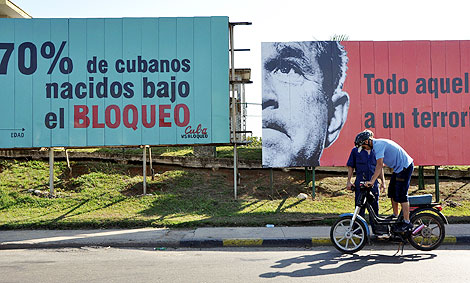
Somos+, Wilfredo Casañas, 22 January 2016 — The so-called economic blockade or embargo by the United States against Cuba is an old an decayed quarrel between the two countries that has been used for the most varied ends, disquisitions that I will not use to affirm or deny what was said by famous characters from the fields of politics, law, literature and culture in many countries.
I will limit myself to confirming the meaning of some elemental concepts, such as a “blockade” that implies that a country’s coasts are surrounded by naval fleets that block international commerce, isolating it. continue reading
According to our actual history since 1959, Cuba was only partially blockaded during the days of the “Missile Crisis” in October of 1962, when the American fleet blocked the passage of ships from the USSR and Eastern European countries because of the danger that they might be transporting weapons.
These events had a historical antecedent. In the “Cold War” between the United States and the USSR, Fidel Castro followed the strategy of allying himself with the Russian and seeking to make the Americans enemies, and allowed Soviet nuclear weapons to be placed in Cuba. This was discovered by American U2 spy planes, and President John F. Kennedy demanding that the Soviet government remove the missiles from Cuban, which was complied with halfway.
During the events that occurred in 1962, when a group of Cuban exiles invaded Cuba at the Bay of Pigs intending to overthrow the ruling regime, the United States did not provide air and naval support to the operation. Therefore, the term “blockade” is not applicable to the decades-long tension between Cuba and the United States.
The Torricelli Law was approved by the US Congress and signed by President George Bush (the father) in 1993, and the Helms-Burton Law was approved by the House of Representatives and the Senate of the United States in 1995. Both laws were enacted with the purpose of economically strangling the Cuban regime.
While it’s true that pressures from U.S. presidents against powerful “Made in USA” companies managed to limit trade with Cuba, it is also true that large and deep gaps remained and the ineffectiveness of such measures was shrewdly exploited by the rulers of the island, for many years, to open trade relations with the entire world, including with the United States itself.
Thus, the term “economic embargo” is not morally or legally applicable to all of the above and has only been used to try to justify the infinite failures of Communism in Cuba.
But something more important than these conceptual differences, is the real and merciless “blockade” that the dictatorship maintains against its own people, making everyday life in the country harrowing every day. There are multiple prohibitions by the regime against Cubans: We cannot have legal organizations, movements or parties other than the Communist, there is no freedom of assembly if it is not organized by the government on matters of interest to them and they do not allow dissent.
They collect impossible taxes from poor entrepreneurs who have huge debts to the State in the process of achieving their dreams and economic improvements. Food is increasingly scarce and of lesser quality, even that is is produced here in Cuba. Indoctrinations continues in schools and mass organizations are used to promote their invariable message, and so on for a long list.
This is the real Blockade and it is imposed by those who are governing our beautiful Cuba. Will we stand with our arms crossed listening to excuses and blaming somebody else for our problems without the power to solve anything? Or are we going to see the reality of the matter and take responsibility like Cuban citizens? The major problem is internal and the best solutions are also internal but be need more commitment and willingness to change.
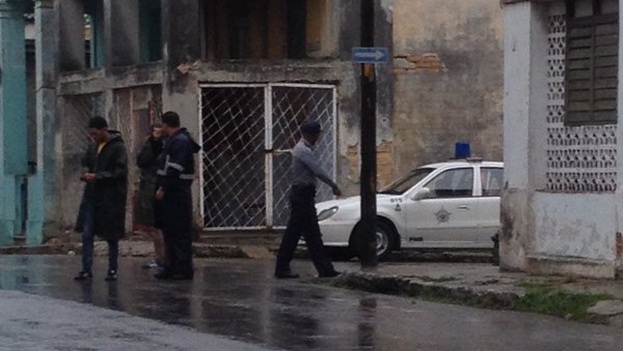
A police patrol at the corner by Eliecer Avila’s to prevent the arrival of guests. (14ymedio)
14ymedio, Havana, 14 January 2016 – The Somos+ (We Are More) opposition movement held its national convention Thursday, despite the arrest of several participants and a strong police operation around its site in Havana. The home of Eliecer Avila, leader of the organization, was surrounded by several police patrols at dawn, and only those who entered the home several hours or days earlier were able to attend.
Despite the obstacles, Somos+ issued a statement announcing,”We are holding the convention!” The activists were referring to a meeting held on 14 January to decide on the program ahead of time. The speeches, lectures and presentations were digitized to be able to project them in case their protagonists were not able to arrive at the site.
Groups of government sympathizers, dressed in plain clothes, threateningly warned off any curious person who wanted to take pictures around the site, or access the house on Esperanza Street in the Cerro district, where the event took place. continue reading
According to Pedro Acosta, who was prevented from reaching Avila’s house, the police deployment included several patrol cars and motorcycles. “I was surprised by this display of police force, because I hadn’t noticed any abnormal situation in the neighborhood.” A motorcycle with a sidecar stopped next to Acosta to ask for his identify card. When he said he wasn’t carrying it, the police ordered him, “Get in, citizen!” In the vehicle, they drove along several streets in Havana and let him out on 26th Avenue. “And this?” Acosta asked them, continuing his story, “They started up and the one driving addressed me for the first time telling me that next time I wouldn’t forget my ID card.”
At seven in the evening the siege on Avila’s house continues, according to what he himself told Acosta by phone.
The police also intercepted Angel Santiesteban and prevented him from reaching the house, said Avila.
In the text released this Thursday, the leadership of Somos+ explains that they tried to rent a space for their most important annual meeting. However, those in charge of the locales – both state and private – were intimidated by State Security and so would not rent to them.
Several members of the movement who live outside the capital were threatened and, in several cases, arrested to prevent them from traveling to Havana. Among these was Johana Columbie, who lives in Camaguey and who, with police stationed outside her house, sent a letter to the convention ensuring them that the recent events, rather than frightening her, had given her “strength to continue.”
Other activists such as Alexey Games and Franky Rojas received police summonses received this morning, while the movement coordinator in the province of Las Tunas, Pedro Escalona, was arrested and released just a few hours ago.
Eliecer Avila and Manuel Diaz Mons, general coordinator of Somos+ were arbitrarily detained and warned not to hold the convention.
On its digital page, the movement thanked Amnesty International – in particular Louise Tillotson, investigator for Cuba and the Caribbean – for having contacted their members and for showing concern in the face of the latest developments.
The convention had as its central theme “how to live with the internet in Cuba so as not to have to emigrate, not to have to jump into the sea, or cross so many borders, without having the power within Cuba to run businesses, labor cooperatives, produce resources,” according to Avila.
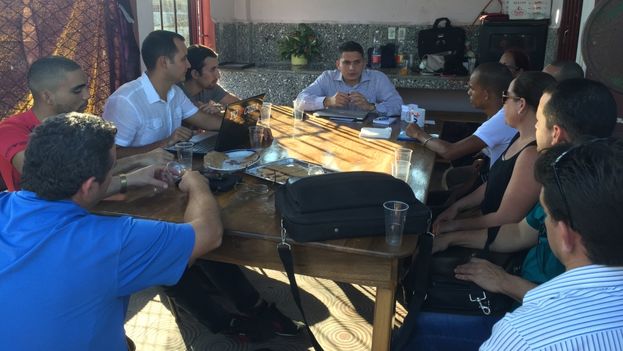
Eliecer Avila and the organizing committee for the Convention of the Somos+ (We Are More) Movement
14ymedio, Havana, 9 January 2016 — The independent movement Somos+ (We Are More) is experiencing intense days as its annual convention approaches, due to a strong police operation against its members. The arrest of activist Joanna Columbie last Thursday in Santiago de Cuba, raised the tension around the event scheduled for 14 January several degrees.
Police pressure has included threats to the majority of Somos+’s members living in Cuba, and police warnings that the meeting would not be permitted. The national coordinator of the group, Manuel Diaz Mons, was also arrested and later released, after an exaggerate options in which several vinyl posters with the Somos+ logo were confiscated. continue reading
There whereabouts of Joanne Columbie remain unknown. If is the second occasion in less than six months in which the former municipal education methodologist has been jailed to prevent her traveling to Havana for a Somos+ meeting. Last September she was taken to the police station in the city of Cespedes in Camaguey, where she lives.
Members of the group strongly denounced the police operation that tool place “in several provinces against people with responsibilities for preparing for the annual convention.” The activists also reported that several members of the organization had their email service cut off by the State entity Nauta.
In a document released Friday, the leader of the organization, Eliecer Avila, condemned “energetically these actions against a peaceful convention,” and warned that they would go ahead with plans to hold the meeting.
Somos+ is a movement created in March of 2013 by Avila, who defined it from its beginning as a group “concerned with opinions and with ideas for future, that many of us share.”
Somos+, Rolby Milian, 6 January 2016 — So I begin this second part of my comments remembering the announcement, this past September 6, 7 and 8, through the media of propaganda and creation of the Roundtable excitement, of new “innovative measures” in higher education.
The measures were announced and explained by the Minister himself, Rodolfo Alarcón Ortiz and a government team. It’s worth pointing out, that among other ideas presented by these gentlemen, is the legal reestablishment for the continuing training of professionals, the creation of a new educational level (“non-university higher education”), the requirement of English in order to graduate and the gradual reduction of the length of degree courses to four years. continue reading
Now, to questions raised with respect to this, they had treasures of linguistic escapism, like: “…these measures are very novel, and right now we can’t exactly explain all the changes they imply….” or “…we still haven’t had meetings to decide how we are going to organize access to the courses.”
What I particularly think is that these measures are a propaganda spectacle about a project that is still in a beginning phase. A typical strategy of the Government to alleviate pressure, deflect attention and pretend that it’s doing something before a crisis of great proportions, like higher education in Cuba (for example, the touted Law of State Businesses, that supposedly will come out in 2017).
From the foregoing I can deduce that right now the Government has no truly solid, concise and intelligent plan to begin solving the multiple problems of higher education in our country.
On the other hand, none of these “measures” match up with the supposed present politics of the Government with respect to the creation of businesses and the increase in private initiatives, in the sense of not mentioning adjustments in the matters of marketing and business management in the related courses of study nor the creation of new disciplines for the training of professionals specializing in this sector (business administration, for example).
With all this it’s difficult not to ask: Are our youth really prepared for a future of economic opening and the creation and development of businesses, with all the logistic and structural support that implies?
My present opinion is no. Youth in Cuba are not ready to efficiently confront an economic opening to the world. Nor does the Government intend to facilitate improvement in the educational system in this sense; in fact, it seems to not even be contemplating this scenario (nor one in which citizens freely participate in any constructive project for the country).
Having arrived at this point, one can look with horror at the future of Cuba, given that the present Government doesn’t offer objective solutions, nor do they listen to proposals that don’t come from their own fiefdom. Which makes me sure that they have no real interest in the education of Cubans. They don’t take it into account or they pretend to ignore reality with respect to the preparation of our professionals, and they ignore the opinions of the student body for creation of their “plans and measures.”
We believe that a packet of emergency measures for the recovery and restructuring of our higher education should be passed, first for the realistic identification of absolutely all the problems, including opinions and proposals from our students.
In addition, there should be no restrictions on absolute freedom of teaching and learning in every one of the institutions and for students, presenting real opportunities for all citizens to have access to higher studies, through an efficient system of vocational training, admission and retention.