The Cuban opposition leader analyzes the challenges of a democratic transition, the role of the opposition, and the need to prevent Castroism from being recycled.
 14ymedio, Yunior García Aguilera, Madrid, May 20, 2026 / For years, the Cuban regime’s propaganda machine has attempted to sow prejudice against opponents, activists, and critical voices. Few have been the object of a smear campaign as sustained as that against José Daniel Ferrer, leader of the Patriotic Union of Cuba (UNPACU).
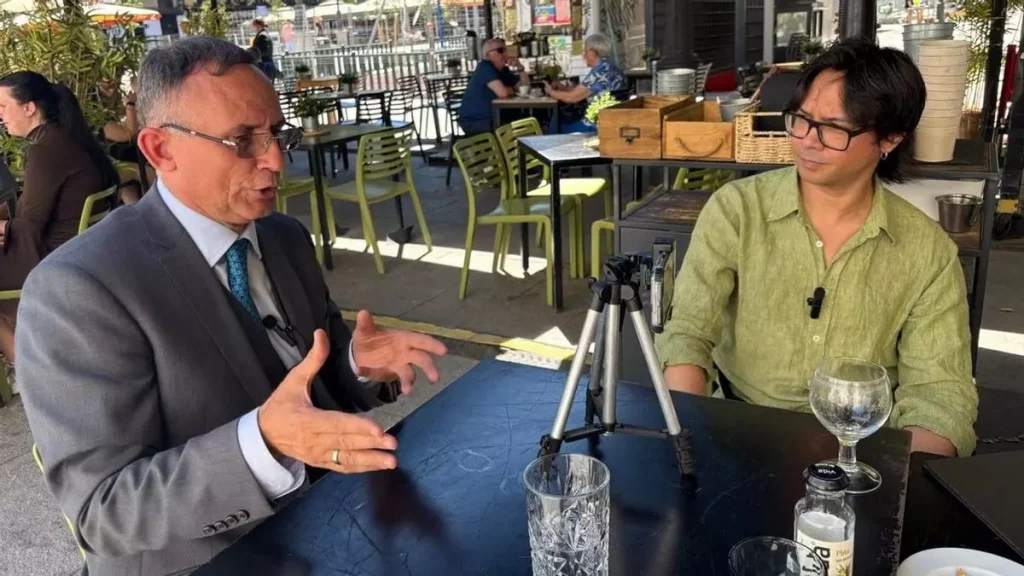
It is surprising, however, to encounter this Cuban, raised in Palmarito de Cauto (Santiago de Cuba), and discover, behind the tale of persecution and dungeons, a profoundly Cuban sense of humor, a simplicity that contrasts with his physical and political stature, a culture capable of moving from the verses of Samaniego and Lope de Vega to the history of Cuba or the countries of Eastern Europe, and a rare ability to move naturally between very different worlds: sitting with diplomats and high-level politicians, stopping on a street in Madrid to talk to a Cuban who recognizes him, or standing up to the regime’s thugs from a punishment cell.
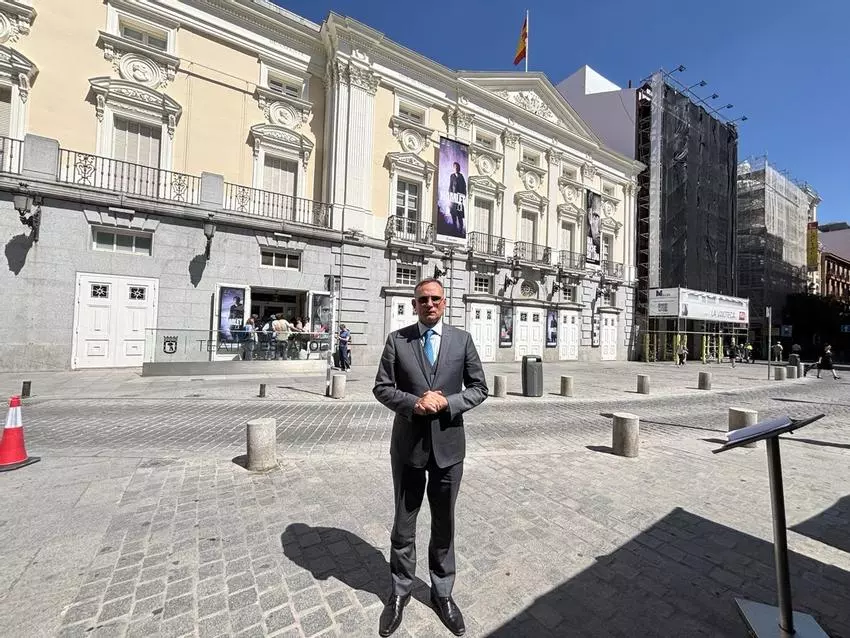
14ymedio spoke with José Daniel Ferrer in Madrid’s Plaza de Santa Ana. We talked about prison, justice, Cuba’s democratic future, and the challenges of a transition that, for many Cubans, is beginning to seem closer than ever.
Yunior García Aguilera: What did prison teach you about the type of state Cuba should never have again?
José Daniel Ferrer: From the moment I began defending human rights and fighting nonviolently for the democratization of Cuba, I knew I was fulfilling my duty as a Cuban. I was clear that we were facing a cruel dictatorship that not only violates fundamental human rights but also deeply despises Cubans.
When I was first arrested, I realized I hadn’t been wrong. The repression against me solidified that certainty. When I was sentenced to 25 years in prison in 2003, I told myself again: “You weren’t wrong. You have to keep fighting against this system, because it is the worst thing that can happen to Cuba, or to any people.”
Prison taught me a fundamental lesson: never give up. Never lose heart. And even when Cuba is free, continue defending freedom and democracy in other lands as well.
That is one of the great challenges of democratic Cuba: to ensure that Cubans have equal rights and opportunities, both in the capital and in the rest of the country.
Yunior García Aguilera: You have led much of your life from eastern Cuba, not from Havana or from traditional exile. How should that eastern, rural, impoverished, and marginalized Cuba be reflected in the design of a new Republic?
José Daniel Ferrer: When the Patriotic Union of Cuba began to grow in Havana, many activists and friends told me: “Go live in Havana.” And I went. But they expelled me time and time again.
The eastern region, and indeed all of Cuba outside the capital, has suffered poverty more severely than Havana. The capital has always had some advantages, though not many. But the further east one travels, the greater the poverty has been.
I remember the 1990s, when many young people from eastern Cuba tried to go to Havana, to Ciego de Ávila to work in agriculture, or to Camagüey to work in rice farming. They looked for jobs on rice farms and then took rice back to Santiago to sell and earn a few pesos.
That is one of the great challenges of democratic Cuba: to ensure that Cubans have equal rights and opportunities, both in the capital and in the rest of the country.
The first democratic government will have the responsibility of implementing policies that allow the East to catch up in development. Cuba will become democratized, and I am sure it will be quite soon. Then will come the reconstruction. We will see the country move forward, prosper, and develop. But that development must be as equitable as possible.
Yunior García Aguilera: What would you say to Cubans on the island who fear that the opposition intends, as happened in 1959, to replace one dictatorship with another?
José Daniel Ferrer: They have no reason to worry. What has happened to us for 67 years will never be repeated in the history of Cuba.
When we conquer our rights and freedoms, when we recover our democratic Republic, I am convinced that we Cubans will take such good care of freedom that it will be very difficult for another Fidel Castro, another Fulgencio Batista like the one from 1952, or a Gerardo Machado like the one from the 1930s to appear.
Freedom—and we are in a square surrounded by illustrious names of Spanish literature—as Cervantes said in Don Quixote, is one of the greatest gifts that humankind has received. After suffering the oppression, misery, and lack of basic rights imposed by the communist regime, we will understand how much we must cherish it.
The people of Eastern Europe who lived under communism understand us best. On this tour of Europe, we find it very easy to explain to Poles, Lithuanians, or Czechs what is happening in Cuba and the need for the European Union to take a firmer stance against the Cuban regime.
On the other hand, it is sometimes surprising that the French, Dutch, or Belgians do not understand the risk of neglecting freedom in the same way. They seem unaware of the danger they face when they take it for granted.
Freedom is hard-won. Martí said that either you decide to buy it, paying its price, or you have to resign yourself to living without it. But once won, you have to keep fighting to keep it.
That’s why I don’t share that fear. My exhortation to Cubans is to think positively: if we defend the conquest of freedom today, we will know how to defend it tomorrow as well.
Yunior García Aguilera: Some European politicians behave like Aesop’s frog that rode the scorpion on its back: they do not know the nature of dictatorships.
José Daniel Ferrer: That’s a very clever way of explaining it. When Barack Obama launched his new policy toward the Cuban regime between 2014 and 2015, I was in the United States and in Europe. In Brussels, many interlocutors from the European Union told me, “Now, with this new US policy, Cuba is going to move toward respecting human rights and democracy.” I replied, “It’s not going to happen.” They said, “Why? There will be more contact; the Cuban government will be forced to respect the rights of Cubans a little more.” And I insisted, “It’s not going to happen.” Then I told them a story I had read years before in an old edition of Selections from Reader’s Digest. A Western journalist was secretly interviewing a disgraced Soviet official and asked him what he thought about the détente process between the West and Nikita Khrushchev. The Soviet looked at him, smiled maliciously, and said, “We Soviets are never sincere.”
That’s exactly what I told them about the Cuban regime: don’t trust them. The regime is always negotiating something, trying to buy time, gain economic benefits, and political breathing room. They destroyed the economy themselves, and they use every opening to survive, not to change. That’s what they’re trying to do now: buy time, hope that circumstances in the United States change, that things get complicated internally, and that Washington forgets about Cuba and Venezuela. But I think this time that calculation could backfire. Their dream could turn into a nightmare.
With the will of the majority, we can ensure that reason and justice prevail, not revenge.
Yunior García Aguilera: There is much talk of truth and justice to redress the crimes of the dictatorship, but also of national reconciliation. How can the damage caused be judged without turning tomorrow’s democratic courts into instruments of vengeance?
José Daniel Ferrer: It is as complex as maintaining perfect balance on a tightrope. Guaranteeing a 100% impartial justice system is a dream. I wish it were so, but wishing for it and what might happen in practice are two different things.
It must be remembered that the regime has been truly cruel to many Cubans. It has been sadistic. From the very beginning of its struggle to seize control of Cuba, it employed terrorist methods. They executed anyone for the mere accusation that they might be an informer or collaborator of Batista.
Then, those revolutionary tribunals committed many crimes. And for decades, in the prisons, there has also been torture, humiliation, and cruel, inhuman, and degrading treatment.
That’s why it will be difficult to completely control the impulse for revenge that some Cubans may feel during a transition. But with the will of the majority, we can ensure that reason and justice prevail, not revenge.
We are not going to build a fraternal, humane, prosperous, and civilized Cuba on the basis of “an eye for an eye and a tooth for a tooth,” because, as someone already said, we would all end up blind and toothless. And we already have enough blind people, and enough dental problems in Cuba, without making them worse.
I believe that in a free and democratic Cuba, the support of human rights organizations, international actors, advisors, and experts, including those from countries that lived under communism, will be very important. The Poles and the Czechs, for example, have very valuable experiences.
It’s preferable that the change be Czech-style. However, who is the main obstacle to an orderly, less traumatic, and less violent process? The regime, which is determined to cling to power at all costs.
The United States, regardless of our opinions or desires, is now a decisive actor in this process, imposing certain rules. And it is still offering those who rule the tyranny a chance: “Leave, even keep what you’ve already stolen, which is far too much.” But it seems they don’t want to accept that option, as happened to Nicolás Maduro.
“You can’t just remove all the police officers overnight and replace them with new ones. It takes a process.”
Yunior García Aguilera: In a Cuba marked by increased crime and the discrediting of repressive institutions, how can public order be guaranteed in a democratic transition without preserving the dictatorship’s police apparatus intact or creating an authority vacuum?
José Daniel Ferrer: I don’t see it as impossible, but it can’t be done radically or all at once. You can’t just remove all the police officers overnight and replace them with new ones. It takes time.
In my opinion, a first step could be to gradually replace the current police force with members of the Armed Forces who are willing to assume responsibility for public order. I’m not saying there isn’t corruption or complicity with the tyranny within the FAR. Of course there is. The Army is subordinate to the Communist Party.
But the police are extremely discredited and excessively corrupt. The rules imposed by the regime have led many officers to be more concerned with how to get food, clothes, or money to celebrate their children’s birthdays or quinceañeras than with maintaining order. And how do they get it? By taking from the population, by accepting bribes from those with businesses or political influence.
Therefore, initially, it would be necessary to begin replacing those repressive bodies, which are deeply involved in corruption and discredited in the eyes of the people.
Next, it will be necessary to professionalize the security forces, depoliticize them, and rid them of corruption. We have already heard from Cubans with extensive experience in security and public order in the United States, such as Manuel Morales, Miami’s police chief, offering their expertise in this process.
“When you analyze how the regime stays in power, you discover that it is sustained by people who don’t want it.”
Yunior García Aguilera: Taking into account the experience of Venezuela, do you believe that the Cuban opposition has enough respect and strength to not be left out of a possible change or transition?
José Daniel Ferrer: The Cuban opposition, with an effective structure, true unity in action, and the necessary coordination, would be so powerful that we could achieve freedom for Cuba even without help from the United States or any other international actor.
When you analyze how the regime maintains its grip on power, you discover that it relies on people who don’t support it. When you get to know the police officer, the soldier, the civil servant; when you establish trust with them and guarantee that what they say won’t be overheard, you reach one conclusion: the regime has no one who supports it.
In prison, for example, I convinced sergeants, non-commissioned officers, lieutenants, captains, and even majors that our fight was also for them and their families. I told them there was no intention of settling scores or seeing them as enemies to be persecuted.
When I managed to make them understand me, they became collaborators. I was completely isolated, but I knew everything. I had to play dumb, pretend I didn’t know what was happening outside the prison, so that the political police would believe the isolation was working.
They came to tell me things themselves. At first they were afraid. They would say, “There are microphones.” I would reply, “Speak softly, no one will hear. And I’ve already checked every inch of this place.”
They told me, “¿Hasta cuándo? [Until when?] I can’t take it anymore. I don’t have enough money. I don’t have any oil at home. My shoes are worn out. My TV broke and I can’t afford to fix it. I get paid in electronic money and I can barely buy anything. If I want to convert it to cash, the bank charges me 20%.”
When they were with me, they seemed like opponents. But if three of them came together, they’d give me dirty looks and say, “Hey, Ferrer, how are you?” And I was dying of laughter inside, because I knew that when they came individually, they were all sweetness and light and would ask, “How long, José Daniel? When is this going to end?”
“That’s why I think the possibility of a bloodbath, like the one Díaz-Canel is announcing, is ridiculous. The people don’t want it, but neither do his own military personnel.”
I’m telling you this because we have several advantages. In Venezuela, many military personnel were more aligned with the regime because the regime prioritized them over society. In Cuba, on the other hand, the military is just as affected as most of the population. The privileged few are the top generals, a small group. Most of them also want this to end. They are tired of blackouts, hunger, poverty, transportation crises, health crises, and lack of medicine.
That’s why I think the possibility of a bloodbath, like the one Díaz-Canel is announcing, is ridiculous. The people don’t want it, but neither do his own military officers.
We have another advantage: Venezuela didn’t have a Secretary of State who was the son of a Venezuelan. We have Marco Rubio, who has been committed to freedom and democratization in Cuba for many years.
I am sure that, whatever happens – and it will happen soon – the Cuban opposition will have a much faster and more effective leading role than Venezuela has had so far.
That said, how do we ensure that happens? With greater unity, greater coordination, and above all, by putting the nation above ideologies and political ambitions.
If some try to use this moment as an election campaign for Cuba’s democratic future, they will harm the cause. That would create rivalries and mistrust: “This person wants to use my sacrifice for political gain.” And that’s not good.
They could bring out a Carlos Lage, or another well-known face, and say: “He was removed because he wanted freedom and democracy.”
This is the moment to remember José Manuel Cortina: political parties out; the homeland must be what matters. The more we talk, get to know each other, unite, and act together, the greater our capacity will be to participate in the change that Cuba needs.
We need something similar to what Solidarity was in Poland, the Indian National Congress in the struggle for independence, the African National Congress in South Africa, or that Chilean coalition where center-left and center-right forces, social democrats and Christian democrats, participated to promote the “No” vote against Pinochet. [see also] They won by a narrow margin, but they won because they put together a very organized and united campaign.
Later, in a democracy, everyone will know what alliances to form and how to run in elections. But even then, we will have to build alliances with those who are closest to our goals, because alone we cannot face an enemy that will try to reinvent itself.
Yunior García Aguilera:. How could that enemy be recycled?
José Daniel Ferrer: They could bring up a Carlos Lage, or another well-known figure, and say, “He was sidelined because he wanted freedom and democracy.” They could make him their star candidate and try to win the election against a pro-democracy opposition that has suffered imprisonment, torture, exile, and death.
But if the opposition can’t organize itself, it could lose. The World Series isn’t won by the team with the best players, but by the one with good players who truly play as a team. That’s what we have to do.
______________________
COLLABORATE WITH OUR WORK: The 14ymedio team is committed to practicing serious journalism that reflects Cuba’s reality in all its depth. Thank you for joining us on this long journey. We invite you to continue supporting us by becoming a member of 14ymedio now. Together we can continue transforming journalism in Cuba.