
The Three Options of a Cuban: Obedience, Escape or Rebellion

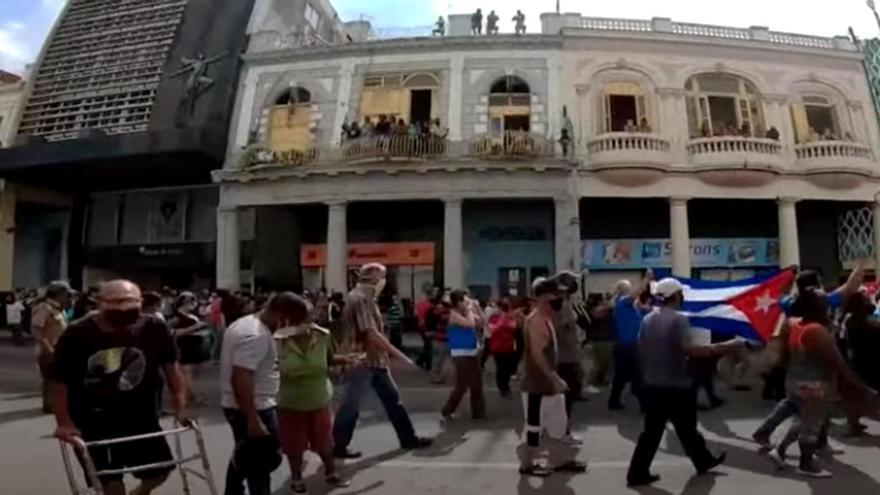
On July 11th, 2021 thousands of Cubans at various points throughout the Island participated in the largest act of rebellion in the history of the country. (14ymedio)

14ymedio bigger14ymedio, Reinaldo Escobar, Havana, January 29th, 2022 — To say it poorly and quickly, for a Cuban who lives on the island subject to the current dictatorship, only three options remain: obedience, escape, or rebellion.

Obedience

Obedience can be taken on consciously, accepted for fear of the consequences of rebelling, or mimicked to create a space for escape.

Those who consciously accept it are the ones who possess a militancy based on their convictions. They act as soldiers, convinced that “the boss’s orders embody a mandate of the Homeland,” believing that those who occupy those very high positions are enlightened bearers of a solid political foundation and grantors of all the elements necessary to make the decisions; elements which can not always be divulged because discretion is a weapon of war and the enemy must not know everything.

Those who obey out of fear have come to the conviction that any rebellion is useless because it would be mercilessly quashed, whereas they view the crumbs offered to them as an advantage. Their low self-esteem leads them to believe (with or without reason) that they would not be capable of surviving or prospering in the competitive society to which they could escape.

The mimics are difficult to identify, because they can far exceed the displays of enthusiasm and “revolutionary fervor” of those who are genuinely convinced. You see them at the reaffirmation marches waving little flags and smiling for the cameras; applauding, praising, raising their hands to approve whatever is proposed, and, if necessary, wielding a club to confront opponents. Until their visa is approved and they gather enough money for a ticket.

The price of obedience is the surrender of oneself. The prize, the peace of not ending up in jail, and the security of counting on the assigned quota of misery.

Escape

It is difficult to calculate the exact number of Cubans who have chosen this option. To know it would require adding those who already have a continue reading

residency, even citizenship in another point on the planet; those who live outside the country but return to “punch the card” before the 24 months required by law for them not to be considered emigrants, and sadly, those who rest at the bottom of the sea in the cemetery in the Florida Straits.

The decision to emigrate is not as dramatic today as it was in the half-century during which the concept of “definite departure” was in force, although black lists still exist to deny entry to those who are “inconvenient” or to sanction for several years those who are considered “deserters.”

“Traitors will not return here,” pounded the hymn of the National Revolutionary Militias in 1960, when everyone who “abandoned the country” was considered an enemy. Two decades later, in the midst of the Mariel stampede, they were described as scum. “We don’t want them, we don’t need them,” argued the commander.

When it was discovered that money could flow from abroad, the discourse changed in an attempt to depoliticize emigration. The so-called “economic motives” as a reason for escaping were used similarly by authorities to portray a normal country and by some emigrants who didn’t want “to look for problems.”

There have been many forms of escape: risking one’s life at sea or in the jungle; asking family members to legally sponsor loved ones who remained on the Island; staying behind while on an official mission, a cultural event, sports competition; requesting humanitarian refuge. The thing is to leave.

The price paid for this option is being uprooted, referring to metaphorical cultural, spiritual, familial roots which ground an individual to a place. The prize, if one arrives, are the fruits: the tangible fruits obtained through one’s own efforts.

Rebellion

When a person respects himself, he is not in a position to obey that which is unacceptable to him. That is the case of children who confront the absurd imposition of authoritarian parents; women who break up with their abusive husbands; a worker who encourages a strike to force the employer to increase salaries or improve work conditions, and the citizen unsatisfied with his/her government.

In countries not governed by a dictatorship, citizens are not forced to escape their country because they have, through their vote at the polls, a civilized alternative to change things. Furthermore, they have the right to rebel, expressed in the sacred right to take to the streets and protest, appealing to a degree of violence that, from the ethical point of view, is acceptable if they do not manage to be heard by peaceful means.

Rebellion has a history in Cuba. But there is no space to tell the story the whole world knows. The latest dictatorship in our history (hopefully the last) is also the longest-serving and the one that has produced the most victims.

Rebels in the mountains, armed explorers, terrorists, conspirators of all kinds were active in the 1960s. The options of peaceful resistance appeared later, defenders of human rights, political party organizers, civil society activists, independent journalists. Rebels, all of them.

On July 11th, 2021, thousands of Cubans at various points throughout the Island participated in the largest act of rebellion in the history of the country. Not against the colony, nor against the dictatorships of Gerardo Machado or Fulgencio Batista, did this many people take to the streets on a single day to protest, to demand freedom and rights.

They were the ones who refused to continue obeying, the ones who wanted to change the country, not to change countries.

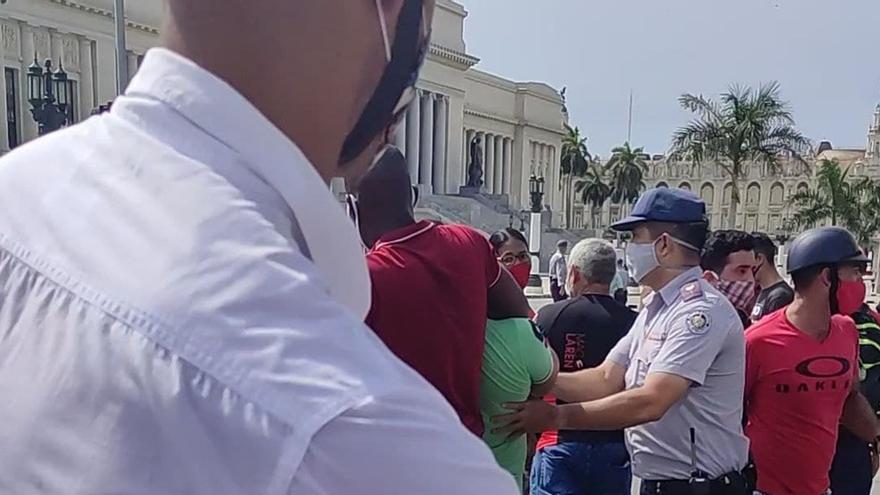
The price of rebellion during the last 63 years has been high: executions, long prison sentences, attacks on your reputation, prohibitions on leaving the country, the impossibility of practicing your profession. The prize is reduced, for the moment, to the satisfaction of knowing that you are doing what is correct.

Translated by: Silvia Suárez

____________

COLLABORATE WITH OUR WORK: The 14ymedio team is committed to practicing serious journalism that reflects Cuba’s reality in all its depth. Thank you for joining us on this long journey. We invite you to continue supporting us by becoming a member of 14ymedio now. Together we can continue transforming journalism in Cuba.

Cuba: The Continuity of Triumphalism

Mural in relief at the entrance to the Youth Labor Army market on Tulipán street, in Havana. (14ymedio)

14ymedio bigger14ymedio, Reinaldo Escobar, Havana, 1 January 2022 — On the last day of 2021, the directors of the Youth Labor Army market (EJT) on Tulipán Street surprised their regulars with a mural in relief that reproduces an old icon of triumphalism: the image of a peasant carrying a succulent bunch of bananas, taken from the back of the 20 peso bills in circulation.

The curious thing is that this image already appeared on the banknotes of the 1990s with the label “Food Program” and in the current ones the foot of the engraving says “Agricultural Development.” Accompanying the guajiro, in both cases, are some furrows that stretch into infinity and some sugarcane workers on a combine in full swing.

The image is taken from the back of the 20 peso bills in circulation. (Collage)

Without the intention of aesthetic pedantries and without pretending that behind the innocent mural is the hairy hand of the ideological apparatus, the reproduction of the banana picker at the gates of a market offers signs that the same triumphalist vision of a controlling State that “guarantees” food to the people continues to be projected.

It doesn’t matter that the bananas they sell on the other side of this gate are no longer those “microjets” from the 90s that made the fat splash up in the pan due to their excessive water content; and even less important is that the price has multiplied by ten today, since the last issue of those bills.

There he is with his slight and sweaty smile, this peasant whose skin has been darkened in the artistic endeavor and to whom, without hidden ideological intentions, they passed the bunch from the left hand to the right. A matter of design.

____________

COLLABORATE WITH OUR WORK: The 14ymedio team is committed to practicing serious journalism that reflects Cuba’s reality in all its depth. Thank you for joining us on this long journey. We invite you to continue supporting us by becoming a member of 14ymedio now. Together we can continue transforming journalism in Cuba.
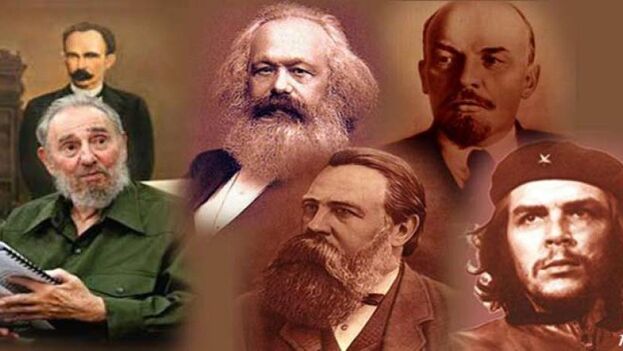
The Return of Marxism-Leninism in Cuba

Díaz-Canel proposes to return to the principles of Marxism-Leninism. (Minrex)

14ymedio bigger14ymedio, Reinaldo Escobar, Desde Aqui, Havana, 20 December 2021 — In the dilemma of changing the model to save the country or sinking the country in order to save the model, those who rule Cuba seem to opt for the latter. That is the feeling left by the recent public statements promoting a return to Marxist-Leninist doctrine, not only in the academic environment but also in the practical application of the theory, economically, politically and socially.

If we believed to the letter what was expressed by Miguel Díaz-Canel, it could be thought that, economically, the socialist state enterprise as an expression of “social property over the means of production” will leave less and less space for the so-called “non-state forms of production.” Such that, politically, the concept of the dictatorship of the proletariat will be imposed more firmly to crush the shreds of bourgeois ideology.

And, in the social sphere, there will be a growing supremacy of the mass organizations that function as a transmission mechanism between the party and the people, versus the entities of independent civil society. The return of atheism as a model of a scientific worldview of the world is not ruled out.

If that is not what comes after the return of Marxism-Leninism, it will be because those who try to make it reappear failed to pass in those subjects.

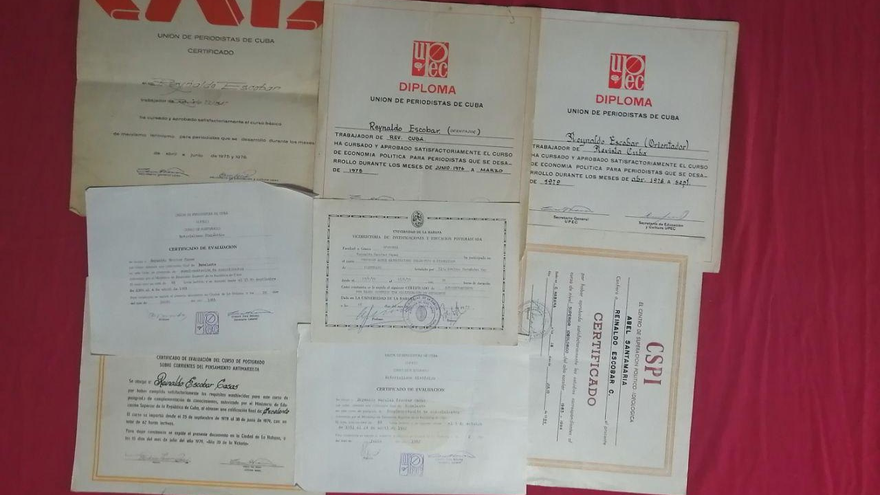
Between 1975 and 1984 I had the opportunity to participate in several postgraduate courses on Marxism-Leninism and, in particular, on political economy and dialectical and historical materialism. Some were continue reading

sponsored by the Cuban Union of Journalists, others I did on my own at the University of Havana.

In the Political Economy courses that were taught in my workplace, Cuba International magazine, I was the guide, first on the political economy of capitalism and then on that of socialism. Most of my students at that time decided to live (and had to die) outside of Cuba.

Diplomas of the author in his courses on Marxism-Leninism. (14ymedio)

If it came to me to study these subjects again, I would ask the professor how the indisputable apothegm is interpreted in Cuba today, the one that says “when the mode of production becomes a straitjacket for the development of the productive forces,” what has to change is the mode of production; if we were to get philosophical, one would demand an explanation of how it is possible that Marxism is considered both science and ideology.

I do not deny that the laws of dialectics have their charm, especially to affirm that when indicators of material poverty are accumulated quantitatively in a country, a qualitative change occurs that allows that country to be defined as miserable.

In the world we live in, where there is talk of the fourth industrial revolution, when artificial intelligence based on quantum computing threatens to leave not a single question unanswered, to appear with Marxism-Leninism as an inexhaustible source of knowledge and a master key to solve problems is, to say the least, a joke in bad taste.

Being generous with the intelligence of others you might venture that there is something hidden behind all this, but that is going too far in search of an unlikely ingenious justification.

____________

COLLABORATE WITH OUR WORK: The 14ymedio team is committed to practicing serious journalism that reflects Cuba’s reality in all its depth. Thank you for joining us on this long journey. We invite you to continue supporting us by becoming a member of 14ymedio now. Together we can continue transforming journalism in Cuba.
The Humiliating ‘Victory’ of the Cuban Dictatorship

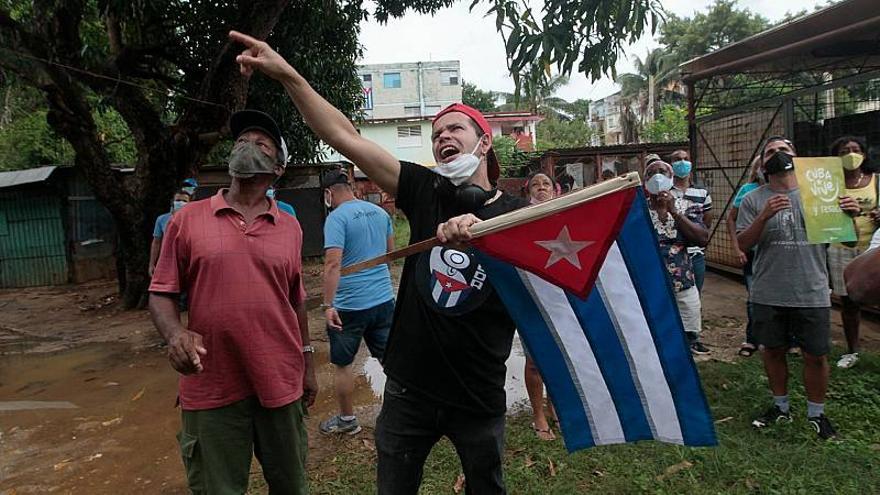
Government supporters during the act of repudiation against the home of Yunior García Aguilera this Sunday. (EFE)

14ymedio bigger14ymedio, Reinaldo Escobar, Havana, 16 November 2021 — From the failed assault on the Moncada barracks in 1953 until the ’Tarea Ordenamiento’* [Ordering Task] debacle, defeat has been a constant in the history of what has come to be called the Cuban Revolution. The intention to industrialize the country, the claim to “liberate” Latin America, the 10 Million Ton Harvest, the Food Plan, business improvement, the Granada disaster and the dismantling of the Wasp Network would be enough to affirm that the victories have been scarce.

At a price that no one will be able to calculate until the secret documents of the Ministry of the Interior are declassified, the repression to prevent the Civic March for Change called by the Archipiélago group has been effective only because the streets were kept empty by a blow of terror. This required the mobilization of thousands of troops throughout the country, as well as making hundreds of vehicles available and countless expenditures in logistics.

More than the disproportionate disbursement of public coffers to instill fear in an unarmed population, it will be necessary to assess how much was spent on political capital, how much international trust was squandered, how much disappointment in their own bases will have been provoked by this nonsense of using force against those who just wanted to walk through the streets. The streets of their own country.

No matter how abject the people who volunteered to participate in the repudiation rallies against the organizers of the march, the dirt that has remained on their consciences will grow with time. When their offspring see on social media the vulgarity, abuse, brutal intolerance with which their parents or grandparents angrily insulted decent citizens, they will have no way of explaining to their children or grandchildren that they were doing the right thing. continue reading

If that is the peace that has been proclaimed by the one who holds the title of “President of the Republic,” if that is the type of dialogue that he has claimed to be willing to promote, then it is he who provokes the confrontation and the desire to tell him: “Save yourself those proposals, we do not understand each other.”

This one of 15 November 2021 will be a bitter “victory” to remember, it will be swept under the carpet, as happened with the repudiation rallies of 1980 that do not appear in any glorious anniversary of those displayed by officialdom, and whose participation as a perpetrator no one proudly notes in their autobiography.

They should be ashamed.

*Translator’s note: Tarea ordenamiento = The [so-called] ‘Ordering Task’ which is a collection of measures that includes eliminating the Cuban Convertible Peso (CUC), leaving the Cuban peso as the only national currency, raising prices, raising salaries (but not as much as prices), opening stores that take payment only in hard currency which must be in the form of specially issued pre-paid debit cards, and others. 

____________

COLLABORATE WITH OUR WORK: The 14ymedio team is committed to practicing serious journalism that reflects Cuba’s reality in all its depth. Thank you for joining us on this long journey. We invite you to continue supporting us by becoming a member of 14ymedio now. Together we can continue transforming journalism in Cuba.
The Raul Rivero I Will Remember

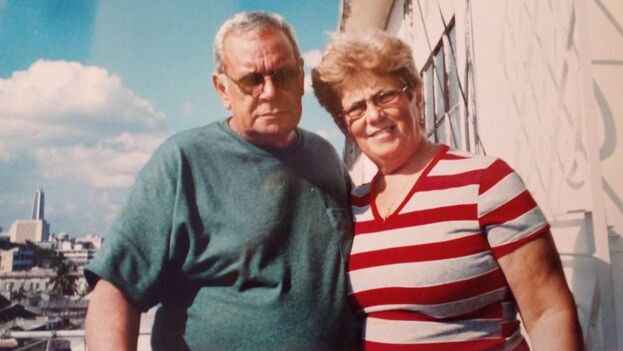
Raúl Rivero and his wife Blanca Reyes, a few days after the poet was released in 2004 and before leaving for Spain. (Courtesy)

14ymedio bigger14ymedio, Reinaldo Escobar, Desde Aqui, Havana, 6 November 2021 — A few days short of 76, the Cuban poet Raúl Rivero has died in exile. We were classmates in the University of Havana’s journalism school, and we shared a time at Cuba Internacional magazine, but above all we were friends.

In the early 1970s, while we were covering the information on the so-called Ten Million Zafra in Camagüey, Raúl Rivero wrote what he would have liked to be his epitaph at the time, or perhaps his will. I never knew why you asked me to keep that typewritten sheet without a copy. Unfortunately, the poem was lost and I only remember the festive tone with which the poet spoke from his imaginary coffin.

“Surrounded as I am by compañeros / I would like to mention my brief biography / that I was never one to ride those fast cars / that were taken from the slow legs of the people.” I am quoting from memory. For the time that was a controversial poem although the corpse appeared dressed as a militiaman.

When I asked him in June 1991 why he had signed that famous Carta de los Diez [Letter of the Ten] that led him to ostracism within Cuba, he replied: “When I read it, I thought that even Little Red Riding Hood could have signed it.” He had that sharp and sarcastic way continue reading

of saying anything, I still remember him leaning out over his balcony on Peñalver Street, in Centro Habana.

We had long conversations and more than a few discussions, especially at times when he was suspicious of almost everyone who approached him. I remember one day talking about the freelance journalist David Orrio he told me “This guy just needs to put on his uniform.” Orrio had not yet exposed himself as ‘agent Miguel’ who served as a witness to imprison Rivero during the Black Spring.

As is known, Raúl Rivero was sentenced to 20 years in prison in that 2003 process. After being released on parole for health reasons, I visited him at his home. When I asked him how hard the prison had been, he replied: “What they did to me was shitty — not even a blow.” But the bruises were internal, they marked him for the rest of his life.

That will be the Raúl Rivero that I will always remember, smiling, clever, witty, the poet of impossible loves, the chronicler who knew how to narrate the dictatorship, a journalist without a mandate as he preferred to define himself. Life even connected our families and, although in recent years we barely had contact due to the distance imposed by his exile, I always knew that I had “Gordo Rivero” by my side.

In the distant days when I thought I was a poet, I fantasized that in an interview someone would inquire about my influences. I wanted to be asked, so as to be able to answer: “First, Raúl Rivero.”

Today when I have only managed to be a journalist, I could give the same answer.

I will be, when I do not return / some sweet ghost / a dear and sweet ghost, / if I do not return. / Raúl Rivero, 1988

____________

COLLABORATE WITH OUR WORK: The 14ymedio team is committed to practicing serious journalism that reflects Cuba’s reality in all its depth. Thank you for joining us on this long journey. We invite you to continue supporting us by becoming a member of 14ymedio now. Together we can continue transforming journalism in Cuba.
A Brief Chronology of Disregard and Intolerance in Cuba

The Ladies in White is another group that has been repressed for decades for marching peacefully on Sundays. (EFE)

14ymedio bigger14ymedio, Reinaldo Escobar, Havana, November 2, 2021 — The dictatorship’s most frequently recurring formula to impede or interfere with changes that do not align with their interests has been to incarcerate.

They’ve raised the bar in two ways: first, by presenting as apocalyptic the results of anything they consider a “return to the past,” and second, making those who dare to dissent pay disproportionately for “daring.”

The most recent expression of this authoritarian eagerness has been displayed in the aggressive response to the Movimiento San Isidro, the protesters of November 27 in front of the Ministry of Culture and the members of Archipiélago who intend to organize a peaceful march on November 15th.

However, those who comb their grey hairs and treasure their scars will recognize in these acts of power the same processes that have been practiced for the last 60 years. With only a superficial retelling of certain moments in which they’ve responded with excessive brutality to those who, in a civilized manner, submitted divergent proposals, including some from within the ranks who displayed their disagreement with the ways the revolutionary project was being carried out.

The list must begin with the resignation letter sent by Commander Huber Matos to Fidel Castro in mid-1959, which stated: “I do not wish to become an obstacle to the Revolution and I believe that having to choose between adapting and being cast aside, the honorable and revolutionary thing to do would be to leave.”

He was tried and sentenced to 20 years in jail. Fidel Castro, in his role as witness, declared that the principal offense of the accused was to malign the Revolution by describing it as communist. continue reading

In January of 1961, cameraman Orlando Jiménez Leal and editor Sabá Cabrera Infante presented a documentary titled PM (post meridian) where instead of showing the people as fired up and willing to die before the “imminent invasion of imperialism,” showed some from Havana as fun-loving — drinking beer and dancing rumba. [See also.]

Toward the end of June that same year, before the reactions that resulted in the censure of the documentary, Fidel Castro announced his so-called Palabras a los intellectuals [Words to the Intellectuals], where he consecrates in a single phrase not only the cultural politics of the country but also the intolerance to all possible discrepancies: ” Against the Revolution, no rights.” [See also.]

Between 1966 and 1968 a group of communists, led by Aníbal Escalante, who had served in the Popular Socialist Party and joined the Integrated Revolutionary Organizations, had the audacity to criticize the direction of the country, arguing, among other things, that the leaders of the 26th of July Movement were bourgeoise with plans to exit the Muscovite sphere of influence and return to the arms of Washington.

That phenomenon, named “microfracture”, ended with 35 of those implicated being tried. The most prominent figures received sentences of up to 15 years in prison.

In March of 1968, to confront the last vestiges of private property, the Revolutionary Offensive was decreed. Entrepreneurship, viewed as a remnant of the past, was punishable by confiscation of the means of employment and the prohibition of self-employment.

In October of 1968, poet Heberto Padilla won the Julián del Casal poetry prize sponsored by the Cuban Union of Writers and Artists (Uneac) for his book Fuera del Juego [Out of the Game]. The panel that awarded the prize stated that “its strength and what gave this book a revolutionary feel was, precisely, the fact that it was not apologetic, but rather critical, controversial, and essentially linked to the idea of the Revolution as the only possible solution to the problems the author obsessed over, which are those of the times we are living.”

The response to those disobedient verses was to add a prologue to the book that described it as counterrevolutionary. Padilla was subsequently jailed for 35 days and forced to provide a public retraction.  Later, he went into exile. His work is not studied in Cuban schools.

Few will remember those “democratization assemblies”, following the failure of the Ten Million Ton Harvest, during which citizens were asked to express their complaints without fear. Barely any data exist (there was no internet in 1970) of the workplace firings and the expulsion of university students which resulted from that unleashing of honesty, or better yet, naivete, in which some came to define the regime as an autocracy and others described the volunteerism and lack of citizen consultation as the worst of the worst.

The First National Congress on Education and Culture was held from the 23rd to the 30th of April 1971. This event launched what historians refer to as the Five Grey Years. They conducted a purge to eliminate from cultural centers all those who “appeared homosexual” or who displayed what they called “ideological weaknesses”. This resulted in the disappearance of Pensamiento Crítico [Critical Thinking] magazine, which provided an academic viewpoint, less orthodox than the practice of socialism. [See also.]

On the scale of intolerance, the well-known events of 1980 must be mentioned, when the state sponsored “acts of repudiation” against those who no longer wanted to partake in the experiment launched by the communists.

On June 13, 1991, Daniel Díaz Torres’s movie, Alice in Wondertown, premiered. That day, hundreds of militants from the Communist Party and the Union of Young Communists were mobilized to repudiate the screening of the film, which provided a sarcastic view of the absurd reality.

That same month a group of intellectuals published a document known as the Letter of the Ten, in which they demanded democratic changes and the release of prisoners of conscience.

The signatories of the declaration, Raúl Rivero, Manuel Díaz Martínez, Nancy Estrada, Lorenzo Fuentes, Bernardo Marquéz Ravelo, Manuel Granados, Fernando Velázquez Medina, Roberto Luque Escalona and Victor Manuel Serpa, were subjected to all kinds of reprisals and harassment.

Poet María Elena Cruz Varela, the author of the letter, was publicly accused of being a CIA agent for having created the dissident group Criterio Alternativo [Alternative Critique], which was branded “a small counterrevolutionary group”. Her house was raided and she was beaten and dragged out of her building and forced to, literally, swallow her documents. Cruz Varela was sentenced to two years in prison.

In February of 1992, Cuban writer Jesús Díaz participated in a public debate in Zurich with Uruguayan intellectual Eduardo Galeano. There, Díaz read a text titled Los anillos de la serpiente [The Serpent’s Rings], which caused profound displeasure among state media because, among other things, it questioned the motto of ’Socialism or Death’ pitched by Fidel Castro.

Jesús Díaz was expelled from the Cuban Union of Writers and Armando Hart,  the Minister of Culture at the time, distributed a pamphlet which accused him of having committed an enormous crime and included the following threat: “Laws do not allow the death sentence for your infamy; however the morality and ethics of Cuban culture will punish you more harshly.”

On September 8th, 1993, Cuba’s Conference of Bishops issued a message titled El amor todo lo espera [Love Hopes All Things], which was subsequently read in all Catholic churches and severely criticized the economic, social, and political situation in the country.

One columnist, who is sadly remembered, published an editorial titled El amor todo lo espera siempre que no venga de Caín [Love Hopes All Things, as Long as They Don’t Come from Cain] where he stated that Cuban bishops were “historic accomplices of all the nation’s enemies,” and that the pastoral message could be considered “a stab in the back, at the most difficult, decisive and heroic moment faced by the Cuban Revolution.”

In March 1996, during the plenary of the Party’s Central Committee Raúl Castro announced the decision to close the Centro de Estudios de Américas (CEA) [Study Center of the Americas], a Cuban center of ideas comprised basically of young researchers who had dared to mention novel ways to build socialism. They were accused of being “fifth columnists” and dispersed to different places of employment.

On June 19th, 1997, members of the Grupo de Trabajo de la Disidencia Interna [Internal Dissidence Working Group] published a document titled La patria es de todos [The Homeland Belongs to Everyone] in response to the scheduled Fifth Congress of Cuba’s Communist Party (PCC), where they were analyzing the main complaints of the population and developing recommendations. A month later, the signers of the document, Vladimiro Roca, Félix Bonne, René Gómez, and Martha Beatriz Roque were detained and processed in summary trials. On May 5th, 2002 the last of them, Vladimiro Roca, was freed after serving close to five years in a maximum-security prison.

In May 2002, protected by Article 88 of the 1992 Constitution, Movimiento Cristiano Liberación [Christian Liberation Movement], led by Oswaldo Payá and supported by other opposition organizations, presented Project Varela as a legislative initiative endorsed and signed by more than 11,000 citizens. This proposal advocated for economic and political reforms.

The government’s response was to amend the Constitution of the Republic, creating the concept of the irrevocability of socialism. In March 2003, in the middle of what is now known as the Black Spring, 75 human rights activists were arrested, including 25 members of Project Varela; they were condemned to long prison sentences.

This extensive yet incomplete account succinctly includes only peaceful acts and their disproportionate responses between 1995 and 2003. Obviously missing are the many specific cases that demonstrate that these abuses of power are not exclusive to the present, but rather, practically habitual over the last six decades.

What occurred in the 18 years since is perhaps more well-known to those who today ask themselves what can be done to change things in Cuba. Among the most notable reprisals to those who have peacefully attempted to do something, several stand out: the permanent harassment of the Ladies in White, who base their struggle on the release of political prisoners, attacks of all kinds against Unión Patriótica de Cuba [Patriotic Union of Cuba] or any other opposition movement.

Arbitrary detentions, prohibitions on travel outside the country, even outside their own homes, confiscation of means of work, and threats of judicial procedures have also befallen bloggers and independent journalists, cultural activists, and defenders of human rights.

The political structure which today governs the country assumes continuity, for which it takes on the responsibility of all the abuses committed to date. The current victims, thrown into the same old sack of discredit as always, understand that there are no scruples that justify distancing themselves from those demonized yesterday. As the poet would say, “We are sewn by the same star.”

 Translated by: Silvia Suárez

____________

COLLABORATE WITH OUR WORK: The 14ymedio team is committed to practicing serious journalism that reflects Cuba’s reality in all its depth. Thank you for joining us on this long journey. We invite you to continue supporting us by becoming a member of 14ymedio now. Together we can continue transforming journalism in Cuba.
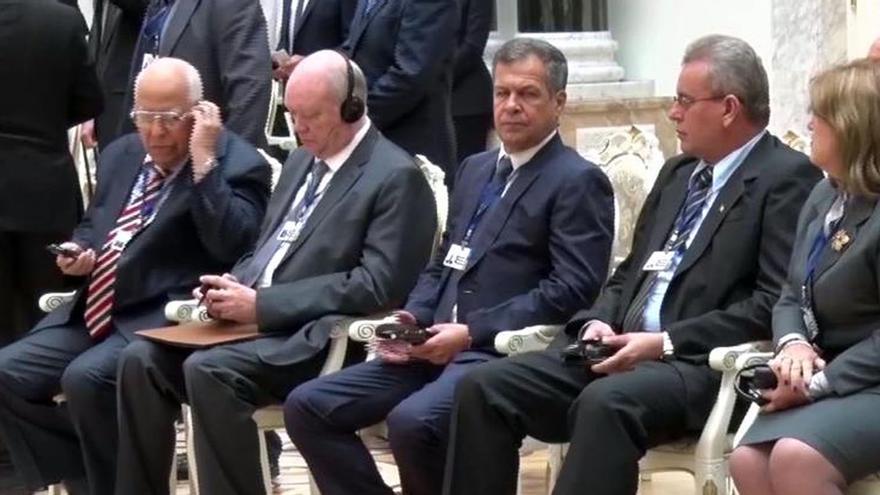
The Next Move of Lopez-Calleja, Raul Castro’s Man

Luis Alberto Rodríguez López-Calleja (center), has a double link with the first group of power in Cuba. (Cubanet)

14ymedio bigger14ymedio, Reinaldo Escobar, Havana, 25 October 2021 — It is assumed that the agenda of Division General Luis Alberto Rodríguez López-Calleja now has room for his new commitment: responding to the requirements of the 16,500 inhabitants of the municipality of Remedios, in the province of Villa Clara, where they have chosen him as their representative to the National Assembly of People’s Power.

In this hypothetical agenda, digitized or on paper, the most confidential data of the Gaesa Business Group, which he controls, as well as bank accounts and properties abroad, and probably the most covert secrets of political activity on the Island, should be noted down.

In the Extraordinary Session of the Municipal Assembly of Remedios held on Saturday, October 23, only one of the 76 delegates of that delegation was against him when he was proposed to fill the void left by Antonio Alberto Pérez Santos, one of the two deputies representing the city in Parliament and one of the 17 vacancies that remained to be filled since last year. continue reading

Pérez Santos, who also served as president of the Union of Writers and Artists of Cuba (UNEAC) in Villa Clara, had died at the age of 55 on September 15, 2020. Since then, his position in Parliament has been vacant.

The all-powerful general, Raúl Castro’s former son-in-law, was promoted in the Eighth Congress of the Communist Party of Cuba to one of the 14 positions in the Political Bureau, so that his “election” as a deputy does not mean an increase in power, where it will only be one vote among the 600 who traditionally raise their hands complacently to approve what is decided in the party leadership.

If we accept that his entry into Parliament is not due to the need to have someone there who can answer for the problems (without remedy) of the municipality of Remedios and considering that he already has a voice and vote in “the highest instance,” it will be necessary to jump to the conclusion that his appointment only seeks the fulfillment of a requirement.

López-Calleja cannot be elected president of the Republic when he is over 60 years of age, the limit established for accessing the position according to article 127 of the Constitution. However, article 143 allows him to be prime minister as long as he is a member of parliament.

Analysts, who like to speculate, say that the current prime minister, Manuel Marrero is “a López-Calleja man” because he was Minister of Tourism for 16 years and this branch of the economy has, for all practical purposes, been in the hands of the military conglomerate Gaesa.

On October 10, 2023, when the first presidential term of Miguel Díaz-Canel expires, Marrero will have lived 60 years and three months, which, according to constitutional requirements, makes him (still) a presidential man.

It is no secret to anyone that the popular acceptance of Miguel Díaz-Canel, if he ever had it, has worn down to a point where many consider him inadmissible for a second term, nor even to conclude the first.

The speculations bet on something similar to what chess players call a castling, where Marrero would be President of the Republic and López-Calleja Prime Minister, but these theories have their fragile point in ignoring not only the popular will but also the invisible internal struggles that will emerge when Raúl Castro is no longer in a position to exert his influence.

For those who are not familiar with the Electoral Law, it is advisable to clarify that it was not an initiative of the voters or the members of the Municipal Assembly for General López-Calleja to represent them in Parliament.

It was the Council of State that considered and ordered that it was necessary to choose a substitute to fill a vacancy, as established in Article 232 of this regulation. Then, the National Nominations Commission approved the candidacy project and the Municipal Commission presented it to the delegates. They only had to mark one ballot to give their approval.

____________

COLLABORATE WITH OUR WORK: The 14ymedio team is committed to practicing serious journalism that reflects Cuba’s reality in all its depth. Thank you for joining us on this long journey. We invite you to continue supporting us by becoming a member of 14ymedio now. Together we can continue transforming journalism in Cuba.
Regime Change in Cuba with Support from a Foreign Power

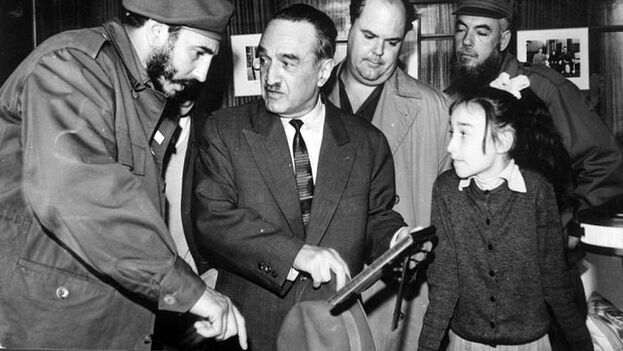
Fidel Castro with Anastas Mikoyan during a visit to Cuba in 1966. (TASS)

14ymedio bigger14ymedio, Reinaldo Escobar, Havana, November 13, 2021 — Those who want to extract the country from the anomaly in which it has found itself for more than six decades are accused of trying to bring about regime change with the support of a foreign power.

Throughout Cuban history there have been numerous changes of government but only three have resulted in regime change. All had the participation or support of foreign powers.

The first and most obvious was the violent eradication of the indigenous community, the archipelago’s original inhabitants, by Spanish conquistadors, who established colonial rule.

The second was the rise of the Republic, which resulted from long years of war for independence culminating in intervention by the United States, which imposed the provisions of the Platt Amendment.

The third regime change formally took place on April 16, 1961 when, in front of a group of his armed followers, Fidel Castro announced the revolution was a socialist one. In his speech he declared, “We will defend this socialist revolution with rifles.” Rifles that — along with mortars, canons and tanks — flowed into the country from the Soviet Union, a foreign power whose history and culture we did not share.

Though Castro made his “proclamation” on that date, the turnaround had begun taking shape a year earlier. On February 4, 1960, Soviet Deputy Premier Anastas Mikoyan travelled to Cuba under the guise of opening an exhibition. During his visit, the first commercial agreement between Cuba and the USSR was signed. It involved the purchase of sugar, the sale of petroleum and machinery, and a loan of 100 million dollars. continue reading

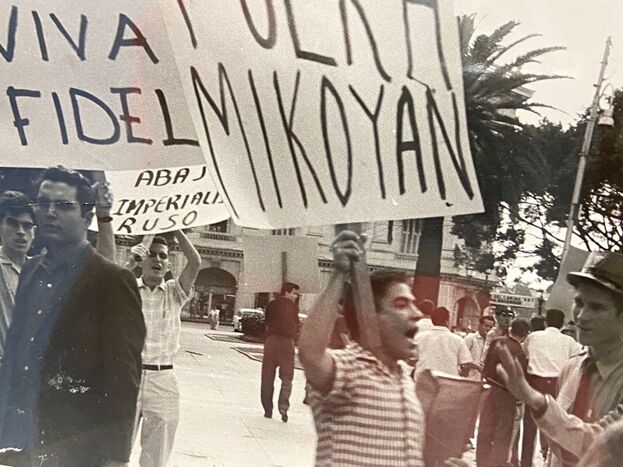
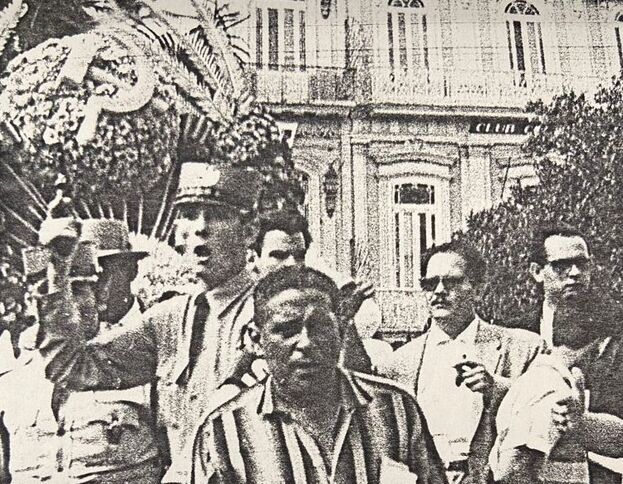
Young Cubans still believed in Fidel but a visit by Soviet Deputy Premier Anastas Mikoyan raised their suspicions. (Courtesy of Alberto Muller)

The presence of Mikoyan, the man associated with the bloody suppression of the 1956 Hungarian revolt, disturbed many anti-communists. After the Soviet leader laid a wreath adorned with a hammer and sickle at the base of a statue of Jose Marti in Central Park, dozens of students from the University of Havana protested by trying to replace the wreath with one displaying the Cuban flag. The peaceful demonstration, the first organized display of opposition since 1959, was violently suppressed by police. About twenty people were detained.

Suspicions that Mikoyan’s presence in Havana was a portent of a communist future alarmed many. But skeptics thought that impossible. Just fifty-two days earlier, when he was testifying at the trial of Commander Huber Matos, Fidel Castro said that the greatest crime the defendant had committed was “to slander the revolution by calling it communist.”

Although the revolution’s confiscatory ambitions had already been demonstrated, particularly after the agrarian reform law which broke up large land holdings, the process accelerated after the Soviet official’s visit, notably with the decision to confiscate the property of those who had decided to go into exile.

Diplomatic relations with Moscow were restored in May 1960. Two months later American-owned Texaco and Esso oil refineries were confiscated as were those owned by Royal Dutch Shell. In August, American telephone and electricity companies along with thirty-six sugar refineries were nationalized. Finally, on October 13, all Cuban and foreign banks (though not Canadian banks) suffered the same fate, as did 382 other large companies that operated textile mills, railways, cinemas, department stores and breweries.

By the end of 1960, Cuba had established diplomatic relations with three other countries: China, North Korea and Vietnam.

In September 1960 Nikita Khruschev visited Fidel Castro at his hotel in New York several days after Castro had attended the annual session of the United Nations General Assembly. Ten days earlier, the Soviet cargo ship Ilya Mietriov, under the command of Adolf Matiukin, had offloaded military supplies that would later be used by militiamen loyal to Castro at the Bay of Pigs.

A policeman fires shots into the air to break up a group of demonstrators offended by a wreath with a hammer and sickle laid at the base of a statue of Jose Marti. (Courtesy of Alberto Muller)

The cargo included the heavy T-34 tank, in which Fidel Castro arrived at the combat zone. Also included was an Su-100 tank from which, legend has it, the Cuban commander-in-chief attacked the Houston, a ship loaded with supplies intended for the men of Brigade 2506.

The invasion force was made up of Cuban exiles supported by the U.S. government who claimed their goal was to restore the 1940 Cuban constitution and prevent a communist takeover of Cuba. Official propanda labeled their efforts as nothing more than an attempt to “recover their properties.”

The process of expropriation that culminated in 1960 mortally wounded Cuban capitalism, which had thrived on the island for fifty-seven years, and represented a political and economic transition to socialism, with the unbridled support of the Soviet Union.

Fidel Castro’s formal proclamation on April 16, 1961 did not follow the protocol such a transformative action required. It was not preceded by debates among parliamentarians (nothing resembling a parliament even existed), it was not discussed among party leaders (a political organization had not yet been created), there was no discussion in the press (all publications were in government hands) and it was not submitted to a referendum. It was done as an irrevocable decision announced in front of his armed followers (something which bears repeating).

Documents have not been declassified that might show the regime change was “cooked up” in Moscow. But the time span between Mikoyan’s visit in February 1960 and Castro’’s to the Soviet Union in July of that year, when an arms deal was finalized, suggests the Cuban side had to provide guarantees that the military equipment would be in good hands.

It is hard to ignore the enormous weight Soviet support had on regime change in Cuba in the 1960s.

Accusations now being made by those in power that anyone who advocates for democracy on the island is supported by “Yankee imperialists” are a reminder that this caricature of socialism was imposed on Cuba with economic and military support from a foreign power — and an imperial power at that — thousands of miles away, with an ideology that does not reflect our traditions.

The decision to seek closer ties to that power affected relations with the United States and Latin American countries, and threatened world peace. It also forced hundreds of thousands of Cubans to flee the country and left the majority of the country mired in poverty.

____________

COLLABORATE WITH OUR WORK: The 14ymedio team is committed to practicing serious journalism that reflects Cuba’s reality in all its depth. Thank you for joining us on this long journey. We invite you to continue supporting us by becoming a member of 14ymedio now. Together we can continue transforming journalism in Cuba.
The Space and Time of Words

As if something that has not yet happened could overshadow what is already registered as a historical date. As if November 20th was not the continuity of July 11th. (14ymedio)

14ymedio bigger14ymedio, Reinaldo Escobar, Havana, 6 October 2021 — Something that I have never managed to do is pronounce two words at the same time. This “deficiency” has led me to understand how difficult it is to state two ideas simultaneously in a grammatical sentence. In this arduous struggle of half a century, I have also learned that I cannot say everything in a 400-word text.

When I speak, for example, of blackouts, a commentator usually appears who reproaches me for not mentioning food shortages, and if I focus on the absence of products, another appears who is outraged because I have not mentioned the critical housing situation, the disastrous state of the streets or the calamity of public transport. There will be no excuse if I forget the plummeting health services or the crushing indoctrination in schools. But the most unforgivable thing will always be not to cast the blame on the dictatorship.

The most current scolding rails against the intention of promoting the call for the November 20 (20N) march because “it is intended to overshadow what happened on July 11 (11J),” as if something that has not yet happened could overshadow what is already registered as a historical date. As if the 20N was not the continuity of the 11J.

Luis Manuel Otero Alcántara has not gone out of style because we expose the arbitrary detention of Hamlet Lavastida; denouncing the unjust imprisonment of Maykel Osorbo does not leave behind the systematic repression against the Ladies in White; reporting the attack on continue reading

the Unpacu headquarters in Santiago de Cuba is not a trick to negate the assault on Cubalex; exposing the seizures of the working tools of independent journalists is not done to forget the outrage to which the prisoners of the Black Spring of 2003 were subjected.

If we manage to expose all of the above in a single page, the crime against the March 13 tugboat, the parameterization of the Five GreyYears, the UMAP camps, the forced evictions in the Escambray, the express executions of 1959 will always be conspicuous by their absence.

Trying to say everything every time one speaks or writes, in addition to being boring for the reader, runs the serious risk of not mentioning something or someone. I prove it in this note where I have omitted so many things that should be unforgettable.

____________

COLLABORATE WITH OUR WORK: The 14ymedio team is committed to practicing serious journalism that reflects Cuba’s reality in all its depth. Thank you for joining us on this long journey. We invite you to continue supporting us by becoming a member of 14ymedio now. Together we can continue transforming journalism in Cuba.
Cuba: When They Hijacked the Applause

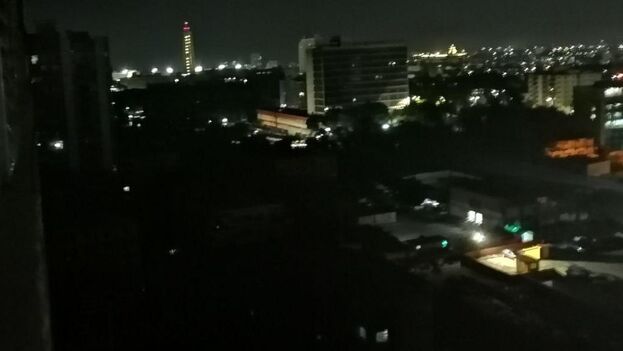
Blackout in Havana, where government buildings are the only ones that remain illuminated. (14ymedio)

14ymedio bigger14ymedio, Reinaldo Escobar, Havana, 24 September 2021 — The blackout on Tuesday night was brief, but as soon as it got dark a man’s voice was heard shouting, “Why don’t you clap now?”

He was speaking directly to neighbors who at nine o’clock “honor” the doctors engaged in the fight against the pandemic. To clarify, in this neighborhood these are the only neighbors who, in addition to clapping forcefully, shout, howl and hit metal objects, as if instead of entertaining the health workers they were provoking an enemy.

In addition to clapping forcefully, they shout, howl and hit metal objects, as if instead of entertaining the health personnel they were provoking an enemy

Twenty-seven years ago, when I was writing a column titled Letters from Havana in the German weekly Wochenpost, I published an article for foreigners, explaining the meaning of a blackout. At the time, I did not consider myself an independent journalist, but as a freelancer, which seemed more elegant to me.

I began my dissertation by narrating the joy that erupted in any neighborhood the moment the lights come on, forgetting about people trapped in elevators, interrupted television shows whose viewers had not been able to see the end of the day’s episode of their favorite novela, students who could not do their homework and, of course, people who were unable to cook because their cooking appliances were electric.

On one occasion I recounted an incident involving impatient neighbors who threw bottles and garbage from their balconies at midnight because the electricity had not been restored according to schedule. To conclude, I added, continue reading

“But that happens very rarely.  Almost never. What always does happen is the chorus of relief, perfectly coordinated like a gigantic orchestra, with which the people of Havana console themselves when the lights come on.”

Today, that text, which would be taken as confrontational from the official angle, seems to me light, complacent, folkloric.

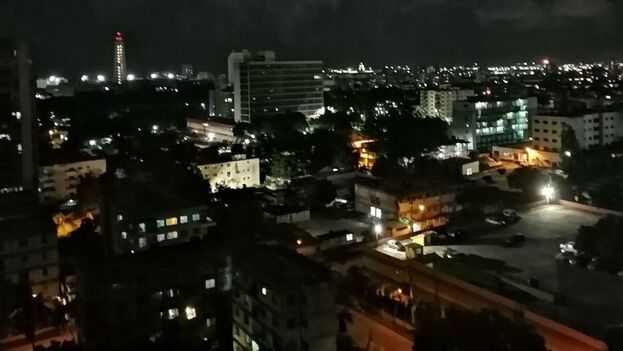
The same view of Havana, in this case illuminated. (14ymedio)

I am not saying that people aren’t happy when the electrons resume their travel through conductors, that is, when the lights return. Of course they are, but the enthusiasm is not the same and neither is the anger manifested the moment the blackout arrives.

The chauvinistic vanity that convinced us that we are part of the “civilized world” also made us believe that we were not to be compared with the 780 million people on this planet who currently live without electricity.

Those are “the others,” we live in the Northern Hemisphere, also in the Western one.  As if that were not enough, here we created a socialist revolution with our sight set on that Leninist definition that “communism is the power of the Soviets plus electricity.” According to statistics, our access to electricity is 99.8%, but they fail to add the adjective “guaranteed” to the noun “access.”

The last one was short and partial. The houses in the neighborhood were dark, but in government buildings, generators were activated immediately. In the Plaza de la Revolución the lights remained on

From our balcony on the 14th floor you can appreciate the magnitude of the blackouts. The houses in the neighborhood were dark, but in government buildings, generators were activated immediately. In the Plaza de la Revolución the lights remained on.

The forecasts are not favorable. Power plants suffer from lack of maintenance and technological obsolescence; the fuel that powers them threatens to become more scarce every day and even the cables show signs of fatigue.

The irritation caused by these blackouts undermines citizen enthusiasm. Furthermore, it even diminishes the desire to applaud the sacrifice of doctors, because among other things, in a subtle but evident way, the propaganda has politicized this tribute, extending it to those responsible for the darkness.

Translated by: Silvia Suárez
____________

COLLABORATE WITH OUR WORK: The 14ymedio team is committed to practicing serious journalism that reflects Cuba’s reality in all its depth. Thank you for joining us on this long journey. We invite you to continue supporting us by becoming a member of 14ymedio now. Together we can continue transforming journalism in Cuba.
Political Intrigue in Today’s Cuba

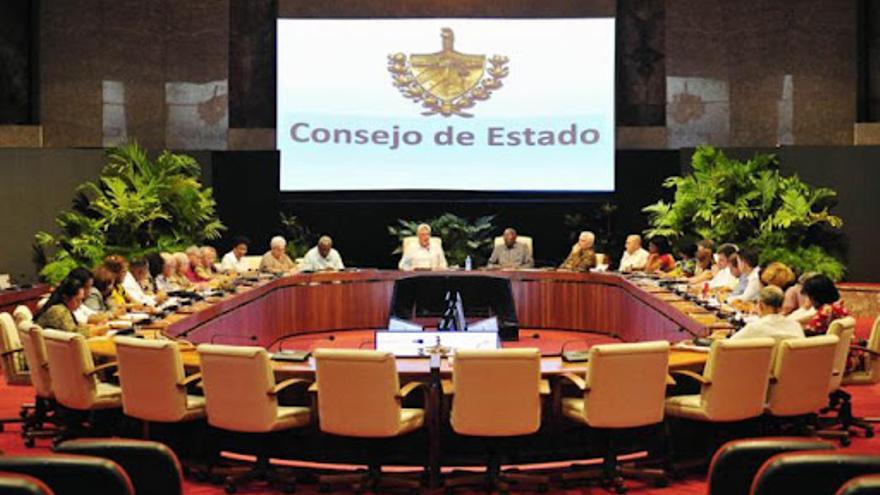
Citizens do not even know who is in favor or against an article of a law, who has an open-minded tendency or who is part of the mechanisms to stop reforms. Everyone is supposed to agree before starting to argue. (Granma)

14ymedio bigger14ymedio, Reinaldo Escobar, Havana, 9 September 2021 — Political intrigues have been fruitful in Cuba, especially since 1959. The deposition of President Urrutia, the microfraction, the Marquitos trial, the execution of General Ochoa and, more recently, the dismissal of the dauphins Carlos Lage, Felipe Pérez Roque and Carlos Valenciaga are partially known facts that show dark machinations alien to the proclaimed political principles.

After the death of Fidel Castro, in November 2016, they did not stop.

Today’s palace intrigues have protagonists and purposes. Names are known because they appear on the list of the Political Bureau, the Council of State and Ministers or because they bear certain surnames, but the inclination of each towards the only two possible purposes cannot be confirmed with certainty: to maintain the system or to liquidate it.

They all share, perhaps, a parallel objective, not related to ideals but to personal ambitions. Understand, enjoy the obscene attributes of power, those honeys that must be tasted with discretion but that are the most effective motivation to agree opportunistically or to conspire in the shadows, as the case may be.

Today there is no conspiracy in the upper echelons, as in 1959, to avoid or promote communist ideology, nor to, as in the 1960s, to approach the Soviet Union or China. No one is plotting to continue reading

start a tropical perestroika anymore. Not even in the local academy do purists of Marxism appear confronting its reformers. No one has ever consulted the books on the political economy of socialism by P. Nikitin or cited the manuals of scientific communism, where it was claimed that humanity was experiencing the transition period from capitalism to socialism.

The most critical dilemma does not seem to be whether or not to proceed with the liquidation of the system (if it can be called that) but how to carry it out and when.

The debate has not yet emerged nor is it recorded in the minutes. Flashes only appear when the promulgation of a decree is prioritized or the presentation of laws to Parliament is delayed without explanation. You can see certain sparks in the advances and setbacks of the acceptance of the market rules or in the absurd prohibitions and timid permissiveness.

In the corridors of the Palace, in the halls of the Capitol, in the ministerial offices, change must be cooking. An enigmatic smile, raised eyebrows, a greeting, will be enough to create complicity. But the opacity in the deep opinions generates doubs and suspicions.

Much is debated about the role that this entelechy called “the military leadership” can play. Here we must distinguish the generals who have taken over the economy through the business group called Gaesa, from the commanders who have the operational capacity to mobilize troops. In parallel, the powerful political police have the mission of discovering any fickleness that could be considered as a presumed treason.

The absence of a transparent and democratic political debate makes anyone who tries to forge alliances to drive change a presumable traitor. The President of the Republic does not commit a crime, not even a mistake, if he orders State Security to seize documents in the offices of opposition parties. It does not engage in Watergate because opposition parties do not have a permit to exist and what is considered illegal is that they issue and keep documents.

That is the reason why the public does not even know who is in favor or against an article of a law, who has an open-minded tendency or who is part of the mechanisms to stop reforms. Everyone is supposed to agree before starting to argue, because unity is not only expressed in action, but also in thought.

The obsession with showing a monolithic union around continuity is intended to give the impression that “up there” everything is under control.

This unitary staging is aimed at the institutions and governments that exert pressure from abroad, the citizens residing on the island, the repressive forces that keep any discrepancies at bay and, very especially, that small group of characters of the so-called ’historic generation’. Although they have not appeared on the payroll of power since the Eighth Congress of the Party, they maintain “one foot in the stirrup” ready to defend their designs at any cost.

Sooner rather than later, the laws of biology will leave the watchmen of that immobile legacy out of the game and the actors in this farce, no longer masked, will want to show themselves to the world and to the people as the only ones capable of carrying out a controlled liquidation, without a power vacuum, bloodbaths or the piñatas of corruption; providers of amnesty and deserving of pardon.

Meanwhile, citizens remain oblivious to the affairs of politics and are amazed how in Spain they flay the political party Podemos, in Chile the president apologizes and promotes a change in the Constitution, in Peru they limit the powers of the president and in the United States he is accused of fraud against the party that won the elections. “Nothing like that happens here,” some think, as if it were a choir of angels that rule the country and not a pack of hungry wolves ready to tear each other apart.

____________

COLLABORATE WITH OUR WORK: The 14ymedio team is committed to practicing serious journalism that reflects Cuba’s reality in all its depth. Thank you for joining us on this long journey. We invite you to continue supporting us by becoming a member of 14ymedio now. Together we can continue transforming journalism in Cuba.

Challenge to Cuba’s Decree-Law 35

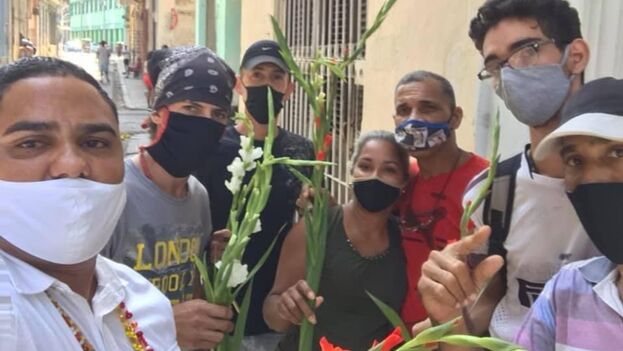
Cuban activists with flowers in their hands in support of Luis Manuel Otero Alcántara on April 29, 2021, when the artist had been on a hunger and thirst strike for days. (Esteban Rodríguez / Facebook)

14ymedio bigger14ymedio, Reinaldo Escobar, Desde Aqui, Havana, 18 August 2021 — As I do not have the patience needed to analyze paragraph by paragraph, article by article, the ways in which Decree-Law 35 violates the rights of freedom of expression, I opt for the following challenge.

I formally challenge President Miguel Díaz-Canel, Prime Minister Manuel Marrero, President of Parliament Esteban Lazo and any minister or official who has the power to legislate to dare to legally prohibit the following presumed manifestations of citizen disagreement:

    • Placing a black cloth on the clothesline in protest
    • Turning off the lights in the house for one minute every day at 9 p.m.
    • Shaving the left side of the mustache (for adult men)
    • Shaving the left eyebrow (valid for all genders and ages)
    • Planting a sweet potato in the garden
    • Carrying a flower, a book, a tree branch in the right hand when walking down the street
    • Stopping on public roads for one minute at an agreed time
    • Applauding the doctors 30 minutes before the orientation (or 30 minutes after)
    • Starting all posts on social media with the same words, for example: “friends,” “what a beautiful day” or “I would like to tell you that …”

    If a consensus of citizen protest was achieved and expressed in any of the hypothetical examples above, would those challenged here dare to decree the corresponding prohibitions?

    I challenge them to make fools of themselves. Let’s see if they understand once and for all that the need to exercise freedom is as precious as that oxygen that is scarce in hospitals today.

    ____________

    COLLABORATE WITH OUR WORK: The 14ymedio team is committed to practicing serious journalism that reflects Cuba’s reality in all its depth. Thank you for joining us on this long journey. We invite you to continue supporting us by becoming a member of 14ymedio now. Together we can continue transforming journalism in Cuba.
Crime Without Punishment, the Death of a Young Man in La Guinera

The death of a young man by police shots in the La Güinera neighborhood of Havana remains surrounded by doubts. (Screen capture)

14ymedio bigger14ymedio, Reinaldo Escobar, Havana, 15 August 2021 — More than a month after the popular protests in Cuba, the death of a young man shot by the police in the La Güinera neighborhood of Havana remains surrounded by doubts. The declassification of part of the investigation file reveals that the officer has not been charged and that there are also several injured.

That Monday, Second Lieutenant Yoennis Pelegrín Hernández, a 28-year-old from Guantanamo who works as a sector chief in Mantilla, fired his Makarov pistol at a group of people until all the cartridges in the magazine were used up. One of the projectiles killed Diubis Laurencio Tejeda, a 37-year-old from Santiago who that day, July 12, was demonstrating against the government in one of the poorest neighborhoods in the Arroyo Naranjo municipality.

Pelegrín has not been accused of the crime, although he appears registered as a witness in the file in the preparatory phase 145/2021 recently leaked by the Cuban Observatory for Human Rights, an entity based in Madrid that demands the judicial prosecution of the officer.

According to experts who examined the body that same day, the bullet entered the back, went through continue reading

the left lung, fractured a rib and brushed the heart by breaking the pericardium.

The demonstration in La Güinera, which began around four in the afternoon on Monday, July 12, was a replica of the popular protests that shocked the entire country on Sunday, July 11. The official version contained in the aforementioned file describes the group as “antisocial and criminal elements” who after carrying out vandalism went to the territory’s National Revolutionary Police Station (PNR) “with the aim of attacking its troops and damaging the installation.” It is noted in the story that the protesters used insults against the country’s leaders and clamored for foreign investment.

Second Lieutenant Pelegrín, accompanied by Lieutenant Wilfredo Sánchez and investigator Yoandro, maneuvered “to get away from behind the demonstration” and on First Street, between Calzada de La Güinera and Principal, they ran into a group of about thirty people who threw stones and bottles at them.

To justify the shots he fired, Pelegrín explained in his statement that the stones had already hit his colleagues who were practically defenseless against their attackers. He stated that he fired “a shot in the air yelling at them to stop, not to throw any more” but they kept advancing. Then, one of the attackers provoked him by showing his genitals and telling him that he only had blanks. They were at a distance of 30 or 40 meters and, as he later alleged, he believed he was in danger.

In the four years of service that Pelegrín has served, he had probably never fired at human beings before, but by the time he aimed his regulation weapon he knew that his projectiles would hit sensitive areas of the body as he learned in the shooting range where he trained as policeman.

In front of him this time there were no cardboard dolls, but people, so his bullets not only killed Diubis Laurencio, but also wounded Yorlandis Pérez, Misael Fuentes and Rubén Pérez. Pelegrín said that after shooting he heard screams from the group telling him that he had hit someone, but he defends himself saying that no one was lying on the ground and that his attackers fled.

The claim that this PNR officer appear as a defendant in court would not only give satisfaction to the families of his victims but also give himself the opportunity to prove to what extent he is innocent and that he acted in legitimate defense.

What happened recalls the death in June 2020 of Hansel Ernesto Hernández Galiano, at the hands of the police, a death that shocked the neighborhood of La Lima, in Guanabacoa (Havana). The 26-year-old was hit by a bullet fired by the uniformed men who were also not tried, a confirmation that the security forces enjoy total impunity and the families of the victims are not given the slightest opportunity to get an objective investigation.

In cases like these, the impunity of the crime, committed by an agent of the authority, could incite others to act in the same way in similar circumstances. If the hundreds of arrests throughout the country, with the imposition of fines or prison sentences, for the alleged crimes of damages, public disorder and instigation to commit a crime have a dissuasive intention to discourage future anti-government demonstrations, the death of a citizen at the hands of a policeman must at least be prosecuted as murder to deter those who, in the name of the law, carry firearms.

____________

COLLABORATE WITH OUR WORK: The 14ymedio team is committed to practicing serious journalism that reflects Cuba’s reality in all its depth. Thank you for joining us on this long journey. We invite you to continue supporting us by becoming a member of 14ymedio now. Together we can continue transforming journalism in Cuba.
This Has A Name, It Only Has One Name

Reinaldo Escobar holds Fidel Castro responsible for all the ills of the Island in this text for Castro’s birthday. (Marcos Evora)

14ymedio bigger14ymedio, Reinaldo Escobar, Havana, August 13, 2021 — I heard your voice for the first time when I was eleven years old. It was 1958 and Radio Rebelde (Rebel Radio) broke the censorship that the brief dictatorship of Fulgencio Batista imposed to keep what was happening in the Sierra Maestra Mountains from becoming known.

In January 1959 I imagined I saw your face in each of the bearded men who paraded through Camagüey, and from whom we children asked for a “balita” [little bullet] as a souvenir and as a symbol that peace had arrived.

I keep one of those projectiles.

I learned that “Triumphal March of the Rebel Army” by the Indian Naborí and I knew how to lower my voice to recite the verses where it was said “and this has a name, it only has one name”* and then came the cataract of your speeches, from which I got to memorize phrases that I repeated aloud while I slept.

Little by little disappointment came: over Prague; over the failure of the sugar harvest; and one good day in 1970, as a university student, I had my first and only discussion with you where I indicated to you my sincere disagreement, and I could no longer remain the same.

I cannot pinpoint the exact date when you entered my past, “in the past of my life,” as the tango says, but I can say that I finally had to give in to the arguments of those who preferred to demonize you. Always, out of academic petulance, I preferred to put all the blame on the system, which it has, and it cost me a lot of work to understand the dose of personal evil that was hidden behind each of your decisions.

Cuba owes you its misfortune. This country should have saved you from coming into the world on a day like today 95 years ago. It will not be possible to describe our sad reality without putting all the blame on you.

I hope this gets to be told one day, and that afterward you will be forgotten, and that no one will remember your name.

*Translator’s note: This is the penultimate line of the paean to Fidel, “Triumphal March of the Rebel Army,” by Jesús Orta Ruiz aka “El Indio Naborí.” The next line of the poem is simply: FIDEL CASTRO RUZ

Translated by: Tomás A.

____________

COLLABORATE WITH OUR WORK: The 14ymedio team is committed to practicing serious journalism that reflects Cuba’s reality in all its depth. Thank you for joining us on this long journey. We invite you to continue supporting us by becoming a member of 14ymedio now. Together we can continue transforming journalism in Cuba.
Cuba: Before and After July 11

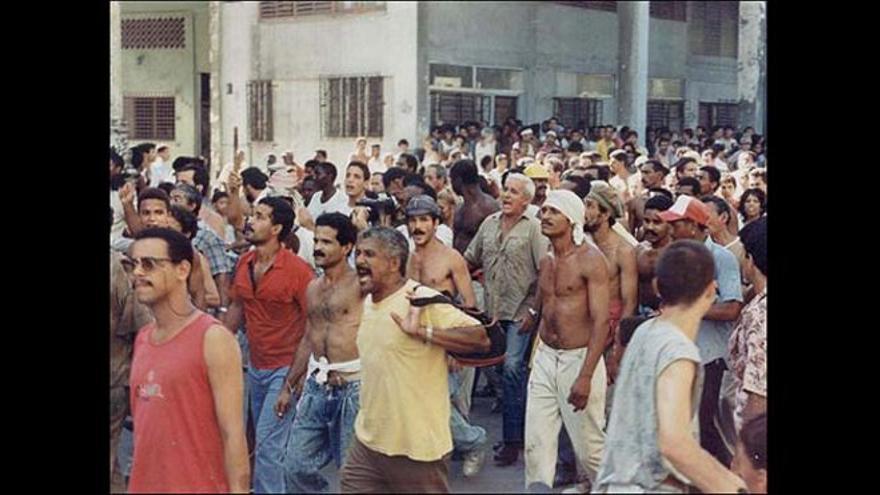
How many of those who protested at the Maleconazo remain on the Island today, how many survive? (Karel Poort)

14ymedio bigger14ymedio, Reinaldo Escobar, Desde Aqui, Havana,  August 5, 2021 — The popular program Escriba y Lea [Write and Read] familiarized viewers with one of the most delicate operations a historian can make: dating the beginning and end of an era. When the panelists had to figure out, sometimes by guessing, the historical fact or character suggested in a riddle, they first asked questions such as whether it was before or after the French Revolution. Or if it was post WWII. Knowing the time period, they figured out the answer.

The formula relied on a wide variety of jokes, especially those that mocked events celebrated in official propaganda: Before the ration book? After the Special Period? In the chocolate milk era?

In conversations in which different generations overlap, confusion often arises about continue reading

what is meant by “before.”

For the septuagenarians, “before” means anything prior to 1959. Up until the late 1970s, if you wanted to find out where dissimilar objects of a certain quality had come from — a lamp, a skirt, a kitchen gadget — you had to first find out if it was “from somewhere else” or “from before.” If the object was said to be “from here” or “from now,” this was not necessary because, by then, everything came from the rationed market. What was “from before” was held in the same esteem as what came “from somewhere else.”

Those born in the the new age of “Revolution” reached adulthood in the 1980s. They saw the dawn of “liberated” markets, were moved by Nueva Trova songs and enjoyed the benefits of what was commonly known in its heyday as “the Soviet pipeline.” They were also the ones who filled the boats fleeing the port of Mariel, those who were victims or perpetrators of acts of repudiation.

Twenty-seven years have passed since the Maleconazo, the Malecón uprising, a watershed event that took place on August 5, 1994. Those who were not old enough to participate, or who had not yet been born, are today in the under-35 age range, when one can still be considered unquestionably young.

How many protestors from that uprising remain on the island today? How many are still alive? Surely, a few of them took to the streets on July 11.

Those who did have earned the right to measure historical time in a new way: before or after July 11.

____________

COLLABORATE WITH OUR WORK: The 14ymedio team is committed to practicing serious journalism that reflects Cuba’s reality in all its depth. Thank you for joining us on this long journey. We invite you to continue supporting us by becoming a member of 14ymedio now. Together we can continue transforming journalism in Cuba.