My Private Gorbachev

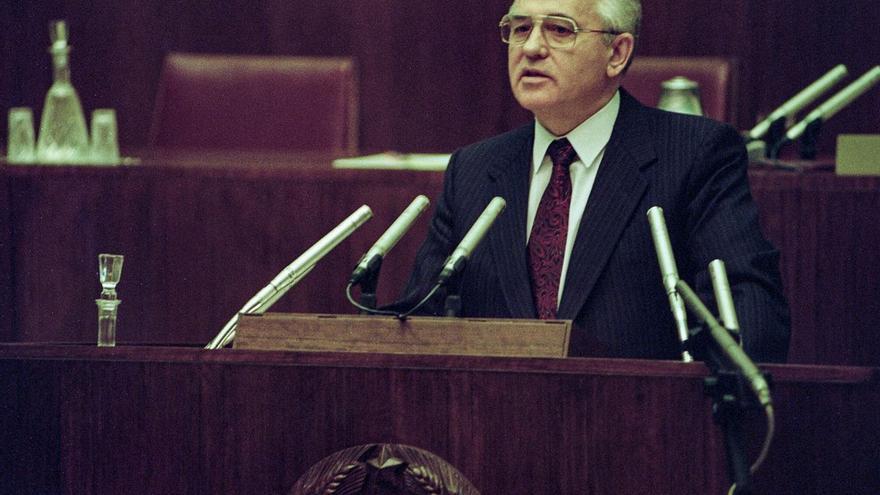
Mikhail Gorbachev in 1991 during the final session of the Supreme Soviet. (EFE/EPA/Vassili Korneyev)

14ymedio bigger14ymedio, Reinaldo Escobar, Havana, 31 August 2022 — In April 1985 Mikhail Gorbachev appeared before a full session of the Soviet Union’s Communist Party Central Committee to present his initial proposals for what would ultimately be known as perestroika (restructuring). My friend, the poet and journalist Julio Martinez, was the first to warn me that what was happening in the USSR was unprecedented and could have repercussions for Cuba.

At that moment we became “perestroikos,” addicted to News from Moscow, a weekly publication that for years had been sold on news stands but which overnight became a source of revelations on the failures of Stalinism and what had been known as real socialism.

The fantasy that our own country could undertake a similar restructuring, and the informational transparency that came with it (glasnost), thrilled those of us who still believed in the myth of socialism with a human face. Though we were many, few dared to publicly align themselves with this experiment.

Gorbachev’s actions, almost 10,000 kilometers from the island, had a lasting impact on me. At the suggestion from my poet friend, I decided in early 1987 to leave my comfortable position as a journalist for Cuba International, a monthly magazine dedicated to sweetening our reality, to become an op-ed columnist for the newspaper Juventud Rebelde, from where — oh, how naive! — I tried to promote a kind of tropical perestroika.

At a historic meeting with students from the University of Havana’s School of Journalism at the headquarters of the Cuban Communist Party Central Committee, the then all-powerful Carlos Adana announced that there continue reading

would be no perestroika happening here and that it had been decided to suspend distribution of News from Moscow, Sputnik and New Times, the three Soviet publications that gave breath to Cuba’s pro-reform intellectual environment.

This was in October 1988. In December of that year I was fired from Juventud Rebelde and prohibited “for life” from practicing the profession of journalism.

The politician who has died at age ninety-one did not succeed in his goal to expand socialism. Instead he caused the fall of Eastern Europe’s communist bloc while managing to turn me into a free man. I am indebted to him and to my friend Julio Martinez, who ended up committing suicide in exile.

____________

COLLABORATE WITH OUR WORKThe 14ymedio team is committed to practicing serious journalism that reflects Cuba’s reality in all its depth. Thank you for joining us on this long journey. We invite you to continue supporting us by becoming a member of 14ymedio now. Together we can continue transforming journalism in Cuba.

Miguel Mouse, ‘Che’ Guevara and Marianao’s Jokers

For Caignet, writing ’Miguel Mouse” during the time of Gerardo Machado resulted in a brief but notorious stay in prison.

14ymedio bigger14ymedio, Reinaldo Escobar, Havana, 29 June 2022 — Félix B. Caignet, considered the founder of radio soap operas, also wrote children’s songs and was an opponent of the first dictatorship suffered by Cubans. Among his contributions is the musical theme known as El ratoncito Miguel [Miguel Mouse], which, in the time of Gerardo Machado, resulted in a brief but notorious stay in prison.

Even at the end of the 1950s, when we endured the second dictatorship in our history, those of us who were then children raised our voices on the occasion that was propitious to emphasize the verse that said:

The thing is

that it horrifies and really scares

And you’ll see

how a mouse will die of hunger

There’s no cheese anymore

much less a slice of ham

Let’s see

who is going to tear out Misifú’s heart.

Mistifú wasn’t a cat, but the repressor on duty. Tearing out his heart meant overthrowing him from power, and the “let’s see” was related to the one who bells the cat. Cross-references that are the essence of every culture.

Years later, an Argentine who believed he knew the essence of the Cuban pontificated that the original sin of our intellectuals was summarized in the fact that they were not revolutionaries. Ernesto Guevara said it in an article entitled “Man and Socialism in Cuba,” where he labeled the entire intelligentsia of a country through his tunnel vision of a classist, Marxist revolutionary.

Today there is no shortage of those who evaluate with Guevarist criteria the behavior of those who appeal to irony and sarcasm to criticize the dictatorship. They are the same ones who don’t forgive anyone who writes the word “government” where it should say “dictatorship.”

They are the ones who don’t stop understanding that, if they’re not a government, they’re not a dictatorship.

The best joke of the year, if that contest existed, would have as winners those young people who identified Marianao* as the territory where all the promises of the dictatorship were fulfilled.

Félix B. Caignet would feel a healthy envy if he found out that his little mouse has found another way to make fun of the cat.

*Translator’s note: In the linked video two young people on a motorcycle, responding to a question from Cuban State media, say everything is fine in the Marianao neighborhood in Havana — there are no shortages, no blackouts, ‘there is everything.’

Translated by Regina Anavy

____________

COLLABORATE WITH OUR WORK: The 14ymedio team is committed to practicing serious journalism that reflects Cuba’s reality in all its depth. Thank you for joining us on this long journey. We invite you to continue supporting us by becoming a member of 14ymedio now. Together we can continue transforming journalism in Cuba.

The ‘Misunderstanding’ of the Cuban People

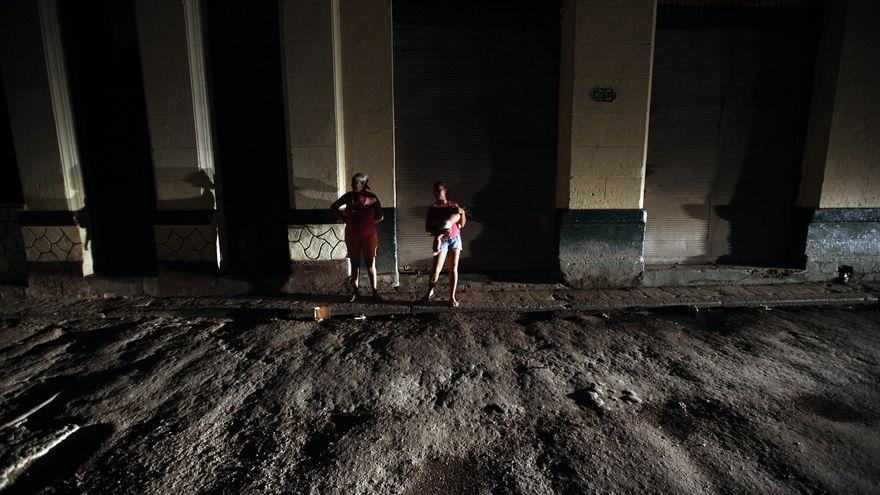
Havana must accept power outages in solidarity, the authorities ask. (EFE)

14ymedio bigger14ymedio, Reinaldo Escobar, Havana, 1 August 2022 — Fidel Castro had not yet assaulted the Moncada barracks in Santiago de Cuba when, in communist Germany, on June 17, 1953, the people took to the streets to protest against the system that, eight years later, that future assailant implanted in Cuba.

The Germans who rejected socialism were not expropriated capitalists or petty bourgeois, but construction workers. The poet and playwright Bertolt Brecht, after reading the pamphlets that the Writers’ Union distributed on Stalin Avenue indicating that the people had lost the confidence of the Government and that they could only win it again “with redoubled efforts,” asked himself, ironically, the following in the last verses of his poem, “The Solution.”

“Wouldn’t it be simpler

in that case for the Government

to dissolve the people

and choose another?”

Obviously, the solution to the disagreements of the governed with the measures of the rulers is not that those who rule seek new subjects, but that new policies are proclaimed and, better yet, that it’s others who dictate them.

People don’t have to be sympathetic to their rulers, whether they are democratically elected or hand-appointed by the only party allowed.

If the policies drawn up by those who hold government positions produce enemies in relations with other nations, if as a result of those bad relations it’s difficult to commercialize what the country can sell and acquire what it needs to buy, if the laws make it difficult  to prosper and suffocate entrepreneurs and if, to top it off, dissent becomes a crime, being understanding becomes an act of complicity. continue reading

They want to convince Cubans that people, Party and Government make up an indissoluble Holy Trinity, and that any fissure constitutes a contribution to the enemy. Therefore, understanding is not enough for those who rule: they demand applause and that the people pretend to be enthusiastic.

At the climax of that claim, to justify the inevitable power cuts in the capital in the midst of the blackouts that mainly overwhelm the cities of the interior, they have appealed to the “solidarity” of the people in Havana, who will have to accept, almost celebrate, the absence of electricity so that the people in the provinces suffer less.

The capital’s solidarity could have another less understanding face so that the inhabitants of the interior are not left alone when it comes to protesting. But then, those would be the people that the Government would like to dissolve.

Translated by Regina Anavy 

____________

COLLABORATE WITH OUR WORK: The 14ymedio team is committed to practicing serious journalism that reflects Cuba’s reality in all its depth. Thank you for joining us on this long journey. We invite you to continue supporting us by becoming a member of 14ymedio now. Together we can continue transforming journalism in Cuba.

Lopez-Calleja, the Key Piece that Fell from the Cuban Political Board

The opacity that surrounded the life of López-Calleja allows us to suppose that he was a person who knew an enormous number of important secrets. (Vanguard)

14ymedio bigger14ymedio, Reinaldo Escobar, Havana, 1 July 2022 — The unexpected death of General Luis Alberto Rodríguez López-Calleja has given way to a list of questions and a mountain of speculation.  [See also.]

Among the questions that have arisen since Friday, we should mention those that refer to his possible successor and whether whoever replaces him will have the same degree of concentration of power that the now deceased maintained due to his “family condition.” Something as important as access to certain bank accounts or as seemingly simple as the password for his phone or his personal computer may be causing insomnia in many people right now.

As expected, speculation has begun to question the cause of his death. Some have gone so far as to recall that the death certificate of the (also) General Arnaldo Ochoa, executed by being shot in July 1989, listed “acute anemia” as the cause of death; and that a heart attack was the official explanation for the death in prison of the (also) General José Abrahantes in January 1991.

The opacity that surrounded the life of López-Calleja allows us to suppose that he was a person who knew an enormous number of important secrets. Among them, the identity of those who have signed their names to register as owners of Cuban companies abroad to circumvent the economic restrictions imposed by the United States. Economic restrictions that the regime calls the “blockade,” and names that the opposition calls “figureheads.”

If he was the only contact, the only one who knew, and he didn’t have time to tell others he trusted, then there is a risk of a stampede by those who guard the values ​​that belong to the Cuban people. Upon learning that their boss has died, it cannot be ruled out that alleged businessmen in Monaco or Zurich might auction off their companies and run away with the money. continue reading

Death is never so unexpected, because in the end we are all going to die; however, this move to the unknown beyond did not appear in the calculations of those who, confusing life with chess, attributed to this general an irreplaceable role in the next foreseeable moves in the future of this Island. Understand a “fraud exchange” or “the Burmese variant.”

Without López-Calleja on the Cuban political board there is no castling possible and the checkmate of the dictatorship remains in the hands of the pawns.

____________

COLLABORATE WITH OUR WORK: The 14ymedio team is committed to practicing serious journalism that reflects Cuba’s reality in all its depth. Thank you for joining us on this long journey. We invite you to continue supporting us by becoming a member of 14ymedio now. Together we can continue transforming journalism in Cuba.

Who Rules in Cuba Today?

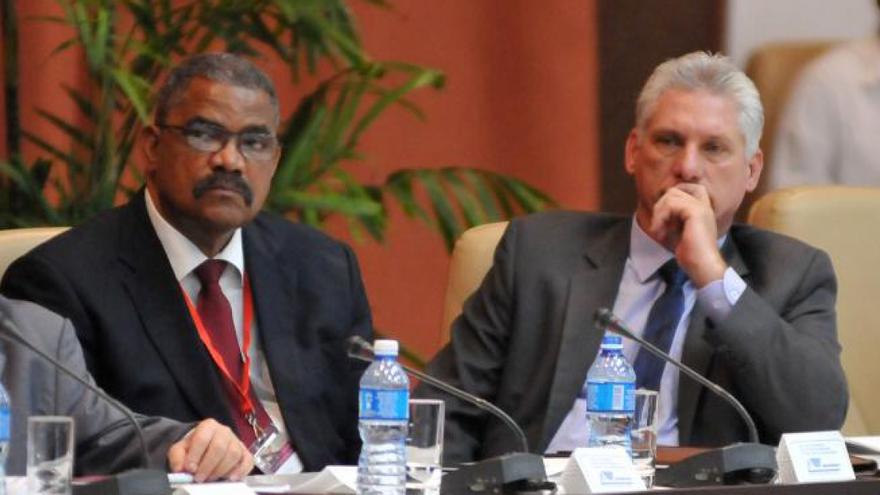
The president of the Supreme Court of Cuba, Rubén Remigio Ferro, together with that of the Republic, Miguel Díaz-Canel. (Granma)

14ymedio bigger14ymedio, Reinaldo Escobar, Havana, 15 June 2022 — It has been the reading of El tirano, el oficial y el cuerpo de lobos [The tyrant, the official and the wolf pack] by colleague Carlos Manuel Álvarez, which has motivated me to write this text, which neither argues nor attempts to add anything to his article, but I feel obliged to recognize the source of inspiration.

Neither history, nor mythology, nor even the imagination are really useful to answer the question of who is in charge in Cuba today. And I say today, because in the time between 1959 and 2006 it was clear that the one who ruled in Cuba was a single person who answered to the name of Fidel Castro.

The position of premier, that of president of the Councils of State and of Ministers, that of first secretary of the Communist Party of Cuba and any other were only important, in the period of time indicated, because they were held by Fidel Castro; or to put it another way, those positions did not make him important, but it was he who gave relevance to the position.

But today is another thing. continue reading

When the results of the Tarea Ordenamiento [Ordering Task*] or the 63 medidas [63 measures] to solve the problem of agriculture are serenely evaluated; when reading the resolutions of the Ministry of Internal Trade to achieve “a better distribution of basic products to the population,” or when listening to official information on the generation of electricity, any person who does not suffer from a pathology that clouds their understanding will have to come to the conclusion that the country is run by a team of incompetents.

However, it moves, or what is the same thing, the incapable remain in their posts. And this is possible due to the conjunction of two powers: the police and the judicial. Of course, in Cuba there is no “division of powers,” so that when the repressive forces catch an individual who is “non-conformist’ with the Government (with the incompetent) and present him before the courts accused of sedition or collaboration with the enemy, it is as if the accused of a horrendous crime were placed in the hands of the victim’s relatives.

This is not how Justice works, because the one who judges has to be a third party, alien to the one who accuses and the accused.

And what does this have to do with the question of who is in charge in Cuba today?

Well, it has to do with it, in the sense that the dissatisfied cannot express themselves, not even express themselves against the incapable ones who govern, because once they fall under the gaze of the repressors, the citizen automatically passes to the category of guilty in front of the courts.

It is evidence of a triangle apparently formed by the incapable who govern, the repressors who persecute the nonconformists and the courts that condemn those who oppose it. But geometry does not have all the answers. Something is missing here.

Could it be true that above all the visible framework of the incapable who govern expressed in a single party, a ministerial group and a docile parliament, the interests of a family clan predominate?

If so, the obedience of the repressive apparatuses to persecute the nonconformists and that of the courts to convict them, following the guidelines of those who govern, would be due to an intermediary that is dark as it is invisible.

That powerful and mysterious instance, oblivious to the sufferings of the people, who surely despises those who entertain themselves by dictating laws and who half trusts the guardians dedicated to repressing, does not seem to be interested in anything other than accumulating wealth to enjoy the obscene attributes of power. They neither govern nor repress, because those tasks seem unworthy of their high status.

So then: Who rules today in Cuba?

The foreman (the incompetent rulers) commands, at the service of the master (the family clan) and for that he uses the repressors (State Security) and the judicial apparatus.

The people should command along the paths that the Constitution offers them by defining them as sovereign, but when those paths have been assaulted by usurpers then the people find other ways to command.

*Translator’s notes: Tarea ordenamiento = the [so-called] ‘Ordering Task’ is a collection of measures that include eliminating the Cuban Convertible Peso (CUC), leaving the Cuban peso as the only national currency, raising prices, raising salaries (but not as much as prices), opening stores that take payment only in hard currency which must be in the form of specially issued pre-paid debit cards, and a broad range of other measures targeted to different elements of the Cuban economy. 

____________

COLLABORATE WITH OUR WORK: The 14ymedio team is committed to practicing serious journalism that reflects Cuba’s reality in all its depth. Thank you for joining us on this long journey. We invite you to continue supporting us by becoming a member of 14ymedio now. Together we can continue transforming journalism in Cuba.

Cuba: The Power Behind the Penal Code

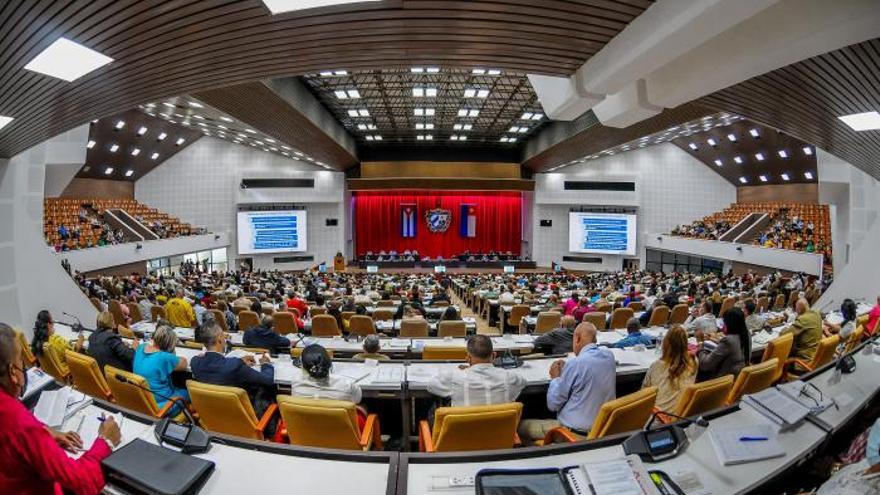
Extraordinary session of the National Assembly of People’s Power in which the new Penal Code was approved. (Granma)

14ymedio bigger14ymedio, Reinaldo Escobar, Havana, 20 May 2022 — The recently approved Penal Code punishes with sentences of up to ten years the citizen “who arbitrarily exercises any right or freedom recognized in the Constitution of the Republic” if that exercise has as its purpose “to change, totally or partially, the Constitution of the Republic or the form of government established by it.”

The previous paragraph is the result of reading articles 119 and 120 of the aforementioned code, which I recommend reading in full and not partially, citing as I do here.

Article 119.1 allows punishing even with the death penalty “whoever takes up arms to obtain by force,” among other things, a total or partial change of the Constitution of the Republic or the form of Government that it establishes.

Article 120.1 provides sentences of up to ten years for anyone who “with any of the purposes stated” in article 119 “arbitrarily” exercises any right recognized in the Constitution.

What does it mean to arbitrarily exercise a right granted by the Constitution? continue reading

Article 80 of the Constitution says that Cuban citizens have the right, among other things, to “exercise legislative initiative and constitutional reform.”

Title XI of the Constitution approved in 2019 has four articles on the subject of constitutional reform. Subsection F of article 227 specifies that citizens are recognized for the constitutional reform initiative “through a petition addressed to the National Assembly of People’s Power, signed before the National Electoral Council, by at least fifty thousand voters.”

Just in case, so that no one is mistaken, article 229 makes it clear that “in no case are pronouncements on the irrevocability of the socialist system reformable.”

Neither by hook nor by crook does the Constitution allow the socialist system to be discarded. But the Penal Code goes further, by punishing the intentions of those who hide behind their constitutional rights to expose the reasons for taking the definitive step that leaves behind the socialist system, or what remains of it, which is nothing more than monopoly of power by one party.

It is clear that the purpose of those who argue in favor of a transformation will always be to make it happen. But you cannot condemn the one who proposes a change as if he were imposing it. It would be like punishing the one who proposes to remove a traffic signal with the fine that falls to the one who does not respect it.

Citizens who prefer another economic or political system should be left no choice but to move to another country. The fear that is evident in this Penal Code is that if dissidents are allowed to express themselves and organize, they will end up convincing the rest of the population that their goals are legitimate and, then, those who rule Cuba today would lose power.

____________

COLLABORATE WITH OUR WORK: The 14ymedio team is committed to practicing serious journalism that reflects Cuba’s reality in all its depth. Thank you for joining us on this long journey. We invite you to continue supporting us by becoming a member of 14ymedio now. Together we can continue transforming journalism in Cuba.

The Prostitution of the Compliment

“The first time he offered me 500 pesos if I let him put his hand under my blouse,” says a girl. (14ymedio)

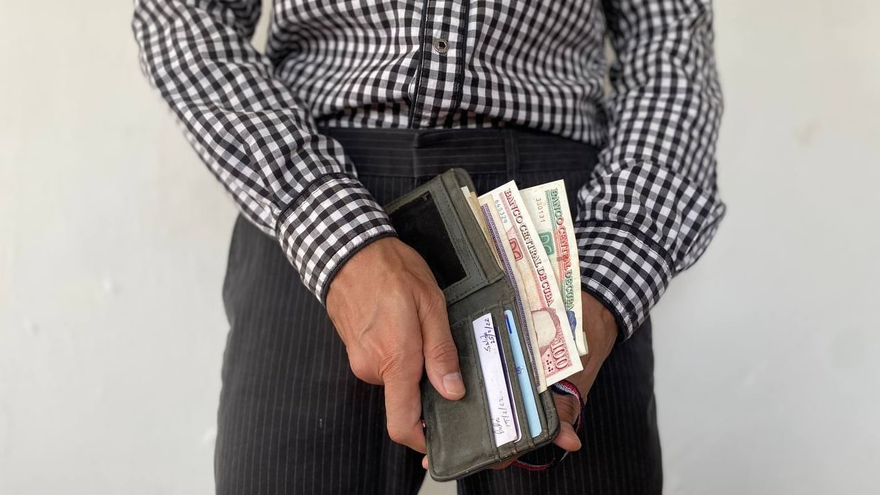
14ymedio bigger14ymedio, Reinaldo Escobar, Havana, 15 May 2022 — A new form of macho exhibitionism (even more sordid) is spreading in Havana. Instead of unzipping their fly they choose to show their wallet. They no longer whisper to their victim what they would like to do to them or what they would like her to do to them: “Look girl, if I catch you I’m going to…” or any other nonsense. Now the offer is priced in pesos, dollars or telephone recharges.

As is known, compliments, even the most “elegant,” have fallen out of favor. Although part of the female population may perhaps feel flattered when a man tells her something about the beauty of her eyes or the charm of her smile, it must be accepted that, in the end, it is an assault on privacy, which, depending on how rudeness demeans you, can become an insult.

A teenager who is still in junior high school has had to change her daily route to school to avoid the proposals that the same guy makes to her every day. “The first time he offered me 500 pesos if I let him put his hand under my blouse,” says the girl, noting that the man, who could be her grandfather, explained it to her in stronger and more direct terms. “Every time the figure went up, he launched into something more daring, until he showed me a hundred dollar bill, but that time I didn’t even understand what he meant.”

A young woman who sells fruit juices in a Havana market had to ask the custodian not to allow the entrance of a regular customer who bought a bag of lemon juice every Saturday by putting a hundred-peso bill on the counter and adding under his breath” For the other juguito [little toy], I’ll give you whatever you ask for.”

Lacking the slightest respect for their targets, these indecent assailants project on their victims the low self-esteem they have for themselves. As if they were at a fair where sexual favors are auctioned off, they put a price on touches that are not caresses, on contacts of the flesh that remain in outrage. They price each part of another’s body with the added value of what they want to do with it.

The street is difficult and money is worth less and less. The values ​​have also been degraded and it is difficult to calculate how steep the slope is. This new form of sexual harassment is another symptom of this degenerative disease, of this multiple trauma that the country suffers. continue reading

____________

COLLABORATE WITH OUR WORK: The 14ymedio team is committed to practicing serious journalism that reflects Cuba’s reality in all its depth. Thank you for joining us on this long journey. We invite you to continue supporting us by becoming a member of 14ymedio now. Together we can continue transforming journalism in Cuba.

Cuba: Speaking Against the Revolution

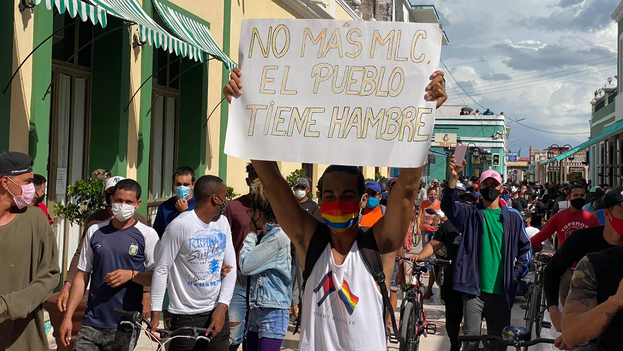
A young man with a placard during the 11 July 2021 protests in Cuba. Text: No More MLC [freely convertible currency] The People Are Hungry. (Screen capture)
14ymedio bigger14ymedio, Reinaldo Escobar, Havana, 25 April 2022 — In a recent interview, Miguel Díaz-Canel, who holds the position of President of the Republic without the consent of the voters, stated that “in Cuba no person has been prosecuted for speaking against the Revolution.” He said more, but I will limit this comment to that phrase.

Although he answered the questions of his complacent interviewer, referring to the events of July 11, the leader of the Cuban communists should have been more explicit, if not more truthful.

What does Díaz-Canel understand by ‘speaking against the Revolution’?

The first question is whether “speaking” includes “writing”; the second is whether the concept changes when speaking into the microphones of a foreign or independent media outlet and whether the words are spoken in the presence of other people, say, in the public square. What if on the streets of Havana a young man displays a placard asking for freedom ?

Here we enter fully into the content. It seems that Díaz-Canel was never informed that distributing or talking about the Declaration of Human Rights was the reason for numerous imprisonments in Cuba; nor have they told him that, in 2003, 75 Cuban opponents were condemned to long sentences, people whose only fault was to express themselves against the ruling party’s policy. continue reading

The citations and threats to the mothers of young prisoners after the 11J [July 11th] trials so that they do not speak, so that they do not complain about the sentences; are these made by State Security without the knowledge of Díaz-Canel? Those who have been fined under Decree Law 370 for expressing themselves freely on the networks, did they go through any legal process before being sanctioned with a fine?

It would be tiresome to discuss the use of the term “Revolution” applied to a process that has already lasted 63 years and whose most urgent goal is to keep a party in power, but ignoring that detail and understanding the Revolution according to its proclaimed initial objectives, it would be necessary to clarify whether defending them, from a point of view other than that of the only party allowed, is also understood as “speaking against.”

Díaz-Canel limits himself to the alleged fact that no person has been prosecuted for speaking against the Revolution. And what about all those who for expressing themselves in a dissenting way are prohibited from leaving the country, have a State Security agent placed at the door of their building to prevent them from attending an event, are arrested and detained without mediation? Without a court proceeding? It is true that they have not been prosecuted, they have only been repressed.

I would applaud Díaz-Canel if he publicly promised to say that no Cuban will be repressed in any way because they express their discrepancies with the Communist Party’s policy, and do so wherever they do it and by whatever means they see fit.

Guilty of ignorance is any Cuban who does not know that oral or written expression that disagrees with the policy of the Communist Party entails different government reprisals, such as being fired from the workplace or thrown out of school, being denigrated in the official media without the right to reply, or being pushed by State Security agents to emigrate.

Guilty of cynicism is any Cuban who, knowing this truth, denies it.

____________

COLLABORATE WITH OUR WORK: The 14ymedio team is committed to practicing serious journalism that reflects Cuba’s reality in all its depth. Thank you for joining us on this long journey. We invite you to continue supporting us by becoming a member of 14ymedio now. Together we can continue transforming journalism in Cuba.

In the Invisible Baggage of the Emigrant

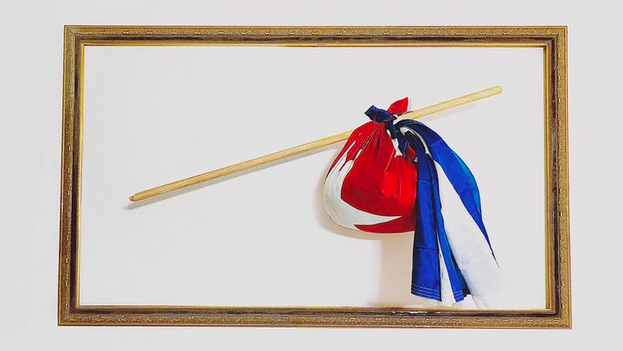
‘Exodus’, by Cuban artist Erick Ravelo Suárez

14ymedio bigger14ymedio, Reinaldo Escobar, Havana, 21 April 2022 — The figures do not say everything, nor does the news, the official reports, the terrifying images in front of the current of the Rio Grande or the thickness of the Central American jungles. In every Cuban who emigrates there is a dramatic inventory that counts what he carries in his luggage and what he had to leave on the Island.

They carry with them everything they learned in school, the vaccinations they received as a child, their work experience, their academic titles; what their parents invested with love and patience so that they would be a good person, what the country (not the Government) invested in subsidizing their precarious diet.

They also drag along the perhaps useless tangle of tricks and simulations that allowed them to evade surveillance, sneak into a line, invent a medical certificate for not going to work, an excuse to miss a fashion show, waste time at the office, get a snack to facilitate an appointment at the dentist.

They leave behind that part of their family that could not or did not want to accompany them on the adventure. They had to get rid of books, clothes, shoes, music records; the posters, paintings and ornaments with which they decorated their most intimate surroundings. They abandoned love letters, childhood photos; they left promises to keep, appointments to keep, thousands of things to do. continue reading

Many of those who emigrate will have to bury a past that they once felt proud of and that today makes them ashamed: medals, diplomas, the cards that identified them as members of a party (the only one allowed), of mass organizations, of unions. At the foot of that past that they bury, they formally renounce an uncertain long-promised future.

In the baggage, backpack or suitcase with which an émigré manages to leave this country, squeezed into a corner, is his Cubanness, the one that makes him shed a tear when he listens to the national anthem; traveling with him is the arrogant belief that this is, despite everything, the most beautiful island that human eyes have ever seen, where the most beautiful women on the planet live and the best music in the world is produced.

They will arrive at their destination and celebrate the success of their journey. When they check their luggage, they may discover, like an unwanted object, the bitter feeling of defeat that comes from having to leave the place where they were born without having done everything possible to change it.

____________

COLLABORATE WITH OUR WORK: The 14ymedio team is committed to practicing serious journalism that reflects Cuba’s reality in all its depth. Thank you for joining us on this long journey. We invite you to continue supporting us by becoming a member of 14ymedio now. Together we can continue transforming journalism in Cuba.

Lawyers and Compensation Instead of Militiamen and Confiscations in Cuba

Expropriation in 1959. (laleftadiario.com)

14ymedio bigger14ymedio, Reinaldo Escobar, Havana, 29 March 2022 — The recently announced Law of Expropriation for reasons of Public Utility or Social Interest has notorious differences with the abundant legislation on this matter. Here we no longer speak of confiscation as punishment or revenge, as in the laws enacted between 1959 and the mid-1960s. However, when the 18 causes that justify an expropriation include “ensuring internal order or interest in guaranteeing national defense and security” it is understood how far this concept can go.

The confiscation of property without compensation appears in the preliminary draft of the new Penal Code defined as an accessory sanction and can be applied to at least a dozen typified crimes. But this text does not speak of confiscation, but of expropriation.

The new law includes details on how to compensate those affected by a duly justified expropriation and establishes a process in which there is a right to refute the arguments of the State objecting to the reasons of public utility put forward.

But said objection does not proceed when the public utility is based on the execution of public works, the construction of low-income housing, the execution of programs for economic and social development, the sustainable management of the environment and, of course, also unobjectionable are reasons founded on the assurance of internal order or national defense and security. continue reading

What then is left? The affected party must demonstrate that it would be more convenient for the State to expropriate other properties than his own. However, what draws the most attention and has raised questions and disagreements is the difference in compensation for foreign investors, who can set the value of what is expropriated “by mutual agreement”; if no agreement is reached, the price is set “by an organization of international prestige in business valuation.”

One of the most striking details is observed in Chapter 10, where the possibility of reversing the expropriation is mentioned if, within a period of three years, the corresponding authority does not allocate the expropriated asset for the purposes expressed in the declaration of public utility. In that case, those affected can go to the same court where the expropriation was ruled and request reversion, paying “its fair price.”

If a clause like this had appeared in other confiscatory or nationalizing decrees, perhaps there would not be so many idle lands infected with marabou or so many commercial establishments turned into ruins.

Article 54 defines that when the interest in the expropriation derives directly from a public calamity or for reasons of ensuring internal order or national defense and security, and there is an urgent need to occupy the property, “the corresponding authority may take immediate possession of those necessary to satisfy that purpose, without prior formality or other diligence, regardless of whether the process to determine compensation is followed.”

Article 10 specifies who has the authority to declare the public utility or social interest of a property for expropriation purposes. Listed in descending hierarchical order it ranges from the Council of Ministers to the Municipal Administration Councils and the directors of the Offices of the Special Development Zones. It is specified that for the expropriation of foreign investments the declaration of public utility or social interest is the exclusive right of the Council of Ministers.

Every time a new law is enacted, citizens ask themselves what is their public utility, what is their social interest. It gives the impression that the State has an imminent compliance plan to carry out numerous public works, build hundreds of thousands of houses, or carry out programs for economic and social development, or for the sustainable management of the environment, which provoke the need to expropriate land, houses and other spaces. But the economic reality of the country shows no signs that these projects are on the State calendar.

Perhaps the only intention is to reassure foreign investors that they will not be dispossessed of their properties in the middle of a fervent speech, as was done in October 1960, when more than 300 large companies and all the banks were liquidated at a stroke of the pen.

In this law there is neither revolutionary passion nor righteous spirits. The exploitation of man by man and the recovery of our wealth are not invoked. This time it will not be rude men dressed as militiamen entering the offices announcing the nationalization, but young lawyers with good manners to discuss the terms of the indemnity.

____________

COLLABORATE WITH OUR WORK: The 14ymedio team is committed to practicing serious journalism that reflects Cuba’s reality in all its depth. Thank you for joining us on this long journey. We invite you to continue supporting us by becoming a member of 14ymedio now. Together we can continue transforming journalism in Cuba.

Cuba: ‘The Excessive Sentences for July 11th Protestors are an Injustice and They Must Be Reversed’

Alberto Reyes was ordained in 1996 at the same site where, as a baby, he was baptized. (14ymedio)

14ymedio bigger14ymedio, Reinaldo Escobar, Havana, 5 March 2022 — Since September 2019, Catholic priest Alberto Reyes Pías (born 1967) serves 10 towns in the municipality of Esmeralda, 120 kilometers from the provincial capital, Camagüey. Masses, baptisms, visiting the sick, and above all, listening to problems consumes part of his daily life. Furthermore, he is engaged in rebuilding the church and expanding the parish spaces and has found time to write very critical texts on the political regime, which resulted in an act of repudiation.

He dropped out of university to become a priest when he was already enrolled in his fourth year of medical school. His transition was filled with angst, as he recounts in his book Hágase mi voluntad [My Will Be Done]. He was ordained in 1996 at the same site where, as a baby, he was baptized.

Escobar. Since the practice of religion was decriminalized in the 90s, clashes are defined by the political posture of certain priests or religious leaders. The question is whether behind that act of repudiation which you suffered here on the 15th of November there are any anti-religious traces.

Reyes. One of the things they repeated relentlessly in school was that religion is the opium of the people. They explained to us that religion strays from reality, that it does not deal with social issues, and only believes in eternal life. It’s ironic because I get the impression that in Cuba, there are many people who from a position of power, would give what they don’t have for religion to be, at this moment, the opium of the people.

When motivated by faith a priest raises his voice against injustice and in favor of values, when he defends people’s human dignity, problems arise. If faith in Cuba is circumscribed to less controversial topics, for example, charity, service of others, or along those lines, the Government would remain in the lead, then there would be no problem. Nonetheless, when someone practices charity in an area where the Government cannot or does not want to participate, then there are problems. We only need to remember how the authorities reacted when people, on their own, mobilized support for those affected by a tornado in Havana.

There is a passage in the Gospel which reminds me of the attitude of the Communist Party. Some disciples tell Jesus that upon seeing some people expelling demons in his name, they forbade it, “because they were not one of us.” Jesus responded, “Well, you did wrong.” continue reading

If the Church were neutral in all matters, there would be no problem, but then it would be renouncing its own identity and that is non-negotiable.

Escobar. One of the most difficult situations today in Cuba is that of hundreds of people who have been sentenced to years in jail for demonstrating peacefully on July 11th. What has been your position with respect to that?

Reyes. What they did was exercise their right to protest. The sentences, aside from being notoriously excessive, had the intention of intimidating the nonconformists. It is clearly an injustice.

This must be reversed, especially taking into consideration that among those convicted are some very young people, for whom jail time may ruin their lives forever, hijack their youth, and destroy their humanity.

It would be a very magnanimous gesture on the part of the Government to simply say, “this will be reversed.” It will be reviewed because it is wrong.

Escobar. And what can the Church do to promote this review?

Reyes. The first thing the Church has done is what it always does: accompany. It has contacted the prisoners’ families, it has listened and helped to the extent possible. I think that by its prophetic nature, which means speaking in the name of God, the Church’s role is to denounce because for God this should be wrong and what is wrong must be denounced. We may or may not be heard, but it must be said. Silence is not the attitude.

The Church has been willing to accompany the families in legal proceedings, but many are afraid to speak, to protest, to stand up, because they have been terrorized with the well-known phrase, “if you speak it will be worse.” The family knows their children, their relatives are at the mercy of the authorities who enjoy total impunity. They can do anything and nothing will happen. That fear of “what if something happens to them,” encloses them in a circle of silence and that is how the impunity of the authorities grows.

There are very courageous women who have decided to dress in black as a sign of protest. As did the mothers and wives of prisoners during the dictatorship of Fulgencio Batista. History repeats itself.

Escobar. A single priest in the town of Esmeralda can do a lot, but is there any initiative to convene more clergymen in this denunciation, in this protest?

Reyes. Whenever I think that the ideal thing would be for as many people as possible to join me, I recall the fable of the hummingbird who, faced with a fire in the forest, while all the animals fled in fear, the small bird went to the river and sucked up all the water it could to throw it on the flames. I invite, I encourage others, but without failing to do my duty. I am not alone in that purpose, but I hope more people will join.

Escobar. As a priest, what advice do you give those young people who debate that dilemma of continuing to live here with little hope for a future or leaving the Island at any cost?

Reyes. That is a very complicated topic. It hurts me very much that people see the need to emigrate, especially young people who can’t find, in their land, the tangible possibility of a future. My first impulse is to tell them, “stay and fight,” but I understand that we only have one life to live and people want to self-actualize; all of a sudden years pass and they don’t achieve anything.

I knew a young man who graduated with a degree in architecture. Everyone made glowing comments about his professional ability, but one day I found out he was at his grandfather’s farm operating machinery to clean rice. When I asked him why he did that he responded that, there, he earned in a day what, as an architect, he earned in one month.  I remember I told him that Cuba would change and he only asked me, “When?” That occurred more than 20 years ago.

No one wants their children to go through the same thing. Since I can’t guarantee anyone here a future for their children, I lose all arguments asking them to stay. I can’t even provide an example of “the failure” of those who have left.

Escobar. In some religious circles, obeying the State is promoted as a norm. How can that be fulfilled under a dictatorship?

Reyes. Peter, the apostle, clearly said that God must be obeyed before men. For his part, Paul said, “pray and obey the authorities,” but the Church promotes obeying authorities when the laws defend values. It doesn’t matter to which political spectrum a citizen belongs, he should stop when the traffic signal demands it; that law defends a value, defends life. When a law goes against a value, obedience is not required. An example is the Family Code, which in my judgment, goes above basic family values, for that reason, there is no obligation to obey it, but rather there is an obligation to oppose it. That is the Church’s social doctrine.

Escobar. What, in your judgment, are the main points in which the Code contradicts human values?

Reyes. It is an extensive topic, so I will only center on the fact that not recognizing a family’s right to educate their own children according to their own criteria and principles. If a child in a family is being abused, clearly there should be a way to protect him or her, and it is that way in almost the whole world, but the family has the right to educate their own children in the way they consider best. The child must be respected, but parents may impose that he or she must eat or inject a medication. Sometimes I jokingly say that if one day a child enthusiastically asks his parents to take him to the dentist, perhaps it would be best if they take him to the psychiatrist. The idea that the family cannot signal to the child what to the State seems incorrect is somewhat of a catastrophe.

Escobar. How does a priest react when he is faced, in the flesh, with officials who put the Government policies into practice?

Reyes. I cannot forget that they are my brothers and that one thing is what I think is wrong and another is their person, their life. For me, principles are also non-negotiable. I try to communicate with them, pray for them. I must extend a hand again and again; if they bite it or they spit on it, that is their problem. They can count on me in their time of need, whether they need medicine or my blood, I will offer it without fanfare.

Escobar. Among those that are dissatisfied with the Government are some who believe that they can advise, “from within the Revolution,” to improve its management; others propose a confrontation without a truce and there is no shortage of those who insist on proposing a dialogue among all parties. Where do you stand?

Reyes. My tendency is toward dialogue, but what do I mean by dialogue? This is a totalitarian system with centralized power which has hijacked the freedom of the [Cuban] people. Dialogue is so that this situation will change with the goal of having a democratic, pluralistic country where the communist government isn’t the only option, and to make a reality for Cuba that wonderful phrase, “with everyone, for the good of everyone.”

A dialogue will make sense if it is to accomplish that, but before that, the government must demonstrate it has the authentic will to make that happen. I am a witness to their lack of will, every time I’ve asked to meet with them, the reply has always been that they will not meet me.

I reject violence and confrontation, but my great fear is that it is the only path left to change things; that the time will come when we will have not just another July 11th, but that this time it be brutal.

The government’s error is insisting on “no one will get me out.” However, that is forgetting that the people get tired. The ideal thing would be that from their seat of power they take the initiative to democratize the country and do it peacefully. Without the government’s willingness to dialogue, Cuba will continue to be an island on the run, it will continue to be a powder keg without knowing when it will explode. They should realize that they will also be better off when this change occurs.

Escobar. And what, of all this, do we leave to God?

Reyes. It is often repeated that the solution for Cuba lies in political and economic change, but it is not possible without spiritual change. Many biblical texts state that God, through the prophets, criticizes the people for abandoning Him and have gone after the baals, the false idols. I think the Cuban people abandoned Yahweh, God the Father, many years ago and without Him, following their idols, tried to build a society that claimed to be prosperous and marvelous.

In the 5th century San Augustine said, “when one flees from God, everything flees from you.” If God is not in the new Cuba, another dictatorship awaits, with the social injustice and all the ills created by that ill-fated revolution. These people need God, which does not mean that everyone must go to mass on Sunday (though that would be magnificent.) But it is absolutely necessary for the [Cuban] people to open their hearts to God.

Translated by: Silvia Suárez

____________

COLLABORATE WITH OUR WORK: The 14ymedio team is committed to practicing serious journalism that reflects Cuba’s reality in all its depth. Thank you for joining us on this long journey. We invite you to continue supporting us by becoming a member of 14ymedio now. Together we can continue transforming journalism in Cuba.

Anohi Piotr Petrovitch, a Soviet Soldier in Cold War Cuba

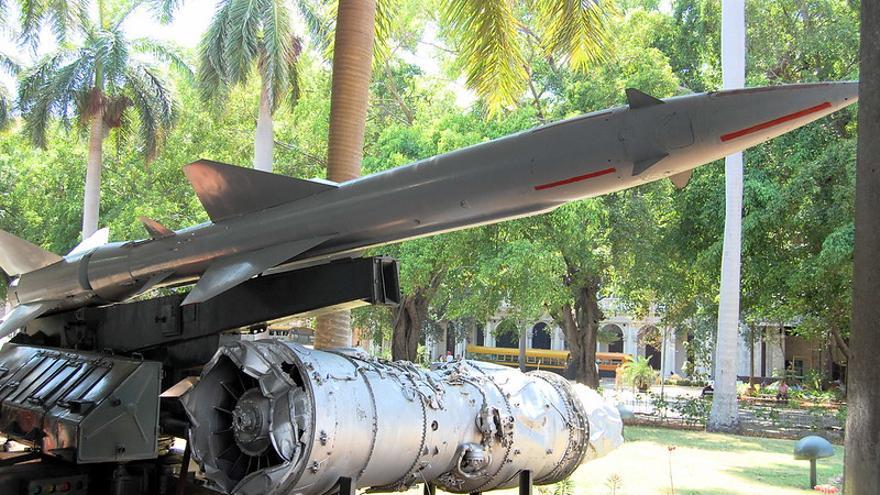
The anti-aircraft devices remained on national territory operated by Soviet technicians. (Steve_cx/CC)

14ymedio bigger14ymedio, Reinaldo Escobar, Desde Aqui, Havana, 7 March 2022 — In the middle of 1962 (or perhaps at the beginning), the Soviet Union placed several anti-aircraft rocket units in Cuba with the purpose of defending the bases of medium-range rockets with nuclear warheads that would later unleash what historians call “The Missile Crisis.”

As is known, the nuclear-charged rockets were withdrawn by Nikita Khrushchev (“Nikita, mariquita, lo que se da no se quita” [Nikita, sissy, you can’t take back what you give] we shouted then), but the anti-aircraft devices remained in national territory, operated by Soviet technicians.

On March 13, 1963, in a political act on the steps of the University of Havana, Fidel Castro called on young Cubans to voluntarily enlist in the Armed Forces to enter what was then known as “strategic weapons.”

This [then] fifteen-year-old fool went there with the belief that he could continue his studies and with the intention of freeing himself from family tutelage. Oh! and to respond to the call of the commander in chief.

After an intensive course at the San Julián base, in the west of the island, we were placed in different combat units according to our specialties. There, at 3671, I met Anohi Piotr Petrovitch, the operator of the Command Radio Transmission system whom I would replace. continue reading

Anohi was about 25 years old and was born on an island in New Siberia, which allowed him to identify with us, despite the difference in latitudes and temperatures. We made the pact to learn, he Spanish and I Russian, without any academic requirements. We used as material the songs that were heard in the loudspeakers transmitted by the Cuban radio. The first was Bésame mucho [Kiss me a lot], which he sang well and which I replied out of tune in cave Russian: “Tseluy menya, tseluy menya mnogo, kak budto segodnya posledniy raz” [Kiss me, kiss me a lot, like today is the last time].

One day Anohi asked me why almost all Cuban songs spoke of love and none referred to harvests, to labor exploits. I didn’t know what to answer, but it was a discovery for me, understanding that we were different cultures. “This is the West,” he would say, and at the time I was not capable of realizing the depth of that definition.

Cabin A of the Radiotechnical Battery was the closest thing to a container on wheels where the electronic equipment that elaborated and transmitted the signals for the remote control of the rockets was located. To enter, it was a mandatory requirement to take off your boots, because you had to protect those valves from dust, huge lightbulbs, like the mythical and super secret phantom, which years later would be supplanted by small transistors.

As personal hygiene was not my forte at that stage of my life, going up to the cabin without boots was an attack on someone else’s sense of smell. That’s why Anohi was the author of my first nickname, which was, in its pronunciation, “peteapata,” that is, foot stink without bathing. In return I nicknamed him “rotten onion,” but I don’t know if he realized the extent of my riposte.

That Soviet soldier in the days of the Cold War was my friend. The day we said goodbye we didn’t know it would be forever. Anti-aircraft rockets remained under our responsibility to defend the sky of the motherland.

Perhaps Anohi must already have grandchildren and I wonder if any of them are invading Ukraine today.

____________

COLLABORATE WITH OUR WORK: The 14ymedio team is committed to practicing serious journalism that reflects Cuba’s reality in all its depth. Thank you for joining us on this long journey. We invite you to continue supporting us by becoming a member of 14ymedio now. Together we can continue transforming journalism in Cuba.

Anamely Ramos and the Family Code

The State should provide its citizens with access to material resources and legal protection so that this essential requirement that defines the family is fulfilled: the union. (EFE)

14ymedio bigger 14ymedio, Reinaldo Escobar, Havana, 18 February 2022 — Perhaps one of the most notable absences from the released versions of the new Family Code is what refers to the unity of its members. The right to live together, the right not to be arbitrarily separated. The State should provide its citizens with access to material resources and legal protection so that this essential requirement that defines the family is fulfilled: union.

It would be unreal, even demagogic, for the State to promulgate that it will guarantee the material resources so that people can live with dignity under one roof. At most it could promise to continue working in that direction. Where it does have its hands free is to legislate in favor of rights. The consequences of the “criminal blockade” [i.e. US embargo] do not intervene there, nor do the pandemic, nor natural disasters.

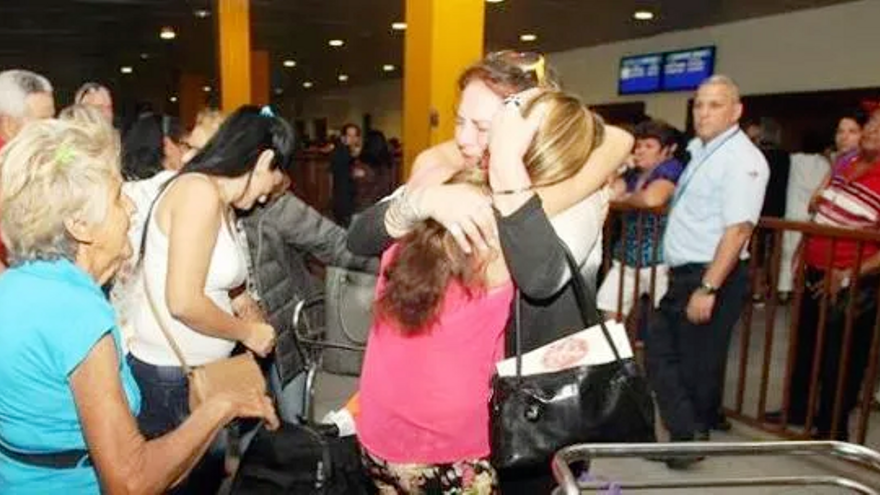
In the current immigration legislation there are two articles that directly affect the family: Article 24 , which regulates the right of Cuban citizens to return to their country, and Article 25, which establishes rules to be able to leave the country.

The Achilles heel of both articles (or better said, the sword of Damocles) is that in order to strip the citizen of what is a constitutional right (Article 52), it is not required that such a decision be made in a court where the person can count on the necessary procedural guarantees, that is to say: evidence of what you are accused of, a lawyer to defend you and the ability to appeal.

The recent ban on Anamely Ramos from entering the country is based (as a regime spokesman has argued) on a presumption of guilt that has not been subjected to the scrutiny of a competent court. It is the first case where this measure is applied to someone who has not exceeded the limit on stays outside the country, which is the only paragraph that allows the entry ban to be applied automatically (although unfairly). continue reading

The threat this constitutes is enormous. If this precedent is set, from now on any father of a family, a son or mother, would run the risk of seeing their family ties broken without being able to do anything other than cry or protest.

If an accusation as serious as having organized, stimulated, carried out or participated in “hostile actions against the political, economic and social foundations of the Cuban State” can have legal consequences on a citizen without the intervention of a court, it should be withdrawn from Article 1 of the Constitution, which defines the country as “a socialist State of law and social justice, democratic, independent and sovereign, organized with all and for the good of all.”

If the Family Code were to include in its articles: “Every Cuban citizen has the right not to be arbitrarily separated from their family,” the aforementioned articles of the immigration law would have to be repealed, or at least modified.

It is only sixteen words. Under its protection, doctors, athletes, civil servants and other “deserters” could return to their country without fear of being turned back at the airport. Similarly, other Cubans who bear the stigma of being ’regulated’ — prevented from leaving the Island — could reunite with their loved ones outside the Island. The right to be together must be recognized for Cuban families wherever they live.

If the arbitrariness committed against Anamely Ramos served to promote this proposal in the public debates that take place with regards to the Family Code, if the proposal were massive and taken into account, if the rectification is made, this girl would have to be received with the honors of a national heroine.

One doesn’t even have to be very brave to ask to speak at one of these assemblies and calmly say: I propose that the Code include the following: “Every Cuban citizen has the right not to be arbitrarily separated from their family.”

____________

COLLABORATE WITH OUR WORK: The 14ymedio team is committed to practicing serious journalism that reflects Cuba’s reality in all its depth. Thank you for joining us on this long journey. We invite you to continue supporting us by becoming a member of 14ymedio now. Together we can continue transforming journalism in Cuba.

By When Does a Person Have to Leave or Desert for it to ‘Count’?

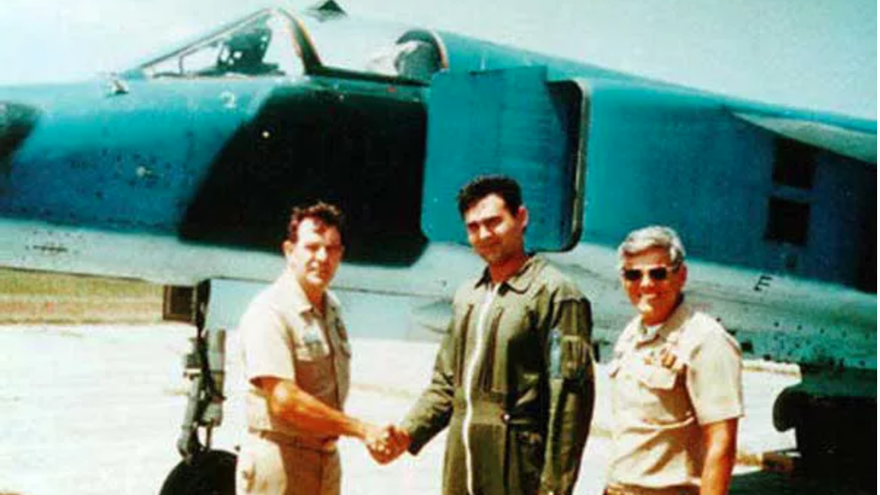
Orestes Lorenzo, a war hero in Cuba, turned his MiG towards the United States and stayed there. (Archive)

14ymedio bigger 14ymedio, Reinaldo Escobar, Havana, 11 February 2022 — Like a trickle of indefinite but constant frequency, we see citizens who decide to free themselves and stop supporting the dictatorship in Cuba. The regime’s spokesmen call them deserters, whether they are doctors, athletes, artists or communicators.

For those who have taken that step before – a year, five years, a decade, half a century before – they believe that those who freed themselves, have done so at the wrong time and refuse to forgive them for the years they were at the service of the regime, in complicit silence, in servile obedience or politically active in the Revolution, according to the terminological affiliation.

To give just two relevant examples that have been victims of this segregation, we can mention a general in 1987 and a deputy minister in 2002; the first stealing a plane, the second as a rafter.

Rafael del Pino (b. 1938), linked to the July 26 Movement since 1955, guerrilla fighter in the Sierra Maestra, where he became a lieutenant, and after victory, as a pilot, achieved the feat of sinking several ships in 25 combat missions and shooting down aircraft during the Bay of Pigs invasion. In May 1987 he clandestinely flew with his entire family in a small twin-engine Cessna to Florida. Since then he lashes out at the regime. continue reading

For Alcibíades Hidalgo (b. 1945), from Camagüey, his revolutionary merits led him to be head of the office of the then Minister of the Armed Forces Raúl Castro and later, in his capacity as Vice Minister of Foreign Affairs, to participate in the peace talks in Angola. He fell from grace and was demoted to director of the Trabajadores newspaper. In 2002 he arrived in Miami on a raft. As far as we know, he works at Radio Martí.

Added to the list are artists committed to the regime at the time (such as Osvaldo Rodríguez or Ramoncito Veloz), a long list of athletes who swore allegiance to the Revolution (Fredy Cepeda, the Gourriel brothers, Víctor Mesa), intellectuals (such as Cabrera Infante, Jesús Díaz or Zoé Valdés), scientists (such as Armando Rivero, founder of Cuban robotics) and anonymous company directors, Party members, cultural cadres, journalists, State Security or intelligence agents and, from then, the neighborhood informers.

What is the date – many people ask – when freeing oneself or “defecting” is meritorious? And on the other hand, who has the right to throw the first stone, to set himself up as a judge to condemn someone who was a prisoner of circumstances?

How much guilt must he who in the 1960s taught literacy, fought in Girón or Escambray, who helped to seize a property in the Revolutionary Offensive, who cut sugarcane in 1970 or planted coffee in the Cordón de La Habana, who participated in the repudiation rallies of 1980, the one who sang, recited or danced in the Anti-Imperialist Platform at the end of the 90s, the one who in the first half of the 2010s became a social worker in the midst of the Battle of Ideas?

How do you measure the guilt of everyone who out of foolishness — foolishness or pure survival instinct — applauded, raised their hands to approve some atrocity, even wanted to stand out as the fiercest, the purest of Fidelistas.

What price will those who did not take to the streets on July 11, 2021 have to pay and worse still, those who were forced or believed in the duty to repress those who marched?

Once freed from the threat of repressive forces, those who choose to drink the “Coca-Cola of oblivion” heal their wounds, make a living, start families, prosper or fail in the midst of a competitive society, and end up wondering how it is possible for Cubans who are still on the island to be so tough.

Not everyone who breaks with the regime leaves the country. Some stay here, purging their past and trying to change things and, furthermore, running the risk of being imprisoned by the dictatorship or disqualified as “light” or tolerated, by those who have never apologized for the affiliation or obedience they professed before their breakup.

The temporary borders that generate impermeable plots among those who oppose the dictatorship are artificial. Anyone who frees themselves from the tutelage of the regime, (everyone who deserts) when they want to do so, should be welcome in the opposition ranks. Strictly speaking, only the Batista supporters could say that they were against it from the beginning and, without wishing to appear exclusive, it seems to me that this trend has no future for Cuba.

____________

COLLABORATE WITH OUR WORK: The 14ymedio team is committed to practicing serious journalism that reflects Cuba’s reality in all its depth. Thank you for joining us on this long journey. We invite you to continue supporting us by becoming a member of 14ymedio now. Together we can continue transforming journalism in Cuba.

Cuba’s New Penal Code Maintains the Right to Kill

In most cases, the death penalty is applied in the name of defending the interests of the State and the legitimacy of its institutions.

14ymedio bigger14ymedio, Reinaldo Escobar, Havana, 31 January 2022 — The death penalty, by firing squad, appears as one of the applicable sanctions in 28 articles of Cuba’s new Penal Code, still pending approval. Also included among the main sanctions are deprivation of liberty, correctional work with and without internment, home confinement, service for the benefit of the community, limitation of liberty, fine and reprimand.

Of all of them, the only irreversible sanction is death and it is imposed, leaving the accused with the hope of reducing it to a life sentence or 30 years in prison, as has happened since an imprecise moratorium was introduced, 19 years ago.

In most cases, this sanction is applied in the name of defending the interests of the State and the legitimacy of its institutions.

This is how it is expressed in the articles numbered from 112 to 116 that refer to the participation in an armed aggression under a foreign flag or engaging in espionage; article 119 typifies the different variables of an armed uprising with the purpose of changing the Constitution or the Government; 121, for those who organize or participate in a social revolt; 123, foresees the action of armed forces insubordinate to the central command or a palace coup, and others where mercenaryism, the violation of maritime or air space, the use of chemical weapons or explosives are mentioned. continue reading

Of particular interest is what is specified in Article 154, according to which the death penalty is imposed on “whoever executes an act against the life, bodily integrity, freedom or safety of any person who, due to the nature of the activities carried out, enjoys relevant recognition in society, or against their closest relatives.”

These crimes against the powers of the State probably do not excite the public enough to provoke enough approval to apply the death penalty; perhaps for this reason, as a “righteous bait” that will surely have the unrestricted support of the population, Article 344, refers to the murder of a person, and becomes explicit when narrating the presumed aggravating circumstances that would justify a sentence to the firing squad.

Among the aggravating circumstances is mentioned that the act has been committed for a price, reward or benefit of any kind; if it has been carried out against a person who is notoriously incapable of adequately defending himself; if it has been motivated by gender discrimination; if the suffering of the victim causing other unnecessary harm deserving execution for the crime; if it involved premeditation; and if, when executing the act, it was done knowing that, at the same time, the life of another person or persons was in danger.

Other aggravating details are added, such as acting out of sadistic impulses or brutal perversity; having illegally deprived the victim of his liberty before killing him; committing the murder with the motive or occasion or as a consequence of committing a crime of robbery with force on objects, robbery with violence or intimidation of people, corruption of minors or sexual assault. It is difficult not to want to punish these atrocities with death.

Once social acceptance of the State’s right to legally kill a citizen is achieved, a dissuasive weapon of enormous power has been achieved to prevent any destabilizing action.

The subject is thorny.

At the end of 2002, the Moderate Opposition for Reflection Roundtable published a Charter of Rights and Duties for Cuban citizens. The first article of that charter, which undoubtedly intended to inspire a new Constitution, stated: “Every Cuban has the right to life. No Cuban may be sentenced to death or executed.” In the debates that arose between various civil society organizations, the most controversial point was precisely that of the abolition of the death penalty.

As a spokesperson for that project, I had the opportunity to hear numerous arguments for and against. I remember what a passionate father of a family used to say, whom I will call Juan Martínez out of elementary discretion: “If someone rapes or kills a child of mine, he deserves the death penalty.” And someone replied: “And what happens if it is your child who rapes or kills another? Do we have to put in the Bill of Rights that the death penalty is correct if the child of Juan Martínez is the victim, but If it turns out that that child is the perpetrator, then it does not proceed.

There was a dramatic silence in the small room where the issue was being discussed. When the controversial point was put to the vote, everyone was in favor of the proposed wording, including the vote of Juan Martínez.

____________

COLLABORATE WITH OUR WORK: The 14ymedio team is committed to practicing serious journalism that reflects Cuba’s reality in all its depth. Thank you for joining us on this long journey. We invite you to continue supporting us by becoming a member of 14ymedio now. Together we can continue transforming journalism in Cuba.