
The Official Cuban Press Once Again Uses the 1898 Explosion of the US Battleship ‘Maine’ to Justify the Regime

Cuban schools still teach that “the majority of the crew were black” and that the ship’s staff had abandoned them in the bay to die. (US Naval Institute)

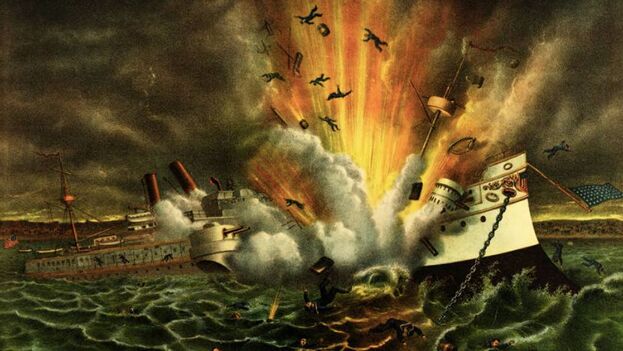
14ymedio bigger14ymedio, Juan Izquierdo, Havana, 15 February 2023 — As every February 15, official propaganda dusts off its theories about the explosion of the US battleship Maine, sunk in Havana Bay in 1898. After 125 years, the version of the “self-sabotage” of the ship by the US as a pretext for Intervening in Cuba’s war against Spain continues to be taught in Cuban schools and reported in the press as an irrefutable truth.

Although the “blasting” of the Maine is the cornerstone of the regime’s historiography against the US, none of the investigations carried out in the past have been conclusive about the cause of the explosion. Why does Havana continue to manipulate the facts with such insistence? The response of the official site Cubadebate response is clear: this version is defended because “it sustains the irrational blockade policy,” another ideological symbolic catch-all of the regime.

This Wednesday, in the Communist Party newspaper Granma, officials assert that the battleship was sent as a “steel Trojan horse” to the Island. Knowing “the truth,” however remote it may seem, means winning the “battle of ideas in which this is enshrined to the Cuban people.” continue reading

The ship that exploded in the Havana port in February 1898 was a second class military vessel, 324 feet long and 54 feet wide, able to open fire from both sides and with a ram on the bow. Its launching took place on November 18, 1889, but it did not enter service until six years later. The officer who took it to Havana as part of a “friendly visit” in January 1898 was Captain Charles Dwight Sigsbee.

Granma selected and reproduced several telegrams from Captain Sigsbee, the US consul on the island and the US Secretary of State, whose placement suggests that the Maine was not in Havana to protect the citizens of that country present in Cuba, but rather “there was an ulterior purpose”: to produce an “agitation” against the island’s autonomous government – constituted only a few weeks earlier – and to achieve “in all probability” a protest.

From this correspondence, which refers only to the climate of political tension that prevailed at the time, the official State newspaper draws a conclusion: the explosion was caused “by the Yankees themselves” to interfere in “another people’s war,” which was already “virtually won” against Spain by the Cuban Liberation Army.

In the explosion, 254 sailors and six officers died, of the 328 member crew. It was a crew made up of American citizens of German, Swedish, Irish, Norwegian, Danish, and even Russian and Finnish origin. In Cuban schools, however, it is still taught that “the majority of the crew were black” and that the ship’s staff had abandoned them in the bay to die. Cubadebate itself admits that this information is a flagrant lie, although it only acknowledges that it has been disclosed in Cuban education “sometimes.”

The only truth in the version of events repeated by the regime was the media hysteria that followed the event, the responsibility, to a large extent, of two famous American press magnates at the time: Joseph Pulitzer and William Randolph Hearst.
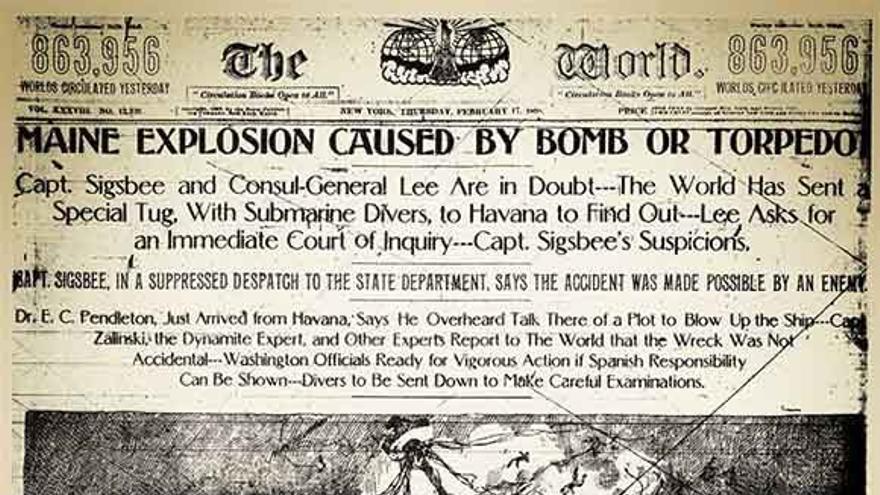
The only truth in the version of events repeated by the regime was the media hysteria that followed the event, the responsibility, to a large extent, of Pulitzer and Hearst. (Cuba debate)
The only truth in the version of events repeated by the regime was the media hysteria that followed the event, the responsibility, to a large extent, of Pulitzer and Hearst. (Cuba debate)

With the slogan Remember the Maine – recycled in 1961 by the pro-government singer Carlos Puebla as Remember Girón [referring to (what is called in the US) the Bay of Pigs] – the US newspapers created an unfavorable opinion of Spain among readers, which undoubtedly facilitated the recruitment of young people to participate in the war.

“With the Maine, the independence of Cuba collapsed,” conclude Granma and Cubadebate, also manipulating a few quotes from the book How the Battleship Maine Was Destroyed, by US Admiral HG Ricover, without mentioning that this author does not find the “self-sabotage” hypothesis viable either.

The Cuban historian Manuel Moreno Fraginals, in his book Cuba/España, España/Cuba (1995) – one of the most reviled by the regime – affirms that the government of Fidel Castro gave the explosion “the easiest and most convenient interpretation,” in the purest propaganda style of the Cold War, when “in reality there is not a single piece of evidence that leads to such an interpretation.”

“The Americans had plenty of political reasons and internal public opinion to take part in the conflict without resorting to the dangerous extreme of blowing up one of their navy cruisers, killing [more than] 250 marines. The Spanish had even less reason to carry out sabotage of this category. For the Cubans it was almost impossible,” continues Moreno Fraginals.

An updated study on the subject, by the Spanish historian Tomás Pérez Vejo (3 de julio de 1898, el fin del Imperio españolJuly 3, 1898 / The End of the Spanish Empire, 2020), agrees that the US intervention was going to take place anyway, “regardless of of the causes of the sinking of the Maine .” The problems, he says, were “deeper.”

In addition to all this, the official Cuban press is especially offended by a theory that involves neither the “self-attack” by the US nor an aggression by Spain. It is about the possibility that Cuban insurgents caused the explosion, indignant with the passivity of the United States in the face of the cause of independence, to force the US to intervene.

This hypothesis, collected among others by the classic Cuba: the Struggle for Freedom (1973) by the English historian Hugh Thomas, describes that by 1898, the desire for annexation to the United States was not unheard of among a faction of the rebels. Those who most fervently opposed union with the north were José Martí and Antonio Maceo. Both had died. “Cubans were capable of such an act, as anyone would be after three years of all-out war,” Thomas suggests.

Even a serious naval historian like the Cuban Gustavo Placer Cervera continues to tear his hair out at this possibility. His arguments, however, are not very objective and border on the naive: “Terrorism was not the method of struggle of the Cuban independence fighters,” he affirms. The Cubans did not want to “change ownership” and the US was an “allied country” for the insurgents.

Regardless of the propaganda, Cuban, Spanish and American historians agree that the most likely explanation is an accident. “The Maine blew up because she was carrying a large quantity of the new gunpowder she needed for the heavier guns and which, in its early years, often set off explosions,” Thomas concludes.

The ship remained in the bay until 1911, when the US pulled the wreck and the corpses of the crew out of the water. On March 16 of that year, the Maine was towed several miles from the Havana port and, after several salvo shots to honor the dead Marines, she was sunk again at a depth of more than 1,000 meters.

____________

COLLABORATE WITH OUR WORKThe 14ymedio team is committed to practicing serious journalism that reflects Cuba’s reality in all its depth. Thank you for joining us on this long journey. We invite you to continue supporting us by becoming a member of 14ymedio now. Together we can continue transforming journalism in Cuba.
Fidel Castro’s Eldest Grandson Continues to ‘Square the Box’ to Rescue His Father’s Memory

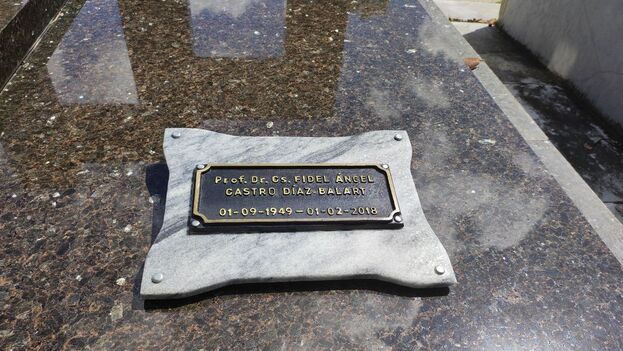
Tombstone of Fidel Castro Díaz-Balart, in the Colón Cemetery, in Havana. (14ymedio)

14ymedio bigger

Juan Izquierdo, Havana, 1 February 2023 — On February 1, 2018, excluded from the leadership of Cuban power and victim of frequent depressive episodes, Fidel Ángel Castro Díaz-Balart committed suicide. He was the only child from the first marriage of Fidel Castro, who had died a year earlier, and both the official press and the authorities avoided giving prominence to the event.

Five years later, the same silence is repeated. The only person who has taken care to remember Castro Díaz-Balart is his son, Fidel Antonio Castro Smirnov –professor of Nuclear Physics in Havana – who for months has been determined to claim the role of his family branch through tweets and media parachute jumps that he dedicates to his grandfather and father.

“Five years ago I lost my best friend, my paradigm of a man and an intellectual. His example was enough, but he was also an extraordinary father,” Castro Smirnov wrote this Wednesday , without referring to the “attack on life” after months of medical care for a “deep depressive state” as indicated by Cuban Television. “With us today, Professor Dr. Cs. Fidel Castro Díaz-Balart breathes, thinks, walks, does and feels,” said the young man, who always refers to his father with his title.

Castro’s “cursed heir” was buried in a dark, wine-red granite tomb, in a pantheon belonging to the Cuban Academy of Sciences, as this newspaper recently verified.

It is the same place where French scientist André Voisin was buried in 1964; Fidel Castro was obsessed with this ideas on cattle raising. The pantheon is discreet and was decorated with a small tombstone containing the full name of Castro Díaz-Balart and his birth and death dates, as well as his titles of Professor and Doctor of Science. It is also far from the memorials dedicated to the heroes of the country, which gives an idea of ​​the place the Revolution reserves for suicides. continue reading

Through Twitter, at scientific conferences in Cuba and abroad, and even in the official press, Castro Smirnov frequently refers to his family’s relationship with Fidel and Raúl Castro and defends his father’s scientific legacy.

The “rescue” began on the first anniversary of his grandfather’s death, in 2017, a few months before his father’s suicide. In a tearjerking article published in Cubadebate, he wrote: “I am Fidel. My father is Fidel. My grandfather is and will always be the eternal and undefeated Fidel. My name is Fidel, and my life is called Fidel. My thoughts, my dreams, my desires, are also called Fidel.”

In the same article, he affirmed his need to speak “often” with the deceased, defended Castro’s “physical” survival, his “strength (stronger than nuclear forces),” as well as “Fidel’s dynamics, the wave of Fidel, Fidel’s light (the most beautiful and intense), Fidel’s movement, Fidel’s magnetism.” All of this, according to the young scientist, “endures” beyond death, since “everything is Physics.”

Since 2016, Castro Smirnov has been “jumping for Fidel,” expensive skydiving maneuvers in different parts of the Island, which, together with the private photos of his family that he publishes regularly, have made him one of the most media-prominent members of Castro descendants.

Along with the commemorative tweet of his father’s death, Castro Smirnov today revealed several photographs where his great-uncle Raúl Castro poses with his mother, Mirta Díaz-Balart, who was divorced from Fidel Castro in 1955, as well as several images of his father smiling with Fidel Castro, in uniform.

In none of his frequent messages does the grandson allude to the distance between Fidel’s eldest son and the children of Dalia Soto del Valle, Fidel Castro’s second wife. The widow and her children were the ones who went first during the caudillo’s funeral, while Castro Smirnov and his father had to present their tribute in second place.

Various media outlets and observers around the Castros have pointed out that, despite appearances, Castro Smirnov was not excluded from the family’s life of luxury and comfort. In addition to the parachute “jumps,” photographs of him at parties and receptions have been revealed where he is accompanied by Professor Marxlenin Pérez, host of the official program Cuadrando la caja [Squaring the Box], who uses the last name Castro when she accompanies the young scientist.

Discreetly, Castro Smirnov has been rehabilitating his father’s image. Five years after the death of Castro Díaz-Balart, he is the only one of Castro’s grandchildren who can boast of a notable academic background and media talent that, without a doubt, he knows how to take advantage of.

____________

COLLABORATE WITH OUR WORKThe 14ymedio team is committed to practicing serious journalism that reflects Cuba’s reality in all its depth. Thank you for joining us on this long journey. We invite you to continue supporting us by becoming a member of 14ymedio now. Together we can continue transforming journalism in Cuba.
The United States Infiltrates ‘Foreign Groups’ to Divide Believers in Cuba, Says the Official Press

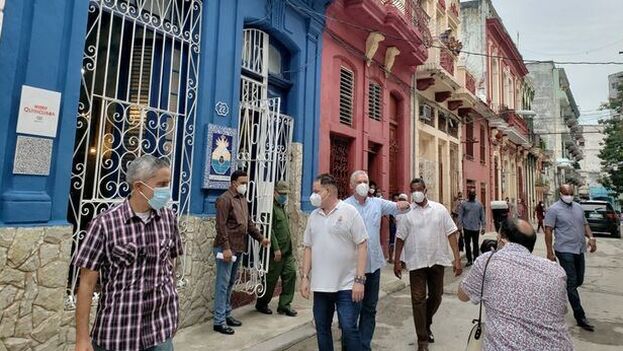
Alemán says it’s an “accomplishment” that the Communist Party has admitted believers to its ranks since 1991, a membership that was prohibited before the Special Period. (Twitter/Cuba Presidency)

14ymedio bigger14ymedio, Juan Izquierdo, Havana, 22 December 2022 — The inclusion of Cuba on the blacklist of countries that violate religious freedom according to the United States has motivated a campaign, by the official press, to prove otherwise. This, despite the fact that several priests, nuns, pastors, Santeria believers and practitioners of different beliefs have been systematically harassed by the Government.

Enrique Alemán Gutiérrez, director of the Cabildo Quisicuaba cultural project in Centro Habana, is one of the regular interlocutors of the regime to discuss the issue. Hence, interviewed by the State newspaper Granma on Wednesday, he once again defended that the State “recognizes, respects and guarantees” all religions, although at no time did he admit the political role, as critical voices, that several religious leaders have assumed.

The director of Quisicuaba — a project that also has a social and religious focus — alleges that the Government has registered “innumerable institutions” in the Register of Associations and attributes that “recognition” to the Cuban Revolution.

Alemán says it’s an “accomplishment” that the Communist Party has admitted believers to its ranks since 1991, a membership that was strictly prohibited before the Special Period. In addition, he also mentions a deputy to the People’s Assembly, and that in 1992 the State was defined as secular instead of atheist. The visit of religious leaders such as Patriarch Kirill, the permission to spiritually care for inmates and the granting of religious visas are, in his opinion, signs of the Government’s support for religion. continue reading

Therefore, says Alemán, the inclusion of Cuba among the countries disrespectful of religious freedom is a strategy of “imperial politics,” to “divide the people and Balkanize faith.” We must look with distrust, he alleges, at the “religious groups induced from the outside” — sects, Protestant denominations, brotherhoods — that “are neither so religious nor so newly formed.”

For Alemán, these groups are foreign to the “very wide religious range” of Cuba, whose components have already resolved their “common points” and their coexistence within what the founder of Quisicuaba understands as “religious syncretism.” The real problem, he points out, is the blockade, which prevents money and donations from Quisicuaba’s allies and other organizations related to the regime from going to the Island.

During the summer of this year, a report by the Prisoners Defenders organization, based in Madrid, showed how the Cuban government had founded a network of its own religious associations, while infiltrating numerous agents into churches and brotherhoods.

“In the case of Christian Churches, it has created the Council of Churches; in the Yoruba religion, the Yoruba Cultural Association; and in the Islamic religion, it has created the Islamic League of Cuba. The three organizations are controlled by State Security,” the document said. Quisicuaba, a spiritualist sect with social projection, is part of the “strong core” of these organizations, and has received visits from the country’s senior leadership.

At the beginning of December, the U.S. State Department included Cuba and Nicaragua — where the Catholic Church and civil society have been persecuted by Daniel Ortega — on the list of countries of “special concern”, along with China, Saudi Arabia, North Korea, Russia, Iran, Pakistan, Burma, Eritrea, Tajikistan and Turkmenistan; as well as organizations such as the terrorist groups Al Shabab, Boko Haram, the Islamic State, the Taliban, the Houthis of Yemen and the Russian paramilitaries of the Wagner Group.

Translated by Regina Anavy

____________

COLLABORATE WITH OUR WORKThe 14ymedio team is committed to practicing serious journalism that reflects Cuba’s reality in all its depth. Thank you for joining us on this long journey. We invite you to continue supporting us by becoming a member of 14ymedio now. Together we can continue transforming journalism in Cuba.
The Traditional Christmas Pig in Cuba, Badly Frozen and Only with a Ration Book

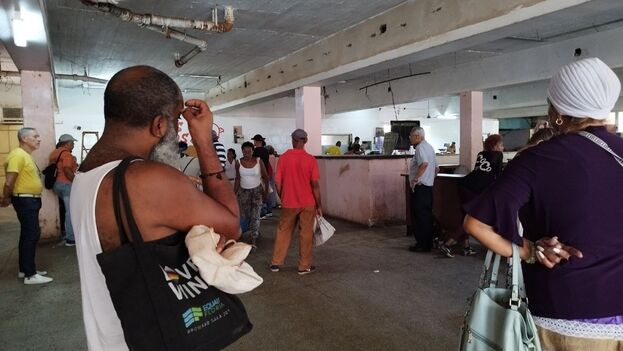
The meat is, according to Havana housewives’ diagnosis, “at room temperature” and the bad smell is impossible to remove, even by frying it in very hot butter. (14ymedio)

14ymedio bigger14ymedio, Juan Diego Rodríguez/Juan Izquierdo, Havana, 16 December 2022 — The stench comes from the back of the butcher shop, from the bundle of pork that the clerks handle with sweaty hands. As he approaches the counter, having survived being shoved and yelled at while in line, Carlos discovers that the unpleasant smell comes from the reddish suet that mucks up the floor.

The transaction is short-lived. The butcher sets his hooks and knives on the mass of smelly meat, weighs it –always cheating, but even Cubans get used to dishonesty — and throws it inside the shopping bag. The manipulation of the scale does not seem to matter to the policeman who watches over the buyers and who, at the end of the day, will be paid in kind for his “indifference.”

The smell is just the beginning of the odyssey to have a bit to eat to put on the family table during the New Year holidays.

The smell is just the beginning of the odyssey to have a bit of energy to put on the family table during the New Year holidays

The meat just bought is old, gray, and almost greenish. Fat, cartilage and bone predominate. Its texture is perhaps the most unpleasant, typical of pork that has not been well refrigerated and that, when it begins to thaw, becomes slimy to the touch.

Unfortunately, Carlos thinks, he listened to the clerks who were shouting on the outskirts of the butcher shop. “Make the effort and buy now,” they said this Thursday, “this is what’s left and tomorrow is going to be worse.” There were people who were more discerning, who preferred to not buy anything.

The meat that the government puts up for sale for the end-of-year celebrations is, according to the diagnosis of Havana housewives, “lukewarm” and it is impossible to remove the stench, even when frying it in very hot butter. continue reading

The conspiracy theorists in the neighborhood have already launched their explanation: in the absence of a recent product, the government makes available for sale its mysterious “war reserve,” the secret food arsenal that has always been attributed to the regime. It is not pork that has been kept in a refrigerator, hanging on a hook, but in little refrigerated warehouses, one piece on top of another. For this reason, they say, the meat is “crushed” and has an “ugly” color.

Crackling pork rind, fried pork chunks or some roasted ribs have always been part of the Cuban New Year’s festivities, even more than holiday trees and cider. The latter, the official hatred for the Christmas festivities has made them disappear and reappear from homes, but pork meat had remained a constant despite the fact that every December of the last decade its price has risen significantly.

In private markets, a pound of steak or leg is close to 500 Cuban pesos but, as the month progresses and Christmas Eve approaches, the product’s presence decreases

In private markets, a pound of steak or leg is close to 500 Cuban pesos, but as the month progresses and Christmas Eve approaches, the product’s presence decreases. Hence, the official announcement was received with relief that the product would begin to be sold in the city of Havana in a “limited, controlled-release” manner, upon presentation of the ration book.

Silvia, Xiomara and María Eugenia have come to an understanding. Between the three of them they will buy a piece of pork that costs about 7,500 pesos. It is a leg that will be divided for Christmas Eve dinner for their corresponding families. “We’re just going to buy just one because no one has the money for the piece that is allocated to her nuclear family,” María Eugenia clarifies.

Since last Sunday, having been alerted that the sales would begin this Wednesday, the three retirees began to stand in line at the butcher shop on Ermita and Conill streets, in the municipality of Plaza de la Revolución. Since then, they have alternated the hours they spend in line, hoping that the time to go into the establishment will arrive this Friday afternoon. “We have about 80 people ahead of us, and sales are going very slowly.”

The long wait is not because the piece of meat has to be cut, since the customer must purchase the complete piece, a requirement that has made many needy people give up, since they do not have the thousands of pesos that a leg costs at a price of 250 pesos per pound. “They weighed a medium one for me and it came out at 6,800 pesos so I had to share buying it with a neighbor,” warns a nearby resident who went in “among the first” because she started standing in line last Saturday. The delay is attributed to “all the paperwork that must be reviewed before buying.”

According to the woman, it is pork meat “with a lot of fat,” it comes unpackaged, which makes her assume it’s from Cuban pigs, but the employees could not tell her if it was imported or from national farms. “The store has refrigeration problems and when I bought the leg, I ran home to put it in the freezer because otherwise it wouldn’t make it to the end of the year.”

In other municipalities, such as Arroyo Naranjo, the residents have improvised real encampments outside the butcher shops to be able to get a portion of meat

In other municipalities, such as Arroyo Naranjo, the residents have improvised real encampments outside butcher shops to be able to get a portion of meat, since it is known that what is available is not enough for all the households registered in the city’s rationed market. On social networks, some of them have shared photos of people wrapped in blankets or drinking rum to warm up in the cool early morning this December.

“I hope that the piece that I get is tenderloin, which is worth 235 pesos a pound and comes with some ribs for frying that my children love,” commented a resident of El Vedado this Thursday, who has to buy at the local store at 17th and K streets. “You can always convince someone else in line to take your piece if you don’t like it and he prefers it that way.”

However, the man fears that the meat that signals the holidays could also become a matter of contention. “Those who are buying legs for three households are not going to be able to separate it until everything is cut in their presence, because otherwise there will be a dispute due to a little extra lard that goes to one or a few chunks above what the other gets.”

Translated by Norma Whiting

____________

COLLABORATE WITH OUR WORKThe 14ymedio team is committed to practicing serious journalism that reflects Cuba’s reality in all its depth. Thank you for joining us on this long journey. We invite you to continue supporting us by becoming a member of 14ymedio now. Together we can continue transforming journalism in Cuba.
Diaz-Canel Talks About His ‘Dissatisfactions’ Without Offering a Way Out of the Cuban Crisis

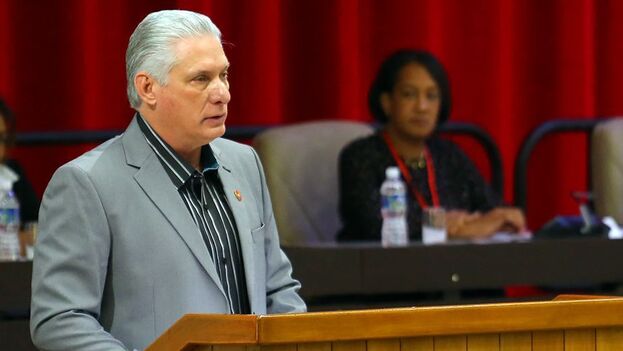
Díaz-Canel stated that he felt guilty “for not having been able to achieve, as the country’s leader, the results that the Cuban people need.” (Cubadebate)

14ymedio bigger14ymedio, Juan Izquierdo, Havana, 12 December 2022 — With a tearful speech about his “personal dissatisfactions” as the head of the Government and in the presence of Raúl Castro, Miguel Díaz-Canel was accountable this Wednesday, at the Havana Convention Center, for his management of the country during 2022.

To the usual justifications to explain the economic drift of the Island — the US ’blockade’, the aftermath of the coronavirus pandemic and the disasters caused by Hurricane Ian and the explosion of the Supertanker Base — he added, with care not to offend Russia, “the new problems generated by the conflict in Europe” and international inflation.

Faced with the economic crisis, he said he felt like the “main person responsible,” but nuanced this by stating that he had limited himself to assuming “continuity from a dialectical perspective.” He did not miss an opportunity to rebuke local and provincial bureaucrats and clarified that, although he knows what the problems are, he hopes that “no one will use them as justification.”

The National Assembly of People’s Power, he warned, will continue in 2023 its “important legislative work” to enact other laws that “develop the Constitution” and address the “difficult Cuban daily life.”

The president was slow to enter into economic matters, and when he did it was to repeat the opinion of the Minister of Economy, Alejandro Gil, during the plenary of the Communist Party: the situation is “difficult”; the Government no longer knows where to extract the necessary currency, and the measures of the Ordering Task* were not enough to alleviate the financial disaster. continue reading

He spoke cryptically about the “increase in the income of natural people without productive support” and was alarmed by the “partial dollarization of the economy,” which has had a significant impact on the rise in product prices.

After vaguely criticizing Washington for keeping the ’blockade’ as a “weapon of coercion, cruel, illegitimate and immoral,” Díaz-Canel praised the Biden Administration. He said he was interested in the “two million people of Cuban origin and their descendants” who live in Florida and stated that he wanted to “promote broader ties” with the US.

He mentioned the technical advice offered by US authorities during the explosion of the Supertanker Base, despite the fact that the official press initially denied the existence of such aid and then considered it “insufficient.”

Díaz-Canel also recalled that the US donated 100 fire suits, in addition to fire and protection equipment, which arrived in Cuba a week ago. It was a “welcome and accepted” initiative, he said with modesty.

In addition, he spoke of the two million dollars sent by the United States Agency for International Development (USAID) — one of the US institutions that the regime has criticized with the most emphasis — after the passage of Hurricane Ian through Western Cuba. “A help without conditions,” he said, attributing it not to USAID but to the Biden Government, “for which we also are thankful and accept it.”

However, he did not miss the opportunity to regret the “open policy of subsidies and attempts to destabilize the country,” paid with “tens of millions of dollars from the federal budget.” The US “trained individuals to commit violent acts against Cuba,” he said, referring to the accusations launched by Cuban Television against alleged criminals against the State captured by the police.

Finally, he recognized that despite everything, Cuba and the US are experiencing a kind of thaw, although with “very discreet steps, aimed at directing bilateral cooperation for compliance with immigration agreements and also in other priority areas between both countries.”

About Vladimir Putin’s invasion of Ukraine, he limited himself to also blaming the US and its “harmful imperialist determination to try to divide the world,” although he admitted that the war complicated the global economic situation.

Regarding his political influence in Latin America and the possibility of alliance with the governments of the Latin American “new left,” he welcomed the rapprochement of Cuba by several presidents, such as Gustavo Petro and Andrés Manuel López Obrador. The “greetings” also reached Daniel Ortega, Luis Arce and Nicolás Maduro, and discreetly pointed out the “mutual benefit” of relations with Argentina, but there was no reference to Chile, with whose president, Gabriel Boric, Havana doesn’t sympathize.

The president avoided mentioning, of course, the former president of Peru, Pedro Castillo, whose self-coup did not merit a comment from the Cuban leadership until two days later.

At the end of the speech– and without finally deciding on triumphalism or self-criticism — Díaz-Canel stated that he felt guilty “for not having been able to achieve, as the country’s leader, the results that the Cuban people need for the desired and hoped-for prosperity.”

 *Translator’s note: The “Ordering Task” is a collection of measures that include eliminating the Cuban Convertible Peso (CUC), leaving the Cuban peso as the only national currency, raising prices, raising salaries (but not as much as prices), opening stores that take payment only in hard currency which must be in the form of specially issued pre-paid debit cards, and a broad range of other measures targeted to different elements of the Cuban economy.   

Translated by Regina Anavy

____________

COLLABORATE WITH OUR WORKThe 14ymedio team is committed to practicing serious journalism that reflects Cuba’s reality in all its depth. Thank you for joining us on this long journey. We invite you to continue supporting us by becoming a member of 14ymedio now. Together we can continue transforming journalism in Cuba.
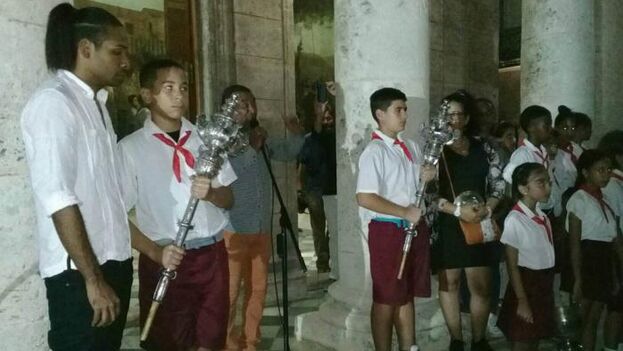
Cuba’s Unusual Procession of Little Pioneers With the Silver Maces of the Old Cabildo of Havana

Children dressed as Pioneers with the maces of the old Cabildo of Havana, from the 17th century. (Tribuna de La Habana)

14ymedio bigger14ymedio, Juan Izquierdo, Havana, November 16, 2022 — A strange mixture of rites, which have become commonplace in recent years, came together on Tuesday night at the ceremony held at the founding site of Havana, the Ceiba de El Templete, on the eve of its 503rd anniversary.

It was attended by the highest authorities of civil power, Luis Antonio Torres Iríbar, first Secretary of the Party in the capital, and Reinaldo García Zapata, governor of the city, but also those of the church. Specifically, Juan de la Caridad García Rodríguez, archbishop of Havana, from whom “the people received a blessing” and who accompanied a procession through the streets surrounding the Plaza de Armas.

However, the most surprising image of the evening — in addition to being extremely worrying if it’s confirmed that the maces are the original pieces — was that of two children, dressed in white shirts and red scarves, the uniform of the Pioneers, holding the maces of the old Havana Cabildo. Made of silver in 1631, they are, according to Emilio Roig de Leuchsenring in his book Havana. Historical Notes, “the oldest works of art in Cuba.”

Both valuables objects are in the custody of the Office of the Historian, founded by Roig and administered until 2020 by the late Eusebio Leal, and they are stored in the former Palace of the Captains General, today the City Museum. It’s not the first time they have been taken out of safekeeping for the same ceremony. continue reading

The official press echos “an emotional letter calling for the conservation of historical heritage,” “warm and simple words” that, says Tribuna de La Habana, “sixth-grade pioneer Laura Hernández García, from Camilo Cienfuegos Primary School, read” at the ceremony.

The ceremony ended, the official press reports, with the song Razo a la Ceiba by Leo Vera, and a concert on the esplanade of El Templete.

Beyond the unease caused by seeing the little Pioneers, ignorant of the historic value of what they carried in their hands, no one is surprised that the celebration of the foundation of the capital mixes ideology and religion.

In 2019, the Cuban regime paid tribute to the priest Guillermo Isaías Sardiñas Menéndez, known as Father Sardiñas, on the 55th anniversary of his death.

Nicknamed the “father of the olive green cassock,” the official press has frequently praised “the coherence between his religious faith and his conviction as a patriot and revolutionary,” although in the historiography of the Catholic Church the mentions of his actions have been more discreet.

But the intersections have not only been between Cuban communist ideology and Catholicism. In 2008, fifty santeros officiated a ritual with drums and animal sacrifices to wish “long life” to Fidel Castro on the day of his 82nd birthday, then convalescing from an intestinal disease.

Translated by Regina Anavy

____________

COLLABORATE WITH OUR WORKThe 14ymedio team is committed to practicing serious journalism that reflects Cuba’s reality in all its depth. Thank you for joining us on this long journey. We invite you to continue supporting us by becoming a member of 14ymedio now. Together we can continue transforming journalism in Cuba.
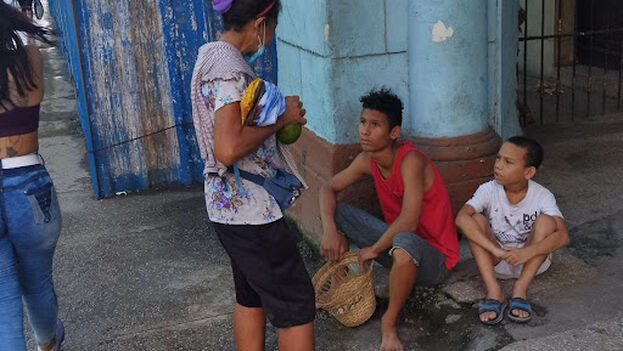
Barefoot and Dirty, Cuba’s Beggar Children of Central Havana Do Not Officially Exist

At the corner where the child beggars operate, an infirm lady arrives and scolds them for begging. (14ymedio)

14ymedio bigger14ymedio, Juan Izquierdo/Juan Diego Rodríguez, Havana, 9 November 9, 2022 –Ragged, with hollow eyes and a slightly hoarse voice, two children ask for money in Central Havana. The older may be fourteen or fifteen years old, the younger not more than eight. One is barefoot, with curly hair and a face stained by dirt. The other wears a pair of tattered flip-flops.

They ring a bell and extend a wicker basket, taking advantage of the activity at Belascoaín and Carlos III. At the corner where the child beggars operate, an infirm lady, not very presentable, arrives, and she scolds them for begging. “Where’s your family?” she asks them, without the children being able to respond.

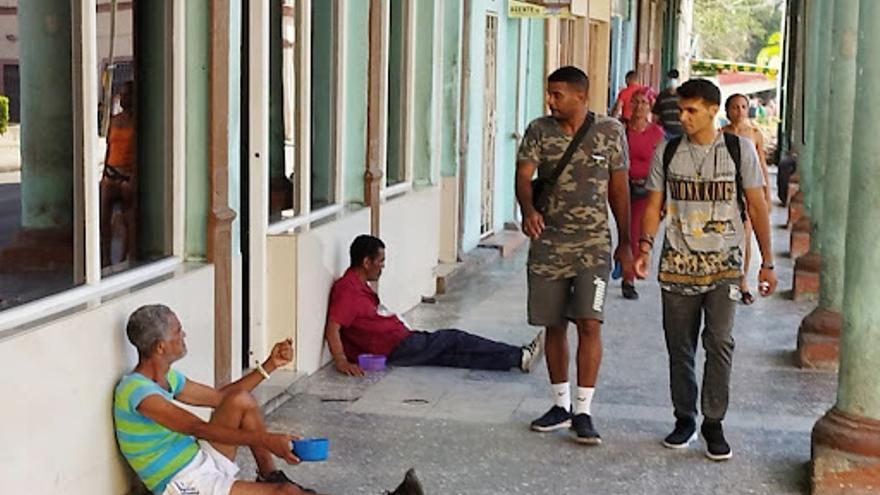
The rate of begging on the Island has skyrocketed tragically, and if before you saw only older men begging in the streets, usually alcoholics, now women, the disabled, psychiatric patients, adolescents and children also do so.

The “homeless’ euphemism which the Government has applied to beggars has proven to be a crude simplification. Although many of them, in fact, live on the streets and sleep in the doorways or corners of a dilapidated building, others beg “as a job.” They are located on central avenues and question not only tourists, but also Cubans.

In many cases they are “stationary” beggars; they choose a neighborhood or a specific corner, and learn to take the pulse of their space: the best hours, the faces of passers-by, the precise words to earn a coin or a loaf of bread. continue reading

“Most of the adults are very deteriorated from alcohol and age,” Julia, a neighbor of Central Havana, tells 14ymedio. They are the typical drunks, who always carry their plastic bottle to store the chispa, the alcohol of any category they consume. Most are adult men.”

In many cases they are “stationary” beggars: they choose a neighborhood or a specific corner, and learn to take the pulse of their space. (14ymedio)

The reason that begging has proliferated so much, says Julia, is due both to the resounding crisis that is going through the Island and the closure of several old-age homes in Havana. “These are things that have a lot to do with it: the collapse of the economy, the emergence of poverty and the forced parental responsibility in the new Family Code. Everything is designed so that the State can wash their hands,” she says.

“On the ground floor of my building,” the woman says, “several beggars ’alternate’. There was an old and very sick one, with a tube from his urine collector, always stained with a bloody liquid. He slept between cartons and right there he urinated and defecated, right in front of the front door.”

Like other neighbors, Julia avoids leaving the building when the beggars are “on guard.” A recent episode of violence confirms this forecast. “Recently, a neighbor came down at ten at night to throw out the garbage and one of them took advantage, pushed the door and tried to enter the building. I don’t know what he intended, whether to lie inside, urinate or settle on the roof.”

“The neighbor tried to bar the way and the man became aggressive. Since then, we never take out the garbage at night,” explains Julia.

One of the variants of poverty in Havana is the “beggar sellers.” (14ymedio)

Faced with government rhetoric, which closes its eyes to extreme poverty on the Island, the woman insists that there have always been beggars, but now they are increasingly aggressive, and it’s common for them to become “fixed tenants” of doorways and buildings. Even so, they still frequent the “boulevards for beggars” of Havana: Infanta, Carlos III, Belascoaín streets and other central avenues.

“Cubans don’t have a culture of giving money to beggars,” Julia adds. Children are always warned that beggars want someone else to “pay for their vices,” and they use that capital to buy rum or cigars. That’s why it’s uncommon for passers-by who walk through Havana’s long covered sidewalks to place a banknote in the baskets that the homeless extend.

One of the variants that poverty adopts in Havana is that of the “beggar-sellers,” sitting on the ground outside the buildings. “The most notorious thing about their ’goods’,” says Julia, “is that they’re things that are old, used, sometimes dirty, in a variety that goes from pots, casseroles and other kitchen utensils, to equipment, plugs and, of course, broken shoes and old books.”

Translated by Regina Anavy

____________

COLLABORATE WITH OUR WORKThe 14ymedio team is committed to practicing serious journalism that reflects Cuba’s reality in all its depth. Thank you for joining us on this long journey. We invite you to continue supporting us by becoming a member of 14ymedio now. Together we can continue transforming journalism in Cuba.
Victor, the Puppeteer who Raises a Smile on the Faces of Cubans in the Midst of Poverty

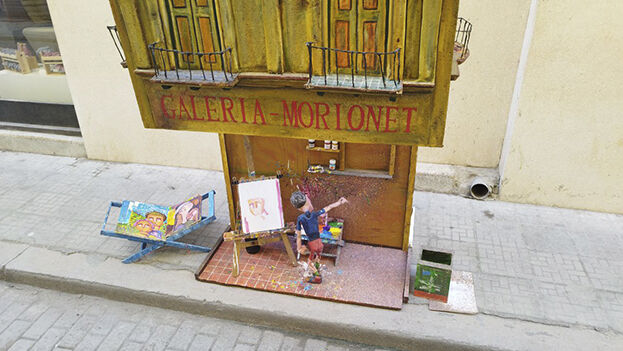
In Calle Obispo, Old Havana, you can find Víctor, with a puppet that moves to the rhythm of his paintbrushes. (14ymedio)

14ymedio bigger14ymedio, Juan Izquierdo/Juan Diego Rodríguez, Havana, 6 November 2022 – Street Artists, fortune tellers, beggars, Tarot readers, palm readers, wizards, promise-keepers, pickpockets. Old Havana is constantly in turmoil and those who live there have to earn a crust by any means possible. Skill, cunning and a ’creole’ type of flair are, in the midst of the general poverty of the country, the only tools available for being able to go home with a bit of money in the pocket.

On Calle Obispo, people push and shove, trying frenetically to make their way about, going in and out of shops, pharmacies, kiosks and snack bars. Then it catches the attention that there’s a group of people who are there to block the way and detain you — under an overhanging roof. And there… you find Víctor, a silent young man, hidden behind the miniature canvas curtains of his Galería Morionet. 

Víctor operates the strings of his little puppet theatre — whose name combines that of the painter Claude Monet with the word ’marionette’ — and he makes his puppet, a Cuban skilled like himself, draw a portrait of a man on a piece of cardboard.

It’s a refined skill, and not the kind of skill that can be learnt in a mere couple of weeks. The puppet master pulls on his strings and the puppet shakes his paintbrush, fills it with watercolour and moves towards the easel. Sometimes a dog approaches and the puppet artist looks up at him cautiously, without stopping his work, and then he strokes its nose.

People watch the scene, fascinated. The puppet paints in a messy kind of dump that might be any habanero’s place, splattered with paint stains and continue reading

above which hang two unstable-looking balconies. Louis Armstrong’s blues plays in the little room, and, when the music stops, some coins drop into the Galería Morionet’s tray.

Unless they are tourists the passers-by aren’t able to offer much, and, after distracting themselves from their worries for a little while with the show, they have to continue walking on through a city that gets more and more inhospitable. Two police officers eye the youth with suspicion; he carries on with his work without paying them too much attention.

On the sidewalks the waiters of the paladares [private restaurants] spring on the passers-by, interrupting them and unfurling their menus without anyone being able to stop them. None of the habaneros can afford the luxury of dining out in Old Havana, but the waiters have to be seen to be active and charming, in order for the owner, who also must defend his business, to justify their salaries.

Sitting on the sidewalk, a mixed-race boy, dressed spotlessly in white, offers a card reading. Next to him, water and a cloth on which sits his deck of cards, ready for the next fortune-telling. But nobody stops, and, bored, he stands up to smooth out his clothes, and then resumes sitting.

On another corner a cartoonist draws the portraits of celebrities like Chucho Valdés and Alicia Alonso. Children beg their parents to let him draw them and the man gets to work: back bent over, he holds a board in one hand and with the other he manipulates his ballpoint pen.

Stilt-walkers have also become part of the scenery in the city, especially in groups which roam those streets with more tourists. Noisy and colourfully dressed, these urban artistes hardly manage to get, these days, more than a couple of notes stuffed into their hats — made from remnants and bells — as the fewer number of travellers arriving in the city has left them practically without customers.

Mounted on their wooden stilts they wait on some corner or other for a Transtur coach to discharge its small group of passengers around the Plaza de Armas or the Castillo de la Fuerza. Their show is brief, to avoid the tourists returning to the coach before having left a bit of money, which, amongst all the laughter and song the performers make sure to tell them that “euros or dollars” would be better received “by these particular street artistes”.

Beyond the tourist area the situation takes on sadder tones. It’s not unusual to meet an old lady in a dirty dressing gown begging for money to buy a few pounds of sweet potatoes, or a ’promise-keeper’ dragging a stone tied to his ankle with a chain. As he approaches, as if he were a soul in purgatory, he holds out a bowl for someone to throw in some ’kilos’. The people who watch him, shocked by the marks on his leg, have little to give him.

Translated by Ricardo Recluso

____________

COLLABORATE WITH OUR WORKThe 14ymedio team is committed to practicing serious journalism that reflects Cuba’s reality in all its depth. Thank you for joining us on this long journey. We invite you to continue supporting us by becoming a member of 14ymedio now. Together we can continue transforming journalism in Cuba.

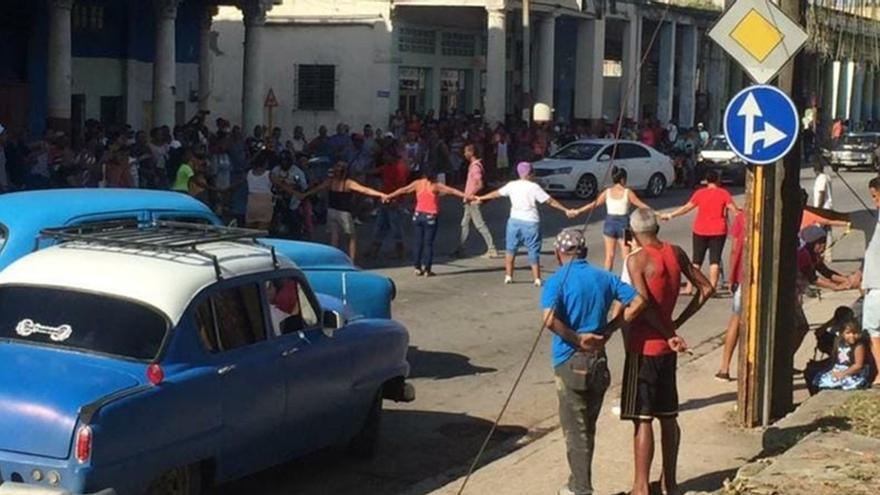
Crowds in Havana’s Streets Shout ‘Freedom’ During a Second Day of Protests

People join hands in the middle of a street in Havana’s Cerro district to block traffic. (Facebook)

14ymedio bigger14ymedio, Juan Izquierdo, Havana, September 30, 2022 — Shouting “Freedom,” a crowd took to the streets of Havana on Friday night for a second day of protests, which spread to several neighborhoods in the city. In response to the demonstrations, the regime again cut off internet access at roughly 7:00 PM.

Throughout the day demonstrators blocked traffic in many areas. In some streets they formed human chains to close off major avenues, like those in the Cerro district.

“Besides joining hands, people have roped off several blocks of Cerro Avenue between Tejas and Patria streets,” reports one source at the scene.

Protests began in the morning on Palma Street and Calzada de Bejucal in the Arroyo Naranjo district. They later spread to Puentes Grandes in the Havana suburb of Playa, which has been without power for 72 hours.


Protests increase, people shout “Freedom” in the streets.

Several videos posted on social media show a crowd in Arroyo Naranjo banging pots and calling for the government to resolve the country’s energy crisis. “They blocked the street so no one could get through,” says a woman filming the protest. “Down with the dictatorship! Enough is enough!” she shouts as she joins the demonstrators. Several police officers stand nearby, leary of confronting the protestors. continue reading

Several women with children joined another afternoon protest, blocking traffic along a stretch of the National Highway, known as the First Ring of Havana. Videos and photos posted online show uniformed officers trying to convince demonstrators, who had placed stones and wooden poles in the roadway, to allow vehicles to pass.


Protest along a stretch of the National Highway.

The collapse of the National Electrical System in the wake of Hurricane Ian, along with worsening shortages, have led to a new wave of demonstrations. Residents of several areas, including Cerro, San Miguel del Padron and Arroyo Naranjo, demonstrated into the night on Thursday.

Those who managed to charge their mobile phones and videotape the protests try to avoid focusing on people’s faces, aware that police later use videos like these to identify and arrest demonstrators, as happened in the aftermath of the July 11 protests in 2021.

14ymedio contacted the state telecommunications company Etecsa to ask about the disruption of internet service that began around 8:00 PM on Thursday. The operator said the disruption was “nationwide” and that the company was working to resolve the problem. Asked about its cause, she curtly replied, “I cannot give out that information.”


Tweet: “Cubans, tired of all the hardship and crisis, confront government leaders and officials. More information on 14ymedio.com” [Click on blue bird to see tweet.]

On Thursday officials from the Provincial Defense Council (CDP) tried to placate crowds with the usual government rhetoric. During one encounter in a Havana neighborhood, a woman interrupted a female official dressed in military uniform to say “I don’t believe you people.” Next to her, an older woman snapped at the officer: “I am a materialist; I am not an idealist. I believe what I see. If after 72 hours they haven’t done anything, I have to say that nothing’s been done.” Her words were greeted with applause by those standing nearby.

Another officer trying to “explain the situation” was also taken to task by the crowd. “Why don’t you take the gas from the patrol cars and use it for the electric company’s cars?” someone asked

On Friday the CDP president himself, Luis Antonio Torres Iribar, acknowledged, “[Last night] we had to deal with isolated events in the province which involved mass demonstrations over the water situation, over the electrical situation, over the loss of food due to the power outage,” before conceding, “I consider these demands to be just.”


Crowd along Bejucal Avenue in Arroyo Naranjo on Thursday.

“I believe people have a right to protest, but only when government leaders are not doing what they are supposed to do,” claimed the official, adding, “But in the situation we’re talking about, yesterday’s protests, instead of helping, they prevented us from carrying out our mission and bringing about a full recovery in the shortest possible time, as we desire.”

Three days after the hurricane, the power outage is affecting whatever small amounts of food people might being storing in refrigerators. Some were able to freeze large plastic bottles of water to keep temperatures in their refrigerators low, but the ice has since melted and the food is threatening to rot.

This has led to a pressing need to consume whatever reserves of meat, milk and other products families might have before they go bad. Even if power is restored in the next few hours, finding food will be the biggest challenge people face in a country that, before the hurricane, already suffered from alarming shortages.

Meanwhile, the government has mobilized its military and police forces, leaving bodegas* and other locations authorities consider essential “unprotected.” In other establishments that sell food, such as some department stores, the police have stationed none-too-subtle “co-workers,” often young men of military age, to keep watch.

According to the state-run newspaper Tribuna de la Habana, the Ministry of Domestic Commerce reported that 700 “economic targets” in the western part of the country were damaged by Hurricane Ian. These include bodegas, department stores and building supply stores. Lost food supplies, flattened buildings, collapsed roofs and structures rendered unusable are some of the most serious types of damage.

The government has said it will prioritize “maintaining food supplies intended for people who have been evacuated,” which are limited to “items to be cooked.” It has forgotten that the rest of the country is facing the same challenges of preserving  and cooking food without electricity.

*Translator’s note: small state-run neighborhood or corner grocery stores that sell rationed goods.

____________

COLLABORATE WITH OUR WORKThe 14ymedio team is committed to practicing serious journalism that reflects Cuba’s reality in all its depth. Thank you for joining us on this long journey. We invite you to continue supporting us by becoming a member of 14ymedio now. Together we can continue transforming journalism in Cuba.
‘Godfathers’ Jump the Lines at the Currency Exchanges in Cuba

The workers at the Cadeca (currency exchange) on 23rd Street — and at any exchange office in Cuba — have their own business of influence, with family, friends and even coleros [people others pay to stand in line for them]. (14ymedio)
14ymedio bigger14ymedio, Juan Diego Rodríguez /Juan Izquierdo, Havana, 22 September 2022 — “No one cheats on me,” a man grumbles in front of the Cadeca [currency exchange] on 23rd Street in Havana, this Tuesday. “I’m not a fool.” His face is swollen and red; he is sweating and drags a crutch with difficulty. Next to him, a  sympathetic mulatto in a T-shirt and with a golden tooth nods. “He walked in front of me and went in;  it was that simple,” shouts the man. Several people in the line predict a heart attack if he doesn’t calm down.

Beyond, at the door, a lady demands explanations from the policeman who guards the exchange house: “It’s not the first time this has happened today,” she says. The officer looks at her reluctantly, as if he doesn’t understand, and sends the complaint to the “organizer” of the Cadeca line, who calls the customers according to a list.

Everyone witnessed how an individual arrived at the establishment, advanced, distracted, up the stairs and approached the door, beckoning through the glass. The door opened, and the man managed to slip between the policeman and the organizer, who didn’t say a word.

The eyes of the clients followed the event in detail, but they were silent until the subject entered the Cadeca. First it was a buzz of comments; then someone rebuked the organizer of the line, and finally the man on the crutch exploded, left his place and began to scream. continue reading

In the face of the screams and fingers pointing at him, the policeman remained calm.

“That one had a ’godfather’ inside the Cadeca,” someone theorizes. Sponsorship consists of having a contact within the establishment, a friend or relative who overcomes obstacles and facilitates access to the first place in line.

The customers can withstand the sun, heat and hunger, but never that someone “unrecognized” approaches and, mysteriously, penetrates the building without waiting: it’s intolerable.

The workers at the Cadeca on 23rd — those at any exchange house in Cuba — have their business of influence. The “chosen” are family or friends, and also coleros who accept a payment to guarantee another person a privileged place.

Those who don’t have a “godfather” must submit to the murky system of “lists,” drawn up illegally after the previous night, which pretends to be a spontaneous form of organization in the face of institutional corruption. The lists include solitary buyers, but also the “gangs” of customers, groups of five or ten people who intend to assault the Cadeca.

However, spending the night in the vicinity of an establishment is considered, by the police, a violation. So they’re authorized to fine or arrest the overnight coleros. But it’s a risk that dollar buyers are willing to take, because without the few bills that the Government agrees to sell, it’s impossible to live decently.

So the man with the crutch calms down, goes up to the policeman and calmly says: “Officer, if you want, arrest me, but tonight I’m going to sleep here, to see who is going to take the first place in line away from me tomorrow.”

Translated by Regina Anavy

____________

COLLABORATE WITH OUR WORKThe 14ymedio team is committed to practicing serious journalism that reflects Cuba’s reality in all its depth. Thank you for joining us on this long journey. We invite you to continue supporting us by becoming a member of 14ymedio now. Together we can continue transforming journalism in Cuba.
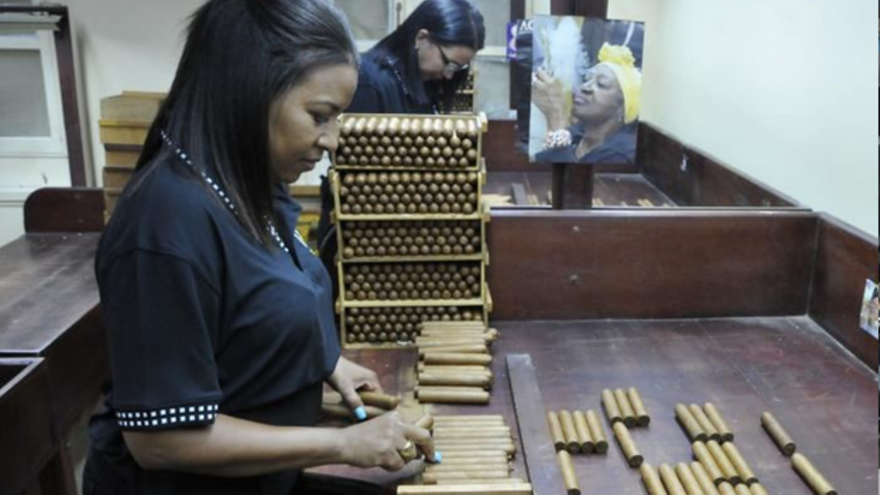
Cohiba’s goal of 2 Million Cigars in 2022 Recalls the Failure of Cuba’s ’10 Million Ton Harvest’*

The factory has mobilized its 252 workers, most of them women, to manufacture the planned amount at a rate of 9,000  cigars per day. (Granma)

14ymedio bigger14ymedio, Juan Izquierdo, Havana, 9 September 2022 — While the quality and distribution of cigars in Cuban shops are at their lowest point, the directors of the famous El Laguito factory, in Havana, promise to make and export two million cigars of the Cohiba brand before the end of this year.

The goal will be met “despite the difficulties,” said the director of the cigar company, Oscar Rodríguez Carballeira. Attracted by the 55th anniversary of the Cohiba label, invented by Fidel Castro to entertain foreign leaders and diplomats, almost 700 cigar fans, including journalists and buyers, attended El Laguito on Thursday.

The manager indicated that the factory has mobilized its 252 workers, most of them women, to manufacture the expected quantity at a rate of 9,000 cigars per day. According to Rodríguez Carballeira, not even two years of pandemic managed to interrupt production at El Laguito.

Although the cigar is fabricated in the old republican factory , the leaf that is processed in El Laguito comes from the highest quality plantations in the country: those of the towns of San Juan y Martínez and San Luis, in Pinar del Río, both located in the tobacco growing region of Vueltabajo, the mecca of the Cuban puro (cigar).

El Laguito, since 1966, has been a factory of excellence, once supervised directly by Fidel Castro and Celia Sánchez. For more than five decades it has produced, in addition to about twenty well-known brands such as Montecristo, Romeo and Juliet, Partagás and H. Upmann, the range of Cohiba premium puros, whose anniversary the Government has decided to celebrate in style. continue reading

This Friday, a gala dinner is planned at the Pabexpo fairgrounds, in which the Habanos awards for 2020 and 2021 will be presented, in the categories of Production, Business and Communication. That same night, the traditional humidor auction will be held, where millionaires from various parts of the world bid to obtain a specialized container to store their cigars, probably signed by Fidel Castro before his death.

Without being in the same category as the noisy Festivals of the Habano (the Havana cigars), which are based at the Convention Center, the celebration for the 55th anniversary of Cohiba will avail itself of the opportunity to raise as much hard currency as possible.

Under the tutelage of the Spanish investors, who finance and distribute the product of the Cuban corporation Habanos S.A., the cigar industry continues to be fundamental in the Cuban economy.

Anticipating these celebrations, the Government planned a luxurious hotel facility in Pinar del Río, which is scheduled to open this month. The delegate of the Ministry of Tourism in that province, José Antonio Aguilera, explained that the hotel, located in San Juan y Martínez, will have only eight exclusive rooms, managed by Islazul.

Customers, who are the same anonymous millionaires who come to El Laguito this year, will enjoy a bar, humidors, specialized shops and a smoking room. “We want tourists to come and share with the community, and local development will benefit,” said Aguilera.

In 2021, Cuba reported $568 million in cigar sales. The main and most stable buyers are still Spain, China, Germany, France and Switzerland.

With the issuance of limited-edition cigar bands, the prices for the  Cohiba brand, the former Indian name for the cigar or the smoking ceremony, have skyrocketed internationally. A pure Cohiba of small or medium caliber can reach 25 euros per cigar in Spanish tobacconists, while cigar bands of the highest quality such as the Pirámides Jar exceed 500, and the Special Reserve Selection, one of the most expensive, exceed 730. In the European informal market, these cigars reach 1,000 euros apiece.

Meanwhile, the cigar stores in Cuba, where you need to pay with foreign currency, have definitively closed their doors for the Cuban, who cannot and does not want to pay the overwhelming prices for the best cigar in the world.

*Translator’s note: See here for the Ten Million Ton Sugar Harvest

Translated by Regina Anavy

____________

COLLABORATE WITH OUR WORKThe 14ymedio team is committed to practicing serious journalism that reflects Cuba’s reality in all its depth. Thank you for joining us on this long journey. We invite you to continue supporting us by becoming a member of 14ymedio now. Together we can continue transforming journalism in Cuba.
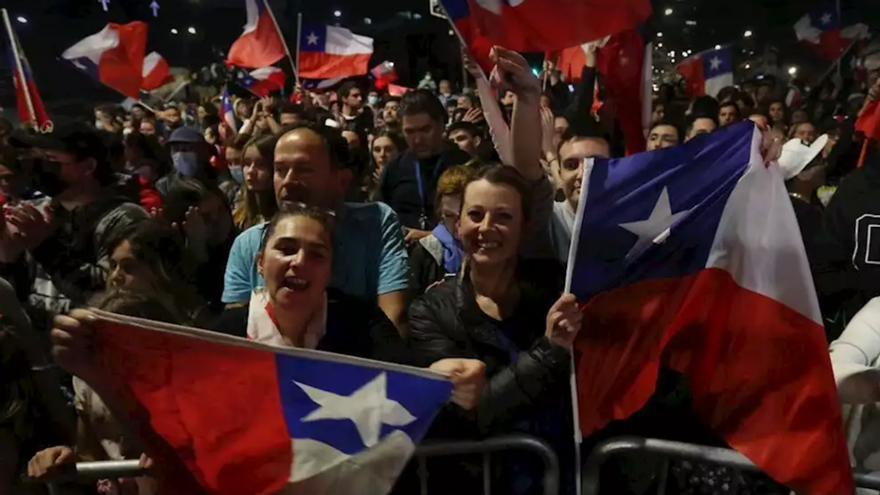
The Official Cuban Press Chokes on the Voters’ Rejection of the Constitution in Chile

Supporters of the “Rejection” option celebrate the result of the constitutional plebiscite, in Santiago de Chile. (EFE/Elvis González)

14ymedio bigger14ymedio, Juan Izquierdo, Havana, 5 September 2022 — The rejection by Chileans of the draft Constitution endorsed by President Gabriel Boric hasn’t taken the Cuban pro-government media by surprise, but it still provokes resentment and bitterness.

This Sunday, the proposal was defeated, with almost 62% of the votes, and Chile chose to maintain the current text, written in 1980, and reformed after the fall of Pinochet and the establishment of democracy.

Meanwhile, in Cuba, several reports, articles and opinion pieces, programmed from the offices of the Central Committee of the Communist Party, spared no reproach or nefarious adjective against those who revalidated the “Constitution of the dictatorship.”

An analysis by journalist Oliver Zamora, broadcast on Noticiero Nacional de Televisión, described the approval of the project as “the most important political event in Chile” since the end of the government of Augusto Pinochet. Enthusiastic about the continental turn to the left, no matter if it’s grotesque or outdated, the reporter doesn’t hide his dismay at defeat.

Chileans were supposed to vote to “delete the legacies of the dictatorship,” and achieve the “real, not apparent, change” that only socialism can offer. Zamora points out that Chile rejected the possibility of a “stronger state,” which would guarantee rights and not allow itself to be “conquered” by neoliberalism.

They threw away, in the opinion of the journalist, a “superior” Constitution because of the media campaign of their enemies, which is a sign that Chile is a “polarized society, trapped in the past.” continue reading

Once the result was known, another of the voices of officialdom, the journalist Talía González, insulted the text of the current Constitution, “written during the military dictatorship.” “The Chileans,” she lamented, “denied their support for a text written by leftist and progressive forces,” to which President Boric had given his “total support.”

Both the State newspaper Granma and Cubadebate took advantage of euphemisms so as not to admit the defeat of the preliminary draft. Metaphors, circumlocutions and extensive paragraphs were intended to cover up the “Rejection option.”

“The option of maintaining a Constitution inherited from the time of Augusto Pinochet is announced as the winner,” admitted the national organ of the Communist Party. “Several experts agree that this result is the consequence of a wide campaign of disinformation regarding the new Constitution; and of an incentive, with a lot of money, to reject the text or deliver invalid votes,” it simplified.

“The most likely thing,” the editors said with disdain, is that Chileans will “wake up without the possibility of having a Constitution” with guarantees in health, education, the environment and pensions.

For Juventud Rebelde, the opportunity was missed to crystallize “the popular claims of the decades under the laws left by the dictator Augusto Pinochet.” Its previous articles warned, with alarm, that all polls pointed to the “possibility of the triumph of Rejection.”

But the “newspaper of Cuban youth” reassured its readers: “There are totally different forecasts and mathematical prediction studies” based on readings from social networks, which “have predicted that the triumph will be of Approval.”

However, there is something that all the official Cuban media agree on. Despite not understanding the mechanisms inherent in democracy and that it seems inconceivable that the government of a country doesn’t have absolute authority over the approval of the laws it intends to propose, as happens on the Island, each comment about Chile ends up predicting Boric’s triumph by any means.

It doesn’t matter if it is the direct one, which has just failed; or the more subtle and slow one, calling a plebiscite again. “Boric needs it,” say the Cuban newspapers, in order to consolidate the socialist reform in a complex country like Chile, which will not easily give up freedom to choose its future.

Translated by Regina Anavy

____________

COLLABORATE WITH OUR WORKThe 14ymedio team is committed to practicing serious journalism that reflects Cuba’s reality in all its depth. Thank you for joining us on this long journey. We invite you to continue supporting us by becoming a member of 14ymedio now. Together we can continue transforming journalism in Cuba.
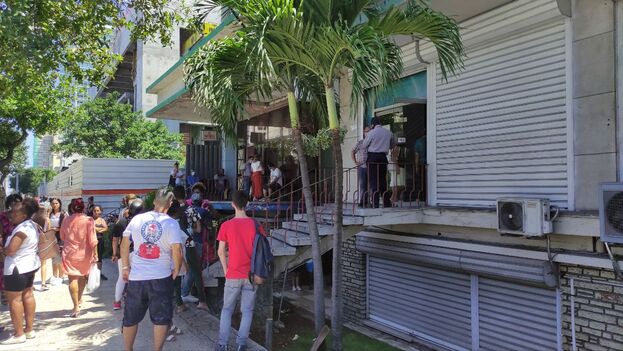
Cubans Wait All Night at the Currency Exchange to Buy Dollars, Which Now Cost 150 pesos in the Informal Market

Like an anthill, the people of Santa Clara hunkered down during the early hours at the junction of Cuba and Tristá streets. (14ymedio)

14ymedio bigger14ymedio, Juan Diego Rodríguez and Juan Izquierdo, Havana, September 5, 2022 — The night begins to cool off over Santa Clara and, after having a bite to eat, the coleros [people standing in line for others, for pay] cross Vidal Park on their way to the currency exchange (Cadeca). The custom is new but the method is as common as poverty and underdevelopment on the island: hold on all night to guarantee one of the first places in line.

The booty: the hundred dollars “per head” that the Government promises to sell to anyone who has a place. Like an anthill, the people of Santa Clara hunkered down during the early hours of Friday at the junction of Cuba and Tristá streets.

It’s a central corner and a crucial one for the movement of the city, interrupted, however, by a long zinc fence, which slows down traffic. The inhabitants of the city are accustomed to going around the obstacle, which “protects” them from the ruins of the old Florida hotel, to reach the Cadeca and the branch of the Bank of Credit and Commerce.

“A tremendous show broke out that night,” one of its readers in Santa Clara tells 14ymedio. “More than a hundred people waiting, and everything is a disaster. A guy started shouting that it was a shame and that he couldn’t take it anymore.”

At ten at night, the man says, the atmosphere was already “heated.” From afar, in the park, the police didn’t lose any time in harassing the coleros. “It’s normal that they patrol that area and, from time to time, intercept a drunkard or an unsuspecting university student and ’invite’ them to enter the guasabita,” he adds.

The guasabita is the name that the people of Santa Clara give to a small gray bus where the officers improvise their “interrogations.” “People leave there on a stretcher,” says the man, “that’s why the coleros also avoid it.” continue reading

But not even a hypothetical beating or an unforeseen arrest stop those who have to exchange their dollars. In the Cadeca, the mechanisms of a gear that no one fully understands and that works based on traps, tricks and bribes, begin to rotate.

The fundamental rule: maintain your ground and be aware of the movements of others. The euphemism par excellence, “taking care of the line,” is the ace up the sleeve of those who appear and disappear, exchange places with someone, or duplicate their place under all kinds of pretexts.

The “dollar line” is confusing and exhausting, with the additional danger of knowing that everyone who goes in or out carries money in their pockets, which tempts the city’s bandits and assailants.

“I’ve even been afraid of standing in line,” admits the man, who says he feels the same neurosis in the Cadeca as in a line for chicken, coffee or cigarettes. The overnight sale of foreign exchange has become another business in the informal market.

“But make no mistake,” he adds, “this is a small business; it isn’t the ‘mafia’ of Santa Clara. This is the same thing that happens when people ‘struggle’ with their ration books for meat or some tobacco. The idea is to spend the time that others can’t or don’t want to spend. That’s why they [the coleros] take a percentage.”

At the moment of greatest agony, when there is no longer any desire to shout or protest, the sun rises. Cadeca workers, very calmly, open the door and start calling the first numbers. But there is no guarantee that there will be enough dollars to cover the demand.

“Everyone knows that you can spend the night here and that it’s a choice,” the man concludes, “but that’s what it is. This is the only country where you can live from standing in line for someone.”

Those who read the daily reports of the official press won’t be able to detect any abnormalities. With subtlety, the Government is recalibrating the balance of exchange: every day it sells the most expensive dollar, but demands to buy it at the lowest possible price.

Meanwhile, exchange rates have skyrocketed on the informal market. The dollar reached 150 pesos on Saturday, according to the monitoring of the digital media El Toque. Those who experienced the instability of the currencies during the Special Period soon recognized that this was the figure at which the dollar came to be valued during the previous crisis.

At exchange rates of 149 and 148 pesos, respectively, the euro and the Freely Convertible Currency (MLC) almost reached the threshold of the US currency. With these figures, phrases such as “recovering the purchasing power of the salary in Cuban pesos” or “single type of exchange,” formulated by Minister Alejandro Gil Fernández, are already terrible jokes of economic humor.

Translated by Regina Anavy

____________

COLLABORATE WITH OUR WORKThe 14ymedio team is committed to practicing serious journalism that reflects Cuba’s reality in all its depth. Thank you for joining us on this long journey. We invite you to continue supporting us by becoming a member of 14ymedio now. Together we can continue transforming journalism in Cuba.
Liquid Ground Chicken in Havana for Only 65 Pesos

The ground meat — what else to call it? — had an almost liquid consistency, a color like vomit and a nauseating odor. (14ymedio)

14ymedio bigger14ymedio, Juan Diego Rodriguez and Juan Izquierdo, Havana, 2 September 2022 — The street is Carlos III, in Havana. The place: a hovel that is part corner store, part market stall. It could be in any town on the island. A line has formed in front. Havana’s midday sun reverberates through the listless crowd waiting to get in.

With the thriftiness of someone who has the whole day ahead of him, the vendor puts on an apron and grabs a wooden palette to use as a counter. He is a tall, sweaty man for whom washing his hands before handling the food serves as a pointless formality.

“Let’s go,” he says quietly to the first customer, who opens the mouth of his bag, as wrung out and hungry as he. The store is a hodgepodge, which is to say that its shelves display plastic pots, kitchen utensils that will not last more than a week, thick strainers and dull knives. There are also some canned goods and products sold in bulk, like the one for which people are now waiting in line.

Most know what’s to come but no one has a real sense of it until they see it, smell it and feel its texture: some kind of ground meat — what else to call it? — with an almost liquid consistency, a color like vomit and an odor as nauseating as the rest of the street, for 65 pesos a pound. continue reading

One distracted customer makes the mistake of paying for it beforehand. He cannot hide his disgust, which turns his stomach and almost causes him to utter an expletive. “What’s wrong?” asks the vendor as he gently stirs the mixture in the muddy bucket before scooping out a portion of watery ground chicken with his hand.

Nothing,” says the boy as he approaches the makeshift counter in resignation. “Toss it here.”

“They mix it with water to stretch it,” explains an elderly man who is also in line. That’s how they make a little more.”  “I remember they sold slop like this during the Special Period,” says another. “And they passed it off as goose paste. The goose is a bird related to the guanajo. Ask your grandparents,” he adds, laughing at his own humor.

Next to the bucket of ground chicken is a can advertised as tomato paste. “No one buys it anymore because people know what goes into it,” says one woman. “Haven’t you seen the online videos? They use guava, banana, some kind of peel, but tomato it’s not.”

After the stench of ground chicken, the air outside has the sweet aroma of syrup and the odor that permeates Cuban soup kitchens. Local residents recognize it as a syrup made in a factory on the same block. It is sold not only at the ground chicken stall but also by a string of elderly people and beggars along Carlos III.

Well-sealed in a backpack, it is now up to Cuban mothers and fathers, armed with their arsenal of tricks, to figure out the most convenient method for cooking it.

Oblivious to all this, however, is the ever-optimistic party newspaper, Granma.  As though describing a consumer’s paradise, the Thursday edition allays its readers’ fears. It promises, perhaps in time, “deliveries of rice, beans, sugar, salt and cooking oil” as well as eggs, coffee and a packets of cigarettes of one sort or another.

“Milk is guaranteed” — the paper’s favorite word — “for children, pregnant women and those suffering from chronic childhood diseases, and is encouraged in some areas in liquid form.”

For those who enjoy a nice bath after preparing a banquet from rationed ingredients, a nice “soap made from nuclei, the bimonthly toothpaste and detergent” are promised.

Granma does not ignore, however, peoples’ greatest concern. That is the current shortage of flour, the key ingredient of bread, which they are guaranteed  — that word again — as part of a basket of basic foodstuffs. Of course, officials are not responsible for the “changes in hours of operation due to power blackouts or the transport of the raw material.”

The Cuban who arrives home with the “merchandise” dispatched by the tall, sweaty vendor and reads this piece by the official mouthpiece of the Communist Party will, inevitably, have to laugh. If he had known that everything — breakfast, lunch and dinner — was guaranteed, he would not have wasted 65 pesos on the disgusting ground chicken he bought on Carlos III.

____________

COLLABORATE WITH OUR WORKThe 14ymedio team is committed to practicing serious journalism that reflects Cuba’s reality in all its depth. Thank you for joining us on this long journey. We invite you to continue supporting us by becoming a member of 14ymedio now. Together we can continue transforming journalism in Cuba.

Castroism Stole the Cuban Rum Industry and Now Seeks to Appropriate the Figurehead of the Bacardi Family

Members of the Communist Party of Cuba paying homage to Bacardi at the Santa Ifigenia cemetery, in Santiago de Cuba. (Juventud Rebelde)

14ymedio bigger14ymedio, Juan Izquierdo, Havana, 29 August 2022 — The imposing funerary pyramid of Emilio Bacardí Moreau, who died on 28 August 1922, is not far from the mortuary stone of Fidel Castro, the man who dismantled the rum distillery and the cultural legacy of the Bacardí family.

One hundred years after the death of the patriot, historian and philanthropist from Santiago, the same regime that expropriated the Bacardí distilleries and buildings intends to pay tribute to the first Republican mayor of Santiago de Cuba.

Tributes and biographical notes in the official newspapers now present Bacardí as a kind of politician precursor of the revolutionary practices of 1959. He is credited with a rabid anti-imperialism, and his business and political acumen is minimized. The issue of rum is taboo, and they almost classify him as a feminist for asking the widows of the mambises to fill positions in the town hall.

Bacardí will attain everything the Cuban regime needs, including a “little war of memory” against the heirs and directors of the company, who are currently based in Bermuda.

However, investigating and quoting Bacardí means playing with fire, because not all those who have contributed to the tribute have expressed themselves in politically “desirable” terms. continue reading

Some texts recover the sappy language of the social chronicle of the Republic, in addition to making use of terms such as patrician, eminent and patriarch, inconceivable in the official organs of the Communist Party.

Censorship confronts journalists with a curious dilemma: they must reconstruct the history of Cuban rum manufactured by Bacardí, talk about it as if it were still being distilled on the Island and suspend any reference after 1960.

“If Cuban rum is the best on the planet,” Cubadebate reasons, “in Cuba the best is that of Santiago de Cuba, the one initiated by Facundo and bequeathed by Don Emilio Bacardí Moreau,” the official government site says, without mentioning the expropriations after the triumph of the Revolution or talking about “trademarks.”

In commemorating his death, Bohemia magazine repeats that the initial tomb of the patriot was “humble to the point of surprise” — the phrase is by Fernando Portuondo — but they forget to talk about the sumptuous mausoleum of a millionaire that was later dedicated to him, described as just a “symbolic pyramid structure.”

The “main course” of the tributes was the presentation, once again, of the two volumes of Emilio Bacardí Moreau: on Passionate Cuban Humanism, published in 2018 by the historian Olga Portuondo, a controversial biography of the patriot whose distribution and sale was delayed, until it was almost impossible to find in bookstores.

Successfully, but serving the official appropriation of “uncomfortable” figures, Portuondo introduces the work of Bacardí as the founder of the oldest Cuban museum, as well as the author of the monumental collection Chronicles of Santiago de Cuba and other books, fictional and historical, of smaller scope. He is presented as an intellectual and mambí conspirator, rather than a politician or entrepreneur.

During the commemorations, there was no shortage of those who remembered quietly the “prophetic coconut tree” of Facundo Bacardí. Facundo, father of the Bacardi clan, was the man who, in 1862, coined the symbol of the bat to identify his new technique for distilling rum. In the vicinity of the factory he planted a palm tree that survived earthquakes, wars, fires, independence and flag changes.

“The company will live in Cuba as long as the coconut tree,” the legend said. On October 14, 1960, on the eve of the centenary of the company, the coconut tree just dried up, and Fidel Castro expropriated Bacardi’s premises without compensation.

The family members went into exile, with the “secret recipe” of rum, honey and yeast strains. Several international legal proceedings have been brought against the Cuban government, but none have been successful.

To this day, the most emblematic brand of Cuban rum continues its production in the United States, Mexico, Puerto Rico, Italy and the Bahamas, but not on the Island.

This Sunday, numerous officials, Party leaders and historians aligned with the regime, and some workers of the Provincial Heritage Center, concluded the tribute in front of the mausoleum of the patriot in the cemetery of Santa Ifigenia.

Whipped by the sun of eastern Cuba, and after anachronistic speeches by the members of the Central Committee, none of the attendees were able to toast to the memory of Don Emilio with a drink of Bacardi rum.

Translated by Regina Anavy

____________

COLLABORATE WITH OUR WORKThe 14ymedio team is committed to practicing serious journalism that reflects Cuba’s reality in all its depth. Thank you for joining us on this long journey. We invite you to continue supporting us by becoming a member of 14ymedio now. Together we can continue transforming journalism in Cuba.