
Cuban Parents are Distressed by the Outrageous Prices of School Supplies

In Cuba, even elementary school students don’t feel sure about the exams if they haven’t paid a tutor for several sessions beforehand. (14ymedio)

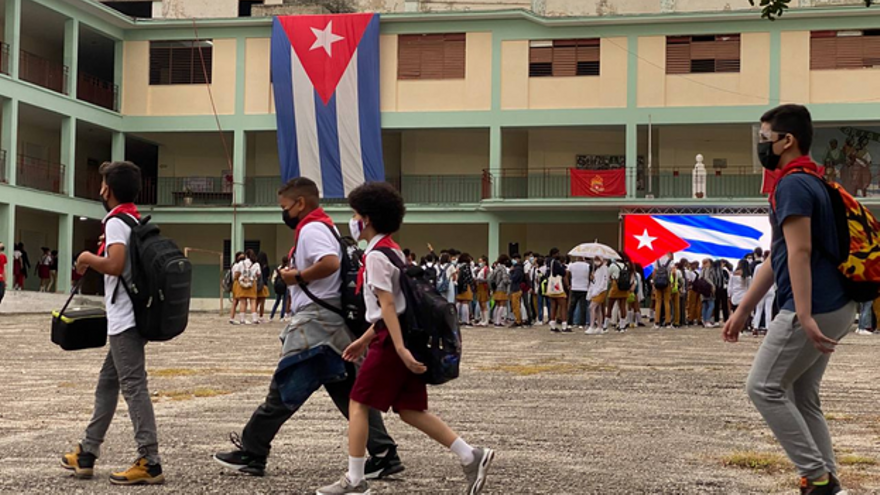
14ymedio bigger14ymedio, Juan Izquierdo, Havana, 26 August 2022 — After two years of ups and downs, between the forced confinement of the pandemic and the economic crisis, the beginning of the school year in September is causing more than one scramble in Cuban homes. The return to school will take place in the midst of high inflation that increases the price of shoes to the snack that students need.

Parents wonder what this new beginning of teaching will be like with the long blackouts that hit the island, the shortage of flour that has sunk the production of bread, so necessary for school snacks, and the loss of value of the Cuban peso against foreign currency, in a country where only in stores that take payment in freely convertible currency can you buy shoes or a backpack.

Given the succulent slice they can get from the sale of school accessories, even several restaurants that sell their products through the Internet have added offers that have nothing to do with food. Backpacks for children at 60 dollars, snack bags, water bottles, pencils and erasers now alternate with their dishes of lasagna or fried rice.

“School supplies for girls,” reads one of these options, which for $120 include the backpack, a pair of notebooks and other tools needed in class. Home delivery in Havana can add about ten dollars more, but in the provinces it can be even more expensive. Having a family abroad that finances the purchase is essential in this case, because payment is made online with Visa or Mastercard.

Those who don’t have emigrated relatives must buy school supplies in Cuban pesos, at the exchange rate with the dollar that is currently in force in the market. Translated into the national currency, the price of a small backpack purchased in Panama can exceed 2,000 pesos, plus 300 for shipping to the house. continue reading

As for the school uniform, the nightmare is no less pressing. “I’ve been wearing this uniform since the tenth grade,” a student from Sancti Spíritus, who is about to start his last year of high school, tells 14ymedio.

“They give you high school uniforms, but no one thinks about the growth spurt at age 17. In the eleventh grade my mom had to ask for another pair or pants and depend on the officials to solve it,” he says.

He’s lucky that his mother is a seamstress, otherwise everything would get tight. “To top it all off, the polyester fabric is hot and fades easily,” he says. In the middle of the school year, the family had to buy a few meters of fabric that was very expensive to sew extra shirts and pants. “I have to take care of them,” the boy continues, “because when high school is over I have to donate them to a cousin of mine who is just starting out.”

No matter what grade he’s in, his municipality or the family’s condition, the student will always have hand-me-downs in need of repair from their use by many generations, with books full of Soviet anecdotes, anachronistic for today’s Cuban student.

“My books always have to be passed down,’” says the young man, showing the texts marked with a pen, drawn on the back and the covers or unbound. “Pencils and notebooks are another story: before you could go to Artex, and get a pencil and a couple of notebooks, but now there isn’t even that.”
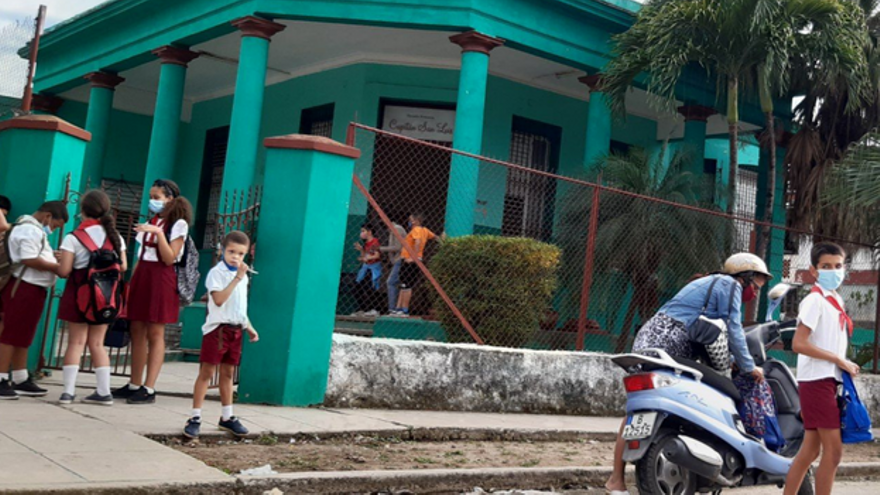
The return to school will take place in the midst of high inflation that increases prices from shoes to the snack that students need. (14ymedio)

The shops of the Artex group used to market stationery, backpacks and other school supplies. But with the extinction of the Cuban convertible peso and the dollarization of the economy, the family can invest very little money in materials that Artex no longer even offers, as it is now almost entirely dedicated to the sale of tobacco and handicrafts at outrageous prices.

“Books almost never arrive; notebooks, which are of very bad paper, always come in the second or third week, hopefully. And it’s better not to mention the pencils with horrible graphite” says the student interviewed by this newspaper.

The young man has been wearing the same backpack since junior high school; the shoes are sent to him by a family member from the United States and the rest, such as socks and underwear, had to be bought in the informal market.

After two years of zero, or hasty and mediocre activity, the logistical aspect is just one side of the problem. Even primary school students don’t feel sure about the exams if they haven’t paid a tutor for several sessions beforehand. In many cases, those who offer these support classes are the same people as the student’s teachers, who have found in these reviews of the coursework a financial complement to their squalid salaries.

Another issue is the food,” continues the young man. “When you live far from the school, you have to bring a snack, because the prices of snack vendors and the private restaurants are impossible to pay. Or you walk home, which, for example, can be over one mile from school.”

Despite these and other obstacles to learning, such as the terrible school furniture or the lack of hygiene in the bathrooms, triumphalist announcements about the beginning of the new school year proliferate in the official press.

“The material base of study is assured in both internal and semi-internal centers,” lies the newspaper Tribuna de La Habana, although it discreetly admits the deficit of 4,000 teachers in the capital’s classrooms, which will be covered “with various alternatives.”

“Completing the faculty and ensuring retention” are priorities of the new course at the Artemisa pedagogical school, says a local newspaper, although it doesn’t specify what measures will be taken to achieve that goal when there are only 77 places out of the 122 that should be filled.

In the continuous journeys through the provinces by the Minister of Education, Ana Elsa Velázquez, the directors of the sector formulate the same guarantees: the State has resolved all the weaknesses, everything has been repaired and the panorama is positive.

The domestic reality, the complaints of mothers on social networks and the external aspect of schools suggest the opposite. Those Cubans who expose the reality are harassed by State Security, as happened with Trilce Denis, a Havana mother who denounced in a direct transmission the difficulty of starting school in such precarious conditions.

“I want to know, on the 7th, when school starts, what snack is going to be given to the children,” Denis said, upset. “Today I decided that I’m not going to send my son,” she concluded.

Translated by Regina Anavy

____________

COLLABORATE WITH OUR WORKThe 14ymedio team is committed to practicing serious journalism that reflects Cuba’s reality in all its depth. Thank you for joining us on this long journey. We invite you to continue supporting us by becoming a member of 14ymedio now. Together we can continue transforming journalism in Cuba.
After Milk and Beef, Bread Disappears from the Cuban Table

Bakery on Carlos III Avenue in Havana. (14ymedio)

14ymedio bigger14ymedio, Juan Diego Rodríguez and Juan Izquierdo, Havana, 24 August 2022 — From the balcony, Yudineya watched dozens of bread and cookie sellers pass by every day in her neighborhood of Los Sitios in Havana, but for weeks they have practically disappeared. The shortage of wheat flour has hit private bakeries hard and has also put state bakeries in check.

For decades, “bread with something” has been the fundamental comfort food in Cuban homes. From the elaborate bite of ham and cheese to the poorest bread with oil and salt, the snacks of students and workers depend to a great extent on that baked product that has been disappearing in recent weeks.

“I don’t know what we’re going to do when our child starts school,” says Yudineya, 38, whose son will start the second grade of elementary school in September. “What my son always takes for a snack is bread with whatever appears, but now not even that is available,” she explains to 14ymedio.

In Nuevo Vedado, a colorful private bakery that until recently offered bags of the so-called “ball bread” in addition to hard-crust French bread, baguettes and rolls, now offers only roasted peanuts and egg-white merengue. “We’re not offering bread because we don’t have any flour,” the employee explains. “Sales have fallen a lot, and if we continue like this we’ll have to close.”

Line to buy bread on August 24 at the Pueblo Nuevo Council, Central Havana. (14ymedio)

But it’s not only bakeries that are feeling the blow of the shortage of wheat flour. Businesses that base their gastronomic offerings on pizzas and sandwiches are also suffering. “We were selling bags with 10 pizza crusts for 300 pesos, and now we’ve had to raise the price to 500,” says the delivery man of La Paloma, a private business in Diez de Octubre. continue reading

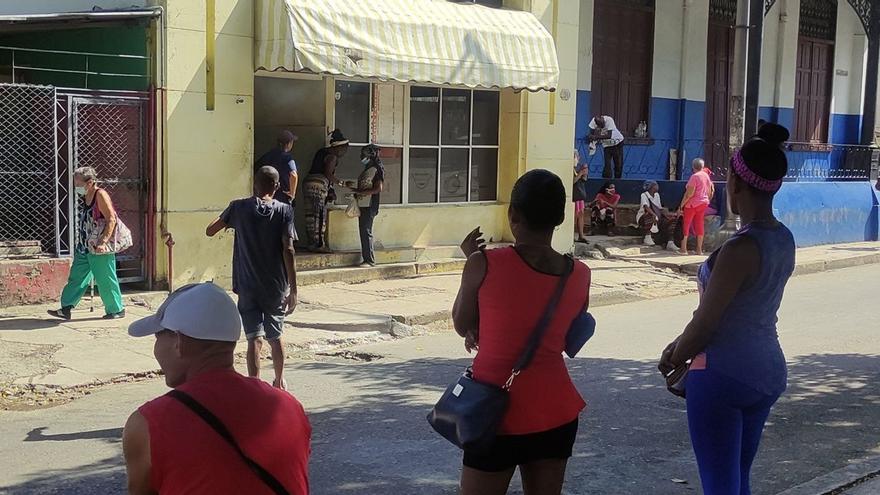
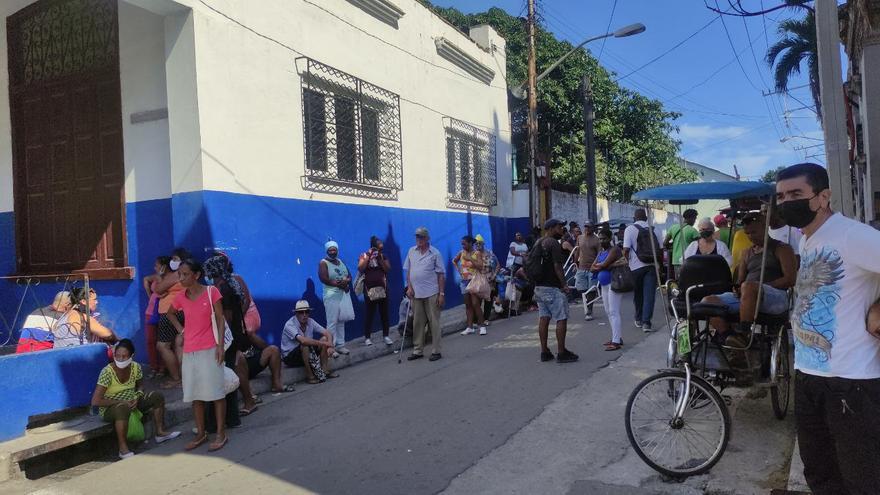
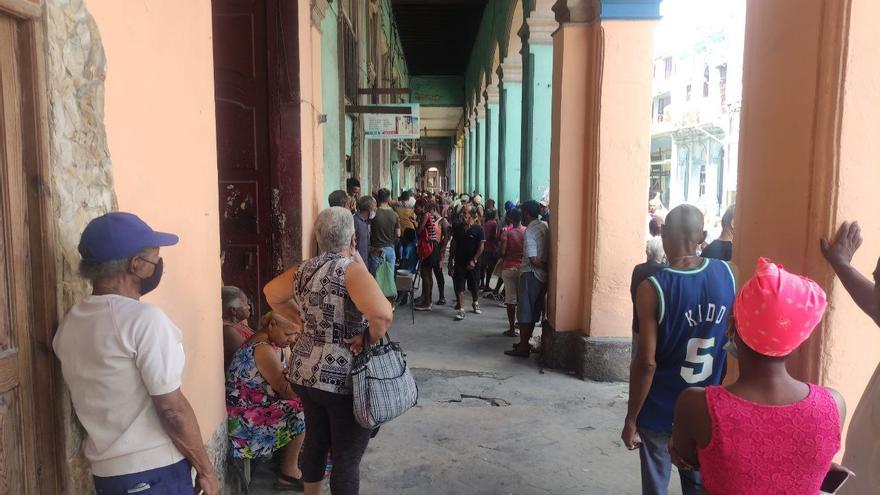
In front of the bakery on Carlos III, one of the few that still sells “released” [unrationed] bread, the elderly, physically disabled, kids, mothers and all kinds of people begin to show up. Neither age nor the numerous ailments exempt the Cuban, who must defend his place in line as if he were in a besieged fortress.

An employee announces that they will soon sell a few breadsticks. What in Creole gastronomy used to be long and crunchy, in socialism assumes the dictionary definition: “small stick, crude and poorly made.”

Invoking strength that they don’t have, battered Cubans, hoping to get a breadstick, stampede to take their place in line. One woman complains, “All we can get is a little piece of breadstick per person.”

Once the “sticks” have been bought and packaged, the crowd recovers its place in the shade. They must keep waiting: in an hour, they think, the bakery will take out a small amount of garlic bread.

“It will get worse,” predicts a bakery employee. “As of September 1, only the popular council can buy bread here. We’ve been told that there must be an establishment in every place that takes care of the people in that area.”

The shortage of flour occupies the gossips, as do the newspaper articles, the panic of daily hunger and the comments about the imminent school year. It scares mothers and overwhelms retirees, accustomed to a Spartan ration of bread and water with sugar.

An audio circulated on social networks, attributed to a Commerce manager, whispers to anyone who wants to listen that there will be no more flour. “Neither for hospitals nor for the army,” says the anonymous voice. Some sacks of flour will be available for standard bread and some for prisons, whose tranquility cannot be risked.

A prison riot, in a country where a protest can break out every night, has become one of the favorite topics to discuss during the blackouts and domino games.

At the bakery on Reina Street they handed out shifts before selling bread this Wednesday. (14ymedio)

“Today for breakfast I had only a hard roll that I brought from Havana several days ago,” Kenny Fernández Delgado, one of the Havana priests who bothers State Security the most, wrote on his social networks.

Fernández lambasted “communism,” which “took away my beef before I was born, and my milk at the age of 7” and now even “the ‘released’ bread has become a prisoner… Take everything away from me and that’s it,” the priest concluded, “as they did to Jesus Christ on Good Friday, because that way I will know that Easter Sunday is closer.”

The Government, as usual, used the State newspaper Granma to “rewrite” the alarming reality on the Island. “There are no problems with the production and distribution of bread from the Regulated Family Basket and the Cuban Bread Chain,” the media said, citing a note from the Ministry of Internal Trade.

He admitted, however, the “difficulties in the import of wheat,” attributed to the embargo, Cuba’s “financial constraints” and the “international logistics crisis.” The report concluded by “calming down” the vulnerable sectors of the population, apparently saved from scarcity.

Meanwhile, the official reporter Lázaro Manuel Alonso was trying to reconcile the fiction with reality: “Señores, stop the interpretations now,” he demanded on Facebook, supporting Granma’s version.

However, he admitted in the same publication, “Yes, there have been difficulties with the processing of bread due to the lack of electricity, which has nothing to do with the supply of raw materials for production.” Regardless of the contradictions within his own message, he tried to settle as “false” the rumor of scarcity that “some users have shared on social networks.”

The “white dust crisis,” as some Cubans have begun to call it, keeps private producers in suspense. Pastry shops have substantially reduced their supply, while the price for any empanada, jam or cake, no matter how squalid, is increasing.

Not only flour, but also eggs, sugar, oil and other ingredients of the family pantry will be removed from the symbolic Cuban’s table. The meats, the fruits and now, finally, the bread basket are also gone.

Translated by Regina Anavy

____________

COLLABORATE WITH OUR WORKThe 14ymedio team is committed to practicing serious journalism that reflects Cuba’s reality in all its depth. Thank you for joining us on this long journey. We invite you to continue supporting us by becoming a member of 14ymedio now. Together we can continue transforming journalism in Cuba.
Miami Pharmacies are Increasingly Supplying Cubans on the Island

The lack of medications in Miami and other Florida cities seemed unusual, but it has already become a daily occurrence. (14ymedio)

14ymedio bigger14ymedio, Juan Izquierdo, Havana, 18 August 2022 — The old emigrant joke about Miami, Cuba’s last province, threatens to become a reality. Some medications are becoming scarce in the big city of Florida. “When I go to a pharmacy, they tell me that they’re out of medicine, that people took everything to send it to Cuba,” complains Enrique, who has been residing in the United States for ten years.

Enrique has toured the pharmacies of the city to put together a package of medical supplies. His mother in Cuba has been undergoing breast cancer treatments for a year and will now face an operation in Villa Clara. Distressed, Enrique understands that his family’s only hope is for him to get the necessary medications and equipment, because, according to the warning of Cuban doctors, “there is nothing here.”

Telephone in hand and driving through the streets of Miami, Enrique consults the list sent to him by his relatives. “Every time I go to a pharmacy they tell me the same thing: they know what to sell me, because all Cubans ask for the same thing, but there isn’t any. The demand is so great that even here things are in short supply,” Enrique laments.

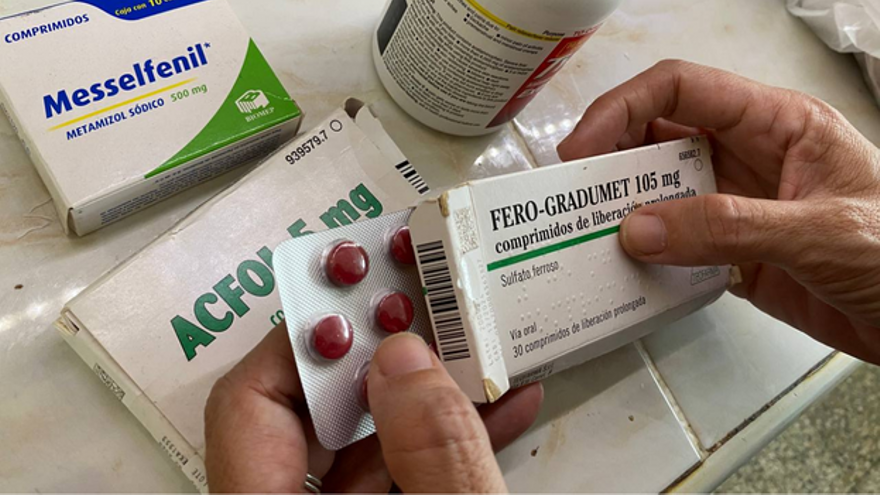
“What is most ’lost’,” he explains, “is the thread for sutures, surgical gloves and anesthesia.” Enrique’s inventory is meticulous. What is missing in one pharmacy must be “hunted” in another, even if it’s in a different city. The operation requires two types of suture thread, thinner for the inside and another kind to close the wound. He needs to get 18 or 20 caliber catheters, which are needed for transfusions and serums.

“Five packs of cotton swabs, four bandages, cotton, 20 compresses, syringes, several rolls of tape, two packages of saline solution … and that’s just the beginning,” Enrique says. The “Cuban” doctor is so visible that, if it weren’t for the fact that they manage to get him the Surgivac drainage equipment, there would be no way to buy it. “It cost me 180 dollars,” says the man, who also paid a good amount for the intravenous anesthetic Propofol and the iodized povidone. continue reading

“Then will come the long recovery process,” he adds, “and my mom will need more gauze and cotton, an elastic bandage with pins, a larger bandage to cover her torso and compresses for each treatment.”

A doctor friend is the one who prepares the list, which Enrique’s mother then sends him. The Cuban health workers themselves admit what they have and what they don’t. “And they have less and less. The Government has already gotten used to the fact that we will do anything to get our relatives operated on. It’s either yes or yes: who’s going to let his mother die for not sending her medicines?”

Like Enrique, many Cubans living abroad are between a rock and a hard place. They don’t have any way to quickly ask for reunification with their relatives, and they’re not willing to subject them to the hard journey through Central America to the U.S. border. “It’s a desperate situation,” says Enrique.

A new message comes in on the phone. His mother is waiting for her turn in the oncology area of the Santa Clara Clinical Surgical Teaching Hospital. As the center ran out of water, a noisy pipe pumps in the liquid and prevents patients from resting. Those who come to be treated avoid the puddles and cables that flood the reception area, so that a slip doesn’t turn into a hip fracture or worse.

“Next week I’m leaving for Cuba,” Enrique concludes. “That means that my suitcases not only carry the medicines and equipment, but also a pair of flip-flops for my mom, two night gowns, clothes for cousins, cookies, preserves, jams, whatever it takes to ’sweeten’ a little everything that is happening.”

The drug deficit in Miami and other Florida cities seemed like an unusual situation, but it has already become a daily occurrence for Cubans living in the United States. Phenomena such as “resolving” how to find products, waiting several hours to make a purchase and the mistreatment of pharmacists and sellers resurrect the worst nightmares of Cuban exile. The Government of the Island, meanwhile, continues to proudly brandish, and through the export of its own health workers to other countries, the label of “medical power.”

Translated by Regina Anavy

____________

COLLABORATE WITH OUR WORKThe 14ymedio team is committed to practicing serious journalism that reflects Cuba’s reality in all its depth. Thank you for joining us on this long journey. We invite you to continue supporting us by becoming a member of 14ymedio now. Together we can continue transforming journalism in Cuba.
With Their Beds on the Street, a Family from Old Havana Denounces the Collapse of Their Home

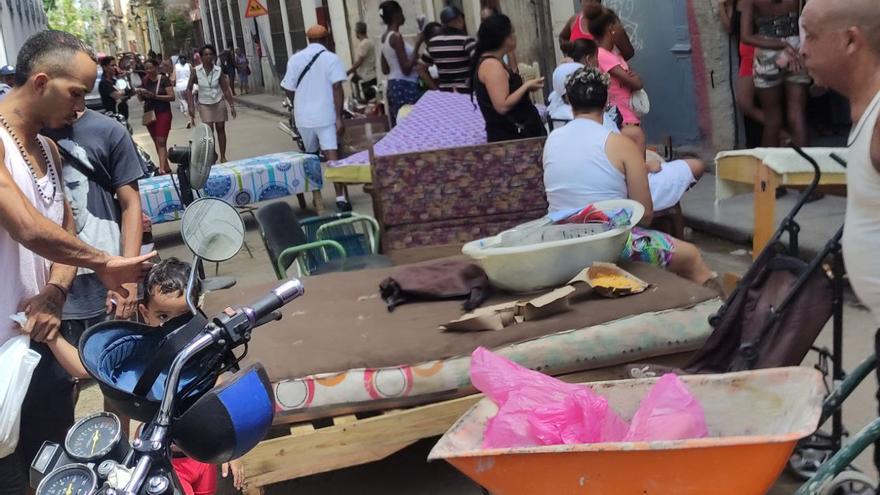
The victims of the collapse, disposed to set up their domestic barricade, prevent the passage of vehicles and pedestrians. (14ymedio)

14ymedio bigger 14ymedio, Juan Izquierdo, Havana, 12 August 2022 — In Cuba, the walls speak as much as the people. Cracks, humidity, bricks, leaks, beams, shreds of clothing, clouds of dust — these are the words of a pained and urgent language: that of the collapsed buildings. They’re not exclusive to Havana, but in Old Havana, punished by salt from the sea air and overpopulation, the boundary between habitable and ruin is more diffuse and matters less.

It’s part of the daily drama that a family, subjected to blackouts and continuous shortages, sees the structure of their house suffer, checks how it trembles during a cyclone and observes how it falls apart due to lack of maintenance.

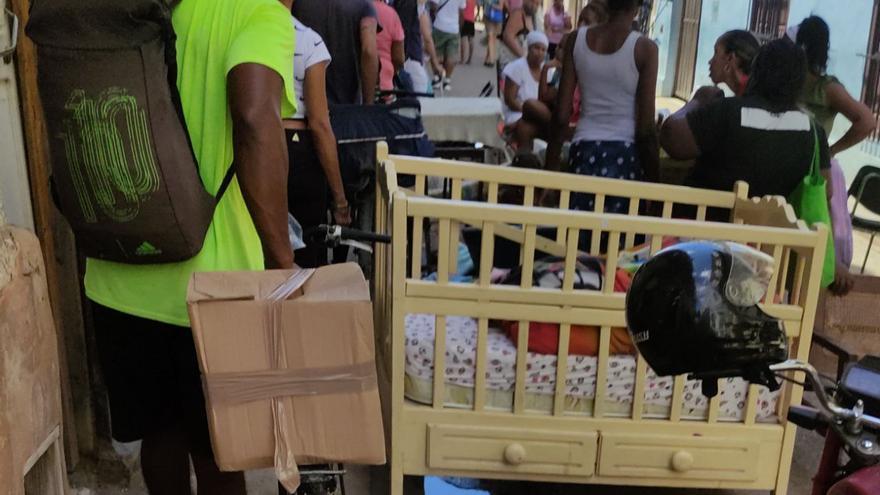
The roof of a building on Habana Street, between Aguiar and Muralla, in the oldest area of the capital, collapsed several days ago. Not knowing what to do, the inhabitants picked up their belongings and took to the streets in protest.

The faces of mothers, children and the elderly are so desperate that it’s frightening to see. There’s a lot of anger and visceral impotence, because the solution doesn’t depend on personal effort but on the parsimony of the bureaucrats. They tried to appease them with promises: guaranteed food, electricity, materials. But nothing happened.

This Friday they returned to the street again. The junk they have on the street contains their whole life: cribs, mattresses, springs, wash basins, wheelbarrows of bricks, furniture that has been in the family for decades, Soviet devices and Chinese fans, relics of all eras.

The junk they have on the street contains their whole life: cribs, mattresses, springs, wash basins, wheelbarrows of bricks, furniture that has been in the family for decades, Soviet devices and Chinese fans, relics of all eras. (14ymedio)

The victims of the collapse, disposed to set up their domestic barricade, prevent the passage of vehicles and pedestrians. They want the country to stop and listen to them. “No one will pass through here until this is resolved,” shouts a woman, who only agreed to the request to let an elderly woman clinging to her cane continue. continue reading

Local authorities don’t offer solutions or respond to dialogue, but they have already sent the usual gang of State Security agents, motorcyclists with police badges, ex-combatants ready to assert their collection of medals and traffic officers, to divert clueless drivers out of the area.

At the end of the street, a couple of agents try to discredit the screaming women. “They’re being stupid, they’re shameless,” they tell anyone who stops to see the panorama. “They know that they can’t be there and that there are people working to solve the problem. But no: what they want is to put on a show.”

Among those evicted is a woman dressed in white. She’s an initiate in santería and iyawo, but the State Security officers lie to passers-by, telling them that she is a Lady in White.* “No one here cares about whether someone is a saint or a dissident, kid,” someone who passes by answers them. The police are frustrated: the old techniques are of little use.

“Look how the Government helps,” says one woman, pointing to a squalid cardboard box with yellow rice and stale pumpkin, which was distributed in the neighborhood at ten at night. “That’s the food they’re going to help us with,” she says, “I’m supposed to feed my son with that?!”

“We are desperate,” explains another of the victims. “There’s no gas or electricity, and in addition, our kitchens also collapsed. What do we do?”

Those who watch, those who beat people, the bureaucrats, all of them often suffer the same shortages. However, that doesn’t prevent them from complying with the orders of those who live comfortably, without blackouts and fed with imported delicacies.

Meanwhile, a retired old man is preparing to fulfill his “duty” and juggles to interrupt a young man who is filming the scene. No matter where he focuses the camera, the old man harasses him, nudges him and stands in front of the camera, until the young man gets bored and leaves. “We don’t have blood in our veins,” says an angry man who witnesses the scene.

With the barricade and the people shouting, Habana Street is narrowed by sweat and despair. The claim of the evicted, shipwrecked in a country adrift, summarizes the pain of the entire island.

*Translator’s note: An opposition movement founded in 2003 by female relatives of jailed dissidents.

Translated by Regina Anavy

____________

COLLABORATE WITH OUR WORKThe 14ymedio team is committed to practicing serious journalism that reflects Cuba’s reality in all its depth. Thank you for joining us on this long journey. We invite you to continue supporting us by becoming a member of 14ymedio now. Together we can continue transforming journalism in Cuba.
The Lights Return with a Saucepan Demonstration in Front of the Dreaded Fifth Police Unit in Santa Clara

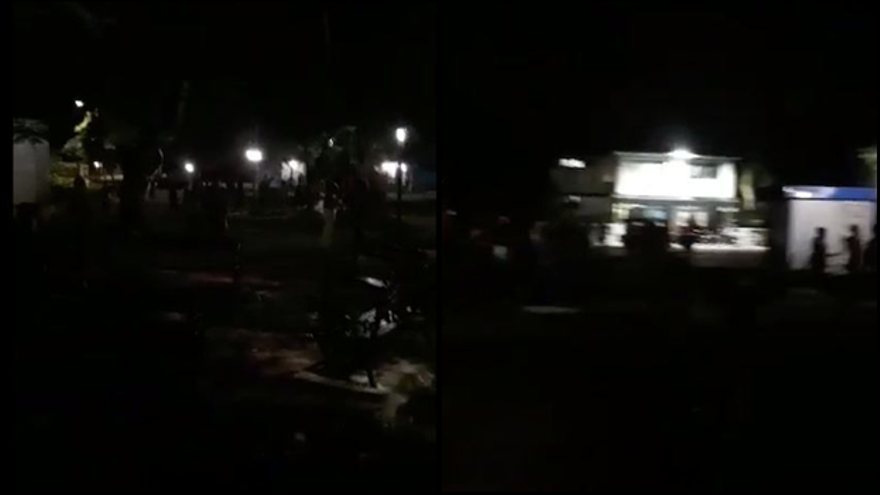
“That neighborhood is the trigger,” explains Enrique, a resident in the center of Santa Clara. “If El Condado explodes, the whole city will follow.” (Collage)

14ymedio bigger14ymedio, Juan Izquierdo, Havana, 15 August 2022 — Two night protests against the blackouts took place this weekend in the neighborhood of El Condado, in Santa Clara. Neighbors took advantage of the darkness to shout and beat on saucepans in front of the dreaded Fifth Unit Police Station

A video that circulated on Sunday on several social networks shows dozens of people shouting slogans in a park located on Estrada Palma Street, in the vicinity of the police station.

“El Condado is a prioritized circuit,” Enrique, a resident in the center of Santa Clara, tells 14ymedio, “and the Electrical Union avoids taking away the power. On Saturday they did it for the first time in some time, and people protested. After half an hour they reestablished service. Yesterday, not too late at night, the same thing happened.”

“That neighborhood is the trigger,” he explains. “If El Condado explodes, the whole city will follow.” He points out that the most significant thing about the protests is that they occurred “for the Police to see,” and in front of the Fifth Unit, which has the reputation of handling any incident in El Condado with a “strong hand.”

A recent example of this, Enrique recalls, was the death of the young Zinédine Zidane Batista, 17, at the hands of a police officer. In the middle of a fight, Batista was neutralized by an officer and shot several times, including once in the chest, which ended his life. Although El Condado is characterized by the people of Santa Clara as a “marginal” neighborhood, this episode of violence deeply moved the residents of the city. continue reading

To the discomfort caused by the repression are added the constant blackouts and the difficulty in obtaining food and basic products, even when this neighborhood of Santa Clara also functions as the center of the city’s informal market.

An article published in the local newspaper Vanguardia, on August 11, informed the people of Santa Clara that they would undergo a “rotation of the four energy blocks” to “distribute” the “effects” of the electric service.

The article specified that the province had “300,000 residential customers distributed on 159 circuits,” of which several receive “protection,” such as circuit 3, in the center of Santa Clara, “where services committed to the population are offered, in addition to radio and television transmitters, banks and ATMs.”

In addition, the provincial government announced two “proposals” for the planning of blackouts. “The first proposal consists of 12 hours divided into two periods of time, and the second, of up to 12 continuous hours, whose interruption time could be shorter depending on the conditions of the National Electricity System.”

The “new system of effects” began on Saturday, August 13, coinciding with the protests in El Condado. Some of the comments of readers, outraged by the article, escaped censorship by the Communist Party, of which Vanguardia is the provincial press organ.

“Are we a national vanguard in blackouts? Why are they so unfair to some and accommodating to others? Are we third-rate citizens?” asked one reader. “Impossible,” said another, “we can’t take it anymore. How long? They do repairs, maintenance, and when they start getting back up on the system they have problems again. The issue of programming, keep it in mind, is abusive. We went back to the years of the Special Period.”

“People are very upset in every way,” Enrique tells 14ymedio, “but the Government has been able to regulate the ’pressure’. In reality, very few people in Santa Clara dare to go out on the street, and those who do immediately give in when they turn on the power.”

“In my neighborhood,” the man continues, “very close to the city center, when the light goes out there are three ’security’ women who go out to see what people say. They have children abroad and their cards are loaded with dollars, a very comfortable position to be in for a ’snitch’. Recently, in the middle of a blackout, the banging on two pots and pans rang down the street, and they immediately went out to see what was going on. There are people like that in every neighborhood.”

Night protests against blackouts are becoming more frequent on the island. The explosion at the Matanzas Supertanker Base, on August 5, was a bad omen for a country that was already in the middle of a crisis. Since the night demonstrations against an energy cut in Los Palacios, Pinar del Río, on July 15, this type of protest has been repeated in dozens of towns and cities on the island.

During the most recent ones, in Güira de Melena, in the province of Artemisa, neighbors took to the streets with pots and pans, shouting “Turn on the power, dickhead,” a slogan that has become common to demand an end to the blackouts.

Translated by Regina a Anavy

____________

COLLABORATE WITH OUR WORKThe 14ymedio team is committed to practicing serious journalism that reflects Cuba’s reality in all its depth. Thank you for joining us on this long journey. We invite you to continue supporting us by becoming a member of 14ymedio now. Together we can continue transforming journalism in Cuba.
In the Midst of the Blackouts, a Luxury Hotel Without Customers Illuminates Havana

Greater Aston, located on 1st and D Streets, very close to Malecón Avenue. (Courtesy)

14ymedio bigger14ymedio, Juan Izquierdo, Havana, 10 August 2022 — In the midst of an almost absolute blackout in Havana’s Vedado, the Grand Aston Hotel Havana seemed to have fallen from another world, less precarious and underdeveloped. All its lamps, windows, spotlights, reflectors and even humble light bulbs were at their maximum capacity, without any attention to the ominous reports of the Electrical Union.

Energy conservation is not an issue of interest to the directors of the Greater Aston, located on 1st and D streets, very close to Malecón Avenue. “The newest and most elegant” hotel in the city, according to its website, also doesn’t seem to concern the Cuban Government too much, which juggles to attract investment from foreign companies in the tourism sector.

It’s not the first time that state hotels and establishments seem to enjoy special “isolation” in the cities of the island, safe from power cuts, the misery of the people, police repression, hunger and protests provoked by all these factors.

On the same day that the Grand Aston threw its luminous aura over the darkened capital, Habaneros watched the sinister glow of the fire at the Supertanker Base in Matanzas.

Also during that day, the Antonio Guiteras thermoelectric power plant announced its umpteenth exit from the National Electricity System, under the pretext of not having “sufficient water supply” and no fuel, while an acidic and heavy downpour bathed the rooftops of the city. continue reading

The torment for the Cuban people doesn’t end there. A few days before the explosion in Matanzas, the Minister of Economy formally declared war on the informal currency exchange and provoked the usual question: “If we don’t have electricity, food, well-being or a future, what are they doing with our dollars?”

Neighbors looking at the incandescent tower of the Grand Aston had to think that, perhaps, the hotel was the only place in Havana where those questions referred to a distant reality.

It is not for nothing that managers say that anyone who can afford a room at the Grand Aston will access “a refuge where they can relax and recharge their batteries, while experiencing its glamour.”

The price of the only illuminated Eden in Havana ranges between $179 and $244 per night, tropical and truly luxurious, not like the accommodations of the rest of Havanans.

The Grand Aston, as seen in the photograph, scandalously happy about a Cuba extinguished by the death, exile and hard lives of its citizens, is the most eloquent symbol of how the darkness of the country feeds the government businesses.

Translated by Regina Anavy

____________

COLLABORATE WITH OUR WORKThe 14ymedio team is committed to practicing serious journalism that reflects Cuba’s reality in all its depth. Thank you for joining us on this long journey. We invite you to continue supporting us by becoming a member of 14ymedio now. Together we can continue transforming journalism in Cuba.